Search Results: "cas"

15 September 2014

Gergely Nagy: Looking ahead

A little more than a year ago, I started working as a syslog-ng OSE developer full-time. That was a tremendously important milestone in my career, as one of the goals I wanted to achieve in life - to work on free software for a living - became a reality. Rocket boots were fired up, and we accomplised quite a lot in the past year, and I'm very, very proud of the work we did - we, the whole community. I enjoyed every bit of it, but as it turns out, some of the other desires I wish to pursue, and new challenges I am looking for, will lead me in a different direction. At the end of August, I handed in my resignation, and the past friday was my last work day at BalaBit.There are a few questions that will likely be asked, and I'll try my best to answer them beforehand. Questions such as: What will happen to syslog-ng?, Who will be the new maintainer?, How does this affect your Debian work?, and so on, and so forth.syslog-ngWhat will happen to syslog-ng?After careful consideration, with the syslog-ng team at BalaBit, we decided that they will take over OSE-related responsibilities as well. They will do releases, they will engage the people on GitHub and the mailing list, they will take care of the @sngOSE twitter account.During the past few months, we've been working on pushing the team closer to the community: we moved issues to GitHub, the team submitted pull requests, and in general, we moved closer to each other in every possible way.While they may not have the open source maintainer experience I had, they are all capable folk, and will quickly learn on the job. The team taking over also has the advantage of having more manpower, and better collaboration between the premium edition and OSE.Who will be the syslog-ng maintainer?There will be no single bottle neck. This has both good and bad implications, but I believe the good ones outweigh the disadvantages.What about the roadmap? When will 3.6.1 happen?The roadmap is already laid out for 3.6, but it is the team's judgement when it will be released. The latest 3.6.0beta2 was released together with the team, too. I expect there will be delays (I planned 3.6.1 to be released on September 27th), but not much; a few weeks, perhaps.What will your involvement in syslog-ng development be?With changing jobs, my involvement will drastically decrease. I will remain a syslog-ng user, and I will continue packaging it for Debian and Ubuntu, and will keep my unofficial repository running. I do not see myself contributing much, perhaps bug reports, opinions and an occasional idea.Nevertheless, my expertise is still considerable, and I will help the team and the community in whatever way I can - but I will be severely time constrained.DebianWhile BalaBit were very free software friendly, and allowed me to work on Debian tasks from time to time, my other activities took up an increasingly big chunk of my paid time, and I had to cut back a little. At the new job, things will be a bit different: while I won't have as much time to do Debian work on the job, I will have a lot more free time, in which I hope to do more for Debian.I will - as promised above - continue maintaining syslog-ng, and all other packages I currently maintain. Apart from those, I wish to make myself more useful within the Clojure and Hy teams.MiscellaneousWhere to are you moving?This is something I will answer in due time. For now, I will have two weeks off, which I wish to spend my way, picking up projects I neglected for far too long.

12 September 2014

Steve Kemp: Storing and distributing secrets.

I run a number of hosts, and they are controlled via a server automation tool I wrote called slaughter [Documentation]. The policies I use to control my hosts are public and I don't want to make them private because they server as good examples. Because the roles are public I don't want to embed passwords in them, which means I need something to hold secrets securely. In my case secrets are things like plaintext-passwords. I want those secrets to be secure and unavailable from untrusted hosts. The simplest solution I could think of was an IP-address based ACL and a simple webserver. A client requests something like: That returns a JSON object, if the requesting host is permitted to read the data. Otherwise it returns a HTTP 403 error. The layout is very simple:
 -- secrets
     -- 206.190.139.148
         -- auth.json
     -- 127.0.0.1
         -- example.json
     -- 80.68.84.109
         -- chat.json
Each piece of data is beneath a directory/symlink which controls the read-only access. If the request comes in from the suitable IP it is granted, if not it is denied. For example a failing case:
skx@desktop ~ $ curl  http://sss.steve.org.uk/chat
missing/permission denied
A working case :
root@chat ~ # curl  http://sss.steve.org.uk/chat
  "steve": "haha", "bot": "notreally"  
(The JSON suffix is added automatically.) It is hardly rocket-science, but I couldn't find anything else packaged neatly for this - only things like auth/secstore and factotum. So I'll share if it is useful. Simple Secret Sharing, or Steve's secret storage.

Jonathan McDowell: Back from DebConf 14

I previously forgot to mention that I was planning to attend DebConf14, having missed DebConf13. This year the conference was held in Portland, OR. This is a city I've been to many times before, and enjoy, but I hadn't spent any time wandering around its city centre as a pedestrian. I have to say I really prefer DebConfs that are held in middle of city. It always seems a bit of a shame to travel some distance to somewhere new and spend all the time there in a conference venue. Plus these days I have the added lure of going out and playing Ingress in a new location. DebConf14 didn't disappoint in these respects; the location was super easy to get to from the airport via public transportation, all of the evening social events were within reasonable walking distance (I'll tend to default to walking when possible) and the talk venue/accommodation were close to each other and various eating + drinking options. Throw in the fact at Portland managed to produce some excellent weather (modulo my Ingress session on the last Saturday morning, when rained on me) and it's impossible to fault the physicalities of DebConf this year. This year the conference format was a bit different; previous years have had a week long DebConf before the week of the conference itself. This year went for a 9 day talk schedule (Saturday -> Sunday) with various gaps of hacking time interspersed. I've found it hard to justify a full two weeks away in the past, so this setup worked a lot better from my viewpoint. Also I rarely go to DebConf with a predetermined list of things to do; the stuff I work on naturally falls out of talks I attend and informal discussions I have. Having hack time throughout the conference helped me avoid feeling I was having to trade off hacking vs talks. Naturally enough a lot of my involvement at DebConf was around OpenPGP. Gunnar and I spent a fair bit of time getting Daniel up to speed with the keyring-maint team (Gunnar more than I, I'll confess). We finally set a hard timeframe for freeing Debian of older 1024 bit keys. I was introduced to the Gnuk, which is a particularly interesting piece of open specification hardware with a completely Free software stack on top if it that implements the OpenPGP smartcard spec. Currently it's limited to 2K keys but it's hoped that 4K support can be added (and I ended up spending a couple of hours after the closing talk hacking on the source and seeing how much needs to change for 4K support, aided by the very patient Niibe). These are the sort of things that really benefit from the face time that DebConf offers to the Debian project. I've said it before, but I think it's worth saying again: Debian is a bit like a huge telecommuting organization and it's my opinion that any such organization should try and ensure its members actually spend some time together on a regular basis. It improves the ability to work remotely a hell of a lot if you can actually put a face to the entity you're emailing / IRCing and have some sort of idea where they're coming from because you've spent some time with them, whether that's in talks or over dinner or just casual hallway chats. For once I also found myself considering alternative employment while at DebConf and it was incredibly useful to be able to have various conversations with both old friends and people who were there with an eye on recruitment. Thanks to all those whose ears I bent about the subject (and more on the outcome in a future post). Thank you also to the many people involved with the organization of DebConf; I've been on the periphery a few times over the years and it's given me a glimpse into the amount of hard work all of the volunteers (be they global team, local organizing team, video team or just random volunteers) put into making DebConf one of my must-attend yearly conferences. If you're at all involved in Debian and haven't attended I strongly urge you to do so - I'll see you all next year at DebConf15 in Heidelberg!

Dariusz Dwornikowski: profanity and libstrophe status in Debian

profanity is a great console based XMPP client written in ncurses and C by James Booth. The code has a great quality, upstream is super collaborative, and willing, so packaging should be pretty straightforward. This post will show that this was not the case here. profanity First obstacle was that profanity depended on libstrophe, an XMPP library, which was not in Debian. As it occurred libstrophe's upstream was not responsive, so any changes that were needed to prepare libstrophe for high quality packaging could not be met.
  1. First of all libstrophe's build system (automake and friends) built only a static library.
  2. The second problem was that libstrophe did not tag releases on github, this was needed to make Debian watch file work.
  3. A third, smaller problem was the presence of debian/ directory in upstream's source. It can be neglected most of the time, since you can tell git-import-orig to delete it.
To solve those 3 problems I created a pull request fixing the build system to build also a shared library, deleting debian/ directory and politely asking for tagging releases. You can see my pull request here dated on April 26th. There was no answer for the libstrophe's upstream but I has some support from profanity's developers and other users wanting to make those changes. Finally metajack (libstrophe upstream) gave us right to the repo and we could merge the pull request on August 6th. The lesson learned - be patient and know autotools (a great tutorial is here). With profanity there were less changes to do. The most important one was that it linked to OpenSSL and due to the license incompatibility with GPL it could not go into Debian. Fortunately upstream added the OpenSSL exception, and profanity could be finally packaged. Now both profanity and libstrophe are in NEW queue and hopefully they will be accepted by ftp masters. When they are, there is plenty to do with them in the future, upstream closed some bugs, new upstream versions are tagged.

11 September 2014

Enrico Zini: suspend-i-really-mean-it

Laptop, I demand that you suspend! Dear Lazyweb, Sometimes some application prevents suspend on my laptop. I want to disable that feature: how? I understand that there may exist some people who like that feature. I, on the other hand, consider a scenario like this inconceivable:
  1. I'm on a plane working with my laptop, the captain announces preparations for landing, so I quickly hit the suspend button (or close the lid) on my laptop and stow it away.
  2. One connecting flight later, I pick up my backpack, I feel it unusually hot and realise that my laptop has been on all along, and is now dead from either running out of battery or thermal protection.
  3. I think things that, if spoken aloud in front of a pentacle, might invoke major lovecraftian horrors.
I do not want this scenario to ever be possible. I want my suspend button to suspend the laptop no matter what. If a process does not agree, I'm fine with suspending it anyway, or killing it. If I want my laptop to suspend, I generally have a good enough real-world reason for it, and I cannot conceive that a software could ever be allowed to override my command. How do I change this? I don't know if I should look into systemd, upowerd, pm-utils, the kernel, the display manager or something else entirely. I worry that I cannot even figure where to start looking for a solution. This happened to me multiple times already, and I consider it ridiculous. I know that it can cause me data loss. I know that it can cause me serious trouble in case I was relying on having some battery or state left at my arrival. I know that depending on what is in my backpack, this could also be physically dangerous. So, what knob do I tweak for this? How do I make suspend reliable? Update Systemd has an inhibitor system, and systemd-inhibit --list only lists 'delay' blocks in my system. It is an interesting feature that seems to be implemented in the right way, and it could mean that I finally can get my screen to be locked before the system is suspended. It is possible to configure the inhibitor system in /etc/systemd/logind.conf, including ways to ignore inhibitors, and a maximum time after which inhibitors are ignored if not yet released. Try as I might to run everything that I was running on the plane that time, I could not manage to see anything take an inhibitor block that could have prevented my suspend. I now suspect that what happened to me was a glitch caused by something else (hardware? kernel? cosmic rays!) during that specific suspend. When I had this issue in the past it looks like the infrastructure at the time was far more primitive that what we have now with systemd, so I guess that when writing my blog post I had simply correlated my old experiences with a one-off suspend glitch. If I want to investigate or tune further, to test the situation with a runaway block, I can use commands like systemd-inhibit --mode=block sleep 3600. I'm quite happy to see that we're moving to a standard and sane system for this. In the meantime, I have learnt that pm-utils has now become superfluous and can be deinstalled, and so can acpi-support and acpi-support-base. Thanks vbernat, mbiebl, and ah, on #debian-devel for all the help.

Sylvestre Ledru: Rebuild of Debian using Clang 3.5.0

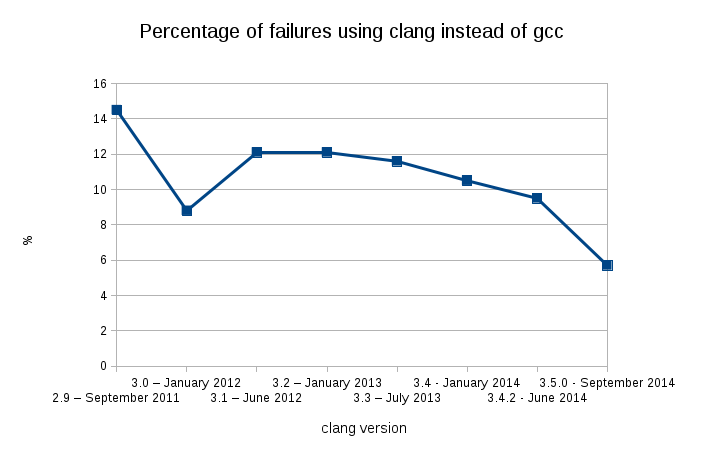
Clang 3.5.0 has just been released. A new rebuild has been done highlight the progress to get Debian built with clang. tl;dr: Great progress. We decreased from 9.5% to 5.7% of failures. Full results are available on http://clang.debian.net At time of the rebuild with 3.4.2, we had 2040 packages failing to build with clang. With 3.5.0, this dropped to 1261 packages. Fixes With Arthur Marble and Alexander Ovchinnikov, both GSoC students, we worked on various ways to decrease the number of errors. Upstream fixes First, the most obvious way, we fixed programming bugs/mistakes in upstream sources. Basically, we took categories of failure and fixed issues one after the other. We started with simple bugs like 'Wrong main declaration', 'non-void function should return a value' or 'Void function should not return a value'.

They are trivial to fix. We continued with harder fixes like ' Undefined reference' or 'Variable length array for a non POD (plain old data) element'.

So, besides these one, we worked on:
In total, we reported 295 bugs with patches. 85 of them have been fixed (meaning that the Debian maintainer uploaded a new version with the fix).

In parallel, I think that the switch by FreeBSD and Mac OS X to Clang also helped to fix various issues by upstreams. Hacking in clang As a parallel approach, we started to implement a suggestion from Linus Torvalds and a few others. Instead of trying to fix all upstream, where we can, we tried to update clang to improve the gcc compatibility.

gcc has many flags to disable or enable optimizations. Some of them are legacy, others have no sense in clang, etc. Instead of failing in clang with an error, we create a new category of warnings (showing optimization flag '%0' is not supported) and moved all relevant flags into it. Some examples, r212805, r213365, r214906 or r214907

We also updated clang to silent some useless arguments like -finput_charset=UTF-8 (r212110), clang being UTF-8 compliant.

Finally, we worked on the forwarding of linker flags. Clang and gcc have a very different behavior: when gcc does not know an argument, it is going to forward the argument to the linker. Clang, in this case, is going to reject the argument and fail with an error. In clang, we have to explicitly declare which arguments are going to be transfer to the linker. Of course, the correct way to pass arguments to the linker is to use -Xlinker or -Wl but the Debian rebuild proved that these shortcuts are used. Two of these arguments are now forwarded: New errors Just like in other releases, new warnings are added in clang. With (bad) usage of -Werror by upstream software, this causes new build failures: I also took the opportunity to add some further categorizations in the list of errors. Some examples: Next steps The Debile project being close to ready with Cl ment Schreiner's GSoC, we will now have an automatic and transparent way to rebuild packages using clang. Conclusion As stated, we can see a huge drop in term of number of failures over time:
Hopefully, Clang getting better and better, more and more projects adopting it as the default compiler or as a base for plugin/extension developments, this percentage will continue to decrease.
Having some kind of release goal with clang for Jessie+1 can now be considered as potentially reachable. Want to help? There are several things which can be done to help: Acknowledgments Thanks to David Suarez for the rebuilds of the archive, Arthur Marble and Alexander Ovchinnikov for their GSoC works and Nicolas S velin-Radiguet for the few fixes.

Matthias Klumpp: Listaller: Back to the future!

Listaller-Logo (with text)It is time for another report on Listaller, the cross-distro 3rd-party package installer, which is now in development for depending how you count 5-6 years. This will become a longer post, so you might grab some coffee or tea ;-) The original idea The Listaller project was initially started with the goal to make application deployment on Linux distributions as simple as possible, by providing a unified package installation format and tools which make building apps for multiple distributions easier and deployment of updates simple. The key ideas were: The current state The current release of Listaller handles all of this with a plugin for PackageKit, the cross-distro package-management abstraction layer. It hooks into PackageKit and reads information passing through to the native distributor backend, and if it encounters Listaller software, it handles it appropriately. It can also inject update information. This results in all Listaller software being shown in any PackageKit frontends, and people can work with it just like if the packages were native packages. Listaller package installations are controlled by a machine policy, so the administrator can decide that e.g. only packages from a trusted source (= GPG signature in trusted database) can be installed. Dependencies can be pulled from the distributor s repositories, or optionally from external sources, like the PyPI. This sounds good on paper, but the current implementation has various problems. The issues The current Listaller approach has some problems. The biggest one lies in the future: Soon, there will be no PackageKit plugins anymore! PackageKit 1.0 will remove support for them, because they appear to be a major source for crashes, even the in-tree plugins cause problems. Also, the PackageKit service itself is currently being trimmed of unneeded features and less-used code. These changes in PackageKit are great and needed for the project (and I support these efforts), but they cause a pretty huge problem for Listaller: The project relies on the PackageKit plugin if used without it, you loose the system-integration part, which is one of the key concepts of Listaller, and a primary goal. But this issue is not the only one. There are more. One huge problem for Listaller is dependency-solving: It needs to know where to get software from in case it isn t installed already. And that has to be done in a cross-distributional way. This is an incredibly complex task, and Listaller contains lots of workarounds for various quirks. It contains so much hacks for distro-specific stuff, that it became really hard to understand. The Listaller dependency model also became very complex, because it tried to handle many corner-cases. This is bad, of course. But the workarounds weren t added for fun, but because it was assumed to be easier than to fixing the root cause, which would have required collaboration between distributors and some changes on the stack, which seemed unlikely to happen at the time the code was written. The systemd effort Also a thing which affects Listaller, is the latest push from the systemd team to allow cross-distro 3rd-party installations to happen. I definitively recommend reading the linked blogpost from Lennart, if you have some spare time! The identified problems are the same as for Listaller, but the solution they propose is completely different, and about three orders of magnitude more invasive than whatever the Listaller project had in mind (I make these numbers up, so don t ask!). There are also a few issues I see with Lennarts approach, I will probably go into detail about that in another blogpost (e.g. it requires multiple copies of a library lying around, where one version might have a security vulnerability, and another one doesn t it s hard to ensure everything is up to date and secure that way, even if you have a top-notch sandbox). I have great respect for the systemd crew and especially Lennart, and I hope them to succeed with their efforts. However, I also think Listaller can achieve a similar things with a less-invasive solution, at least for the 3rd-party app-installations (Listaller is one of the partial-fix solutions with strict focus, so not a direct competitor to the holistic systemd approach. Both solutions could happily live together.) A step into the future Some might have guessed it already: There are some bigger changes coming to Listaller! The most important one is that there will be no Listaller anymore, at least not in its old form. Since the current code relies heavily on the PackageKit plugin, and contains some ugly workarounds, it doesn t make much sense to continue working on it. Instead, I started the Listaller.NEXT project, which is a rewrite of Listaller in C. There are a some goals for the rewrite: I made a last release of the 0.5.x series of Listaller, to work with PackageKit 0.9.x the future lies in the C port. If you are using Listaller (and I know of people who do, for example some deploy statically-linked stuff on internal test-setups with it), stay tuned. The packaging format will stay mostly compatible with the current version, so you will not see many changes there (the plan is to freeze it very soon, so no backwards-incompatible changes are made anymore). The o.5.x series will receive critical bugfixes if necessary. Help needed! As always, there is help needed! Writing C is not that difficult ;-) But user feedback is welcome as well, in case you have an idea. The new code will be hosted on Github in the new listaller-next branch (currently not that much to find there). Long-term, we will completely migrate away from Launchpad. You can expect more blogposts about the Listaller concepts and progress in the next months (as soon as I am done with some AppStream-related things, which take priority).

10 September 2014

Lucas Nussbaum: Will the packages you rely on be part of Debian Jessie?

The start of the jessie freeze is quickly approaching, so now is a good time to ensure that packages you rely on will the part of the upcoming release. Thanks to automated removals, the number of release critical bugs has been kept low, but this was achieved by removing many packages from jessie: 841 packages from unstable are not part of jessie, and won t be part of the release if things don t change. It is actually simple to check if you have packages installed locally that are part of those 841 packages:
  1. apt-get install how-can-i-help (available in backports if you don t use testing or unstable)
  2. how-can-i-help --old
  3. Look at packages listed under Packages removed from Debian testing and Packages going to be removed from Debian testing
Then, please fix all the bugs :-) Seriously, not all RC bugs are hard to fix. A good starting point to understand why a package is not part of jessie is tracker.d.o. On my laptop, the two packages that are not part of jessie are the geeqie image viewer (which looks likely to be fixed in time), and josm, the OpenStreetMap editor, due to three RC bugs. It seems much harder to fix If you fix it in time for jessie, I ll offer you a $drink!

8 September 2014

Jaldhar Vyas: Debconf 14 - Days 1 and 2

Unfortunately I was not able to attend debconf this year but thanks to the awesome video team the all the talks are available for your viewing pleasure. In order to recreate an authentic Portland experience, I took my laptop into the shower along with a vegan donut and had my children stand outside yelling excerpts from salon.com in whiny Canadianesque accents. Here are some notes I took as I watched the talks. Welcome Talk
Debian in the Dark Ages of Free software - Stefan Zacchiroli Weapons of the Geek - Gabriella Coleman bugs.debian.org -- Database Ho! - Don Armstrong Grub Ancient and Modern - Colin and Watson One year of fedmsg in Debian - Nicolas Dandrimont Coming of Age: My Life with Debian - Christine Spang Status report of the Debian Printing Team - Didier Raboud

6 September 2014

Joachim Breitner: ICFP 2014

Another on-my-the-journey-back blog post; this time from the Frankfurt Airport Train Station my flight was delayed (if I knew that I could have watched the remaining Lightning Talks), and so was my train, but despite 5min of running through the Airport just not enough. And now that the free 30 Minutes of Railway Station Internet are used up, I have nothing else to do but blog... Last week I was attending ICFP 2014 in Gothenburg, followed by the Haskell Symposium and the Haskell Implementors Workshop. The justification to attend was the paper on Safe Coercions (joint work with Richard Eisenberg, Simon Peyton Jones and Stephanie Weirich), although Richard got to hold the talk, and did so quite well. So I got to leisurely attend the talks, while fighting the jet-lag that I brought from Portland. There were as expected quite a few interesting talks. Among them the first keynote, Kathleen Fisher on the need for formal methods in cars and toy-quadcopters and unmanned battle helicopters, which made me conclude that my Isabelle skills might eventually become relevant in practical applications. And did you know that if someone gains access to your car s electronics, they can make the seat belt pull you back hard? Stefanie Weirich s keynote (and the subsequent related talks by Jan Stolarek and Richard Eisenberg) on what a dependently typed Haskell would look like and what we could use it for was mouth-watering. I am a bit worried that Haskell will be become a bit obscure for newcomers and people that simply don t want to think about types too much, on the other hand it seems that Haskell as we know it will always stay there, just as a subset of the language. Similarly interesting were refinement types for Haskell (talks by Niki Vazou and by Eric Seidel), in the form of LiquidTypes, something that I have not paid attention to yet. It seems to be a good way for more high assurance in Haskell code. Finally, the Haskell Implementors Workshop had a truckload of exciting developments in and around Haskell: More on GHCJS, Partial type signatures, interactive type-driven development like we know it from Agda, the new Haskell module system and amazing user-defined error messages the latter unfortunately only in Helium, at least for now. But it s not the case that I only sat and listened. During the Haskell Implementors Workshop I held a talk Contributing to GHC with a live demo of me fixing a (tiny) bug in GHC, with the aim of getting more people to hack on GHC (slides, video). The main message here is that it is not that big of deal. And despite me not actually saying much interesting in the talk, I got good feedback afterwards. So if it now actually motivates someone to contribute to GHC, I m even more happier. And then there is of course the Hallway Track. I discussed the issues with fusing a left fold (unfortunately, without a great solution). In order to tackle this problem more systematically, John Wiegley and I created the beginning of a List Fusion Lab , i.e. a bunch of list benchmark and the possibility to compare various implementations (e.g. with different RULES) and various compilers. With that we can hopefully better assess the effect of a change to the list functions. PS: The next train is now also delayed, so I ll likely miss my tram and arrive home even later... PPS: I really have to update my 10 year old picture on my homepage (or redesign it completely). Quite a few people knew my name, but expected someone with shoulder-long hair... PPPS: Haskell is really becoming mainstream: I just talked to a randomly chosen person (the boy sitting next to me in the train), and he is a Haskell enthusiast, building a structured editor for Haskell together with his brother. And all that as a 12th-grader...

4 September 2014

Steve Kemp: systemd, a brave new world

After spending a while fighting with upstart, at work, I decided that systemd couldn't be any worse and yesterday morning upgraded one of my servers to run it. I have two classes of servers: I thought it would be a fair test to upgrade one of each systems, to see how it worked. The Debian wiki has instructions for installing Systemd, and both systems came up just fine. Although I realize I should replace my current runit jobs with systemd units I didn't want to do that. So I wrote a systemd .service file to launch runit against /etc/service, as expected, and that was fine. Docker was a special case. I wrote a docker.service + docker.socket file to launch the deamon, but when I wrote a graphite.service file to start a docker instance it kept on restarting, or failing to stop. In short I couldn't use systemd to manage running a docker guest, but that was probably user-error. For the moment the docker-host has a shell script in root's home directory to launch the guest:
#!/bin/sh
#
# Run Graphite in a detached state.
#
/usr/bin/docker run -d -t -i -p 8080:80 -p 2003:2003 skxskx/graphite
Without getting into politics (ha), systemd installation seemed simple, resulted in a faster boot, and didn't cause me horrific problems. Yet. ObRandom: Not sure how systemd is controlling prosody, for example. If I run the status command I can see it is using the legacy system:
root@chat ~ # systemctl status prosody.service 
prosody.service - LSB: Prosody XMPP Server
      Loaded: loaded (/etc/init.d/prosody)
      Active: active (running) since Wed, 03 Sep 2014 07:59:44 +0100; 18h ago
      CGroup: name=systemd:/system/prosody.service
            942 lua5.1 /usr/bin/prosody
I've installed systemd and systemd-sysv, so I thought /etc/init.d was obsolete. I guess it is making pretend-services for things it doesn't know about (because obviously not all packages contain /lib/systemd/system entries), but I'm unsure how that works.

2 September 2014

Mario Lang: exercism.io C++ track

exercism.io is a croud-sourced mentorship platform for learning to program. In my opinion, they do a lot of things right. In particular, an exercise on exercism.io consists of a descriptive README file and a set of test cases implemented in the target programming language. The tests have two positive sides: You learn to do test-driven development, which is good. And you also have an automated validation suite. Of course, a test can not give you feedback on your actual implementation, but at least it can give you an idea if you have managed to implement what was required of you. But that is not the end of it. Once you have submitted a solution to a particular exercise, other users of exercism.io can comment on your implementation. And you can, as soon as you have submitted the first implementation, look at the solutions that other people have submitted to that particular problem. So knowledge transfer can happen both ways from there on: You can learn new things from how other people have solved the same problem, and you can also tell other people about things they might have done in a different way. These comments are, somewhat appropriately, called nitpicks on exercism.io. Now, exercism has recently gained a C++ track. That track is particularily fun, because it is based on C++11, Boost, and CMake. Things that are quite standard to C++ development these days. And the use of C++11 and Boost makes some solutions really shine.

Antonio Terceiro: DebConf 14: Community, Debian CI, Ruby, Redmine, and Noosfero

This time, for personal reasons I wasn t able to attend the full DebConf, which started on the Saturday August 22nd. I arrived at Portland on the Tuesday the 26th by noon, at the 4th of the conference. Even though I would like to arrive earlier, the loss was alleviated by the work of the amazing DebConf video team. I was able to follow remotely most of the sessions I would like to attend if I were there already. As I will say to everyone, DebConf is for sure the best conference I have ever attended. The technical and philosophical discussions that take place in talks, BoF sessions or even unplanned ad-hoc gathering are deep. The hacking moments where you have a chance to pair with fellow developers, with whom you usually only have contact remotely via IRC or email, are precious. That is all great. But definitively, catching up with old friends, and making new ones, is what makes DebConf so special. Your old friends are your old friends, and meeting them again after so much time is always a pleasure. New friendships will already start with a powerful bond, which is being part of the Debian community. Being only 4 hours behind my home time zone, jetlag wasn t a big problem during the day. However, I was waking up too early in the morning and consequently getting tired very early at night, so I mostly didn t go out after hacklabs were closed at 10PM. Despite all of the discussion, being in the audience for several talks, other social interactions and whatnot, during this DebConf I have managed to do quite some useful work. debci and the Debian Continuous Integration project I gave a talk where I discussed past, present, and future of debci and the Debian Continuous Integration project. The slides are available, as well as the video recording. One thing I want you to take away is that there is a difference between debci and the Debian Continuous Integration project: A few days before DebConf, C dric Boutillier managed to extract gem2deb-test-runner from gem2deb, so that autopkgtest tests can be run against any Ruby package that has tests by running gem2deb-test-runner --autopkgtest. gem2deb-test-runner will do the right thing, make sure that the tests don t use code from the source package, but instead run them against the installed package. Then, right after my talk I was glad to discover that the Perl team is also working on a similar tool that will automate running tests for their packages against the installed package. We agreed that they will send me a whitelist of packages in which we could just call that tool and have it do The Right Thing. We might be talking here about getting autopkgtest support (and consequentially continuous integration) for free for almost 2000 4000 packages. The missing bits for this to happen are: During a few days I have mentored Lucas Kanashiro, who also attended DebConf, on writing a patch to add support for email notifications in debci so maintainers can be pro-actively notified of status changes (pass/fail, fail/pass) in their packages. I have also started hacking on the support for distributed workers, based on the initial work by Martin Pitt: Ruby I had some discusion with Christian about making Rubygems install to $HOME by default when the user is not root. We discussed a few implementation options, and while I don t have a solution yet, we have a better understanding of the potential pitfalls. The Ruby BoF session on Friday produced a few interesting discussions. Some take away point include, but are not limited to: Redmine I was able to make Redmine work with the Rails 4 stack we currently have in unstable/testing. This required using a snapshot of the still unreleased version 3.0 based on the rails-4.1 branch in the upstream Subversion repository as source. I am a little nervous about using a upstream snapshot, though. According to the "roadmap of the project ":http://www.redmine.org/projects/redmine/roadmap the only purpose of the 3.0 release will be to upgrade to Rails 4, but before that happens there should be a 2.6.0 release that is also not released yet. 3.0 should be equivalent to that 2.6.0 version both feature-wise and, specially, bug-wise. The only problem is that we don t know what that 2.6.0 looks like yet. According to the roadmap it seems there is not much left in term of features for 2.6.0, though. The updated package is not in unstable yet, but will be soon. It needs more testing, and a good update to the documentation. Those interested in helping to test Redmine on jessie before the freeze please get in touch with me. Noosfero I gave a lighting talk on Noosfero, a platform for social networking websites I am upstream for. It is a Rails appplication licensed under the AGPLv3, and there are packages for wheezy. You can checkout the slides I used. Video recording is not available yet, but should be soon. That s it. I am looking forward to DebConf 15 at Heidelberg. :-)

31 August 2014

Thorsten Alteholz: My Debian activities in August 2014

FTP assistant By pure chance I was able to accept 237 packages, the same number as last month. 33 times I contacted the maintainer to ask a question about a package and 55 times I had to reject a package. The reject number increased a bit as I also worked on packages that already got a note but had not been fully processed. In contrast I only filed three serious bugs this month. Currently there are about 200 packages still waiting in the NEW queue As the freeze for Jessie comes closer every day, I wonder whether all of them can be processed in time. So I don t mind if every maintainer checks the package again and maybe uploads an improved version that can be processed faster. Squeeze LTS This was my second month that I did some work for the Squeeze LTS initiative, started by Raphael Hertzog at Freexian All in all I got assigned a workload of 16.5h for August. I spent these hours to upload new versions of As last month I prepared these uploads on the basis of the corresponding DSAs for Wheezy. For these packages backporting the Wheezy patches to Squeeze was rather easy. I also had a look at python-django and eglibc. Although the python-django patches apply now, the package fails some tests and these issues need some further investigation. In case of eglibc, my small pbuilder didn t have enough resources and trying to build the package resulted in a full disk after more than three hours of work. For PHP5 Ond ej Sur (the real maintainer) suggested to use point releases of upstream instead of applying only patches. I am curious about how much effort is needed for this approach. Stay tuned, next month you will be told more details! Anyway, this is still a lot of fun and I hope I can finish python-django, eglibc and php5 in September. Other packages This month my meep packages plus mpb have been part of a small hdf5 transition. All five packages needed a small patch and a new upload. As the patch was already provided by Gilles Filippini, this was done rather quickly. Support If you would like to support my Debian work you could either be part of the Freexian initiative (see above) or consider to send some bitcoins to 1JHnNpbgzxkoNexeXsTUGS6qUp5P88vHej. Contact me at donation@alteholz.eu if you prefer another way to donate. Every kind of support is most appreciated.

Russell Coker: Links August 2014

Matt Palmer wrote a good overview of DNSSEC [1]. Sociological Images has an interesting article making the case for phasing out the US $0.01 coin [2]. The Australian $0.01 and $0.02 coins were worth much more when they were phased out. Multiplicity is a board game that s designed to address some of the failings of SimCity type games [3]. I haven t played it yet but the page describing it is interesting. Carlos Buento s article about the Mirrortocracy has some interesting insights into the flawed hiring culture of Silicon Valley [4]. Adam Bryant wrote an interesting article for NY Times about Google s experiments with big data and hiring [5]. Among other things it seems that grades and test results have no correlation with job performance. Jennifer Chesters from the University of Canberra wrote an insightful article about the results of Australian private schools [6]. Her research indicates that kids who go to private schools are more likely to complete year 12 and university but they don t end up earning more. Kiwix is an offline Wikipedia reader for Android, needs 9.5G of storage space for the database [7]. Melanie Poole wrote an informative article for Mamamia about the evil World Congress of Families and their connections to the Australian government [8]. The BBC has a great interactive web site about how big space is [9]. The Raspberry Pi Spy has an interesting article about automating Minecraft with Python [10]. Wired has an interesting article about the Bittorrent Sync platform for distributing encrypted data [11]. It s apparently like Dropbox but encrypted and decentralised. Also it supports applications on top of it which can offer social networking functions among other things. ABC news has an interesting article about the failure to diagnose girls with Autism [12]. The AbbottsLies.com.au site catalogs the lies of Tony Abbott [13]. There s a lot of work in keeping up with that. Racialicious.com has an interesting article about Moff s Law about discussion of media in which someone says why do you have to analyze it [14]. Paul Rosenberg wrote an insightful article about conservative racism in the US, it s a must-read [15]. Salon has an interesting and amusing article about a photography project where 100 people were tased by their loved ones [16]. Watch the videos.

Lucas Nussbaum: Debian trivia

After an intensive evening of brainstorming by the 5th floor cabal, I am happy to release the very first version of the Debian Trivia, modeled after the famous TCP/IP Drinking Game. Only the questions are listed here maybe they should go (with the answers) into a package? Anyone willing to co-maintain? Any suggestions for additional questions?

Alexander Wirt: cgit on alioth.debian.org

Recently I was doing some work on the alioth infrastructure like fixing things or cleaning up things. One of the more visible things I done was the switch from gitweb to cgit. cgit is a lot of faster and looks better than gitweb. The list of repositories is generated every hour. The move also has the nice effect that user repositories are available via the cgit index again. I don t plan to disable the old gitweb, but I created a bunch of redirect rules that - hopefully - redirect most use cases of gitweb to the equivalent cgit url. If I broke something, please tell me, if I missed a common use case, please tell me. You can usually reach me on #alioth@oftc or via mail (formorer@d.o) People also asked me to upload my cgit package to Debian, the package is now waiting in NEW. Thanks to Nicolas Dandrimont (olasd) we also have a patch included that generates proper HTTP returncodes if repos doesn t exist.

30 August 2014

Francois Marier: Outsourcing your webapp maintenance to Debian

Modern web applications are much more complicated than the simple Perl CGI scripts or PHP pages of the past. They usually start with a framework and include lots of external components both on the front-end and on the back-end. Here's an example from the Node.js back-end of a real application:
$ npm list   wc -l
256
What if one of these 256 external components has a security vulnerability? How would you know and what would you do if of your direct dependencies had a hard-coded dependency on the vulnerable version? It's a real problem and of course one way to avoid this is to write everything yourself. But that's neither realistic nor desirable. However, it's not a new problem. It was solved years ago by Linux distributions for C and C++ applications. For some reason though, this learning has not propagated to the web where the standard approach seems to be to "statically link everything". What if we could build on the work done by Debian maintainers and the security team?

Case study - the Libravatar project As a way of discussing a different approach to the problem of dependency management in web applications, let me describe the decisions made by the Libravatar project.

Description Libravatar is a federated and free software alternative to the Gravatar profile photo hosting site. From a developer point of view, it's a fairly simple stack: The service is split between the master node, where you create an account and upload your avatar, and a few mirrors, which serve the photos to third-party sites. Like with Gravatar, sites wanting to display images don't have to worry about a complicated protocol. In a nutshell, all that a site needs to do is hash the user's email and add that hash to a base URL. Where the federation kicks in is that every email domain is able to specify a different base URL via an SRV record in DNS. For example, francois@debian.org hashes to 7cc352a2907216992f0f16d2af50b070 and so the full URL is:
http://cdn.libravatar.org/avatar/7cc352a2907216992f0f16d2af50b070
whereas francois@fmarier.org hashes to 0110e86fdb31486c22dd381326d99de9 and the full URL is:
http://fmarier.org/avatar/0110e86fdb31486c22dd381326d99de9
due to the presence of an SRV record on fmarier.org.

Ground rules The main rules that the project follows is to:
  1. only use Python libraries that are in Debian
  2. use the versions present in the latest stable release (including backports)

Deployment using packages In addition to these rules around dependencies, we decided to treat the application as if it were going to be uploaded to Debian:
  • It includes an "upstream" Makefile which minifies CSS and JavaScript, gzips them, and compiles PO files (i.e. a "build" step).
  • The Makefile includes a test target which runs the unit tests and some lint checks (pylint, pyflakes and pep8).
  • Debian packages are produced to encode the dependencies in the standard way as well as to run various setup commands in maintainer scripts and install cron jobs.
  • The project runs its own package repository using reprepro to easily distribute these custom packages.
  • In order to update the repository and the packages installed on servers that we control, we use fabric, which is basically a fancy way to run commands over ssh.
  • Mirrors can simply add our repository to their apt sources.list and upgrade Libravatar packages at the same time as their system packages.

Results Overall, this approach has been quite successful and Libravatar has been a very low-maintenance service to run. The ground rules have however limited our choice of libraries. For example, to talk to our queuing system, we had to use the raw Python bindings to the C Gearman library instead of being able to use a nice pythonic library which wasn't in Debian squeeze at the time. There is of course always the possibility of packaging a missing library for Debian and maintaining a backport of it until the next Debian release. This wouldn't be a lot of work considering the fact that responsible bundling of a library would normally force you to follow its releases closely and keep any dependencies up to date, so you may as well share the result of that effort. But in the end, it turns out that there is a lot of Python stuff already in Debian and we haven't had to package anything new yet. Another thing that was somewhat scary, due to the number of packages that were going to get bumped to a new major version, was the upgrade from squeeze to wheezy. It turned out however that it was surprisingly easy to upgrade to wheezy's version of Django, Apache and Postgres. It may be a problem next time, but all that means is that you have to set a day aside every 2 years to bring everything up to date.

Problems The main problem we ran into is that we optimized for sysadmins and unfortunately made it harder for new developers to setup their environment. That's not very good from the point of view of welcoming new contributors as there is quite a bit of friction in preparing and testing your first patch. That's why we're looking at encoding our setup instructions into a Vagrant script so that new contributors can get started quickly. Another problem we faced is that because we use the Debian version of jQuery and minify our own JavaScript files in the build step of the Makefile, we were affected by the removal from that package of the minified version of jQuery. In our setup, there is no way to minify JavaScript files that are provided by other packages and so the only way to fix this would be to fork the package in our repository or (preferably) to work with the Debian maintainer and get it fixed globally in Debian. One thing worth noting is that while the Django project is very good at issuing backwards-compatible fixes for security issues, sometimes there is no way around disabling broken features. In practice, this means that we cannot run unattended-upgrades on our main server in case something breaks. Instead, we make use of apticron to automatically receive email reminders for any outstanding package updates. On that topic, it can occasionally take a while for security updates to be released in Debian, but this usually falls into one of two cases:
  1. You either notice because you're already tracking releases pretty well and therefore could help Debian with backporting of fixes and/or testing;
  2. or you don't notice because it has slipped through the cracks or there simply are too many potential things to keep track of, in which case the fact that it eventually gets fixed without your intervention is a huge improvement.
Finally, relying too much on Debian packaging does prevent Fedora users (a project that also makes use of Libravatar) from easily contributing mirrors. Though if we had a concrete offer, we would certainly look into creating the appropriate RPMs.

Is it realistic? It turns out that I'm not the only one who thought about this approach, which has been named "debops". The same day that my talk was announced on the DebConf website, someone emailed me saying that he had instituted the exact same rules at his company, which operates a large Django-based web application in the US and Russia. It was pretty impressive to read about a real business coming to the same conclusions and using the same approach (i.e. system libraries, deployment packages) as Libravatar. Regardless of this though, I think there is a class of applications that are particularly well-suited for the approach we've just described. If a web application is not your full-time job and you want to minimize the amount of work required to keep it running, then it's a good investment to restrict your options and leverage the work of the Debian community to simplify your maintenance burden. The second criterion I would look at is framework maturity. Given the 2-3 year release cycle of stable distributions, this approach is more likely to work with a mature framework like Django. After all, you probably wouldn't compile Apache from source, but until recently building Node.js from source was the preferred option as it was changing so quickly. While it goes against conventional wisdom, relying on system libraries is a sustainable approach you should at least consider in your next project. After all, there is a real cost in bundling and keeping up with external dependencies. This blog post is based on a talk I gave at DebConf 14: slides, video.

John Goerzen: 2AM to Seattle

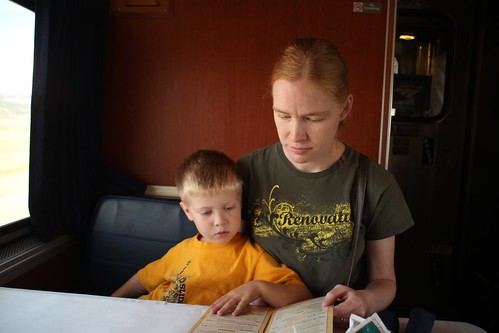
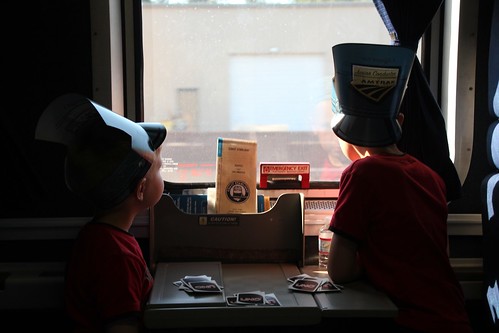
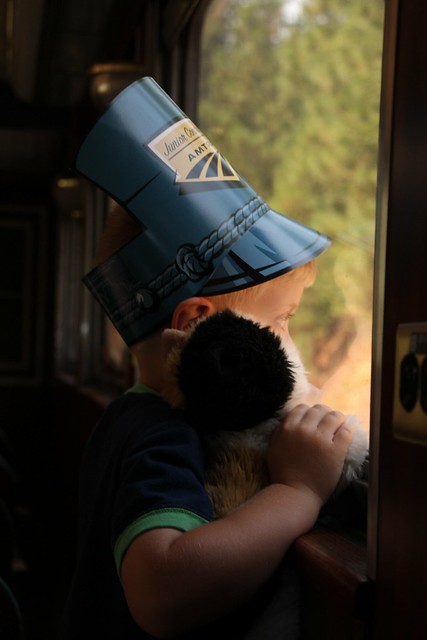
Monday morning, 1:45AM. Laura and I walk into the boys room. We turn on the light. Nothing happens. (They re sound sleepers.) Boys, it s time to get up to go get on the train! Four eyes pop open. Yay! Oh I m so excited! And then, Meow! (They enjoy playing with their stuffed cats that Laura got them for Christmas.) Before long, it was out the door to the train station. We even had time to stop at a donut shop along the way. We climbed into our family bedroom (a sleeping car room on Amtrak specifically designed for families of four), and as the train started to move, the excitement of what was going on crept in. Yes, it s 2:42AM, but these are two happy boys: 2014-08-04 02 Jacob and Oliver love trains, and this was the beginning of a 3-day train trip from Newton to Seattle that would take us through Kansas, Colorado, the Rocky Mountains of New Mexico, Arizona, Los Angeles, up the California coast, through the Cascades, and on to Seattle. Whew! Here we are later that morning before breakfast: IMG_3776 Here s our train at a station stop in La Junta, CO: IMG_3791 And at the beautiful small mountain town of Raton, NM: IMG_3805 Some of the passing scenery in New Mexico: IMG_3828 Through it all, we found many things to pass the time. I don t think anybody was bored. I took the boys exploring the train several times we d walk from one end to the other and see what all was there. There was always the dining car for our meals, the lounge car for watching the passing scenery, and on the Coast Starlight, the Pacific Parlor Car. Here we are getting ready for breakfast one morning. IMG_3830 Getting to select meals and order in the train restaurant was a big deal for the boys. IMG_3832 Laura brought one of her origami books, which even managed to pull the boys away from the passing scenery in the lounge car for quite some time. IMG_3848 Origami is serious business: IMG_3869 They had some fun wrapping themselves around my feet and challenging me to move. And were delighted when I could move even though they were trying to weight me down! IMG_3880 Several games of Uno were played, but even those sometimes couldn t compete with the passing scenery: IMG_3898 The Coast Starlight features the Pacific Parlor Car, which was built over 50 years ago for the Santa Fe Hi-Level trains. They ve been updated; the upper level is a lounge and small restaurant, and the lower level has been turned into a small theater. They show movies in there twice a day, but most of the time, the place is empty. A great place to go with little boys to run around and play games. IMG_3896 The boys and I sort of invented a new game: roadrunner and coyote, loosely based on the old Looney Tunes cartoons. Jacob and Oliver would be roadrunners, running around and yelling MEEP MEEP! Meanwhile, I was the coyote, who would try to catch them even briefly succeeding sometimes but ultimately fail in some hilarious way. It burned a lot of energy. And, of course, the parlor car was good for scenery-watching too: IMG_3908 We were right along the Pacific Ocean for several hours sometimes there would be a highway or a town between us and the beach, but usually there was nothing at all between us and the coast. It was beautiful to watch the jagged coastline go by, to gaze out onto the ocean, watching the birds apparently so beautiful that I didn t even think to take some photos. Laura s parents live in California, and took a connecting train. I had arranged for them to have a sleeping car room near ours, so for the last day of the trip, we had a group of 6. Here are the boys with their grandparents at lunch Wednesday: 2014-08-06 11 We stepped off the train in Seattle into beautiful King Street Station. P8100197 Our first day in Seattle was a quiet day of not too much. Laura s relatives live near Lake Washington, so we went out there to play. The boys enjoyed gathering black rocks along the shore. IMG_3956 We went blackberry picking after that filled up buckets for a cobbler. The next day, we rode the Seattle Monorail. The boys have been talking about this for months a kind of train they ve never been on. That was the biggest thing in their minds that they were waiting for. They got to ride in the very front, by the operator. P8080073 Nice view from up there. P8080078 We walked through the Pike Market I hadn t been in such a large and crowded place like that since I was in Guadalajara: P8080019 At the Seattle Aquarium, we all had a great time checking out all the exhibits. The please touch one was a particular hit. P8080038 Walking underneath the salmon tank was fun too. We spent a couple of days doing things closer to downtown. Laura s cousin works at MOHAI, the Museum of History and Industry, so we spent a morning there. The boys particularly enjoyed the old periscope mounted to the top of the building, and the exhibit on chocolate (of course!) P8100146 They love any kind of transportation, so of course we had to get a ride on the Seattle Streetcar that comes by MOHAI. P8090094 All weekend long, we had been noticing the seaplanes taking off from Lake Washington and Lake Union (near MOHAI). So finally I decided to investigate, and one morning while Laura was doing things with her cousin, the boys and I took a short seaplane ride from one lake to another, and then rode every method of transportation we could except for ferries (we did that the next day). Here is our Kenmore Air plane: P8100100 The view of Lake Washington from 1000 feet was beautiful: P8100109 I think we got a better view than the Space Needle, and it probably cost about the same anyhow. P8100117 After splashdown, we took the streetcar to a place where we could eat lunch right by the monorail tracks. Then we rode the monorail again. Then we caught a train (it went underground a bit so it was a subway to them!) and rode it a few blocks. There is even scenery underground, it seems. P8100151 We rode a bus back, and saved one last adventure for the next day: a ferry to Bainbridge Island. 2014-08-11 14 2014-08-11 16 Laura and I even got some time to ourselves to go have lunch at an amazing Greek restaurant to celebrate a year since we got engaged. It s amazing to think that, by now, it s only a few months until our wedding anniversary too! There are many special memories of the weekend I could mention visiting with Laura s family, watching the boys play with her uncle s pipe organ (it s in his house!), watching the boys play with their grandparents, having all six of us on the train for a day, flying paper airplanes off the balcony, enjoying the cool breeze on the ferry and the beautiful mountains behind the lake. One of my favorites is waking up to high-pitched Meow? Meow meow meow! Wake up, brother! sorts of sounds. There was so much cat-play on the trip, and it was cute to hear. I have the feeling we won t hear things like that much more. So many times on the trip I heard, Oh dad, I am so excited! I never get tired of hearing that. And, of course, I was excited, too.























Joachim Breitner: DebConf 14

I m writing this blog post on the plane from Portland towards Europe (which I now can!), using the remaining battery live after having watched one of the DebConf talks that I missed. (It was the systemd talk, which was good and interesting, but maybe I should have watched one of the power management talks, as my battery is running down faster than it should be, I believe.) I mostly enjoyed this year s DebConf. I must admit that I did not come very prepared: I had neither something urgent to hack on, nor important things to discuss with the other attendees, so in a way I had a slow start. I also felt a bit out of touch with the project, both personally and technically: In previous DebConfs, I had more interest in many different corners of the project, and also came with more naive enthusiasm. After more than 10 years in the project, I see a few things more realistic and also more relaxed, and don t react on Wouldn t it be cool to have crazy idea very easily any more. And then I mostly focus on Haskell packaging (and related tooling, which sometimes is also relevant and useful to others) these days, which is not very interesting to most others. But in the end I did get to do some useful hacking, heard a few interesting talks and even got a bit excited: I created a new tool to schedule binNMUs for Haskell packages which is quite generic (configured by just a regular expression), so that it can and will be used by the OCaml team as well, and who knows who else will start using hash-based virtual ABI packages in the future... It runs via a cron job on people.debian.org to produce output for Haskell and for OCaml, based on data pulled via HTTP. If you are a Debian developer and want up-to-date results, log into wuiet.debian.org and run ~nomeata/binNMUs --sql; it then uses the projectb and wanna-build databases directly. Thanks to the ftp team for opening up incoming.debian.org, by the way! Unsurprisingly, I also held a talk on Haskell and Debian (slides available). I talked a bit too long and we had too little time for discussion, but in any case not all discussion would have fitted in 45 minutes. The question of which packages from Hackage should be added to Debian and which not is still undecided (which means we carry on packaging what we happen to want in Debian for whatever reason). I guess the better our tooling gets (see the next section), the more easily we can support more and more packages. I am quite excited by and supportive of Enrico s agenda to remove boilerplate data from the debian/ directories and relying on autodebianization tools. We have such a tool for Haskell package, cabal-debian, but it is unofficial, i.e. neither created by us nor fully endorsed. I want to change that, so I got in touch with the upstream maintainer and we want to get it into shape for producing perfect Debian packages, if the upstream provided meta data is perfect. I d like to see the Debian Haskell Group to follows Enrico s plan to its extreme conclusion, and this way drive innovation in Debian in general. We ll see how that goes. Besides all the technical program I enjoyed the obligatory games of Mao and Werewolves. I also got to dance! On Saturday night, I found a small but welcoming Swing-In-The-Park event where I could dance a few steps of Lindy Hop. And on Tuesday night, Vagrant Cascadian took us (well, three of us) to a blues dancing night, which I greatly enjoyed: The style was so improvisation-friendly that despite having missed the introduction and never having danced Blues before I could jump right in. And in contrast to social dances in Germany, where it is often announced that the girls are also invited to ask the boys, but then it is still mostly the boys who have to ask, here I took only half a minute of standing at the side until I got asked to dance. In retrospect I should have skipped the HP reception and went there directly... I m not heading home at the moment, but will travel directly to G teborg to attend ICFP 2014. I hope the (usually worse) west-to-east jet lag will not prevent me from enjoying that as much as I could.

Next.

Previous.