Search Results: "tb"

27 November 2010

Russell Coker: Open Respect

On the 5th of November Jono Bacon wrote a blog post titled MAKING OUR WORLD MORE RESPECTFUL [1]. He then registered the domain OpenRespect.org for his manifesto [2].Aaron Siego supports the general concept of being more respectful while listing some of the practical problems that occur in a multi-cultural world [3]. If you read nothing else about this issue I recommend reading Aaron s post (which I summarised very poorly, I can t think of a good one-sentence explanation).Sam Varghese wrote an article suggesting that it was an attempt to deflect criticism from Ubuntu [4]. I think that Ubuntu receives a lot of unfair criticism, but don t think it s really relevant to the issue at hand. Sam criticises some of the Open Respect supporters for failing to show respect in the past.Jono wrote a follow-up blog post titled REFLECTIONS ON RESPECT [5], in that post he said Sometimes we were disrespectful, and frankly, sometimes we were also inadvertently assholes. We never set out to be assholes, but we did set out to be edgy in a satirical way, but we sometimes went too far and I apologize for that. But you know what, we all grow and mature in different parts of our lives about his past LugRadio work. Maybe instead of focusing on being respectful of others it would give more benefit to focus on how to apologise, back down, and move on after being disrespectful. It seems that the situations of epic disrespect tend not to be one-off incidents but are instead arguments of greatly expanded scope that arose from someone refusing to admit any error after doing something that is considered to be offensive. [Someone has registered OpenApology.org, just in case you were wondering.]Maybe advocating Rogerian Argument would be another way of reducing some of the problems in the community.Finally Kirrily wrote an insightful post about the ineffectiveness of discussing offensive things [6]. In terms of issues such as Feminism (which Kirrily uses as an example and which is also a matter of significant interest for her) discussions about offense apparently tend to end up being about the person who was offended rather than the person who might be described as acting in an offensive manner. She suggests using terms such as marginalised, belittled, stereotyped, frustrated, humiliated, threatened, patronised, silenced, intimidated, misrepresented, etc instead. It seems to me that there may be a similar issue with respect . Objective claims about people being dismissed, ignored, patronised, etc can be evaluated more easily than a claim about being disrespected.

26 November 2010

Axel Beckert: Useful but Unknown Unix Tools: awsetbg

Have you ever wondered which tool you should use to set the background of your X11 desktop? There are tons of it and every single one does need different command line options. And if you picked one, you could be sure, you ll once come to a machine or operating system, where that one isn t available. When I started to play around with the tiling window manager awesome, I also noticed that the awesome Debian package contains awesome s own desktop background image setting tool named awsetbg . Yet another one! I thought. But I was wrong: Today I noticed the word wrapper in awsetbg s man page. I became curious and had a peek into its source code. And indeed, it s an awesome desktop background image setting POSIX bourne shell compatible shell-script: It knows about not less than 15 other desktop background image setting tools and can be used as frontend wrapper for those who don t want to remember each tool s command line syntax: Needless to say that most of them are also available in Debian. :-) You may wonder what s useful with it. Well, it does something you no more need to do yourself or in one of your own scripts: Checking which desktop background image setting tools are available on the machine you re currently working and using the appropriate command line options for tiling, fullscreen, whatever. Only drawback I found so far: In Debian, you need the awesome window manager package to be installed, if you want to get the script via APT. But on the other hand, it s just a shell script. You can easily put it into your $HOME/bin or so. :-)

Julien Viard de Galbert: Triage X Bugs of the Week 3 (TXBW3)

This week it has been harder for me to start on this but KiBi s post Debian XSF News #1 pushed me to continue. Thanks for the cheers! The X Strike Force (still) needs you ! You can have a look at the X Strike Force Bug Closing Procedure and check XSF unstable bugs sorted by date.

Alexander Reichle-Schmehl: Release Critical Bug report for Week 47

The bug webinterface of the Universal Debian Database currently knows about the following release critical bugs:
In Total:713
Affecting Squeeze:283
Squeeze only:74
Remaining to be fixed in Squeeze:209
Of these 209 bugs, the following tags are set:
Pending in Squeeze:18
Patched in Squeeze:50
Duplicates in Squeeze:18
Can be fixed in a security Update:16
Contrib or non-free in Squeeze:6
Otherwise fixed in Squeeze:26
Ignoring all the above (multiple tags possible), 127 bugs need to be fixed by Debian Contributors to get Debian 6.0 Squeeze released. However, with the view of the Release Managers, 170 need to be dealt with for the release to happen. Please see Interpreting the release critical bug statistics for an explanation of the different numbers.

Russell Coker: Quality of Cameras in Phones

The discussion in the comments on my post about a mobile phone for Sysadmin use [1] turned to the issue of picture quality. This is an issue for a sysadmin as photographing the screen of a crashed computer while being a rare occurrence can be an important part of solving a computer problem.Lon recommended a review of phone cameras by the Norwegian site Amobil [2]. This review only included devices that had already passed earlier review, so even the HTC Desire HD (which came last on the Amobil tests) still has a better camera than most phones on the market. It s a pity that no English-language site seems to have done such a review.The Amobil article (when translated) says: In the mobile industry is faced with the need for much extra processing for the images to look good, because there is no room for large optics and large image sensors that receive sufficient amount of light .IMHO that s overstating the case. I have yet to see a camera-phone that couldn t be redesigned in a trivial way to give a better camera functionality. It appears that the limiting factor is the thickness of phone which limits the maximum focal length and therefore the maximum area (I presume it s safe to assume that Fresnel lenses are not viable for cameras). My LG U990 Viewty is 14.8mm thick, I would be happy with something a bit thicker if it gave a better picture, 30mm wouldn t be a problem (my first few mobile phones were thicker than that and had no camera). Maybe a design could have the camera stick out such that the main body of the phone was 15mm thick while the camera part was 30mm. Also having the camera in a central part of the phone (underneath the touch-screen) probably loses at least 1mm of focal length. It seems that the amount of light captured will be the square of the focal length, so an ideal (IMHO) camera design could have twice the depth of a Viewty, 4* the light captured, and therefore have an 8MP camera with a better response in adverse light than the Viewty (which is pretty good for a phone but crap for a camera).I noted in the comments that it s a pity that camera-phones don t support storing pictures in RAW format, Paul pointed out that the Nokia N900 supports RAW pictures. I m glad to learn that at least one phone-camera manufacturer is doing the sane thing, now we just need to have RAW pictures as a check-list item on reviews to force others to do the same. I wonder whether a modified version of the Android OS could support RAW format Amobil published an article about some joint ventures between camera and phone companies [3]. Apparently LG are working on a phone with 3* Optical Zoom that uses Pentax optics, while the Olympus camera company is considering the purchase of a phone company with the apparent aim of producing a killer camera-phone.I wonder whether I should delay the purchase of my next phone for a few months to take advantage of some of these developments. If nothing else I expect some significant improvements in the screen resolution of phones in the near future. The maximum screen resolution that is common at the moment is 800*480 (WVGA), but the iPhone 4 supports 960*640 resolution which is 60% more pixels and I expect other manufacturers to release phones to compete with it in the near future.

25 November 2010

Russell Coker: Victorian State Election

Election TomorrowOn Saturday we will have a Victorian state election. As usual for state elections most people will vote on issues related to the federal government, the mainstream media has little coverage of state politics and people seem to vote on what they see on TV. Presumably that means we have a good chance of having a similar situation to the last Federal Election where the Labor and Liberal parties each won 72 seats in the lower house and Labor formed a coalition with the Greens MP and three independents.The independent MPs didn t give much explanation of the reasons for their choices. But it seems that a large motivating factor was the Greens success in the senate, as Labor was more willing to work with the Greens that meant that if a Liberal based coalition had won in the lower house there was a good chance of a Double Dissolution.The Liberal party can t make dealsIn a world where sanity prevailed the result of this would be the Liberal party firstly adjusting their policies to appeal to Greens voters and secondly trying to make some deals with the Greens at a high level to allow the possibility of a Liberal/Green coalition government. While there are substantial policy conflicts between the Liberal and Green parties it does seem possible to get a coalition working if both sides accept that they won t get everything that they want. Forming government and getting only some of your policy implemented seems like a better option than being in the opposition and getting almost none of your policy implemented. Also there is no reason why we couldn t have a Liberal/Labor coalition government in the next decade it seems unlikely that any election will deliver a result that doesn t have Liberal + Labor comprising more than 50% of the seats in both houses.But it seems that sanity doesn t prevail. The Liberal party have put the Greens below Labor on their preferences for the upper house and on their How To Vote cards for the lower house [1]. This greatly increases the probability of Labor scoring an outright win. It also seems likely to drive a wedge against the conservative voters who want to conserve the environment.The Sad State of the Liberal PartyKevin Andrews (Liberal MP and former minister) wrote a strange and amusing diatribe titled The ideological drive behind the Greens [2]. Here is what I regard as the best part:First, those who vote Green as their primary vote: This is the Don s Party group that used to be in the ALP in the 60s and 70s: young university students or graduates, frequently working or still studying in academia, no kids, often gay, arts and drama type degrees or architecture where they specialise is designing environmentally friendly suburbs, agnostic or atheist, often US or Canadian refugees from capitalism, but well paid in professional consulting or media jobs. According to the CIA World Factbook [3] the median age of Australians is 37.5, the majority of the population were born in 1972 or later. The film Don's_Party was released in 1976 and was about the 1969 election. While Kevin Andrews was old enough to remember the 1969 election clearly the majority of the Australian population weren t even born before that election and isn t old enough to have watched the movie when it was in the cinemas. Kevin is making it quite clear that he and his party represent a time that is past. The rest of that paragraph is filled with strangeness that is a good sample of the rest of his article.The sad thing is that he seems to think that this appeal to the minority of people who are old enough to remember the 1969 election, bigoted enough to appreciate the discrimination against homosexuals (which is a long standing Liberal policy), and politically clueless enough to support McCarthyist policies against alleged communists.We need a decent and sane conservative party to represent the decent and sane Australian citizens who are politically conservative. I am beginning to doubt that the Liberal party could ever be reformed enough to become such a party.

Stefano Zacchiroli: h-index spoofing

Next time you are asked your h-index ... Next time you are asked your h-index, I suggest replying by pointing to related work by Ike Antkare [1].
[1] Ike Antkare. Ike Antkare one of the great stars in the scientific firmament.
April, 2010.
http://membres-lig.imag.fr/labbe/Publi/IkeAntkareSub.pdf,
retrieved November 25th, 2010.
Although some people still don't get it, the bottom line is always the same: you can't rely on a fully automatic method to evaluate intelligent entities which are aware of the evaluation method, as they are very likely to adapt to it. This is even more so when the automatic method relies on a data source which is not under the control of the evaluator(s). Thanks to Lucas for sharing the bibliography entry.

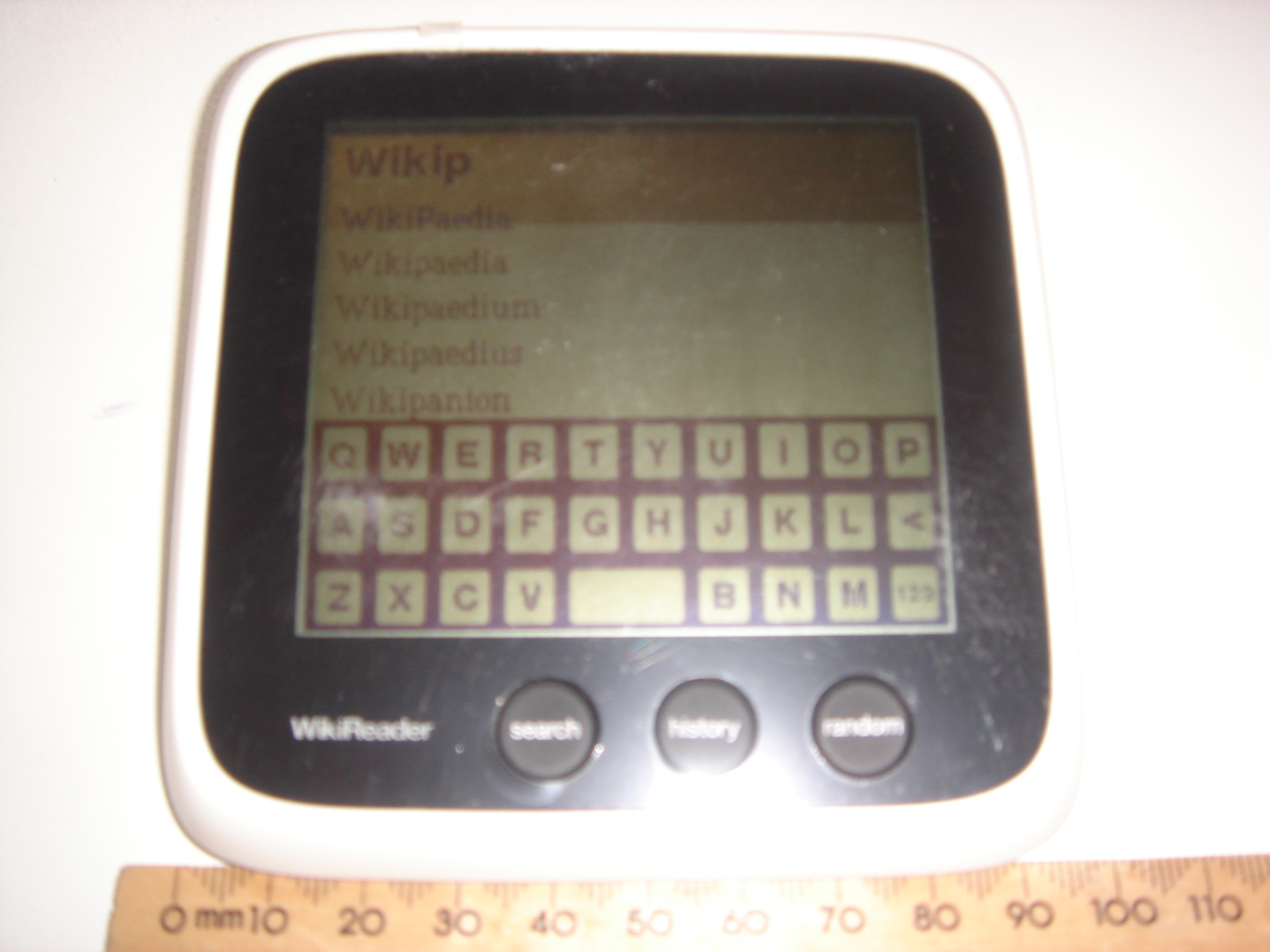
Russell Coker: The Wikireader

Just over a month ago I bought a Wikireader [1] from Officeworks (an Australian chain of stores that sell all manner of office supplies). It cost only $99, thanks to Brianna for informing me about this [2]. When I purchased my Wikireader an Officeworks employee had to get one from the back office and told me that I was the first person to buy one. I suggested to him that when a product isn t mentioned in their advertising and isn t put on the shelves it s unlikely to sell in quantity and that they shouldn t rely on bloggers to promote what is possibly one of the most desirable products that they stock.The Wikireader stores a copy of the text of the English language version of Wikipedia on a micro-SD card. They have a service whereby you can get two updates posted to you every year for $29, which would make it pretty close to free once postage and the cost of the micro-SD cards is taken into account. Also you can download new content. I have no immediate plans for updating my Wikireader as the content is more than good enough to answer idle questions while waiting for a bus but as it s lacking external links due to no net access and images it can t be used for serious Wiki reading IMHO.Brianna has documented the process of updating a Wikireader to add more content [3], she added the Chinese version and discovered that inter-wiki links are preserved! I have no immediate plans to add extra content (I don t know any other language well enough to read an encyclopaedia). Also an 8GB MicroSD card (which is the minimum requirement to use multiple languages) costs $35 and is a significant portion of the original purchase price.In terms of functionality the device is pretty good. The screen is not back-lit, but if it was then the two AA batteries wouldn t last anywhere near a year. The screen is not high resolution and the touch functionality isn t particularly accurate or sensitive but I guess that s a necessary trade-off to get the $99 price. The Wikipedia content seems quite complete, so far the only page which I found to be missing was the bio of an Australian architect, I m not sure if his page was removed from the Wikireader to save space or whether my device has a snapshot that predates the addition of the page.The Wikipedia page about downloading the database is interesting [4], it s 6GB of compressed data for the text of the English pages (not including history or talk pages) and for years they haven t even tried to provide a dump of the images. So I guess that a Wikireader that displays pictures is out of the question.The Wikireader has a parental filter, in my quick tests the only page that has been blocked is Sexual Intercourse , I could read all about safe-sex, infidelity, and lots of other related adult topics without being asked for a password. It also shows pages about goatse and other related things without asking for a password NB if you don t know what goatse is then you probably don t want to learn, trust me that it s something that most people won t want their children to learn about. The filter is so bad that I think they shouldn t include it, it will just give people false confidence. It s OK to sell a cheap device that is designed to give a detailed description of goatse etc on request to anyone, but IMHO it s not OK to sell such a device with a claim that it is kid safe and has parental controls . Note that holding down the History button will allow you to clear your history this is useful if you have just verified that goatse isn t blocked and you want to give the device to a young child.There is a button to give a random page, I believe that this would be more useful if it had some metric to make it more often return pages that might be interesting. It could weight the randomness by the length of the page (usually a longer page is more interesting to more people and has more links to other pages) or by some other metric that indicates the potential popularity. Random links often get me pages about obscure country towns and other things that probably aren t of interest to people who don t live near them.But overall this is a great product, $99 is not much to pay, and I recommend getting one!

23 November 2010

Russell Coker: Links November 2010

Guy Deutscher wrote an interesting article for the New York Times about how language shapes how we think [1]. The example of people who have no language construct for self-sentered directions and how they describe things is particularly interesting.TED published an interesting interview with Shaffi Mather the founder of India s first organised ambulance service (with differential pricing based on ability to pay) [2]. He also talks about founding schools in small towns and his BribeBusters.com company.World Changing has an interesting article about a legislative change in California that allows car-sharing of personal vehicles [3]. The concept is that if you own a car that you don t use most of the time (as is usually the case) then you can contract with a car-share company to share it to others when you don t need it. This saves the car share company from the capital expense of owning cars and thus allows them to place cars in remote locations that wouldn t otherwise be financially viable (IE the street in front of random people who sign up). The person who owns the car may get about $2 per hour for the time when it s rented. The car owner gets to specify when the car may be available.Charles Stross wrote an entertaining and informative rant about Steam-Punk [4]. He cites Michael Moorcock s informative essay about Starship Troopers and other right-wing apologist themes in sci-fi [5] as well as China Mieville s essay about politics and The Lord of the Rings [6].Glenn Greenwald wrote an informative article about the New York Times defending torture by the US military [7]. I have unsubscrubed from the @Times mailout and will avoid citing NYT articles wherever possible. I sent the URL for Glenn s article to the NYT feedback address but I don t expect them to take any notice.Fate Of the World is a new computer game that s in beta where you have a simulation of the next 200 years of climate change [8]. It s currently in beta for Windows only, they hope to have a Mac version in March and have no stated plans for Linux support.Cory Doctorow wrote an interesting article for Locus about Sci-Fi fans and cosmopolitanism taking the best option after consideration rather than doing what s locally fashionable [9]. He uses the term Martian to refer to some of the viewpoints, but it seems to me that Vulcan would be more appropriate.The Wall St Journal has an interesting article about people who manufacture drugs that aren t yet illegal, every time one drug gets banned they market a new one [10]. This is yet another example of the War on Drugs doing more harm than good, instead of taking drugs which have well known effects (that can be treated by hospitals) people are taking weird new drugs and no-one knows what will happen to them.Mieke Meijer in the Netherlands has invented a new product known as newspaper wood [11], it involves gluing paper together to create a form of chip-board that keeps the layers of paper distinct to give a result like wood grain. The World Changing commentary suggests that this could give a heirloom quality to objects made with it, while I m dubious about that I think that the surface would be pleasing to look at in a kitchen or office environment.Ze Frank gave an interesting TED talk about unusual social projects that he s run on the Internet [12]. This includes an attempt to reconcile Red and Blue voters after the 2008 US presidential election, the creation of inspirational songs, and remixing the Whip Somebody s Ass song. This is really worth watching!The Chronicle Review has an interesting article by someone who is paid to complete academic assignments for other people [13]. The scope of cheating that is claimed is profound. Naturally we have to take claims by someone who admits acting unethically with a grain of salt, but if there is any truth to this then it s a serious matter. I m surprised that no-one has made a serious attempt to catch the customers of such people.David Brin (the famous sci-fi author) gave an interesting short lecture about the future of humanity [14]. He promotes the Lifeboat Foundation (of which he is a director) and describes his concern about the Fermi Paradox.Shimon Schocken gave an inspiring TED talk about his work rehabilitating juvenile prisoners through taking them mountain-bike riding [15]. This shows that anyone can do great things to help other people, he got this idea when riding past a prison, convinced the prison governor that it was a good idea and then started doing it.Conrad Wolfram gave an insightful TED talk about math education [16]. His claim is that the entire mathematical education system is wrong in it s focus on hand calculation, instead the aim should be to teach children how to use computers to solve problems which is what is mostly done in the real world.

Jo Shields: Always twirling, twirling, twirling towards Freedom

I ve never quit a job before. Well, not a real job. Quitting PC World was more than easy, it was practically required for my soul not to leave my body. Quitting Waitrose was, well, it was a freaking supermarket job. And Southampton football stadium I just stopped turning up after one girl fainted in the kitchen from heat exhaustion. But a real, proper handing in of notice is something new in no small part because I ve been in the same place since my first job as a new graduate. Not that I m ungrateful, mind. Looking after big iron at the University of Oxford has been pretty awesome more blinky lights than you can shake a stick at but there comes a time when you need to think about your career, and move on to pastures new. I m fairly sure six and a bit years is WELL past that point. When I started looking at work, I had only a few mandatory criteria a sysadmin job, working with Free Software, without any significant decrease to my monthly income. Beyond that well, in this economy, who am I to argue? What I hadn t accounted for, however, was a job whose awesomeness can t be contained. A job with a dedicated Free Software company whose entire staff roster, top to bottom, is filled with the most talented, smart, and generally awesome people you could hope to work with. Such a job would be a fevered dream, the mere ramblings of a madman. Yet, somehow, for the second time running, I find myself in an enviable job, working exclusively on Free Software. Being able to show off root access to a box with 256 cores and a tibibyte of RAM is pretty cool. But you know what s even cooler? A job where I never need to worry about openSUSE 10.1 administration ever again. A job where several of my colleagues are fellow Debian Developers, with all the prestige and knowledge that comes with such a title. And somehow, by rolling proverbial twenties, I find myself in that position. I am very, VERY proud to say that from the start of January, I ll be joining Collabora Ltd as their new Systems Manager.

Julien Danjou: Color contrast correction

I finally took some time to finish my color contrast corrector. It's now able to compare two colors and to tell if they are readable when used as foreground and background color for text rendering. If they are too close, the code corrects both colors so to they'll become distant enough to be readable. To do that, it uses color coordinates in the CIE L*a*b* colorspace. This allows to determine the luminance difference between 2 colors very easily by comparing the L component of the coordinates. The default threshold used to determine readability based on luminance difference is 40 (on 100), which seems to give pretty good results so far. Then it uses the CIE Delta E 2000 formula to obtain the distance between colors. A distance of 6 is considered to be enough for the colors to be distinctive in our case, but that can be adjusted anyway. That depends on reader's eyes. If both the color and luminance distances are big enough, the color pair is considered readable when used upon each other. If these criteria are not satisfied, the code simply tries to correct the color by adjusting the L (luminance) component of the colors so their difference is 40. Optionally, the background color can be fixed so only the foreground color would be adjusted; this is especially handy when the color background is not provided by any external style, but it the screen one (like the Emacs frame background in my case). Here is an example result generated over 10 pairs of random colors. Left colors are randomly generated, and right colors are the corrected one. <style type="text/css"> </style>

bg: DarkSeaGreen4 fg: gray67 ->                             fg: #4a6b4b bg: #cccccc
bg: SlateGray4 fg: forest green ->                          fg: #9faec0 bg: #005700
bg: grey13 fg: grey36 ->                                    fg: #131313 bg: #6c6c6c
bg: MediumPurple2 fg: honeydew ->                           fg: #9e78ed bg: #f0fff0
bg: grey43 fg: chartreuse3 ->                               fg: #5e5e5e bg: #79de25
bg: linen fg: DeepPink2 ->                                  fg: linen bg: DeepPink2
bg: CadetBlue4 fg: blue1 ->                                 fg: #6c9fa4 bg: #0000e1
bg: gray33 fg: NavajoWhite3 ->                              fg: #525252 bg: #cfb58c
bg: chartreuse1 fg: RosyBrown3 ->                           fg: #9cff38 bg: #b28282
bg: medium violet red fg: DeepPink1 ->                      fg: #9c0060 bg: #ff55b9
All this has been written in Emacs Lisp. The code is now available in Gnus (and therefore in Emacs 24) in the packages color-lab and shr-color. A future work would be to add support for colour blindness. As a side note, several people pointed me at the WCAG formulas to determine luminance and contrast ratio. These are probably good criteria to choose your color when designing a user interface. However, they are not enough to determine if displayed color will be readable. This means you can use them if you are a designer, but IMHO they are pretty weak for detecting and correcting colors you did not choose. Flattr this

Mike Hommey: Improving libxul startup I/O by hacking the ELF format

If you have been following this blog during the past months, you might have gathered that I ve been focusing on I/O patterns on library initialization, more specifically libxul.so. The very patterns there s not much to do about, except enduring them, or hacking ld.so and/or the toolchain. The latter is not necessarily easy, and won t benefit everyone until all linux distros use an improved glibc and/or toolchain. This could take years before any actual result would reach end users. But with a little creativity, one can overcome these limitations and improve the situation today. Here is a summary of my recent hacks. Backwards static initializers As Taras showed in the past, static initializers are executed in reverse order. It turns out it is an unfortunate design choice in gcc, and it also turns out not to impact all ELF binary files. As far as I know there are currently two different implementations of the static initializers call loop, one provided by gcc, and one provided by ld.so. In the gcc case, the compiler creates a .ctors section, starting with 0xffffffff, ending with 0x00000000, and filled with pointers to the various static initializer functions, in ascending order. The compiler also injects an initializer function, called from .init, going through this .ctors section, starting from the end (__do_global_ctors_aux in crtend.o). A similar .dtors section is created for functions to run when the library is unloaded, and the pointers in it are called in ascending order. There is actually no importance in the order in which .ctors and .dtors are executed. All that matters is that they are executed in reverse order from each other, because that limits the risks of bad ordering. It is only unfortunate that .ctors was chosen to be the one backwards. In the ld.so case, the compiler creates a .init_array section, filled with pointers to the various static initializer functions, in ascending order. It also stores the location and the size of this section in the PT_DYNAMIC ELF header. At runtime, ld.so itself reads this information and executes the static initializers in ascending orders. A similar .fini_array section is created for functions to run when the library in unloaded, and ld.so goes through it in descending order. The .init_array section is newer, and for backwards compatibility reasons, is not used on systems that have been using the .ctors approach forever. On the other hand, some newer ABIs, such as arm EABI, uses the new facility, which means they are not victim of backwards static initialization. I however wonder if backwards compatibility is still needed, considering how long .init_array support has been around (more than 11 years, according to glibc git repository). While we could obviously bug the gcc maintainers to revert their .ctors execution order, or ditch .ctors support on glibc systems, which means we wouldn t get any immediate global benefit, we can also just revert the .ctors section content. Please note the source code out there doesn t take care of reverting the .dtors section accordingly, because it is currently empty in libxul.so. Relocations As I mentioned in an earlier post, relocations are what make it possible to load libraries at arbitrary locations. Unfortunately, a great number of relocations means awful I/O patterns: ld.so reads and applies them one by one, and while the kernel reads ahead by 128 KB chunks, when your relocation section exceeds that amount by more than an order of magnitude, it means I/O goes back and forth a lot between the relocation section and where the relocations take place. There are two classes of relocations: REL and RELA. In both cases, there are several types of relocations, some of which require an addend. The difference between both classes is in REL relocations, the addend is stored at the offset the relocation takes place, and in RELA relocations, the addend is stored in the relocation entry. It means that RELA relocations effectively waste space, as the addend ends up actually being stored twice: it is also stored at the offset the relocation takes place, like with REL relocations, though it could technically be nulled out, there ; in any case, the space is wasted. REL relocations thus take 2 words of storage, and RELA relocations, 3. On x86, the ELF ABI only uses REL relocations, and words are 32 bits, making each relocation take 8 bytes ; on x86-64, the ELF ABI only uses RELA relocations, and words are 64 bits, thus making each relocation take 24 bytes, 3 times that of x86 relocations. On ARM, both may be used, but apparently the compiler and the linker only use REL relocations. These words of storage are used to store 3 or 4 bits of informations: The linker splits relocations in two main categories: those for dynamic linking at startup and those for procedure linkage table (PLT) resolution at runtime. Here is what the repartition look like on libxul.so (taken from the mozilla-central nightly from Nov, the 22nd):
dynamic relocations PLT relocations
Architecture number size (bytes) number size (bytes)
x86 231,836 1,854,688 3,772 30,176
x86-64 235,893 5,661,432 3,773 90,528
So, PLT relocations are quite negligible, and dynamic relocations are just huge, especially on x86-64. Compared to the binary size, it s pretty scary:
Architecture libxul.so size relocations size %
x86 21,869,684 1,884,864 8.61%
x86-64 29,629,040 5,751,984 19.41%
Let me remind you that not only do we need to read these relocations at startup (at least the dynamic ones, but the PLT ones are just negligible), but we only read them by chunks, and need to read other data in between. Of the many existing types of relocations, only a few are actually used in dynamic libraries. Here is a summary of those in use in libxul.so:
x86 relocation type number x86-64 relocation type number
dynamic relocations
R_386_TLS_DTPMOD32 1 R_X86_64_DTPMOD64 1
R_386_GLOB_DAT 213 R_X86_64_GLOB_DAT 238
R_386_32 27,643 R_X86_64_64 27,611
R_386_RELATIVE 203,979 R_X86_64_RELATIVE 208,043
PLT relocations
R_386_JUMP_SLOT 3,772 R_X86_64_JUMP_SLOT 3,773
The above types can be separated in two distinct categories: In the second category, it means we are wasting all the bits for the symbol reference in each entry: 24 on x86 and 32 on x86-64. Unfortunately, the vast majority of the relocations in libxul.so are from that category. At this point, this is how much waste we identified:
description num. entries waste per entry (bytes) total % of relocation size
x86
Relocation without symbol ref. 203,980 3 611,937 32.46%
x86-64
Duplicated addend 239,666 8 1,917,328 33.33%
Relocation type encoded on 32 bits 239,666 3 718,998 12.49%
Relocation without symbol ref. 208,044 4 832,176 14.46%
Total 3,468,502 60.30%
On top of that, one could argue that we don t need 24 or 32 bits for symbol reference (which is the entry number in the symbol table), and that we re really far from requiring 64 bits for r_offset on 64 bits systems, as libxul.so is far from being bigger than 4GB. Anyways, that means we have room for improvement here, and it means that the ELF format, especially on 64 bits systems with RELA relocations, really doesn t help with big programs or libraries with a lot of relocations. (For that matter, the mach-o format used on OS-X has some kind of similar issues ; I don t know for the DLL format) Another interesting data point is looking at how relocations r_offset are following each other, once relocations are reordered (to avoid too much symbol resolution, they are actually grouped by symbol). It turns out 206,739 relocations r_offset are at 4 bytes from the previous one on x86 (i.e. strictly following it), and 210,364 at 8 bytes from the previous on x86-64. The main reason why this happens is that most relocations are happening in pointer tables, and libxul.so has lots of them: And when I say libxul.so has lots of them, that s not an understatement: there are 184,320 relocations due to vtables (function tables you get when using virtual methods in C++) on x86 and 184,098 on x86-64. That s respectively 78.23% and 76.81% of the total number of relocations. Interestingly, while most of these relocations are R_*_RELATIVE, 26,853 are R_386_32, and 26,829 are R_X86_64_64. Except for a very few, these non relative relocations are for the __cxa_pure_virtual symbol, which is a dummy function that does nothing, used for pure virtual methods, such as the following:
class Abstract
public:
virtual void pure_virtual() = 0;
;
As for the remaining relative relocations, there are a few pointer tables responsible for several thousand relocations, such as JSString::length2StringTable, gEntries, GkAtoms_info, Html5Atoms_info, kUnixCharsets, nsIDOMCSS2Properties_properties, etc. Packing relocations While they are not detrimental to most binaries, we saw that relocations can have a bad effect on startup I/O for big binaries. Reducing how much space they take would have a direct impact on these startup I/Os. One way to do so is obviously to reduce the number of relocations. But as we saw above, the vast majority are due to vtables. While reducing vtables would be a nice goal, it s a long way before this can have a significant impact on the relocations number. So another possible way is to try to avoid wasting so much space in relocations. The main problem is that relocations are applied by ld.so, and that, as mentioned in the introduction, while we can hack ld.so to do what we want, it won t work everywhere before a long time. Moreover, it s difficult to test various implementations, and binary compatibility needs to be guaranteed once something is applied in the upstream libc. The idea I started to test a few weeks ago, is to effectively apply relocations by hand instead of relying on ld.so doing it. Considering the first thing ld.so does with a library after applying relocations is to call its DT_INIT function, the idea was to replace the dynamic relocations we can with a new DT_INIT function we would inject that d apply those relocations, while storing them in a more efficient manner. The function would obviously need to call the original DT_INIT function once done. Some parts of the PT_DYNAMIC section also obviously need to be adjusted accordingly. The first iteration I tested a few weeks ago helped validating the idea, but didn t change much of the binary: the dynamic relocation section still was taking all the space it took before, though its content was mostly empty (we ll see further below how efficient even the current dumb format is). Once the theory that an injected DT_INIT function could apply the relocations without breaking everything, I went on to implement a program that would actually strip the ELF binary. I won t get too much into the gory details, but it required PT_LOAD splitting, thus program headers growth, which means moving the following sections, then removing a huge part of the relocations, shrinking the relocations section, injecting our code and the packed relocations as sections, and moving the remaining sections after these new sections, to avoid empty space, but still respecting the proper offsets for both PT_LOAD and the code itself. So far, I only took care of the R_*_RELATIVE relocations. Some but not all other relocations could be taken care of, too, but everything involving symbol resolution from other libraries would be really difficult to handle from the injected code. The relocations are currently stored with a quite dumb format: As we only take care of one type of relocations, we can skip any information about the type. Also, the addend already being stored at r_offset, we just strip it from RELA relocations ; the binary being far from 4GB big, 32 bits is enough on 64 bits systems too. We also saw that a lot of relocations were next to the following ones, so instead of storing r_offset for each one, storing some kind of range is more efficient. As I ve so far been focusing on getting something that actually works more than on getting something really efficient, I only tested this format, but the results are already nice:
x86 x86-64
before
dynamic relocations (bytes) 1,854,688 5,661,432
libxul.so size 21,869,684 29,629,040
after
dynamic relocations (bytes) 222,856 668,400
injected code size 129 84
packed relative relocations (bytes) 224,816 228,568
libxul.so size 20,464,836 (-6.42%) 24,865,520 (-16.07%)
Getting rid of the __cxa_pure_virtual relocations would help getting this even further down, and an even better storage format could be used, too. Gathering new startup coverage data should be interesting as well. The code is available via mercurial. Please note the Makefile deeply sucks, and that the code is in the middle of its third refactoring. Anyways, once you get the code to compile, you just need to run test-x86 or test-x64 depending on your architecture, from the build directory, and give it the libxul.so file as an argument. It will create a libxul.so.new file that you can use to replace libxul.so. You may successfully use the tool on other libraries, but chances are you ll bump into an assert(), or in the worst case, that the resulting library ends up broken. The tool might work on PIE executables, but most probably not on other executables. If you wonder, Chrome is not PIE. It s not even relocatable (which means ASLR won t work with it) ; or at least the x86-64 binaries I just got aren t. More possible ELF hacking The code I wrote to pack relocations allows to do various tricks on ELF files, and it opens various opportunities, such as: Some of the above could probably be done with linker scripts, but using linker scripts is unnecessarily over complicated: as soon as you start using a linker script to fiddle with sections, you need to reimplement the entire default linker script (the one you can see with ld --verbose). And it s not guaranteed to work (Taras told me he had a hard time failing to align the .bss section). And as far as I know, you can t use the same thing depending whether you use ld or gold (AIUI, gold doesn t support the whole ld linker script syntax).

Biella Coleman: An unlikely story about a pit bull attack, free software, and a New York Times reporter

If I told you that in the last two days, I have been caught in a vortex of coincidence, a vortex composed of pit bulls, free software, diaspora (the software), mold, and a New York Times reporter, I bet you would think not likely. So the story started on Jet Blue, which offers snacks, lots of them, and Direct TV. Since I don t have TV I kinda go on a binge, watching all sorts of shows as I make my way home. I watched a pretty distributing but interesting documentary on Jim Jones on CNN and a show on Animal Planet on pit bulls and parolees. When I rolled into my my current digs in northern Manhattan (I am currently banished from my downtown apt due to mold, but that is a whole other story), there was a dinner party well underway. At some point in the evening prompted by me, we talked pit bulls as my friends want to get one but their family has issued a threat of disavowal if they do. The next morning, I was scoping out the website for the Animal Planet show as I was intrigued by it and frankly I kinda like pit bulls (maybe less now although I think they are unfairly maligned). Five minutes into pursuing the site, I hear screeches from hell. It sounds like a woman is being attacked. And she is. A woman right outside of my window was being attacked by a pit bull. So I am staying with a friend, an open source developer, Karl Fogel and good soul that he is, he runs out to help the lady (since I have been subject to 5 weeks of sickness due to mold or so that is what we think it is was enough for me; I could not stomach the idea of getting bit so I played the role of concerned spectator). It took minutes upon minutes, really just too many minutes to get the pit bull off, even a brick pounded against his head failed (apparently, a cigarette or match held to the throat does the trick, which I found out later). Eventually, the dog was extracted, a huge team of cops showed up, the dog was whisked away, the victim taken to the hospital, and life returned to calm and quiet. So the next day, I was being interviewed by a New York Times reporter Jim Dwyer who wrote a story about Diaspora for the New York Times back in the summer, helping to propel it from relative obscurity to near insta-fame (one of the Diaspora developers, Max, was my student). We were running out of time (I had another appointment) so I asked him if he lived in northern Manhattan as that is what his bio page indicates. He confirmed, I explained I was up there and that we could meet up there later to finish up. He inquired what part, I told him roughly where I was, he remarked he was near there, and so naturally I told him about the crazy pit bull attack I witnessed from my window as I can t shut my trap when it comes to things like that. Well yes you know what is coming next next: he was there, helping Karl (and others) deal with the pit bull attack. He lives nearby and heard the shrieks of agony and came out to aid. All and all it was pretty horrific. He also met Karl in so far as Karl gave him his phone number and email just in case he was needed as a witness (Karl had to dash off to catch a plane). Well, the funny thing, or as you also might guess: Jim, who is doing some more writing on tech, free software etc, should really talk to Karl given his key role in the community, so they already met, although under odd and terrible circumstances. I am not sure if I am more wigged out by the fact that I was reading about pit bulls when the attack happened or whether the reporter I was interviewed by was there along side with a free software developer he really needs to interview. Whatever the case, I kinda hope the vortex of coincidence now leaves me to hit someone else (sans any horrible attack). Or else, as Karl noted in the blog comments, I will have to be very careful about what shows I watch:
Amen to that! Enough with the coincidence vortex. As I said to Biella in IRC later: Do us a favor don t watch any shows about nuclear attacks on New York, okay

Russell Coker: A First Digital Camera

I ve just been asked for advice on buying a digital camera. I m not an expert on cameras but I have a good general knowledge of technology and I m sure that the readers of my blog will correct me rapidly if I make any serious mistakes. ;)Types of CameraThe Wikipedia Page about Digital Cameras is worth reading [1].Here are the types of camera that are useful as a stand-alone camera (IE not camera phones or industrial cameras):I suggest that people not start out a hobby of digital photography with a DSLR or other interchangeable lens camera. I think that it s best to start out with simple gear that s cheap if you decide that digital photography is not your thing then you have wasted less money, and if you really get into it then you ll be able to make a more informed choice about an expensive camera after getting some experience.A spare cheap compact camera can be useful even if you own a more expensive camera. There are times when you don t want the bulk of a DSLR or Bridge Camera and when you have a risk of theft or accidental damage such that you don t want to take an expensive camera. People who are really serious about photography apparently take a camera everywhere, you could have a compact camera in your front pocket for fast pictures and a bulky camera in your backpack for when you have time to prepare a quality shot. So buying a cheap camera and then buying an expensive one a few months later would not be wasting money!As the person who asked for advice has never owned a digital camera before I ll focus on cheap compact cameras for the rest of this post.Pixels and LensesCameras are typically advertised with the resolution in Megapixels described in bold. Presumably most people search for the camera with the highest resolution. The first thing to beware of is cameras that don t have hardware which is capable of taking a picture of the stated resolution, they use interpolation to generate a higher resolution image. There are probably some cameras with interpolation that are OK and provide a decent picture at a low price, but generally I recommend avoiding all cameras that do interpolation.Optical zoom is a very important feature. Often pictures have to be cropped to remove unwanted background, if you zoom in appropriately you can avoid cropping and make better use of the available resolution. Beware of cameras that advertise things such as advanced zoom , anything that doesn t exactly say optical zoom is using digital zoom IE interpolation. I suggest not considering a compact camera unless it can do at least 4* optical zoom, with 5* or better being preferable.The physical size of the lens is important. A bigger lens allows better pictures in adverse lighting and also allows a faster shutter speed to give better photos of moving objects and better photos when you are moving. Generally you can get a rough idea of the potential that a camera has by just glancing at the lens, if it s the size of a lens in a mobile phone then the pictures won t be that great. If it is on a telescopic mount and it s wide then the result will be better. When buying a lens for a DSLR or other detachable lens camera you should be able to read specifications of the lens which indicate it s size. For compact cameras the specifications of the lens are usually available from the vendor and often available from review sites but generally aren t included in adverts by retailers. If you are comparing cameras in the store looking at them seems like the best option.The ratio of the lens area to the number of pixels determines how much light is received by the sensors for each pixel. So when there are two cameras that are essentially identical apart from the number of megapixels the one with the highest number isn t necessarily better in all situations. A 12MP camera might not give a better result than a 10MP camera, a monitor described as Full HD has a resolution of 1920*1080 which is 2MP. A 5MP camera is useful to allow cropping but if the aim is to display pictures on current monitors then anything much bigger than 5MP is probably wasted at this time and 10MP will provide pictures that can use the capabilities of monitors that are developed for a while.PrintingSome printers that are affordable for home use might require something like a 7MP camera to print a picture at A4 or Letter size at the highest quality. Professional printing will probably require something even greater. But if your intended use of a digital camera doesn t involve printing the pictures, or only rarely involves printing them at A4 or Letter size then you don t need a high resolution for printing. I expect that there are some available printers that can use paper at sizes such as B3 which might require a 20MP camera for best quality. But if the aim of the printing is to put a picture on your wall (the most common case) then even if it s not at the ideal resolution then probably no-one will notice the difference you can t see the pixels from a few meters away.If the aim of the camera is to photograph professional artwork for the purpose of selling it on the Internet then a high resolution camera really isn t desired. You want to offer pictures on the Internet which aren t good enough to be usefully printed.VideoThe capabilities for recording video can vary significantly between different cameras in the same range. If you don t care about video then that s fine, but if video matters to you then you have to read the specs. It s also worth considering digital video cameras, I have previously summarised the available digital video cameras although I m sure that there have been some new models since then [3]. A good (expensive) digital camera will have video functionality that compares well to most digital video cameras but it will cost a lot more.Choosing a Compact CameraThere are many compact cameras in the $100 to $150 price range. Ted s has the Samsung Digimax ES65 for $99.95 which has 10MP and 5* optical zoom. This seems like a good deal. Practice with a cheap camera could easily allow you to make a better choice when buying a more expensive camera that saves you more than $100 so it seems unlikely that you will have any great regrets about buying a $100 camera.Buying from the specs is a bad idea, I recommend testing a camera in the store before buying every store that you want to buy from allows this. But don t expect that quality pictures in the store means much, the people who run the camera stores usually set them up with good lighting so that pictures will tend to turn out well. The aim of an in-store test is not to discover what the camera does well, but to discover what (if anything) it does badly. Also it s useful to test the ergonomics of the camera before buying, discover whether you would be happy to hold the camera for an hour.It s a good idea to ask the staff at a camera store for advice, but don t rely on such advice. My experience is that they tend not to ask what the prospective customer plans to do with the camera and this significantly limits the quality of their recommendations.ConclusionMake your first digital camera a cheap compact camera that doesn t cost much more than $100. Make sure it has at least 4* optical zoom with 5* being preferred. Don t worry too much about the number of megapixels, anything more than 5 will do. Test the camera in the store to look for any obvious reasons that make it unsuitable for your use. If you want video then be prepared to pay a little more as the cheapest cameras have a low resolution for video.

22 November 2010

Sergio Talens-Oliag: The Freaky Wall (Part 1: Why?)

This post and the next to come are about a project I'm doing at work that I've called The Freaky Wall. The project has its origins on the idea that using multiples technologies is better for security; almost all the servers I use are running Debian GNU/Linux and use iptables locally, so when I decided that we had to build new firewalls at work I thought it was a good idea to look at different technologies, that is, a different kernel and firewalling tools. As I wanted to avoid iptables and the Linux kernel my first idea was to go after the free BSD systems (FreeBSD, OpenBSD or NetBSD), and soon realized that pf (the OpenBSD Packet Filter) was the way to go; it has a clean syntax and includes advanced features like CARP and pfsync that allow me to build redundant firewalls. Before going after the standard systems I looked at pfSense a firewall appliance built on top of FreeBSD that uses a PHP interface to do everything. At first it seemed that it was going to be a good option, but soon I felt that I wasn't in control of what the system was doing and I had to change the PHP code to do trivial things (I wanted to configure IP aliases on a CARP interface and it was not possible with the web interface, while it is trivial to do using the standard system configuration files), so I left the idea of using it. The second option was to use OpenBSD directly, as it is the system were pf has been developed. Soon I saw that I was going to be able to do what I wanted with the system, but I missed the Debian's way of installing and upgrading the system and the list of packages available. For different reasons the firewall project was left in a limbo for a little while and when I went back to it I already had to upgrade my test systems to a new OpenBSD release; after reading a little bit about how to upgrade and not liking the idea of doing it I remembered that jordi suggested that if we only want the kernel and the firewall tools the Debian GNU/kFreeBSD port could be an option instead of OpenBSD or FreeBSD. Before trying to install the Debian GNU/kFreeBSD system I saw Robert's post about a Debian installer with ZFS support and I decided to start with it, as the use of ZFS will allow us to use software RAID-1 and snapshots, something we have on almost all our Linux servers (we use software RAID for redundancy and LVM snapshots to be able to do our backups at any time of the day with consistent data, but that is for another post). On my next post I'll explain how I did the initial installation with ZFS, and after that I'll explain the changes I did to the kernel and some of the packages to be able to build a firewall as described on the Firewalling with PF document (that is, I needed pfctl, pflogd, a tcpdump with pflog support, the pf's ftp-proxy, etc.) and on the last document I'll explain how I've configured the firewalls The Debian Way .

21 November 2010

Russell Coker: Ruxcon 2010

Yesterday and today I attended Ruxcon the leading technical security conference in Australia [1]. The first lecture I attended was Breaking Linux Security Protections by Andrew Griffiths. This included a good overview of many current issues with Linux security. One thing that was particularly noteworthy was his mention of SE Linux policy, he cited the policy for the FTP server as an example of policy that can be regarded as too lax but also noted the fact that to get SE Linux used the policies had to be more liberal than we might desire. There is probably scope for someone to give a good lecture about how we are forced to make uncomfortable choices between making security features stronger and making them more usable.The next lecture I attended was Breaking Virtualisation by Endrazine. It makes me wonder how long it will be before someone cracks one of the major cloud hosting services such as EC2 it s not an appealing thought.Billy Rios gave a really interesting lecture titled Will it Blend? about blended exploits. The idea is to try and find a few programs which do things that are slightly undesired (arguably not even bugs) but which when combined can result in totally cracking a system. One example was a way of tricking IE into loading a DLL from the desktop and a way of tricking Safari into saving arbitrary files to the desktop, combine them and you can push a DLL to a victim and make them load it. Learning about these things can really change the way you think about misbehaving programs!Ben Nagy gave an interesting lecture about Prospecting for Rootite . His systematic way of finding test cases that cover a large portion of the code of a large application such as MS-Word seems quite effective. Once you have test cases that cover a lot of code then you can use fuzzing to find flaws.Edward Farrell gave an informative lecture about RFID Security , I didn t really learn that much though, he confirmed my suspicions that RFID implementations generally suck.Mark Goudie gave a very informative lecture titled We ve been Hacked! What Went Wrong and Why . Mark works for Verizon and often with the US Secret Service in investigating security breaches. He presented a lot of information that I have not seen before and made some good arguments in support of companies being more proactive in protecting their systems from attack.Stephen Glass and Mark Robert gave a lecture titled Security in Public Safety Radio Systems which mainly focussed on digital radios used by the Australian police. It would be good if the police got people like them to test out new kit before ordering it in bulk, it seems that they will be using defective radios for a long time (it s not easy or cheap to replace them once they are deployed).Edward Farrell gave an interesting lecture titled Hooray for Reading: The Kindle & You about hacking the Kindle. Unfortunately they haven t worked out how to get GUI code going on a hacked Kindle yet so there are some limitations as to what can be done.I think that the most interesting lecture of the conference was This Job Makes you Paranoid by Alex Tilley of the Australian Federal Police. He gave some interesting anecdotes about real cases to illustrate his points and he advocated the police position really well. I ve attended several lectures by employees of law enforcement agencies, but none of them demonstrated anywhere near the understanding of their audience that Alex did.The last lecture I attended was Virtualisation Security State of the Union by David Jorn of Red Hat. He gave an interesting summary of some of the issues including mentioning how SE Linux is being used for confining KVM virtual machines.Ruxcon was a great conference and I definitely recommend attending it. I have to note that even though there are police attending and lecturing it s not entirely a white-hat affair. One thing that I hope they do next year is to get a bigger venue. The foyer was rather crowded and because it had a hard floor was really noisy between lectures. Space and carpet are two really important things when you have lots of people in one room!

20 November 2010

Lars Wirzenius: Packaging tutorial for Debian-Women

On Thursday, I gave a packaging tutorial for Debian-Women. The logs are now available on the Debian wiki, and also on the meetbot site. This was similar to the Ubuntu Developer Week sessions I've participated in the past. Giving these tutorials is fun. It's also a great way to share your knowledge and skills. While most of the session is going to be uni-directional, with the teacher speaking and everyone else listening, IRC is an interactive medium, so whenever there is something unclear, the students can ask questions or make comments. And that's what makes these sessions different from people just reading a web page on their own: the chance to interact with the teacher. It would be great to see other Debian people do their own sessions. There are a lot of topics, and they don't even have to be about teaching. For example, a session where the Debian kernel team answers questions from the audience might be nice. Or the X team, or the DPL, or whoever. Debian's done these things for DPL elections on several years. The election sessions are hectic and pretty stressful for the participants, but that's because they're elections, not because of the sessions themselves. Any other Debian people up to this?

Petter Reinholdtsen: Gnash buildbot slave and Debian kfreebsd

Answering the call from the Gnash project for buildbot slaves to test the current source, I have set up a virtual KVM machine on the Debian Edu/Skolelinux virtualization host to test the git source on Debian/Squeeze. I hope this can help the developers in getting new releases out more often. As the developers want less main-stream build platforms tested to, I have considered setting up a Debian/kfreebsd machine as well. I have also considered using the kfreebsd architecture in Debian as a file server in NUUG to get access to the 5 TB zfs volume we currently use to store DV video. Because of this, I finally got around to do a test installation of Debian/Squeeze with kfreebsd. Installation went fairly smooth, thought I noticed some visual glitches in the cdebconf dialogs (black cursor left on the screen at random locations). Have not gotten very far with the testing. Noticed cfdisk did not work, but fdisk did so it was not a fatal problem. Have to spend some more time on it to see if it is useful as a file server for NUUG. Will try to find time to set up a gnash buildbot slave on the Debian Edu/Skolelinux this weekend.

19 November 2010

Julien Viard de Galbert: Triage X Bugs of the Week 2 (TXBW2)

Hey, one more week ! Well my UDD query report 879 bugs today not a great improvement since last week if more bugs are opened than I can close, I m not going to make it alone ! The X Strike Force (still) needs you ! You can have a look at the X Strike Force Bug Closing Procedure and check XSF unstable bugs sorted by date.

Alexander Reichle-Schmehl: Release Critical Bug report for Week 46

The bug webinterface of the Universal Debian Database currently knows about the following release critical bugs:
In Total:707
Affecting Squeeze:271
Squeeze only:71
Remaining to be fixed in Squeeze:200
Of these 200 bugs, the following tags are set:
Pending in Squeeze:12
Patched in Squeeze:36
Duplicates in Squeeze:22
Can be fixed in a security Update:17
Contrib or non-free in Squeeze:5
Otherwise fixed in Squeeze:27
Ignoring all the above (multiple tags possible), 123 bugs need to be fixed by Debian Contributors to get Debian 6.0 Squeeze released. However, with the view of the Release Managers, 157 need to be dealt with for the release to happen. Please see Interpreting the release critical bug statistics for an explanation of the different numbers.

Next.

Previous.