Search Results: "sf"

8 February 2010

Biella Coleman: Hacker and Troller as Trickster

trickster If you read the literature on tricksters, you will confront a string of words that capture the moral quality and sensibilities of these figures, figures scattered across time and place and largely enshrined in myths and stories:
Cunning, deceit, lying, provocateur, mischief, audacious, thief, play, shrewdness, audacity, grotesque, over the top, appetite, shocking, fun, delight, wit, trap, subversive, ability, wanderer.
These figures, which include Coyote, Loki, Hermes, and Eshu, among many more, push the envelope of what is morally acceptable and in so doing, argues Lewis Hyde (in his tome on the subject), renew and revitalize culture, especially the moral stuff of culture. They are not only boundary crossers, they are boundary makers. As the title of his book so succinctly and masterfully broadcasts Trickster Makes this World. Or as he suggests with a bit more elaboration:
I want to argue a paradox that the myth asserts: that the origins, liveliness, and durability of cultures require that there be a space for figures whose function is to uncover and disrupt the very things that cultures are based on p. 9
At the opening of the book, Hyde asks whether there are tricksters in modern industrial societies. His answer is a plain no. The con man who might share some similarities does not qualify. For in fact what is needed is either a polytheistic system or lacking that, he needs at least a relationship to other powers, to people, to instructions, and traditions that can manage the odd double attitude of both insisting that boundaries be respected and recognizing that in the long run their liveliness depends on having those boundaries regularly distributed p.13 He does locate the spirit of the trickster in spirited individuals: in Picasso, in Frederick Douglass, in laudable figures who push certain boundaries and renew our world for the better but nonetheless fall short of the archetypal trickster. I bet it is pretty obvious where I am going with all of this given my object of study: phreakers, hackers, and trollers. The trickster does exist across America, across Europe, really across the world and it is not in myth but in embodied in group and living practice: in that of the prankster, hacker, the phreaker, the troller (all of whom, have their own unique elements of course, but so does each trickster). Their relationship to other powers are many and can be located in terms of information, intellectual property, the government, language itself, institutions of power like the FBI and AT&T. The list is not short. For a few years now I have been thinking about the linkages between the trickster and hackers as well as the troller but it was only in the fall when I found myself trapped in a hospital for a week that I finally cracked open the book by Hyde and devoured it. Within a the first few pages, it was undeniable: there are many links to be made between the trickster and hacking. Many of these figures, push boundaries of all sorts: they upset ideas of propriety and property; they use their sharpened wits sometimes for play, sometimes for political ends; they get trapped by their cunning (which happens ALL the time with tricksters! That is how they learn); and they remake the world, technically, socially, and legally and includes software, licensing and even forms of literature (think textfile, the Jargon File or most dramatically, ED). But if the trickster generally resides in myth, and the trickster of the information age resides in practice, myth matters everywhere because there is a mythos created around these figures. Sometimes the mythos is propagated these groups (take a look of ED for example or Phrack in the past) and of course the media has played an undeniable role. And yet, unlike what is represented in the pages of Hyde, there are living, actual bodies in motion, in conversation, in transformation, a group that goes far beyond the other more controlled and bounded tricksters we might be able to locate in society, such as artistic/political groups like the Yes Men. But the most shocking (or hard to think through) element lies less in the many associations one can make, but in the following curious fact. For the most part the trickster is enshrined in myth and stories but the tricksters I am referring to are in fact full-bodied, full-blooded groups of people who are actually engaging in all sorts of acts of trickery. This is culture not in the sense of art and myth but people and practice and this of course makes an (ethical) difference. What happens when you are the recipient not of a story offered an elder, but the recipient of trickery, an act of pranking or trolling, for example? What happens when you can trace all sorts of instances of boundary re-shifting and remaking, as with the GPL? I think this, even more than the linkages, is what makes this connection so remarkable and I trying to think through what it means to have a figure that we can find and talk to, as opposed to one embodied in myth and story. For now I am going to leave this post short and in the next installment, will start raising some of the connections between trickery and variants of hacking and trolling.

Nico Golde: Two weeks with the n900

Two weeks ago I got myself a nokia n900 phone which is running maemo 5. So far I am quite happy with it, given that my previous phone was a sony erricsson p1i which is pretty crappy.
I've taken some notes about my experiences:

Those are the things I came up with while using the phone. The calling functionality and everything which is only phone related really works fine and the sound quality while talking to someone on the phone is also really good. So far I am really happy with the phone and I can only recommend it. I hope I'll have some time to port some applications to maemo soon.

7 February 2010

Ben Armstrong: Eee PC care at 2 years

In November 2007, we bought two of the first Eee PC netbooks available in North America: the model 4G in pearl white, one for me, and one for my wife. My plan was to start the Debian Eee PC project and get Debian working on them both which, thanks to the work of everyone on the team, has been a great success. Fast forward to February 2010, and they are still serving us well. Here is a list of hardware enhancements and issues over the past two years of continuous use: Battery life Asus claims 3.5hrs for the model 4G, though I don t think we ever experienced anything better than 2.5 hrs with wifi in operation. Today, I m down to something short of 2 hrs. If you consider the Lithium ion battery article on Wikipedia to be accurate, it is typical to permanently lose 20% capacity per year, so this sounds about right for the age of the battery. Touchpad The touchpad itself is fine. The buttons are not. They are hard to push and prone to become less responsive after a while, or to fail entirely. I now really have to bear down hard on my left button to make it work. Because the buttons are soldered to the motherboard, they would be hard to replace. Configuring the synaptics driver for tap-to-click is an acceptable workaround. Also, one of the first purchases we made was the Logitech VX Nano, one for each Eee, so most of the time now, we use our mice, falling back to the touchpad only when using a mouse is inconvenient due to space constraints (e.g. on the bus). Keyboard After two years of continuous use, both of our keyboards needed replacing. Some of the keys had been pounded flat and needed surgery (rubber springs sliced out of a scavenged Acer netbook keyboard and grafted on) to make them usable again. And aesthetically, the keyboards have really suffered, with a good percentage of the markings on the keycaps partially or completely eroded off. Fortunately, for $3 plus $10 shipping each, new keyboards can be ordered from a Chinese e-Bay seller. But with the new keyboards, there is still the problem with excessive flex in the keyboard making some keys less responsive than others. I m considering trying this hack to solve the problem. Display I have no complaints about the matte finish displays of either Eee. Both have stood up well. People tell me they don t care for a 7 display, but I find it bright, crisp and easy to get along with, so long as you maximize windows and increase font size as needed (e.g. for reading PDF books and magazines). When I really need the extra real estate, I just hook up an external monitor. Fan Some people complain about the noise of the fan, from the otherwise silent 4G (due to the lack of a hard drive) and seek ways to limit the amount of time the fan runs. We ve never had that problem. However, if any plastic bits break off inside the Eee, they will eventually find their way to your fan and get wedged. This has happened twice: once in my wife s Eee, and once in mine. Disassembly of the Eee to clear the blockage and get the fan running again was relatively painless both times. Plastic bits About those plastic bits: In my wife s case, I think the bit was some extruded plastic from the molding that had broken off. In my case, it was a deteriorating plastic post which was holding the hinge in place. More about this later. Sound Unfortunately, the integrated sound seems to be particularly sensitive to heat. During both fan failures, sound cut out. On my wife s system, it never fully recovered, and now only works on alternate Tuesdays, whereas on mine, after I unwedged the fan and brought the heat down, sound has functioned properly ever since. (Update: see my comments below on power adapters for an alternate theory about what killed sound.) We are waiting now for the delivery of a cheap ($1.42 including shipping, again from China) 3D Sound USB device which is reported to work on Linux. While some users complain about hum with this device, we re cautiously optimistic that on the Eee it won t be an issue. If it is, oh well, a buck and a half is a small gamble. Display hinge The plastic posts that hold the anchors for the machine screws for the hinge are fragile. Three out of four of these posts in my Eee have shattered, leaving the left hinge to float freely. For the past two days I was distressed about how I could fix this. Based on some helpful suggestions from #eeepc @ irc.freenode.net, I had worked out a plan to rebuild one of the posts with two-part epoxy, sand it and the fractured stub of the post, and use cyanoacrylate glue to affix it to the case. It sounded like fiddly work for which I didn t hold much hope of success. But this morning, I realized that the plastic in the bottom of the case was still sound, and that I could drop a screw into that hole, and with pliers, line up the anchor on the other side. This appears to work! I ll handle that hinge with care, but it should do me until I eventually repurpose the machine to some daily use that is less stressful on the hinge than daily travel on the bus. SSD and SDHC Some people were initially worried that the limited write life an SSD meant that you needed to take special measures to avoid its premature death, which I have always regarded as a myth. Our 4G SSDs each have no swap space, and ext3 filesystems. At the two year point, there are no problems. I expect our SSDs to outlast the other components. We did, however, eventually find the 4G to be a bit on the small side. We now each have Kingston 4G micro-SDHC cards for a bit of extra capacity for large media files and for some extra space for the apt cache. I recently priced the Lexan version of this card at $19 for a two-pack at Wal-mart, and these seem to work in the model 4G just as well (which seems to be an issue with this model not all SDHC cards work). Memory We found the 512M that came with the 4G somewhat constraining. Without any swap space (so we could maximize the space available on the small SSD) we decided our systems really needed a memory upgrade. At the time, 2G didn t seem overly expensive (though I no longer remember the exact price) so we splurged on 2G for each system, even though that was probably more than we needed. Power adapter When I first wrote this article, I forgot to mention the power adapter. The model 4G uses an unusual 9.5V power adapter for which it is hard to find a generic replacement. This unit is prone to fail in two places: in rare cases, (one out of 6 units that I have in some way assisted with: 3 of them mine, 3 belonging to others,) it will break at the wall plug end. The plug swivels into the unit for easy storage, but this adds a point of failure. More commonly, (in 3 out of six of the units,) the wires at the netbook plug end will fray due to stress on the non-angled cord, leading either to no connect, or to a short. In fact, since in the case of my wife s adapter, the netbook end of the cable shorted, making the cable heat up and the system spontaneously shut down after a little while, we can t say for sure whether the overheating of the Eee took out integrated sound, or whether this short did. On the one hand, I know for certain my own system, which never suffered a short, has responded to overheating by making the sound flaky, but it has never taken out sound completely. On the other hand, shorting the power cable can t be very good for the Eee, so who knows, maybe that s what ultimately killed my wife s Eee s sound. This is where it helps to have soldering skills, or a friend who can do the repair for you. In my case, it was the latter. While I was waiting for a replacement adapter I had ordered, we also found on eeeuser.com part#s for replacement plugs and sleeves from Digikey, total cost $20 including shipping, 10 pieces each. Cutting off the bad plugs on three units and attaching the new was a quick, straightforward operation, and succeeded in two out of three cases. Having carefully checked the failed repair, we deduced that the failure in that unit was at the wall end, and we judged there was nothing further we could do to try to save it. Even the unit that had previously shorted was returned to perfect health and has been in operation trouble-free ever since. Conclusion After over two years of continuous use, the model 4G has held up well for a $400 system. We definitely feel we have received our money s worth of value over that time. All of the problems we ve experienced so far have been fixable at very little expense, and we expect them to last at least another year before we seriously consider replacing them. In the next several months, I plan to order a high capacity 8-cell 10400mAh battery for my own system so that I can enjoy a 5-6 hr run time. The purchase will be roughly $55 including shipping, the most expensive purchase for my system to date, but still well worth it to extend the 4G s lifespan for another year or more.

MJ Ray: The Phone Co-op 2010

Ed Mayo talking to the Phone Co-op meeting
Ed Mayo talking to the Phone Co-op meeting Yesterday I had the pleasure to be at the Phone Co-ops annual meeting, as those of you who follow me on identi.ca or elsewhere will already know. The proceedings included a speech from Cooperatives-UK Chief Exec Ed Mayo that included the co-op pub in Salford, spurning David Beckham s gift and this summer s Co-operatives Fortnight. As ever, the bits I liked best were the lively question-and-answer sessions, both on Ed s speech and the annual report. I took notes and reproduce them below, but I didn t capture every question, or every answer and none of this is verbatim. Questions to Ed about UK cooperation included:

Questions about the annual report asked about:

5 February 2010

Brandon Holtsclaw: My Friend Audio Business Converter Product

Audio information can be stored in a wide variety of formats, which vary in sound quality, file size, compatibility, etc. There are lots of extensions that cannot be read by some players. For this reason, many audiophiles are often confronted with compatibility issues. There are lots of audio conversion tools available on the web, but there are much more formats out there than they support. Most converters support only a few extensions and therefore they fail to satisfy users requirements.

Finding a high quality mp3 converter
has long been a challenge. Happily, software developers have designed Factory Audio Converter. It converts audio files to MP3, WAV, WMA, OGG, APE, MP4, FLAC, MPC, AAC. The array of input formats is even broader: MP3, RA, RMM, RAM, RPM, RM, RMVB, WAV, OGG, CDA, APE, APL, MPC, MP+, WMA, FLAC, AAC, M4A, MP4, TTA, OFR, SPX, WV, XM, IT, S3M, MOD, MTM, UMX, AMR, MP3/OGG compressed MODs, MIDI, VQF, AU / SND, PAF, IFF, SVX, WAV, SF, VOC, W64, MAT4, MAT5, PVF, XI, HTK, CAF. If you are looking for a flexible audio conversion utility, this one is the best!

Good audio converters feature batch mode. If you have a lot of wma files and would like to save them as mp3, you need a fast-working and powerful wma to mp3 converter. Factory Audio Converter can convert hundreds of files within seconds. If you have gigs of music on your PC, you can set the utility to convert all of them and turn in. You will get up in the morning to see all your files saved in your preferred format!

By aid of Factory Audio Converter, you can convert wma to mp3 right from the desktop. Once installed on a PC, the program integrates into Windows seamlessly, and Convert to option appears in the right-button menu. All you need to do is right-click on a wma file and select Convert to. You can also run Factory Audio Converter from within other programs via command line.

Advanced users do not only want toconvert wma to mp3
. They want to do it easily! User-friendliness all but heads the top-importance list of characteristics. Factory Audio Converter has a robust and intuitive user interface. It does not take any background to understand how to use it. The program wizard will guide you through the whole procedure. It will help you select your settings. You may either skip it and leave the default settings or specify your own settings. Sound quality will depend on your choice of bitrate, samplerate and channel.

The more new features a program has, the more likely it is to enjoy demand. Factory Audio Converter incorporates a built-in audio player and CD ripper. You can listen to your tracks prior to conversion and compare output and input files. The CD ripper will rip your CD files and help you save them on any type of hard drive. Factory Audio Converter permits you to change wav to mp3
and save a lot of drive space. Now you can use any portable player and listen to your favorite musicians any time, wherever you are!

You can buy Factory Audio converter at a price comparable to that of any other converter. However, few converters are comparable to Factory Audio Converter in terms of user friendliness and productiveness. <script class="owbutton" src="http://onlywire.com/button" title="My Friend Audio Business Converter Product" type="text/javascript" url="http://www.imbrandon.com/2010/02/05/my-friend-audio-business-product/"></script>

3 February 2010

Steve Kemp: Revenge is not good. Once you're done. Believe me.

I was interested to see Adnan Hodzic discuss life without evolution in the GNOME environment recently. I too use GNOME as my desktop environment (I sometimes toy with various tiling window managers before getting annoyed at something or other). My solution to the GNOME problem is to purge the gnome-desktop-environment package and instead my own local package gnome-desktop-minimal. This package is a meta-package which includes a smaller selection of GNOME packages, notably ignoring several that the gnome-core package would pull in such as eog - why install that when I prefer qiv or feh? If I believed we could agree on precisely which packages to include I would submit a bug to the gnome team "Please provide gnome-desktop-minimal" or similar. Still I suspect individual biases/preferences will make such a suggestion contentious at best and impossible to satisfy at worst. ObTitle: L on

Enrico Zini: Cropping images with GDAL

Cropping images with GDAL I am working to get a better integration between Meteosatlib and GDAL. A nice aspect of GDAL is that it allows to create read/write drivers around two functions: Open and CreateCopy. Open opens a datset read only, and to implement that all you have to do is to implement read access to your data using the GDALDataset interface. To implement CreateCopy, all you have to do is to create a new file reading information from a GDALDataset; then call Open on it. This means that there is no need to support incremental updates, and that all the data required to create a new file is readily available. This simplifies matters a lot. GDAL provides some interesting image manipulation functions, that can work over just these two calls. The way it does it is by exploiting the concept of a virtual dataset, which wraps an existing dataset but changes some parameters on the fly. This means that you can wrap a read only dataset with a virtual dataset that transforms it somehow, and then pass the virtual dataset to CreateCopy to save the transformed image in a format of your choice. On top of that, for many transformations you do not need to create your own virtual datasets, but you can use the functions provided by the VRT GDAL driver. One can learn a lot on how to use VRTDataset by reading the source code for gdal_translate. By doing that I could come up with this code for cropping an image, which is an interesting VRTDataset example.
GDALDataset* crop(GDALDataset* poDS, int xoff, int yoff, int xsize, int ysize)
 
        VRTDataset *poVDS = (VRTDataset*)VRTCreate(xsize, ysize);
        // Copy dataset info
        const char* pszProjection = poDS->GetProjectionRef();
        if (pszProjection != NULL && strlen(pszProjection) > 0)
                poVDS->SetProjection(pszProjection);
        double adfGeoTransform[6];
        if (poDS->GetGeoTransform(adfGeoTransform) == CE_None)
         
                // Adapt the geotransform matrix to the subarea
                adfGeoTransform[0] += xoff * adfGeoTransform[1]
                        + yoff * adfGeoTransform[2];
                adfGeoTransform[3] += xoff * adfGeoTransform[4]
                        + yoff * adfGeoTransform[5];
                poVDS->SetGeoTransform(adfGeoTransform);
         
        poVDS->SetMetadata(poDS->GetMetadata());
        // Here I also copy metadata from my own domain
        char **papszMD;
        papszMD = poDS->GetMetadata(MD_DOMAIN_MSAT);
        if (papszMD != NULL)
                poVDS->SetMetadata(papszMD, MD_DOMAIN_MSAT);
        for (int i = 0; i < poDS->GetRasterCount(); ++i)
         
                GDALRasterBand* poSrcBand = poDS->GetRasterBand(i + 1);
                GDALDataType eBandType = poSrcBand->GetRasterDataType();
                poVDS->AddBand(eBandType, NULL);
                VRTSourcedRasterBand* poVRTBand = (VRTSourcedRasterBand*)poVDS->GetRasterBand(i + 1);
                poVRTBand->AddSimpleSource(poSrcBand,
                                xoff, yoff,
                                xsize, ysize,
                                0, 0, xsize, ysize);
                poVRTBand->CopyCommonInfoFrom(poSrcBand);
                // Again, I copy my own metadata
                papszMD = poSrcBand->GetMetadata(MD_DOMAIN_MSAT);
                if (papszMD != NULL)
                        poVRTBand->SetMetadata(papszMD, MD_DOMAIN_MSAT);
         
        return poVDS;
 
This function wraps a dataset with a virtual dataset that crops it. Just pass the resulting dataset to GDALCreateCopy to save it in the format that you need.

MJ Ray: Welcome to Koha-Community.org

At last night s #koha community hand-over meeting, it was felt that the LL/PTFS transfer could easily delay community control of the previous koha website for 3 months, so HLT should register a fan site for community members to put the latest Koha news and information on the web. So welcome to Koha-community.org which will mainly be about updates about new releases, support listings and the manuals until the previous website reflects the community again. Well done to all involved for getting it online so quickly!

31 January 2010

Russell Coker: Choosing an Australian Mobile Telco for use with Android

Since playing with the IBM Seer augmented reality software [1] I ve been lusting after a new mobile phone which can do such things. While the implementation of Seer that I tried was not of great practical use to me (not being a tennis fan I was only there to learn about computers) it was a demonstration of an exciting concept. It will surely be implemented by IBM in other venues that are of more immediate interest, and we can probably expect other vendors to write similar systems to compete with IBM. So the question is how to get a phone that will run such things well. The answer is probably not to rely on a contract plan for this, currently Vodaphone [2] is currently the only Australian telco that sells a phone that can run Seer, it is offering a HTC Magic (which was released in April 2009) on a $29 per month plan. A phone that is 9 months old isn t necessarily a bad thing, but the has been out for more than 6 months and has some significant benefits (such as a 5MP camera). So it seems that Three (my current provider) is probably the best option at this time. Virgin would save my $4 per month, but would only give me 300M of Internet data per month, and the Virgin limit of $60 per month of calls might not be enough for me. Vodaphone offers a deal for $25 that only includes 200MB of data, that might be enough for just phone use, but wouldn t be enough for tethering for laptop net access. I wonder how well tethering works on an Android phone, can you make a phone call while transmitting data from a tethered laptop? I find that with my Viewty when I receive an SMS or phone call it stops the net access. That makes a tethered Viewty impractical for some support tasks as it s fairly common that I need to talk to someone while logging in to their server I m sure that most people who use mobile Internet services regularly need to phone someone while using them. My current Three bill is $29 per month for the phone plan and $15 per month for Internet access. If I m going to buy phones outright instead of getting them with the plan then I want to reduce the overall amount of money I spend on phone plans and using tethering instead of a 3G USB dongle would allow this. I think that I can get something that comes close to my ideal mobile phone [8] (apart from being able to connect a keyboard, mouse, and monitor) if I import it from overseas. We really need more competition in the Australian mobile phone market. We have only two phone companies offering Android phones, Three is sold out of the obsolete model that they offer while Vodaphone has stock of an obsolete model.

29 January 2010

MJ Ray: World Economic Forum 2010

It still doesn t seem to be getting the coverage, but this is the sixth year that I ve written about the World Economic Forum, which is basically where large corporations try to tell governments how to rule their populations, as described in this VIRUS article. This year, it is overshadowed in the UK by war-starting former Prime Minister Blair giving evidence to the Iraq enquiry. If you have satellite television, you can watch it live on SFinfo at 13e (schedule). There s more detailed listings on Klack. In previous years, English audio has been on one side of the stereo channels. It looks like almost none of the SFinfo coverage is live this year. Maybe they ve noticed comments like mine from 2005:
I am convinced that if more people watched it for themselves, there wouldn t be any need to publicise against them. Without the soundbiting and polishing of TV news, these people are scary. They re less slick than the European Social Forum, too.
If you find live coverage on any other stations, please could you leave me a comment here?
In that vein, BBC News has Ten things you didn t know about Davos (thanks Policomm). Amongst other things, this isn t the 40th WEF and Bill Clinton was the first sitting US president to attend, so its influence is a fairly recent mistake. Once again, there an official programme, as well as @davos which seems to be talking much more than listening seems appropriate for WEF, no? To close with a quote that s also in the VIRUS article:
But I don t want to go among mad people, Alice remarked.
Oh, you can t help that, said the Cat: we re all mad here. I m mad. You re mad.
How do you know I m mad? said Alice.
You must be, said the Cat, or you wouldn t have come here.
-Lewis Carroll, Alice s Adventures in Wonderland (Puffin Books, 1946)

28 January 2010

John Goerzen: Greek Mythology and the Old Testament

I have lately been reading Homer s epic poems: first The Iliad, and now I am nearly done with The Odyssey. I figure there isn t anyone alive today that believes that Zeus literally caused thunder in answer to a prayer, or that Athene really transformed Ulysses between having a youthful and an aged physical appearance at a whim. Despite our understanding that these poems don t reflect a literal truth, we still find meaning and truth in them. It is for this reason that they are read by high school and college students all over the world. This same reason drives our reading of more modern plays and novels everything from King Lear to Catcher in the Rye. We learn something of the author s world, something about our world, and if we are truly lucky, a deeper understanding of the universal truths of human life. And it is with that preface that I suggest that the Old Testament or parts of it, at least ought to be read in the same manner. Modern Christianity speaks of a loving, caring God, one who is deeply concerned for the wellbeing of all. Under this understanding, forgiveness is more desired than retribution, and helping the week is better than enslaving them. How then can one square that with a literal reading of the Old Testament? This was a key question I asked over a span of perhaps 15 years. I was perplexed that the God of Love ought to turn someone into a pillar of salt for turning her head the right way, that almost all life on earth might be extinguished by a flood, that slavery is condoned and regulated, and all sorts of people being stoned to death, animals killed for no reason. In short, the God of the Torah, at least, didn t seem to me to be even the same person as the God the Church talks about. I raised this question with many people, and there was even a seminar on it at a convention I went to in 2001. The answers I got usually were of one of two types: 1) God is beyond our comprehension, and this is one of the mysteries we will never understand because that s just the way it is; or 2) the arrival of Jesus changed things, and it s impossible for a modern person to fully appreciate the laws as they existed prior to that. These are really two sides of the same stick: they re both saying, Yep, that s odd. But we have to believe that the Bible is inerrant and literally true, so we just have to accept the mystery and move on. Except I m not so good at accepting mysteries and moving on. It strikes me as odd that nobody even mentioned the third option: that some of the stuff in the Old Testament is, to be blunt, made up. This even though I have come to learn later that some of those people probably believed this to be the most correct explanation. Now, that doesn t mean it has no value or that is doesn t show us truth. Romeo & Juliet was made up, but we learn from it. A typical example of this is the creation myth. There are some that are very defensive about it, perhaps thinking that it weakens their religion to admit it might not be literally true. To me, I find that insisting upon its literal truth weakens the religion; can we not see how a piece of literature speaks to us today and leave it at that? Need we say that Shakespeare s Julius Caesar is an inferior play because it is a work of historical fiction? The position I suggest here is not some crazy nutjob position. Wikipedia has a concise overview of some of the scholarship surrounding these ideas. I now count myself as somewhat inspired by Homer to read the Old Testament in the same way that I read Homer: as a story that can speak to us today, one that inspired a nation in captivity and after, and launched perhaps the most amazing religious movement in history. I only wish that more people would admit the possibility of a non-literal reading of the Bible. This return to an earlier era of Christianity is, in my mind, the only way that Christianity can maintain its relevance in this age. Update: A note I received suggests I ought to make a bit of a clarification. I am not bothered by the fact that people have differing opinions about the historicity of Genesis. I m all for putting all the opinions out there for sure. I think that really the concern over whether Genesis is literally true or not is mostly irrelevant. I have no problem with Christians that find Genesis to be literally true. What I m lamenting is the attitude that you re not Christian if you re not sure that Genesis is literally true or saying anything else about Genesis undermines Christianity. I believe neither of those statements, and would really rather that we collectively got past the creationism vs. evolution debate already. Update 2: It appears that my use of a bit of technical language has caused some confusion. A creation myth can be defined as a supernatural story or explanation that describes the beginnings of humanity, earth, life, and the universe (cosmogony), often as a deliberate act by one or more deities. It is a category of explanations. Simply calling the Genesis story a creation myth is an act of categorization only, and doesn t imply anything about its accuracy or value.

27 January 2010

Joerg Jaspert: HP Mini 5101, gobi_loader problem

A short while ago I bought a new device, a HP Mini 5101. Basically a slightly oversized pocket calculator, but exactly what I wanted: It is painful to do anything real on it, but it can be used if there is really no better way. And this is exactly what I want to take with me on the vacation starting soon. A device that ensures I will not use it for more than the emergency case and as backup storage for pictures I take. This little thing has a tiny 10.1 (non-glare, I want it painful but even there is a limit. Idiot mirrors, brrr) TFT (1366x768), an Atom N280 with 1.66GHz, 2G RAM, a 160Gb disc, 3 usb ports, wifi, gigabit lan, bluetooth and a 3G module. It ships with one of those pain adventures with which the seller shows you how much they hate you (Windows XP), but that did only boot twice yet. Once to check everything works, for the second read on. It weights 1.3kg and HP imagines some 8 and a half hour runtime with the 6-cell battery. ACPI and powertop predict between 7 and 14hours, depending on my workload and probably the phase of the moon. But 7 will do nicely. Of course I put a Debian on this device. It runs all well. As it has no optical drive its either usbboot or netboot and off it goes. Easy install, only need to remember installing the broadcom-sta packages and building the module for the kernel to get wifi. Otherwise its a simple install and the stuff works out of the box. Except for one thing. I can not get this goddamn 3G module to work. It works fine in Windows, confirming this was the second time I did boot this abomination of a bad joke. When using that HP manager thingie for 3G, its all fine and works. When you then reboot into Linux - it also works. Annoying. It is one of those Qualcomm Gobi USB chipsets and to function it needs it firmware transferred over. Fine. Using google one can easily find gobiloader, which is meant to do that. Just get the firmware from Windows and let gobiloader do the rest. Except - it does not work. Everything I can find tells me it should, ie. various posts on various places on the net, the usbids the device has when without firmware and after this windows crap put firmware into it, everything looks exactly like it should. Yet, gobi_loader simply hangs itself right in the first while (1) loop, where it wants to send the first real data after the set of 3 magics it send before. The write never times out, the firmware never gets into the device, its not usable. Argh. Dear lazyweb, anyone out there with an idea? I tested various firmwares (the one I found in Windows, the one you can find at vendors download page, various of the 10 different you find in each), even let it run for some while before interrupting. Unfortunately I do not have enough clue in this area to debug what is happening here, nor to fix this up myself.

Gunnar Wolf: Packaging PKP OJS (Open Journals System)

New guidelines for periodic publications' websites at my University favor the different journals we have to use a standardized system And it makes quite a bit of sense. It is quite hard to explain to the people I work with that the content is not only meant to be consumed by humans, but also by other systems; the reasons behind rich content tagging and deep hierarchies for what they would just see as a list of words (think list of authors for an article, list of keywords, and so on). After all, aggregator databases such as Latindex and SciELO have achieved getting this understanding through. And I must be quite grateful, as the University's guidelines point to what appears to be a very well-thought and thorough system, the Open Journal Systems by the Public Knowledge Project, co-funded by several well-regarded universities. OJS is a GPL-2-covered PHP bundle. Anyway I am very glad at least one of my Institute's journal accepted the challenge and decided to go OJS. I know I will quite probably be administering this system long-term. And, being as snobbish as I am, I know I loathe anything installed in my machines that is not either developed by myself or comes in a Debian package. So, as it was not packaged, I made the package Note that I am still not filing an ITP (which means, I have not yet decided whether I will upload this to Debian) because I want first to make sure I do have the needed long-term commitment Besides, I am by far not a PHP person, and being responsible for a package Carries a nontrivial weight. Still, you might be interested in getting it. If you are interested, you can either download the .deb package or add it to your apt repositories (and stay updated with any new releases), by adding this to your /etc/apt/sources.list: deb http://www.iiec.unam.mx/apt/ lenny misc
deb-src http://www.iiec.unam.mx/apt/ lenny misc
Note: My packaging has still a small bug: The installer fails to create the PostgreSQL database. The MySQL database works fine. I will look into it soon So far, I am quite impressed with this program's functionality and the depth/quality of its (online) documentation. Besides, its usage statistics speak for themselves: So, it is quite possible I will be uploading this into Debian in a couple of weeks (hopefully in time to be considered for Squeeze). The reasons I am making it available in my personal repository now is:

Mike Hommey: Ubuntu switches default search engine. Will Google react ?

Many have commented on the event. As I noted in a reply to Romain Beauxis s post, the only reason Google was the default search engine in Ubuntu, and is still in other distros is because Mozilla has a revenue deal with Google. Which means that actually, Mozilla might be getting money from Debian, Ubuntu and other distros users actions on the Google search engine. (maybe not from Debian, though, because of the search url including iceweasel instead of firefox). Now, at least, Ubuntu will be the one getting the money. One has to know that these revenue deals probably don t cost a dime to Google and Microsoft (through Yahoo), because they may be transferring revenue they get from the extra advertising revenue they can get from these users being using their search engine as default. Anyways, much more interesting to know is how Google is going to react on other services: some core functionalities of Firefox (geolocation, safe browsing) are based on Google services. These are actually a possible problem for Debian, depending on the agreement between Mozilla and Google, and I have yet to address the RC bug I filed on my own package about these. Now, since Google is going to get less advertising revenue from Ubuntu users in favour of one of its competitor, why should they provide the geolocation and safe browsing to these users ?

Russell Coker: Costs and Benefits of Search Engines

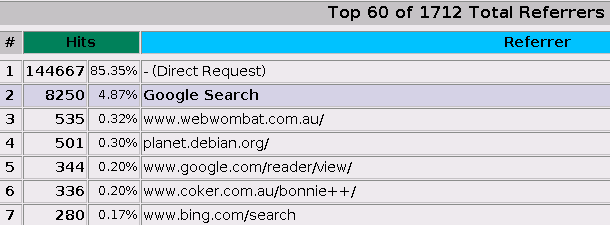
Chris Smart writes about the latest money making schemes for OS distributors, Canonical is getting paid by Yahoo to make them stop using Google as the default Firefox search engine [1]. I think this is OK, the user can easily change it back if desired and it allows them to pay the salaries of more employees who contribute code back to upstream projects. MSN uses 455M, Google uses 189M, and Yahoo uses 109MGoogle referrs 8250 hits, but Bing only refers 280 Above are sections of my Webalizer output related to my blog which show the data transfer use of search.msn.com (Bing presumably) which is 50% greater than that of Google and Yahoo combined. Why does MSN need to do 455MB of transfer so far this month to scan my blog when Google gets the job done with 189M and Yahoo only takes 109M? Also judging by the referrals Bing is only 3% as much use to me as Google. MSN uses 525M, Yahoo uses 132M, and Google only uses 35M Above is a sample of the Webalizer output from www.coker.com.au, MSN is using 525MB of data to scan the site which contains about 1.2G of static files that change very rarely. A Russian malware site seems to be downloading it three times a month, and Google only takes 35MB of data transfer to scan the site (which is probably still excessive). If Bing was a quality search engine that returned appropriate results then this could be forgiven. But however it is a very poor search engine that returns bad results. For example if you query Google or Yahoo for bonnie++ you will get an entire page of search results concerning my Bonnie++ benchmark, and those results are ordered in a sensible way. If you ask Bing then the first four results concern Bonnie (three women and a plant) and most of the first page don t concern my benchmark. Some time ago I had blocked MSN from scanning a server that I ran. The server in question had all the web servers for my domain plus quite a few other small domains. The total MSN data transfer was 3G per month which was almost half the data allowance for the server in question (data plans in Australia suck that s why my web servers are hosted in Germany now), so it was a question of whether to allow normal operation of the business or MSN searches. With Microsoft not running a popular search engine (then or now) it was an easy decision. I think that anyone who accepts money from Microsoft/Bing is doing their users a mis-service. Bing is simply an inferior search engine, it gets bad results and imposes excessive costs on service providers. Yahoo however seems to be a reasonable service, not as good as Google for the web hosters but not too bad. I wonder what would happen if Yahoo offered some sponsorship money to the Debian project in exchange for being the default search engine. I m sure it would be dramatic.

22 January 2010

Steve Kemp: We have to be ready to do anything. Do you hear me?

Good people steal ideas, right? On that basis I setup a static domain to host the javascript and icons I use upon a few different sites & projects. This was preempted by the release of a new version of the excellent jQuery library. I also managed to put together a tremendous hack to solve a pretty annoying problem running multiple distributions from a single external kernel under KVM. Ubuntu users, in particular, will be well aware of dmesg SPAM coming from the use of CONFIG_SYSFS_DEPRECATED. In short the way that the kernel presents information beneath the /sys tree has changed over the life of the kernel - and this has a knock-on effect to the userspace supplied by different distributions and releases of GNU/Linux.
Some distributions need an "old" kernel and an "old" udev with "old" udev rules in order to create the appropriate device nodes such that the kernel will boot & mount its filesystems. (i.e. These need CONFIG_SYSFS_DEPRECATED to be set.) Conversely some distributions mandate a "new" minimum kernel version, and supply a "new" version of udev with "new" udev rules and they absolutely will not function when presented with an "old" kernel. (i.e. They must have kernels without CONFIG_SYSFS_DEPRECATED set.)
I've solved this problem via a kernel patch which is both evil and genius. The details are a little me-specific, but in short: Ultimately udev doesn't get an empty /dev tree to play with, instead it finds one already pre-populated, such that any devices it cannot create are there regardless - because the devtmpfs implementation has already created them. Genius. And evil. So very evil. Meh. Steal that idea. I dare you .. (I'm impressed at how well devtmpfs works, and how easy I was able to make my "patch of evil"tm. Just a few lines in fs/namespace.c.) ObSubject: The Last House On The Left

Russell Coker: How to Lose Customers

Bruce Everiss who is famous for being threatened with legal action by Evony has been writing about the supposed losses from game piracy, in his latest missive he copies the text from a number of blog comments without citing the original authors [1]. He copied my text without citing me as the author (which is at best shoddy journalism and by a fundamentalist attitude such as his could be considered as piracy). He also copied my text in with a bunch of other comments which he attributes to The thieves . It s unfortunate that Bruce doesn t seem capable of understanding irony, he wrote There is no doubt whatsoever that downloading and playing a game that should have been paid for is theft and then copied part of the text of my comment where I provided a dictionary definition of theft that directly contradicts his claim. If he was at all interested in quality writing he would cite his references and then when a dictionary is cited which disagrees with his opinion he would at least try to find a dictionary with a more agreeable definition. It shouldn t be THAT difficult to find a dictionary that has multiple definitions of theft of which one is agreeable to the MAFIAA [2]. Now if Bruce had properly read my comment he would have seen I ve started watching content from sites such as blip.tv (in the little time I have for such things) and I only play games that are part of the Debian distribution of Linux (free software) which makes it very clear to any reasonable interpretation that I am not a game pirate and probably not even a movie pirate. I did mention in a comment on Bruce s blog that the DVD experience of being forced to sit through a whinge about piracy was a factor that made buying a DVD a worse experience than downloading it, a concept that I expanded into a blog post on the relative technical merits of DVDs and pirate MP4 files [3]. That post received a number of interesting comments including one from Josselin Mouette which had some useful technical detail about subtitles and audio track storage. I had believed that there were some real technical advantages of DVDs but Josselin corrected me on this matter. Also one thing that is noteworthy is that Bruce seems to use a copyright picture in almost every post but he doesn t attribute any of them. It does seem unusual for someone to use commercial artwork without any copyright or trademark notices attached. This usually isn t a big deal for a blogger, a liberal interpretation of copyright and trademark law is usually expected in terms of blogging corporations will tend to be hesitant to invoke the Streisand effect by suing a blogger (EG Bruce blog came to fame when he was sued by Evony). But when a blogger is writing about the importance of not pirating anything it would seem sensible to go to the effort of citing trademark and copyright references and also mentioning the licence agreements under which the IP was used. I believe that any loss of customers and revenue by the MAFIAA and the gaming industry is due to the actions of the companies involved. They should just try to make their customers happy, otherwise they lose the customers. The same goes for bloggers. I read blogs written by people who disagree with me, and sometimes by people who offend me on occasion. But Bruce is making baseless claims while deliberately ignoring evidence. He is calling for strong anti-piracy measures while doing what could be considered as pirating my work. He uses words in ways that conflict with dictionary definitions, and he calls for an end to our current legal system by demanding punishment based on three accusations rather than any legal process. I even pointed out to Bruce that if there was a three strikes law regarding accusations of copyright infringement then his blog would be offline after three accusations by Evony. Sorry Bruce, if I was looking for irrational rants about copyright then I would look at what the members of the Science Fiction Writers of America (SFWA) are doing [4]. The SFWA people demonstrate as much knowledge of computers and the Internet as Bruce does, but they are at least really good writers. If it was just me unsubscribing from Bruce s RSS feed then it wouldn t matter (I m one of tens of thousands of readers). But I expect that a large portion of the new readers Bruce acquired after being attacked by Evony will disappear when they see Bruce as the attacker and everyone who uses the Internet as a potential victim of the Three Strikes law.

Marc 'Zugschlus' Haber: Block devices in KVM guests

In the last few days, I found the time to spend some with KVM and libvirt. Unfortunately, there is a subject that I haven t yet found a satisfying solution: Naming of block devices in guest instances. This is surely a common issue, but solutions are rare. Neither an article on Usenet (in German) nor the German version of this blog article has found solutions for the main question. I should have written this in English in the first place and am thus translating from German to english, hoping that there will be some answers and suggestions. KVM is quite inflexible when it coms to configure block devices. It is possible to define on the host, which files or whole devices from the host should be visible in the guest. The documentation suggests that devices should be brought into the guest with the virtio model, which needs suppport in the guest kernel. Importing a device as emulated ATA or SCSI device brings a performance penalty. The devices brought into the guest via virtio appear in the guest s dev as /dev/vd<x> and do also have their corresponding entries in /dev/disk/by-uuid and /dev/disk/by-path. The vd<x> node is simply numbered in consecutive order as hd<x> and sd<x>. /dev/disk/by-uuid is the correct UUID of the file system found on the device, at least if it s a block device partitioned inside the guest and formatted with ext3 (I didn t try anything else yet). The terminology of the /dev/disk/by-path node is not yet understood, and I am somewhat reluctant to assume the PCI paths of emulated hardware as stable. Looks like I am forced to configure inside the guest when I have changed the host s mass storage system (for example, after migration to a different file system or after new block devices have been added) to accommodate for the new order of the /dev/vd<x> or to have the UUID correctly configured. This is like calling for configuration errors. This is a reincarnation of the same issue that has been killed by LVM on Linuxes running on bare metal : The block device itself has a mnemonic name which is constant even in migration and copy actions. This works without file-system specific stuff like UUID or label, and wouldn t even be possible with a UUID (which won t be unique in this case). The mnemonic names of LVs are also available when the data is directly written to the raw device such as a CNFS buffer of a news server. I would love to have something like a paravirtualized device mapper interface which would allow to say in the host s configuration which of the host s LVs should be visible in the guest with which name in /dev/mapper. That way, the guest s configuration could remain stable during data wrangling operations on the host. One solution is to have a single LV for each guest and import this LV as /dev/vda into the guest. /dev/vda would then be partitioned like a real disk and have its own LVM installation. This would however need kpartx if one wants to access the data from the host, and loses flexibility when resizing file systems. These issues appear in every installation of KVM virtualization, and I would expect that there are gazillions of other possible solutions. I am interested in knowing how other people have tackled this issue and whether there are more possiblity that I haven t thought of before. Maybe there is a solution that doesn t leave me with the feeling of having implemented something ugly. Does the interface between the host s KVM and the guest s device mapper that I have been dreaming of maybe exist. Or is there any other possibility of configuring the device node s name in the guest Linux on the host side?

21 January 2010

Daniel Kahn Gillmor: TCP weirdness, IMAP, wireshark, and perdition

This is the story of a weirdly unfriendly/non-compliant IMAP server, and some nice interactions that arose from a debugging session around it. Over the holidays, i got to do some computer/network debugging for friends and family. One old friend (I'll call him Fred) had a series of problems i managed to help work through, but was ultimately basically stumped based on the weird behavior of an IMAP server. Here's the details (names of the innocent and guilty have been changed), just in case it helps other folks in at least diagnosing similar situations. the diagnosis The initial symptom was that Fred's computer was "very slow". Sadly, this was a Windows machine, so my list of tricks for diagnosing sluggishness is limited. I went through a series of questions, uninstalling things, etc, until we figured it would be better to just have him do his usual work while i watched, kibitzing on what seemed acceptable and what seemed slow. Quite soon, we hit a very specific failure: Fred's Thunderbird installation (version 2, FWIW) was sometimes hanging for a very long period of time during message retrieval. This was not exhaustion of the CPU, disk, RAM, or other local resource. It was pure network delay, and it was a frequent (if unpredictable) frustrating hiccup in his workflow. One thought i had was Thunderbird's per-server max_cached_connections setting, which can sometimes cause a TB instance to hang if a remote server thinks Thunderbird is being too aggressive. After sorting out why Thunderbird was resetting the values after we'd set them to 0 (grr, thanks for the confusing UI, folks!), we set it to 1, but still had the same occasional, lengthy (about 2 minutes) hang when transfering messages between folders (including the trash folder!), or when reading new messages. Sending mail was quite fast, except for occasional (similarly lengthy) hangs writing the copy to the sent folder. So IMAP was the problem (not SMTP), and the 2-minute timeouts smelled like an issue with the networking layer to me. At this point, i busted out wireshark, the trusty packet sniffer, which fortunately works as well on Windows as it does on GNU/Linux. Since Fred was doing his IMAP traffic in the clear, i could actually see when and where in the IMAP session the hang was happening. (BTW, Fred's IMAP traffic is no longer in the clear: after all this happened, i switched him to IMAPS (IMAP wrapped in a TLS session), because although the IMAP server in question actually supports the STARTTLS directive, it fails to advertise it in response to the CAPABILITIES query, so Thunderbird refuses to try it. arrgh.) The basic sequence of Thunderbird's side of an initial IMAP conversation (using plain authentication, anyway) looks something like this:
1 capability
2 login "user" "pass"
3 lsub "" "*"
4 list "" "INBOX"
5 select "INBOX"
6 UID fetch 1:* (FLAGS)
What i found with this server was that if i issued commands 1 through 5, and then left the connection idle for over 5 minutes, then the next command (even if it was just a 6 NOOP or 6 LOGOUT) would cause the IMAP server to issue a TCP reset. No IMAP error message or anything, just a failure at the TCP level. But a nice, fast, responsive failure -- any IMAP client could recover nicely from that by just immediately opening a new connection. I don't mind busy servers killing inactive connections after a reasonable timeout. If it was just this, though, Thunderbird should have continued to be responsive. the deep weirdness But if i issued commands 1 through 6 in rapid succession (the only difference is that extra 6 UID fetch 1:* (FLAGS) command), and then let the connection idle for 5 minutes, then sent the next command: no response of any kind would come from the remote server (not even a TCP ACK or TCP RST). In this circumstance, my client OS's TCP stack would re-send the data repeatedly (staggered at appropriate intervals), until finally the client-side TCP timeout would trigger, and the OS would report the failure to the app, which could turn around and do a simple connection restart to finish up the desired operation. This was the underlying situation causing Fred's Thunderbird client to hang. In both cases above (with or without the 6th command), the magic window for the idle cutoff was a little more than 300 seconds (5 minutes) of idleness. If the client issued a NOOP at 4 minutes, 45 seconds from the last NOOP, it could keep a connection active indefinitely. Furthermore, i could replicate the exact same behavior when i used IMAPS -- the state of the IMAP session itself was somehow modifying the TCP session behavior characteristics, whether it was wrapped in a TLS tunnel or not. One interesting thing about this set of data is that it rules out most common problems in the network connectivity between the two machines. Since none of the hops between the two endpoints know anything about the IMAP state (especially under TLS), and some of the failures are reported properly (e.g. the TCP RST in the 5-command scenario), it's probably safe to say that the various routers, NAT devices, and such were not themselves responsible for the failures. So what's going on on that IMAP server? The service itself does not announce the flavor of IMAP server, though it does respond to a successful login with You are so in, and to a logout with IMAP server logging out, mate. A bit of digging on the 'net suggests that they are running a perdition IMAP proxy. (clearly written by an Aussie, mate!) But why does it not advertise its STARTTLS capability, even though it is capable? And why do some idle connections end up timing out without so much as an RST, when other idle connections give at least a clean break at the TCP level? Is there something about issuing the UID command that causes perdition to hand off the connection to some other service, which in turn doesn't do proper TCP error handling? I don't really know anything about the internals of perdition, so i'm just guessing here. the workaround I ultimately recommended to Fred to reduce the number of cached connections to 1, and to set Thunderbird's interval to check for new mail down to 4 minutes. Hopefully, this will keep his one connection active enough that nothing will timeout, and will keep the interference to his workflow to a minimum. It's an unsatisfactory solution to me, because the behavior of the remote server still seems so non-standard. However, i don't have any sort of control over the remote server, so there's not too much i can do to provide a real fix (other than point the server admins (and perdition developers?) at this writeup). I don't even know the types of backend server that their perdition proxy is balancing between, so i'm pretty lost for better diagnostics even, let alone a real resolution. some notes I couldn't have figured out the exact details listed above just using Thunderbird on Windows. Fortunately, i had a machine with a decent OS available, and was able to cobble together a fake IMAP client from a couple files (imapstart contained the lines above, and imapfinish contained 8 LOGOUT), bash, and socat. Here's the bash snippet i used as a fake IMAP client:
spoolout()   while read foo; do sleep 1 && printf "%s\r\n" "$foo" ; done  
( sleep 2 && spoolout < imapstart && sleep 4 && spoolout < imapfinish && sleep 500 )   socat STDIO TCP4:imap.fubar.example.net:143
To do the test under IMAPS, i just replaced TCP4:imap.fubar.example.net:143 with OPENSSL:imap.fubar.example.net:993. And of course, i had wireshark handy on the GNU/Linux machine as well, so i could analyze the generated packets over there. One thing to note about user empowerment: Fred isn't a tech geek, but he can be curious about the technology he relies on if the situation is right. He was with me through the whole process, didn't get antsy, and never tried to get me to "just fix it" while he did something else. I like that, and wish i got to have that kind of interaction more (though i certainly don't begrudge people the time if they do need to get other things done). I was nervous about breaking out wireshark and scaring him off with it, but it turned out it actually was a good conversation starter about what was actually happening on the network, and how IP and TCP traffic worked. Giving a crash course like that in a quarter of an hour, i can't expect him to retain any concrete specifics, of course. But i think the process was useful in de-mystifying how computers talk to each other somewhat. It's not magic, there are just a lot of finicky pieces that need to fit together a certain way. And Wireshark turned out to be a really nice window into that process, especially when it displays packets during a real-time capture. I usually prefer to do packet captures with tcpdump and analyze them as a non-privileged user afterward for security reasons. But in this case, i felt the positives of user engagement (how often do you get to show someone how their machine actually works?) far outweighed the risks. As an added bonus, it also helped Fred really understand what i meant when i said that it was a bad idea to use IMAP in the clear. He could actually see his username and password in the network traffic! This might be worth keeping in mind as an idea for a demonstration for workshops or hacklabs for folks who are curious about networking -- do a live packet capture of the local network, project it, and just start asking questions about it. Wireshark contains such a wealth of obscure packet dissectors (and today's heterogenous public/open networks are so remarkably chatty and filled with weird stuff) that you're bound to run into things that most (or all!) people in the room don't know about, so it could be a good learning activity for groups of all skill levels. Tags: debugging, imap, perdition, wireshark

Next.

Previous.