Search Results: "pm"

3 February 2011

Pau Garcia i Quiles: FOSDEM 2011

Another year, another FOSDEM. Yay, I m attending again! The biggest open source event in Europe, with more than 200 conferences and 5,000 people.

This year I will be talking about KDE on Windows. Sunday, 10.15, CrossDesktop Room (H.1309). If you are interested in helping us with KDE on Windows development, in making use of KDE on Windows for your application, or just want to use your favorite KDE applications on Windows, then you should come.

Raphaël Hertzog: People behind Debian: Mike Hommey, Firefox/Iceweasel maintainer

Mike Hommey, our Iceweasel maintainer

For as long as I have known Mike, he s been maintaining one of the largest (and most widely used) package: Iceweasel, Debian s default web browser. It s effectively Mozilla s Firefox although it has been renamed to avoid some rules enforced by Mozilla s trademark policy. But we might see Firefox back in Debian read on to know Mike s plans. His story is also very interesting in that he went from simple user to Iceweasel maintainer, and now he s working for Mozilla Corporation. But you already knew that contributing to free software is a good way to grow skills and gain experience that are valuable on the job market, right? ;-) My questions are in bold, the rest is by Mike. Who are you? I am Mike Hommey. I am French, even if my name doesn t sound so. I have been a GNU/Linux user since 1995, using Debian since 1999, and started packaging in 2003. After a long time in the NM queue, I became a DD in 2005. The main reason I started being actively involved is quite selfish: I wanted some things done, and I just did them. My first packages were extensions for the Mozilla Suite, the old one that directly inherited from Netscape Communicator. Later on, I wanted some of these extensions to work with the new kid on the block: Phoenix; or maybe it was already Firebird. By then, integrating extensions was a hassle, and the mozilla-browser maintainer had come up with a script that would make it easier for extension packages. So I ported that script for use with Phoenix/Firebird and sent it to the BTS. Then Phoenix/Firebird became Firefox, and it grew a real extension manager. Except that is was entirely not suited for extensions installed by the packaging system. So I made it work better. And made a few more changes to make Firefox work better. All through patches or NMUs. Then I became co-maintainer, then Firefox couldn t keep its name and became Iceweasel, and, fast-forward until today, I m now taking care of Iceweasel/Xulrunner and Iceape in stable, unstable, experimental and an external repository. This 8 years-long story (wow, I hadn t even realized it had been that long until I wrote it) tells you something: newcomers shouldn t be afraid to stick their hands anywhere, even in big packages. I was only a Mozilla and Phoenix end-user when I started. Apart from Mozilla-related packaging, I also happen to (co-)maintain some other packages in Debian, most notably webkit, though I haven t been very active in the pkg-webkit team recently. There are several reasons for that, the main one being that there are other team members getting the job done. And I can t say that much about the pkg-mozilla team, since there are effectively no other team members. What s your biggest achievement within Debian? I am quite proud that Squeeze will be the first Debian release where Iceweasel works on all supported architectures. Previously, we only knew the package compiled on all these architectures. Starting with Squeeze, we know it passes several of the test suites coming with the source code. This ensures most of the browser is functional. It was actually far from being the case before, as it appeared when the test suites were first enabled. I think it is very important to have properly working packages on all our supported architectures. The current evolution of hardware shows how important it still is. Who would have thought a few years back that we would see ARM or MIPS based netbooks today ? What are your plans for Debian Wheezy? For Debian Wheezy, I would like to improve Iceweasel/Icedove/Iceape integration with the packaging system. Something that would allow to use the apt database to find extensions or plugins, on top of the current behaviour. I also want to improve desktop integration, most notably for KDE. Another thing I d like to see happen is to package google breakpad independently (its source code is currently embedded in chromium and iceweasel, though not built, as far as I know), and have our Mozilla products builds be able to send their crash reports upstream. It is very important that upstream gets direct visibility over what crashes on GNU/Linux systems. It helps making them aware of issues that would otherwise probably remain unnoticed, as there are much more users using distributions packages than upstream tarballs. And not all Debian users report crashes to the BTS. I know at least Fedora and SuSE are already doing it. More importantly, I want to avoid the sad situation we got with Squeeze, where we re going to release a 18 months old Iceweasel. We got there for a combination of reasons, one being that I was preparing for a freeze in December 2009 and focusing on getting 3.5 in shape instead of the then upcoming 3.6. The result was that we didn t get 3.6 packages before upstream released 3.6.3 in April 2010. By then it was too late, considering the uncertainty of the release schedule, to update reverse dependencies and get 3.6 ready for Squeeze. Things are different for 4.0. I m already getting ahead of things, and while reverse dependencies haven t been taken care of, all beta releases have been made available through http://mozilla.debian.net/, usually within hours after upstream release (sometimes even a few hours before official announcement, but always after availability on ftp.mozilla.org). A great share of our patches were also pushed upstream. Several things made that possible: There will be a couple major upstream releases until Wheezy comes along, and I want to make them available early in unstable, even if that means breaking reverse dependencies until they are fixed. Finally, I would like to get other people involved, starting with the Icedove maintainer. Volunteers are very much welcome, for any kind of involvement: bug triaging, documentation (which we are deeply lacking), testing, code People interested can contact the pkg-mozilla team list. As the Debian packaging gets less time consuming, I should be able to spend more time mentoring, which should help. If you could spend all your time on Debian, what would you work on? I actually have been working almost full time on Debian for a few months during a more-or-less purposeful unemployment period. That s when I attempted to add an alert popup when Iceweasel or extensions are upgraded (which was eventually removed because not working very effectively). That s when I worked on Iceweasel 3.6 and the first 4.0 betas. That s when I pushed more than 70 patches upstream, and got upstream commit access. I know for a fact that keeping up with upstream and answering bug reports is already time consuming, and time comes in finite quantity. Working full time on Debian allows to do more than that, as I ve been able to experience first hand. Unfortunately, that doesn t help pay the bills, so it would be best if time could be shared with other persons. Like, actual members in the pkg-mozilla team. ;) Anyways, if I were to work full time on Debian again, I d like to do more than packaging, and help improve some of our infrastructure, most notably the buildd network, to grow some automated way to get packages built on all or some of our architectures. Call that PPA if you want, though I don t think we need something exactly like PPA. We sure do have porter boxes, but there is a huge overhead to get packages built there: you need to first try, then see you lack build dependencies, then wait for admins to install them, then come back and launch your build, and finally come back again much later to see how it went. And that s when it goes smoothly. Repeat for each architecture. It s already cumbersome when it s a small package, so imagine when it s Iceweasel. I d like to be able to push a (signed) .dsc somewhere, say I want it built on that and that architecture, and get binary packages and logs back. It could then be up to developers to distribute them, or not. Sometimes, you re just interested in test suite results. Another related wish would be a way to access build trees of failed builds, possibly on the buildd where it failed. What s the biggest problem of Debian? Lack of contributors, lack of contributors, and lack of contributors. It can sound weird to say that in a community of 1000+ people. But the sad reality is that we ve seen, repeatedly, calls for help in various places from various understaffed teams (most often of effectively one member) for years. So there is obviously a problem getting people to invest time in these teams either on the long term, or at all. I know this is not a very significant metric, but it already should say a lot: I wouldn t be surprised if more than 2/3 of the number of source lines of code in Debian come from less than 5% of the number of packages in the archive, and see less than 5% of the DD/DM population involved. If someone feels like doing the actual math, I m curious to know how far I m from reality, and in what direction. We also lack manpower to be able to make our release development smoother. In a perfect world where manpower is not a scarce resource, we should work on $release+1 when $release is being frozen. Said otherwise, we should have been able to start working on Wheezy in August 2010, or even earlier. You ve been working for Mozilla Corporation for a few months. How does the work look like and what are you working on? I am actually not working full time for MoCo; I am only contracting for 4 days a week. That was a request I made to keep having enough spare time for Debian or other activities. I am working from home, and am pretty much free about when I work, as long as I work long enough. I take advantage of this freedom and the saved commuting time to live a healthier life by doing some sports in the daytime (which also happens to be cheaper). I mostly work with Taras Glek and other people on various aspects of Firefox startup performance. This involves pretty interesting low-level stuff, in which I actually got involved before being contracted. This work has nothing to do with packaging Iceweasel, though I can have a few opportunities to do things somehow related. You told in your blog that you were discussing with Mozilla how Debian could use the Firefox trademark. Can you tell us a bit about the progress you made? I have got an informal approval of the patches we are applying to the Iceweasel 4.0 beta packages. There are a few concerns about using the system cairo library, and the embedded copy of libpng needs to be used to have support for the animated PNGs that are used in the user interface and that are required in Firefox feature-set. Other than that, there are pretty much no objection on the technical side. We managed to get to some common ground as to how to manage stable updates and more generally, changes to our packages, but I m still waiting for an actual agreement draft. While I, as the maintainer, am fine with the way it should look according to my discussions with the people involved at Mozilla, I ll seek review from my fellow Debian Developers when I ll have something to show. I haven t decided yet how this will reflect on the Debian packages, though. For example, would Iceweasel stay? But I do hope Wheezy will get Firefox back. Is there someone in Debian that you admire for their contributions? Not someone, but all past, present and future release team members. This is a team that receives a lot of critics (and I indirectly gave one a few paragraphs ago), yet manages to keep doing an amazing job and its members are very committed to their task. I admire their dedication.
Thank you to Mike for the time spent answering my questions. I hope you enjoyed reading his answers as I did. Subscribe to my newsletter to get my monthly summary of the Debian/Ubuntu news and to not miss further interviews. You can also follow along on Identi.ca, Twitter and Facebook.

8 comments Liked this article? Click here. My blog is Flattr-enabled.

2 February 2011

Dominique Dumont: My synopsis suck

Hello I ve taken a step back and looked at the synopsis of the Config::Model man
pages. Boy, I m not proud of what I ve released. Except the ones I ve reworked recently, most of them are worthless. The next release of Config::Model will feature new synopsis. Each synopsis will contain a valid example that can be run with a cut n'paste in a test file. The code in the synopsis will actually do something visible. Here s an example extracted from the next version of Config::Model::Dumper:
 use Config::Model ;
 use Log::Log4perl qw(:easy) ;
 Log::Log4perl->easy_init($WARN);
 # define configuration tree object
 my $model = Config::Model->new ;
 $model ->create_config_class (
    name => "MyClass",
    element => [
        [qw/foo bar/] =>  
            type => 'leaf',
            value_type => 'string'
         ,
        baz =>  
            type => 'hash',
            index_type => 'string' ,
            cargo =>  
                type => 'leaf',
                value_type => 'string',
             ,
         ,
    ],
 ) ;
 my $inst = $model->instance(root_class_name => 'MyClass' );
 my $root = $inst->config_root ;
 # put some data in config tree the hard way
 $root->fetch_element('foo')->store('yada') ;
 $root->fetch_element('bar')->store('bla bla') ;
 $root->fetch_element('baz')->fetch_with_id('en')->store('hello') ;
 # put more data the easy way
 my $step = 'baz:fr=bonjour baz:hr="dobar dan"';
 $root->load( step => $step ) ;
 # dump data
 print $root->dump_tree;
Feel free to log bugs on Debian BTS or on CPAN RT if the next synopsis still have problems. All the best

1 February 2011

Cyril Brulebois: Debian XSF News #3

Time for a third Debian XSF News issue! Debian XSF News #3 It s been a year On a personal note, it s been a year to the day since I first looked into X. After having hacked on the Debian Installer to make it use X.Org instead of DirectFB, I did some heavy bug triaging, resulting in a drop in the xorg-server bug count in March. The same happened past week as written above, resulting in a second drop. In the meanwhile, the bug count remained more or less stable, since we try to reply quickly to new bugs, and since Julien Viard de Galbert does bug triaging on a weekly basis: BTS graph for xorg-server One might ask: what does maintaining X mean?

30 January 2011

Dominique Dumont: How to configure OpenSsh through a virtual filesystem

Hello My blog How about a configfs with Config::Model ? mentioned the on-going work to provide an access to configuration data through a virtual file system , i.e. through fuse. This new feature is now working since Config::Model 1.231. As an example, let s see how Fuse can be used to your ssh client. I.e. how to use config-edit command to modify your ~/.ssh/config through a virtual file system. Note that this is just an example, Fuse can also be used for other configuration withan existing model. First, you need to install Config::Model and Fuse and the fuse software. If you re on Debian/Sid, installing all this is straightforward:
$ sudo aptitude install libconfig-model-perl libfuse-perl
On other systems, you can use CPAN to install the Perl modules
$ cpanp i Fuse
$ cpanp i Config::Model
Hopefully, fuse library will be available through a package on your favorite repository. Let s start from an empty ssh configuration file. First you need to create a directory that will be used by Fuse as a mount point:
$ mkdir my_fuse_dir
Then run config-edit-ssh (which will be changed later to config-edit -applit ssh ):
$ config-edit-ssh -ui fuse -fuse_dir my_fuse_dir
Mounting config on my_fuse_dir in background.
Use command fusermount -u my_fuse_dir to unmount
Now, all parameters that can be configured in /.ssh/config are shown as files and directories in the fuse directory (the list was reduced to save electrons):
$ tree my_fuse_dir/
my_fuse_dir/
AddressFamily
BatchMode
BindAddress
ForwardX11
ForwardX11Trusted
[snip]
HashKnownHosts
Host
*
ConnectionAttempts
[snip]
User
UserKnownHostsFile
VerifyHostKeyDNS
VisualHostKey
XAuthLocation
HostbasedAuthentication
HostKeyAlgorithms
[snip] 14 directories, 119 files
Let s say that we want to configure specific settings for 2 hosts: First step is to create the repoman entry:
$ mkdir my_fuse_dir/Host/repoman
A ls command in that new directory will show a lot of files:
$ ls my_fuse_dir/Host/repoman
IdentityFile Protocol Tunnel
CheckHostIP ForwardX11 KbdInteractiveAuthentication ProxyCommand TunnelDevice
Lo and behold, one of them is ForwardX11 ! Let s check what s in there:
$ cat my_fuse_dir/Host/repoman/ForwardX11
Since the entry is new, it s still empty. Enabling X11Forward for repoman is quite easy:
$ echo 1 > my_fuse_dir/Host/repoman/ForwardX11
Let s check:
$ cat my_fuse_dir/Host/repoman/ForwardX11
1
Now, unmount the fuse directory:
$ fusermount -u my_fuse_dir
And see the modified .ssh/config file:
$ cat ~/.ssh/config
Host repoman
ForwardX11 yes
You can see that ForwardX11 is indeed set to yes for host repoman. Last but not least, you may consider that handling files and directories through shell commands is not very easy for the end user. You re right. But that s not the point. The idea is to enable programmers to access and edit configuration data with any language (not only Perl). Just like a lot of program can access kernel data through /proc and /sys, configuration data can now be accessed in a unified way through this virtual file system. May be, one day, exploring /config will be as common as exploring /sys All the best

28 January 2011

Michal Čihař: phpMyAdmin improvements

As my Gammu Hackweek 6 project went smoothly, I've decided to spend some time today on phpMyAdmin as well. My work was mostly inspired by (IMHO unfair) comparing of Adminer and phpMyAdmin. I could surely create similar comparing where would be dozens of things why is phpMyAdmin better, but I don't want to go that way and I rather decided to spend my time on coding. First and easy task was bit which is in comparing described as "Status variables", where I've added documentation links, so phpMyAdmin now has both short executive summary and link to the official documentation. While looking at server status page, I've categorized some newly added variables, so they now appear in right place. I also reconsidered formatting of numbers and hopefully current solution will work for everybody and not produce contradicting bug reports like the old one. Then I did focus a little bit on testing AJAX and fixed some minor issues, mostly affecting Chrome/Chromium browsers, because they are strict in case of some errors. Last but not least I've added URL redirector inside phpMyAdmin, so no external links will now reveal what did user actually was doing in phpMyAdmin, but rather the url of the redirector. And when speaking about phpMyAdmin, I need to mention one thing as well: contribute yourself! You don't have to be developer, there is currently ongoing themes contest and we're always looking for translators.

Filed under: English Phpmyadmin Suse 0 comments Flattr this!

Amaya Rodrigo: Indignez Vous!

If There is any sort of food for thought worth reading, this is it.
INDIGNEZ-VOUS! GET ANGRY! CRY OUT by St phane Hessel


St phane Hessel, author of Indignez-vous!
After 93 years, it is almost the final act. The end for me is not very far off any more. But it still leaves me a chance to be able to remind others of what acted as the basis of my political engagement. It was the years of resistance to the Nazi occupation -- and the program of social rights worked out 66 years ago by the National Council of the Resistance!

It is to Jean Moulin [murdered founder of the Council] that we owe, as part of this Council, the uniting of all elements of occupied France -- the movements, the parties, the labor unions -- to proclaim their membership in Fighting France, and we owe this to the only leader that it acknowledged, General de Gaulle. From London, where I had joined de Gaulle in March 1941, I learned that this Council had completed a program and adopted it on March 15th, 1944, that offered for liberated France a group of principles and values on which would rest the modern democracy of our country.

These principles and these values, we need today more than ever. It is up to us to see to it, all together, that our society becomes a society of which we are proud, not this society of immigrants without papers -- expulsions, suspicion regarding the immigrants. Not this society where they call into question social security and national retirement and health plans. Not this society where mass media are in the hands of the rich. These are things that we would have refused to give in to if we had been the true heirs of the National Council of the Resistance.


From 1945, after a dreadful drama [WWII], it was an ambitious
resurrection of society to which the remaining contingent of the Council
of the Resistance devoted itself. Let us remember them while creating
national health and pensions plans such as the Resistance wished, as its
program stipulated, "a full plan of French national health and social
security, aimed at assuring all citizens the means of existence whenever
they are unable to obtain them by a job; a retirement allowing the old
workers to finish their days with dignity."

The sources of energy, electricity, and gas, mines, the big banks, were
nationalized. Now this was as the program recommended: "... the return
to the nation of big monopolized means of production, fruits of common
labor, sources of energy, wealth from the mines, from insurance
companies and from big banks; the institution of a true economic and
social democracy involving the ousting of the big economic and financial
fiefdoms from the direction of the economy."

General interest must dominate over special interest. The just man
believes that wealth created in the realm of labor should dominate over
the power of money.

The Resistance proposed, "a rational organization of the economy
assuring the subordination of special interests to general interest, and
the emancipation of 'slaves' of the professional dictatorship that was
instituted just as in the fascist states," which had used the interim
[for two years after the war] government of the Republic as an agent.

A true democracy needs an independent press, and the Resistance
acknowledged it, demanded it, by defending "the freedom of the press,
its honor, and its independence from the State, the power of money and
foreign influence." This is what relieved restrictions on the press from
1944 on. And press freedom is definitely what is in danger today.

The Resistance called for a "real possibility for all French children to
benefit from the most advanced education," without discrimination.
Reforms offered in 2008 go contrary to this plan. Young teachers, whose
actions I support, went so far as refusing to apply them, and they saw
their salaries cut by way of punishment. They were indignant,
"disobeyed," judging these reforms too far from the ideal of the
democratic school, too much in the service of a society of commerce and
not developing the inventive and critical mind enough. 2

All the foundations of the social conquests of the Resistance are
threatened today.

The motive of the Resistance: indignation (Indignez-vous!)

Some dare to say to us that the State cannot afford the expenses of
these measures for citizens any more. But how can there be today a lack
of money to support and extend these conquests while the production of
wealth has been considerably augmented since the Liberation period when
Europe was in ruins? On the contrary, the problem is the power of money,
so much opposed by the Resistance, and of the big, boldfaced, selfish
man, with his own servants in the highest spheres of the State.

Banks, since privatized again, have proved to be concerned foremost for
their dividends and for the very high salaries of their leaders, not the
general interest. The disparity between the poorest and the richest has
never been so great, and amassing money, competition, so encouraged.

The basic motive of the Resistance was indignation!

We, the veterans of the resistance movements and combat forces of Free
France, we call on the young generation to live by, to transmit, the
legacy of the Resistance and its ideals. We say to them: Take our place,
"Indignez-vous!" [Get angry! or Cry out!].

The political, economic, intellectual leaders, and the whole society do
not have to give in, nor allow oppression by an actual international
dictatorship of the financial markets, which threatens peace and
democracy.

I wish for you all, each of you, to have your own motive for
indignation. It is precious. When something outrages you as I was
outraged by Nazism, then people become militant, strong, and engaged.
They join this current of history, and the great current of history must
continue thanks to each individual. And this current goes towards more
justice, more freedom, but not this unbridled freedom of the fox in the
henhouse. The rights contained in the UN Universal Declaration of Human
Rights of 1948 are just that, universal.

If you meet somebody who does not benefit from it, feel sorry for them
but help them to win their rights.

Two visions of history

When I try to understand what caused fascism, what made it so we were
overcome by Hitler and the Vichy [French government that collaborated
with Hitler], I tell myself that the propertied, with their selfishness,
were terrifically afraid of Bolshevik revolution. They were allowed to
lead with their fear.

But if, today as then, an active minority stands up, it will be enough;
we shall be the leavening that makes the bread rise. Certainly, the
experience of a very old person like me, born in 1917, is different from
the experience of the today's young persons. I often ask professors for
the opportunity to interact with their students, and I say to them: You
don't have the same obvious reasons to engage you. For us, to resist was
not to accept German occupation, defeat. It was comparatively simple.
Simple as what followed, decolonization. Then the war in Algeria.

It was necessary that Algeria become independent, it was obvious. As for
Stalin, we all applauded the victory of the Red Army against the Nazis
in 1943. But already we had known about the big Stalinist trials of
1935, and even if it was necessary to keep an ear open towards communism
to compensate against American capitalism, the necessity to oppose this
unbearable form of totalitarianism had established itself as an
obviousness. My long life presented a succession of reasons to outrage
me.

These reasons were born less from an emotion than a deliberate
commitment. As a young student at normal school [teachers college] I was
very influenced by Sartre, a fellow student. His "Nausea" [a novel],
"The Wall," [play], and "The Being and Nothingness" [essay] were very
important in the training of my thought. Sartre taught us, "You are
responsible as individuals." It was a libertarian message. The
responsibility of a person can not be assigned by a power or an
authority. On the contrary, it is necessary to get involved in the name
of one's responsibility as a human being.

When I entered the French Ecole Normale Superieure, Ulm Street, in Paris
in 1939, I entered it as a fervent adherent of the philosopher Hegel,
and I adhered to the thought of Maurice Merleau-Ponty. His teaching
explored concrete experience, that of the body and of its relations with
the senses, one big singular sense faced with a plurality of senses. But
my natural optimism, which wants all that is desirable to be possible,
carried me rather towards Hegel. Hegelism interprets the long history of
humanity as having a meaning: It is the freedom of man progressing step
by step. History is made of successive shocks, and the taking into
account of challenges. The history of societies thus advances; and in
the end, man having attained his full freedom, we have the democratic
state in its ideal form.

There is certainly another understanding of history. It says progress is
made by "freedom" of competition, striving for "always more"; it can be
as if living in a devastating hurricane. That's what it represented to a
friend of my father, the man who shared with him an effort to translate
into German "The Search for Time Lost" [novel] by Marcel Proust.

That was the German philosopher Walter Benjamin. He had drawn a
pessimistic view from a painting by the Swiss painter Paul Klee,
"Angelus Novus," where the face of the angel opens arms as if to contain
and push back a tempest, which he identifies with progress. For
Benjamin, who would commit suicide in September 1940 to escape Nazism,
the sense of history is the overpowering progression of disaster upon
disaster.

Indifference: the worst of attitudes

It is true the reasons to be indignant can seem today less clearly
related or the world too complex. Who's doing the ordering, who decides?
It is not always easy to differentiate between all the currents that
govern us. We are not any more dealing with a small elite whose joint
activities can be clearly seen. It is a vast world, of which we have a
feeling of interdependence.

We live in an interconnectivity as never before. But in this world there
still are intolerable things. To see them, it is well and necessary to
look, to search. I say to the young people, Search little, and that is
what you are going to find. The worst of attitudes is indifference, to
say "I can do nothing there, I'll just manage to get by." By including
yourself in that, you lose one of the essential elements that makes the
human being: the faculty of indignation and the commitment that is a
consequence of it.

They [young people] can already identify two big new challenges:

1. The huge gap which exists between the very poor and the very rich and
that does not cease increasing. It is an innovation of the 20th and 21st
centuries. The very poor in the today's world earn barely two dollars a
day. The new generation cannot let this gap become even greater. The
official reports alone should provoke a commitment.

2. Human rights and state of the planet: I had the chance after the
Liberation to join in the writing of the Universal Declaration of Human
Rights, adopted by the United Nations organization, on December 10th,
1948, in Paris at the palace of Chaillot. It was as principal private
secretary of Henry Laugier, the adjunct general-secretary of the UN, and
as and secretary of the Commission on Human Rights that I with others
was led to participate in the writing of this statement. I wouldn't know
how to forget the role in its elaboration of Ren Cassin, who was
national commissioner of justice and education in the government of Free
France in London in 1941 and won the Nobel peace prize in 1968, nor that
of Pierre Mend s-France in the Economic and Social Council, to whom the
text drafts we worked out were submitted before being considered by the
Third Committee (Social, Humanitarian and Cultural) of the General
Assembly. It was ratified by the 54 member states in session of the
United Nations, and I certified it as secretary.

It is to Ren Cassin that we owe the term "universal rights" instead of
"international rights" as offered by our American and British friends.
This [universal versus international] was key because, at the end of the
Second World War, what was at stake was to becomeereignty," which a
nation can emphasize while it devotes itself to crimes against humanity
on its own soil. Such was the case of Hitler, who felt himself supreme
and authorized to carry out a genocide. This universal statement owed
much to universal revulsion towards Nazism, fascism, and totalitarianism
-- and owes a lot, in our minds, to the spirit of the Resistance.

I had a feeling that it was necessary to move quickly so as not to be
dupes of the hypocrisy that there was in the UN membership, some whom
claimed these values already won but had no intention at all to promote
them faithfully -- claimed that we were trying to impose values on them.

I can not resist the desire to quote Article 15 of the Universal
Declaration of Human Rights (1948): "Everyone has the right to a
nationality." Article 22 says, "Everyone, as a member of society, has
the right to social security and is entitled to realization, through
national effort and international cooperation and in accordance with the
organization and resources of each State, of the economic, social and
cultural rights indispensable for his dignity and the free development
of his personality." And if this statement has a declarative scope, and
not statutory, the Declaration nevertheless has played a powerful role
since 1948. It saw colonized people take it up in their fight for
independence; it sowed minds in a battle for freedom.

I note with pleasure that in the course of last decades there has been
an increase in nongovernmental organizations (NGOs) and social movements
such as ATTAC (Association for the Taxation of Financial Transactions);

also FIDH (International Federation for Human Rights) and Amnesty
International, which are active and competitive. It is obvious that to
be effective today it is necessary to act in a network, to use all
modern means of communication.

To the young people, I say: Look around you, you will find topics that
justify your indignation facts about treatment of immigrants, of
"illegal" immigrants, of the Roma [aka Gypsies]. You will find concrete
situations that lead you to strong citizen action. Search and you shall
find!

My indignation regarding Palestine outrages by Israel [Indignez-vous!]

Today, my main indignation concerns Palestine, the Gaza Strip, and the
West Bank of Jordan. This conflict is outrageous. It is absolutely
essential to read the report by Richard Goldstone, of September 2009, on
Gaza, in which this South African, Jewish judge, who claims even to be a
Zionist, accuses the Israeli army of having committed "acts comparable
to war crimes and perhaps, in certain circumstances, crimes against
humanity" during its "Operation Cast Lead," which lasted three weeks.

I went back to Gaza in 2009 myself, when I was able to enter with my
wife thanks to our diplomatic passports, to study first-hand what this
report said. People who accompanied us were not authorized to enter the
Gaza Strip. There and in the West Bank of Jordan. We also visited the
Palestinian refugee camps set up from 1948 by the United Nations agency
UNRWA, where more than three million Palestinians expelled off their
lands by Israel wait even yet for a more and more problematical return.

As for Gaza, it is a roofless prison for one and a half million
Palestinians. A prison where people get organized just to survive.
Despite material destruction such as that of the Red Crescent hospital
by Operation Cast Lead, it is the behavior of the Gazans, their
patriotism, their love of the sea and beaches, their constant
preoccupation for the welfare of their children, who are innumerable and
cheerful, that haunt our memory. We were impressed by how ingeniously
they face up to all the scarcities that are imposed on them. We saw them
making bricks, for lack of cement, to rebuild the thousands of houses
destroyed by tanks. They confirmed to us that there had been 1400 deaths
including women, children, and oldsters in the Palestinian camp
during this Operation Cast Lead led by the Israeli army, compared to
only 50 injured men on the Israeli side. I share conclusions of the
South African judge. That Jews can, themselves, perpetrate war crimes is
unbearable. Alas, history does not give enough examples of people who
draw lessons from their own history. [The author, St phane Hessel, had
a Jewish father.]

Terrorism, or exasperation?

I know that Hamas [party of Palestine freedom fighters], which had won
the last legislative elections, could not help it that rockets were
launched on Israeli cities in response to the situation of isolation and
blockade in which Gazans exist. I think, naturally, that terrorism is
unacceptable; but it is necessary to acknowledge (from experience in
France) that when people are occupied by forces immensely superior to
their own, popular reaction cannot be altogether bloodless.

Does it serve Hamas to send rockets onto the town of Sd rot [Israeli
town across the border from Gaza]?

The answer is no. This does not serve their purpose, but they can
explain this gesture by the exasperation of Gazans. In the notion of
exasperation, it is necessary to understand violence as the regrettable
conclusion of situations not acceptable to those who are subjected them.

Thus, they can tell themselves, terrorism is a form of exasperation. And
that this "terrorism" is a misnomer. One should not have to resort to
this exasperation, but it is necessary to have hope. Exasperation is a
denial of hope. It is comprehensible, I would say almost natural, but it
still is not acceptable. Because it does not allow one to acquire
results that hope can possibly, eventually produce.

Nonviolence: the way we must learn to follow

I am persuaded that the future belongs to nonviolence, to reconciliation
of different cultures. It is by this way that humanity will have to
enter its next stage. But on this I agree with Sartre: We cannot excuse
the terrorists who throw bombs, but we can understand them. Sartre wrote
in 1947: "I recognize that violence in whatever form it may manifest
itself is a setback. But it is an inevitable setback because we are in a
world of violence. And if it is true that recourse to violence risks
perpetuating it, it is also true it is the sure means to make it stop."

To that I would add that nonviolence is a surer means of making violence
stop. One can not condone the terrorism, using Sartre or in the name of
this principle, during the war of Algeria, nor during the Munich Games
of 1972 the murder attempt made against Israeli athletes. Terrorism is
not productive, and Sartre himself would end up wondering at the end of
his life about the sense of violence and doubt its reason for being.

However, to proclaim "violence is not effective" is more important than
to know whether one must condemn or not those who devote themselves to
it. Terrorism is not effective. In the notion of effectiveness, a
bloodless hope is needed. If there is a violent hope, it is in the poem
of William Apollinaire "that hope is violent," and not in policy.

Sartre, in March 1980, within three weeks of his death, declared: "It is
necessary to try to explain why the world of today, which is horrible,
is only an instant in a long historical development, that hope always
has been one of the dominant forces in revolutions and insurrections,
and how I still feel hope as my conception of the future." [Note 5]

It is necessary to understand that violence turns its back on hope. It
is necessary to prefer to it hope, hope over violence. Nonviolence is
the way that we must learn to follow. So must the oppressors.
10

It is necessary to arrive at negotiations to remove oppression; it is
what will allow you to have no more terrorist violence. That's why you
should not let too much hate pile up.

The message of Mandela and Martin Luther King finds all its pertinence
in the world that overcame the confrontation of ideologies [e.g.,
Nazism] and conquered totalitarianism [e.g.,Hitler]. It is also a
message of hope in the capacity of modern societies to overcome
conflicts by a mutual understanding and a vigilant patience. To reach
that point is necessarily based on rights, against es, such as the
military intervention in Iraq.

We had this economic crisis, but we still did not initiate a new policy
of development. Also, the summit of Copenhagen against climatic warming
did not bring about a true policy for the preservation of the planet.

We are on a threshold between the terror of the first decade and the
possibilities of following decades. But it is necessary to hope, it is
always necessary to hope. The previous decade, that of 1990s, had been a
time of great progress. The United Nations had enough wisdom to call
conferences such as those of Rio on environment, in 1992, and that of
Beijing on women, in 1995. In September 2000, on the initiative of the
general secretary of United Nations, Kofi Annan, the 191 member
countries adopted a statement on the "eight objectives of the millennium
for development," by which they notably promised to reduce poverty in
the world by half before 2015.

My big regret is that neither Obama nor the European Union has yet
committed themselves to what should be the provision for a useful forum
bearing on the fundamental values.

Conclusion

How to conclude this call to be indignant? By saying still what, on the
occasion of the sixtieth anniversary of the program of the National
Council of the Resistance, we said on March 8th, 2004 -- we veterans of
the resistance movements and combat forces of Free France (1940-1945) --
that certainly "Nazism was conquered, thanks to the sacrifice of our
brothers and sisters of the Resistance and United Nations against
fascist barbarism. But this threat did not completely disappear, and our
anger against injustice is ever intact." [Note 6] Also, let us always be
called in "a truly peaceful insurrection against means of mass
communication that offer as a vista for our youth only the consumption
of mass trivia, contempt of the weakest and the culture, a generalized
amnesia, and the hard competition of all against all."

To those who will make the 21st century, we say with our affection:

TO CREATE IS TO RESIST; TO RESIST IS TO CREATE.

Jonathan McDowell: We fear undocumented change

I love revision control. I love the ability to track changes over time, whether that be to see why I changed something in the past, or to see why a particular thing has stopped working, or to see if a particular thing is fixed in a more recent version than the one I'm using. However I have a few opinions about the use of revision control that are obviously not shared by other people. Here are a few of them:

26 January 2011

Martin Pitt: Na zdrav PyGI!

(Update: Link to Tomeu s blog post, repost for planet.gnome.org) Last week I was in Prague to attend the GNOME/Python 2011 Hackfest for gobject-introspection, to which Tomeu Vizoso kindly invited me after I started working with PyGI some months ago. It happened at a place called brmlab which was quite the right environment for a bunch of 9 hackers: Some comfy couches and chairs, soldering irons, lots of old TV tubes, chips, and other electronics, a big Pirate flag, really good Wifi, plenty of Club Mate and Coke supplies, and not putting unnecessary effort into mundane things like wallpapers. It was really nice to get to know the upstream experts John (J5) Palmieri and Tomeu Vizoso (check out Tomeu s blog post for his summary and some really nice photos). When sitting together in a room, fully focussing on this area for a full week, it s so much easier to just ask them about something and getting things done and into upstream than on IRC or bugzilla, where you don t know each other personally. I certainly learned a lot this week (and not only how great Czech beer tastes :-) )! So what did I do? Application porting After already having ported four Ubuntu PyGTK applications to GI before (apport, jockey, aptdaemon, and language-selector),
my main goal and occupation during this week was to start porting a bigger PyGTK application. I picked system-config-printer, as it s two magnitudes bigger than the previous projects, exercises quite a lot more of the GTK GI bindings, and thus also exposes a lot more GTK annotation and pygobject bugs. This resulted in a new pygi s-c-p branch which has the first 100 rounds of test, break, fix iterations. It now at least starts, and you can do a number of things with it, but a lot of functionality is still broken. As a kind of finger exercise and also to check for how well pygi-convert works for small projects now, I also ported computer-janitor. This went really well (I had it working after about 30 minutes), and also led me to finally fixing the unicode vs. str mess for GtkTreeView that you got so far with Python 2.x. pygobject and GTK fixes Porting system-config-printer and computer-janitor uncovered a lot of opportunities to improve pygi-convert.sh, a big perl -e kind of script to do the mechanical grunt work of the porting process. It doesn t fix up changed signatures (such as adding missing arguments which were default arguments in PyGTK, or the ubiquitous user_data argument for signal handlers), but at least it gets a lot of namespaces, method, and constant names right. I also fixed three annotation fixes in GTK+. We also collaboratively reviewed and tested Pavel s annotation branch which helped to fix tons of problems, especially after Steve Fr cinaux s excellent reference leak fix, so if you play around with current pygobject git head, you really also have to use the current GTK+ git head. Speaking of which, if you want to port applications and always stay on top of the pygobject/GTK development without having to clutter your package system with make install s of those, it works very well to have this in your ~/.bashrc:
export GI_TYPELIB_PATH=$HOME/projects/gtk/gtk:$HOME/projects/gtk/gdk
export PYTHONPATH=$HOME/projects/pygobject
Better GVariant/GDBus support The GNOME world is moving from the old dbus-glib python bindings to GDBus, which is integrated into GLib. However, dbus-python exposed a really nice and convenient way of doing D-Bus calls, while using GDBus from Python was hideously complicated, especially for nontrivial arguments with empty or nested arrays:
from gi.repository import Gio, GLib
from gi._gi import variant_type_from_string
d = Gio.bus_get_sync(Gio.BusType.SESSION, None)
notify = Gio.DBusProxy.new_sync(d, 0, None, 'org.freedesktop.Notifications',
    '/org/freedesktop/Notifications', 'org.freedesktop.Notifications', None)
vb = GLib.VariantBuilder()
vb.init(variant_type_from_string('r'))
vb.add_value(GLib.Variant('s', 'test'))
vb.add_value(GLib.Variant('u', 1))
vb.add_value(GLib.Variant('s', 'gtk-ok'))
vb.add_value(GLib.Variant('s', 'Hello World!'))
vb.add_value(GLib.Variant('s', 'Subtext'))
# add an empty array
eavb = GLib.VariantBuilder()
eavb.init(variant_type_from_string('as'))
vb.add_value(eavb.end())
# add an empty dict
eavb = GLib.VariantBuilder()
eavb.init(variant_type_from_string('a sv '))
vb.add_value(eavb.end())
vb.add_value(GLib.Variant('i', 10000))
args = vb.end()
result = notify.call_sync('Notify', args, 0, -1, None)
id = result.get_child_value(0).get_uint32()
print id
So I went to making the GLib.Variant constructor work properly with nested types and boxed variants, adding Pythonic GVariant iterators and indexing (so that you can treat GVariant dictionaries/arrays/tuples just like their Python equivalents), and finally a Variant.unpack() method for converting the return value of a D-Bus call back into a native Python data type. This looks a lot friendlier now:
from gi.repository import Gio, GLib
d = Gio.bus_get_sync(Gio.BusType.SESSION, None)
notify = Gio.DBusProxy.new_sync(d, 0, None, 'org.freedesktop.Notifications',
    '/org/freedesktop/Notifications', 'org.freedesktop.Notifications', None)
args = GLib.Variant('(susssasa sv i)', ('test', 1, 'gtk-ok', 'Hello World!',
    'Subtext', [],  , 10000))
result = notify.call_sync('Notify', args, 0, -1, None)
id = result.unpack()[0]
print id
I also prepared another patch in GNOME#640181 which will provide the icing on the cake, i. e. handle the variant building/unpacking transparently and make the explicit call_sync() unnecessary:
from gi.repository import Gio, GLib
d = Gio.bus_get_sync(Gio.BusType.SESSION, None)
notify = Gio.DBusProxy.new_sync(d, 0, None, 'org.freedesktop.Notifications',
    '/org/freedesktop/Notifications', 'org.freedesktop.Notifications', None)
result = notify.Notify('(susssasa sv i)', 'test', 1, 'gtk-ok', 'Hello World!',
            'Subtext', [],  , 10000)
print result[0]
I hope that I can get this reviewed and land this soon. Thanks to our sponsors! Many thanks to the GNOME Foundation and Collabora for sponsoring this event!

23 January 2011

Wouter Verhelst: PMW vs Lilypond

A few days ago, I discovered From Punched Cards To Flat Screens, the "technical memoirs" of Philip Hazel (of exim and PCRE fame). This document, by itself a very good read, mentioned something about him having written a piece of software for the Acorn RISC OS platform, starting in the early 90s, to typeset music based on a text file; very much the way in which lilypond operates. The document also mentioned that after the demise of Acorn's platform, Philip had ported that application, PMW, to the unix platform. Being interested in music, this had me curious, so I did a bit of investigation. Lilypond is an interesting piece of software, but as I've written before, I do have a few gripes with it. Once you get beyond the basics, the lilypond syntaxis is somewhat counter-intuitive in my opinion, and there are a number of things that are just wrong with it. Upon reading through the first few examples, I quickly learned that most of the major issues that I have with lilypond's syntaxis simply do not exist with PMW, and that it also has quite a number of features which lilypond in its (in the mean time) fairly long history, still does not support. And while lilypond does have a slightly higher amount of output options, that simply does not weigh against the much higher processing speed and much more sensible input syntaxis of PMW. I've made a short comparison of the two, which shows some of their differences, and contains some notes on my opinion of the two. This table may grow in the future... I've only been playing with PMW for a few days now, but I've already decided that I'm going to ditch Lilypond.

Russell Coker: Autism, Food, etc

James Purser wrote Stop Using Autism to Push Your Own Brand of Lunacy about the organisations that use Autism for their own political agenda [1]. He references the ongoing vaccine issue (which didn t even stop when Andrew Wakefield was proven to have engaged in fraudulent research) and a campaign of PETA.PETA s ClaimsPETA claims that many autistic kids improve dramatically when put on a diet free of dairy foods [2]. They also speculate about the possibility of Autism being caused by dairy.One thing that confuses the issue is the impact of stress on people with Autism Spectrum Disorders (ASDs). Whatever you are trying to do you will probably do it less effectively if under an excessive amount of stress, and the background stress levels of people on the Autism Spectrum tend to be quite high at the best of times. So add in some extra stress from a food allergy and the ability to emulate an NT can decrease a lot.There are people who make credible claims about significant behavior improvements in Autistic children after changing their diet. Eliminate foods that trigger a minor allergic response and the behavior of NT kids will improve too.I m sure that there are some Autistic kids who have a minor intolerance to lactose or casein who s behavior would improve if they had no dairy products. There are probably just as many Autistic kids who have a minor allergy to peanuts who would get the same benefit from avoiding peanut butter. It s not inconceivable that some Autistic people may be allergic to soy or wheat and find that they can cope better if their consume more milk, cheese, and steak and less vegetables!Also some people on the Autism Spectrum have a better sense of smell than NTs, and it s fairly common to be more fussy about the appearance of food. Force children to eat food that smells bad and their behavior might deteriorate.The issues of diet and Autism are more difficult than those of vaccines because while people just imagine the vaccines to have a bad affect, there are people who are proven to get a bad affect from certain foods.Some Ideas for ResearchI think that the biggest problem with PETA s research in this regard is citing a study of only 20 individuals and only testing the removal of milk. A proper study would involve more subjects (maybe 100) and separate tests of removing milk, eggs, wheat, rice, seeds, nuts, soy, fish, spices, and food colorings and additives.It would also test various methods of reducing stress, having a more quiet environment etc.PETA do deserve some credit for leaving this URL in the comments [3], it s a study that disproves the link between milk and Autism. But it s still a small sample size of 14.Why They Target AutismIn spite of psychologists moving to define Asperger Syndrome and Autism as the same thing, the people who make such claims aren t talking about people like me. They want to make claims about people who can t refute them, such as people who fit the Rain Man stereotype. The Low Functioning Autistic (LFA) people have less ability to communicate and are easier to ignore, so if you want to make some stuff up about a group of people then they are an easy target.Parents of LFA kids are often desperate and will latch on to any idea that seems to help. They can imagine that things have improved in spite of a lack of evidence and also fail to realise that children can improve rapidly just due to their natural development, 1 month is not much time for an adult but for a 4yo it s 2% of their life!Also any supposed research that includes testimony of parents should be regarded as rubbish. If you talk to any child psychologist they will tell you about how difficult it is to convince parents that their child is on the Autism Spectrum, a Google search for autism + denial also brings up plenty of hits. Parental denial doesn t stop at refusing to accept a diagnosis, it includes wanting to reject it at any later time based on any shred of evidence that may be available. So when there is a diet change or some other supposed cause followed by some apparently better behavior they want to claim that Autism is cured.I ve written a document titled Some Suggestions for Parents of Aspies [4] which is largely based on the childhood memories and adult experiences of various Aspies. My document covers many issues and few kids on the Spectrum will benefit from all of them, but I think that there is something there that can benefit every child on the Spectrum and probably a lot of geeky NT kids too. It seems to me that when dealing with Autistic kids it s a lot better to seek advice from adults on the Autism Spectrum than from random Neuro-Typical people (NTs), particularly if those NTs happen to have an agenda to push. The sensible parents are the ones who seek advice from psychologists and people like me rather than from random unqualified NTs.

22 January 2011

Lars Wirzenius: Obnam and btree journal dump

For some years now I have kept a private journal, sort of a private blog. It is mainly related to my work and hobby development activities, though some private life gets poured into it as well. It's a private journal. It is not meant for others to read. It has a dual purpose in life: I find this journalling activity to be beneficial to software development. Since I mainly work alone, at home, it is a bit like having someone to talk to across the desk. However, since it is recorded, it is more practical to grep things for useful stuff later on. Re-reading entries also gives me a wonderful sense of how fast or slow things happen. For example, on January 23 last year, exactly one year ago tomorrow, I wrote:
That concludes my list of next actions that should be done before obnam is theoretically able to do normal backups.
I then spent most of last year actually making Obnam be capable of doing backups for real. Recently, I thought that it might be interesting for some to read another programmer's thought processes when designing, writing, and debugging code. For this reason, I've collected some of my journal entries from the past year or so, those related to Obnam and my Python B-tree library (which Obnam uses). I have lightly sanitized them, to protect other people's privacy. Other than that, it's me as raw as you could wish. The dump is on my website. Please be gentle and laugh at me behind my back.

Mark Brown: Tracing ASoC with trace events

Kernel 2.6.38 will add support for tracing ASoC using trace points. Previously all logging for ASoC had been done using printk(), meaning that changing the active logging required a kernel rebuild and that when trace was enabled the volume of trace could easily become very disruptive to other logging within the system. Trace points solve these problems by providing a framework for enabling and disabling individual traces dynamically and separate logging infrastructure designed for easy filtering and post-processing. When using trace points it s reasonable to leave them enabled all the time, making life much easier especially when debugging intermittent problems. There s a bunch of existing documentation out there for the trace subsystem, including some in the kernel under Documentation/trace, which I won t repeat here. The ASoC events are grouped together under asoc . The raw log can be viewed by looking at the file tracing/trace in debugfs. Here s a sample output from starting playback of an MP3 on a Samsung SMDK6410 reference system using WM8580, a high performance six channel CODEC with a very simple software interface:
mplayer-1673  [000]   183.920000: snd_soc_dapm_start: card=SMDK-I2S
mplayer-1673  [000]   183.920000: snd_soc_dapm_widget_power: widget=Rear val=1
mplayer-1673  [000]   183.920000: snd_soc_dapm_widget_power: widget=Center+Sub val=1
mplayer-1673  [000]   183.920000: snd_soc_dapm_widget_power: widget=Front val=1
mplayer-1673  [000]   183.920000: snd_soc_dapm_widget_power: widget=VOUT3R val=1
mplayer-1673  [000]   183.920000: snd_soc_dapm_widget_power: widget=VOUT3L val=1
mplayer-1673  [000]   183.920000: snd_soc_dapm_widget_power: widget=VOUT2R val=1
mplayer-1673  [000]   183.920000: snd_soc_dapm_widget_power: widget=VOUT2L val=1
mplayer-1673  [000]   183.920000: snd_soc_dapm_widget_power: widget=VOUT1R val=1
mplayer-1673  [000]   183.920000: snd_soc_dapm_widget_power: widget=VOUT1L val=1
mplayer-1673  [000]   183.920000: snd_soc_dapm_widget_power: widget=DAC3 val=1
mplayer-1673  [000]   183.920000: snd_soc_dapm_widget_power: widget=DAC2 val=1
mplayer-1673  [000]   183.920000: snd_soc_dapm_widget_power: widget=DAC1 val=1
mplayer-1673  [000]   183.920000: snd_soc_bias_level_start: card=SMDK-I2S val=2
mplayer-1673  [000]   183.920000: snd_soc_bias_level_done: card=SMDK-I2S val=2
mplayer-1673  [000]   183.920000: snd_soc_reg_read: codec=wm8580-codec.0-001b.27 reg=32 val=1e
mplayer-1673  [000]   183.920000: snd_soc_reg_write: codec=wm8580-codec.0-001b.27 reg=32 val=2
mplayer-1673  [000]   183.920000: snd_soc_bias_level_start: card=SMDK-I2S val=3
mplayer-1673  [000]   183.920000: snd_soc_bias_level_done: card=SMDK-I2S val=3
mplayer-1673  [000]   183.920000: snd_soc_dapm_done: card=SMDK-I2S
mplayer-1673  [000]   183.920000: snd_soc_reg_read: codec=wm8580-codec.0-001b.27 reg=13 val=10
mplayer-1673  [000]   183.920000: snd_soc_reg_write: codec=wm8580-codec.0-001b.27 reg=13 val=0
Each line represents a trace event, showing the process that initiated the event, the CPU it ran on and the time it was recorded at together with event-specific details. On this system the time is reported with 10ms accuracy and the CODEC is very simple so the timing information is not terribly informative, but more accurate timers can be really helpful in analysing what s going on with more complex CODECs. The set of events available will change over time, the key ones currently present in the kernel are: The set of events traced will change as the subsystem develops and as people gain more experience with using the trace API.

Michal Čihař: Reminder for phpMyAdmin theme contest

I looked at list of themes submitted to phpMyAdmin theme contest (see my previous announcement) and surprisingly I found there is none. I expected that at least some existing themes will be submitted. Okay, there is still plenty of time to submit themes, but we're looking forward to your contributions :-).

Filed under: English Phpmyadmin 0 comments Flattr this!

Julien Viard de Galbert: Triage X Bugs of 2011 first Weeks (TXBW9-10-11)

I ve been lasy about the reporting lately, so this is a 3 weeks update at once ! The bug count according to udd is down to 818. I guess this is due to Kibi s triaging on input related bugs, but I helped to close a few one too ! I kept my week numbering as before, so now I know the first bugs I pinged are more that 11 weeks old. I guess if some submitter did not answer in that delay, they will probably never do it. I think the bug count will go down again ! ;) The X Strike Force (still) needs you ! You can have a look at the X Strike Force Bug Closing Procedure and check XSF unstable bugs sorted by date.

Russell Coker: Continuously Usable Testing of SE Linux

Joey has proposed a new concept of Continuously Usable Testing for Debian [1], basically testing should be usable at all times and packages that aren t usable should be dropped. But to properly achieve this goal we need continual testing of usability.The Plan For SE LinuxTo do this for SE Linux I m setting up a Xen server which will have a number of different DomUs for testing a variety of server applications. The system has 1.5G of RAM and 160G of mirrored storage. An image of a typical server will take about 4G of disk space, so we could have something like 40 images online and ready for testing. I have already setup Squid on another system on the same LAN to cache Debian packages, so running apt-get dist-upgrade on a number of DomUs won t take that long. With 256M for a typical server image I could have 5 images running at the same time. If the hardware isn t enough then I can expand it, I hope to get some donations of DDR-266 or DDR-333 RAM (or maybe DDR-400) to upgrade the system to 4G of RAM, I can add more hard drives, and I could even install more servers.I want to have testing be very usable for SE Linux throughout the development cycle so that I don t have to rush things before release.At this stage I m not sure whether to track Unstable or Testing for this. I guess it might be best to track Testing most of the time and only track Unstable for daemons that are changing rapidly. It might get boring testing every version that comes through Unstable, but if people want to do this then I won t stop them.Setting up the TestsWhat I need are interested people who want to install server configurations for testing. If you have some favorite combination of daemons that you want tested for SE Linux support (even if it s daemons that have no current policy) then I can give you root access to a DomU to develop test cases. Ideally there would be automated tests used for most things for example testing a mail server by using swaks to deliver mail and a POP or IMAP client script to retrieve it. But some things can t be tested properly without human intervention.For the automated tests I want to script the creation of DomUs, upgrading the packages in the DomU, testing it, and then shutting down the DomU if it all works. If at any time the tests fail (or the upgrade fails) then it would wait for human intervention. That would be me fixing SE Linux problems and other people fixing the application problems. I think that discovering SE Linux issues will only be a part of this project.For the manual tests I will grant access to create and destroy the DomUs in question to people who can run the tests.I m thinking of having a couple of DomUs running permanently for things which are test candidates but also useful for the project, such as a MediaWiki instance. It really depends on the interest of people who might use such things.Also I m thinking of setting up some Ubuntu DomUs too, I probably should join Ubuntu and get involved with SE Linux there.Sharing the ImagesI have a web server in Germany with almost unlimited bandwidth and storage. For every image that is created I want to upload a version to the server in Germany to allow anyone in the world to test it. There are lots of possible ways of using this for software development. For example if you had a patched version of Apache that you wanted to test then you could download every image that had Apache installed and test that they all work. That would be easier than configuring Apache in different ways and also possibly provide better coverage.Also if someone can t figure out how to configure a daemon correctly then downloading a Xen image of a working configuration could be helpful (if a little bandwidth intensive). Note that deploying such an image in production would be a really bad idea, among other things there are lots of places where passwords are stored and you wouldn t want to risk missing one.I also plan to share the scripts used in running the Dom0 and anything else that seems useful along the way.What We NeedThe main thing we need is volunteers to configure virtual machines with their favorite daemons. Note that I don t plan to have only one daemon per DomU, if we can get multiple daemons running that don t conflict (EG file server and mail server) or multiple daemons that can interact (EG database server and a mail server or anything else that can be a database client) running on the same system then that s a good thing. So there will be some degree of interaction with other people.I m happy to accept contributions from people who aren t interested in SE Linux. But SE Linux will run on all DomUs.Finally I also need more RAM for a HP D530S, DU875PA (that s a Celeron 2.4GHz). I ll accept donations of complete systems too once my HP system gets full, preferably relatively low power systems as they will be housed in a location that s not as well ventilated as I would like (cost and availability of IP addresses were the main criteria). A laptop with a broken screen would be great!The system won t go live until Monday, but I think that probably people won t be ready to do much work with less than two days notice anyway.

Enrico Zini: Match package names across distributions

Match package names across distributions What would happen if we had a quick and reliable way to match package names across distributions? These ideas came up at the appinstaller2011 meeting: We thought they were good ideas, so we started hacking. To try it, you need to get the code and build the index first:
git clone git://git.debian.org/users/enrico/distromatch.git
cd distromatch
# Careful: 90Mb
wget http://people.debian.org/~enrico/dist-info.tar.gz
tar zxf dist-info.tar.gz
# Takes a long time to do the indexing
./distromatch --reindex --verbose
Then you can query it this way:
./distromatch $DISTRO $PKGNAME [$PKGNAME1 ...]
This would give you, for the package $PKGNAME in $DISTRO, the corresponding package names in all other distros for which we have data. If you do not provide package names, it automatically shows output for all packages in $DISTRO. For example:
$ time ./distromatch debian libdigest-sha1-perl
debian:libdigest-sha1-perl fedora:perl-Digest-SHA1
debian:libdigest-sha1-perl mandriva:perl-Digest-SHA1
debian:libdigest-sha1-perl suse:perl-Digest-SHA1
real    0m0.073s
user    0m0.056s
sys 0m0.016s
Yes it's quick. It builds a Xapian index with the information it needs, and then it reuses it. As soon as I find a moment, I intend to deploy an instance of it on DDE. It is using a range of different heuristics: This list may get obsolete soon as more heuristics get implemented. Euristics will never cover all corner cases we surely have, but the idea is that if we can match a sizable amout of packages, the rest can be somehow fixed by hand as needed. The data it requires for a distribution should be rather straightforward to generate:
  1. a file which maps binary package names to source package names
  2. a file with the list of files in all the packages
For example:
$ ls -l dist-debian/
total 39688
-rw-r--r--  1 enrico enrico  1688249 Jan 20 17:37 binsrc
drwxr-xr-x  2 enrico enrico     4096 Jan 21 19:12 db
-rw-r--r--  1 enrico enrico 29960406 Jan 21 10:02 files.gz
-rw-r--r--  1 enrico enrico  8914771 Jan 21 18:39 interesting-files
$ head dist-debian/binsrc 
openoffice.org-dev openoffice.org
ext4-modules-2.6.32-5-4kc-malta-di linux-kernel-di-mipsel-2.6
linux-headers-2.6.30-2-common linux-2.6
libnspr4 nspr
ipfm ipfm
libforks-perl libforks-perl
med-physics debian-med
libntfs-3g-dev ntfs-3g
libguppi16 guppi
selinux selinux
$ zcat dist-debian/files.gz   head
memstat etc/memstat.conf
memstat usr/bin/memstat
memstat usr/share/doc/memstat/changelog.gz
memstat usr/share/doc/memstat/copyright
memstat usr/share/doc/memstat/memstat-tutorial.txt.gz
memstat usr/share/man/man1/memstat.1.gz
libdirectfb-dev usr/bin/directfb-config
libdirectfb-dev usr/bin/directfb-csource
libdirectfb-dev usr/include/directfb-internal/core/clipboard.h
libdirectfb-dev usr/include/directfb-internal/core/colorhash.h
interesting-files and db are generated when indexing. To prove the usefulness of the idea (but does it need proving?), you can find in the same git repo a little example app (it took me 10 minutes to write it), that uses the distromatch engine to export Debtags tags to other distributions:
$ ./exportdebtags fedora   head
memstat: admin::benchmarking, interface::commandline, role::program, use::monitor
libdirectfb-dev: devel::lang:c, devel::library, implemented-in::c, interface::framebuffer, role::devel-lib
libkonqsidebarplugin4a: implemented-in::c++, role::shared-lib, suite::kde, uitoolkit::qt
libemail-simple-perl: devel::lang:perl, devel::library, implemented-in::perl, role::devel-lib, role::shared-lib, works-with::mail
libpoe-component-pluggable-perl: devel::lang:perl, devel::library, implemented-in::perl, role::shared-lib
manpages-ja: culture::japanese, made-of::man, role::documentation
libhippocanvas-dev: devel::library, qa::low-popcon, role::devel-lib
libexpat-ocaml-dev: devel::lang:ocaml, devel::library, implemented-in::c, implemented-in::ocaml, role::devel-lib, works-with-format::xml
libgnutls-dev: devel::library, role::devel-lib, suite::gnu
Just in case this made you itch to play with Debtags in a non-Debian distribution, I've generated the full datasets for Fedora, Mandriva and OpenSUSE. Others have been working on the same matching problem. After we started writing code we started to become aware of existing work: I'd like to make use of those efforts, maybe to cross-validate results, maybe even better as yet another heuristics.

21 January 2011

Raphaël Hertzog: People behind Debian: Michael Vogt, synaptic and APT developer

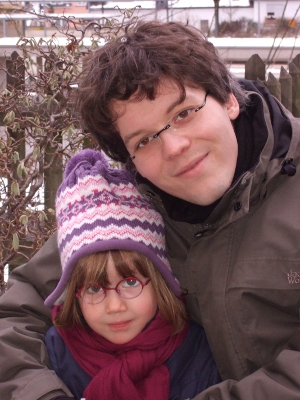
Michael and his daughter Marie

Michael has been around for more than 10 years and has always contributed to the APT software family. He s the author of the first real graphical interface to APT synaptic. Since then he created software-center as part of his work for Ubuntu. Being the most experienced APT developer, he s naturally the coordinator of the APT team. Check out what he has to say about APT s possible evolutions. My questions are in bold, the rest is by Michael. Who are you? My name is Michael Vogt, I m married and have two little daughters. We live in Germany (near to Trier) and I work for Canonical as a software developer. I joined Debian as a developer in early 2000 and started to contribute to Ubuntu in 2004. What s your biggest achievement within Debian or Ubuntu? I can not decide on a single one so I will just be a bit verbose. From the very beginning I was interested in improving the package manager experience and the UI on top for our users. I m proud of the work I did with synaptic. It was one of the earliest UIs on top of apt. Because of my work on synaptic I got into apt development as well and fixed bugs there and added new features. I still do most of the uploads here, but nowadays David Kalnischkies is the most active developer. I also wrote a bunch of tools like gdebi, update-notifier, update-manager, unattended-upgrade and software-properties to make the update/install situation for the user easier to deal with. Most of the tools are written in python so I added a lot of improvements to python-apt along the way, including the initial high level apt interface and a bunch of missing low-level apt_pkg features. Julian Andres Klode made a big push in this area recently and thanks to his effort the bindings are fully complete now and have good documentation. My most recent project is software-center. Its aim is to provide a UI strongly targeted for end-users. The goal of this project is to make finding and installing software easy and beautiful. We have a fantastic collection of software to offer and software-center tries to present it well (including screenshots, instant search results and soon ratings&reviews). This builds on great foundations like aptdaemon by Sebastian Heinlein, screenshots.debian.net by Christoph Haas, ddtp.debian.org by Michael Bramer, apt-xapian-index by Enrico Zini and many others (this is what I love about free software, it usually adds , rarely takes away ). What are your plans for Debian Wheezy? For apt I would love to see a more plugable architecture for the acquire system. It would be nice to be able to make apt-get update (and the frontends that use this from libapt) be able to download additional data (like debtags or additional index file that contains more end-user targeted information). I also want to add some scripts so that apt (optionally) creates btrfs snapshots on upgrade and provide some easy way to rollback in case of problems. There is also some interesting work going on around making the apt problem resolver a more plugable part. This way we should be able to do much faster development. software-center will get ratings&reviews in the upstream branch, I really hope we can get that into Wheezy. If you could spend all your time on Debian, what would you work on? In that case I would start with a refactor of apt to make it more robust about ABI breaks. It would be possible to move much faster once this problem is solved (its not even hard, it just need to be done). Then I would add a more complete testsuite. Another important problem to tackle is to make maintainer scripts more declarative. I triaged a lot of upgrade bug reports (mostly in ubuntu though) and a lot of them are caused by maintainer script failures. Worse is that depending on the error its really hard for the user to solve the problem. There is also a lot of code duplication. Having a central place that contains well tested code to do these jobs would be more robust. Triggers help us a lot here already, but I think there is still more room for improvement. What s the biggest problem of Debian? That s a hard question :) I mostly like Debian the way it is. What frustrated me in the past were flamewars that could have been avoided. To me being respectful to each other is important, I don t like flames and insults because I like solving problems and fighting like this rarely helps that. The other attitude I don t like is to blame people and complain instead of trying to help and be positive (the difference between it sucks because it does not support $foo instead of it would be so helpful if we had $foo because it enables me to let me do $bar ). For a long time, I had the feeling you were mostly alone working on APT and were just ensuring that it keeps working. Did you also had this feeling and are things better nowadays ? I felt a bit alone sometimes :) That being said, there were great people like Eugene V. Lyubimkin and Otavio Salvador during my time who did do a lot of good work (especially at release crunch times) and helped me with the maintenance (but got interested in other area than apt later). And now we have the unstoppable David Kalnischkies and Julian Andres Klode. Apt is too big for a single person, so I m very happy that especially David is doing superb work on the day-to-day tasks and fixes (plus big project like multiarch and the important but not very thankful testsuite work). We talk about apt stuff almost daily, doing code reviews and discuss bugs. This makes the development process much more fun and healthy. Julian Andres Klode is doing interesting work around making the resolver more plugable and Christian Perrier is as tireless as always when it comes to the translations merging. I did a quick grep over the bzr log output (including all branch merges) and count around ~4300 total commits (including all revisions of branches merged). Of that there ~950 commits from me plus an additional ~500 merges. It was more than just ensuring that it keeps working but I can see where this feeling comes from as I was never very verbose. Apt also was never my only project, I am involved in other upstream work like synaptic or update-manager or python-apt etc). This naturally reduced the time available to hack on apt and spend time doing the important day-to-day bug triage, response to mailing list messages etc. One the python-apt side Julian Andres Klode did great work to improve the code and the documentation. It s a really nice interface and if you need to do anything related to packages and love python I encourage you to try it. Its as simple as:
import apt
cache = apt.Cache()
cache["update-manager"].mark_install()
cache.commit()
Of course you can do much more with it (update-manager, software-center and lots of more tools use it). With pydoc apt you can get a good overview. The apt team always welcomes contributors. We have a mailing list and a irc channel and it s a great opportunity to solve real world problems. It does not matter if you want to help triage bugs or write documentation or write code, we welcome all contributors. You re also an Ubuntu developer employed by Canonical. Are you satisfied with the level of cooperation between both projects? What can we do to get Ubuntu to package new applications developed by Canonical directly in Debian? Again a tricky question :) When it comes to cooperation there is always room for improvement. I think (with my Canonical hat on) we do a lot better than we did in the past. And it s great to see the current DPL coming to Ubuntu events and talking about ways to improve the collaboration. One area that I feel that Debian would benefit is to be more positive about NMUs and shared source repositories (collab-maint and LowThresholdNmu are good steps here). The lower the cost is to push a patch/fix (e.g. via direct commit or upload) the more there will be. When it comes to getting packages into Debian I think the best solution is to have a person in Debian as a point of contact to help with that. Usually the amount of work is pretty small as the software will have a debian/* dir already with useful stuff in it. But it helps me a lot to have someone doing the Debian uploads, responding to the bugmail etc (even if the bugmail is just forwarded as upstream bugreports :) IMO it is a great opportunity especially for new packagers as they will not have to do a lot of packaging work to get those apps into Debian. This model works very well for me for e.g. gdebi (where Luca Falavigna is really helpful on the Debian side). Is there someone in Debian that you admire for his contributions? There are many people I admire. Probably too many to mention them all. I always find it hard to single out individual people because the project as a whole can be so proud of their achievements. The first name that comes to my mind is Jason Gunthorpe (the original apt author) who I ve never met. The next is Daniel Burrows who I met and was inspired by. David Kalnischkies is doing great work on apt. From contributing his first (small) patch to being able to virtually fix any problem and adding big features like multiarch support in about a year. Sebastian Heinlein for aptdaemon. Christian Perrier has always be one of my heroes because he cares so much about i18n. Christoph Haas for screenshots.debian.net, Michael Bramer for his work on debian translated package descriptions.
Thank you to Michael for the time spent answering my questions. I hope you enjoyed reading his answers as I did. Subscribe to my newsletter to get my monthly summary of the Debian/Ubuntu news and to not miss further interviews. You can also follow along on Identi.ca, Twitter and Facebook.

4 comments Liked this article? Click here. My blog is Flattr-enabled.

20 January 2011

Richard Darst: The DebConf talk selection and scheduling process

The DebConf talk selection process is in charge of selecting the talks at DebConf. Some of the reasons for having a talks team are to help ensure a high quality of talks, maintain a somewhat academic feeling for the conference, and to let attendees know what talks can be expected to be good.Even though there is a big talk selection process in advance, DebConf has always allowed attendees to schedule new talks during the conference - at DebConf10, these were called "ad-hoc" talks. At DC10, attendees could sign up for a room+time slot on a wiki page, and each night they would be added to the main schedule. In past years, this distinction had been called "official" (pre-selected) vs "non-official" (new ideas during DebConf) talks, which was extremely confusing to people. "Ad-hoc" talks are a very important part of DebConf: not all development meetings are pre-planned.Since we pretty much always surplus of talk rooms and times and we let people schedule talks during DebConf, people have asked: what is the purpose of talk selection? Are we going to let all talks be given? Are we going to reject talks just to say we selected them? When talks were "rejected" in the past, the speakers were told to just ask for a room during DebConf if they still wanted to give it. This question was raised on our mailing list. Even if there is a surplus of talk rooms, there are reasons for talk selection: it allows attendees to know what is most prepared, helps the video team to capture the best talks, lets talks be scheduled in the best room. You could also say it helps to organize talks into tracks and to collect abstracts for proceedings.For DebConf10, we introduced a "conference track" concept, a set of related talks which would be scheduled in the same room in sequence. This allowed a more structured conference for attendees, and perhaps recruiting speakers to fill in requested talks for the tracks. Example tracks from DebConf10 are Science, Enterprise, and Community Outreach. I would have liked to see some tracks more Debian related, such as: project infrastructure, project communication, project social issues, ..., but what we had was a good start that can be improved on, if the new team desires to.As for scheduling, there are two main parts: one phase before DebConf, assigning the selected talks to rooms and making the advance schedule. The other phase happens during DebConf and handles assigning rooms to people who want to do "ad-hoc" talks. The two phases aren't always done by the same person. The schedulers need to balance the expected audience and room capacity, need for video coverage, BOF vs auditorium style seating, not making talks overlap that are likely to appeal to the same audience, ... . The scheduling team works with the talk team, but doesn't necessarily have to be the same people.I'm very happy that there was good discussion about the selection and scheduling process for DebConf10. In the end, a talk selection and scheduling wiki page was created. This page had two main purposes. First, it discussed and documented the selection and scheduling process, so that it was transparent to people that year and provides a reference for future teams. Secondly, other people have added their proposed talks workflows, that they can be considered in future years.
Talk selection has many competing demands - because of the completeness of the wiki page, I'll just refer you there. The rest of this post mainly frames the types of questions the talks team has to face. If you have thoughts on the DebConf talk selection process, feel free to add your ideas to the talk selection process wiki page, or better yet, help out with the team this year.

19 January 2011

Alexander Reichle-Schmehl: 149 862

149 862 - that's the number of bugs closed after Lenny got released1. Let me repeat that: In the nearly two year development cycle for Debian 6.0 Squeeze the Debian Project handled nearly one hundred and fifty thousand bugs! Having currently a bit more than 600 000 bugs in total, that means one fourth of all bug reports where dealt with in Debian Squeeze! Kudos to everyone involved with our quality assurance! Sorting them by severity, we have the following:
Severitycount
grave5880
critical691
serious16047
important24398
normal54372
minor13157
wishlist35317
  1. As determined by the following command on the Ultimate Debian Database: select count(id) from all_bugs where status='done' and last_modified > '2008-02-14';

Next.

Previous.