Search Results: "edd"

5 December 2007

Stefano Zacchiroli: pts debian style

On wiki.d.o and PTS styles [Eddy, you're totally right in stating that it is a pity to base the PTS reword on the wiki.d.o current theme. Actually, it would have been a pity :-), indeed after some people commenting that the wiki.d.o current theme is just one of moin's default I've made up my mind. In particular, thanks to Dan Callahan who contributed a new CSS, we now have a really more Debian-ish theme for the PTS. Here are some samples though, as you can guess from the URL, these links are not meant to last. I've been quite busy since my return from Extremadura and that's why I haven't mentioned the new colors on planet; I guess the next you'll see is directly a change in the PTS pages in the next days or something. On the reworking of the wiki.d.o theme though, I think making it resemble www.d.o is not the way to go. After all there have been many proposals to change it because a lot of people think it is not that nice, and many more think that it feels very old-fashioned, actually: too much old-fashioned. (The fact that those actual proposals haven't been turned into a working reality is sad, but somewhat unrelated ...) I would much prefer to see a wiki.d.o theme that is somewhat Debian-ish, i.e. it uses our "social colors", but which feels less ancient than current www.d.o. I think Dan's work is an example that something in that spirit can be achieved, maybe we can collaborate? (Well, actually you can, I'm nowhere near a web designer :-) )

Eddy Petrișor: People who think the default wiki theme is nice

The people who think the default wiki.d.o theme is nice, should think again. Thanks to an anonymous reader I was pointed to http://browsershots.org and I looked at the wiki.debian.org default theme. Then I shrug.

This was after I made a few screen shots myself to prove that the default wiki.d.o theme looks like crap on MSIE or Opera even on a 1024px wide screen, not to mention 800px wide screen or smaller window be it of MSIE or Opera.

In case you think I have faked something, see for yourselves at http://browsershots.org/http://wiki.debian.org/ (the third request is for a 800px wide screen, so expect fun when is done uploading MSIE variants).

4 December 2007

Eddy Petrișor: wiki.d.o theme -is it bad timing or too late?

I have been working recently working on the wiki.d.o theme; this work was started last year around May - June and I halted it due to lack of time. The point was (opposed to what many might have thought) to make a theme that looks like the www.d.o theme.

Currently the TODO is outdated, so here is an updated one (I'll update it and push it there, too):
There are some screen shots with the current theme as seen on Opera, Epiphany (for some reason sometimes different from iceweasel) and MSIE 6.0, but here are again since I expect that my public darcs repo will change:

In MSIE (by far the most annoying browser and creates the most issues):


In Opera:


In Epiphany (the window was smaller, the content isn't bigger):

If you want to contribute, you can:

darcs get http://users.alioth.debian.org/~eddyp-guest/darcs/wiki.debian.org_theme

read the README to understand what matters, and tackle one of the items on the TODO list above.


I found it pitiful that Zack has based his PTS rework based on the wiki.d.o default theme since that theme is, in my opinion the one that should be corrected (at least the colors should be).

I am not an expert in aesthetics and i don't claim that the www.d.o theme is beautiful, but it seems that the recurrent discussion of it being replaced with something better never found a person to make it true. This is one of the reasons I stopped last year since it seemed the dream would come true at that time.

3 December 2007

Edd Dumbill: Smartcard authentication on Linux and Mac

For various reasons, I need to secure access to some resources using two-factor authentication, and thus have been looking at smartcards. These little devices store digital keys and certificates, protected by a passphrase, and calculate digital signatures on-device. Hence the two factors: possession of the card, and knowledge of the password.This sort of scheme is widely used by government agencies and large corporations (and largely reliant on Windows, too), but I wanted to find the low cost way in for the small operator using open source.
OpenSC on Linux
The best starting point for Linux is the OpenSC project. It supports a reasonably broad array of devices, and is well supported by Linux distributions. Using command line tools you can create keys and certificates, as you would in OpenSSL for web servers and so on, and then upload them to the smartcard.Although OpenSSH source code has support for OpenSC, it is not compiled in by default in Debian and derived distributions. Unfortunately this means a bit of recompilation to get SSH supporting OpenSC. When that's done, you have an SSH implementation that can use an RSA key from your smartcard, and best of all, you can add this key to the ssh-agent like you would with regular keys. The hardwareI ordered two devices, which seemed to have the best support from OpenSC, the Axalto Cryptoflex E-Gate, and an Aladdin eToken. I got these from UsaSmartCard, who have a special section in their catalogue for Open Source compatible products. Both these cards have a USB interface built-in, I didn't want to be toting around an extra card reader in addition to the tokens themselves.
On the MacWhile both the devices worked as advertised under Linux, the experience has been a lot less fruitful under Mac OS 10.5 Leopard. There is a port of the OpenSC project for Mac OS, called SCA. The promise of the integration is great: you can use the on-device keys with apps like Safari and Mail, but there is a change in the way that the daemon responsible for talking to the smartcards (pcscd) works on Leopard, which means OpenSC won't recognise the cards.
With some fiddling, I have managed to force the Cryptoflex device to work with Mac. Unfortunately the Leopard/Darwin source for OpenSSH has diverged significantly enough from the upstream OpenSSH, that I couldn't apply the OpenSC patches. Not having ssh-agent work with the smartcard is a significant nuisance for me, as it's the easiest way to patch in the extra security to deployment processes.The Aladdin eToken just plain didn't work on Leopard. There is a report that Aladdin are working on Leopard drivers, however.I think a small number of mainly US federal smart cards will work out of the box on Leopard, though I've seen a few complaints about these on the Apple forums. It loooks unfortunately like smartcard support slipped through the net a bit. ConclusionSmartcard support is relatively straightforward on Linux. On Mac OS 10.5, it looks like some waiting is in order before things will work properly.

29 November 2007

Eddy Petrișor: Have you ever drove your dreams?

Thomas writes about a dream of his and how his dream self failed to do the right thing.

I have been able several times, while asleep, to be aware enough to realize I was dreaming and was asleep and started to drive my dream the way I wanted.

I made myself fly superman like and fly a plane, I managed to come in second place after Ayrton Senna (this was while he was alive and I respected him too much to take his victory) I managed to do a lot of things. At some point I even managed to turn right a recursive nightmare I had and got rid of it that way.

Unfortunately, I haven't been able to do this in the last 3 or 4 years, but I know I had to set a goal before going to sleep in order to achieve it.

Has anyone else experienced this?

Eddy Petrișor: I thought that was Debian's 50000

Phew, Rob, I thought that was Debian's 50000th bug!

Fortunately, I haven't lost the bet!

22 November 2007

Neil Williams: Debian GPE team

I'd better put some details of this somewhere, so here goes.
Moray Allen and I have formed a Debian GPE team at Alioth. The idea is to gather all the GPE packaging stuff onto a mailing list as a single point of contact for all things related to GPE - the G Palmtop Environment.
I'm now busy updating the GPE packages to add the Debian GPE team as Uploader and taking advantage of these uploads to also add cross building support for all these packages for Emdebian as well as the normal upload tasks for keeping up with the Debian Menu transition and fixing lintian warnings that arose since the last upload, etc.
My basic idea is that everything under the "Debian GPE team" banner should be cross-buildable - it's only logical.
Once dpkg is fixed to once again allow cross-building properly, I'll upload these packages to Emdebian and lots more of their dependencies.
Next task is to file a few more ITP bugs and make good on my existing ones so that GPE can be a complete environment within Debian and Emdebian.

21 November 2007

Dirk Eddelbuettel: Several new Rmetrics packages

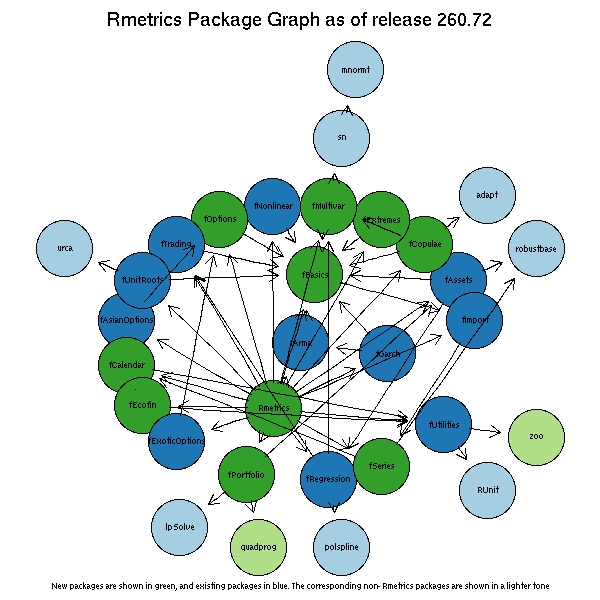
Debian has provided Rmetrics packages for financial engineering and computational finance since the Rmetrics release for R 1.9.0 in the summer of 2004. Over the years, Rmetrics has gotten more granular and changed from a handful of packages to two handfuls --- and the most recent release extended this trend even further to almost two dozen packages as shown in this chart. Dependency chart for Rmetrics packages Rmetrics now comprosises over twenty individual packages. Eleven new packages were added in the 260.72 release for R 2.6.0, and they required eight other new packages from CRAN. While I would have preferred a more spread-out approach than the shotgun approach of having to introduce all these new packages at once (which took the last four weeks), I am in support of the reorganisation which should make maintenance more easy going forward. So to get all of these packages onto a Debian box, a quick sudo apt-get install r-cran-rmetrics is all it takes. Currently supported only in the always-fresh unstable flavour, but hopefully soon in testing too. A big Thank You goes to the Debian FTPmasters. Of the 20-some packages that I added to Debian during this Rmetrics expansion, many were added within a day or two. Lastly, thanks also to Florian Hahne, Robert Gentleman and Elijah Wright for much appreciated help with R's Rgraphviz and graph packages to create the chart above. It only takes a handful of lines to create the basic graph, and another few lines for the colours and titles. The code is available on request, of course, but you need the current development versions of the BioConductor packages Rgraphviz and graph (which are not in Debian yet).

Eddy Petrișor: I just made mself a favour...

... and ignored a troll. I feel so good now.

18 November 2007

Christian Perrier: [running life] Nice use of Googlemaps

Today, I found an interesting use of Google Maps:
Agrandir le plan That happens to be my running loop as of today, the longest ever. For Dirk Eddelbuettel: 16.87km, 1h41. I'm still far from your marathon performances..:-) Amazing how each and every small track in the fields is mentioned and, believe me, they have the *right* names. After all, I could use this to track down my running data. Only drawback: it takes about 15 minutes to draw such loop.

14 November 2007

Eddy Petrișor: Linux: plain weird network behaviour; Windows is OK

Update: problem fixed, thanks for the comments; it was MTU related issues.

Note: This is a long post, but I expect it to bring in some questions for many Linux people; I advise you to read this when you have enough time.


After the last events related to connectivity at home which have been lasting since Thursday evening and the weird fact that it seems that NAT doesn't work at home, but does at work for the same setup, I called the ISP's support and wasted 15 minutes trying to convince them at least to send a technical team with another modem just to test if that is the reason for the breakage.

Of course, talking to the ISP support and trying to convince them that there might be a problem on their side since NAT works with another provider but doesn't with them, was fruitless.

Tonight I was stuck and tried another approach, convinced I would confirm my suspicion that there is something wrong on ISP's side. Still I am not yet sure what to conclude from what happened.


So, to get a better view of what is going on, I'll describe the setup I have and what are its limitations and characteristics. People in a hurry can skip to the paragraph starting with "I tested" and stare in wonder at will.


So the connection I have is done through a DSL modem which gets the MAC of the network card connected to it and exposes that as its own to the ISP's network. This MAC seems to be quite persistent and special measures must be taken in order to be able to use another NIC to connect. The modem (or probably some machine in ISP's; the IP is 10.10.0.1) offers a DHCP address and everything should work fine.

Because of this "your MAC is my MAC" issue, when I connected the first time, I used an USB NIC since a broken router or some temporary failure would have allowed me to use the Internet connection directly from my laptop. I can say this decision has proven in time to be wise.

The router I used until now is a NSLU2 with Debian installed on it. The built in network interface always faced the internal network.

The router (which I call ritter) served as a NAT router for two machines inside the network, my laptop and my apartment mate's laptop. All until last Thursday, after which it never got back properly.


I tested (doing NAT on my laptop; the laptop shouldn't have been affected by the power problems):

Of course, I have n-checked that /proc/sys/net/ipv4/ip_forward was set to 1, the tables had policy ACCEPT and there were no extra rules, except the basic NAT-ting stuff, the routes were correctly set on both the clients and the machine doing the NAT.


All I could see is that:
  1. the machine doing the NAT was always working fine
  2. at work all NAT clients worked fine
  3. at home any of the NAT "clients" were
    1. able to resolve addresses while the DNS server was in ISP territory and another LAN
    2. ping the outside world (if ping was available - in D-I is not)
    3. hanging when trying to get a http page
    4. telnet-ting directly to the port 80 was ok (but I didn't try to "GET / HTTP/1.0")

So after all of this, I was thinking of trying to see if a new client (the laptop of my apartment mate, a Windows XP machine) would work using the connection at home. It didn't work.

Then I thought of trying to do "Internet Connection Sharing" as is called in Windows. Of course, there was some pain to find Windows XP drivers for the ASIX AX88172 network card (remember, the modem needed to see the MAC of that NIC), but I managed to find the proper one.


And, almost sure the NAT wouldn't work for this case either, I configured the new connection as a shared one. I didn't even disabled the firewall, as I was thinking I could take those down gradually.

I wasn't expecting this, not even by pure chance, but my laptop which was a NAT "client" now was able to browse, ping and do whatever was normal through NAT, while the Windows machine was doing the "Connection sharing".

I was utterly flabbergasted. And that was just the beginning.


I was expecting that the problem coincidentally went away, but after a minute I was proven otherwise. It still didn't work with Linux as the NAT-ting machine. I connected back the USB NIC to the Windows machine and I saw the same thing. NAT was just working.


At that point I was to observe an even more shocking fact: the IP that the Windows machine got was different from the one the Linux machine received, in spite of the fact that the network card was the same, so it would have made sense to get the same one. More than that, the IP that the Windows machine got was from an entirely different network, although it was a valid IP belonging to my ISP.

I was thinking that one reason why it works with Windows might be that there could be some TCP protocol twist that is differently implemented in Windows and the equipment from my ISP gets along better with the Windows network stack.


As a way to test that, I am thinking of forcing somehow the IP on the Linux machine to see if anything changes. But before doing that, I felt the urge to post these, maybe some kind soul will shed some light on this issue for me or drop a hint.

Another reason might be different DHCP servers answering, but I don't know how I can see in Windows who offered the lease.


If anyone has any clue why these weird things happen, please drop a line. I would greatly appreciate it. TIA.

Eddy Petrișor: Lesson relearned: when Linux networking weirdess occurs...

My relearned lesson for the day: when Linux networking weirdness occurs in a NAT environment, remember to try MTU clamping.

Thanks to the comments by Justin and Sesse, I was fast-tracked to the core of the problems I have been experiencing since Thursday, MTU issues. What's worse (from my pov) is that I have encountered this issue before with the provider I had in Timi oara, but, since that ISP was using PPPoE and my current ISP in Bucharest doesn't, I never really made the connection. I even had a commented out iptables rule for MTU clamping in my firewall script.

The rule I am talking about looks like this:

iptables -t mangle -A POSTROUTING -p tcp --tcp-flags SYN,RST SYN -o $EXT_IF -j TCPMSS --clamp-mss-to-pmtu

or like the one I have been using (seems more logical to me):

iptables -I FORWARD -p tcp --tcp-flags SYN,RST SYN -j TCPMSS --clamp-mss-to-pmtu


Note that this is not a fix, but a workaround and the real problem is over-zealous admins or weird setups[1] which think that banning TCP fragmentation (or the entire ICMP traffic) is a way to secure networks.


Once again, thanks to everybody who read and/or commented about my issue.

[1] Sesse told me that in his case there was a transparent proxy involved when he exeprienced MTU weirdness.

13 November 2007

Eddy Petrișor: good news, bad news, such is life

After a really crazy weekend in which it looked like I wasn't able to set up NAT[1], I went to work with the gear and tested the exact same thing I did at home and it worked without a glitch.

So, now I suspect that there might be something wrong with my ISP or the DSL modem, while ritter (my NSLU2) is fine. As a bonus I just installed Debian armel on it (installation report to arrive soon).


When I got home, after the laptop came back from hibernate[2] I saw these messages on all my terminals:

Message from syslogd@bounty at Mon Nov 12 23:57:04 2007 ...
bounty kernel: Uhhuh. NMI received for unknown reason b0.

Message from syslogd@bounty at Mon Nov 12 23:57:04 2007 ...
bounty kernel: You have some hardware problem, likely on the PCI bus.

Message from syslogd@bounty at Mon Nov 12 23:57:04 2007 ...
bounty kernel: Dazed and confused, but trying to continue

Is this a good time to panic?
I guess I'll have to dig into this, too.


In other news, svn-buildpackage 0.6.23 has been uploaded to unstable and it fixes yet another 7 bugs, which brings svn-bp's bug count down to 19 open valid bugs (2 more if you count wontfix bugs, too). This is the lowest bug count of svn-buildpackage since at least the end of April, according to the bug count graph.

Also, oolite 1.65-6 was also uploaded to unstable and fixes the breakage due to the gnustep build tools changes. Unfortunately, on arm is dep-waiting for libgnustep-base-dev which is broken on this arch.


Thanks to my sponsors, you know who you are ;-) .

[1] I have been trying to set up a simple NAT machine for more than 6 hours and, although everything seemed to be OK, checked and double checked it didn't work
[2] which works now only if I don't use fglrx which is broken from this PoV (bug 449095)

11 November 2007

Adam Rosi-Kessel: Proof of Fall 2007

I’ve been playing around with Gallery and wpg2. I’m still a bit puzzled attempting to integrate Gallery and Wordpress. I’ve resolved most issues; the main remaining issue is to display images in the Ajaxian theme without running over the borders in the Ajax/slideshow views. Also, the embedded image apparently doesn’t render in the RSS feed. Update: I’ve given up on the G2 tinymce plugin and the WPG2 tag for now and just hardcoded the image and album URL. Update 2: now the embedded image is working again for no good reason. Suggestions on the entire configuration are welcome. In any case, I took some pretty photos today in our back yard (use left and right arrow keys to scroll through images after clicking on the one below — I still can’t get the navigation icons to appear):
p1040772
Before: Proof of Spring 2007. Technorati Tags: , , , , ,

10 November 2007

Eddy Petrișor: nslu2 broken?

Thursday evening, when I came from work I found my nslu2 not working. It is/was a router and a local mirror. I tried to understand what's going on, but I couldn't. Everything looked fine, except that it did not resolve any addresses and the ping to my provider was not giving any results.

I tried to restart dnsmasq, although it seemed it was running fine, and then, in a desperate gesture (after trying to understand what was going on) I thought of restarting networking. I got locked on the outside and was forced to restart the system.

Everything looked to come back to normal. Since it was late, I set myself to investigate the next morning what happened. But yesterday morning, the network was again down and the slug was inaccessible.

Since the only way to restore sanity in such a situation (because I don't have a serial console on the slug) was to reset and hope for the best, I did that.


The slug didn't start anymore. It seemed to cycle through boot -> reset -> reboot. I tried to see what was going on and connected the hard disk to my laptop. The filesystem was clean, although /var/log/boot.0 was a directory (and that directory had the same content as /var/lib/dpkg/info). I manually removed that, but that didn't make the slug boot.


It seems my slug is kind of dead.

Now I would like to know if is there any way to do remotely what flash-kernel does from within debian.

Clint Adams: Will the light flicker, will the hills lift?

I spent 10 hours unraveling a horrible place: from Q to A to B to the valley. I watched countless mystic forces acting one way, then another, but the ones I could see were not the ones tugging on my heartstrings. I doubt Freddie knows, but will Emily call? Will Amy? At some point blood will rain down from those allied stars. At midnight, I turned into a pumpkin, but no one thought to inform me, least of all before I encountered the pink ribbon barriers. After that, all was lost, and Torres was forgotten, though his jowls were not.
Unwanted boots and unwanted bridges
Thinking of shells and penne with ridges
A picture was not there.

7 November 2007

Roland Mas: Planet scores

Top posters in a few Debian-related Planets:
$ planet-scores.sh 
Planet Debian-FR :
     19 Rapha l Hertzog
      4 Roland Mas
      3 Jean-Christophe Dubacq
      2 Gr gory Colpart
      2 Alexis Sukrieh
Sometimes I think this should be renamed Planet Buxy.
Planet Debian-FR (utilisateurs) :
     10 Julien Candelier
      8 Emilien Macchi
      4 Guilhem Bonnefille
      3 Shams Fantar
      1 Rapha l Hertzog
      1 Olivier Berger (perso)
      1 Jean-Christophe Dubacq
      1 Jean-Baptiste H tier (djib)
      1 Eric Veiras Galisson
Newly added contributors to that planet have all their recent articles aggregated, not only the ones they wrote since they were added.
Planet Debian :
     40 Christian Perrier
      2 Russell Coker
      2 Raphael Geissert
      1 Wouter Verhelst
      1 Steve Kemp
      1 Romain Francoise
      1 NOKUBI Takatsugu
      1 Michal  iha 
      1 John Goerzen
      1 Joey Schulze
      1 Gerfried Fuchs
      1 Fathi Boudra
      1 Enrico Zini
      1 Emanuele Rocca
      1 Dirk Eddelbuettel
      1 David Welton
      1 Christine Spang
      1 Antti-Juhani Kaijanaho
      1 Adam Rosi-Kessel
Planet "Christian loves rugby".
debian-community.org :
      4 Holger Levsen
      3 Andrew Donnellan
      2 Evgeni Golov
      1 Wolfgang Lonien
      1 Rapha l Hertzog
      1 Martin Albisetti
      1 Marcos Marado
      1 Jean-Christophe Dubacq
      1 Cord Beermann
      1 Benjamin A'Lee
      1 Andreas Putzo
$
I know I have an encoding problem on some planets, but that script is a very basic curl+shell+sed+grep+recode+sort+uniq pipeline, and I only use it for the amusement value. Maybe I'll recode it with a proper RSS parser some day if I feel utterly bored.

Dirk Eddelbuettel: New York Marathon 2007

I was in New York last weekend to run the 37th New York Marathon which reportedly currently stands as the largest marathon ever run in terms of starters and finishers. And it couldn't have happened on a nicer day: sunny at the start with temperatures in the 50s, no wind, and some clouds in the second half prevented it from getting too hot. Large crowds at most parts of the course, a decent number of bands, and a generally very excited atmosphere. And of course a nice course across the five buroughs finishing in Central Park. For once, I managed to run the race steadily and yet fairly fast, ending up with a time of 3:18:47 (and thus a 7:35 pace). This is about a minute slower than my PR from Sunburst 2006, and just two seconds faster than my best Chicago Marathon result from 2006, yet much better than this year's times from Boston 2007 where it was too cold, and Chicago 2007 where it was way too hot. Given that the NY course is somewhat hillier, and that was definitely busier and more crowded than the other races, I'm quite happy with the time, and the way I ran, getting through without any walking breaks. Not quite negative splits at around 1:38 and 1:40 for the two halfes. With enough energy left at the end, I finished the remaining 2+ km after the 40 km with a sub-7:00 min/mile pace which felt great. And it is a nice feeling to have completed the Boston, Chicago and now New York marathons in the same year. Last but not least, the weekend was a general blast as I was staying with a friend I hadn't seen in a decade which made for lots of stories, and even more beers...

5 November 2007

Eddy Petrișor: (debian) work and the silence

I've been really busy lately in RL and Debian work took the hit.

Some news:

31 October 2007

David Nusinow: They'd Better Not Spike My Beer With AJAX

Web 2.0 may be hate, but free drinks are love. Come help me spend Conde Nast's money tonight!

Next.

Previous.