Search Results: "az"

18 March 2009

Wouter Verhelst: Dear lazyweb,

Having used a powerbook as my primary machine for about four years, I'm not very up-to-date on Intel-specific hardware, such as ACPI, these days. When at conferences or similar, I often see people who've configured their laptops so that acpid would start an alarm when the battery's almost flat. Now that I have an HP laptop again, which does ACPI, I'd like to do the same; but I can't seem to figure out how this is configured. That is to say, when my laptop's battery is flat, it just switches off. No alarm. Needless to say, this is is rather annoying, and searching through the 56 files in /etc/acpi hasn't resulted in success so far. Any hints would be greatly appreciated.

17 March 2009

Ondřej Čertík: Newtonian Mechanics with SymPy

Luke Peterson from UC Davis came to visit me in Reno and we spent the last weekend hacking on the Python Dynamics package that uses SymPy to calculate equations of motion for basically any rigid body system.

On Friday we did some preliminary work, mostly on the paper, Luke showed me his rolling torus demo that he did with the proprietary autolev package. We set ourselves a goal to get this implemented in SymPy by the time Luke leaves and then we went to the Atlantis casino together with my boss Pavel and other guys from the Desert Research Institute and I had my favourite meal here, a big burger, fries and a beer.

On Saturday we started to code and had couple lines of the autolev torus script working. Then we went on the bike ride from Reno to California. I took some pictures with Luke's iphone:


Those mountains are in California and we went roughly to the snow line level and back:

This is Nevada side:


That was fun. Then we worked hard and by the evening we had a dot product and a cross product working, so we went to an Irish pub to have couple beers and I had my burger as usual.

On Sunday we spent the whole day and evening coding and we got the equations of motion working. On Monday we worked very hard again:


and fixed some remaining nasty bugs. I taught Luke to use git, so our code is at: http://github.com/hazelnusse/pydy, for the time being we call it pydy and after we polish everything, we'll probably put it into sympy/physics/pydy.py. If you run rollingtorus.py, you get this plot of the trajectory of the torus in a plane:

It's basically if you throw a coin on the table, e.g. this model takes into account moments of inertia, yaw (heading), lean, spin and the x-y motion in the plane. Depending on the initial conditions, you can get many different trajectories, e.g for example:

or:


This is very exciting, as the code is very short, and most of the things that Luke needs are needed for all the other applications of sympy, e.g. a good printing of equations and vectors (both in the terminal and in latex), C code generation, fast handling of expressions, nice ipython terminal for experimentation, plotting, etc.

Together with the atomic physics package that we started to develop with Brian sympy will soon be able to cover some basic areas of physics. Other areas are general relativity (there is some preliminary code in examples/advanced/relativity.py) and quantum field theory and Feynman diagrams - for that we need someone enthusiastic that needs this for his/her research --- if you are interested, drop me an email, you can come to Reno (or work remotely) and we can get it done.

My vision is that sympy should be able to handle all areas of physics, e.g. it needs good assumptions (if you want to help out, please help us test Fabian's patches here), then faster core, we have a pretty good optional Cython core here, so we'll be merging it after the new assumptions are in place. Then sympy should have basic modules for most areas in physics so that one can get started really quickly. From our experience so far in sympy/physics, those modules will not be big, as most of the functionality is not module specific.

Neil Williams: If the law is inconvenient, unelected bodies just change the rules?

From the FFII:

EPO seeks to validate software patents without the European Parliament

Benjamin Henrion, President of the association, says: "The current plan of the patent lobby is very clear: avoid a new software patent directive, validate the EPO practice via a central patent court, and guide the hand of the courts via a decision of the Enlarged Board of Appeal. They want to avoid the intervention of the European Parliament in substantive patent law."

In other words, seeing as the elected representatives have blocked a change in the law, the unelected quango will simply seek a change in the rules to make it unnecessary to change the law and therefore avoid asking the elected representatives at all.

This is crazy, dangerous and downright sinister.

"Considering that the EPO is an institution acting as judge and party, where the attributions and procedures have to be revised. [...] Demand the revision of rules of function of the EPO in order to guarantee that this institution can publicly justify the accountability in the exercise of its functions [...]."

Judge, jury and executioner more like.

Interested parties have up to the last day of April to send their comments to the Enlarged Board of Appeal.

Information for third parties wishing to file written statements

Communication from the Enlarged Board of Appeal concerning case G 3/08

(my comments added in bold)

In accordance with Article 112(1)(b) EPC, the President of the European Patent Office has referred the following points of law concerning the limits of patentability of programs for computers within the meaning of Article 52(2)(c) and (3) EPC to the Enlarged Board of Appeal. The case is pending under ref. No. G 3/08.

The questions referred are:

1. Can a computer program only be excluded as a computer program as such if it is explicity claimed as a computer program?

No, any computer program is excluded no matter how it is claimed because a computer program is not patentable. The patent claim must contain material other than a computer program and the computer program itself cannot be claimed as part of any patent claim nor can any computer program ever be deemed to have infringed any patent claim even if that claim was previously based entirely in hardware.

2.(a) Can a claim in the area of computer programs avoid exclusion under Art. 52(2)(c) and (3) merely by explicity mentioning the use of a computer or a computer-readable data storage medium?

No patent claim can be made against any method expressed as a computer program. It is the software that matters, not the paraphernalia of computers. Therefore, whether a computer or computer-readable data storage media are mentioned, any software is automatically excluded from patentability. If the claim makes no sense without that software, then the claim is excluded.

(b) If question 2(a) is answered in the negative, is a further technical effect necessary to avoid exclusion, said effect going beyond those effects inherent in the use of a computer or data storage medium to respectively execute or store a computer program?

Any effect is excluded from patentability if that effect is or can be executed by software. If the effect becomes possible via software at some point in the future, the software cannot be deemed to have infringed the patent claim because software is not patentable.

3.(a) Must a claimed feature cause a technical effect on a physical entity in the real world in order to contribute to the technical character of the claim?

Effects on the "real world" are irrelevant - if the effect is or can be performed in software, the effect is excluded and any software implementing that effect cannot be deemed to have infringed the patent claim. The real world still includes the electrons that implement the effect of software but software is not patentable.

(b) If question 3(a) is answered in the positive, is it sufficient that the physical entity be an unspecified computer?

No, the effect is not the issue, the method is the issue.

(c) If question 3(a) is answered in the negative, can features contribute to the technical character of the claim if the only effects to which they contribute are independent of any particular hardware that may be used?

Portability infers software and software is not patentable. A claim must be excluded if it is wholly or partially implemented as software or can be wholly implemented as software and no software implementation can be deemed to have infringed the patent claim either in whole or in part now or in the future because software is not patentable.

4.(a) Does the activity of programming a computer necessarily involve technical considerations?

No. Programming is a form of speech, it uses languages and different languages have different requirements for technical expertise. Some languages require little or no technical expertise to generate an effect within a computer by means of software.

(b) If question 4(a) is answered in the positive, do all features resulting from programming thus contribute to the technical character of a claim?

No software programming can have any technical character for patentability because software is not patentable.

(c) If question 4(a) is answered in the negative, can features resulting from programming contribute to the technical character of a claim only when they contribute to a further technical effect when the program is executed?

No, if the features result from programming then the software to effect those features is not patentable and the feature itself is not patentable. No effect of a computer program can be wholly or partially patentable.

The text of the referral in the English language is available under Referrals pending before the Enlarged Board of Appeal.

The Enlarged Board of Appeal considering the referral will be composed as follows:

* P. Messerli (CH) (Chairman)
* M. Vogel (DE)
* D. Rees (GB)
* M. Dorn (DK)
* K. H rmand (EE)
* A. Klein (FR)
* J.-P. Seitz (FR)

It is expected that third parties will wish to use the opportunity to file written statements in accordance with Article 10 of the Rules of Procedure of the Enlarged Board of Appeal (OJ EPO 2007, 303 ff). To ensure that any such statements can be given due consideration they should be filed together with any new cited documents by the end of April 2009 at the Registry of the Enlarged Board of Appeal, quoting case number G 3/08. An additional filing of the statement and documents in electronic form would be appreciated (Dg3registry_eba@epo.org ).


Feel free to add your own answers to the questions as comments.

16 March 2009

James Morrison: Recent Bands

13 Mar 2009
White Swan, Black Swan: nice vocals, I only caught a couple songs

The Donkeys
Decent band, fun to listen to. A good whale joke:
Two whales are sitting at a bar
one says to the other [long whale noises]
The other says, "man you are trashed."

Quick to get on stage and play

Phosphoressence
Good country rock band. Slow to start playing and some assholes decided to pop into the front of the crowd, they were tall so they blocked a bunch of peoples view. Then they gained an extra 3 people and started moving backwards. For once someone actually got inside my bubble.

7 Mar 2008 -- Red Devil Lounge
* "Three of" (good luck googling these guys) -- very good
* A, b, and C -- not good, the lead singers voice cracked a lot, they did look like they should be in the movie "That thing you do" (my first date was at this movie).
* Moonlight Sexy -- ok, Andy didn't like these guys
* Marcy Playground -- Great!

14 Mar 2008 -- Writers with drinks
S.G Browne with Breathers: A zombie's lament. The chapter he read was really funny. I think this was the best part of the night. The host was also really good, but the host could be described as slightly scripted talking out of her ass.

James Morrison: Fruit fly

I went to see Fruit Fly at the Castro Theatre tonight. It was a really fun movie and very local. Oh yeah, it's a musical, I don't think I've had that much fun watching a movie since I saw Jesus Christ Vampire Hunter the first time. The opening number is a song about public transit and not needing a car in San Francisco. The previous film by H.P. Mendoza is Colma: The Musical, it's got a lot of the same cast and also look like a lot of fun. Unfortunatly, movies are behind music and I can't find a stream or download on hulu, amazon or youtube of Colma the musical.

Anyway, if anyone wants to go see Fruit Fly it is playing in Berkeley on friday. I don't think I'll make it out to that since the Castro Theatre is having a triple bill "nerds with balls" Midnites for maniacs on friday.

In other good news, I couldn't get either a Petzl size 1 or size 2 harness since my legs are size two, but my waist is size 1.

Luciano Bello: new camera

Some days ago, my new camera arrived. I bougth it by Amazon and the parents of a friend brought it to my country. The selected model was a Canon PowerShot SX110 IS. My last camera was a Canon PowerShot A700. It has been in service since April 2006, until a terrible fall ended with its nice capability of taking good pictures, during the 25C3 in Berlin.

15 March 2009

Russell Coker: Why Cyrus Sucks

I m in the middle of migrating a mail server away from the Cyrus mail store [1]. Cyrus provides a POP and IMAP server, a local delivery agent (accepting mail via LMTP). It is widely believed that Cyrus will give better performance than other mail stores, but according to a review by linux-magazin.de Dovecot and Courier deliver comparable (and sometimes better) performance [2]. The biggest problem with Cyrus is that it is totally incompatible with the Unix way. This wouldn t be a problem if it would just work and if it would display reasonable error messages when it failed, but it doesn t. It often refuses to work as desired, gives no good explanation, and it s data structures can t be easily manipulated. Dovecot [3] and Courier [4] use the Maildir++ format [5] (as well as many other programs). I have set up a system with Courier Maildrop and Dovecot for the IMAP server [6] and it works well - it s good to have a choice! But also Maildir++ is reasonably well documented and is an extension to the well known Maildir format. This means that it s easy to manipulate things if necessary, I can use mv to rename folders and rm to remove them. Cyrus starts with a database (Berkeley DB file) of all folders in all mailboxes. Therefore it is not possible to move a user from one back-end server to another by merely copying all the files across and changing the LDAP (or whatever else contains the primary authentication data) to point to the new one. It also makes it impossible to add or remove folders by using maildirmake or rm -rf. The defined way of creating, deleting, and modifying mailboxes is through IMAP. One of the problems with this is that copying a mailbox from one server to another requires writing a program to open IMAP connections to both servers at once (tar piped through netcat is much faster and easier). Also if you need to rename a mailbox that contains many gigabytes of mail then it will be a time consuming process (as opposed to a fraction of a second for mv). Cyrus has a tendency to break while Dovecot is documented as being self-healing and Cyrus also seems to cope well in the fact of a corrupted mail store. Even manually repairing problems with Cyrus is a painful exercise. The Cyrus mail store is also badly designed - and it s design was worse for older filesystems (which were common when it was first released) than it is for modern ones. The top level of a Cyrus maildir contains all the messages in the INBOX stored one per file, as well as three files containing Cyrus indexes and sub-directories for each of the sub-folders. So if I want to discover what sub-folders a mailbox has then I can run ls and wait for it to stat every file in the directory or I can use an IMAP client (which takes more configuration time). As opposed to a Maildir++ store where every file that contains a message is stored in a folder subdirectory named new , cur , or tmp which means that I can run ls on the main directory of the mail store and get a short (and quick) result. Using tools such as ls to investigate the operation of a server is standard practice for a sysadmin, it should work well! A finall disadvantage of Cyrus seems to have many small and annoying bugs (such as the reconstruct program not correctly recursing the sub folders). I guess it s because not many people use Cyrus that such things don t get fixed. One trivial advantage of Cyrus is that by default it splits users into different sub-directories for the first letter of the account name. Dovecot supports using a hash of the user-name this is better than splitting by first-letter for performance (it gives a more equal distribution) but will make it slightly more difficult to manipulate the mail store by script. Ext3 can give decent performance without a two level directory structure for as many as 31,998 sub-directories (the maximum that it will support) due to directory indexing and Linux caching of dentries. There may be some other advantages of Cyrus, but I can t think of them at the moment. Here is a script I wrote to convert Cyrus mail boxes to Maildir++. To make this usable for a different site would require substituting a different domain name for example.com (or writing extra code to handle multiple domains) and inserting commands to modify a database or directory with the new server name. There is no chance of directly using this script on another system, but it should give some ideas for people performing similar tasks.

#!/bin/bash -e
# $1 is the user to move # BASEDIR is the directory for temporary files
BASEDIR=/mail/new
rm -rf $BASEDIR/$1 archive.tgz archive2.tgz ORIGSRV=$(echo "MYSQL_COMMAND_TO_GET_SERVER" mysql dbname)
echo "original server was $ORIGSRV" if [ "$ORIGSRV" = "" ]; then
echo "No server for account, strange error."
exit 1
fi ORIGPARENT="/mail/domain/e/example.com/$(echo $1 cut -c1)/user" # copy the data to a local archive
# USERDIR is for using ^ instead of . as Cyrus does.
mkdir -p $BASEDIR
cd $BASEDIR
USERDIR=$(echo $1 sed -e "s/\./^/g")
ssh cyrus@$ORIGSRV "(cd $ORIGPARENT ; tar czf - $USERDIR)" > archive.tgz
tar xzf archive.tgz
if [ "$USERDIR" != "$1" ]; then
mv $USERDIR $1
fi DEPTH=$(find . -mindepth 3 -type d wc -l)
if [ "$DEPTH" != "0" ]; then
echo "too deep"
exit 1
fi # remove cyrus index files
find $1 -name "cyrus.*" -exec rm \;
cd $1 # "mail" is a directory with sub-folders, every other name starting with
# [a-zA-Z] is a regular folder that needs to become a Maildir
for n in [a-zA-Z]* ; do
if [ "$n" != "mail" ]; then
cd "$n" ; mkdir new cur tmp ; touch maildirfolder
mv [0-9]* new true
cd .. ; mv "$n" ".$n"
fi
done # move the inbox files to Maildir storage
mkdir new cur tmp
mv [0-9]* new true
mv mail/[0-9]* cur true # move sub-folders of "mail/" and merge ones with duplicate names
cd mail
for n in * ; do
if [ -e "../.$n" ]; then
cd "$n"
mv [0-9]* "../../.$n/cur" true
cd .. ; rmdir "$n"
else
cd "$n" ; mkdir new cur tmp ; touch maildirfolder
mv [0-9]* new true
cd .. ; mv "$n" "../.$n"
fi
done
cd ..
rmdir mail # get a list of all names so we can recognise duplicates
find . -type d egrep -v "new cur tmp" cd $BASEDIR ssh root@localhost "mv /mail/new/$1 /mail/example.com ; chown -R mail:mail /mail/example.com/$1"
echo "MYSQL_COMMAND_TO_SET_SERVER" mysql dbname

Jaldhar Vyas: Paris, Venice, The Olive Garden in Secaucus.

Today was our 11th wedding anniversary. It's amazing to think that so much time has passed but Jyoti and I are still filled with the unlimited breadsticks of our love.

Chris Lamb: Joachim Raff and the orchestration of Bach's Chaconne

Earlier today I stumbled across a recording of a work I had not heard in a few years by the obscure Swiss-German composer Joachim Raff. The composition is an orchestral transcription of the Chaconne from Bach's Partita in D minor, without doubt the finest work ever written for solo violin. This piece has been transcribed countless times; the source material is clearly a masterpiece, but what makes the movement really attractive is its implicit nature - dispite the violin's limited facilities for counterpoint and polyphony in general, Bach succeeds in alluding to a multitude of voices within the same line. Larry Solomon provides a brief overview of what to look out for. Raff's transcription thus endeavours to render the implicit explicit; for example, where there is the implication of a held note, it can played for its implied duration. Indeed, Raff believed that Chaconne was in itself a "reduction" from an orchestrated original. Whilst I don't share that literal belief, it is certainly good working model for a transcription. And what a transcription! I've often thought of the romantic transcriptions such as these to be a guilty pleasures; they clearly violate any sensibilities I have about performing early music. However, what is most surprising (and guilt-relieving) about Raff's effort is the sheer amount of novel material involved. Here is an example starting at bar 216 - I have overlayed Bach's original line with a melody of Raff's own invention:
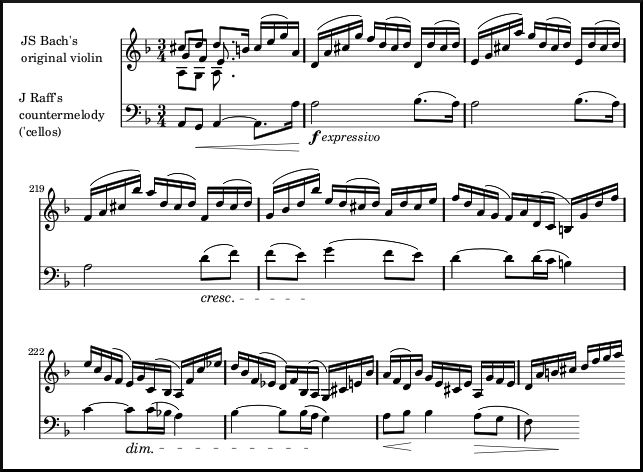
http://chris-lamb.co.uk/wp-content/2009/raff_chaconne.png
There are countless other examples which, following Bach's example, vary greatly in their subtlety. No prizes for guessing why I chose this excerpt though. However, dispite these additions I feel some crucial aspects are actually lost in translation. Firstly, we can muse over whether Bach would have approved of such a rendering - not wishing to dwell too deeply in well-tread arguments, many would point to Bach's re-use of his own material (as well as his transcriptions of other composers) to illustrate that he was not against the practice, but I find that argument difficult to apply to the Chaconne - the dualism between the implicit and the explicit would have greatly appealed to Bach, so to rob the work of it would seem to be doing him a serious discourtesy. Furthermore, the implications in Bach's work are certainly not followed to the same conclusions by all - a truly solo musician has the advantage of being able to make their own decisions about the music, perhaps even on the spur of the moment. In contrast, an ensemble is effectively forced to obey Hr. Raff's inferences. This lack of spontaneity is particularly damning; I am sure one would tire of differing interpretations of Raff's transcription quicker than one would of Bach's original. Lastly (and certainly most subjectively) there is something disarmingly solitary about the original work which is only amplified by being played solo - dispite my inability to provide a satisfactory rendition I would find performing this piece with (or even to) others rather discomforting. In conclusion, I would recommend listening to this work (and the rest of the CD). I have found it extremely illuminating, if only about Bach's original than of Raff's.

13 March 2009

Robert McQueen: Top acts

I ve been very impressed several times in the past few months when I ve discovered awesome new top-like utilities. I m probably being slow on the uptake and everyone else but me knows about these, but in case its not just me thats been stuck in the 70s:
htop
A much-needed refresh of oldschool top, this still works on your beloved console but gives you visual bar-graphs of CPU, RAM and swap, lets you scroll through the processes and deliver signals/renicing without having to copy the PID off the moving target. Its like the future!
iftop
One of those things I use so often now I have no idea how I even survived without it. Why is this server lagging, who s hogging the wireless/DSL, which VM is chewing all of the upstream bandwidth? iftop shows you at a glance how much traffic is being used by which host pairs on a given interface, and you can toggle port numbers on and off with simple key-presses. Absolutely indispensable.
iotop
Does this box feel slow to anyone else? Is it swapping, or is it the database server chewing all the IO? Why does my drive keep seeking? It s amazing top for IO bandwidth usage!
A passing mention is deserved for apachetop too, which is pretty neat, but when a server is being hammered it s not something I found too hard to get a feel for just by tailing the log for a while, so it s not been as life-changing as the others. Maybe that just means my servers don t see enough traffic.

David Paleino: ..so I turned 22.

Eheh, I'm getting older... 22 today! Smile I just wanted to put down some of the important things happened to me this year... Wishes for the 22-23 development cycle Smile : Happy birthday to me!

Alexander Reichle-Schmehl: Dear Lazyweb,

Since a recent update of one of my systems, amavisd-new keeps on spamming me. I get mails containing stuff like bayes: synced databases from journal in 0 seconds: 674 unique entries (742 total entries). The reasons seems to be a cronjob from amavisd-new (which can be deactivated via debconf):

grep amavisd-new-cron /etc/cron. d,daily /*
/etc/cron.d/amavisd-new:18 */3  * * *   amavis  test -e /usr/sbin/amavisd-new-cronjob && /usr/sbin/amavisd-new-cronjob sa-sync
/etc/cron.daily/amavisd-new:test -e /usr/sbin/amavisd-new-cronjob && exec /usr/sbin/amavisd-new-cronjob sa-clean
However, the called script contains:
egrep "sa-sync\) sa-clean\)" -A 2 /usr/sbin/amavisd-new-cronjob
        sa-sync)
                do_amavis_cmd "/usr/bin/sa-learn --sync >/dev/null"
                ;;
        sa-clean)
                do_amavis_cmd "/usr/bin/sa-learn --sync --force-expire >/dev/null"
                ;;
Note that output is redirected to /dev/null, so I should only mails if an error occurs, shouldn't I? I'm really baffled... To the best of my knowledge I shouldn't get these mails. Where am I wrong, and how to formulate that in a bug report?

12 March 2009

Jon Dowland: interzone

The next issue of Interzone, a british SF magazine, is due out soon. The issue features a story and interview with Bruce Sterling, plus a review of his new novel the Caryatids (which Cory Doctorow said was his pick for best book of 2009, already). The cover for this issue looks fantastic: modern covers seem to be placing most of the focus on the artwork and placing the graphics and text to suite each cover art individually. I've been reading IZ for several years after having seen it mentioned several times as the source of stories in SF anthologies and highly recommend that people who enjoy reading SF give it a try.

Theodore Ts'o: Delayed allocation and the zero-length file problem

A recent Ubuntu bug has gotten slashdotted, and has started raising a lot of questions about the safety of using ext4. I ve actually been meaning to blog about this for a week or so, but between a bout of the stomach flu and a huge todo list at work, I simply haven t had the time. The essential problem is that ext4 implements something called delayed allocation. Delayed allocation isn t new to Linux; xfs has had delayed allocation for years. Pretty much all modern file systems have delayed allocation, according to the Wikipedia Allocate-on-flush article, this includes HFS+, Reiser4, and ZFS; btrfs has this property as well. Delayed allocation is a major win for performance, both because it allows writes to be streamed more efficiently to disk, and because it can reduce file fragmentation so that later on they can be read more efficiently from disk. This sounds like a good thing, right? It is, except for badly written applications that don t use fsync() or fdatasync(). Application writers had gotten lazy, because ext3 by default has a commit interval of 5 seconds, and and uses a journalling mode called data=ordered. What does this mean? The journalling mode data=ordered means that before the commit takes place, any data blocks are
associated with inodes that are about to be committed in that transaction will be forced out to disk. This is primarily done for security reasons; if this is not done (which would be the case if the disk is mounted with the mount option data=writeback), then any newly allocated blocks might still contain previous data belonging to some other file or user, and after a crash, accessing that file might result in a user seeing unitialized data that had previously belonged to another user (say, their e-mail or their p0rn), which would be a Bad Thing from a security perspective. However, this had the side effect of essentially guaranteeing that anything that had been written was guaranteed to be on disk after 5 seconds. (This is somewhat modified if you are running on batteries
and have enabled laptop mode, but we ll ignore that for the purposes of this discussion.) Since ext3 became the dominant filesystem for Linux, application writers and users have started depending on this, and so they become shocked and angry when their system locks up and they lose data even though POSIX never really made any such guarantee. This become especially noticeable on Ubuntu, which uses many proprietary, binary-only drivers, which caused some Ubuntu systems to become highly unreliable, especially for Alpha releases of Ubuntu Jaunty, with the net result that some Ubuntu users have become used to their machines regularly crashing. (I use bleeding edge kernels, and I don t see the kind of unreliability that apparently at least some Ubuntu users are seeing, which came as quite a surprise to me.) So what are the solutions to this? One thing is that the applications could simply be rewritten to properly use fsync() and fdatasync(). This is what is required by POSIX, if you want to be sure that data has gotten written to stable storage. Some folks have resisted this suggestions, on two grounds; first, that it s too hard to fix all of the applications out there, and second, that fsync() is too slow. This perception that fsync() is too slow was most recently caused by a problem with Firefox 3.0. As Mike Shaver put it:
On some rather common Linux configurations, especially using the ext3 filesystem in the data=ordered mode, calling fsync doesn t just flush out the data for the file it s called on, but rather on all the buffered data for that filesystem.
Fundamentally, the problem is caused by data=ordered mode. This problem can be avoided by mounting the filesystem using data=writeback or by using a filesystem that supports delayed allocation such as ext4. This is because if you have a small sqllite database which you are fsync(), and in another process you are writing a large 2 megabyte file, the 2 megabyte file won t be be allocated right away, and so the fsync operation will not force the dirty blocks of that 2 megabyte file to disk; since the blocks haven t been allocated yet, there is no security issue to worry about with the previous contents of newly allocated blocks if the system were to crash at that point. Another solution is a set of patches to ext4 that has been queued for 2.6.30 merge window. These three patches (with git id s bf1b69c0, f32b730a, and 8411e347) will cause a file to have any delayed allocation blocks to be allocated immediately when a file is replaced. This gets done for files which were truncated using ftruncate() or opened via O_TRUNC when the file is closed, and when a file is renamed on top of an existing file. This solves the most annoying set of problems where an existing file gets rewritten, and thanks to the delayed allocation semantics, that existing file gets replaced with a zero-length file. However, it will not solve the problem for newly created files, of course, which would have delayed allocation semantics. Yet another solution would be to mount ext4 volumes with the nodelalloc mount option. This will cause a significant performance hit, but apparently some Ubuntu users are happy using proprietary Nvidia drivers, even if it means that when they are done playing World of Goo, quitting the game causes the system to hang and they must hard-reset the system. For those users, it may be that nodelalloc is the right solution for now personally, I would consider that kind of system instability to be completely unacceptable, but I guess gamers have very different priorities than I do. A final solution which might not be that hard to implement would be a new mount option, data=alloc-on-commit. This would work much like data=ordered, with the additional constraint that all blocks that had delayed allocation would be allocated and forced out to disk before a commit takes place. This would probably give slightly better performance compared to mounting with nodelalloc, but it shares many of the disadvantages of nodelalloc, including making fsync() to be potentially very slow because it would force all dirty blocks to be forced out to disk once again. What s the best path forward? For now, what I would recommend to Ubuntu gamers whose systems crash all the time and who want to use ext4, to use the nodelalloc mount option. I haven t quantified what the performance penalty will be for this mode of operation, but the performance will be better than ext3, and at least this way they won t have to worry about files getting lost as a result of delayed allocation. Long term, application writers who are worried about files getting lost on an unclena shutdown really should use fsync. Modern filesystems are all going to be using delayed allocation, because of its inherent performance benefits, and whether you think the future belongs to ZFS, or btrfs, or XFS, or ext4 all of these filesystems used delayed allocation. What do you think? Do you think all of these filesystems have gotten things wrong, and delayed allocation is evil? Should I try to implement a data=alloc-on-commit mount option for ext4? Should we try to fix applications to properly use fsync() and fdatasync()? Related posts (automatically generated):
  1. Don t fear the fsync! After reading the comments on my earlier post, Delayed allocation...
  2. SSD s, Journaling, and noatime/relatime On occasion, you will see the advice that the ext3...
  3. Ext4 is now the primary filesystem on my laptop Over the weekend, I converted my laptop to use the...

11 March 2009

Sune Vuorela: n810 && usbhost

easy. http://www.amazon.de/dp/B001CX5G8K/ + https://garage.maemo.org/projects/usb-otg-plugin/ + random usb thingie + n810 == success.

10 March 2009

Steve McIntyre: You are not alone

Shockingly, I seem to have found a woman crazy enough to like me! This delusion looks like it might be long-term; let's see how it goes... :-)

Biella Coleman: Automatic Content/ID/System

Fred von Lohmman gave a lively talk tonight about public interest law (and I hope he inspired at least some NYUlawites to follow in that path) with a focus on Youtube s content ID system now being used by Warner Music to automatically delete/censor videos, such as this one from Youtube. Go Google. Go Youtube. Go Warner Music.

9 March 2009

Martin F. Krafft: Import to Switzerland: being charged for services you never asked for

When you order good into Switzerland, they will pass the customs office, where VAT and possibly import duties are levied. The customs office does not charge any duties if the total amount to be paid is less than 5 CHF Practically, given 7.6% VAT, this means that you can import 5 CHF / 0.076 = 65.79 CHF for free . As soon as you exceed this amount, it gets complicated. All of a sudden, the carrier charges you for the customs declaration it does in your name. What really blows my mind is that the fee to pay to the carrier (more on that later) actually plays into the whole equation. Let s assume you order goods for 100 CHF, which is well above the free import limit. You also paid 10 CHF for shipping. The carrier charges you 20 CHF to do the customs presentation for you. There, they determine that import duties are 5 CHF, and you end up paying: (100 + 10 + 20 + 5) * 107.6% = 145.26. That s fun, isn t it? I continue to be amazed by all the ways in which the government sucks money from your pockets. What s similarly baffling is how some carries deal with this. The Swiss Post (and their ally TNT) makes you pay taxes, duties, and fees on delivery, and their charges are the lowest when compared to the other carriers. With this approach, you have the option to refuse the package, if you re willing to deal with the vendor to get your money back. DHL is the only other carries I know who does things like the Swiss Post. However, due to their extraordinary crap performance and service, I could never recommend them to anyone. The three letters of DHL, a German company, apparently stand for das heisst langsam this means slow . None of the other carriers give you the option to accept the duties and their services. For instance, GLS delivers your parcel, and some weeks later you get an invoice, asking for the taxes and duties, and charging a fee of 45 CHF for their service, which you ve never really asked for and which you could not refuse. UPS, FedEx, and DPD fall into the same category, but their charges are lower. The one and only time I had used GLS to have something shipped to me, I called them up to complain about their invoice, and replied with an invoice of my own, in which I charged the same amount for opening and reading your letter and giving your call-centre employee the chance to talk to me directly . They got the message and dropped the invoice. The next step should be to play them off against each other: create some pencil art, write an invoice for half a million, and pay UPS to deliver the package to GLS headquarters. Attach a miniature audio transmitter to the invoice for added fun. NP: Goldie: Timeless

John Goerzen: A Few Days With the Kindle 2

So I am going to do something that nobody on the Internet is doing lately: post a review of the Kindle 2 after having only used it for three days. Shocking, yes, I know. I had never even seen a Kindle of either model before getting the Kindle 2. I had, though, thought about getting an eInk device for some time. The $359 Kindle 2 price tag caused me significant pause, though in the end I went for it due to the 30-day return policy. On the surface, I thought that it would be weird to have a Kindle. After all, how often am I away from the computer? And there s a small local library a few blocks from where I work. But I had a hunch it might turn out for me like my iPod did: something that didn t sound all that useful from reading about it, but turned out to be tremendously so after having actually used it. Turtleback Delivery I ordered my Kindle 2 with standard shipping, which meant that it went by FedEx Smart Post. Here is my SmartPost rant. There are two words in Smart Post that are misleading. I once had an item take literally a week to make it from St. Louis to Kansas. That is, I kid you not, slower than the Pony Express ran in 1860. This time, my Kindle made it from Kentucky to Kansas in a mere five days. Oh, and it spent more than 24 hours just sitting in St. Louis. The Device Overall, the device is physically quite nice. It is larger and thinner than I had imagined, and the screen also is a bit smaller. It is usually easier to hold than a paperback, due to not having to prevent it from closing too far at the binding edge. The buttons are easy to press, though I could occasionally wish for them to be easier, but that s a minor nit. The Screen The most important consideration for me was the screen. The eInk display as both stunningly awesome and disappointing. This is not the kind of display you get on your computer. Or, for that matter, any other device. It isn t backlit. It reacts to light as paper does. It can be viewed from any angle. And it consumes no power to sustain an image; only to change it. Consequently, it puts up a beautiful portrait of a famous author on the screen when it is put to sleep, and consumes no power to maintain it. The screen s response time isn t anywhere near as good as you d expect from a regular LCD. It flashes to black when you turn a page, and there is no scrolling. On the other hand, this is not really a problem. I found the page turning speed to be more than adequate, and probably faster than I d turn the page on a real book. The resolution of the display has the feeling of being incredible. The whole thing provides a far different, and in my eyes superior, experience to reading on an LCD or CRT screen. My nit is the level of contrast. The background is not really a pure white, but more of a light gray. This results in a contrast level that is quite clearly poorer than that of the printed page. At first I thought this would be a serious problem, though I am growing somewhat more used to it as I read more. Reading Experience Overall, I ve got to say that it is a great device. You can easily get lost in a book reading it on the Kindle. I m reading David Copperfield for the first time, and have beat a rather rapid path through the first five chapters on the Kindle already. And that, I think, is the best thing that could be said about an ebook reader. It stays out of the way and lets you immerse yourself in your reading. The Kindle s smartly-integrated Oxford-American Dictionary was useful too. One thing about a novel written 150 years ago is that there are some words I just haven t ever heard. Nosegay, for instance. You can move a cursor to a word to see a brief pop-up definition appear, or press Enter to see the entire entry. This is nice and so easy that I m looking up words I wouldn t have bothered to if I were reading the book any other way. A nosegay, by the way, is a bouquet of showy flowers. Buying Experience The Kindle has a wireless modem tied to the Sprint network on it. The data charges for this, whatever they may be, are absorbed by Amazon in the cost of the device and/or the books you buy for it. This turned out to be a very smart piece of engineering. I discovered on Amazon s Kindle Daily Post that Random House is offering five mostly highly-rated sci-fi books for free on the Kindle for a limited time. So I went over to the page for each, and made my purchase . It was only a click or two, and I saw a note saying it was being delivered. A few minutes later, I picked up the Kindle off the kitchen counter. Sure enough, my purchases were there ready to read. Impressive. This level of ease of use smells an awful lot like Apple. Actually, I think it s surpassed them. You can delete books from the Kindle and re-download them at any time. You can initiate that operation from either the PC or the Kindle. And you can also browse Amazon s Kindle store directly from the device itself. I haven t subscribed to any magazines or newspapers, but I gather that they deliver each new issue automatically the moment it s released by the publisher, in the middle of the night. I pre-ordered the (free to Kindle) Cook s Illustrated How-to-Cook Library. It makes me way happier than it should to see This item will be auto-delivered to your Kindle on March 26 in the order status. Free Books Amazon s Kindle library has a number of completely free Kindle books as well. These are mostly out-of-copyright books, probably sourced from public etext places like Project Gutenberg, and converted to the Mobipocket format that is the Kindle s native format with a minimum of human intervention. As they are free, you can see them in Amazon s library if you sort by price. And, of course, Amazon will transfer them to the Kindle wirelessly, and maintain a copy of them in your amazon.com account. Unfortunately, as with free etexts in general on the Internet, the quality of these varies. I was very annoyed to find that many free etexts look like they were done on a typewriter, rather than professionally printed. They don t use smart quotes; only the straight ones. When reading on a device that normally shows you a faithful print experience, this is jarring. And I spent an inordinate amount of time trying to find a copy of Return of Sherlock Holmes that actually had the graphic figures in Dancing Men. Ah well. Your Own Content Amazon operates a mail server, username@kindle.com. You can email stuff to it, and it will convert it to the Kindle format and wirelessly upload it to your kindle for a fee of $0.10. Alternatively, you can use username@free.kindle.com, which does the same thing at no charge, but emails you back a link to download the converted work to install via USB yourself. I tried it with a number of PDFs. It rejected about a dozen times from only my single mail message a PDF containing graphic images only. However, it does quite well with most text-heavy PDFs notably doing an excellent job with Return of Sherlock Holmes from bookstacks.org the only source I found that was both beautifully typeset and preserved the original figures. Unfortunately, the PDF converter occasionally has troubles identifying what should be a paragraph, particularly in sections of novels dealing with brief dialog. I have also sent it some HTML files to convert, which it also does a great job with. You can also create Mobipocket files yourself and upload them directly. There is a Mobipocket creator, or you can use mobiperl if you are Windows-impaired or prefer something scriptable on Linux. The device presents itself as a USB mass storage device, so you can see it under any OS. There s a documents folder to put your files in. You can back it up with your regular backup tools, too. And it charges over USB. Web Browser I haven t tried it much. It usually works, but seems to be completely down on occasion. It would get by in a pinch, but is not suitable for any serious work. The guys over at XKCD seem to love it; in fact, their blog post was what finally convinced me to try the Kindle in the first place. Final Thoughts I ve ordered a clip-on light and a leather case for the Kindle. The light, I believe, will completely resolve my contrast complaint. The leather case to protect it, of course. I can t really see myself returning the Kindle anymore. It s way too much fun, and it s making it easier to read more again. And really, if Amazon manages to reach out to a whole generation of people and make it easy and fun for them to read again and make a profit doing it, of course they may move up a notch or two from being an evil patent troll company to a positive social force company. Wow, never thought I d say that one.

Next.

Previous.