Search Results: "sto"

26 September 2016

Kees Cook: security things in Linux v4.3

When I gave my State of the Kernel Self-Protection Project presentation at the 2016 Linux Security Summit, I included some slides covering some quick bullet points on things I found of interest in recent Linux kernel releases. Since there wasn t a lot of time to talk about them all, I figured I d make some short blog posts here about the stuff I was paying attention to, along with links to more information. This certainly isn t everything security-related or generally of interest, but they re the things I thought needed to be pointed out. If there s something security-related you think I should cover from v4.3, please mention it in the comments. I m sure I haven t caught everything. :) A note on timing and context: the momentum for starting the Kernel Self Protection Project got rolling well before it was officially announced on November 5th last year. To that end, I included stuff from v4.3 (which was developed in the months leading up to November) under the umbrella of the project, since the goals of KSPP aren t unique to the project nor must the goals be met by people that are explicitly participating in it. Additionally, not everything I think worth mentioning here technically falls under the kernel self-protection ideal anyway some things are just really interesting userspace-facing features. So, to that end, here are things I found interesting in v4.3: CONFIG_CPU_SW_DOMAIN_PAN Russell King implemented this feature for ARM which provides emulated segregation of user-space memory when running in kernel mode, by using the ARM Domain access control feature. This is similar to a combination of Privileged eXecute Never (PXN, in later ARMv7 CPUs) and Privileged Access Never (PAN, coming in future ARMv8.1 CPUs): the kernel cannot execute user-space memory, and cannot read/write user-space memory unless it was explicitly prepared to do so. This stops a huge set of common kernel exploitation methods, where either a malicious executable payload has been built in user-space memory and the kernel was redirected to run it, or where malicious data structures have been built in user-space memory and the kernel was tricked into dereferencing the memory, ultimately leading to a redirection of execution flow. This raises the bar for attackers since they can no longer trivially build code or structures in user-space where they control the memory layout, locations, etc. Instead, an attacker must find areas in kernel memory that are writable (and in the case of code, executable), where they can discover the location as well. For an attacker, there are vastly fewer places where this is possible in kernel memory as opposed to user-space memory. And as we continue to reduce the attack surface of the kernel, these opportunities will continue to shrink. While hardware support for this kind of segregation exists in s390 (natively separate memory spaces), ARM (PXN and PAN as mentioned above), and very recent x86 (SMEP since Ivy-Bridge, SMAP since Skylake), ARM is the first upstream architecture to provide this emulation for existing hardware. Everyone running ARMv7 CPUs with this kernel feature enabled suddenly gains the protection. Similar emulation protections (PAX_MEMORY_UDEREF) have been available in PaX/Grsecurity for a while, and I m delighted to see a form of this land in upstream finally. To test this kernel protection, the ACCESS_USERSPACE and EXEC_USERSPACE triggers for lkdtm have existed since Linux v3.13, when they were introduced in anticipation of the x86 SMEP and SMAP features. Ambient Capabilities Andy Lutomirski (with Christoph Lameter and Serge Hallyn) implemented a way for processes to pass capabilities across exec() in a sensible manner. Until Ambient Capabilities, any capabilities available to a process would only be passed to a child process if the new executable was correctly marked with filesystem capability bits. This turns out to be a real headache for anyone trying to build an even marginally complex least privilege execution environment. The case that Chrome OS ran into was having a network service daemon responsible for calling out to helper tools that would perform various networking operations. Keeping the daemon not running as root and retaining the needed capabilities in children required conflicting or crazy filesystem capabilities organized across all the binaries in the expected tree of privileged processes. (For example you may need to set filesystem capabilities on bash!) By being able to explicitly pass capabilities at runtime (instead of based on filesystem markings), this becomes much easier. For more details, the commit message is well-written, almost twice as long as than the code changes, and contains a test case. If that isn t enough, there is a self-test available in tools/testing/selftests/capabilities/ too. PowerPC and Tile support for seccomp filter Michael Ellerman added support for seccomp to PowerPC, and Chris Metcalf added support to Tile. As the seccomp maintainer, I get excited when an architecture adds support, so here we are with two. Also included were updates to the seccomp self-tests (in tools/testing/selftests/seccomp), to help make sure everything continues working correctly. That s it for v4.3. If I missed stuff you found interesting, please let me know! I m going to try to get more per-version posts out in time to catch up to v4.8, which appears to be tentatively scheduled for release this coming weekend.

2016, Kees Cook. This work is licensed under a Creative Commons Attribution-ShareAlike 3.0 License.
Creative Commons License

Reproducible builds folks: Reproducible Builds: week 74 in Stretch cycle

Here is what happened in the Reproducible Builds effort between Sunday September 18 and Saturday September 24 2016: Outreachy We intend to participate in Outreachy Round 13 and look forward for new enthusiastic applications to contribute to reproducible builds. We're offering four different areas to work on: Reproducible Builds World summit #2 We are planning e a similar event to our Athens 2015 summit and expect to reveal more information soon. If you haven't been contacted yet but would like to attend, please contact holger. Toolchain development and fixes Mattia uploaded dpkg/1.18.10.0~reproducible1 to our experimental repository. and covered the details for the upload in a mailing list post. The most important change is the incorporation of improvements made by Guillem Jover (dpkg maintainer) to the .buildinfo generator. This is also in the hope that it will speed up the merge in the upstream. One of the other relevant changes from before is that .buildinfo files generated from binary-only builds will no longer include the hash of the .dsc file in Checksums-Sha256 as documented in the specification. Even if it was considered important to include a checksum of the source package in .buildinfo, storing it that way breaks other assumptions (eg. that Checksums-Sha256 contains only files part of that are part of a single upload, wheras the .dsc might not be part of that upload), thus we look forward for another solution to store the source checksum in .buildinfo. Bugs filed Reviews of unreproducible packages 250 package reviews have been added, 4 have been updated and 4 have been removed in this week, adding to our knowledge about identified issues. 4 issue types have been added: 3 issue types have been updated: Weekly QA work FTBFS bugs have been reported by: Documentation updates h01ger created a new Jenkins job so that every commit pushed to the master branch for the website will update reproducible-builds.org. diffoscope development strip-nondeterminism development reprotest development tests.reproducible-builds.org Misc. This week's edition was written by Chris Lamb, Holger Levsen and Mattia Rizzolo and reviewed by a bunch of Reproducible Builds folks on IRC.

Rhonda D'Vine: LP

I guess you know by now that I simply love music. It is powerful, it can move you, change your mood in a lot of direction, make you wanna move your body to it, even unknowingly have this happen, and remind you of situations you want to keep in mind. The singer I present to you was introduce to me by a dear friend with the following words: So this hasn't happened to me in a looooong time: I hear a voice and can't stop crying. I can't decide which song I should send to you thus I send three of which the last one let me think of you. And I have to agree, that voice is really great. Thanks a lot for sharing LP with me, dear! And given that I got sent three songs and I am not good at holding excitement back, I want to share it with you, so here are the songs: Like always, enjoy!

/music permanent link Comments: 0 Flattr this

25 September 2016

Vincent Sanders: I'll huff, and I'll puff, and I'll blow your house in

Sometimes it really helps to have a different view on a problem and after my recent writings on my Public Suffix List (PSL) library I was fortunate to receive a suggestion from my friend Enrico Zini.

I had asked for suggestions on reducing the size of the library further and Enrico simply suggested Huffman coding. This was a technique I had learned about long ago in connection with data compression and the intervening years had made all the details fuzzy which explains why it had not immediately sprung to mind.

A small subset of the Public Suffix List as stored within libnspslHuffman coding named for David A. Huffman is an algorithm that enables a representation of data which is very efficient. In a normal array of characters every character takes the same eight bits to represent which is the best we can do when any of the 256 values possible is equally likely. If your data is not evenly distributed this is not the case for example if the data was english text then the value is fifteen times more likely to be that for e than k.

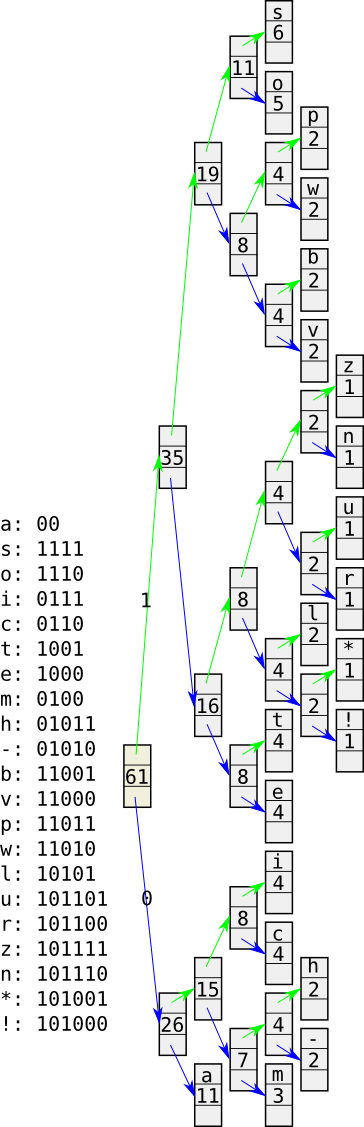
every step of huffman encoding tree build for the example string tableSo if we have some data with a non uniform distribution of probabilities we need a way the data be encoded with fewer bits for the common values and more bits for the rarer values. To be efficient we would need some way of having variable length representations without storing the length separately. The term for this data representation is a prefix code and there are several ways to generate them.

Such is the influence of Huffman on the area of prefix codes they are often called Huffman codes even if they were not created using his algorithm. One can dream of becoming immortalised like this, to join the ranks of those whose names are given to units or whole ideas in a field must be immensely rewarding, however given Huffman invented his algorithm and proved it to be optimal to answer a question on a term paper in his early twenties I fear I may already be a bit too late.

The algorithm itself is relatively straightforward. First a frequency analysis is performed, a fancy way of saying count how many of each character is in the input data. Next a binary tree is created by using a priority queue initialised with the nodes sorted by frequency.

The resulting huffman tree and the binary representation of the input symbols
The two least frequent items count is summed together and a node placed in the tree with the two original entries as child nodes. This step is repeated until a single node exists with a count value equal to the length of the input.

To encode data once simply walks the tree outputting a 0 for a left node or 1 for right node until reaching the original value. This generates a mapping of values to bit output, the input is then simply converted value by value to the bit output. To decode the data the data is used bit by bit to walk the tree to arrive at values.

If we perform this algorithm on the example string table *!asiabvcomcoopitamazonawsarsaves-the-whalescomputebasilicata we can reduce the 488 bits (61 * 8 bit characters) to 282 bits or 40% reduction. Obviously in a real application the huffman tree would need to be stored which would probably exceed this saving but for larger data sets it is probable this technique would yield excellent results on this kind of data.

Once I proved this to myself I implemented the encoder within the existing conversion program. Although my perl encoder is not very efficient it can process the entire PSL string table (around six thousand labels using 40KB or so) in less than a second, so unless the table grows massively an inelegant approach will suffice.

The resulting bits were packed into 32bit values to improve decode performance (most systems prefer to deal with larger memory fetches less frequently) and resulted in 18KB of output or 47% of the original size. This is a great improvement in size and means the statically linked test program is now 59KB and is actually smaller than the gzipped source data.

$ ls -alh test_nspsl
-rwxr-xr-x 1 vince vince 59K Sep 25 23:58 test_nspsl
$ ls -al public_suffix_list.dat.gz
-rw-r--r-- 1 vince vince 62K Sep 1 08:52 public_suffix_list.dat.gz

To be clear the statically linked program can determine if a domain is in the PSL with no additional heap allocations and includes the entire PSL ordered tree, the domain label string table and the huffman decode table to read it.

An unexpected side effect is that because the decode loop is small it sits in the processor cache. This appears to cause the string comparison function huffcasecmp() (which is not locale dependant because we know the data will be limited ASCII) performance to be close to using strcasecmp() indeed on ARM32 systems there is a very modest improvement in performance.

I think this is as much work as I am willing to put into this library but I am pleased to have achieved a result which is on par with the best of breed (libpsl still has a data representation 20KB smaller than libnspsl but requires additional libraries for additional functionality) and I got to (re)learn an important algorithm too.

Julian Andres Klode: Introducing TrieHash, a order-preserving minimal perfect hash function generator for C(++)

Abstract I introduce TrieHash an algorithm for constructing perfect hash functions from tries. The generated hash functions are pure C code, minimal, order-preserving and outperform existing alternatives. Together with the generated header files,they can also be used as a generic string to enumeration mapper (enums are created by the tool). Introduction APT (and dpkg) spend a lot of time in parsing various files, especially Packages files. APT currently uses a function called AlphaHash which hashes the last 8 bytes of a word in a case-insensitive manner to hash fields in those files (dpkg just compares strings in an array of structs). There is one obvious drawback to using a normal hash function: When we want to access the data in the hash table, we have to hash the key again, causing us to hash every accessed key at least twice. It turned out that this affects something like 5 to 10% of the cache generation performance. Enter perfect hash functions: A perfect hash function matches a set of words to constant values without collisions. You can thus just use the index to index into your hash table directly, and do not have to hash again (if you generate the function at compile time and store key constants) or handle collision resolution. As #debian-apt people know, I happened to play a bit around with tries this week before guillem suggested perfect hashing. Let me tell you one thing: My trie implementation was very naive, that did not really improve things a lot Enter TrieHash Now, how is this related to hashing? The answer is simple: I wrote a perfect hash function generator that is based on tries. You give it a list of words, it puts them in a trie, and generates C code out of it, using recursive switch statements (see code generation below). The function achieves competitive performance with other hash functions, it even usually outperforms them. Given a dictionary, it generates an enumeration (a C enum or C++ enum class) of all words in the dictionary, with the values corresponding to the order in the dictionary (the order-preserving property), and a function mapping strings to members of that enumeration. By default, the first word is considered to be 0 and each word increases a counter by one (that is, it generates a minimal hash function). You can tweak that however:
= 0
WordLabel ~ Word
OtherWord = 9
will return 0 for an unknown value, map Word to the enum member WordLabel and map OtherWord to 9. That is, the input list functions like the body of a C enumeration. If no label is specified for a word, it will be generated from the word. For more details see the documentation C code generation
switch(string[0]   32)  
case 't':
    switch(string[1]   32)  
    case 'a':
        switch(string[2]   32)  
        case 'g':
            return Tag;


return Unknown;
Yes, really recursive switches they directly represent the trie. Now, we did not really do a straightforward translation, there are some optimisations to make the whole thing faster and easier to look at: First of all, the 32 you see is used to make the check case insensitive in case all cases of the switch body are alphabetical characters. If there are non-alphabetical characters, it will generate two cases per character, one upper case and one lowercase (with one break in it). I did not know that lowercase and uppercase characters differed by only one bit before, thanks to the clang compiler for pointing that out in its generated assembler code! Secondly, we only insert breaks only between cases. Initially, each case ended with a return Unknown, but guillem (the dpkg developer) suggested it might be faster to let them fallthrough where possible. Turns out it was not faster on a good compiler, but it s still more readable anywhere. Finally, we build one trie per word length, and switch by the word length first. Like the 32 trick, his gives a huge improvement in performance. Digging into the assembler code The whole code translates to roughly 4 instructions per byte:
  1. A memory load,
  2. an or with 32
  3. a comparison, and
  4. a conditional jump.
(On x86, the case sensitive version actually only has a cmp-with-memory and a conditional jump). Due to https://gcc.gnu.org/bugzilla/show_bug.cgi?id=77729 this may be one instruction more: On some architectures an unneeded zero-extend-byte instruction is inserted this causes a 20% performance loss. Performance evaluation I run the hash against all 82 words understood by APT in Packages and Sources files, 1,000,000 times for each word, and summed up the average run-time:
host arch Trie TrieCase GPerfCase GPerf DJB
plummer ppc64el 540 601 1914 2000 1345
eller mipsel 4728 5255 12018 7837 4087
asachi arm64 1000 1603 4333 2401 1625
asachi armhf 1230 1350 5593 5002 1784
barriere amd64 689 950 3218 1982 1776
x230 amd64 465 504 1200 837 693
Suffice to say, GPerf does not really come close. All hosts except the x230 are Debian porterboxes. The x230 is my laptop with a a Core i5-3320M, barriere has an Opteron 23xx. I included the DJB hash function for another reference. Source code The generator is written in Perl, licensed under the MIT license and available from https://github.com/julian-klode/triehash I initially prototyped it in Python, but guillem complained that this would add new build dependencies to dpkg, so I rewrote it in Perl. Benchmark is available from https://github.com/julian-klode/hashbench Usage See the script for POD documentation.
Filed under: General

Sven Hoexter: in causa wosign

Since I kind of recommended the free WoSign CA in the past, I would like to point out the issues that have piled up. Mozilla has a writeup due to a removal discussion for NSS: https://wiki.mozilla.org/CA:WoSign_Issues (Yes I'm late with this post, about a month or two by now ...) Since WoSign, or the person behind it, silently also bought StartCom we've now with StartSSL and WoSign two of the three free CAs in one hand with a questionable track record. That leaves everyone looking for a low budget option with Let's Encrypt.

24 September 2016

Iain R. Learmonth: Azure from Debian

Around a week ago, I started to play with programmatically controlling Azure. I needed to create and destroy a bunch of VMs over and over again, and this seemed like something I would want to automate once instead of doing manually and repeatedly. I started to look into the azure-sdk-for-python and mentioned that I wanted to look into this in #debian-python. ardumont from Software Heritage noticed me, and was planning to package azure-storage-python. We joined forces and started a packaging team for Azure-related software. I spoke with the upstream developer of the azure-sdk-for-python and he pointed me towards azure-cli. It looked to me that this fit my use case better than the SDK alone, as it had the high level commands I was looking for. Between me and ardumont, in the space of just under a week, we have now packaged: python-msrest (#838121), python-msrestazure (#838122), python-azure (#838101), python-azure-storage (#838135), python-adal (#838716), python-applicationinsights (#838717) and finally azure-cli (#838708). Some of these packages are still in the NEW queue at the time I m writing this, but I don t foresee any issues with these packages entering unstable. azure-cli, as we have packaged, is the new Python-based CLI for Azure. The Microsoft developers gave it the tagline of our next generation multi-platform command line experience for Azure . In the short time I ve been using it I ve been very impressed with it. In order to set it up initially, you have to configure a couple of of defaults using az configure. After that, you need to az login which again is an entirely painless process as long as you have a web browser handy in order to perform the login. After those two steps, you re only two commands away from deploying a Debian virtual machine:
az resource group create -n testgroup -l "West US"
az vm create -n testvm -g testgroup --image credativ:Debian:8:latest --authentication-type ssh
This will create a resource group, and then create a VM within that resource group with a user automatically created with your current username and with your SSH public key (~/.ssh/id_rsa.pub) automatically installed. Once it returns you the IP address, you can SSH in straight away. Looking forward to some next steps for Debian on Azure, I d like to get images built for Azure using vmdebootstrap and I ll be exploring this in the lead up to, and at, the upcoming vmdebootstrap sprint in Cambridge, UK later in the year (still being organised).

22 September 2016

Joey Hess: keysafe beta release

After a month of development, keysafe 0.20160922 is released, and ready for beta testing. And it needs servers. With this release, the whole process of backing up and restoring a gpg secret key to keysafe servers is implemented. Keysafe is started at desktop login, and will notice when a gpg secret key has been created, and prompt to see if it should back it up. At this point, I recommend only using keysafe for lower-value secret keys, for several reasons: Currently the only keysafe server is one that I'm running myself. Two more keysafe servers are needed for keysafe to really be usable, and I can't run those. If you're interested in running a keysafe server, read the keysafe server requirements and get in touch.

Gustavo Noronha Silva: WebKitGTK+ 2.14 and the Web Engines Hackfest

Next week our friends at Igalia will be hosting this year s Web Engines Hackfest. Collabora will be there! We are gold sponsors, and have three developers attending. It will also be an opportunity to celebrate Igalia s 15th birthday \o/. Looking forward to meet you there! =) Carlos Garcia has recently released WebKitGTK+ 2.14, the latest stable release. This is a great release that brings a lot of improvements and works much better on Wayland, which is becoming mature enough to be used by default. In particular, it fixes the clipboard, which was one of the main missing features, thanks to Carlos Garnacho! We have also been able to contribute a bit to this release =) One of the biggest changes this cycle is the threaded compositor, which was implemented by Igalia s Gwang Yoon Hwang. This work improves performance by not stalling other web engine features while compositing. Earlier this year we contributed fixes to make the threaded compositor work with the web inspector and fixed elements, helping with the goal of enabling it by default for this release. Wayland was also lacking an accelerated compositing implementation. There was a patch to add a nested Wayland compositor to the UIProcess, with the WebProcesses connecting to it as Wayland clients to share the final rendering so that it can be shown to screen. It was not ready though and there were questions as to whether that was the way to go and alternative proposals were floating around on how to best implement it. At last year s hackfest we had discussions about what the best path for that would be where collaborans Emanuele Aina and Daniel Stone (proxied by Emanuele) contributed quite a bit on figuring out how to implement it in a way that was both efficient and platform agnostic. We later picked up the old patchset, rebased on the then-current master and made it run efficiently as proof of concept for the Apertis project on an i.MX6 board. This was done using the fancy GL support that landed in GTK+ in the meantime, with some API additions and shortcuts to sidestep performance issues. The work was sponsored by Robert Bosch Car Multimedia. Igalia managed to improve and land a very well designed patch that implements the nested compositor, though it was still not as efficient as it could be, as it was using glReadPixels to get the final rendering of the page to the GTK+ widget through cairo. I have improved that code by ensuring we do not waste memory when using HiDPI. As part of our proof of concept investigation, we got this WebGL car visualizer running quite well on our sabrelite imx6 boards. Some of it went into the upstream patches or proposals mentioned below, but we have a bunch of potential improvements still in store that we hope to turn into upstreamable patches and advance during next week s hackfest. One of the improvements that already landed was an alternate code path that leverages GTK+ s recent GL super powers to render using gdk_cairo_draw_from_gl(), avoiding the expensive copying of pixels from the GPU to the CPU and making it go faster. That improvement exposed a weird bug in GTK+ that causes a black patch to appear when shrinking the window, which I have a tentative fix for. We originally proposed to add a new gdk_cairo_draw_from_egl() to use an EGLImage instead of a GL texture or renderbuffer. On our proof of concept we noticed it is even more efficient than the texturing currently used by GTK+, and could give us even better performance for WebKitGTK+. Emanuele Bassi thinks it might be better to add EGLImage as another code branch inside from_gl() though, so we will look into that. Another very interesting igalian addition to this release is support for the MemoryPressureHandler even on systems with no cgroups set up. The memory pressure handler is a WebKit feature which flushes caches and frees resources that are not being used when the operating system notifies it memory is scarce. We worked with the Raspberry Pi Foundation to add support for that feature to the Raspberry Pi browser and contributed it upstream back in 2014, when Collabora was trying to squeeze as much as possible from the hardware. We had to add a cgroups setup to wrap Epiphany in, back then, so that it would actually benefit from the feature. With this improvement, it will benefit even without the custom cgroups setups as well, by having the UIProcess monitor memory usage and notify each WebProcess when memory is tight. Some of these improvements were achieved by developers getting together at the Web Engines Hackfest last year and laying out the ground work or ideas that ended up in the code base. I look forward to another great few days of hackfest next week! See you there o/

Junichi Uekawa: Tried creating a GCE control panel for myself.

Tried creating a GCE control panel for myself. GCP GCE control panel takes about 20 seconds for me to load, CPU is busy loading the page. It does so many things and it's very complex. I've noticed that the API isn't that slow, so I used OAuth to let me do what I want usually; list the hosts and start/stop the instance, and list the IPs. Takes 500ms to do it instead of 20 seconds. I've put the service on AppEngine. The hardest part was figuring out how this OAuth2 dance was supposed to work, and all the python documentation I have seen were somewhat outdated and rewriting then to a workable state. document was outdated but sample code was fixed. I had to read up on vendoring and PIP and other stuff in order to get all the dependencies installed. I guess my python appengine skills are too rusty now.

21 September 2016

Matthew Garrett: Microsoft aren't forcing Lenovo to block free operating systems

There's a story going round that Lenovo have signed an agreement with Microsoft that prevents installing free operating systems. This is sensationalist, untrue and distracts from a genuine problem.

The background is straightforward. Intel platforms allow the storage to be configured in two different ways - "standard" (normal AHCI on SATA systems, normal NVMe on NVMe systems) or "RAID". "RAID" mode is typically just changing the PCI IDs so that the normal drivers won't bind, ensuring that drivers that support the software RAID mode are used. Intel have not submitted any patches to Linux to support the "RAID" mode.

In this specific case, Lenovo's firmware defaults to "RAID" mode and doesn't allow you to change that. Since Linux has no support for the hardware when configured this way, you can't install Linux (distribution installers will boot, but won't find any storage device to install the OS to).

Why would Lenovo do this? I don't know for sure, but it's potentially related to something I've written about before - recent Intel hardware needs special setup for good power management. The storage driver that Microsoft ship doesn't do that setup. The Intel-provided driver does. "RAID" mode prevents the Microsoft driver from binding and forces the user to use the Intel driver, which means they get the correct power management configuration, battery life is better and the machine doesn't melt.

(Why not offer the option to disable it? A user who does would end up with a machine that doesn't boot, and if they managed to figure that out they'd have worse power management. That increases support costs. For a consumer device, why would you want to? The number of people buying these laptops to run anything other than Windows is miniscule)

Things are somewhat obfuscated due to a statement from a Lenovo rep:This system has a Signature Edition of Windows 10 Home installed. It is locked per our agreement with Microsoft. It's unclear what this is meant to mean. Microsoft could be insisting that Signature Edition systems ship in "RAID" mode in order to ensure that users get a good power management experience. Or it could be a misunderstanding regarding UEFI Secure Boot - Microsoft do require that Secure Boot be enabled on all Windows 10 systems, but (a) the user must be able to manage the key database and (b) there are several free operating systems that support UEFI Secure Boot and have appropriate signatures. Neither interpretation indicates that there's a deliberate attempt to prevent users from installing their choice of operating system.

The real problem here is that Intel do very little to ensure that free operating systems work well on their consumer hardware - we still have no information from Intel on how to configure systems to ensure good power management, we have no support for storage devices in "RAID" mode and we have no indication that this is going to get better in future. If Intel had provided that support, this issue would never have occurred. Rather than be angry at Lenovo, let's put pressure on Intel to provide support for their hardware.

comment count unavailable comments

20 September 2016

Vincent Sanders: If I see an ending, I can work backward.

Now while I am sure Arthur Miller was referring to writing a play when he said those words they have an oddly appropriate resonance for my topic.

In the early nineties Lou Montulli applied the idea of magic cookies to HTTP to make the web stateful, I imagine he had no idea of the issues he was going to introduce for the future. Like most of the web technology it was a solution to an immediate problem which it has never been possible to subsequently improve.

Chocolate chip cookie are much tastier than HTTP cookiesThe HTTP cookie is simply a way for a website to identify a connecting browser session so that state can be kept between retrieving pages. Due to shortcomings in the design of cookies and implementation details in browsers this has lead to a selection of unwanted side effects. The specific issue that I am talking about here is the supercookie where the super prefix in this context has similar connotations as to when applied to the word villain.

Whenever the browser requests a resource (web page, image, etc.) the server may return a cookie along with the resource that your browser remembers. The cookie has a domain name associated with it and when your browser requests additional resources if the cookie domain matches the requested resources domain name the cookie is sent along with the request.

As an example the first time you visit a page on www.example.foo.invalid you might receive a cookie with the domain example.foo.invalid so next time you visit a page on www.example.foo.invalid your browser will send the cookie along. Indeed it will also send it along for any page on another.example.foo.invalid

A supercookies is simply one where instead of being limited to one sub-domain (example.foo.invalid) the cookie is set for a top level domain (foo.invalid) so visiting any such domain (I used the invalid name in my examples but one could substitute com or co.uk) your web browser gives out the cookie. Hackers would love to be able to set up such cookies and potentially control and hijack many sites at a time.

This problem was noted early on and browsers were not allowed to set cookie domains with fewer than two parts so example.invalid or example.com were allowed but invalid or com on their own were not. This works fine for top level domains like .com, .org and .mil but not for countries where the domain registrar had rules about second levels like the uk domain (uk domains must have a second level like .co.uk).

 NetSurf cookie manager showing a supercookieThere is no way to generate the correct set of top level domains with an algorithm so a database is required and is called the Public Suffix List (PSL). This database is a simple text formatted list with wildcard and inversion syntax and is at time of writing around 180Kb of text including comments which compresses down to 60Kb or so with deflate.

A few years ago with ICANN allowing the great expansion of top level domains the existing NetSurf supercookie handling was found to be wanting and I decided to implement a solution using the PSL. At this point in time the database was only 100Kb source or 40Kb compressed.

I started by looking at limited existing libraries. In fact only the regdom library was adequate but used 150Kb of heap to load the pre-processed list. This would have had the drawback of increasing NetSurf heap usage significantly (we still have users on 8Mb systems). Because of this and the need to run PHP script to generate the pre-processed input it was decided the library was not suitable.

Lacking other choices I came up with my own implementation which used a perl script to construct a tree of domains from the PSL in a static array with the label strings in a separate table. At the time my implementation added 70Kb of read only data which I thought reasonable and allowed for direct lookup of answers from the database.

This solution still required a pre-processing step to generate the C source code but perl is much more readily available, is a language already used by our tooling and we could always simply ship the generated file. As long as the generated file was updated at release time as we already do for our fallback SSL certificate root set this would be acceptable.

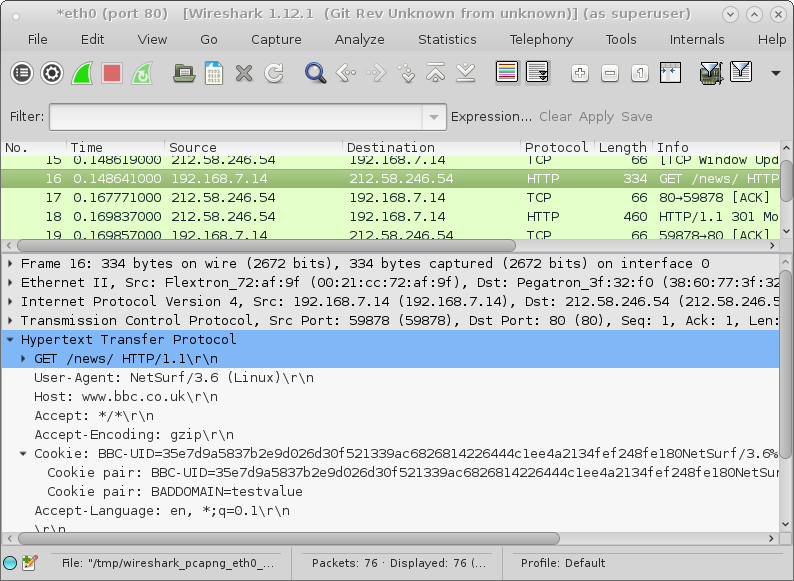
wireshark session shown NetSurf sending a co.uk supercookie to bbc.co.uk
I put the solution into NetSurf, was pleased no-one seemed to notice and moved on to other issues. Recently while fixing a completely unrelated issue in the display of session cookies in the management interface and I realised I had some test supercookies present in the display. After the initial "thats odd" I realised with horror there might be a deeper issue.

It quickly became evident the PSL generation was broken and had been for a long time, even worse somewhere along the line the "redundant" empty generated source file had been removed and the ancient fallback code path was all that had been used.

This issue had escalated somewhat from a trivial display problem. I took a moment to asses the situation a bit more broadly and came to the conclusion there were a number of interconnected causes, centered around the lack of automated testing, which could be solved by extracting the PSL handling into a "support" library.

NetSurf has several of these support libraries which could be used separately to the main browser project but are principally oriented towards it. These libraries are shipped and built in releases alongside the main browser codebase and mainly serve to make API more obvious and modular. In this case my main aim was to have the functionality segregated into a separate module which could be tested, updated and monitored directly by our CI system meaning the embarrassing failure I had found can never occur again.

Before creating my own library I did consider a library called libpsl had been created since I wrote my original implementation. Initially I was very interested in using this library given it managed a data representation within a mere 32Kb.

Unfortunately the library integrates a great deal of IDN and punycode handling which was not required in this use case. NetSurf already has to handle IDN and punycode translations and uses punycode encoded domain names internally only translating to unicode representations for display so duplicating this functionality using other libraries requires a great deal of resource above the raw data representation.

I put the library together based on the existing code generator Perl program and integrated the test set that comes along with the PSL. I was a little alarmed to discover that the PSL had almost doubled in size since the implementation was originally written and now the trivial test program of the library was weighing in at a hefty 120Kb.

This stemmed from two main causes:
  1. there were now many more domain label strings to be stored
  2. there now being many, many more nodes in the tree.
To address the first cause the length of the domain label strings was moved into the unused padding space within each tree node removing a byte from each domain label saving 6Kb. Next it occurred to me that while building the domain label string table that if the label to be added already existed as a substring within the table it could be elided.

The domain labels were sorted from longest to shortest and added in order searching for substring matches as the table was built this saved another 6Kb. I am sure there are ways to reduce this further I have missed (if you see them let me know!) but a 25% saving (47Kb to 35Kb) was a good start.

The second cause was a little harder to address. The structure representing nodes in the tree I started with was at first look reasonable.

struct pnode  
uint16_t label_index; /* index into string table of label */
uint16_t label_length; /* length of label */
uint16_t child_node_index; /* index of first child node */
uint16_t child_node_count; /* number of child nodes */
;

I examined the generated table and observed that the majority of nodes were leaf nodes (had no children) which makes sense given the type of data being represented. By allowing two types of node one for labels and a second for the child node information this would halve the node size in most cases and requiring only a modest change to the tree traversal code.

The only issue with this would be that a way to indicate a node has child information. It was realised that the domain labels can have a maximum length of 63 characters meaning their length can be represented in six bits so a uint16_t was excessive. The space was split into two uint8_t parts one for the length and one for a flag to indicate child data node followed.

union pnode  
struct
uint16_t index; /* index into string table of label */
uint8_t length; /* length of label */
uint8_t has_children; /* the next table entry is a child node */
label;
struct
uint16_t node_index; /* index of first child node */
uint16_t node_count; /* number of child nodes */
child;
;

static const union pnode pnodes[8580] =
/* root entry */
.label = 0, 0, 1 , .child = 2, 1553 ,
/* entries 2 to 1794 */
.label = 37, 2, 1 , .child = 1795, 6 ,

...

/* entries 8577 to 8578 */
.label = 31820, 6, 1 , .child = 8579, 1 ,
/* entry 8579 */
.label = 0, 1, 0 ,

;

This change reduced the node array size from 63Kb to 33Kb almost a 50% saving. I considered using bitfields to try and reduce the label length and has_children flag into a single byte but such packing will not reduce the length of a node below 32bits because it is unioned with the child structure.

A possibility of using the spare uint8_t derived by bitfield packing to store an additional label node in three other nodes was considered but added a great deal of complexity to node lookup and table construction for saving around 4Kb so was not incorporated.

With the changes incorporated the test program was a much more acceptable 75Kb reasonably close to the size of the compressed source but with the benefits of direct lookup. Integrating the libraries single API call into NetSurf was straightforward and resulted in correct operation when tested.

This episode just reminded me of the dangers of code that can fail silently. It exposed our users to a security problem that we thought had been addressed almost six years ago and squandered the limited resources of the project. Hopefully a lesson we will not have to learn again any time soon. If there is a positive to take away it is that the new implementation is more space efficient, automatically built and importantly tested

Gunnar Wolf: Proposing a GR to repeal the 2005 vote for declassification of the debian-private mailing list

For the non-Debian people among my readers: The following post presents bits of the decision-taking process in the Debian project. You might find it interesting, or terribly dull and boring :-) Proceed at your own risk. My reason for posting this entry is to get more people to read the accompanying options for my proposed General Resolution (GR), and have as full a ballot as possible. Almost three weeks ago, I sent a mail to the debian-vote mailing list. I'm quoting it here in full:
Some weeks ago, Nicolas Dandrimont proposed a GR for declassifying
debian-private[1]. In the course of the following discussion, he
accepted[2] Don Armstrong's amendment[3], which intended to clarify the
meaning and implementation regarding the work of our delegates and the
powers of the DPL, and recognizing the historical value that could lie
within said list.
[1] https://www.debian.org/vote/2016/vote_002
[2] https://lists.debian.org/debian-vote/2016/07/msg00108.html
[3] https://lists.debian.org/debian-vote/2016/07/msg00078.html
In the process of the discussion, several people objected to the
amended wording, particularly to the fact that "sufficient time and
opportunity" might not be sufficiently bound and defined.
I am, as some of its initial seconders, a strong believer in Nicolas'
original proposal; repealing a GR that was never implemented in the
slightest way basically means the Debian project should stop lying,
both to itself and to the whole free software community within which
it exists, about something that would be nice but is effectively not
implementable.
While Don's proposal is a good contribution, given that in the
aforementioned GR "Further Discussion" won 134 votes against 118, I
hereby propose the following General Resolution:
=== BEGIN GR TEXT ===
Title: Acknowledge that the debian-private list will remain private.
1. The 2005 General Resolution titled "Declassification of debian-private
   list archives" is repealed.
2. In keeping with paragraph 3 of the Debian Social Contract, Debian
   Developers are strongly encouraged to use the debian-private mailing
   list only for discussions that should not be disclosed.
=== END GR TEXT ===
Thanks for your consideration,
--
Gunnar Wolf
(with thanks to Nicolas for writing the entirety of the GR text ;-) )
Yesterday, I spoke with the Debian project secretary, who confirmed my proposal has reached enough Seconds (that is, we have reached five people wanting the vote to happen), so I could now formally do a call for votes. Thing is, there are two other proposals I feel are interesting, and should be part of the same ballot, and both address part of the reasons why the GR initially proposed by Nicolas didn't succeed: So, once more (and finally!), why am I posting this? I plan to do the formal call for votes by Friday 23.
[update] Kurt informed me that the discussion period started yesterday, when I received the 5th second. The minimum discussion period is two weeks, so I will be doing a call for votes at or after 2016-10-03.

Reproducible builds folks: Reproducible Builds: week 73 in Stretch cycle

What happened in the Reproducible Builds effort between Sunday September 11 and Saturday September 17 2016: Toolchain developments Ximin Luo started a new series of tools called (for now) debrepatch, to make it easier to automate checks that our old patches to Debian packages still apply to newer versions of those packages, and still make these reproducible. Ximin Luo updated one of our few remaining patches for dpkg in #787980 to make it cleaner and more minimal. The following tools were fixed to produce reproducible output: Packages reviewed and fixed, and bugs filed The following updated packages have become reproducible - in our current test setup - after being fixed: The following updated packages appear to be reproducible now, for reasons we were not able to figure out. (Relevant changelogs did not mention reproducible builds.) The following 3 packages were not changed, but have become reproducible due to changes in their build-dependencies: jaxrs-api python-lua zope-mysqlda. Some uploads have addressed some reproducibility issues, but not all of them: Patches submitted that have not made their way to the archive yet: Reviews of unreproducible packages 462 package reviews have been added, 524 have been updated and 166 have been removed in this week, adding to our knowledge about identified issues. 25 issue types have been updated: Weekly QA work FTBFS bugs have been reported by: diffoscope development A new version of diffoscope 60 was uploaded to unstable by Mattia Rizzolo. It included contributions from: It also included from changes previous weeks; see either the changes or commits linked above, or previous blog posts 72 71 70. strip-nondeterminism development New versions of strip-nondeterminism 0.027-1 and 0.028-1 were uploaded to unstable by Chris Lamb. It included contributions from: disorderfs development A new version of disorderfs 0.5.1 was uploaded to unstable by Chris Lamb. It included contributions from: It also included from changes previous weeks; see either the changes or commits linked above, or previous blog posts 70. Misc. This week's edition was written by Ximin Luo and reviewed by a bunch of Reproducible Builds folks on IRC.

19 September 2016

Mike Gabriel: Rocrail changed License to some dodgy non-free non-License

The Background Story A year ago, or so, I took some time to search the internet for Free Software that can be used for controlling model railways via a computer. I was happy to find Rocrail [1] being one of only a few applications available on the market. And even more, I was very happy when I saw that it had been licensed under a Free Software license: GPL-3(+). A month ago, or so, I collected my old M rklin (Digital) stuff from my parents' place and started looking into it again after +15 years, together with my little son. Some weeks ago, I remembered Rocrail and thought... Hey, this software was GPLed code and absolutely suitable for uploading to Debian and/or Ubuntu. I searched for the Rocrail source code and figured out that it got hidden from the web some time in 2015 and that the license obviously has been changed to some non-free license (I could not figure out what license, though). This made me very sad! I thought I had found a piece of software that might be interesting for testing with my model railway. Whenever I stumble over some nice piece of Free Software that I plan to use (or even only play with), I upload this to Debian as one of the first steps. However, I highly attempt to stay away from non-free sofware, so Rocrail has become a no-option for me back in 2015. I should have moved on from here on... Instead... Proactively, I signed up with the Rocrail forum and asked the author(s) if they see any chance of re-licensing the Rocrail code under GPL (or any other FLOSS license) again [2]? When I encounter situations like this, I normally offer my expertise and help with such licensing stuff for free. My impression until here already was that something strange must have happened in the past, so that software developers choose GPL and later on stepped back from that decision and from then on have been hiding the source code from the web entirely. Going deeper... The Rocrail project's wiki states that anyone can request GitBlit access via the forum and obtain the source code via Git for local build purposes only. Nice! So, I asked for access to the project's Git repository, which I had been granted. Thanks for that. Trivial Source Code Investigation... So far so good. I investigated the source code (well, only the license meta stuff shipped with the source code...) and found that the main COPYING files (found at various locations in the source tree, containing a full version of the GPL-3 license) had been replaced by this text:
Copyright (c) 2002 Robert Jan Versluis, Rocrail.net
All rights reserved.
Commercial usage needs permission.
The replacement happened with these Git commits:
commit cfee35f3ae5973e97a3d4b178f20eb69a916203e
Author: Rob Versluis <r.j.versluis@rocrail.net>
Date:   Fri Jul 17 16:09:45 2015 +0200
    update copyrights
commit df399d9d4be05799d4ae27984746c8b600adb20b
Author: Rob Versluis <r.j.versluis@rocrail.net>
Date:   Wed Jul 8 14:49:12 2015 +0200
    update licence
commit 0daffa4b8d3dc13df95ef47e0bdd52e1c2c58443
Author: Rob Versluis <r.j.versluis@rocrail.net>
Date:   Wed Jul 8 10:17:13 2015 +0200
    update
Getting in touch again, still being really interested and wanting to help... As I consider such a non-license as really dangerous when distributing any sort of software, be it Free or non-free Software, I posted the below text on the Rocrail forum:
Hi Rob,
I just stumbled over this post [3] [link reference adapted for this
blog post), which probably is the one you have referred to above.
It seems that Rocrail contains features that require a key or such
for permanent activation.  Basically, this is allowed and possible
even with the GPL-3+ (although Free Software activists will  not
appreciate that). As the GPL states that people can share the source
code, programmers can  easily deactivate license key checks (and
such) in the code and re-distribute that patchset as they  like.
Furthermore, the current COPYING file is really non-protective at
all. It does not really protect   you as copyright holder of the
code. Meaning, if people crash their trains with your software, you  
could actually be legally prosecuted for that. In theory. Or in the
U.S. ( ;-) ). Main reason for  having a long long license text is to
protect you as the author in case your software causes t trouble to
other people. You do not have any warranty disclaimer in your COPYING
file or elsewhere. Really not a good idea.
In that referenced post above, someone also writes about the nuisance
of license discussions in  this forum. I have seen various cases
where people produced software and did not really care for 
licensing. Some ended with a letter from a lawyer, some with some BIG
company using their code  under their copyright holdership and their
own commercial licensing scheme. This is not paranoia,  this is what
happens in the Free Software world from time to time.
A model that might be much more appropriate (and more protective to
you as the author), maybe, is a  dual release scheme for the code. A
possible approach could be to split Rocrail into two editions:  
Community Edition and Professional/Commercial Edition. The Community
Edition must be licensed in a  way that it allows re-using the code
in a closed-source, non-free version of Rocrail (e.g.   MIT/Expat
License or Apache2.0 License). Thus, the code base belonging to the
community edition  would be licensed, say..., as Apache-2.0 and for
the extra features in the Commercial Edition, you  may use any
non-free license you want (but please not that COPYING file you have
now, it really  does not protect your copyright holdership).
The reason for releasing (a reduced set of features of a) software as
Free Software is to extend  the user base. The honey jar effect, as
practise by many huge FLOSS projects (e.g. Owncloud,  GitLab, etc.).
If people could install Rocrail from the Debian / Ubuntu archives
directly, I am  sure that the user base of Rocrail will increase.
There may also be developers popping up showing  an interest in
Rocrail (e.g. like me). However, I know many FLOSS developers (e.g.
like me) that  won't waste their free time on working for a non-free
piece of software (without being paid).
If you follow (or want to follow) a business model with Rocrail, then
keep some interesting  features in the Commercial Edition and don't
ship that source code. People with deep interest may  opt for that.
Furthermore, another option could be dual licensing the code. As the
copyright holder of Rocrail  you are free to juggle with licenses and
apply any license to a release you want. For example, this  can be
interesing for a free-again Rocrail being shipped via Apple's iStore. 
Last but not least, as you ship the complete source code with all
previous changes as a Git project  to those who request GitBlit
access, it is possible to obtain all earlier versions of Rocrail. In 
the mail I received with my GitBlit credentials, there was some text
that  prohibits publishing the  code. Fine. But: (in theory) it is
not forbidden to share the code with a friend, for local usage.  This
friend finds the COPYING file, frowns and rewinds back to 2015 where
the license was still  GPL-3+. GPL-3+ code can be shared with anyone
and also published, so this friend could upload the  2015-version of
Rocrail to Github or such and start to work on a free fork. You also
may not want  this.
Thanks for working on this piece of software! It is highly
interesing, and I am still sad, that it  does not come with a free
license anymore. I won't continue this discussion and move on, unless
you  are interested in any of the above information and ask for more
expertise. Ping me here or directly  via mail, if needed. If the
expertise leads to parts of Rocrail becoming Free Software again, the 
expertise is offered free of charge ;-).
light+love
Mike
Wow, the first time I got moderated somewhere... What an experience! This experience now was really new. My post got immediately removed from the forum by the main author of Rocrail (with the forum's moderator's hat on). The new experience was: I got really angry when I discovererd having been moderated. Wow! Really a powerful emotion. No harassment in my words, no secrets disclosed, and still... my free speech got suppressed by someone. That feels intense! And it only occurred in the virtual realm, not face to face. Wow!!! I did not expect such intensity... The reason for wiping my post without any other communication was given as below and quite a statement to frown upon (this post has also been "moderately" removed from the forum thread [2] a bit later today):
Mike,
I think its not a good idea to point out a way to get the sources back to the GPL periode.
Therefore I deleted your posting.
(The phpBB forum software also allows moderators to edit posts, so the critical passage could have been removed instead, but immediately wiping the full message, well...). Also, just wiping my post and not replying otherwise with some apology to suppress my words, really is a no-go. And the reason for wiping the rest of the text... Any Git user can easily figure out how to get a FLOSS version of Rocrail and continue to work on that from then on. Really. Now the political part of this blog post... Fortunately, I still live in an area of the world where the right of free speech is still present. I found out: I really don't like being moderated!!! Esp. if what I share / propose is really noooo secret at all. Anyone who knows how to use Git can come to the same conclusion as I have come to this morning. [Off-topic, not at all related to Rocrail: The last votes here in Germany indicate that some really stupid folks here yearn for another this time highly idiotic wind of change, where free speech may end up as a precious good.] To other (Debian) Package Maintainers and Railroad Enthusiasts... With this blog post I probably close the last option for Rocrail going FLOSS again. Personally, I think that gate was already closed before I got in touch. Now really moving on... Probably the best approach for my new train conductor hobby (as already recommended by the woman at my side some weeks back) is to leave the laptop lid closed when switching on the train control units. I should have listened to her much earlier. I have finally removed the Rocrail source code from my computer again without building and testing the application. I neither have shared the source code with anyone. Neither have I shared the Git URL with anyone. I really think that FLOSS enthusiasts should stay away from this software for now. For my part, I have lost my interest in this completely... References light+love,
Mike

17 September 2016

Jonas Meurer: apache rewritemap querystring

Apache2: Rewrite REQUEST_URI based on a bulk list of GET parameters in QUERY_STRING Recently I searched for a solution to rewrite a REQUEST_URI based on GET parameters in QUERY_STRING. To make it even more complicated, I had a list of ~2000 parameters that have to be rewritten like the following:
if % QUERY_STRING  starts with one of <parameters>:
    rewrite % REQUEST_URI  from /new/ to /old/
Honestly, it took me several hours to find a solution that was satisfying and scales well. Hopefully, this post will save time for others with the need for a similar solution. Research and first attempt: RewriteCond % QUERY_STRING ... After reading through some documentation, particularly Manipulating the Query String, the following ideas came to my mind at first:
RewriteCond % REQUEST_URI  ^/new/
RewriteCond % QUERY_STRING  ^(param1)(.*)$ [OR]
RewriteCond % QUERY_STRING  ^(param2)(.*)$ [OR]
...
RewriteCond % QUERY_STRING  ^(paramN)(.*)$
RewriteRule /new/ /old/?%1%2 [R,L]
or instead of an own RewriteCond for each parameter:
RewriteCond % QUERY_STRING  ^(param1 param2 ... paramN)(.*)$

There has to be something smarter ... But with ~2000 parameters to look up, neither of the solutions seemed particularly smart. Both scale really bad and probably it's rather heavy stuff for Apache to check ~2000 conditions for every ^/new/ request. Instead I was searching for a solution to lookup a string from a compiled list of strings. RewriteMap seemed like it might be what I was searching for. I read the Apache2 RewriteMap documentation here and here and finally found a solution that worked as expected, with one limitation. But read on ... The solution: RewriteMap and RewriteCond $ mapfile:% QUERY_STRING ... Finally, the solution was to use a RewriteMap with all parameters that shall be rewritten and check given parameters in the requests against this map within a RewriteCond. If the parameter matches, the simple RewriteRule applies. For the inpatient, here's the rewrite magic from my VirtualHost configuration:
RewriteEngine On
RewriteMap RewriteParams "dbm:/tmp/rewrite-params.map"
RewriteCond % REQUEST_URI  ^/new/
RewriteCond $ RewriteParams:% QUERY_STRING NOT_FOUND  !=NOT_FOUND
RewriteRule ^/new/ /old/ [R,L]

A more detailed description of the solution First, I created a RewriteMap at /tmp/rewrite-params.txt with all parameters to be rewritten. A RewriteMap requires two field per line, one with the origin and the other one with the replacement part. Since I use the RewriteMap merely for checking the condition, not for real string replacement, the second field doesn't matter to me. I ended up putting my parameters in both fields, but you could choose every random value for the second field: /tmp/rewrite-params.txt:
param1 param1
param2 param2
...
paramN paramN
Then I created a DBM hash map file from that plain text map file, as DBM maps are indexed, while TXT maps are not. In other words: with big maps, DBM is a huge performance boost:
httxt2dbm -i /tmp/rewrite-params.txt -o /tmp/rewrite-params.map

Now, let's go through the VirtualHost configuration rewrite magic from above line by line. First line should be clear: it enables the Apache Rewrite Engine:
RewriteEngine On
Second line defines the RewriteMap that I created above. It contains the list of parameters to be rewritten:
RewriteMap RewriteParams "dbm:/tmp/rewrite-params.map"
The third line limits the rewrites to REQUEST_URIs that start with /new/. This is particularly required to prevent rewrite loops. Without that condition, queries that have been rewritten to /old/ would go through the rewrite again, resulting in an endless rewrite loop:
RewriteCond % REQUEST_URI  ^/new/
The fourth line is the core condition: it checks whether QUERY_STRING (the GET parameters) is listed in the RewriteMap. A fallback value 'NOT_FOUND' is defined if the lookup didn't match. The condition is only true, if the lookup was successful and the QUERY_STRING was found within the map:
RewriteCond $ RewriteParams:% QUERY_STRING NOT_FOUND  !=NOT_FOUND
The last line is a simple RewriteRule from /new/ to /old/. It is executed only if all previous conditions are met. The flags are R for redirect (issuing a HTTP redirect to browser) and L for last (causing mod_rewrite to stop processing immediately after that rule):
RewriteRule ^/new/ /old/ [R,L]

Known issues A big limitation of this solution (compared to the ones above) is, that it looks up the whole QUERY_STRING in RewriteMap. Therefore, it works only if param is the only GET parameter. In case of additional GET parameters, the second rewrite condition fails and nothing is rewritten even if the first GET parameter is listed in RewriteMap. If anyone comes up with a solution to this limitation, I would be glad to learn about it :)

Norbert Preining: Android 7.0 Nougat Root PokemonGo

Since my switch to Android my Nexus 6p is rooted and I have happily fixed the Android (<7) font errors with Japanese fonts in English environment (see this post). The recently released Android 7 Nougat finally fixes this problem, so it was high time to update. In addition, a recent update to Pokemon Go excluded rooted devices, so I was searching for a solution that allows me to: update to Nougat, keep root, and run PokemonGo (as well as some bank security apps etc). android-nougat-root-poke After some playing around here are the steps I took: Installation of necessary components Warning: The following is for Nexus6p device, you need different image files and TWRP recovery for other devices. Flash Nougat firmware images Get it from the Google Android Nexus images web site, unpack the zip and the included zip one gets a lot of img files.

unzip angler-nrd90u-factory-7c9b6a2b.zip
cd angler-nrd90u/
unzip image-angler-nrd90u.zip
As I don t want my user partition to get flashed, I did not use the included flash script, but did it manually:
fastboot flash bootloader bootloader-angler-angler-03.58.img
fastboot reboot-bootloader
sleep 5
fastboot flash radio radio-angler-angler-03.72.img
fastboot reboot-bootloader
sleep 5
fastboot erase system
fastboot flash system system.img
fastboot erase boot
fastboot flash boot boot.img
fastboot erase cache
fastboot flash cache cache.img
fastboot erase vendor
fastboot flash vendor vendor.img
fastboot erase recovery
fastboot flash recovery recovery.img
fastboot reboot
After that boot into the normal system and let it do all the necessary upgrades. Once this is done, let us prepare for systemless root and possible hiding of it. Get the necessary file Get Magisk, SuperSU-magisk, as well as the Magisk-Manager.apk from this forum thread (direct links as of 2016/9: Magisk-v6.zip, SuperSU-v2.76-magisk.zip, Magisk-Manager.apk). Transfer these two files to your device I am using an external USB stick that can be plugged into the device, or copy it via your computer or via a cloud service. Also we need to get a custom recovery image, I am using TWRP. I used the version 3.0.2-0 of TWRP I had already available, but that version didn t manage to decrypt the file system and hangs. One needs to get at least version 3.0.2-2 from the TWRP web site. Install latest TWRP recorvery Reboot into boot-loader, then use fastboot to flash twrp:
fastboot erase recovery
fastboot flash recovery twrp-3.0.2-2-angler.img
fastboot reboot-bootloader
After that select Recovery with the up-down buttons and start twrp. You will be asked you pin if you have one set. Install Magisk-v6.zip Select Install in TWRP, select the Magisk-v6.zip file, and see you device being prepared for systemless root. Install SuperSU, Magisk version Again, boot into TWRP and use the install tool to install SuperSU-v2.76-magisk.zip. After reboot you should have a SuperSU binary running. Install the Magisk Manager From your device browse to the .apk and install it. How to run safety net programs Those programs that check for safety functions (Pokemon Go, Android Pay, several bank apps) need root disabled. Open the Magisk Manager and switch the root switch to the left (off). After this starting the program should bring you past the special check.

13 September 2016

John Goerzen: Two Boys, An Airplane, Plus Hundreds of Old Computers

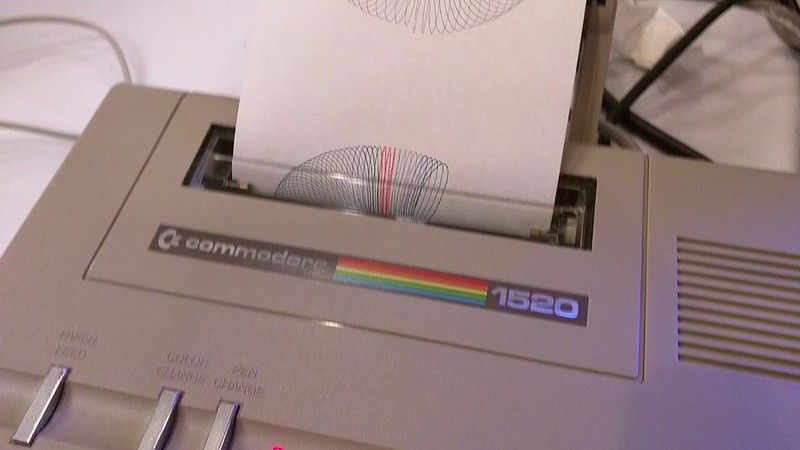
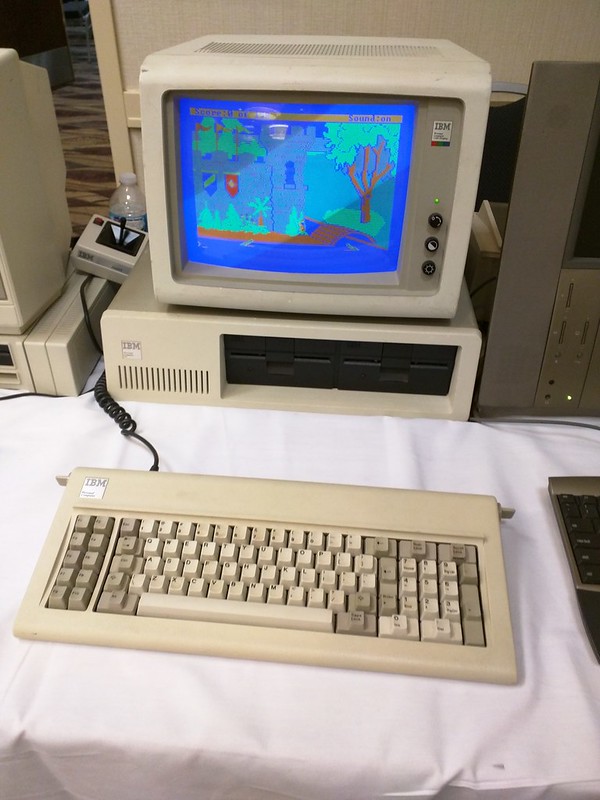
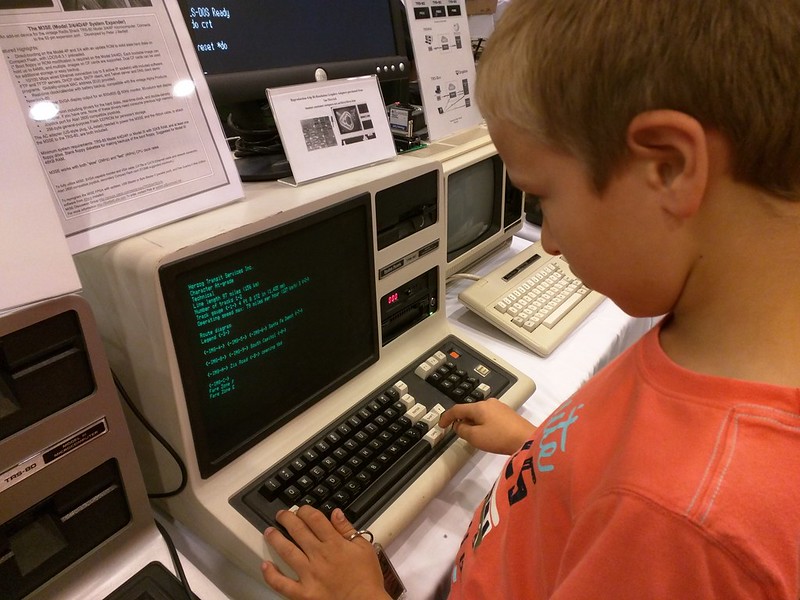
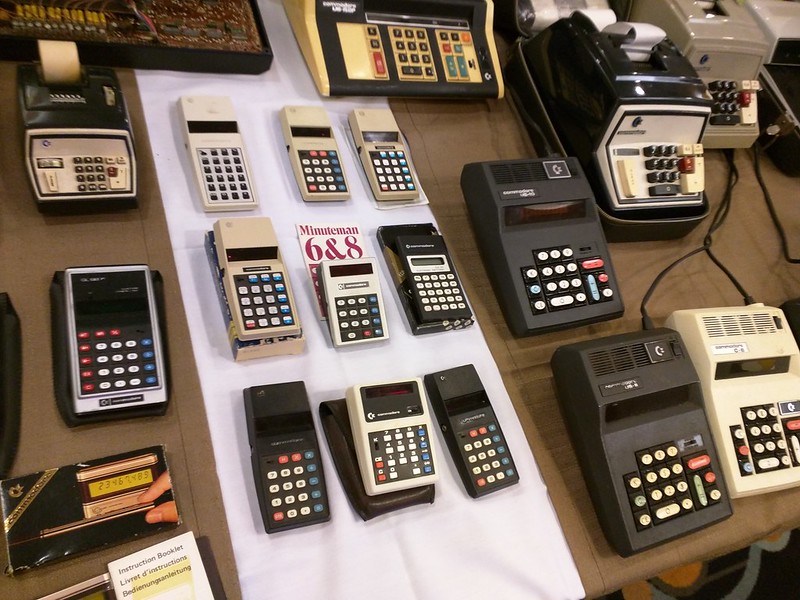
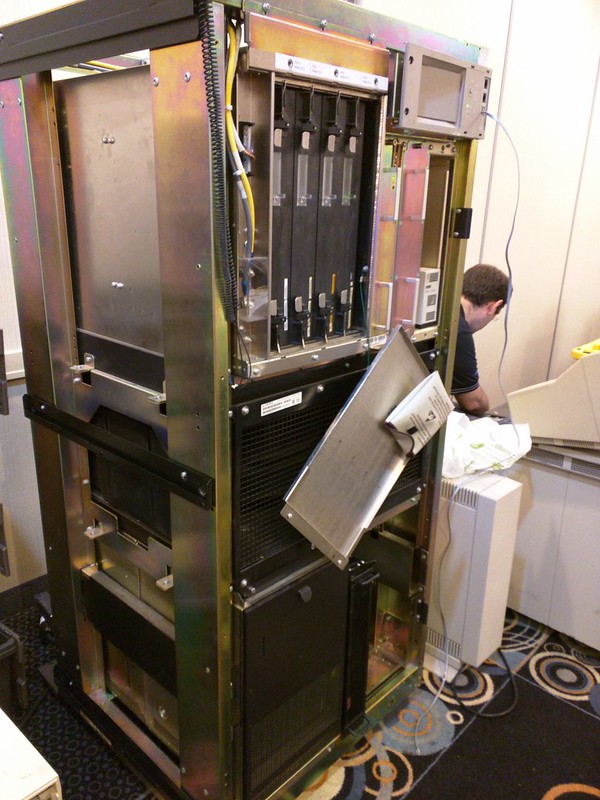
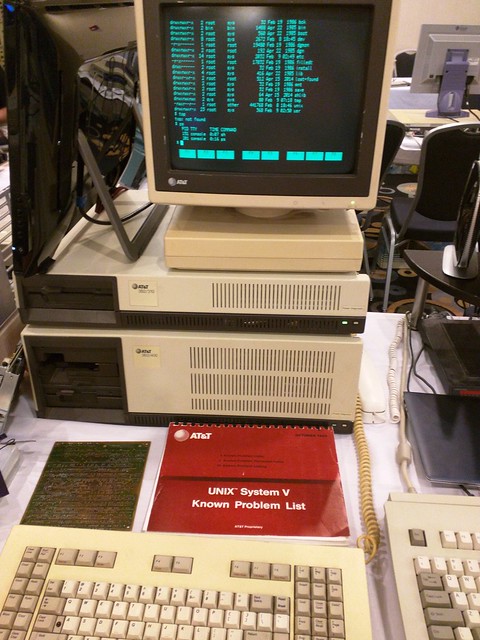
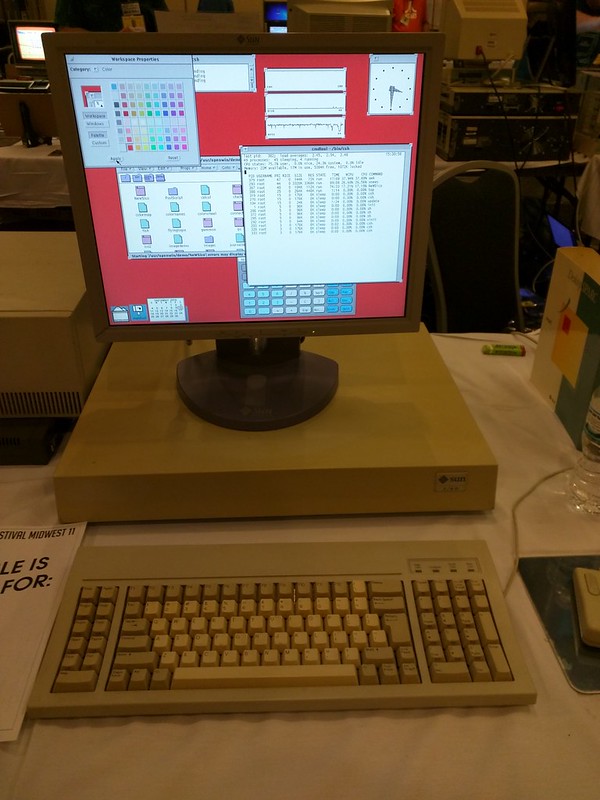
Was there anything you didn t like about our trip? Jacob s answer: That we had to leave so soon! That s always a good sign. When I first heard about the Vintage Computer Festival Midwest, I almost immediately got the notion that I wanted to go. Besides the TRS-80 CoCo II up in my attic, I also have fond memories of an old IBM PC with CGA monitor, a 25MHz 486, an Alpha also in my attic, and a lot of other computers along the way. I didn t really think my boys would be interested. But I mentioned it to them, and they just lit up. They remembered the Youtube videos I d shown them of old line printers and punch card readers, and thought it would be great fun. I thought it could be a great educational experience for them too and it was. It also turned into a trip that combined being a proud dad with so many of my other interests. Quite a fun time. IMG_20160911_061456 (Jacob modeling his new t-shirt) Captain Jacob Chicago being not all that close to Kansas, I planned to fly us there. If you re flying yourself, solid flight planning is always important. I had already planned out my flight using electronic tools, but I always carry paper maps with me in the cockpit for backup. I got them out and the boys and I planned out the flight the old-fashioned way. Here s Oliver using a scale ruler (with markings for miles corresponding to the scale of the map) and Jacob doing calculating for us. We measured the entire route and came to within one mile of the computer s calculation for each segment those boys are precise! 20160904_175519 We figured out how much fuel we d use, where we d make fuel stops, etc. The day of our flight, we made it as far as Davenport, Iowa when a chance of bad weather en route to Chicago convinced me to land there and drive the rest of the way. The boys saw that as part of the exciting adventure! Jacob is always interested in maps, and had kept wanting to use my map whenever we flew. So I dug an old Android tablet out of the attic, put Avare on it (which has aviation maps), and let him use that. He was always checking it while flying, sometimes saying this over his headset: DING. Attention all passengers, this is Captain Jacob speaking. We are now 45 miles from St. Joseph. Our altitude is 6514 feet. Our speed is 115 knots. We will be on the ground shortly. Thank you. DING Here he is at the Davenport airport, still busy looking at his maps: IMG_20160909_183813 Every little airport we stopped at featured adults smiling at the boys. People enjoyed watching a dad and his kids flying somewhere together. Oliver kept busy too. He loves to help me on my pre-flight inspections. He will report every little thing to me a scratch, a fleck of paint missing on a wheel cover, etc. He takes it seriously. Both boys love to help get the plane ready or put it away. The Computers Jacob quickly gravitated towards a few interesting things. He sat for about half an hour watching this old Commodore plotter do its thing (click for video): VID_20160910_142044 His other favorite thing was the phones. Several people had brought complete analog PBXs with them. They used them to demonstrate various old phone-related hardware; one had several BBSs running with actual modems, another had old answering machines and home-security devices. Jacob learned a lot about phones, including how to operate a rotary-dial phone, which he d never used before! IMG_20160910_151431 Oliver was drawn more to the old computers. He was fascinated by the IBM PC XT, which I explained was just about like a model I used to get to use sometimes. They learned about floppy disks and how computers store information. IMG_20160910_195145 He hadn t used joysticks much, and found Pong ( this is a soccer game! ) interesting. Somebody has also replaced the guts of a TRS-80 with a Raspberry Pi running a SNES emulator. This had thoroughly confused me for a little while, and excited Oliver. Jacob enjoyed an old TRS-80, which, through a modern Ethernet interface and a little computation help in AWS, provided an interface to Wikipedia. Jacob figured out the text-mode interface quickly. Here he is reading up on trains. IMG_20160910_140524 I had no idea that Commodore made a lot of adding machines and calculators before they got into the home computer business. There was a vast table with that older Commodore hardware, too much to get on a single photo. But some of the adding machines had their covers off, so the boys got to see all the little gears and wheels and learn how an adding machine can do its printing. IMG_20160910_145911 And then we get to my favorite: the big iron. Here is a VAX a working VAX. When you have a computer that huge, it s easier for the kids to understand just what something is. IMG_20160910_125451 When we encountered the table from the Glenside Color Computer Club, featuring the good old CoCo IIs like what I used as a kid (and have up in my attic), I pointed out to the boys that we have a computer just like this that can do these things and they responded wow! I think they are eager to try out floppy disks and disk BASIC now. Some of my favorites were the old Unix systems, which are a direct ancestor to what I ve been working with for decades now. Here s AT&T System V release 3 running on its original hardware: IMG_20160910_144923 And there were a couple of Sun workstations there, making me nostalgic for my college days. If memory serves, this one is actually running on m68k in the pre-Sparc days: IMG_20160910_153418 Returning home After all the excitement of the weekend, both boys zonked out for awhile on the flight back home. Here s Jacob, sleeping with his maps still up. IMG_20160911_132952 As we were nearly home, we hit a pocket of turbulence, the kind that feels as if the plane is dropping a bit (it s perfectly normal and safe; you ve probably felt that on commercial flights too). I was a bit concerned about Oliver; he is known to get motion sick in cars (and even planes sometimes). But what did I hear from Oliver? Whee! That was fun! It felt like a roller coaster! Do it again, dad!

Joey Hess: PoW bucket bloom: throttling anonymous clients with proof of work, token buckets, and bloom filters

An interesting side problem in keysafe's design is that keysafe servers, which run as tor hidden services, allow anonymous data storage and retrieval. While each object is limited to 64 kb, what's to stop someone from making many requests and using it to store some big files? The last thing I want is a git-annex keysafe special remote. ;-) I've done a mash-up of three technologies to solve this, that I think is perhaps somewhat novel. Although it could be entirely old hat, or even entirely broken. (All I know so far is that the code compiles.) It uses proof of work, token buckets, and bloom filters.
Each request can have a proof of work attached to it, which is just a value that, when hashed with a salt, starts with a certain number of 0's. The salt includes the ID of the object being stored or retrieved. The server maintains a list of token buckets. The first can be accessed without any proof of work, and subsequent ones need progressively more proof of work to be accessed. Clients will start by making a request without a PoW, and that will often succeed, but when the first token bucket is being drained too fast by other load, the server will reject the request and demand enough proof of work to allow access to the second token bucket. And so on down the line if necessary. At the worst, a client may have to do 8-16 minutes of work to access a keysafe server that is under heavy load, which would not be ideal, but is acceptible for keysafe since it's not run very often. If the client provides a PoW good enough to allow accessing the last token bucket, the request will be accepted even when that bucket is drained. The client has done plenty of work at this point, so it would be annoying to reject it. To prevent an attacker that is willing to burn CPU from abusing this loophole to flood the server with object stores, the server delays until the last token bucket fills back up.
So far so simple really, but this has a big problem: What prevents a proof of work from being reused? An attacker could generate a single PoW good enough to access all the token buckets, and flood the server with requests using it, and so force everyone else to do excessive amounts of work to use the server. Guarding against that DOS is where the bloom filters come in. The server generates a random request ID, which has to be included in the PoW salt and sent back by the client along with the PoW. The request ID is added to a bloom filter, which the server can use to check if the client is providing a request ID that it knows about. And a second bloom filter is used to check if a request ID has been used by a client before, which prevents the DOS. Of course, when dealing with bloom filters, it's important to consider what happens when there's a rare false positive match. This is not a problem with the first bloom filter, because a false positive only lets some made-up request ID be used. A false positive in the second bloom filter will cause the server to reject the client's proof of work. But the server can just request more work, or send a new request ID, and the client will follow along. The other gotcha with bloom filters is that filling them up too far sets too many bits, and so false positive rates go up. To deal with this, keysafe just keeps count of how many request IDs it has generated, and once it gets to be too many to fit in a bloom filter, it makes a new, empty bloom filter and starts storing request IDs in it. The old bloom filter is still checked too, providing a grace period for old request IDs to be used. Using bloom filters that occupy around 32 mb of RAM, this rotation only has to be done every million requests of so. But, that rotation opens up another DOS! An attacker could cause lots of request IDs to be generated, and so force the server to rotate its bloom filters too quickly, which would prevent any requests from being accepted. To solve this DOS, just use one more token bucket, to limit the rate that request IDs can be generated, so that the time it would take an attacker to force a bloom filter rotation is long enough that any client will have plenty of time to complete its proof of work.
This sounds complicated, and probably it is, but the implementation only took 333 lines of code. About the same number of lines that it took to implement the entire keysafe HTTP client and server using the amazing servant library. There are a number of knobs that may need to be tuned to dial it in, including the size of the token buckets, their refill rate, the size of the bloom filters, and the number of argon2 iterations in the proof of work. Servers may eventually need to adjust those on the fly, so that if someone decides it's worth burning large quantities of CPU to abuse keysafe for general data storage, the server throttles down to a rate that will take a very long time to fill up its disk. This protects against DOS attacks that fill up the keysafe server storage. It does not prevent a determined attacker, who has lots of CPU to burn, from flooding so many requests that legitimate clients are forced to do an expensive proof of work and then time out waiting for the server. But that's an expensive attack to keep running, and the proof of work can be adjusted to make it increasingly expensive.

12 September 2016

Norbert Preining: Farewell academics talk: Colloquium Logicum 2016 G del Logics

Today I had my invited talk at the Colloquium Logicum 2016, where I gave an introduction to and overview of the state of the art of G del Logics. Having contributed considerably to the state we are now, it was a pleasure to have the opportunity to give an invited talk on this topic. cl16-preining It was also somehow a strange talk (slides are available here), as it was my last as academic . After the rejection of extension of contract by the JAIST (foundational research, where are you going? Foreign faculty, where?) I have been unemployed not a funny state in Japan, but also not the first time I have been, my experiences span Austrian and Italian unemployment offices. This unemployment is going to end this weekend, and after 25 years in academics I say good-bye. Considering that I had two invited talks, one teaching assignment for the ESSLLI, submitted three articles (another two forthcoming) this year, JAIST is missing out on quite a share of achievements in their faculty database. Not my problem anymore. It was a good time in academics, and I will surely not stop doing research, but I am looking forward to new challenges and new ways of collaboration and development. I will surely miss academics, but for now I will dedicate my energy to different things in life. Thanks to all the colleagues who did care, and for the rest, I have already forgotten you.

Next.

Previous.