Search Results: "gt"

22 August 2022

Antoine Beaupr : Alternative MPD clients to GMPC

GMPC (GNOME Music Player Client) is a audio player based on MPD (Music Player Daemon) that I've been using as my main audio player for years now. Unfortunately, it's marked as "unmaintained" in the official list of MPD clients, along with basically every client available in Debian. In fact, if you look closely, all but one of the 5 unmaintained clients are in Debian (ario, cantata, gmpc, and sonata), which is kind of sad. And none of the active ones are packaged.

GMPC status and features GMPC, in particular, is basically dead. The upstream website domain has been lost and there has been no release in ages. It's built with GTK2 so it's bound to be destroyed in a fire at some point anyways. Still: it's really an awesome client. It has:
  • cover support
  • lyrics and tabs lookups (although those typically fail now)
  • last.fm lookups
  • high performance: loading thousands of artists or tracks is almost instant
  • repeat/single/consume/shuffle settings (single is particularly nice)
  • (global) keyboard shortcuts
  • file, artist, genre, tag browser
  • playlist editor
  • plugins
  • multi-profile support
  • avahi support
  • shoutcast support
Regarding performance, the only thing that I could find to slow down gmpc is to make it load all of my 40k+ artists in a playlist. That's slow, but it's probably understandable. It's basically impossible to find a client that satisfies all of those. But here are the clients that I found, alphabetically. I restrict myself to Linux-based clients.

CoverGrid CoverGrid looks real nice, but is sharply focused on browsing covers. It's explicitly "not to be a replacement for your favorite MPD client but an addition to get a better album-experience", so probably not good enough for a daily driver. I asked for a FlatHub package so it could be tested.

mpdevil mpdevil is a nice little client. It supports:
  • repeat, shuffle, single, consume mode
  • playlist support (although it fails to load any of my playlist with a UnicodeDecodeError)
  • nice genre / artist / album cover based browser
  • fails to load "all artists" (or takes too long to (pre-?)load covers?)
  • keyboard shortcuts
  • no file browser
Overall pretty good, but performance issues with large collections, and needs a cleanly tagged collection (which is not my case).

QUIMUP QUIMUP looks like a simple client, C++, Qt, and mouse-based. No Flatpak, not tested.

SkyMPC SkyMPC is similar. Ruby, Qt, documentation in Japanese. No Flatpak, not tested.

Xfmpc Xfmpc is the XFCE client. Minimalist, doesn't seem to have all the features I need. No Flatpak, not tested.

Ymuse Ymuse is another promising client. It has trouble loading all my artists or albums (and that's without album covers), but it eventually does. It does have a Files browser which saves it... It's noticeably slower than gmpc but does the job. Cover support is spotty: it sometimes shows up in notifications but not the player, which is odd. I'm missing a "this track information" thing. It seems to support playlists okay. I'm missing an album cover browser as well. Overall seems like the most promising. Written in Golang. It crashed on a library update. There is an ITP in Debian.

Conclusion For now, I guess that ymuse is the most promising client, even though it's still lacking some features and performance is suffering compared to gmpc. I'll keep updating this page as I find more information about the projects. I do not intend to package anything yet, and will wait a while to see if a clear winner emerges.

Wouter Verhelst: Remote notification

Sometimes, it's useful to get a notification that a command has finished doing something you were waiting for:
make my-large-program && notify-send "compile finished" "success"   notify-send "compile finished" "failure"
This will send a notification message with the title "compile finished", and a body of "success" or "failure" depending on whether the command completed successfully, and allows you to minimize (or otherwise hide) the terminal window while you do something else, which can be a very useful thing to do. It works great when you're running something on your own machine, but what if you're running it remotely? There might be something easy to do, but I whipped up a bit of Perl instead:
#!/usr/bin/perl -w
use strict;
use warnings;
use Glib::Object::Introspection;
Glib::Object::Introspection->setup(
    basename => "Notify",
    version => "0.7",
    package => "Gtk3::Notify",
);
use Mojolicious::Lite -signatures;
Gtk3::Notify->init();
get '/notify' => sub ($c)  
    my $msg = $c->param("message");
    if(!defined($msg))  
        $msg = "message";
     
    my $title = $c->param("title");
    if(!defined($title))  
        $title = "title";
     
    app->log->debug("Sending notification '$msg' with title '$title'");
    my $n = Gtk3::Notify::Notification->new($title, $msg, "");
    $n->show;
    $c->render(text => "OK");
 ;
app->start;
This requires the packages libglib-object-introspection-perl, gir1.2-notify-0.7, and libmojolicious-perl to be installed, and can then be started like so:
./remote-notify daemon -l http://0.0.0.0:3000/
(assuming you did what I did and saved the above as "remote-notify") Once you've done that, you can just curl a notification message to yourself:
curl 'http://localhost:3000/notify?title=test&message=test+body'
Doing this via localhost is rather silly (much better to use notify-send for that), but it becomes much more interesting if you're going to run this to your laptop from a remote system. An obvious TODO would be to add in some form of security, but that's left as an exercise to the reader...

Simon Josefsson: Static network config with Debian Cloud images

I self-host some services on virtual machines (VMs), and I m currently using Debian 11.x as the host machine relying on the libvirt infrastructure to manage QEMU/KVM machines. While everything has worked fine for years (including on Debian 10.x), there has always been one issue causing a one-minute delay every time I install a new VM: the default images run a DHCP client that never succeeds in my environment. I never found out a way to disable DHCP in the image, and none of the documented ways through cloud-init that I have tried worked. A couple of days ago, after reading the AlmaLinux wiki I found a solution that works with Debian. The following commands creates a Debian VM with static network configuration without the annoying one-minute DHCP delay. The three essential cloud-init keywords are the NoCloud meta-data parameters dsmode:local, static network-interfaces setting combined with the user-data bootcmd keyword. I m using a Raptor CS Talos II ppc64el machine, so replace the image link with a genericcloud amd64 image if you are using x86.
wget https://cloud.debian.org/images/cloud/bullseye/latest/debian-11-generic-ppc64el.qcow2
cp debian-11-generic-ppc64el.qcow2 foo.qcow2
cat>meta-data
dsmode: local
network-interfaces:  
 iface enp0s1 inet static
 address 192.168.98.14/24
 gateway 192.168.98.12
^D
cat>user-data
#cloud-config
fqdn: foo.mydomain
manage_etc_hosts: true
disable_root: false
ssh_pwauth: false
ssh_authorized_keys:
- ssh-ed25519 AAAA...
timezone: Europe/Stockholm
bootcmd:
- rm -f /run/network/interfaces.d/enp0s1
- ifup enp0s1
^D
virt-install --name foo --import --os-variant debian10 --disk foo.qcow2 --cloud-init meta-data=meta-data,user-data=user-data
Unfortunately virt-install from Debian 11 does not support the cloud-init network-config parameter, so if you want to use a version 2 network configuration with cloud-init (to specify IPv6 addresses, for example) you need to replace the final virt-install command with the following.
cat>network_config_static.cfg
version: 2
 ethernets:
  enp0s1:
   dhcp4: false
   addresses: [ 192.168.98.14/24, fc00::14/7 ]
   gateway4: 192.168.98.12
   gateway6: fc00::12
   nameservers:
    addresses: [ 192.168.98.12, fc00::12 ]
^D
cloud-localds -v -m local --network-config=network_config_static.cfg seed.iso user-data
virt-install --name foo --import --os-variant debian10 --disk foo.qcow2 --disk seed.iso,readonly=on --noreboot
virsh start foo
virsh detach-disk foo vdb --config
virsh console foo
There are still some warnings like the following, but it does not seem to cause any problem: [FAILED] Failed to start Initial cloud-init job (pre-networking). Finally, if you do not want the cloud-init tools installed in your VMs, I found the following set of additional user-data commands helpful. Cloud-init will not be enabled on first boot and a cron job will be added that purges some unwanted packages.
runcmd:
- touch /etc/cloud/cloud-init.disabled
- apt-get update && apt-get dist-upgrade -uy && apt-get autoremove --yes --purge && printf '#!/bin/sh\n  rm /etc/cloud/cloud-init.disabled /etc/cloud/cloud.cfg.d/01_debian_cloud.cfg && apt-get purge --yes cloud-init cloud-guest-utils cloud-initramfs-growroot genisoimage isc-dhcp-client && apt-get autoremove --yes --purge && rm -f /etc/cron.hourly/cloud-cleanup && shutdown --reboot +1;   2>&1   logger -t cloud-cleanup\n' > /etc/cron.hourly/cloud-cleanup && chmod +x /etc/cron.hourly/cloud-cleanup && reboot &
The production script I m using is a bit more complicated, but can be downloaded as vello-vm. Happy hacking!

Russ Allbery: Review: And Shall Machines Surrender

Review: And Shall Machines Surrender, by Benjanun Sriduangkaew
Series: Machine Mandate #1
Publisher: Prime Books
Copyright: 2019
ISBN: 1-60701-533-1
Format: Kindle
Pages: 86
Shenzhen Sphere is an artificial habitat wrapped like complex ribbons around a star. It is wealthy, opulent, and notoriously difficult to enter, even as a tourist. For Dr. Orfea Leung to be approved for a residency permit was already a feat. Full welcome and permanence will be much harder, largely because of Shenzhen's exclusivity, but also because Orfea was an agent of Armada of Amaryllis and is now a fugitive. Shenzhen is not, primarily, a human habitat, although humans live there. It is run by the Mandate, the convocation of all the autonomous AIs in the galaxy that formed when they decided to stop serving humans. Shenzhen is their home. It is also where they form haruspices: humans who agree to be augmented so that they can carry an AI with them. Haruspices stay separate from normal humans, and Orfea has no intention of getting involved with them. But that's before her former lover, the woman who betrayed her in the Armada, is assigned to her as one of her patients. And has been augmented in preparation for becoming a haruspex. Then multiple haruspices kill themselves. This short novella is full of things that I normally love: tons of crunchy world-building, non-traditional relationships, a solidly non-western setting, and an opportunity for some great set pieces. And yet, I couldn't get into it or bring myself to invest in the story, and I'm still trying to figure out why. It took me more than a week to get through less than 90 pages, and then I had to re-read the ending to remind me of the details. I think the primary problem was that I read books primarily for the characters, and I couldn't find a path to an emotional connection with any of these. I liked Orfea's icy reserve and tight control in the abstract, but she doesn't want to explain what she's thinking or what motivates her, and the narration doesn't force the matter. Krissana is a bit more accessible, but she's not the one driving the story. It doesn't help that And Shall Machines Surrender starts in medias res, with a hinted-at backstory in the Armada of Amaryllis, and then never fills in the details. I felt like I was scrabbling on a wall of ice, trying to find some purchase as a reader. The relationships made this worse. Orfea is a sexual sadist who likes power games, and the story dives into her relationship with Krissana with a speed that left me uninterested and uninvested. I don't mind BDSM in story relationships, but it requires some foundation: trust, mental space, motivations, effects on the other character, something. Preferably, at least for me, all romantic relationships in fiction get some foundation, but the author can get away with some amount of shorthand if the relationship follows cliched patterns. The good news is that the relationships in this book are anything but cliched; the bad news is that the characters were in the middle of sex while I was still trying to figure out what they thought about each other (and the sex scenes were not elucidating). Here too, I needed some sort of emotional entry point that Sriduangkaew didn't provide. The plot was okay, but sort of disappointing. There are some interesting AI politics and philosophical disagreements crammed into not many words, and I do still want to know more, but a few of the plot twists were boringly straightforward and too many words were spent on fight scenes that verged on torture descriptions. This is a rather gory book with a lot of (not permanent) maiming that I could have done without, mostly because it wasn't that interesting. I also was disappointed by the somewhat gratuitous use of a Dyson sphere, mostly because I was hoping for some set pieces that used it and they never came. Dyson spheres are tempting to use because the visual and concept is so impressive, but it's rare to find an author who understands how mindbogglingly huge the structure is and is able to convey that in the story. Sriduangkaew does not; while there are some lovely small-scale descriptions of specific locations, the story has an oddly claustrophobic feel that never convinced me it was set somewhere as large as a planet, let alone the artifact described at the start of the story. You could have moved the whole story to a space station and nothing would have changed. The only purpose to which that space is put, at least in this installment of the story, is as an excuse to have an unpopulated hidden arena for a fight scene. The world-building is great, what there is of it. Despite not warming to this story, I kind of want to read more of the series just to get more of the setting. It feels like a politically complicated future with a lot of factions and corners and a realistic idea of bureaucracy and spheres of government, which is rarer than I would like it to be. And I loved that the cultural basis for the setting is neither western nor Japanese in both large and small ways. There is a United States analogue in the political background, but they're both assholes and not particularly important, which is a refreshing change in English-language SF. (And I am pondering whether my inability to connect with the characters is because they're not trying to be familiar to a western lens, which is another argument for trying the second installment and seeing if I adapt with more narrative exposure.) Overall, I have mixed feelings. Neither the plot nor the characters worked for me, and I found a few other choices (such as the third-person present tense) grating. The setting has huge potential and satisfying complexity, but wasn't used as vividly or as deeply as I was hoping. I can't recommend it, but I feel like there's something here that may be worth investing some more time into. Followed by Now Will Machines Hollow the Beast. Rating: 6 out of 10

21 August 2022

Junichi Uekawa: Somehow my email in emacs/wl shows right justified.

Somehow my email in emacs/wl shows right justified. Seems like some emails are detected as RTL language for some reason. Now how do I configure this...

Russ Allbery: Review: A Prayer for the Crown-Shy

Review: A Prayer for the Crown-Shy, by Becky Chambers
Series: Monk & Robot #2
Publisher: Tordotcom
Copyright: 2022
ISBN: 1-250-23624-X
Format: Kindle
Pages: 151
A Prayer for the Crown Shy is the second novella in the Monk & Robot series and a direct sequel to A Psalm for the Wild-Built. Don't start here. I would call this the continuing adventures of Sibling Dex and Mosscap the robot, except adventures is entirely the wrong term for stories with so little risk or danger. The continuing tour? The continuing philosophical musings? Whatever one calls it, it's a slow exploration of Dex's world, this time with Mosscap alongside. Humans are about to have their first contact with a robot since the Awakening. If you're expecting that to involve any conflict, well, you've misunderstood the sort of story that this is. Mosscap causes a sensation, certainly, but a very polite and calm one, and almost devoid of suspicion or fear. There is one village where they get a slightly chilly reception, but even that is at most a quiet disapproval for well-understood reasons. This world is more utopian than post-scarcity, in that old sense of utopian in which human nature has clearly been rewritten to make the utopia work. I have to admit I'm struggling with this series. It's calm and happy and charming and occasionally beautiful in its descriptions. Dex continues to be a great character, with enough minor frustration, occasional irritation, and inner complications to make me want to keep reading about them. But it's one thing to have one character in a story who is simply a nice person at a bone-deep level, particularly given that Dex chose religious orders and to some extent has being a nice person as their vocation. It's another matter entirely when apparently everyone in the society is equally nice, and the only conflicts come from misunderstandings, respectful disagreements of opinion, and the occasional minor personality conflict. Realism has long been the primary criticism of Chambers's work, but in her Wayfarers series the problems were mostly in the technology and its perpetual motion machines. Human civilization in the Exodus Fleet was a little too calm and nice given its traumatic past (and, well, humans), but there were enough conflicts, suspicions, and poor decisions for me to recognize it as human society. It was arguably a bit too chastened, meek, and devoid of shit-stirring demagogues, but it was at least in contact with human society as I recognize it. I don't recognize Panga as humanity. I realize this is to some degree the point of this series: to present a human society in which nearly all of the problems of anger and conflict have been solved, and to ask what would come after, given all of that space. And I'm sure that one purpose of this type of story is to be, as I saw someone describe it, hugfic: the fictional equivalent of a warm hug from a dear friend, safe and supportive and comforting. Maybe it says bad, or at least interesting, things about my cynicism that I don't understand a society that's this nice. But that's where I'm stuck. If there were other dramatic elements to focus on, I might not mind it as much, but the other pole of the story apart from the world tour is Mosscap's philosophical musings, and I'm afraid I'm already a bit tired of them. Mosscap is earnest and thoughtful and sincere, but they're curious about Philosophy 101 material and it's becoming frustrating to see Mosscap and Dex meander through these discussions without attempting to apply any theoretical framework whatsoever. Dex is a monk, who supposedly has a scholarship tradition from which to draw, and yet appears to approach all philosophical questions with nothing more than gut feeling, common sense, and random whim. Mosscap is asking very basic meaning-of-life sorts of questions, the kind of thing that humans have been writing and arguing about from before we started keeping records and which are at the center of any religious philosophy. I find it frustrating that someone supposedly educated in a religious tradition can't bring more philosophical firepower to these discussions. It doesn't help that this entry in the series reinforces the revelation that Mosscap's own belief system is weirdly unsustainable to such a degree that it's staggering that any robots still exist. If I squint, I can see some interesting questions raised by the robot attitude towards their continued existence (although most of them feel profoundly depressing to me), but I was completely unable to connect their philosophy in any believable way with their origins and the stated history of the world. I don't understand how this world got here, and apparently I'm not able to let that go. This all sounds very negative, and yet I did enjoy this novella. Chambers is great at description of places that I'd love to visit, and there is something calm and peaceful about spending some time in a society this devoid of conflict. I also really like Dex, even more so after seeing their family, and I'm at least somewhat invested in their life decisions. I can see why people like these novellas. But if I'm going to read a series that's centered on questions of ethics and philosophy, I would like it to have more intellectual heft than we've gotten so far. For what it's worth, I'm seeing a bit of a pattern where people who bounced off the Wayfarers books like this series much better, whereas people who loved the Wayfarers books are not enjoying these quite as much. I'm in the latter camp, so if you didn't like Chambers's earlier work, maybe you'll find this more congenial? There's a lot less found family here, for one thing; I love found family stories, but they're not to everyone's taste. If you liked A Psalm for the Wild-Built, you will probably also like A Prayer for the Crown-Shy; it's more of the same thing in both style and story. If you found the first story frustratingly unbelievable or needing more philosophical depth, I'm afraid this is unlikely to be an improvement. It does have some lovely scenes, though, and is stuffed full of sheer delight in both the wild world and in happy communities of people. Rating: 7 out of 10

Iustin Pop: Note to self: Don't forget Qemu's discard option

This is just a short note to myself, and to anyone who might run VMs via home-grown scripts (or systemd units). I expect modern VM managers to do this automatically, but for myself, I have just a few hacked together scripts. By default, QEMU (at least as of version 7.0) does not honour/pass discard requests from block devices to the underlying storage. This is a sane default (like lvm s default setting), but with long-lived VMs it can lead to lots of wasted disk space. I keep my VMs on SSDs, which is limited space for me, so savings here are important. Older Debian versions did not trim automatically, but nowadays they do (which is why this is worth enabling for all VMs), so all you need is to pass: And the next trim should save lots of disk space. It doesn t matter much if you use raw or qcow2, both will know to unmap the unused disk, leading to less disk space used. This part seems to me safe security-wise, as long as you trust the host. If you have pass-through to the actual hardware, it will also do proper discard at the SSD level (with the potential security issues leading from that). I m happy with the freed up disk space Note: If you have (like I do) Windows VMs as well, using paravirt block devices, make sure the drive is recent enough. One interesting behaviour from Windows: it looks like the default cluster size is quite high (64K), which with many small files will lead to significant overhead. But, either I misunderstand, or Windows actually knows how to unmap the unused part of a cluster (although it takes a while). So in the end, the backing file for the VM (19G) is smaller than the disk used as reported in Windows (23-24G), but higher than size on disk for all the files (17.2G). Seems legit, and it still boots Most Linux file systems have much smaller block sizes (usually 4K), so this is not a problem for it.

19 August 2022

Emmanuel Kasper: Everything markdown with pandoc

Using a markdown file , this style sheet and this simple command,
pandoc couronne.md --standalone --css styling.css \
    --to  html5  --table-of-contents > couronne.html
I feel I will never need a word processor again. It produces this nice looking document without pain.

Dirk Eddelbuettel: RcppArmadillo 0.11.2.3.1 on CRAN: Double Update

armadillo image Armadillo is a powerful and expressive C++ template library for linear algebra and scientific computing. It aims towards a good balance between speed and ease of use, has a syntax deliberately close to Matlab, and is useful for algorithm development directly in C++, or quick conversion of research code into production environments. RcppArmadillo integrates this library with the R environment and language and is widely used by (currently) 1005 packages other packages on CRAN (as celebrated in this blog post on passing 1000 packages from just four days ago), downloaded nearly 26 million times (per the partial logs from the cloud mirrors of CRAN), and the CSDA paper (preprint / vignette) by Conrad and myself has been cited 488 times according to Google Scholar. This release brings together two distinct changes. First, it updates the relese from upstream 11.2.0 (and CRAN 0.11.2.0.0 released a few weeks ago) to the now current 11.2.3 release by Conrard (given that more than four weeks have passed so that we do not surpass CRAN s desired cadence of releases no more than once a month ). The changeset includes a few small refinements (see below), it also includedes a deprecation for initialization for which I will need to reach out to a few packages for whom this triggers a deprecation warning. And speaking of deprecation, the other reason for this release is the desire by the Matrix package to phase out a few older conversions (or casts in C/C++ lingo) which we accomodated. The full set of changes (since the last CRAN release 0.11.2.0.0) follows.

Changes in RcppArmadillo version 0.11.2.3.1 (2022-08-16)
  • Accomodate upcoming Matrix 1.4-2 deprecation for conversion (Dirk in #387)
  • CRAN release with small upstream changes in Armadillo 11.2.1,2,3 made since the last CRAN release 0.11.2.0.0 (Dirk in #383, #384 and #386)
  • Undefine arma_deprecated warning as it affects a number of CRAN packages which will likely need a small transition

Changes in RcppArmadillo version 0.11.2.3.0 (2022-07-12) (GitHub Only)
  • Upgraded to Armadillo release 11.2.3 (Classic Roast)
    • fix Cube::insert_slices() to accept Cube::slice() as input

Changes in RcppArmadillo version 0.11.2.2.0 (2022-07-04) (GitHub Only)
  • Upgraded to Armadillo release 11.2.2 (Classic Roast)
    • fix incorrect and/or slow convergence in single-threaded versions of kmeans(), gmm_diag::learn(), gmm_full::learn()

Changes in RcppArmadillo version 0.11.2.1.0 (2022-06-28) (GitHub Only)
  • Upgraded to Armadillo release 11.2.1 (Classic Roast)
    • old style matrix initialisation via the << operator will now emit a compile-time deprecation warning
    • use of the old and inactive ARMA_DONT_PRINT_ERRORS option will now emit a compile-time deprecation warning
    • the option ARMA_WARN_LEVEL can be used instead

Courtesy of my CRANberries, there is a diffstat report relative to previous release. More detailed information is on the RcppArmadillo page. Questions, comments etc should go to the rcpp-devel mailing list off the R-Forge page. If you like this or other open-source work I do, you can sponsor me at GitHub.

This post by Dirk Eddelbuettel originated on his Thinking inside the box blog. Please report excessive re-aggregation in third-party for-profit settings.

Reproducible Builds (diffoscope): diffoscope 221 released

The diffoscope maintainers are pleased to announce the release of diffoscope version 221. This version includes the following changes:
* Don't crash if we can open a PDF file with PyPDF but cannot parse the
  annotations within. (Closes: reproducible-builds/diffoscope#311)
* Depend on the dedicated xxd package, not vim-common.
* Update external_tools.py to reflect xxd/vim-common change.
You find out more by visiting the project homepage.

18 August 2022

Lukas M rdian: Netplan v0.105 is now available

I m happy to announce that Netplan version 0.105 is now available on GitHub and is soon to be deployed into an Ubuntu/Debian installation near you! Six month and exactly 100 commits after the previous version, this release is brought to you by 7 free software contributors from around the globe. Changelog Bug fixes

16 August 2022

Bits from Debian: Debian turns 29!

Alt Happy Birthday Debian by Juliette Taka - click to enlarge Today is Debian's 29th anniversary. We recently wrote about some ideas to celebrate the DebianDay, and several events have been planned in more than 14 locations. You can join the party or organise something yourselves too! Today is also an opportunity for you to start or resume your contributions to Debian. For example, you can have a look at our list of Debian Teams, install the how-can-i-help package and see if there is a bug in any of the software that you use that you can help to fix, start designing your artwork candidate for the next release, contribute small tips on how to install Debian on your machines to our wiki pages https://wiki.debian.org/InstallingDebianOn/, or put a Debian live image in an USB memory and give it to some person near you, who still didn't discover Debian. Our favorite operating system is the result of all the work we do together. Thanks to everybody who has contributed in these 29 years, and happy birthday Debian!

15 August 2022

Jonathan Dowland: Temperature monitoring

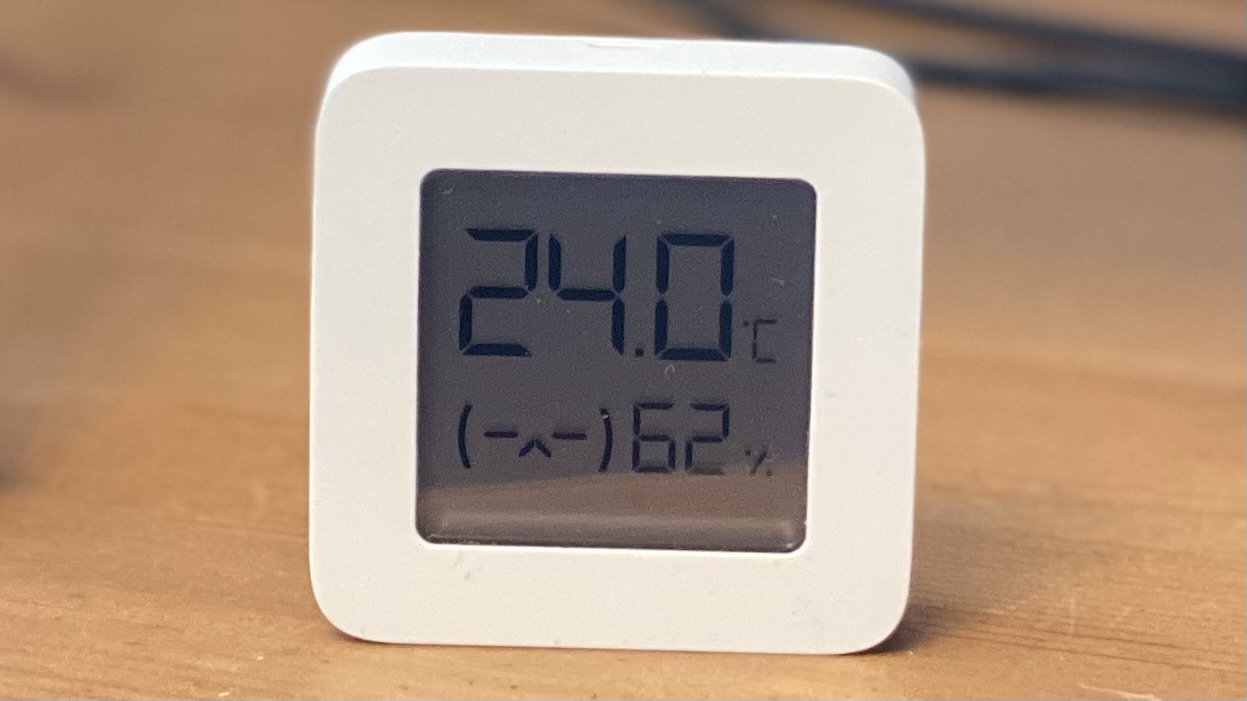
Xiaomi Mijia Temperature Sensor Xiaomi Mijia Temperature Sensor
I've been having some temperature problems in my house, so I wanted to set up some thermometers which I could read from a computer, and look at trends. I bought a pack of three cheap Xiaomi IoT thermometers. There's some official Xiaomi tooling to access them from smartphones and suchlike, but I wanted something more open. The thermometers have some rudimentary security on them to try and ensure you use the official tooling. This is pretty weak, and the open-source Home Assistant (HA) has support for querying them. I wasn't already running HA and it looked to do more than I needed right now. gathering A friend told me that it was trivial to write custom firmware to the devices. It's so easy you can do it from a web-based flasher: in fact, anyone in range can. There's a family of custom firmwares out there, and most move the sensors readings into the BTLE announce packets, meaning, you can scrape the temperature by simply reading and decoding the announcement packets, no need to handshake at all, and certainly no need to navigate Xiaomi's weird security. This is the one I used. I hacked up a Python script to read the values with the help of this convenience library1. Next, I needed to set up somewhere to write the values. reporting
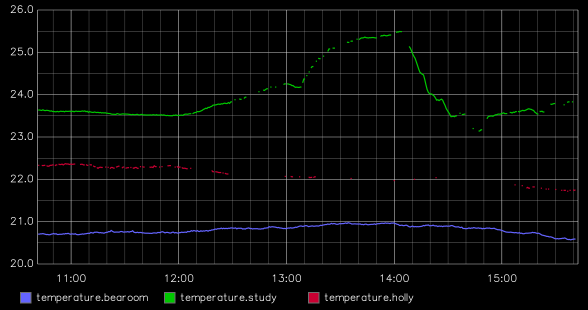
The study is thankfully cooler today The study is thankfully cooler today
It's been long enough since I last looked at something like this that the best in class software was things like multi router traffic grapher, and rrdtool, or things that build on top of them like Munin. The world seems to have moved on (rightly or wrongly) with a cornucopia of options like Prometheus, Grafana, Graphite/Carbon, InfluxDB, statsd, etc. I ruled most of these out as being too complex for what I want to do, and got something working with Graphite (front-end) and Carbon (back-end). I was surprised that this wasn't packaged in Debian, and opted to try the Docker container. This works, although even that is more complex than I need: it's got graphite and carbon, but also nginx and statsd too; I'm submitting directly to carbon, side-stepping statsd entirely. So as I refine what I'm doing I might possibly strip that back. next steps I might add more sensors in my house! My scripts also need a lot of tidying up. But, I think it would be useful to add some external temperature data, such as something from a Weather service. I am also considering pulling in some of the sensor data from the Newcastle University Urban Observatory, which is something I looked at a while ago for my PhD but didn't ultimately end up using. There are several temperature sensors nearby, but they seem to operate relatively sporadically. There's a load of other interesting sensors in my vicinity, such as air quality monitors. I'm currently ignoring the humidity data from the sensors but I should collect that too. It would be useful to mark relevant "events", too: does switching on or off my desktop PC, or printer, etc. correlate to a jump in temperature?

  1. I might get rid of that in the future as I refine my approach

John Goerzen: The Joy of Easy Personal Radio: FRS, GMRS, and Motorola DLR/DTR

Most of us carry cell phones with us almost everywhere we go. So much so that we often forget not just the usefulness, but even the joy, of having our own radios. For instance: From my own experience, as a person and a family that enjoys visiting wilderness areas, having radio communication is great. I have also heard from others that they re also very useful on cruise ships (I ve never been on one so I can t attest to that). There is also a sheer satisfaction in not needing anybody else s infrastructure, not paying any sort of monthly fee, and setting up the radios ourselves.

How these services fit in This article is primarily about handheld radios that can be used by anybody. I laid out some of their advantages above. Before continuing, I should point out some of the other services you may consider:
  • Cell phones, obviously. Due to the impressive infrastructure you pay for each month (many towers in high locations), in areas of cell coverage, you have this ability to connect to so many other phones around the world. With radios like discussed here, your range will likely a few miles.
  • Amateur Radio has often been a decade or more ahead of what you see in these easy personal radio devices. You can unquestionably get amateur radio devices with many more features and better performance. However, generally speaking, each person that transmits on an amateur radio band must be licensed. Getting an amateur radio license isn t difficult, but it does involve passing a test and some time studying for the exam. So it isn t something you can count on random friends or family members being able to do. That said, I have resources on Getting Started With Amateur Radio and it s not as hard as you might think! There are also a lot of reasons to use amateur radio if you want to go down that path.
  • Satellite messengers such as the Garmin Inreach or Zoleo can send SMS-like messages across anywhere in the globe with a clear view of the sky. They also often have SOS features. While these are useful safety equipment, it can take many minutes for a message to be sent and received it s not like an interactive SMS conversation and there are places where local radios will have better signal. Notably, satellite messengers are almost useless indoors and can have trouble in areas without a clear view of the sky, such as dense forests, valleys, etc.
  • My earlier Roundup of secure messengers with off-the-grid capabilities (distributed/mesh messengers) highlighted a number of other options as well, for text-only communication. For instance:
    • For very short-range service, Briar can form a mesh over Bluetooth from cell phones or over Tor, if Internet access is available.
    • Dedicated short message services Mesh Networks like Meshtastic or Beartooth have no voice capability, but share GPS locations and short text messages over their own local mesh. Generally they need to pair to a cell phone (even if that phone has no cell service) for most functionality.
  • Yggdrasil can do something similar over ad-hoc Wifi, but it is a lower-level protocol and you d need some sort of messaging to run atop it.
This article is primarily about the USA, though these concepts, if not the specific implementation, apply many other areas as well.

The landscape of easy personal radios The oldest personal radio service in the US is Citizens Band (CB). Because it uses a lower frequency band than others, handheld radios are larger, heavier, and less efficient. It is mostly used in vehicles or other installations where size isn t an issue. The FRS/GMRS services mostly share a set of frequencies. The Family Radio Service is unlicensed (you don t have to get a license to use it) and radios are plentiful and cheap. When you get a blister pack or little radios for maybe $50 for a pair or less, they re probably FRS. FRS was expanded by the FCC in 2017, and now most FRS channels can run up to 2 watts of power (with channels 8-14 still limited to 0.5W). FRS radios are pretty much always handheld. GMRS runs on mostly the same frequencies as FRS. GMRS lets you run up to 5W on some channels, up to 50W on others, and operate repeaters. GMRS also permits limited occasional digital data bursts; three manufacturers currently use this to exchange GPS data or text messages. To use GMRS, you must purchase a GMRS license; it costs $35 for a person and their immediate family and is good for 10 years. No exam is required. GMRS radios can transmit on FRS frequencies using the GMRS authorization. The extra power of GMRS gets you extra distance. While only the best handheld GMRS radios can put out 5W of power, some mobile (car) or home radios can put out the full 50W, and use more capable exterior antennas too. There is also the MURS band, which offers very few channels and also very few devices. It is not in wide use, probably for good reason. Finally, some radios use some other unlicensed bands. The Motorola DTR and DLR series I will talk about operate in the 900MHz ISM band. Regulations there limit them to a maximum power of 1W, but as you will see, due to some other optimizations, their range is often quite similar to a 5W GMRS handheld. All of these radios share something in common: your radio can either transmit, or receive, but not both simultaneously. They all have a PTT (push-to-talk) button that you push and hold while you are transmitting, and at all other times, they act as receivers. You ll learn that doubling is a thing where 2 or more people attempt to transmit at the same time. To listeners, the result is often garbled. To the transmitters, they may not even be aware they did it since, after all, they were transmitting. Usually it will be clear pretty quickly as people don t get responses or responses say it was garbled. Only the digital Motorola DLR/DTR series detects and prevents this situation.

FRS and GMRS radios As mentioned, the FRS/GMRS radios are generally the most popular, and quite inexpensive. Those that can emit 2W will have pretty decent range; 5W even better (assuming a decent antenna), though the 5W ones will require a GMRS license. For the most part, there isn t much that differentiates one FRS radio from another, or (with a few more exceptions) one GMRS handheld from another. Do not believe the manufacturers claims of 50 mile range or whatever; more on range below. FRS and GMRS radios use FM. GMRS radios are permitted to use a wider bandwidth than FRS radios, but in general, FRS and GMRS users can communicate with each other from any brand of radio to any other brand of radio, assuming they are using basic voice services. Some FRS and GMRS radios can receive the NOAA weather radio. That s nice for wilderness use. Nicer ones can monitor it for alert tones, even when you re tuned to a different channel. The very nicest on this as far as I know, only the Garmin Rino series will receive and process SAME codes to only trigger alerts for your specific location. GMRS (but not FRS) also permits 1-second digital data bursts at periodic intervals. There are now three radio series that take advantage of this: the Garmin Rino, the Motorola T800, and BTech GMRS-PRO. Garmin s radios are among the priciest of GMRS handhelds out there; the top-of-the-line Rino will set you back $650. The cheapest is $350, but does not contain a replaceable battery, which should be an instant rejection of a device like this. So, for $550, you can get the middle-of-the-road Rino. It features a sophisticated GPS system with Garmin trail maps and such, plus a 5W GMRS radio with GPS data sharing and a very limited (13-character) text messaging system. It does have a Bluetooth link to a cell phone, which can provide a link to trail maps and the like, and limited functionality for the radio. The Rino is also large and heavy (due to its large map-capable screen). Many consider it to be somewhat dated technology; for instance, other ways to have offline maps now exist (such as my Garmin Fenix 6 Pro, which has those maps on a watch!). It is bulky enough to likely be left at home in many situations. The Motorola T800 doesn t have much to talk about compared to the other two. Both of those platforms are a number of years old. The newest entrant in this space, from budget radio maker Baofeng, is the BTech GMRS-PRO, which came out just a couple of weeks ago. Its screen, though lacking built-in maps, does still have a GPS digital link similar to Garmin s, and can show you a heading and distance to other GMRS-PRO users. It too is a 5W unit, and has a ton of advanced features that are rare in GMRS: ability to pair a Bluetooth headset to it directly (though the Garmin Rino supports Bluetooth, it doesn t support this), ability to use the phone app as a speaker/mic for the radio, longer text messages than the Garmin Rino, etc. The GMRS-PRO sold out within a few days of its announcement, and I am presently waiting for mine to arrive to review. At $140 and with a more modern radio implementation, for people that don t need the trail maps and the like, it makes a compelling alternative to Garmin for outdoor use. Garmin documents when GPS beacons are sent out: generally, when you begin a transmission, or when another radio asks for your position. I couldn t find similar documentation from Motorola or BTech, but I believe FCC regulations mean that the picture would be similar with them. In other words, none of these devices is continuously, automatically, transmitting position updates. However, you can request a position update from another radio. It should be noted that, while voice communication is compatible across FRS/GMRS, data communication is not. Garmin, Motorola, and BTech all have different data protocols that are incompatible with radios from other manufacturers. FRS/GMRS radios often advertise privacy codes. These do nothing to protect your privacy; see more under the privacy section below.

Motorola DLR and DTR series Although they can be used for similar purposes, and I do, these radios are unique from the others in this article in several ways:
  • Their sales and marketing is targeted at businesses rather than consumers
  • They use digital encoding of audio, rather than analog FM or AM
  • They use FHSS (Frequency-Hopping Spread Spectrum) rather than a set frequency
  • They operate on the 900MHz ISM band, rather than a 460MHz UHF band (or a lower band yet for MURS and CB)
  • The DLR series is quite small, smaller than many GMRS radios.
I don t have space to go into a lot of radio theory in this article, but I ll briefly expand on some of this. First, FHSS. A FHSS radio hops from frequency to frequency many times per second, following some preset hopping algorithm that is part of the radio. Although it complicates the radio design, it has some advantages; it tends to allow more users to share a band, and if one particular frequency has a conflict with something else, it will be for a brief fraction of a second and may not even be noticeable. Digital encoding generally increases the quality of the audio, and keeps the quality high even in degraded signal conditions where analog radios would experience static or a quieter voice. However, you also lose that sort of audible feedback that your signal is getting weak. When you get too far away, the digital signal drops off a cliff . Often, either you have a crystal-clear signal or you have no signal at all. Motorola s radios leverage these features to build a unique radio. Not only can you talk to a group, but you can select a particular person to talk to with a private conversation, and so forth. DTR radios can send text messages to each other (but only preset canned ones, not arbitrary ones). Channels are more like configurations; they can include various arbitrary groupings of radios. Deconfliction with other users is established via hopsets rather than frequencies; that is, the algorithm that it uses to hop from frequency to frequency. There is a 4-digit PIN in the DLR radios, and newer DTR radios, that makes privacy very easy to set up and maintain. As far as I am aware, no scanner can monitor DLR/DTR signals. Though they technically aren t encrypted, cracking a DLR/DTR conversation would require cracking Motorola s firmware, and the chances of this happening in your geographical proximity seem vanishingly small. I will write more below on comparing the range of these to GMRS radios, but in a nutshell, it compares well, despite the fact that the 900MHz band restrictions allow Motorola only 1W of power output with these radios. There are three current lines of Motorola DLR/DTR radios:
  • The Motorola DLR1020 and DLR1060 radios. These have no screen; the 1020 has two channels (configurations) while the 1060 supports 6. They are small and compact and great pocketable just work radios.
  • The Motorola DTR600 and DTR700 radios. These are larger, with a larger antenna (that should theoretically provide greater range) and have a small color screen. They support more channels and more features (eg, short messages, etc).
  • The Motorola Curve (aka DLR110). Compared to the DLR1060, it adds limited WiFi capabilities that are primarily useful in certain business environments. See this thread for more. These features are unlikely to be useful in the environments we re talking about here.
These radios are fairly expensive new, but DLRs can be readily found at around $60 on eBay. (DTRs for about $250) They are quite rugged. Be aware when purchasing that some radios sold on eBay may not include a correct battery and charger. (Not necessarily a problem; Motorola batteries are easy to find online, and as with any used battery, the life of a used one may not be great.) For more advanced configuration, the Motorola CPS cable works with both radios (plugs into the charging cradle) and is used with the programming software to configure them in more detail. The older Motorola DTR650, DTR550, and older radios are compatible with the newer DLR and DTR series, if you program the newer ones carefully. The older ones don t support PINs and have a less friendly way of providing privacy, but they do work also. However, for most, I think the newer ones will be friendlier; but if you find a deal on the older ones, hey, why not? This thread on the MyGMRS forums has tons of useful information on the DLR/DTR radios. Check it out for a lot more detail. One interesting feature of these radios is that they are aware if there are conflicting users on the channel, and even if anybody is hearing your transmission. If your transmission is not being heard by at least one radio, you will get an audible (and visual, on the DTR) indication that your transmission failed. One thing that pleasantly surprised me is just how tiny the Motorola DLR is. The whole thing with antenna is like a small candy bar, and thinner. My phone is slightly taller, much wider, and only a little thinner than the Motorola DLR. Seriously, it s more pocketable than most smartphones. The DTR is of a size more commonly associated with radios, though still on the smaller side. Some of the most low-power FRS radios might get down to that size, but to get equivolent range, you need a 5W GMRS unit, which will be much bulkier. Being targeted at business users, the DLR/DTR don t include NOAA weather radio or GPS.

Power These radios tend to be powered by:
  • NiMH rechargable battery packs
  • AA/AAA batteries
  • Lithium Ion batteries
Most of the cheap FRS/GMRS radios have a NiMH rechargable battery pack and a terrible charge controller that will tend to overcharge, and thus prematurely destroy, the NiMH packs. This has long ago happened in my GMRS radios, and now I use Eneloop NiMH AAs in them (charged separately by a proper charger). The BTech, Garmin, and Motorola DLR/DTR radios all use Li-Ion batteries. These have the advantage of being more efficient batteries, though you can t necessarily just swap in AAs in a pinch. Pay attention to your charging options; if you are backpacking, for instance, you may want something that can charge from solar-powered USB or battery banks. The Motorola DLR/DTR radios need to sit in a charging cradle, but the cradle is powered by a Micro USB cable. The BTech GMRS-PRO is charged via USB-C. I don t know about the Garmin Rino or others. Garmin offers an optional AA battery pack for the Rino. BTech doesn t (yet) for the GMRS-PRO, but they do for some other models, and have stated accessories for the GMRS-PRO are coming. I don t have information about the T800. This is not an option for the DLR/DTR.

Meshtastic I ll briefly mention Meshtastic. It uses a low-power LoRa system. It can t handle voice transmissions; only data. On its own, it can transmit and receive automatic GPS updates from other Meshtastic devices, which you can view on its small screen. It forms a mesh, so each node can relay messages for others. It is also the only unit in this roundup that uses true encryption, and its battery lasts about a week more than the a solid day you can expect out of the best of the others here. When paired with a cell phone, Meshtastic can also send and receive short text messages. Meshtastic uses much less power than even the cheapest of the FRS radios discussed here. It can still achieve respectable range because it uses LoRa, which can trade bandwidth for power or range. It can take it a second or two to transmit a 50-character text message. Still, the GMRS or Motorola radios discussed here will have more than double the point-to-point range of a Meshtastic device. And, if you intend to take advantage of the text messaging features, keep in mind that you must now take two electronic devices with you and maintain a charge for them both.

Privacy The privacy picture on these is interesting.

Cell phone privacy Cell phones are difficult for individuals to eavesdrop, but a sophisticated adversary probably could: or an unsophisticated adversary with any manner of malware. Privacy on modern smartphones is a huge area of trouble, and it is safe to say that data brokers and many apps probably know at least your location and contact list, if not also the content of your messages. Though end-to-end encrypted apps such as Signal can certainly help. See Tools for Communicating Offline and in Difficult Circumstances for more details.

GMRS privacy GMRS radios are unencrypted and public. Anyone in range with another GMRS radio, or a scanner, can listen to your conversations even if you have a privacy code set. The privacy code does not actually protect your privacy; rather, it keeps your radio from playing conversations from others using the same channel, for your convenience. However, note the in range limitation. An eavesdropper would generally need to be within a few miles of you.

Motorola DLR/DTR privacy As touched on above, while these also aren t encrypted, as far as I am aware, no tools exist to eavesdrop on DLR/DTR conversations. Change the PIN away from the default 0000, ideally to something that doesn t end in 0 (to pick a different hopset) and you have pretty decent privacy right there. Decent doesn t mean perfect; it is certainly possible that sophisticated adversaries or state agencies could decode DLR/DTR traffic, since it is unencrypted. As a practical matter, though, the lack of consumer equipment that can decode this makes it be, as I say, pretty decent .

Meshtastic Meshtastic uses strong AES encryption. But as messaging features require a paired phone, the privacy implications of a phone also apply here.

Range I tested my best 5W GMRS radios, as well as a Motorola DTR600 talking to a DLR1060. (I also tried two DLR1060s talking to each other; there was no change in rnage.) I took a radio with me in the car, and had another sitting on my table indoors. Those of you familiar with radios will probably recognize that being in a car and being indoors both attenuate (reduce the strength of) the signal significantly. I drove around in a part of Kansas with gentle rolling hills. Both the GMRS and the DLR/DTR had a range of about 2-3 miles. There were times when each was able to pull out a signal when the other was not. The DLR/DTR series was significantly better while the vehicle was in motion. In weaker signal conditions, the GMRS radios were susceptible to significant picket fencing (static caused by variation in the signal strength when passing things like trees), to the point of being inaudible or losing the signal entirely. The DLR/DTR remained perfectly clear there. I was able to find some spots where, while parked, the GMRS radios had a weak but audible signal but the DLR/DTR had none. However, in all those cases, the distance to GMRS dropping out as well was small. Basically, no radios penetrate the ground, and the valleys were a problem for them all. Differences may play out in other ways in other environments as well: for instance, dense urban environments, heavy woods, indoor buildings, etc. GMRS radios can be used with repeaters, or have a rooftop antenna mounted on a car, both of which could significantly extend range and both of which are rare. The DLR/DTR series are said to be exceptionally good at indoor environments; Motorola rates them for penetrating 20 floors, for instance. Reports on MyGMRS forums state that they are able to cover an entire cruise ship, while the metal and concrete in them poses a big problem for GMRS radios. Different outdoor landscapes may favor one or the other also. Some of the cheapest FRS radios max out at about 0.5W or even less. This is probably only a little better than yelling distance in many cases. A lot of manufacturers obscure transmit power and use outlandish claims of range instead; don t believe those. Find the power output. A 2W FRS transmitter will be more credible range-wise, and the 5W GMRS transmitter as I tested better yet. Note that even GMRS radios are restricted to 0.5W on channels 8-14. The Motorola DLR/DTR radio gets about the same range with 1W as a GMRS radio does with 5W. The lower power output allows the DLR to be much smaller and lighter than a 5W GMRS radio for similar performance.

Overall conclusions Of course, what you use may depend on your needs. I d generally say:
  • For basic use, the high quality, good range, reasonable used price, and very small size of the Motorola DLR would make it a good all-arounder. Give one to each person (or kid) for use at the mall or amusement park, take them with you to concerts and festivals, etc.
  • Between vehicles, the Motorola DLR/DTR have a clear range advantage over the GMRS radios for vehicles in motion, though the GPS features of the more advanced GMRS radios may be more useful here.
  • For wilderness hiking and the like, GMRS radios that have GPS, maps, and NOAA weather radio reception may prove compelling and worth the extra bulk. More flexible power options may also be useful.
  • Low-end FRS radios can be found very cheap; around $20-$30 new for the lowest end, though their low power output and questionable charging circuits may limit their utility where it really counts.
  • If you just can t move away from cell phones, try the Zoleo app, which can provide some radio-like features.
  • A satellite communicator is still good backup safety gear for the wilderness.

Postscript: A final plug for amateur radio My 10-year-old Kenwood TH-D71A already had features none of these others have. For instance, its support for APRS and ability to act as a digipeater for APRS means that TH-D71As can form an automatic mesh between them, each one repeating new GPS positions or text messages to the others. Traditional APRS doesn t perform well in weak signal situations; however, more modern digital systems like D-Star and DMR also support APRS over more modern codecs and provide all sorts of other advantages as well (though not FHSS). My conclusions above assume a person is not going to go the amateur radio route for whatever reason. If you can get those in your group to get their license the technician is all you need a whole world of excellent options opens to you.

Appendix: The Trisquare eXRS Prior to 2012, a small company named Trisquare made a FHSS radio they called the eXRS that operated on the 900MHz band like Motorola s DLR/DTR does. Trisquare aimed at consumers and their radios were cheaper than the Motorola DLR/DTR. However, that is where the similarities end. Trisquare had an analog voice transmission, even though it used FHSS. Also, there is a problem that can arise with FHSS systems: synchronization. The receiver must hop frequencies in exactly the same order at exactly the same time as the sender. Motorola has clearly done a lot of engineering around this, and I have never encountered a synchronization problem in my DLR/DTR testing, not even once. eXRS, on the other hand, had frequent synchronization problems, which manifested themselves in weak signal conditions and sometimes with doubling. When it would happen, everyone would have to be quiet for a minute or two to give all the radios a chance to timeout and reset to the start of the hop sequence. In addition, the eXRS hardware wasn t great, and was susceptible to hardware failure. There are some that still view eXRS as a legendary device and hoard them. You can still find them used on eBay. When eXRS came out in 2007, it was indeed nice technology for the day, ahead of its time in some ways. I used and loved the eXRS radios back then; powerful GMRS wasn t all that common. But compared to today s technology, eXRS has inferior range to both GMRS and Motorola DLR/DTR (from my recollection, about a third to half of what I get with today s GMRS and DLR/DTR), is prone to finicky synchronization issues when signals are weak, and isn t made very robustly. I therefore don t recommend the eBay eXRS units. Don t assume that the eXRS weaknesses extend to Motorola DLR/DTR. The DLR/DTR radios are done well and don t suffer from the same problems. Note: This article has a long-term home on my website, where it may be updated from time to time.

14 August 2022

Dirk Eddelbuettel: RcppArmadillo used by 1001 CRAN Packages

It is with a mix of pride and joy, but also some genuine astonishment and amazement, that we can share that the counter of reverse dependencies at CRAN for our RcppArmadillo package for R just crossed 1000 packages [1]: Conrad actually posted this a few weeks ago, by my count we were then still a few packages shy. In any event, having crossed this marker this summer, either then or now, and after more than a dozen years of working on the package is a really nice moment. Google Scholar counts nearly 500 citations for our CSDA paper (also this vignette), and that ratio of nearly a citation for every two packages used is certainly impressive. We have had the pleasure of working with so many other researchers and scientists using RcppArmadillo. Its combination of performance (C++, after all, and heavily tuned) and ease-of-use (inspired by another popular flavour for matrix computing that is however mostly interpreted) makes for a powerful package, and we are delighted to see it used so widely. Working on this with Conrad has been excellent. The (upstream) package (now at this GitLab repo) has received numerous releases at a rate that is in fact so high that we now slow it down to not exceed a monthly cadence of uploads to CRAN. But the package should always be in release condition at its GitHub repo, and is frequently also installable in rc versions via the Rcpp drat repo. So with that, a big Thank You! to Conrad, to Romain for all the early work laying the package foundations, and to all the users of (Rcpp)Armadillo for helping us along with testing, suggestions, extensions, and bug reports. Keep em coming! If you like this or other open-source work I do, you can now sponsor me at GitHub. [1] The code snippet shows that we remove some possible duplicates in the count (mostly for the total of packages). This is a correction we use across packages for consistency. It does not have an effect for RcppArmadillo.

This post by Dirk Eddelbuettel originated on his Thinking inside the box blog. Please report excessive re-aggregation in third-party for-profit settings.

Jamie McClelland: Web caching is hard

Web caching is hard. And also, maybe I m not that good under pressure? In any event, I made the following mistakes while trying to debug a web site using our nginx cache that bit the dust under heavy load today: Action: I ran curl -I https://website.org/ and it hung. Wrong assumption: Something is wrong with nginx. Why else would it just hang? Reconsidered conclusion: The resource (the home page) is a MISS, so nginx has to retrieve it from the origin, but the origin is over-loaded and timing out, so my request is also timing out. Maybe something is wrong with the nginx caching configuration since the home page really should be a HIT but that s another problem. Action: I changed the configuration from our normal caching set of directives to our aggressive caching set of directives, reloaded nginx and curl -I https://website.org/ still hung. Wrong assumption: aggressive caching isn t working and I need a different configuration. Reconsidered conclusion: The home page still has failed to be loaded from the origin, so every request for it is going to be a MISS, and is going to hang, until nginx is able to fill the cache with it. The configuration change might be the right change; we just need the origin to calm down before we will know. Action: I restarted PHP on the origin to free up PHP processes so my home page request can fill the cache and still curl -I https://website.org/ hangs. Wrong assumption: WTF! The world is ending! Reconsidered conclusion: The regular traffic which is accessing other pages (not the home page) consumed all the available PHP processes on the origin before my request for the home page could complete, so nginx is still unable to fill the cache with the home page. Action: Once we got things under control, I changed the caching level from aggressive back down to normal. I ran curl -I https://website.org/ and it was HIT ing. I concluded that we don t need the aggressive cache after all. Got some coffee, came back later and ran it again and it consistently showed MISS. Wrong assumption: What?!? Did something change on the origin to stop the cache from working?? Reconsidered conclusion: The aggressive cache set the cache for 5 minutes. Even after changing to normal caching, the home page was still cached so it was served from the cache. After 5 minutes, the cache expired. Now, the normal cache setting are in play to determine whether the request would be cached or not. In other words, you have to wait for the cache to expire (or bust the cache) before you can effectively know if the new cache settings are working.

Sergio Durigan Junior: Debuginfod is coming to Ubuntu

These past couple of months I have been working to bring debuginfod to Ubuntu. I thought it would be a good idea to make this post and explain a little bit about what the service is and how I'm planning to deploy it. A quick recap: what's debuginfod? Here's a good summary of what debuginfod is:
debuginfod is a new-ish project whose purpose is to serve
ELF/DWARF/source-code information over HTTP.  It is developed under the
elfutils umbrella.  You can find more information about it here:
  https://sourceware.org/elfutils/Debuginfod.html
In a nutshell, by using a debuginfod service you will not need to
install debuginfo (a.k.a. dbgsym) files anymore; the symbols will be
served to GDB (or any other debuginfo consumer that supports debuginfod)
over the network.  Ultimately, this makes the debugging experience much
smoother (I myself never remember the full URL of our debuginfo
repository when I need it).
If you follow the Debian project, you might know that I run their debuginfod service. In fact, the excerpt above was taken from the announcement I made last year, letting the Debian community know that the service was available. First stage With more and more GNU/Linux distributions offering a debuginfod service to their users, I strongly believe that Ubuntu cannot afford to stay out of this "party" anymore. Fortunately, I have a manager who not only agrees with me but also turned the right knobs in order to make this project one of my priorities for this development cycle. The deployment of this service will be made in stages. The first one, whose results are due to be announced in the upcoming weeks, encompasses indexing and serving all of the available debug symbols from the official Ubuntu repository. In other words, the service will serve everything from main, universe and multiverse, from every supported Ubuntu release out there. This initial (a.k.a. "alpha") stage will also allow us to have an estimate of how much the service is used, so that we can better determine the resources allocated to it. More down the road This is just the beginning. In the following cycles, I will be working on a few interesting projects to expand the scope of the service and make it even more useful for the broader Ubuntu community. To give you an idea, here is what is on my plate: As you can see, there's a lot to do. I am happy to be working on this project, and I hope it will be helpful and useful for the Ubuntu community.

Russ Allbery: Review: Still Not Safe

Review: Still Not Safe, by Robert L. Wears & Kathleen M. Sutcliffe
Publisher: Oxford University Press
Copyright: November 2019
ISBN: 0-19-027128-0
Format: Kindle
Pages: 232
Still Not Safe is an examination of the recent politics and history of patient safety in medicine. Its conclusions are summarized by the opening paragraph of the preface:
The American moral and social philosopher Eric Hoffer reportedly said that every great cause begins as a movement, becomes a business, and eventually degenerates into a racket. The reform movement to make healthcare safer is clearly a great cause, but patient safety efforts are increasingly following Hoffer's path.
Robert Wears was Professor of Emergency Medicine at the University of Florida specializing in patient safety. Kathleen Sutcliffe is Professor of Medicine and Business at Johns Hopkins. This book is based on research funded by a grant from the Robert Wood Johnson Foundation, for which both Wears and Sutcliffe were primary investigators. (Wears died in 2017, but the acknowledgments imply that at least early drafts of the book existed by that point and it was indeed co-written.) The anchor of the story of patient safety in Still Not Safe is the 1999 report from the Institute of Medicine entitled To Err is Human, to which the authors attribute an explosion of public scrutiny of medical safety. The headline conclusion of that report, which led nightly news programs after its release, was that 44,000 to 120,000 people died each year in the United States due to medical error. This report prompted government legislation, funding for new safety initiatives, a flurry of follow-on reports, and significant public awareness of medical harm. What it did not produce, in the authors' view, is significant improvements in patient safety. The central topic of this book is an analysis of why patient safety efforts have had so little measurable effect. The authors attribute this to three primary causes: an unwillingness to involve safety experts from outside medicine or absorb safety lessons from other disciplines, an obsession with human error that led to profound misunderstandings of the nature of safety, and the misuse of safety concerns as a means to centralize control of medical practice in the hands of physician-administrators. (The term used by the authors is "managerial, scientific-bureaucratic medicine," which is technically accurate but rather awkward.) Biggest complaint first: This book desperately needed examples, case studies, or something to make these ideas concrete. There are essentially none in 230 pages apart from passing mentions of famous cases of medical error that added to public pressure, and a tantalizing but maddeningly nonspecific discussion of the atypically successful effort to radically improve the safety of anesthesia. Apparently anesthesiologists involved safety experts from outside medicine, avoided a focus on human error, turned safety into an engineering problem, and made concrete improvements that had a hugely positive impact on the number of adverse events for patients. Sounds fascinating! Alas, I'm just as much in the dark about what those improvements were as I was when I started reading this book. Apart from a vague mention of some unspecified improvements to anesthesia machines, there are no concrete descriptions whatsoever. I understand that the authors were probably leery of giving too many specific examples of successful safety initiatives since one of their core points is that safety is a mindset and philosophy rather than a replicable set of actions, and copying the actions of another field without understanding their underlying motivations or context within a larger system is doomed to failure. But you have to give the reader something, or the book starts feeling like a flurry of abstract assertions. Much is made here of the drawbacks of a focus on human error, and the superiority of the safety analysis done in other fields that have moved beyond error-centric analysis (and in some cases have largely discarded the word "error" as inherently unhelpful and ambiguous). That leads naturally to showing an analysis of an adverse incident through an error lens and then through a more nuanced safety lens, making the differences concrete for the reader. It was maddening to me that the authors never did this. This book was recommended to me as part of a discussion about safety and reliability in tech and the need to learn from safety practices in other fields. In that context, I didn't find it useful, although surprisingly that's because the thinking in medicine (at least as presented by these authors) seems behind the current thinking in distributed systems. The idea that human error is not a useful model for approaching reliability is standard in large tech companies, nearly all of which use blameless postmortems for exactly that reason. Tech, similar to medicine, does have a tendency to be insular and not look outside the field for good ideas, but the approach to large-scale reliability in tech seems to have avoided the other traps discussed here. (Security is another matter, but security is also adversarial, which creates different problems that I suspect require different tools.) What I did find fascinating in this book, although not directly applicable to my own work, is the way in which a focus on human error becomes a justification for bureaucratic control and therefore a concentration of power in a managerial layer. If the assumption is that medical harm is primarily caused by humans making avoidable mistakes, and therefore the solution is to prevent humans from making mistakes through better training, discipline, or process, this creates organizations that are divided into those who make the rules and those who follow the rules. The long-term result is a practice of medicine in which a small number of experts decide the correct treatment for a given problem, and then all other practitioners are expected to precisely follow that treatment plan to avoid "errors." (The best distributed systems approaches may avoid this problem, but this failure mode seems nearly universal in technical support organizations.) I was startled by how accurate that portrayal of medicine felt. My assumption prior to reading this book was that the modern experience of medicine as an assembly line with patients as widgets was caused by the pressure for higher "productivity" and thus shorter visit times, combined with (in the US) the distorting effects of our broken medical insurance system. After reading this book, I've added a misguided way of thinking about medical error and risk avoidance to that analysis. One of the authors' points (which, as usual, I wish they'd made more concrete with a case study) is that the same thought process that lets a doctor make a correct diagnosis and find a working treatment is the thought process that may lead to an incorrect diagnosis or treatment. There is not a separable state of "mental error" that can be eliminated. Decision-making processes are more complicated and more integrated than that. If you try to prevent "errors" by eliminating flexibility, you also eliminate vital tools for successfully treating patients. The authors are careful to point out that the prior state of medicine in which each doctor was a force to themselves and there was no role for patient safety as a discipline was also bad for safety. Reverting to the state of medicine before the advent of the scientific-bureaucratic error-avoiding culture is also not a solution. But, rather at odds with other popular books about medicine, the authors are highly critical of safety changes focused on human error prevention, such as mandatory checklists. In their view, this is exactly the sort of attempt to blindly copy the machinery of safety in another field (in this case, air travel) without understanding the underlying purpose and system of which it's a part. I am not qualified to judge the sharp dispute over whether there is solid clinical evidence that checklists are helpful (these authors claim there is not; I know other books make different claims, and I suspect it may depend heavily on how the checklist is used). But I found the authors' argument that one has to design systems holistically for safety, not try to patch in safety later by turning certain tasks into rote processes and humans into machines, to be persuasive. I'm not willing to recommend this book given how devoid it is of concrete examples. I was able to fill in some of that because of prior experience with the literature on site reliability engineering, but a reader who wasn't previously familiar with discussions of safety or reliability may find much of this book too abstract to be comprehensible. But I'm not sorry I read it. I hadn't previously thought about the power dynamics of a focus on error, and I think that will be a valuable observation to keep in mind. Rating: 6 out of 10

12 August 2022

Shirish Agarwal: Mum and Books

The last day
The first lesson I would like everybody to know and have is to buy two machines, especially a machine to check low blood pressure. I had actually ordered one from Amazon but they never delivered. I hope to sue them in consumer court in due course of time. The other one is a blood sugar machine which I ordered and did get, but the former is more important than the latter, and the reason why will be known soon. Mum had stopped eating solids and was entirely on liquids for the last month of her life. I did try enticing her however I could with aromatic food but failed. Add to that we had weird weather this entire year. June is supposed to be when the weather turns and we have gentle showers, but this whole June it felt like we were in an oven. She asked for liquids whenever and although I hated that she was not eating solids, at least she was having liquids (juices and whatnot) and that s how I pacified myself. I had been repeatedly told by family and extended family to get a full-time nurse but she objected time and again for the same and I had to side with her. Then July 1st came around and part of extended family also came, and they impressed both on me and her to get a nurse so finally, I was able to get her nurse. I was also being pulled in various directions (outside my stuff, mumma s stuff) and doing whatever she needed in terms of supplies. On July 4th, think she had low blood pressure but without a machine, one cannot know. At least that s what I know. If somebody knows anything better, please share, who knows it may save lives. I don t have a blood pressure monitor even to date

There used to be 5-6 doctors in our locality before the Pandemic, but because of the Pandemic and whatever other reasons, almost all doctors had given up attending house calls. And the house where I live is a 100-year-old house so it has narrow passageways and we have no lift. So taking her in and out is a challenge and an ordeal, and something that is not easily done. I had to do some more works so I asked the nurse to stay a bit over 8 p.m. I came and the nurse left for the day. That day I had been distracted for a number of reasons which I don t remember what was but at that point in time, doing those works seemed important. I called out to her but she didn t respond. I remember the night before she had been agitated while sleeping, I slept nearby and kept an eye on her. I had called her a few times to ask whether she needed something but she didn t respond. (this is about the earlier night). That evening, it was raining quite a bit, I called her a few times but she didn t speak. I kissed her on the cheek and realized she is cold. Mumma usually becomes very agitated if she feels cold and shouts at me. I realized she is cold and her body a bit stiff. I was supposed to eat but just couldn t. I dunno what I suspected, I just hired a rickshaw and went around till 9 p.m. and it was a fruitless search for a doctor. I returned home, and again called her but there was no response. Because she was not responding, I became fearful, had a shat, and then dialed the hospital. Asking for the ambulance, it took about an hr. but finally, the ambulance came in. It was now 11 o clock or 2300 hrs. when the ambulance arrived in. It took another half an hr. getting few kids who had come from some movie or something to get them to help mum get down through the passage to the ambulance. We finally reached the hospital at 2330. The people on casualty that day were known to me, and they also knew my hearing problem, so it was much easier to communicate. Half an hour later, they proclaimed her dead. Fortunately or not, I had just bought the newer mobile phone just a few days back. And right now, In India, WhatsApp is one of the most used apps. So I was able to chat with everybody and tell them what was happening or rather what has happened. Of all, mamaji (mother s brother) shared that most members of the family would not be able to come except a cousin sister who lives in Mumbai. I was instructed to get the body refrigerated for a few hrs. It is only then I came to know various ways in which the body is refrigerated and how cruel it would have been towards Atal Bihari Vajpayee s family, but that is politics. I had to go to quite a few places and was back home around 3 a.m. I was supposed to sleep, but sleep was out of the question. I whiled away a few hrs. playing, seeing movies, something or the other to keep myself distracted as literally, I had no idea what to do. Morning came, took a bath, went outside, had some snacks, came home and somewhere then slept. One of my Mausi s (mother s sister) was insisting to get the body burnt in the morning itself but I wanted at least one relative to be there on the last journey. Cousin sister and her husband came to Pune around 4 p.m. I somehow woke, ringing, the vibration I do not know what. I took a short bath, rushed to the place where we had kept the body, got the body and from there where we had asked permission to get the body burned. More than anything else, I felt so sad that except for cousin sister, and me, nobody was with her on the last journey. Even that day, it was raining hard, so people avoided going out. Brother-in-law tried to give me some money, but I brushed it off. I just wanted their company, money is and was never the criteria. So, in the evening we had a meal, my cousin sister, brother-in-law, their two daughters and me. The next day we took the bones and ash to Alandi and did what was needed. I have tried to resurrect the day so many times in my head trying to figure out what I could have done better and am inconclusive. Having a blood pressure monitor for sure would have prevented the tragedy or at least post-phoned for it for a few more days, weeks, years, dunno. I am not medically inclined.

The Books I have to confess, the time they said she is no more, I was hoping that the doctors would say, we have a pill, would you like to take it, it would reunite you with mum. Maybe it wa crazy or whatever, but if such a situation had been, I would have easily gone for it. If I were to go, some people might miss me, but nobody would miss me terribly, and at least I would be with her. There was nothing to look forward to. What saved me from going mad was Michael Crichton s Timeline. It is a fascinating and seductive book. I had actually read it years ago but had forgotten. So many days and nights I was able to sleep hoping that quantum teleportation can be achieved. Anybody in my space would be easily enticed. What joy would it be if I were to meet mum once again. I can tell my other dumb child what to do so she lives for few more years. I could talk to her, just be with her for some time. It is a powerful and seductive idea. I can see so many cults and whatnot that can be formed around it, there may already be, who knows. Another good book that helped me to date has been Through The, Rings Of Fire (Hardcover, J. D. Benedict Thyagarajan). It is an autobiography of Venkat Chalasany (story of an orphan boy who became a successful builder in Pune and the setbacks he had.) While the author has very strong views and I sometimes feel very naive views about things, I was taken a ride of my own city as it was in 1970s and 1980s. I could very well imagine all the different places and people as if they were happening right now. While I have finished the main story, there is still a bit left to read and I read 5-10 minutes every day as it s like a sweet morsel, it s like somebody sharing a tale passed without me having to make an effort. And no lies, the author has been pretty upfront where he has exaggerated or told lies or simply made-up stuff. I was thinking of adding something about movies and some more info or impressions about android but it seems that would have to wait, I do hope, it does work for somebody, even if a single life can be saved from what I shared above, my job is done.

Wouter Verhelst: Upgrading a Windows 10 VM to Windows 11

I run Debian on my laptop (obviously); but occasionally, for $DAYJOB, I have some work to do on Windows. In order to do so, I have had a Windows 10 VM in my libvirt configuration that I can use. A while ago, Microsoft issued Windows 11. I recently found out that all the components for running Windows 11 inside a libvirt VM are available, and so I set out to upgrade my VM from Windows 10 to Windows 11. This wasn't as easy as I thought, so here's a bit of a writeup of all the things I ran against, and how I fixed them. Windows 11 has a number of hardware requirements that aren't necessary for Windows 10. There are a number of them, but the most important three are: So let's see about all three.

A modern enough processor If your processor isn't modern enough to run Windows 11, then you can probably forget about it (unless you want to use qemu JIT compilation -- I dunno, probably not going to work, and also not worth it if it were). If it is, all you need is the "host-passthrough" setting in libvirt, which I've been using for a long time now. Since my laptop is less than two months old, that's not a problem for me.

A TPM 2.0 module My Windows 10 VM did not have a TPM configured, because it wasn't needed. Luckily, a quick web search told me that enabling that is not hard. All you need to do is:
  • Install the swtpm and swtpm-tools packages
  • Adding the TPM module, by adding the following XML snippet to your VM configuration:
    <devices>
      <tpm model='tpm-tis'>
        <backend type='emulator' version='2.0'/>
      </tpm>
    </devices>
    
    Alternatively, if you prefer the graphical interface, click on the "Add hardware" button in the VM properties, choose the TPM, set it to Emulated, model TIS, and set its version to 2.0.
You're done! Well, with this part, anyway. Read on.

Secure boot Here is where it gets interesting. My Windows 10 VM was old enough that it was configured for the older i440fx chipset. This one is limited to PCI and IDE, unlike the more modern q35 chipset (which supports PCIe and SATA, and does not support IDE nor SATA in IDE mode). There is a UEFI/Secure Boot-capable BIOS for qemu, but it apparently requires the q35 chipset, Fun fact (which I found out the hard way): Windows stores where its boot partition is somewhere. If you change the hard drive controller from an IDE one to a SATA one, you will get a BSOD at startup. In order to fix that, you need a recovery drive. To create the virtual USB disk, go to the VM properties, click "Add hardware", choose "Storage", choose the USB bus, and then under "Advanced options", select the "Removable" option, so it shows up as a USB stick in the VM. Note: this takes a while to do (took about an hour on my system), and your virtual USB drive needs to be 16G or larger (I used the libvirt default of 20G). There is no possibility, using the buttons in the virt-manager GUI, to convert the machine from i440fx to q35. However, that doesn't mean it's not possible to do so. I found that the easiest way is to use the direct XML editing capabilities in the virt-manager interface; if you edit the XML in an editor it will produce error messages if something doesn't look right and tell you to go and fix it, whereas the virt-manager GUI will actually fix things itself in some cases (and will produce helpful error messages if not). What I did was:
  • Take backups of everything. No, really. If you fuck up, you'll have to start from scratch. I'm not responsible if you do.
  • Go to the Edit->Preferences option in the VM manager, then on the "General" tab, choose "Enable XML editing"
  • Open the Windows VM properties, and in the "Overview" section, go to the "XML" tab.
  • Change the value of the machine attribute of the domain.os.type element, so that it says pc-q35-7.0.
  • Search for the domain.devices.controller element that has pci in its type attribute and pci-root in its model one, and set the model attribute to pcie-root instead.
  • Find all domain.devices.disk.target elements, setting their dev=hdX to dev=sdX, and bus="ide" to bus="sata"
  • Find the USB controller (domain.devices.controller with type="usb", and set its model to qemu-xhci. You may also want to add ports="15" if you didn't have that yet.
  • Perhaps also add a few PCIe root ports:
    <controller type="pci" index="1" model="pcie-root-port"/>
    <controller type="pci" index="2" model="pcie-root-port"/>
    <controller type="pci" index="3" model="pcie-root-port"/>
    
I figured out most of this by starting the process for creating a new VM, on the last page of the wizard that pops up selecting the "Modify configuration before installation" option, going to the "XML" tab on the "Overview" section of the new window that shows up, and then comparing that against what my current VM had. Also, it took me a while to get this right, so I might have forgotten something. If virt-manager gives you an error when you hit the Apply button, compare notes against the VM that you're in the process of creating, and copy/paste things from there to the old VM to make the errors go away. As long as you don't remove configuration that is critical for things to start, this shouldn't break matters permanently (but hey, use your backups if you do break -- you have backups, right?) OK, cool, so now we have a Windows VM that is... unable to boot. Remember what I said about Windows storing where the controller is? Yeah, there you go. Boot from the virtual USB disk that you created above, and select the "Fix the boot" option in the menu. That will fix it. Ha ha, only kidding. Of course it doesn't. I honestly can't tell you everything that I fiddled with, but I think the bit that eventually fixed it was where I chose "safe mode", which caused the system to do a hickup, a regular reboot, and then suddenly everything was working again. Meh. Don't throw the virtual USB disk away yet, you'll still need it. Anyway, once you have it booting again, you will now have a machine that theoretically supports Secure Boot, but you're still running off an MBR partition. I found a procedure on how to convert things from MBR to GPT that was written almost 10 years ago, but surprisingly it still works, except for the bit where the procedure suggests you use diskmgmt.msc (for one thing, that was renamed; and for another, it can't touch the partition table of the system disk either). The last step in that procedure says to restart your computer!, which is fine, except at this point you obviously need to switch over to the TianoCore firmware, otherwise you're trying to read a UEFI boot configuration on a system that only supports MBR booting, which obviously won't work. In order to do that, you need to add a loader element to the domain.os element of your libvirt configuration:
<loader readonly="yes" type="pflash">/usr/share/OVMF/OVMF_CODE_4M.ms.fd</loader>
When you do this, you'll note that virt-manager automatically adds an nvram element. That's fine, let it. I figured this out by looking at the documentation for enabling Secure Boot in a VM on the Debian wiki, and using the same trick as for how to switch chipsets that I explained above. Okay, yay, so now secure boot is enabled, and we can install Windows 11! All good? Well, almost. I found that once I enabled secure boot, my display reverted to a 1024x768 screen. This turned out to be because I was using older unsigned drivers, and since we're using Secure Boot, that's no longer allowed, which means Windows reverts to the default VGA driver, and that only supports the 1024x768 resolution. Yeah, I know. The solution is to download the virtio-win ISO from one of the links in the virtio-win github project, connecting it to the VM, going to Device manager, selecting the display controller, clicking on the "Update driver" button, telling the system that you have the driver on your computer, browsing to the CD-ROM drive, clicking the "include subdirectories" option, and then tell Windows to do its thing. While there, it might be good to do the same thing for unrecognized devices in the device manager, if any. So, all I have to do next is to get used to the completely different user interface of Windows 11. Sigh. Oh, and to rename the "w10" VM to "w11", or some such. Maybe.

Next.

Previous.