Ben Hutchings: Securing my own blog
 Yeah I know, a bit ironic that this isn't available over HTTP-S.
I could reuse the mail server certificate to make
https://decadent.org.uk/ work...
Yeah I know, a bit ironic that this isn't available over HTTP-S.
I could reuse the mail server certificate to make
https://decadent.org.uk/ work...
Yeah I know, a bit ironic that this isn't available over HTTP-S.
I could reuse the mail server certificate to make
https://decadent.org.uk/ work...
Yeah I know, a bit ironic that this isn't available over HTTP-S.
I could reuse the mail server certificate to make
https://decadent.org.uk/ work...

Dimitri, I personally enjoy shell
tglase@tglase:~ $ x=
tglase@tglase:~ $ echo $ x::12

tglase@tglase:~ $ printf '%s\n' 'import sys' 'print(sys.argv[1][:12])' >x.py
tglase@tglase:~ $ python x.py $x
much more than Python, actually. (Python is the language in which you do not want to write code dealing with strings, due to UnicodeDecodeError and all; even py3k is not much better.) I would have commented on your post if it allowed doing so without getting a proprietary Google+ account.
 jenkins has a fourth state
So, at the jenkins.debian.org BOF (very short summary: j.d.o will be coming soonish, long summary thanks to the awesome video team) I shared a trick I discovered almost a year ago, but had never really announced anywhere yet, which enables one to programatically use a fourth state to the existing three jenkins job states ("success", "unstable" and "failed"), which is "aborted".
Common knowledge is that it's only possible to abort jobs manually, but it's also possible to do that like this:
TMPFILE=$(mktemp)
curl https://jenkins.debian.net/jnlpJars/jenkins-cli.jar -o $TMPFILE
java -jar $TMPFILE -s http://localhost:8080/ set-build-result aborted
rm $TMPFILE
exit
The nice thing about aborted job runs is that these don't cause any notifications (neither mail nor IRC), so I intend to use this for several cases:
# apt-get install torsocks apt-transport-tor
# mv /etc/apt/sources.list /etc/apt/sources.list--backup2
# > /etc/apt/sources.list << EOF
deb tor+http://vwakviie2ienjx6t.onion/debian/ unstable main contrib non-free
deb tor+http://earthqfvaeuv5bla.onion/debian/ unstable main contrib non-free
EOF
# apt-get update
# apt-get install vcsh
http://vwakviie2ienjx6t.onion/
/etc/apt/sources.list and Acquire::socks::proxy
"socks://127.0.0.1:9050"; in /etc/apt/apt.conf,
but the torify wrapper worked like a charm. What
follows is, to the best of my knowledge, the first ever download
from Debian's "official" Tor-enabled mirror:
~ # apt-get install torsocks
~ # mv /etc/apt/sources.list /etc/apt/sources.list.backup
~ # echo 'deb http://vwakviie2ienjx6t.onion/debian/ unstable main non-free contrib' > /etc/apt/sources.list
~ # torify apt-get update
Get:1 http://vwakviie2ienjx6t.onion unstable InRelease [215 kB]
Get:2 http://vwakviie2ienjx6t.onion unstable/main amd64 Packages [7548 kB]
Get:3 http://vwakviie2ienjx6t.onion unstable/non-free amd64 Packages [91.9 kB]
Get:4 http://vwakviie2ienjx6t.onion unstable/contrib amd64 Packages [58.5 kB]
Get:5 http://vwakviie2ienjx6t.onion unstable/main i386 Packages [7541 kB]
Get:6 http://vwakviie2ienjx6t.onion unstable/non-free i386 Packages [85.4 kB]
Get:7 http://vwakviie2ienjx6t.onion unstable/contrib i386 Packages [58.1 kB]
Get:8 http://vwakviie2ienjx6t.onion unstable/contrib Translation-en [45.7 kB]
Get:9 http://vwakviie2ienjx6t.onion unstable/main Translation-en [5060 kB]
Get:10 http://vwakviie2ienjx6t.onion unstable/non-free Translation-en [80.8 kB]
Fetched 20.8 MB in 2min 0s (172 kB/s)
Reading package lists... Done
~ # torify apt-get install vim
Reading package lists... Done
Building dependency tree
Reading state information... Done
The following extra packages will be installed:
  vim-common vim-nox vim-runtime vim-tiny
Suggested packages:
  ctags vim-doc vim-scripts cscope indent
The following packages will be upgraded:
  vim vim-common vim-nox vim-runtime vim-tiny
5 upgraded, 0 newly installed, 0 to remove and 661 not upgraded.
Need to get 0 B/7719 kB of archives.
After this operation, 2048 B disk space will be freed.
Do you want to continue? [Y/n]
Retrieving bug reports... Done
Parsing Found/Fixed information... Done
Reading changelogs... Done
(Reading database ... 316427 files and directories currently installed.)
Preparing to unpack .../vim-nox_2%3a7.4.826-1_amd64.deb ...
Unpacking vim-nox (2:7.4.826-1) over (2:7.4.712-3) ...
Preparing to unpack .../vim_2%3a7.4.826-1_amd64.deb ...
Unpacking vim (2:7.4.826-1) over (2:7.4.712-3) ...
Preparing to unpack .../vim-tiny_2%3a7.4.826-1_amd64.deb ...
Unpacking vim-tiny (2:7.4.826-1) over (2:7.4.712-3) ...
Preparing to unpack .../vim-runtime_2%3a7.4.826-1_all.deb ...
Unpacking vim-runtime (2:7.4.826-1) over (2:7.4.712-3) ...
Preparing to unpack .../vim-common_2%3a7.4.826-1_amd64.deb ...
Unpacking vim-common (2:7.4.826-1) over (2:7.4.712-3) ...
Processing triggers for man-db (2.7.0.2-5) ...
Processing triggers for mime-support (3.58) ...
Processing triggers for desktop-file-utils (0.22-1) ...
Processing triggers for hicolor-icon-theme (0.13-1) ...
Setting up vim-common (2:7.4.826-1) ...
Setting up vim-runtime (2:7.4.826-1) ...
Processing /usr/share/vim/addons/doc
Setting up vim-nox (2:7.4.826-1) ...
Setting up vim (2:7.4.826-1) ...
Setting up vim-tiny (2:7.4.826-1) ...
~ #
/usr not pre-mounted by
initrd, etc.).
After installing a new system with Jessie and playing a bit with
systemd on it a couple of months ago, I said it's finally time to
upgrade. Easier said than starting to actually do it .
The first system I upgraded was a recent (~1 year old) install. It was
a trimmed-down system with Debian's kernel, so everything went
smoothly. So smoothly that I soon forgot I made the change, and didn't
do any more switches for a while.
Systemd was therefore out of my mind until this recent Friday when I
got a bug report about mt's rcS init script and shipping a proper
systemd unit. The first step should be to actually start using
systemd, so I said - let's convert some more things!
During the weekend I upgraded one system, still a reasonably small
install, but older - probably 6-7 years. First reboot into systemd
flagged the fact that I had some forced-load modules which no longer
exist, fact that was too easy to ignore with sysv. Nice! The only
downside was that there seems to be some race condition between
and ntp, as it fails to start on boot (port listen
conflict). I'll see if it repeats. Another small issue is that systemd
doesn't like duplicate fstab entries (i.e. two devices which both
refer to the same mount point), while this works fine for mount itself
(when specifying the block device).
I said that after that system, I'll wait a while until to upgrade the
next. But so it happened that today another system had an issue and I
had to reboot it (damn lost uptimes!). The kernel was old so I booted
into a newer one (this time compiled with the required systemd
options), so I had a though - what if I take the opportunity and also
switch to systemd on this system?
Caution said to wait, since this was the oldest system - installed
sometime during or before 2004. Plus it doesn't use an initrd (long
story), and it has a split /usr. Caution excitement caution lost
and I proceeded.
It turns out that systemd does warn about split /usr but itself has
no problems. I learned that I also had very old sysfs entries that no
longer exist, and which I didn't know about as sysv doesn't make it
obvious. I also had a crypttab entry which was obsolete, and I forgot
about it, until I met the nice red moving ASCII bar
which fortunately had a timeout.
To be honest, I believed I'll have to rescue boot and fix things on
this "always-unstable" machine, on which I install and run random
things, and which has a hackish /etc/fstab setup. I'm quite
surprised it just worked. On unstable.
So thanks a lot to the Debian systemd team. It was much simpler than I
thought, and now, on to exploring systemd!
P.S.: the sad part is that usually I'm a strong proponent of
declarative configuration, but for some reason I was reluctant to
migrate to systemd also on account on losing the "power" of shell
scripts. Humans
 There are a bunch of things I mean to blog about, but as I have just got fully home from Heidelberg and DebConf15 this afternoon that seems most appropriate to start with. It s a bit of a set of disjoint thoughts, but I figure I should write them down while they re in my head.
DebConf is an interesting conference. It s the best opportunity the Debian project has every year to come together and actually spend a decent amount of time with each other. As a result it s a fairly full on experience, with lots of planned talks as a basis and a wide range of technical discussions and general social interaction filling in whatever gaps are available. I always find it a thoroughly enjoyable experience, but equally I m glad to be home and doing delightfully dull things like washing my clothes and buying fresh milk.
I have always been of the opinion that the key aspect of DebConf is the face time. It was thus great to see so many people there - we were told several times that this was the largest DebConf so far (~ 570 people IIRC). That s good in the sense that it meant I got to speak to a lot of people (both old friends and new), but does mean that there are various people I know I didn t spend enough, or in some cases any, time with. My apologies, but I think many of us were in the same situation. I don t feel it made the conference any less productive for me - I managed to get a bunch of hacking done, discuss a number of open questions in person with various people and get pulled into various interesting discussions I hadn t expected. In short, a typical DebConf.
Also I d like to say that the venue worked out really well. I ll admit I was dubious when I heard it was in a hostel, but it was well located (about a 30 minute walk into town, and a reasonable bus service available from just outside the door), self-contained with decent facilities (I m a big believer in having DebConf talks + accommodation be as close as possible to each other) and the room was much better than expected (well, aside from the snoring but I can t blame the DebConf organisers for that).
One of the surprising and interesting things for me that was different from previous DebConfs was the opportunity to have more conversations with a legal leaning. I expect to go to DebConf and do OpenPGP/general crypto related bits. I wasn t expecting affirmation about the things I have learnt on my course over the past year, in terms of feeling that I could use that knowledge in the process of helping Debian. It provided me with some hope that I ll be able to tie my technology and law skills together in a way that I will find suitably entertaining (as did various conversations where people expressed significant interest in the crossover).
Next year is in Cape Town, South Africa. It s a long way (though I suppose no worse than Portland and I get to stay in the same time zone), and a quick look at flights indicates they re quite expensive at the moment. The bid presentation did look pretty good though so as soon as the dates are confirmed (I believe this will happen as soon as there are signed contracts in place) I ll take another look at flights.
In short, excellent DebConf, thanks to the organisers, lovely to see everyone I managed to speak to, apologies to those of you I didn t manage to speak to. Hopefully see you in Cape Town next year.
 Back to Tokyo, and it's hot.
 I tried to start to write this blog entry like I usually do: Type along what goes through my mind and see where I'm heading. This won't work out right now for various reasons, mostly because there is so much going on that I don't have the time to finish that in a reasonable time and I want to publish this today still. So please excuse me for being way more brief than I usually am, and hopefully I'll find the time to expand some things when asked or come back to that later.
Part of the reason of me being short on time is different stuff going on in my private life which requires additional attention. A small part of this is also something that I hinted in a former blog entry: I switched my job in June. I really was looking forward to this. I made them aware of what the name Rhonda means to me and it's definitely extremely nice to be addressed with female pronouns at work. And also I'm back in a system administration job which means there is an interest overlap with my work on Debian, so a win-win situation on sooo many levels!
I'm at DebConf15 since almost two weeks now. On my way here I was complimented on my outfit by a security guard at the Vienna airport which surprised me but definitely made my day. I was wearing one of these baggy hippie pants (which was sent to me by a fine lady I met at MiniDebConf Bucharest) but pulled up the leg parts to the knees so it could be perceived as a skirt instead. Since I came here I was pretty busy with taking care of DCschedule bot adjustments (like, changing topic and twittering from @DebConf at the start of the talks), helping out with the video team when I noticed there was a lack of people (which is a hint for that you might want to help with the video team in the future too, it's important for remote people but also for yourself because you can't attend multiple sessions at the same time).
And I have to repeat myself, this is the place I feel home amongst my extended family, even though I it still is sometimes for me to get to speak up in certain groups. I though believe it's more an issue of certain individuals taking up a lot of space in discussions without giving (more shy) people in the round the space to also join in. I guess it might be the time that we need a session on dominant talking patterns for next year and how to work against them. I absolutely enjoyed such a session during last year's FemCamp in Vienna which set the tone for the rest of the conference, and it was simply great.
And then there was the DebConf Poetry Night. I'm kinda disappointed with the outcome this year. It wasn't able to attract as much people anticipated, which I to some degree account to me not making people aware of it well enough, overlapping with a really great band playing at the same time in competition, and even though the place where we did it sounded like a good idea at first, it didn't had enough light for someone to read something from a book (but that was solved through smartphone lights). I know that most people did enjoy it, so it was good to do it, but I'm still a fair bit disappointed with the outcome and will try to work on improving on that grounds for next year. :)
With all this going on there unfortunately wasn't as much time as I would have liked to spend with people I haven't seen for a long time, or new people I haven't met yet. Given that this year's DebConf had an height in attendees (526 being here at certain times during the two weeks, and just today someone new arrived too, so that doesn't even have to be the final number) it makes it a bit painful to have picked up so many tasks and thus lost some chances to socialize as much as I would have liked to.
So, if you are still here and have the feeling we should have talked more, please look for me. As Bdale pointed out correctly in the New to DebConf BoF (paraphrased):
When you see us DebConf old timers speaking to someone else and you feel like you don't want to disturb, please do disturb and speak to us.I always enjoyed to get to know new people. This for me always is one of the important aspects of DebConf. Also, I am very very happy to have received feedback from different people about both my tweets and my blog, thank you a lot of that. It is really motivating to keep going. So, lets enjoy the last few hours of DebConf! Another last side notice: While my old name in the Debian LDAP did manage to find some wrongly displayed names in the DebConf website, like for speakers, or volunteers, it was clear to me that having it exposed through SSO.debian.org isn't really something I appreciate. So I took the chance and spoke to Luca from the DSA team right here today, and ... got it fixed. I love it! Next step is getting my gpg key exchanged, RT ticket is coming up. :)
 The URW Base35 fonts are a great set of fonts, available for free as in free software. They have been part of various distributions and systems since long time. Big thanks to URW for their work. But these fonts don t have Cyrillic or Greek glyphs. Be it as it is, world would be easy. People would need to use different fonts for these languages. Comes around someone who did the unthinkable namely adding the Cyrillic and Greek glyphs to the fonts (by now nothing bad), but then NOT renaming the fonts. Here we see one point of the stupidity of GPL and absolute freedom. Because what we now have is that documents produced several TeX engines (in particular XeTeX and LuaTeX) which use fontconfig to search the fonts, suddenly pick up these changed fonts that fake their identity, and what comes out is this, a complete rubbish:
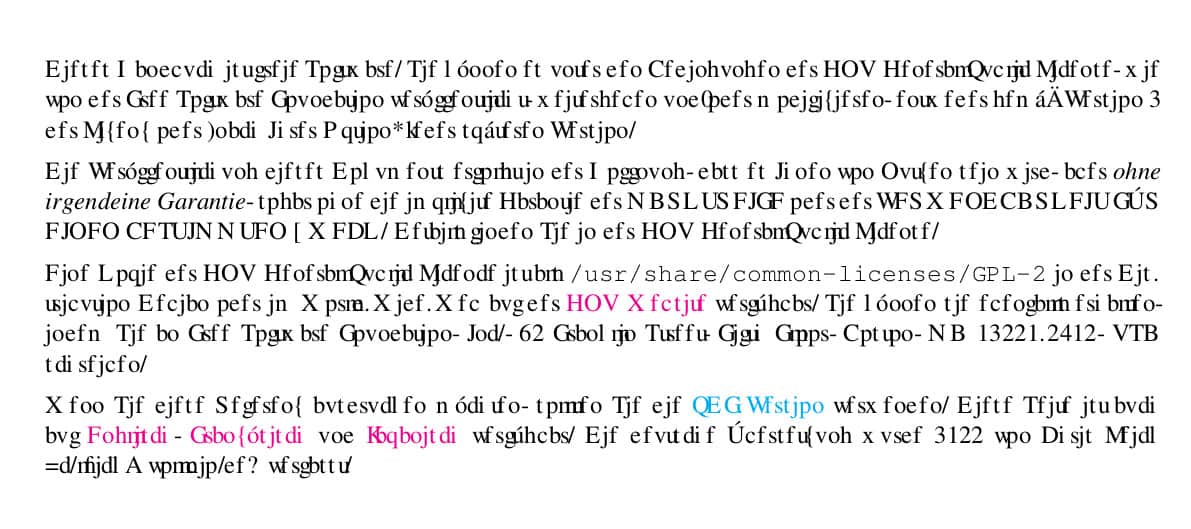 And now we are suffering huge pain from that. Look at the bug reports of that are coming in:
Just to name a few. And there is a simple way to circumvent this: Don t install gsfonts which guarantees that fontconfig finds the real original URW fonts within the TeX Live tree first.
I have now spent many hours to track down these problems, find the reason, and at the end of the day there is always gsfonts with its broken fonts with added Cyrillic glyphs. I honestly don t care about the history, there are now many fonts with Cyrillic and Greek glyphs, there is no need to fake fonts, and incorrectly take over font names.
This should be a lesson to all the GPL zealots that require absolute freedom of each and everything. Unfortunately things don t work like that. Using AND RENAMING is ok, the Knuth license as I would say, but anything else is just a source of much pain.
End for today, I have to go to work now. Real work instead of fighting sins of the past.
Nothing to enjoy here.
Additional information Just to let you know, before starting a flame war, I have already contacted the upstream developers, that is TeX Live, and explained them the situation. I don t see much chance for fixing, since the problem is with fonts without upstream and support, which are probably only used in Debian (I haven t seen them anywhere else but some mentioning in RH), and which are not officially supported or distributed. It really needs a nice developer to look into why this breakage appeared. Let us hope. And instead of flaming, anyone here is invited to dig into the code him/herself and search for changes.
Additional information 2015-08-22 Just to back up my complaints and counteract several of the comments: I am quoting from an email of a colleague on the list where we are discussing the problem:
However, the fonts extended by Valek Filippov are quite problematic. The Type1 spec clearly requires that there may not exist two different fonts with the same /FontName. The modified fonts shipped with Ghostscript have the same /FontName as the original fonts donated by URW and not even the /UniqueID was changed. IMO they are broken because they don t comply with the Type1 specification.I hope that convinced also the last in doubt.
 I bumped into Mark Shuttleworth today at Linuxcon and we had a brief conversation about Canonical's IP policy. The short summary:
Someone has said that it requires less mental effort to condemn than to think. (Emma Goldman, on several things including mailing list flamewars)Fascinating A da's "Dogging" song. Look for "dogging etiquette" for more examples of code of conducts. Just don't take your computer for repair immediately afterwards . Introduction
Every daring attempt to make a great change in existing conditions, every lofty vision of new possibilities for the human race, has been labeled Utopian. (Emma Goldman, on the Debian Social Contract)I am going to talk about many topics that we all know have so much in common:
A person is no less a slave because they are allowed to choose a new master once in a term of years. (Lysander Spooner about proprietary cloud service providers)If you thought you've seen it all with recursive acronyms, here's a chain acronym: Bondage Discipline, Dominance Submission, Sado Masochism. Why I think BDSM is interesting: not (just) because of whips, but for having a lot of awareness about power releationships. Why should one accept from a coworker a level of abuse that would be considered a hard limit when negotiating with a trusted dom? The BDSM Free Software definition: "I refuse to be bound by software I cannot negotiate with". YKINMKBYKIOK (Your Kink Is Not My Kink But Your Kink Is Okay) is a nice example of dealing with diversity, and it also definitely solves the emacs vs vi debate. Comfort zones, safewords, traffic light flow control, safety. "No means no", unless there has been a long discussion first, and a safeword is in place, in which case "Fuzzy purple unicorn" means "no" "No means no", and if someone insists after a "no", it becomes harassment. "No means no" is a precondition for being able to say "yes": http://pervocracy.blogspot.de/2011/03/no-and-no-and-no-and-yes.html Aftercare! Aftercare! Release parties! High fives! Solidarity after flamewars or votes! Poliamory
If love does not know how to give and take without restrictions, it is not love, but a transaction that never fails to lay stress on a plus and a minus. (Emma Goldman, on volunteer projects)Polyamory is the practice, desire, or acceptance of intimate relationships that are not exclusive with respect to other sexual or intimate relationships, with knowledge and consent of everyone involved. Compersion, n: the feeling you get when someone else also takes good care of one of your packages. We currently allow only one value in the Maintainer field: * takeover is traumatic, because values can only be replaced * if values could be added instead, and removed when they don't make sense anymore... What is your definition of love? My current one is: my world is better with you in it. Relationship anarchy is the practice of forming relationships which are not bound by rules aside from what the people involved mutually agree on. How do you call a relationship that is bound by rules that the people involved do not agree on? From discussions after the talk New Relationship Energy, the excitement when you start to maintain a new package, and the risk of been carried away by the excitement and neglecting all the other ones. Consent
Anarchism, to me, means not only the denial of authority, not only a new economy, but a revision of the principles of morality. It means the development of the individual as well as the assertion of the individual. It means self-responsibility, and not leader worship. (Voltairine de Cleyre about trusting lintian warnings)You need to know what you are doing, and what situation you're putting yourself into. You need to know that the person asking a question really is able to accept any answer, and take it seriously. You need to feel that you have alternatives. Be selfish when you ask, honest when you reply, and when others reply, take them seriously. If any of this doesn't stand, I find it hard to trust that we are in a consensual situation. When is one supposed to learn about consent?
Anarchism has but one infallible, unchangeable motto, Freedom. Freedom to discover any truth, freedom to develop, to live naturally and fully. (Lucy Parsons about the DFSG)Relationship advice and work advice have a lot in common:


 <Sigh/>
For the second time since I joined Debian, I missed DebConf. This time, mostly for two completely happy reasons (which have, of course, grown up quite significatively):
 But adding to that very important factor, early-to-mid August is possibly the worst date for me to attend DebConf As that's when we start classes at UNAM, and I really don't want to delegate introducing my class to somebody else (besides it being or not possible).
Life has been quite busy here. Besides starting my seventh semester as a teacher (finally being able to present my book on operating systems to the students!), I also took on teaching two modules for a diploma-course on embedded Linux. I'm co- teaching the "User-space Linux" module together with Gabriel Salda a, and will teach the "Boot process" module with Sandino Araico. There are many things that should be improved about the covered program, but we are having good fun working our way on it; Gabriel and I have given two (out of six) 6hr sessions each, and have reached the point where it is actually becoming fun :)
As for Debian... I have been doing minimal maintenance work. Answering to some keyring tickets, or taking care of only high-profile important issues. I do not have time to do much. I have been wanting to do some interesting analysis on the evolution of our keyring for several months, but have not had the time to follow it up. Will do at some point, /mehopes.
Anyway... This post is probably just because I need to somehow be there at our community's highest social, technical exchange period in the year. That is, there's not much to report, it's only me waving from home!
Next.