Search Results: "edd"

17 January 2008

Eddy Petrișor: networking in wine on amd64

Anyone managed to do that?

I tried the sid amd64 packages, the i386 packages, the lenny amd64 packages, backported etch packages (they worked for me on a i386 system at work). None of these lets me use networking.

Is wine networking working for other people using the amd64 arch?


Update: apparently I am one of the few for which wine networking on amd64 doesn't work. Th ebad thing is that I don't know why or how to fix it.

Lior Kaplan: Why does Oracle s applications needs xscreensaver in order to run ?


Working with some of Oracle’s products, made me wonder about their installation requirements as appears in the documentation. Let start with Oracle Database 10g Release 2. The installation guide for linux x86 says under “Checking the Software Requirements” it needs the following RPMs for RHEL 4.0:
  • binutils
  • compat-db
  • compat-libstdc++-296
  • control-center
  • gcc
  • gcc-c++
  • glibc
  • glibc-common
  • gnome-libs
  • libstdc++
  • libstdc++-devel
  • make
  • pdksh
  • sysstat
  • xscreensaver
  • setarch
Most of them are valid requirements when needing to compile C/C++ code (as it may be done inside the database). But why do I need to install gnome’s libraries, gnome’s control-center and xscreensaver? I fail to see how are these 3 are related to running a database. It is reasonable to require these packages for running a graphical installation, but that’s not a runtime requirement! I even tested that with checking the database opened files while it’s been running. I really don’t want to have these packages installed on servers unless I must, as I believe server should contain the minimal software required on top of the distribution default installation. Another funny (and weird) fact is that for SELS 9.0 there isn’t any requirement for gnome’s control-center. For RHEL 3.0 there aren’t any requirements for the 3 packages… Mentioning optional requirements are probably the best why to solve this, unless there’s some real requirement that eludes me. John Smiley’s “Installing Oracle Database 10g Release 2 on Linux x86″ has this for openmotif21 which is mentioned as needed only for Oracle demos. The same happens for Oracle Enterprise Manager in installation guide for linux x86 10g Release 2 (10.2), but this time the package requirements for RHEL 3.0 and SELS 9.0 don’t mention any of the 3 packages, whilst they are required for RHEL 4.0. Very weird. The status for Oracle Application Server 10g Release 3 is similar. I would be happy if someone could shed some light on the issue.

16 January 2008

Lior Kaplan: Who moved my PEs (or why does pvmove sucks on linux) ?


Yesterday I wanted to extend an existing LVM VG with some central storage disks. In the process, I notice the VG is built upon local & external disk, which isn’t according to my standards. So I decided to extend the VG with the external disks, and then use pvmove command to move all the PE from the internal disk before reducing the VG. The problem is, that on RHEL 4.4, the pvmove command hangs during it’s work, never returns to the prompt, and locks all the other LVM commands. Seems that for little amounts of PEs the command works, but for 10G disks it hangs. As nothing else helped, I was forced to hard boot the server using to power button. Running the command in single user also doesn’t effect the result, although non other user/services are running. RHEL 4.4 has LVM2 version 2.02.06, RHEL 4.5 has version 2.02.21 and RHEL 4.6 has version 2.02.27. Reading upstream’s changelog seems there isn’t any change regarding pvmove, although it’s still worth testing if upgrade helps. Version 2.02.29 has “Refactor pvmove allocation code” in its changelog, but it will take time before this version will be officially available for RHEL (fedora 8 only has 2.02.28). Hoepfully it will solve the problem, as my HP-UX colleagues are laughing on my expense… And that I have to invest more time in mimicking pvmove work manually.

Mark Brown: dpkg symbol versioning

About a month ago I added symbol version information to the zlib package, allowing dpkg-shlibdeps to calculate more relaxed dependencies for packages using the library. The results have been very satisfying so far - of the 1784 packages depending on zlib1g on amd64: Of course, zlib is a particularly good use case for this - both API and ABI are extremely stable and most of the changes in interface are in rarely used features - but it’s still good to see it working in practice. I don’t need to worry nearly so much as I would have done previously about keeping other packages out of testing. If you maintain a library written in C I would encourage you to take a look at implementing this, it’s very straightforward. Libraries written in other languages may cause more difficulty. There are some automatically generated symbol files in mole which provide a good starting point (I didn’t use them since upstream already had a more exact list of versions at which symbols were introduced) and support is already present in debhelper. The main things to watch out for when using the mole data are backwards compatible ABI changes which don’t just add new symbols (for example, if new values are accepted by a function) and variations between architectures. Kudos to Rapha l for all the work he’s put into this.

loldebian - Can I has a RC bug?: Why be an average guy any longer

14 January 2008

Andrew Pollock: [tech/security] Tracking email address harvesters

Erich Schubert's two posts about embedding spamtraps in web pages got me wondering about trying to track the web crawlers that harvest such addresses. If the pages that had the embedded spamtraps could be dynamically generated, it'd be interesting to generate email addresses that encoded the time of the crawl (well the page load I guess) and the IP address of the remote host. I expect that most of the harvesting is done by botnets, so it possibly wouldn't tell you a lot, but it'd be kind of cool to maintain a central blacklist of known harvesting IP addresses, that sites like mailing list archives could use to try and block the harvesters with.

Dirk Eddelbuettel: littler 0.1.0 released

I've just rolled up release 0.1.0 of r (pronounced littler). A few changes made it into this release: As usual, our code in our svn archive, on my r page, and in the local directory here. A fresh package is in Debian's incoming queue, and Jeff's littler page at Vanderbilt should reflect the new release soon too.

13 January 2008

Eddy Petrișor: blowing things out of proportion

First I want to say shame on you for plain out laying. I had the laptop in service once, not twice. That was for the battery. The HDD is fine and I never had hardware issues with it. Now I am writing from that laptop, is that proof good enough for you?

Now I understand how rumors start.

What I don't understand what would motivate anyone to do this?

Oh, and you're welcome for the free advertising.

Julian Andres Klode: A small benchmark: Bazaar, Git, Mercurial


I just performed some benchmark on Bazaar, Git and Mercurial. This is a very small benchmark, I may publish a more detailed one in a few weeks. vcs-performance.pdf Some notes:
  1. The unit in the first chart is seconds
  2. I haven’t run git-gc before taking the directory sizes. Running git-gc saves about 1083 kilobytes
  3. This PDF file is licensed under the MIT License, see http://opensource.org/licenses/mit-license.php

Julian Andres Klode: Neil: It s not HP s fault - HP rocks!


Neil, you have problems with your HP laptop. But this is not HP’s fault. The laptop you bought has been designed for use with windows only, like all (?) other HP laptops for home users. Most (all?) HPs Business products are fully Linux compatible and come with pre-installed FreeDOS. A few months ago, I bought an HP Compaq 6720s (GR 644ET), installed Ubuntu 7.10 64-bit on it, and everything worked out of the box (except eth0, due to problems in Ubuntu’s kernel). I have absolutely no problems with my laptop, even the built-in card reader works out of the box. BTW, HP has sponsored several Developer machines (including Gluck) and was one of the sponsors of the debconf7. Maybe the following page at the Ubuntu wiki helps you with your laptop: https://wiki.ubuntu.com/hp_dv6000_series_(dv6116eu) The next time you buy an HP laptop, buy one of their business laptops and make sure that a version with pre-installed FreeDOS is available.

11 January 2008

Felipe Augusto van de Wiel: 11 Jan 2008

Bits from the Debian i18n meeting (Extremadura 2007)
From December 12th to December 15th, Junta de Extremadura hosted another one of the Debian Meetings; five i18n guys shared ideas, food, buses and fun with the Debian KDE maintainers. We would like to thank Extremadura for hosting us during the Hispalinux Meeting 2007, the event was held at Universad de Derecho (Law University) in Caceres, Spain.

These are the minutes, results and notes from our work, it is a brief description but hopefully complete of what we have done and what is still missing/pending.

Thanks to Cesar (cek) we had the chance to work on churro (i18n.debian.net) locally; the server is still running a 2.4 kernel because of some "tick" problems with 2.6 series, the last one tried was 2.6.21 and we should try newer ones, in order to support upgrades and not get stuck with 2.4, we hope Cesar will find time to test new Debian kernels.

First, let me introduce everybody to the services, robots and resources being hosted by i18n.d.n:

  • MoinMoin wiki for local and simple reference documentation, it contains all the links to the below resources. (http://i18n.debian.net/wiki/)
  • Pootle experimental server
  • dl10n scripts, aka dl10n robots (codename Lion), these scripts are responsible for the status of pseudo URLs used by some translation teams, by the Project Smith and by the NMU Priority List for i18n NMU Campaign
  • Synchronization of the i18n material used by the Debian website to generate translation statistics about PO and PO-debconf
  • Generation of Compendium PO files per-language
  • Different types of statistics
  • Other non user-visible services like a full source mirror for stable, testing, unstable and experimental, used by the scripts and robots.
  • DDTP, Debian Descriptions Translation Project
  • DDTSS, The Debian Distributed Translation Server Satellite, a web front-end for DDTP, now integrated to DDTP to use the Database back-end instead of the e-mail interface.


And, at some point, we found important to state clear the acronyms and names used in related DDTP projects/tools:
  • DDTS, Debian Description Translation Server, this is the main "back-end" used in DDTP, it tends to be the interface between translator tools (present and future ones) and the database;
  • ddt.cgi is a CGI interface that is able to provide info for specific packages or translations, including diffs, related packages and active/inactive descriptions.
  • DDTC which is the old (and still functional) command line client for DDTP.


We took the chance to organize a few things on churro, old accounts were cleaned out and removed, we moved from /org to /srv and got more GBs of space to the "playground". Old files were also removed and some are schedule to deletion on early 2008. With the reallocation of /org we also find some more space to /home and /var, we reorganize some of the links on the web space (specially to remove services from people's accounts), and we changed the mirror script to also synchronize the Packages and Contents files.

Grisu and Martijn worked mainly on DDTP and DDTSS integration. DDTSS now provides statistics for stable, testing and unstable, we are also working with Debian Med to provide support and infrastructure to a specific audience, like packages related to Medicine. The conversion to talk directly with DDTP/DDTS database also provided:

  • Fetching new translations is almost instantaneous and marks translation as requested (avoiding duplicated works via the e-mail interface).
  • After sufficient reviews occurred, the upload is instant
  • Committed DDTS / DDTSS / DDTP website generation into SVN
    • Added READMEs for the above directories


DDTSS now announces the user using authentication because of its integration with the Database backend used by DDTP. Quick trivia: DDTP is now a compound of 25 languages occupying 18 GBytes.

A few days before the meeting we had the offer to use "AUTOBYHAND" to upload a package with the Translation-* files. The package is now called 'ddtp-translations' and we worked during the meeting to create scripts to build the package and to test it on the archive side. This approach allow Debian i18n Team to upload new translations and remove old ones (or inactive ones) without bother FTP Master Team. Special thanks to Anthony Town, he has been working with us to prove tips, fixes and info on how to produce the package and the scripts. The code is available in the debian-l10n SVN under pkg-ddtp-translations:
http://svn.debian.org/viewsvn/debian-l10n/pkg-ddtp-translations

In our case, "BYHAND" processing consists of a simple tarball of the main,contrib,non-free /i18n/Translation-*, we decide to work on a set of scripts to make it easier to create new packages (ddtp-translations) in a consistent way and keeping debian/changelog up-to-date. We also made some suggestions to the script what will run on the archive side to check the tarball structure, base on the examples of debian-maintainers and debtags (tags-override).

One of our initial targets for the meeting with regards to Pootle and Debian was to try big PO files per language, fortunately, Nicolas and Friedel were able to increase Pootle performance enough to get a few languages from DDTP loaded in Pootle. Using the upstream Pootle-diet branch, which uses a database back-end for the generation of statistics, the time to browse the DDTP POs of a language (~20.000 files) went down to a dozen of seconds.

Speaking about Pootle, Friedel gave us a good picture of what is coming next in terms of Pootle's development. There are improvements planned in the areas of permissions and rights delegation, as well as file management (for projects and templates). Improved management of terminology projects is also planned.

Improvements in the QA capabilities of the translate toolkit and Pootle are planned to help with the "false positives" of the pofilter checks. Better reuse of existing translations will become possible by using better translation memory techniques. There is also work planned on formats and converters involving, for example, XLIFF, TMX, TRADOS and WordFast.

Another pending task for quite a while was the CVS migration to SVN, it is now done, with a new layout. Commits to the CVS were disabled and every single script or resource depending on CVS should be changed to use SVN. For now, we are publishing (via HTTP) the status files generated by the pseudo-urls robots until we can fix the scripts to re-enable the commit of the files. You can find them here: http://i18n.debian.net/debian-l10n/status/

We are pretty happy with the changes and results of the work during those days, but we still have some items pending on our TODO list:

  • More advertisement and usage information about PO Compendiums
    There are two use cases are identified:
    • Filling new PO files.
    • QA work to find inconsistent translations.
    Maybe Eddy would love to do that? :-)
  • Extend the duration of the statistics history. (Nekral)
  • Debian packages of the services running on churro
    • DDTP (Grisu)
    • DDTSS (Martijn)
    • dl10n (Nekral)
  • DDTP: add some scripts to handle packages with version in the description (e.g. kernel and kernel modules) (Martijn)
  • DDTP: Standard generation of the translation tarballs (faw)
  • DDTP: document the bracketed stats on the main page (faw)
  • DDTC: should be updated to match the current features. Documentation to ease integration with procmail. (Nekral - low priority)
  • Implement mail service for translation teams with their own robots (e.g. Dutch) (faw)
  • Collect data from http://www.debian.org/devel/website/stats/ (Nekral)
  • http://www.debian.org/intl/l10n/po/,
    http://www.debian.org/intl/l10n/po-debconf/
    are built based on the churro material. It would make more sense to build these statistics on churro (Nekral)
    • We could "fork" the page and add some fancy new features on these pages (Nekral)
    • Add information from the coordination page to indicate that a translation is ongoing. (Nekral)
  • Pootle: missing review indication. Hard with PO back-end. (Friedel)


There are a couple more reports to be sent but they are more focused on i18n specific questions, tools and plans for 2008. So, probably those will be sent only to debian-i18n mail list. If you are interested, please, stay tuned. :-)
Posted on d-d-a: http://lists.debian.org/debian-devel-announce/2008/01/msg00002.html
And a big thanks to Nicolas François (aka nekral), he helped me a lot making notes, preparing the text and reviewing it; and was patient enough to wait for the report while I was solving some personal problems.

9 January 2008

Eddy Petrișor: Updates: NSLU2, Andrew S. Tanenbaum in .ro

Last weekend was as hectic as my life has been lately: I have been trying to restore sanity into my NSLU2, I went to a lecture from Andrew S. Tanenbaum and I made a 2.5 hours drive to my parents in about 4 hours because of the fog.

First, my slug:
Since the USB NIC works on my laptop, I suspect a hardware problem with the slug. Bummer!

Dear no-so-lazyweb, is there a way to install Debian on an ASUS WL-500G Premium router without loosing wireless ability? Or, is there a way to make use of my USB NIC with the ASUS router?


Second, Andrew S. Tanenbaum visited Romania and lectured Friday at the University Politehnica Bucharest.

He presented Minix3's architecture and the advantages it has over monolithic OSes. I attended the lecture (although I am not a student anymore) and found it quite nice and well prepared, but I had the feeling that sometimes he was trying to avoid or to bash topics that were not putting Minix into a good light or challenged its title of being the first open[0] OS based on a micro-kernel architecture[1]. In spite of that, I found him to be a really good speaker and I liked the overall presentation, although, I also expected some on the spot demos or at least some recordings.

The things that I remember:
I also got a Minix live CD (which is more like the Gentoo Linux install CD - just console in the live system) and made an installation of Minix in a qemu machine[2]. Unfortunately, I don't think I'll have the time to dwell into the source.

I was thinking, would it worth the effort to try to make a GNU/Hurd/Minix system (i.e. replace Mach with Minix's micro-kernel)? BTW, is Debian GNU/Hurd now based on L4 or does it still uses Mach?


Note: Some of my work colleagues suggested that the presentation was the same as one he made at linux.conf.au last year, but I can't confirm/infirm that since I didn't saw the recording.


I won't write about the "fog drive", but I'll just say it wasn't pleasant at all, and I felt I was in driving in The Twilight Zone for the whole Friday evening.


[0] he gave credit to QNX
[1] For instance, I tried to ask him twice if he felt that GNU Hurd was violating the micro-kernel paradigm or if he can compare it to Minix' architecture. I had the impression that both times he avoided to answer and started the usual Hurd bashing, "they have been developing it for 20+ years, but got nothing working", meanwhile "Minix is here". After the lecture/presentation somebody told me that AST shortly said that they "were similar, but different". I didn't catch that line.
[2] thanks to qemu-launcher it is trivial to create and manage multiple qemu virtual machines

Eddy Petrișor: my laptop is back

Yesterday I got my laptop back. It was in service since the 6th of December.

They replaced the battery, and although it looked like the built-in charge indicator was defect, actually the button on this battery is buried deeper than it was on the previous one and I have to press really hard on it to trigger it.

According to the tests made yesterday night, this battery holds for about 2.5-3 hours when playing music. Also it has 96% of its designed capacity. I guess is OK enough since I don't want to be spared from my laptop anymore.

Next on the agenda:
BTW, I still hold to my opinion that Dell and Emag suck, although I might buy desktops from Dell, laptops are a no-no until they fix their broken batteries and their broken "1-year warranty for batteries" policy.

[1] I bought a new NSLU2 after I left my laptop in service and it has been waiting since then to run the Debian Arm EABI (armel) port

6 January 2008

Dirk Eddelbuettel: NAS'ed

I had been eyeing an inexpensive network-storage device -- for the non-geeks: think of a hard disk with an ethernet port and some controlling software -- for some time. I was aware of some of the hacking efforts around a few of these but somehow nothing really appealed. I was sort-of looking for nslu2-with-a-disk, and preferably not too expensive. Lo and behold, that's what I saw today in my techbargains feed: a Buffalo LinkStation Live which contains a 500gb SATA for $199 after rebates. Some quick googling lead to these wiki pages which looked promising: anything from enhancing the stock Linux setup by enabling a few more services to a custom Linux distro (similar to my wrt54 router running linux) to reportedly some work-in-progress for a native Debian installation. Nice! So off I went, ordered the thingie for local pickup for an additional 5% off and picked it up a little later at the local Circuit City (where visits are seemingly a recurring event these days). The documentation is very brief and insist that you install something on Windows -- just to find that the little box autoconfigures itself just fine. Presumably some network discovery is going to find the assigned dhcp address which is needed for the web interface. A few minutes later, a new (fixed) IP address was assigned, ntp was enabled and that was about that. After dinner, I quickly followed this tutorial to get the box a bit more Unixy without going too far (yet) from the default: start up telnet via a simple Java command-line tool, login, then enable ssh, set it up in /etc/init.d, add some extra binaries. All very quick and simple [ with the caveat that the addons.tar didn't want to get there via the Java tool, so manual scp once 'inside' did the trick ]. NFS, which I like for shuffling files around, appears to be little trickier for this ARM-based LinkStation Live. So at least for now I am content with simple rsync'ing of my backup directories on the few machines here. Much better than the current setup with mutual backups between workstations and semi-permanently being out of space. All in all a rather pleasant gadget and recommended at the price. The extra $100 in rebates are valid from today to the 12th.

5 January 2008

Lior Kaplan: usertag support for mass-bug script


While working on mass bug filling in Debconf, I noticed problems with specifying user & usertags in mass-bug’s templates. Which resulted with some manual work to tag all the reported bugs after getting the bugs’ numbers. Thanks to Mohammed Adn ne Trojette, it seems to be resolved:
* mass-bug: add –user and –usertags options to avoid their wrapping. (Closes: #429479)
So I guess that’s a small improvement for the QA people… Enjoy.

Dirk Eddelbuettel: RQuantLib 0.2.8

Version 0.9.0 of QuantLib was released a couple of days ago on Christmas Eve; as usual, Debian packages for QuantLib were uploaded right away following a few earlier pre-releases. As QuantLib is approaching its 1.0 release, a few API changes requires updates to basically all of RQuantLib's C++ source files. Luckily most changes were minor. At the same time, we also generalised the Binary (aks Digital) option pricer to allow for a 'binType' argument (with values 'cash', 'asset' or 'gap' for CashOrNothing, AssetOrNothing or Gap digitals) as well as an 'excType' argument to switch between European and American exercise. Dominick made a small change to the DiscountCurve object to seamlessly pass a switch variable indicating whether we have 'flat' curves or not. Another change was the addition of formal unit tests using the RUnit from CRAN (which we happened to have added to Debian recently in the wave of new RMetrics packages). We use the scheme initially proposed by Gregor Gojanc and extended by Martin Maechler for RMetrics that allows the unit tests to be run from both the source and the installed package which is nice. As QuantLib itself has a massive amount of unit tests in its code; I am hoping to add more and more of those into RQuantLib itself as we add more functionality. On that front, more exciting news: RQuantLib is now hosted on R-Forge. Potential contributors are encouraged to register at R-Forge and to get in touch -- this is a great way to learn about combining C++ and R. To wrap up, the new version 0.2.8 is currently in the queue at R's master CRAN host and should hit the CRAN mirrors shortly; likewise the Debian package has been uploaded and should also propagate to Debian mirrors in due course. As usual, source are also available locally on my site.

2 January 2008

Eddy Petrișor: back(b)loging until 2008

I haven't blogged since last year :-D so a "Happy New Year!" is required.

So what happened meanwhile? Quite a few things, both good and bad.

Maybe at a future point in time I'll post a picture or two with my nephews.

To all the people, thanks for the support and, once again, Happy New Year!

[1] a simple poem for kids

1 January 2008

Lior Kaplan: Responsible Behavior


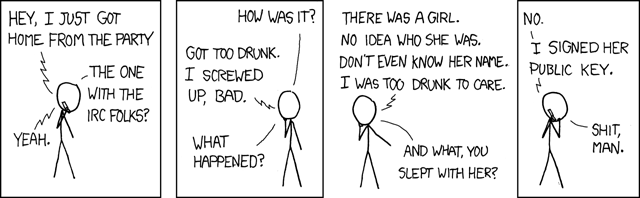
For all those DDs who love to drink: (click to enlarge) By xkcd, A webcomic of romance, sarcasm, math, and language.

Julian Andres Klode: Bye, 2007 - Welcome 2008!


April 2007, I joined the Fellowship of the Free Software Foundation Europe. I also became involved in the development of Debian GNU/Linux with my first package, aufs, sponsored by Daniel Baumann. This was the starting point for my Debian stuff. Now I maintain 6 packages in Debian. One of the most interesting packages is gnome-app-install, which will be part of the gnome-desktop task (already added to tasksel’s list). Users will be able to install applications easily. It also activates the automatic codec installation, so users will be able to play most multimedia files easily. 30th December, I finally got assigned my AM, Martin Zobel-Helas (zobel), and I’m happy to be able to continue the NM process now. On the Ubuntu side, some things have happened, too. I merged several new versions of dir2ogg and a new aufs version, and became an Ubuntu Member on the 29th November. In 2008, I plan to complete the New Maintainer process and become an Ubuntu MOTU. I will continue my packaging stuff, and will merge new features from Debian to Ubuntu and from Ubuntu to Debian. A happy new year to everyone and sorry for blogging this such late.

31 December 2007

MJ Ray: Strange Traditions: Dinner for One

The last day of each year sees one of the strangest traditions I've ever noticed. A 40-year-old English-language film of an 80-year-old music hall comedy is played repeatedly on various stations in Germany - and in Austria, Switzerland, Denmark and Australia too. There's not only the film, but edited versions, localised versions, spoofs and other shows based around it too. The film still isn't shown on any English stations, as far as I can tell. I'd never heard of it before getting satellite TV. So, to see what the fuss is about, grab your Dinner for One times (may contain annoying ads if you switch Javascript on) and sit down with the satellite TV (best), or enjoy this description and script from analoguesat, a German-language description or this BBC report which includes this snippet:-
"To the end of his life, Freddie Frinton heartily disliked Germany and the Germans, thanks to his own wartime experience. He refused to allow a German-language version to be made. That is what has led to the extraordinary fact that today the Germans as a nation have embraced a trifling one-act play in English as their all-time favourite entertainment."
Anyway, the last joke is on we English. It's much better than the aging boy bands on our TV at New Year, isn't it? (Updated 2008-01-03 with 1 comment)

Next.

Previous.