Search Results: "beh"

11 December 2006

Amaya Rodrigo: Pinochet, al hoyo

Several years ago, Pinochet was prosecuted by the Spanish judge Baltasar Garz n:


On October 17, 1998, while traveling to the United Kingdom for medical treatment, Pinochet was arrested on a Spanish provisional warrant for the murder in Chile of Spanish citizens while he was president. Five days later, Pinochet was served with a second provisional arrest warrant from judge Baltasar Garz n of Spain charging him with systematic torture, murder, illegal detention, and disappearances. Pinochet was placed under house arrest in Britain while appealing the legal authority of the Spanish and British courts to try him, but eventually released on medical grounds by the then Home Secretary Jack Straw without facing trial. .

Garz n became my hero since that very moment.

Since then I have been repeating like crazy: Pinochet, al talego , which barely means Get Pinochet behind bars . Now I am smiling as I think Pinochet, al hoyo , which I will not even try to translate. I pity the worms his unpunished criminal corpse will breed.

Go take a look at the Valech Report.

Cheers!

Edd Dumbill: Afraid of the POX?

The other day I had was tinkering with that cute little poster child of Web 2.0, Flickr. Looking for a lightweight way to incorporate some photos into a web site, I headed to their feeds page to find some XML to use.Before you read on, don't forget that the XTech 2007 call for participation ends this week. The result was interesting. Flickr have a variety of outputs in RSS dialects, but you just can't get at the raw data using XML. The bookmarking service del.icio.us is another case in point. My friend Matt Biddulph recently had to resort to screenscraping in order to write his tag stemmer, until some kind soul pointed out there's a JSON feed.Both of these services support XML output, but only with the semantics crammed awkwardly into RSS or Atom. Neither have plain XML for public consumption (some is available behind a registration protected API), but do support serialization via other formats. We don't really have "XML on the Web". We have RSS on the web, plus a bunch of mostly JSON and YAML for those who didn't care for pointy brackets.Did we as supporters of XML get it wrong somehow? I think we did. The success of the XML project and the W3C as a unifying forum was seductive, and we felt more bound to the edicts of the W3C than we thought. Our justified love of open standards inadvertently promoted a straitjacketed approach to using XML. XML was felt to need a schema language.What we missed was that settling on schemas for data serialization represented much more of an up-front commitment than most developers could really make. The rise of agile programming techniques further emphasizes the hazards of prematurely freezing a design.Schemas never really came with great evolution or migration strategies.
And of course it didn't help that both DTDs and W3C XML Schema are pretty darn obscure. Somehow we never got the word out, despite the "standalone" XML declaration, that it's OK to spread schema-less XML around.We had of course the Simple XML movement, but it came to little. Other voices pointed the way forward. Walter Perry notably promoted an agenda that required little a priori agreement between communicators, but it gained little ground in common thought. Ironically it took James Clark to push the agenda of developer convenience, with the RELAX NG compact syntax giving us all permission not to think in angle brackets.Meanwhile, busy developers with work to do on the web have created non-XML syntaxes such as JSON and YAML. Though I deliberately closeted myself in XML for a long time, I have come to appreciate the utility of these syntaxes.One of the more intriguing developments is that the Semantic Web crowd, while still very much W3C oriented, have really proved themselves more flexible in their attitude than the XML world at large. RDF/XML is hardly the only acceptable way to approach the throne of Tim, and the man himself threw out XML syntax pretty early on with the development of the N3 scribble format. More recently, the work on GRDDL to scrape semantics from HTML has shown the semweb folks' amenability to outside initiatives such as microformats.Maybe it's not such a bad world, as making an XML mapping of YAML, JSON and friends isn't really very hard. I'd just like to get the message out to web application developers that Plain Old XML is fine by me. I live in hope yet that the rise of REST will hit this home.So while markup has most definitely won on the web, it's a shame XML hasn't yet achieved as much as it could. It's not too late for an injection of pragmatism and a little less constraint.

Andreas Barth: Reading is difficult - or why the current number of RC bugs is ok for the freeze

People who have following our release update mails have seen that we are tracking different numbers this time. There is the total number of RC bugs relevant for etch, which is currently 122. And there is the number of RC bugs relevant for both etch and sid (i.e. "not handled yet"-bugs), which is currently 78 - and that number was basically the only number we could track for release of sarge. (Then there are also the numbers of bugs only in etch, and the number of aged bugs relevant for etch and sid - please see http://bts.turmzimmer.net/graph-small.png for the full stats.) So, if you look back we have written "RC bugs below 80" as precondition in our timeline. We copied that from the sarge release, were we had "~85 RC bugs" at time of freeze. During detailed planing, it became obvious that if we want to basically "go by the same numbers", that is (and can only be) the number of RC bugs applying to both etch and sid - as that was the only stats we really had during sarge release planing (please remember, we didn't had version tracking at that time, at the moment where a bug fix was uploaded to sid, the bug disappeared at all, unless someone reopened the bug report and tagged it sarge). So, we agreed that we can and should freeze Etch as soon as the combined number is below 80, and the number of fixes waiting for transition is not out of control (and a few other issues are resolved, please see the previous mail to debian-devel-announce for that). Please allow me also a personal remark: It is really sad when somone tries to hurt active Developers working on the release, while not contributing anything except spite. I don't think that is adequate behaviour.

10 December 2006

Evan Prodromou: 18 Frimaire CCXV

Fun day today. Maj, Amita and I went up to the Christmas tree lot at Parc Lahaie on St. Joseph and St. Laurent. It was packed with people there for No l dans le Parc, a month-long Christmas festival held in two parks in Montreal. Of course, we had no idea it was going on before we got there. Christmas tree lots in Quebec are a lot more festive than the businesslike lots in, say, California. There is often a pen full of farm animals -- like the Christmas manger, eh? -- that kids can look at and pet. Since it's often ass-cold, there's also usually a fireplace or a barrel fire. For some weird reason, all the lots in our neighborhood are in public parks, but that might have to do with a dearth of big parking lots in the Plateau. But No l dans le Parc was even bigger than all that. When we arrived, there were two blues players in separate giant plastic globes hovering in the trees above the campfire. In two other (terrestrial) booths, a Quebec traditional music band was playing silently behind a glass window while a radio crew in the other booth broadcast them live. There was a concession stand serving bi re and vin chaud (of which we ordered two), and an open-air museum with fun stuff for kids. We ended up hanging out for more than an hour. Amita June developed an intense fascination with the sheep in the petting zoo, and even after Papa had bought an 8' tree and tied it to the roof, she insisted on going back to the pen and saying goodbye one more time. The tree looks great in our living room -- it's almost scraping the ceiling, but it fills up its corner nicely. tags:

Lina and Jeremy's Xmas party Even better tonight was our friends Lina and Jeremy's Christmas Party, at their house. Maj whipped up some steamed artichokes to take over, and I put together mixins for hot buttered rums, and we headed over to their great place in Little Italy. We got there early and Lina had made mulled wine -- a big pot of it, based on the recipe from Clarence the Angel. Amita June headed off with Clea and Sylvie, two girls much older than her, and although she couldn't really communicate with them she followed along with what they were doing just fine. The under-10 crowd eventually settled around the TV, which was originally on Hockey Night in Canada but eventually switched over to a tape of Zoboomafoo. So her Mama and I got to hang out with grownups for a change, which I at least was ill-equipped to do, but made a game attempt. Lots of nice people, including L and J's upstairs neighbor Annabelle, whose band The Wailin Jennys is doing pretty darn good lately. They're up for a couple slots in the Canadian Folk Music Awards tomorrow. Good for them. I made a big batch of HBRs and they were quite a hit. It's such an easy recipe, I'll share it right here:
  • 1 oz dark rum
  • 1 tsp brown sugar
  • 1 tsp butter
  • 8 oz boiling water
Mix it all together in a coffee mug and serve when the butter's melted. Keeps you warm when you need it. We came home early, of course -- the baby's getting independent, but not that independent -- and now we're rresting from a long day. tags:

Wikitravel RSS So, I know this sounds crazy, but we've never really had much of an RSS presence for Wikitravel. We've got an RSS feed for Recent Changes, of course, as does every MediaWiki site, but never anything else. But I was talking to Jack Herrick of wikiHow recently, and he was telling me that their Daily Howto RSS feed is one of their biggest vectors of people coming into the site. Wikitravellers make updated news and information on our Main Page all the time, so I figure it'd be useful to make an RSS feed of new stuff from Wikitravel, too. So I've started scraping the frequently-updated parts of the site to make them available through a Wikitravel News feed. It includes the strange-travel trivia from Wikitravel:Discover and the Travel news info, too. There's been a lot of work in it -- making feeds out of wiki pages requires some assumptions and creative markup. But I'm getting closer, and I think the lessons I'm learning with our English version will help making RSS feeds for the other language versions easier. I'll be adding in more features for English, too, as I learn how to scrape them better. tags:

9 December 2006

Thom May: Rising from the Murky Depths

In a watery contrast to the real Venice, The Venice Project surfaced from stealth mode recently (and I just fixed my blog, so I figured I’d get caught up). Our blog has some more official news and buzz, too.
People who know me at this point will be wondering why I’m involved in a TV project when I hardly ever watch TV, but we’re actually aiming to solve much of my irritation. Colm writes about what TVP solves for him, and I agree that the social aspect is one the fundamental points to our work. We’re seeing - via MMORPGs, blogging communities, etc - the attraction that connectedness has and the importance people are beginning to attach to sharing and aggregating data effectively.
Leo has written about some of the underlying technologies that parts of the project are using, although unfortunately he somewhat takes the reasoning behind the choices for granted.
My other major problem with TV is timing. This one is pretty obvious, but being able to build channels with content that I want to watch, and watch them when I want to is pretty compelling.
And I’m looking forward to combining these two…
So what am I doing? I’m broadly doing operations, with - unsurprisingly - a Linux bent… But more about that later.

Gustavo Franco: Amaya and my world.

Amaya, the song you quoted in your previous post (My World) isn't 80s. It was composed by first Guns N' Roses incarnation (Axl, Slash and co) during the Use Your Illusion sessions (90-91) and close the two albums. The history behind the song is that they were on mushrooms after working during all the night in the Live and Let Die cover. Axl wanted to do something quick and they came up with that. The song has nothing to do with Guns and Roses because Axl was into industrial that time and though it was ok close the illusions that way.

While we're at it, the second incarnation of the band successfully toured Europe this year and is right now doing some gigs in USA. From the new material i would recommend: There Was a Time and Better. You can watch proshots from the European leg of the tour everywhere on the web. Have fun!

8 December 2006

Benjamin Mako Hill: Over The Counter, Behind Bars

I went to buy some pseudoephedrine yesterday because we ran out at home. A sign on the shelf prompted me to ask for it at the pharmacy. They would only sell it to me in small blister-packs and in order to buy any, they wanted to transcribe all of the information on my driver's license. A little bit of research reveals that this is roughly connected to the national Combat Methamphetamine Epidemic Act of 2005, signed into law earlier this year as part of the PATRIOT act extension. Apparently, pseudoephedrine is used to created (illegal) methamphetamine and meth chemists qualify as terrorists under PATRIOT. States, however, have gone even further. Oregon has gone so far as to make pseudoephedrine a Schedule III controlled substance that requires a prescription. Many other states, like Massachusetts have made pseudoephedrine a over-the-counter drug that's kept, well, on the other side of the counter. It was, I think, the first I ever had to buy an over-the-counter drug over a counter. Usually, I just pick it off the shelf myself. I find that fact slightly humorous. But it hardly seems worth collecting and recording a pile of personal information on every person who wants to buy a weeks worth of cold medicine -- particularly when the largest producers of U.S. meth remain outside of the country.

6 December 2006

Matthew Garrett

Regular viewers may have noticed a reduced frequency of updates lately. This is due to unfortunate circumstances.

But anyway.

Fed up with Bruce Perens claiming to speak on your behalf? Object that someone who hasn't written any useful code in approximately forever wants to class you as being in the same category of people as him? Think it's a bit off for him to claim random things about the meaning of the GPL? Irritated that there's no way to make this clear to journalists?

Now there's a solution!

Visit Bruce Perens does not speak for me and let the world know that when Bruce says that the Open Source community is fighting the same sort of battle that Martin Luther King did, you'd rather not be included.

Adrian von Bidder: We Know Who Takes the Blame!

Sam Hocevar is wrong when he says:
Suppose for instance that you stopped contributing to Debian months ago [...] You are obviously not only directly responsible for Etch being late due to your lack of involvement, ...
“You” are not responsible for Etch being late. The Debian project has picked an official scapegoat for Etch being late and for everything else in Debian that just doesn't work how it should. So everybody can now relax: no Debian developer is personally responsible for anything. It's really convenient if some people group together and do something that other people don't like and then give it a name. You can blame the new thing for everything you don't want to do or don't like, without actually having to name the people behind it or thinking about constructive ways to improve matters. It's always “them”. Yes, I'm pissed by the attitude of some very vocal people. Dunc Tank is not an official Debian project, so I still fail to see how it's different from Canonical, Progeny, Credativ etc. hiring people. Dunc Tank even pays people to work directly on Debian, it doesn't pay them to do Debian-related work that might eventually benefit Debian, too. As a private employer, Dunc Tank is free to pick who to employ and who not to employ. Yes, Dunc Tank and some Debian project roles do overlap, but stuff like this can't be avoided, especially in time consuming volunteer projects doing stuff that can also be done for money. Debian is not a charity, but a project competing directly with commercial products, so its members shouldn't be surprised when the question of money comes up every now and then. (And just to make it clear: I'm not arguing against Sam, who blogged about a totally different topic. The part I quoted just got me started.)

5 December 2006

Julien Danjou: Where is my Etch

With your bug count in the air and your Etch on the ground
Try this trick and spin it, yeah
Your RM will collapse
But there's nothing in it
And you'll ask yourself Where is Debian?
Where is Debian?
Where is Debian? Way out in the money
See it dunkin' I was squasin' for free
Bugs were hiding behind the money
Except the little board
But they told me, he swears
Tryin' to release me me me
Where is Debian?
Where is Debian?
Where is Debian? Ooooh
With your bug count in the air and your Etch on the ground
Ooooh
Try this trick and spin it, yeah
Ooooh
Ooooh Thanks to The Pixies.

4 December 2006

Erich Schubert: Penny Stock Spam

... is rather annoying these days. Apparently this known hacker group with their powerful Windows trojans is behind the latest spam wave: they use image obfuscation that makes the average Captchas look easy. In fact it took me a couple of seconds to understand what they're spamming about this time - the image just contained a highly unreadable stock symbol. I wonder if the big financial web sites (for non-experts) like Google Finance, Yahoo Finance or whatever you use for occassionally checking your stock quotes couldn't just add a warning if a penny stock is being spamvertised. Preventing naive users from falling for these frauds would certainly be a good service for their visitors, wouldn't it? And there are already websites listing spamvertised penny stocks. So dear big-financial-websites, start protecting your customers now (and reduce the amount of spam for all of us that way, since that will hopefully make penny stocks a lot less lucrative).

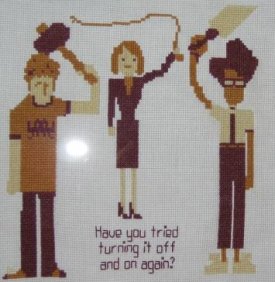
Amaya Rodrigo: Have you tried turning it off and on again?

Some wonderful cross-stitch art:


The IT Crowd is my all-time favorite geek TV show -- a sitcom about sysadmins, written by Graham Linehan, the genius behind Father Ted.

3 December 2006

Amaya Rodrigo: Amayita in ProzacLand

[Absolutely nothing related in any way to Debian or Free Software here, so you can just skip ahead]

As some of you may be already aware of, I suffer from OCD, in a very mild form. If left untreated for long enough time, in my case it was years, it leads to depression. A good one. You can end up in Learned Helplessness Land, where your closest companion will be your inner voice, constantly criticising you, blaming you for anything that happens, I even used to believe I brought bad luck to the people I was with or met.

I strive for perfection, and the world is not perfect, not everything is under my control, and OCD is just a jail. In my case it is cleaning and re-arranging stuff. My perfectly shiny jail.

Some of my friends think it is so bourgeois that I have a person come clean my house every week. Maybe they do not understand that I can t clean, because I can t stop. The same way an ex-addict can t take $SUBSTANCE_OF_CHOICE. When I get stressed I tend to clean, and when I start cleaning I just don t stop. One stupid example of how ridiculous it can get: doing the laundry in an empty laundry machine so that it is clean inside. I can kill my plants by watering them too much, specially Cactus, dist-upgrading all my machines every morning, and then several more times a day, even if i know there will be no updates available at all.

And while I am doing it, I don t enjoy it. I can t stop, control it or decide anything. I follow very strict rituals, things have to be the right way, following a very complex set of rules that make sense to no one else but me. Well, not even me. But I have to, I don t choose to, and that is where the jail comes from.

I think it all comes from my childhood, in a very chaotic household, at a deeply disturbed family, with an abusive, alcoholic father and a very overwhelmed mother, the only thing I could control in my life was that my room was clean and arranged, as opposed to the rest of the house, and my homework perfect, as opposed to the rest of my life. The same way anorexics feel in control when they let themselves starve to death, because they control the food they eat, their hunger and their bodies.

My father also turned up to be psychotic, manic-depressive, and what not. When my mother finally forced^W helped him to stop drinking, I had this hope that things would be fine, but they didn t really improve. I was eleven. At the beginning it was the drinking, then the mental illness, then the aging, but my worst fear has always been to become him. To do onto others what was done to me. When I was 16 I already knew I would never have kids. I can t even bear to think that I could fuck up the way my family did. I can t even bear the thoughts of passing these genes onto an innocent baby. I specially hate the idea of bringing a new baby into this fucked up world, with so many kids out there so helpless, as myself as a kid, that nobody wants. I would definitely adopt a kid one day, if I was sure I would not repeat certain behaviours on him/her. If a doctor would put it in writing with his own blood.

In 2004, wanting to kill myself, even with a well thought plan and a written unofficial will (who gets my laptop, who gets my clothes, who gets my money, and so on) I went into treatment. Some of you might remember I was kind of MIA at the time. I was on Prozac, tranquilizers, and a year and a half therapy later, I was fine. I was even happy! That was by Debconf 5, after being fired from a job that was hurting me, giving up a 15 years relationship that had become unhealthy for both of us, the death of two very dear friends, and other looses not worth mentioning in this blog post that already gives too much away, I was finally happy. My life radically changed, my jail was almost gone, my fears were under control, I was finally free.

But, recently, a very dear friend of mine got sick, not any near what my father was or had ever been, but I saw myself in a mirror. My worst fears paralyzed me. My inner voice whispered I would end up being him. Again. And again. And some more. So I had to fight my I can do this alone pride, called my doctor and I am back on all the crap that will probably fuck my brain chemistry in the long run, and back on therapy, which is the only resource that will be really helpful for my life. I am not as bad as I once was, and it is going to be much easier this time, but I am scared as hell, because I though this was gone forever. But my friend got sick, and I had a stressful couple of months at work, and (yay!) I started cleaning again.

My physical health is also reflecting what I am going through. I am in a very acute UTI episode. The amount of pills I take in the morning is getting scary now. The pain and the burn are hardly bearable, and I have become unwillingly an early riser. I wake up at 5:30 or 6:00 am, and go to bed somewhere between 8:00 and 10:00 pm. One of the side effects of the painkillers is I can t really focus my sight at the moment, so my computing is painful and limited.

Being unable to concentrate on the computer I engaged in compulsive house improvement.

* I changed every light switch and power outlet in the house without turning the power off. Dangerous? Sure. Am I proud of my new skill? You bet!

* I revamped a very old and crappy piece of furniture I found in the trash. When the lady that cleans for you has a better cell phone than you, and you can t afford new shoes for the winter, you start looking at the stuff other people throw away in a different way. In a very different way.

* I lost ten kilos, and the clothes I wore to Brazil fit again. I am fixing the broken bits, because I can t really afford to get clothes of my new size anymore either.

Some pics of my achievements (some work is still in progress):


You might have noticed my web server is down at the moment. I hope this post explains why I am timing out. My server is called aenima, latin for soul, and quite incidentally.
2 December 2006

Jaldhar Vyas: The Real Meaning of Nalanda

Venkatesh Hariharan recently wrote an article on Indias traditions of knowledge and how Open Source meshes with them. Now having met him at foss.in and knowing of his work, I am 100% convinced he is on the side of the angels and their is no malice in what he wrote. However, his interpretation (really not his, but the conventional wisdom amongst the Indian elite.) of Indian history and culture is so monumentally wrong it bears correction. While I admit my hackles were raised by the cultural and theological mistakes made, there are implications for Open Source advocacy in India and the world at large too. He starts by giving the example of Nalanda, supposedly "the first university in the world." but more accurately a Buddhist vihara (monastery.) Its' very name indicated sharing. I use the past tense because Nalanda doesn't exist anymore. In fact except in a few border areas influenced by Tibet or Burma, Buddhism itself is so thoroughly extinct in the land of its birth, the place where it flourished for over 1500 years, that the only reason people like Hariharan or myself only know that there ever was such a thing due to the work of 19th century Western Indologists. How could this be? One theory is that a resurgent Hinduism coopted or persecuted the Buddhists into oblivion. However this is unsatisfactory. It does not explain why Jainism (a religion as old as Buddhism and equally heretical for exactly the same reasons from the Hindu point of view) still survives to this day and it doesn't explain how it could have happened for even the most advanced genocidal regimes of the 20th century have been unable to "disappear" undesirables to the extent which Buddhism disappeared. A more plausible explanation revolves around the fact that, as I mentioned before, places like Nalanda were Viharas. This doesn't mean that they can't have university-like properties too; after all the great academic institutions of Europe also had religious foundations but the monastic nature of a vihara is salient. A monastery is not a place you go to engage the world, its a place you go to escape it. To mix metaphors a bit, the viharas were cathedrals not bazaars. While there may have been a lively intellectual life within its walls, there is no evidence that Nalanda and its denizens interacted much with the surrounding culture. An economically unproductive institution of such vast size (15,000 monks at its peak) could only survive by the patronage of kings and other rich people. When that patronage dried up as for example when the medieval Muslim invasions swept away the old royalty, Nalanda and its sisters couldn't survive. Just as when a proprietary software company dies, its "intellectual property" often dies with it, when centralized Buddhism died, Buddhist ideas died with it. (Luckily Buddhism had spread to other countries by then and developed new, less monolithic forms so it was not lost to the world altogether.) In contrast Hinduism (and for that matter Jainism) while having all due respect for monks were and are primarily lay movements. The pursuit of morality (Dharma), wealth (artha) and pleasure (kama) in this world are equally valid human goals alongside liberation from the world (moksha.) and this manifested as the much maligned institution of caste. Hariharan quotes the conventional view probably familiar to Westerners from Anthropology 101, a lock-step hierarchy of four classes (varna is the Sanskrt word) with fixed occupations, with knowledge and privilege on top and ignorance and oppression at the bottom. The thing is, this view bears no relationship whatsoever with social reality in India now or historically. There is another Sanskrit word, jati, which can be translated as caste. There are thousands of these jatis and while Indian thinkers have periodically attempted to try and shoehorn them into the varna framework, they have had little success and varna is for all practical purposes just a theory. And this is not just a fall from some putative golden age (Like the canard that once caste was flexible and merit based and only later became rigid.) but the state of affairs throughout recorded history.

A jati consists of people who share a common (or fictive) kinship, who have particular food and ritual choices, and marry endogamously. While many jatis are associated with a particular occupation, many others are not. This is what caste means to a typical Indian (it is also the social organization prevalent amongst Jains, Sikhs, Muslims and Christians even if they don't accept its theological basis.) Yes, hierarchy and concommitantly oppression, are in some cases a byproduct of casteist thinking but they are hardly its raison d'etre. A comparison can be made to the Western nuclear family system. Some people think it is superior to any other form of social organization. Most people wouldn't go that far but go along with it as "the way it is." Some of those of a liberal persuasion might want tweaks of certain aspects of it. A very small fringe think it is nothing more than a nefarious plot to spread patriarchy, subjugation and racism etc. They are mostly considered kooks by the other groups. (Unfortunately when India and caste are concerned, the kooks are ruling the roost.) The diversity of jatis like the diversity of open source creates a certain resistence to disruption that a monoculture cannot. Thus though Hinduism also suffered grievously from invasions, it was able to hold on where Indian Buddhism could not. Brahmin (sic. That's an English mispronounciation.) is also misinterpreted as one who knows Brahma (masculine noun. The Creator God.) instead of Brahman (neuter noun. The supreme spirit pervading the Universe.) though even then it would be wrong because Brahmin, Brahma, and Brahman all come from a common root word brhati (feminine noun. Sacred speech.) as any Sanskrit dictionary will attest. Hariharan cites the example of the sacred scriptures (Sic. He means the Vedas) and the notorious statement of the Manusmrti saying that an unqualified person who hears them should have molten lead poured into their ears as examples of the proprietarization of knowledge. Now the long-suffering untouchables may have been afraid of many things but having lead earplugs was not one of them. There is no historical evidence that any such action was ever attempted. You can criticize the Manusmrti for even saying such a thing but that is a far cry from using it as evidence of historical attitudes. You see, the Manusmrti is not even in the most orthodox conception Hindu Sharia and the Vedas are not "Sacred Scriptures" in the sense that the Bible or Koran are. Rather they are part of a wide range of significant literary works respected in Hinduism of which other important examples are the two Epics the Mahabharata (which includes the Bhagavadgita), and the Ramayana, and the vast compendia of geneologies, philosophy, lore and legend called the Puranas. Hariharan actually missed a good chance to make his point here because while the Vedas are indeed "proprietary" the other works I mentioned are not and have in fact permeated all over India and even beyond its borders. Many Indian languages owe their literary existence to translation of the epics or Puranas. For instance one of the earliest monuments of Hindi literature is the Ramacharitamanasa, Saint Tulsidas's translation of the Ramayana. When he wrote it in the 16th century, he did face some opposition from those who didn't think such an august work should be rendered into a "vulgar" tongue, he also received encouragement from equally orthodox people (including those who believed the Vedas should be restricted to Brahmins) Today it is by many accounts the most popular Hindu holy book in existence. So really the whole idea that the Hindu canon shows a fall from open grace to rigidly controlled private property is just bogus. To those who have slogged their way though all this verbiage wondering what it has do with Linux and Open Source, let me assure you I am getting to the point :-) It's bad enough from my point of view as a devout Hindu that my religion would be misrepresented this way but from my point of view as a supporter of Free Software ideals, it is catastrophic. Linux and Open Source in India has spread, as in most parts of the world, primararily as a hobby amongst computer enthusiasts and for a hobby it's doing ok. However if you think of it as more than that, as a tool to enhance society and empower peoples lives, that is not nearly good enough. But how can one serve a society if one apparently has no clue about that societies history and mores? The developing world is littered with failed projects that were carried out with the purest of motives but no regard to what the putative clients actually wanted. Do we want Linux and Open Source deployments to go the same way? For a couple of years now I've been trying to get Indian and NRI programmers to get involved in localization in debian-installer and elsewhere but even with the small minority that are sympathetic to Open Source (a scandal in itself.) it is like pulling teeth. To their credit, Red Hat India pays people to work on such things but volunteerism is the heart of the Open Source movement as we all know so the apathy of Indian IT professionals is deeply troubling. Hariharan is trying to increase interest by appealing to the Indians' sense of cultural pride which is a good tactic--it has been successfuly applied by many non-western or minority cultures--but he is not going to be very successful if the vision of Indian culture he is presenting is as alien as Eskimo culture to the vast majority of the people. Western Open Source advocates also run into difficulties due to being tone-deaf in their understanding of how third-world cultures actually operate. When India declined to participate in the One Laptop Per Child (OLPC) project, some commentators on places like Slashdot were perplexed. Wouldn't a poor country want an inexpensive yet efficient pc using free software instead of high-priced imports? The thing they missed is that while people in India may be poor, thanks to a more-or-less democratic polity and more-or-less open communications, their frame of reference is no longer their village. Their trends are increasingly set in Mumbai, New York, Paris, and London. The forward-thinking amongst them know that computers are the key to the future. They also know Bill Gates is the richest man in the world thanks to something called "Windows" knowing which can get you a green card and your own chance of becoming rich. So if Linux comes along, presented as a cheap alternative which is "just as good", the fake Gucci handbag of IT if you will, it is not going to impress. Thinkpads and Dells appeal to the upwardly-mobile persons vanity, a third-world hand-cranked laptop does not. (This incidently is what is behind the "Nalanda university" meme too. Monasteries are yesterday. Universities are the in thing so we have to have some in our past and not just any but by golly, the first university in the world.) When they venture from pure technology into the realm of culture, Open Source advocates need to be a lot more sophisticated, not to mention accurate, in their arguments lest they fall on deaf ears. Platitudes and sentimentality about "spiritual" versus "material" culture aren't enough. There must be concrete demonstrations of the benefits of why the Open Source approach to knowledge is better. They must be more sensitive in their presentation to avoid needlessly antagonizing people who might otherwise be natural allies. I believe the Open Source ideal is good for India and the whole world, not just in software but for society at large and I wish Venkatesh Hariharan and all the others on the frontlines of the fight for openness the best of luck. But good intentions cannot excuse sloppy thinking.

1 December 2006

Ross Burton: bprobe

Wow. Behdad makes a casual mention to the coolest hack in the world. Yes, there are better solutions but they are heavy, this is quick and lean. Love it! The only problem is that typically GTK+ is built with PLT hacks, so the probes cannot intercept the calls. With a GTK+ built without the PLT manipulations, this should do exactly what you expect:
#include <gtk/gtk.h>
#include <bprobe.h>
PKG_CONFIG_CFLAGS(gtk+-2.0)
PROBE
void
gtk_widget_show (GtkWidget *w)
 
        LOG ("gtk_widget_show");
        return SUPER(gtk_widget_show) (w);
 
NP: Londinium, Archive

29 November 2006

Eric Warmenhoven: Breeders

As I said a while back, Lisa and I had been in the process of finding and buying a new house. A few months ago, we found one, and moved. We left behind a bit of our furniture that we have had since we were in college, and since then have been in a rather involved process of finding furniture that we’re willing to live with for the next few decades or so. It’s been a rather painless process for me, since Lisa’s been doing all of it. I just have to stay alert for when new things show up. I still tend to miss lamps. We were in the process of selling our townhouse; but after a few months we only had two offers, and both were significantly below our asking price. So we’ve taken it off the market for now, but will list it again in the spring. Fortunately for us it’s paid off, so other than property tax, it isn’t too big of an expense. We considered renting it but have friends who did that and their experience has convinced us that we’ll never rent anything ever. Also, a couple months ago, after we moved, we found out that Lisa’s pregnant. We’re both really excited about it. We had been married for just less than a year when we found out, which doesn’t seem like a long enough time, but we had been together for seven years prior to that. So it seemed like a good time for us. We have our third ultrasound in a couple weeks when hopefully we’ll find out the baby’s gender. Lisa’s hoping for a girl, but she thinks it’s going to be a boy; I think it’s going to be a girl. Everything seems to be going well so far, and Lisa’s starting to show a little. We haven’t started doing any of the baby-related things yet, like picking names, or setting up a nursery and buying a ton of crap that will probably end up being mostly unused. We did receive our first baby-related gift from my grandmother though, and Lisa’s grandmother is busy knitting booties and blankets. One of these days we’ll probably head over to Babies R Us and set up a baby registry, but probably not until after the new year.

25 November 2006

Biella Coleman: NYTimes article on kids and psych drug

It is good to see the New York Times critically report on the (ab)use of cocktail psychiatric drugs used for treating children (and see this older New Yorker article The Pediatric Gap on the general lack of saftey testing for drugs given to kids). What is a shame, however, is that the total lack of critical interrogation that there may be actual environmental causes for some of these problems and this, despite the publication of new studies from leading medical journals (such as Lancet) that finally are addressing the possibility that over 200 chemicals are causing havoc on brains, behavior, and thus life… (kinda a no brainer at some level even if we do need more specific studies…) As the article on the chemicals reports, critics of they study say they Lancent authors are verging on scare-mongering, because there is no proof of a pandemic.. Well, we do need more proof but does that mean we should not study what is so understudied (and hard to study because how does one measure the effects of the synergistic combination of x number of chemicals over x many years??) But as the NYTimes piece shows there does seem to be a pandemic in prescribing people and kids psychiatric medications. So possibly there is some connection to be made here?? And what I can’t understand is why it is that those within the medical establishment who are confronting kids with so called behavioral and those that are critics of overprescription are not asking what may be behind some of these problems… While I agree that a percentage of the kids being put on drugs are totally fine and just being kids, I am sure there are many others who are suffering. And while some of these psych drugs may be an acceptable and necessary short term solution, this NY Times article should make us pause, and seriously pause, about the viability of these drugs as a realistic solution, given the horrible side effects they cause (just read the article). Even if some so think these are necessary, these are crude therapies. I think we need another “Silent Spring” with an eye toward possible behavioral effects to shake people not out of an apathy, but from a myopia that seems satisifed with engaging only with symptoms and surfaces. .

23 November 2006

Uwe Hermann: How to make Firefox/Iceweasel bearable

Firefox/Iceweasel TABs After a recent apt-get dist-upgrade I noticed that I'm using Firefox/Iceweasel 2.0 now. Which is nice and all, but it doesn't really fit my way of browsing and TAB-handling. I always have lots of TABs open simultaneously. And by lots I mean 100-600. I'm not kidding. Firefox 2.0 changed TAB sizes and behaviour which makes it completely unusable for me. A quickfix to make it at least bearable:
  1. Type about:config in the URL bar.
  2. Search for browser.tabs.tabMinWidth default integer 100
  3. Change 100 to 8.
  4. Restart the browser.
A lot better now... Now I need an extention which provides me with a scrollbar for the TAB-bar, I cannot click 200 times just to move to a TAB which is 200 TABs away from the current one...

David Pashley: Yum Bitching

It can be quite discouraging to type "yum update" and have yum simply go off forever. Among other things, one must wait a great long time to distinguish this behavior from yum's normal mode of operation. Other times, it comes back very quickly with a message saying, for all practical purposes, "RPM crashed, you lose, sorry."
via LWN.net (subscription required) Jonathan Corbet normally manages to amuse me on a weekly basis, but this time he's outdone himself. Consider my LWN.net subcription renewed for another year. Update: I;ve been convinced to include a subscriber link to the article for those without LWN.net subscriptions. http://lwn.net/SubscriberLink/210373/8badbe4f9c463fb8/

22 November 2006

Gunnar Wolf: O mighty Tezcatlipoca, we bow before you!


Tezcatlipoca, the smoking mirror, was (quoting from Wikipedia) the god of the night, the north, temptation, sorcery, beauty and war. He was known by other descriptive names, such as Titlacauan (We His Slaves), Ipalnemoani (He by whom we live), Necocyaotl (Sower of Discord on Both Sides) and Tloque Nahuaque (Lord of the Near and Nigh) and Yohualli ecatl (Night, Wind). And today, I strongly feel as being born his servant. Why? Because today I took courage and started working on the integration of our ~20 print servers into a single, smarter scheme, with user control and printer assignment done by a central server. I cannot, of course, say that in the course of a day my troubles are over - No, no, quite far from it... But at least, I managed to grasp how to send the CUPS generic Postscript driver as the default driver for W2K/XP clients (no, I haven't worked on older ones yet - and yes, we still have many W98 machines around). I'm quite used to the fact that things in a Unix system are just easy to understand. Yes, sometimes it takes some time, sometimes you have to dig into the manuals, but all in all things can be finally understood. Today, after a couple of hours sticking my nose into the extremely extensive Official Samba HOWTO and Reference guide (chapters 21 and 22) and having my attention drift over the quite interesting Implementing CIFS book in a vain attempt to fully understand what goes on behind the curtains, after trying to debug my Windows-Linux communication issues by grokking what Wireshark finds over the wire... I can only understand that CUPS is pure black magic, although quite well documented. Samba is elegant and feels nice and easy, but really begs to be debugged with the Malleus Maleficarum at hand. CIFS (also here) is the subtle utterance of a dark spell pronounced by a stuttering sorcerer. And the way Windows integrates with it all is... Bah.

Next.

Previous.