Search Results: "ads"

29 June 2020

Holger Levsen: 20200629-developers-reference-challenge

developer-reference challenge: get the bug count down to 0 As of now, the BTS counts 52 bugs for src:developers-reference and I'd like to get this down to zero, because src:developers-reference is just documenting best practices and this should be easy and done well. So, I've been trying to keep the habit of fixing at least one bug per month and I also try to do one upload per month. And I very much welcome your patches, commits, MRs and bug reports, because else it will take more than 5 years. Though I'm hopeful, src:developers-reference is maintained by the debian group on salsa, which is like a thousand people. Please help and join the fun and responsibility. Even if only once every three months (or less) ;-) And thank you, it's awesome to be in this together.

26 June 2020

Dirk Eddelbuettel: littler 0.3.11: docopt updates

max-heap image The twelveth release of littler as a CRAN package is now available, following in the fourteen-ish year history as a package started by Jeff in 2006, and joined by me a few weeks later. littler is the first command-line interface for R as it predates Rscript. It allows for piping as well for shebang scripting via #!, uses command-line arguments more consistently and still starts faster. It also always loaded the methods package which Rscript only started to do in recent years. littler lives on Linux and Unix, has its difficulties on macOS due to yet-another-braindeadedness there (who ever thought case-insensitive filesystems as a default where a good idea?) and simply does not exist on Windows (yet the build system could be extended see RInside for an existence proof, and volunteers are welcome!). See the FAQ vignette on how to add it to your PATH. A few examples are highlighted at the Github repo, as well as in the examples vignette. This release mostly responds to the recent docopt release 0.7.0 which brought a breaking change for quoted arguments. In short, it is for the better because an option --as-cran is now available parsed as opt$as_cran which is easier than the earlier form where we needed to back-tick protect as-cran containing an underscore. We also added a new portmanteau-ish option to roxy.r. The NEWS file entry is below.

Changes in littler version 0.3.11 (2020-06-26)
  • Changes in examples
    • Scripts check.r and rcc.r updated to reflect updated docopt 0.7.0 behaviour of quoted arguments
    • The roxy.r script has a new ease-of-use option -f --full regrouping two other options.

CRANberries provides a comparison to the previous release. Full details for the littler release are provided as usual at the ChangeLog page. The code is available via the GitHub repo, from tarballs and now of course also from its CRAN page and via install.packages("littler"). Binary packages are available directly in Debian as well as soon via Ubuntu binaries at CRAN thanks to the tireless Michael Rutter. Comments and suggestions are welcome at the GitHub repo. If you like this or other open-source work I do, you can now sponsor me at GitHub. For the first year, GitHub will match your contributions.

This post by Dirk Eddelbuettel originated on his Thinking inside the box blog. Please report excessive re-aggregation in third-party for-profit settings.

Chris Lamb: On the pleasure of hating

People love to tell you that they "don't watch sports" but the story of Lance Armstrong provides a fascinating lens through which to observe our culture at large. For example, even granting all that he did and all the context in which he did it, why do sports cheats act like a lightning rod for such an instinctive hatred? After all, the sheer level of distaste directed at people such as Lance eludes countless other criminals in our society, many of whom have taken a lot more with far fewer scruples. The question is not one of logic or rationality, but of proportionality. In some ways it should be unsurprising. In all areas of life, we instinctively prefer binary judgements to moral ambiguities and the sports cheat is a clich of moral bankruptcy cheating at something so seemingly trivial as a sport actually makes it more, not less, offensive to us. But we then find ourselves strangely enthralled by them, drawn together in admiration of their outlaw-like tenacity, placing them strangely close to criminal folk heroes. Clearly, sport is not as unimportant as we like to claim it is. In Lance's case in particular though, there is undeniably a Shakespearean quality to the story and we are forced to let go of our strict ideas of right and wrong and appreciate all the nuance.

There is a lot of this nuance in Marina Zenovich's new documentary. In fact, there's a lot of everything. At just under four hours, ESPN's Lance combines the duration of a Tour de France stage with the depth of the peloton an endurance event compared to the bite-sized hagiography of Michael Jordan's The Last Dance. Even for those who follow Armstrong's story like a mini-sport in itself, Lance reveals new sides to this man for all seasons. For me, not only was this captured in his clumsy approximations at being a father figure but also in him being asked something I had not read in countless tell-all books: did his earlier experiments in drug-taking contribute to his cancer? But even in 2020 there are questions that remain unanswered. By needlessly returning to the sport in 2009, did Lance subconsciously want to get caught? Why does he not admit he confessed to Betsy Andreu back in 1999 but will happily apologise to her today for slurring her publicly on this very point? And why does he remain so vindictive towards former-teammate Floyd Landis? In all of Armstrong's evasions and masterful control of the narrative, there is the gnawing feeling that we don't even know what questions we should be even asking. As ever, the questions are more interesting than the answers.

Lance also reminded me of how professional cycling's obsession with national identity. Although I was intuitively aware of it to some degree, I had not fully grasped how much this kind of stereotyping runs through the veins of the sport itself, just like the drugs themselves. Journalist Daniel Friebe first offers us the portrait of:
Spaniards tend to be modest, very humble. Very unpretentious. And the Italians are loud, vain and outrageous showmen.
Former directeur sportif Johan Bruyneel then asserts that "Belgians are hard workers... they are ambitious to a certain point, but not overly ambitious", and cyclist J rg Jaksche concludes with:
The Germans are very organised and very structured. And then the French, now I have to be very careful because I am German, but the French are slightly superior.
This kind of lazy caricature is nothing new, especially for those brought up on a solid diet of Tintin and Asterix, but although all these examples are seemingly harmless, why does the underlying idea of ascribing moral, social or political significance to genetic lineage remain so durable in today's age of anti-racism? To be sure, culture is not quite the same thing as race, but being judged by the character of one's ancestors rather than the actions of an individual is, at its core, one of the many conflations at the heart of racism. There is certainly a large amount of cognitive dissonance at work, especially when Friebe elaborates:
East German athletes were like incredible robotic figures, fallen off a production line somewhere behind the Iron Curtain...
... but then bermensch Jan Ullrich is immediately described as "emotional" and "struggled to live the life of a professional cyclist 365 days a year". We see the habit to stereotype is so ingrained that even in the face of this obvious contradiction, Friebe unironically excuses Ullrich's failure to live up his German roots due to him actually being "Mediterranean".

I mention all this as I am known within my circles for remarking on these national characters, even collecting stereotypical examples of Italians 'being Italian' and the French 'being French' at times. Contrary to evidence, I don't believe in this kind of innate quality but what I do suspect is that people generally behave how they think they ought to behave, perhaps out of sheer imitation or the simple pleasure of conformity. As the novelist Will Self put it:
It's quite a complicated collective imposture, people pretending to be British and people pretending to be French, and then they get really angry with each other over what they're pretending to be.
The really remarkable thing about this tendency is that even if we consciously notice it there is no seemingly no escape even I could not smirk when I considered that a brash Texan winning the Tour de France actually combines two of America's cherished obsessions: winning... and annoying the French.

Norbert Preining: KDE/Plasma 5.19.2 for Debian

After the long wait (or should I say The Long Dark) finally Qt 5.14 has arrived in Debian/unstable, and thus the doors for KDE/Plasma 5.19 are finally open.
I have been preparing this release for quite some time, but due to Qt 5.12 I could only test it in a virtual machine using Debian/experimental. But now, finally, a full upgrade to Plasma 5.19(.2) has arrived. Unfortunately, it turned out that the OBS build servers are either overloaded, incapable, or broken, but they do not properly build the necessary packages. Thus, I make the Plasma 5.19.2 (and framework) packages available via my server, for amd64. Please use the following apt line:
deb https://www.preining.info/debian/ unstable kde
(The source packages are also there, just in case you want to rebuild them for i386). Not that this requires my GPG key to be imported, best is to put it into /etc/apt/trusted.gpg.d/preining-norbert.asc. For KDE Applications please still use
deb https://download.opensuse.org/repositories/home:/npreining:/debian-kde:/apps/Debian_Unstable/ ./
but I might sooner or later move that to my server, too. OBS servers are too broken with respect to considerable big rebuild groups it seems. So, enjoy your shiny new KDE/Plasma desktop on Debian, too!

Jonathan Dowland: Our Study

This is a fairly self-indulgent post, sorry! Encouraged by Evgeni, Michael and others, given I'm spending a lot more time at my desk in my home office, here's a picture of it:
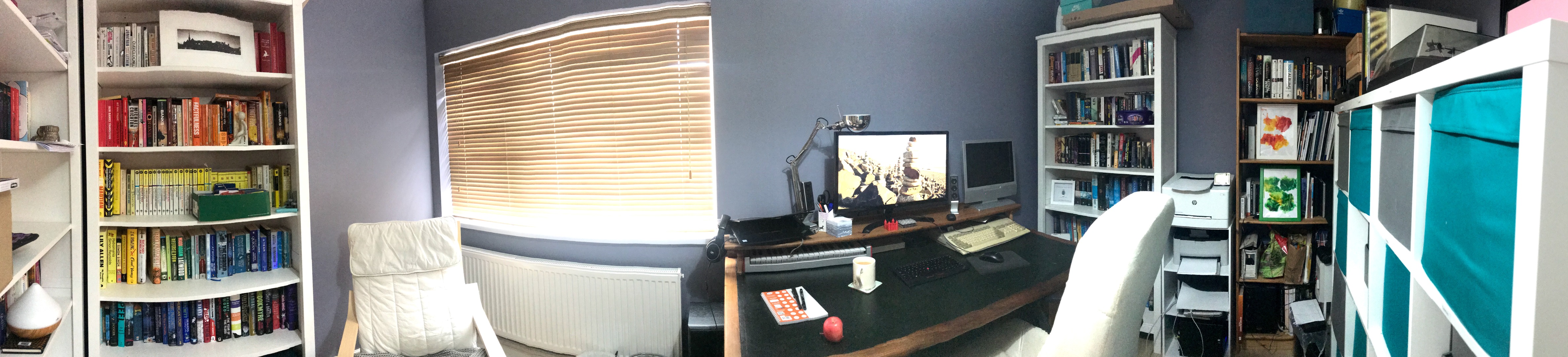
Fisheye shot of my home office Fisheye shot of my home office
Near enough everything in the study is a work in progress. The KALLAX behind my desk is a recent addition (under duress) because we have nowhere else to put it. Sadly I can't see it going away any time soon. On the up-side, since Christmas I've had my record player and collection in and on top of it, so I can listen to records whilst working. The arm chair is a recent move from another room. It's a nice place to take some work calls, serving as a change of scene, and I hope to add a reading light sometime. The desk chair is some Ikea model I can't recall, which is sufficient, and just fits into the desk cavity. (I'm fairly sure my Aeron, inaccessible elsewhere, would not fit.) I've had this old mahogany, leather-topped desk since I was a teenager and it's a blessing and a curse. Mostly a blessing: It's a lovely big desk. The main drawback is it's very much not height adjustable. At the back is a custom made, full-width monitor stand/shelf, a recent gift produced to specification by my Dad, a retired carpenter. On the top: my work Thinkpad T470s laptop, geared more towards portable than powerful (my normal preference), although for the forseeable future it's going to remain in the exact same place; an Ikea desk lamp (I can't recall the model); a 27" 4K LG monitor, the cheapest such I could find when I bought it; an old LCD Analog TV, fantastic for vintage consoles and the like. Underneath: An Alesis Micron 2 octave analog-modelling synthesizer; various hubs and similar things; My Amiga 500. Like Evgeni, my normal keyboard is a ThinkPad Compact USB Keyboard with TrackPoint. I've been using different generations of these styles of keyboards for a long time now, initially because I loved the trackpoint pointer. I'm very curious about trying out mechanical keyboards, as I have very fond memories of my first IBM Model M buckled-spring keyboard, but I haven't dipped my toes into that money-trap just yet. The Thinkpad keyboard is rubber-dome, but it's a good one. Wedged between the right-hand bookcases are a stack of IT-related things: new printer; deprecated printer; old/spare/play laptops, docks and chargers; managed network switch; NAS.

Martin Michlmayr: ledger2beancount 2.3 released

I released version 2.3 of ledger2beancount, a ledger to beancount converter. There are three notable changes with this release:
  1. Performance has significantly improved. One large, real-world test case has gone from around 160 seconds to 33 seconds. A smaller test case has gone from 11 seconds to ~3.5 seconds.
  2. The documentation is available online now (via Read the Docs).
  3. The repository has moved to the beancount GitHub organization.
Here are the changes in 2.3: Thanks to Colin Dean for some feedback. Thanks to Stefano Zacchiroli for prompting me into investigating performance issues (and thanks to the developers of the Devel::NYTProf profiler). You can get ledger2beancount from GitHub

25 June 2020

Dirk Eddelbuettel: RcppSimdJson 0.0.6: New Upstream, New Features!

A very exciting RcppSimdJson release with the updated upstream simdjson release 0.4.0 as well as a first set of new JSON parsing functions just hit CRAN. RcppSimdJson wraps the fantastic and genuinely impressive simdjson library by Daniel Lemire and collaborators. Via very clever algorithmic engineering to obtain largely branch-free code, coupled with modern C++ and newer compiler instructions, it results in parsing gigabytes of JSON parsed per second which is quite mindboggling. The best-case performance is faster than CPU speed as use of parallel SIMD instructions and careful branch avoidance can lead to less than one cpu cycle use per byte parsed; see the video of the recent talk by Daniel Lemire at QCon (which was also voted best talk). The very recent 0.4.0 release further improves the already impressive speed. And this release brings a first set of actually user-facing functions thanks to Brendan which put in a series of PRs! The full NEWS entry follows.

Changes in version 0.0.6 (2020-06-25)
  • Created C++ integer-handling utilities for safe downcasting and integer return (Brendan in #16 closing #13).
  • New JSON functions .deserialize_json and .load_json (Brendan in #16, #17, #20, #21).
  • Upgrade Travis CI to 'bionic', extract package and version from DESCRIPTION (Dirk in #23).
  • Upgraded to simdjson 0.4.0 (Dirk in #25 closing #24).

Courtesy of CRANberries, there is also a diffstat report for this release. For questions, suggestions, or issues please use the issue tracker at the GitHub repo. If you like this or other open-source work I do, you can now sponsor me at GitHub. For the first year, GitHub will match your contributions.

This post by Dirk Eddelbuettel originated on his Thinking inside the box blog. Please report excessive re-aggregation in third-party for-profit settings.

24 June 2020

Ian Jackson: Renaming the primary git branch to "trunk"

I have been convinced by the arguments that it's not nice to keep using the word master for the default git branch. Regardless of the etymology (which is unclear), some people say they have negative associations for this word, Changing this upstream in git is complicated on a technical level and, sadly, contested. But git is flexible enough that I can make this change in my own repositories. Doing so is not even so difficult. So: Announcement I intend to rename master to trunk in all repositories owned by my personal hat. To avoid making things very complicated for myself I will just delete refs/heads/master when I make this change. So there may be a little disruption to downstreams. I intend make this change everywhere eventually. But rather than front-loading the effort, I'm going to do this to repositories as I come across them anyway. That will allow me to update all the docs references, any automation, etc., at a point when I have those things in mind anyway. Also, doing it this way will allow me to focus my effort on the most active projects, and avoids me committing to a sudden large pile of fiddly clerical work. But: if you have an interest in any repository in particular that you want updated, please let me know so I can prioritise it. Bikeshed Why "trunk"? "Main" has been suggested elswewhere, and it is often a good replacement for "master" (for example, we can talk very sensibly about a disk's Main Boot Record, MBR). But "main" isn't quite right for the VCS case; for example a "main" branch ought to have better quality than is typical for the primary development branch. Conversely, there is much precedent for "trunk". "Trunk" was used to refer to this concept by at least SVN, CVS, RCS and CSSC (and therefore probably SCCS) - at least in the documentation, although in some of these cases the command line API didn't have a name for it. So "trunk" it is. Aside: two other words - passlist, blocklist People are (finally!) starting to replace "blacklist" and "whitelist". Seriously, why has it taken everyone this long? I have been using "blocklist" and "passlist" for these concepts for some time. They are drop-in replacements. I have also heard "allowlist" and "denylist" suggested, but they are cumbersome and cacophonous. Also "allow" and "deny" seem to more strongly imply an access control function than merely "pass" and "block", and the usefulness of passlists and blocklists extends well beyond access control: protocol compatibility and ABI filtering are a couple of other use cases.

comment count unavailable comments

Raphaël Hertzog: Freexian s report about Debian Long Term Support, May 2020

A Debian LTS logo Like each month, here comes a report about the work of paid contributors to Debian LTS. Individual reports In May, 198 work hours have been dispatched among 14 paid contributors. Their reports are available: Evolution of the situation In May 2020 we had our second (virtual) contributors meeting on IRC, Logs and minutes are available online. Then we also moved our ToDo from the Debian wiki to the issue tracker on salsa.debian.org.
Sadly three contributors went inactive in May: Adrian Bunk, Anton Gladky and Dylan A ssi. And while there are currently still enough active contributors to shoulder the existing work, we like to use this opportunity that we are always looking for new contributors. Please mail Holger if you are interested.
Finally, we like to remind you for a last time, that the end of Jessie LTS is coming in less than a month!
In case you missed it (or missed to act), please read this post about keeping Debian 8 Jessie alive for longer than 5 years. If you expect to have Debian 8 servers/devices running after June 30th 2020, and would like to have security updates for them, please get in touch with Freexian. The security tracker currently lists 6 packages with a known CVE and the dla-needed.txt file has 30 packages needing an update. Thanks to our sponsors New sponsors are in bold. With the upcoming start of Jessie ELTS, we are welcoming a few new sponsors and others should join soon.

No comment Liked this article? Click here. My blog is Flattr-enabled.

Matthew Garrett: Making my doorbell work

I recently moved house, and the new building has a Doorbird to act as a doorbell and open the entrance gate for people. There's a documented local control API (no cloud dependency!) and a Home Assistant integration, so this seemed pretty straightforward.

Unfortunately not. The Doorbird is on separate network that's shared across the building, provided by Monkeybrains. We're also a Monkeybrains customer, so our network connection is plugged into the same router and antenna as the Doorbird one. And, as is common, there's port isolation between the networks in order to avoid leakage of information between customers. Rather perversely, we are the only people with an internet connection who are unable to ping my doorbell.

I spent most of the past few weeks digging myself out from under a pile of boxes, but we'd finally reached the point where spending some time figuring out a solution to this seemed reasonable. I spent a while playing with port forwarding, but that wasn't ideal - the only server I run is in the UK, and having packets round trip almost 11,000 miles so I could speak to something a few metres away seemed like a bad plan. Then I tried tethering an old Android device with a data-only SIM, which worked fine but only in one direction (I could see what the doorbell could see, but I couldn't get notifications that someone had pushed a button, which was kind of the point here).

So I went with the obvious solution - I added a wifi access point to the doorbell network, and my home automation machine now exists on two networks simultaneously (nmcli device modify wlan0 ipv4.never-default true is the magic for "ignore the gateway that the DHCP server gives you" if you want to avoid this), and I could now do link local service discovery to find the doorbell if it changed addresses after a power cut or anything. And then, like magic, everything worked - I got notifications from the doorbell when someone hit our button.

But knowing that an event occurred without actually doing something in response seems fairly unhelpful. I have a bunch of Chromecast targets around the house (a mixture of Google Home devices and Chromecast Audios), so just pushing a message to them seemed like the easiest approach. Home Assistant has a text to speech integration that can call out to various services to turn some text into a sample, and then push that to a media player on the local network. You can group multiple Chromecast audio sinks into a group that then presents as a separate device on the network, so I could then write an automation to push audio to the speaker group in response to the button being pressed.

That's nice, but it'd also be nice to do something in response. The Doorbird exposes API control of the gate latch, and Home Assistant exposes that as a switch. I'm using Home Assistant's Google Assistant integration to expose devices Home Assistant knows about to voice control. Which means when I get a house-wide notification that someone's at the door I can just ask Google to open the door for them.

So. Someone pushes the doorbell. That sends a signal to a machine that's bridged onto that network via an access point. That machine then sends a protobuf command to speakers on a separate network, asking them to stream a sample it's providing. Those speakers call back to that machine, grab the sample and play it. At this point, multiple speakers in the house say "Someone is at the door". I then say "Hey Google, activate the front gate" - the device I'm closest to picks this up and sends it to Google, where something turns my speech back into text. It then looks at my home structure data and realises that the "Front Gate" device is associated with my Home Assistant integration. It then calls out to the home automation machine that received the notification in the first place, asking it to trigger the front gate relay. That device calls out to the Doorbird and asks it to open the gate. And now I have functionality equivalent to a doorbell that completes a circuit and rings a bell inside my home, and a button inside my home that completes a circuit and opens the gate, except it involves two networks inside my building, callouts to the cloud, at least 7 devices inside my home that are running Linux and I really don't want to know how many computational cycles.

The future is wonderful.

(I work for Google. I do not work on any of the products described in this post. Please god do not ask me how to integrate your IoT into any of this)

comment count unavailable comments

22 June 2020

Dirk Eddelbuettel: #27: R and CRAN Binaries for Ubuntu

Welcome to the 27th post in the rationally regularized R revelations series, or R4 for short. This is a edited / updated version of yesterday s T^4 post #7 as it really fits the R4 series as well as it fits the T4 series. A new video in both our T^4 series of video lightning talks with tips, tricks, tools, and toys is also a video in the R^4 series as it revisits a topic previously covered in the latter: how to (more easily) get (binary) packages onto your Ubuntu system. In fact, we show it in three different ways.

The slides are here. This repo at GitHub support the series: use it to open issues for comments, criticism, suggestions, or feedback. Thanks to I aki Ucar who followed up on twitter with a Fedora version. We exchanged some more message, and concluded that complete comparison (from an empty Ubuntu or Fedora container) to a full system takes about the same time on either system. If you like this or other open-source work I do, you can now sponsor me at GitHub. For the first year, GitHub will match your contributions.

This post by Dirk Eddelbuettel originated on his Thinking inside the box blog. Please report excessive re-aggregation in third-party for-profit settings.

Evgeni Golov: mass-migrating modules inside an Ansible Collection

Im the Foreman project, we've been maintaining a collection of Ansible modules to manage Foreman installations since 2017. That is, 2 years before Ansible had the concept of collections at all. For that you had to set library (and later module_utils and doc_fragment_plugins) in ansible.cfg and effectively inject our modules, their helpers and documentation fragments into the main Ansible namespace. Not the cleanest solution, but it worked quiet well for us. When Ansible started introducing Collections, we quickly joined, as the idea of namespaced, easily distributable and usable content units was great and exactly matched what we had in mind. However, collections are only usable in Ansible 2.8, or actually 2.9 as 2.8 can consume them, but tooling around building and installing them is lacking. Because of that we've been keeping our modules usable outside of a collection. Until recently, when we decided it's time to move on, drop that compatibility (which costed a few headaches over the time) and release a shiny 1.0.0. One of the changes we wanted for 1.0.0 is renaming a few modules. Historically we had the module names prefixed with foreman_ and katello_, depending whether they were designed to work with Foreman (and plugins) or Katello (which is technically a Foreman plugin, but has a way more complicated deployment and currently can't be easily added to an existing Foreman setup). This made sense as long as we were injecting into the main Ansible namespace, but with collections the names be became theforemam.foreman.foreman_ <something> and while we all love Foreman, that was a bit too much. So we wanted to drop that prefix. And while at it, also change some other names (like ptable, which became partition_table) to be more readable. But how? There is no tooling that would rename all files accordingly, adjust examples and tests. Well, bash to the rescue! I'm usually not a big fan of bash scripts, but renaming files, searching and replacing strings? That perfectly fits! First of all we need a way map the old name to the new name. In most cases it's just "drop the prefix", for the others you can have some if/elif/fi:
prefixless_name=$(echo $ old_name   sed -E 's/^(foreman katello)_//')
if [[ $ old_name  == 'foreman_environment' ]]; then
  new_name='puppet_environment'
elif [[ $ old_name  == 'katello_sync' ]]; then
  new_name='repository_sync'
elif [[ $ old_name  == 'katello_upload' ]]; then
  new_name='content_upload'
elif [[ $ old_name  == 'foreman_ptable' ]]; then
  new_name='partition_table'
elif [[ $ old_name  == 'foreman_search_facts' ]]; then
  new_name='resource_info'
elif [[ $ old_name  == 'katello_manifest' ]]; then
  new_name='subscription_manifest'
elif [[ $ old_name  == 'foreman_model' ]]; then
  new_name='hardware_model'
else
  new_name=$ prefixless_name 
fi
That defined, we need to actually have a $ old_name . Well, that's a for loop over the modules, right?
for module in $ BASE /foreman_*py $ BASE /katello_*py; do
  old_name=$(basename $ module  .py)
   
done
While we're looping over files, let's rename them and all the files that are associated with the module:
# rename the module
git mv $ BASE /$ old_name .py $ BASE /$ new_name .py
# rename the tests and test fixtures
git mv $ TESTS /$ old_name .yml $ TESTS /$ new_name .yml
git mv tests/fixtures/apidoc/$ old_name .json tests/fixtures/apidoc/$ new_name .json
for testfile in $ TESTS /fixtures/$ old_name -*.yml; do
  git mv $ testfile  $(echo $ testfile   sed "s/$ old_name /$ new_name /")
done
Now comes the really tricky part: search and replace. Let's see where we need to replace first:
  1. in the module file
    1. module key of the DOCUMENTATION stanza (e.g. module: foreman_example)
    2. all examples (e.g. foreman_example: )
  2. in all test playbooks (e.g. foreman_example: )
  3. in pytest's conftest.py and other files related to test execution
  4. in documentation
sed -E -i "/^(\s+$ old_name  module):/ s/$ old_name /$ new_name /g" $ BASE /*.py
sed -E -i "/^(\s+$ old_name  module):/ s/$ old_name /$ new_name /g" tests/test_playbooks/tasks/*.yml tests/test_playbooks/*.yml
sed -E -i "/'$ old_name '/ s/$ old_name /$ new_name /" tests/conftest.py tests/test_crud.py
sed -E -i "/ $ old_name  / s/$ old_name /$ new_name /g' README.md docs/*.md
You've probably noticed I used $ BASE and $ TESTS and never defined them Lazy me. But here is the full script, defining the variables and looping over all the modules.
#!/bin/bash
BASE=plugins/modules
TESTS=tests/test_playbooks
RUNTIME=meta/runtime.yml
echo "plugin_routing:" > $ RUNTIME 
echo "  modules:" >> $ RUNTIME 
for module in $ BASE /foreman_*py $ BASE /katello_*py; do
  old_name=$(basename $ module  .py)
  prefixless_name=$(echo $ old_name   sed -E 's/^(foreman katello)_//')
  if [[ $ old_name  == 'foreman_environment' ]]; then
    new_name='puppet_environment'
  elif [[ $ old_name  == 'katello_sync' ]]; then
    new_name='repository_sync'
  elif [[ $ old_name  == 'katello_upload' ]]; then
    new_name='content_upload'
  elif [[ $ old_name  == 'foreman_ptable' ]]; then
    new_name='partition_table'
  elif [[ $ old_name  == 'foreman_search_facts' ]]; then
    new_name='resource_info'
  elif [[ $ old_name  == 'katello_manifest' ]]; then
    new_name='subscription_manifest'
  elif [[ $ old_name  == 'foreman_model' ]]; then
    new_name='hardware_model'
  else
    new_name=$ prefixless_name 
  fi
  echo "renaming $ old_name  to $ new_name "
  git mv $ BASE /$ old_name .py $ BASE /$ new_name .py
  git mv $ TESTS /$ old_name .yml $ TESTS /$ new_name .yml
  git mv tests/fixtures/apidoc/$ old_name .json tests/fixtures/apidoc/$ new_name .json
  for testfile in $ TESTS /fixtures/$ old_name -*.yml; do
    git mv $ testfile  $(echo $ testfile   sed "s/$ old_name /$ new_name /")
  done
  sed -E -i "/^(\s+$ old_name  module):/ s/$ old_name /$ new_name /g" $ BASE /*.py
  sed -E -i "/^(\s+$ old_name  module):/ s/$ old_name /$ new_name /g" tests/test_playbooks/tasks/*.yml tests/test_playbooks/*.yml
  sed -E -i "/'$ old_name '/ s/$ old_name /$ new_name /" tests/conftest.py tests/test_crud.py
  sed -E -i "/ $ old_name  / s/$ old_name /$ new_name /g' README.md docs/*.md
  echo "    $ old_name :" >> $ RUNTIME 
  echo "      redirect: $ new_name " >> $ RUNTIME 
  git commit -m "rename $ old_name  to $ new_name " $ BASE  tests/ README.md docs/ $ RUNTIME 
done
As a bonus, the script will also generate a meta/runtime.yml which can be used by Ansible 2.10+ to automatically use the new module names if the playbook contains the old ones. Oh, and yes, this is probably not the nicest script you'll read this year. Maybe not even today. But it got the job nicely done and I don't intend to need it again anyways.

Junichi Uekawa: The situation is getting better in some ways because we are opening up in Tokyo.

The situation is getting better in some ways because we are opening up in Tokyo. However fear remains the same. The fear of going out vs the business as usual. I'm spending more time on home network than ever before and I am learning about ipv6 more than before. I can probably explain MAP-E or dslite to you like I never could before.

21 June 2020

Dirk Eddelbuettel: T^4 #7 and R^4 #5: R and CRAN Binaries for Ubuntu

A new video in both our T^4 series of video lightning talks with tips, tricks, tools, and toys is also a video in the R^4 series as it revisits a topic previously covered in the latter: how to (more easily) get (binary) packages onto your Ubuntu system. In fact, we show it in three different ways.

The slides are here. This repo at GitHub support the series: use it to open issues for comments, criticism, suggestions, or feedback. If you like this or other open-source work I do, you can now sponsor me at GitHub. For the first year, GitHub will match your contributions.

This post by Dirk Eddelbuettel originated on his Thinking inside the box blog. Please report excessive re-aggregation in third-party for-profit settings.

Daniel Lange: Upgrading Limesurvey with (near) zero downtime

Limesurvey is an online survey tool. It is very powerful and commonly used in academic environments because it is Free Software (GPLv2+), allows for local installations protecting the data of participants and allowing to comply with data protection regulations. This also means there are typically no load-balanced multi-server szenarios with HA databases. But simple VMs where Limesurvey runs and needs upgrading in place. There's an LTS branch (currently 3.x) and a stable branch (currently 4.x). There's also a 2.06 LTS branch that is restricted to paying customers. The main developers behind Limesurvey offer many services from template design to custom development to support to hosting ("Cloud", "Limesurvey Pro"). Unfortunately they also charge for easy updates called "ComfortUpdate" (currently 39 for three months) and the manual process is made a bit cumbersome to make the "ComfortUpdate" offer more attractive. Due to Limesurvey being an old code base and UI elements not being clearly separated, most serious use cases will end up patching files and symlinking logos around template directories. That conflicts a bit with the opaque "ComfortUpdate" process where you push a button and then magic happens. Or you have downtime and a recovery case while surveys are running. If you do not intend to use the "ComfortUpdate" offering, you can prevent Limesurvey from connecting to http://comfortupdate.limesurvey.org daily by adding the updatable stanza as in line 14 to limesurvey/application/config/config.php:
  1. return array(
  2. [...]
  3. // Use the following config variable to set modified optional settings copied from config-defaults.php
  4. 'config'=>array(
  5. // debug: Set this to 1 if you are looking for errors. If you still get no errors after enabling this
  6. // then please check your error-logs - either in your hosting provider admin panel or in some /logs directory
  7. // on your webspace.
  8. // LimeSurvey developers: Set this to 2 to additionally display STRICT PHP error messages and get full access to standard templates
  9. 'debug'=>0,
  10. 'debugsql'=>0, // Set this to 1 to enanble sql logging, only active when debug = 2
  11. // Mysql database engine (INNODB MYISAM):
  12. 'mysqlEngine' => 'MYISAM'
  13. , // Update default LimeSurvey config here
  14. 'updatable' => false,
  15. )
  16. );
The comma on line 13 is placed like that in the current default limesurvey config.php, don't let yourself get confused. Every item in a php array must end with a comma. It can be on the next line. The basic principle of low risk, near-zero downtime, in-place upgrades is:
  1. Create a diff between the current release and the target release
  2. Inspect the diff
  3. Make backups of the application webroot
  4. Patch a copy of the application in-place
  5. (optional) stop the web server
  6. Make a backup of the production database
  7. Move the patched application to the production webroot
  8. (if 5) Start the webserver
  9. Upgrade the database (if needed)
  10. Check the application
So, in detail: Continue reading "Upgrading Limesurvey with (near) zero downtime"

Dirk Eddelbuettel: RcppGSL 0.3.8: More fixes and polish

Release 0.3.8 of RcppGSL is now getting onto CRAN. The RcppGSL package provides an interface from R to the GNU GSL using the Rcpp package. Peter Carbonetto let us know in issue #25 that the included example now showed linker errors on (everybody s favourite CRAN platform) Slowlaris. Kidding aside, the added compiler variety really has benefits because we were indeed missing a good handful or two of inline statements in the headers which our good friends g++ and clang++ apparently let us get away with. This has been fixed, and a little bit of the usual package polish and cleanup has been added; see the list of detailed changes below.

Changes in version 0.3.8 (2020-06-21)
  • A few missing inline statements were added to the headers fixing a (genuine) error that was seen only on Solaris (Dirk).
  • The nice colNorm example is now in a file by itself, the previous versions are off in a new file colNorm_old.cpp (Dirk).
  • The README.me now sports two new badges (Dirk).
  • Travis CI was updated to 'bionic' and R 4.0 (Dirk).

Special thanks also to CRAN for a super-smooth and fully automated processing of a package with both compiled code and two handful of reverse dependencies. Courtesy of CRANberries, a summary of changes to the most recent release is also available. More information is on the RcppGSL page. Questions, comments etc should go to the issue tickets at the GitHub repo. If you like this or other open-source work I do, you can now sponsor me at GitHub. For the first year, GitHub will match your contributions.

This post by Dirk Eddelbuettel originated on his Thinking inside the box blog. Please report excessive re-aggregation in third-party for-profit settings.

19 June 2020

Russell Coker: Storage Trends

In considering storage trends for the consumer side I m looking at the current prices from MSY (where I usually buy computer parts). I know that other stores will have slightly different prices but they should be very similar as they all have low margins and wholesale prices are the main factor. Small Hard Drives Aren t Viable The cheapest hard drive that MSY sells is $68 for 500G of storage. The cheapest SSD is $49 for 120G and the second cheapest is $59 for 240G. SSD is cheaper at the low end and significantly faster. If someone needed about 500G of storage there s a 480G SSD for $97 which costs $29 more than a hard drive. With a modern PC if you have no hard drives you will notice that it s quieter. For anyone who s buying a new PC spending an extra $29 is definitely worthwhile for the performance, low power use, and silence. The cheapest 1TB disk is $69 and the cheapest 1TB SSD is $159. Saving $90 on the cost of a new PC probably isn t worth while. For 2TB of storage the cheapest options are Samsung NVMe for $339, Crucial SSD for $335, or a hard drive for $95. Some people would choose to save $244 by getting a hard drive instead of NVMe, but if you are getting a whole system then allocating $244 to NVMe instead of a faster CPU would probably give more benefits overall. Computer stores typically have small margins and computer parts tend to quickly either become cheaper or be obsoleted by better parts. So stores don t want to stock parts unless they will sell quickly. Disks smaller than 2TB probably aren t going to be profitable for stores for very long. The trend of SSD and NVMe becoming cheaper is going to make 2TB disks non-viable in the near future. NVMe vs SSD M.2 NVMe devices are at comparable prices to SATA SSDs. For some combinations of quality and capacity NVMe is about 50% more expensive and for some it s slightly cheaper (EG Intel 1TB NVMe being cheaper than Samsung EVO 1TB SSD). Last time I checked about half the motherboards on sale had a single M.2 socket so for a new workstation that doesn t need more than 2TB of storage (the largest NVMe that MSY sells) it wouldn t make sense to use anything other than NVMe. The benefit of NVMe is NOT throughput (even though NVMe devices can often sustain over 4GB/s), it s low latency. Workstations can t properly take advantage of this because RAM is so cheap ($198 for 32G of DDR4) that compiles etc mostly come from cache and because most filesystem writes on workstations aren t synchronous. For servers a large portion of writes are synchronous, for example a mail server can t acknowledge receiving mail until it knows that it s really on disk, so there s a lot of small writes that block server processes and the low latency of NVMe really improves performance. If you are doing a big compile on a workstation (the most common workstation task that uses a lot of disk IO) then the writes aren t synchronised to disk and if the system crashes you will just do all the compilation again. While NVMe doesn t give a lot of benefit over SSD for workstation use (I ve uses laptops with SSD and NVMe and not noticed a great difference) of course I still want better performance. ;) Last time I checked I couldn t easily buy a PCIe card that supported 2*NVMe cards, I m sure they are available somewhere but it would take longer to get and probably cost significantly more than twice as much. That means a RAID-1 of NVMe takes 2 PCIe slots if you don t have an M.2 socket on the motherboard. This was OK when I installed 2*NVMe devices on a server that had 18 disks and lots of spare PCIe slots. But for some systems PCIe slots are an issue. My home server has all PCIe slots used by a video card and Ethernet cards and the BIOS probably won t support booting from NVMe. It s a Dell server so I can t just replace the motherboard with one that has more PCIe slots and M.2 on the motherboard. As it s running nicely and doesn t need replacing any time soon I won t be using NVMe for home server stuff. Small Servers Most servers that I am responsible for have less than 2TB of storage. For my clients I now only recommend SSD storage for small servers and am recommending SSD for replacing any failed disks. My home server has 2*500G SSDs in a BTRFS RAID-1 for the root filesystem, and 3*4TB disks in a BTRFS RAID-1 for storing big files. I bought the SSDs when 500G SSDs were about $250 each and bought 2*4TB disks when they were about $350 each. Currently that server has about 3.3TB of space used and I could probably get it down to about 2.5TB if I deleted things I don t really need. If I was getting storage for that server now I d use 2*2TB SSDs and 3*1TB hard drives for the stuff that doesn t fit on SSDs (I have some spare 1TB disks that came with servers). If I didn t have spare hard drives I d get 3*2TB SSDs for that sort of server which would give 3TB of BTRFS RAID-1 storage. Last time I checked Dell servers had a card for supporting M.2 as an optional extra so Dells probably won t boot from NVMe without extra expense. Ars Technica has an informative article about WD selling SMR disks as NAS disks [1]. The Shingled Magnetic Recording technology allows greater storage density on a platter which leads to either larger capacity or cheaper disks but at the cost of lower write performance and apparently extremely bad latency in some situations. NAS disks are supposed to be low latency as the expectation is that they will be used in a RAID array and kicked out of the array if they have problems. There are reports of ZFS kicking SMR disks from RAID sets. I think this will end the use of hard drives for small servers. For a server you don t want to deal with this sort of thing, by definition when a server goes down multiple people will stop work (small server implies no clustering). Spending extra to get SSDs just to avoid the risk of unexpected SMR would be a good plan. Medium Servers The largest SSD and NVMe devices that are readily available are 2TB but 10TB disks are commodity items, there are reports of 20TB hard drives being available but I can t find anyone in Australia selling them. If you need to store dozens or hundreds of terabytes than hard drives have to be part of the mix at this time. There s no technical reason why SSDs larger than 10TB can t be made (the 2.5 SATA form factor has more than 5* the volume of a 2TB M.2 card) and it s likely that someone sells them outside the channels I buy from, but probably at a price higher than what my clients are willing to pay. If you want 100TB of affordable storage then a mid range server like the Dell PowerEdge T640 which can have up to 18*3.5 disks is good. One of my clients has a PowerEdge T630 with 18*3.5 disks in the 8TB-10TB range (we replace failed disks with the largest new commodity disks available, it used to have 6TB disks). ZFS version 0.8 introduced a Special VDEV Class which stores metadata and possibly small data blocks on faster media. So you could have some RAID-Z groups on hard drives for large storage and the metadata on a RAID-1 on NVMe for fast performance. For medium size arrays on hard drives having a find / operation take hours is not uncommon, for large arrays having it take days isn t that uncommon. So far it seems that ZFS is the only filesystem to have taken the obvious step of storing metadata on SSD/NVMe while bulk data is on cheap large disks. One problem with large arrays is that the vibration of disks can affect the performance and reliability of nearby disks. The ZFS server I run with 18 disks was originally setup with disks from smaller servers that never had ZFS checksum errors, but when disks from 2 small servers were put in one medium size server they started getting checksum errors presumably due to vibration. This alone is a sufficient reason for paying a premium for SSD storage. Currently the cost of 2TB of SSD or NVMe is between the prices of 6TB and 8TB hard drives, and the ratio of price/capacity for SSD and NVMe is improving dramatically while the increase in hard drive capacity is slow. 4TB SSDs are available for $895 compared to a 10TB hard drive for $549, so it s 4* more expensive on a price per TB. This is probably good for Windows systems, but for Linux systems where ZFS and special VDEVs is an option it s probably not worth considering. Most Linux user cases where 4TB SSDs would work well would be better served by smaller NVMe and 10TB disks running ZFS. I don t think that 4TB SSDs are at all popular at the moment (MSY doesn t stock them), but prices will come down and they will become common soon enough. Probably by the end of the year SSDs will halve in price and no hard drives less than 4TB will be viable. For rack mounted servers 2.5 disks have been popular for a long time. It s common for vendors to offer 2 versions of a rack mount server for 2.5 and 3.5 disks where the 2.5 version takes twice as many disks. If the issue is total storage in a server 4TB SSDs can give the same capacity as 8TB HDDs. SMR vs Regular Hard Drives Rumour has it that you can buy 20TB SMR disks, I haven t been able to find a reference to anyone who s selling them in Australia (please comment if you know who sells them and especially if you know the price). I expect that the ZFS developers will soon develop a work-around to solve the problems with SMR disks. Then arrays of 20TB SMR disks with NVMe for special VDEVs will be an interesting possibility for storage. I expect that SMR disks will be the majority of the hard drive market by 2023 if hard drives are still on the market. SSDs will be large enough and cheap enough that only SMR disks will offer enough capacity to be worth using. I think that it is a possibility that hard drives won t be manufactured in a few years. The volume of a 3.5 disk is significantly greater than that of 10 M.2 devices so current technology obviously allows 20TB of NVMe or SSD storage in the space of a 3.5 disk. If the price of 16TB NVMe and SSD devices comes down enough (to perhaps 3* the price of a 20TB hard drive) almost no-one would want the hard drive and it wouldn t be viable to manufacture them. It s not impossible that in a few years time 3D XPoint and similar fast NVM technologies occupy the first level of storage (the ZFS special VDEV , OS swap device, log device for database servers, etc) and NVMe occupies the level for bulk storage with no space left in the market for spinning media. Computer Cases For servers I expect that models supporting 3.5 storage devices will disappear. A 1RU server with 8*2.5 storage devices or a 2RU server with 16*2.5 storage devices will probably be of use to more people than a 1RU server with 4*3.5 or a 2RU server with 8*3.5 . My first IBM PC compatible system had a 5.25 hard drive, a 5.25 floppy drive, and a 3.5 floppy drive in 1988. My current PC is almost a similar size and has a DVD drive (that I almost never use) 5 other 5.25 drive bays that have never been used, and 5*3.5 drive bays that I have never used (I have only used 2.5 SSDs). It would make more sense to have PC cases designed around 2.5 and maybe 3.5 drives with no more than one 5.25 drive bay. The Intel NUC SFF PCs are going in the right direction. Many of them only have a single storage device but some of them have 2*M.2 sockets allowing RAID-1 of NVMe and some of them support ECC RAM so they could be used as small servers. A USB DVD drive costs $36, it doesn t make sense to have every PC designed around the size of an internal DVD drive that will probably only be used to install the OS when a $36 USB DVD drive can be used for every PC you own. The only reason I don t have a NUC for my personal workstation is that I get my workstations from e-waste. If I was going to pay for a PC then a NUC is the sort of thing I d pay to have on my desk.

18 June 2020

Gunnar Wolf: On masters and slaves, whitelists and blacklists...

LWN published today yet another great piece of writing, Loaded terms in free software. I am sorry, the content will not be immediately available to anybody following at home, as LWN is based on a subscription model But a week from now, the article will be open for anybody to read. Or you can ask me (you most likely can find my contact addresses, as they are basically everywhere) for a subscriber link, I will happily provide it. In consonance with the current mood that started with the killing of George Floyd and sparked worldwide revolts against police brutality, racism (mostly related to police and law enforcement forces, but social as well) and the like, the debate that already started some months ago in technical communities has re-sparked: We have many terms that come with long histories attached to them, and we are usually oblivious to their obvious meaning. We? Yes, we, the main users and creators of technology. I never felt using master and slave to refer to different points of a protocol, bus, clock or whatever (do refer to the Wikipedia article for a fuller explanation) had any negative connotations but then again, those terms have never tainted my personal family. That is, I understand I speak from a position of privilege. A similar although less heated issue goes around the blacklist and whitelist terms, or other uses that use white to refer to good, law-abiding citizens, and black to refer to somewhat antisocial uses (i.e. the white hat and black hat hackers). For several years, this debate has been sparking and dying off. Some important changes have been made Particularly, in 2017 the Internet Software Consortium started recommending Primary and Secondary, Python dropped master/slave pairs after a quite thorough and deep review throughout 2018, GitHub changed the default branch from master to main earlier this week. The Internet Engineering Task Force has a draft (that lapsed and thus sadly didn t become an RFC, but still, is archived), Terminology, Power and Oppressive Language that lists suggested alternatives:
There are also many other relationships that can be used as metaphors, Eglash s research calls into question the accuracy of the master-slave metaphor. Fortunately, there are ample alternatives for the master-slave relationship. Several options are suggested here and should be chosen based on the pairing that is most clear in context:
  • Primary-secondary
  • Leader-follower
  • Active-standby
  • Primary-replica
  • Writer-reader
  • Coordinator-worker
  • Parent-helper
I ll add that I think we Spanish-speakers are not fully aware of the issue s importance, because the most common translation I have seen for master/slave is maestro/esclavo: Maestro is the word for teacher (although we do keep our slaves in place). But think whether it sounds any worse if you refer to device pairs, or members of a database high-availability cluster, or whatever as Amo and Esclavo. It does sound much worse I cannot add much of value to this debate. I am just happy issues like this are being recognized and dealt with. If the topic interests you, do refer to the LWN article! Some excrepts: I consider the following to be the core of Jonathan Corbet s writeup:
Recent events, though, have made it clear even to those of us who were happy to not question this view that the story of slavery and the wider racist systems around it is not yet finished. There are many people who are still living in the middle of it, and it is not a nice place to be. We are not so enlightened as we like to think we are. If there is no other lesson from the events of the last few weeks, we should certainly take to heart the point that we need to be listening to the people who have been saying, for many years, that they are still suffering. If there are people who are telling us that terms like slave or blacklist are a hurtful reminder of the inequities that persist in our society, we need to accept that as the truth and act upon it. Etymological discussions on what, say, master really means may be interesting, but they miss the point and are irrelevant to this discussion.
Part of a comment by user yokem_55:
Often, it seems to me that the replacement words are much more descriptive and precise than the old language. Allowlist is far more obviously a list of explicitly authorized entities than whitelist . Mainline has a more obvious meaning of a core stream of development than master . The benefit of moving past this language is more than just changing cultural norms, it s better, more precise communication across the board.
Another spot-on comment, by user alan:
From my perspective as a Black American male, I think that it s nice to see people willing to see and address racism in various spheres. I am concerned that some of these steps will be more performative than substantial. Terminology changes in software so as to be more welcoming is a nice thing. Ensuring that oppressed minorities have access to the tools and resources to help reduce inequity and ensuring equal protection under the laws is better. We ll get there one day I m sure. The current ask is much simpler, its just to stop randomly killing and terrorizing us. Please and thank you.
So Maybe the protests of this year caught special notoriety because the society is reacting after (or during, for many of us) the lockdown. In any case, I hope for their success in changing the planet s culture of oppression.

Comments Tomas Janousek 2020-06-19 10:04:32 +0200 In the blog post On masters and slaves, whitelists and blacklists you claim that GitHub changed the default branch from master to main earlier this week but I don t think that change is in effect yet. When you create a repo, the default branch is still named master . Gunnar Wolf 2020-06-19 11:52:30 -0500 Umh, seems you are right. Well, what can I say? I m reporting only what I have been able to find / read Now, given that said master branch does not carry any Git-specific meaning and is just a commonly used configuration I hope people start picking it up. No, I have not renamed master branches in any of my repos but intend to do so soonish. Tomas Janousek 2020-06-19 20:01:52 +0200 Yeah, don t worry. I just find it sad that so much inaccurate news is spreading from a single CEO tweet, and I wanted to help stop that. I m sure some change will happen eventually, but until it does, we shouldn t speak about it in the past tense. :-)

17 June 2020

Ulrike Uhlig: On Language

Language is a tool of power In school, we read the philologist diary of Victor Klemperer about the changes in the German language during the Third Reich, LTI - Lingua Tertii Imperii, a book which makes it clear that the use of language is political, creates realities, and has reverse repercussions on concepts of an entire society. Language was one of the tools that supported Nazism in insiduously pervading all parts of society. Language shapes our concepts of society Around the same time, a friend of mine proposed to read Egalia's daughters by Gerd Brantenberg, a book in which gendered words were reversed: so that human becomes huwim, for example. This book made me take notice of gendered concepts that often go unnoticed. Language shapes the way we think and feel I spent a large part of my adult life in France, which confronted me with the realization that a language provides its speakers with certain concepts. If a concept does not exist in a language, people cannot easily feel or imagine this concept either. Back then (roughly 20 years ago), even though I was aware of gender inequality, I hated using gender neutral language because in German and French it felt unnatural, and, or so I thought, we were all alike. One day, at a party, we played a game that consisted in guessing people's professions by asking them Yes/No questions. Turns out that we were unable to guess that the woman we were talking with was a doctor, because we could simply not imagine this profession for a young woman. In French, docteur is male and almost nobody would use the word doctoresse, ou femme docteur. Unimaginable are also the concepts of words in German that have no equivalent in French or vice versa: Or, to make all this a bit less serious, Italian has the word gattara (female) or gattaro (male), which one could translate to English roughly as cat person, most often designating old women who feed stray cats. But really, the way language shapes our concepts and ideas goes much further, as well explained by Lera Boroditsky in a talk in which she explains how language influences concepts of space, time, and blame, among other things. Building new models This quote by Buckminster Fuller is pinned on the wall over my desk:

You never change things by fighting the existing reality. To change something, build a new model that makes the existing model obsolete.
A change in language is such a new model: it can make oppression and inequalities visible. Words do not only describe our world, they are a vehicle of ideas, and utopias. Analyzing and criticizing our use of language means paving the way for ideas and concepts of inclusion, equality, and unity. You might be guessing at where am I getting at with this Right: I am in favor of acknowledging past mistakes, and replacing oppressive metaphors in computing. As noted in the IETF draft about Terminology, Power and Oppressive Language, by Niels Ten Oever and Mallory Knodel, the metaphors "master/slave" and "blacklist/whitelist" associate "white with good and black with evil [which] is known as the 'bad is black effect'", all the while being technically inaccurate. I acknowledge that this will take time. There is a lot of work to do.

16 June 2020

Ritesh Raj Sarraf: Kodi PS3 BD Remote

Setting up a Sony PS3 Blu-Ray Disc Remote Controller with Kodi TLDR; Since most of the articles on the internet were either obsolete or broken, I ve chosen to write these notes down in the form of a blog post so that it helps me now and in future, and hopefully others too.

Raspberry Pi All this time, I have been using the Raspberry Pi for my HTPC needs. The first RPi I acquired was in 2014 and I have been very very happy with the amount of support in the community and quality of the HTPC offering it has. I also appreciate the RPi s form factor and the power consumption limits. And then, to add more sugar to it, it uses a derivative of Debian, Raspbian, which was very familiar and feel good to me.

Raspberry Pi Issues So primarily, I use my RPi with Kodi. There are a bunch of other (daemon) services but the primary use case is HTPC only. RPi + Kodi has a very very annoying issue wherein it loses its audio pitch during video playback. The loss is so bad that the audio is barely audible. The workaround is to seek the video playback either way and then it comes back to its actual audio level, just to fade again in a while. My suspicion was that it may be a problem with Kodi. Or at least, Kodi would have a workaround in software. But unfortunately, I wasted a lot of time in dealing with my suspicion with no fruitful result. This started becoming a PITA over time. And it seems the issue is with the hardware itself because after I moved my setup to a regular laptop, the audio loss is gone.

Laptop with Kodi Since I had my old Lenovo Yoga 2 13 lying on all the time, it made sense to make some more use of it, using as the HTPC. This machine comes with a Micro-HDMI Out port, so it felt ideal for my High Definition video rendering needs. It comes stock with just Intel HD Video with good driver support in Linux, so it was quite quick and easy getting Kodi charged up and running on it. And as I mentioned above, the sound issues are not seen on this setup. Some added benefits are that I get to run stock Debian on this machine. And I must say a big THANK YOU to the Debian Multimedia Maintainers, who ve done a pretty good job maintaining Kodi under Debian.

HDMI CEC Only after I decommissioned my RPi, I came to notice how convenient the HDMI CEC functionality is. Turns out no standard laptops ship CEC functionality onto them. Even the case of my laptop, which has a Micro HDMI Out port, but still no CEC capabilities. As far as I know, the RPi came with the Pulse-Eight CEC module, so obvious first thought was to opt for a compatible external module of the same; but it comes with a nice price tag, me not willing to spend.

WiFi Remotes Kodi has very well implemented network interface for almost all its features. One could take the Yatse or Music Pump Kodi Remote Android applications that work very very well with Kodi. But wifi can be flaky some times. Especially, my experience with the Realtek network devices hasn t been very good. The driver support in Linux is okay but there are many firmware bugs to deal with. In my case, the machine will lose wifi signal/network every once in a while. And it turns out, for this machine, with this network device type, I m not the only one running into such problems. And to add to that, this is an UltraBook, which means it doesn t have an Ethernet port. So I ve had not much choice other than to live and suffer deal with it. The WiFi chip also provides the Bluetooth module, which so far I had not used much. From my /etc/modprobe.d/blacklist-memstick.conf, all relevant BT modules were added to the blacklist, all this time.
rrs@lenovo:~$ cat /etc/modprobe.d/blacklist-memstick.conf 
blacklist memstick
blacklist rtsx_usb_ms
# And bluetooth too
#blacklist btusb
#blacklist btrtl
#blacklist btbcm
#blacklist btintel
#blacklist bluetooth
21:21            
Also to keep in mind is that the driver for my card gives a very misleading kernel message, which is one of the many reasons for this blog post, so that I don t forget it a couple of months later. The missing firmware error message is okay to ignore, as per this upstream comment.
Jun 14 17:17:08 lenovo kernel: usbcore: registered new interface driver btusb
Jun 14 17:17:08 lenovo systemd[1]: Mounted /boot/efi.
Jun 14 17:17:08 lenovo kernel: Bluetooth: hci0: RTL: examining hci_ver=06 hci_rev=000b lmp_ver=06 lmp_subver=8723
Jun 14 17:17:08 lenovo kernel: Bluetooth: hci0: RTL: rom_version status=0 version=1
Jun 14 17:17:08 lenovo kernel: Bluetooth: hci0: RTL: loading rtl_bt/rtl8723b_fw.bin
Jun 14 17:17:08 lenovo kernel: bluetooth hci0: firmware: direct-loading firmware rtl_bt/rtl8723b_fw.bin
Jun 14 17:17:08 lenovo kernel: Bluetooth: hci0: RTL: loading rtl_bt/rtl8723b_config.bin
Jun 14 17:17:08 lenovo kernel: bluetooth hci0: firmware: failed to load rtl_bt/rtl8723b_config.bin (-2)
Jun 14 17:17:08 lenovo kernel: firmware_class: See https://wiki.debian.org/Firmware for information about missing firmware
Jun 14 17:17:08 lenovo kernel: bluetooth hci0: Direct firmware load for rtl_bt/rtl8723b_config.bin failed with error -2
Jun 14 17:17:08 lenovo kernel: Bluetooth: hci0: RTL: cfg_sz -2, total sz 22496
This device s network + bt are on the same chip.
01:00.0 Network controller: Realtek Semiconductor Co., Ltd. RTL8723BE PCIe Wireless Network Adapter
And then, when the btusb module is initialed (along with the misleading driver message), you ll get the following in your USB device listing
Bus 002 Device 005: ID 0bda:b728 Realtek Semiconductor Corp. Bluetooth Radio

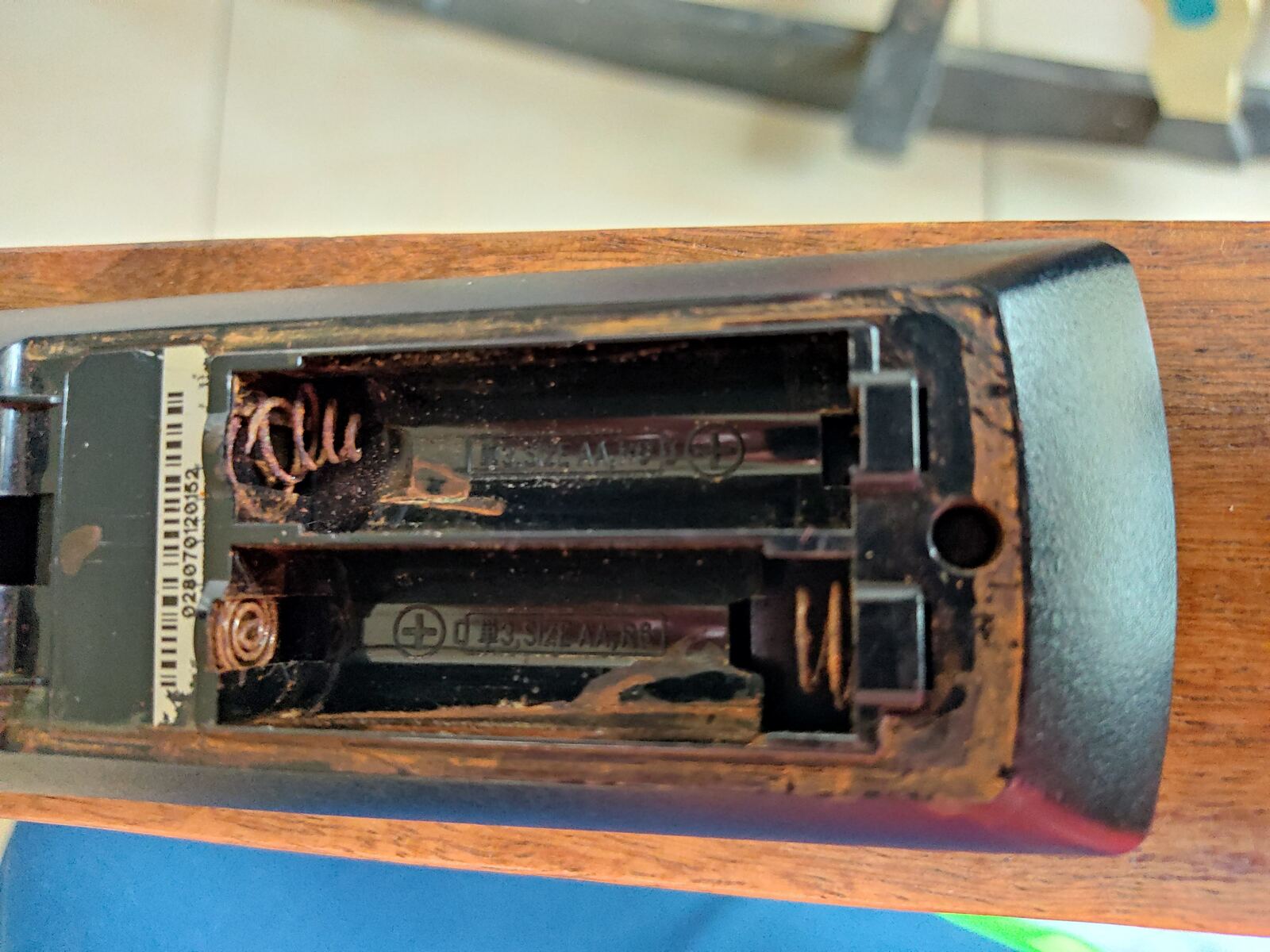
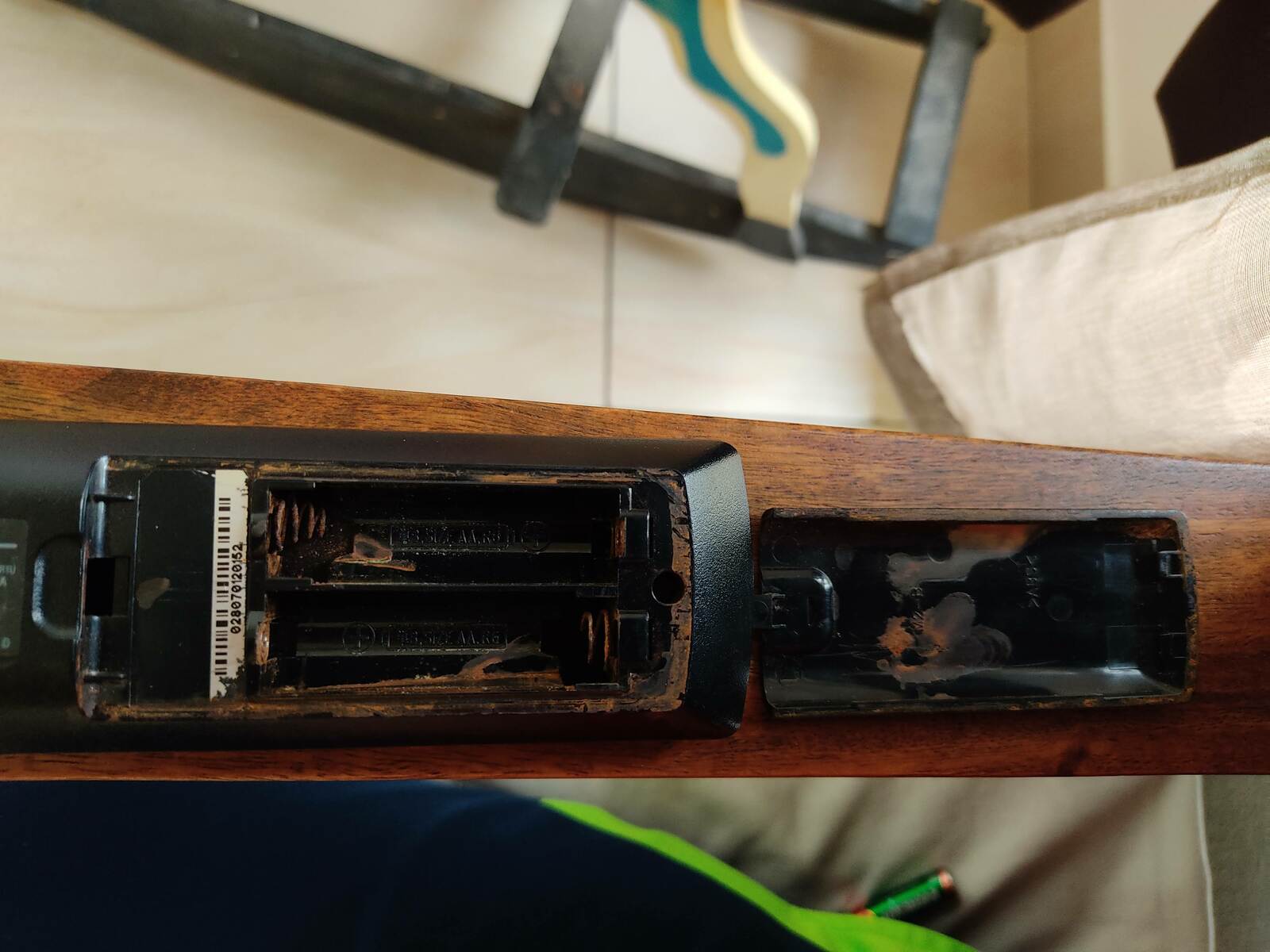
Sony PlayStation 3 BD Remote Almost 10 years ago, I bought the PS3 and many of its accessories. The remote has just been rotting in the shelf. It had rusted so bad that it is better described with these pics.
Rusted inside
Rusted inside
Rusted inside and cover
Rusted spring
Rusted spring
The rust was so much that the battery holding spring gave up. A little bit scrubbing and cleaning has gotten it working. I hope it lasts for some time before I find time to open it up and give it a full clean-up.

Pairing the BD Remote to laptop Honestly, with the condition of the hardware and software on both ends, I did not have much hopes of getting this to work. And in all the years on my computer usage, I hardly recollect much days when I ve made use of BT. Probably, because the full BT stack wasn t that well integrated in Linux, earlier. And I mostly used to disable them in hardware and software to save on battery. All yielded results from the internet talked about tools/scripts that were either not working, pointing to broken links etc. These days, bluez comes with a nice utility, bluetoothctl. It was a nice experience using it. First, start your bluetooth service and ensure that the device talks well with the kernel
rrs@lenovo:~$ systemctl status bluetooth                                                                                                          
  bluetooth.service - Bluetooth service                                                                                                           
     Loaded: loaded (/lib/systemd/system/bluetooth.service; enabled; vendor preset: enabled)                                                      
     Active: active (running) since Mon 2020-06-15 12:54:58 IST; 3s ago                                                                           
       Docs: man:bluetoothd(8)                                                                                                                    
   Main PID: 310197 (bluetoothd)                                                                                                                  
     Status: "Running"                                                                                                                            
      Tasks: 1 (limit: 9424)                                                                                                                      
     Memory: 1.3M                                                                                                                                 
     CGroup: /system.slice/bluetooth.service                                                                                                      
              310197 /usr/lib/bluetooth/bluetoothd                                                                                               
                                                                                                                                                  
Jun 15 12:54:58 lenovo systemd[1]: Starting Bluetooth service...                                                                                  
Jun 15 12:54:58 lenovo bluetoothd[310197]: Bluetooth daemon 5.50                                                                                  
Jun 15 12:54:58 lenovo systemd[1]: Started Bluetooth service.                                                                                     
Jun 15 12:54:58 lenovo bluetoothd[310197]: Starting SDP server                                                                                    
Jun 15 12:54:58 lenovo bluetoothd[310197]: Bluetooth management interface 1.15 initialized                                                        
Jun 15 12:54:58 lenovo bluetoothd[310197]: Sap driver initialization failed.                                                                      
Jun 15 12:54:58 lenovo bluetoothd[310197]: sap-server: Operation not permitted (1)                                                                
12:55                                                                                                                                       
Next, then is to discover and connect to your device
rrs@lenovo:~$ bluetoothctl 
Agent registered
[bluetooth]# devices
Device E6:3A:32:A4:31:8F MI Band 2
Device D4:B8:FF:43:AB:47 MI RC
Device 00:1E:3D:10:29:0F BD Remote Control
[CHG] Device 00:1E:3D:10:29:0F Connected: yes
[BD Remote Control]# info 00:1E:3D:10:29:0F
Device 00:1E:3D:10:29:0F (public)
        Name: BD Remote Control
        Alias: BD Remote Control
        Class: 0x0000250c
        Paired: no
        Trusted: yes
        Blocked: no
        Connected: yes
        LegacyPairing: no
        UUID: Human Interface Device... (00001124-0000-1000-8000-00805f9b34fb)
        UUID: PnP Information           (00001200-0000-1000-8000-00805f9b34fb)
        Modalias: usb:v054Cp0306d0100
[bluetooth]# 
In case of the Sony BD Remote, there s no need to pair. In fact, trying to pair fails. It prompts for the PIN code, but neither 0000 or 1234 are accepted. So, the working steps so far are to Trust the device and then Connect the device. For the sake of future use, I also populated /etc/bluetooth/input.conf based on suggestions on the internet. Note: The advertised keymappings in this config file do not work. Note: I m only using it for the power saving measures in instructing the BT connection to sleep after 3 minutes.
rrs@priyasi:/tmp$ cat input.conf 
# Configuration file for the input service
# This section contains options which are not specific to any
# particular interface
[General]
# Set idle timeout (in minutes) before the connection will
# be disconnect (defaults to 0 for no timeout)
IdleTimeout=3
# Enable HID protocol handling in userspace input profile
# Defaults to false (HIDP handled in HIDP kernel module)
#UserspaceHID=true
# Limit HID connections to bonded devices
# The HID Profile does not specify that devices must be bonded, however some
# platforms may want to make sure that input connections only come from bonded
# device connections. Several older mice have been known for not supporting
# pairing/encryption.
# Defaults to false to maximize device compatibility.
#ClassicBondedOnly=true
# LE upgrade security
# Enables upgrades of security automatically if required.
# Defaults to true to maximize device compatibility.
#LEAutoSecurity=true
#
#[00:1E:3D:10:29:0F]
[2c:33:7a:8e:d6:30]
[PS3 Remote Map]
# When the 'OverlayBuiltin' option is TRUE (the default), the keymap uses
# the built-in keymap as a starting point.  When FALSE, an empty keymap is
# the starting point.
#OverlayBuiltin = TRUE
#buttoncode = keypress    # Button label = action with default key mappings
#OverlayBuiltin = FALSE
0x16 = KEY_ESC            # EJECT = exit
0x64 = KEY_MINUS          # AUDIO = cycle audio tracks
0x65 = KEY_W              # ANGLE = cycle zoom mode
0x63 = KEY_T              # SUBTITLE = toggle subtitles
0x0f = KEY_DELETE         # CLEAR = delete key
0x28 = KEY_F8             # /TIME = toggle through sleep
0x00 = KEY_1              # NUM-1
0x01 = KEY_2              # NUM-2
0x02 = KEY_3              # NUM-3
0x03 = KEY_4              # NUM-4
0x04 = KEY_5              # NUM-5
0x05 = KEY_6              # NUM-6
0x06 = KEY_7              # NUM-7
0x07 = KEY_8              # NUM-8
0x08 = KEY_9              # NUM-9
0x09 = KEY_0              # NUM-0
0x81 = KEY_F2             # RED = red
0x82 = KEY_F3             # GREEN = green
0x80 = KEY_F4             # BLUE = blue
0x83 = KEY_F5             # YELLOW = yellow
0x70 = KEY_I              # DISPLAY = show information
0x1a = KEY_S              # TOP MENU = show guide
0x40 = KEY_M              # POP UP/MENU = menu
0x0e = KEY_ESC            # RETURN = back/escape/cancel
0x5c = KEY_R              # TRIANGLE/OPTIONS = cycle through recording options
0x5d = KEY_ESC            # CIRCLE/BACK = back/escape/cancel
0x5f = KEY_A              # SQUARE/VIEW = Adjust Playback timestretch
0x5e = KEY_ENTER          # CROSS = select
0x54 = KEY_UP             # UP = Up/Skip forward 10 minutes
0x56 = KEY_DOWN           # DOWN = Down/Skip back 10 minutes
0x57 = KEY_LEFT           # LEFT = Left/Skip back 5 seconds
0x55 = KEY_RIGHT          # RIGHT = Right/Skip forward 30 seconds
0x0b = KEY_ENTER          # ENTER = select
0x5a = KEY_F10            # L1 = volume down
0x58 = KEY_J              # L2 = decrease the play speed
0x51 = KEY_HOME           # L3 = commercial skip previous
0x5b = KEY_F11            # R1 = volume up
0x59 = KEY_U              # R2 = increase the play speed
0x52 = KEY_END            # R3 = commercial skip next
0x43 = KEY_F9             # PS button = mute
0x50 = KEY_M              # SELECT = menu (as per PS convention)
0x53 = KEY_ENTER          # START = select / Enter (matches terminology in mythwelcome)
0x30 = KEY_PAGEUP         # PREV = jump back (default 10 minutes)
0x76 = KEY_J              # INSTANT BACK (newer RCs only) = decrease the play speed
0x75 = KEY_U              # INSTANT FORWARD (newer RCs only) = increase the play speed
0x31 = KEY_PAGEDOWN       # NEXT = jump forward (default 10 minutes)
0x33 = KEY_COMMA          # SCAN BACK =  decrease scan forward speed / play
0x32 = KEY_P              # PLAY = play/pause
0x34 = KEY_DOT            # SCAN FORWARD decrease scan backard speed / increase playback speed; 3x, 5, 10, 20, 30, 60, 120, 180
0x60 = KEY_LEFT           # FRAMEBACK = Left/Skip back 5 seconds/rewind one frame
0x39 = KEY_P              # PAUSE = play/pause
0x38 = KEY_P              # STOP = play/pause
0x61 = KEY_RIGHT          # FRAMEFORWARD = Right/Skip forward 30 seconds/advance one frame
0xff = KEY_MAX
21:48                 
I have not spent much time finding out why not all the key presses work. Especially, given that most places on the internet mention these mappings. For me, some of the key scan codes aren t even reported. For keys like L1, L2, L3, R1, R2, R3, Next_Item, Prev_Item, they generate no codes in the kernel. If anyone has suggestions, ideas or fixes, I d appreciate if you can drop a comment or email me privately. But given my limited use to get a simple remote ready, to be usable with Kodi, I was apt with only some of the keys working.

Mapping the keys in Kodi With the limited number of keys detected, mapping those keys to what Kodi could use was the next step. Kodi has a very nice and easy to use module, Keymap Editor. It is very simple to use and map detected keys to functionalities you want. With it, I was able to get a functioning remote to use with my Kodi HTPC setup.

Update: Wed Jun 17 11:38:20 2020 One annoying problem that breaks the overall experience is the following bug on the driver side, that results in connections not being established instantly. Once the device goes into sleep mode, in random attempts, waking up and re-establishing a BT connection can be multi-poll affair. This can last from a couple of seconds to well over minute. Random suggestions on the internet mention disabling the autosuspend functionality for the device in the driver with btusb.enable_autosuspend=n, but that did not help in this case. Given that this device is enumberated over the USB Bus, it probably needs this feature applied to the whole USB tree of the device s chain. Something to investigate over the weekend.
Jun 16 20:41:23 lenovo kernel: Bluetooth: hci0: ACL packet for unknown connection handle 7
Jun 16 20:41:43 lenovo kernel: Bluetooth: hci0: ACL packet for unknown connection handle 8
Jun 16 20:41:59 lenovo kernel: Bluetooth: hci0: ACL packet for unknown connection handle 9
Jun 16 20:42:18 lenovo kernel: input: BD Remote Control as /devices/pci0000:00/0000:00:14.0/usb1/1-7/1-7:1.0/bluetooth/hci0/hci0:10/0005:054C:030>
Jun 16 20:42:18 lenovo kernel: sony 0005:054C:0306.0006: input,hidraw1: BLUETOOTH HID v1.00 Gamepad [BD Remote Control] on 2c:33:7a:8e:d6:30
Jun 16 20:51:59 lenovo kernel: input: BD Remote Control as /devices/pci0000:00/0000:00:14.0/usb1/1-7/1-7:1.0/bluetooth/hci0/hci0:11/0005:054C:030>
Jun 16 20:51:59 lenovo kernel: sony 0005:054C:0306.0007: input,hidraw1: BLUETOOTH HID v1.00 Gamepad [BD Remote Control] on 2c:33:7a:8e:d6:30
Jun 16 21:05:55 lenovo rtkit-daemon[1723]: Supervising 3 threads of 1 processes of 1 users.
Jun 16 21:05:55 lenovo rtkit-daemon[1723]: Successfully made thread 32747 of process 1646 owned by '1000' RT at priority 5.
Jun 16 21:05:55 lenovo rtkit-daemon[1723]: Supervising 4 threads of 1 processes of 1 users.
Jun 16 21:05:56 lenovo kernel: Bluetooth: hci0: ACL packet for unknown connection handle 12
Jun 16 21:06:12 lenovo kernel: Bluetooth: hci0: ACL packet for unknown connection handle 1
Jun 16 21:06:34 lenovo kernel: Bluetooth: hci0: ACL packet for unknown connection handle 2
Jun 16 21:06:59 lenovo kernel: input: BD Remote Control as /devices/pci0000:00/0000:00:14.0/usb1/1-7/1-7:1.0/bluetooth/hci0/hci0:3/0005:054C:0306>
Jun 16 21:06:59 lenovo kernel: sony 0005:054C:0306.0008: input,hidraw1: BLUETOOTH HID v1.00 Gamepad [BD Remote Control] on 2c:33:7a:8e:d6:30

Others There s a package, kodi-eventclients-ps3, which can be used to talk to the BD Remote. Unfortunately, it isn t up-to-date. When trying to make use of it, I ran into a couple of problems. First, the easy one is:
rrs@lenovo:~/ps3pair$ kodi-ps3remote localhost 9777
usr/share/pixmaps/kodi//bluetooth.png
Traceback (most recent call last):
  File "/usr/bin/kodi-ps3remote", line 220, in <module>
  File "/usr/bin/kodi-ps3remote", line 208, in main
    xbmc.connect(host, port)
    packet = PacketHELO(self.name, self.icon_type, self.icon_file)
  File "/usr/lib/python3/dist-packages/kodi/xbmcclient.py", line 285, in __init__
    with open(icon_file, 'rb') as f:
11:16         => 1  
This one was simple as it was just a broken path. The second issue with the tool is a leftover from python2 to python3 conversion.
rrs@lenovo:/etc/bluetooth$ kodi-ps3remote localhost
/usr/share/pixmaps/kodi//bluetooth.png
Searching for BD Remote Control
(Hold Start + Enter on remote to make it discoverable)
Redmi (E8:5A:8B:73:57:44) in range
Living Room TV (E4:DB:6D:24:23:E9) in range
Could not find BD Remote Control. Trying again...
Searching for BD Remote Control
(Hold Start + Enter on remote to make it discoverable)
Living Room TV (E4:DB:6D:24:23:E9) in range
Redmi (E8:5A:8B:73:57:44) in range
Could not find BD Remote Control. Trying again...
Searching for BD Remote Control
(Hold Start + Enter on remote to make it discoverable)
BD Remote Control (00:1E:3D:10:29:0F) in range
Found BD Remote Control with address 00:1E:3D:10:29:0F
Attempting to pair with remote
Remote Paired.
Traceback (most recent call last):
  File "/usr/bin/kodi-ps3remote", line 221, in <module>
    main()
  File "/usr/bin/kodi-ps3remote", line 212, in main
    if process_keys(remote, xbmc):
  File "/usr/bin/kodi-ps3remote", line 164, in process_keys
    keycode = data.encode("hex")[10:12]
AttributeError: 'bytes' object has no attribute 'encode'
11:24         => 1  
Fixing that too did not give me the desired result on using the BD Remote in the way I want. So eventually, I gave up and used Kodi s Keymap Editor instead.

Next Next in line, when I can manage to get some free time, is to improve the Kodi Video Scraper to have a fallback mode. Currently, for files where it cannot determine the content, it reject the file resulting in those files not showing up in your collection at all. A better approach would have been to have a fallback mode, that when the scraper cannot determine the content, it should fallback to using the filename scraper

Next.

Previous.