Search Results: freedom

20 November 2014

Daniel Pocock: Is Amnesty giving spy victims a false sense of security?

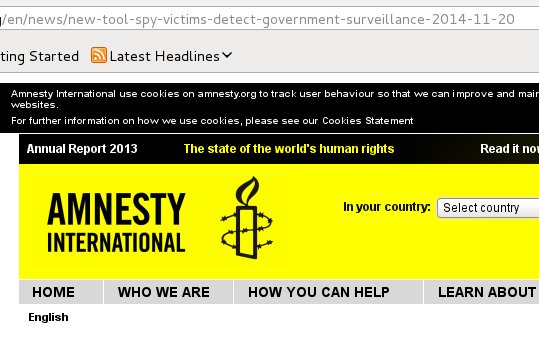
Amnesty International is getting a lot of attention with the launch of a new tool to detect government and corporate spying on your computer. I thought I would try it myself. I went to a computer running Microsoft Windows, an operating system that does not publish its source code for public scrutiny. I used the Chrome browser, users often express concern about Chrome sending data back to the vendor about the web sites the users look for. Without even installing the app, I would expect the Amnesty web site to recognise that I was accessing the site from a combination of proprietary software. Instead, I found a different type of warning. Beware of Amnesty? Instead, the only warning I received was from Amnesty's own cookies: Even before I install the app to find out if the government is monitoring me, Amnesty is keen to monitor my behaviour themselves. While cookies are used widely, their presence on a site like Amnesty's only further desensitizes Internet users to the downside risks of tracking technologies. By using cookies, Amnesty is effectivley saying a little bit of tracking is justified for the greater good. Doesn't that sound eerily like the justification we often hear from governments too? Is Amnesty part of the solution or part of the problem? Amnesty is a well known and widely respected name when human rights are mentioned. However, their advice that you can install an app onto a Windows computer or iPhone to detect spyware is like telling people that putting a seatbelt on a motorbike will eliminate the risk of death. It would be much more credible for Amnesty to tell people to start by avoiding cloud services altogether, browse the web with Tor and only use operating systems and software that come with fully published source code under a free license. Only when 100% of the software on your device is genuinely free and open source can independent experts exercise the freedom to study the code and detect and remove backdoors, spyware and security bugs. It reminds me of the advice Kim Kardashian gave after the Fappening, telling people they can continue trusting companies like Facebook and Apple with their private data just as long as they check the privacy settings (reality check: privacy settings in cloud services are about as effective as a band-aid on a broken leg). Write to Amnesty Amnesty became famous for their letter writing campaigns. Maybe now is the time for people to write to Amnesty themselves, thank them for their efforts and encourage them to take more comprehensive action. Feel free to cut and paste some of the following potential ideas into an email to Amnesty:

I understand you may not be able to respond to every email personally but I would like to ask you to make a statement about these matters on your public web site or blog. I understand it is Amnesty's core objective to end grave abuses of human rights. Electronic surveillence, due to its scale and pervasiveness, has become a grave abuse in itself and in a disturbing number of jurisdictions it is an enabler for other types of grave violations of human rights. I'm concerned that your new app Detekt gives people a false sense of security and that your campaign needs to be more comprehensive to truly help people and humanity in the long term. If Amnesty is serious about solving the problems of electronic surveillance by government, corporations and other bad actors, please consider some of the following:
  • Instead of displaying a cookie warning on Amnesty.org, display a warning to users who access the site from a computer running closed-source software and give them a link to download a free and open source web browser like Firefox.
  • Redirect all visitors to your web site to use the HTTPS encrypted version of the site.
  • Using free software such as the GNU/Linux operating system (using one of the Debian, Fedora or Ubuntu systems is one of the more common ways to achieve this) and LibreOffice for all Amnesty's own operations, making a public statement about your use of free software and mentioning this in the closing paragraph of all press releases relating to surveillance topics.
  • Encouraging Amnesty donors, members and supporters to choose similar software especially when engaging in any political activities.
  • Make a public statement that Amnesty will not use cloud services such as SalesForce or Facebook to store, manage or interact with data relating to members, donors or other supporters.
  • Encouraging the public to move away from centralized cloud services such as those provided by their smartphone or social networks and use de-centralized or federated services such as XMPP chat.
Given the immense threat posed by electronic surveillance, I'd also like to call on Amnesty to allocate at least 10% of annual revenue towards software projects releasing free and open source software that offers the public an alternative to the centralized cloud.

While publicity for electronic privacy is great, I hope Amnesty can go a step further and help people use trustworthy software from the ground up.


19 November 2014

Thorsten Glaser: Debian init system freedom of choice GR worst possible outcome

Apparently (the actual results have not yet been published by the Secretary), the GR is over, and the worst possible option has won. This is an absolutely ambiguous result, while at the same time sending a clear signal that Debian is not to be trusted wrt. investing anything into it, right now. Why is this? Simply: GR not required means that whatever people do is probably right . Besides this, we have one statement from the CTTE ( systemd is default init system for jessie. Period. ) and nothing else. This means that runit, or upstart, or file-rc, or uselessd, can be the default init system for zurg^H^H^H^Hstretch, or even the only one. It also means that the vast majority of Debian Developers are sheeple, neither clearly voting to preserve freedom of choice between init systems for its users, nor clearly voting to unambiguously support systemd and progress over compatibility and choice, nor clearly stating that systemd is important but supporting other init systems is still recommended. (I ll not go into detail on how the proposer of the apparently winning choice recommends others to ignore ftpmaster constraints and licences, and even suggests to run a GR to soften up the DFSG interpretation.) I d have voted this as no, absolutely not if it was possible to do so more strongly. Judging from the statistics, the only thing I voted above NOTA/FD is the one least accepted by DDs, although the only other proposal I considered is the first-rated of them: support for other init systems is recommended but not required. What made me vote it below NOTA/FD was: The Debian Project makes no statement at this time on sysvinit support beyond the jessie release. This sentence made even this proposal unbearable, unacceptable, for people wanting to invest (time, money, etc.) into Debian. Update: Formal result announced. So 358 out of 483 voting DDs decided to be sheeple (if I understand the eMail correctly). We had 1006 DDs with voting rights, which is a bit ashaming as well. That s 48.01% only. I wonder what s worse. This opens up a very hard problem: I m absolutely stunned by this and wondering what to do now. While there is no real alternative to Debian at $dayjob I can always create customised packages in my own APT repository, and while it was great when those were eventually (3.1.17-1) accepted into Debian, even replacing the previous packages completely it is simpler and quicker to not do so. While $dayjob benefits from having packages I work on inside Debian itself, even though I cannot always test all scenarios Debian users would need, some work reduction due to reactions already led to Debian losing out on Mediawiki for jessie and some additional suffering. With my own package repository, I can modulo installing/debootstrap serve my needs for $dayjob much quicker, easily, etc. and only miss out on absolutely delightful user feedback. But then, others could always package software I m upstream of for Debian. Or, if I do not leave the project, continue doing so via QA uploads. I m also disappointed because I have invested quite some effort into trying to make Debian better (my idea to join as DD was if I ve got to use it, it better be damn good! ), into packaging software and convincing people at work that developing software as Debian packages instead of (or not) thinking of packaging later was good. I ve converted our versions of FusionForge and d-push to Debian packages, and it works pretty damn well. Sometimes it needs backports of my own, but that s the corportate world, and no problem to an experienced DD. (I just feel bad we ($orkplace) lost some people, an FTP master along them, before this really gained traction.) I d convert to OpenBSD because, despite MirBSD s history with them, they re the only technically sound alternative, but apparently tedu (whom I respect technically, and who used to offer good advice to even me when asked, and who I think wouldn t choose systemd himself) still (allying with the systemd side (I m not against people being able to choose systemd, for the record, I just don t want to be forced into it myself!)) has some sort of grudge against me. Plus, it d be hard to get customers to follow. So, no alternative right now. But I m used to managing my own forks of software; I m doomed to basically hack and fix anything I use (I recently got someone who owns a licence to an old-enough Visual Studio version to transfer that to me, so I can hack on the Windows Mobile 6 version of Cachebox, to fix bugs in one of the geocaching applications I use. Now I just need to learn C# and the .NET Compact Framework. So I m also used to some amount of pain.) I m still unresolved wrt. the attitude I should show the Debian project now. I had decided to just continue to live on, and work on the things I need done, but that was before this GR non-result. I absolutely cannot recommend anyone to invest into Debian (without sounding hypocriet), but I cannot recommend anything else either. I cannot justify leaving but don t know if I want to stay. I think I should sleep over it. One thing I promised, and thus will do, is to organise a meeting of the Debian/m68k people soonish. But then, major and important and powerful forces inside Debian still insist that Debian-Ports are not part of it [Update: yes, DSA is moving it closer, thanks for that by the way, but that doesn t mean anything to certain maintainers or the Release Team, although, the latter is actually understandable and probably sensible.] yet, all forks of Debian now suffer from the systemd adoption in it instead of having a freedom-of-choice upstream. I ve said, and I still feel that systemd adoption should have done in a Debian downstream / (pure?) blend, and maybe (parts of) GNOME removed from Debian itself for it. (Adding cgroups support to the m68k kernel to support systemd was done. I adviced against it, on the grounds of memory and code size. But no downstream can remove it now.)

10 November 2014

Petter Reinholdtsen: A Debian package for SMTP via Tor (aka SMTorP) using exim4

The right to communicate with your friends and family in private, without anyone snooping, is a right every citicen have in a liberal democracy. But this right is under serious attack these days. A while back it occurred to me that one way to make the dragnet surveillance conducted by NSA, GCHQ, FRA and others (and confirmed by the whisleblower Snowden) more expensive for Internet email, is to deliver all email using SMTP via Tor. Such SMTP option would be a nice addition to the FreedomBox project if we could send email between FreedomBox machines without leaking metadata about the emails to the people peeking on the wire. I proposed this on the FreedomBox project mailing list in October and got a lot of useful feedback and suggestions. It also became obvious to me that this was not a novel idea, as the same idea was tested and documented by Johannes Berg as early as 2006, and both the Mailpile and the Cables systems propose a similar method / protocol to pass emails between users. To implement such system one need to set up a Tor hidden service providing the SMTP protocol on port 25, and use email addresses looking like username@hidden-service-name.onion. With such addresses the connections to port 25 on hidden-service-name.onion using Tor will go to the correct SMTP server. To do this, one need to configure the Tor daemon to provide the hidden service and the mail server to accept emails for this .onion domain. To learn more about Exim configuration in Debian and test the design provided by Johannes Berg in his FAQ, I set out yesterday to create a Debian package for making it trivial to set up such SMTP over Tor service based on Debian. Getting it to work were fairly easy, and the source code for the Debian package is available from github. I plan to move it into Debian if further testing prove this to be a useful approach. If you want to test this, set up a blank Debian machine without any mail system installed (or run apt-get purge exim4-config to get rid of exim4). Install tor, clone the git repository mentioned above, build the deb and install it on the machine. Next, run /usr/lib/exim4-smtorp/setup-exim-hidden-service and follow the instructions to get the service up and running. Restart tor and exim when it is done, and test mail delivery using swaks like this:
torsocks swaks --server dutlqrrmjhtfa3vp.onion \
  --to fbx@dutlqrrmjhtfa3vp.onion
This will test the SMTP delivery using tor. Replace the email address with your own address to test your server. :) The setup procedure is still to complex, and I hope it can be made easier and more automatic. Especially the tor setup need more work. Also, the package include a tor-smtp tool written in C, but its task should probably be rewritten in some script language to make the deb architecture independent. It would probably also make the code easier to review. The tor-smtp tool currently need to listen on a socket for exim to talk to it and is started using xinetd. It would be better if no daemon and no socket is needed. I suspect it is possible to get exim to run a command line tool for delivery instead of talking to a socket, and hope to figure out how in a future version of this system. Until I wipe my test machine, I can be reached using the fbx@dutlqrrmjhtfa3vp.onion mail address, deliverable over SMTorP. :)

John Goerzen: Debian A plea to worry about what matters, and not take ourselves too seriously

I posted this on debian-devel today. I am also posting it here, because I believe it is important to more than just Debian developers. Good afternoon, This message comes on the heels of Sam Hartman s wonderful plea for compassion [1] and the sad news of Joey Hess s resignation from Debian [2]. I no longer frequently post to this list, but when you ve been a Debian developer for 18 years, and still care deeply about the community and the project, perhaps you have a bit of perspective to share. Let me start with this: Debian is not a Free Software project. Debian is a making-the-world-better project, a caring for people project, a freedom-spreading project. Free Software is our tool. As many of you, hopefully all of you, I joined Debian because I enjoyed working on this project. We all did, didn t we? We joined Debian because it was fun, because we were passionate about it, because we wanted to make the world a better place and have fun doing it. In short, Debian is life-giving, both to its developers and its users. As volunteers, it is healthy to step back every so often, and ask ourselves two questions: 1) Is this activity still life-giving for me? 2) Is it life-giving for others? I have my opinions about init. Strong ones, in fact. [3] They re not terribly relevant to this post. Because I can see that they are not really all that relevant. 14 years ago, I proposed what was, until now anyhow, one of the most controversial GRs in Debian history. It didn t go the way I hoped. I cared about it deeply then, and still care about the principles. I had two choices: I could be angry and let that process ruin my enjoyment of Debian. Or I could let it pass, and continue to have fun working on a project that I love. I am glad I chose the latter. Remember, for today, one way or another, jessie will still boot. 18 years ago when I joined Debian, our major concerns were helping newbies figure out how to compile their kernels, finding manuals for monitors so we could set the X modelines properly, finding some sort of Free web browser, finding some acceptable Office-type software. Wow. We WON, didn t we? Not just Debian, but everyone. Freedom won. I promise you 18 years from now, it will not matter what init Debian chose in 2014. It will probably barely matter in 3 years. This is not key to our goals of making the world a better place. Jessie will still boot. I say that even though my system runs out of memory every few days because systemd-logind has a mysterious bug [4]. It will be fixed. I say that even though I don t know what init system it will use, or how much choice there will be. I say that because it is simply true. We are Debian. We will make it work, one way or another. I don t post much on this list anymore because my personal passion isn t with posting on this list anymore. I make liberal use of my Delete Thread keybinding on -vote these days, because although I care about the GR, I don t care about it enough to read all the messages about it. I have not yet decided if I will spend the time researching it in order to vote. Instead of debating the init GR, sometimes I sit on the sofa with my wife. Sometimes I go out and fly the remote-control airplane I m learning to fly. Sometimes I repair my plane after a flight that was shorter than planned. Sometimes I play games with my boys, or help them with homework, or share my 8-year-old s delight as a text file full of facts about the Titanic that he wrote in Emacs comes spitting out of the printer. Sometimes I write code or play with the latest Linux filesystems or build a new server for my basement. All these things matter more to me than init. I have been using Debian at home for almost 20 years, at various workplaces for almost that long, and it is not going to stop being a part of my life any time soon. Perhaps I will have to learn how to administer a new init system. Well, so be it; I enjoy learning new things. Or perhaps I will have to learn to live with some desktop limitations with an old init system. Well, so be it; it won t bother me much anyhow. Either way, I m still going to be using what is, to me, the best operating system in the world, made by one of the world s foremost Freedom projects. My hope is that all of you may also have the sense of peace I do, that you may have your strong convictions, but may put them all in perspective. That we as a project realize that the enemy isn t the lovers of the other init, but the people that would use law and technology to repress people all over the world. We are but one shining beacon on a hill, but the world will be worse off if our beacon winked out. My plea is that we each may get angry at what matters, and let go of the smaller frustrations in life; that we may each find something more important than init/systemd to derive enjoyment and meaning from. [5] May you each find that airplane to soar freely in the skies, to lift your soul so that the joy of using Free Software to make the world a better place may still be here, regardless of what /sbin/init is. [1] https://lists.debian.org/debian-project/2014/11/msg00002.html [2] https://lists.debian.org/debian-devel/2014/11/msg00174.html [3] A hint might be that in my more grumpy moments, I realize I haven t ever quite figured out why the heck this dbus thing is on so many of my systems, or why I have to edit XML to configure it ;-) [4] #765870 [5] No disrespect meant to the init/systemd maintainers. Keep enjoying what you do, too!

9 November 2014

Erich Schubert: GR vote on init coupling

Overregulation is bad, and the project is suffering from the recent Anti-Systemd hate campaigning.
There is nothing balanced about the original GR proposal. It is bullshit from a policy point of view (it means we must remove software from Debian that would not work with other inits, such as gnome-journal, by policy).At the same time, it uses manipulative language like "freedom to select a different init system" (as if this would otherwise be impossible) and "accidentally locked in". It is exactly this type of language and behavior which has made Debian quite poisonous the last months.
In fact, the GR pretty much says "I don't trust my fellow maintainers to do the right thing, therefore I want a new hammer to force my opinion on them". This is unacceptable in my opinion, and the GR will only demotivate contributors. Every Debian developer (I'm not talking about systemd upstream, but about Debian developers!) I've met would accept a patch that adds support for sysvinit to a package that currently doesn't. The proposed GR will not improve sysvinit support. It is a hammer to kick out software where upstream doesn't want to support sysvinit, but it won't magically add sysvinit support anywhere.
What some supporters of the GR may not have realized - it may as well backfire on them. Some packages that don't yet work with systemd would violate policy then, too... - in my opinion, it is much better to make the support on a "as good as possible, given available upstream support and patches" basis, instead of a "must" basis. The lock-in may come even faster if we make init system support mandatory: it may be more viable to drop software to satisfy the GR than to add support for other inits - and since systemd is the current default, software that doesn't support systemd are good candidates to be dropped, aren't they? (Note that I do prefer to keep them, and have a policy that allows keeping them ...)
For these reasons I voted:
  1. Choice 4: GR not required
  2. Choice 3: Let maintainers do their work
  3. Choice 2: Recommended, but not mandatory
  4. Choice 5: No decision
  5. Choice 1: Ban packages that don't work with every init system
Fact is that Debian maintainers have always been trying hard to allow people to choose their favorite software. Until you give me an example where the Debian maintainer (not upstream) has refused to include sysvinit support, I will continue to trust my fellow DDs. I've been considering to place Choice 2 below "further discussion", but essentially this is a no-op GR anyway - in my opinion "should support other init systems" is present in default Debian policy already anyway...
Say no to the haters.
And no, I'm not being unfair. One of the most verbose haters going by various pseudonyms such as Gregory Smith (on Linux Kernel Mailing list), Brad Townshend (LKML) and John Garret (LKML) has come forward with his original alias - it is indeed MikeeUSA, a notorious anti-feminist troll (see his various youtube "songs", some of them include this pseudonym). It's easy to verify yourself.
He has not contributed anything to the open source community. His songs and "games" are not worth looking at, and I'm not aware of any project that has accepted any of his "contributions". Yet, he uses several sock puppets to spread his hate.
The anti-systemd "crowd" (if it acually is more than a few notorious trolls) has lost all its credibility in my opinion. They spread false information, use false names, and focus on hate instead of improving source code. And worse, they tolerate such trolling in their ranks.

30 October 2014

Matthew Garrett: On joining the FSF board

I joined the board of directors of the Free Software Foundation a couple of weeks ago. I've been travelling a bunch since then, so haven't really had time to write about it. But since I'm currently waiting for a test job to finish, why not?

It's impossible to overstate how important free software is. A movement that began with a quest to work around a faulty printer is now our greatest defence against a world full of hostile actors. Without the ability to examine software, we can have no real faith that we haven't been put at risk by backdoors introduced through incompetence or malice. Without the freedom to modify software, we have no chance of updating it to deal with the new challenges that we face on a daily basis. Without the freedom to pass that modified software on to others, we are unable to help people who don't have the technical skills to protect themselves.

Free software isn't sufficient for building a trustworthy computing environment, one that not merely protects the user but respects the user. But it is necessary for that, and that's why I continue to evangelise on its behalf at every opportunity.

However.

Free software has a problem. It's natural to write software to satisfy our own needs, but in doing so we write software that doesn't provide as much benefit to people who have different needs. We need to listen to others, improve our knowledge of their requirements and ensure that they are in a position to benefit from the freedoms we espouse. And that means building diverse communities, communities that are inclusive regardless of people's race, gender, sexuality or economic background. Free software that ends up designed primarily to meet the needs of well-off white men is a failure. We do not improve the world by ignoring the majority of people in it. To do that, we need to listen to others. And to do that, we need to ensure that our community is accessible to everybody.

That's not the case right now. We are a community that is disproportionately male, disproportionately white, disproportionately rich. This is made strikingly obvious by looking at the composition of the FSF board, a body made up entirely of white men. In joining the board, I have perpetuated this. I do not bring new experiences. I do not bring an understanding of an entirely different set of problems. I do not serve as an inspiration to groups currently under-represented in our communities. I am, in short, a hypocrite.

So why did I do it? Why have I joined an organisation whose founder I publicly criticised for making sexist jokes in a conference presentation? I'm afraid that my answer may not seem convincing, but in the end it boils down to feeling that I can make more of a difference from within than from outside. I am now in a position to ensure that the board never forgets to consider diversity when making decisions. I am in a position to advocate for programs that build us stronger, more representative communities. I am in a position to take responsibility for our failings and try to do better in future.

People can justifiably conclude that I'm making excuses, and I can make no argument against that other than to be asked to be judged by my actions. I hope to be able to look back at my time with the FSF and believe that I helped make a positive difference. But maybe this is hubris. Maybe I am just perpetuating the status quo. If so, I absolutely deserve criticism for my choices. We'll find out in a few years.

comment count unavailable comments

21 October 2014

Lucas Nussbaum: Tentative summary of the amendments of the init system coupling GR

This is an update of my previous attempt at summarizing this discussion. As I proposed one of the amendments, you should not blindly trust me, of course. :-) First, let s address two FAQ: What is the impact on jessie?
On the technical level, none. The current state of jessie already matches what is expected by all proposals. It s a different story on the social level. Why are we voting now, then?
Ian Jackson, who submitted the original proposal, explained his motivation in this mail. We now have four different proposals: (summaries are mine) [plessy] is the simplest, and does not discuss the questions that the other proposals are answering, given it considers that the normal Debian decision-making processes have not been exhausted. In order to understand the three other proposals, it s useful to break them down into several questions. Q1: support for the default init system on Linux
A1.1: packages MUST work with the default init system on Linux as PID 1.
(That is the case in both [iwj] and [lucas]) A1.2: packages SHOULD work with the default init system on Linux as PID 1.
With [dktrkranz], it would no longer be required to support the default init system, as maintainers could choose to require another init system than the default, if they consider this a prerequisite for its proper operation; and no patches or other derived works exist in order to support other init systems. That would not be a policy violation. (see this mail and its reply for details). Theoretically, it could also create fragmentation among Debian packages requiring different init systems: you would not be able to run pkgA and pkgB at the same time, because they would require different init systems. Q2: support for alternative init systems as PID 1
A2.1: packages MUST work with one alternative init system (in [iwj])
(Initially, I thought that one here should be understood as sysvinit , as this mail, Ian detailed why he chose to be unspecific about the target init system. However, in that mail, he later clarified that a package requiring systemd or uselessd would be fine as well, given that in practice there aren t going to be many packages that would want to couple specifically to systemd _or_ uselessd, but where support for other init systems is hard to provide.)
To the user, that brings the freedom to switch init systems (assuming that the package will not just support two init systems with specific interfaces, but rather a generic interface common to many init systems).
However, it might require the maintainer to do the required work to support additional init systems, possibly without upstream cooperation.
Lack of support is a policy violation (severity >= serious, RC).
Bugs about degraded operation on some init systems follow the normal bug severity rules. A2.2: packages SHOULD work with alternative init systems as PID 1. (in [lucas])
This is a recommendation. Lack of support is not a policy violation (bug severity < serious, not RC). A2.3: nothing is said about alternative init systems (in [dktrkranz]). Lack of support would likely be a wishlist bug. Q3: special rule for sysvinit to ease wheezy->jessie upgrades
(this question is implicitly dealt with in [iwj], assuming that one of the supported init systems is sysvinit)
A3.1: continue support for sysvinit (in [lucas])
For the jessie release, all software available in Debian wheezy that supports being run under sysvinit should continue to support sysvinit unless there is no technically feasible way to do so. A3.2: no requirement to support sysvinit (in [dktrkranz])
Theoretically, this could require two-step upgrades: first reboot with systemd, then upgrade other packages Q4: non-binding recommendation to maintainers
A4.1: recommend that maintainers accept patches that add or improve
support for alternative init systems. (in both [iwj] and [lucas], with a different wording) A4.2: say nothing (in [dktrkranz]) Q5: support for init systems with are the default on non-Linux ports
A5.1: non-binding recommendation to add/improve support with a high priority (in [lucas]) A5.2: say nothing (in [iwj] and [dktrkranz]) Comments are closed: please discuss by replying to that mail.

24 September 2014

Matthew Garrett: My free software will respect users or it will be bullshit

I had dinner with a friend this evening and ended up discussing the FSF's four freedoms. The fundamental premise of the discussion was that the freedoms guaranteed by free software are largely academic unless you fall into one of two categories - someone who is sufficiently skilled in the arts of software development to examine and modify software to meet their own needs, or someone who is sufficiently privileged[1] to be able to encourage developers to modify the software to meet their needs.

The problem is that most people don't fall into either of these categories, and so the benefits of free software are often largely theoretical to them. Concentrating on philosophical freedoms without considering whether these freedoms provide meaningful benefits to most users risks these freedoms being perceived as abstract ideals, divorced from the real world - nice to have, but fundamentally not important. How can we tie these freedoms to issues that affect users on a daily basis?

In the past the answer would probably have been along the lines of "Free software inherently respects users", but reality has pretty clearly disproven that. Unity is free software that is fundamentally designed to tie the user into services that provide financial benefit to Canonical, with user privacy as a secondary concern. Despite Android largely being free software, many users are left with phones that no longer receive security updates[2]. Textsecure is free software but the author requests that builds not be uploaded to third party app stores because there's no meaningful way for users to verify that the code has not been modified - and there's a direct incentive for hostile actors to modify the software in order to circumvent the security of messages sent via it.

We're left in an awkward situation. Free software is fundamental to providing user privacy. The ability for third parties to continue providing security updates is vital for ensuring user safety. But in the real world, we are failing to make this argument - the freedoms we provide are largely theoretical for most users. The nominal security and privacy benefits we provide frequently don't make it to the real world. If users do wish to take advantage of the four freedoms, they frequently do so at a potential cost of security and privacy. Our focus on the four freedoms may be coming at a cost to the pragmatic freedoms that our users desire - the freedom to be free of surveillance (be that government or corporate), the freedom to receive security updates without having to purchase new hardware on a regular basis, the freedom to choose to run free software without having to give up basic safety features.

That's why projects like the GNOME safety and privacy team are so important. This is an example of tying the four freedoms to real-world user benefits, demonstrating that free software can be written and managed in such a way that it actually makes life better for the average user. Designing code so that users are fundamentally in control of any privacy tradeoffs they make is critical to empowering users to make informed decisions. Committing to meaningful audits of all network transmissions to ensure they don't leak personal data is vital in demonstrating that developers fundamentally respect the rights of those users. Working on designing security measures that make it difficult for a user to be tricked into handing over access to private data is going to be a necessary precaution against hostile actors, and getting it wrong is going to ruin lives.

The four freedoms are only meaningful if they result in real-world benefits to the entire population, not a privileged minority. If your approach to releasing free software is merely to ensure that it has an approved license and throw it over the wall, you're doing it wrong. We need to design software from the ground up in such a way that those freedoms provide immediate and real benefits to our users. Anything else is a failure.

(title courtesy of My Feminism will be Intersectional or it will be Bullshit by Flavia Dzodan. While I'm less angry, I'm solidly convinced that free software that does nothing to respect or empower users is an absolute waste of time)

[1] Either in the sense of having enough money that you can simply pay, having enough background in the field that you can file meaningful bug reports or having enough followers on Twitter that simply complaining about something results in people fixing it for you

[2] The free software nature of Android often makes it possible for users to receive security updates from a third party, but this is not always the case. Free software makes this kind of support more likely, but it is in no way guaranteed.

comment count unavailable comments

Russ Allbery: Review: 2014 Hugos: Short Story Nominees

Review: 2014 Hugos: Short Story Nominees, edited by Loncon 3
Publisher: Loncon 3
Copyright: 2014
Format: Kindle
This is a bit of a weird "book review," since this is not a book. Rather, it's the collection of Hugo-nominated short stories for the 2014 Hugos (given for works published in 2013) at Loncon 3, the 2014 Worldcon. As such, the "editor" is the pool of attendees and supporting members who chose to nominate works, all of which had been previously edited by other editors in their original publication. This is also not something that someone else can acquire; if you were not a supporting or attending member, you didn't get the voting packet. But I believe all of the stories here are available on-line for free in some form, a short search away. "If You Were a Dinosaur, My Love" by Rachel Swirsky: The most common complaint about this story is that it's not really a story, and I have to agree. It's a word image of an alternate world in which the narrator's love is a human-sized dinosaur, starting with some surreal humor and then slowly shifting tone as it reveals the horrible event that's happened to the narrator's actual love, and that's sparked the wish for her love to have claws and teeth. It's reasonably good at what it's trying to do, but I wanted more of a story. The narrator's imagination didn't do much for me. (5) "The Ink Readers of Doi Saket" by Thomas Olde Heuvelt: At least for me, this story suffered from being put in the context of a Hugo nominee. It's an okay enough story about a Thai village downstream from a ritual that involves floating wishes down the river, often with offerings in the improvised small boats. The background of the story is somewhat cynical: the villagers make some of the wishes come true, sort of, while happily collecting the offerings and trying to spread the idea that the wishes with better offerings are more likely to come true. The protagonist follows a familiar twist: he actually can make wishes come true, maybe, but is very innocent about his role in the world. This is not a bad story, although stories written by people with western-sounding names about non-western customs worry me, and there were a few descriptions and approaches here (such as the nickname translations in footnotes and the villager archetypes) that made my teeth itch. But it is not a story that belongs on the Hugo nomination slate, at least in my opinion. It's either cute or mildly irritating, depending on one's mood when one meets it, not horribly original, and very forgettable. (5) "Selkie Stories Are for Losers" by Sofia Samatar: I really liked this story for much of its length. It features a couple of young, blunt, and bitter women, and focuses on the players in the typical selkie story that don't get much attention. The selkie's story is one of captivity or freedom; her lover's story is the inverse, the captor or the lover. But I don't recall a story about the children before, and I think Samatar got the tone right. It has the bitterness of divorce and abandonment mixed with the disillusionment of fantasy turned into pain. My problem with this story is the ending, or rather, the conclusion, since the story doesn't so much end as stop. There's a closing paragraph that gives some hint of the shape to come, but it gave me almost no closure, and it didn't answer any of the emotional questions that the rest of the story raised for me. I wanted something more, some sort of epiphany or clearer determination. (7) "The Water That Falls on You from Nowhere" by John Chu: This was by far my favorite of the nominees, which is convenient since it won. I thought it was the only nominee that felt in the class of stories I would expect to win a Hugo. I think this story needs one important caveat up front. The key conceit of the story is that, in this world, water falls on you out of nowhere if you tell any sort of lie. It does not explore the practical impact on that concept for the broader world. That didn't bother me; for some reason, I wasn't really expecting it to do so. But it did bother several other people I've seen comment on this story. They were quite frustrated that the idea was used primarily to shape a personal and family emotional dilemma, not to explore the impact on the world. So, go into this with the right expectations: if you want world-building or deep exploration of a change in physical laws, you will want a different story. This story, instead, is a beautiful gem about honesty in relationships, about communication about very hard things and very emotional things, about coming out, about trusting people, and about understanding people. I thought it was beautiful. If you read Captain Awkward, or other discussion of how to deal with difficult families and the damage they cause to relationships, seek this one out. It surprised me, and delighted me, and made me cry in places, and I loved the ending. It's more fantasy than science fiction, and it uses the conceit as a trigger for a story about people instead of a story about worlds and technology, but I'm still very happy to see it win. (9) Rating: 7 out of 10

20 September 2014

Laura Arjona: Happy Software Freedom Day!

Today we celebrate the day of free software (each year, a saturday around mid-September) More info at softwarefreedomday.org There are no public events in Madrid, but I m going to try to hack and write a bit more this weekend, as my personal celebration. In this blog post you can find some of my very very recent activities on free software, and my plans for this weekend of celebration! Debian Children distros aka Derivatives I had the translation/update of the page www.debian.org/misc/children-distros pending since long time. It s a long page, and I was not sure what was better: if picking up the too-outdated last translation, and review it carefully in order to update it, or starting from scratch. I decided to reuse the last translation (thanks Luis Uribe!) and after some days dedicating my commuting time on it, finally, yesterday evening I finished it at home. Now it s in the review queue, and I hope in 10 days or so it will be uploaded. In the meantime, I have learned a bit about the Debian Derivatives subproject and census, I have watched the Derivatives Panel at DebConf13, and had a look at the bug #723069 about keeping the children-distros page up to date. So now that I m liberated about this translation, I m going to put some time in keeping up to date the original English page (I m part of the www and publicity team, so I think it makes sense). My goal is to review at least one Debian derivative each two days, and when I finish the list, start again. I can update the wiki myself, and for the www, I ll send patches against #723069, unless I m told to do it other way. BTW, wouldn t be nice to mark web/wiki pages as RFH the same as packages?, so other people can easily decide to put some time on them, and make http://www.debian.org even more awesome! Or make them appear in the how-can-i-help reminders :) Mmm maybe it s just a matter of filing a bug and tagging it as gift ? I think no, because nobody has the package www.debian.org installed in their system I ll talk with the maintainer about this. New Member process I promised myself to try to work a bit more in Debian during the summer and September, and if everything goes well, try to apply to the new member process in October. I wanted to read all the documentation first, and one challenge is to review/update the translations of www.debian.org/devel/join folder. This way, both myself and the Spanish speaking community benefit from the effort. Yesterday I translated one of those pending pages and I hope during the weekend I can translate/update the rest. When I finish that, I ll keep reading the other documentation. DebConf15 This summer I was invited to join the DebConf15 organization team and pick up tasks in the publicity area. I was very happy to join, I m not sure at all that I can go to DebConf15 in Heidelberg (Germany), in fact I m quite sure I will not go since mid-August is the only opportunity to visit family who lives far away, but anyway, there are things that we can do before DebConf15 and I can contribute. For now, I attended last Monday to the meeting at IRC, and I m finishing a short blogpost about the DebConf14 talk presenting DebConf15, that will be published in the DebConf15 blog. Android, F-Droid I keep on trying to spread the word about F-Droid and the free software available for Android, last week some of my friends updated Kontalk to the 3.0.b1 version (I had updated at the beginning of September) and they liked that now, the images are sent encrypted as well as the text messages :) Some friends also liked the 2048 game, since it can be played offline, without ads, and so. I decided to spend some time this weekend contributing translations to the Android apps that I use. A long pending issue is to try to put workforce in the F-Droid project itself so apps descriptions are internationalized (the program is fully translatable, but the categories of apps and the descriptions themselves, are not). This is a complicated issue, it requires to take some design decisions, and later, of course, the implementation. I cannot do it alone, and I cannot do it in the short time. But today I have filed a bug report (#35) so maybe I find other people able to help. Jabber/XMPP and the RedesLibres chatroom Since several months I ve been using more often my Jabber/XMPP account to join the chatroom redeslibres@salas.mijabber.es I meet there some people that I follow in Pump.io (for example, the people that write in the Comun cate Libremente or Lignux blogs) and we talk about pump.io, free software, free services, and other things. I feel very comfortable there, it s nice to have a Spanish speaking group inside the Free Software community, and I m also learning a bit about XMPP (I ve tried a lot of desktop and Android clients, just for fun!), free networks, and so. So today I wanted to publicly thank you everybody in that chatroom, that welcomed me so well :) Thank you, free software friends And, by extension, I want to thank you all the people that work and have fun in the Free Software communities, in the projects where I contribute or others. They (we) hack to make the world better, and to allow others join to this beautiful challenge that is making machines do what their (final) users wants. Comments? You can comment on this post in this Pump.io thread.
Filed under: My experiences and opinion Tagged: Android, Communities, Contributing to libre software, Debian, English, F-Droid, federation, Free Software, Freedom, internationalization, libre software, localization, translations

16 September 2014

Steve Kemp: Applications updating & phoning home

Personally I believe that any application packaged for Debian should neither phone home, attempt to download plugins over HTTP at run-time, or update itself. On that basis I've filed #761828. As a project we have guidelines for what constitutes a "serious" bug, which generally boil down to a package containing a security issue, causing data-loss, or being unusuable. I'd like to propose that these kind of tracking "things" are equally bad. If consensus could be reached that would be a good thing for the freedom of our users. (Ooops I slipped into "us", "our user", I'm just an outsider looking in. Mostly.)

8 September 2014

Jaldhar Vyas: Debconf 14 - Days 1 and 2

Unfortunately I was not able to attend debconf this year but thanks to the awesome video team the all the talks are available for your viewing pleasure. In order to recreate an authentic Portland experience, I took my laptop into the shower along with a vegan donut and had my children stand outside yelling excerpts from salon.com in whiny Canadianesque accents. Here are some notes I took as I watched the talks. Welcome Talk
Debian in the Dark Ages of Free software - Stefan Zacchiroli Weapons of the Geek - Gabriella Coleman bugs.debian.org -- Database Ho! - Don Armstrong Grub Ancient and Modern - Colin and Watson One year of fedmsg in Debian - Nicolas Dandrimont Coming of Age: My Life with Debian - Christine Spang Status report of the Debian Printing Team - Didier Raboud

26 August 2014

Daniel Pocock: GSoC talks at DebConf 14 today

This year I mentored two students doing work in support of Debian and free software (as well as those I mentored for Ganglia). Both of them are presenting details about their work at DebConf 14 today. While Juliana's work has been widely publicised already, mainly due to the fact it is accessible to every individual DD, Andrew's work is also quite significant and creates many possibilities to advance awareness of free software. The Java project that is not just about Java Andrew's project is about recursively building Java dependencies from third party repositories such as the Maven Central Repository. It matches up well with the wonderful new maven-debian-helper tool in Debian and will help us to fill out /usr/share/maven-repo on every Debian system. Firstly, this is not just about Java. On a practical level, some aspects of the project are useful for many other purposes. One of those is the aim of scanning a repository for non-free artifacts, making a Git mirror or clone containing a dfsg branch for generating repackaged upstream source and then testing to see if it still builds. Then there is the principle of software freedom. The Maven Central repository now requires that people publish a sources JAR and license metadata with each binary artifact they upload. They do not, however, demand that the sources JAR be complete or that the binary can be built by somebody else using the published sources. The license data must be specified but it does not appeared to be verified in the same way as packages inspected by Debian's legendary FTP masters. Thanks to the transitive dependency magic of Maven, it is quite possible that many Java applications that are officially promoted as free software can't trace the source code of every dependency or build plugin. Many organizations are starting to become more alarmed about the risk that they are dependent upon some rogue dependency. Maybe they will be hit with a lawsuit from a vendor stating that his plugin was only free for the first 3 months. Maybe some binary dependency JAR contains a nasty trojan for harvesting data about their corporate network. People familiar with the principles of software freedom are in the perfect position to address these concerns and Andrew's work helps us build a cleaner alternative. It obviously can't rebuild every JAR for the very reason that some of them are not really free - however, it does give the opportunity to build a heat-map of trouble spots and also create a fast track to packaging for those heirarchies of JARs that are truly free. Making WebRTC accessible to more people Juliana set out to update rtc.debian.org and this involved working on JSCommunicator, the HTML5/JavaScript softphone based on WebRTC. People attending the session today or participating remotely are advised to set up your RTC / VoIP password at db.debian.org well in advance so the server will allow you to log in and try it during the session. It can take 30 minutes or so for the passwords to be replicated to the SIP proxy and TURN server. Please also check my previous comments about what works and what doesn't and in particular, please be aware that Iceweasel / Firefox 24 on wheezy is not suitable unless you are on the same LAN as the person you are calling.

Neil Williams: vmdebootstrap images for ARMMP on BBB

After patches from Petter to add foreign architecture support and picking up some scripting from freedombox, I ve just built a Debian unstable image using the ARMMP kernel on Beaglebone-black. A few changes to vmdebootstrap will need to go into the next version (0.3), including an example customise script to setup the u-boot support. With the changes, the command would be:
sudo ./vmdebootstrap --owner  whoami  --verbose --size 2G --mirror http://mirror.bytemark.co.uk/debian --log beaglebone-black.log --log-level debug --arch armhf --foreign /usr/bin/qemu-arm-static --no-extlinux --no-kernel --package u-boot --package linux-image-armmp --distribution sid --enable-dhcp --configure-apt --serial-console-command '/sbin/getty -L ttyO0 115200 vt100' --customize examples/beagleboneblack-customise.sh --bootsize 50m --boottype vfat --image bbb.img
Some of those commands are new but there are a few important elements: With this in place, a simple dd to an SD card and the BBB boots directly into Debian ARMMP. The examples are now in my branch and include an initial cubieboard script which is unfinished. The current image is available for download. (222Mb). I hope to upload the new vmdebootstrap soon let me know if you do try the version in the branch.

24 August 2014

Lucas Nussbaum: on the Dark Ages of Free Software: a Free Service Definition ?

Stefano Zacchiroli opened DebConf 14 with an insightful talk titled Debian in the Dark Ages of Free Software (slides available, video available soon). He makes the point (quoting slide 16) that the Free Software community is winning a war that is becoming increasingly pointless: yes, users have 100% Free Software thin client at their fingertips [or are really a few steps from there]. But all their relevant computations happen elsewhere, on remote systems they do not control, in the Cloud. That give-up on control of computing is a huge and important problem, and probably the largest challenge for everybody caring about freedom, free speech, or privacy today. Stefano rightfully points out that we must do something about it. The big question is: how can we, as a community, address it? Towards a Free Service Definition? I believe that we all feel a bit lost with this issue because we are trying to attack it with our current tools & weapons. However, they are largely irrelevant here: the Free Software Definition is about software, and software is even to be understood strictly in it, as software programs. Applying it to services, or to computing in general, doesn t lead anywhere. In order to increase the general awareness about this issue, we should define more precisely what levels of control can be provided, to understand what services are not providing to users, and to make an informed decision about waiving a particular level of control when choosing to use a particular service. Benjamin Mako Hill pointed out yesterday during the post-talk chat that services are not black or white: there aren t impure and pure services. Instead, there s a graduation of possible levels of control for the computing we do. The Free Software Definition lists four freedoms how many freedoms, or types of control, should there be in a Free Service Definition, or a Controlled-Computing Definition? Again, this is not only about software: the platform on which a particular piece of software is executed has a huge impact on the available level of control: running your own instance of WordPress, or using an instance on wordpress.com, provides very different control (even if as Asheesh Laroia pointed out yesterday, WordPress does a pretty good job at providing export and import features to limit data lock-in). The creation of such a definition is an iterative process. I actually just realized today that (according to Wikipedia) the very first occurrence of an attempt at a Free Software Definition was published in 1986 (GNU s bulletin Vol 1 No.1, page 8) I thought it happened a couple of years earlier. Are there existing attempts at defining such freedoms or levels of controls, and at benchmarking such criteria against existing services? Such criteria would not only include control over software modifications and (re)distribution, but also likely include mentions of interoperability and open standards, both to enable the user to move to a compatible service, and to avoid forcing the user to use a particular implementation of a service. A better understanding of network effects is also needed: how much and what type of service lock-in is acceptable on social networks in exchange of functionality? I think that we should inspire from what was achieved during the last 30 years on Free Software. The tools that were produced are probably irrelevant to address this issue, but there s a lot to learn from the way they were designed. I really look forward to the day when we will have: Exciting times!

22 August 2014

Russell Coker: Men Commenting on Women s Issues

A lecture at LCA 2011 which included some inappropriate slides was followed by long discussions on mailing lists. In February 2011 I wrote a blog post debunking some of the bogus arguments in two lists [1]. One of the noteworthy incidents in the mailing list discussion concerned Ted Ts o (an influential member of the Linux community) debating the definition of rape. My main point on that issue in Feb 2011 was that it s insensitive to needlessly debate the statistics. Recently Valerie Aurora wrote about another aspect of this on The Ada Initiative blog [2] and on her personal blog. Some of her significant points are that conference harassment doesn t end when the conference ends (it can continue on mailing lists etc), that good people shouldn t do nothing when bad things happen, and that free speech doesn t mean freedom from consequences or the freedom to use private resources (such as conference mailing lists) without restriction. Craig Sanders wrote a very misguided post about the Ted Ts o situation [3]. One of the many things wrong with his post is his statement I m particularly disgusted by the men who intervene way too early without an explicit invitation or request for help or a clear need such as an immediate threat of violence in womens issues . I believe that as a general rule when any group of people are involved in causing a problem they should be involved in fixing it. So when we have problems that are broadly based around men treating women badly the prime responsibility should be upon men to fix them. It seems very clear that no matter what scope is chosen for fixing the problems (whether it be lobbying for new legislation, sociological research, blogging, or directly discussing issues with people to change their attitudes) women are doing considerably more than half the work. I believe that this is an indication that overall men are failing. Asking for Help I don t believe that members of minority groups should have to ask for help. Asking isn t easy, having someone spontaneously offer help because it s the right thing to do can be a lot easier to accept psychologically than having to beg for help. There is a book named Women Don t Ask which has a page on the geek feminism Wiki [4]. I think the fact that so many women relate to a book named Women Don t Ask is an indication that we shouldn t expect women to ask directly, particularly in times of stress. The Wiki page notes a criticism of the book that some specific requests are framed as complaining , so I think we should consider a complaint from a woman as a direct request to do something. The geek feminism blog has an article titled How To Exclude Women Without Really Trying which covers many aspects of one incident [5]. Near the end of the article is a direct call for men to be involved in dealing with such problems. The geek feminism Wiki has a page on Allies which includes Even a blog post helps [6]. It seems clear from public web sites run by women that women really want men to be involved. Finally when I get blog comments and private email from women who thank me for my posts I take it as an implied request to do more of the same. One thing that we really don t want is to have men wait and do nothing until there is an immediate threat of violence. There are two massive problems with that plan, one is that being saved from a violent situation isn t a fun experience, the other is that an immediate threat of violence is most likely to happen when there is no-one around to intervene. Men Don t Listen to Women Rebecca Solnit wrote an article about being ignored by men titled Men Explain Things to Me [7]. When discussing women s issues the term Mansplaining is often used for that sort of thing, the geek feminism Wiki has some background [8]. It seems obvious that the men who have the greatest need to be taught some things related to women s issues are the ones who are least likely to listen to women. This implies that other men have to teach them. Craig says that women need space to discover and practice their own strength and their own voices . I think that the best way to achieve that goal is to listen when women speak. Of course that doesn t preclude speaking as well, just listen first, listen carefully, and listen more than you speak. Craig claims that when men like me and Matthew Garrett comment on such issues we are making women s spaces more comfortable, more palatable, for men . From all the discussion on this it seems quite obvious that what would make things more comfortable for men would be for the issue to never be discussed at all. It seems to me that two of the ways of making such discussions uncomfortable for most men are to discuss sexual assault and to discuss what should be done when you have a friend who treats women in a way that you don t like. Matthew has covered both of those so it seems that he s doing a good job of making men uncomfortable I think that this is a good thing, a discussion that is comfortable and palatable for the people in power is not going to be any good for the people who aren t in power. The Voting Aspect It seems to me that when certain issues are discussed we have a social process that is some form of vote. If one person complains then they are portrayed as crazy. When other people agree with the complaint then their comments are marginalised to try and preserve the narrative of one crazy person. It seems that in the case of the discussion about Rape Apology and LCA2011 most men who comment regard it as one person (either Valeria Aurora or Matthew Garrett) causing a dispute. There is even some commentary which references my blog post about Rape Apology [9] but somehow manages to ignore me when it comes to counting more than one person agreeing with Valerie. For reference David Zanetti was the first person to use the term apologist for rapists in connection with the LCA 2011 discussion [10]. So we have a count of at least three men already. These same patterns always happen so making a comment in support makes a difference. It doesn t have to be insightful, long, or well written, merely I agree and a link to a web page will help. Note that a blog post is much better than a comment in this regard, comments are much like conversation while a blog post is a stronger commitment to a position. I don t believe that the majority is necessarily correct. But an opinion which is supported by too small a minority isn t going to be considered much by most people. The Cost of Commenting The Internet is a hostile environment, when you comment on a contentious issue there will be people who demonstrate their disagreement in uncivilised and even criminal ways. S. E. Smith wrote an informative post for Tiger Beatdown about the terrorism that feminist bloggers face [11]. I believe that men face fewer threats than women when they write about such things and the threats are less credible. I don t believe that any of the men who have threatened me have the ability to carry out their threats but I expect that many women who receive such threats will consider them to be credible. The difference in the frequency and nature of the terrorism (and there is no other word for what S. E. Smith describes) experienced by men and women gives a vastly different cost to commenting. So when men fail to address issues related to the behavior of other men that isn t helping women in any way. It s imposing a significant cost on women for covering issues which could be addressed by men for minimal cost. It s interesting to note that there are men who consider themselves to be brave because they write things which will cause women to criticise them or even accuse them of misogyny. I think that the women who write about such issues even though they will receive threats of significant violence are the brave ones. Not Being Patronising Craig raises the issue of not being patronising, which is of course very important. I think that the first thing to do to avoid being perceived as patronising in a blog post is to cite adequate references. I ve spent a lot of time reading what women have written about such issues and cited the articles that seem most useful in describing the issues. I m sure that some women will disagree with my choice of references and some will disagree with some of my conclusions, but I think that most women will appreciate that I read what women write (it seems that most men don t). It seems to me that a significant part of feminism is about women not having men tell them what to do. So when men offer advice on how to go about feminist advocacy it s likely to be taken badly. It s not just that women don t want advice from men, but that advice from men is usually wrong. There are patterns in communication which mean that the effective strategies for women communicating with men are different from the effective strategies for men communicating with men (see my previous section on men not listening to women). Also there s a common trend of men offering simplistic advice on how to solve problems, one thing to keep in mind is that any problem which affects many people and is easy to solve has probably been solved a long time ago. Often when social issues are discussed there is some background in the life experience of the people involved. For example Rookie Mag has an article about the street harassment women face which includes many disturbing anecdotes (some of which concern primary school students) [12]. Obviously anyone who has lived through that sort of thing (which means most women) will instinctively understand some issues related to threatening sexual behavior that I can t easily understand even when I spend some time considering the matter. So there will be things which don t immediately appear to be serious problems to me but which are interpreted very differently by women. The non-patronising approach to such things is to accept the concerns women express as legitimate, to try to understand them, and not to argue about it. For example the issue that Valerie recently raised wasn t something that seemed significant when I first read the email in question, but I carefully considered it when I saw her posts explaining the issue and what she wrote makes sense to me. I don t think it s possible for a man to make a useful comment on any issue related to the treatment of women without consulting multiple women first. I suggest a pre-requisite for any man who wants to write any sort of long article about the treatment of women is to have conversations with multiple women who have relevant knowledge. I ve had some long discussions with more than a few women who are involved with the FOSS community. This has given me a reasonable understanding of some of the issues (I won t claim to be any sort of expert). I think that if you just go and imagine things about a group of people who have a significantly different life-experience then you will be wrong in many ways and often offensively wrong. Just reading isn t enough, you need to have conversations with multiple people so that they can point out the things you don t understand. This isn t any sort of comprehensive list of ways to avoid being patronising, but it s a few things which seem like common mistakes. Anne Onne wrote a detailed post advising men who want to comment on feminist blogs etc [13], most of it applies to any situation where men comment on women s issues.

3 August 2014

Bits from Debian: DebConf14 - schedule available

Debconf14 will be held in three weeks in Portland, OR, USA and we're happy to announce that the schedule is already available. Of course, it is still possible for some minor changes to happen! DebConf will open on Saturday, August 23 with the Welcome talk followed by two highlighted talks: There will also be also a plethora of social events, such as our traditional cheese and wine party, our group photo and our day trip. The complete schedule can be found at: https://summit.debconf.org/debconf14/ DebConf talks will be broadcast live on the Internet when possible, and videos of the talks will be published on the web along with the presentation slides.

17 July 2014

Daniel Pocock: MH17 and the elephant in the room

Just last week, air passengers were told of intrusive new checks on their electronic devices when flying. For years, passengers have also suffered bans on basic essentials like drinking water and excesses like the patting down of babies that even Jimmy Saville would find offensive. Of course, all this is being done for public safety. So if western leaders claim the safety and security of their citizens is really their number one priority, just how is it that a passenger aircraft can be flying through a war zone where two other planes were shot down this month? When it comes to aviation security, this really is the elephant in the room. The MH17 tragedy today demonstrates that terror always finds a way. It is almost like the terrorists can have their cake and eat it too: they force "free" countries to give up their freedoms and public decency and then they still knock the occasional plane out of the sky anyway. History in the making? It is 100 years since the assassination of Austrian Archduke Franz Ferdinand started World War I and just over 50 years since the Cuban missile crisis. Will this incident also achieve similar notoriety in history? The downing of MH17 may well have been a "mistake" but the casualties are real and very tragic indeed. I've flown with Malaysia Airlines many times, including the same route MH17 and feel a lot of sympathy for these people who have been affected.

4 July 2014

Matthew Garrett: Self-signing custom Android ROMs

The security model on the Google Nexus devices is pretty straightforward. The OS is (nominally) secure and prevents anything from accessing the raw MTD devices. The bootloader will only allow the user to write to partitions if it's unlocked. The recovery image will only permit you to install images that are signed with a trusted key. In combination, these facts mean that it's impossible for an attacker to modify the OS image without unlocking the bootloader[1], and unlocking the bootloader wipes all your data. You'll probably notice that.

The problem comes when you want to run something other than the stock Google images. Step number one for basically all of these is "Unlock your bootloader", which is fair enough. Step number two is "Install a new recovery image", which is also reasonable in that the key database is stored in the recovery image and so there's no way to update it without doing so. Except, unfortunately, basically every third party Android image is either unsigned or is signed with the (publicly available) Android test keys, so this new recovery image will flash anything. Feel free to relock your bootloader - the recovery image will still happily overwrite your OS.

This is unfortunate. Even if you've encrypted your phone, anyone with physical access can simply reboot into recovery and reflash /system with something that'll stash your encryption key and mail your data to the NSA. Surely there's a better way of doing this?

Thankfully, there is. Kind of. It's annoying and involves a bunch of manual processes and you'll need to re-sign every update yourself. But it is possible to configure Nexus devices in such a way that you retain the same level of security you had when you were using the Google keys without losing the freedom to run whatever you want. Here's how.

Note: This is not straightforward. If you're not an experienced developer, you shouldn't attempt this. I'm documenting this so people can create more user-friendly approaches.

First: Unlock your bootloader. /data will be wiped.
Second: Get a copy of the stock recovery.img for your device. You can get it from the factory images available here
Third: Grab mkbootimg from here and build it. Run unpackbootimg against recovery.img.
Fourth: Generate some keys. Get this script and run it.
Fifth: zcat recovery.img-ramdisk.gz cpio -id to extract your recovery image ramdisk. Do this in an otherwise empty directory.
Sixth: Get DumpPublicKey.java from here and run it against the .x509.pem file generated in step 4. Replace /res/keys from the recover image ramdisk with the output. Include the "v2" bit at the beginning.
Seventh: Repack the ramdisk image (find . cpio -o -H newc gzip > ../recovery.img-ramdisk.gz) and rebuild recovery.img with mkbootimg.
Eighth: Write the new recovery image to your device
Ninth: Get signapk from here and build it. Run it against the ROM you want to sign, using the keys you generated earlier. Make sure you use the -w option to sign the whole zip rather than signing individual files.
Tenth: Relock your bootloader
Eleventh: Boot into recovery mode and sideload your newly signed image.

At this point you'll want to set a reasonable security policy on the image (eg, if it grants root access, ensure that it requires a PIN or something), but otherwise you're set - the recovery image can't be overwritten without unlocking the bootloader and wiping all your data, and the recovery image will only write images that are signed with your key. For obvious reasons, keep the key safe.

This, well. It's obviously an excessively convoluted workflow. A *lot* of it could be avoided by providing a standardised mechanism for key management. One approach would be to add a new fastboot command for modifying the key database, and only permit this to be run when the bootloader is unlocked. The workflow would then be something like which seems more straightforward. Long term, individual projects could do the signing themselves and distribute their public keys, resulting in the install process becoming as easy as which is actually easier than the current requirement to install an entirely new recovery image.

I'd actually previously criticised Google on the grounds that using custom keys wasn't possible on Android devices. I was wrong. It is, it's just that (as far as I can tell) nobody's actually documented it before. It's important that users not be forced into treating security and freedom as mutually exclusive, and it's great that Google have made that possible.

[1] This model fails if it's possible to gain root on the device. Thankfully this would never hold on what's that over there is that a distraction?

comment count unavailable comments

2 July 2014

Tanguy Ortolo: PayPal cut a secure email project's funds

It should be no news that PayPal have made an habit of opposing to projects that fight for the respect of freedom and democracy by cutting their funds. Anyway, they have just provided us another example of such an abuse, against the ProtonMail project.ProtonMail is a secure email service project, similar to the defunct Lavabit service, with characteristics that should allow it a greater resistance to external pressure: it is based in Switzerland (which has specific privacy laws and with a strong democratic control) and developed by CERN and MIT researchers. Well, it seems that this project was not appreciated by some organization, for which PayPal is just a puppet. Long story short, PayPal cut ProtonMail's funds without prior warning nor real explanation. When pressed to explain themselves, they eventually asked them if their email encryption project was approved by the government (which one, by the way?)! As I said in introduction, this is not really a surprise, but it remind us that PayPal's major position is a threat to freedom and democracy as they still behave as enemies of these values (or as collaborator to known harmful organization, which is close enough) and that no project should rely on them. Fortunately, ProtonMail does not.,

Next.

Previous.

