Search Results: "xam"

5 March 2025

Dima Kogan: Shop scheduling with PuLP

I recently used the PuLP modeler to solve a work scheduling problem to assign workers to shifts. Here are notes about doing that. This is a common use case, but isn't explicitly covered in the case studies in the PuLP documentation. Here's the problem: The tool is supposed to allocate workers to the shifts to try to cover all the shifts, give everybody work, and try to match their preferences. I implemented the tool:
#!/usr/bin/python3
import sys
import os
import re
def report_solution_to_console(vars):
    for w in days_of_week:
        annotation = ''
        if human_annotate is not None:
            for s in shifts.keys():
                m = re.match(rf' w  - ', s)
                if not m: continue
                if vars[human_annotate][s].value():
                    annotation = f" ( human_annotate  SCHEDULED)"
                    break
            if not len(annotation):
                annotation = f" ( human_annotate  OFF)"
        print(f" w annotation ")
        for s in shifts.keys():
            m = re.match(rf' w  - ', s)
            if not m: continue
            annotation = ''
            if human_annotate is not None:
                annotation = f" ( human_annotate   shifts[s][human_annotate] )"
            print(f"    ----  s[m.end():] annotation ")
            for h in humans:
                if vars[h][s].value():
                    print(f"          h  ( shifts[s][h] )")
def report_solution_summary_to_console(vars):
    print("\nSUMMARY")
    for h in humans:
        print(f"--  h ")
        print(f"   benefit:  benefits[h].value():.3f ")
        counts = dict()
        for a in availabilities:
            counts[a] = 0
        for s in shifts.keys():
            if vars[h][s].value():
                counts[shifts[s][h]] += 1
        for a in availabilities:
            print(f"    counts[a]   a ")
human_annotate = None
days_of_week = ('SUNDAY',
                'MONDAY',
                'TUESDAY',
                'WEDNESDAY',
                'THURSDAY',
                'FRIDAY',
                'SATURDAY')
humans = ['ALICE', 'BOB',
          'CAROL', 'DAVID', 'EVE', 'FRANK', 'GRACE', 'HEIDI', 'IVAN', 'JUDY']
shifts =  'SUNDAY - SANDING 9:00 AM - 4:00 PM':
           'ALICE': 'NEUTRAL',
           'BOB':   'NEUTRAL',
           'CAROL': 'PREFERRED',
           'DAVID': 'PREFERRED',
           'EVE':   'PREFERRED',
           'FRANK': 'PREFERRED',
           'GRACE': 'DISFAVORED',
           'HEIDI': 'DISFAVORED',
           'IVAN':  'PREFERRED',
           'JUDY':  'NEUTRAL' ,
          'WEDNESDAY - SAWING 7:30 AM - 2:30 PM':
           'ALICE': 'NEUTRAL',
           'BOB':   'NEUTRAL',
           'CAROL': 'PREFERRED',
           'DAVID': 'PREFERRED',
           'FRANK': 'PREFERRED',
           'GRACE': 'NEUTRAL',
           'HEIDI': 'DISFAVORED',
           'IVAN':  'PREFERRED',
           'EVE':   'REFUSED',
           'JUDY':  'REFUSED' ,
          'THURSDAY - SANDING 9:00 AM - 4:00 PM':
           'ALICE': 'NEUTRAL',
           'BOB':   'NEUTRAL',
           'CAROL': 'PREFERRED',
           'DAVID': 'PREFERRED',
           'EVE':   'PREFERRED',
           'FRANK': 'PREFERRED',
           'GRACE': 'PREFERRED',
           'HEIDI': 'DISFAVORED',
           'IVAN':  'PREFERRED',
           'JUDY':  'PREFERRED' ,
          'SATURDAY - SAWING 7:30 AM - 2:30 PM':
           'ALICE': 'NEUTRAL',
           'BOB':   'NEUTRAL',
           'CAROL': 'PREFERRED',
           'DAVID': 'PREFERRED',
           'FRANK': 'PREFERRED',
           'HEIDI': 'DISFAVORED',
           'IVAN':  'PREFERRED',
           'EVE':   'REFUSED',
           'JUDY':  'REFUSED',
           'GRACE': 'REFUSED' ,
          'SUNDAY - SAWING 9:00 AM - 4:00 PM':
           'ALICE': 'NEUTRAL',
           'BOB':   'NEUTRAL',
           'CAROL': 'PREFERRED',
           'DAVID': 'PREFERRED',
           'EVE':   'PREFERRED',
           'FRANK': 'PREFERRED',
           'GRACE': 'DISFAVORED',
           'IVAN':  'PREFERRED',
           'JUDY':  'PREFERRED',
           'HEIDI': 'REFUSED' ,
          'MONDAY - SAWING 9:00 AM - 4:00 PM':
           'ALICE': 'NEUTRAL',
           'BOB':   'NEUTRAL',
           'CAROL': 'PREFERRED',
           'DAVID': 'PREFERRED',
           'EVE':   'PREFERRED',
           'FRANK': 'PREFERRED',
           'GRACE': 'PREFERRED',
           'IVAN':  'PREFERRED',
           'JUDY':  'PREFERRED',
           'HEIDI': 'REFUSED' ,
          'TUESDAY - SAWING 9:00 AM - 4:00 PM':
           'ALICE': 'NEUTRAL',
           'BOB':   'NEUTRAL',
           'CAROL': 'PREFERRED',
           'DAVID': 'PREFERRED',
           'EVE':   'PREFERRED',
           'FRANK': 'PREFERRED',
           'GRACE': 'NEUTRAL',
           'IVAN':  'PREFERRED',
           'JUDY':  'PREFERRED',
           'HEIDI': 'REFUSED' ,
          'WEDNESDAY - PAINTING 7:30 AM - 2:30 PM':
           'ALICE': 'NEUTRAL',
           'BOB':   'NEUTRAL',
           'CAROL': 'PREFERRED',
           'FRANK': 'PREFERRED',
           'GRACE': 'NEUTRAL',
           'HEIDI': 'DISFAVORED',
           'IVAN':  'PREFERRED',
           'EVE':   'REFUSED',
           'JUDY':  'REFUSED',
           'DAVID': 'REFUSED' ,
          'THURSDAY - SAWING 9:00 AM - 4:00 PM':
           'ALICE': 'NEUTRAL',
           'BOB':   'NEUTRAL',
           'CAROL': 'PREFERRED',
           'DAVID': 'PREFERRED',
           'EVE':   'PREFERRED',
           'FRANK': 'PREFERRED',
           'GRACE': 'PREFERRED',
           'IVAN':  'PREFERRED',
           'JUDY':  'PREFERRED',
           'HEIDI': 'REFUSED' ,
          'FRIDAY - SAWING 9:00 AM - 4:00 PM':
           'ALICE': 'NEUTRAL',
           'BOB':   'NEUTRAL',
           'CAROL': 'PREFERRED',
           'DAVID': 'PREFERRED',
           'EVE':   'PREFERRED',
           'FRANK': 'PREFERRED',
           'GRACE': 'PREFERRED',
           'IVAN':  'PREFERRED',
           'JUDY':  'DISFAVORED',
           'HEIDI': 'REFUSED' ,
          'SATURDAY - PAINTING 7:30 AM - 2:30 PM':
           'ALICE': 'NEUTRAL',
           'BOB':   'NEUTRAL',
           'CAROL': 'PREFERRED',
           'FRANK': 'PREFERRED',
           'HEIDI': 'DISFAVORED',
           'IVAN':  'PREFERRED',
           'EVE':   'REFUSED',
           'JUDY':  'REFUSED',
           'GRACE': 'REFUSED',
           'DAVID': 'REFUSED' ,
          'SUNDAY - PAINTING 9:45 AM - 4:45 PM':
           'ALICE': 'NEUTRAL',
           'BOB':   'NEUTRAL',
           'CAROL': 'NEUTRAL',
           'EVE':   'PREFERRED',
           'FRANK': 'PREFERRED',
           'GRACE': 'DISFAVORED',
           'IVAN':  'PREFERRED',
           'JUDY':  'PREFERRED',
           'HEIDI': 'REFUSED',
           'DAVID': 'REFUSED' ,
          'MONDAY - PAINTING 9:45 AM - 4:45 PM':
           'ALICE': 'NEUTRAL',
           'BOB':   'NEUTRAL',
           'CAROL': 'NEUTRAL',
           'EVE':   'PREFERRED',
           'FRANK': 'PREFERRED',
           'GRACE': 'PREFERRED',
           'IVAN':  'PREFERRED',
           'JUDY':  'NEUTRAL',
           'HEIDI': 'REFUSED',
           'DAVID': 'REFUSED' ,
          'TUESDAY - PAINTING 9:45 AM - 4:45 PM':
           'ALICE': 'NEUTRAL',
           'BOB':   'NEUTRAL',
           'CAROL': 'NEUTRAL',
           'EVE':   'PREFERRED',
           'FRANK': 'PREFERRED',
           'GRACE': 'NEUTRAL',
           'IVAN':  'PREFERRED',
           'JUDY':  'PREFERRED',
           'HEIDI': 'REFUSED',
           'DAVID': 'REFUSED' ,
          'WEDNESDAY - SANDING 9:45 AM - 4:45 PM':
           'ALICE': 'NEUTRAL',
           'BOB':   'NEUTRAL',
           'CAROL': 'NEUTRAL',
           'DAVID': 'PREFERRED',
           'FRANK': 'PREFERRED',
           'GRACE': 'NEUTRAL',
           'HEIDI': 'DISFAVORED',
           'IVAN':  'PREFERRED',
           'JUDY':  'NEUTRAL',
           'EVE':   'REFUSED' ,
          'THURSDAY - PAINTING 9:45 AM - 4:45 PM':
           'ALICE': 'NEUTRAL',
           'BOB':   'NEUTRAL',
           'CAROL': 'NEUTRAL',
           'EVE':   'PREFERRED',
           'FRANK': 'PREFERRED',
           'GRACE': 'NEUTRAL',
           'IVAN':  'PREFERRED',
           'JUDY':  'PREFERRED',
           'HEIDI': 'REFUSED',
           'DAVID': 'REFUSED' ,
          'FRIDAY - PAINTING 9:45 AM - 4:45 PM':
           'ALICE': 'NEUTRAL',
           'BOB':   'NEUTRAL',
           'CAROL': 'NEUTRAL',
           'EVE':   'PREFERRED',
           'FRANK': 'PREFERRED',
           'GRACE': 'PREFERRED',
           'IVAN':  'PREFERRED',
           'JUDY':  'DISFAVORED',
           'HEIDI': 'REFUSED',
           'DAVID': 'REFUSED' ,
          'SATURDAY - SANDING 9:45 AM - 4:45 PM':
           'ALICE': 'NEUTRAL',
           'BOB':   'NEUTRAL',
           'CAROL': 'NEUTRAL',
           'DAVID': 'PREFERRED',
           'FRANK': 'PREFERRED',
           'HEIDI': 'DISFAVORED',
           'IVAN':  'PREFERRED',
           'EVE':   'REFUSED',
           'JUDY':  'REFUSED',
           'GRACE': 'REFUSED' ,
          'SUNDAY - PAINTING 11:00 AM - 6:00 PM':
           'ALICE': 'NEUTRAL',
           'BOB':   'NEUTRAL',
           'CAROL': 'NEUTRAL',
           'EVE':   'DISFAVORED',
           'FRANK': 'NEUTRAL',
           'GRACE': 'NEUTRAL',
           'HEIDI': 'PREFERRED',
           'IVAN':  'NEUTRAL',
           'JUDY':  'NEUTRAL',
           'DAVID': 'REFUSED' ,
          'MONDAY - PAINTING 12:00 PM - 7:00 PM':
           'ALICE': 'NEUTRAL',
           'BOB':   'NEUTRAL',
           'CAROL': 'NEUTRAL',
           'EVE':   'DISFAVORED',
           'FRANK': 'NEUTRAL',
           'GRACE': 'PREFERRED',
           'IVAN':  'NEUTRAL',
           'JUDY':  'NEUTRAL',
           'HEIDI': 'REFUSED',
           'DAVID': 'REFUSED' ,
          'TUESDAY - PAINTING 12:00 PM - 7:00 PM':
           'ALICE': 'NEUTRAL',
           'BOB':   'NEUTRAL',
           'CAROL': 'NEUTRAL',
           'EVE':   'DISFAVORED',
           'FRANK': 'NEUTRAL',
           'GRACE': 'NEUTRAL',
           'IVAN':  'NEUTRAL',
           'HEIDI': 'REFUSED',
           'JUDY':  'REFUSED',
           'DAVID': 'REFUSED' ,
          'WEDNESDAY - PAINTING 12:00 PM - 7:00 PM':
           'ALICE': 'NEUTRAL',
           'BOB':   'NEUTRAL',
           'CAROL': 'NEUTRAL',
           'FRANK': 'NEUTRAL',
           'GRACE': 'NEUTRAL',
           'IVAN':  'NEUTRAL',
           'JUDY':  'PREFERRED',
           'EVE':   'REFUSED',
           'HEIDI': 'REFUSED',
           'DAVID': 'REFUSED' ,
          'THURSDAY - PAINTING 12:00 PM - 7:00 PM':
           'ALICE': 'NEUTRAL',
           'BOB':   'NEUTRAL',
           'CAROL': 'NEUTRAL',
           'EVE':   'DISFAVORED',
           'FRANK': 'NEUTRAL',
           'GRACE': 'NEUTRAL',
           'IVAN':  'NEUTRAL',
           'JUDY':  'PREFERRED',
           'HEIDI': 'REFUSED',
           'DAVID': 'REFUSED' ,
          'FRIDAY - PAINTING 12:00 PM - 7:00 PM':
           'ALICE': 'NEUTRAL',
           'BOB':   'NEUTRAL',
           'CAROL': 'NEUTRAL',
           'EVE':   'DISFAVORED',
           'FRANK': 'NEUTRAL',
           'GRACE': 'NEUTRAL',
           'IVAN':  'NEUTRAL',
           'JUDY':  'DISFAVORED',
           'HEIDI': 'REFUSED',
           'DAVID': 'REFUSED' ,
          'SATURDAY - PAINTING 12:00 PM - 7:00 PM':
           'ALICE': 'NEUTRAL',
           'BOB':   'NEUTRAL',
           'CAROL': 'NEUTRAL',
           'FRANK': 'NEUTRAL',
           'IVAN':  'NEUTRAL',
           'JUDY':  'DISFAVORED',
           'EVE':   'REFUSED',
           'HEIDI': 'REFUSED',
           'GRACE': 'REFUSED',
           'DAVID': 'REFUSED' ,
          'SUNDAY - SAWING 12:00 PM - 7:00 PM':
           'ALICE': 'PREFERRED',
           'BOB':   'PREFERRED',
           'CAROL': 'NEUTRAL',
           'EVE':   'DISFAVORED',
           'FRANK': 'NEUTRAL',
           'GRACE': 'NEUTRAL',
           'IVAN':  'NEUTRAL',
           'JUDY':  'PREFERRED',
           'HEIDI': 'REFUSED',
           'DAVID': 'REFUSED' ,
          'MONDAY - SAWING 2:00 PM - 9:00 PM':
           'ALICE': 'PREFERRED',
           'BOB':   'PREFERRED',
           'CAROL': 'DISFAVORED',
           'EVE':   'DISFAVORED',
           'FRANK': 'NEUTRAL',
           'GRACE': 'NEUTRAL',
           'IVAN':  'DISFAVORED',
           'JUDY':  'DISFAVORED',
           'HEIDI': 'REFUSED',
           'DAVID': 'REFUSED' ,
          'TUESDAY - SAWING 2:00 PM - 9:00 PM':
           'ALICE': 'PREFERRED',
           'BOB':   'PREFERRED',
           'CAROL': 'DISFAVORED',
           'EVE':   'DISFAVORED',
           'FRANK': 'NEUTRAL',
           'GRACE': 'NEUTRAL',
           'IVAN':  'DISFAVORED',
           'HEIDI': 'REFUSED',
           'JUDY':  'REFUSED',
           'DAVID': 'REFUSED' ,
          'WEDNESDAY - SAWING 2:00 PM - 9:00 PM':
           'ALICE': 'PREFERRED',
           'BOB':   'PREFERRED',
           'CAROL': 'DISFAVORED',
           'FRANK': 'NEUTRAL',
           'GRACE': 'NEUTRAL',
           'IVAN':  'DISFAVORED',
           'JUDY':  'DISFAVORED',
           'EVE':   'REFUSED',
           'HEIDI': 'REFUSED',
           'DAVID': 'REFUSED' ,
          'THURSDAY - SAWING 2:00 PM - 9:00 PM':
           'ALICE': 'PREFERRED',
           'BOB':   'PREFERRED',
           'CAROL': 'DISFAVORED',
           'EVE':   'DISFAVORED',
           'FRANK': 'NEUTRAL',
           'GRACE': 'NEUTRAL',
           'IVAN':  'DISFAVORED',
           'JUDY':  'DISFAVORED',
           'HEIDI': 'REFUSED',
           'DAVID': 'REFUSED' ,
          'FRIDAY - SAWING 2:00 PM - 9:00 PM':
           'ALICE': 'PREFERRED',
           'BOB':   'PREFERRED',
           'CAROL': 'DISFAVORED',
           'EVE':   'DISFAVORED',
           'FRANK': 'NEUTRAL',
           'GRACE': 'NEUTRAL',
           'IVAN':  'DISFAVORED',
           'HEIDI': 'REFUSED',
           'JUDY':  'REFUSED',
           'DAVID': 'REFUSED' ,
          'SATURDAY - SAWING 2:00 PM - 9:00 PM':
           'ALICE': 'PREFERRED',
           'BOB':   'PREFERRED',
           'CAROL': 'DISFAVORED',
           'FRANK': 'NEUTRAL',
           'IVAN':  'DISFAVORED',
           'JUDY':  'DISFAVORED',
           'EVE':   'REFUSED',
           'HEIDI': 'REFUSED',
           'GRACE': 'REFUSED',
           'DAVID': 'REFUSED' ,
          'SUNDAY - PAINTING 12:15 PM - 7:15 PM':
           'ALICE': 'NEUTRAL',
           'BOB':   'NEUTRAL',
           'CAROL': 'PREFERRED',
           'EVE':   'DISFAVORED',
           'FRANK': 'NEUTRAL',
           'GRACE': 'NEUTRAL',
           'HEIDI': 'NEUTRAL',
           'IVAN':  'DISFAVORED',
           'JUDY':  'NEUTRAL',
           'DAVID': 'REFUSED' ,
          'MONDAY - PAINTING 2:00 PM - 9:00 PM':
           'ALICE': 'NEUTRAL',
           'BOB':   'NEUTRAL',
           'CAROL': 'DISFAVORED',
           'EVE':   'DISFAVORED',
           'FRANK': 'NEUTRAL',
           'GRACE': 'NEUTRAL',
           'HEIDI': 'NEUTRAL',
           'IVAN':  'DISFAVORED',
           'JUDY':  'DISFAVORED',
           'DAVID': 'REFUSED' ,
          'TUESDAY - PAINTING 2:00 PM - 9:00 PM':
           'ALICE': 'NEUTRAL',
           'BOB':   'NEUTRAL',
           'CAROL': 'DISFAVORED',
           'EVE':   'DISFAVORED',
           'FRANK': 'NEUTRAL',
           'GRACE': 'NEUTRAL',
           'HEIDI': 'NEUTRAL',
           'IVAN':  'DISFAVORED',
           'JUDY':  'REFUSED',
           'DAVID': 'REFUSED' ,
          'WEDNESDAY - PAINTING 2:00 PM - 9:00 PM':
           'ALICE': 'NEUTRAL',
           'BOB':   'NEUTRAL',
           'CAROL': 'DISFAVORED',
           'FRANK': 'NEUTRAL',
           'GRACE': 'NEUTRAL',
           'HEIDI': 'NEUTRAL',
           'IVAN':  'DISFAVORED',
           'JUDY':  'DISFAVORED',
           'EVE':   'REFUSED',
           'DAVID': 'REFUSED' ,
          'THURSDAY - PAINTING 2:00 PM - 9:00 PM':
           'ALICE': 'NEUTRAL',
           'BOB':   'NEUTRAL',
           'CAROL': 'DISFAVORED',
           'EVE':   'DISFAVORED',
           'FRANK': 'NEUTRAL',
           'GRACE': 'NEUTRAL',
           'HEIDI': 'NEUTRAL',
           'IVAN':  'DISFAVORED',
           'JUDY':  'DISFAVORED',
           'DAVID': 'REFUSED' ,
          'FRIDAY - PAINTING 2:00 PM - 9:00 PM':
           'ALICE': 'NEUTRAL',
           'BOB':   'NEUTRAL',
           'CAROL': 'DISFAVORED',
           'EVE':   'DISFAVORED',
           'FRANK': 'NEUTRAL',
           'GRACE': 'NEUTRAL',
           'HEIDI': 'NEUTRAL',
           'IVAN':  'DISFAVORED',
           'JUDY':  'REFUSED',
           'DAVID': 'REFUSED' ,
          'SATURDAY - PAINTING 2:00 PM - 9:00 PM':
           'ALICE': 'NEUTRAL',
           'BOB':   'NEUTRAL',
           'CAROL': 'DISFAVORED',
           'FRANK': 'NEUTRAL',
           'HEIDI': 'NEUTRAL',
           'IVAN':  'DISFAVORED',
           'JUDY':  'DISFAVORED',
           'EVE':   'REFUSED',
           'GRACE': 'REFUSED',
           'DAVID': 'REFUSED' 
availabilities = ['PREFERRED', 'NEUTRAL', 'DISFAVORED']
import pulp
prob = pulp.LpProblem("Scheduling", pulp.LpMaximize)
vars = pulp.LpVariable.dicts("Assignments",
                             (humans, shifts.keys()),
                             None,None, # bounds; unused, since these are binary variables
                             pulp.LpBinary)
# Everyone works at least 2 shifts
Nshifts_min = 2
for h in humans:
    prob += (
        pulp.lpSum([vars[h][s] for s in shifts.keys()]) >= Nshifts_min,
        f" h  works at least  Nshifts_min  shifts",
    )
# each shift is ~ 8 hours, so I limit everyone to 40/8 = 5 shifts
Nshifts_max = 5
for h in humans:
    prob += (
        pulp.lpSum([vars[h][s] for s in shifts.keys()]) <= Nshifts_max,
        f" h  works at most  Nshifts_max  shifts",
    )
# all shifts staffed and not double-staffed
for s in shifts.keys():
    prob += (
        pulp.lpSum([vars[h][s] for h in humans]) == 1,
        f" s  is staffed",
    )
# each human can work at most one shift on any given day
for w in days_of_week:
    for h in humans:
        prob += (
            pulp.lpSum([vars[h][s] for s in shifts.keys() if re.match(rf' w  ',s)]) <= 1,
            f" h  cannot be double-booked on  w "
        )
#### Some explicit constraints; as an example
# DAVID can't work any PAINTING shift and is off on Thu and Sun
h = 'DAVID'
prob += (
    pulp.lpSum([vars[h][s] for s in shifts.keys() if re.search(r'- PAINTING',s)]) == 0,
    f" h  can't work any PAINTING shift"
)
prob += (
    pulp.lpSum([vars[h][s] for s in shifts.keys() if re.match(r'THURSDAY SUNDAY',s)]) == 0,
    f" h  is off on Thursday and Sunday"
)
# Do not assign any "REFUSED" shifts
for s in shifts.keys():
    for h in humans:
        if shifts[s][h] == 'REFUSED':
            prob += (
                vars[h][s] == 0,
                f" h  is not available for  s "
            )
# Objective. I try to maximize the "happiness". Each human sees each shift as
# one of:
#
#   PREFERRED
#   NEUTRAL
#   DISFAVORED
#   REFUSED
#
# I set a hard constraint to handle "REFUSED", and arbitrarily, I set these
# benefit values for the others
benefit_availability = dict()
benefit_availability['PREFERRED']  = 3
benefit_availability['NEUTRAL']    = 2
benefit_availability['DISFAVORED'] = 1
# Not used, since this is a hard constraint. But the code needs this to be a
# part of the benefit. I can ignore these in the code, but let's keep this
# simple
benefit_availability['REFUSED' ] = -1000
benefits = dict()
for h in humans:
    benefits[h] = \
        pulp.lpSum([vars[h][s] * benefit_availability[shifts[s][h]] \
                    for s in shifts.keys()])
benefit_total = \
    pulp.lpSum([benefits[h] \
                for h in humans])
prob += (
    benefit_total,
    "happiness",
)
prob.solve()
if pulp.LpStatus[prob.status] == "Optimal":
    report_solution_to_console(vars)
    report_solution_summary_to_console(vars)
The set of workers is in the humans variable, and the shift schedule and the workers' preferences are encoded in the shifts dict. The problem is defined by a vars dict of dicts, each a boolean variable indicating whether a particular worker is scheduled for a particular shift. We define a set of constraints to these worker allocations to restrict ourselves to valid solutions. And among these valid solutions, we try to find the one that maximizes some benefit function, defined here as:
benefit_availability = dict()
benefit_availability['PREFERRED']  = 3
benefit_availability['NEUTRAL']    = 2
benefit_availability['DISFAVORED'] = 1
benefits = dict()
for h in humans:
    benefits[h] = \
        pulp.lpSum([vars[h][s] * benefit_availability[shifts[s][h]] \
                    for s in shifts.keys()])
benefit_total = \
    pulp.lpSum([benefits[h] \
                for h in humans])
So for instance each shift that was scheduled as somebody's PREFERRED shift gives us 3 benefit points. And if all the shifts ended up being PREFERRED, we'd have a total benefit value of 3*Nshifts. This is impossible, however, because that would violate some constraints in the problem. The exact trade-off between the different preferences is set in the benefit_availability dict. With the above numbers, it's equally good for somebody to have a NEUTRAL shift and a day off as it is for them to have DISFAVORED shifts. If we really want to encourage the program to work people as much as possible (days off discouraged), we'd want to raise the DISFAVORED threshold. I run this program and I get:
....
Result - Optimal solution found
Objective value:                108.00000000
Enumerated nodes:               0
Total iterations:               0
Time (CPU seconds):             0.01
Time (Wallclock seconds):       0.01
Option for printingOptions changed from normal to all
Total time (CPU seconds):       0.02   (Wallclock seconds):       0.02
SUNDAY
    ---- SANDING 9:00 AM - 4:00 PM
         EVE (PREFERRED)
    ---- SAWING 9:00 AM - 4:00 PM
         IVAN (PREFERRED)
    ---- PAINTING 9:45 AM - 4:45 PM
         FRANK (PREFERRED)
    ---- PAINTING 11:00 AM - 6:00 PM
         HEIDI (PREFERRED)
    ---- SAWING 12:00 PM - 7:00 PM
         ALICE (PREFERRED)
    ---- PAINTING 12:15 PM - 7:15 PM
         CAROL (PREFERRED)
MONDAY
    ---- SAWING 9:00 AM - 4:00 PM
         DAVID (PREFERRED)
    ---- PAINTING 9:45 AM - 4:45 PM
         IVAN (PREFERRED)
    ---- PAINTING 12:00 PM - 7:00 PM
         GRACE (PREFERRED)
    ---- SAWING 2:00 PM - 9:00 PM
         ALICE (PREFERRED)
    ---- PAINTING 2:00 PM - 9:00 PM
         HEIDI (NEUTRAL)
TUESDAY
    ---- SAWING 9:00 AM - 4:00 PM
         DAVID (PREFERRED)
    ---- PAINTING 9:45 AM - 4:45 PM
         EVE (PREFERRED)
    ---- PAINTING 12:00 PM - 7:00 PM
         FRANK (NEUTRAL)
    ---- SAWING 2:00 PM - 9:00 PM
         BOB (PREFERRED)
    ---- PAINTING 2:00 PM - 9:00 PM
         HEIDI (NEUTRAL)
WEDNESDAY
    ---- SAWING 7:30 AM - 2:30 PM
         DAVID (PREFERRED)
    ---- PAINTING 7:30 AM - 2:30 PM
         IVAN (PREFERRED)
    ---- SANDING 9:45 AM - 4:45 PM
         FRANK (PREFERRED)
    ---- PAINTING 12:00 PM - 7:00 PM
         JUDY (PREFERRED)
    ---- SAWING 2:00 PM - 9:00 PM
         BOB (PREFERRED)
    ---- PAINTING 2:00 PM - 9:00 PM
         ALICE (NEUTRAL)
THURSDAY
    ---- SANDING 9:00 AM - 4:00 PM
         GRACE (PREFERRED)
    ---- SAWING 9:00 AM - 4:00 PM
         CAROL (PREFERRED)
    ---- PAINTING 9:45 AM - 4:45 PM
         EVE (PREFERRED)
    ---- PAINTING 12:00 PM - 7:00 PM
         JUDY (PREFERRED)
    ---- SAWING 2:00 PM - 9:00 PM
         BOB (PREFERRED)
    ---- PAINTING 2:00 PM - 9:00 PM
         ALICE (NEUTRAL)
FRIDAY
    ---- SAWING 9:00 AM - 4:00 PM
         DAVID (PREFERRED)
    ---- PAINTING 9:45 AM - 4:45 PM
         FRANK (PREFERRED)
    ---- PAINTING 12:00 PM - 7:00 PM
         GRACE (NEUTRAL)
    ---- SAWING 2:00 PM - 9:00 PM
         BOB (PREFERRED)
    ---- PAINTING 2:00 PM - 9:00 PM
         HEIDI (NEUTRAL)
SATURDAY
    ---- SAWING 7:30 AM - 2:30 PM
         CAROL (PREFERRED)
    ---- PAINTING 7:30 AM - 2:30 PM
         IVAN (PREFERRED)
    ---- SANDING 9:45 AM - 4:45 PM
         DAVID (PREFERRED)
    ---- PAINTING 12:00 PM - 7:00 PM
         FRANK (NEUTRAL)
    ---- SAWING 2:00 PM - 9:00 PM
         ALICE (PREFERRED)
    ---- PAINTING 2:00 PM - 9:00 PM
         BOB (NEUTRAL)
SUMMARY
-- ALICE
   benefit: 13.000
   3 PREFERRED
   2 NEUTRAL
   0 DISFAVORED
-- BOB
   benefit: 14.000
   4 PREFERRED
   1 NEUTRAL
   0 DISFAVORED
-- CAROL
   benefit: 9.000
   3 PREFERRED
   0 NEUTRAL
   0 DISFAVORED
-- DAVID
   benefit: 15.000
   5 PREFERRED
   0 NEUTRAL
   0 DISFAVORED
-- EVE
   benefit: 9.000
   3 PREFERRED
   0 NEUTRAL
   0 DISFAVORED
-- FRANK
   benefit: 13.000
   3 PREFERRED
   2 NEUTRAL
   0 DISFAVORED
-- GRACE
   benefit: 8.000
   2 PREFERRED
   1 NEUTRAL
   0 DISFAVORED
-- HEIDI
   benefit: 9.000
   1 PREFERRED
   3 NEUTRAL
   0 DISFAVORED
-- IVAN
   benefit: 12.000
   4 PREFERRED
   0 NEUTRAL
   0 DISFAVORED
-- JUDY
   benefit: 6.000
   2 PREFERRED
   0 NEUTRAL
   0 DISFAVORED
So we have a solution! We have 108 total benefit points. But it looks a bit uneven: Judy only works 2 days, while some people work many more: David works 5 for instance. Why is that? I update the program with =human_annotate = 'JUDY'=, run it again, and it tells me more about Judy's preferences:
Objective value:                108.00000000
Enumerated nodes:               0
Total iterations:               0
Time (CPU seconds):             0.01
Time (Wallclock seconds):       0.01
Option for printingOptions changed from normal to all
Total time (CPU seconds):       0.01   (Wallclock seconds):       0.02
SUNDAY (JUDY OFF)
    ---- SANDING 9:00 AM - 4:00 PM (JUDY NEUTRAL)
         EVE (PREFERRED)
    ---- SAWING 9:00 AM - 4:00 PM (JUDY PREFERRED)
         IVAN (PREFERRED)
    ---- PAINTING 9:45 AM - 4:45 PM (JUDY PREFERRED)
         FRANK (PREFERRED)
    ---- PAINTING 11:00 AM - 6:00 PM (JUDY NEUTRAL)
         HEIDI (PREFERRED)
    ---- SAWING 12:00 PM - 7:00 PM (JUDY PREFERRED)
         ALICE (PREFERRED)
    ---- PAINTING 12:15 PM - 7:15 PM (JUDY NEUTRAL)
         CAROL (PREFERRED)
MONDAY (JUDY OFF)
    ---- SAWING 9:00 AM - 4:00 PM (JUDY PREFERRED)
         DAVID (PREFERRED)
    ---- PAINTING 9:45 AM - 4:45 PM (JUDY NEUTRAL)
         IVAN (PREFERRED)
    ---- PAINTING 12:00 PM - 7:00 PM (JUDY NEUTRAL)
         GRACE (PREFERRED)
    ---- SAWING 2:00 PM - 9:00 PM (JUDY DISFAVORED)
         ALICE (PREFERRED)
    ---- PAINTING 2:00 PM - 9:00 PM (JUDY DISFAVORED)
         HEIDI (NEUTRAL)
TUESDAY (JUDY OFF)
    ---- SAWING 9:00 AM - 4:00 PM (JUDY PREFERRED)
         DAVID (PREFERRED)
    ---- PAINTING 9:45 AM - 4:45 PM (JUDY PREFERRED)
         EVE (PREFERRED)
    ---- PAINTING 12:00 PM - 7:00 PM (JUDY REFUSED)
         FRANK (NEUTRAL)
    ---- SAWING 2:00 PM - 9:00 PM (JUDY REFUSED)
         BOB (PREFERRED)
    ---- PAINTING 2:00 PM - 9:00 PM (JUDY REFUSED)
         HEIDI (NEUTRAL)
WEDNESDAY (JUDY SCHEDULED)
    ---- SAWING 7:30 AM - 2:30 PM (JUDY REFUSED)
         DAVID (PREFERRED)
    ---- PAINTING 7:30 AM - 2:30 PM (JUDY REFUSED)
         IVAN (PREFERRED)
    ---- SANDING 9:45 AM - 4:45 PM (JUDY NEUTRAL)
         FRANK (PREFERRED)
    ---- PAINTING 12:00 PM - 7:00 PM (JUDY PREFERRED)
         JUDY (PREFERRED)
    ---- SAWING 2:00 PM - 9:00 PM (JUDY DISFAVORED)
         BOB (PREFERRED)
    ---- PAINTING 2:00 PM - 9:00 PM (JUDY DISFAVORED)
         ALICE (NEUTRAL)
THURSDAY (JUDY SCHEDULED)
    ---- SANDING 9:00 AM - 4:00 PM (JUDY PREFERRED)
         GRACE (PREFERRED)
    ---- SAWING 9:00 AM - 4:00 PM (JUDY PREFERRED)
         CAROL (PREFERRED)
    ---- PAINTING 9:45 AM - 4:45 PM (JUDY PREFERRED)
         EVE (PREFERRED)
    ---- PAINTING 12:00 PM - 7:00 PM (JUDY PREFERRED)
         JUDY (PREFERRED)
    ---- SAWING 2:00 PM - 9:00 PM (JUDY DISFAVORED)
         BOB (PREFERRED)
    ---- PAINTING 2:00 PM - 9:00 PM (JUDY DISFAVORED)
         ALICE (NEUTRAL)
FRIDAY (JUDY OFF)
    ---- SAWING 9:00 AM - 4:00 PM (JUDY DISFAVORED)
         DAVID (PREFERRED)
    ---- PAINTING 9:45 AM - 4:45 PM (JUDY DISFAVORED)
         FRANK (PREFERRED)
    ---- PAINTING 12:00 PM - 7:00 PM (JUDY DISFAVORED)
         GRACE (NEUTRAL)
    ---- SAWING 2:00 PM - 9:00 PM (JUDY REFUSED)
         BOB (PREFERRED)
    ---- PAINTING 2:00 PM - 9:00 PM (JUDY REFUSED)
         HEIDI (NEUTRAL)
SATURDAY (JUDY OFF)
    ---- SAWING 7:30 AM - 2:30 PM (JUDY REFUSED)
         CAROL (PREFERRED)
    ---- PAINTING 7:30 AM - 2:30 PM (JUDY REFUSED)
         IVAN (PREFERRED)
    ---- SANDING 9:45 AM - 4:45 PM (JUDY REFUSED)
         DAVID (PREFERRED)
    ---- PAINTING 12:00 PM - 7:00 PM (JUDY DISFAVORED)
         FRANK (NEUTRAL)
    ---- SAWING 2:00 PM - 9:00 PM (JUDY DISFAVORED)
         ALICE (PREFERRED)
    ---- PAINTING 2:00 PM - 9:00 PM (JUDY DISFAVORED)
         BOB (NEUTRAL)
SUMMARY
-- ALICE
   benefit: 13.000
   3 PREFERRED
   2 NEUTRAL
   0 DISFAVORED
-- BOB
   benefit: 14.000
   4 PREFERRED
   1 NEUTRAL
   0 DISFAVORED
-- CAROL
   benefit: 9.000
   3 PREFERRED
   0 NEUTRAL
   0 DISFAVORED
-- DAVID
   benefit: 15.000
   5 PREFERRED
   0 NEUTRAL
   0 DISFAVORED
-- EVE
   benefit: 9.000
   3 PREFERRED
   0 NEUTRAL
   0 DISFAVORED
-- FRANK
   benefit: 13.000
   3 PREFERRED
   2 NEUTRAL
   0 DISFAVORED
-- GRACE
   benefit: 8.000
   2 PREFERRED
   1 NEUTRAL
   0 DISFAVORED
-- HEIDI
   benefit: 9.000
   1 PREFERRED
   3 NEUTRAL
   0 DISFAVORED
-- IVAN
   benefit: 12.000
   4 PREFERRED
   0 NEUTRAL
   0 DISFAVORED
-- JUDY
   benefit: 6.000
   2 PREFERRED
   0 NEUTRAL
   0 DISFAVORED
This tells us that on Monday Judy does not work, although she marked the SAWING shift as PREFERRED. Instead David got that shift. What would happen if David gave that shift to Judy? He would lose 3 points, she would gain 3 points, and the total would remain exactly the same at 108. How would we favor a more even distribution? We need some sort of tie-break. I want to add a nonlinearity to strongly disfavor people getting a low number of shifts. But PuLP is very explicitly a linear programming solver, and cannot solve nonlinear problems. Here we can get around this by enumerating each specific case, and assigning it a nonlinear benefit function. The most obvious approach is to define another set of boolean variables: vars_Nshifts[human][N]. And then using them to add extra benefit terms, with values nonlinearly related to Nshifts. Something like this:
benefit_boost_Nshifts = \
     2: -0.8,
     3: -0.5,
     4: -0.3,
     5: -0.2 
for h in humans:
    benefits[h] = \
        ... + \
        pulp.lpSum([vars_Nshifts[h][n] * benefit_boost_Nshifts[n] \
                    for n in benefit_boost_Nshifts.keys()])
So in the previous example we considered giving David's 5th shift to Judy, for her 3rd shift. In that scenario, David's extra benefit would change from -0.2 to -0.3 (a shift of -0.1), while Judy's would change from -0.8 to -0.5 (a shift of +0.3). So the balancing out the shifts in this way would work: the solver would favor the solution with the higher benefit function. Great. In order for this to work, we need the vars_Nshifts[human][N] variables to function as intended: they need to be binary indicators of whether a specific person has that many shifts or not. That would need to be implemented with constraints. Let's plot it like this:
#!/usr/bin/python3
import numpy as np
import gnuplotlib as gp
Nshifts_eq  = 4
Nshifts_max = 10
Nshifts = np.arange(Nshifts_max+1)
i0 = np.nonzero(Nshifts != Nshifts_eq)[0]
i1 = np.nonzero(Nshifts == Nshifts_eq)[0]
gp.plot( # True value: var_Nshifts4==0, Nshifts!=4
         ( np.zeros(i0.shape),
           Nshifts[i0],
           dict(_with     = 'points pt 7 ps 1 lc "red"') ),
         # True value: var_Nshifts4==1, Nshifts==4
         ( np.ones(i1.shape),
           Nshifts[i1],
           dict(_with     = 'points pt 7 ps 1 lc "red"') ),
         # False value: var_Nshifts4==1, Nshifts!=4
         ( np.ones(i0.shape),
           Nshifts[i0],
           dict(_with     = 'points pt 7 ps 1 lc "black"') ),
         # False value: var_Nshifts4==0, Nshifts==4
         ( np.zeros(i1.shape),
           Nshifts[i1],
           dict(_with     = 'points pt 7 ps 1 lc "black"') ),
        unset=('grid'),
        _set = (f'xtics ("(Nshifts== Nshifts_eq ) == 0" 0, "(Nshifts== Nshifts_eq ) == 1" 1)'),
        _xrange = (-0.1, 1.1),
        ylabel = "Nshifts",
        title = "Nshifts equality variable: not linearly separable",
        hardcopy = "/tmp/scheduling-Nshifts-eq.svg")
scheduling-Nshifts-eq.svg
So a hypothetical vars_Nshifts[h][4] variable (plotted on the x axis of this plot) would need to be defined by a set of linear AND constraints to linearly separate the true (red) values of this variable from the false (black) values. As can be seen in this plot, this isn't possible. So this representation does not work. How do we fix it? We can use inequality variables instead. I define a different set of variables vars_Nshifts_leq[human][N] that are 1 iff Nshifts <= N. The equality variable from before can be expressed as a difference of these inequality variables: vars_Nshifts[human][N] = vars_Nshifts_leq[human][N]-vars_Nshifts_leq[human][N-1] Can these vars_Nshifts_leq variables be defined by a set of linear AND constraints? Yes:
#!/usr/bin/python3
import numpy as np
import numpysane as nps
import gnuplotlib as gp
Nshifts_leq = 4
Nshifts_max = 10
Nshifts = np.arange(Nshifts_max+1)
i0 = np.nonzero(Nshifts >  Nshifts_leq)[0]
i1 = np.nonzero(Nshifts <= Nshifts_leq)[0]
def linear_slope_yintercept(xy0,xy1):
    m = (xy1[1] - xy0[1])/(xy1[0] - xy0[0])
    b = xy1[1] - m * xy1[0]
    return np.array(( m, b ))
x01     = np.arange(2)
x01_one = nps.glue( nps.transpose(x01), np.ones((2,1)), axis=-1)
y_lowerbound = nps.inner(x01_one,
                         linear_slope_yintercept( np.array((0, Nshifts_leq+1)),
                                                  np.array((1, 0)) ))
y_upperbound = nps.inner(x01_one,
                         linear_slope_yintercept( np.array((0, Nshifts_max)),
                                                  np.array((1, Nshifts_leq)) ))
y_lowerbound_check = (1-x01) * (Nshifts_leq+1)
y_upperbound_check = Nshifts_max - x01*(Nshifts_max-Nshifts_leq)
gp.plot( # True value: var_Nshifts_leq4==0, Nshifts>4
         ( np.zeros(i0.shape),
           Nshifts[i0],
           dict(_with     = 'points pt 7 ps 1 lc "red"') ),
         # True value: var_Nshifts_leq4==1, Nshifts<=4
         ( np.ones(i1.shape),
           Nshifts[i1],
           dict(_with     = 'points pt 7 ps 1 lc "red"') ),
         # False value: var_Nshifts_leq4==1, Nshifts>4
         ( np.ones(i0.shape),
           Nshifts[i0],
           dict(_with     = 'points pt 7 ps 1 lc "black"') ),
         # False value: var_Nshifts_leq4==0, Nshifts<=4
         ( np.zeros(i1.shape),
           Nshifts[i1],
           dict(_with     = 'points pt 7 ps 1 lc "black"') ),
         ( x01, y_lowerbound, y_upperbound,
           dict( _with     = 'filledcurves lc "green"',
                 tuplesize = 3) ),
         ( x01, nps.cat(y_lowerbound_check, y_upperbound_check),
           dict( _with     = 'lines lc "green" lw 2',
                 tuplesize = 2) ),
        unset=('grid'),
        _set = (f'xtics ("(Nshifts<= Nshifts_leq ) == 0" 0, "(Nshifts<= Nshifts_leq ) == 1" 1)',
                'style fill transparent pattern 1'),
        _xrange = (-0.1, 1.1),
        ylabel = "Nshifts",
        title = "Nshifts inequality variable: linearly separable",
        hardcopy = "/tmp/scheduling-Nshifts-leq.svg")
scheduling-Nshifts-leq.svg
So we can use two linear constraints to make each of these variables work properly. To use these in the benefit function we can use the equality constraint expression from above, or we can use these directly:
# I want to favor people getting more extra shifts at the start to balance
# things out: somebody getting one more shift on their pile shouldn't take
# shifts away from under-utilized people
benefit_boost_leq_bound = \
     2: .2,
     3: .3,
     4: .4,
     5: .5 
# Constrain vars_Nshifts_leq variables to do the right thing
for h in humans:
    for b in benefit_boost_leq_bound.keys():
        prob += (pulp.lpSum([vars[h][s] for s in shifts.keys()])
                 >= (1 - vars_Nshifts_leq[h][b])*(b+1),
                 f" h  at least  b  shifts: lower bound")
        prob += (pulp.lpSum([vars[h][s] for s in shifts.keys()])
                 <= Nshifts_max - vars_Nshifts_leq[h][b]*(Nshifts_max-b),
                 f" h  at least  b  shifts: upper bound")
benefits = dict()
for h in humans:
    benefits[h] = \
        ... + \
        pulp.lpSum([vars_Nshifts_leq[h][b] * benefit_boost_leq_bound[b] \
                    for b in benefit_boost_leq_bound.keys()])
In this scenario, David would get a boost of 0.4 from giving up his 5th shift, while Judy would lose a boost of 0.2 from getting her 3rd, for a net gain of 0.2 benefit points. The exact numbers will need to be adjusted on a case by case basis, but this works. The full program, with this and other extra features is available here.

Otto Kek l inen: Will decentralized social media soon go mainstream?

Featured image of post Will decentralized social media soon go mainstream?In today s digital landscape, social media is more than just a communication tool it is the primary medium for global discourse. Heads of state, corporate leaders and cultural influencers now broadcast their statements directly to the world, shaping public opinion in real time. However, the dominance of a few centralized platforms X/Twitter, Facebook and YouTube raises critical concerns about control, censorship and the monopolization of information. Those who control these networks effectively wield significant power over public discourse. In response, a new wave of distributed social media platforms has emerged, each built on different decentralized protocols designed to provide greater autonomy, censorship resistance and user control. While Wikipedia maintains a comprehensive list of distributed social networking software and protocols, it does not cover recent blockchain-based systems, nor does it highlight which have the most potential for mainstream adoption. This post explores the leading decentralized social media platforms and the protocols they are based on: Mastodon (ActivityPub), Bluesky (AT Protocol), Warpcast (Farcaster), Hey (Lens) and Primal (Nostr).
Comparison of architecture and mainstream adoption potential
Protocol Identity System Example Storage model Cost for end users Potential
Mastodon Tied to server domain @ottok@mastodon.social Federated instances Free (some instances charge) High
Bluesky Portable (DID) ottoke.bsky.social Federated instances Free Moderate
Farcaster ENS (Ethereum) @ottok Blockchain + off-chain Small gas fees Moderate
Lens NFT-based (Polygon) @ottok Blockchain + off-chain Small gas fees Niche
Nostr Cryptographic Keys npub16lc6uhqpg6dnqajylkhwuh3j7ynhcnje508tt4v6703w9kjlv9vqzz4z7f Federated instances Free (some instances charge) Niche

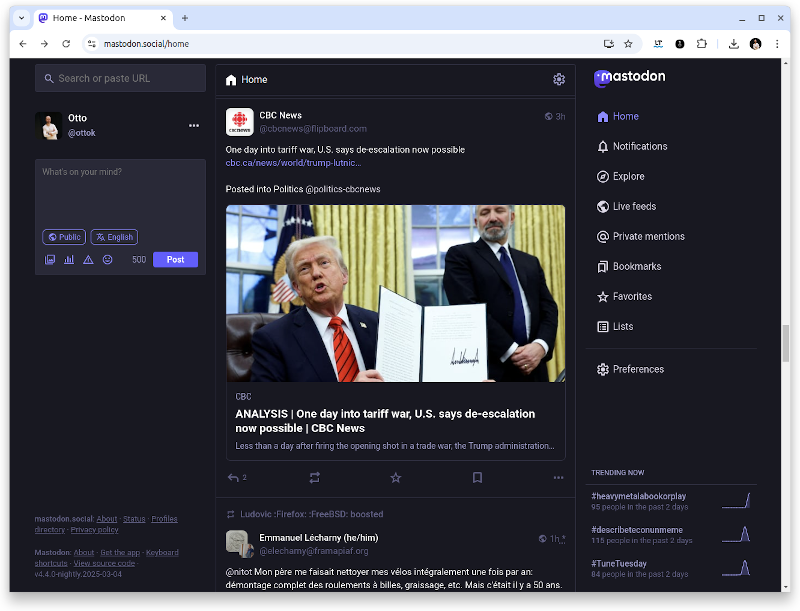
1. Mastodon (ActivityPub) Screenshot of Mastodon Mastodon was created in 2016 by Eugen Rochko, a German software developer who sought to provide a decentralized and user-controlled alternative to Twitter. It was built on the ActivityPub protocol, now standardized by W3C Social Web Working Group, to allow users to join independent servers while still communicating across the broader Mastodon network. Mastodon operates on a federated model, where multiple independently run servers communicate via ActivityPub. Each server sets its own moderation policies, leading to a decentralized but fragmented experience. The servers can alternatively be called instances, relays or nodes, depending on what vocabulary a protocol has standardized on.
  • Identity: User identity is tied to the instance where they registered, represented as @username@instance.tld.
  • Storage: Data is stored on individual instances, which federate messages to other instances based on their configurations.
  • Cost: Free to use, but relies on instance operators willing to run the servers.
The protocol defines multiple activities such as:
  • Creating a post
  • Liking
  • Sharing
  • Following
  • Commenting

Example Message in ActivityPub (JSON-LD Format)
json
 
 "@context": "https://www.w3.org/ns/activitystreams",
 "type": "Create",
 "actor": "https://mastodon.social/users/ottok",
 "object":  
 "type": "Note",
 "content": "Hello from #Mastodon!",
 "published": "2025-03-03T12:00:00Z",
 "to": ["https://www.w3.org/ns/activitystreams#Public"]
  
 
Servers communicate across different platforms by publishing activities to their followers or forwarding activities between servers. Standard HTTPS is used between servers for communication, and the messages use JSON-LD for data representation. The WebFinger protocol is used for user discovery. There is however no neat way for home server discovery yet. This means that if you are browsing e.g. Fosstodon and want to follow a user and press Follow, a dialog will pop up asking you to enter your own home server (e.g. mastodon.social) to redirect you there for actually executing the Follow action on with your account. Mastodon is open source under the AGPL at github.com/mastodon/mastodon. Anyone can operate their own instance. It just requires to run your own server and some skills to maintain a Ruby on Rails app with a PostgreSQL database backend, and basic understanding of the protocol to configure federation with other ActivityPub instances.

Popularity: Already established, but will it grow more? Mastodon has seen steady growth, especially after Twitter s acquisition in 2022, with some estimates stating it peaked at 10 million users across thousands of instances. However, its fragmented user experience and the complexity of choosing instances have hindered mainstream adoption. Still, it remains the most established decentralized alternative to Twitter. Note that Donald Trump s Truth Social is based on the Mastodon software but does not federate with the ActivityPub network. The ActivityPub protocol is the most widely used of its kind. One of the other most popular services is the Lemmy link sharing service, similar to Reddit. The larger ecosystem of ActivityPub is called Fediverse, and estimates put the total active user count around 6 million.

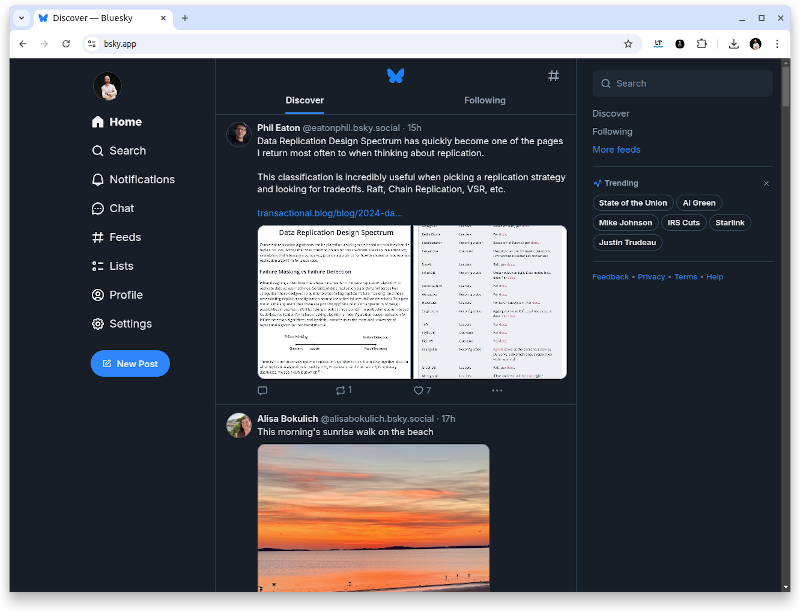
2. Bluesky (AT Protocol) Screenshot of Bluesky Interestingly, Bluesky was conceived within Twitter in 2019 by Twitter founder Jack Dorsey. After being incubated as a Twitter-funded project, it spun off as an independent Public Benefit LLC in February 2022 and launched its public beta in February 2023. Bluesky runs on top of the Authenticated Transfer (AT) Protocol published at https://github.com/bluesky-social/atproto. The protocol enables portable identities and data ownership, meaning users can migrate between platforms while keeping their identity and content intact. In practice, however, there is only one popular server at the moment, which is Bluesky itself.
  • Identity: Usernames are domain-based (e.g., @user.bsky.social).
  • Storage: Content is theoretically federated among various servers.
  • Cost: Free to use, but relies on instance operators willing to run the servers.

Example Message in AT Protocol (JSON Format)
json
 
 "repo": "did:plc:ottoke.bsky.social",
 "collection": "app.bsky.feed.post",
 "record":  
 "$type": "app.bsky.feed.post",
 "text": "Hello from Bluesky!",
 "createdAt": "2025-03-03T12:00:00Z",
 "langs": ["en"]


Popularity: Hybrid approach may have business benefits? Bluesky reported over 3 million users by 2024, probably getting traction due to its Twitter-like interface and Jack Dorsey s involvement. Its hybrid approach decentralized identity with centralized components could make it a strong candidate for mainstream adoption, assuming it can scale effectively.

3. Warpcast (Farcaster Network) Farcaster was launched in 2021 by Dan Romero and Varun Srinivasan, both former crypto exchange Coinbase executives, to create a decentralized but user-friendly social network. Built on the Ethereum blockchain, it could potentially offer a very attack-resistant communication medium. However, in my own testing, Farcaster does not seem to fully leverage what Ethereum could offer. First of all, there is no diversity in programs implementing the protocol as at the moment there is only Warpcast. In Warpcast the signup requires an initial 5 USD fee that is not payable in ETH, and users need to create a new wallet address on the Ethereum layer 2 network Base instead of simply reusing their existing Ethereum wallet address or ENS name. Despite this, I can understand why Farcaster may have decided to start out like this. Having a single client program may be the best strategy initially. One of the decentralized chat protocol Matrix founders, Matthew Hodgson, shared in his FOSDEM 2025 talk that he slightly regrets focusing too much on developing the protocol instead of making sure the app to use it is attractive to end users. So it may be sensible to ensure Warpcast gets popular first, before attempting to make the Farcaster protocol widely used. As a protocol Farcaster s hybrid approach makes it more scalable than fully on-chain networks, giving it a higher chance of mainstream adoption if it integrates seamlessly with broader Web3 ecosystems.
  • Identity: ENS (Ethereum Name Service) domains are used as usernames.
  • Storage: Messages are stored in off-chain hubs, while identity is on-chain.
  • Cost: Users must pay gas fees for some operations but reading and posting messages is mostly free.

Example Message in Farcaster (JSON Format)
json
 
 "fid": 766579,
 "username": "ottok",
 "custodyAddress": "0x127853e48be3870172baa4215d63b6d815d18f21",
 "connectedWallet": "0x3ebe43aa3ae5b891ca1577d9c49563c0cee8da88",
 "text": "Hello from Farcaster!",
 "publishedAt": 1709424000,
 "replyTo": null,
 "embeds": []
 

Popularity: Decentralized social media + decentralized payments a winning combo? Ethereum founder Vitalik Buterin (warpcast.com/vbuterin) and many core developers are active on the platform. Warpcast, the main client for Farcaster, has seen increasing adoption, especially among Ethereum developers and Web3 enthusiasts. I too have an profile at warpcast.com/ottok. However, the numbers are still very low and far from reaching network effects to really take off. Blockchain-based social media networks, particularly those built on Ethereum, are compelling because they leverage existing user wallets and persistent identities while enabling native payment functionality. When combined with decentralized content funding through micropayments, these blockchain-backed social networks could offer unique advantages that centralized platforms may find difficult to replicate, being decentralized both as a technical network and in a funding mechanism.

4. Hey.xyz (Lens Network) The Lens Protocol was developed by decentralized finance (DeFi) team Aave and launched in May 2022 to provide a user-owned social media network. While initially built on Polygon, it has since launched its own Layer 2 network called the Lens Network in February 2024. Lens is currently the main competitor to Farcaster. Lens stores profile ownership and references on-chain, while content is stored on IPFS/Arweave, enabling composability with DeFi and NFTs.
  • Identity: Profile ownership is tied to NFTs on the Polygon blockchain.
  • Storage: Content is on-chain and integrates with IPFS/Arweave (like NFTs).
  • Cost: Users must pay gas fees for some operations but reading and posting messages is mostly free.

Example Message in Lens (JSON Format)
json
 
 "profileId": "@ottok",
 "contentURI": "ar://QmExampleHash",
 "collectModule": "0x23b9467334bEb345aAa6fd1545538F3d54436e96",
 "referenceModule": "0x0000000000000000000000000000000000000000",
 "timestamp": 1709558400
 

Popularity: Probably not as social media site, but maybe as protocol? The social media side of Lens is mainly the Hey.xyz website, which seems to have fewer users than Warpcast, and is even further away from reaching critical mass for network effects. The Lens protocol however has a lot of advanced features and it may gain adoption as the building block for many Web3 apps.

5. Primal.net (Nostr Network) Nostr (Notes and Other Stuff Transmitted by Relays) was conceptualized in 2020 by an anonymous developer known as fiatjaf. One of the primary design tenets was to be a censorship-resistant protocol and it is popular among Bitcoin enthusiasts, with Jack Dorsey being one of the public supporters. Unlike the Farcaster and Lens protocols, Nostr is not blockchain-based but just a network of relay servers for message distribution. If does however use public key cryptography for identities, similar to how wallets work in crypto.
  • Identity: Public-private key pairs define identity (with prefix npub...).
  • Storage: Content is federated among multiple servers, which in Nostr vocabulary are called relays.
  • Cost: No gas fees, but relies on relay operators willing to run the servers.

Example Message in Nostr (JSON Format)
json
 
 "id": "note1xyz...",
 "pubkey": "npub1...",
 "kind": 1,
 "content": "Hello from Nostr!",
 "created_at": 1709558400,
 "tags": [],
 "sig": "sig1..."
 

Popularity: If Jack Dorsey and Bitcoiners promote it enough? Primal.net as a web app is pretty solid, but it does not stand out much. While Jack Dorsey has shown support by donating $1.5 million to the protocol development in December 2021, its success likely depends on broader adoption by the Bitcoin community.

Will any of these replace X/Twitter? As usage patterns vary, the statistics are not fully comparable, but this overview of the situation in March 2025 gives a decent overview.
Platform Total Accounts Active Users Growth Trend
Mastodon ~10 million ~1 million Steady
Bluesky ~33 million ~1 million Steady
Nostr ~41 million ~20 thousand Steady
Farcaster ~850 thousand ~50 thousand Flat
Lens ~140 thousand ~20 thousand Flat
Mastodon and Bluesky have already reached millions of users, while Lens and Farcaster are growing within crypto communities. It is however clear that none of these are anywhere close to how popular X/Twitter is. In particular, Mastodon had a huge influx of users in the fall of 2022 when Twitter was acquired, but to challenge the incumbents the growth would need to significantly accelerate. We can all accelerate this development by embracing decentralized social media now alongside existing dominant platforms. Who knows, given the right circumstances maybe X.com leadership decides to change the operating model and start federating contents to break out from a walled garden model. The likelyhood of such development would increase if decentralized networks get popular, and the encumbents feel they need to participate to not lose out.

Past and future The idea of decentralized social media is not new. One early pioneer identi.ca launched in 2008, only two years after Twitter, using the OStatus protocol to promote decentralization. A few years later it evolved into pump.io with the ActivityPump protocol, and also forked into GNU Social that continued with OStatus. I remember when these happened, and that in 2010 also Diaspora launched with fairly large publicity. Surprisingly both of these still operate (I can still post both on identi.ca and diasp.org), but the activity fizzled out years ago. The protocol however survived partially and evolved into ActivityPub, which is now the backbone of the Fediverse. The evolution of decentralized social media over the next decade will likely parallel developments in democracy, freedom of speech and public discourse. While the early 2010s emphasized maximum independence and freedom, the late 2010s saw growing support for content moderation to combat misinformation. The AI era introduces new challenges, potentially requiring proof-of-humanity verification for content authenticity. Key factors that will determine success:
  • User experience and ease of onboarding
  • Network effects and critical mass of users
  • Integration with existing web3 infrastructure
  • Balance between decentralization and usability
  • Sustainable economic models for infrastructure
This is clearly an area of development worth monitoring closely, as the next few years may determine which protocol becomes the de facto standard for decentralized social communication.

3 March 2025

Bits from Debian: Bits from the DPL

Dear Debian community, this is bits from DPL for February. Ftpmaster team is seeking for new team members In December, Scott Kitterman announced his retirement from the project. I personally regret this, as I vividly remember his invaluable support during the Debian Med sprint at the start of the COVID-19 pandemic. He even took time off to ensure new packages cleared the queue in under 24 hours. I want to take this opportunity to personally thank Scott for his contributions during that sprint and for all his work in Debian. With one fewer FTP assistant, I am concerned about the increased workload on the remaining team. I encourage anyone in the Debian community who is interested to consider reaching out to the FTP masters about joining their team. If you're wondering about the role of the FTP masters, I'd like to share a fellow developer's perspective:
"My read on the FTP masters is:
  • In truth, they are the heart of the project.
  • They know it.
  • They do a fantastic job."
I fully agree and see it as part of my role as DPL to ensure this remains true for Debian's future. If you're looking for a way to support Debian in a critical role where many developers will deeply appreciate your work, consider reaching out to the team. It's a great opportunity for any Debian Developer to contribute to a key part of the project. Project Status: Six Months of Bug of the Day In my Bits from the DPL talk at DebConf24, I announced the Tiny Tasks effort, which I intended to start with a Bug of the Day project. Another idea was an Autopkgtest of the Day, but this has been postponed due to limited time resources-I cannot run both projects in parallel. The original goal was to provide small, time-bound examples for newcomers. To put it bluntly: in terms of attracting new contributors, it has been a failure so far. My offer to explain individual bug-fixing commits in detail, if needed, received no response, and despite my efforts to encourage questions, none were asked. However, the project has several positive aspects: experienced developers actively exchange ideas, collaborate on fixing bugs, assess whether packages are worth fixing or should be removed, and work together to find technical solutions for non-trivial problems. So far, the project has been engaging and rewarding every day, bringing new discoveries and challenges-not just technical, but also social. Fortunately, in the vast majority of cases, I receive positive responses and appreciation from maintainers. Even in the few instances where help was declined, it was encouraging to see that in two cases, maintainers used the ping as motivation to work on their packages themselves. This reflects the dedication and high standards of maintainers, whose work is essential to the project's success. I once used the metaphor that this project is like wandering through a dark basement with a lone flashlight-exploring aimlessly and discovering a wide variety of things that have accumulated over the years. Among them are true marvels with popcon >10,000, ingenious tools, and delightful games that I only recently learned about. There are also some packages whose time may have come to an end-but each of them reflects the dedication and effort of those who maintained them, and that deserves the utmost respect. Leaving aside the challenge of attracting newcomers, what have we achieved since August 1st last year? With some goodwill, you can see a slight impact on the trends.debian.net graphs (thank you Lucas for the graphs), but I would never claim that this project alone is responsible for the progress. What I have also observed is the steady stream of daily uploads to the delayed queue, demonstrating the continuous efforts of many contributors. This ongoing work often remains unseen by most-including myself, if not for my regular check-ins on this list. I would like to extend my sincere thanks to everyone pushing fixes there, contributing to the overall quality and progress of Debian's QA efforts. If you examine the graphs for "Version Control System" and "VCS Hosting" with the goodwill mentioned above, you might notice a positive trend since mid-last year. The "Package Smells" category has also seen reductions in several areas: "no git", "no DEP5 copyright", "compat <9", and "not salsa". I'd also like to acknowledge the NMUers who have been working hard to address the "format != 3.0" issue. Thanks to all their efforts, this specific issue never surfaced in the Bug of the Day effort, but their contributions deserve recognition here. The experience I gathered in this project taught me a lot and inspired me to some followup we should discuss at a Sprint at DebCamp this year. Finally, if any newcomer finds this information interesting, I'd be happy to slow down and patiently explain individual steps as needed. All it takes is asking questions on the Matrix channel to turn this into a "teaching by example" session. By the way, for newcomers who are interested, I used quite a few abbreviations-all of which are explained in the Debian Glossary. Sneak Peek at Upcoming Conferences I will join two conferences in March-feel free to talk to me if you spot me there.
  1. FOSSASIA Summit 2025 (March 13-15, Bangkok, Thailand) Schedule: https://eventyay.com/e/4c0e0c27/schedule
  2. Chemnitzer Linux-Tage (March 22-23, Chemnitz, Germany) Schedule: https://chemnitzer.linux-tage.de/2025/de/programm/vortraege
Both events will have a Debian booth-come say hi! Kind regards Andreas.

28 February 2025

Antoine Beaupr : testing the fish shell

I have been testing fish for a couple months now (this file started on 2025-01-03T23:52:15-0500 according to stat(1)), and those are my notes. I suspect people will have Opinions about my comments here. Do not comment unless you have some Constructive feedback to provide: I don't want to know if you think I am holding it Wrong. Consider that I might have used UNIX shells for longer that you have lived. I'm not sure I'll keep using fish, but so far it's the first shell that survived heavy use outside of zsh(1) (unless you count tcsh(1), but that was in another millenia). My normal shell is bash(1), and it's still the shell I used everywhere else than my laptop, as I haven't switched on all the servers I managed, although it is available since August 2022 on torproject.org servers. I first got interested in fish because they ported to Rust, making it one of the rare shells out there written in a "safe" and modern programming language, released after an impressive ~2 year of work with Fish 4.0.

Cool things Current directory gets shortened, ~/wikis/anarc.at/software/desktop/wayland shows up as ~/w/a/s/d/wayland Autocompletion rocks. Default prompt rocks. Doesn't seem vulnerable to command injection assaults, at least it doesn't trip on the git-landmine. It even includes pipe status output, which was a huge pain to implement in bash. Made me realized that if the last command succeeds, we don't see other failures, which is the case of my current prompt anyways! Signal reporting is better than my bash implementation too. So far the only modification I have made to the prompt is to add a printf '\a' to output a bell. By default, fish keeps a directory history (but separate from the pushd stack), that can be navigated with cdh, prevd, and nextd, dirh shows the history.

Less cool I feel there's visible latency in the prompt creation. POSIX-style functions (foo() true ) are unsupported. Instead, fish uses whitespace-sensitive definitions like this:
function foo
    true
end
This means my (modest) collection of POSIX functions need to be ported to fish. Workaround: simple functions can be turned into aliases, which fish supports (but implements using functions). EOF heredocs are considered to be "minor syntactic sugar". I find them frigging useful. Process substitution is split on newlines, not whitespace. you need to pipe through string split -n " " to get the equivalent. <(cmd) doesn't exist: they claim you can use cmd foo - as a replacement, but that's not correct: I used <(cmd) mostly where foo does not support - as a magic character to say 'read from stdin'. Documentation is... limited. It seems mostly geared the web docs which are... okay (but I couldn't find out about ~/.config/fish/conf.d there!), but this is really inconvenient when you're trying to browse the manual pages. For example, fish thinks there's a fish_prompt manual page, according to its own completion mechanism, but man(1) cannot find that manual page. I can't find the manual for the time command (which is actually a keyword!) Fish renders multi-line commands with newlines. So if your terminal looks like this, say:
anarcat@angela:~> sq keyring merge torproject-keyring/lavamind-
95F341D746CF1FC8B05A0ED5D3F900749268E55E.gpg torproject-keyrin
g/weasel-E3ED482E44A53F5BBE585032D50F9EBC09E69937.gpg   wl-copy
... but it's actually one line, when you copy-paste the above, in foot(1), it will show up exactly like this, newlines and all:
sq keyring merge torproject-keyring/lavamind-
95F341D746CF1FC8B05A0ED5D3F900749268E55E.gpg torproject-keyrin
g/weasel-E3ED482E44A53F5BBE585032D50F9EBC09E69937.gpg   wl-copy
Whereas it should show up like this:
sq keyring merge torproject-keyring/lavamind-95F341D746CF1FC8B05A0ED5D3F900749268E55E.gpg torproject-keyring/weasel-E3ED482E44A53F5BBE585032D50F9EBC09E69937.gpg   wl-copy
Note that this is an issue specific to foot(1), alacritty(1) and gnome-terminal(1) don't suffer from that issue. I have already filed it upstream in foot and it is apparently fixed already. Globbing is driving me nuts. You can't pass a * to a command unless fish agrees it's going to match something. You need to escape it if it doesn't immediately match, and then you need the called command to actually support globbing. 202[345] doesn't match folders named 2023, 2024, 2025, it will send the string 202[345] to the command.

Blockers () is like $(): it's process substitution, and not a subshell. This is really impractical: I use ( cd foo ; do_something) all the time to avoid losing the current directory... I guess I'm supposed to use pushd for this, but ouch. This wouldn't be so bad if it was just for cd though. Clean constructs like this:
( git grep -l '^#!/.*bin/python' ; fdfind .py )   sort -u
Turn into what i find rather horrible:
begin; git grep -l '^#!/.*bin/python' ; fdfind .py ; end   sort -ub
It... works, but it goes back to "oh dear, now there's a new langage again". I only found out about this construct while trying:
  git grep -l '^#!/.*bin/python' ; fdfind .py     sort -u 
... which fails and suggests using begin/end, at which point: why not just support the curly braces? FOO=bar is not allowed. It's actually recognized syntax, but creates a warning. We're supposed to use set foo bar instead. This really feels like a needless divergence from standard. Aliases are... peculiar. Typical constructs like alias mv="\mv -i" don't work because fish treats aliases as a function definition, and \ is not magical there. This can be worked around by specifying the full path to the command, with e.g. alias mv="/bin/mv -i". Another problem is trying to override a built-in, which seems completely impossible. In my case, I like the time(1) command the way it is, thank you very much, and fish provides no way to bypass that builtin. It is possible to call time(1) with command time, but it's not possible to replace the command keyword so that means a lot of typing. Again: you can't use \ to bypass aliases. This is a huge annoyance for me. I would need to learn to type command in long form, and I use that stuff pretty regularly. I guess I could alias command to c or something, but this is one of those huge muscle memory challenges. alt . doesn't always work the way i expect.

25 February 2025

Michael Ablassmeier: proxmox backup nbdkit plugin

nbdkit is a really powerful NBD toolkit. Lately, i wanted to access VM backups from a Proxmox Backup Server via network (not by using the proxmox-backup-client map function..) For example, to test-boot a virtual machine snapshot directly from a backup. NBD suits that usecase quite well, so i quickly put a nbdkit plugin together that can be used for this. The available golang bindings for the proxmox backup client API, made that quite easy. As nbdkit already comes with a neat COW plugin, its only been a few lines of go code resulting in: pbsnbd

24 February 2025

Russ Allbery: Review: A Little Vice

Review: A Little Vice, by Erin E. Elkin
Publisher: Erin Elkin
Copyright: June 2024
ASIN: B0CTHRK61X
Format: Kindle
Pages: 398
A Little Vice is a stand-alone self-published magical girl novel. It is the author's first novel. C is a high school student and frequent near-victim of monster attacks. Due to the nefarious work of Avaritia Wolf and her allies, his high school is constantly attacked by Beasts, who are magical corruptions of some internal desire taken to absurd extremes. Standing in their way are the Angelic Saints: magical girls who transform into Saint Castitas, Saint Diligentia, and Saint Temperantia and fight the monsters. The monsters for some reason seem disposed to pick C as their victim for hostage-taking, mind control, use as a human shield, and other rather traumatic activities. He's always rescued by the Saints before any great harm is done, but in some ways this makes the situation worse. It is obvious to C that the Saints are his three friends Inessa, Ida, and Temperance, even though no one else seems able to figure this out despite the blatant clues. Inessa has been his best friend since childhood when she was awkward and needed his support. Now, she and his other friends have become literal heroes, beautiful and powerful and capable, constantly protecting the school and innocent people, and C is little more than a helpless burden to be rescued. More than anything else, he wishes he could be an Angelic Saint like them, but of course the whole idea is impossible. Boys don't get to be magical girls. (I'm using he/him pronouns for C in this review because C uses them for himself for most of the book.) This is a difficult book to review because it is deeply focused on portraying a specific internal emotional battle in all of its sometimes-ugly complexity, and to some extent it prioritizes that portrayal over conventional story-telling. You have probably already guessed that this is a transgender coming-out story Elkin's choice of the magical girl genre was done with deep understanding of its role in transgender narratives but more than that, it is a transgender coming-out story of a very specific and closely-observed type. C knows who he wishes he was, but he is certain that this transformation is absolutely impossible. He is very deep in a cycle of self-loathing for wanting something so manifestly absurd and insulting to people who have the virtues that C does not. A Little Vice is told in the first person from C's perspective, and most of this book is a relentless observation of C's anxiety and shame spiral and reflexive deflection of any possibility of a way out. This is very well-written: Elkin knows the reader is going to disagree with C's internalized disgust and hopelessness, knows the reader desperately wants C to break out of that mindset, and clearly signals in a myriad of adroit ways that Elkin is on the reader's side and does not agree with C's analysis. C's friends are sympathetic, good-hearted people, and while sometimes oblivious, it is obvious to the reader that they're also on the reader's side and would help C in a heartbeat if they saw an opening. But much of the point of the book is that it's not that easy, that breaking out of the internal anxiety spiral is nearly impossible, and that C is very good at rejecting help, both because he cannot imagine what form it could take but also because he is certain that he does not deserve it. In other words, much of the reading experience of this book involves watching C torture and insult himself. It's all the more effective because it isn't gratuitous. C's internal monologue sounds exactly like how an anxiety spiral feels, complete with the sort of half-effective coping mechanisms, deflections, and emotional suppression one develops to blunt that type of emotional turmoil. I normally hate this kind of book. I am a happy ending and competence porn reader by default. The world is full of enough pain that I don't turn to fiction to read about more pain. It says a lot about how well-constructed this book is that I stuck with it. Elkin is going somewhere with the story, C gets moments of joy and delight along the way to keep the reader from bogging down completely, and the best parts of the book feel like a prolonged musical crescendo with suspended chords. There is a climax coming, but Elkin is going to make you wait for it for far longer than you want to. The main element that protects A Little Vice from being too grim is that it is a genre novel that is very playful about both magical girls and superhero tropes in general. I've already alluded to one of those elements: Elkin plays with the Mask Principle (the inability of people to see through entirely obvious secret identities) in knowing and entertaining ways. But there are also villains, and that leads me to the absolutely delightful Avaritia Wolf, who for me was the best character in this book. The Angelic Saints are not the only possible approach to magical girl powers in this universe. There are villains who can perform a similar transformation, except they embrace a vice rather than a virtue. Avaritia Wolf embraces the vice of greed. They (Avaritia's pronouns change over the course of the book) also have a secret identity, which I suspect will be blindingly obvious to most readers but which I'll avoid mentioning since it's still arguably a spoiler. The primary plot arc of this book is an attempt to recruit C to the side of the villains. The Beasts are drawn to him because he has magical potential, and the villains are less picky about gender. This initially involves some creepy and disturbing mind control, but it also brings C into contact with Avaritia and Avaritia's very specific understanding of greed. As far as Avaritia is concerned, greed means wanting whatever they want, for whatever reason they feel like wanting it, and there is absolutely no reason why that shouldn't include being greedy for their friends to be happy. Or doing whatever they can to make their friends happy, whether or not that looks like villainy. Elkin does two things with this plot that I thought were remarkably skillful. The first is that she directly examines and then undermines the "easy" transgender magical girl ending. In a world of transformation magic, someone who wants to be a girl could simply turn into a girl and thus apparently resolve the conflict in a way that makes everyone happy. I think there is an important place for that story (I am a vigorous defender of escapist fantasy and happy endings), but that is not the story that Elkin is telling. I won't go into the details of why and how the story complicates and undermines this easy ending, but it's a lot of why this book feels both painful and honest to a specific, and very not easy, transgender experience, even though it takes place in an utterly unrealistic world. But the second, which is more happy and joyful, is that Avaritia gleefully uses a wholehearted embrace of every implication of the vice of greed to bulldoze the binary morality of the story and question the classification of human emotions into virtues and vices. They are not a hero, or even all that good; they have some serious flaws and a very anarchic attitude towards society. But Avaritia provides the compelling, infectious thrill of the character who looks at the social construction of morality that is constraining the story and decides that it's all bullshit and refuses to comply. This is almost the exact opposite of C's default emotional position at the start of the book, and watching the two characters play off of each other in a complex friendship is an absolute delight. The ending of this book is complicated, messy, and incomplete. It is the sort of ending that I think could be incredibly powerful if it hits precisely the right chords with the reader, but if you're not that reader, it can also be a little heartbreaking because Elkin refuses to provide an easy resolution. The ending also drops some threads that I wish Elkin hadn't dropped; there are some characters who I thought deserved a resolution that they don't get. But this is one of those books where the author knows exactly what story they're trying to tell and tells it whether or not that fits what the reader wants. Those books are often not easy reading, but I think there's something special about them. This is not the novel for people who want detailed world-building that puts a solid explanation under events. I thought Elkin did a great job playing with the conventions of an episodic anime, including starting the book on Episode 12 to imply C's backstory with monster attacks and hinting at a parallel light anime story by providing TV-trailer-style plot summaries and teasers at the start and end of each chapter. There is a fascinating interplay between the story in which the Angelic Saints are the protagonists, which the reader can partly extrapolate, and the novel about C that one is actually reading. But the details of the world-building are kept at the anime plot level: There's an arch-villain, a World Tree, and a bit of backstory, but none of it makes that much sense or turns into a coherent set of rules. This is a psychological novel; the background and rules exist to support C's story. If you do want that psychological novel... well, I'm not sure whether to recommend this book or not. I admire the construction of this book a great deal, but I don't think appealing to the broadest possible audience was the goal. C's anxiety spiral is very repetitive, because anxiety spirals are very repetitive, and you have to be willing to read for the grace notes on the doom loop if you're going to enjoy this book. The sentence-by-sentence writing quality is fine but nothing remarkable, and is a bit shy of the average traditionally-published novel. The main appeal of A Little Vice is in the deep and unflinching portrayal of a specific emotional journey. I think this book is going to work if you're sufficiently invested in that journey that you are willing to read the brutal and repetitive parts. If you're not, there's a chance you will bounce off this hard. I was invested, and I'm glad I read this, but caveat emptor. You may want to try a sample first. One final note: If you're deep in the book world, you may wonder, like I did, if the title is a reference to Hanya Yanagihara's (in)famous A Little Life. I do not know for certain I have not read that book because I am not interested in being emotionally brutalized but if it is, I don't think there is much similarity. Both books are to some extent about four friends, but I couldn't find any other obvious connections from some Wikipedia reading, and A Little Vice, despite C's emotional turmoil, seems to be considerably more upbeat. Content notes: Emotionally abusive parent, some thoughts of self-harm, mind control, body dysmorphia, and a lot (a lot) of shame and self-loathing. Rating: 7 out of 10

23 February 2025

Colin Watson: Qalculate time hacks

Anarcat recently wrote about Qalculate, and I think I m a convert, even though I ve only barely scratched the surface. The thing I almost immediately started using it for is time calculations. When I started tracking my time, I quickly found that Timewarrior was good at keeping all the data I needed, but I often found myself extracting bits of it and reprocessing it in variously clumsy ways. For example, I often don t finish a task in one sitting; maybe I take breaks, or I switch back and forth between a couple of different tasks. The raw output of timew summary is a bit clumsy for this, as it shows each chunk of time spent as a separate row:
$ timew summary 2025-02-18 Debian
Wk Date       Day Tags                            Start      End    Time   Total
W8 2025-02-18 Tue CVE-2025-26465, Debian,       9:41:44 10:24:17 0:42:33
                  next, openssh
                  Debian, FTBFS with GCC-15,   10:24:17 10:27:12 0:02:55
                  icoutils
                  Debian, FTBFS with GCC-15,   11:50:05 11:57:25 0:07:20
                  kali
                  Debian, Upgrade to 0.67,     11:58:21 12:12:41 0:14:20
                  python_holidays
                  Debian, FTBFS with GCC-15,   12:14:15 12:33:19 0:19:04
                  vigor
                  Debian, FTBFS with GCC-15,   12:39:02 12:39:38 0:00:36
                  python_setproctitle
                  Debian, Upgrade to 1.3.4,    12:39:39 12:46:05 0:06:26
                  python_setproctitle
                  Debian, FTBFS with GCC-15,   12:48:28 12:49:42 0:01:14
                  python_setproctitle
                  Debian, Upgrade to 3.4.1,    12:52:07 13:02:27 0:10:20 1:44:48
                  python_charset_normalizer
                                                                         1:44:48
So I wrote this Python program to help me:
#! /usr/bin/python3
"""
Summarize timewarrior data, grouped and sorted by time spent.
"""
import json
import subprocess
from argparse import ArgumentParser, RawDescriptionHelpFormatter
from collections import defaultdict
from datetime import datetime, timedelta, timezone
from operator import itemgetter
from rich import box, print
from rich.table import Table
parser = ArgumentParser(
    description=__doc__, formatter_class=RawDescriptionHelpFormatter
)
parser.add_argument("-t", "--only-total", default=False, action="store_true")
parser.add_argument(
    "range",
    nargs="?",
    default=":today",
    help="Time range (usually a hint, e.g. :lastweek)",
)
parser.add_argument("tag", nargs="*", help="Tags to filter by")
args = parser.parse_args()
entries: defaultdict[str, timedelta] = defaultdict(timedelta)
now = datetime.now(timezone.utc)
for entry in json.loads(
    subprocess.run(
        ["timew", "export", args.range, *args.tag],
        check=True,
        capture_output=True,
        text=True,
    ).stdout
):
    start = datetime.fromisoformat(entry["start"])
    if "end" in entry:
        end = datetime.fromisoformat(entry["end"])
    else:
        end = now
    entries[", ".join(entry["tags"])] += end - start
if not args.only_total:
    table = Table(box=box.SIMPLE, highlight=True)
    table.add_column("Tags")
    table.add_column("Time", justify="right")
    for tags, time in sorted(entries.items(), key=itemgetter(1), reverse=True):
        table.add_row(tags, str(time))
    print(table)
total = sum(entries.values(), start=timedelta())
hours, rest = divmod(total, timedelta(hours=1))
minutes, rest = divmod(rest, timedelta(minutes=1))
seconds = rest.seconds
print(f"Total time:  hours:02 : minutes:02 : seconds:02 ")
$ summarize-time 2025-02-18 Debian
  Tags                                                     Time
  
  CVE-2025-26465, Debian, next, openssh                 0:42:33
  Debian, FTBFS with GCC-15, vigor                      0:19:04
  Debian, Upgrade to 0.67, python_holidays              0:14:20
  Debian, Upgrade to 3.4.1, python_charset_normalizer   0:10:20
  Debian, FTBFS with GCC-15, kali                       0:07:20
  Debian, Upgrade to 1.3.4, python_setproctitle         0:06:26
  Debian, FTBFS with GCC-15, icoutils                   0:02:55
  Debian, FTBFS with GCC-15, python_setproctitle        0:01:50
Total time: 01:44:48
Much nicer. But that only helps with some of my reporting. At the end of a month, I have to work out how much time to bill Freexian for and fill out a timesheet, and for various reasons those queries don t correspond to single timew tags: they sometimes correspond to the sum of all time spent on multiple tags, or to the time spent on one tag minus the time spent on another tag, or similar. As a result I quite often have to do basic arithmetic on time intervals; but that s surprisingly annoying! I didn t previously have good tools for that, and was reduced to doing things like str(timedelta(hours=..., minutes=..., seconds=...) + ...) in Python, which gets old fast. Instead:
$ qalc '62:46:30 - 51:02:42 to time'
(225990 / 3600)   (183762 / 3600) = 11:43:48
I also often want to work out how much of my time I ve spent on Debian work this month so far, since Freexian pays me for up to 20% of my work time on Debian; if I m under that then I might want to prioritize more Debian projects, and if I m over then I should be prioritizing more Freexian projects as otherwise I m not going to get paid for that time.
$ summarize-time -t :month Freexian
Total time: 69:19:42
$ summarize-time -t :month Debian
Total time: 24:05:30
$ qalc '24:05:30 / (24:05:30 + 69:19:42) to %'
(86730 / 3600) / ((86730 / 3600) + (249582 / 3600))   25.78855349%
I love it.

21 February 2025

Jonathan Dowland: haskell streaming libraries

For my PhD, my colleagues/collaborators and I built a distributed stream-processing system using Haskell. There are several other Haskell stream-processing systems. How do they compare? First, let's briefly discuss and define streaming in this context. Structure and Interpretation of Computer Programs introduces Streams as an analogue of lists, to support delayed evaluation. In brief, the inductive list type (a list is either an empty list or a head element pre-pended to another list) is replaced with a structure with a head element and a promise which, when evaluated, will generate the tail (which in turn may have a head element and a promise to generate another tail, culminating in the equivalent of an empty list.) Later on SICP also covers lazy evaluation. However, the streaming we're talking about originates in the relational community, rather than the functional one, and is subtly different. It's about building a pipeline of processing that receives and emits data but doesn't need to (indeed, cannot) reference the whole stream (which may be infinite) at once. Haskell streaming systems Now let's go over some Haskell streaming systems. conduit (2011-) Conduit is the oldest of the ones I am reviewing here, but I doubt it's the first in the Haskell ecosystem. If I've made any obvious omissions, please let me know! Conduit provides a new set of types to model streaming data, and a completely new set of functions which are analogues of standard Prelude functions, e.g. sumC in place of sum. It provides its own combinator(s) such as . ( aka fuse) which is like composition but reads left-to-right. The motivation for this is to enable (near?) constant memory usage for processing large streams of data -- presumably versus using a list-based approach and to provide some determinism: the README gives the example of "promptly closing file handles". I think this is another way of saying that it uses strict evaluation, or at least avoids lazy evaluation for some things. Conduit offers interleaved effects: which is to say, IO can be performed mid-stream. Conduit supports distributed operation via Data.Conduit.Network in the conduit-extra package. Michael Snoyman, principal Conduit author, wrote up how to use it here: https://www.yesodweb.com/blog/2014/03/network-conduit-async To write a distributed Conduit application, the application programmer must manually determine the boundaries between the clients/servers and write specific code to connect them. pipes (2012-) The Pipes Tutorial contrasts itself with "Conventional Haskell stream programming": whether that means Conduit or something else, I don't know. Paraphrasing their pitch: Effects, Streaming Composability: pick two. That's the situation they describe for stream programming prior to Pipes. They argue Pipes offers all three. Pipes offers it's own combinators (which read left-to-right) and offers interleaved effects. At this point I can't really see what fundamentally distinguishes Pipes from Conduit. Pipes has some support for distributed operation via the sister library pipes-network. It looks like you must send and receive ByteStrings, which means rolling your own serialisation for other types. As with Conduit, to send or receive over a network, the application programmer must divide their program up into the sub-programs for each node, and add the necessary ingress/egress code. io-streams (2013-) io-streams emphasises simple primitives. Reading and writing is done under the IO Monad, thus, in an effectful (but non-pure) context. The presence or absence of further stream data are signalled by using the Maybe type (Just more data or Nothing: the producer has finished.) It provides a library of functions that shadow the standard Prelude, such as S.fromList, S.mapM, etc. It's not clear to me what the motivation for io-streams is, beyond providing a simple interface. There's no declaration of intent that I can find about (e.g.) constant-memory operation. There's no mention of or support (that I can find) for distributed operation. streaming (2015-) Similar to io-streams, Streaming emphasises providing a simple interface that gels well with traditional Haskell methods. Streaming provides effectful streams (via a Monad -- any Monad?) and a collection of functions for manipulating streams which are designed to closely mimic standard Prelude (and Data.List) functions. Streaming doesn't push its own combinators: the examples provided use $ and read right-to-left. The motivation for Streaming seems to be to avoid memory leaks caused by extracting pure lists from IO with traditional functions like mapM, which require all the list constructors to be evaluated, the list to be completely deconstructed, and then a new list constructed. Like io-streams, the focus of the library is providing a low-level streaming abstraction, and there is no support for distributed operation. streamly (2017-) Streamly appears to have the grand goal of providing a unified programming tool as suited for quick-and-dirty programming tasks (normally the domain of scripting languages) and high-performance work (C, Java, Rust, etc.). Their intended audience appears to be everyone, or at least, not just existing Haskell programmers. See their rationale Streamly offers an interface to permit composing concurrent (note: not distributed) programs via combinators. It relies upon fusing a streaming pipeline to remove intermediate list structure allocations and de-allocations (i.e. de-forestation, similar to GHC rewrite rules) The examples I've seen use standard combinators (e.g. Control.Function.&, which reads left-to-right, and Applicative). Streamly provide benchmarks versus Haskell pure lists, Streaming, Pipes and Conduit: these generally show Streamly several orders of magnitude faster. I'm finding it hard to evaluate Streamly. It's big, and it's focus is wide. It provides shadows of Prelude functions, as many of these libraries do. wrap-up It seems almost like it must be a rite-of-passage to write a streaming system in Haskell. Stones and glass houses, I'm guilty of that too. The focus of the surveyed libraries is mostly on providing a streaming abstraction, normally with an analogous interface to standard Haskell lists. They differ on various philosophical points (whether to abstract away the mechanics behind type synonyms, how much to leverage existing Haskell idioms, etc). A few of the libraries have some rudimentary support for distributed operation, but this is limited to connecting separate nodes together: in some cases serialising data remains the application programmer's job, and in all cases the application programmer must manually carve up their processing according to a fixed idea of what nodes they are deploying to. They all define a fixed-function pipeline.

20 February 2025

Dirk Eddelbuettel: Rcpp now used by 3000 CRAN packages!

3000 Rcpp packages As of today, Rcpp stands at 3001 reverse-dependencies on CRAN. The graph on the left depicts the growth of Rcpp usage (as measured by Depends, Imports and LinkingTo, but excluding Suggests) over time. Rcpp was first released in November 2008. It took seven year years to clear 500 packages in late October 2015 after which usage of R and Rcpp accelerated: 1000 packages in April 2017, 1500 packages in November 2018, 2000 packages in July 2020, and 2500 package in February 2022. The chart extends to the very beginning via manually compiled data from CRANberries and checked with crandb. The core part of the data set is generated semi-automatically when updating a (manually curated) list of packages using Rcpp that is available too. The Rcpp team aims to keep Rcpp as performant and reliable as it has been (and see e.g. here for more details). Last month s 1.0.14 release post is a good example of the ongoing work. A really big shoutout and Thank You! to all users and contributors of Rcpp for help, suggestions, bug reports, documentation or, of course, code.

This post by Dirk Eddelbuettel originated on his Thinking inside the box blog. If you like this or other open-source work I do, you can sponsor me at GitHub.

19 February 2025

Thomas Lange: The secret maze of Debian images

TL;DR It's difficult to find the right Debian image. We have thousands of ISO files and cloud images and we support multiple CPU architectures and several download methods. The directory structure of our main image server is like a maze, and our web pages for downloading are also confusing. Most important facts from this blog post The Debian maze Debian maze Did you ever searched for a specific Debian image which was not the default netinst ISO for amd64? How long did it take to find it? Debian is very good at hiding their images for downloading by offering a huge amount of different versions and variants of images and multiple methods how to download them. Debian also has multiple web pages for This is the secret Debian maze of images. It's currently filled with 8700+ different ISO images and another 34.000+ files (raw and qcow2) for the cloud images. The main URL for the server hosting all Debian images is https://cdimage.debian.org/cdimage/ There, you will find installer images, live images, cloud images. Let's try to find the right image you need We have three different types of images: Images for the stable release Almost always, you are probably looking for the image to install the latest stable release. The URL https://cdimage.debian.org/cdimage/release/ shows:

12.9.0
12.9.0-live
current
current-live
but you cannot see that two are symlinks:
current -> 12.9.0/
current-live -> 12.9.0-live/
Here you will find the installer images and live images for the stable release (currently Debian 12, bookworm). If you choose https://cdimage.debian.org/cdimage/release/12.9.0/ you will see a list of CPU architectures:
amd64
arm64
armel
armhf
i386
mips64el
mipsel
ppc64el
s390x
source
trace
(BTW source and trace are no CPU architectures) The typical end user will not care about most architectures, because your computer will actually always need images from the amd64 folder. Maybe you have heard that your computer has a 64bit CPU and even if you have an Intel processor we call this architecture amd64. Let's see what's in the folder amd64:
bt-bd
bt-cd
bt-dvd
iso-bd
iso-cd
iso-dvd
jigdo-16G
jigdo-bd
jigdo-cd
jigdo-dlbd
jigdo-dvd
list-16G
list-bd
list-cd
list-dlbd
list-dvd
Wow. This is confusing and there's no description what all those folders mean. The first three are different methods how to download an image. Use iso when a single network connection will be fast enough for you. Using bt can result in a faster download, because it downloads via a peer-to-peer file sharing protocol. You need an additional torrent program for downloading. Then we have these variants: 16G and dlbd images are only available via jigdo. All iso-xx and bt-xx folders provide the same images but with a different access method. Here are examples of images:
  iso-cd/debian-12.9.0-amd64-netinst.iso
  iso-cd/debian-edu-12.9.0-amd64-netinst.iso
  iso-cd/debian-mac-12.9.0-amd64-netinst.iso
Fortunately the folder explains in very detail the differences between these images and what you also find there. You can ignore the SHA... files if you do not know what they are needed for. They are not important for you. These ISO files are small and contain only the core Debian installer code and a small set of programs. If you install a desktop environment, the other packages will be downloaded at the end of the installation. The folders bt-dvd and iso-dvd only contain debian-12.9.0-amd64-DVD-1.iso or the appropriate torrent file. In bt-bd and iso-bd you will only find debian-edu-12.9.0-amd64-BD-1.iso. These large images contain much more Debian packages, so you will not need a network connection during the installation. For the other CPU architectures (other than amd64) Debian provides less variants of images but still a lot. In total, we have 44 ISO files (or torrents) for the current release of the Debian installer for all architectures. When using jigdo you can choose between 268 images. And these are only the installer images for the stable release, no older or newer version are counted here. Take a breath before we're diving into..... The live images The live images in release/12.9.0-live/amd64/iso-hybrid/ are only available for the amd64 architecture but for newer Debian releases there will be images also for arm64. We have 7 different live images containing one of the most common desktop environments and one with only a text interface (standard).
debian-live-12.9.0-amd64-xfce.iso
debian-live-12.9.0-amd64-mate.iso
debian-live-12.9.0-amd64-lxqt.iso
debian-live-12.9.0-amd64-gnome.iso
debian-live-12.9.0-amd64-lxde.iso
debian-live-12.9.0-amd64-standard.iso
debian-live-12.9.0-amd64-cinnamon.iso
debian-live-12.9.0-amd64-kde.iso
The folder name iso-hybrid is the technology that you can use those ISO files for burning them onto a CD/DVD/BD or writing the same ISO file to a USB stick. bt-hybrid will give you the torrent files for downloading the same images using a torrent client program. More recent installer and live images (aka testing) For newer version of the images we have currently these folders:
daily-builds
weekly-builds
weekly-live-builds
trixie_di_alpha1
I suggest using the weekly-builds because in this folder you find a similar structure and all variants of images as in the release directory. For e.g. weekly-builds/amd64/iso-cd/debian-testing-amd64-netinst.iso and similar for the live images
weekly-live-builds/amd64/iso-hybrid/debian-live-testing-amd64-kde.iso
weekly-live-builds/amd64/iso-hybrid/debian-live-testing-amd64-lxde.iso
weekly-live-builds/amd64/iso-hybrid/debian-live-testing-amd64-debian-junior.iso
weekly-live-builds/amd64/iso-hybrid/debian-live-testing-amd64-standard.iso
weekly-live-builds/amd64/iso-hybrid/debian-live-testing-amd64-lxqt.iso
weekly-live-builds/amd64/iso-hybrid/debian-live-testing-amd64-mate.iso
weekly-live-builds/amd64/iso-hybrid/debian-live-testing-amd64-xfce.iso
weekly-live-builds/amd64/iso-hybrid/debian-live-testing-amd64-gnome.iso
weekly-live-builds/amd64/iso-hybrid/debian-live-testing-amd64-cinnamon.iso
weekly-live-builds/arm64/iso-hybrid/debian-live-testing-arm64-gnome.iso
Here you see a new variant call debian-junior, which is a Debian blend. BitTorrent files are not available for weekly builds. The daily-builds folder structure is different and only provide the small network install (netinst) ISOs but several versions of the last days. Currently we have 55 ISO files available there. If you like to use the newest installation image fetch this one: https://cdimage.debian.org/cdimage/daily-builds/sid_d-i/arch-latest/amd64/iso-cd/debian-testing-amd64-netinst.iso Debian stable with a backports kernel Unfortunately Debian does not provide any installation media using the stable release but including a backports kernel for newer hardware. This is because our installer environment is a very complex mix of special tools (like anna) and special .udeb versions of packages. But the FAIme web service of my FAI project can build a custom installation image using the backports kernel. Choose a desktop environment, a language and add some packages names if you like. Then select Debian 12 bookworm and then enable backports repository including newer kernel. After a short time you can download your own installation image. Older releases Usually you should not use older releases for a new installation. In our archive the folder https://cdimage.debian.org/cdimage/archive/ contains 6163 ISO files starting from Debian 3.0 (first release was in 2002) and including every point release. The full DVD image for the oldstable release (Debian 11.11.0 including non-free firmware) is here https://cdimage.debian.org/cdimage/unofficial/non-free/cd-including-firmware/archive/latest-oldstable/amd64/iso-dvd/firmware-11.11.0-amd64-DVD-1.iso the smaller netinst image is https://cdimage.debian.org/cdimage/archive/11.10.0/amd64/iso-cd/debian-11.10.0-amd64-netinst.iso The oldest ISO I could find is from 1999 using kernel 2.0.36 I still didn't managed to boot it in KVM. UPDATE I got a kernel panic because the VM had 4GB RAM. Reducing this to 500MB RAM (also 8MB works) started the installer of Debian 2.1 without any problems. Anything else? In this post, we still did not cover the ports folder (the non official supported (older) hardware architectures) which contains around 760 ISO files and the unofficial folder (1445 ISO files) which also provided the ISOs which included the non-free firmware blobs in the past. Then, there are more than 34.000 cloud images. But hey, no ISO files are involved there. This may be part of a complete new posting.

18 February 2025

Dima Kogan: When are the days getting longer the fastest?

We're way past the winter solstice, and approaching the equinox. The sun is noticeably staying up later and later every day, which raises an obvious question: when are the days getting longer the fastest? Intuitively I want to say it should happen at the equinox. But does it happen exactly at the equinox? I could read up on all the gory details of this, or I could just make some plots. I wrote this:
#!/usr/bin/python3
import sys
import datetime
import astral.sun
lat  = 34.
year = 2025
city = astral.LocationInfo(latitude=lat, longitude=0)
date0 = datetime.datetime(year, 1, 1)
print("# date sunrise sunset length_min")
for i in range(365):
    date = date0 + datetime.timedelta(days=i)
    s = astral.sun.sun(city.observer, date=date)
    date_sunrise = s['sunrise']
    date_sunset  = s['sunset']
    date_string    = date.strftime('%Y-%m-%d')
    sunrise_string = date_sunrise.strftime('%H:%M')
    sunset_string  = date_sunset.strftime ('%H:%M')
    print(f" date_string   sunrise_string   sunset_string   (date_sunset-date_sunrise).total_seconds()/60 ")
This computes the sunrise and sunset time every day of 2025 at a latitude of 34degrees (i.e. Los Angeles), and writes out a log file (using the vnlog format). Let's plot it:
< sunrise-sunset.vnl                   \
  vnl-filter -p date,l='length_min/60' \
  feedgnuplot                          \
  --set 'format x "%b %d"'             \
  --domain                             \
  --timefmt '%Y-%m-%d'                 \
  --lines                              \
  --ylabel 'Day length (hours)'        \
  --hardcopy day-length.svg
day-length.svg
Well that makes sense. When are the days the longest/shortest?
$ < sunrise-sunset.vnl vnl-sort -grk length_min   head -n2   vnl-align
#  date    sunrise sunset     length_min   
2025-06-21 04:49   19:14  864.8543702000001
$ < sunrise-sunset.vnl vnl-sort -gk length_min   head -n2   vnl-align
#  date    sunrise sunset     length_min   
2025-12-21 07:01   16:54  592.8354265166668
Those are the solstices, as expected. Now let's look at the time gained/lost each day:
$ < sunrise-sunset.vnl                                  \
  vnl-filter -p date,d='diff(length_min)'               \
  vnl-filter --has d                                    \
  feedgnuplot                                           \
  --set 'format x "%b %d"'                              \
  --domain                                              \
  --timefmt '%Y-%m-%d'                                  \
  --lines                                               \
  --ylabel 'Daytime gained from the previous day (min)' \
  --hardcopy gain.svg
gain.svg
Looks vaguely sinusoidal, like the last plot. And looks like we gain/lost as most ~2 minutes each day. When does the gain peak?
$ < sunrise-sunset.vnl vnl-filter -p date,d='diff(length_min)'   vnl-filter --has d   vnl-sort -grk d   head -n2   vnl-align
#  date       d   
2025-03-19 2.13167
$ < sunrise-sunset.vnl vnl-filter -p date,d='diff(length_min)'   vnl-filter --has d   vnl-sort -gk d   head -n2   vnl-align
#  date        d   
2025-09-25 -2.09886
Not at the equinoxes! The fastest gain is a few days before the equinox and the fastest loss a few days after.

12 February 2025

Dirk Eddelbuettel: RcppUUID 1.2.0 on CRAN: Adding Clock-based UUIDs

The RcppUUID package on CRAN has been providing UUIDs (based on the underlying Boost library) for several years. Written by Artem Klemsov and maintained in this gitlab repo, the package is a very nice example of clean and straightforward library binding. As it had dropped off CRAN over a relatively minor issue, I descided to adopted it with the previous 1.1.2 release made quite recently. This release adds new high-resolution clock-based UUIDs accordingt to the v7 spec. Internally 100ns increments are represented. The resulting UUIDs are both unique and sortable. I added this recent example to the README.md which illustrated both the implicit ordering and uniqueness. The unit tests check this with a much larger N.
> RcppUUID::uuid_generate_time(5)
[1] "0194d8fa-7add-735c-805b-6bbf22b78b9e" "0194d8fa-7add-735e-8012-3e0e53895b19"
[3] "0194d8fa-7add-735e-81af-bc67bb435ade" "0194d8fa-7add-735e-82b1-405bf57963ad"
[5] "0194d8fa-7add-735f-801e-efe57078b2e7"
>
While one can revert from the UUID object to the clock object, I am not aware of a text parser so there is currently no inverse function (as ulid offers) for the character representation. The NEWS entry for the two releases follows.

Changes in version 1.2.0 (2025-02-12)
  • Time-based UUIDs, ie version 7, can now be generated (requiring Boost 1.86 or newer as in the current BH package)

Changes in version 1.1.2 (2025-01-31)
  • New maintainer to resurrect package on CRAN

Courtesy of my CRANberries, there is also a diffstat report. More detailed information is on the RcppUUID page, or the github repo.

This post by Dirk Eddelbuettel originated on his Thinking inside the box blog. If you like this or other open-source work I do, you can sponsor me at GitHub.

11 February 2025

Ian Jackson: derive-deftly 1.0.0 - Rust derive macros, the easy way

derive-deftly 1.0 is released. derive-deftly is a template-based derive-macro facility for Rust. It has been a great success. Your codebase may benefit from it too! Rust programmers will appreciate its power, flexibility, and consistency, compared to macro_rules; and its convenience and simplicity, compared to proc macros. Programmers coming to Rust from scripting languages will appreciate derive-deftly s convenient automatic code generation, which works as a kind of compile-time introspection. Rust s two main macro systems I m often a fan of metaprogramming, including macros. They can help remove duplication and flab, which are often the enemy of correctness. Rust has two macro systems. derive-deftly offers much of the power of the more advanced (proc_macros), while beating the simpler one (macro_rules) at its own game for ease of use. (Side note: Rust has at least three other ways to do metaprogramming: generics; build.rs; and, multiple module inclusion via #[path=]. These are beyond the scope of this blog post.) macro_rules! macro_rules! aka pattern macros , declarative macros , or sometimes macros by example are the simpler kind of Rust macro. They involve writing a sort-of-BNF pattern-matcher, and a template which is then expanded with substitutions from the actual input. If your macro wants to accept comma-separated lists, or other simple kinds of input, this is OK. But often we want to emulate a #[derive(...)] macro: e.g., to define code based on a struct, handling each field. Doing that with macro_rules is very awkward: macro_rules! s pattern language doesn t have a cooked way to match a data structure, so you have to hand-write a matcher for Rust syntax, in each macro. Writing such a matcher is very hard in the general case, because macro_rules lacks features for matching important parts of Rust syntax (notably, generics). (If you really need to, there s a horrible technique as a workaround.) And, the invocation syntax for the macro is awkward: you must enclose the whole of the struct in my_macro! . This makes it hard to apply more than one macro to the same struct, and produces rightward drift. Enclosing the struct this way means the macro must reproduce its input - so it can have bugs where it mangles the input, perhaps subtly. This also means the reader cannot be sure precisely whether the macro modifies the struct itself. In Rust, the types and data structures are often the key places to go to understand a program, so this is a significant downside. macro_rules also has various other weird deficiencies too specific to list here. Overall, compared to (say) the C preprocessor, it s great, but programmers used to the power of Lisp macros, or (say) metaprogramming in Tcl, will quickly become frustrated. proc macros Rust s second macro system is much more advanced. It is a fully general system for processing and rewriting code. The macro s implementation is Rust code, which takes the macro s input as arguments, in the form of Rust tokens, and returns Rust tokens to be inserted into the actual program. This approach is more similar to Common Lisp s macros than to most other programming languages macros systems. It is extremely powerful, and is used to implement many very widely used and powerful facilities. In particular, proc macros can be applied to data structures with #[derive(...)]. The macro receives the data structure, in the form of Rust tokens, and returns the code for the new implementations, functions etc. This is used very heavily in the standard library for basic features like #[derive(Debug)] and Clone, and for important libraries like serde and strum. But, it is a complete pain in the backside to write and maintain a proc_macro. The Rust types and functions you deal with in your macro are very low level. You must manually handle every possible case, with runtime conditions and pattern-matching. Error handling and recovery is so nontrivial there are macro-writing libraries and even more macros to help. Unlike a Lisp codewalker, a Rust proc macro must deal with Rust s highly complex syntax. You will probably end up dealing with syn, which is a complete Rust parsing library, separate from the compiler; syn is capable and comprehensive, but a proc macro must still contain a lot of often-intricate code. There are build/execution environment problems. The proc_macro code can t live with your application; you have to put the proc macros in a separate cargo package, complicating your build arrangements. The proc macro package environment is weird: you can t test it separately, without jumping through hoops. Debugging can be awkward. Proper tests can only realistically be done with the help of complex additional tools, and will involve a pinned version of Nightly Rust. derive-deftly to the rescue derive-deftly lets you use a write a #[derive(...)] macro, driven by a data structure, without wading into any of that stuff. Your macro definition is a template in a simple syntax, with predefined $-substitutions for the various parts of the input data structure. Example Here s a real-world example from a personal project:
define_derive_deftly!  
    export UpdateWorkerReport:
    impl $ttype  
        pub fn update_worker_report(&self, wr: &mut WorkerReport)  
            $(
                $ when fmeta(worker_report) 
                wr.$fname = Some(self.$fname.clone()).into();
            )


#[derive(Debug, Deftly, Clone)]
...
#[derive_deftly(UiMap, UpdateWorkerReport)]
pub struct JobRow  
    ...
    #[deftly(worker_report)]
    pub status: JobStatus,
    pub processing: NoneIsEmpty<ProcessingInfo>,
    #[deftly(worker_report)]
    pub info: String,
    pub duplicate_of: Option<JobId>,
 
This is a nice example, also, of how using a macro can avoid bugs. Implementing this update by hand without a macro would involve a lot of cut-and-paste. When doing that cut-and-paste it can be very easy to accidentally write bugs where you forget to update some parts of each of the copies:
    pub fn update_worker_report(&self, wr: &mut WorkerReport)  
        wr.status = Some(self.status.clone()).into();
        wr.info = Some(self.status.clone()).into();
     
Spot the mistake? We copy status to info. Bugs like this are extremely common, and not always found by the type system. derive-deftly can make it much easier to make them impossible. Special-purpose derive macros are now worthwhile! Because of the difficult and cumbersome nature of proc macros, very few projects have site-specific, special-purpose #[derive(...)] macros. The Arti codebase has no bespoke proc macros, across its 240kloc and 86 crates. (We did fork one upstream proc macro package to add a feature we needed.) I have only one bespoke, case-specific, proc macro amongst all of my personal Rust projects; it predates derive-deftly. Since we have started using derive-deftly in Arti, it has become an important tool in our toolbox. We have 37 bespoke derive macros, done with derive-deftly. Of these, 9 are exported for use by downstream crates. (For comparison there are 176 macro_rules macros.) In my most recent personal Rust project, I have 22 bespoke derive macros, done with with derive-deftly, and 19 macro_rules macros. derive-deftly macros are easy and straightforward enough that they can be used as readily as macro_rules macros. Indeed, they are often clearer than a macro_rules macro. Stability without stagnation derive-deftly is already highly capable, and can solve many advanced problems. It is mature software, well tested, with excellent documentation, comprising both comprehensive reference material and the walkthrough-structured user guide. But declaring it 1.0 doesn t mean that it won t improve further. Our ticket tracker has a laundry list of possible features. We ll sometimes be cautious about committing to these, so we ve added a beta feature flag, for opting in to less-stable features, so that we can prototype things without painting ourselves into a corner. And, we intend to further develop the Guide.

comment count unavailable comments

Kentaro Hayashi: Breaking compatibility, upgrade from createrepo-c 0.17.3 to 1.2.0

Recently createrepo-c on Debian unstable was updated from 0.17.3 to 1.2.0. It introduces breaking compatibility about metadata (repodata/*). In the previous versions, generated metadata was compressed in gz format, newer version use zst compression instead. This kills some yum client to work because old yum client can't handle newer metadata format correctly. At least, (as far as I know) it affects on Amazon Linux 2 for example. To keep compatibility with such a old platform, need to specify --compatibility option for createrepo-c.

Freexian Collaborators: Debian Contributions: Python 3.13 as the default Python 3 version, Fixing qtpaths6 for cross compilation, sbuild support for Salsa CI, Rails 7 transition, DebConf preparations and more! (by Anupa Ann Joseph)

Debian Contributions: 2025-01 Contributing to Debian is part of Freexian s mission. This article covers the latest achievements of Freexian and their collaborators. All of this is made possible by organizations subscribing to our Long Term Support contracts and consulting services.

Python 3.13 is now the default Python 3 version in Debian, by Stefano Rivera and Colin Watson The Python 3.13 as default transition has now completed. The next step is to remove Python 3.12 from the archive, which should be very straightforward, it just requires rebuilding C extension packages in no particular order. Stefano fixed some miscellaneous bugs blocking the completion of the 3.13 as default transition.

Fixing qtpaths6 for cross compilation, by Helmut Grohne While Qt5 used to use qmake to query installation properties, Qt6 is moving more and more to CMake and to ease that transition it relies on more qtpaths. Since this tool is not naturally aware of the architecture it is called for, it tends to produce results for the build architecture. Therefore, more than 100 packages were picking up a multiarch directory for the build architecture during cross builds. In collaboration with the Qt/KDE team and Sandro Knau in particular (none affiliated with Freexian), we added an architecture-specific wrapper script in the same way qmake has one for Qt5 and Qt6 already. The relevant CMake module has been updated to prefer the triplet-prefixed wrapper. As a result, most of the KDE packages now cross build on unstable ready in time for the trixie release.

/usr-move, by Helmut Grohne In December, Emil S dergren reported that a live-build was not working for him and in January, Colin Watson reported that the proposed mitigation for debian-installer-utils would practically fail. Both failures were to be attributed to a wrong understanding of implementation-defined behavior in dpkg-divert. As a result, all M18 mitigations had to be reviewed and many of them replaced. Many have been uploaded already and all instances have received updated patches. Even though dumat has been in operation for more than a year, it gained recent changes. For one thing, analysis of architectures other than amd64 was requested. Chris Hofstaedler (not affiliated with Freexian) kindly provided computing resources for repeatedly running it on the larger set. Doing so revealed various cross-architecture undeclared file conflicts in gcc, glibc, and binutils-z80, but it also revealed a previously unknown /usr-move issue in rpi.rpi-common. On top of that, dumat produced false positive diagnostics and wrongly associated Debian bugs in some cases, both of which have now been fixed. As a result, a supposedly fixed python3-sepolicy issue had to be reopened.

rebootstrap, by Helmut Grohne As much as we think of our base system as stable, it is changing a lot and the architecture cross bootstrap tooling is very sensitive to such changes requiring permanent maintenance. A problem that recently surfaced was that building a binutils cross toolchain would result in a binutils-for-host package that would not be practically installable as it would depend on a binutils-common package that was not built. This turned into an examination of binutils-common and noticing that it actually differed across architectures even though it should not. Johannes Schauer Marin Rodrigues (not affiliated with Freexian) and Colin Watson kindly helped brainstorm possible solutions. Eventually, Helmut provided a patch to move gprofng bits out of binutils-common. Independently, Matthias Klose (not affiliated with Freexian) split out binutils-gold into a separate source package. As a result, binutils-common is now equal across architectures and can be marked Multi-Arch: foreign resolving the initial problem.

Salsa CI, by Santiago Ruano Rinc n Santiago continued the work about the sbuild support for Salsa CI, that was mentioned in the previous month report. The !568 merge request that created the new build image was merged, making it easier to test !569 with external projects. Santiago used a fork of the debusine repo to try the draft !569, and some issues were spotted, and part of them fixed. This is the last debusine pipeline run with the current !569: https://salsa.debian.org/santiago/debusine/-/pipelines/794233. One of the last improvements relates to how to enable projects to customize the pipeline, in an equivalent way than they currently do in the extract-source and build jobs. While this is work-in-progress, the results are rather promising. Next steps include deciding on introducing schroot support for bookworm, bookworm-security, and older releases, as they are done in the official debian buildd.

DebConf preparations, by Stefano Rivera and Santiago Ruano Rinc n DebConf will be happening in Brest, France, in July. Santiago continued the DebConf 25 organization work, looking for catering providers. Both Stefano and Santiago have been reaching out to some potential sponsors. DebConf depends on sponsors to cover the organization cost, if your company depends on Debian, please consider sponsoring DebConf. Stefano has been winding up some of the finances from previous DebConfs. Finalizing reimbursements to team members from DebConf 23, and handling some outstanding issues from DebConf 24. Stefano and the rest of the DebConf committee have been reviewing bids for DebConf 26, to select the next venue.

Ruby 3.3 is now the default Ruby interpreter, by Lucas Kanashiro Ruby 3.3 is about to become the default Ruby interpreter for Trixie. Many bugs were fixed by Lucas and the Debian Ruby team during the sprint hold in Paris during Jan 27-31. The next step is to remove support of Ruby 3.1, which is the alternative Ruby interpreter for now. Thanks to the Debian Release team for all the support, especially Emilio Pozuelo Monfort.

Rails 7 transition, by Lucas Kanashiro Rails 6 has been shipped by Debian since Bullseye, and as a WEB framework, many issues (especially security related issues) have been encountered and the maintainability of it becomes harder and harder. With that in mind, during the Debian Ruby team sprint last month, the transition to Rack 3 (an important dependency of rails containing many breaking changes) was started in Debian unstable, it is ongoing. Once it is done, the Rails 7 transition will take place, and Rails 7 should be shipped in Debian Trixie.

Miscellaneous contributions
  • Stefano improved a poor ImportError for users of the turtle module on Python 3, who haven t installed the python3-tk package.
  • Stefano updated several packages to new upstream releases.
  • Stefano added the Python extension to the re2 package, allowing for the use of the Google RE2 regular expression library as a direct replacement for the standard library re module.
  • Stefano started provisioning a new physical server for the debian.social infrastructure.
  • Carles improved simplemonitor (documentation on systemd integration, worked with upstream for fixing a bug).
  • Carles upgraded packages to new upstream versions: python-ring-doorbell and python-asyncclick.
  • Carles did po-debconf translations to Catalan: reviewed 44 packages and submitted translations to 90 packages (via salsa merge requests or bugtracker bugs).
  • Carles maintained po-debconf-manager with small fixes.
  • Rapha l worked on some outstanding DEP-14 merge request and participated in the associated discussion. The discussions have been more contentious than anticipated, somewhat exacerbated by Otto s desire to conclude fast while the required tool support is not yet there.
  • Rapha l, with the help of Philipp Kern from the DSA team, upgraded tracker.debian.org to use Django 4.2 (from bookworm-backports) which in turn enabled him to configure authentication via salsa.debian.org. It s now possible to login to tracker.debian.org with your salsa credentials!
  • Rapha l updated zim a nice desktop wiki that is very handy to organize your day-to-day digital life to the latest upstream version (0.76).
  • Helmut sent patches for 10 cross build failures.
  • Helmut continued working on a tool for memory-based concurrency limit of builds.
  • Helmut NMUed libtool, opensysusers and virtualbox.
  • Enrico tried to support Helmut in working out tricky usrmerge situations
  • Thorsten Alteholz uploaded a new upstream version of brlaser.
  • Colin Watson upgraded 33 Python packages to new upstream versions, including fixes for CVE-2024-42353, CVE-2024-47532, and CVE-2025-22153.
  • Emilio Pozuelo managed various transitions, and fixed various RC bugs (telepathy-glib, xorg, xserver-xorg-video-vesa, apitrace, mesa).
  • Anupa attended the monthly team meeting for Debian publicity team and shared the social media stats.
  • Anupa assisted Jean-Pierre Giraud in the point release announcement for Debian 12.9 and published the Micronews.
  • Anupa took part in multiple Debian publicity team discussions regarding our presence in social media platforms.

9 February 2025

Antoine Beaupr : A slow blogging year

Well, 2024 will be remembered, won't it? I guess 2025 already wants to make its mark too, but let's not worry about that right now, and instead let's talk about me. A little over a year ago, I was gloating over how I had such a great blogging year in 2022, and was considering 2023 to be average, then went on to gather more stats and traffic analysis... Then I said, and I quote:
I hope to write more next year. I've been thinking about a few posts I could write for work, about how things work behind the scenes at Tor, that could be informative for many people. We run a rather old setup, but things hold up pretty well for what we throw at it, and it's worth sharing that with the world...
What a load of bollocks.

A bad year for this blog 2024 was the second worst year ever in my blogging history, tied with 2009 at a measly 6 posts for the year:
anarcat@angela:anarc.at$ curl -sSL https://anarc.at/blog/   grep 'href="\./'   grep -o 20[0-9][0-9]   sort   uniq -c   sort -nr   grep -v 2025   tail -3
      6 2024
      6 2009
      3 2014
I did write about my work though, detailing the migration from Gitolite to GitLab we completed that year. But after August, total radio silence until now.

Loads of drafts It's not that I have nothing to say: I have no less than five drafts in my working tree here, not counting three actual drafts recorded in the Git repository here:
anarcat@angela:anarc.at$ git s blog
## main...origin/main
?? blog/bell-bot.md
?? blog/fish.md
?? blog/kensington.md
?? blog/nixos.md
?? blog/tmux.md
anarcat@angela:anarc.at$ git grep -l '\!tag draft'
blog/mobile-massive-gallery.md
blog/on-dying.mdwn
blog/secrets-recovery.md
I just don't have time to wrap those things up. I think part of me is disgusted by seeing my work stolen by large corporations to build proprietary large language models while my idols have been pushed to suicide for trying to share science with the world. Another part of me wants to make those things just right. The "tagged drafts" above are nothing more than a huge pile of chaotic links, far from being useful for anyone else than me, and even then. The on-dying article, in particular, is becoming my nemesis. I've been wanting to write that article for over 6 years now, I think. It's just too hard.

Writing elsewhere There's also the fact that I write for work already. A lot. Here are the top-10 contributors to our team's wiki:
anarcat@angela:help.torproject.org$ git shortlog --numbered --summary --group="format:%al"   head -10
  4272  anarcat
   423  jerome
   117  zen
   116  lelutin
   104  peter
    58  kez
    45  irl
    43  hiro
    18  gaba
    17  groente
... but that's a bit unfair, since I've been there half a decade. Here's the last year:
anarcat@angela:help.torproject.org$ git shortlog --since=2024-01-01 --numbered --summary --group="format:%al"   head -10
   827  anarcat
   117  zen
   116  lelutin
    91  jerome
    17  groente
    10  gaba
     8  micah
     7  kez
     5  jnewsome
     4  stephen.swift
So I still write the most commits! But to truly get a sense of the amount I wrote in there, we should count actual changes. Here it is by number of lines (from commandlinefu.com):
anarcat@angela:help.torproject.org$ git ls-files   xargs -n1 git blame --line-porcelain   sed -n 's/^author //p'   sort -f   uniq -ic   sort -nr   head -10
  99046 Antoine Beaupr 
   6900 Zen Fu
   4784 J r me Charaoui
   1446 Gabriel Filion
   1146 Jerome Charaoui
    837 groente
    705 kez
    569 Gaba
    381 Matt Traudt
    237 Stephen Swift
That, of course, is the entire history of the git repo, again. We should take only the last year into account, and probably ignore the tails directory, as sneaky Zen Fu imported the entire docs from another wiki there...
anarcat@angela:help.torproject.org$ find [d-s]* -type f -mtime -365   xargs -n1 git blame --line-porcelain 2>/dev/null   sed -n 's/^author //p'   sort -f   uniq -ic   sort -nr   head -10
  75037 Antoine Beaupr 
   2932 J r me Charaoui
   1442 Gabriel Filion
   1400 Zen Fu
    929 Jerome Charaoui
    837 groente
    702 kez
    569 Gaba
    381 Matt Traudt
    237 Stephen Swift
Pretty good! 75k lines. But those are the files that were modified in the last year. If we go a little more nuts, we find that:
anarcat@angela:help.torproject.org$ $ git-count-words-range.py    sort -k6 -nr   head -10
parsing commits for words changes from command: git log '--since=1 year ago' '--format=%H %al'
anarcat 126116 - 36932 = 89184
zen 31774 - 5749 = 26025
groente 9732 - 607 = 9125
lelutin 10768 - 2578 = 8190
jerome 6236 - 2586 = 3650
gaba 3164 - 491 = 2673
stephen.swift 2443 - 673 = 1770
kez 1034 - 74 = 960
micah 772 - 250 = 522
weasel 410 - 0 = 410
I wrote 126,116 words in that wiki, only in the last year. I also deleted 37k words, so the final total is more like 89k words, but still: that's about forty (40!) articles of the average size (~2k) I wrote in 2022. (And yes, I did go nuts and write a new log parser, essentially from scratch, to figure out those word diffs. I did get the courage only after asking GPT-4o for an example first, I must admit.) Let's celebrate that again: I wrote 90 thousand words in that wiki in 2024. According to Wikipedia, a "novella" is 17,500 to 40,000 words, which would mean I wrote about a novella and a novel, in the past year. But interestingly, if I look at the repository analytics. I certainly didn't write that much more in the past year. So that alone cannot explain the lull in my production here.

Arguments Another part of me is just tired of the bickering and arguing on the internet. I have at least two articles in there that I suspect is going to get me a lot of push-back (NixOS and Fish). I know how to deal with this: you need to write well, consider the controversy, spell it out, and defuse things before they happen. But that's hard work and, frankly, I don't really care that much about what people think anymore. I'm not writing here to convince people. I have stop evangelizing a long time ago. Now, I'm more into documenting, and teaching. And, while teaching, there's a two-way interaction: when you give out a speech or workshop, people can ask questions, or respond, and you all learn something. When you document, you quickly get told "where is this? I couldn't find it" or "I don't understand this" or "I tried that and it didn't work" or "wait, really? shouldn't we do X instead", and you learn. Here, it's static. It's my little soapbox where I scream in the void. The only thing people can do is scream back.

Collaboration So. Let's see if we can work together here. If you don't like something I say, disagree, or find something wrong or to be improved, instead of screaming on social media or ignoring me, try contributing back. This site here is backed by a git repository and I promise to read everything you send there, whether it is an issue or a merge request. I will, of course, still read comments sent by email or IRC or social media, but please, be kind. You can also, of course, follow the latest changes on the TPA wiki. If you want to catch up with the last year, some of the "novellas" I wrote include: (Well, no, you can't actually follow changes on a GitLab wiki. But we have a wiki-replica git repository where you can see the latest commits, and subscribe to the RSS feed.) See you there!

Antoine Beaupr : Qalculate hacks

This is going to be a controversial statement because some people are absolute nerds about this, but, I need to say it. Qalculate is the best calculator that has ever been made. I am not going to try to convince you of this, I just wanted to put out my bias out there before writing down those notes. I am a total fan. This page will collect my notes of cool hacks I do with Qalculate. Most examples are copy-pasted from the command-line interface (qalc(1)), but I typically use the graphical interface as it's slightly better at displaying complex formulas. Discoverability is obviously also better for the cornucopia of features this fantastic application ships.

Qalc commandline primer On Debian, Qalculate's CLI interface can be installed with:
apt install qalc
Then you start it with the qalc command, and end up on a prompt:
anarcat@angela:~$ qalc
> 
Then it's a normal calculator:
anarcat@angela:~$ qalc
> 1+1
  1 + 1 = 2
> 1/7
  1 / 7   0.1429
> pi
  pi   3.142
> 
There's a bunch of variables to control display, approximation, and so on:
> set precision 6
> 1/7
  1 / 7   0.142857
> set precision 20
> pi
  pi   3.1415926535897932385
When I need more, I typically browse around the menus. One big issue I have with Qalculate is there are a lot of menus and features. I had to fiddle quite a bit to figure out that set precision command above. I might add more examples here as I find them.

Bandwidth estimates I often use the data units to estimate bandwidths. For example, here's what 1 megabit per second is over a month ("about 300 GiB"):
> 1 megabit/s * 30 day to gibibyte 
  (1 megabit/second)   (30 days)   301.7 GiB
Or, "how long will it take to download X", in this case, 1GiB over a 100 mbps link:
> 1GiB/(100 megabit/s)
  (1 gibibyte) / (100 megabits/second)   1 min + 25.90 s

Password entropy To calculate how much entropy (in bits) a given password structure, you count the number of possibilities in each entry (say, [a-z] is 26 possibilities, "one word in a 8k dictionary" is 8000), extract the base-2 logarithm, multiplied by the number of entries. For example, an alphabetic 14-character password is:
> log2(26*2)*14
  log (26   2)   14   79.81
... 80 bits of entropy. To get the equivalent in a Diceware password with a 8000 word dictionary, you would need:
> log2(8k)*x = 80
  (log (8   000)   x) = 80  
  x   6.170
... about 6 words, which gives you:
> log2(8k)*6
  log (8   1000)   6   77.79
78 bits of entropy.

Exchange rates You can convert between currencies!
> 1 EUR to USD
  1 EUR   1.038 USD
Even fake ones!
> 1 BTC to USD
  1 BTC   96712 USD
This relies on a database pulled form the internet (typically the central european bank rates, see the source). It will prompt you if it's too old:
It has been 256 days since the exchange rates last were updated.
Do you wish to update the exchange rates now? y
As a reader pointed out, you can set the refresh rate for currencies, as some countries will require way more frequent exchange rates. The graphical version has a little graphical indicator that, when you mouse over, tells you where the rate comes from.

Other conversions Here are other neat conversions extracted from my history
> teaspoon to ml
  teaspoon = 5 mL
> tablespoon to ml
  tablespoon = 15 mL
> 1 cup to ml 
  1 cup   236.6 mL
> 6 L/100km to mpg
  (6 liters) / (100 kilometers)   39.20 mpg
> 100 kph to mph
  100 kph   62.14 mph
> (108km - 72km) / 110km/h
  ((108 kilometers)   (72 kilometers)) / (110 kilometers/hour)  
  19 min + 38.18 s

Completion time estimates This is a more involved example I often do.

Background Say you have started a long running copy job and you don't have the luxury of having a pipe you can insert pv(1) into to get a nice progress bar. For example, rsync or cp -R can have that problem (but not tar!). (Yes, you can use --info=progress2 in rsync, but that estimate is incremental and therefore inaccurate unless you disable the incremental mode with --no-inc-recursive, but then you pay a huge up-front wait cost while the entire directory gets crawled.)

Extracting a process start time First step is to gather data. Find the process start time. If you were unfortunate enough to forget to run date --iso-8601=seconds before starting, you can get a similar timestamp with stat(1) on the process tree in /proc with:
$ stat /proc/11232
  File: /proc/11232
  Size: 0               Blocks: 0          IO Block: 1024   directory
Device: 0,21    Inode: 57021       Links: 9
Access: (0555/dr-xr-xr-x)  Uid: (    0/    root)   Gid: (    0/    root)
Access: 2025-02-07 15:50:25.287220819 -0500
Modify: 2025-02-07 15:50:25.287220819 -0500
Change: 2025-02-07 15:50:25.287220819 -0500
 Birth: -
So our start time is 2025-02-07 15:50:25, we shave off the nanoseconds there, they're below our precision noise floor. If you're not dealing with an actual UNIX process, you need to figure out a start time: this can be a SQL query, a network request, whatever, exercise for the reader.

Saving a variable This is optional, but for the sake of demonstration, let's save this as a variable:
> start="2025-02-07 15:50:25"
  save("2025-02-07T15:50:25"; start; Temporary; ; 1) =
  "2025-02-07T15:50:25"

Estimating data size Next, estimate your data size. That will vary wildly with the job you're running: this can be anything: number of files, documents being processed, rows to be destroyed in a database, whatever. In this case, rsync tells me how many bytes it has transferred so far:
# rsync -ASHaXx --info=progress2 /srv/ /srv-zfs/
2.968.252.503.968  94%    7,63MB/s    6:04:58  xfr#464440, ir-chk=1000/982266) 
Strip off the weird dots in there, because that will confuse qalculate, which will count this as:
  2.968252503968 bytes   2.968 B
Or, essentially, three bytes. We actually transferred almost 3TB here:
  2968252503968 bytes   2.968 TB
So let's use that. If you had the misfortune of making rsync silent, but were lucky enough to transfer entire partitions, you can use df (without -h! we want to be more precise here), in my case:
Filesystem              1K-blocks       Used  Available Use% Mounted on
/dev/mapper/vg_hdd-srv 7512681384 7258298036  179205040  98% /srv
tank/srv               7667173248 2870444032 4796729216  38% /srv-zfs
(Otherwise, of course, you use du -sh $DIRECTORY.)

Digression over bytes Those are 1 K bytes which is actually (and rather unfortunately) Ki, or "kibibytes" (1024 bytes), not "kilobytes" (1000 bytes). Ugh.
> 2870444032 KiB
  2870444032 kibibytes   2.939 TB
> 2870444032 kB
  2870444032 kilobytes   2.870 TB
At this scale, those details matter quite a bit, we're talking about a 69GB (64GiB) difference here:
> 2870444032 KiB - 2870444032 kB
  (2870444032 kibibytes)   (2870444032 kilobytes)   68.89 GB
Anyways. Let's take 2968252503968 bytes as our current progress. Our entire dataset is 7258298064 KiB, as seen above.

Solving a cross-multiplication We have 3 out of four variables for our equation here, so we can already solve:
> (now-start)/x = (2996538438607 bytes)/(7258298064 KiB) to h
  ((actual   start) / x) = ((2996538438607 bytes) / (7258298064
  kibibytes))
  x   59.24 h
The entire transfer will take about 60 hours to complete! Note that's not the time left, that is the total time. To break this down step by step, we could calculate how long it has taken so far:
> now-start
  now   start   23 h + 53 min + 6.762 s
> now-start to s
  now   start   85987 s
... and do the cross-multiplication manually, it's basically:
x/(now-start) = (total/current)
so:
x = (total/current) * (now-start)
or, in Qalc:
> ((7258298064  kibibytes) / ( 2996538438607 bytes) ) *  85987 s
  ((7258298064 kibibytes) / (2996538438607 bytes))   (85987 secondes)  
  2 d + 11 h + 14 min + 38.81 s
It's interesting it gives us different units here! Not sure why.

Now and built-in variables The now here is actually a built-in variable:
> now
  now   "2025-02-08T22:25:25"
There is a bewildering list of such variables, for example:
> uptime
  uptime = 5 d + 6 h + 34 min + 12.11 s
> golden
  golden   1.618
> exact
  golden = ( (5) + 1) / 2

Computing dates In any case, yay! We know the transfer is going to take roughly 60 hours total, and we've already spent around 24h of that, so, we have 36h left. But I did that all in my head, we can ask more of Qalc yet! Let's make another variable, for that total estimated time:
> total=(now-start)/x = (2996538438607 bytes)/(7258298064 KiB)
  save(((now   start) / x) = ((2996538438607 bytes) / (7258298064
  kibibytes)); total; Temporary; ; 1)  
  2 d + 11 h + 14 min + 38.22 s
And we can plug that into another formula with our start time to figure out when we'll be done!
> start+total
  start + total   "2025-02-10T03:28:52"
> start+total-now
  start + total   now   1 d + 11 h + 34 min + 48.52 s
> start+total-now to h
  start + total   now   35 h + 34 min + 32.01 s
That transfer has ~1d left, or 35h24m32s, and should complete around 4 in the morning on February 10th. But that's icing on top. I typically only do the cross-multiplication and calculate the remaining time in my head. I mostly did the last bit to show Qalculate could compute dates and time differences, as long as you use ISO timestamps. Although it can also convert to and from UNIX timestamps, it cannot parse arbitrary date strings (yet?).

Other functionality Qalculate can:
  • Plot graphs;
  • Use RPN input;
  • Do all sorts of algebraic, calculus, matrix, statistics, trigonometry functions (and more!);
  • ... and so much more!
I have a hard time finding things it cannot do. When I get there, I typically need to resort to programming code in Python, use a spreadsheet, and others will turn to more complete engines like Maple, Mathematica or R. But for daily use, Qalculate is just fantastic. And it's pink! Use it!

Further reading and installation This is just scratching the surface, the fine manual has more information, including more examples. There is also of course a qalc(1) manual page which also ships an excellent EXAMPLES section. Qalculate is packaged for over 30 Linux distributions, but also ships packages for Windows and MacOS. There are third-party derivatives as well including a web version and an Android app.

Updates Colin Watson liked this blog post and was inspired to write his own hacks, similar to what's here, but with extras, check it out!

8 February 2025

Erich Schubert: Azul s State-of-Java report is nonsense

Azul s State-of-Java report is full of nonsense, and no worth looking at. The report claims various stuff about the adoption of AI in the Java ecosystem. But its results do not make any sense when looked at in detail. For example (in the AI section): I can only guess that people picked some random plausible answer, but were not actually using any of that. Probably because of bad incentives:
Participants were offered token compensation for their participation.
Seems like Dimensional Research, the company who did that survey, screwed up badly.

7 February 2025

Dirk Eddelbuettel: zigg 0.0.2 on CRAN: Micromaintenance

benchmark chart The still very new package zigg which arrived on CRAN a week ago just received a micro-update at CRAN. zigg provides the Ziggurat pseudo-random number generator (PRNG) for Normal, Exponential and Uniform draws proposed by Marsaglia and Tsang (JSS, 2000), and extended by Leong et al. (JSS, 2005). This PRNG is lightweight and very fast: on my machine speedups for the Normal, Exponential, and Uniform are on the order of 7.4, 5.2 and 4.7 times faster than the default generators in R as illustrated in the benchmark chart borrowed from the git repo. As wrote last week in the initial announcement, I had picked up their work in package RcppZiggurat and updated its code for the 64-buit world we now live in. That package alredy provided the Normal generator along with several competing implementations which it compared rigorously and timed them. As one of the generators was based on the GNU GSL via the implementation of Voss, we always ended up with a run-time dependency on the GSL too. No more: this new package is zero-depedency, zero-suggsts and hence very easy to deploy. Moreover, we also include a demonstration of four distinct ways of accessing the compiled code from another R package: pure and straight-up C, similarly pure C++, inclusion of the header in C++ as well as via Rcpp. The other advance is the resurrection of the second generator for the Exponential distribution. And following Burkardt we expose the Uniform too. The main upside of these generators is their excellent speed as can be seen in the comparison the default R generators generated by the example script timings.R: Needless to say, speed is not everything. This PRNG comes the time of 32-bit computing so the generator period is likely to be shorter than that of newer high-quality generators. If in doubt, forgo speed and stick with the high-quality default generators. This release essentially just completes the DESCRIPTION file and README.md now that this is a CRAN package. The short NEWS entry follows.

Changes in version 0.0.2 (2025-02-07)
  • Complete DESCRIPTION and README.md following initial CRAN upload

Courtesy of my CRANberries, there is a diffstat report relative to previous release. For more information, see the package page or the git repo.

This post by Dirk Eddelbuettel originated on his Thinking inside the box blog. If you like this or other open-source work I do, you can sponsor me at GitHub.

5 February 2025

Alberto Garc a: Keeping your system-wide configuration files intact after updating SteamOS

Introduction If you use SteamOS and you like to install third-party tools or modify the system-wide configuration some of your changes might be lost after an OS update. Read on for details on why this happens and what to do about it.
As you all know SteamOS uses an immutable root filesystem and users are not expected to modify it because all changes are lost after an OS update. However this does not include configuration files: the /etc directory is not part of the root filesystem itself. Instead, it s a writable overlay and all modifications are actually stored under /var (together with all the usual contents that go in that filesystem such as logs, cached data, etc). /etc contains important data that is specific to that particular machine like the configuration of known network connections, the password of the main user and the SSH keys. This configuration needs to be kept after an OS update so the system can keep working as expected. However the update process also needs to make sure that other changes to /etc don t conflict with whatever is available in the new version of the OS, and there have been issues due to some modifications unexpectedly persisting after a system update. SteamOS 3.6 introduced a new mechanism to decide what to to keep after an OS update, and the system now keeps a list of configuration files that are allowed to be kept in the new version. The idea is that only the modifications that are known to be important for the correct operation of the system are applied, and everything else is discarded1. However, many users want to be able to keep additional configuration files after an OS update, either because the changes are important for them or because those files are needed for some third-party tool that they have installed. Fortunately the system provides a way to do that, and users (or developers of third-party tools) can add a configuration file to /etc/atomic-update.conf.d, listing the additional files that need to be kept. There is an example in /etc/atomic-update.conf.d/example-additional-keep-list.conf that shows what this configuration looks like.
Sample configuration file for the SteamOS updater
Developers who are targeting SteamOS can also use this same method to make sure that their configuration files survive OS updates. As an example of an actual third-party project that makes use of this mechanism you can have a look at the DeterminateSystems Nix installer: https://github.com/DeterminateSystems/nix-installer/blob/v0.34.0/src/planner/steam_deck.rs#L273 As usual, if you encounter issues with this or any other part of the system you can check the SteamOS issue tracker. Enjoy!
  1. A copy is actually kept under /etc/previous to give the user the chance to recover files if necessary, and up to five previous snapshots are kept under /var/lib/steamos-atomupd/etc_backup

Next.

Previous.