Search Results: "uli"

30 March 2020

Shirish Agarwal: Covid 19 and the Indian response.

There have been lot of stories about Coronavirus and with it a lot of political blame-game has been happening. The first step that India took of a lockdown is and was a good step but without having a plan as to how especially the poor and the needy and especially the huge migrant population that India has (internal migration) be affected by it. A 2019 World Economic Forum shares the stats. as 139 million people. That is a huge amount of people and there are a variety of both push and pull factors which has displaced these huge number of people. While there have been attempts in the past and probably will continue in future they will be hampered unless we have trust-worthy data which is where there is lots that need to be done. In the recent few years, both the primary and secondary data has generated lot of controversies within India as well as abroad so no point in rehashing all of that. Even the definition of who is a migrant needs to be well-established just as who is a farmer . The simplest lucanae in the later is those who have land are known as farmers but the tenant farmers and their wives are not added as farmers hence the true numbers are never known. Is this an India-specific problem or similar definition issues are there in the rest of the world I don t know.

How our Policies fail to reach the poor and the vulnerable The sad part is most policies in India are made in castles in the air . An interview by the wire shares the conundrum of those who are affected and the policies which are enacted for them (it s a youtube video, sorry)
If one with an open and fresh mind sees the interview it is clear that why there was a huge reverse migration from Indian cities to villages. The poor and marginalized has always seen the Indian state as an extortive force so it doesn t make sense for them to be in the cities. The Prime Minister s annoucement of food for 3 months was a clear indication for the migrant population that for 3 months they will have no work. Faced with such a scenario, the best option for them was to return to their native places. While videos of huge number of migrants were shown of Delhi, this was the scenario of most states and cities, including Pune, my own city . Another interesting point which was made is most of the policies will need the migrants to be back in the villages. Most of these are tied to the accounts which are opened in villages, so even if they want to have the benefits they will have to migrate to villages in order to use them. Of course, everybody in India knows how leaky the administration is. The late Shri Rajiv Gandhi had famously and infamously remarked once how leaky the Public Distribution system and such systems are. It s only 10 paise out of rupee which reaches the poor. And he said this about 30 years ago. There have been numerous reports of both IPS (Indian Police Services) reforms and IAS (Indian Administrative Services) reforms over the years, many of the committee reports have been in public domain and in fact was part of the election manifesto of the ruling party in 2014 but no movement has happened on that part. The only thing which has happened is people from the ruling party have been appointed on various posts which is same as earlier governments. I was discussing with a friend who is a contractor and builder about the construction labour issues which were pointed in the report and if it is true that many a times the migrant labour is not counted. While he shared a number of cases where he knew, a more recent case in public memory was when some labourers died while building Amanora mall which is perhaps one of largest malls in India. There were few accidents while constructing the mall. Apparently, the insurance money which should have gone to the migrant laborer was taken by somebody close to the developers who were building the mall. I have a friend in who lives in Jharkhand who is a labour officer. She has shared with me so many stories of how the labourers are exploited. Keep in mind she has been a labor officer appointed by the state and her salary is paid by the state. So she always has to maintain a balance of ensuring worker s rights and the interests of the state, private entities etc. which are usually in cahoots with the state and it is possible that lot of times the State wins over the worker s rights. Again, as a labour officer, she doesn t have that much power and when she was new to the work, she was often frustrated but as she remarked few months back, she has started taking it easy (routinized) as anyways it wasn t helping her in any good way. Also there have been plenty of cases of labor officers being murdered so its easier to understand why one tries to retain some sanity while doing their job.

The Indian response and the World Response The Indian response has been the lockdown and very limited testing. We seem to be following the pattern of UK and U.S. which had been slow to respond and slow to testing. In the past Kerala showed the way but this time even that is not enough. At the end of the day we need to test, test and test just as shared by the WHO chairman. India is trying to create its own cheap test kits with ICMR approval, for e.g. a firm from my own city Pune MyLab has been given approval. We will know how good or bad they are only after they have been field-tested. For ventilators we have asked Mahindra and Mahindra even though there are companies like Allied Medical and others who have exported to EU and others which the Govt. is still taking time to think through. This is similar to how in UK some companies who are with the Govt. but who have no experience in making ventilators are been given orders while those who have experience and were exporting to Germany and other countries are not been given orders. The playbook is errily similar. In India, we don t have the infrastructure for any new patients, period. Heck only a couple of states have done something proper for the anganwadi workers. In fact, last year there were massive strikes by anganwadi workers all over India but only NDTV showed a bit of it along with some of the news channels from South India. Most mainstream channels chose to ignore it. On the world stage, some of the other countries and how they have responded perhaps need sharing. For e.g. I didn t know that Cuba had so many doctors and the politics between it and Brazil. Or the interesting stats. shared by Andreas Backhaus which seems to show how distributed the issue (age-wise) is rather than just a few groups as has been told in Indian media. What was surprising for me is the 20-29 age group which has not been shared so much in the Indian media which is the bulk of our population. The HBR article also makes a few key points which I hope both the general public and policymakers both in India as well as elsewhere take note of. What is worrying though that people can be infected twice or more as seems to be from Singapore or China and elsewhere. I have read enough of Robin Cook and Michael Crichton books to be aware that viruses can do whatever. They will over time mutate, how things will happen then is anybody s guess. What I found interesting is the world economic forum article which hypothesis that it may be two viruses which got together as well as research paper from journal from poteome research which has recently been published. The biggest myth flying around is that summer will halt or kill the spread which even some of my friends have been victim of . While a part of me wants to believe them, a simple scientific fact has been viruses have probably been around us and evolved over time, just like we have. In fact, there have been cases of people dying due to common cold and other things. Viruses are so prevalent it s unbelivable. What is and was interesting to note is that bat-borne viruses as well as pangolin viruses had been theorized and shared by Chinese researchers going all the way back to 90 s . The problem is even if we killed all the bats in the world, some other virus will take its place for sure. One of the ideas I had, dunno if it s feasible or not that at least in places like Airports, we should have some sort of screenings and a labs working on virology. Of course, this will mean more expenses for flying passengers but for public health and safety maybe it would worth doing so. In any case, virologists should have a field day cataloging various viruses and would make it harder for viruses to spread as fast as this one has. The virus spread also showed a lack of leadership in most of our leaders who didn t react fast enough. While one hopes people do learn from this, I am afraid the whole thing is far from over. These are unprecedented times and hope that all are maintaining social distancing and going out only when needed.

29 March 2020

Enrico Zini: Politics links

How tech's richest plan to save themselves after the apocalypse
politics privilege archive.org
Silicon Valley s elite are hatching plans to escape disaster and when it comes, they ll leave the rest of us behind
Heteronomy refers to action that is influenced by a force outside the individual, in other words the state or condition of being ruled, governed, or under the sway of another, as in a military occupation.
Poster P590CW $9.00 Early Warning Signs Of Fascism Laurence W. Britt wrote about the common signs of fascism in April, 2003, after researching seven fascist regimes: Hitler's Nazi Germany; Mussolini's Italy; Franco's Spain; Salazar's Portugal; Papadopoulos' Greece; Pinochet's Chile; Suharto's Indonesia. Get involved! Text: Early Warning Signs of Fascism Powerful and Continuing Nationalism Disdain For Human Rights Identification of Enemies As a unifying cause Supremacy of the military Rampant Sexism Controlled Mass Media Obsession With National Security
Political and social scientist Stefania Milan writes about social movements, mobilization and organized collective action. On the one hand, interactions and networks achieve more visibility and become a proxy for a collective we . On the other hand: Law enforcement can exercise preemptive monitorin
How new technologies and techniques pioneered by dictators will shape the 2020 election
A regional election offers lessons on combatting the rise of the far right, both across the Continent and in the United States.
The Italian diaspora is the large-scale emigration of Italians from Italy. There are two major Italian diasporas in Italian history. The first diaspora began more or less around 1880, a decade or so after the Unification of Italy (with most leaving after 1880), and ended in the 1920s to early-1940s with the rise of Fascism in Italy. The second diaspora started after the end of World War II and roughly concluded in the 1970s. These together constituted the largest voluntary emigration period in documented history. Between 1880-1980, about 15,000,000 Italians left the country permanently. By 1980, it was estimated that about 25,000,000 Italians were residing outside Italy. A third wave is being reported in present times, due to the socio-economic problems caused by the financial crisis of the early twenty-first century, especially amongst the youth. According to the Public Register of Italian Residents Abroad (AIRE), figures of Italians abroad rose from 3,106,251 in 2006 to 4,636,647 in 2015, growing by 49.3% in just ten years.

20 March 2020

Molly de Blanc: Seven hundred words on Internet access

I wrote this a few months ago, and never published it. Here you go. In the summer of 2017, I biked from Boston, MA to Montreal, QC. I rode across Massachusetts, then up the New York/Vermont border, weaving between the two states over two days. I spent the night in Washington County, NY at a bed and breakfast that generously fed me dinner even though they weren t supposed to. One of the proprietors told me about his history as a physics teacher, and talked about volunteer work he was doing. He somewhat casually mentioned that in his town there isn t really internet access. At the time (at least) Washington County wasn t served by broadband companies. Instead, for $80 a month you could purchase a limited data package from a mobile phone company, and use that. A limited data package means limited access. This could mean no or limited internet in schools or libraries. This was not the first time I heard about failings of Internet penetration in the United States. When I first moved to Boston I was an intern at One Laptop Per Child. I spoke with someone interested in bringing internet access to their rural community in Maine. They had hope for mesh networks, linking computers together into a web of connectivity, bouncing signals from one machine to another in order to bring internet to everyone. Access to the Internet is a necessity. As I write this, 2020 is only weeks away, which brings our decennial, nationwide census. There had been discussions of making the census entirely online, but it was settled that people could fill it out online, by telephone, or via mail and that households can answer the questions on the internet or by phone in English and 12 Non-English languages. [1][2] This is important because a comprehensive census is important. A census provides, if nothing else, population and demographics information, which is used to assist in the disbursement of government funding and grants to geographic communities. Apportionment, or the redistribution of the 435 seats occupied by members of the House of Representatives, is done based on the population of a given state: more people, more seats. Researchers, students, and curious people use census data to carry out their work. Non-profits and activist organizations can better understand the populations they serve. As things like the Census increasingly move online, the availability of access becomes increasingly important. Some things are only available online including job applications, customer service assistance, and even education opportunities like courses, academic resources, and applications for grants, scholarships, and admissions. The Internet is also a necessary point of connection between people, and necessary for building our identities. Being acknowledged with their correct names and pronouns decreases the risk of depression and suicide among trans youths and one assumes adults as well. [3] Online spaces provide acknowledgment and recognition that is not being met in physical spaces and geographic communities. Internet access has been important to me in my own mental health struggles and understanding. My bipolar exhibits itself through long, crushing periods of depression during which I can do little more than wait for it to be over. I fill these quiet spaces by listening to podcasts and talking with my friends using apps like Signal to manage our communications. My story of continuous recovery includes a particularly gnarly episode of bulimia in 2015. I was only able to really acknowledge that I had a problems with food and purging, using both as opportunities to inflict violence onto myself, when reading Tumblr posts by people with eating disorders. This made it possible for me to talk about my purging with my therapist, my psychiatrist, and my doctor in order to modify my treatment plan in order to start getting help I need. All of these things are made possible by having reliable, fast access to the Internet. We can respond to our needs immediately, regardless of where we are. We can find or build the communities we need, and serve the ones we already live in, whether they re physical or exist purely as digital. [1]: https://census.lacounty.gov/census/ Accessed 29.11.2019
[2]: https://www.census.gov/library/stories/2019/03/one-year-out-census-bureau-on-track-for-2020-census.html Accessed 29.11.2019
[3]: https://news.utexas.edu/2018/03/30/name-use-matters-for-transgender-youths-mental-health/ Accessed 29.11.2019

17 March 2020

Dirk Eddelbuettel: Rcpp 1.0.4: Lots of goodies

rcpp logo The fourth maintenance release 1.0.4 of Rcpp, following up on the 10th anniversary and the 1.0.0. release sixteen months ago, arrived on CRAN this morning. This follows a few days of gestation at CRAN. To help during the wait we provided this release via drat last Friday. And it followed a pre-release via drat a week earlier. But now that the release is official, Windows and macOS binaries will be built by CRAN over the next few days. The corresponding Debian package will be uploaded as a source package shortly after which binaries can be built. As with the previous releases Rcpp 1.0.1, Rcpp 1.0.2 and Rcpp 1.0.3, we have the predictable and expected four month gap between releases which seems appropriate given both the changes still being made (see below) and the relative stability of Rcpp. It still takes work to release this as we run multiple extensive sets of reverse dependency checks so maybe one day we will switch to six month cycle. For now, four months still seem like a good pace. Rcpp has become the most popular way of enhancing R with C or C++ code. As of today, 1873 packages on CRAN depend on Rcpp for making analytical code go faster and further, along with 191 in BioConductor. And per the (partial) logs of CRAN downloads, we are running steasy at one millions downloads per month. This release features quite a number of different pull requests by seven different contributors as detailed below. One (personal) highlight is the switch to tinytest.

Changes in Rcpp version 1.0.4 (2020-03-13)
  • Changes in Rcpp API:
    • Safer Rcpp_list*, Rcpp_lang* and Function.operator() (Romain in #1014, #1015).
    • A number of #nocov markers were added (Dirk in #1036, #1042 and #1044).
    • Finalizer calls clear external pointer first (Kirill M ller and Dirk in #1038).
    • Scalar operations with a rhs matrix no longer change the matrix value (Qiang in #1040 fixing (again) #365).
    • Rcpp::exception and Rcpp::stop are now more thread-safe (Joshua Pritikin in #1043).
  • Changes in Rcpp Attributes:
    • The cppFunction helper now deals correctly with mulitple depends arguments (TJ McKinley in #1016 fixing #1017).
    • Invisible return objects are now supported via new option (Kun Ren in #1025 fixing #1024).
    • Unavailable packages referred to in LinkingTo are now reported (Dirk in #1027 fixing #1026).
    • The sourceCpp function can now create a debug DLL on Windows (Dirk in #1037 fixing #1035).
  • Changes in Rcpp Documentation:
    • The .github/ directory now has more explicit guidance on contributing, issues, and pull requests (Dirk).
    • The Rcpp Attributes vignette describe the new invisible return object option (Kun Ren in #1025).
    • Vignettes are now included as pre-made pdf files (Dirk in #1029)
    • The Rcpp FAQ has a new entry on the recommended importFrom directive (Dirk in #1031 fixing #1030).
    • The bib file for the vignette was once again updated to current package versions (Dirk).
  • Changes in Rcpp Deployment:
    • Added unit test to check if C++ version remains remains aligned with the package number (Dirk in #1022 fixing #1021).
    • The unit test system was switched to tinytest (Dirk in #1028, #1032, #1033).

Please note that the change to execptions and Rcpp::stop() in pr #1043 has been seen to have a minor side effect on macOS issue #1046 which has already been fixed by Kevin in pr #1047 for which I may prepare a 1.0.4.1 release for the Rcpp drat repo in a day or two. Thanks to CRANberries, you can also look at a diff to the previous release. Questions, comments etc should go to the rcpp-devel mailing list off the R-Forge page. Bugs reports are welcome at the GitHub issue tracker as well (where one can also search among open or closed issues); questions are also welcome under rcpp tag at StackOverflow which also allows searching among the (currently) 2356 previous questions. If you like this or other open-source work I do, you can now sponsor me at GitHub. For the first year, GitHub will match your contributions.

This post by Dirk Eddelbuettel originated on his Thinking inside the box blog. Please report excessive re-aggregation in third-party for-profit settings.

12 March 2020

Julien Danjou: One year of Mergify

One year of MergifyIt has been close to a year now that I've incorporated my new company, Mergify. I've been busy, and I barely wrote anything about it so far. Now is an excellent time to take a break and reflect a bit on what happened during those last 12 months.
One year of Mergify

What problem does Mergify solve?Mergify is a powerful automation engine for GitHub pull requests. It allows you to automate everything and especially merging. You write rules, and it handles the rest.
One year of MergifyExample of rule matching returned in GitHub checks
For example, let's say you want your pull request to be merged, e.g., once your CI passes and the pull request has been approved. You just write such a rule, and our engine merges the pull request as soon as it's ready.We also deal with more advanced use cases. For instance, we provide a merge queue so your pull requests are merged serially and tested by your CI one after another avoiding any regression in your code.Our goal is to make pull request management and automation easy. You can use your bot to trigger a rebase of your pull requests, or a backport to a different branch, just with a single comment.
One year of MergifySome people like to make bots talk to each other.

A New AdventureMergify is the first company that I ever started. I did run some personal businesses before, created non-profit organizations, built FOSS projects but I never created a company from scratch, even less with an associate.Indeed, I've chosen to build the company with my old friend Mehdi. We've known each others for 7 years now, and have worked together all that time on different open-source projects. Having worked with each other for so long has probably been a critical factor in the success of our venture so far.I had little experience sharing the founding seats with someone, and tons of reading seemed to indicate that it would be a tough ride. Picking the right business partner(s) can be a hard task. Luckily, after working so much time together, Mehdi and I both know our strengths and weaknesses well enough to be able to circumvent them. On the other hand, we both have similar backgrounds as software engineers. That does not help to cover all the hats you need to wear when building a company. Over time, we found arrangements to cover most of those equally between us.We don't have any magical advice to give on this. As in every relationship, communication is the key, and the #1 factor of success.

Getting UsersI don't know if we got lucky, but we got users and customers pretty early. We used a few cooperative projects as guinea pigs first, and they were brave enough to try our service and give us feedback. No repository has been harmed during this first phase!Then, as soon as we managed to get our application on the GitHub Marketplace, we saw a steady number of users coming to us.This has been fantastic as it allowed us to get feedback rapidly. We set up a form asking users for feedback after they used Mergify for a couple of weeks. What we hear is that users were happy, that the documentation was confusing and that some features were buggy or missing. We planned all of those ideas as our future work in our roadmap, using the principles we described a few months ago.
How we handle our roadmap for Mergify
Whatever you re building a company, a product, or a house a time comes where you need planning. Pushing random buttons to move forward does not work anymore. You need to take a step back to
One year of Mergify
If you're curious, you can read this article.
We tried various strategies to get new users, but so far, organic growth has been our #1 way of onboarding new users. Like many small startups out there, we're not that good at marketing and executing strategies.We provide our service for free for open-source projects We are now powering many organizations, such as Mozilla, Amazon Web Services, Ceph and Fedora.

Working with GitHubWorking with GitHub has been complicated. When you build an application for a marketplace, your business is entirely dependent on the platform you develop for both in terms of features and quality of service.In our case, we hit quite many bugs with GitHub. Their support has mostly been fast to answer, but some significant issues are still opened months later. The truth is that the GitHub API could deserve more love and care from GitHub. For example, their GraphQL API is a work in progress for years and miss out many essential features.
One year of MergifyGitHub service status is not always green.
We dealt and still deal with all those issues. It obviously impacts our operations and decreases our overall velocity. We regularly have to find new ways to sidestep GitHub limitations.You have no idea how we wished for GitHub to be open-source. The idea of not having access to their code and understand how it works is so frustrating that we publish our engine as an open-source project. That allows all of our users to see how it works and even propose enhancements.
One year of Mergify

Automate all the wayWe're a tiny startup, and we decided to bootstrap our company. We never took any funding. From the beginning, it has been clear to us that we had to think and act like we had no resources. We're built around a scarcity mindset. Every decision we make is based on the assumption that we basically are very limited in terms of money and time.We basically act like any wrong choice we do could (virtually) kill the company. We only do what is essential, we ship fast, and we automate everything.For example, we have built our whole operation about CI/CD systems, and pushing any new fix or feature in production is done in a matter of minutes. It's not uncommon for us to push a fix from our phone, just by reviewing some code or editing a file.

GrowthWe're extremely happy with our steady growth and more users using our service. We now manage close to 30k repositories and merge 15k pull requests per month for our users.That's a lot of mouse clicks saved!If you want to try Mergify yourself, it's a single click log-in using your GitHub account. Check it out!

8 March 2020

Enrico Zini: Self perception links

Self-handicapping - Wikipedia
empowerment archive.org
Self-handicapping is a cognitive strategy by which people avoid effort in the hopes of keeping potential failure from hurting self-esteem.[1] It was first theorized by Edward E. Jones and Steven Berglas,[2] according to whom self-handicaps are obstacles created, or claimed, by the individual in anticipation of failing performance.[3]
Learned Helplessness is behaviour exhibited by a subject after enduring repeated aversive stimuli beyond their control. It was initially thought to be caused from the subject's acceptance of their powerlessness: discontinuing attempts to escape or avoid the aversive stimulus, even when such alternatives are unambiguously presented. Upon exhibiting such behavior, the subject was said to have acquired learned helplessness.[1][2] Over the past few decades, neuroscience has provided insight into learned helplessness and shown that the original theory actually had it backwards: the brain's default state is to assume that control is not present, and the presence of "helpfulness" is what is actually learned.[3]
One of the "classics" of Magic literature. Stuck In The Middle With Bruce by John F. Rizzo.

7 March 2020

Julian Andres Klode: APT 2.0 released

After brewing in experimental for a while, and getting a first outing in the Ubuntu 19.10 release; both as 1.9, APT 2.0 is now landing in unstable. 1.10 would be a boring, weird number, eh? Compared to the 1.8 series, the APT 2.0 series features several new features, as well as improvements in performance, hardening. A lot of code has been removed as well, reducing the size of the library.

Highlighted Changes Since 1.8

New Features
  • Commands accepting package names now accept aptitude-style patterns. The syntax of patterns is mostly a subset of aptitude, see apt-patterns(7) for more details.
  • apt(8) now waits for the dpkg locks - indefinitely, when connected to a tty, or for 120s otherwise.
  • When apt cannot acquire the lock, it prints the name and pid of the process that currently holds the lock.
  • A new satisfy command has been added to apt(8) and apt-get(8)
  • Pins can now be specified by source package, by prepending src: to the name of the package, e.g.:
    Package: src:apt
    Pin: version 2.0.0
    Pin-Priority: 990
    
    Will pin all binaries of the native architecture produced by the source package apt to version 2.0.0. To pin packages across all architectures, append :any.

Performance
  • APT now uses libgcrypt for hashing instead of embedded reference implementations of MD5, SHA1, and SHA2 hash families.
  • Distribution of rred and decompression work during update has been improved to take into account the backlog instead of randomly assigning a worker, which should yield higher parallelization.

Incompatibilities
  • The apt(8) command no longer accepts regular expressions or wildcards as package arguments, use patterns (see New Features).

Hardening
  • Credentials specified in auth.conf now only apply to HTTPS sources, preventing malicious actors from reading credentials after they redirected users from a HTTP source to an http url matching the credentials in auth.conf. Another protocol can be specified, see apt_auth.conf(5) for the syntax.

Developer changes
  • A more extensible cache format, allowing us to add new fields without breaking the ABI
  • All code marked as deprecated in 1.8 has been removed
  • Implementations of CRC16, MD5, SHA1, SHA2 have been removed
  • The apt-inst library has been merged into the apt-pkg library.
  • apt-pkg can now be found by pkg-config
  • The apt-pkg library now compiles with hidden visibility by default.
  • Pointers inside the cache are now statically typed. They cannot be compared against integers (except 0 via nullptr) anymore.

python-apt 2.0 python-apt 2.0 is not yet ready, I m hoping to add a new cleaner API for cache access before making the jump from 1.9 to 2.0 versioning.

libept 1.2 I ve moved the maintenance of libept to the APT team. We need to investigate how to EOL this properly and provide facilities inside APT itself to replace it. There are no plans to provide new features, only bugfixes / rebuilds for new apt versions.

6 March 2020

Reproducible Builds: Reproducible Builds in February 2020

Welcome to the February 2020 report from the Reproducible Builds project. One of the original promises of open source software is that distributed peer review and transparency of process results in enhanced end-user security. However, whilst anyone may inspect the source code of free and open source software for malicious flaws, almost all software today is distributed as pre-compiled binaries. This allows nefarious third-parties to compromise systems by injecting malicious code into ostensibly secure software during the various compilation and distribution processes. The motivation behind the reproducible builds effort is to provide the ability to demonstrate these binaries originated from a particular, trusted, source release: if identical results are generated from a given source in all circumstances, reproducible builds provides the means for multiple third-parties to reach a consensus on whether a build was compromised via distributed checksum validation or some other scheme. In this month s report, we cover:

If you are interested in contributing to the project, please visit our Contribute page on our website.

Media coverage & upstream news Omar Navarro Leija, a PhD student at the University Of Pennsylvania, published a paper entitled Reproducible Containers that describes in detail the workings of a new user-space container tool called DetTrace:
All computation that occurs inside a DetTrace container is a pure function of the initial filesystem state of the container. Reproducible containers can be used for a variety of purposes, including replication for fault-tolerance, reproducible software builds and reproducible data analytics. We use DetTrace to achieve, in an automatic fashion, reproducibility for 12,130 Debian package builds, containing over 800 million lines of code, as well as bioinformatics and machine learning workflows.
There was also considerable discussion on our mailing list regarding this research and a presentation based on the paper will occur at the ASPLOS 2020 conference between March 16th 20th in Lausanne, Switzerland. The many virtues of Reproducible Builds were touted as benefits for software compliance in a talk at FOSDEM 2020, debating whether the Careful Inventory of Licensing Bill of Materials Have Impact of FOSS License Compliance which pitted Jeff McAffer and Carol Smith against Bradley Kuhn and Max Sills. (~47 minutes in). Nobuyoshi Nakada updated the canonical implementation of the Ruby programming language a change such that filesystem globs (ie. calls to list the contents of filesystem directories) will henceforth be sorted in ascending order. Without this change, the underlying nondeterministic ordering of the filesystem is exposed to the language which often results in an unreproducible build. Vagrant Cascadian reported on our mailing list regarding a quick reproducible test for the GNU Guix distribution, which resulted in 81.9% of packages registering as reproducible in his installation:
$ guix challenge --verbose --diff=diffoscope ...
2,463 store items were analyzed:
  - 2,016 (81.9%) were identical
  - 37 (1.5%) differed
  - 410 (16.6%) were inconclusive
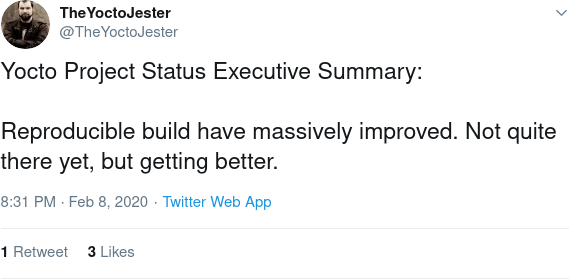
Jeremiah Orians announced on our mailing list the release of a number of tools related to cross-compilation such as M2-Planet and mescc-tools-seed. This project attemps a full bootstrap of a cross-platform compiler for the C programming language (written in C itself) from hex, the ultimate goal being able to demonstrate fully-bootstrapped compiler from hex to the GCC GNU Compiler Collection. This has many implications in and around Ken Thompson s Trusting Trust attack outlined in Thompson s 1983 Turing Award Lecture. Twitter user @TheYoctoJester posted an executive summary of reproducible builds in the Yocto Project: Finally, Reddit user tofflos posted to the /r/Java subreddit asking about how to achieve reproducible builds with Maven and Chris Lamb noticed that the Linux kernel documentation about reproducible builds of it is available on the kernel.org homepages in an attractive HTML format.

Distribution work

Debian Chris Lamb created a merge request for the core debian-installer package to allow all arguments and options from sources.list files (such as [check-valid-until=no] , etc.) in order that we can test the reproducibility of the installer images on the Reproducible Builds own testing infrastructure. (#13) Thorsten Glaser followed-up to a bug filed against the dpkg-source component that was originally filed in late 2015 that claims that the build tool does not respect permissions when unpacking tarballs if the umask is set to 0002. Matthew Garrett posted to the debian-devel mailing list on the topic of Producing verifiable initramfs images as part of a wider conversation on being able to trust the entire software stack on our computers. 59 reviews of Debian packages were added, 30 were updated and 42 were removed this month adding to our knowledge about identified issues. Many issue types were noticed and categorised by Chris Lamb, including:

openSUSE In openSUSE, Bernhard M. Wiedemann published his monthly Reproducible Builds status update as well as provided the following patches:

Software development

diffoscope diffoscope is our in-depth and content-aware diff-like utility that can locate and diagnose reproducibility issues. It is run countless times a day on our testing infrastructure and is essential for identifying fixes and causes of nondeterministic behaviour. Chris Lamb made the following changes this month, including uploading version 137 to Debian:
  • The sng image utility appears to return with an exit code of 1 if there are even minor errors in the file. (#950806)
  • Also extract classes2.dex, classes3.dex from .apk files extracted by apktool. (#88)
  • No need to use str.format if we are just returning the string. [ ]
  • Add generalised support for ignoring returncodes [ ] and move special-casing of returncodes in zip to use Command.VALID_RETURNCODES. [ ]

Other tools disorderfs is our FUSE-based filesystem that deliberately introduces non-determinism into directory system calls in order to flush out reproducibility issues. This month, Vagrant Cascadian updated the Vcs-Git to specify the debian packaging branch. [ ] reprotest is our end-user tool to build same source code twice in widely differing environments and then checks the binaries produced by each build for any differences. This month, versions 0.7.13 and 0.7.14 were uploaded to Debian unstable by Holger Levsen after Vagrant Cascadian added support for GNU Guix [ ].

Project documentation & website There was more work performed on our documentation and website this month. Bernhard M. Wiedemann added a Java Gradle Build Tool snippet to the SOURCE_DATE_EPOCH documentation [ ] and normalised various terms to unreproducible [ ]. Chris Lamb added a Meson.build example [ ] and improved the documentation for the CMake [ ] to the SOURCE_DATE_EPOCH documentation, replaced anyone can with anyone may as, well, not everyone has the resources, skills, time or funding to actually do what it refers to [ ] and improved the pre-processing for our report generation [ ][ ][ ][ ] etc. In addition, Holger Levsen updated our news page to improve the list of reports [ ], added an explicit mention of the weekly news time span [ ] and reverted sorting of news entries to have latest on top [ ] and Mattia Rizzolo added Codethink as a non-fiscal sponsor [ ] and lastly Tianon Gravi added a Docker Images link underneath the Debian project on our Projects page [ ].

Upstream patches The Reproducible Builds project detects, dissects and attempts to fix as many currently-unreproducible packages as possible. We endeavour to send all of our patches upstream where appropriate. This month, we wrote a large number of such patches, including: Vagrant Cascadian submitted patches via the Debian bug tracking system targeting the packages the Civil Infrastructure Platform has identified via the CIP and CIP build depends package sets:

Testing framework We operate a fully-featured and comprehensive Jenkins-based testing framework that powers tests.reproducible-builds.org. This month, the following changes were made by Holger Levsen: In addition, Mattia Rizzolo added an Apache web server redirect for buildinfos.debian.net [ ] and reverted the reshuffling of arm64 architecture builders [ ]. The usual build node maintenance was performed by Holger Levsen, Mattia Rizzolo [ ][ ] and Vagrant Cascadian.

Getting in touch If you are interested in contributing to the Reproducible Builds project, please visit our Contribute page on our website. However, you can get in touch with us via:

This month s report was written by Bernhard M. Wiedemann, Chris Lamb and Holger Levsen. It was subsequently reviewed by a bunch of Reproducible Builds folks on IRC and the mailing list.

23 November 2017

Russ Allbery: Holiday haul

Catching up on accumulated book purchases. I'm going to get another burst of reading time over the holidays (and am really looking forward to it). Alfred Bester The Stars My Destination (sff)
James Blish A Case of Conscience (sff)
Leigh Brackett The Long Tomorrow (sff)
Algis Budrys Who? (sff)
Frances Hardinge Fly By Night (sff)
Robert A. Heinlein Double Star (sff)
N.K. Jemisin The Obelisk Gate (sff)
N.K. Jemisin The Stone Sky (sff)
T. Kingfisher Clockwork Boys (sff)
Ursula K. Le Guin City of Illusions (sff)
Ursula K. Le Guin The Complete Orsinia (historical)
Ursula K. Le Guin The Dispossessed (sff)
Ursula K. Le Guin Five Ways to Forgiveness (sff)
Ursula K. Le Guin The Left Hand of Darkness (sff)
Ursula K. Le Guin Planet of Exile (sff)
Ursula K. Le Guin Rocannon's World (sff)
Ursula K. Le Guin The Telling (sff)
Ursula K. Le Guin The World for Word Is Forest (sff)
Fritz Leiber The Big Time (sff)
Melina Marchetta Saving Francesca (mainstream)
Richard Matheson The Shrinking Man (sff)
Foz Meadows An Accident of Stars (sff)
Dexter Palmer Version Control (sff)
Frederick Pohl & C.M. Kornbluth The Space Merchants (sff)
Adam Rex True Meaning of Smekday (sff)
John Scalzi The Dispatcher (sff)
Julia Spencer-Fleming In the Bleak Midwinter (mystery)
R.E. Stearns Barbary Station (sff)
Theodore Sturgeon More Than Human (sff)
I'm listing the individual components except for the Orsinia collection, but the Le Guin are from the Library of America Hainish Novels & Stories two-volume set. I had several of these already, but I have a hard time resisting a high-quality Library of America collection for an author I really like. Now I can donate a bunch of old paperbacks. Similarly, a whole bunch of the older SF novels are from the Library of America American Science Fiction two-volume set, which I finally bought since I was ordering Library of America sets anyway. The rest is a pretty random collection of stuff, although several of them are recommendations from Light. I was reading through her old reviews and getting inspired to read (and review) more.

22 November 2017

Louis-Philippe V ronneau: DebConf Videoteam sprint report - day 3

Erf, I'm tired and it is late so this report will be short and won't include dank memes or funny cat pictures. Come back tomorrow for that. tumbleweed Stefano worked all day long on the metadata project and on YouTube uploads. I think the DebConf7 videos have just finished being uploaded, check them out! RattusRattus Apart from the wonderful lasagna he baked for us, Andy continued working on the scraping scheme, helping tumbleweed. nattie Nattie has been with us for a few days now, but today she did some great QA work on our metadata scraping of the video archive. ivodd More tests, more bugs! Ivo worked quite a bit on the Opsis board today and it seems everything is ready for the mini-conf. \0/ olasd Nicolas built the streaming network today and wrote some Ansible roles to manage TLS cert creation through Let's Encrypt. He also talked with DSA some more about our long term requirements. wouter I forgot to mention it yesterday because he could not come to Cambridge, but Wouter has been sprinting remotely, working on the reviewing system. Everything with regards to reviewing should be in place for the mini-conf. He also generated the intro and outro slides for the videos for us. KiBi and Julien KiBi and Julien arrived late in the evening, but were nonetheless of great assistance. Neither are technically part of the videoteam, but their respective experience with Debian-Installer and general DSA systems helped us a great deal. pollo I'm about 3/4 done documenting our ansible roles. Once I'm done, I'll try to polish some obvious hacks I've seen while documenting.

12 November 2017

Ben Armstrong: The Joy of Cat Intelligence

As a cat owner, being surprised by cat intelligence delights me. They re not exactly smart like a human, but they are smart in cattish ways. The more I watch them and try to sort out what they re thinking, the more it pleases me to discover they can solve problems and adapt in recognizably intelligent ways, sometimes unique to each individual cat. Each time that happens, it evokes in me affectionate wonder. Today, I had one of those joyful moments. First, you need to understand that some months ago, I thought I had my male cat all figured out with respect to mealtimes. I had been cleaning up after my oafish boy who made a watery mess on the floor from his mother s bowl each morning. I was slightly annoyed, but was mostly curious, and had a hunch. A quick search of the web confirmed it: my cat was left-handed. Not only that, but I learned this is typical for males, whereas females tend to be right-handed. Right away, I knew what I had to do: I adjusted the position of their water bowls relative to their food, swapping them from right to left; the messy morning feedings ceased. I congratulated myself for my cleverness. You see, after the swap, as he hooked the kibbles with his left paw out of the right-hand bowl, they would land immediately on the floor where he could give them chase. The swap caused the messes to cease because before, his left-handed scoops would land the kibbles in the water to the right; he would then have to scoop the kibble out onto the floor, sprinkling water everywhere! Furthermore, the sodden kibble tended to not skitter so much, decreasing his fun. Or so I thought. Clearly, I reasoned, having sated himself on the entire contents of his own bowl, he turned to pilfering his mother s leftovers for some exciting kittenish play. I had evidence to back it up, too: he and his mother both seem to enjoy this game, a regular fixture of their mealtime routines. She, too, is adept at hooking out the kibbles, though mysteriously, without making a mess in her water, whichever way the bowls are oriented. I chalked this up to his general clumsiness of movement vs. her daintiness and precision, something I had observed many times before. Come to think of it, lately, I ve been seeing more mess around his mother s bowl again. Hmm. I don t know why I didn t stop to consider why And then my cat surprised me again. This morning, with Shadow behind my back as I sat at my computer, finishing up his morning meal at his mother s bowl, I thought I heard something odd. Or rather, I didn t hear something. The familiar skitter-skitter sound of kibbles evading capture was missing. So I turned and looked. My dear, devious boy had squished his overgrown body behind his mother s bowls, nudging them ever so slightly askew to fit the small space. Now the bowl orientation was swapped back again. Stunned, I watched him carefully flip out a kibble with his left paw. Plop! Into the water on the right. Concentrating, he fished for it. A miss! He casually licked the water from his paw. Another try. Swoop! Plop, onto the floor. No chase now, just satisfied munching of his somewhat mushy kibble. And then it dawned on me that I had got it somewhat wrong. Yes, he enjoyed Chase the Kibble, like his mom, but I never recognized he had been indulging in a favourite pastime, peculiarly his own I had judged his mealtime messes as accidents, a very human way of thinking about my problem. Little did I know, it was deliberate! His private game was Bobbing for Kibbles. I don t know if it s the altered texture, or dabbling in the bowl, but whatever the reason, due to my meddling, he had been deprived of this pleasure. No worries, a thwarted cat will find a way. And that is the joy of cat intelligence.

7 November 2017

Reproducible builds folks: Reproducible Builds: Weekly report #132

Here's what happened in the Reproducible Builds effort between Sunday October 29 and Saturday November 4 2017: Past events Upcoming events Reproducible work in other projects Packages reviewed and fixed, and bugs filed Reviews of unreproducible packages 7 package reviews have been added, 43 have been updated and 47 have been removed in this week, adding to our knowledge about identified issues. Weekly QA work During our reproducibility testing, FTBFS bugs have been detected and reported by: Documentation updates diffoscope development Version 88 was uploaded to unstable by Mattia Rizzolo. It included contributions (already covered by posts of the previous weeks) from: strip-nondeterminism development Version 0.040-1 was uploaded to unstable by Mattia Rizzolo. It included contributions already covered by posts of the previous weeks, as well as new ones from:
Version 0.5.2-2 was uploaded to unstable by Holger Levsen. It included contributions already covered by posts of the previous weeks, as well as new ones from: reprotest development buildinfo.debian.net development tests.reproducible-builds.org Misc. This week's edition was written by Bernhard M. Wiedemann, Chris Lamb, Mattia Rizzolo & reviewed by a bunch of Reproducible Builds folks on IRC & the mailing lists.

23 October 2017

Russ Allbery: Review: Algorithms to Live By

Review: Algorithms to Live By, by Brian Christian & Tom Griffiths
Publisher: Henry Holt and Company
Copyright: April 2016
ISBN: 1-62779-037-3
Format: Kindle
Pages: 255
Another read for the work book club. This was my favorite to date, apart from the books I recommended myself. One of the foundations of computer science as a field of study is research into algorithms: how do we solve problems efficiently using computer programs? This is a largely mathematical field, but it's often less about ideal or theoretical solutions and more about making the most efficient use of limited resources and arriving at an adequate, if not perfect, answer. Many of these problems are either day-to-day human problems or are closely related to them; after all, the purpose of computer science is to solve practical problems with computers. The question asked by Algorithms to Live By is "can we reverse this?": can we learn lessons from computer science's approach to problems that would help us make day-to-day decisions? There's a lot of interesting material in the eleven chapters of this book, but there's also an amusing theme: humans are already very good at this. Many chapters start with an examination of algorithms and mathematical analysis of problems, dive into a discussion of how we can use those results to make better decisions, then talk about studies of the decisions humans actually make... and discover that humans are already applying ad hoc versions of the best algorithms we've come up with, given the constraints of typical life situations. It tends to undermine the stated goal of the book. Thankfully, it in no way undermines interesting discussion of general classes of problems, how computer science has tackled them, and what we've learned about the mathematical and technical shapes of those problems. There's a bit less self-help utility here than I think the authors had intended, but lots of food for thought. (That said, it's worth considering whether this congruence is less because humans are already good at this and more because our algorithms are designed from human intuition. Maybe our best algorithms just reflect human thinking. In some cases we've checked our solutions against mathematical ideals, but in other cases they're still just our best guesses to date.) This is the sort of a book where a chapter listing is an important part of the review. The areas of algorithms discussed here are optimal stopping, explore/exploit decisions (when to go with the best thing you've found and when to look for something better), sorting, caching, scheduling, Bayes's rule (and prediction in general), overfitting when building models, relaxation (solving an easier problem than your actual problem), randomized algorithms, a collection of networking algorithms, and finally game theory. Each of these has useful insights and thought-provoking discussion of how these sometimes-theoretical concepts map surprisingly well onto daily problems. The book concludes with a discussion of "computational kindness": an encouragement to reduce the required computation and complexity penalty for both yourself and the people you interact with. If you have a computer science background (as I do), many of these will be familiar concepts, and you might be dubious that a popularization would tell you much that's new. Give this book a shot, though; the analogies are less stretched than you might fear, and the authors are both careful and smart about how they apply these principles. This book passes with flying colors a key sanity check: the chapters on topics that I know well or have thought about a lot make few or no obvious errors and say useful and important things. For example, the scheduling chapter, which unsurprisingly is about time management, surpasses more than half of the time management literature by jumping straight to the heart of most time management problems: if you're going to do everything on a list, it rarely matters the order in which you do it, so the hardest scheduling problems are about deciding what not to do rather than deciding order. The point in the book where the authors won my heart completely was in the chapter on Bayes's rule. Much of the chapter is about Bayesian priors, and how one's knowledge of past events is a vital part of analysis of future probabilities. The authors then discuss the (in)famous marshmallow experiment, in which children are given one marshmallow and told that if they refrain from eating it until the researcher returns, they'll get two marshmallows. Refraining from eating the marshmallow (delayed gratification, in the psychological literature) was found to be associated with better life outcomes years down the road. This experiment has been used and abused for years for all sorts of propaganda about how trading immediate pleasure for future gains leads to a successful life, and how failure in life is because of inability to delay gratification. More evil analyses have (of course) tied that capability to ethnicity, with predictably racist results. I have kind of a thing about the marshmallow experiment. It's a topic that reliably sends me off into angry rants. Algorithms to Live By is the only book I have ever read to mention the marshmallow experiment and then apply the analysis that I find far more convincing. This is not a test of innate capability in the children; it's a test of their Bayesian priors. When does it make perfect sense to eat the marshmallow immediately instead of waiting for a reward? When their past experience tells them that adults are unreliable, can't be trusted, disappear for unpredictable lengths of time, and lie. And, even better, the authors supported this analysis with both a follow-up study I hadn't heard of before and with the observation that some children would wait for some time and then "give in." This makes perfect sense if they were subconsciously using a Bayesian model with poor priors. This is a great book. It may try a bit too hard in places (applicability of the math of optimal stopping to everyday life is more contingent and strained than I think the authors want to admit), and some of this will be familiar if you've studied algorithms. But the writing is clear, succinct, and very well-edited. No part of the book outlives its welcome; the discussion moves right along. If you find yourself going "I know all this already," you'll still probably encounter a new concept or neat explanation in a few more pages. And sometimes the authors make connections that never would have occurred to me but feel right in retrospect, such as relating exponential backoff in networking protocols to choosing punishments in the criminal justice system. Or the realization that our modern communication world is not constantly connected, it's constantly buffered, and many of us are suffering from the characteristic signs of buffer bloat. I don't think you have to be a CS major, or know much about math, to read this book. There is a lot of mathematical details in the end notes if you want to dive in, but the main text is almost always readable and clear, at least so far as I could tell (as someone who was a CS major and has taken a lot of math, so a grain of salt may be indicated). And it still has a lot to offer even if you've studied algorithms for years. The more I read of this book, the more I liked it. Definitely recommended if you like reading this sort of analysis of life. Rating: 9 out of 10

Julian Andres Klode: APT 1.6 alpha 1 seccomp and more

I just uploaded APT 1.6 alpha 1, introducing a very scary thing: Seccomp sandboxing for methods, the programs downloading files from the internet and decompressing or compressing stuff. With seccomp I reduced the number of system calls these methods can use to 149 from 430. Specifically we excluded most ways of IPC, xattrs, and most importantly, the ability for methods to clone(2), fork(2), or execve(2) (or execveat(2)). Yes, that s right methods can no longer execute programs. This was a real problem, because the http method did in fact execute programs there is this small option called ProxyAutoDetect or Proxy-Auto-Detect where you can specify a script to run for an URL and the script outputs a (list of) proxies. In order to be able to seccomp the http method, I moved the invocation of the script to the parent process. The parent process now executes the script within the sandbox user, but without seccomp (obviously). I tested the code on amd64, ppc64el, s390x, arm64, mipsel, i386, and armhf. I hope it works on all other architectures libseccomp is currently built for in Debian, but I did not check that, so your apt might be broken now if you use powerpc, powerpcspe, armel, mips, mips64el, hhpa, or x32 (I don t think you can even really use x32). Also, apt-transport-https is gone for good now. When installing the new apt release, any installed apt-transport-https package is removed (apt breaks apt-transport-https now, but it also provides it versioned, so any dependencies should still be satisfiable). David also did a few cool bug fixes again, finally teaching apt-key to ignore unsupported GPG key files instead of causing weird errors
Filed under: Uncategorized

17 October 2017

Antoine Beaupr : A comparison of cryptographic keycards

An earlier article showed that private key storage is an important problem to solve in any cryptographic system and established keycards as a good way to store private key material offline. But which keycard should we use? This article examines the form factor, openness, and performance of four keycards to try to help readers choose the one that will fit their needs. I have personally been using a YubiKey NEO, since a 2015 announcement on GitHub promoting two-factor authentication. I was also able to hook up my SSH authentication key into the YubiKey's 2048 bit RSA slot. It seemed natural to move the other subkeys onto the keycard, provided that performance was sufficient. The mail client that I use, (Notmuch), blocks when decrypting messages, which could be a serious problems on large email threads from encrypted mailing lists. So I built a test harness and got access to some more keycards: I bought a FST-01 from its creator, Yutaka Niibe, at the last DebConf and Nitrokey donated a Nitrokey Pro. I also bought a YubiKey 4 when I got the NEO. There are of course other keycards out there, but those are the ones I could get my hands on. You'll notice none of those keycards have a physical keypad to enter passwords, so they are all vulnerable to keyloggers that could extract the key's PIN. Keep in mind, however, that even with the PIN, an attacker could only ask the keycard to decrypt or sign material but not extract the key that is protected by the card's firmware.

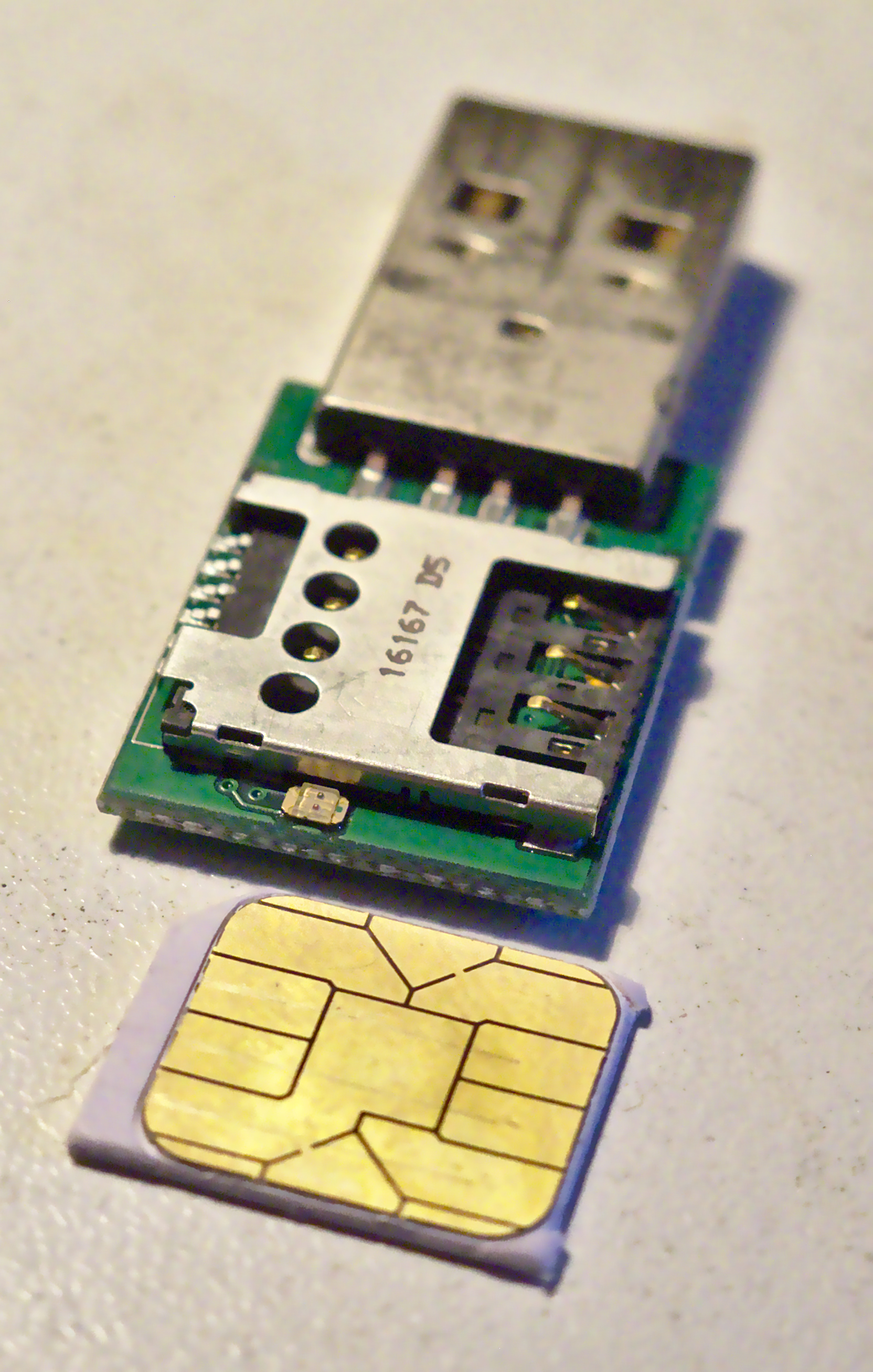
Form factor The Nitrokey Pro, YubiKey NEO (worn out), YubiKey 4, and FST-01 The four keycards have similar form factors: they all connect to a standard USB port, although both YubiKey keycards have a capacitive button by which the user triggers two-factor authentication and the YubiKey 4 can also require a button press to confirm private key use. The YubiKeys feel sturdier than the other two. The NEO has withstood two years of punishment in my pockets along with the rest of my "real" keyring and there is only minimal wear on the keycard in the picture. It's also thinner so it fits well on the keyring. The FST-01 stands out from the other two with its minimal design. Out of the box, the FST-01 comes without a case, so the circuitry is exposed. This is deliberate: one of its goals is to be as transparent as possible, both in terms of software and hardware design and you definitely get that feeling at the physical level. Unfortunately, that does mean it feels more brittle than other models: I wouldn't carry it in my pocket all the time, although there is a case that may protect the key a little better, but it does not provide an easy way to hook it into a keyring. In the group picture above, the FST-01 is the pink plastic thing, which is a rubbery casing I received along with the device when I got it. Notice how the USB connectors of the YubiKeys differ from the other two: while the FST-01 and the Nitrokey have standard USB connectors, the YubiKey has only a "half-connector", which is what makes it thinner than the other two. The "Nano" form factor takes this even further and almost disappears in the USB port. Unfortunately, this arrangement means the YubiKey NEO often comes loose and falls out of the USB port, especially when connected to a laptop. On my workstation, however, it usually stays put even with my whole keyring hanging off of it. I suspect this adds more strain to the host's USB port but that's a tradeoff I've lived with without any noticeable wear so far. Finally, the NEO has this peculiar feature of supporting NFC for certain operations, as LWN previously covered, but I haven't used that feature yet. The Nitrokey Pro looks like a normal USB key, in contrast with the other two devices. It does feel a little brittle when compared with the YubiKey, although only time will tell how much of a beating it can take. It has a small ring in the case so it is possible to carry it directly on your keyring, but I would be worried the cap would come off eventually. Nitrokey devices are also two times thicker than the Yubico models which makes them less convenient to carry around on keyrings.

Open and closed designs The FST-01 is as open as hardware comes, down to the PCB design available as KiCad files in this Git repository. The software running on the card is the Gnuk firmware that implements the OpenPGP card protocol, but you can also get it with firmware implementing a true random number generator (TRNG) called NeuG (pronounced "noisy"); the device is programmable through a standard Serial Wire Debug (SWD) port. The Nitrokey Start model also runs the Gnuk firmware. However, the Nitrokey website announces only ECC and RSA 2048-bit support for the Start, while the FST-01 also supports RSA-4096. Nitrokey's founder Jan Suhr, in a private email, explained that this is because "Gnuk doesn't support RSA-3072 or larger at a reasonable speed". Its devices (the Pro, Start, and HSM models) use a similar chip to the FST-01: the STM32F103 microcontroller. Nitrokey Pro with STM32F103TBU6 MCU Nitrokey also publishes its hardware designs, on GitHub, which shows the Pro is basically a fork of the FST-01, according to the ChangeLog. I opened the case to confirm it was using the STM MCU, something I should warn you against; I broke one of the pins holding it together when opening it so now it's even more fragile. But at least, I was able to confirm it was built using the STM32F103TBU6 MCU, like the FST-01. Nitrokey back side But this is where the comparison ends: on the back side, we find a SIM card reader that holds the OpenPGP card that, in turn, holds the private key material and does the cryptographic operations. So, in effect, the Nitrokey Pro is really a evolution of the original OpenPGP card readers. Nitrokey confirmed the OpenPGP card featured in the Pro is the same as the one shipped by the Free Software Foundation Europe (FSFE): the BasicCard built by ZeitControl. Those cards, however, are covered by NDAs and the firmware is only partially open source. This makes the Nitrokey Pro less open than the FST-01, but that's an inevitable tradeoff when choosing a design based on the OpenPGP cards, which Suhr described to me as "pretty proprietary". There are other keycards out there, however, for example the SLJ52GDL150-150k smartcard suggested by Debian developer Yves-Alexis Perez, which he prefers as it is certified by French and German authorities. In that blog post, he also said he was experimenting with the GPL-licensed OpenPGP applet implemented by the French ANSSI. But the YubiKey devices are even further away in the closed-design direction. Both the hardware designs and firmware are proprietary. The YubiKey NEO, for example, cannot be upgraded at all, even though it is based on an open firmware. According to Yubico's FAQ, this is due to "best security practices": "There is a 'no upgrade' policy for our devices since nothing, including malware, can write to the firmware." I find this decision questionable in a context where security updates are often more important than trying to design a bulletproof design, which may simply be impossible. And the YubiKey NEO did suffer from critical security issue that allowed attackers to bypass the PIN protection on the card, which raises the question of the actual protection of the private key material on those cards. According to Niibe, "some OpenPGP cards store the private key unencrypted. It is a common attitude for many smartcard implementations", which was confirmed by Suhr: "the private key is protected by hardware mechanisms which prevent its extraction and misuse". He is referring to the use of tamper resistance. After that security issue, there was no other option for YubiKey NEO users than to get a new keycard (for free, thankfully) from Yubico, which also meant discarding the private key material on the key. For OpenPGP keys, this may mean having to bootstrap the web of trust from scratch if the keycard was responsible for the main certification key. But at least the NEO is running free software based on the OpenPGP card applet and the source is still available on GitHub. The YubiKey 4, on the other hand, is now closed source, which was controversial when the new model was announced last year. It led the main Linux Foundation system administrator, Konstantin Ryabitsev, to withdraw his endorsement of Yubico products. In response, Yubico argued that this approach was essential to the security of its devices, which are now based on "a secure chip, which has built-in countermeasures to mitigate a long list of attacks". In particular, it claims that:
A commercial-grade AVR or ARM controller is unfit to be used in a security product. In most cases, these controllers are easy to attack, from breaking in via a debug/JTAG/TAP port to probing memory contents. Various forms of fault injection and side-channel analysis are possible, sometimes allowing for a complete key recovery in a shockingly short period of time.
While I understand those concerns, they eventually come down to the trust you have in an organization. Not only do we have to trust Yubico, but also hardware manufacturers and designs they have chosen. Every step in the hidden supply chain is then trusted to make correct technical decisions and not introduce any backdoors. History, unfortunately, is not on Yubico's side: Snowden revealed the example of RSA security accepting what renowned cryptographer Bruce Schneier described as a "bribe" from the NSA to weaken its ECC implementation, by using the presumably backdoored Dual_EC_DRBG algorithm. What makes Yubico or its suppliers so different from RSA Security? Remember that RSA Security used to be an adamant opponent to the degradation of encryption standards, campaigning against the Clipper chip in the first crypto wars. Even if we trust the Yubico supply chain, how can we trust a closed design using what basically amounts to security through obscurity? Publicly auditable designs are an important tradition in cryptography, and that principle shouldn't stop when software is frozen into silicon. In fact, a critical vulnerability called ROCA disclosed recently affects closed "smartcards" like the YubiKey 4 and allows full private key recovery from the public key if the key was generated on a vulnerable keycard. When speaking with Ars Technica, the researchers outlined the importance of open designs and questioned the reliability of certification:
Our work highlights the dangers of keeping the design secret and the implementation closed-source, even if both are thoroughly analyzed and certified by experts. The lack of public information causes a delay in the discovery of flaws (and hinders the process of checking for them), thereby increasing the number of already deployed and affected devices at the time of detection.
This issue with open hardware designs seems to be recurring topic of conversation on the Gnuk mailing list. For example, there was a discussion in September 2017 regarding possible hardware vulnerabilities in the STM MCU that would allow extraction of encrypted key material from the key. Niibe referred to a talk presented at the WOOT 17 workshop, where Johannes Obermaier and Stefan Tatschner, from the Fraunhofer Institute, demonstrated attacks against the STMF0 family MCUs. It is still unclear if those attacks also apply to the older STMF1 design used in the FST-01, however. Furthermore, extracted private key material is still protected by user passphrase, but the Gnuk uses a weak key derivation function, so brute-forcing attacks may be possible. Fortunately, there is work in progress to make GnuPG hash the passphrase before sending it to the keycard, which should make such attacks harder if not completely pointless. When asked about the Yubico claims in a private email, Niibe did recognize that "it is true that there are more weak points in general purpose implementations than special implementations". During the last DebConf in Montreal, Niibe explained:
If you don't trust me, you should not buy from me. Source code availability is only a single factor: someone can maliciously replace the firmware to enable advanced attacks.
Niibe recommends to "build the firmware yourself", also saying the design of the FST-01 uses normal hardware that "everyone can replicate". Those advantages are hard to deny for a cryptographic system: using more generic components makes it harder for hostile parties to mount targeted attacks. A counter-argument here is that it can be difficult for a regular user to audit such designs, let alone physically build the device from scratch but, in a mailing list discussion, Debian developer Ian Jackson explained that:
You don't need to be able to validate it personally. The thing spooks most hate is discovery. Backdooring supposedly-free hardware is harder (more costly) because it comes with greater risk of discovery. To put it concretely: if they backdoor all of them, someone (not necessarily you) might notice. (Backdooring only yours involves messing with the shipping arrangements and so on, and supposes that you specifically are of interest.)
Since that, as far as we know, the STM microcontrollers are not backdoored, I would tend to favor those devices instead of proprietary ones, as such a backdoor would be more easily detectable than in a closed design. Even though physical attacks may be possible against those microcontrollers, in the end, if an attacker has physical access to a keycard, I consider the key compromised, even if it has the best chip on the market. In our email exchange, Niibe argued that "when a token is lost, it is better to revoke keys, even if the token is considered secure enough". So like any other device, physical compromise of tokens may mean compromise of the key and should trigger key-revocation procedures.

Algorithms and performance To establish reliable performance results, I wrote a benchmark program naively called crypto-bench that could produce comparable results between the different keys. The program takes each algorithm/keycard combination and runs 1000 decryptions of a 16-byte file (one AES-128 block) using GnuPG, after priming it to get the password cached. I assume the overhead of GnuPG calls to be negligible, as it should be the same across all tokens, so comparisons are possible. AES encryption is constant across all tests as it is always performed on the host and fast enough to be irrelevant in the tests. I used the following:
  • Intel(R) Core(TM) i3-6100U CPU @ 2.30GHz running Debian 9 ("stretch"/stable amd64), using GnuPG 2.1.18-6 (from the stable Debian package)
  • Nitrokey Pro 0.8 (latest firmware)
  • FST-01, running Gnuk version 1.2.5 (latest firmware)
  • YubiKey NEO OpenPGP applet 1.0.10 (not upgradable)
  • YubiKey 4 4.2.6 (not upgradable)
I ran crypto-bench for each keycard, which resulted in the following:
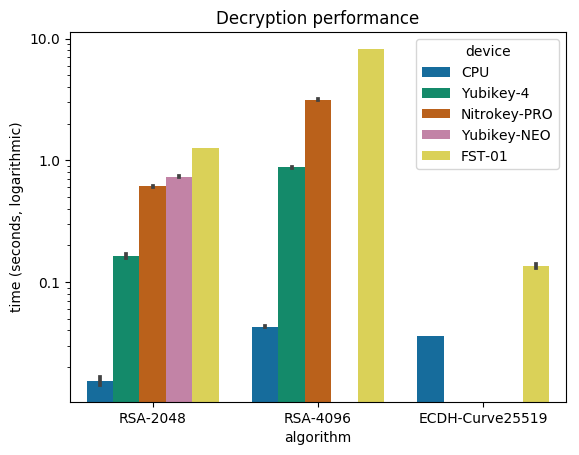
Algorithm Device Mean time (s)
ECDH-Curve25519 CPU 0.036
FST-01 0.135
RSA-2048 CPU 0.016
YubiKey-4 0.162
Nitrokey-Pro 0.610
YubiKey-NEO 0.736
FST-01 1.265
RSA-4096 CPU 0.043
YubiKey-4 0.875
Nitrokey-Pro 3.150
FST-01 8.218
Decryption graph There we see the performance of the four keycards I tested, compared with the same operations done without a keycard: the "CPU" device. That provides the baseline time of GnuPG decrypting the file. The first obvious observation is that using a keycard is slower: in the best scenario (FST-01 + ECC) we see a four-fold slowdown, but in the worst case (also FST-01, but RSA-4096), we see a catastrophic 200-fold slowdown. When I presented the results on the Gnuk mailing list, GnuPG developer Werner Koch confirmed those "numbers are as expected":
With a crypto chip RSA is much faster. By design the Gnuk can't be as fast - it is just a simple MCU. However, using Curve25519 Gnuk is really fast.
And yes, the FST-01 is really fast at doing ECC, but it's also the only keycard that handles ECC in my tests; the Nitrokey Start and Nitrokey HSM should support it as well, but I haven't been able to test those devices. Also note that the YubiKey NEO doesn't support RSA-4096 at all, so we can only compare RSA-2048 across keycards. We should note, however, that ECC is slower than RSA on the CPU, which suggests the Gnuk ECC implementation used by the FST-01 is exceptionally fast. In discussions about improving the performance of the FST-01, Niibe estimated the user tolerance threshold to be "2 seconds decryption time". In a new design using the STM32L432 microcontroller, Aurelien Jarno was able to bring the numbers for RSA-2048 decryption from 1.27s down to 0.65s, and for RSA-4096, from 8.22s down to 3.87s seconds. RSA-4096 is still beyond the two-second threshold, but at least it brings the FST-01 close to the YubiKey NEO and Nitrokey Pro performance levels. We should also underline the superior performance of the YubiKey 4: whatever that thing is doing, it's doing it faster than anyone else. It does RSA-4096 faster than the FST-01 does RSA-2048, and almost as fast as the Nitrokey Pro does RSA-2048. We should also note that the Nitrokey Pro also fails to cross the two-second threshold for RSA-4096 decryption. For me, the FST-01's stellar performance with ECC outshines the other devices. Maybe it says more about the efficiency of the algorithm than the FST-01 or Gnuk's design, but it's definitely an interesting avenue for people who want to deploy those modern algorithms. So, in terms of performance, it is clear that both the YubiKey 4 and the FST-01 take the prize in their own areas (RSA and ECC, respectively).

Conclusion In the above presentation, I have evaluated four cryptographic keycards for use with various OpenPGP operations. What the results show is that the only efficient way of storing a 4096-bit encryption key on a keycard would be to use the YubiKey 4. Unfortunately, I do not feel we should put our trust in such closed designs so I would argue you should either stick with 2048-bit encryption subkeys or keep the keys on disk. Considering that losing such a key would be catastrophic, this might be a good approach anyway. You should also consider switching to ECC encryption: even though it may not be supported everywhere, GnuPG supports having multiple encryption subkeys on a keyring: if one algorithm is unsupported (e.g. GnuPG 1.4 doesn't support ECC), it will fall back to a supported algorithm (e.g. RSA). Do not forget your previously encrypted material doesn't magically re-encrypt itself using your new encryption subkey, however. For authentication and signing keys, speed is not such an issue, so I would warmly recommend either the Nitrokey Pro or Start, or the FST-01, depending on whether you want to start experimenting with ECC algorithms. Availability also seems to be an issue for the FST-01. While you can generally get the device when you meet Niibe in person for a few bucks (I bought mine for around \$30 Canadian), the Seeed online shop says the device is out of stock at the time of this writing, even though Jonathan McDowell said that may be inaccurate in a debian-project discussion. Nevertheless, this issue may make the Nitrokey devices more attractive. When deciding on using the Pro or Start, Suhr offered the following advice:
In practice smart card security has been proven to work well (at least if you use a decent smart card). Therefore the Nitrokey Pro should be used for high security cases. If you don't trust the smart card or if Nitrokey Start is just sufficient for you, you can choose that one. This is why we offer both models.
So far, I have created a signing subkey and moved that and my authentication key to the YubiKey NEO, because it's a device I physically trust to keep itself together in my pockets and I was already using it. It has served me well so far, especially with its extra features like U2F and HOTP support, which I use frequently. Those features are also available on the Nitrokey Pro, so that may be an alternative if I lose the YubiKey. I will probably move my main certification key to the FST-01 and a LUKS-encrypted USB disk, to keep that certification key offline but backed up on two different devices. As for the encryption key, I'll wait for keycard performance to improve, or simply switch my whole keyring to ECC and use the FST-01 or Nitrokey Start for that purpose.
[The author would like to thank Nitrokey for providing hardware for testing.] This article first appeared in the Linux Weekly News.

14 October 2017

Lior Kaplan: Debian Installer git repository

While dealing with d-i s translation last month in FOSScamp, I was kinda surprised it s still on SVN. While reviewing PO files from others, I couldn t select specific parts to commit. Debian does have a git server, and many DDs (Debian Developers) use it for their Debian work, but it s not as public as I wish it to be. Meaning I lack the pull / merge request abilities as well as the review process. Recently I got a reminder that the D-I s Hebrew translation needs some love. I asked my local community for help. Receiving a PO file by mail, reminded me of the SVN annoyance. So this time I decided to convert it to git and ask people to send me pull requests. Another benefit would be making the process more transparent as others could see these PRs (and hopefully comment if needed). For this experiment, I opened a repository on GitHub at https://github.com/kaplanlior/debian-installer I know they aren t open source as GitLab, but they are a popular choice which is a good start for my experiment. If and when it succeeds, we can discuss the platform.
debian-9

Debian 9

(featured image by Jonathan Carter)
Filed under: Debian GNU/Linux

8 October 2017

Daniel Pocock: A step change in managing your calendar, without social media

Have you been to an event recently involving free software or a related topic? How did you find it? Are you organizing an event and don't want to fall into the trap of using Facebook or Meetup or other services that compete for a share of your community's attention? Are you keen to find events in foreign destinations related to your interest areas to coincide with other travel intentions? Have you been concerned when your GSoC or Outreachy interns lost a week of their project going through the bureaucracy to get a visa for your community's event? Would you like to make it easier for them to find the best events in the countries that welcome and respect visitors? In many recent discussions about free software activism, people have struggled to break out of the illusion that social media is the way to cultivate new contacts. Wouldn't it be great to make more meaningful contacts by attending more a more diverse range of events rather than losing time on social media? Making it happen There are already a number of tools (for example, Drupal plugins and Wordpress plugins) for promoting your events on the web and in iCalendar format. There are also a number of sites like Agenda du Libre and GriCal who aggregate events from multiple communities where people can browse them. How can we take these concepts further and make a convenient, compelling and global solution? Can we harvest event data from a wide range of sources and compile it into a large database using something like PostgreSQL or a NoSQL solution or even a distributed solution like OpenDHT? Can we use big data techniques to mine these datasources and help match people to events without compromising on privacy? Why not build an automated iCalendar "to-do" list of deadlines for events you want to be reminded about, so you never miss the deadlines for travel sponsorship or submitting a talk proposal? I've started documenting an architecture for this on the Debian wiki and proposed it as an Outreachy project. It will also be offered as part of GSoC in 2018. Ways to get involved If you would like to help this project, please consider introducing yourself on the debian-outreach mailing list and helping to mentor or refer interns for the project. You can also help contribute ideas for the specification through the mailing list or wiki. Mini DebConf Prishtina 2017 This weekend I've been at the MiniDebConf in Prishtina, Kosovo. It has been hosted by the amazing Prishtina hackerspace community. Watch out for future events in Prishtina, the pizzas are huge, but that didn't stop them disappearing before we finished the photos:

3 October 2017

Reproducible builds folks: Reproducible Builds: Weekly report #127

Here's what happened in the Reproducible Builds effort between Sunday September 24 and Saturday September 30 2017: Development and fixes in key packages Kai Harries did an initial packaging of the Nix package manager for Debian. You can track his progress in #877019. Uploads in Debian: Packages reviewed and fixed, and bugs filed Patches sent upstream: Reproducible bugs (with patches) filed in Debian: QA bugs filed in Debian: Reviews of unreproducible packages 103 package reviews have been added, 153 have been updated and 78 have been removed in this week, adding to our knowledge about identified issues. Weekly QA work During our reproducibility testing, FTBFS bugs have been detected and reported by: diffoscope development Mattia Rizzolo uploaded version 87 to stretch-backports. strip-nondeterminism development reprotest development tests.reproducible-builds.org reproducible-website development Misc. This week's edition was written by Ximin Luo, Bernhard M. Wiedemann, Holger Levsen and Chris Lamb & reviewed by a bunch of Reproducible Builds folks on IRC & the mailing lists.

2 October 2017

Antoine Beaupr : My free software activities, September 2017

Debian Long Term Support (LTS) This is my monthly Debian LTS report. I mostly worked on the git, git-annex and ruby packages this month but didn't have time to completely use my allocated hours because I started too late in the month.

Ruby I was hoping someone would pick up the Ruby work I submitted in August, but it seems no one wanted to touch that mess, understandably. Since then, new issues came up, and not only did I have to work on the rubygems and ruby1.9 package, but now the ruby1.8 package also had to get security updates. Yes: it's bad enough that the rubygems code is duplicated in one other package, but wheezy had the misfortune of having two Ruby versions supported. The Ruby 1.9 also failed to build from source because of test suite issues, which I haven't found a clean and easy fix for, so I ended up making test suite failures non-fatal in 1.9, which they were already in 1.8. I did keep a close eye on changes in the test suite output to make sure tests introduced in the security fixes would pass and that I wouldn't introduce new regressions as well. So I published the following advisories:
  • ruby 1.8: DLA-1113-1, fixing CVE-2017-0898 and CVE-2017-10784. 1.8 doesn't seem affected by CVE-2017-14033 as the provided test does not fail (but it does fail in 1.9.1). test suite was, before patch:
    2199 tests, 1672513 assertions, 18 failures, 51 errors
    
    and after patch:
    2200 tests, 1672514 assertions, 18 failures, 51 errors
    
  • rubygems: uploaded the package prepared in August as is in DLA-1112-1, fixing CVE-2017-0899, CVE-2017-0900, CVE-2017-0901. here the test suite passed normally.
  • ruby 1.9: here I used the used 2.2.8 release tarball to generate a patch that would cover all issues and published DLA-1114-1 that fixes the CVEs of the two packages above. the test suite was, before patches:
    10179 tests, 2232711 assertions, 26 failures, 23 errors, 51 skips
    
    and after patches:
    1.9 after patches (B): 10184 tests, 2232771 assertions, 26 failures, 23 errors, 53 skips
    

Git I also quickly issued an advisory (DLA-1120-1) for CVE-2017-14867, an odd issue affecting git in wheezy. The backport was tricky because it wouldn't apply cleanly and the git package had a custom patching system which made it tricky to work on.

Git-annex I did a quick stint on git-annex as well: I was able to reproduce the issue and confirm an approach to fixing the issue in wheezy, although I didn't have time to complete the work before the end of the month.

Other free software work

New project: feed2exec I should probably make a separate blog post about this, but ironically, I don't want to spend too much time writing those reports, so this will be quick. I wrote a new program, called feed2exec. It's basically a combination of feed2imap, rss2email and feed2tweet: it allows you to fetch RSS feeds and send them in a mailbox, but what's special about it, compared to the other programs above, is that it is more generic: you can basically make it do whatever you want on new feed items. I have, for example, replaced my feed2tweet instance with it, using this simple configuration:
[anarcat]
url = https://anarc.at/blog/index.rss
output = feed2exec.plugins.exec
args = tweet "%(title)0.70s %(link)0.70s"
The sample configuration file also has examples to talk with Mastodon, Pump.io and, why not, a torrent server to download torrent files available over RSS feeds. A trivial configuration can also make it work as a crude podcast client. My main motivation to work on this was that it was difficult to extend feed2imap to do what I needed (which was to talk to transmission to download torrent files) and rss2email didn't support my workflow (which is delivering to feed-specific mail folders). Because both projects also seemed abandoned, it seemed like a good idea at the time to start a new one, although the rss2email community has now restarted the project and may produce interesting results. As an experiment, I tracked my time working on this project. It turns out it took about 45 hours to write that software. Considering feed2exec is about 1400 SLOC, that's 30 lines of code per hour. I don't know if that's slow or fast, but it's an interesting metric for future projects. It sure seems slow to me, but we need to keep in mind those 30 lines of code don't include documentation and repeated head banging on the keyboard. For example, I found two issues with the upstream feedparser package which I use to parse feeds which also seems unmaintained, unfortunately. Feed2exec is beta software at this point, but it's working well enough for me and the design is much simpler than the other programs of the kind. The main issue people can expect from it at this point is formatting issues or parse errors on exotic feeds, and noisy error messages on network errors, all of which should be fairly easy to fix in the test suite. I hope it will be useful for the community and, as usual, I welcome contributions, help and suggestions on how to improve the software.

More Python templates As part of the work on feed2exec, I did cleanup a few things in the ecdysis project, mostly to hook tests up in the CI, improve on the advancedConfig logger and cleanup more stuff. While I was there, it turns out that I built a pretty decent basic CI configuration for Python on GitLab. Whereas the previous templates only had a non-working Django example, you should now be able to chose a Python template when you configure CI on GitLab 10 and above, which should hook you up with normal Python setup procedures like setup.py install and setup.py test.

Selfspy I mentioned working on a monitoring tool in my last post, because it was a feature from Workrave missing in SafeEyes. It turns out there is already such a tool called selfspy. I did an extensive review of the software to make sure it wouldn't leak out confidential information out before using it, and it looks, well... kind of okay. It crashed on me at least once so far, which is too bad because then it loses track of the precious activity. I have used it at least once to figure out what the heck I worked on during the day, so it's pretty useful. I particularly used it to backtrack my work on feed2exec as I didn't originally track my time on the project. Unfortunately, selfspy seems unmaintained. I have proposed a maintenance team and hopefully the project maintainer will respond and at least share access so we don't end up in a situation like linkchecker. I also sent a bunch of pull requests to fix some issues like being secure by default and fixing the build. Apart from the crash, the main issue I have found with the software is that it doesn't detect idle time which means certain apps are disproportionatly represented in statistics. There are also some weaknesses in the crypto that should be adressed for people that encrypt their database. Next step is to package selfspy in Debian which should hopefully be simple enough...

Restic documentation security As part of a documentation patch on the Restic backup software, I have improved on my previous Perl script to snoop on process commandline arguments. A common flaw in shell scripts and cron jobs is to pass secret material in the environment (usually safe) but often through commandline arguments (definitely not safe). The challenge, in this peculiar case, was the env binary, but the last time I encountered such an issue was with the Drush commandline tool, which was passing database credentials in clear to the mysql binary. Using my Perl sniffer, I could get to 60 checks per second (or 60Hz). After reimplementing it in Python, this number went up to 160Hz, which still wasn't enough to catch the elusive env command, which is much faster at hiding arguments than MySQL, in large part because it simply does an execve() once the environment is setup. Eventually, I just went crazy and rewrote the whole thing in C which was able to get 700-900Hz and did catch the env command about 10-20% of the time. I could probably have rewritten this by simply walking /proc myself (since this is what all those libraries do in the end) to get better result, but then my point was made. I was able to prove to the restic author the security issues that warranted the warning. It's too bad I need to repeat this again and again, but then my tools are getting better at proving that issue... I suspect it's not the last time I have to deal with this issue and I am happy to think that I can come up with an even more efficient proof of concept tool the next time around.

Ansible 101 After working on documentation last month, I ended up writing my first Ansible playbook this month, converting my tasksel list to a working Ansible configuration. This was a useful exercise: it allow me to find a bunch of packages which have been removed from Debian and provides much better usability than tasksel. For example, it provides a --diff argument that shows which packages are missing from a given setup. I am still unsure about Ansible. Manifests do seem really verbose and I still can't get used to the YAML DSL. I could probably have done the same thing with Puppet and just run puppet apply on the resulting config. But I must admit my bias towards Python is showing here: I can't help but think Puppet is going to be way less accessible with its rewrite in Clojure and C (!)... But then again, I really like Puppet's approach of having generic types like package or service rather than Ansible's clunky apt/yum/dnf/package/win_package types...

Pat and Ham radio After responding (too late) to a request for volunteers to help in Puerto Rico, I realized that my amateur radio skills were somewhat lacking in the "packet" (data transmission in ham jargon) domain, as I wasn't used to operate a Winlink node. Such a node can receive and transmit actual emails over the airwaves, for free, without direct access to the internet, which is very useful in disaster relief efforts. Through summary research, I stumbled upon the new and very promising Pat project which provides one of the first user-friendly Linux-compatible Winlink programs. I provided improvements on the documentation and some questions regarding compatibility issues which are still pending. But my pet issue is the establishment of pat as a normal internet citizen by using standard protocols for receiving and sending email. Not sure how that can be implemented, but we'll see. I am also hoping to upload an official Debian package and hopefully write more about this soon. Stay tuned!

Random stuff I ended up fixing my Kodi issue by starting it as a standalone systemd service, instead of gdm3, which is now completely disabled on the media box. I simply used the following /etc/systemd/service/kodi.service file:
[Unit]
Description=Kodi Media Center
After=systemd-user-sessions.service network.target sound.target
[Service]
User=xbmc
Group=video
Type=simple
TTYPath=/dev/tty7
StandardInput=tty
ExecStart=/usr/bin/xinit /usr/bin/dbus-launch --exit-with-session /usr/bin/kodi-standalone -- :1 -nolisten tcp vt7
Restart=on-abort
RestartSec=5
[Install]
WantedBy=multi-user.target
The downside of this is that it needs Xorg to run as root, whereas modern Xorg can now run rootless. Not sure how to fix this or where... But if I put needs_root_rights=no in Xwrapper.config, I get the following error in .local/share/xorg/Xorg.1.log:
[  2502.533] (EE) modeset(0): drmSetMaster failed: Permission denied
After fooling around with iPython, I ended up trying the xonsh shell, which is supposed to provide a bash-compatible Python shell environment. Unfortunately, I found it pretty unusable as a shell: it works fine to do Python stuff, but then all my environment and legacy bash configuration files were basically ignored so I couldn't get working quickly. This is too bad because the project looked very promising... Finally, one of my TLS hosts using a Let's Encrypt certificate wasn't renewing properly, and I figured out why. It turns out the ProxyPass command was passing everything to the backend, including the /.well-known requests, which obviously broke ACME verification. The solution was simple enough, disable the proxy for that directory:
ProxyPass /.well-known/ !

Next.

Previous.