Search Results: "tats"

25 January 2013

Richard Hartmann: Release Critical Bug report for Week 04

The UDD bugs interface currently knows about the following release critical bugs: How do we compare to the Squeeze release cycle?
Week Squeeze Wheezy Diff
43 284 (213+71) 468 (332+136) +184 (+119/+65)
44 261 (201+60) 408 (265+143) +147 (+64/+83)
45 261 (205+56) 425 (291+134) +164 (+86/+78)
46 271 (200+71) 401 (258+143) +130 (+58/+72)
47 283 (209+74) 366 (221+145) +83 (+12/+71)
48 256 (177+79) 378 (230+148) +122 (+53/+69)
49 256 (180+76) 360 (216+155) +104 (+36/+79)
50 204 (148+56) 339 (195+144) +135 (+47/+90)
51 178 (124+54) 323 (190+133) +145 (+66/+79)
52 115 (78+37) 289 (190+99) +174 (+112/+62)
1 93 (60+33) 287 (171+116) +194 (111/+83)
2 82 (46+36) 271 (162+109) +189 (+116/+73)
3 25 (15+10) 249 (165+84) +224 (+150/+74)
4 14 (8+6) 244 (176+68) +230 (+168/+62)
5 2 (0+2)
6 release!
Graphical overview of bug stats thanks to azhag:

18 January 2013

Richard Hartmann: Release Critical Bug report for Week 03

The UDD bugs interface currently knows about the following release critical bugs: How do we compare to the Squeeze release cycle?
Week Squeeze Wheezy Diff
43 284 (213+71) 468 (332+136) +184 (+119/+65)
44 261 (201+60) 408 (265+143) +147 (+64/+83)
45 261 (205+56) 425 (291+134) +164 (+86/+78)
46 271 (200+71) 401 (258+143) +130 (+58/+72)
47 283 (209+74) 366 (221+145) +83 (+12/+71)
48 256 (177+79) 378 (230+148) +122 (+53/+69)
49 256 (180+76) 360 (216+155) +104 (+36/+79)
50 204 (148+56) 339 (195+144) +135 (+47/+90)
51 178 (124+54) 323 (190+133) +145 (+66/+79)
52 115 (78+37) 289 (190+99) +174 (+112/+62)
1 93 (60+33) 287 (171+116) +194 (111/+83)
2 82 (46+36) 271 (162+109) +189 (+116/+73)
3 25 (15+10) 249 (165+84) +224 (150/+74)
4 14 (8+6)
5 2 (0+2)
6 release!
Graphical overview of bug stats thanks to azhag:

Ingo Juergensmann: Progress of m68k port

A few weeks ago on Christmas Wouter and I blogged about the successful reinstallation of m68k buildds after a very long period of years of inactivity. This even got us mentioned on Slashdot. It's been now roughly 3 weeks since then and we made some sort of progress:

Debian-ports.org shows now that we're from 20% keeping up to about 60% keeping up. The installed packages went from ~1900 to about 3800 and we even triggered 200 packages from BD-uninstallable to Needs-Build:

  wanna-build statistics - Fri Jan 18 06:52:36 CET 2013
  -----------------------------------------------------
Distribution unstable:
---------------------
Installed       :  3868 (buildd_m68k-ara5: 488, buildd_m68k-arrakis: 20,
                         buildd_m68k-elgar: 106, buildd_m68k-vivaldi: 80,
                         tg: 1412, unknown: 1761, wouter: 1)
Needs-Build     :  3500
Building        :    26 (buildd_m68k-ara5: 1, buildd_m68k-elgar: 1,
                         buildd_m68k-vivaldi: 1, tg: 23)
Built           :     0
Uploaded        :     1 (tg: 1)
Failed          :    34 (buildd_m68k-ara5: 17, tg: 17)
Dep-Wait        :     4 (tg: 4)
Reupload-Wait   :     0
Install-Wait    :     0
Failed-Removed  :     0
Dep-Wait-Removed:     0
BD-Uninstallable:  2320
Auto-Not-For-Us :   188
Not-For-Us      :     9
total           :  9975
 38.78% (3868) up-to-date,  38.79% (3869) including uploaded
 35.09% (3500) need building
  0.26% ( 26) currently building
  0.00% (  0) already built, but not uploaded
  0.38% ( 38) failed/dep-wait
  0.00% (  0) old failed/dep-wait
 23.26% (2320) not installable, because of missing build-dep
  1.88% (188) need porting or cause the buildd serious grief (Auto)
  0.09% (  9) need porting or cause the buildd serious grief
So, overall we're performing fine. The mention on Slashdot even brought up new donors of hardware. Someone offered SCSI/SCA disks up to 73 GB in size and another person even offered several Amigas, from which we'll using a Amiga 2000 with Blizzard 2060 accellerator card as a new buildd. This leads me to a medium-sized drawback: we actually have several Amigas with a Blizzard 2060 as buildds. Unfortunately there's no SCSI driver in current kernels for that kind of hardware. This results in the effect that we can't use as many machines as we could. Currently we are using 3 active buildds and some Aranym VMs running on Thorsten Glasers hosts. We could add 4 more buildds when there would be a working SCSI driver. So, if anyone likes to contribute to the m68k port and loves kernel hacking, this would be a great way to help us. :-)
Kategorie:

16 January 2013

Francois Marier: Moving from Blogger to Ikiwiki and Branchable

In order to move my blog to a free-as-in-freedom platform and support the great work that Joey (of git-annex fame) and Lars (of GTD for hackers fame) have put into their service, I decided to convert my Blogger blog to Ikiwiki and host it on Branchable. While the Ikiwiki tips page points to some old instructions, they weren't particularly useful to me. Here are the steps I followed.

Exporting posts and comments from Blogger Thanks to Google letting people export their own data from their services, I was able to get a full dump (posts, comments and metadata) of my blog in Atom format. To do this, go into "Settings Other" then look under "Blog tools" for the "Export blog" link.

Converting HTML posts to Markdown Converting posts from HTML to Markdown involved a few steps:
  1. Converting the post content using a small conversion library to which I added a few hacks.
  2. Creating the file hierarchy that ikiwiki requires.
  3. Downloading images from Blogger and fixing their paths in the article text.
  4. Extracting comments and linking them to the right posts.
The Python script I wrote to do all of the above will hopefully be a good starting point for anybody wanting to migrate to Ikiwiki.

Maintaining old URLs In order to make sure I wouldn't break any existing links pointing to my blog on Blogger, I got the above Python script to output a list of Apache redirect rules and then found out that I could simply email these rules to Joey and Lars to get them added to my blog. My rules look like this:
# Tagged feeds
Redirect permanent /feeds/posts/default/-/debian http://feeding.cloud.geek.nz/tags/debian/index.rss
Redirect permanent /search/label/debian http://feeding.cloud.geek.nz/tags/debian
# Main feed (needs to come after the tagged feeds)
Redirect permanent /feeds/posts/default http://feeding.cloud.geek.nz/index.rss
# Articles
Redirect permanent /2012/12/keeping-gmail-in-separate-browser.html http://feeding.cloud.geek.nz/posts/keeping-gmail-in-separate-browser/
Redirect permanent /2012/11/prefetching-resources-to-prime-browser.html http://feeding.cloud.geek.nz/posts/prefetching-resources-to-prime-browser/

Collecting analytics Since I am no longer using Google Analytics on my blog, I decided to take advantage of the access log download feature that Joey recently added to Branchable. Every night, I download my blog's access log and then process it using awstats. Here is the cron job I use:
#!/bin/bash
BASEDIR=/home/francois/documents/branchable-logs
LOGDIR=/var/log/feedingthecloud
# Download the current access log
LANG=C LC_PAPER= ssh -oIdentityFile=$BASEDIR/branchable-logbot b-feedingthecloud@feedingthecloud.branchable.com logdump > $LOGDIR/access.log
It uses a separate SSH key I added through the Branchable control panel and outputs to a file that gets overwritten every day. Next, I installed the awstats Debian package, and configured it like this:
$ cat /etc/awstats/awstats.conf.local
SiteDomain=feedingthecloud.branchable.com
LogType=W
LogFormat=1
LogFile="/var/log/feedingthecloud/access.log"
Even if you're not interested in analytics, I recommend you keep an eye on the 404 errors for a little while after the move. This has helped me catch a critical redirection I had forgotten.

Limiting Planet feeds One of the most common things that happen right after someone migrates to a new blogging platform is the flooding of any aggregator that subscribes to their blog. The usual cause being the change in post identifiers. Unsurprisingly, Ikiwiki already had a few ways to avoid this problem. I chose to simply modify each tagged feed and limit them to the posts added after the move to Branchable.

Switching DNS Having always hosted my blog on a domain I own, all I needed to do to move over to the new platform without an outage was to change my CNAME to point to feedingthecloud.branchable.com. I've kept the Blogger blog alive and listening on feeding.cloud.geek.nz to ensure that clients using a broken DNS resolver (which caches records for longer than requested via the record's TTL) continue to see the old posts.

12 January 2013

Sylvestre Ledru: Some more cool stuff with LLVM/Clang

One of the drawback of C is the hard memory management. It is because of this aspect that Clang provides a way to detect, at runtime, memory errors. Called Address Sanitizer, it allows, while the program is running, to keep track of the memory and detect typical errors (out-of-bound accesses, use of a variable after a free, etc).
# With the following packages (version 3.2-1~exp3)
$ sudo apt-get install clang clang-3.2 compiler-rt -t experimental
Taking the simple following example, even if the errors are obvious, compilers will accept this code.
#include <stdlib.h>
int main()
char *x = (char*)malloc(10 * sizeof(char*));
free(x);
return x[5];
Built and run with:
$ clang -O1 -g -fsanitize=address -fno-omit-frame-pointer foo.c -o foo
$ ./foo &> memoryDebug.log
The previous command will generate a log file. Log which can be post processed with the asan_symbolize command.
$ asan_symbolize memoryDebug.log
which will give:
=================================================================
==21368== ERROR: AddressSanitizer: heap-use-after-free on address 0x7fb22e547f45 at pc 0x408c44 bp 0x7ffff60c10b0 sp 0x7ffff60c10a8
READ of size 1 at 0x7fb22e547f45 thread T0
    #0 0x408c43 in main /tmp/foo.c:5
    #1 0x7fb22d99f6ac in __libc_start_main /home/adconrad/eglibc-2.16/csu/libc-start.c:227
0x7fb22e547f45 is located 5 bytes inside of 80-byte region [0x7fb22e547f40,0x7fb22e547f90)
freed by thread T0 here:
    #0 0x408c90 in __interceptor_free ??:0
    #1 0x408c0a in main /tmp/foo.c:4
    #2 0x7fb22d99f6ac in __libc_start_main /home/adconrad/eglibc-2.16/csu/libc-start.c:227
previously allocated by thread T0 here:
    #0 0x408d50 in __interceptor_malloc ??:0
    #1 0x408bff in main /tmp/foo.c:3
    #2 0x7fb22d99f6ac in __libc_start_main /home/adconrad/eglibc-2.16/csu/libc-start.c:227
Shadow byte and word:
  0x1ff645ca8fe8: fd
  0x1ff645ca8fe8: fd fd fd fd fd fd fd fd
More shadow bytes:
  0x1ff645ca8fc8: fa fa fa fa fa fa fa fa
  0x1ff645ca8fd0: fa fa fa fa fa fa fa fa
  0x1ff645ca8fd8: fa fa fa fa fa fa fa fa
  0x1ff645ca8fe0: fa fa fa fa fa fa fa fa
=>0x1ff645ca8fe8: fd fd fd fd fd fd fd fd
  0x1ff645ca8ff0: fd fd fd fd fd fd fd fd
  0x1ff645ca8ff8: fa fa fa fa fa fa fa fa
  0x1ff645ca9000: fa fa fa fa fa fa fa fa
  0x1ff645ca9008: fa fa fa fa fa fa fa fa
Stats: 0M malloced (0M for red zones) by 1 calls
Stats: 0M realloced by 0 calls
Stats: 0M freed by 1 calls
Stats: 0M really freed by 0 calls
Stats: 0M (128 full pages) mmaped in 1 calls
  mmaps   by size class: 8:2047;
  mallocs by size class: 8:1;
  frees   by size class: 8:1;
  rfrees  by size class:
Stats: malloc large: 0 small slow: 1
==21368== ABORTING
The main advantage compare to valgrind is that asan is supposed to be way more faster. Threads can be also tricking to develop.
With the following example from stolen from upstream:
#include <pthread.h>
int Global;
void *Thread1(void *x)
Global = 42;
return x;
int main()
pthread_t t;
pthread_create(&t, NULL, Thread1, NULL);
Global = 43;
pthread_join(t, NULL);
return Global;
$ clang -fsanitize=thread -g -O1 foo2.c -fPIE -pie -o foo
$ ./foo
==================
WARNING: ThreadSanitizer: data race (pid=21416)
  Write of size 4 at 0x7f2f1a214a50 by thread 1:
    #0 Thread1 /tmp/foo2.c:4 (exe+0x00000000f850)
  Previous write of size 4 at 0x7f2f1a214a50 by main thread:
    #0 main /tmp/foo2.c:10 (exe+0x00000000f8a4)
  Thread 1 (tid=21417, running) created at:
    #0 pthread_create ??:0 (exe+0x00000001267e)
    #1 main /tmp/foo2.c:9 (exe+0x00000000f894)
==================
ThreadSanitizer: reported 1 warnings
Note that clang also provides scan-build, a static analyzer for memory issues. Not as powerful as the Address Sanitizer (it only works on a file), it provides some excellent reports. See the Wouter's blog post on this subject or the automatic report of scan-build on Scilab.

11 January 2013

Richard Hartmann: Release Critical Bug report for Week 02

The UDD bugs interface currently knows about the following release critical bugs: How do we compare to the Squeeze release cycle?
Week Squeeze Wheezy Diff
43 284 (213+71) 468 (332+136) +184 (+119/+65)
44 261 (201+60) 408 (265+143) +147 (+64/+83)
45 261 (205+56) 425 (291+134) +164 (+86/+78)
46 271 (200+71) 401 (258+143) +130 (+58/+72)
47 283 (209+74) 366 (221+145) +83 (+12/+71)
48 256 (177+79) 378 (230+148) +122 (+53/+69)
49 256 (180+76) 360 (216+155) +104 (+36/+79)
50 204 (148+56) 339 (195+144) +135 (+47/+90)
51 178 (124+54) 323 (190+133) +145 (+66/+79)
52 115 (78+37) 289 (190+99) +174 (+112/+62)
1 93 (60+33) 287 (171+116) +194 (+111/+83)
2 82 (46+36) 271 (162+109) +189 (+116/+73)
3 25 (15+10)
4 14 (8+6)
5 2 (0+2)
6 release!
Graphical overview of bug stats thanks to azhag:

4 January 2013

Richard Hartmann: Release Critical Bug report for Week 01

Another gaffe Sorry for pushing this on Saturday, couldn't manage to do it earlier. I'm just glad that other than running my script, updating UDD source (the stats below) and then copying that one line over to here, there's no coherent thought required to publish this. Another gist The UDD bugs interface currently knows about the following release critical bugs: How do we compare to the Squeeze release cycle?
Week Squeeze Wheezy Diff
43 284 (213+71) 468 (332+136) +184 (+119/+65)
44 261 (201+60) 408 (265+143) +147 (+64/+83)
45 261 (205+56) 425 (291+134) +164 (+86/+78)
46 271 (200+71) 401 (258+143) +130 (+58/+72)
47 283 (209+74) 366 (221+145) +83 (+12/+71)
48 256 (177+79) 378 (230+148) +122 (+53/+69)
49 256 (180+76) 360 (216+155) +104 (+36/+79)
50 204 (148+56) 339 (195+144) +135 (+47/+90)
51 178 (124+54) 323 (190+133) +145 (+66/+79)
52 115 (78+37) 289 (190+99) +174 (+112/+62)
1 93 (60+33) 287 (171+116) +194 (111/+83)
2 82 (46+36)
3 25 (15+10)
4 14 (8+6)
5 2 (0+2)
6 release!
Graphical overview of bug stats thanks to azhag:

28 December 2012

Richard Hartmann: Release Critical Bug report for Week 52

The UDD bugs interface currently knows about the following release critical bugs: How do we compare to the squeeze cycle ?
Week Squeeze Wheezy Diff
43 284 (213+71) 468 (332+136) +184 (+119/+65)
44 261 (201+60) 408 (265+143) +147 (+64/+83)
45 261 (205+56) 425 (291+134) +164 (+86/+78)
46 271 (200+71) 401 (258+143) +130 (+58/+72)
47 283 (209+74) 366 (221+145) +83 (+12/+71)
48 256 (177+79) 378 (230+148) +122 (+53/+69)
49 256 (180+76) 360 (216+155) +104 (+36/+79)
50 204 (148+56) 339 (195+144) +135 (+47/+90)
51 178 (124+54) 323 (190+133) +145 (+66/+79)
52 115 (78+37) 289 (190+99) +174 (+112/+62)
1 93 (60+33)
2 82 (46+36)
3 25 (15+10)
4 14 (8+6)
5 2 (0+2)
6 release!
Graphical overview of bug stats thanks to azhag:

25 December 2012

Ingo Juergensmann: Resurrecting m68k - We're on track again!

Mid of November I already wrote about "Resurrecting m68k" - and went on holidays right after that writing. So, nothing really happened until December. But then things happened rather quickly one after one. First, I got Elgar up and running. Then I upgraded Arrakis and Vivaldi again. And then it was a lucky coincedence that my parents made a short trip to Nuremberg. Back then there were another buildd located in that city: Akire, which was operated by Matthias "smurf" Urlichs. So I mailed him and asked, if Akire still do exists and he answered surprising quickly that it is - but he wanted to take it to the garbage soon. I asked Smurf if my parents could pick it up and we managed to exchange contact addresses/phone numbers. To all of our surprise the Hotel, where my parents were staying, was just 180m away from Smurfs home! So it was really easy for my parents to pick up the machine, until they continued their trip to visit me in Rostock. That way I had just another machine to upgrade! Whoohoo! I used most of the time in December to upgrade the machines, migrating to larger disks, setting up everything as someone on debian-68k list popped up to offer a hosting facility in Berlin. That was really perfect timing! I took Elgar from NMMN in Hamburg, where it was hosted until August, and had now a second machine, Akire, where I didn't know where to host. So the offer made it easy to decide: Elgar & Akire will go to Berlin whereas Kullervo & Crest will move back to NMMN, when those two boxes got upgraded. That way we have some kind of redundancy. Perfect! Except that we would still need a running Buildd on those machines. During the last few years, I think 4-5 years, the sbuild/buildd suite did change in a great way. Nothing worked any longer as it did. So I concentrated on getting sbuild ready to pick a source and build it. But I got faced with some segfaults of various stuff. After all, it happened to be a somewhat broken kernel that caused all the problems. After upgrading the kernel, schroot suddenly did work and I could continue in setting up sbuild. After some days things got clearer and finally it worked: 6tunnel was the first newly build package by sbuild on m68k on 20. December 2012! During the next days I tried to get a larger disk (18G) for Spice, another machine, working, so I could use the big disk (36G) for Akire, instead of the old 2 & 4G disks and tried to deploy the sbuild config to Arrakis and Vivaldi. That was about two days ago. The missing part was an updated buildd config. This was addressed by Wouter today (well, actually yesterday in the meantime) and now we have a working buildd again since years! Hooray! :-)) Now we are back on track with the m68k port and will add more buildds, as well native as emulated ones, to come down from that "Needs-Build : 5261" number. So, very big thanks to all that made this possible:
  • Wouter for configuring the buildd setup on Arrakis
  • Aurelien for adding the m68k buildd back to debian-ports.org.
  • John Paul Adrian Glaubitz for offering the hosting
  • Matthias "smurf" Urlichs for keeping care of Akire all of these years
  • NMMN in Hamburg for willing to continue the hosting for Kullervo & Crest
  • adb@#debian-68k for donating 4x 32MB PS/2 RAM
and finally, last but not least, a very, very BIG THANKS to Thorsten Glaser who acted all these years as a human buildd and for solving the TLS problem on m68k and keeping the port alive in some kind of one-man-show!
Kategorie:

21 December 2012

Richard Hartmann: Release Critical Bug report for Week 51

The gaffe Please note that the historic data had a bug which is fixed and the correct value highlighted below. On the plus side, this means that the delta is not as large as I feared. On the negative side, the gap between the Squeeze and Wheezy release cycles keeps widening slowly but steadily. The gist The UDD bugs interface currently knows about the following release critical bugs: How do we compare to the squeeze cycle ?
Week Squeeze Wheezy Diff
43 284 (213+71) 468 (332+136) +184 (+119/+65)
44 261 (201+60) 408 (265+143) +147 (+64/+83)
45 261 (205+56) 425 (291+134) +164 (+86/+78)
46 271 (200+71) 401 (258+143) +130 (+58/+72)
47 283 (209+74) 366 (221+145) +83 (+12/+71)
48 256 (177+79) 378 (230+148) +122 (+53/+69)
49 256 (180+76) 360 (216+155) +104 (+36/+79)
50 204 (148+56) 339 (195+144) +135 (+47/+90)
51 178 (124+54) 323 (190+133) +145 (+66/+79)
52 115 (78+37)
1 93 (60+33)
2 82 (46+36)
3 25 (15+10)
4 14 (8+6)
5 2 (0+2)
6 release!
Graphical overview of bug stats thanks to azhag:

14 December 2012

Richard Hartmann: Release Critical Bug report for Week 50

The UDD bugs interface currently knows about the following release critical bugs: How do we compare to the squeeze cycle ?
Week Squeeze Wheezy Diff
43 284 (213+71) 468 (332+136) +184 (+119/+65)
44 261 (201+60) 408 (265+143) +147 (+64/+83)
45 261 (205+56) 425 (291+134) +164 (+86/+78)
46 271 (200+71) 401 (258+143) +130 (+58/+72)
47 283 (209+74) 366 (221+145) +83 (+12/+71)
48 256 (177+79) 378 (230+148) +122 (+53/+69)
49 256 (180+76) 360 (216+155) +104 (+36/+79)
50 204 (148+56) 339 (195+144) +135 (+47/+90)
51 124 (124+54)
52 115 (78+37)
1 93 (60+33)
2 82 (46+36)
3 25 (15+10)
4 14 (8+6)
5 2 (0+2)
6 release!
Graphical overview of bug stats thanks to azhag:

Russell Coker: Globalisation and Phone Calls

I just watched an interesting TED talk by Pankaj Ghemawat (of which the most important points are summarised in a TED blog post) about the world not being as globalised as people expect [1]. One point is that only 2% of traditional voice phone calling minutes (and ~6% when you include VOIP) are for international calls which is less than most people expect. After reading that it occurred to me that most of the included value in my mobile phone contract goes unused, I pay for extra data transfer and it includes voice calling credit that I don t use. So out of $450 of included calls I typically use much less than $50. $400 of calls to even the most expensive countries is about 100 minutes of talking. So the logical thing to do is to find people in other countries to call. If you are involved in the FOSS community and would like to speak to me then send me an email with your phone number, time zone, and a range of times that are convenient. I won t make any promises about calling you soon (I could use up my monthly credit on a single call), but I will call you eventually. I will also send email to some people I know by email and suggest a chat. Some years ago I did this with people who were involved in SE Linux development and it seemed to help the development of the SE Linux community. Also if anyone in Australia wants to speak to me then that s OK too. While Pankaj s talk inspired me to call people I m not dedicated to calling other countries.

8 December 2012

Dirk Eddelbuettel: Rcpp attributes: Even easier integration of GSL code into R

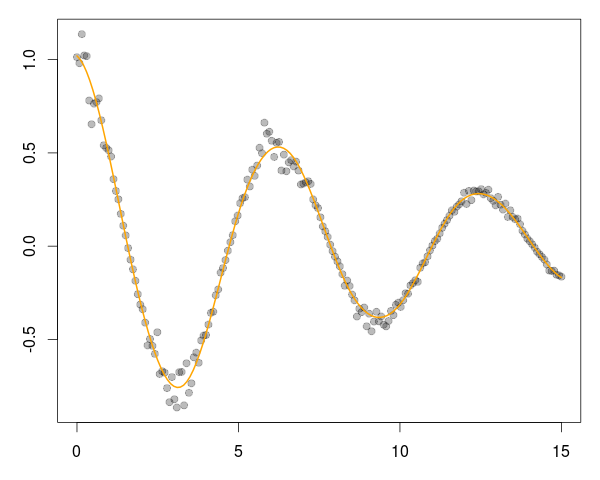
Following the Rcpp 0.10.0 release, I had written about simulating pi easily by using the wonderful new Rcpp Attributes feature. Now with Rcpp 0.10.1 released a good week ago, it is time to look at how Rcpp Attributes can help with external libraries. As this posts aims to show, it is a breeze! One key aspect is the use of the plugins for the inline package. They provide something akin to a callback mechanism so that compilation and linking steps can be informed about header and library locations and names. We are going to illustrate this with an example from GNU Scientific Library (GSL). The example I picked uses B-Spline estimation from the GSL. This is a little redundant as R has its own spline routines and package, but serves well as a simple illustration---and, by reproducing an existing example, followed an established path. So we will look at Section 39.7 of the GSL manual which has a complete example as a standalone C program, generating both the data and the fit via cubic B-splines. We can decompose this two parts: data generation, and fitting. We will provide one function each, and then use both from R. These two function will follow the aforementioned example from Section 39.7 somewhat closely. We start with the first function to generate the data.
// [[Rcpp::depends(RcppGSL)]]
#include <RcppGSL.h>
#include <gsl/gsl_bspline.h>
#include <gsl/gsl_multifit.h>
#include <gsl/gsl_rng.h>
#include <gsl/gsl_randist.h>
#include <gsl/gsl_statistics.h>
const int N = 200;                              // number of data points to fit 
const int NCOEFFS = 12;                         // number of fit coefficients */
const int NBREAK = (NCOEFFS - 2);               // nbreak = ncoeffs + 2 - k = ncoeffs - 2 since k = 4 */
// [[Rcpp::export]]
Rcpp::List genData()  
    const size_t n = N;
    size_t i;
    double dy;
    gsl_rng *r;
    RcppGSL::vector<double> w(n), x(n), y(n);
    gsl_rng_env_setup();
    r = gsl_rng_alloc(gsl_rng_default);
    //printf("#m=0,S=0\n");
    /* this is the data to be fitted */
    for (i = 0; i < n; ++i)  
        double sigma;
        double xi = (15.0 / (N - 1)) * i;
        double yi = cos(xi) * exp(-0.1 * xi);
        sigma = 0.1 * yi;
        dy = gsl_ran_gaussian(r, sigma);
        yi += dy;
        gsl_vector_set(x, i, xi);
        gsl_vector_set(y, i, yi);
        gsl_vector_set(w, i, 1.0 / (sigma * sigma));
                
        //printf("%f %f\n", xi, yi);
     
    Rcpp::DataFrame res = Rcpp::DataFrame::create(Rcpp::Named("x") = x,
                                                  Rcpp::Named("y") = y,
                                                  Rcpp::Named("w") = w);
    x.free();
    y.free();
    w.free();
    gsl_rng_free(r);
    return(res);
 
We include a few header files, define (in what is common for C programs) a few constants and then define a single function genData() which returns and Rcpp::List as a list object to R. A primary importance here are the two attributes: one to declare a dependence on the RcppGSL package, and one to declare the export of the data generator function. That is all it takes! The plugin of the RcppGSL will provide information about the headers and library, and Rcpp Attributes will do the rest. The core of the function is fairly self-explanatory, and closely follows the original example. Space gets allocated, the RNG is setup and a simple functional form generates some data plus noise (see below). In the original, the data is written to the standard output; here we return it to R as three columns in a data.frame object familiar to R users. We then free the GSL vectors; this manual step is needed as they are implemented as C vectors which do not have a destructor. Next, we can turn the fitting function.
// [[Rcpp::export]]
Rcpp::List fitData(Rcpp::DataFrame ds)  
    const size_t ncoeffs = NCOEFFS;
    const size_t nbreak = NBREAK;
    const size_t n = N;
    size_t i, j;
    Rcpp::DataFrame D(ds);              // construct the data.frame object
    RcppGSL::vector<double> y = D["y"]; // access columns by name, 
    RcppGSL::vector<double> x = D["x"]; // assigning to GSL vectors
    RcppGSL::vector<double> w = D["w"];
    gsl_bspline_workspace *bw;
    gsl_vector *B;
    gsl_vector *c; 
    gsl_matrix *X, *cov;
    gsl_multifit_linear_workspace *mw;
    double chisq, Rsq, dof, tss;
    bw = gsl_bspline_alloc(4, nbreak);      // allocate a cubic bspline workspace (k = 4)
    B = gsl_vector_alloc(ncoeffs);
    X = gsl_matrix_alloc(n, ncoeffs);
    c = gsl_vector_alloc(ncoeffs);
    cov = gsl_matrix_alloc(ncoeffs, ncoeffs);
    mw = gsl_multifit_linear_alloc(n, ncoeffs);
    gsl_bspline_knots_uniform(0.0, 15.0, bw);   // use uniform breakpoints on [0, 15] 
    for (i = 0; i < n; ++i)                     // construct the fit matrix X 
        double xi = gsl_vector_get(x, i);
        gsl_bspline_eval(xi, B, bw);            // compute B_j(xi) for all j 
        for (j = 0; j < ncoeffs; ++j)           // fill in row i of X 
            double Bj = gsl_vector_get(B, j);
            gsl_matrix_set(X, i, j, Bj);
         
     
    gsl_multifit_wlinear(X, w, y, c, cov, &chisq, mw);  // do the fit 
    
    dof = n - ncoeffs;
    tss = gsl_stats_wtss(w->data, 1, y->data, 1, y->size);
    Rsq = 1.0 - chisq / tss;
    
    Rcpp::NumericVector FX(151), FY(151);       // output the smoothed curve 
    double xi, yi, yerr;
    for (xi = 0.0, i=0; xi < 15.0; xi += 0.1, i++)  
        gsl_bspline_eval(xi, B, bw);
        gsl_multifit_linear_est(B, c, cov, &yi, &yerr);
        FX[i] = xi;
        FY[i] = yi;
     
    Rcpp::List res =
      Rcpp::List::create(Rcpp::Named("X")=FX,
                         Rcpp::Named("Y")=FY,
                         Rcpp::Named("chisqdof")=Rcpp::wrap(chisq/dof),
                         Rcpp::Named("rsq")=Rcpp::wrap(Rsq));
    gsl_bspline_free(bw);
    gsl_vector_free(B);
    gsl_matrix_free(X);
    gsl_vector_free(c);
    gsl_matrix_free(cov);
    gsl_multifit_linear_free(mw);
    
    y.free();
    x.free();
    w.free();
    return(res);   
 
The second function closely follows the second part of the GSL example and, given the input data, fits the output data. Data structures are setup, the spline basis is created, data is fit and then the fit is evaluated at a number of points. These two vectors are returned along with two goodness of fit measures. We only need to load the Rcpp package and source a file containing the two snippets shown above, and we are ready to deploy this:
library(Rcpp)
sourceCpp("bSpline.cpp")                # compile two functions
dat <- genData()                        # generate the data
fit <- fitData(dat)                     # fit the model, returns matrix and gof measures
And with that, we generate a chart such as Spline fitting example from GSL manual redone with Rcpp Attributes via a simple four lines, or as much as it took to create the C++ functions, generate the data and fit it!
op <- par(mar=c(3,3,1,1))
plot(dat[,"x"], dat[,"y"], pch=19, col="#00000044")
lines(fit[[1]], fit[[2]], col="orange", lwd=2)
par(op)
The RcppArmadillo and RcppEigen package support plugin use in the same way. Add an attribute to export a function, and an attribute for the depends -- and you're done. Extending R with (potentially much faster) C++ code has never been easier, and opens a whole new set of doors.

7 December 2012

Richard Hartmann: Release Critical Bug report for Week 49

The UDD bugs interface currently knows about the following release critical bugs: How do we compare to the squeeze cycle ?
Week Squeeze Wheezy Diff
43 284 (213+71) 468 (332+136) +184 (+119/+65)
44 261 (201+60) 408 (265+143) +147 (+64/+83)
45 261 (205+56) 425 (291+134) +164 (+86/+78)
46 271 (200+71) 401 (258+143) +130 (+58/+72)
47 283 (209+74) 366 (221+145) +83 (+12/+71)
48 256 (177+79) 378 (230+148) +122 (+53/+69)
49 256 (180+76) 360 (216+155) +104 (+36/+79)
50 204 (148+56)
51 124 (124+54)
52 115 (78+37)
1 93 (60+33)
2 82 (46+36)
3 25 (15+10)
4 14 (8+6)
5 2 (0+2)
6 release!
Graphical overview of bug stats thanks to azhag:

3 December 2012

Joey Hess: hledger

Apologies in advance for writing a long blog post about the dull and specialised subject of double-entry accounting from the Unix tools perspective, that ends up talking about Monads to boot. I can't believe I'm about to write such a thing, but I'm finding it an oddly interesting subject. double-entry accounting I've known of, though probably not really understood double entry accounting for a while, thanks to GnuCash. I think GnuCash did something rather special in making such a subject approachable to the layman, and I've been happy to recommend GnuCash to friends. I was stoked to find a chapter in my sister Anna's new book that happily and plausibly suggests readers use GnuCash. But for my personal use, GnuCash is clunky. I mean, I'm a programmer, but I can't bring any of my abilities to bear on it, without a deep dive into the code. The file format is opaque (and a real pain to keep checked into git with all the log files); the user interface is often confusing, but there's no benefit to its learning curve, it never seems to get better than manually entering data into its ledger, or perhaps importing data from a bank. I've never found the reports very useful. I've got perhaps a year of data in GnuCash, but it's fragmented and incomplete and not something I've been able to motivate myself to keep up with. So I have less financial data than I'd like. I'm hoping ledger will change that. ledger I've known about ledger for a while, at least since This Linux Weekly News article. It's a quintessential Unix tool, that simply processes text files. The genius of it is the simplicity of the file format, that gets the essence and full power of double entry bookeeping down to something that approaches a meme. Once you get the file format stuck in your head, you're done for.
2004/05/27 Book Store
      Expenses:Books                 $20.00
      Liabilities:Visa
starting to use hledger Now as a Haskell guy, I was immediately drawn to the Haskell clone, hledger. It's nice that there are two (mostly) compatable implementations of ledger too. So from here on, I'll be talking about hledger. I sat down and built a hledger setup for myself the other day. I started by converting the GnuCash books I have been keeping up-to-date, for a small side business (a rental property). It quickly turned into something like programming, in the best way, as I used features like: a modern unix program While I've been diving into hledger, I've been drawing all kinds of parallels between it and other modern Unix-friendly programs I use lately. I think we've gone over a bit of a watershed recently. Unix tools used to be either very simple and crude (though often quite useful), or really baroque and complex with far too many options (often due to 10-30 years of evolution). Or they were a graphical user interface, like GnuCash, and completely divorced from Unix traditions. The new unix programs have some commonalities... importing data After manually converting my GnuCash data, I imported all my PayPal history into hledger. And happily it calculates the same balance Paypal does. It also tells me I've paid PayPal $180 in transaction fees over the years, which is something PayPal certianly doesn't tell you on their website. (However, my current import from PayPal's CSV files is a hackish, and only handles USD currency, so I miss some currency conversion fees.) I also imported my Amazon Payments history, which includes all the Kickstarter transactions. I almost got this to balance, but hledger and Amazon disagree about how many hundreths of a cent remain in my account. Still, pretty good, and I know how much I paid Amazon in fees for my kickstarter, and how much was kicked back to Kickstarter as well. (Look for a cost breakdown in some future blog post.) At this point, hledger stats says I have 3700 transactions on file, which is not bad for what was just a few hours work yesterday. One problem is hledger's gotten a little slow with this many transactions. It takes 5 seconds to get a balance. The ledger program, written in C, is reportedly much faster. hledger recently had a O(n^2) slowdown fixed, which makes me think it's probably only starting to be optimised. With Haskell code, you can get lucky and get near C (language, not speed of light) performace without doing much, or less lucky and get not much better than python performance until you dive into optimising. So there's hope. harnessing haskell If there's one place hledger misses out on being a state of the art modern Unix program, it's in the rules files that are used to drive CSV imports. I found these really hard to use; the manual notes that "rules file parse errors are not the greatest"; and it's just really inflexible. I think the state of the art would be to use a Domain Specific Language here. For both my Amazon and PayPal imports I had CVS data something like:
date, description, amount, fees, gross
I want to take the feeds into account, and make a split transaction, like this:
date description
    assets:accounts:PayPal             $9.90
    expenses:transaction fees:PayPal   $0.10
    income:misc:PayPal                 -$10.00
This does not seem possible with the rules file. I also wanted to combine multiple CVS lines, to do with currency conversions, into a single transaction, and couldn't. The problem is that the rules file is an ad-hoc format, not a fully programmable one. If instead, hledger's rules files were compiled into standalone haskell programs that performed the import, arbitrarily complicated conversions like the above could be done. So, I'm thinking about something like this for a DSL.. I doubt I'll get much further than this, since I have a hacked together multi-pass importer that meets my basic needs. Still, this would be nice, and being able to think about adding thing kind of thing to a program cleanly is one of the reasons I reach for the Haskell version when possible these days. First, here's part of one of my two paypal import rules files (the other one extracts the transaction fees):
amount-field 7
date-field 0
description-field %(3) - %(4) - %(11)
base-account assets:accounts:PayPal
Bank Account
assets:accounts:checking
.*
expenses:misc:PayPal
That fills out the basic fields, and makes things with "Bank Account" in their description be categorised as bank transfers. Here's how it'd look as Haskell, carefully written to avoid the $ operator that's more than a little confusing in this context. :)
main :: IO ()
main = convert paypalConveter
paypalConverter :: [CSVLine] -> [Maybe Transaction]
paypalConverter = map convert
  where
    convert = do
        setAmount =<< field 7
        setDate =<< field 0
        setDescription =<< combine " - " [field 3, field 4, field 11]
        defaultAccounts
            "assets:accounts:PayPal" ==> "expenses:misc:PayPal"
        inDescription "Bank Account" ?
            "assets:accounts:PayPal" ==> "assets:accounts:checking"
That seems like something non-haskell people could get their heads around, especially if they didn't need to write the boilerplate function definitions and types at the top. But I may be biased. :) Internally, this seems to be using a combination Reader and Writer monad that can get at fields from a CSV line and build up a Transaction. But I really just made up a simple DSL as I went along and thew in enough syntax to make it seem practical to implement. :) Of course, a Haskell programmer can skip the monads entirely, or use others they prefer. And could do arbitrarily complicated stuff during imports, including building split transactions, and combining together multiple related CVS lines into a single transaction.

30 November 2012

Michal &#268;iha&#345;: Flexible commit messages in Weblate

Next release of Weblate, the web based translation tool, will bring more flexibility in creating commit messages to allow include there whatever your project would like to see. Originally commit message was fixed string hardcoded withing the code. Later it has been moved to configuration file to be finally placed into database to allow per project customization. During these steps, it was also possible to add some basic information into the message (project and language code at the beginning). Weblate 1.4 will add some more options to add there, including translation stats. You can find all supported format strings in our documentation. The default value now includes language name and translation status as can be seen in Weblate repository.

Filed under: English Weblate 0 comments Flattr this!

17 November 2012

Craig Sanders: done

OK, I m finished my experiment. It s over now and I can break character . First, I have to offer special thanks to tshirtman for being the first to unambiguously exemplify one of my main points. well done! In case it s not blindingly obvious (as it should be), the reason for my post was that I was outraged by the spectacle of one fairly high-profile member of the linux community trying to rally support to shun and exclude another fairly high-profile member because a nightmare had upset her. WTF? Is that really all it s going to take to destroy someone s reputation and perhaps their career? even with the shunning target s own words available and archived to disprove the ridiculous straw-man mis-characterisations of what he actually said? Not one of the arguments against him actually addressed anything he said, they ALL attacked him for things he didn t say, for things that other people claimed he said. I was further outraged by seeing everyone who even suggested that questioning of stats (or, indeed, ANY claim of fact or evidence) may be, in some small way, a valid and reasonable thing to do get instantly put in their place and dismissed as Yet Another Rape Apologist. Are we supposed to be anti-science, anti-scientific method now? or are rape stats a special case like religion where we are just supposed to switch off our analytical brains and accept what we are told on faith, without question? Surely we are capable of better than that? i know we are capable of better than that. Or, at least, i used to know that. Now i m not so sure. In 2011, all it took was Ted Tso ( TT ) making some fairly reasonable statements about the need for any claimed evidence or statistics to be viewed skeptically and that dissenting research should also be considered and he was instantly vilified as a rape apologist . Sorry, but questioning extremely dodgy stats (that even in feminist circles are viewed more as ideological propaganda than as serious research) is NOWHERE NEAR SUFFICIENT to earn the label of rape-apologist. That is not how debate works you can t just refuse to engage with someone s point and simply accuse them of being the enemy for not agreeing 100% with whatever you say at least, not if you have any intellectual honesty or self-respect. (sure, some people are complete jerks and deserve to be told to FOAD in no uncertain terms but a) jerks like that are self-evident and obvious, and b) TT s participation in that thread was at all times civil and reasonable) But that thread is ancient history it was over and done with nearly two years ago.
In October this year, for reasons which are not at all clear, Valerie Aurora ( VA ) decided to revive the issue (which had been resolved back in 2011 with a resounding fuck no, we don t want misogynist shit or porn in our conferences from pretty much the entire linux community including near-universal support for improved anti-harassment policies both for linux.conf.au and for geek conferences in general) and use it to attack TT. And she did so by twisting his words and claiming in a post on The Ada Initiative blog that he said something which he didn t, that rape was impossible if both people were drunk enough . If he chose, he could quite easily win a libel case against her and TAI on that. It s not what he said, it s not even close to what he said, and VA is clearly too smart to honestly believe that it is what he said. In another post on her personal, blog she talks about how what he said was so terrible that it even now gives her nightmares, and that she can t bear the thought of working with him. Again, WTF? VA can say I had nightmares and was upset and furious and THAT is enough to justify a call to shun TT?? He didn t attack her, or threaten her (explicitly or implicitly), he was polite and civil. What he did was disagree with VA by referring to other research that disputed VA s preferred studies. I agree with and support many (perhaps most) of VA s and The Ada Initiative s aims, I certainly believe that linux and open source etc should be very welcoming and supportive of human diversity (including gender and sexuality, identity, religion, politics and so on), believe that it s a good thing that The Ada Initiative exists as part of that diversity welcome to be particularly supportive of women in geekdom. And i wholeheartedly agree that Linux leaders should not make public statements belittling and condoning rape BUT: a) I haven t seen one instance of that happening, ever and b) I find VA s choice of tactics here to be despicable. as i do when anyone else uses similar tactics, because they ARE despicable tactics. They are exactly the same as accusing someone of being a child pornographer for being against net censorship: You dared to disagree with me so I m going to accuse you of being a monster. (and, i must admit, the enthusiasm level of my support for The Ada Initiative is somewhat .diminished by this tactical blunder by the spokesperson and co-founder) There are far more deserving targets of VA s ire than TT. And there are far better ways for the Ada Initiative to achieve their aims.
Why? So why did I decide to comment when I knew that I was inevitably going to be accused of hating women and being a rape apologist? Mostly because I thought it would be gutless of me not to. Hardly anyone else had, and they quickly backed down under the accusations of misogyny and since I consider myself to be psychologically fairly strong, I felt that I am capable of wearing a little shit (or even a lot) for a while. In my egocentric fashion, I thought if I can t do then it s no wonder that no one else dares . And also because anyone who cared to make even the slightest effort to find out what my actual views on sexual harassment, rape, women s rights and numerous inter-related issues are can fairly easily see a very consistent record of the kinds of things I argue for and against, and my scathing responses to actual misogynists when they appear on lists that I participate in. they are not my kind of people. and even then, i hesitated. it s scary and intimidating to be putting yourself forward to be accused of being one of the things you hate. this is, of course, an instance of the chilling effect. So, I found the prospect scary, almost terrifying .and I can t think of a single person who has met me online or in real life who would even remotely describe me as being any kind of delicate or sensitive wall-flower. again, if i can t do it, it s no wonder no one else dares . so i clicked the Publish button. an ego is useful for some things. Also, I took VA s words but don t be silent as inspiration. In the process, i discovered why it is that some people just simply refuse to engage in rational discourse. I ve seen it many times from the other side, but i ve never experienced the seductive pleasure of indulging in it myself before there s a liberating freedom in just ignoring any and every point that someone makes and simply accuse them of being the enemy. You don t have to try to understand what they wrote, hell you don t even have to really read it you just need to quickly scan it for overall tone and if they don t seem like they re 100% supportive, you just accuse them of being the enemy or an apologist for the enemy. it s that fucking simple and easy. well, sort of easy. easy for some, perhaps. i personally found it extremely difficult a struggle to refrain from engaging, to remain in character (i m not much of an actor). especially when i kind of agreed with whoever was arguing against my experimental character or if i thought they made a good point. and even more so when i thought that some comments skirted a bit too close to being the kind of misogynist crap that i didn t want to tolerate having on MY blog. (i resolved that issue by just approving any reply that didn t squick me or that i could squint at and think hmmm borderline, give benefit of doubt ) but even though i don t like it, i can recognise the attraction it holds for some people.
Other thoughts: I m particularly disgusted by the men who intervene way too early without an explicit invitation or request for help or a clear need such as an immediate threat of violence in womens issues. Many or maybe even most may not realise it, but they are just taking over and asserting male strength and control by protecting women rather than giving them the support and space to discover and practice their own strength and their own voices. These uninvited interventions do not help women, they weaken and undermine them, they perpetuate dependence, they steal strength from the movement. It is patronising and enfeebling. But mostly, they just re-assert male dominance and are an attempt to make women s spaces more comfortable, more palatable, for men.(*) (it s also quite often very transparent self-serving and ingratiating behaviour from blokes who want to lay the groundwork for perhaps getting laid one day) IMO this goes far beyond a problem with men over-involving themselves in feminist causes i feel the same way for any relatively less-privileged group with a need to find their own voice and their own power they ll never find it if members of the privileged class (i.e. white males like me) just ride roughshod over the movement and speak FOR them rather then just silently lending their strength in support. For the most part, they (we) should just shut up and listen we already have more than enough opportunities to have our say. (*) yes, i m well aware of the difficulty in writing something like that paragraph as a member of a privileged class, without coming across as either self-hating or patronising or both. if i ve failed here, it s not for want of trying. done is a post from: Errata

15 November 2012

Peter Makholm: Deploying Half of CPAN on Debian using Carton

As systems developer I like just being able to pick the most useful Perl modules from CPAN and preferably use quite recent versions of the modules I need. On the other hand our systems administrators prefer running Debian Stable and deploy software using .deb packages. I do not want to maintain hundred small packages by hand. I just want a single package with all needed the Perl dependencies for a given project. After looking at different possibilities for bundling Perl dependencies I finally found Carton written by Tatsuhiko Miyagawa. Given a list of your direct Perl dependencies, Carton can maintain the full dependency chain and manage which versions of each module you deploy. One of the nice features is that you get a reproducible set of versions each time and not just the latest, greatest, and recently broken versions. The initial step is to set Carton up to install the dependencies for my project. This part is done just like the Carton documentation describes. To ensure independence from whatever is available on CPAN I end by calling carton bundle. The next step is to write a small Perl module making sure you load modules from the right place. I end up with installing modules in /usr/lib/projectname. My module looks like this:
package My::Bundle::ProjectName;
=head1 NAME
My::Bundle::ProjectName - Bundle of CPAN modules used by ProjectName
=cut
our $VERSION = 1.0;
use Config;
use Carp;
use Carp::Heavy;  # Ensure that all parts of Carp are loaded before @INC mangling
use File::Spec;
our $BASE = '/usr/lib/projectname';
sub import  
    carp (__PACKAGE__ . " bundle not installed")
        unless -d $BASE;
    unshift @INC, 
        File::Spec->catdir( $BASE, 'lib', 'perl5' ),
        File::Spec->catdir( $BASE, 'lib', 'perl5', $Config archname );
 
1;
Now I need to install this module and all the modules maintained by Carton. I do this by a enhanced Module::Build script:
use v5.10.0;
use strict;
use warnings;
use Module::Build;
my $class = Module::Build->subclass(
    class => "My::Builder",
    code  => q 
        sub ACTION_build  
            my $self = shift;
            $self->SUPER::ACTION_build;
            !system 'carton', 'install', '--cached';
         
        sub ACTION_install  
            my $self = shift;
            $self->SUPER::ACTION_install;
            
            my $installdir = $self->destdir . "/usr/lib/projectname";
            system 'install', '-d', $installdir;
            !system 'cp', '-a', 'local/lib', $installdir;
         
     ,
);
$class->new(
    module_name       => 'My::Bundle::ProjectName',
    dist_author       => 'Peter Makholm <peter>',
    dist_version_from => 'lib/My/Bundle/ProjectName.pm',
    add_to_cleanup    => [ 'local/lib', 'local/bin' ],
)->create_build_script;
The last step is to create a .deb package. This is mostly just a standard debian/ directory using debhelper. You just need to override the dh_perl to pick up the correct binary dependencies. So this is my debian/rules:
#!/usr/bin/make -f
%:
        dh $@
override_dh_perl:
        dh_perl /usr/lib/projectname/lib
That s it. Then all the scripts and applications making up my project just needes to use My::Bundle::ProjectName and the rest is automatic. I am thinking about enhancing Carton to provide individual .deb packages instead of just installing the modules. This would make it quite easy to maintain the packages in a more The Debian Perl Group-compatible way. That could be cool.

12 November 2012

Ingo Juergensmann: Resurrecting m68k

In August I picked up Elgar, a m68k machine, from NMMN in Hamburg, where it was ought to run as a buildd (NMMN donated space and network). Unfortunately it was in some kind of bad state: operating system was out of date, expansion cards were getting loose and NMMN wasn't happy about the CRT monitor in its datacenter as well. Elgar is an Amiga 4000 Desktop built into a custom tower case. It took some weeks and months until I found a little time to care about Elgar, but now it's up and running again:
[ 0.000000] Initializing cgroup subsys cpuset
[ 0.000000] Initializing cgroup subsys cpu
[ 0.000000] Linux version 3.2.0-3-amiga (Debian 3.2.23-1) (debian-kernel@lists.debian.org) (gcc version 4.6.3 (Debian 4.6.3-8+m68k.1) ) #1 Wed Jul 25 13:02:31 UTC 2012
[ 0.000000] Enabling workaround for errata I14
[ 0.000000] console [debug0] enabled
[ 0.000000] Amiga hardware found: [A4000] VIDEO BLITTER AUDIO FLOPPY A4000_IDE KEYBOARD MOUSE SERIAL PARALLEL A3000_CLK CHIP_RAM PAULA LISA ALICE_PAL ZORRO3
That's the stock Debian m68k kernel and it already runs on Arrakis and Vivaldi, two other buildds, as well without any problem. The only problem at the moment is the missing SCSI driver for the CyberStorm Mk1 accelerator card. There were some changes in the kernel that need to be dealt with by someone knowing. The other problem was to upgrade from etch-m68k to unstable. I already blogged about this last year. It's not as easy anymore and you'll need to deal with lots of dependency problems and such nowadays. But anyway:
elgar:~# cat /etc/debian_version
wheezy/sid
elgar:~# dpkg -l libc6
Desired=Unknown/Install/Remove/Purge/Hold
Status=Not/Inst/Conf-files/Unpacked/halF-conf/Half-inst/trig-aWait/Trig-pend
/ Err?=(none)/Reinst-required (Status,Err: uppercase=bad)
/ Name Version Architecture Description
+++-====================-===============-===============-==============================================
ii libc6:m68k 2.13-35 m68k Embedded GNU C Library: Shared libraries
It's amazing that the m68k port is in such good condition after more than 4 years. That's because of the real great work of Torsten Glaser who is doing much of the porter work for the tool chain. But m68k has currently 4833 packages in state Needs-Build:
wanna-build statistics - Mon Nov 12 06:51:13 CET 2012
----------------------------------------------------- Distribution unstable:
---------------------
Installed : 1321
Needs-Build : 4833
Building : 0
Uploaded : 0
Failed : 0
Dep-Wait : 0
Reupload-Wait : 0
Install-Wait : 0
Failed-Removed : 0
Dep-Wait-Removed: 0
Not-For-Us : 0
total : 9906 13.34% (1321) up-to-date, 13.34% (1321) including uploaded
48.79% (4833) need building
0.00% ( 0) currently building
0.00% ( 0) failed/dep-wait
0.00% ( 0) old failed/dep-wait
0.00% ( 0) need porting or cause the buildd serious grief
So, there's a lot of work to do, but it's apparent that m68k won't keep up with 10.000 packages in unstable. When I started running an autobuilder back in year 2000 there were 2400 packages for m68k, on Aug. 15th 2005 we had a total of 5949 packages in the archive. For m68k this means that we will have to start adding lots of packages to Not-For-Us. I think m68k will/should end up with approx. 4000 packages at most. In the end m68k is a fairly good shape now. It only needs to get some packages built... Let's see when the buildds are operational again... ;-)
Kategorie:

11 November 2012

Nathan Handler: Introducing nmbot

While going through the NM Process, I spent a lot of time on https://nm.debian.org. At the bottom of the page, there is a TODO list of some new features they would like to implement. One item on the list jumped out at me as something I was capable of completing: IRC bot to update stats in the #debian-newmaint channel topic. I immediately reached out to Enrico Zini who was very supportive of the idea. He also explained how he wanted to expand on that idea and have the bot send updates to the channel whenever the progress of an applicant changes. Thanks to Paul Tagliamonte, I was able to get my hands on a copy of the nm.debian.org database (with private information replaced with dummy data). This allowed me to create some code to parse the database and create counts for the number of people waiting in the various queues. I also created a list of events that occurred in the last n days. Enrico then took this code and modified it to integrate it into the website. You can specify the number of days to show events for, and even have the information produced in JSON format. This information is generated upon requesting the page, so it is always up-to-date. It took a couple of rounds of revisions to ensure that the website was exposing all of the necessary information in the JSON export. At this stage, I converted the code to be an IRC bot. Based on prior experience, I decided to implement this as an irssi5 script. The bot is currently running as nmbot in #debian-newmaint on OFTC. Every minute, it fetches the JSON statistics to see if any new events have occurred. If they have, it updates the topic and sends announcements as necessary. While the bot is running, there are still a few more things on its TODO list. First, we need to move it to a stable and permanent home. Running it off of my personal laptop is fine for testing, but it is not a long term solution. Luckily, Joerg Jaspert (Ganneff) has graciously offerred to host the bot. He also made the suggestion of converting the bot to a Supybot plugin so that it could be integrated into the existing ftpmaster bot (dak). The bot's code is currently pretty simple, so I do not expect too much difficulty in converting it to Python/supybot. One last item on the list is something that Enrico is working on implementing. He is going to have the website generate static versions of the JSON output whenever an applicant's progress changes. The bot could then fetch this file, which would reduce the number of times the site needs to generate the JSON. The code for the bot is available in a public git repository, and feedback/suggestions are always appreciated.

Next.

Previous.