Search Results: "stone"

14 February 2014

Gergely Nagy: I love Free Software

I love Free Software! I love Free Software, and the people behind it. Even though I have been a free software user and developer for more than a decade now, there's still more to be amazed at, still more to contribute, and still more to learn. I love the Free Software community, because it never ceases to amaze me. It's not just about the technical side, but the social, human side of it, too!During the past year, I came to another milestone in my career: as of july first, I am a Free Software developer, and enjoying every moment of it. This is a feat that could not have been done without there being demand for what I do, without the free software community as a whole. For that, I owe you all a big thank you, you make it possible for me to make my dream come true. I can only hope that through my work, and through my example, I can contribute back enough.To this day, I take delight in contributing to free software, be it a Lisp on Python (or projects built in it), any of my own projects, syslog-ng, Google Summer of Code mentoring, Debian work - any and all of that are great fun. Even processing NEW is (I really should do that more often)! It's an endless source of not only entertainment and knowledge, but inspiration too.Whenever I read something as amazing as Russ Allbery's mail on the Debian technical committee impasse, I realize just how amazing people we have in our community, and how much we all can learn from them, and how much we owe them. This is yet another reason why I feel that contributing to Free Software is a passion many can share, because it teaches us good values too, atop of being technically excellent.I love Free Software, because without it, I would be lost. Thank you.

Rudy Godoy: Getting Movistar Peru ZTE MF193 work in Debian

After so many attempts to have my shiny Movistar Peru (Internet M vil) 3G ZTE MF193 modem to work out-of-the-box in Debian jessie (unstable) with NetworkManager, the word frustration was hitting on my head. Even trying to do the right thing, led me to craziness. I gave up on fanzines and decided to take the old-school route. Release wvdial and friends! Trying different combinations for wvdial.conf was no heaven for sure, but I ve found this wonderful guide from Christian Ams ss from Vienna, Austria! that really made a difference. Of course he s talking about the MF180 model but you get the idea. So I m sharing what was different for the MF193. Basically, I ve done the eject and disable CD-ROM thing already, but still no progress. I ve also tried using wvdial to send AT commands to the evasive /dev/ttyUSBX device. Starting from scratch confirmed that I ve done such things properly indeed. I was amused by the fact that I could use screen to talk to the modem! (yo, all the time wasted trying to have minicom and friends play nice) So, let s get to the point. After following this procedure, you should be able to use NetworkManager to connect to the Interwebs using the 3G data service from Movistar Peru.
  1. Step 1 follow the guide
  2. Step 2 Here I had to use /dev/ttyUSB4
  3. Step 3 follow the guide
  4. Unplug your USB modem
  5. Plug your USB modem. This time you should see only /dev/ttyUSB 0,1,2 and /dev/gsmmodem should be missing (not sure if this is a bug). Now /dev/ttyUSB2 is your guy.
  6. Step 4 use /dev/ttyUSB2
  7. Run wvdial from CLI it should connect successfully.
  8. Stop wvdial
  9. Select the Network icon on GNOME3, click on the Mobile Broadband configuration you have, if not create one.
  10. Voil . Happy surfing!
I m pasting my wvdial.conf, just in case.
[Dialer Defaults]
Modem = /dev/ttyUSB2
Username = movistar@datos
Password = movistar
APN = movistar.pe
Phone = *99#
Stupid Mode = 1
Init2 = AT+CGDCONT=4,"IP","movistar.pe"

30 January 2014

Rudy Godoy: What have we done?

Couple of weeks ago I was in the situation of having to setup up a new laptop. I decided to go with wheezy s DVD installer. So far so good. I didn t expect (somewhere in the lies-I-tell-myself dept.) to have GNOME as the default Debian desktop. However after install I ve figured it was the new GNOME3 everybody was talking about. Before that I ve seen it in Ubuntu systems used by my classmates. I thought yeah, OK GNOME3, I think that s fine for them as a Linux desktop. Turns out that I ve started using the Debian desktop aka GNOME3 and noticed that it was not as bloated as the Ubuntu desktop I ve seen before looked, so I sticked with it, (I thought for a while). Turns out that I did like this new so called GNOME3, the non-window based but an application-based system (that is something that sticks in my head). I liked the way it makes sense as a desktop system, like when you look for applications, documents, connect to networks, use pluggable devices or just configure stuff every time with less and less effort. Good practices and concepts learned from Mac OS X-like environments and for sure taking advantage of the new features the Linux kernel and user-space environment got over the years. So, like one month later I stick with it and it makes sense for me to keep it. I had no chance to try the latest XFCE or KDE, my default choices before this experience. Kudos GNOME team, even after the depictions you guys had on GNOME Shell; as I learned. This whole situation got me into some pondering about the past of the Linux user experience and how we in the community lead people into joining. I remember that when I guy asked: how do I configure this new monitor/VGA card/network card/Etc? the answer was in the lines of: what is the exact chipset model and specific whole product code number that your device has? Putting myself in the shoes of such people or today s people I d say: what are you talking about? what it is a chipset? I mean, like it was too technical that only one guy with more than average knowledge could grasp. From a product perspective this is similar for a car manufacturer tell to a customer to look for the exact layout or design your car s engine has, so that they are able to tell whether is the 82 s model A or 83 s model C. Simplicity on naming and identification was not in the mindset of most of us. This is funny because as technology advances it also becomes more transparent to the customer. So, for instance, today s kids can become really power users of any new technology as if they had, indeed, many pre-set chipsets in their brain. But when going into the details we had to grasp few years ago they have some hard time figuring out the complexity of the product that presents itself on this clean and simple interface. New times, interesting times. Always good to look back. No, I m not getting old.

25 January 2014

Ben Hutchings: Looking back on my time at Solarflare, part 1

Friday was my last day at Solarflare Communications, which I joined in 2006 (originally as Level 5 Networks). When I started, Level 5 Networks (L5N) had a 2-port gigabit Ethernet controller called EF1 and a user-level network stack called EtherFabric which ran on Linux. It had nearly completed the Falcon project to develop a 10-gigabit controller (also supporing a 2-port gigabit mode) and was porting EtherFabric to Windows. Later that year, however, L5N merged with Solarflare Communications (SF), which was developing a 10GBASE-T PHY (for 10-gigabit Ethernet over twisted-pair cables). The investors and management saw the opportunity to create an integrated 10GBASE-T LAN-on-motherboard chip that would be attractive to OEMs and so had the potential for mass sales. EtherFabric was put on the back-burner, but regular net drivers for Linux, Windows and other operating systems became more important. In a change from my previous jobs, my initial role at L5N was to maintain and extend the in-house test automation software, Runbench, written in Python. I worked with Dickon Reed who had written most of Runbench up to then. One of my first major tasks was to extend it to cover DUTs running Windows. Aside from changing Runbench itself, I wrote a simple SSH server to be installed on DUTs, using the Twisted.Python framework. (Cygwin's port of OpenSSH wasn't suitable for running a lot of native Windows commands.) I rewrote the test-installation script for the Windows driver itself, converting it to Python (with a C extension to get around the WOW64 nonsense). As Windows does not allow loading a driver just once (like insmod in Linux), except by using the kernel debugger, I added a time check in the driver so the test-installation script can make it fail early when reloaded after a reboot, so that a crasher bug in the probe path would usually be recoverable. In 2007 I persuaded management in Cambridge to loan several older servers to DebConf. I took them there and back by car, and they were used to convert video for live streams and recordings. (This was repeated in 2009.) I was also asked to work on other small development tasks, including some cleanup on the Linux net driver (sfc). In mid-2007, when SF decided it was time to get sfc upstream (in-tree), I joined Steve Hodgson and Robert Stonehouse in working on that. Out-of-tree (separately distributed) drivers for Linux normally need a large number of preprocessor conditions for compatibility with Linux's kernel module API across a range of supported versions. They may also implement some features with a driver-specific interface that should be replaced with a standard interface (possibly including the work to define that standard). They may not comply with the kernel coding style or unwritten conventions for kernel code. All of these problems were present and had to be dealt with. As part of this work, I extended unifdef so that it could be used to remove all of the backward-compatibility and not-for-upstream code without introducing extra blank lines. I could then export the out-of-tree driver from CVS(!) into a kernel source tree automatically and turn it into a patch or patch series that would stand a chance of being acceptable upstream. Our first few attempts got little response, but eventually we newbies got the message that the driver was simply too big for a single submission and that putting patches on a web site because they're too big for the list was not a solution. In the next week, I removed about half of the code (on a git branch), resulting in a relatively lean driver that could be sent to the netdev list. And finally the 9th (I think) submission was accepted. Following this, I continued to work on sfc but was also brought into the Siena project. Siena (SFL9021) was the LAN-on-motherboard chip that had been planned following the merger. It combined a dual-port controller based on Falcon with a 10GBASE-T PHY and a management controller (MC) to support Lights-Out Management (LOM). (Since 10GBASE-T has not taken off, it is now mostly sold as the SFC9020 variant in which the PHY is disabled.) I worked on some of the test framework and test cases for validating the controller design in software simulation and FPGA. In the course of this I learned to read and (somewhat) understand the chip design written in Verilog, but only made a single trivial fix to it. In August 2009, the first Siena ASICs came back from the fab. There were a few ASIC-specific bugs but all of them were quickly worked around in firmware, so it would soon be ready for production. But there was much work still to be done on the driver and firmware. The firmware had until then been running in a smaller block of RAM with no peripherals to manage, while sfc had earlier been modified just enough to configure a sim or FPGA for running a userland test application. sfc now had many special cases scattered around it, and would tell the MC firmware to peek and poke registers that were no longer directly accessible from the host. The software and firmware developers had agreed that, in order to support LOM, the MC would be responsible for managing the ports and all peripherals and drivers would send higher-level requests to the MC. As a bonus, this removed the need for the driver to know the details of each new board, so that it would not be necessary to backport sfc into distribution kernels very often. Over the next few months, the firmware team did an excellent job of defining and implementing those operations, including writing the driver-side functions to invoke them. Meanwhile, Steve and I concentrated on refactoring sfc so most of the Falcon/Siena differences could be abstracted through a few structures with function pointers. The refactoring and new code for Siena were completed and submitted upstream in several large patch series in October and November. In fact, there were so many patches that Solarflare appeared in LWN's table of who wrote Linux 2.6.33 (as did I, thanks also to another patch series adding firmware metadata to many drivers). Sadly we had missed Linux 2.6.32 which was a longterm stable branch and used in many distributions, but I was able to get this version backported into all the major distributions over the next year. (To be continued.)

24 January 2014

Julien Danjou: OpenStack Ceilometer Icehouse-2 milestone released

Yesterday, the second milestone of the Icehouse development branch of Ceilometer has been released and is now available for testing and download. This means the first half of the OpenStack Icehouse development has passed! New features For the Icehouse-1 milestone, we barely had enough time to implement 2 blueprints. We almost did a better job this time, but finally only 2 blueprints were implemented again. This is really far from what we planned initially. The infrastructure slowdown issues and the lower number of reviews is probably the root cause here. Anyway, Ceilometer now offers a REST API to accesses the stored event. The initial work to replace the /v2/meters endpoint with something more RESTy has started with the implementation of /v2/samples. Bug fixes Thirty-one bugs were fixed, though most of them might not interest you so I won't elaborate too much on that. Go read the list if you are curious. Toward Icehouse 3 We now have 29 blueprints targeting the Ceilometer's third Icehouse milestone, with some of them are already started and ready to merge. However, it's likely that we won't make all of them. As usual, the priority should indicate how confident we are that we want and need a feature. Still, it's likely the roadmap will be adjusted in the upcoming weeks. I'll try to make sure we'll get there without too much trouble for the 6th March 2013. Stay tuned!

20 January 2014

Wouter Verhelst: On the init system debate

The decision on which init system to use has plagued Debian for a fairly long time now. We've had people talking about it as early as debconf11 in Banja Luka, and we still haven't got a decision. Instead, the decision has been going round in circles, in a typical bikeshed fashion. Originally, my opinion on the subject was "sysv-rc is good enough for everyone, and it's portable, which other alternatives aren't". By now, however, I've become convinced that the first part of that statement isn't true, and that as a result a switch of a default init system is indeed appropriate; that we should indeed switch to "something else", at least for our Linux ports. Once I came to that conclusion, my opinion on what, exactly, we should use turned out to be nonexistent. That is, I don't care. Anything will be fine. What is bothering me, though, is that things keep dragging on and on and on and on and on and on and on, ad infinitum. We should just pick one and be done with it, dammit. The fact that sysv-rc is replaced by "something else" does not mean people must stop using sysv init scripts. Even if the maintainer of some random package "foo" refuses to accept patches to support sysv-rc for his package, there's nothing stopping anyone from providing a package "sysv-support" containing init scripts (and nothing else) for sysv-rc. The same goes for a hypothetical upstart-support or systemd-support package, of course: if you want to continue living in the stone age and keep using sysv-rc forever, then there is nothing stopping you. Even if we decide to use something else for our Linux ports. Ideally the non-Linux ports would move to something more modern too; but there really really really isn't any reason why it would be a problem if they didn't. Can we stop painting the bikeshed now? If we don't, soon we'll have to call it "hunk of paint with some bikes inside" rather than "bikeshed". Thanks.

6 January 2014

Vincent Sanders: NetSurf Developer Workshop Redux

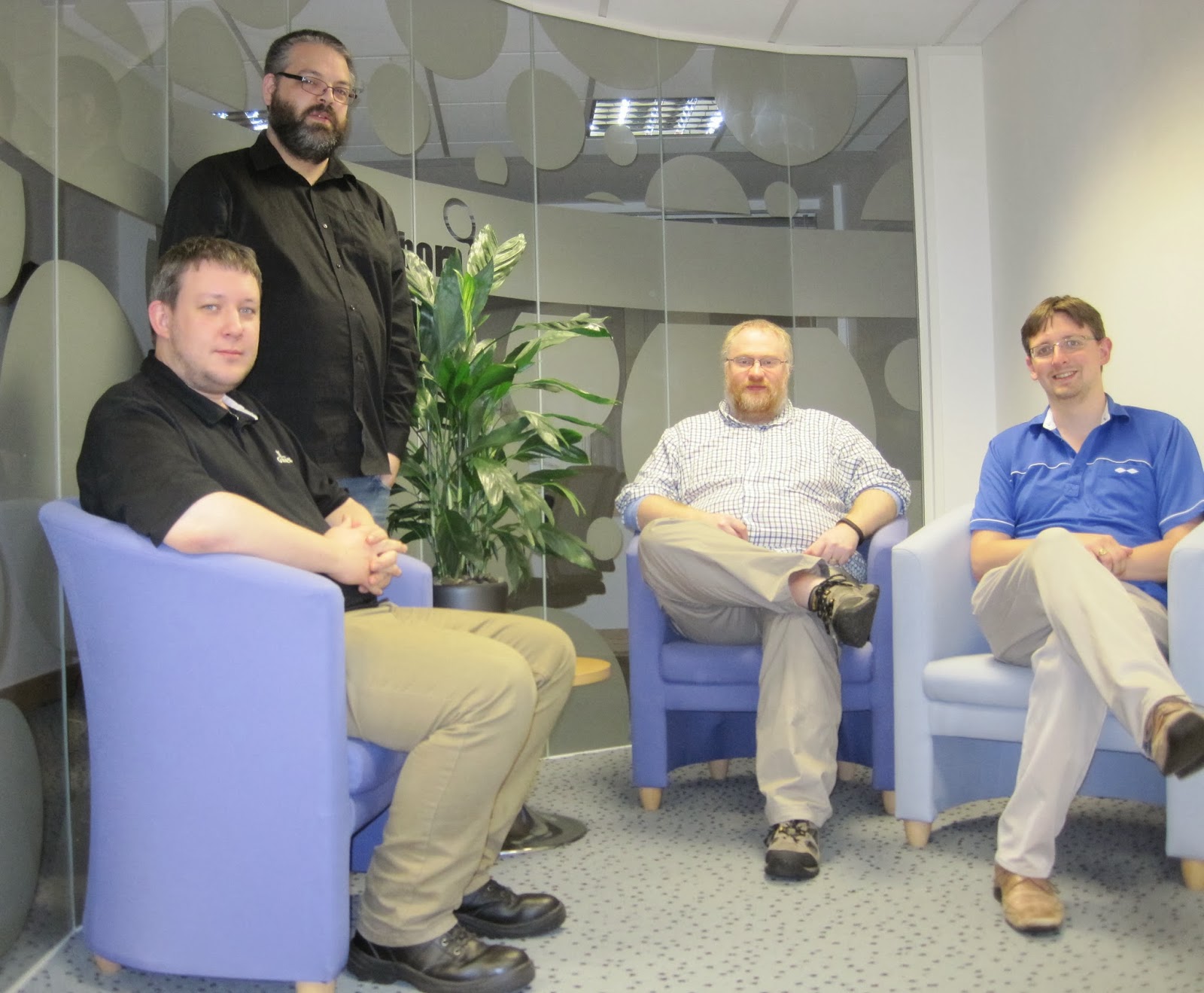
The NetSurf Developers bringing you alternative LOLcat viewing software since 2002Once again the NetSurf developers congregated in Cambridge at the Collabora offices where we were made welcome in a nice environment for the event.

Five developers managed to attend from around the UK Rob Kendrick, Vincent Sanders, Daniel Silverstone, John-Mark Bell and Michael Drake. We also had Chris Young and Fran ois Revol providing some bug fixes remotely.

This was the first time we had all met since the previous event towards the end of 2012 and we took full advantage of this to discuss a pretty extensive agenda in addition to the practical programming tasks.

From Friday lunchtime through to Sunday evening we managed 30 hours of work consisting of over 70 commits to over 100 files.

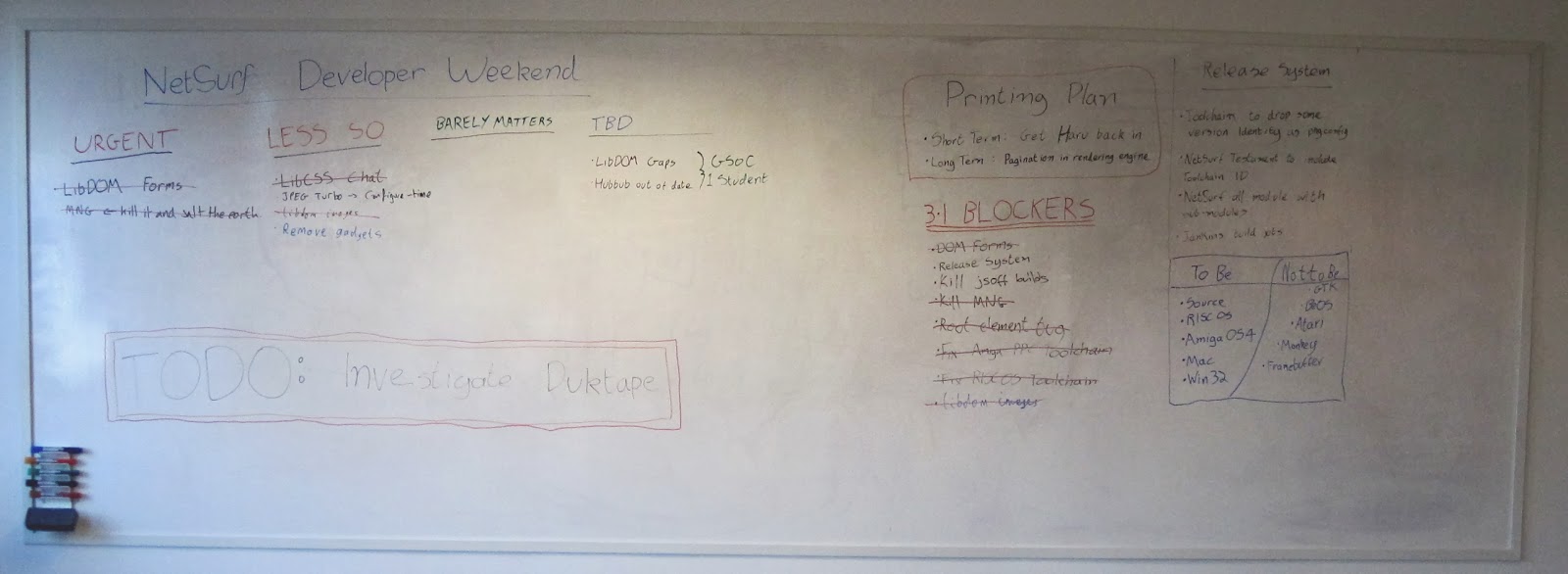
The whiteboard of our notes

Our main focus was working towards a 3.1 release which is scheduled for early April. Along with the source the release will have binary builds for RISC OS, AmigaOS, Windows and Mac OS X (x86 and ppc). Although the NetSurf project will not be directly releasing binaries for the GTK and Framebuffer frontends we will be ensuring the Debian packages are updated which is our prefered method of distribution for those targets.

We analysed the 3.0 release and formulated an improved process for the future. The 3.1 release will be generated automatically by the CI system ensuring constant results and removing the problems we encountered previously.

A set of release blocking issues was derived which we used as a task list during the workshop.The majority of these were completed including:
DOM based forms
Web forms are a feature Netsurf has supported for a long time and their implementation has not kept up with the rest of the browser. This is a long standing problem area which has resulted in numerous strange bugs with form submission. With this change the form system has been reworked to correctly operate directly from the DOM resulting in the squashing of a large number of bugs and a much improved user experience.

DOM based image loading
Up to now image fetching was performed only during the rendering of a page. With this change when the image link is placed into the DOM during the page parse it is scheduled to be fetched, this should give an improved user experience as images should be available earlier in a pages render.

Removal of MNG support
NetSurf has supported MNG since the 1.0 release, indeed the MNG library used to provide the PNG support too though we have long ago transitioned to libPNG. Alas the web has moved on and MNG has been largely forgotten, the libMNG library that performs the image decoding is old and generally unsupported specifically lacking security updates.

The build issues with libMNG (lack of pkg-config, reliance on libcms1 etc.) were causing maintenance issues in code nobody was actually using (there were crash bugs discovered during its removal!). Because of these issues it was decided to join the vast majority of browsers and remove support for this format.
The developers also addressed several issues with toolchain construction and a number of annoying usability bugs.

Plans for how to improve printing support we made. Initially we intend to fix the existing haru based pdf generation using this to print via pdf and in future have correct css styled page paginated printing render output.

The perennial issue of javascript was discussed however, while efforts to improve the existing support are ongoing, our usage of the spidermonkey library continues to raise various challenges including platform support and API changes between versions.

Due to these issues it has been suggested that we might add support for using the duktape JS engine instead, initial results are promising but given the size of the task of implementing an additional javascript engine binding further investigation is necessary before making a commitment.

Amongst the other discussions the group has also agreed that we will once again apply to be a GSoC organisation for a single student with some very focused projects:
  • Improving our HTML5 parser (hubbub)
  • Improving the DOM library implementing missing functionality.
While neither of these projects are as fashionable as some of our previous proposals they are well defined enough that as a group we believe we could offer enough support to the student to make their experience a pleasurable one and get the resulting code reviewed and merged promptly.

This event was very successful with a great deal achieved, the project is much more likely to be in a good shape to release 3.1 by April now and the meeting has given the developers a much welcomed boost.

I would like to extend the groups thanks to Robert McQueen for letting us use the Collabora offices, Dor e Carrier for organising all the administrative things and to Vivek Dasmohapatra for coming out on his Sunday afternoon to let us back in after locking ourselves out.


5 January 2014

Jonathan Carter: Happy 2014!

So, it s 2014 and I still haven t migrated away from WordPress to using something fancy written in Python. But who cares? Life is great and I ve made good progress in lots of other areas :) I m getting fitter by the day, last year I joined a running club and I now play squash too, which is working so much better than just going to the gym. Also finally making progress with learning how to play guitar, another ancient goal of mine that had slow progress for a while. It helps that I now live on my own and can make noise whenever I want to. I m also going for lessons every Wednesday and have some plans to convert my spare room in to a music room. I ve also gotten into beer brewing. I attended Beerschool via Beerlab, my first batch of American Pale Ale is just about ready for bottling and I ll probably do that next weekend. What else? Well, this year I definitely want to be more focused in my free software contributions than in 2013. I want to get my Debian contributions flowing well again with the aim of becoming a Debian Maintainer. Also planning to go to Debconf in Portland, Oregon in August. Then there s LTSP which is working towards LTSP 6, which will see a huge shift in proper support for local processing and less on thin client support. Not sure how far my involvement will stretch there but I m certainly very interested and will do my best to make the LTSP hackfest later in the year. The next 2-3 months will need the most focus on Edubuntu. The 14.04 LTS release will be a big release and the single-sign-on directory infrastructure that will be released along with it will mark a big milestone for the project. Well, to anyone still reading my blog, have a great 2014!

4 January 2014

Andrew Pollock: [life] My daughter, the future Olympic swimmer

I'm not a strong swimmer, and never have been. I was never confident in the water as a child. In my teenage years, I had some skin issues that I was very self-conscious about. Going to a boy's school where I was already bullied, I didn't want to add material, so I avoided swimming. To this day, I can barely swim 50 metres freestyle. To think I once had aspirations of getting into the police, which required a bronze medallion. As as result of my atrocious swimming abilities, it's been very important to me that Zoe be able to swim well. Purely for her own personal safety if nothing more. She's been doing "swim classes" of various sorts since she's been 6 months old. In the US, they were group parent/child water familiarisation classes. When we moved back to Australia and turned three, she was eligible to start doing small-group instructor-led classes with Hampton Swim School. It felt like such an milestone just to no longer have to be in the pool with Zoe. I was initially quite skeptical of Hampton's methods, compared with what I'd observed at the Betty Wright Swim School (which subsequently had to close due to aging facilities). Having seen how well Zoe's swimming has progressed in 3 quarters of classes is just amazing. The last few times I've taken Zoe to a public pool for some non-class swim time, her confidence in the water has been fantastic. I've bought some "sinkies", toys that sink to the bottom, and she'll happily dive down to the bottom to retrieve them (with assistance from me getting down there). Today, to escape the 40 plus degree heat, I took her to the Sleeman Sports Centre, because they have a really cool slide, and the whole thing's indoors. Zoe was confidently swimming between me and the side of the pool in water that was over her head, repeatedly. So to have her go from being fine in the water as long as she was being held, to actively asking me to go further back from the wall, in under a year has been really excellent progress. She's also "diving" in off the side (it's more like a bad belly flop, but she has brilliant form at the start, with her hands over her head). We got to the pool today around 10:30am, and it turned out the slide didn't open until 1pm, so we decided to stick around for lunch and wait until the slide opened. To kill time after lunch, we went to the 50 metre pool, where some other kids were taking turns to jump in off the starting blocks. Fearless Zoe wanted to have a go too. This was seriously deep water. It was really inspiring watching this tiny little girl climb up onto the starting blocks of the 1982 Commonwealth Games 50 metre pool and "dive" into the water, flounder over to me, who was furiously treading water in the middle of the lane, and then flounder over to the side, climb out unassisted and do it all over again. It was a seriously "proud father" moment, while I was trying not to drown myself in the middle of the lane. I wish I'd had someone there with a camera to capture the moment. I have great hopes for the future of her swimming, and I think she's ready to go up a level in her swim class.

17 December 2013

Jonathan McCrohan: Debian Ireland User Group Meetup: Festive Drinks

The Debian Ireland User Group will be meeting for festive drinks this Thursday, 19th Dec 2013, at 20:00 in The Long Stone, Townsend Street, Dublin 2. All welcome. For more information, please see the mailing list or contact us via IRC.

2 December 2013

Ben Hutchings: Upgrading from Android 2.3 'Gingerbread' to 4.3 'Jelly Bean'

Replacing my phone My first Android phone was a ZTE Blade (sold as Orange San Francisco here in the UK). It originally shipped with Android 2.1 but was upgradable to 2.3 thanks to CyanogenMod (or other unofficial mods). However there's little sign of an upgrade to 4.x; the apps I want to use are pushing the limits of its CPU, RAM and internal storage; and I've never got very good at typing on a soft keyboard. So it seemed like time to get a newer phone with a hard keyboard (and still with a SD slot). After a little research with the CyanogenMod compatibility list and some time looking at reviews, I settled on the Samsung Galaxy S Relay 4G, which was exclusive to T-Mobile USA but is being resold through eBay. It shipped with Android 4.0 but I immediately installed CyanogenMod 10.2 (Android 4.3). This was a bit of an adventure as I bought the Blade with CM already installed and wasn't familiar with the multiple steps that were necessary. Copying my data The last step, and the real subject of this entry, was to move my data across. Much of this was on a SD card which I could simply plug into the Relay. The internal files had to be backed up onto this card and then restored, using the recovery environment (ClockworkMod) on each phone. After rebooting the Relay into the full Android system, my apps and settings were mostly present but I was immediately confronted with a series of error dialogs reporting that 'Unfortunately, Dialler has stopped' - and the same for 'Clock' and 'the process android.process.acore' (whatever that is). What went wrong There are thankfully more detailed error logs in the filesystem, under /data/system/dropbox (this is for logging at the Java level; if a process is terminated by a fatal signal it's logged to /data/tombstones). There are several ways to get at them, but I used recovery mode and adb to get a root shell where I could easily read and write files as necessary. The Contacts (aka People) database upgrade fails with an SQLiteException, apparently because it doesn't account for upgrading from the schema used in 2.3:
Process: android.process.acore
Flags: 0x883e45
Package: com.android.providers.applications v18 (4.3.1-f963020e38)
Package: com.android.providers.contacts v18 (4.3.1-f963020e38)
Package: com.android.providers.userdictionary v18 (4.3.1-f963020e38)
Build: samsung/apexqtmo/apexqtmo:4.1.2/JZO54K/T699UVBMC5:user/release-keys
android.database.sqlite.SQLiteException: no such column: phonebook_label (code 1): , while compiling: UPDATE raw_contacts SET display_name_source=?,display_name=?,display_name_alt=?,phonetic_name=?,phonetic_name_style=?,sort_key=?,phonebook_label=?,phonebook_bucket=?,sort_key_alt=?,phonebook_label_alt=?,phonebook_bucket_alt=? WHERE _id=?
...
        at com.android.providers.contacts.ContactsDatabaseHelper.updateRawContactDisplayName(ContactsDatabaseHelper.java:5344)
        at com.android.providers.contacts.ContactsDatabaseHelper.upgradeToVersion504(ContactsDatabaseHelper.java:3580)
        at com.android.providers.contacts.ContactsDatabaseHelper.onUpgrade(ContactsDatabaseHelper.java:2261)
...
Clock fails somewhat similarly though it apparently didn't try to upgrade:
Process: com.android.deskclock
Flags: 0xc8be45
Package: com.android.deskclock v203 (2.0.3)
Build: samsung/apexqtmo/apexqtmo:4.1.2/JZO54K/T699UVBMC5:user/release-keys
android.database.sqlite.SQLiteException: no such column: incvol (code 1): , while compiling: SELECT _id, hour, minutes, daysofweek, alarmtime, enabled, vibrate, message, alert, incvol, profile FROM alarms WHERE (enabled=1)
...
        at com.android.deskclock.AlarmProvider.query(AlarmProvider.java:73)
        at android.content.ContentProvider.query(ContentProvider.java:744)
        at android.content.ContentProvider$Transport.query(ContentProvider.java:199)
        at android.content.ContentResolver.query(ContentResolver.java:414)
        at android.content.ContentResolver.query(ContentResolver.java:357)
        at com.android.deskclock.Alarms.getFilteredAlarmsCursor(Alarms.java:165)
        at com.android.deskclock.Alarms.calculateNextAlert(Alarms.java:344)
        at com.android.deskclock.Alarms.setNextAlert(Alarms.java:417)
        at com.android.deskclock.Alarms.saveSnoozeAlert(Alarms.java:510)
        at com.android.deskclock.AlarmInitReceiver$1.run(AlarmInitReceiver.java:49)
...
The media player fails with a NullPointerException:
Process: com.andrew.apollo:main
Flags: 0x98be65
Package: com.andrew.apollo v2 (1.1)
Build: samsung/apexqtmo/apexqtmo:4.1.2/JZO54K/T699UVBMC5:user/release-keys
java.lang.NullPointerException
        at com.andrew.apollo.MusicPlaybackService.stop(MusicPlaybackService.java:878)
        at com.andrew.apollo.MusicPlaybackService.openCurrentAndMaybeNext(MusicPlaybackService.java:1048)
        at com.andrew.apollo.MusicPlaybackService.openCurrentAndNext(MusicPlaybackService.java:1031)
        at com.andrew.apollo.MusicPlaybackService.access$1500(MusicPlaybackService.java:74)
        at com.andrew.apollo.MusicPlaybackService$MusicPlayerHandler.handleMessage(MusicPlaybackService.java:2337)
        at android.os.Handler.dispatchMessage(Handler.java:99)
        at android.os.Looper.loop(Looper.java:137)
        at android.os.HandlerThread.run(HandlerThread.java:61)
Fixing the problem Maybe I could have worked out how to upgrade the relevant databases myself, but I went for simpler solutions. The clock settings are easy to re-enter and most of the media player state is regenerated by scanning files on the SD card. So I just deleted those on the Relay:
  rm -rf /data/data/com.android.deskclock
  rm -rf /data/data/com.android.providers.media
The contacts were what I really cared about, and there are actually specific menu items in Contacts to export and import those (using VCF format), side-stepping the database upgrade. So I did:
  1. Insert SD card in Blade
  2. Open Contacts and export to VCF (I forget where this is in the menus but it was easy to find)
  3. Remove broken Contacts database on Relay:
    rm -rf /data/data/com.android.providers.contacts
  4. Insert SD card in Relay
  5. Move exported contacts to internal storage:
    mv /storage/sdcard1/*.vcf /storage/emulated/legacy
  6. Open People and tap the menu key, 'Import/export', 'Import from storage', then the filename
This may not include all data, and in particular it doesn't seem to include attached photos. But that was good enough for me.

30 November 2013

Russell Coker: Links November 2013

Shanley wrote an insightful article about microagressions and management [1]. It s interesting to read that and think of past work experiences, even the best managers do it. Bill Stone gave an inspiring TED talk about exploring huge caves, autonamous probes to explore underground lakes (which can be used on Europa) and building a refuelling station on the Moon [2]. Simon Lewis gave an interesting TED talk about consciousness and the technology needed to help him recover from injuries sustained in a serious car crash [3]. Paul Wayper wrote an interesting article about reforming the patent system [4]. He also notes that the patent system is claimed to be protecting the mythical home inventor when it s really about patent trolls (and ex-inventors who work for them). This is similar to the way that ex-musicians work for organisations that promote extreme copyright legislation. Amanda Palmer gave an interesting TED talk about asking for donations/assistance, and the interactions between musicians and the audience [5]. Some part of this are NSFW. Hans Rakers wrote a useful post about how to solve a Dovecot problem with too many files open [6]. His solution was for a Red Hat based system, for Debian you can do the same but by editing /etc/init.d/dovecot. The use of the /proc/N/limits file was interesting, I ve never had a cause to deliberately use that file before. Krebs on Security has an interesting article about Android malware being used to defeat SMS systems to prevent bank fraud [7]. Apparently an infected PC will instruct the user to install an Android app to complete the process. Rick Falkvinge wrote an interesting article about how to apply basic economics terminology to so-called Intellectual Property [8]. Matthew Garrett wrote an interesting post about the way that Ubuntu gets a better result than Debian and Fedora because it has clear fixed goals [9]. He states that many people regard Fedora as a playground to produce a range of niche derivatives , probably a large portion of the Fedora and Debian developers consider this a feature not a bug. Ming Thein wrote an interesting article about the demise of the DSLR [10]. Bruce Schneier wrote an interesting post on the detention of David Miranda by the British authorities [11]. It s mostly speculation as to why they would do such a thing (which seems to go against their own best interests) and whether the NSA even knows which documents Edward Snowden copied. Jaclyn Friedman wrote an interesting article on Mens Rights Movements (MRAs) and how they are bad for MEN as well as for women [12]. Rodney S. Tucker wrote an insightful article for the IEEE about the NBN [13]. Basically the Liberal party are going to spend most of the tax money needed for a full NBN but get a significantly less than the full benefit. Lauren Drell wrote an interesting article for Mashable about TellSpec, a portable spectrometer that communicates with an Android phone to analyse food for allergens [14]. I guess this will stop schools from banning phones. Katie McDonough wrote an interesting article for Salon about the Pope s statements about the problems with unchecked capitalism [15]. His ideas are really nothing new to anyone who has read the Bible and read the news. It seems to me that the most newsworthy part of this is that most Christian leaders don t make similar statements. Daniel Leidert wrote an interesting post about power saving when running Debian on a HP Microserver [16]. Most of it is relevant to other AMD64 hardware too, I ll have to investigate the PCIE ASPM and spin down options on some of my systems that are mostly idle.

28 November 2013

Debian Med: Bits from Debian Med team (by Andreas Tille)

Some of these bits are a bit outdated but there is no point in hiding this information just because it is old. FOSDEM talkAndreas Tille had a talk at FOSDEM which is also Video recorded. A quite similar but updated talk was held at DebConf 13 (see below). Jabber interview by reporter from IndiaThere was an interesting interview between Rajeev Nair and Andreas Tille at So, 17.02.2013 Rajeev Nair is Business head of an health care journal in India held via jabber. Since this might serve as some nice FAQ about Debian Med here is a complete log of this interview (permission to publish it was granted). Article about Debian MedAs a consequence of the interview above the Debian Med team has assembled an article which was originally intended to be published in the Health Cafe journal but somehow this never happened. So we ended up with a nice article targeting at interested readers about Free Software in medicine with not necessarily informatics background. Since the article is considered to be of good quality and has consumed some time of several team members we are seeking for ideas for relevant places where to publish it. It is available as PDFas well as in SVN. Yearly sprint of Debian Med teamThis year we had our third sprint of the Debian Med team and all participants consider it a great success again. The sprint was in end of February and the individual reports are linked from the according wiki page. Since Andreas Tille was able to prove the nice effect of having face to face meetings in Debian teams in the team metrics graphs presented in his talks at DebConf (see below) we will keep on with this good tradition. The next sprint is scheduled for Friday 31st January until Sunday 2nd February in Stonehaven near Aberdeen. If you are interested to meet the people behind Debian Med and want to join us in developing packages which are helpful in health care and bioinformatics you are invited to join us. DebConf 13 in VaumarcusAndreas Tille had two talks with specific influence to Debian Med development(Debian Med as a success story for other Blends, How to attract new developers for your team (MoM, SoB). For those who want to read a full (and lengthy) report about DebConf 13 by Andreas Tille this is online in this blog article. Codefest of the Open Bioinformatics FoundationIvo Maintz and Steffen M ller organised the Codefest of the Open Bioinformatics Foundation in Berlin. About 40 contributors from all over the world attended, connecting the Debian community strongly with upstream. The event triggered a joint paper of participants to Sprints, Codefests and Hackathons alike, presented at the Nettab conference on Semantic, Social, and Mobile Applications for Bioinformatics and Biomedical Laboratories in Venice. Reupload unattended packagesAndreas Tille has mentored the GSoC student Emmanouil Kiagias and as a byproduct some Blends metadata were now kept in UDD. This has inspired some new tools and one of this was an UDD query to return all packages in the interest of the Blend ordered by date when they were uploaded. It has shown that there were packages hanging around in the package pool since five years. So some effort was done to check those packages which were not necessarily "buggy" according to BTS entries and so we were able to fix the following issues in about 20-30 packages: Since it was impressive how many things that deserve fixing are hidden in such long unattended packages it is recommended also to other teams to spend some time into these. The UDD query can be easily tweaked for a team maintainer address. Debian Med Bug Squashing Advent Calendar 2013The Debian Med team will again do the Bug Squashing Advent Calendar. Feel free to join us in our bug squashing effort where we close bugs while other people are opening doors. :-) Kind regards and see you at Debian Med sprint
Andreas.

17 November 2013

Dmitrijs Ledkovs: libnih (upstart dependency) ported to kFreeBSD/eglibc


Back in September at the Linux Plumbers Conference in New Orleans, James Hunt and I presented Upstart roadmap, which included porting Upstart to kFreeBSD/glibc. The first milestone is now complete.

Libnih is ported to kFreeBSD/eglibc. During the course to get there the following has happened:

  • Later libnih test-suite gets a test case failure, which is then reported to FreeBSD.org. Turns out some syscalls on FreeBSD returned bogus siginfo_t.si_status information in some cases. Luckily there is now a full test-case and kernel patch posted by Jilles Tjoelker. Once that's committed upstream, I'll push for uploads to the affected kernels in Debian.


  • A few small patches applied to libnih, mostly adding POSIX compliant header includes and the like.
So with a patched libc and patched kernel one can compile libnih & run its test-suite. There are however some caveats feature miss-partiy:

  • nih_watch / inotify support is disabled. This is TODO on my list to port nih_watch to use kevent/kqueue EVFILT_VNODE.
  • FreeBSD kernel doesn't have abstract namespace domain sockets, so at the moment I have disabled some abstract namespace test-cases & changed dbus-connection tests to use pathname sockets instead. This is still a TODO because unlink before bind is not done, and the socket is not cleaned up after servers close it at the moment.


With all caveats above, here are the test-suite results:

================================================
libnih 1.0.4: nih-dbus-tool/test-suite.log
================================================

# TOTAL: 2492
# PASS: 2492
# SKIP: 0
# XFAIL: 0
# FAIL: 0
# XPASS: 0
# ERROR: 0

.. contents:: :depth: 2

===========================================
libnih 1.0.4: nih-dbus/test-suite.log
===========================================

# TOTAL: 110
# PASS: 110
# SKIP: 0
# XFAIL: 0
# FAIL: 0
# XPASS: 0
# ERROR: 0

.. contents:: :depth: 2

======================================
libnih 1.0.4: nih/test-suite.log
======================================

# TOTAL: 788
# PASS: 787
# SKIP: 0
# XFAIL: 1
# FAIL: 0
# XPASS: 0
# ERROR: 0

.. contents:: :depth: 2

PASS: test_watch
================

not ok 1 - nih_watch not supprted yet # TODO
XFAIL: test_watch 1 - nih_watch not supprted yet # TODO

at tests/test_watch.c:1594 (main).
1..1

15 November 2013

Rudy Godoy: New GPG Key 65F80A4D

A bit late but I ve created a new 4096 RSA GPG key. I ve published a transition document as well. I hope I can meet fellow Debian developers soon to get my new key signed. So, if you are in town (Arequipa, Peru) drop me an email!

10 November 2013

Steve Kemp: So I have a new project

Recently I decided to set myself a big photography challenge. The three options which I discussed with a couple of people were: Ultimately I decided pubs would be most fun. Not least because you could do it every year or two, to see what changes occurred. To make it more useful I decided to not only take the pictures, but to collect, and share, the meta-data too: Today I spent an hour walking up Easter road, and down Leith Walk. I shot the outside of about 20 pubs, and then fiddled with the layout and organization of the images. I'm reasonably happy with the result, but it remains obvious that I'm not a designer. The data-set use to generate the site - which is perhaps the most interesting/useful part of the whole exercise to other people - is available online too: All the data, even the images, is stored on github for collaboration purposes. I'm not sure if folk will join in, but I can probably manage a few of the major thoroughfares every weekend indefinitely it will only take a couple of days to get "city-wide coverage", then the rest is gravy.

5 November 2013

Russ Allbery: Review: Asimov's, August 2011

Review: Asimov's Science Fiction, August 2011
Editor: Sheila Williams
Issue: Volume 35, No. 8
ISSN: 1065-2698
Pages: 112
The editorial this issue is about the Dell Magazines Award, so newsy without a lot of content (particularly since we don't get to read the winners). Silverberg's column is much more interesting, focusing on the complex rules of the honor code of the Albanian highlands and pointing out that there's more complexity and strangeness in things we can find on Earth than in a lot of science fiction. Even within the rules of real human cultures. James Patrick Kelly's column this issue is an interesting summary of what graduates of the Clarion writing workshop learned, in their own words. It's a nice barrage of quick writing tips, and an interesting view of what people take away from a writing workshop. The book review column this issue is Peter Heck's normal workman-like job. "The End of the Line" by Robert Silverberg: Someday, I really should read Lord Valentine's Castle. As you might guess from this comment, this is another Majipoor story. This one follows an official who is part of an advance party for the Coronal Lord, the ruler (of sorts). He's decided, as part of those duties, to take the opportunity to learn more about the aboriginal people of Majipoor: the somewhat mysterious metamorphs, or Piurivar. I'm not that familiar with the history of Majipoor, since all I've read is this story and one other, none of the novels. Apparently, knowing that the official in question is named Stiamot will place this story for more familiar readers. For the unfamiliar, such as myself, there's a lot of politics here and what's clearly background for a major event in the world, but as a standalone story it's a bit unsatisfying (and grim). It's not that clear why things had to turn out the way they did, and the characters seem largely without agency. It's well-written, but mostly a story for fans of the series, I think. (6) "Corn Teeth" by Melanie Tem: This is a tight third-person story about a human child raised by alien foster parents, and it's deeply disturbing. Not because of the fostering, which appears wonderful and loving, but because it's a train wreck sort of story: the reader can see the horrible coming and can't do anything about it (and it turns out even worse than one might expect). It's also a story built around failure of communication and failure of empathy, and has a monumentally depressing ending, the kind that leaves scars. I'm sure all of this is entirely intentional; it seems very well-written. But I really didn't want this much horrible misunderstanding and depressing hopelessness in my reading. (2) "Watch Bees" by Philip Brewer: I rather liked this story even if the protagonist is an awful person. The story is set in a future of bioengineered insects and hard economic times, and it features a man who is supposedly working his way from farm to farm to get back home. What he's actually after is more complicated and is closely related to the defense systems that keep intruders off of farms. You might guess some of the rest from the title. It's a story about understanding layered defense systems, and about economic warfare. I didn't care much for any of the characters, but the story is well-plotted and kept me interested in seeing what would happen next. (6) "For I Have Lain Me Down on the Stones of Loneliness and I'll Not Be Back Again" by Michael Swanwick: By Swanwick, so it's a little odd, but I found this story surprisingly moving and ambiguous. It's about an American of Irish descent, a trip to Ireland, and a love affair with a fierce Irish nationalist, all set against an SF background of an Earth conquered by benevolent aliens. It's angry, uncertain, fanatical, and realistic by turns, and left me with profound mixed feelings. I think it does a good job capturing in a brief story the emotional complexities of what it means to give onself to a cause. (7) "We Were Wonder Scouts" by Will Ludwigsen: This is a short and odd story about a variant of the Boy Scouts founded by a man who is a little too obsessed with the paranormal, and an outing in the woods that turns rather creepy. It's a type of story that I'm not very fond of: one that twists the delight of discovery into something dark and mundane. I suppose you could call it horror; it's more horror than fantasy, at least. Anyway, not my thing. (3) "Pairs" by Zachary Jernigan: This story, on the other hand, isn't as dark as it seems like it should be from the setup. Humans have been conquered and enslaved by more powerful alien races, and now human souls are a profitable business. The protagonist is a person who has been embodied in a spaceship, and who works with (and monitors) another largely insane embodied person as they work as couriers, carrying souls to their buyers. But neither of them are as fully under control as they might appear, which is the point of the story. There is no grand tale of redemption, and the price is high, but I found the psychological portrayal oddly satisfying and faintly hopeful, and I was intrigued by the world background. (7) "Paradise is a Walled Garden" by Lisa Goldstein: The cover story, this is by far the best story of the issue. It's steampunk, set in a world where Muslim civilization was not pressed back by Christianity and continues to thrive into the reign of Queen Elizabeth as, among other things, makers of automata. A girl has managed to get herself a job in a British factory by posing as a boy and is the first to sound the alarm when the automata that do most of the work go strangely (and violently) haywire. That leads to her being assigned to the subsequent delegation to Al-Andulus (Muslim Spain, if you're not familiar with that name from history). The protagonist is the best part of this story. She's thoughtful, resourceful, and delights in learning things, something that she's rarely had the opportunity to do. She's also utterly unintimidated. In Al-Andulus, she thrives, despite the contempt of the leader of the expedition and some dangerous intrigues around the source of the anomalous behavior. I won't spoil the ending, but it's a delight, leaving the reader with a lot of hope for her future. I also liked the portrayal of the Muslim world, which is engrossed in its own business and has its own advantages and disadvantages, but is at least open to and focused on learning and technological development. The contrast with the superstitious British delegation is both pointed and historically grounded in Muslim relations with Europe around the point of divergence of Goldstein's world. (8) Rating: 7 out of 10

17 October 2013

Thomas Goirand: OpenStack Havana 2013.2 Debian packages available

OpenStack upstream was released today. Thanks to the release team and a big up to TTX for his work. By the time you read this, probably all of my uploads have reached your local Debian mirror. Please try Havana using either Sid from any Debian mirror, or using the Wheezy backports available here: deb http://havana.pkgs.enovance.com/debian havana main

deb http://archive.gplhost.com/debian havana-backports main Yes, you will need *both* repositories. This is unofficial, though these are the exact same packages as in Sid, just rebuilt for Wheezy. On the package side, here s what is new: - All packages who needs it can now be configured through debconf for the RabbitMQ settings. This is on top of what was already available for Grizzly, which is automated configuration for: keystone auth token, the database, the API endpoints and much more. (remember: this is fully optional, you can always use the non-interactive mode ) - All Quantum pluggin packages have been removed, and now everything is self-contained in the neutron-common package. The selection of which plugin to use is done directly using the core_plugin= directive in /etc/neutron/neutron.conf. This will also control the init.d script of neutron-server, so that it loads the corresponding ini file in /etc/neutron/plugins. The plugin selection is done through Debconf, so that users don t have to write the full path of the plugin class, which is (for most) very cryptic (am I the only one who thinks that writing neutron.plugins.openvswitch.ovs_neutron_plugin.OVSNeutronPluginV2 in a configuration file is user friendly?). - All of the package descriptions and Debconf templates have been reviewed by the Debian internationalization team, and most strings are translated in Czech, Danish, French, Italian, Japanese and Russian (sometimes even more) for almost all packages (thanks everyone!). I d like to publicly thanks eNovance for sponsoring my packaging work, and Mehdi Abaakouk for his work on our CI with the tempest tests. Happy Havana release testing,
Please report bugs through the Debian BTS.

12 October 2013

Lars Wirzenius: Moving repositories to git.liw.fi

I'm moving all my git repositories from Gitorious and git.gitano.org.uk to my new Gitano instance at git.liw.fi. Gitano is a git server written by Daniel Silverstone, and it's wonderful. I will be converting my non-git repositories to git, on git.liw.fi, later on.

8 October 2013

Gergely Nagy: Onto the margin of a summer of code

Just as last year, BalaBit applied to become a mentoring organisation for this year's Google Summer of Code, but like the year before, were not accepted. Instead, the openSUSE project was kind enough to give us two slots of their own, similarly to the year before - we are very thankful for this, and this year, both of the projects we took were closed successfully! So much so, that one of them was already merged into syslog-ng 3.5.0beta2, and the other one is being prepared for getting merged into the Incubator. I also helped out a little with Clojure & Leiningen packaging, although my contributions there were minimal at best.On the whole, I really liked this year's programme, our students accomplished a lot, and the whole summer was a great experience in itself, I learned a lot about mentoring, and about working with other people, people who are very new to the codebase they're working on. I would like to summarise what I learned and observed this year, in the hopes that others may find them useful too.This year, we set fairly ambitious goals for our students: they had to write a Redis and a MySQL destination, both of which presented interesting challenges to the students. None of them had prior experience with the syslog-ng source code, and their programming knowledge was mostly in C#, not plain old C which syslog-ng is written in. They also had to dabble a bit in the bowels of our overly complex configure.ac and a few Makefiles. Wasn't an easy task.In the beginning, we tasked the students to write proof of concept code, to get familiar with the libraries they will need to use - no syslog-ng involved at this point. This sounded like a good idea on paper, but without clear goals and milestones, a lot of time was spent on this task, and the students ran into a few dead-ends which could have been avoided, if we, the mentors, were more careful. This resulted in a reasonably poor first term, frustration and caused many a sleepless nights. We had to change our approach if we wanted to see the projects succeed.So we sat down with the students, and took one big leap: in person, we explained some of the internals of syslog-ng, did code reviews with them, and so on. But the best thing we did was what my colleague (and the main mentor), Viktor Tusa, came up with: we wrote a test script, that started syslog-ng, configured it, and ran tests against it. Students had to make their code pass the test by the next in-person meeting. This helped tremendously, and increased the speed they worked at by an order of magnitude at least. We kept developing the test script further, and so did the projects improve.ConclusionsThere are a couple of conclusions I arrived at as the programme concluded, things we (or other mentors, as I plan to participate as a student next year) will need to improve upon in the coming years.

Next.

Previous.