Search Results: "rui"

12 March 2013

Eddy Petrișor: Herbalife, a detailed analysis

You might remember that a while ago I mentioned I got involved in skepticism to the point I even co-host a podcast, Skeptics in Romania (in Romanian).

Among the subjects we tackle there are claims about various miracle fruits, shady dietary advice, various nonscientific health products, and even scams. We try to inform or listeners about ways to identify themselves such dangerous/fake products and how they can inform themselves about the claims they might encounter, what questions they should ask before considering buying (into) such things.

One sensitive subject is the so called multilevel marketing, especially for people involved in such businesses.

This is a sensitive subject because many of these schemes are actually pyramidal schemes, also known as Ponzi schemes. These are illegal in many countries, since they are, in fact scams designed to lure people with supposed high profits and little work.

One such pyramidal system... well you can judge yourselves (note that the presentation contains many slides, but it's really captivating):

http://www.businessinsider.com/bill-ackmans-herbalife-presentation-2012-12?op=1j

10 March 2013

Gergely Nagy: DPL platform

Last year, I invited you all to walk the plank with me, to follow me on a road, a road that even I was unsure where it led. I had a vision, I had ideas, but I had little to show for a plan. Even worse, some of my ideas, some of the things I've thought I knew, turned out to be wrong this past year. While my original plan was to pursue the goals I set out in my previous platform, I did none of that, and before I get to the meat of the platform, I owe you an explanation why: After walking the plank last year, I spent some time swimming to the shore, determined that no matter what, I will get things done. But how shall I do that? And when, with whom? Those questions needed an answer, therefore I took on a coat of an ordinary hacker, and started a journey to find the answers.That is how the past year's been spent: looking and learning. I was - and still am - following every major Debian list, I'm on IRC, absorbing all the information that fits into my tiny mind. I see now, that there's a lot more to be done than I thought last year, that some of the assumptions I made then, were wrong. And having spent a long time learning, it is my hope, that I did learn, and that this time, the plans I came up with will serve the same goal I had last year, better.That goal is as simple as growing Debian from a community of mostly technical folk to something much bigger, a community of enthusiastic, bright-eyed people who all want to do their part of making the world a better place. Big words, big task.The problemOne of the most fundamental problems with the project is that it is old, and hasn't grown up yet. We're still very focused on technical merit - don't get me wrong, that is important too, but there's much more we can do than that! We have tremendous amounts of talent, but pretty much every team is suffering from lack of people, and we seem to be slow and ineffective in recruiting new contributors (either from within the project, or outside of it), and even worse at keeping them motivated. This is not new, I worried about it last year, and I'm not the only one to see things this way, respectable members of the project expressed their pessimism publicly too.This is our biggest issue. We can be excellent at the technical level, but not being able to keep people motivated, failing to find new contributors is hurting us more and more, and it is my firm belief that without quick improvement in these areas, it won't be just me virtually walking the plank.On the flip side, we have every tool in our possession to steer ourselves into a better, brighter direction. We have excellent hackers, we have people who are terrific at communication, we have people who inspire others (just see the pattern on the dpl-game!), we have everything we need. Read on then, dear reader, and see my plan!Dancing on a tightropeTo tread on a path we have not taken so consciously before, we need to have a vision to strive for. A vision for the project as a whole, and a vision for ourselves, to see where we'd like to be a few years from now.As Stefano put it so well in his platform last year, Debian is a very unique member of the larger Free Software ecosystem - go and read his description, it can hardly be written better. This is the same vision I share, where Debian grows up to be much more than hundreds of talented people putting together a distribution. I want to see Debian becoming more than that, something that attracts not only the technical geniuses, but those who wield the power of speech and inspiration too, for these traits rarely go together.I envision a project, where people recognise each other's strengths, and make use of these strengths; where we can - and will - turn to each other, and work closely together, to achieve such good balance of skills of all kinds, as we already achieved in creating and maintaining the distribution itself.Let's dance!But alas, a vision is useless without a plan. That is a mistake I made last year, one that I will not repeat again. The approaches I choose may seem strange, or weird at first, but rest assured, they were carefully considered, and most of them tried out in a smaller setting. CommunicationWhat I've seen and experienced over the past year (and thinking back, far more than that - I just didn't know where to put the experience at that time) is that written communication is rarely the best medium to reach out to people. In this age we live in, written text reaches those who were already curious, it rarely reaches those who're still waiting for enlightenment. And even if it does, more often than not, there is no direct channel between the writer and the reader, which hurts not only the latency of the communication, but the quality too. Not to mention, that - however sad it may sound - the recipient is often too shy to engage.What does help, is face to face time. Events, where we can reach out to people, and receive immediate feedback, where we can notice the shy ones, and help them. Where we can immediately adapt to expectations.For this reason, I feel it necessary to encourage and help local teams in every possible way, to organise hackfests, code retreats, and all kinds of events that they feel will attract the bright-eyed youth (be them 20 or 80, it's the spirit that counts) we so direly need. These events need not be technical at all: a session about Debian publicity, about representing the project in press or on conferences is just as useful (if not more). Along with hackfests, we could - and should - have events focused on improving communication, for that is just as important.With strong focus placed on non-technical matters, I believe we can step on a path of rapid progress: my experience shows that techies and non-techies can inspire one another very well, much more than two techies would. With a focus on areas we are lacking in, we are indirectly improving those we are already good at. Inspiration & motivationBut finding new contributors, be them technically-sawwy or not is only part of the task, and the easier one too. It is much harder to keep people interested and motivated over a long period of time, than to find them once.On one hand, I would like to rely on those members of our community, who we all hold in high esteem (including, but not limited to those mentioned during the dpl-game). They know what keeps them going, they know what drives them away, we need to learn from that. I'd like to hear them speak more often, on conferences, if possible, as they are, I believe, a much more credible source than any elected official, at least in some situations.I'd also like to hear everyone's voice, from old members to the newest ones, I'd like to read - and if so need be, conduct - interviews with people who recently became Debian Developers, to hear about their experience, to learn what they think is good or bad, because a fresh view is just as important as a decade long experience.On the other hand, we need to act on the issues discovered too. We already know that quite a lot of trouble stems from lack of time, overburden and eventually burn out. We know the solution to this: recruit more people, and utilise the resources we do have better. Part of that can be solved by expanding our numbers, but for the other part, we may need deeper changes. What those may be, I cannot tell yet, there simply wasn't enough time to dig deeper, and I'm likely not the best person to undertake the task, either. I am, however, confident that we'll discover the solution as we travel along.The first step is gaining knowledge, without this, no further plans can be made. RecruitmentI already touched the recruitment part earlier, at least the how of the approach. What I'd like to expand on is the why, in particular: why encourage recruiting non-packaging contributors, when we are building a distribution, and we're lacking packaging manpower too?Let me answer those questions separately.First of all, I still like to think - but perhaps I am wrong - that we have an unbelievable amount of packaging manpower, which we fail to use to its full extent. We can use more, we always will be able to. But it also helps if we manage to put our existing resources to better use.And that is where non-packaging contributions come in. If we improve our skills in areas we're lacking in, that in turn, will improve the general quality of the project, which in turns improves morale, and a vibrant, well functioning, welcoming community attracts even more people, and keeps us motivated in the long run too.Mouse on the tightropeWith all that out, you may be wondering who I may be, and why you have not seen my name over the mailing lists in recent years. I'm not a terribly vocal person anymore, not a hot-headed teen I used to be some ten years ago. Most who know me, know me by my online nick name, algernon, and in most cases, I prefer that in real life too, for silly reasons I'd rather not dive into (but the primary one being that people have a hard time correctly pronouncing my name, and I have a hard time recognising my name unless pronounced the way I learnt it). Nevertheless, my name is Gergely Nagy, and I'm a recovering hacker, who intends to become a bachelor of (hungarian) arts, by majoring in Hungarian grammar & literature sometime in the next three to five years.Over the course of the past year, I also strived to observe and learn from exceptional leaders at my day job, because there, I have the advantage of meeting with them face to face, to interact with them on a daily basis. Fortunately for me, there are people among them from whom I learned a great deal about not only motivation, but about behind-the-scenes politics too - both a valuable lesson.And while I still have a tremendous amount of things to learn, I like to believe that I can do that. I know I can learn technical things extremely quickly (my day job depends on that, I would be out of a job if I failed at that), I'm positive that I can do the same in other areas as well, at least as long as it doesn't involve extreme amounts of economics. That proved to be a major barrier in the past.But back to the more important point: my organising, presentation and leading skills. I'm a co-organiser of the Budapest Clojure User Group meetups, I started to encourage GSoC participation at my day job last year (we participated thanks to OpenSUSE who gave us a slot), and I'm driving it this year, aiming to become a mentoring organisation of our own. I'm doing regular talks and presentations, participate in code retreats, meetups and other similar events where I can both practice and learn the art of interacting with people, and the fine art of organising events.


Gergely Nagy: DPL platform

Last year, I invited you all to walk the plank with me, to follow me on a road, a road that even I was unsure where it led. I had a vision, I had ideas, but I had little to show for a plan. Even worse, some of my ideas, some of the things I've thought I knew, turned out to be wrong this past year. While my original plan was to pursue the goals I set out in my previous platform, I did none of that, and before I get to the meat of the platform, I owe you an explanation why: After walking the plank last year, I spent some time swimming to the shore, determined that no matter what, I will get things done. But how shall I do that? And when, with whom? Those questions needed an answer, therefore I took on a coat of an ordinary hacker, and started a journey to find the answers.That is how the past year's been spent: looking and learning. I was - and still am - following every major Debian list, I'm on IRC, absorbing all the information that fits into my tiny mind. I see now, that there's a lot more to be done than I thought last year, that some of the assumptions I made then, were wrong. And having spent a long time learning, it is my hope, that I did learn, and that this time, the plans I came up with will serve the same goal I had last year, better.That goal is as simple as growing Debian from a community of mostly technical folk to something much bigger, a community of enthusiastic, bright-eyed people who all want to do their part of making the world a better place. Big words, big task.The problemOne of the most fundamental problems with the project is that it is old, and hasn't grown up yet. We're still very focused on technical merit - don't get me wrong, that is important too, but there's much more we can do than that! We have tremendous amounts of talent, but pretty much every team is suffering from lack of people, and we seem to be slow and ineffective in recruiting new contributors (either from within the project, or outside of it), and even worse at keeping them motivated. This is not new, I worried about it last year, and I'm not the only one to see things this way, respectable members of the project expressed their pessimism publicly too.This is our biggest issue. We can be excellent at the technical level, but not being able to keep people motivated, failing to find new contributors is hurting us more and more, and it is my firm belief that without quick improvement in these areas, it won't be just me virtually walking the plank.On the flip side, we have every tool in our possession to steer ourselves into a better, brighter direction. We have excellent hackers, we have people who are terrific at communication, we have people who inspire others (just see the pattern on the dpl-game!), we have everything we need. Read on then, dear reader, and see my plan!Dancing on a tightropeTo tread on a path we have not taken so consciously before, we need to have a vision to strive for. A vision for the project as a whole, and a vision for ourselves, to see where we'd like to be a few years from now.As Stefano put it so well in his platform last year, Debian is a very unique member of the larger Free Software ecosystem - go and read his description, it can hardly be written better. This is the same vision I share, where Debian grows up to be much more than hundreds of talented people putting together a distribution. I want to see Debian becoming more than that, something that attracts not only the technical geniuses, but those who wield the power of speech and inspiration too, for these traits rarely go together.I envision a project, where people recognise each other's strengths, and make use of these strengths; where we can - and will - turn to each other, and work closely together, to achieve such good balance of skills of all kinds, as we already achieved in creating and maintaining the distribution itself.Let's dance!But alas, a vision is useless without a plan. That is a mistake I made last year, one that I will not repeat again. The approaches I choose may seem strange, or weird at first, but rest assured, they were carefully considered, and most of them tried out in a smaller setting. CommunicationWhat I've seen and experienced over the past year (and thinking back, far more than that - I just didn't know where to put the experience at that time) is that written communication is rarely the best medium to reach out to people. In this age we live in, written text reaches those who were already curious, it rarely reaches those who're still waiting for enlightenment. And even if it does, more often than not, there is no direct channel between the writer and the reader, which hurts not only the latency of the communication, but the quality too. Not to mention, that - however sad it may sound - the recipient is often too shy to engage.What does help, is face to face time. Events, where we can reach out to people, and receive immediate feedback, where we can notice the shy ones, and help them. Where we can immediately adapt to expectations.For this reason, I feel it necessary to encourage and help local teams in every possible way, to organise hackfests, code retreats, and all kinds of events that they feel will attract the bright-eyed youth (be them 20 or 80, it's the spirit that counts) we so direly need. These events need not be technical at all: a session about Debian publicity, about representing the project in press or on conferences is just as useful (if not more). Along with hackfests, we could - and should - have events focused on improving communication, for that is just as important.With strong focus placed on non-technical matters, I believe we can step on a path of rapid progress: my experience shows that techies and non-techies can inspire one another very well, much more than two techies would. With a focus on areas we are lacking in, we are indirectly improving those we are already good at. Inspiration & motivationBut finding new contributors, be them technically-sawwy or not is only part of the task, and the easier one too. It is much harder to keep people interested and motivated over a long period of time, than to find them once.On one hand, I would like to rely on those members of our community, who we all hold in high esteem (including, but not limited to those mentioned during the dpl-game). They know what keeps them going, they know what drives them away, we need to learn from that. I'd like to hear them speak more often, on conferences, if possible, as they are, I believe, a much more credible source than any elected official, at least in some situations.I'd also like to hear everyone's voice, from old members to the newest ones, I'd like to read - and if so need be, conduct - interviews with people who recently became Debian Developers, to hear about their experience, to learn what they think is good or bad, because a fresh view is just as important as a decade long experience.On the other hand, we need to act on the issues discovered too. We already know that quite a lot of trouble stems from lack of time, overburden and eventually burn out. We know the solution to this: recruit more people, and utilise the resources we do have better. Part of that can be solved by expanding our numbers, but for the other part, we may need deeper changes. What those may be, I cannot tell yet, there simply wasn't enough time to dig deeper, and I'm likely not the best person to undertake the task, either. I am, however, confident that we'll discover the solution as we travel along.The first step is gaining knowledge, without this, no further plans can be made. RecruitmentI already touched the recruitment part earlier, at least the how of the approach. What I'd like to expand on is the why, in particular: why encourage recruiting non-packaging contributors, when we are building a distribution, and we're lacking packaging manpower too?Let me answer those questions separately.First of all, I still like to think - but perhaps I am wrong - that we have an unbelievable amount of packaging manpower, which we fail to use to its full extent. We can use more, we always will be able to. But it also helps if we manage to put our existing resources to better use.And that is where non-packaging contributions come in. If we improve our skills in areas we're lacking in, that in turn, will improve the general quality of the project, which in turns improves morale, and a vibrant, well functioning, welcoming community attracts even more people, and keeps us motivated in the long run too.Mouse on the tightropeWith all that out, you may be wondering who I may be, and why you have not seen my name over the mailing lists in recent years. I'm not a terribly vocal person anymore, not a hot-headed teen I used to be some ten years ago. Most who know me, know me by my online nick name, algernon, and in most cases, I prefer that in real life too, for silly reasons I'd rather not dive into (but the primary one being that people have a hard time correctly pronouncing my name, and I have a hard time recognising my name unless pronounced the way I learnt it). Nevertheless, my name is Gergely Nagy, and I'm a recovering hacker, who intends to become a bachelor of (hungarian) arts, by majoring in Hungarian grammar & literature sometime in the next three to five years.Over the course of the past year, I also strived to observe and learn from exceptional leaders at my day job, because there, I have the advantage of meeting with them face to face, to interact with them on a daily basis. Fortunately for me, there are people among them from whom I learned a great deal about not only motivation, but about behind-the-scenes politics too - both a valuable lesson.And while I still have a tremendous amount of things to learn, I like to believe that I can do that. I know I can learn technical things extremely quickly (my day job depends on that, I would be out of a job if I failed at that), I'm positive that I can do the same in other areas as well, at least as long as it doesn't involve extreme amounts of economics. That proved to be a major barrier in the past.But back to the more important point: my organising, presentation and leading skills. I'm a co-organiser of the Budapest Clojure User Group meetups, I started to encourage GSoC participation at my day job last year (we participated thanks to OpenSUSE who gave us a slot), and I'm driving it this year, aiming to become a mentoring organisation of our own. I'm doing regular talks and presentations, participate in code retreats, meetups and other similar events where I can both practice and learn the art of interacting with people, and the fine art of organising events.

9 March 2013

Lars Wirzenius: Can the world be saved by coding?

I love programming. I was born to code. I want to save the world by writing code. I feel very strongly about software freedom. As I get older, and my eyes open to see more of the evil in the world, I become more concerned about freedom in general. Software freedom is, at least traditionally, about permission use, study, modify, and re-distribute software. The Free Software Foundation expresses this as the four essential freedoms. Debian expanded on that, and produced the Debian Free Software Guidelines. This is no longer enough. It is not enough to have all the freedom when you using your own computer, to have the source code to every bit of code that runs on your hardware. We live in the era of the Internet. Much of what we use computers for involves communication over the Internet, and the Internet is being actively used to curtail the freedom of people. For example, governments and corporations do large-scale surveillance of everyone, by eavesdropping on private communications, gathering enormous databases of personal data, and by analysing everything they can in order to find patterns and make conclusions both at the statistical level and about individuals. This ruins privacy. Without privacy, democracy cannot survive. Another example: in the name of various strawmen, such as terrorism, copyright violations, drugs, and child pornography, governments and corporations are collaborating in limiting private people's communications. I'm a Finnish citizen living in the UK. Both countries are among the closest ones to an ideal democractic nation state. Both countries arbitrarily block access to websites based on lists provided by private organisations, assuming that those organisations produce accurate lists of sites that contain copyright violations. As a result, both countries blocked, for example, a site where musical artists promoted their own works, bypassing the large media corporations that fund the list-making organisation. These issues transcend software freedom, though they interact with it. Software freedom is a necessary requirement for freedom, in a world where almost everything is done with, or controlled by, the use of computers. Software freedom is not enough to prevent censorship or surveillance: even if all the software in the world were free, including the national firewalls of China, Finland, and the UK, this would not prevent those countries from censoring and surveilling their citizens. The firewall would run free software, but that does not give the citizens the freedom to disable, or modify, the firewall systems. Fixing these issues is not a coding task. It is a job for politics, and it is going to take a long time, I fear. In the mean time, is there something a hacker can do to improve things? My main hobby project is Obnam, my backup program. Does that help people to protect their freedom? I think it does, in a small way: Obnam supports online, encrypted backups (and de-duplication even for encryption is used), which means they can make backups to servers anywhere on the Internet without having to fear their data gets read and analysed by hostile entities such as their own government, other governments, large corporations, or criminals. Obviously this does not help them if their government prohibits the use of encryption, or requires key escrow, or mandates backdoors to all encryption methods. But it's a step in the right direction. I don't claim Obnam will save the world, but a million small such steps by a thousand individual hackers, even without any particular organisation or guidance, will make a big impact. What step can you take?

8 March 2013

Petter Reinholdtsen: First Skolelinux / Debian Edu Squeeze update released

Last Sunday, 2013-03-03,, Holger Levsen announced the first update of Skolelinux / Debian Edu based on Debian Squeeze. This is the first update since the initial release 2012-03-11. This is the release announcement email from Holger:
Hi, it's my pleasure to announce the immediate availability of Debian Edu 6.0.7+r1 ("Debian Edu Squeeze"). Debian Edu 6.0.7+r1 is an incremental update to Debian Edu 6.0.4+r0, containing all the changes between Debian 6.0.4 and 6.0.7 as well Debian Edu specific bugfixes and enhancements. See below (in this mail) for the full list of (edu) changes. Please see http://www.debian.org/News/2012/20120311 for more information on "Debian Edu Squeeze". Images are available for download at http://ftp.skolelinux.org/skolelinux-cd/ md5sums:
1fe79eb4f0f9ae1c58fc318e26cc1e2e debian-edu-6.0.7+r1-CD.iso
a6ddd924a8bd9a1b5ca122e8fe1c34ec debian-edu-6.0.7+r1-DVD.iso
ac6c72cd7925ccec51bfbf58e2a7c69c debian-edu-6.0.7+r1-source-DVD.iso sha1sums:
a4b58233b672a99c7df8dc24fb6de3327654a5c3 debian-edu-6.0.7+r1-CD.iso
9b524915e0ff2aa793f13d93123e5bd2bab2dbaa debian-edu-6.0.7+r1-DVD.iso
43997614893fc5e9e59ad6ce066b05d07fd836fa debian-edu-6.0.7+r1-source-DVD.iso These images are suitable for amd64+i386. Changes for Debian Edu 6.0.7+r1 Codename "Squeeze", released 2013-03-03:
  • sitesummary was updated from 0.1.3 to 0.1.8
    • Make Nagios configuration more robust and efficient
    • Comply with 3.X kernel
  • debian-edu-doc from 1.4~20120310~6.0.4+r0 to 1.4~20130228~6.0.7+r1
    • Minor updates from the wiki
    • Danish translation now complete
  • debian-edu-config from 1.453 to 1.455
    • Fix /etc/hosts for LTSP diskless workstations. Closes: #699880
    • Make ltsp_local_mount script work for multiple devices.
    • Correct Kerberos user policy: don't expire password after 2 days. Closes: #664596
    • Handle '#' characters in the root or first users password. Closes: #664976
    • Fixes for gosa-sync:
      • Don't fail if password contains "
      • Don't disclose new password string in syslog
    • Fixes for gosa-create:
      • Invalidate libnss cache before applying changes
      • Multiple failures during mass user import into GOsa
      • gosa-netgroups plugin: don't erase entries of attribute type "memberNisNetgroup". Closes: #687256
      • First user now uses the same Kerberos policy as all other users
    • Add Danish web page
  • debian-edu-install from 1.528 to 1.530
    • Improve preseeding support and documentation
End-user documentation in English is available at http://wiki.debian.org/DebianEdu/Documentation/Squeeze/ - translations to French, Italian, Danish and German are available in the debian-edu-doc package. (Other languages could use your help!) If you want to contribute to Debian Edu, please join our mailinglist debian-edu@lists.debian.org!
I am very happy to see the fruits of a year of hard work. :)

5 March 2013

Lisandro Damián Nicanor Pérez Meyer: My Debian freeze experience (so far)

This is the first freeze in which I'm involved with upload rights. And it turned out to be a quite interesting ride so far, so I thought it would be nice to write about it.

As some of you may know, I'm a part of the Qt/KDE team. Before the freeze I was mostly involved in leaf packages, with some patch here or there, nothing fancy. And then the freeze came...

Bugs in Qt

...and bugs appeared in Qt. But they didn't get solved, even if the patches were there. Due to personal reasons, the manpower in Qt/KDE land decreased below normal levels (which were already low).

I took the time to review them, apply them in a local branch, build and test the fixes. I did a Qt upload before, but it was a team-consented one. This time there was not much reaction in our IRC channel as it used to be, so I was doubting if going ahead or not. I asked Ana, my great friend and former sponsor, for an opinion on the subject, and she gave me a really important advice: the patches were looking good and there is one really big true: if something get's broken, it can be fixed with a later upload.

You might be asking yourself why I was that afraid of doing the upload. Well, when one maintains such a medular package for many users one has to be careful And I also got used that those "big ones" like Qt where normally handled by hand skilled people. Do not take me wrong here, it's not that those people where keeping them for themselves, it's knowing that one does not has the same skills nor experience as them.

But again, no one was able to upload and I had the chance and will to do another upload if needed, so off it went. That was Qt 4:4.8.2-2.

Then new experiences followed: asking a buildd maintainer for a giveback, asking the Release Team for an unblock (more on this later), etc. While sponsoring me, Ana gave me another excellent advice which I always keep in my mind:

You can't know **everything** about Debian.

And that also includes a not so technical skill: communicating with other teams. But finally we got this new version of Qt in testing. Cool :-)

Of course, new bugs appeared, and my lack of skills (and sometimes, time) where replaced by team work: Pino looking at patches and Sune contacting upstream. The eleven uploads that followed are a nice example of team work, even if I was the one who signed and did the uploads. Whoever uses Qt must know that these wonderful people (including those who are not so active nowadays like Modestas or Fathi) have done lots to bring the better to their users.Thank you guys!

Be careful, they might bite you back!

Coming back to the non-technical skills, sometimes you have to communicate with other teams in Debian. And each team is (naturally) a separate world: possibly different people, different goals, etc. Of course, we share the goal to make Debian the best experience we can, but we do not necessarily agree on the paths to achieve so.

During the freeze, there is a team that gets lots of pressure, and not by chance: the Release Team. They handle a very important task, which is to ride the freeze to get to a release. OK, that's what everyone knows. Now, one thing is knowing that and another is really understanding what does that means.

Of course I was in the first group. From the outside, communicating with the RT was a kind of "special art", and not an easy one. I have even been advised to not ask for more than one or two unblocks per weekend, as they might "bite me back". So I put on my flamesuit on and... launched reportbug release.debian.org.

Now I'm really happy to say that my experience was far from what I described above. And yes, I had the chance to even disagree on some stuff. But remember: non-technical skills, a.k.a. social skills. Once I started to know what was going on inside the RT (joining #debian-release was a big help for that) I learnt some nice tips to approach them. Please allow me to list some of them:

  • Remember: you are the maintainer of the package, they are like gatekeepers that are there to help us coordinate to do a release. But they don't maintain the code, you do that. So try to be verbose when needed, explain the changes and don't forget a nice diff. They need to understand what is going on: they can't read your mind.
  • They are human beings too: not everyday might be their best day (the same goes for you too!). And they are under the pressure of a release. Be patient, that finally pays off.
  • Does your changes seem not so clear? try to improve them.
  • The package has a lot of changes but you really feel they are needed? Try to explain that as good as you can.
  • Try to put yourself in their position: do we really want this? If in doubt, there is a nice way to know what they think: a pre-approval bug.
I want to make a stop in this last point. A pre-approval bug it's an unblock bug in which you edit the subject to add "pre-approval" in it. Easy, isn't it? It gives you the opportunity to know what the RT thinks before doing the upload. In other words: it gives you the chance to communicate and do things in the best possible way for all the parts involved.

I've have also seen pre-approval bugs that were really not needed. But to learn where the threshold of what can be directly uploaded and what deserves a pre-approval bug is you need to know the guidelines the RT gives you. Do you still have doubts? fire a pre-approval bug and try to be clear.

Of course, this are all fruits of my experience with the RT during this time. If the RT thinks different from what I'm writing here, please stand up: we are hear to listen to you and learn :-)

As a side note, I think I should file a wishlist bug to include the pre-approval bug option in reportbug. Yes, I'm lazy :-)

Summing up

Overall this was a very nice and positive experience. We are not done yet. Are we really done at some point? Let's hope not, because this is where the fun comes from :-)

20 February 2013

Gunnar Wolf: "No al voto electr nico", Triple W, W Radio

Title"No al voto electr nico", Triple W, W Radio
Publication TypeBroadcast
Year of Publication2013
AuthorsWolf G, Ruiz O
Refereed DesignationNon-Refereed
Keywordse-vote
URLhttp://www.wradio.com.mx/escucha/programas/voto-electronico-octavio-ruiz-y-kunar-wolf-analistas-190213/20130219/programa/1789792.aspx?au=1845636
Full TextIn yet another episode where we push for the population to be aware of the perils that electronic voting represents, Octavio Ruiz (@tacvbo) and me were invited to (briefly) talk about the topic in W Radio, one of the largest radio networks in Mexico.
The interview was short-ish, but we managed to get several points accross. And, of course, one of the best ways to do so is via a radio show with tens of thousands of listeners. So, we were quite happy to be there!
Here is the audio of the segment we presented in Fernanda Tapia's radio show "Triple W", in W Radio, Mexico.
AttachmentSize
Tripe W - Entrevista: no al voto electronico9.97 MB

10 February 2013

David Bremner: First Steps with Argyll and ColorHug

In April of 2012 I bought a ColorHug colorimeter. I got a bit discouraged when the first thing I realized was that one of my monitors needed replacing, and put the the colorhug in a drawer until today. With quite a lot of help and encouragment from Pascal de Bruijn, I finally got it going. Pascal has written an informative blog post on color management. That's a good place to look for background. This is more of a "write down the commands so I don't forget" sort of blog post, but it might help somebody else trying to calibrate their monitor using argyll on the command line. I'm not running gnome, so using gnome color manager turns out to be a bit of a hassle. I run Debian Wheezy on this machine, and I'll mention the packages I used, even though I didn't install most of them today.
  1. Find the masking tape, and tear off a long enough strip to hold the ColorHug on the monitor. This is probably the real reason I gave up last time; it takes about 45minutes to run the calibration, and I lack the attention span/upper-arm-strength to hold the sensor up for that long. Apparently new ColorHugs are shipping with some elastic.
  2. Update the firmware on the colorhug. This is a gui-wizard kindof thing.
     % apt-get install colorhug-client
     % colorhug-flash 
    
  3. Set the monitor to factory defaults. On this ASUS PA238QR, that is brightness 100, contrast 80, R=G=B=100. I adjusted the brightness down to about 70; 100 is kindof eye-burning IMHO.
  4. Figure out which display is which; I have two monitors.
     % dispwin -\?
    
    Look under "-d n"
  5. Do the calibration. This is really verbatim from Pascal, except I added the ENABLE_COLORHUG=true and -d 2 bits.
     % apt-get install argyll
     % ENABLE_COLORHUG=true dispcal -v -d 2 -m -q m -y l -t 6500 -g 2.2 test
     % targen -v -d 3 -G -f 128 test
     % ENABLE_COLORHUG=true dispread -v -d 2 -y l -k test.cal test
     % colprof -v -A "make" -M "model" -D "make model desc" -C   "copyright" -q m -a G test
    
  6. Load the profile
     % dispwin -d 2 -I test.icc           
    
    It seems this only loads the x property _ICC_PROFILE_1 instead of _ICC_PROFILE; whether this works for a particular application seems to be not 100% guaranteed. It seems ok for darktable and gimp.

6 February 2013

Lior Kaplan: RTL status for Libre Office 4.0.0

LibreOffice 4.0.0 will be released soon, and it s a good time to summarize its RTL status. Similar to 3.5.0, the RTL work started with LibreOffice conference in October, showing the current state (see LibreOffice RTL status 2012 presentation) and listing the top problems. The main goal of this talk is to raise awareness to RTL issues and recruit developer to help fix them. This was exactly what happened with fdo#44657 which is about Calc not having a scroll bar in RTL user interface. This way RTL bug #1 for almost a year. In total, version 4.0.0 has 8 bugs fixed (mainly Calc, Presenter Console and toolbars). In addition it has 5 language specific bugs fixed. Full lists are at https://wiki.documentfoundation.org/RTL_Bugs#4.0.0 and https://wiki.documentfoundation.org/RTL_Bugs#4.0.0_2. Beside working on fixing bugs for the 4.0.0, another focus was put on making sure the fixes are available for the 3.6.x users. This resulted with cherry picking 11 out of 13 bug fixes (part of 3.6.4 and 3.6.5 releases). More fixes are already underway in the master branch, and will also be part of 4.0.1 maintenance release (full list at https://wiki.documentfoundation.org/RTL_Bugs#4.0.1). Beside thanking the core developers for their help (patches, code review), I d like to thank the guys from The National Program for Free and Open Source Software Technologies (Motah) at King Abdulaziz City for Science and Technology (KACST) in Saudi Arabia, which have joined the RTL team during this release, and their effect is well noticed. Despite all the work done, we still have a share of RTL bugs for the next release, these are the 7 top priority RTL bugs, any help would be appreciated.
  1. fdo#33302 Brackets inverted in rtl text (mac only)
  2. fdo#53030 Calc deletes current sheet, not right-clicked on sheet when trying to delete opposite directionality sheets
  3. fdo#56403 RTL UI: with RTL locales presentations appear with text align to the right instead of to the left
  4. fdo#37128 Writer saves text alignment of RTL paragraph not according to the ODF specification
  5. fdo#44029 docx files with RTL paragraphs aren t compatible with Word
  6. fdo#43093 FILEOPEN: [docx] MS Office documents opens with wrong alignment and directionality
  7. fdo#56408 Brackets are not handled correctly with mixed English/Latin and Hebrew/Arabic texts

Filed under: i18n & l10n, LibreOffice

27 January 2013

Russell Coker: LCA 2012

LCA 2013 [1] is starting so it seems like time to finish my write-up of LCA 2012. As usual it was a great conference, although I got sick immediately after getting there which reduced my ability to attend. Android A major unofficial theme of the conference was Android. Most delegates seemed to have Android phones, the Samsung Galaxy S and Galaxy Nexus seemed to be the most popular phones. Many delegates had two or more phones for development purposes. A large portion of the casual conversation at the conference concerned Android. There were a couple of really interesting talks about the Serval mesh networking project [2] which involves Android phones running in ad-hoc Wifi mode for long range communication without any official base station. Serval allows transferring messages, pictures, and voice calls. If you need to get longer range you can mount one phone in a convenient place and other phones will decide to use it as a relay there is no need to have a dedicated relay device (such as a mobile phone tower or Wifi access point). Serval is supposed to work with Wifi access points but due to Java not exposing some networking details to the higher levels of software the code that was available at the time of the conference didn t support networks other than a /24, which meant that the conference Wifi network didn t work with Serval. As an aside most people at the conference who installed Serval were using a development version that was newer than the version on the Android market. I can t remember what the extra features were though. Serval was designed for emergency situations, it can be installed on phones (and pushed to other phones via Wifi) in the field and allow communications when the infrastructure is broken. Also it s designed with some aim of circumventing censorship which among other things means that there are no facilities for tracking use. I think it would be really handy to be able to in some way track viewing of or interest in images that are transported via the mesh (maybe by something similar in concept to Google +1). Then in a crowd sourced environment people who take photos would be encouraged in their work by audience appreciation. One thing that interests me is the possibility of using Serval on a cruise ship. A cruise ship is an environment where mobile phone calls are unreasonably expensive, cabin phones aren t much use (who pays for a cruise and hangs out in their cabin?), and where there is usually a Wifi network installed. If a ship has a single bridged Wifi network that allows connecting to Wifi before authenticating for Internet access (which is probably the common case) then you could transport VOIP over that network without paying and without incurring any expense on the cruise company. One of the Serval developers assured me that this should be possible, of course a cruise ship with 3,000 passengers probably doesn t use a /24 for their Wifi so the current versions of Serval won t work At the geek my dinner event (a party where everyone brought $20 of food/drink which was cooked by volunteers) an artist showed me some art work that she created on her Samsung Galaxy Note (which was the biggest phone on sale at the time), it was very impressive. She recommended Picasso Mirror Draw, Sketch Free, Sketch Book Mobile Express, and Freenote as free graphical programs for Android. Samsung has a Noteworthy Project advertising campaign based on the artistic uses of the Galaxy Note which has some good videos of artists [3]. Chris Neugebauer and Paris Buttfield-Addison gave an informative and amusing talk about Android UI development (this link has the video) [4]. It s a pity that I missed seeing that one live but fortunately the video is of high quality. Accommodation picture of women cleaning As I ve become interested in Sociology I couldn t help but notice the pictures that accompanied the rules about cleaning the dormitory (which were displayed over the kitchen sink), it seems to imply that cleaning is only women s work. I wonder whether the people who created that poster deliberately chose pictures of women or whether they just chose the first available pictures from a collection of stock photos. Someone who was near my dorm room seemed to not realise how their alarm impacts other people. For the first two mornings I was woken repeatedly after 6AM by someone who was pressing the snooze button on their alarm. When sleeping in close proximity to other people the reasonable options involve some combination of having no loud alarm, immediately turning the alarm off and getting up (not pressing snooze to have it go off repeatedly), and setting the alarm for a time when almost everyone wants to get up (EG 1 hour before the first session). Networking Chris Neugebauer organised the Unprofessional Delegates Networking Session which was a great event. It was an event held at the same time as the Professional Delegates Networking Session with the difference being that you had to pay $5 for food and there was no free drink. A lot of great people attended the UPDNS so I m glad I don t pay for the PDNS. It seems that we won t have a UPDNS this year unfortunately. Conclusion LCA is always great fun and very educational. I recommend attending every year.

25 January 2013

Russ Allbery: The "Why?" of Work

(This is going to be long and rambling. Hopefully at some point I'll be able to distill it into something shorter.) In preparation for a tech leads retreat tomorrow, several of us at work were asked to watch Simon Sinek's TED talk, "How great leaders inspire action". I'll be honest with you: I hated this talk. Sinek lost me right at the start by portraying his idea as the point of commonality among great leaders (don't get me started on survivorship bias; it's a pet peeve) and then compounded the presentation problem with some dubious biology about brain structure. So, after watching it, I ranted a bit about how much I disliked it (to, as it turns out, people who had gotten a lot out of it). (Don't do this, btw. It's nearly always worthwhile to suppress negativity about something someone else enjoyed. I say this to increase the pool of people who can remind me of what I said the next time I forget. Which, if my normal pattern holds, will be about five minutes from now.) Thankfully, I work with tolerant and forgiving people who kindly pointed out the things they saw in the video that I missed, and we ended up having a really good hour and a half discussion, which convinced me that there's an idea under here that's worth talking about. It also helped clarify for me just how much I hate the conventional construction of both leadership and success. This talk is framed around getting other people to do things, which is one of the reasons why I had such a negative reaction to it. It's right there in the title: leaders inspiring action. This feeds into what at least in the United States is an endemic belief that the world consists of leaders and followers, and that the key to success in the world (in business, in politics, in everything else) is to become one of the leaders and accumulate followers (most frequently as customers, since we have a capitalist obsession). This is then defined as success. I think this idea of success is bullshit. Now, that statement requires an immediate qualification. Saying that the societal definition of success is bullshit is a statement from privilege. I have the luxury of saying that because I am successful; I'm in a position where I have a lot of control over my own job, I'm not struggling to make ends meet, and I can spend my time pondering existential questions like how to define success. If I were a little less lucky, success would be whatever put food on the table and kept a roof over my head. I'm making an argument from the top of Maslow's hierarchy. But that is, in a roundabout way, my point: why is defining and constructing success still so hard, and why do we do such a bad job at it, even when we're at the top of the pyramid and able to focus on self-actualization? The context of this talk for my group is pre-work for a discussion about, in Sinek's construction, the "why?" of our group. Why are we here, what is our purpose, and what do we care about? By the mere fact that we are able to ask questions like that, you can correctly surmise that we're already successful. The question, therefore, is what should we do with that success? I normally hear one or more of the following answers, all of which I find unsatisfying or problematic. So, what should I do with success? Or, put another way, since I have the luxury of figuring out a "why?", what's my "why?" This question comes at a good time. As I've mentioned the last couple of days here, I've just come off of two days of the most fun I've had at work in the last several years. I spent about 25 hours total building a log parsing infrastructure that I'm quite fond of, and which may even be useful to other people. And I did that in response to a rather prosaic request: produce a report of user agents by authenticated unique users, rather than by hits, so that we can get an idea of what percentage of our community uses different devices or browsers. This was a problem that I probably could have solved adequately enough for the original request in four hours, maybe less, and then moved on to something else. I spent six times that long on it. That's something I can do because I'm successful: that's the sort of luxury you get when you can define how you want to do your job. So, apparently I have an answer to my question staring me in my face: what I do with success, when I have it, is use that leeway to produce elegant and comprehensive solutions to problems in a way that fully engages me, makes the problem more interesting, and constructs infrastructure that I can reuse for other problems. Huh. That sounds like a "why?" response that's quite common among hackers and software developers. Nothing earth-shattering there... except why is that so rare in a business context? Why isn't it common to answer questions like "what is our group mission statement" with answers like that? This is what I missed in the TED talk, and what the subsequent discussion with my co-workers brought to light for me. I think Sinek was getting at this, but I think he buried the lede. The "why?" should be something that excites you. Something that you're passionate about. Something that you believe in. He says that's because other people will then believe in it too and will buy it from you. I personally don't care about (or, to be honest, have active antipathy towards) that particular outcome, but that's fine; that's not the point. The point is that a "why?" comes from the heart, from something that actually matters, and it creates a motivating and limiting principle. It defines both what you want to do and what you don't want to do. That gives me a personal answer. My "why?" is that I want to build elegant solutions to problems and do work that I find engaging and can be proud of afterwards. I automate common tasks not because I particularly care about being efficient, but because manually doing common tasks is mind-numbing and boring, and I don't like being bored. I write reliable systems not particularly because that helps clients, but primarily because reliable software is more elegant and beautiful and unreliable software offends me. (Being more usable and frustrating for clients is also good; don't get me wrong. It's just not a motive. It's an outcome.) What does that mean for a group mission statement, a group "why?" Usually these exercises produce some sort of distillation of the collective job responsibilities of the people in the group. Our mission is to maintain core infrastructure to let people do their work and to support authentication and authorization services for the university, yadda yadda yadda... this is all true, in its way, but it's also boring. One can work oneself up to caring about things like that, but it requires a lot of effort. But we all have individual "why?" answers, and I bet they look more like my answer than they do like traditional mission statements. If we're in a place where we have the luxury of worrying about self-actualization questions, what gets us up in the morning, what makes it exciting to go into work, is probably some variation on doing interesting and engaging work. But it's probably a different variation for everyone in the group. For example, as you can see from above, I like building things. My happiest moments are when someone gives me a clearly-defined problem statement that fills a real need and then goes away and leaves me in peace to solve it. One thing I've learned is that I'm not very good at coming up with the problem statements myself; I can do it, but usually I end up solving some problem that isn't very important to other people. I love it when my employer can hand me real problems that will make the world better for people, since often they're a lot more interesting (and meaningful) than the problems I come up with on my own. But that's all highly idiosyncratic and is not going to be shared by everyone in my group. I'm an introvert; the "leave me alone" part of that is important. Other people are extroverts; what gets them up in the morning is, in part, engaging with other people. Some people care passionately about UI design. (I also care passionately about UI design, but the UI designs that I'm passionate about are the ones that are natural for my people, who are apparently aliens from another galaxy, so I'm not the person you want doing UI design for things used by humans.) Others might be particularly interested in researching new technology, or coming up with those problem statements, or in smoothly-running production systems, or in metrics and reporting... I don't really know, but I do know that there's no one answer that fits everyone. Which means that none of our individual "why?" responses should become the group "why?". However, I think that leads to an answer, and it's the answer I'm going to advocate for in the meeting tomorrow. I believe the "why?" of our team should be to use the leeway, trust, and credibility that we have because we're successful to try to create an environment in which every individual member of the team can follow their own "why?" responses. In other words, I think the mission of our group should not be about any specific technology, or about any specific set of services, or outcomes. The way we should use our success is to let every member of our team work in a way that lights their fire. That makes them excited to come into work. That lets each of us have as much fun as I had in the past two days. We should have as our goal to create passionate and empowered employees. Nothing more, but nothing less. This is totally not how group mission statements are done. They're always about blending in to some larger overall technological purpose. But I think that's a mistake, and (despite disliking the presentation), I think that's what this TED talk does actually get at. The purpose is the what, or sometimes the how. It's not the why. And the why isn't static; technology is changing fast, and people are using technology in different ways. Any mission statement around technology today is going to be obsolete in short order, and is going to be too narrow. But I think the flip side is that good technological solutions to the problems of the larger organization are outcomes that fall out of having passionate and inspired employees. If people can work in ways that engage and excite them, they will end up solving problems. We're all adults; we know that we're paid to do a job and that job needs to involve solving real problems for the larger organization. All of that is obvious, and therefore none of that belongs in a mission statement. A mission statement should state the inobvious. And while some visionary people can come up with mission statements around technology or around how people use technology that can be a rallying point for a team or organization, I think that's much rarer than people like to think it is. If you stumble across one like that, great, but I think most teams, and certainly our team, would be better served by having the team mission statement be to enable every individual on the team to be passionate about their work. What should our group work on next? Figure out what the university's problems are, line those needs up with the passions of the members of the team, ask the people most excited about each problem how they want to solve that problem, and write down the answers. There's our roadmap and our strategy, all rolled into one.

22 January 2013

John Goerzen: Today is Pretend St. Patrick s Day!

Today in the USA is Martin Luther King, Jr., day. But sometimes these holidays get confusing for a 6-year-old. I asked Jacob the other day if he knew what holiday was coming up. He thought about it for a second, then declared it would be St. Patrick s Day. He was excited because St. Patrick s Day is green. When he realized that it was really MLK Day, he was disappointed. That day isn t green. So I said, Jacob, how about we celebrate pretend St. Patrick s Day on Monday? His face lit up, he got a huge smile, and said, Oh yes! Great idea, dad! Oliver got all excited about it too. I was already planning on us doing some cooking, and thankfully had green food coloring already. So I sort of discarded my plans so each meal could have something green in it. When the boys woke up this morning, I wished each of them Happy Pretend St. Patrick s Day! We all wore green. Jacob put his shirt on backwards so the side with more green would be facing front. For breakfast, our green dish was green crepes with a succotash (based on baby lima beans and corn) filling. The boys were excited to discover that the crepes could be green on one side, and green and a little brown on the other. Jacob was unsure of the succotash idea, but after having a few bites, declared it excellent . After breakfast, we made bread. They loved watching the green food coloring disperse in the water. We checked on how green the dough looked periodically. We watched how it was rising and whether it was staying green. And we checked in on it backing, as the crust turned from green to brown. We discussed green bread over and over. Important questions were asked and answers were attempted. And then, of course, the moment of truth removing the loaf from the pan. The boys jabbered excitedly that there was some green peeking out. While we waited for it to cool, we went out to the creek. The creek is dry this year, so we got to walk in it. Jacob used his stick to make a line behind him. I asked him, Is that a line so we can find our way back? Oh! Uhm. Yes! And then he added arrows so we d know which way to go. Jacob stopped every 20 or so feet to collect pretend train tickets from Oliver and me. Oliver eventually grew tired of this, so Jacob started collecting Oliver s ticket from me. They climbed on some trees, managed to find some mud, drew outlines of train cars in the dirt, and then followed Jacob s line back down the creek bed. They pointed out any green things they saw. Then we went back to the house, took off our warm coats, and cut into the bread. Can you imagine the excitement? I hadn t realized green is a flavor, but it must have been somehow, because those boys absolutely loved this green bread. When we got out the jam, Jacob realized that it was red on the green bread, and that now his bread was Christmas-colored. All sorts of green bread discoveries were made, but the best among them was that if you hold a slice of green bread up to the bright sun, the sun makes it glow green and it looks like a stained-glass window. Sometimes a few drops of food coloring can add a ton of excitement to a day.

13 January 2013

Russ Allbery: Slacktivism that may actually help

Normally, I'm not that much of a fan of the slacktivist trend of signing pre-canned petitions, signing things that political organizations send in the mail, and so forth. It takes very little effort and therefore carries very little weight. A lot of those efforts are more exercises in helping the signers feel better about themselves. But there is the occasional exception. Most of you probably already know about the death of Aaron Swartz. For those who aren't familiar, see Larry Lessig's article. Swartz suffered from depression (and, seriously, fuck depression it's an awful, horrible disease), but there's little doubt that the ongoing federal prosecution using the full weight of the US district attorney's office to hound him for what amounts to political trespassing was part of what led to his suicide. As it happens, I personally believe that Swartz committed a crime, and probably should have paid some consequence for it (on the order of a fine or some community service). Hooking your devices up to someone else's network without their permission and messing around in their wiring closets (locked or not) is, for me, akin to traipsing into someone's barn or backyard shed without their permission and using some of their tools because you want to use them. And whether or not one likes the current copyright regime (and I don't like it at all), MIT is still in the awkward position of having to work with it. Abusing their license for your political goals is effectively recruiting them into your activism without their permission, and as I've mentioned before, I have a mild obsession with consent. It was a crime. However, it was a minor crime, and that's where this whole situation went completely off the rails. One aspect of a justice system is fairness: uniform application of the laws to everyone. However, another aspect of a justice system is proportionality: punishments that fit the crime. Without ever having been convicted, Swartz was already punished completely out of proportion to what he actually did, both financially and emotionally, by prosecution by the US attorney that went far, far beyond zealous into actively abusive. This despite the fact that the owner of the academic papers that he was downloading as an act of open access activism stated they did not want the case to proceed and asked the US government to drop the charges. I don't think what Swartz did was right, or legal. However, the correct reaction was "look, involuntarily recruiting MIT as an accomplice to your act of civil disobedience is not okay don't ever do that again." Not "you are evil and should be locked up in prison for 35 years." And I'm completely fed up with the disproportionality of our justice system and the practice of ridiculous over-charging of crimes in an attempt to terrify people into bad plea bargains. Which brings me to the slacktivism. This is exactly the sort of situation where popular opinion matters. US attorneys who have lost the faith and support of the population they serve won't keep their jobs. And no one in government particularly wants this case to be splashed across the front pages, or to have to answer questions about the appropriateness or proportionality of the prosecution while people are mourning a dead young man. If we make it clear enough to the Obama administration that people are watching, that this matters, and that we're angry about it, not only is it quite likely there will be consequences for this prosecutor, but it may serve as a deterrant for other prosecutors in the future. There is a petition on WhiteHouse.Gov to remove the district attorney for prosecutorial overreach, and for once taking five minutes to create an account and clicking on a petition may be both useful and appropriate. Taking disciplinary action here is, unlike with a lot of petitions, something that the Obama administration can actually do, directly, without involving the rest of the dysfunctional US government, and without making new law. If you are a US citizen, please consider going to this site and signing it to say that this matters to you and you believe this prosecution was excessive and inappropriate. Please note: you do not have to believe that Swartz died solely or even primarily because of this prosecution to do this. We'll never really know the complex factors behind his death. But this was a burden that he shouldn't have had to deal with. Please also note that you do not have to think he was justified in his behavior to sign this petition. This is not a question of whether what he did should be legal or was ethical. Rather, even assuming it was illegal, it's a question of appropriate punishment and proportionality of response. Whether or not you agree with his political cause, there simply was not enough damage done, to anyone, to warrant this kind of aggressive prosecution. And the direct victims agreed, which was the point at which the district attorney should have scaled way back on their actions or dropped the matter entirely. Not doing so was an abuse of office and position, and that should have consequences. ETA: Corrected "taking" to "using" in the analogy about tools. I was actually thinking "taking and then returning" when I wrote that, but only the first word made it into the post, and ended up creating a confusing parallel with theft that wasn't intended.

9 January 2013

Daniel Kahn Gillmor: universally accessible storage for the wary user

A friend wrote me a simple question today. My response turned out to be longer than i expected, but i hope it's useful (and maybe other people will have better suggestions) so i thought i'd share it here too: Angela Starita wrote:
I'd like to save my work in a location where I can access it from any computer. I'm wary of using the mechanisms provided by Google and Apple. Can you suggest another service?
Here's my reply: I think you're right to be wary of the big cloud providers, who have a tendency to inspect your data to profile you, to participate in arbitrary surveillance regimes, and to try to sell your eyeballs to advertisers. Caveat: You have to trust the client machine too But it's also worth remembering that the network service provider is not the only source of risk. If you really mean "accessing your data from any computer", that means the computer you're using to access the data can do whatever it wants with it. That is, you need to trust both the operator of these "cloud" services, *and* the administrator/operating system of the client computer you're using to access your data. For example, if you log into any "secure" account from a terminal in a web caf , that leaves you vulnerable to the admins of the web caf (and, in the rather-common case of sloppily-administered web terminals, vulnerable to the previous user(s) of the terminal as well). Option 0: Portable physical storage One way to have your data so that you can access it from "any computer" is to not rely on the network at all, but rather to carry a high-capacity MicroSD card (and USB adapter) around with you (you'll probably want to format the card with a widely-understood filesystem like FAT32 instead of NTFS or HFS+ or ext4, which are only understood by some of the major operating systems, but not all). Here is some example hardware: Almost every computer these days has either a microSD slot or a USB port, while some computers are not connected to the network. This also means that you don't have to rely on someone else to manage servers that keep your data available all the time. Note that going the microSD route doesn't remove the caveat about needing to trust the client workstation you're using, and it has another consideration: You'd be responsible for your own backup in the case of hardware failure. You're responsible for your own backup in the case of online storage too, of course -- but the better online companies are probably better equipped than most of us to deal with hardware failure. OTOH, they're also susceptible to some data loss scenarios that we aren't as individual humans (e.g. the company might go bankrupt, or get bought by a competitor who wants to terminate the service, or have a malicious employee who decides to take revenge). Backup of a MicroSD card isn't particularly hard, though: just get a USB stick that's the same size, and regularly duplicate the contents of the MicroSD card to the USB stick. One last consideration is storage size -- MicroSD cards are currently limited to 32GB or 64GB. If you have significantly more data than that, this approach might not be possible, or you might need to switch to a USB hard disk, which would limit your ability to use the data on computers that don't have a USB port (such as some smartphones). Option 1: Proprietary service providers If you don't think this portable physical storage option is the right choice for you, here are a couple proprietary service providers who offer some flavor of "cloud" storage while claiming to not look at the contents of your data: I'm not particularly happy with either of those, though, in part because the local client software they want you to run is proprietary, so there's no way to verify that they are actually unable to access the contents of your data. But i'd be a lot happier with either wuala or spideroak than i would be with google drive, dropbox, or iCloud. Option 2: What i really want I'm much more excited about the network-accessible, free-software, privacy-sensitive network-based storage tool known as git-annex assistant. The project is spearheaded by Joey Hess, who is one of the most skilled and thoughtful software developers i know of. "assistant" (and git-annex, from which it derives) has the advantage of being pretty agnostic about the backend service (many plugins for many different cloud providers) and allows you to encrypt your data locally before sending it to the remote provider. This also means you can put your encrypted data in more than one provider, so that if one of the providers fails for some reason, you can be relatively sure that you have another copy available. But "assistant" won't be ready for Windows or Android for several months (builds are available for Linux and Mac OS X now), so i don't know if it meets the criterion for "accessible from any computer". And, of course, even with the encryption capabilities, the old caveat about needing to trust the local client machine still applies.

30 December 2012

Keith Packard: MicroPeakSerial

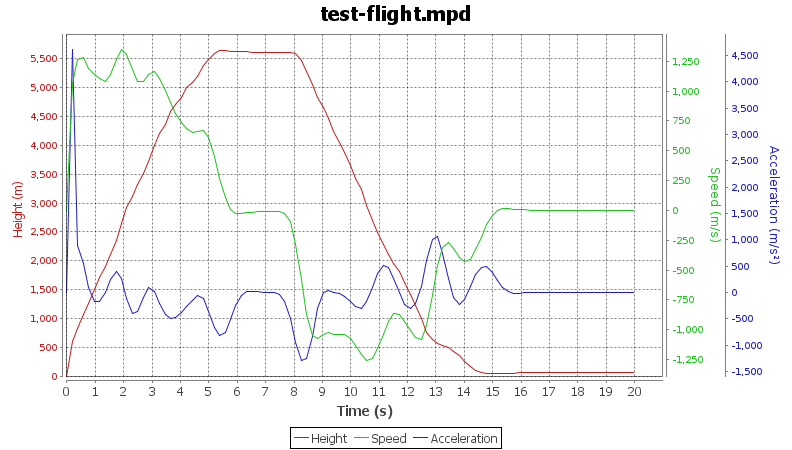
MicroPeak Serial Interface Flight Logging for MicroPeak MicroPeak was original designed as a simple peak-recording altimeter. It displays the maximum height of the last flight by blinking out numbers on the LED. Peak recording is fun and easy, but you need a log across apogee to check for unexpected bumps in baro data caused by ejection events. NAR also requires a flight log for altitude records. So, we wondered what could be done with the existing MicroPeak hardware to turn it into a flight logging altimeter. Logging the data The 8-bit ATtiny85 used in MicroPeak has 8kB of flash to store the executable code, but it also has 512B (yes, B as in bytes ) of eeprom storage for configuration data. Unlike the code flash, the little eeprom can be rewritten 100,000 times, so it should last for a lifetime of rocketry. The original MicroPeak firmware already used that to store the average ground pressure and minimum pressure (in Pascals) seen during flight; those are used to compute the maximum height that is shown on the LED. If we store just the two low-order bytes of the pressure data, we d have room left for 251 data points. That means capturing data at least every 32kPa, which is about 3km at sea level. 251 points isn t a whole lot of storage, but we really only need to capture the ascent and arc across apogee, which generally occurs within the first few seconds of flight. MicroPeak samples air pressure once every 96ms, if we record half of those samples, we ll have data every 192ms. 251 samples every 192ms captures 48 seconds of flight. A flight longer than that will just see the first 48 seconds. Of course, if apogee occurs after that limit, MicroPeak will still correctly record that value, it just won t have a continuous log. Downloading the data Having MicroPeak record data to the internal eeprom is pretty easy, but it s not a lot of use if you can t get the data into your computer. However, there aren t a whole lot of interfaces avaialble on MicroPeak. We ve only got: First implementation I changed the MicroPeak firmware to capture data to eeprom and made a test flight using my calibrated barometric chamber (a large syringe). I was able to read out the flight data using the AVR programming pins and got the flight logging code working that way. The plots I created looked great, but using an AVR programmer to read the data looked daunting for most people as it requires: With the hardware running at least $120 retail, and requiring a pile of software installed from various places around the net, this approach didn t seem like a great way to let people easily capture flight data from their tiny altimeter. The Blinking LED The only other interface available is the MicroPeak LED. It s a nice LED, bright and orange and low power. But, it s still just a single LED. However, it seemed like it might be possible to have it blink out the data and create a device to watch the LED and connect that to a USB port. The simplest idea I had was to just blink out the data in asynchronous serial form; a start bit, 8 data bits and a stop bit. On the host side, I could use a regular FTDI FT230 USB to serial converter chip. Those even have a 3.3V regulator and can supply a bit of current to other components on the board, eliminating the need for an external power supply. To see the LED blink, I needed a photo-transistor that actually responds to the LED s wavelength. Most photo-transistors are designed to work with infrared light, which nicely makes the whole setup invisible. There are a few photo-transistors available which do respond in the visible range, and ROHM RPM-075PT actually has its peak sensitivity right in the same range as the LED. In between the photo-transistor and the FT230, I needed a detector circuit which would send a 1 when the light was present and a 0 when it wasn t. To me, that called for a simple comparator made from an op-amp. Set the voltage on the negative input to somewhere between light and dark and then drive the positive input from the photo-transistor; the output would swing from rail to rail. Bit-banging async The ATtiny85 has only a single serial port , which is used on MicroPeak to talk to the barometric sensor in SPI mode. So, sending data out the LED requires that it be bit-banged directly modulated with the CPU. I wanted the data transmission to go reasonably fast, so I picked a rate of 9600 baud as a target. That means sending one bit every 104 S. As the MicroPeak CPU is clocked at only 250kHz, that leaves only about 26 cycles per bit. I need all of the bits to go at exactly the same speed, so I pack the start bit, 8 data bits and stop bit into a single 16 bit value and then start sending. Of course, every pass around the loop would need to take exactly the same number of cycles, so I carefully avoided any conditional code. With that, 14 of the 26 cycles were required to just get the LED set to the right value. I padded the loop with 12 nops to make up the remaining time. At 26 cycles per bit, it s actually sending data at a bit over 9600 baud, but the FT230 doesn t seem to mind. A bit of output structure I was a bit worried about the serial converter seeing other light as random data, so I prefixed the data transmission with MP ; that made it easy to ignore anything before those two characters as probably noise. Next, I decided to checksum the whole transmission. A simple 16-bit CRC would catch most small errors; it s easy enough to re-try the operation if it fails after all. Finally, instead of sending the data in binary, I displayed each byte as two hex digits, and sent some newlines along to keep the line lengths short. This makes it easy to ship flight logs in email or whatever. Here s a sample of the final data format:
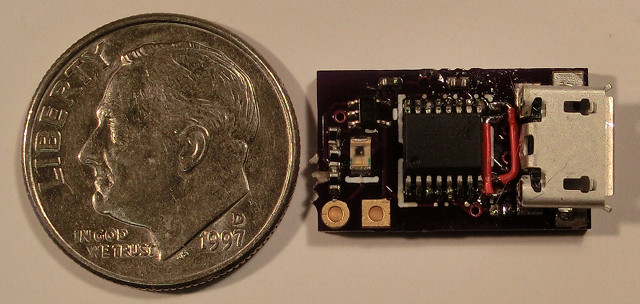
MP
dc880100fec000006800f56d8f63b059
73516447273fa93728301927d91b7712
730bbf0491fe88f7c5ee8ee896e3fadc
9dd9d3d502d1afcea2cbafc6b4c34ec1
bfbfcabf10c03dc05dc070c084c08fc0
9cc0abc0b9c0c1c0ccc0dcc020c152c4
71c9a6cf45d623db7de05ee758edd9f2
b4f9fd00aa074311631a9221c4291330
c035873b2943084bbb52695c0c67eb6b
d26ee5707472fb74a4781f7dee802b84
09860a87e786ad868a866e8659865186
4e8643863e863986368638862e862d86
2f862d86298628862a86268629862686
28862886258625862486
d925
Making the photo-transistor go fast enough The photo-transistor acts as one half of a voltage divider on the positive op-amp terminal, with a resistor making the other half. However, the photo-transistor acts a bit like a capacitor, so when I initially chose a fairly large value for the resistor, it actually took too long to switch between on and off the transistor would spend a bunch of time charging and discharging. I had to reduce the resistor to 1k for the circuit to work. Remaining hardware design I prototyped the circuit on a breadboard using a through-hole op-amp that my daughter designed into her ultrasonic guided robot and a prefabricated FTDI Friend board. I wanted to use the target photo-transistor, so I soldered a couple of short pieces of wire onto the SMT pads and stuck that into the breadboard. Once I had that working, I copied the schematic to gschem, designed a board and had three made at OSHPark for the phenomenal sum of $1.35. Aside from goofing up on the FT230 USB data pins (swapping D+ and D-), the board worked perfectly. The final hardware design includes an LED connected to the output of the comparator that makes it easier to know when things are lined up correctly, otherwise it will be essentially the same. Host software Our AltosUI code has taught us a lot about delivering code that runs on Linux, Mac OS X and Windows, so I m busy developing something based on the same underlying Java bits to support MicroPeak. Here s a sample of the graph results so far: Production plans I ve ordered a couple dozen raw boards from OSH Park, and once those are here, I ll build them and make them available for sale in a couple of weeks. The current plan is to charge $35 for the MicroPeak serial interface board, or sell it bundled with MicroPeak for $75.

25 December 2012

Russ Allbery: Review: A Paradise Built in Hell

Review: A Paradise Built in Hell, by Rebecca Solnit
Publisher: Penguin
Copyright: 2009
Printing: 2010
ISBN: 0-14-311807-2
Format: Trade paperback
Pages: 319
A Paradise Built in Hell is a book with an agenda. Solnit's goal is to convince the reader that nearly everything we're shown in movies and popular culture about human behavior during disasters is wrong. Not only is destructive mass panic unusual verging on nonexistent, spontaneous cooperation and acts of startling courage and resourcefulness are commonplace. The heroes that we hear about afterwards are more the norm than the exception. Disasters are far more likely to bring out the best in people than the worst. They break down barriers and form spontaneous human communities that survivors remember for a lifetime. Rather than natural disasters leading inevitably to an exacerbating human crisis in the absence of strong authority, Solnit argues that they are an amazing human opportunity, and that the most negative and destructive human behavior during crises is not from untrained victims but from the panic of the elites who are supposedly responsible for protecting the public. I think her analysis and presentation is both deeply appealing and deeply flawed. The flaws involve extrapolation and generalization beyond the applicability of her research, and I'll say more about that in a moment. But the appeal is still surprising and satisfying, and I think there's a lot of truth in this book despite its one-sided presentation. I like to tell people, half-jokingly, that I'm an anarchosyndicalist. It's my political alliegance of the heart: the political structure that I know would never work, but that matches the world I want to live in. (I suspect much of the belief in libertarianism is of this form.) Now I have a book to point people at when they ask what the appeal of anarchosyndicalism is. The sense of spontaneous community, of bonding, of reaching out to other people to do something necessary, together, that Solnit describes here in the aftermath of a disaster matches that vision of a world without imposed economic authority, where people spontaneously collaborate to solve problems. A Paradise Built in Hell is structured by disaster, providing a tour of major disasters and their aftermath interspersed with extended musings on what the human reactions mean and how disaster communities functioned. The major disasters discussed are the 1906 San Francisco earthquake, the Halifax explosion, the 1985 Mexico City earthquake, 9/11, and Hurricane Katrina. Solnit moves through them in chronological order, closing the book with Katrina, which had (at least for me) the most infuriating and uplifting mixes of community bonding and elite panic. But both of those factors are present from the beginning in the 1906 earthquake: spontaneous human organization that (from multiple first-hand accounts) transformed people's lives mixed with a military reaction and elite panic that possibly did more damage to the city than the earthquake did. Elite panic is the dark side of Solnit's celebration of human altruism and spontaneous community organization. The primary picture she paints is of ordinary people responding with great courage and creativity and finding, in their reaction, a transformative experience and a sense of purpose that often becomes the most powerful and positive experience of their life. But this is at odds with a deeply-entrenched elite belief in mass panic, in the necessity of keeping information from the public to suppress their reaction, and in the need to re-establish "order." And with that, Solnit is absolutely scathing, and with some justification. Along with detailed accounts of these major disasters, Solnit also gives the reader a tour of the research literature on disasters, research that has shown that the panic and chaos that is at the center of practically every disaster movie ever made is essentially a myth. Mass panic in disasters is not only rare, it's close to non-existent. As you might expect, the handling of Katrina by both the government and by neighboring white communities is the subject of the harshest attacks. The material on Katrina presented here is enough to make anyone want to throw out the current playbook on how we react to disasters (and lest one think Solnit is unfair, her research matches very closely with other research and journalism on Katrina that I've seen from a wide variety of sources). But Solnit shows that this is a pattern: the combination of our media-driven belief in how people will react to disasters combined with the elite need to re-establish control plays out in many major disasters, and almost always negatively. Even in 9/11, the official response in some cases hampered and undermined an already-effective unofficial response. This is very interesting and has concrete implications for public policy around disasters. But where Solnit moves onto thinner anarchosyndicalist ice is the story that she tells about disasters as dramatic upheavals of the established social order that could point to a revolution in how we interact with each other. Solnit is deeply inspired by human altruism during disasters, and her enthusiasm is somewhat contageous, but it was useful to read this book shortly after Bruce Schneier's Liars and Outliers. I think Solnit, in her understandable eagerness to find a way to extend disaster behavior to general life, does not understand the relationships between what Schneier terms moral, reputational, and institutional pressures. And that's the core of why we need to both enable spontaneous human response in disasters and have organized first responders and supporting infrastructure, and why disaster communities will break down when extended beyond the disaster. When I first mentioned A Paradise Built in Hell to my mother, her first reaction was dubiousness due to her memory of the 1977 New York City blackout. There was a disaster that resulted in widespread looting and destruction, rather than the positive reaction Solnit describes. Solnit does have a cogent argument for why looting is poorly analyzed (we don't, for example, distinguish between breaking into stores to get desperately needed supplies and doing so for personal gain) and should not be a priority in a life-threatening disaster. But it's not completely convincing; in some disasters, particularly ones like the 1977 power outage that were not particularly life-threatening, the looting has been the most destructive part of the disaster. Schneier provides what I think is the missing piece, both to this and to why the wonderful behavior during disasters doesn't last into everyday life. During a life-threatening disaster, moral pressures are massively increased. Nearly all of us have self-images and moral beliefs that provide very strong incentives to help others and collaborate in the face of life-threatening emergencies, incentives that override other motives and lead to the sort of behavior that Solnit celebrates. But moral pressures have inherent limitations. That moral reaction applies most strongly to small groups (such as bands of survivors), and will start to break down as larger society re-establishes itself. And disasters, like a power outage, that are not immediately life-threatening will not provoke the same intensification of moral pressures: we don't have strong moral beliefs and internal stories about staying quietly at home during power outages the way that we do for saving people from burning buildings or pulling them out of rubble. Once larger communities have reformed and that short-term emergency reaction has dissipated, the need for institutional pressures (police, law, and formal authority structures) will return. I wish Solnit had been able to read Schneier's book before writing hers. I think his analysis structure provides a healthy dose of realism and perspective to her desire for a self-organizing communal world, and might have blunted her enthusiastic but somewhat unrealistic hopes for finding some key to a revolution in human organization in the heart of disasters. But if A Paradise Built in Hell is unlikely to lead to a radical change in how we organize societies, it should at least provoke a radical rethinking of some of our unnecessary pessimism about our fellow humans. The evidence is substantial and compelling: crisis brings out the best in people, not the worst, and the ordinary people who happen to be around are capable of becoming some of the most amazing disaster response teams that we can imagine. This has numerous mundane implications for social policy. We should consider simple training for the general public, for example, to strengthen that reaction, should allow for it in legal structures and training of first responders (around looting, for instance), and should do everything we can to kill the destructive myth that people cannot be trusted in disasters or that mass panic will be as much of a threat as the disaster. But the best part of this book is that it provides a concrete, well-documented, and well-defended reason to let go of some of our cynicism and to extend a bit of trust to our fellow humans. There sadly aren't earth-shaking implications for everyday society, but there is a wealth of evidence that shows that we're better people in the crunch than we believe we are, or that we expect of others. And the more that we can embrace the dissolution of boundaries and social hierarchies in the middle of disasters, the more we are likely to be surprised by deep human connection and a sense of shared, focused purpose. Solnit is a bit long-winded with her agenda, but that bright hope has stuck with me. Recommended. Rating: 8 out of 10

17 December 2012

Jaldhar Vyas: Heads Up: Latest Dovecot Package Loses Features

Sometimes it's easy to forget that Debian's unstable branch is...unstable. Unfortunately today I have to remind you of that unpleasant fact. Dovecot 2.1.7-6 which I just uploaded has removed some features present in -5. The reason for this is that I am trying to get dovecot in shape for Wheezy. Unfortunately, as I have been severely pressed for time these past few months, the process did not take place in quite as orderly a fashion as I had hoped. My -5 packages were deemed by the release managers to have too drastic changes for this stage of the pre-Wheezy freeze and this is an attempt to make things more acceptable to them. Hopefully this version will pass into testing without incident and as soon as it does, I will prepare -7 which will put these features back. So if you need any of them, you are advised to skip -6 and stay at -5 until that happens. If you are following testing there is another possible problem you might encounter. When -1 of this version was uploaded, certain extra conf files were accidently omitted from the package. This is also true of -2 which is currently in testing. It was fixed in -3 but that version (or -4 or -5) never made it into testing so -6 is potentially the first time you might be dealing with the conf file fix. If you have manually made changes to files in /etc/dovecot/conf.d make sure you have backups because they may get overriden (as dpkg will be unaware at that point that they are conffiles.) This is a one time only packaging error and will not be a problem going forward but I apologize in advance for any inconvenience caused. And this is a good time to ask anyone interested in Dovecot on Debian (and Ubuntu etc.) to volunteer to help maintain it. It is getting more and more popular at a time when I can give it less and less attention. It is vital that an important package like this needs is team-maintained and it kind of is but so far other people who have expressed an interest in joining the team have been similarly strapped for time so we still need more recruits. All the code is publically accessible at git://git.debian.org/git/collab-maint/dovecot.git and I would be happy to sponsor any non-DD/DMs who need it.

8 December 2012

Russ Allbery: Consent: Do you speak it?

Yes, humor is a matter of taste. Does this mean that practical jokes, pranks, and social engineering are just a matter of taste? No. What's different, and what's missing, is consent. A key characteristic of practical jokes is that they involve a third party in the joke without getting specific prior consent because to get prior consent would ruin the joke. There are situations in which that's fine: if the people involved know each other well, they can give implicit consent to that sort of joke, for example. If the victim isn't known to the pranksters, they are outside of the set of situations in which this is okay. Consent is something that human society in general seems to be struggling with right now. Consent to sex. Consent to have one's personal information used by a corporation. Consent to have one's pictures posted on-line. And in every case, I think the default position should be the same as the gold standard for sex: enthusiastic consent. If you want to make someone else part of your business, your art work, your joke, your sex act, or anything else that happens outside of your head in a way that affects them, the required step is very simple: you need to get their enthusiastic consent. If that's too much trouble for you, if that makes it less fun for you, if that means you can't make money, if you think your great idea overrides their rights over their own life, body, ideas, information, or participation, then you fail. That simple. If you want to use someone else, you have to ask first. It's not a hard concept. One might even say that it's basic politeness. Now, the role of governments in this is limited and often not practical. For example, I don't think one can write laws about radio performers who like prank calling, at least without causing so many negative side effects that the effort isn't really practical. Doing that doesn't make you a criminal. It just makes you an asshole. Also, doing things to other people without their consent doesn't mean that you're then morally responsible for anything that subsequently happens that may or may not be related. But you're still an asshole. And if your employer decides that you being an asshole as part of your job has suddenly stopped being funny and fires you, hey, works for me.

4 December 2012

Russell Coker: Recruiting at a LUG Meeting

I m at the main meeting of Linux Users of Victoria (my local LUG). A couple of recruiting agents from Interpro [1] are here and have been working the crowd, one of them is on each side of the room and it seems that their plan is to speak to every person at the meeting and ask about whether they are looking for work. It is apparently difficult for them to find good Linux candidates and they hope to find people here (they are mainly looking for a senior programmer/team leader and an experienced sysadmin). One of my friends is looking for work but he s got two interviews for arranged for this week so they will have to be quick if they want to get him. I guess this means that the economy must be going well, or at least it s not too difficult for Linux people to find work (which is what matters the most to me). Attending the meeting and talking to people is a good business idea for the recruiters and is generally good for members of the group. Before the meeting starts and during the intermission people just hang out and talk, asking them if they are looking for work generally won t harm anyone and can really help some people. I wouldn t want to see multiple agencies doing this at every meeting, but I think that having it happen occasionally is a good thing.

29 November 2012

Bernhard R. Link: Gulliver's Travels

After seeing some book descriptions recently on planet debian, let me add some short recommendation, too. Almost everyone has heard about Gulliver's Travels already, so usually only very cursory. For example: did you know the book describes 4 journeys and not only the travel to Lilliput? Given how influential the book has been, that is even more suprising. Words like "endian" or "yahoo" originate from it. My favorite is the third travel, though, especially the acadamy of Lagado, from which I want to share two gems: " His lordship added, 'That he would not, by any further particulars, prevent the pleasure I should certainly take in viewing the grand academy, whither he was resolved I should go.' He only desired me to observe a ruined building, upon the side of a mountain about three miles distant, of which he gave me this account: 'That he had a very convenient mill within half a mile of his house, turned by a current from a large river, and sufficient for his own family, as well as a great number of his tenants; that about seven years ago, a club of those projectors came to him with proposals to destroy this mill, and build another on the side of that mountain, on the long ridge whereof a long canal must be cut, for a repository of water, to be conveyed up by pipes and engines to supply the mill, because the wind and air upon a height agitated the water, and thereby made it fitter for motion, and because the water, descending down a declivity, would turn the mill with half the current of a river whose course is more upon a level.' He said, 'that being then not very well with the court, and pressed by many of his friends, he complied with the proposal; and after employing a hundred men for two years, the work miscarried, the projectors went off, laying the blame entirely upon him, railing at him ever since, and putting others upon the same experiment, with equal assurance of success, as well as equal disappointment.' " "I went into another room, where the walls and ceiling were all hung round with cobwebs, except a narrow passage for the artist to go in and out. At my entrance, he called aloud to me, 'not to disturb his webs.' He lamented 'the fatal mistake the world had been so long in, of using silkworms, while we had such plenty of domestic insects who infinitely excelled the former, because they understood how to weave, as well as spin.' And he proposed further, 'that by employing spiders, the charge of dyeing silks should be wholly saved;' whereof I was fully convinced, when he showed me a vast number of flies most beautifully coloured, wherewith he fed his spiders, assuring us 'that the webs would take a tincture from them; and as he had them of all hues, he hoped to fit everybody s fancy, as soon as he could find proper food for the flies, of certain gums, oils, and other glutinous matter, to give a strength and consistence to the threads.'"

Next.

Previous.