Search Results: "pini"

5 November 2015

Gunnar Wolf: WTF @omarfayad Should *all* computer activity be illegal now? #LeyFayad

Last week, Senator Omar Fayad presented one of the prime examples of a poorly redacted law that, if enacted, will make basically any way of computer use illegal. And yes, even if he states this is merely a draft, it has so many factual and conceptual errors that there is no way to trust sanity can be regained at any point. Oh, and before I continue with this rant: If the topic interests you, I suggest you to read the 10 key points about Ley Fayad, the worst Internet initiative in history, published by r3d.mx. [update] An English equivalent of the work at r3d, at revolution-news.com: #LeyFayad: The Worst Bill in Internet History The full text (in Spanish, of course) for the law initiative is available at the Senate webpage; the law will be called Ley Federal para Prevenir y Sancionar los Delitos Inform ticos (Federal law to prevent and punish informatic felonies<) A bad name to start with, as there are many laws already in that contested area. I started reading with the preamble (Exposici n de motivos), which already shows bad signs of imprecise redaction and is plagued with factual errors (i.e. asserting that the real danger stems from the Web migrating to the Web 2.0, from which stems that this migration and not any previous one. Or by stating that (quoting+translating a full paragraph):
Activities such as electronic commerce, digital periodism, publicity and the opinions, messages or elements written in social networks can lead to patrimonial, reputation, honor or professional activity losses for people.
He continues by stating that only 16% of the countries have some kind of cybersecurity strategy (and, of course, Mexico doesn't). That... Well, is very hard to believe, as Mexico has two separate policial groups devoted to cybersecurity, and laws regulating from electronic signatures, commerce, identity, privacy, use and abuse, and a long list. Of course, as most law proposals go, it quickly decays into a dry, boring document... And I must admit I didn't fully read it, but picked here and there. I won't copy in full the note I mentioned at the beginning at r3d.mx, but will continue with some strange points, such as:
Article 16
Every person that, without the corresponding authorization or exceeding the authorization confered, accesses, intercepts, interfers or uses an information system, will be punished by one to eight years of prision and fined by 800 to 1000 days of minimum wage
So, yes, borrowing your computer without getting explicit permission, or playing around with the options in kiosks, or tons of whatever we curious people do with systems we encounter are basis for jail. (And yes, fines in this country are expressed in "days of minimum wage", which goes at ~MX$70 per day, which is ~US$4). But it gets funkier quickly:
Article 17
Whoever fraudulently destroys, disables, damages or in any way alters the working of an informatic system or any of its components, will be punished by fice to fifteen years of jail and fined by up to a thousand minimum wage days The same punishment will be given to whoever, without authorization, destroys, damages, modifies, divulges, transfers or disables information contained in any Informatic System or any of its components. The punishment will be ten to twenty years in prision and a fine of up to a thousand days of minimum wage if the effects here mentioned are done by the creation, introduction or fraudulent transmission, by any means, of an informatic weapon or malicious code
This law is meant to protect against cyberfelonies, if such a thing exists. However, here we are putting at risk people even for accidental equipment destructions. I dropped your portable hard disk with my elbow off the table? Accuse me of acting fraudulently, and I'm up for a serious jail time. And yes, laws are meant to be interpreted... And I don't want to be at the receiving end of this one! In this last article, Fayad mentions informatic weapons, which are defined in the preamble as any informatic program, informatic system, or in general, any device or material created or designed with the purpose of committing an informatic crime. So the very next article makes me, as it should make all of my fellow students and researchers, very uneasy:
Article 18
Whoever uses informatic weapons or malicious code will be imprisioned by two to six years, and fined with 200 to 500 days of minimum wage.
Article 19
Whoever builds, distributes, commerces with informatic weapons or malicious codes will be punished by three to seven years of prision and 200 to 500 days of minimum wage.
If we need to analyze malware for our classes (or for paid work, or as a hobby), we clearly fall in article 18. If we write something that can be classified as malware (without even releasing it, as an academic excercise only!), we are covered by article 19. If I give my students code that's known to be malicious (which could be as inofensive as linking to a well-known Web comic), I'm also covered by article 19. I'll jump all the way to article 31 (reproduced only partially):
Article 31
Whoever, by any means, creates, captures, records, copies, alters, duplicates, clones or deletes the information contained in a credit or debit card (...) will be punished by 8 to 14 years of prision and 300 to 500 days of minimum wage. (...)
This clearly disincentivates any way of e-commerce. When I try to buy anything online, I have to capture+copy my (rightfully owned) credit card data. The services provider has to copy, process and then delete said information. Any e-transaction is punished by jail! Well... But thinking about this again, maybe I shouldn't be so worried about the malware distribution issue at my classes. There are clearer and more contundent articles. Say...
Article 35
Whoever convenes, organizes, is part of, or executes a cibernetic attack, will be punished by 20 to 30 years of prision and fined with 100 to 1000 days of minimum wage
Of course we have convened, organized, been part of and executed cibernetic attacks at the computer security lab at ESIME. Why would there be such a lab otherwise? Then, there are clear indications that the Senator didn't understand the topic his team was working on:
Article 37
Who manipulates the digital seals used by command of the public authority will be punished with 240 days of community work
Now... What is a digital seal? It's not a phisical one that does not allow opening the doors to a business found at fault, but something that just proves a document is legitimate and pristine. How can I manipulate them? Of course, if the seals are MD5-based, I can easily forge them (and SHA1-based, it seems they will be broken enough soon to be considered no longer trustable)... But that's about it! And there is more, lots more. I'm swamped with work, and have to get back to it. But chapters the following chapters have a lot of potential for finding holes. PS - And yes, the only use I do of Twitter is via the headlines in my blog ;-) [update] Ley Fayad is dead, yay! \o/ The senator withdrew the proposal.

31 October 2015

Jonathan McDowell: Thoughts on the LG G Watch R Android smartwatch

Back in March I was given an LG G Watch R, the first Android Wear smartwatch to have a full round display (the Moto 360 was earlier, but has a bit cut off the bottom of the actual display). I d promised I d get round to making some comments about it once I d had it for a while and have failed to do so until now. Note that this is very much comments on the watch from a user point of view; I haven t got to the point of trying to do any development or other hacking of it. Firstly, it s important to note I already was wearing a watch and have been doing so for all of my adult life. Just a basic, unobtrusive analogue watch (I ve had a couple since I was 18, before that it was pretty much every type of calculator watch available at some point), but I can t remember a period where I didn t. The G Watch R is bulkier than what I was previously wearing, but I haven t found it obtrusive. And I love the way it looks; if you don t look closely it doesn t look like a smart watch (and really it s only the screen that gives it away). Secondly, I already would have taken my watch off at night and when I was showering. So while the fact that the battery on the G Watch R will really only last a day and a half is by far and away its most annoying problem, it s not as bad as it could be for me. The supplied charging dock is magnetic, so it lives on my beside table and I just drop the watch in it when I go to bed. With those details out of the way, what have I thought of it? It s certainly a neat gadget. Being able to see my notifications without having to take my phone out of my pocket is more convenient than I expected - especially when it s something like an unimportant email that I can then easily dismiss by swiping the watch face. My agenda being just a flick away, very convenient, particularly when I m still at the stage of trying to remember where my next lecture is. Having walking directions from Google Maps show up on the watch (and be accompanied by a gentle vibration when I need to change direction) is pretty handy too. The ability to take pictures via the phone camera, not so much. Perhaps if it showed me roughly what I was about to photograph, but without that it s no easier than using the phone interface. It s mostly an interface for consuming information - I ve tried the text to SMS interface a few times, but it s just not reliable enough that I d choose to use it. I ve also been pleased to see it get several updates from LG in the time I ve had it. First the upgrade from Wear 4.4 to Wear 5.1 (probably via 5.0 but I forget), but also the enabling of wifi support. The hardware could always support this, but initially Android Wear didn t and then there was some uncertainty about the FCC certification for the G Watch R. I can t say I use it much (mostly the phone is within range) but it s nice to see the improvements in support when they re available. What about the downsides? Battery life, as mentioned above, is definitely the major one. Mostly a day is fine, but the problem comes if I m ever away. There s no way to charge without the charging dock, so that becomes another things I have to pack. And it s really annoying to have your watch go dead on you midday when you forget to do so. I also had a period where I d frequently (at least once a week) find an Android Wear isn t responding. Wait/Restart? error on the watch screen. Not cool, but thankfully seems to have stopped happening. Finally there s the additional resource requirements it puts on the phone. I have a fairly basic Moto G 4G that already struggles with Ingress and Chrome at the same time, so adding yet another thing running all the time doesn t help. I m sure I could make use of a few more apps if I was more comfortable with loading the phone. The notable point for me with the watch was DebConf. I d decided not to bring it, not wanting the hassle of dealing with the daily charging. I switched back to my old analogue watch (a Timex, if you care). And proceeded to spend 3 days looking at it every time my phone vibrated before realising that I couldn t do that. That marked the point where I accepted that I was definitely seeing benefits from having a smart watch. So when I was away for a week at the start of September, I brought the charger with me (at some point I ll get round to a second base for travel). I was glad I d done so. I m not sure I m yet at the point I d replace it in the event it died, but on the whole I m more of a convert that I was expecting to be.

30 October 2015

Laura Arjona: Look at that nice looking FreedomBox!

This is a guest post by Alberto Fuentes, Debian contributor. Thanks!! I m rebuilding one my home server and decided to take a look at the FreedomBox project as the base for it. The 0.6 version was recently released and I wasn t aware of how advanced the project is already! They have a virtualbox image ready for some quick test. It took me longer to download it than to start using it. Here s is a pic of what it looks like to entice you to try it :) Selection_175
All this is already on debian right now and you can turn any debian sid installation into a FreedomBox just by installing a package. The setup generates everything private on the first run, so even the virtualbox image can be used as the final thing They use Plinth (Django) to integrate the applications into the web interface. More info on how to help integrate more Debian packages here. A live demo is going to be streamed this Friday 30 Oct 2015 and a hackaton is scheduled for this saturday 31 Oct 2015. Cheers!
Filed under: My experiences and opinion Tagged: Debian, English, Freedom, FreedomBox, selfhosting

27 October 2015

Wouter Verhelst: Adventures with modern electronics

I got me a new television last wednesday. The previous one was still functional, but with its 20 inch display it was (by today's standards) a very small one. In itself that wasn't an issue, but combined with my rather large movie collection and the 5.1 surround set that I bought a few years ago, my living room was starting to look slightly ridiculous. The new TV is a Panasonic 40" UHD ("4K") 3D-capable so-called smart thing. Unfortunately, all did not go well. When I initially hooked it up, I found it confusingly difficult to figure out how to make it display something useful from the HDMI input rather than from the (not yet connected) broadcast cable. This eventually turned out to be due to the fact that the HDMI input was not selectable by a button marked "AUX" or similar, but by a button marked with some pictogram on a location near the teletext controls, which was pretty much the last place I'd look for such a thing. After crossing that bridge, I popped in the correct film for that particular day and started watching it. The first thing I noticed, however, was that something was odd with the audio. It turned out that the TV as well as the 5.1 amplifier support the CEC protocol, which allows the TV to control some functionality of the A/V receiver. Unfortunately, the defaults were set in the TV to route audio to the TV's speakers, rather than to the 5.1 amp. This was obviously wrong, and it took me well over an hour to figure out why that was happening, and how I could fix it. My first solution at that time was to disable CEC on the amplifier, so that I could override where the audio would go there. Unfortunately, that caused the audio and video to go out of sync; not very pleasant. In addition, the audio would drop out every twenty seconds or so, which if you're trying to watch a movie is horribly annoying, and eventually I popped the DVD into a machine with analog 5.1 audio and component HD video outputs; not the best quality, but at least I could stop getting annoyed about it. Over the next few days, I managed to get the setup working better and better: There's just on thing remaining: when I go into the channel list and try to move some channels around, the TV has the audacity to tell me that it's "not allowed". I mean, I paid for it, so I get to say what's allowed, not you, thankyouverymuch. Anyway, I'm sure I'll figure that out eventually. The TV also has some 3D capability, but unfortunately it's one of those that require active 3D glasses, so the set that I bought at the movie theatre a while ago won't work. So after spending several tens of euros on extra cabling, I'll have to spend even more on a set of 3D glasses. They'll probably be brand-specific, too. Ah well. It's a bit odd, in my opinion, that it takes me almost a week to get all that stuff to properly work. Ten years ago, the old TV had some connections, a remote, and that was it; you hook it up and you're done. Not anymore.

20 October 2015

Ritesh Raj Sarraf: Controlling ill behaving applications with Linux Cgroups

For some time, I have been wanting to read more on Linux Cgroups to explore possibilities of using it to control Ill behaving applications. At this time, while I'm stuck in travel, it has given me some time to look into it. In our Free Software world, most of the things are do-o-cracy, i.e. when your use case is not the common one, it is typically you who has to explore possible solutions. It could be Bugs, Feature Requests or as is in my case, performance issues. But that is not to assume that we do not have better quality software in Free Software world. Infact, in my opinion, some of the tools available are far much more better than the competition in terms of features, and to add a sweetener (or nutritional facts) to it is the fact that Free Software liberates the user. One of my favorite tool, for photo management, is Digikam. Digikam is a big project, very featureful, and has some functionalities that may not be available in the competition. But as is with most Free Software projects, Digikam is a tool which underneath consumes many more subprojects from the Free Software ecosystem. For anyone who has used Digikam, may know some of the bugs that surface on it. Not necessarily a bug in Digikam, but maybe in one of the underneath libraries/tools that it consumes (Exiv, libkface, marble, OpenCV, libPGF etc). But the bottom line is that the overall Digikam experience (and if I may say: the overall GNU/Linux experience) takes a hit. Digikam has pretty powerful features for annotation, tagging, facial recognition. These features, together with Digikam, make it a compelling product. But the problem is that many of these projects are independent. Thus tight integration is a challenge. And at times, bugs can be hard to find, root cause and fix. Let's take a real example here. If you were to use Digikam today (version 4.13.0) with annotation, tagging and facial recognition as some of the core features for your use case, you may run into frustrating overall experience. Not just that, the bugs would also effect your overall GNU/Linux experience. The facial recognition feature, if triggered, will eat up all your memory. Thus leading you to uncover Linux's long old memory bug. The tagging feature, if triggered, again will lead to frequent I/O. Thus again leading to a stalled Linux system because of blocked CPU cycled, for nothing. So one of the items on my TODO list was to explore Linux Cgroups, and see if it was cleanly possible to tame a process to a confinement, so that even if it was ill behaving (for whatever reasons), your machine does not take the beating. And now that the cgroups consumer dust has kinda settled down, systemd was my first obvious choice to look at. systemd provides a helper utility, systemd-run, for similar tasks. With systemd-run, you could apply all the resource controller logic to the given process, typically cpu, memory and blkio. And restrict it to a certain set. You can also define what user to run the service as.
rrs@learner:/var/tmp/Debian-Build/Result$ systemd-run -p BlockIOWeight=10 find /
Running as unit run-23805.service.
2015-10-20 / 21:37:44         
rrs@learner:/var/tmp/Debian-Build/Result$ systemctl status -l run-23805.service
  run-23805.service - /usr/bin/find /
   Loaded: loaded
  Drop-In: /run/systemd/system/run-23805.service.d
            50-BlockIOWeight.conf, 50-Description.conf, 50-ExecStart.conf
   Active: active (running) since Tue 2015-10-20 21:37:44 CEST; 6s ago
 Main PID: 23814 (find)
   Memory: 12.2M
      CPU: 502ms
   CGroup: /system.slice/run-23805.service
            23814 /usr/bin/find /
Oct 20 21:37:45 learner find[23814]: /proc/3/net/raw6
Oct 20 21:37:45 learner find[23814]: /proc/3/net/snmp
Oct 20 21:37:45 learner find[23814]: /proc/3/net/stat
Oct 20 21:37:45 learner find[23814]: /proc/3/net/stat/rt_cache
Oct 20 21:37:45 learner find[23814]: /proc/3/net/stat/arp_cache
Oct 20 21:37:45 learner find[23814]: /proc/3/net/stat/ndisc_cache
Oct 20 21:37:45 learner find[23814]: /proc/3/net/stat/ip_conntrack
Oct 20 21:37:45 learner find[23814]: /proc/3/net/stat/nf_conntrack
Oct 20 21:37:45 learner find[23814]: /proc/3/net/tcp6
Oct 20 21:37:45 learner find[23814]: /proc/3/net/udp6
2015-10-20 / 21:37:51         
But, out of the box, graphical applications do not work. I haven't looked, but it should be doable by giving it the correct environment details.
Underneath, systemd is using the same Linux Control Groups to limit resources for individual applications. So, in cases where you have a requirement and do not have systemd, or you directly want to make use of cgroups, it could be easily done with basic cgroups tools like cgroup-tools.
With cgroup-tools, I now have a simple cgroups hierarchy set for my current use case, i.e. Digikam
rrs@learner:/var/tmp/Debian-Build/Result$ ls /sys/fs/cgroup/memory/rrs_customCG/
cgroup.clone_children           memory.kmem.tcp.limit_in_bytes      memory.numa_stat
cgroup.event_control            memory.kmem.tcp.max_usage_in_bytes  memory.oom_control
cgroup.procs                    memory.kmem.tcp.usage_in_bytes      memory.pressure_level
digikam/                        memory.kmem.usage_in_bytes          memory.soft_limit_in_bytes
memory.failcnt                  memory.limit_in_bytes               memory.stat
memory.force_empty              memory.max_usage_in_bytes           memory.swappiness
memory.kmem.failcnt             memory.memsw.failcnt                memory.usage_in_bytes
memory.kmem.limit_in_bytes      memory.memsw.limit_in_bytes         memory.use_hierarchy
memory.kmem.max_usage_in_bytes  memory.memsw.max_usage_in_bytes     notify_on_release
memory.kmem.slabinfo            memory.memsw.usage_in_bytes         tasks
memory.kmem.tcp.failcnt         memory.move_charge_at_immigrate
2015-10-20 / 21:45:38         
rrs@learner:/var/tmp/Debian-Build/Result$ ls /sys/fs/cgroup/memory/rrs_customCG/digikam/
cgroup.clone_children           memory.kmem.tcp.max_usage_in_bytes  memory.oom_control
cgroup.event_control            memory.kmem.tcp.usage_in_bytes      memory.pressure_level
cgroup.procs                    memory.kmem.usage_in_bytes          memory.soft_limit_in_bytes
memory.failcnt                  memory.limit_in_bytes               memory.stat
memory.force_empty              memory.max_usage_in_bytes           memory.swappiness
memory.kmem.failcnt             memory.memsw.failcnt                memory.usage_in_bytes
memory.kmem.limit_in_bytes      memory.memsw.limit_in_bytes         memory.use_hierarchy
memory.kmem.max_usage_in_bytes  memory.memsw.max_usage_in_bytes     notify_on_release
memory.kmem.slabinfo            memory.memsw.usage_in_bytes         tasks
memory.kmem.tcp.failcnt         memory.move_charge_at_immigrate
memory.kmem.tcp.limit_in_bytes  memory.numa_stat
2015-10-20 / 21:45:53         
rrs@learner:/var/tmp/Debian-Build/Result$ cat /sys/fs/cgroup/cpu/rrs_customCG/cpu.shares 
1024
2015-10-20 / 21:48:44         
rrs@learner:/var/tmp/Debian-Build/Result$ cat /sys/fs/cgroup/cpu/rrs_customCG/digikam/cpu.shares 
512
2015-10-20 / 21:49:05         
rrs@learner:/var/tmp/Debian-Build/Result$ cat /sys/fs/cgroup/memory/rrs_customCG/memory.limit_in_bytes 
9223372036854771712
2015-10-20 / 22:20:14         
rrs@learner:/var/tmp/Debian-Build/Result$ cat /sys/fs/cgroup/memory/rrs_customCG/digikam/memory.limit_in_bytes 
2764369920
2015-10-20 / 22:20:27         
rrs@learner:/var/tmp/Debian-Build/Result$ cat /sys/fs/cgroup/blkio/rrs_customCG/blkio.weight
500
2015-10-20 / 21:51:43         
rrs@learner:/var/tmp/Debian-Build/Result$ cat /sys/fs/cgroup/blkio/rrs_customCG/digikam/blkio.weight
10
2015-10-20 / 21:51:50         
The base group, $USER_customCG needs super admin privileges. Which once set appropriately, allows the user to further self-define sub-groups. And users can then also define separate limits per sub-group.
With the resource limitations set in place, my overall experience on very recent hardware (Intel Haswell Core i7, 8 GiB RAM, 500 GB SSHD, 128 GB SSD) has improved considerably. It still is not perfect, but it definitely is a huge improvement over what I had to go through ealire: A stalled machine for hours.
top - 21:54:38 up 1 day,  6:46,  1 user,  load average: 7.22, 7.51, 7.37
Tasks: 299 total,   1 running, 298 sleeping,   0 stopped,   0 zombie
%Cpu0  :  7.1 us,  3.0 sy,  1.0 ni, 11.1 id, 77.8 wa,  0.0 hi,  0.0 si,  0.0 st
%Cpu1  :  6.0 us,  4.0 sy,  2.0 ni, 49.0 id, 39.0 wa,  0.0 hi,  0.0 si,  0.0 st
%Cpu2  :  5.0 us,  2.0 sy,  0.0 ni, 24.8 id, 68.3 wa,  0.0 hi,  0.0 si,  0.0 st
%Cpu3  :  5.9 us,  5.0 sy,  0.0 ni, 21.8 id, 67.3 wa,  0.0 hi,  0.0 si,  0.0 st
MiB Mem : 7908.926 total,   96.449 free, 4634.922 used, 3177.555 buff/cache
MiB Swap: 8579.996 total, 3454.746 free, 5125.250 used. 2753.324 avail Mem 
PID to signal/kill [default pid = 8879] 
  PID  PPID nTH USER        PR  NI S %CPU %MEM     TIME+ COMMAND                           UID 
 8879  8868  18 rrs         20   0 S  8.2 31.2  37:44.64 digikam                          1000 
10255  9960   4 rrs         39  19 S  1.0  0.8  19:47.73 tracker-miner-f                  1000 
10157  9960   7 rrs         20   0 S  0.5  3.0  32:29.76 gnome-shell                      1000 
    7     2   1 root        20   0 S  0.2        0:53.48 rcu_sched                           0 
  401     1   1 root        20   0 S  0.2  1.3   0:54.93 systemd-journal                     0 
10269  9937   4 rrs         20   0 S  0.2  0.4   2:34.50 gnome-terminal-                  1000 
15316     1  14 rrs         20   0 S  0.2  3.7  30:05.96 evolution                        1000 
23777     2   1 root        20   0 S  0.2        0:05.73 kworker/u16:0                       0 
23814     1   1 root        20   0 D  0.2  0.0   0:02.00 find                                0 
24049     2   1 root        20   0 S  0.2        0:01.29 kworker/u16:3                       0 
24052     2   1 root        20   0 S  0.2        0:02.94 kworker/u16:4                       0 
    1     0   1 root        20   0 S       0.1   0:18.24 systemd                             0 
The reporting tools may not be correct here. Because from what is being reported above, I should be having a machine stalled, and heavily paging, while the kernel scanning its list of processes to find the best process to kill. From this approach of jailing processes, the major side effect I can see is that the process (Digikam) is now starved of resources and will take much much much more time than what it would have been usually. But in the usual cases, it takes up all, and ends up starving (and getting killed) for consuming all available resources. So I guess it is better to be on a balanced resource diet. :-)

Categories:

Keywords:

Like:

16 October 2015

Vincent Sanders: Raspberries are not the only fruit

I have worked with ARM based systems for longer than I care to admit to myself. From the Acorn Archimedes 305 in 1987 through to modern 64bit systems I have seen many many changes in the ARM community. One big change has been the rise of the inexpensive single board computer (SBC).

Arguably the Raspberry Pi (RPi) was responsible for starting this trend. Before RPi there were small development boards available, I was even involved in producing some of them, none of these really became a big thing and were principally vehicles for silicon vendors to showcase their SoC in an accessible way. When I say accessible I mean for silicon vendors who were previously used to charging many thousands of pounds for their development boards now only charging hundreds.

Raspberry Pi 2 B+ in my case
In my opinion the RPi was a complete disruption to the SBC market. In early 2012 a complete ARM computer system could now be purchased for $35 ( 25) which was substantially cheaper than the best contemporary competitor the Beaglebone $89 ( 60)

To be clear, the reason the RPi succeeded (millions sold, household name) was not on price alone but also the large amount of good supporting software and how easy it was made for teachers and makers to use.

There were several areas that the RPi managed to change perceived issues into opportunities for using what was already available or third parties to provide. There were also several issues raised about the original RPi:
Some of these have been addressed since release as the foundation now sells cases, hardware revisions with much more powerful processors, pre-configured storage, cameras and displays. The important thing to note here though is the RPi has made the bare SBC a much more widely accepted product where all the non critical parts are considered "extras" and a lot is forgiven because of the price.

With that acceptance there have been many, many new SBC coming to market with better peripherals and increasingly competitive pricing. These are technically not clones as none of them use the Broadcom processor of the RPi but they often share many features and possibly even a compatible expansion header.

Banana pi in my case with a 2.5inch drive bay
The Banana Pi was one of these copycats which I acquired for a similar price as an RPi in 2014. The main processor of this system was a 1Ghz dual core Allwinner A20 processor (a considerable advance on the 700MHz single core of the original RPi) coupled to a gigabyte of memory. Additionally the board benefited from having SATA and gigabit Ethernet MAC which made for a much more versatile system. Various third parties filled in the missing peripherals including my own attempt at a case.

I acquired a cubietruck for the NetSurf project to use as a build node in their CI system this is again based on the A20 but with more memory and somewhat better peripheral support but at a substantial cost over the Banana Pi.

The most recent addition to this form factor is the introduction by Xunlong Software of the Orange Pi PC. This little board is the same footprint as the RPi2 B+ design but with differing connector placement. The processor is a quad core 1.6GHz Allwinner H3 with a gigabyte of memory and has has Ethernet and USB but no SATA.

Pile of Orange Pi PC in my cases
The big news about this board though is the price, at $15 ( 10) it resets the price expectations just as the RPi did before it. I was initially sceptical of the quality of the product (or if it would arrive at all) but I have acquired five of these boards and every one of them came well packaged, boxed and in a static bag, just like the RPi does, and they all worked.

I created a case design based on my RPi slimline case so they would be protected when piled up with all the other boards. The use of a DC barrel jack instead of micro USB for power is better in that the connector is more robust and intended for higher current draws but does mean additional leads are needed. There are, however, two flies in the ointment, neither are showstoppers but make the board a little more difficult to use.

Orange Pi in my case with heatsinkOne is a simple necessity of a substantial heatsink on the H3 processor. Initially I used a small 20 x 20mm copper heatsink (around 800mm square surface area) but this was insufficient under full load. I did not want to have to use a fan so I milled some slots into copper round bar, then cut off sections and faced them on a lathe. The completed design had more than 2200 square mm surface area and cost around $2.5 ( 1.5) in material (and a couple of hours in the workshop but that was fun and I made something)

The second issue and arguably much more serious is that of software. Let me be honest, it is dreadful, I mean very bad indeed. The images provided from the Orange Pi website are some of the worst examples of "do something quick" I have experienced.

Fortunately a user on the forums named loboris decided to create scripts that generate a Debian (and Ubuntu and Fedora) distribution images that can be installed from SD card. He relies on a somewhat patched 3.4 kernel full of Allwinner vendor changes and the inevitable binary blobs for the Marli GPU but the result does work.

I have had a few units acting as distcc compiler slaves for two weeks now at 100% CPU loading and they are still running. The processor does not get overly warm with the heatsink installed and Debian behaves just fine. The main caveat being that it is definitely not going to work if you try and update the kernel through packaging.

My ARM build farm as a pile of SBC
The state of software support and Xunlong Software relying on a forum user to complete their product does tarnish an otherwise impressive and possibly market changing SBC.

Perhaps I expect too much for fifteen bucks? I guess when the cost of the case, heatsink, cables and memory storage card is similar to the rest of the computer there is simply no margin left for anything else.

In conclusion hopefully this brief overview has provided some insight into what is available in this market and that the Raspberry Pi is indeed not the only option.

I finish with an image is of my ARM build farm consisting of every SBC I mention here (including a couple of RPi)

15 October 2015

Laura Arjona: Long summer story, Welcome team, and I am a Debian Developer now

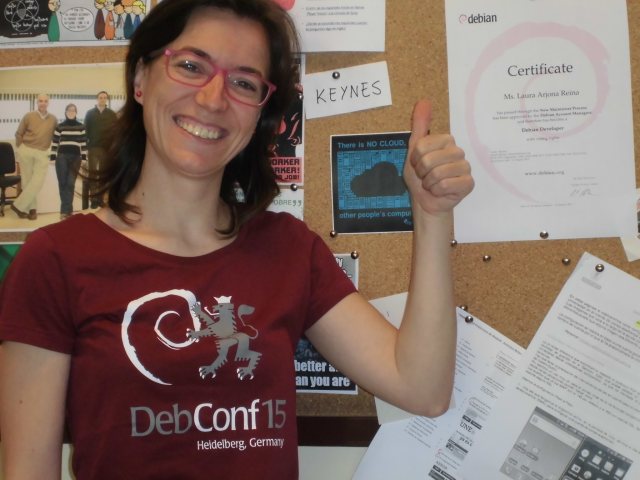
Note: 2015/10/16: I need to add some links but I won t delay this more, posting now, will edit later. Summer ended long time ago, but believe me, I m still catching up with all the things that I began in June/July, all the things I left in August when I went holidays, and more things that appeared in August and September. This is a long overdue post, I hope you bear with me for waiting so long, and writing (now) so long too! June In June, I was 100% sure that I would not attend DebConf15 (well, I was 98% sure until then), and when the new Outreach Sponsorship grants were announced, I decided to write some mails to several Debian contributors, so they consider applying for the grant and attend DebConf (and maybe trigger some i18n/l10n meeting ). They kindly declined, and I understood their reasons, but also wondered what would have happened if the proposal would have come from somebody more official instead of a random contributor that they don t know. I also hoped that lots of other Debianites also write to newbies or not-yet-DD-contributors or non-packaging contributors to invite them to DebConf, and I hoped that they had better luck than me in convincing them :) July In July I usually work hard preparing the computer labs for next academic year at my workplace in the University, but I also have more free time in the long afternoons and evenings, since I don t sleep much, and there is not much to do outside with the summer hot. So I used that month to go on contributing to DebConf publicity and think a bit more about Debian and the other free software communities. I didn t put much time in advancing my selfhosting (no SSL yet in *.larjona.net! booooo!) but I decided to deep my toe in Sandstorm.io, and try to selfhost an instance ( http://lacaja.larjona.net ) and try Etherpad inside Sandstorm (since I failed in deploying Etherpad by myself in my jessie+nginx+postgres box). Sandstorm worked, and Etherpad was packaged in Sandstorm so it worked too; and I have my free-software-base pads now for writing and share. So I joined #sandstorm IRC channel since then, and there I learnt that Asheesh Laroia (who works in Sandstorm.io and is also a Debian Developer and was going to give a talk about Sandstorm.io in DebConf15) was offering mentorship for people wanting to learn Sandstorm packaging, and his proposal was to begin packaging Framadate. I also failed in selfhosting Dudle (prepared for Apache + FastCGI, couldn t make it work in my Nginx), so Asheesh s proposal looked suitable for me. We talked and decided to invest the rest of July and first days of August in learning to package Framadate. I learned a lot, but couldn t finish the task. I encountered many issues (setting my dev environment, and later trying to package), and we solved some of them but my time ran out. I posted my work in the list, and I hope that my feedback on the documentation and the issues I encountered helped Asheesh and the Sandstorm community. Framadate is packaged in Sandstorm.io now, Drew Fisher packaged it, not sure if my stuff was useful or not (it s been useful for me, for learning, at least). I ll talk more about Sandstorm.io in a future blog post updating on my selfhosting adventures. What I liked most was the kind of proposal of mentoring that Asheesh made. It was very detailed in every aspect: the task, the things you need to accomplish it, details about his availability for mentorship I try to be welcoming in the teams in which I participate, but the fact is that I fail in actually mentor, maybe because of not making specific proposals to people (until now, I was like Hi, newcomer! Go read this, this and this, and try for yourself any task you feel you like it, and come back if you have issues , la Debian ). This, plus the thoughts about my mails in June for diversity outreach in DebConf, made me feel the need of having a team where people willing to welcome newcomers share tricks and procedures, write together more specific proposals, and follow up the newcomers experiences in a regular way. I talked with Enrico Zini and we wrote down some notes for a Welcome Team in Debian; he said he would spread the word during DebCamp/DebConf and we would see what people thinks about it. August August came, and the day before going on holidays I was really tired: too much luggage to prepare, too many hours in front of the computer, and the usual stress of traveling; and I took the bad decision of signing some GPG keys of several Debianites that I met in July. I say bad decision because the lack of sleep showed its black magic and I accidentally deleted my secring.gpg file. I knew I had a backup but I didn t have too much time to invest and I didn t want to mess it with the backup too, and my laptop was going to stay at home, powered off, during the whole month, so I just went on holidays and left the GPG issue for later. The day after, meanwhile I was waiting in the airport for my boarding time, I received a mail accepting me as Debian Developer. Wow!! Really, I was not expecting that the process was already finished, I had interchanged several mails with my Application Manager (who happens to be the current DPL!) and I thought that his summer could be quite packed of Debian/DebConf work and my process could wait a bit. So it was a very happy news and very motivating after one month (July) full of free software work. On the other side, I was a bit scared: what type of Debian Developer are you, larjona, not capable to sign some GPG keys without breaking your setup?! but I answered myself well, I m the type of Debian Developer that has backups :) and then, with that mixed feelings of excitement and impostor syndrome, I took my plane and went on holidays, not expecting to touch any computer until the end of the month. August is probably the month in the year when I have more free time (holidays), but less time to dedicate to free software. I devote most of the month to visit family and stay with them, with no internet connection available or no free time to look at the mailbox or social networks or IRC But DebCamp and DebConf15 were happening during my holidays. And this DebConf15 was the first one in which I participated in the organization, and the first one in which I felt more than being a consumer of Debian videos . I could not follow the streamings, my only internet-capable device was my Android 2.x phone, but when I had wifi I fetched the mail, and during the nights, while everybody else was sleeping and I was laying on the terrace, below the sky full of stars, I could read batches of hundred of mails from debconf-discuss mailing list. And I could get some feeling from DebConf life, because I learned about the ad-hoc BoFs and discussions, the morning bike rides and swimming proposals, and the dancing classes, the i18m/l10n meeting, and many other things. I could answer some mail from time to time, and I also knew that a fellow Debianite from Madrid was going to bring me some stickers, maybe a t-shirt, and shake hands in my name to some persons. September and October September was about finishing reading all the mails and try to answer the pending ones, and preparing my computer to use my new Debian identity (and stop using larjona-guest). I still have some things to do, pending technical work, and some mails that I should have answered and I ve forgotten, for sure (if you sent me a mail that needs answer or would be fine that I answer (even if it was months ago!), please resend or ping me). I recovered my secring.gpg but and just now I added larjona@debian.org to the ID in my GPG key, but didn t signed the pending keys again (sorry dkg and holger! will catch up there soon). My subkeys expired and I m trying to find out how to proceed (they are in my FSFE SmartCard) :/ About the Debian teams, I ve resumed my work in publicity team (this year I ll try to be more involved, in Debian Project News in particular), partially in the website team, and recently I ve finished catching up with the Spanish translation of the website. I ve also joined the DebConf team again (for DebConf16, no matter I probably won t attend) and documented the Publicity task for DebConf, and I try to engage the mailing list and the IRC meetings. I finally could have time to watch some DebConf15 videos and Andreas Tille s talk ( Creating a more inviting environment for newcomers New experiences from MoM, SoB, Teammetrics ) helped me to step ahead in welcoming people with more useful stuff than Hi, newcomer! Go read this (general URLs), try for yourself whatever you like . I have made specific proposals for two people. In mid September I accepted an interview about Debian for a podcast with quite a lot audience (in Spanish), in which I explained the idea of the Welcome Team and offered myself as first-contact. Since then, two more people have contacted me and I have offered specific tasks I think are suitable for them. I also try to be more available in the IRC and offer some time spans for new contributors to DebConf to explain the git setup, the wiki, and all this stuff that looks more complicated than what it is. And I think that s all. My Debianite friend kindly brought me some stickers and a DebConf t-shirt, plus the organization t-shirt that the team gave me as present for my contributions in DebConf15. Neil McGovern kindly sent me a certificate of my new Debian Developer status (thanks!!), and it s posted in my wall at work. Here you are a photo! larjona_dd.JPG (Note: my wall is full of stickers and pieces of papers with things I need, things I like and things I use to explain my work (sometimes sarcastically/ironically ). Maybe some day I ll make a blog post about that!) I feel very proud and happy. Still, a lot of things to learn and work to do, but my intentions are: to keep on progressing (sometimes fast, sometimes slowly), never give up, and enjoy the multiple flowers I find in my way :) Thanks everybody! October and future Some other ideas/plans for the future (the ones I didn t say yet): Comments? If you want to comment you can use this pump.io thread.
Filed under: My experiences and opinion, News Tagged: Communities, Contributing to libre software, Debian, Developer motivations, encryption, English, Free Software, gpg, libre software

14 October 2015

Norbert Preining: On Lars Wirzenius, Mart n Ferrari, and Debian

Now that the tsunami that followed my recent blog post has passed, I can read through all the nice comments and blogs of other people. I didn t expect that just writing up some links to posts on LKML, plus adding my personal opinion on what has happened and about my interpretation concerning Debian could gather so much attention. Anyway, let us look at the blog posts written in the aftermath. debian-newspeak-coc In particular do I want to answer to two blogs: Lars Wirzenius blog and Mart n Ferrari s blog, both of which are excellent examples of insults. I also want to mention that although the previous two are bad examples, there are fortunately also those who are able to resist primitive insults, in particular Gunnar Wolf (direct link to the blog does not work), and Miriam Ruiz blog, which contradict my blog and propose a different view, without pulling the knife. Lars Wirzenius Let us start with Lars (ah sorry, I have to call him Wirzenius here, strange custom has suddenly popped up in Debian!):

I think Preining mis-characterises what happens on the Linux kernel mailing list, and in Debian, in free software development in general, and what Sarah Sharp has said and done. I continue to think he is wrong about everything on this topic.
I am very surprised that Lars^WWirzenius is in possession of a crystal ball that allows him to see and evaluate my attitude towards all these items, considering that I have presented links to posts on the LKML, and yes, my interpretation of the matter. Mind that the whole text amounts to about 130 lines on my screen, while my personal opinion was stated in two paragraphs of total 9 lines plus some interspersed comments. And in these maybe 20 lines I didn t make general statements about open source, kernel development etc etc. Lars, I know you have closed your blog for comments so I couldn t ask you but please, can you send me one of your crystal balls if you have more of them? At least he has managed to keep a bit of proper writing and disagreed with my statement on Debian (whether there is fun or not in Debian). He is of course free to do that, but please, don t rob me the right to state that I think Debian has changed. All this dispute centers around people not being capable to distinguish two things: One, being against the Code of Conduct due to the inclusion of administrative actions without clear definitions, and Two, being pro offensive behavior and and insults. Now, dear Lars^WWirzenius, please listen: I never advocated abusive behavior or insults, nor do I defend it. (Did you hear that!) I simply opposed the Code of Conduct as ruling instrument. And what kind of emails I got due to my opposition was far outside the Code of Conduct you are so strongly defending. So please, stay at the facts, and stop insulting me. Thanks. Mart n Ferrari Concerning Mart n I don t have much to say but please, stop spreading lies. You stated:
Once again, he s complaining about how the fun from Debian has been lost because making sexist jokes, or treating other people like shit is not allowed any more.
Could you please come up with a reference to this? Or are you just interpreting? I am very disappointed about this level of discussion between Debian Developers. You not even cared to answer my comment on your blog. Should I say something clear here you should be happy that this has not been written on a Debian mailing list, otherwise I hope the Code of Conduct hammer would hit you.
So yes, it seems that at least these two blogs underline exactly what my opinion is: Communication culture in Debian has changed to be more company-like. Probably due to the ever increasing amount of developers that are paid for their work on Debian (Ubuntu), the pressure to follow US company codes has taken a firm grip, so firm that even stating my diverging opinion is already enough to get branded. Good Future!

12 October 2015

Dimitri John Ledkov: uwsgi gains --paste-name option

One of the WSGI servers that is commonly using with nginx is uwsgi. One way to configure and deploy simple and complex WSGI middlewares and apps is by using Paste deploy tooling. However, until now uwsgi was only able to load a default app under the suffix "main". There is no such limitation in the Paste deploy code itself, as functions there accept a name argument. What was missing is an option in uwsgi to pass, optionally, alternative non-default name of the app to load.

A patch adding this option has now been merged upstream and should be available in the next uwsgi release.

What I was hoping that one will be able to do something like this:
$ uwsgi --ini-paste /etc/nova/api-paste.ini --paste-name osapi_compute
But alas that didn't work. I wish all OpenStack Software service were deployable as normal wsgi stand-alone apps without any addition glue code. Keystone is kind of like this with /usr/share/httpd/cgi-bin/keystone/main entry point for deploying keystone as a wsgi app, instead of a daemon.

Also can nova operate on top of nginx ugreen threats? Or is that something entirely difference from the recent day eventlet?!

The postings on this site are my own and don't necessarily represent Intel s positions, strategies, or opinions.

9 October 2015

Miriam Ruiz: Thick Skin (within Free/Open Source communities)

The definition of thick-skinned in different dictionaries ranges from not easily offended to largely unaffected by the needs and feelings of other people; insensitive , going through able to ignore personal criticism , ability to withstand criticism and show no signs of any criticism you may receive getting to you , an insensitive nature or impervious to criticism . It essentially describes an emotionally detached attitude regarding one s social environment, the capacity or ignoring or minimizing the effects of others criticism and the priorization of the protection of one s current state over the capacity of empathizing and taking into account what others may say that don t conform to one s current way of thinking. It is essentially setting up barriers against whatever others may do that might provoke any kind of crisis or change in you. There are a few underlying assumptions in the use of this term as a something good to have, when it comes to interactions with your own community: In the first place, it assumes that your own community is essentially hostile to you, and you will have to be constantly in guard against them. It assumes that it is better to set up barriers against the influence of others within your own comunity, because in fact your own peers are out there essentially to hurt you. Or, at least, they do not care a damn about you. In second place, it assumes that changes are wrong, that personal evolution is wrong, and that the more insensitive you are to your peer s opinions, the best, because they really have nothing to contribute to help you grow as a person. I m smart; you re dumb. I m big; you re little. I m right; you re wrong; And there s nothing you can do about it. (from the film Matilda). Matilda s dad is in fact the first reference that comes to my mind when we re talking about really thick skin. Scene of the film Matilda: I'm smart, You're dumb. I'm big, You're little. I'm right, You're wrong When the main recommendation when the level of aggressiveness within a community is that someone has to make their skin thicker, they are assuming that a bullying environment will help the results. This is nothing new. It s the same theoretical base that you can see in hazing and in other activities involving harassment, abuse or humiliation in college, when initiating a person into some groups. It s supposed to build character, to make someone closer to the alpha male stereotype and, in essence, make us better men (yes, I am using the word men on purpose, because insensitiveness is not usually seen as a positive trait in females). The assumption is that a community with a hard environment and individuals prepared for the war is more effective than a more civilized one. Luckily, that s not the point of view of most members of the Debian Community, and many other Free/Open Source projects. The Code of Conduct is very explicit when it says that a community in which people feel threatened is not a healthy community , and that is good. The Debian Project welcomes and encourages participation by everyone (Diversity Statement), including those with a thin skin, and I m happy about that. There are still a lot of things to improve, of course, but I have the feeling that -despite the occasional complains that having to be respectful to others take the fun away- we re moving in the right direction. The best tip I can give you on thickening your skin = don t. That is, don t thicken your skin. Having a thin skin means you re letting the world in, you re letting what s out there affect what s in you. It means you re connected. You re open. You re considerate and you ll consider it whatever it might be. Having a thin skin may be dangerous, sure, because you might take in so much that you pop, like that blueberry girl from Willy Wonka. But life is dangerous. A thick skin protects you from everything, but it also protects you from everything from the gentle touches of life, from the subtle emotions of others, the deep connections, the meaningful interactions. (Top Ten Tips on how to Thicken your Skin).

8 October 2015

Gunnar Wolf: On evolving communities and changing social practices

I will join Lars and Tincho in stating this, and presenting a version contrary to what Norbert portraits. I am very glad and very proud that the community I am most involved in, the Debian project, has kept its core identity over the years, at least for the slightly-over-a-decade I have been involved in it. And I am very glad and very proud that being less aggressive, more welcoming and in general more respectful to each other does not counter this. When I joined Debian, part of the mantra chants we had is that in order to join a Free Software project you had to grow a thick skin, as sooner or later we'd all be exposed to flamefests. But, yes, the median age of the DD was way lower back then I don't have the data at hand, but IIRC I have always been close to our median. Which means we are all growing old and grumpy. But old and wiser. A very successful, important and dear subproject to many of us is the Debian Women Project. Its original aim was, as the name shows, to try to reduce the imbalance between men and women participants in Debian IIRC back in 2004 we had 3 female DDs, and >950 male DDs. Soon, the project started morphing into pushing all of Debian to be less hostile, more open to contributions from any- and everyone (as today our diversity statement reads). And yes, we are still a long, long, long way from reaching equality. But we have done great steps. And not just WRT women, but all of the different minorities, as well as to diverging opinions within our community. Many people don't enjoy us abiding by a code of conduct; I also find it irritating sometimes to have to abide by certain codes if we mostly know each other and know we won't be offended by a given comment... Or will we? So, being more open and more welcoming also means being more civil. I cannot get myself to agree with Linus' quote, when he says that respect is not just given to everybody but must be earned. We should always start, and I enjoy feeling that in Debian this is becoming the norm, by granting respect to everybody And not losing it, even if things get out of hand. Thick skins are not good for communication.

Lars Wirzenius: On Norbert Preining, Sarah Sharp, and Debian

I disagree with pretty much everything Norbert Preining says in his blog post about Sarah Sharp in response to Sharp's blog post Closing a door about leaving Linux kernel development. I think Preining mis-characterises what happens on the Linux kernel mailing list, and in Debian, in free software development in general, and what Sarah Sharp has said and done. I do not wish to participate in yet another discussion on the Debian Code of Conduct, respect, appropriate behaviour, or whether these things result in worse software. I won't spend any further of my time on debating, point-by-point, the arguments and straw-men Preining makes. Those discussions have happened often enough, without any effect on Preining and those who think like him. Likewise, despite the many times he makes the arguments, I continue to think he is wrong about everything on this topic. I do feel it is important to make it clear to the people reading Planet Debian, where both Preining's and my blogs are published, that his opinions are not mainstream in the Debian project, and that despite what he says, Debian development continues to be fun.

Mart n Ferrari: Pining for the good ol' days

Today, Norbert Preining wrote a blog post syndicated in planet talking about Sarah Sharp quitting Linux development, and making a parallel with the Debian community. Once again, he's complaining about how the fun from Debian has been lost because making sexist jokes, or treating other people like shit is not allowed any more. He seems to think the LKML is the ideal environment and that Debian should be more like it. He also celebrates that Ms Sharp12 left Linux, because evidently the freedom to be a jerk to each other is more important than the contributions that she -or any other person that finds that atmosphere toxic, like mjg- has produced or could have produced in the future.
I would like to tell readers of Planet Debian that this view is not the norm in Debian any more. We are working hard to make the project more inclusive, fun, and welcoming to everybody. Sadly, some people are still pining for the good ol' days, and won't give up so easily on their privilege.

  1. Whom he calls "one more SJW", I guess then that after all, this is just about ethics in FOSS development.
  2. At this point, using the term SJW in a discussion should equate to a Godwin, and mean that you lost the argument.
6 comments

Norbert Preining: Looking at the facts: Sarah Sharp s crusade

Much has been written around the internet about this geeky kernel maintainer Sarah Sharp who left kernel development. I have now spent two hours reading through lkml posts, and want to summarize a few mails from the long thread, since most of the usual news sites just rewrap the original blog of hers without adding any background. darth-cookie The whole thread evolved out call for stable kernel review by Greg Kroah-Hartman where he complained about too many patches that are not actually in rc1 before going into stable:
<rant>
  I'm sitting on top of over 170 more patches that have been marked for
  the stable releases right now that are not included in this set of
  releases.  The fact that there are this many patches for stable stuff
  that are waiting to be merged through the main -rc1 merge window cycle
  is worrying to me.
  [...]
from where it developed into a typical Linus rant on people flagging crap for stable, followed by some jokes:
On Fri, Jul 12, 2013 at 8:47 AM, Steven Rostedt <rostedt@goodmis.org> wrote:
> I tend to hold things off after -rc4 because you scare me more than Greg
> does ;-)
 
Have you guys *seen* Greg? The guy is a freakish giant. He *should*
scare you. He might squish you without ever even noticing.
 
              Linus
and Ingo Molnar giving advice to Greg KH:
So Greg, if you want it all to change, create some _real_ threat: be frank 
with contributors and sometimes swear a bit. That will cut your mailqueue 
in half, promise!
with Greg KH taking a funny position in answering:
Ok, I'll channel my "inner Linus" and take a cue from my kids and start
swearing more.
Up to now a pretty decent and normal thread with some jokes and poking, nobody minded, and reading through it I had a good time. The thread continues with a discussion on requirements what to submit to stable, and some side threads on particular commits. And then, out of the blue, Social Justice Warrior (SJW) Sarah Sharp pops in with a very important contribution:
Seriously, guys?  Is this what we need in order to get improve -stable?
Linus Torvalds is advocating for physical intimidation and violence.
Ingo Molnar and Linus are advocating for verbal abuse.
 
Not *fucking* cool.  Violence, whether it be physical intimidation,
verbal threats or verbal abuse is not acceptable.  Keep it professional
on the mailing lists.
 
Let's discuss this at Kernel Summit where we can at least yell at each
other in person.  Yeah, just try yelling at me about this.  I'll roar
right back, louder, for all the people who lose their voice when they
get yelled at by top maintainers.  I won't be the nice girl anymore.
Onto which Linus answers in a great way:
That's the spirit.
 
Greg has taught you well. You have controlled your fear. Now, release
your anger. Only your hatred can destroy me.
 
Come to the dark side, Sarah. We have cookies.
On goes Sarah, gearing up in her SJW mode and starting to rant:
However, I am serious about this.  Linus, you're one of the worst
offenders when it comes to verbally abusing people and publicly tearing
their emotions apart.
 
http://marc.info/?l=linux-kernel&m=135628421403144&w=2
http://marc.info/?l=linux-acpi&m=136157944603147&w=2
 
I'm not going to put up with that shit any more.
Linus himself made clear what he thinks of her:
Trust me, there's a really easy way for me to curse at people: if you
are a maintainer, and you make excuses for your bugs rather than
trying to fix them, I will curse at *YOU*.
 
Because then the problem really is you.
[...]
It is easy to verify what Linus said, by reading the above two links and the answers of the maintainers, both agreed that it was their failure and were sorry. (Mauro s answer, Rafael s answer) It is just the geeky SJW that was not even attacked (who would dare to attack a woman nowadays?). The overall reaction to her by the maintainers can be exemplified by Thomas Gleixner s post:
Just for the record. I got grilled by Linus several times over the
last years and I can't remember a single instance where it was
unjustified.
What follows is a nearly endless discussion with Sarah meandering around, changing permanently her opinion what is acceptable. Linus tried to explain to her in simple words, without success, she continues to rant around. Here arguments are so weak I had nothing but good laugh:
> Sarah, that's a pretty potent argument by Linus, that "acting 
> professionally" risks replacing a raw but honest culture with a
> polished but dishonest culture - which is harmful to developing
> good technology.
> 
> That's a valid concern. What's your reply to that argument?
 
I don't feel the need to comment, because I feel it's a straw man
argument.  I feel that way because I disagree with the definition of
professionalism that people have been pushing.
 
To me, being "professional" means treating each other with respect.  I
can show emotion, express displeasure, be direct, and still show respect
for my fellow developers.
 
For example, I find the following statement to be both direct and
respectful, because it's criticizing code, not the person:
 
"This code is SHIT!  It adds new warnings and it's marked for stable
when it's clearly *crap code* that's not a bug fix.  I'm going to revert
this merge, and I expect a fix from you IMMEDIATELY."
 
The following statement is not respectful, because it targets the
person:
 
"Seriously, Maintainer.  Why are you pushing this kind of *crap* code to
me again?  Why the hell did you mark it for stable when it's clearly
not a bug fix?  Did you even try to f*cking compile this?"
Fortunately, she was immediately corrected and Ingo Molnar wrote an excellent refutation (starting another funny thread) of all her emails, statements, accusations (all of the email is a good read):
_That_ is why it might look to you as if the person was
attacked, because indeed the actions of the top level maintainer were
wrong and are criticised.
 
... and now you want to 'shut down' the discussion. With all due respect,
you started it, you have put out various heavy accusations here and elsewhere,
so you might as well take responsibility for it and let the discussion be
brought to a conclusion, wherever that may take us, compared to your initial view?
(He retracted that last statement, though I don t see a reason for it) Last but not least, let us return to her blog post, where she states herself that:
FYI, comments will be moderated by someone other than me. As this is my blog, not a
government entity, I have the right to replace any comment I feel like with 
 fart fart fart fart .
and she made lots of use of it, I counted at least 10 instances. She seems to remove or fart fart fart any comment that is not in line with her opinion. Further evidence is provided by this post on lkml. Everyone is free to have his own opinion (sorry, his/her), and I am free to form my own opinion on Sarah Sharp by just simply reading the facts. I am more than happy that one more SJW has left Linux development, as the proliferation of cleaning of speech from any personality has taken too far a grip. Coming to my home-base in Debian, unfortunately there is no one in the position and the state of mind of Linus, so we are suffering the same stupidities imposed by social justice worriers and some brainless feminists (no, don t get me wrong, these are two independent attributes. I do NOT state that feminism is brainless) that Linus and the maintainer crew was able to fend of this time. I finish with my favorite post from that thread, by Steven Rosted (from whom I also stole the above image!):
On Tue, 2013-07-16 at 18:37 -0700, Linus Torvalds wrote:
> Emotions aren't bad. Quite the reverse. 
 
Spock and Dr. Sheldon Cooper strongly disagree.
Post Scriptum (after a bike ride) The last point by Linus is what I criticize most on Debian nowdays, it has become a sterilized over-governed entity, where most fun is gone. Making fun is practically forbidden, since there is the slight chance that some minority somewhere on this planet might feel hurt, and by this we are breaking the CoC. Emotions are restricted to the Happy happy how nice we are and how good we are level of US and also Japanese self-reenforcement society. Post Post Scriptum I just read Sarah Sharp s post on What makes a good community? , and without giving a full account or review, I am just pi**ed by the usage of the word microaggressions I can only recommend everyone to read this article and this article to get a feeling how bs the idea of microaggressions has taken over academia and obviously not only academia. Post3 Scriptum I am happy to see Lars Wirzenius, Gunnar Wolf, and Mart n Ferrari opposing my view. I agree with them that my comments concerning Debian are not mainstream in Debian something that is not very surprising, though, and I think it is great that they have fun in Debian, like many other contributors. Post4 Scriptum Although nobody will read this, here is a great response from a female developer:
[...] To Linus: You're a hero to many of us. Don't change. Please. You DO
NOT need to take time away from doing code to grow a pair of breasts
and judge people's emotional states: [...]
Nothing to add here!

7 October 2015

Emanuele Rocca: systemd is your friend

Today I want to talk a bit about some cool features of systemd, the default Debian init system since the release of Jessie. Ubuntu has also adopted systemd in 15.04, meaning that you are going to find it literally everywhere.
Logging The component responsible for logging in systemd is called journal. It collects and stores logs in a structured, indexed journal (hence the name). The journal can replace traditional syslog daemons such as rsyslog and syslog-ng, or work together with them. By default Debian keeps on using rsyslog, but if you don't need to ship logs to a centralized server (or do other fancy things) it is possible to stop using rsyslog right now and rely on systemd-journal instead. The obvious question is: why would anybody use a binary format for logs instead of a bunch of tried and true plain-text files? As it turns out, there are quite a lot of good reasons to do so. The killer features of systemd-journald for me are:
  • Index tons of logs while being able to search with good performance: O(log(n)) instead of O(n) which is what you get with text files
  • No need to worry about log rotation anymore, in any shape or form
The last point in particular is really critical in my opinion. Traditional log rotation implementations rely on cron jobs to check how much disk space is used by logs, compressing/removing old files. Log rotation is usually: 1) annoying to configure; 2) hard to get right; 3) prone to DoS attacks. With journald, there is pretty much nothing to configure. Log rotation is built into the daemon disk space allocation logic itself. This also allows to avoid vulnerability windows due to time-based rotation, which is what you get with logrotate and friends. Enough high-level discussions though, here is how to use the journal! Check if you already have the directory /var/log/journal, otherwise create it (as root). Then restart systemd-journald as follows: sudo systemctl restart systemd-journald You can get all messages produced since the last boot with journalctl -b. All messages produced today can get extracted using journalctl --since=today. Want to get all logs related to ssh? Try with journalctl _SYSTEMD_UNIT=ssh.service. There are many more filtering options available, you can read all about them with man journalctl. journald's configuration file is /etc/systemd/journald.conf. Two of the most interesting options are SystemMaxUse and SystemKeepFree, which can be used to change the amount of disk space dedicated to logging. They default to 10% and 15% of the /var filesystem respectively. Here is a little cheatsheet:
journalctl -b                # Show all messages since last boot
journalctl -f                # Tail your logs
journalctl --since=yesterday # Show all messages produced since yesterday
journalctl -pcrit            # Filter messages by priority
journalctl /bin/su           # Filter messages by program
journalctl --disk-usage      # The amount of space in use for journaling
Further reading:
Containers A relatively little known component of systemd is systemd-nspawn. It is a small, straightforward container manager. If you don't already have a chroot somewhere, here is how to create a basic Debian Jessie chroot under /srv/chroots/jessie:
$ debootstrap jessie /srv/chroots/jessie http://http.debian.net/debian/
With systemd-nspawn you can easily run a shell inside the chroot:
$ sudo systemd-nspawn -D /srv/chroots/jessie
Spawning container jessie on /srv/chroots/jessie.
Press ^] three times within 1s to kill container.
/etc/localtime is not a symlink, not updating container timezone.
root@jessie:~#
Done. Everything works out of the box: no need for you to mount /dev, /run and friends, systemd-nspawn took care of that. Networking also works. If you want to actually boot the system, just add the -b switch to the previous command:
$ sudo systemd-nspawn -b -D /srv/chroots/jessie
Spawning container jessie on /srv/chroots/jessie.
Press ^] three times within 1s to kill container.
/etc/localtime is not a symlink, not updating container timezone.
systemd 215 running in system mode. (+PAM +AUDIT +SELINUX +IMA +SYSVINIT +LIBCRYPTSETUP +GCRYPT +ACL +XZ -SECCOMP -APPARMOR)
Detected virtualization 'systemd-nspawn'.
Detected architecture 'x86-64'.
Welcome to Debian GNU/Linux jessie/sid!
Set hostname to <orion>.
[  OK  ] Reached target Remote File Systems (Pre).
[  OK  ] Reached target Encrypted Volumes.
[  OK  ] Reached target Paths.
[  OK  ] Reached target Swap.
[  OK  ] Created slice Root Slice.
[  OK  ] Created slice User and Session Slice.
[  OK  ] Listening on /dev/initctl Compatibility Named Pipe.
[  OK  ] Listening on Delayed Shutdown Socket.
[  OK  ] Listening on Journal Socket (/dev/log).
[  OK  ] Listening on Journal Socket.
[  OK  ] Created slice System Slice.
[  OK  ] Created slice system-getty.slice.
[  OK  ] Listening on Syslog Socket.
         Mounting POSIX Message Queue File System...
         Mounting Huge Pages File System...
         Mounting FUSE Control File System...
         Starting Copy rules generated while the root was ro...
         Starting Journal Service...
[  OK  ] Started Journal Service.
[  OK  ] Reached target Slices.
         Starting Remount Root and Kernel File Systems...
[  OK  ] Mounted Huge Pages File System.
[  OK  ] Mounted POSIX Message Queue File System.
[  OK  ] Mounted FUSE Control File System.
[  OK  ] Started Copy rules generated while the root was ro.
[  OK  ] Started Remount Root and Kernel File Systems.
         Starting Load/Save Random Seed...
[  OK  ] Reached target Local File Systems (Pre).
[  OK  ] Reached target Local File Systems.
         Starting Create Volatile Files and Directories...
[  OK  ] Reached target Remote File Systems.
         Starting Trigger Flushing of Journal to Persistent Storage...
[  OK  ] Started Load/Save Random Seed.
         Starting LSB: Raise network interfaces....
[  OK  ] Started Create Volatile Files and Directories.
         Starting Update UTMP about System Boot/Shutdown...
[  OK  ] Started Trigger Flushing of Journal to Persistent Storage.
[  OK  ] Started Update UTMP about System Boot/Shutdown.
[  OK  ] Started LSB: Raise network interfaces..
[  OK  ] Reached target Network.
[  OK  ] Reached target Network is Online.
[  OK  ] Reached target System Initialization.
[  OK  ] Listening on D-Bus System Message Bus Socket.
[  OK  ] Reached target Sockets.
[  OK  ] Reached target Timers.
[  OK  ] Reached target Basic System.
         Starting /etc/rc.local Compatibility...
         Starting Login Service...
         Starting LSB: Regular background program processing daemon...
         Starting D-Bus System Message Bus...
[  OK  ] Started D-Bus System Message Bus.
         Starting System Logging Service...
[  OK  ] Started System Logging Service.
         Starting Permit User Sessions...
[  OK  ] Started /etc/rc.local Compatibility.
[  OK  ] Started LSB: Regular background program processing daemon.
         Starting Cleanup of Temporary Directories...
[  OK  ] Started Permit User Sessions.
         Starting Console Getty...
[  OK  ] Started Console Getty.
[  OK  ] Reached target Login Prompts.
[  OK  ] Started Login Service.
[  OK  ] Reached target Multi-User System.
[  OK  ] Reached target Graphical Interface.
         Starting Update UTMP about System Runlevel Changes...
[  OK  ] Started Cleanup of Temporary Directories.
[  OK  ] Started Update UTMP about System Runlevel Changes.
Debian GNU/Linux jessie/sid orion console
orion login:
That's it! Just one command to start a shell in your chroot or boot the container, again zero configuration needed. Finally, systemd provides a command called machinectl that allows you to introspect and control your container:
$ sudo machinectl status jessie
jessie
           Since: Wed 2015-10-07 11:22:56 CEST; 55min ago
          Leader: 32468 (systemd)
         Service: nspawn; class container
            Root: /srv/chroots/jessie
         Address: fe80::8e70:5aff:fe81:2290
                  192.168.122.1
                  192.168.1.13
              OS: Debian GNU/Linux jessie/sid
            Unit: machine-jessie.scope
                   32468 /lib/systemd/systemd
                   system.slice
                     dbus.service
                       32534 /usr/bin/dbus-daemon --system --address=systemd: --nofork --nopidfile -...
                     cron.service
                       32539 /usr/sbin/cron
                     systemd-journald.service
                       32487 /lib/systemd/systemd-journald
                     systemd-logind.service
                       32532 /lib/systemd/systemd-logind
                     console-getty.service
                       32544 /sbin/agetty --noclear --keep-baud console 115200 38400 9600 vt102
                     rsyslog.service
                       32540 /usr/sbin/rsyslogd -n
With machinectl you can also reboot, poweroff, terminate your containers and more. There are so many things to learn about systemd and containers! Here are some references. This stuff is pretty exciting. Now that all major distributions use systemd by default, we can expect to have access to tools like journalctl and systemd-nspawn everywhere!

4 October 2015

Lunar: Reproducible builds: week 23 in Stretch cycle

What happened in the reproducible builds effort this week: Toolchain fixes Andreas Metzler uploaded autogen/1:5.18.6-1 in experimental with several patches for reproducibility issues written by Valentin Lorentz. Groovy upstream has merged a change proposed by Emmanuel Bourg to remove timestamps generated by groovydoc. Ben Hutchings submitted a patch to add support for SOURCE_DATE_EPOCH in linux-kbuild as an alternate way to specify the build timestamp. Reiner Herrman has sent a patch adding support for SOURCE_DATE_EPOCH in docbook-utils. Packages fixed The following packages became reproducible due to changes in their build dependencies: commons-csv. fest-reflect, sunxi-tools, xfce4-terminal, The following packages became reproducible after getting fixed: Some uploads fixed some reproducibility issues but not all of them: Patches submitted which have not made their way to the archive yet: Tomasz Rybak uploaded pycuda/2015.1.3-1 which should fix reproducibility issues. The package has not been tested as it is in contrib. akira found an embedded code copy of texi2html in fftw. reproducible.debian.net Email notifications are now only sent once a day per package, instead of on each status change. (h01ger) disorderfs has been temporarily disabled to see if it had any impact on the disk space issues. (h01ger) When running out of disk space, build nodes will now automatically detect the problem. This means test results will not be recorded as FTBFS and the problem will be reported to Jenkins maintainers. (h01ger) The navigation menu of package pages has been improved. (h01ger) The two amd64 builders now use two different kernel versions: 3.16 from stable and 4.1 from backports on the other. (h01ger) We now graph the number of packages which needs to be fixed. (h01ger) Munin now creates graphs on how many builds were performed by build nodes (example). (h01ger) A migration plan has been agreed with DSA on how to turn Jenkins into an official Debian service. A backport of jenkins-job-builder for Jessie is currently missing. (h01ger) Package reviews 119 reviews have been removed, 103 added and 45 updated this week. 16 fail to build from source issues were reported by Chris Lamb and Mattia Rizzolo. New issue this week: timestamps_in_manpages_generated_by_docbook_utils. Misc. Allan McRae has submitted a patch to make ArchLinux pacman record a .BUILDINFO file.

Johannes Schauer: new sbuild release 0.66.0

I just released sbuild 0.66.0-1 into unstable. It fixes a whopping 30 bugs! Thus, I'd like to use this platform to: And a super big thank you to Roger Leigh who, despite having resigned from Debian, was always available to give extremely helpful hints, tips, opinion and guidance with respect to sbuild development. Thank you! Here is a list of the major changes since the last release:

23 September 2015

Russ Allbery: Review: Getting Back to Full Employment

Review: Getting Back to Full Employment, by Dean Baker & Jared Bernstein
Publisher: CEPR
Copyright: 2013
ISBN: 0-615-91836-0
Format: Kindle
Pages: 116
Getting Back to Full Employment is more of a policy paper than a book. The authors both work for economic think tanks; one of those, the Center for Economic and Policy research (co-founded by Baker), is the publisher of this book. It's also free on the Kindle, another sign that the purpose is more about educating and convincing the public than about selling a non-fiction analysis. I found out about this through Paul Krugman, and if you're a regular reader of Krugman's columns and blog, not much here will be a surprise. Baker and Bernstein are advocating what I would call conventional-liberal economic policy by US standards (which means that it's not really that liberal). The short version is that full employment is vital for improving the economic position of the average person, inflation is nowhere near as much of a risk as people claim, and the best economic action the US government can take at present is to aggressively pursue a full employment strategy without worrying excessively about inflation. If you're at all familiar with this debate, you probably already have an opinion about everything in that summary. I certainly do. If you follow economics at all, this debate has been raging ever since the 2008 financial crisis (and earlier versions of the debate were raging before then). Since I'm a regular Krugman reader, you probably know my opinion: the people who have been crying wolf about the dangers of inflation have been systematically wrong about everything for seven years solid, and it's amazing that anyone is still giving them the time of day. Baker and Bernstein make a similar argument at greater length, and with a more academic tone. The risk of any policy paper like this is that reactions will be almost entirely decided by one's pre-existing opinion about the political actions that each economic policy implies. If you (like me) have already decided that government intervention in the economy is useful to prevent concentration of wealth in the hands of a few and provide support for the most vulnerable, everything Baker and Bernstein say here is going to sound quite convincing. If you've already decided that government intervention in the economy almost always leads to tears, and that a large government with the ability to take economic action is far more dangerous than any of the effects of economic downturns and unemployment, it would surprise me if Baker and Bernstein will change your mind. In other words, I'm skeptical that policy papers like this accomplish much. That said, there are a lot of facts and data here, which at least help ground this ongoing argument in more specifics. The authors show you the math: the evidence for moderate inflation not leading to any serious impact for economies, the very strong correlations between low unemployment rates and rising median wages, the theoretical basis for lower bounds on unemployment rates and our extensive past history of assuming that lower bound is much higher than it actually is, and some pointed comparisons to countries like Germany that have taken many of the specific policy recommendations included here and have a far healthier labor market as a result. All the statistics, charts, and discussion of analysis techniques is fairly dry, but I think the data is compelling. Of course, I was already convinced by earlier reading. There are a few bits here that I hadn't seen before, or at least hadn't internalized. One is a subtle but very important statistical limitation: any uncertainty in measuring the inflation rate will lead to incorrect statistical findings that inflation slows growth. The explanation for this takes several pages and is somewhat technical: the short and somewhat inaccurate version is that growth is measured in inflation-adjusted GDP, so if you get inflation wrong, you magnify the correlation between GDP and inflation. An inaccurately-high measure of inflation rate simultaneously leads to underestimating GDP growth for that country; an inflation rate that's inaccurate on the low side leads to overestimating GDP growth. This is inherent in how this comparison is done, and it's hard to see how to avoid it. It's therefore worth taking any analysis of the growth impact from higher inflation with a grain of salt. (Please note here that we're talking about moderate inflation the typical rates between 1% and 8% that you see in developed economics.) Another bit that was new to me was the analysis of the connection between trade deficits and full employment. I typically dismiss any international trade analysis in macroeconomic policy for the US since international trade is a much smaller part of our economy than most people think it is, and because protectionism has been rightfully discarded as a policy approach. But Baker and Bernstein make an interesting argument here about the effects of a strong currency on increasing unemployment; even with the relatively small amount of trade, reducing the deficit would have a noticeable effect. (Increasing the volume of trade but not changing the balance would not.) The authors certainly don't recommend protectionism; they do recommend being willing to let the value of the dollar drop against other currencies as a good way to reduce the deficit, and to be aware that other central banks have intentional policies of propping up the dollar that we're largely ignoring. They also mention that this is a zero-sum game for the world economy as a whole, although I would have preferred a bit more emphasis on that. You can't get very far via beggar-thy-neighbor economic policy. But it's a good reminder that the obsession in some parts with not "devaluing the currency" is economic nonsense and directly hurts employment. The end of the book discusses a variety of sensible policy recommendations ranging from international currency policy to Germany's work-sharing program where the government subsidies reduction of worker hours the same way that we already subsidize unemployment. They all seemed reasonable to me, although, sadly, I have little faith that the dysfunctional US government will consider any of them seriously, particularly more direct approaches such as government taking on the role of employer of last resort. But they're fun to read about and imagine a US in which the government actually did sensible things like that. Getting Back to Full Employment is pretty dry, and it's hard to shake the feeling that writing things like this is basically pointless, so I'm not sure I can really recommend it. But if you like reading Krugman's columns and are interested in similar material from different people at a longer length, that's basically what this is. Rating: 6 out of 10

22 September 2015

Clint Adams: 404 No forwarding address for Ryan Hockert-Lotz in Fall River, MA

[As You Like It, Act III, Scene V] Hey Beautiful I thought of you on the Fourth of July; which does not, in and of itself, distinguish the day from any other since I met you. It was remarkable only in that it was justifiable, given our conversation about fireworks displays. Of course, I'm happy to take the flimsiest of displays as an excuse to mark you. I'm home alone right now, after watching The Bad Seed. Truth be told, the shadows keep spooking me. I can't seem to stop myself from imagining precocious blonde murderers in them. It's a manageable silliness, but made a little less so by the fact that I forgot to lock the door. Less troublesome than the night I spent after Ringu (the original Japanese version of The Ring). I finished watching it in the wee hours of the morning, and I wanted to go to sleep. I was in half a stupor, but the incessant inner critic in me kept imagining all the changes that could have been made to make the movie more truly unsettling until visions of Obake were swimming around me. Ordinarily I doubt I'd be bothered particularly by a 50's classic, but went back up to Boston this afternoon. 's at a conference in Finland, so I invited him down to visit while I have the apartment all to myself. It was strange to have a visitor actually in my home for whom I didn't have to play at being contented. At any rate, being around for three days essentially meant carrying on a three-day-long conversaiton, and the abrupt drop of sociability makes me feel my isolation a little more acutely. We watched The Way We Were together, and agreed that it should be remade with casting that actually works. I hadn't seen it before, and was surprised to find it unusually nuanced and substantial, yet still not good. It was nice to have someone around who would dissect it with me afterward. It's been a while since I actually discussed a film with someone. Partly out of my own fault; I don't always enjoy verbalizing my opinions of movies immediately after watching them if I've found them in the least bit moving. I guess I consider the aftertaste part of the experience. In this case, we both felt the film had missed its emotional mark so it wasn't so much of an issue. On the other hand, I don't find most movies moving. I find them frustratingly flawed, and by the time they end I'm raring to rant about their petty contradictions and failures of logic. I think it might give people the impression that I don't actually make any effort to tease out the messages filmmakers weave into their work. Or maybe I'm just making excuses for having uninteresting friends. Either way, it was pleasant to be in the company of someone eager to tolerate the convolutions of my thought process. On Wednesday night, I have a date to meet up with some former co-workers/friends that I've been passively avoiding for several years now. Every time I fail to carefully manage my visibility, people seem to come flooding back into my life. This time the culprit was a day spent logged into instant messaging without stringent privacy settings. I should feel lucky for that, I suppose. I'm not sure how I actually feel. One of the formers is a woman I was very close to, as far as most of the world her included could discern. The other is a Boston boy I admired for the touch of golden child in the air that hung about him. The main theme of his life was (and I suspect still is) getting to drinks with friends at one of his regular bars at the end of every evening. Which did not at all stop him from being productive, interested in the world, and bright. If he had been a girl I would have been hateful with envy. Instead he's always stood out in my memory as the only person I've had a bit of a crush on despite not finding him particularly intellectually stimulating. A month or so ago he sold his company to google. Now he spends a lot of time out of town giving lectures. I suspect I may be generally happy for him, and I'm not quite sure what to do with that. Thursday I'm leaving for a few days in Denver. I wish I hadn't scheduled it for a time when I could have been the sole occupant of my domicile, but other than that I'm looking forward to it. I've no idea what I'll do there, but at least that means I really am going someplace that wouldn't occur to me outside of a peculiar set of constraints. I think it would be advisable to work out the transportation system before I depart, though. I hope this letter finds you relatively satisfied, at a minimum. I don't actually need to tell you how much I miss talking to you, do I? You're wonderful. Affectionally, as always,

18 September 2015

Dimitri John Ledkov: Clear Containers for Docker* Engine

Today at work, I announced something James Hunt, Ikey Doherty and myself have been working on. We integrated Clear Containers technology with Docker* Engine to create Clear Containers for Docker* Engine.

After following installation instructions, one can pull and run existing Docker* containers in the secure Clear Containers environment. This means that instead of namespaces, a fast virtual machine is started using the kvmtool hypervisor. This VM is running an optimised minimal Linux* kernel and the optimised Clear Linux* for Intel Architecture Project user-space, with the only goal to execute the Docker* workload and then shut down.

The net effect is almost indistinguishable from typical Docker* container usage:
$ docker run -ti ubuntu:vivid
root@d88a60502ed7:/# systemd-detect-virt
kvm
Apart from, as you see, it's running inside a kvm VM, and thus protected by Intel Virtualization Technology.

This is available on Clear Linux* as well as multiple other operating systems.

I hope this is exciting enough for people to try out, and if you have any feedback, feel free to leave comments or join our mailing list.

*Other names and brands may be claimed as the property of others

The postings on this site are my own and don't necessarily represent Intel s positions, strategies, or opinions.

Next.

Previous.