Search Results: "lucas"

16 December 2008

Lucas Nussbaum: membership status results

So, in the Membership Status GR, we sent a clear message that we wanted those decisions to be postponed. Now, we have a responsibility to prove that we were not just rejecting any change, but that our vote was really a vote against the way those decisions were announced, and/or those particular decisions. I m convinced that our management of membership needs to be improved. I hope that in the next weeks/months, we will be able to discuss proposals about membership status. There s Joerg s, there s Lars , there s Raphael s, and there might be other ideas. Ideally, each of them would be discussed and improved separately (because we can t be expected to agree on one proposal right from the start), and finally we would get to vote on a coherent set of proposals (with an unbiaised ballot ;) to choose in which direction we want to change our management of membership. It would be great to use the DEP process or something similar for that. It is also interesting to compare this whole story with our current issue: a secretary that ignored valid criticism about a ballot and went on with asking to vote on it. In both cases, someone that is generally trusted and respected by the project made a mistake, and failed to acknowledge it, requiring strong actions from other DDs. I wonder how the secretary crisis will end

10 December 2008

Lucas Nussbaum: Debian on a Dell E4300

I received a new laptop, a Dell Latitude E4300. I was a bit anxious with its level of support on Linux, because it only recently started being shipping, and it s full of recent Intel hardware. Also, with lenny being frozen for 5 months, we are currently a bit behind regarding hardware support. I installed lenny on it, as I usually run testing+APT pinning. What I m describing here is what is unsupported in lenny out of the box. Wireless:
Needs a 2.6.27 kernel (iwlagn driver), Lenny only has 2.6.26. Downloaded from the kernel team s unofficial repo. Firmware isn t packaged in Debian (firmware-iwlwifi needs an update). Needed to download it from Intel. Graphics:
Intel device, unsupported with lenny s driver (but vesa works surprisingly well, oI only noticed that I was using vesa when I tried to play a video and found out I had no xv support).
Works with experimental s Xorg and the experimental intel driver, but that Xorg needs some polishing. The evdev driver now handles all inputs, so the keymap has to be configured differently (as usual, #debian-x people were very helpful). Suspend/Resume:
Works out of the box using pm-utils. No need for quirks. All in all, it was easier than I expected, and support will probably be perfect for lenny+1/2 ;)

9 December 2008

Lucas Nussbaum: The Project membership procedures GR

So, the call for vote on the “Project membership procedures” GR was sent. Since I took part in the discussions that lead to that GR, I feel obliged to explain my point of view. What this GR isn’t about
This GR isn’t about the merits of Joerg Jaspert’s proposal. I personally don’t think that the changes he wants to implement are what we need in Debian, but even if I fully agreed with those changes, I would still disagree with the process that led to those changes. Also, this GR isn’t about Joerg Jaspert himself. I deeply respect him and his awesome work for Debian. And I’m sure that this vote could have been triggered by decisions announced by someone else. What this GR is about
I think that the question we are asked to vote on is:
Some people in Debian have a special role, and special privileges. Does it allow them to change important aspects of our project, without the approval of all the other developers?
Or, put differently:
Where is our limit between Doocracy and Democracy?
I’m all for listening to developers who contribute(d) a lot. I think that most people, when skimming through posts in a big thread on -devel@, will look for posts from people who did a lot of work for Debian, or who usually post interesting ideas. However, that doesn’t mean that those people should feel empowered to decide changes to important parts of our project, without first discussing those changes with all other developers, and making sure that those changes are consensual. So, I hope that we will send a clear message that says: you are very welcome to propose changes, but please make sure that they are properly discussed within the developers before they are implemented. Joerg’s initial mail on d-d-a, with a few s/decision/proposal/, and a final question phrased like “Any comments? Suggestions? Other ideas?”, could have been the start of an interesting discussion about how we can integrate non-developing contributors in Debian. And if too many developers disagreed, we could have had an opinion poll (it would be great to have an infrastructure for running polls inside Debian, like what Jeroen did three times a long time ago), or even a GR, like we did for Debian Maintainers. For this actual vote, there are two similar options on the ballot (choices 1 and 2, respectively “amendment text A” and the original text on the vote page). I proposed this amendement (choice 1) because the original text is unclear, and mixes several different questions, forcing voters to answer several (secondary) questions at once, like: The amendment aims at going straight to the point. And yes, it is only asking the DAMs, but if the developers ask the DAMs not to do something, and the DAMs do it anyway, we clearly have a bigger problem. I believe that the way those decisions were announced was a mistake (that unfortunately none of the people involved have been willing to admit), not that the DAMs are trying to take-over Debian, so there’s no need for a stronger wording.

30 November 2008

Lucas Nussbaum: State of hardware support in Linux

I’m getting increasingly annoyed by the state of some aspects of hardware support in Linux. My laptop (old Dell Latitude D610, Intel-based with ATI graphics) used to suspend/resume correctly with Linux 2.6.24 (ie, > 95% success rate). Later changes made the success rate drop significantly, and added a problem with kacpid taking 100% CPU because of an interrupt storm. And now, with 2.6.28-rc6, it’s completely broken. (partially documented in bug 11563, but I admit I gave up on this bug, because I’m going to change my laptop soon). My desktop used to wake-on-lan correctly with 2.6.24 (but required some hacks, because it wouldn’t wake up if the NIC was DOWNed before shutdown), but changes in the r8169 driver broke it. (documented in bug 9512). As a result, I’m forced to run old kernel versions on the two systems I have at home. I can understand that those issues aren’t considered high priority (not everybody use WoL), but the fact that in both cases, they are regressions, worries me a bit. How many things are routinely broken during each kernel release cycle? Hardware support is difficult, of course, but are we really doing everything we could to make it suck less? Some things I really would like to see:

17 November 2008

Lucas Nussbaum: -vote@ discussions on DFSG violations

There have been 470 mails during the last month in the DFSG violations threads on -vote@, but only 10 posters have contributed more than 10 mails so far:
85 Robert Millan
51 Manoj Srivastava
18 Pierre Habouzit
18 Josselin Mouette
16 Thomas Bushnell BSG
14 Stephen Gran
13 Frans Pop
13 Ean Schuessler
13 Adeodato Simo
12 Russ Allbery
Is someone working on a summary of the discussions? I would really hate it if we were asked to vote on this, with a “for details, see the -vote@ archives” footnote. (Robert Millan sounds like a perfect candidate for this task :-) )

13 November 2008

Lucas Nussbaum: Living in France? Not an April member? You are WRONG.

I’ve been a member of April, the french association for promotion and defense of Free Software, for a bit more than a year, and I often regret not becoming a member earlier. (I was feeling so guilty and shameful about not being a member that I actually postponed becoming a member.) Stop feeling guilty and shameful, become an April member today! Why Is becoming an April member so important? Some of the things they worked on recently (from the top of my head): So, really, become a member today. It’s only 10 EUR, and you already know they will be well used. April is trying to reach 5000 members by the end of 2008. (Apparently, if you use that address, April will now that you came from me. No benefit for me at all.)

5 November 2008

Lucas Nussbaum: Universal Studios Automated Copyright Notice System

FTWCA copyright issues, there’s interesting stuff on Universal Studios’ Automated Copyright Notice System website.

24 October 2008

Lucas Nussbaum: Developer status: problems and solutions

For a minute, I’d like to think about The Announcement in terms of problems and solutions. Problem: We don’t have enough non-developing contributors in Debian
Solution in The Announcement: Give them special, official, statuses in the Debian community, so they are rewarded for their work.
Alternate solution: Are they really looking forward this status? Aren’t we just thinking that they are just as power-hungry as we are? Last time I checked, the Debian community wasn’t really welcoming non-developers. It isn’t a problem of official status. We have to work on ourselves to make Debian a better place to be for non-developing contributors. Also, giving those people a second-class citizenship, that won’t be widely recognized — “Debian Member” instead of “Debian Developer”, isn’t going to help. (or even worse, “Debian Contributor”, which doesn’t give any right except an email address). Problem: We have a trust and security problem. It’s difficult to give upload rights and access to Debian machines to more than 1000 people, with some of them not being active anymore, or not having much experience with security (in the case of non-developing contributors).
Solution in The Announcement: Remove rights based on classes of developers, so the group of people having full access stays within manageable boundaries.
Alternate solution: Have fine-grained control on who can do want. Problem: DMs can’t get access to Debian resources because their keys aren’t managed by the Debian keyring team, but by another team.
Solution in The Announcement: Keyring managers will take care of the Debian Maintainers keyring too. In the past, the keyring managers were the cause for huge delays in the NM process. It has improved a lot recently, but it doesn’t mean that it will always be like that.
Alternate solution: Make the DM keyring team, the keyring managers, and DSA, work together on a solution. it doesn’t sound impossible. If that’s necessary, merge the DM keyring team and the keyring managers. Problem: DM was done without the blessing of most of the members of the loosely defined group of powerful DDs (sometimes described as “cabal”).
Solution in The Announcement: Drop it, replace it with something very similar, but originating from the cabal.
Alternate solution: Why not keep it? Problem: Clueless DDs advocate clueless contributors for DMs. Then those DMs upload crap to the archive. (Note: I don’t necessarily agree with that problem, that’s just a problem that the announcement tries to solve)
Solution in The Announcement: Require answering a few questions before becoming a DM. Remove the right for every DD to decide which DM can upload which package. Give that control only to the NM committee.
Alternate solution: If we can’t trust one DD to take the good decision about advocating someone for DM, we could require that each person needs to be advocated by two different DDs. Or three, four, five. Asking the DM to answer a few questions, whose answers he can probably get by asking around on IRC, is not going to improve the average level of our DMs or DDs.
I believe that there are real problems that need to be solved, but that the decisions announced don’t solve the real underlying problem. Here is what I’d like to see: All rights would default to “NO”. DDs would be allowed to change their rights for everything, while DMs would only be allowed to change specific rights. Of course, we need a secure way to change rights (HTTPS+confirmation using GPG, like the current “sudo password” thing?). But that would help with the security problem (you wouldn’t have access to all Debian hosts without enabling it). In fact, we already have that: many hosts require a switch to be enabled in LDAP before you can login, and we have tons of Unix groups to restrict access to specific areas of our infrastructure. I’m just proposing to extend that to basically everything, and to allow people to grant themselves some rights without going through DSA.
  • Modified NM process for non-developing contributors, that would still include many P&P and T&S questions, but would give “Debian Developer” status without any upload rights. That way, non-developing contributor would have an official status, and will still be able to write “Debian Developer” in their resume. Giving a different status to those people just because we don’t think that they should have the right to upload any package doesn’t feel right.
  • Is that enough? Probably not. We need to be more welcoming towards non-developing contributors, which is a social problem, not a technical one. But we are not going to solve that in a GR.

    16 October 2008

    Adam Rosi-Kessel: Joe the Plumber isn t a plumber?

    I haven’t been blogging this election at all recently — there are enough folks out there saying just about everything that should be said (and lots that shouldn’t), but I couldn’t let this little tidbit slip by without mention.Via the TaxProf blog: Also, the Trademark Blog notes the flurry of related domain name registrations. Technorati Tags: , , , ,

    7 October 2008

    Lucas Nussbaum: Hype

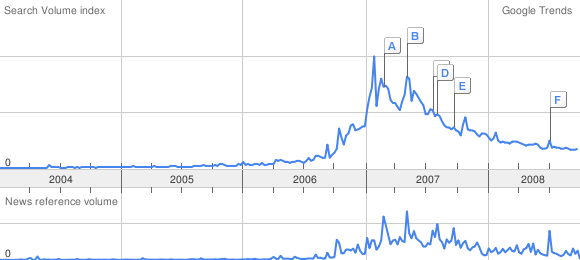
    It’s really funny to see how popular things can get, and then totally disappear. Some time ago, there was a TV show on the french TV called “Un an de +”, that talked about what was in the news one year before. It was really interesting to see how quickly everybody can forget stuff that looks so important now. For example, who remembers Second Life? Apparently, it has been on the decline for some time already, according to Google Trends:
    Will Facebook be the next Second Life?

    27 September 2008

    Lucas Nussbaum: Importing bugs into UDD, faster.

    Importing bugs from the Debian Bug Tracking System into UDD (the Ultimate Debian Database) in a reasonable time is challenging. The BTS uses flat files to store bug information, and importing a bug typically requires reading a ’summary’ file, and a file containing the verisoning information, both of a few hundred bytes. That looks easy, but when you multiply it by ~70000 unarchived bugs, it takes a lot of time (about 40 minutes) to read those ~100k files, because the import process will block on every I/O. The problem is not the amount of data to read (19.8 MB for summary files, 7.4 MB for versioning files), but the number of files (69612 summary files, 17507 versioning files). The obvious solution is to preload all the files into the page cache, so they are there when you need them. But you can’t simply do that with find /org/bugs.debian.org/versions/pkg -type f -exec cat \+ &>/dev/null, because that wouldn’t fix anything: you would still block on each file, and prevent the I/O scheduler to reorder the reads and optimize them (it’s called elevator for a reason). So, how do I tell the kernel “I’m going to read that in the future, please preload it?” readahead(2) is blocking, so it’s not helpful. The right solution is to use posix_fadvise(2), that allows to declare an access pattern. Using fadvise to preload all the files takes less than 5 minutes, and importing the bugs after that takes less than 8 minutes, so it’s really a big win. Does someone know if there’s already an fadvise-based tool that allows to preload a list of files? That’s something that I could need in other contexts as well.

    24 September 2008

    Lucas Nussbaum: Cool stats about Debian bugs

    Now that bug #500000 has been reported, let’s have a look at all our other bugs, using UDD. Number of archived bugs:
    select count(*) from archived_bugs;
     count
    --------
     402826
    Number of unarchived bugs marked done:
    select count(*) from bugs where status = 'done';
     count
    -------
      8267
    Status of unarchived bugs (”pending” doesn’t mean “tagged pending” here):
    select status, count(*) from bugs group by status;
        status       count
    ---------------+-------
     pending         53587
     pending-fixed    1195
     forwarded        6778
     done             8267
     fixed             167
    The sum isn’t even close to 500000. That’s because quite a lot of bugs disappeared:
    select id from bugs union select id from archived_bugs order by id limit 10;
     id
    -----
     563
     660
     710
     725
     740
     773
     775
     783
     817
     819
    Now, let’s look at our open bugs.
    Oldest open bugs:
    select id, package, title, arrival from bugs where status != 'done' order by id limit 10;
      id       package                                         title                                            arrival
    ------+----------------+----------------------------------------------------------------------------+---------------------
      825   trn              trn warning messages corrupt thread selector display                         1995-04-22 18:33:01
     1555   dselect          dselect per-screen-half focus request                                        1995-10-06 15:48:04
     2297   xterm            xterm: xterm sometimes gets mouse-paste and RETURN keypress in wrong order   1996-02-07 21:33:01
     2298   trn              trn bug with shell escaping                                                  1996-02-07 21:48:01
     3175   xonix            xonix colors bad for colorblind                                              1996-05-31 23:18:04
     3180   linuxdoc-tools   linuxdoc-sgml semantics and formatting problems                              1996-06-02 05:18:03
     3251   acct             accounting file corruption                                                   1996-06-12 17:44:10
     3773   xless            xless default window too thin and won't go away when asked nicely            1996-07-14 00:03:09
     4073   make             make pattern rules delete intermediate files                                 1996-08-08 20:18:01
     4448   dselect          [PERF] dselect performance gripe (disk method doing dpkg -iGROEB)            1996-09-09 03:33:05
    Breakdown by severity:
    select severity, count(*) from bugs where status != 'done' group by severity;
     severity    count
    -----------+-------
     normal      27680
     important    7606
     minor        6921
     wishlist    18898
     critical       29
     grave         209
     serious       384
    Top 10 submitters for open bugs:
    select submitter, count(*) from bugs where status != 'done' group by submitter order by count desc limit 10;
    submitter                        count
    ----------------------------------------------------+-------
     Dan Jacobson                     1455
     martin f krafft                    667
     Raphael Geissert                    422
     Joey Hess                            392
     Marc Haber                368
     Julien Danjou                         342
     Josh Triplett                    331
     Vincent Lefevre                    296
     jidanni@jidanni.org                                    260
     Justin Pryzby      245
    Top bugs reporters ever:
    select submitter, count(*) from (select * from bugs union select * from archived_bugs) as all_bugs
    group by submitter order by count desc limit 10;
                      submitter                     count
    ----------------------------------------------+-------
     Martin Michlmayr                4279
     Dan Jacobson               3652
     Daniel Schepler     3045
     Joey Hess                     2836
     Lucas Nussbaum        2701
     Andreas Jochens                   2605
     Matthias Klose            2442
     Christian Perrier           2302
     James Troup                   2198
     Matt Zimmerman                  2027
    You want more data? Connect to UDD (from master.d.o or alioth.d.o, more info here), run your own queries, and post them with the results in the comments!

    19 September 2008

    Adrian von Bidder: 42

    Lucas just found the single most interesting fact of this day: the size of the biggest clique in the GPG key graph is ... wait for it ... fortytwo. Yep, I'm just parroting his finding here, but I'm sure you can see why.

    Lucas Nussbaum: Looking for cliques in the GPG signatures graph

    The strongly connected set of the GPG keys graph contains a bit more than 40000 keys now (yes, that’s a lot of geeks!). I wondered what was the biggest clique (complete subgraph) in that graph, and also of course the biggest clique I was in. It’s easy to grab the whole web of trust there. Finding the maximum clique in a graph is NP-complete, but there are algorithms that work quite well for small instances (and you don’t need to consider all 40000 keys: to be in a clique of n keys, a key must have at least n-1 signatures, so it’s easy to simplify the graph — if you find a clique with 20 keys, you can remove all keys that have less than 19 signatures). My first googling result pointed to Ashay Dharwadker’s solver implementation (which also proves P=NP ;). Googling further allowed me to find the solver provided with the DIMACS benchmarks. It’s clearly not the state of the art, but it was enough in my case (allowed to find the result almost immediately). The biggest clique contains 47 keys. However, it looks like someone had fun, and injected a lot of bogus keys in the keyring. See the clique. So I ignored those keys, and re-ran the solver. And guess what’s the size of the biggest “real” clique? Yes. 42. Here are the winners:
    CF3401A9 Elmar Hoffmann
    AF260AB1 Florian Zumbiehl
    454C864C Moritz Lapp
    E6AB2957 Tilman Koschnick
    A0ED982D Christian Brueffer
    5A35FD42 Christoph Ulrich Scholler
    514B3E7C Florian Ernst
    AB0CB8C0 Frank Mohr
    797EBFAB Enrico Zini
    A521F8B5 Manuel Zeise
    57E19B02 Thomas Glanzmann
    3096372C Michael Fladerer
    E63CD6D6 Daniel Hess
    A244C858 Torsten Marek
    82FB4EAD Timo Weing rtner
    1EEF26F4 Christoph Ulrich Scholler
    AAE6022E Karlheinz Geyer
    EA2D2C41 Mattia Dongili
    FCC5040F Stephan Beyer
    6B79D401 Giunchedi Filippo
    74B11360 Frank Mohr
    94C09C7F Peter Palfrader
    2274C4DA Andreas Priesz
    3B443922 Mathias Rachor
    C54BD798 Helmut Grohne
    9DE1EEB1 Marc Brockschmidt
    41CF0322 Christoph Reeg
    218D18D7 Robert Schiele
    0DCB0431 Daniel Hess
    B84EF12A Mathias Rachor
    FD6A8D9D Andreas Madsack
    67007C30 Bernd Paysan
    9978AF86 Christoph Probst
    BD8B050D Roland Rosenfeld
    E3DB4EA7 Christian Barth
    E263FCD4 Kurt Gramlich
    0E6D09CE Mathias Rachor
    2A623F72 Christoph Probst
    E05C21AF Sebastian Inacker
    5D64F870 Martin Zobel-Helas
    248AEB73 Rene Engelhard
    9C67CD96 Torsten Veller
    It’s likely that this happened thanks to a very successful key signing party somewhere in germany (looking at the email addresses). [Update: It was the LinuxTag 2005 KSP.] It might be a nice challenge to beat that clique during next Debconf ;) And the biggest clique I’m in contains 23 keys. Not too bad.

    18 September 2008

    Lucas Nussbaum: tool to mirror a website locally?

    Dear lazyweb, I need a tool to mirror a website locally (so I can browse it offline). Requirements:
    - not GUI-based (I want to run it in a script)
    - support recursive retrieval and include/exclude lists (like wget)
    - no output when everything is fine, but still output errors (not possible with wget, which still output “basic information” when running with –no-verbose, and doesn’t output errors when running with –quiet)
    - understands timestamps, and retransfers files if timestamps or sizes don’t match
    - not too over-engineered, not too badly maintained, etc… Thank you.

    16 September 2008

    Sandro Tosi: Ignition sequence. All engines are started. We have ignition. 2, 1, zero. We have a DD!! We have a DD!!

    I just receive The Mail (tm) from weasel, and I can't be happier that this (mh, is my life too boring?): I just become a DD!!!!!!! Please join my happiness in this achievement!!

    I'd like to thank all the people helped me in my way to Debian, both for a long and fruitful collaboration or for just a mail exchange, both for kind people and rude ones (ah, we all have our own character, so never mind :) ) and in doing this I'm sure I'll forget someone (so please excuse me for this, you're in my mind tough): so thank you Tony, Bernd, Piotr, Thomas, Vincent, Adeodato, Lucas, Luk, Sune, Joerg (yeah, I'm brave :) ), Paul, and many others!

    Of course, congrats go also to my other colleagues that "laureate" with me in Mid September DD Class :D

    Lucas Nussbaum: New Debian Developers!

    We got a lot of (>= 10) new Debian developers recently. I’m really happy to see that the bottlenecks in the New Maintainer process were (at least partially) solved. My first NM (actually my second, my first one is on hold) also became a DD today. So, how long does it take to become a DD ? Let’s take 2 examples. Both are very active and skilled new contributors, that probably were quite close from being the faster you can be through NM:
    Name Applied AM assigned Approved by AM Account created
    Chris Lamb 2008-05-01 2008-06-12 2008-07-22 2008-09-16
    Sandro Tosi 2008-03-24 2008-05-06 2008-06-22 2008-09-16
    We have the proof: provided you have all the required skills, you can become a DD in less than 6 months! Of course, some things are not perfect yet:

    Lucas Nussbaum: Is Mozilla the new XFree86? Could Ubuntu actually help?

    All the recent moves of Mozilla make me feel that they are really taking the XFree86 path. Reading the Launchpad bug log about the EULA shows that most of the posters agree on who is on the wrong side, and favor switching to IceWeasel or Epiphany+Webkit. Even if Mozilla is apparently going to back off on the EULA story, it looks like the harm was done. If they want to fix that, they will have to start listening to other players in the Free Software community. Or just watch Webkit eat their market share. Since Ubuntu leaders are apparently talking to Mozilla about that, I really hope that they are aiming for a solution that will help the Free Software community as a whole, and are not looking for a work-around that will “fix” the problem for Ubuntu. There has been a lot of noise about the lack of “giving back” to the community by Ubuntu. Using Ubuntu user base to weight in and solve such issues in a way that benefit the whole community would probably be seen as a much more valuable contribution than another bunch of patches.

    10 September 2008

    Lucas Nussbaum: UDD and Buildstat

    Ultimate Debian Database (UDD) is a GSoC project (now finished) which aimed at importing all different data sources that we have in Debian in a single SQL database, to make it easy to combine that data. Currently, we import information about source and binary packages, all bugs (both archived and unarchived), lintian, carnivore, popcon, history of uploads, history of migrations to testing, and orphaned packages. The goal is really to have that data, without really thinking of a specific use cases: there will be lots of use cases. Buildstat is a project by Gon ri Le Bouder, that provides a framework for running QA tests (rebuilds and lintian currently, but buildstat is built in a very extensible way) on packages, using both packages in the archive, and packages in the VCS repositories of teams. This is pretty cool: it allows teams to get an overview of the status of their packages, not using the archive as reference, but using their VCS. Buildstat schedules and runs the tests, store the data in an SQL database, and allows to browse the data using a web interface. Buildstat also import some data from other sources (only the BTS currently, using the LDAP dump) to display it on the web interface. Since both projects are using an SQL DB, people have been asking why we don’t simply merge them. The big advantage would be that the data is synchronized: buildstat would display more up-to-date info about the data sources it doesn’t generate locally (like bugs), and UDD would get fresh buildstat data. We have been talking a lot with Gon ri, considering the different possibilities. But I don’t think it’s a good idea. I think that both projects should try to do one thing, but do it very well, instead of trying to fix the world. UDD focuses on importing data that exists elsewhere. Sometimes it means doing some complex processing. But data should be be generated by UDD. Merging the projects would mean having a very big piece of software that does everything (or tries to do everything). Both databases were designed differently, with different goals. UDD tries to stay close to the data it imports. There might be some incoherences in the data sources, but that’s fine: one of the goal of UDD is to make it easy to find them (and fix them), so we need them in the DB. In buildstat, since the goal of importing data is to display it on the web interface, with a strict use case, you can freely “simplify” data if it helps. Another big difference is that UDD is designed to be easy to use (ie write and run queries) by a human user: UDD uses multi-column primary keys, while buildstat uses surrogate keys (integer “id” keys), that ORM tools usually require. There are also more technical concerns: currently UDD makes a compromise, for each data source, on what it imports: it tries to import the data that is useful, not all the data available. Merging buildstat and UDD would mean increasing the DB size significantly, by adding all the “private” data that buildstat needs. Another problem is the stable API problem: if buildstat and UDD are merged, it means that buildstat cannot change its DB schema without making sure that it wouldn’t break what UDD users are doing. So, what should we do, from my POV, instead of merging? - Continue to talk, and get Gon ri into the UDD “team”. He gathered a lot of experience working on buildstat, and he probably would be able to help a lot. - Data that is not generated by buildstat (bugs data) should be imported from UDD. Doing SQL->SQL will probably make things easier there. - A summary of buildstat’s infos should be imported into UDD. There’s also the issue of providing the data through a web interface, to the DDs, which buildstat tries to address partially. The Debian Developer Packages Overview (DDPO)’s main limitations are: - lack of knowledge about VCS (what buildstat solves) - lack of knowledge about complex organizations (you can’t get any list of packages, or list of packages maintained by teams not using a consistant Maintainer/Uploaders scheme, or list of packages from tasks, etc) - poor handling of large amount of packages. In teams with lots of packages, it’s useful to have restricted views, such as “packages outdated compared to upstream”, “packages which have bugs/RC bugs”, “packages which are newer in the VCS than in the archive”. The perl team’s work on PET clearly shows the kind of things that are needed. At this point, I think that DDPO would benefit from a full rewrite (using the existing code as a source of inspiration, and making sure that there are no regressions, of course). Using UDD as the data source, it should be easy to get something done (even if UDD still lacks some of the data DDPO has currently). But it still requires web developer skills, which I don’t have. If you are interested, contact me!

    19 August 2008

    Lucas Nussbaum: tiling terminals manager

    I tried terminator (thanks go to Nicolas Valcarcel for asking me to sponsor a Debian upload, thus forcing me to try it, and Asheesh Laroia for doing a lightning talk at debconf about it), but I’m not convinced.
    - More keybindings are clearly missing. You can only switch terminals using Previous/Next keybindings.
    - More features would be great, like the ability to switch the position of two terminals (so you could reorganize them).
    - It has some small usability problems, like the fact that the config is text-based, not using gconf, that it’s not possible to change the config without restarting it, that the title bar doesn’t display anything useful most of the time, since it prefixes the current terminal’s title with “Terminator: “, etc. So, is there any other tiling terminals manager I should try, before filing tons of feature requests on terminator? My other requirement is that it mustn’t reinvent the wheel, but use the gnome-terminal widget. Thank you.

    Next.

    Previous.