Search Results: "jmtd"

6 February 2012

Jon Dowland: Rip it Up and Start Again

I've just finally finished reading Simon Reynold's dense "Rip it Up and Start Again": a history of post-punk music from 1978-1984. I often think of music journalism in the terms that Zappa famously phrased as (roughly) "people who can't write, writing for people who can't read". This book sometimes suffers from that syndrome, of attempting to describe audio in terms of other senses, which sometimes wanders deep into synesthesia territory, but for the most part the book is coherent and enjoyable. It's also very "dense": you leave each page with another half-dozen songs or bands of music genres to go and investigate. I'm surprised that there isn't a commercially-released anthology counterpart to the book. There are, however, several playlists, many of which are locked away on Spotify, but via this review I found these two which are web-based (powered by opentape, an interesting piece of AGPL software). The book has helped me to discover a lot of music that I hadn't heard of before and now love, which I will probably write about in different contexts over the next few months.

Jon Dowland: I Shall Wear Midnight

I Shall Wear Midnight is the 38th Discworld novel and the fourth following the story of Tiffany Aching, young witch of the Chalk. Reading modern Pratchett, I'm sadly, acutely (and morbidly) aware that, as he succumbs to Alzheimer's disease, these are the likely to be some of the last Discworld novels written. With the last few, this observation has been entirely external to the novel. With Midnight, however, I got the impression that the awful disease has finally started to affect the prose itself. I could just be jumping at shadows, but I got the impression that he repeated himself a tad more often than usual. With such a long series of books, an author has the difficult job of balancing new and established readers in the same text: as such, as an established reader, you get used to having some back-story with which you must be patient. This necessary background could have contributed to the impression of repetition, but I'm fairly sure doesn't explain all of it. An enjoyable story, and possibly the one to bring the Aching arc to a conclusion. She stands on her own two feet, proving herself a a capable Witch. There weren't any earth-shattering new concepts or new characters or unexplored areas of the Disc for fans to map out with their minds; non-the-less it was a satisfying read.

27 January 2012

Jon Dowland: An Early Start

early start
An early start.

25 January 2012

Jon Dowland: Music for Our Future

cover
In 2010, a collaboration between the SyFy channel, Create Digital Music, XLR8R and Pitchfork created "Music for our Future": a compilation album of free music inspired by the TV show "Caprica". XLR8R hosted it but their page for the release has subsequently disappeared. A few people here and there on the 'net have been asking for a copy, so here it is on archive.org: http://www.archive.org/details/MusicForOurFuture. Some background info, photos etc. via CDM.

22 January 2012

Jon Dowland: The Crying Tree

Somebody bought The Crying Tree by Naseem Rakha for Sarah as a present and she asked me to read it so we could talk about it, so I did. It's a novel about a family tragedy, Southern-state U.S.A. and the death penalty. A little boy is shot dead, a man is arrested for the crime and faces the death penalty. The book chronicles what happens to the family and to the killer during the 19 years or so that passes before the execution takes place. The book could be accused of having an anti-capital punishment agenda, but I have no problem with that. At least until about half-way through the book, the plot and happenings follow the synopsis with little in the way of surprise, but then there's a twist. I felt that the twist diminished the message of the book. Without trying to spoil what happens, I felt that you didn't need the core details of the story to be varied or expanded upon or U-turned to push that agenda. In my opinion, it's perfectly possible for someone to construct a story about a killer who faces death, who was unambiguously guilty of the crime they are charged with, and still leave the reader feeling remorse for the killer, and questioning the justice meted out. In fact I thought Rakha was doing a fine job of just that. However, a twist (or twists) occur, and the facts are called into question, and so you ask even further questions about the practise of killing criminals, in my view redundantly. It's a good book and worth a read, regardless of what your position is on the issue. It does a great job of describing the unbearable pain of losing a child, but also of the power of forgiveness for the victims.

Jon Dowland: bugs

[pic]
Bugs I've hit in GNOME 3, in the last 5 minutes: I didn't set out to bug-hunt this morning, I'm actually trying to get some work done. Whilst this is a particularly bad case of stacked-bugs, it's unfortunately, pretty representative of what it's like to try and use a Linux desktop at the moment. Every day I go through a similar experience. I've just had to give up and log out and back in again. The shell path bug above has re-surfaced in a new session. Great. I'm waiting on a delayed laptop at work. I'm very tempted to cancel the order and just use a Mac Air instead (we have one spare). It seems I'm walking the inevitable path of F/OSS desktop frustration and the end for many people seems to be the Mac perhaps I should spare myself the pain of the journey. In the mean time, It's bye-bye to GNOME and off to Xfce for me.

21 January 2012

Steve Kemp: So mega-upload is gone

So the site http://megaupload.com/ has been taken offline, amidst allegations of knowingly conducting in piracy. There are probably a lot of legitimate users who have lost access to their uploaded files, even if they were offsite backups you can imagine a user owning a website which now has a million dead-links. This reminds me of a conversation I overheard on Jon Dowlands blog - the summary is that he'd written a (useful) tool to extract attachments from Maildir folders and was wondering how to store and access those attachments. The upshot seemed to be magical URLs of the form:
  • https://file.example.com/sha1/509c2fe2eba509e93987c3024a74d74583c274bd
The comments covered an alternative which was hash:///sha1/xxxxxxxxxxxxxxxx, which then becomes close to the magnet:// schema. I've not yet thought things through, but I can't help thinking that with the redundency already present in the internet we should be looking at non-server-specific links. Yes there are times right now when you might want to address a specific file on a specific server - but otherwise? Wouldn't it be nice if you could just access a file from "anywhere" which happened to have the right contents? Already my nonporn-but-definitely-adult-site makes its images available as /img/$md5sum.jpg - and similarly the storage at the back-end of my random image upload site uses SHA1 hashes to store the actual files. To make this more complete what we need is something that crawls the internet to find files by hash; then add support in browsers. Obviously this must be async and could introduce timing issues, but fundamentally it seems like a reasonable approach to the problem of a single host going offline. (Consider what happens if imgur.com disappears. All those links would die, yet 99% of the images would still be available somewhere.) I'm tempted to suggest microformat format but I need to consider the matter. Right now I'm going to immediately update my current image hosts to use, at the very least:
 <a href="/foo" rel="sha1:xxxxx md5sum:xxxx">
  <img src="foo.jpg" alt="img name">
 </a>
The unfortunate thing is you cannot have a 'rel="xx"' attribute for an image. So you either have to encode it in the parent link, or add it to the alt attribute which is suboptimal. ObQuote: "Now, they tell me I paid my debt to society." - Oceans Eleven (2001)

13 January 2012

Jon Dowland: vi

As seen on reddit: an old Bill Joy quote often banded about as part of the (largely synthetic) vi-vs.-emacs holy war starts as follows:
vi was written for a world that doesn't exist anymore
The context of that quote is:
I was trying to make it usable over a 300 baud modem. That's also the reason you have all these funny commands. It just barely worked to use a screen editor over a modem. It was just barely fast enough. 9600 baud is faster than you can read. 1200 baud is way slower. So the editor was optimized so that you could edit and feel productive when it was painting slower than you could think.
(source: the register). Furthermore:
unless you decide to get a satellite phone and use it to connect to the Net at 2400 baud, in which case you'll realize that the Net is not usable at 2400 baud.
You don't need anything as esoteric as a satellite phone: a cellular mobile phone will suffice. I've no idea what the effective/equivalent baud rate of GPRS is (or EDGE), but I have a new-found appreciation for vi's design goals having tried to run an SSH session over such a connection.

11 January 2012

Jon Dowland: The Silent Land

I've just finished reading Graham Joyce's haunting The Silent Land: an atmospheric and moving love story set in an Alpine ski resort. Husband and Wife Jake and Zoe head out to the slopes early one morning and are caught in an avalanche. They survive, narrowly, but upon returning to the resort, everything has changed Anyone who has read any quantity of SF or fantasy will probably make an early guess at what's going on, and you'd most likely get it wrong. Even if you know where you're going, the journey is often the point, rather than the destination, and this journey is pretty gripping. I do most of my reading on the train to and from work. I often listen to music when I'm reading and I try to choose things which aren't going to distract my attention from the book too much. Film soundtracks are good; so is classical; so is a lot of Eno's work. For this book I mostly listened to the score from the latest film version of The Girl with the Dragon Tattoo, by Trent Reznor and Atticus Ross. Clocking in at only seven minutes shy of three hours, this is a haunting score that evokes a cold, isolated Swedish winter, and thematically matched the book perfectly. The score is a little less accessible than their previous work, but is rewarding on repeat listen. You can get a free 6-track sampler at the website linked above.

Jon Dowland: My new record player unit

[pic]
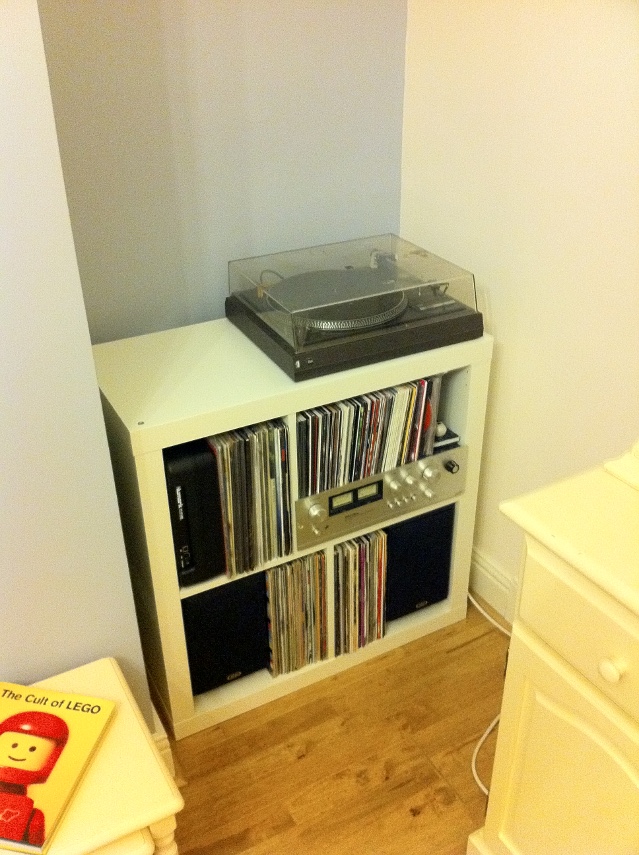
A mildly hacked Ikea "Expedit" shelving unit is a surprisingly snug home for my Hi-fi and my vinyl collection (even the 7" records). [

Jon Dowland: whiley.gif

Jon Dowland: Robert Smith in for John Peel

On 21st October 2004, Robert Smith of the Cure sat in for John Peel whilst he was on holiday and presented his show. This was part of a sequence of people covering for Peel. Off the top of my head Siouxie of the Banshees sat in on another night, but I forget who else. Anyway, sadly, John died a few days later on the 25th. Before John's death, in response to his pre-recorded show being butchered by the BBC, Smith posted an angry message on the Cure's website, which included the tracklisting as he had originally prepared. After John's death was announced, Smith deleted the post from his site, no doubt out of respect for Peel and to avoid any mis-interpretation. I recorded the show onto minidisc when it was broadcast and discovered a lot of music that I loved and hadn't heard of before. I've just stumbled across a copy of Smith's post, including the tracklist, so for historical interest's sake, here it is (with only light typographical editing). If anyone cares enough, I could have a look for that minidisc

7 January 2012

Jon Dowland: Flow My Tears, the Policeman Said

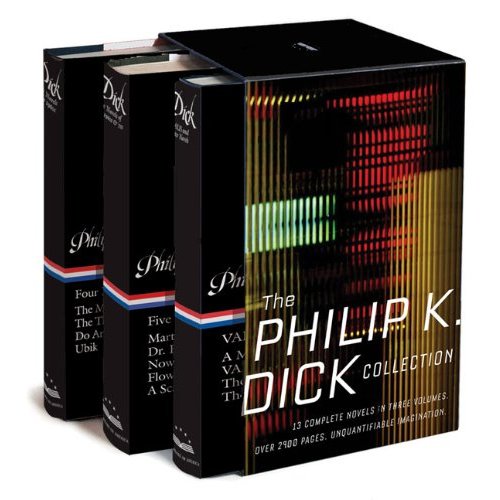
The Philip K. Dick Collection The Philip K. Dick Collection
I've just finished reading "Flow My Tears, the Policeman Said" by Philip K Dick, one of 13 novels collected in the Library of America's wonderful "The Philip K. Dick Collection" boxed set. This story has never jumped out at me as one to read with any particular urgency, despite the title being a reference to a composition by my namesake. I was reminded about it whilst listening to one of BBC Radio 4's "Great Lives" broadcasts, where Michael Sheen read a passage from the book. As an aside, the "Great Lives" series is a really interesting listen: I particularly enjoyed their episode on Ludwig Wittgenstein. You can get the whole series in podcast form. Back to the book. It features Dick's trademark theme of fractured realities, perhaps more so than in many of his more well-known works such as Ubik or A Scanner Darkly. It also has much better characterisation than I expect from his writing. His female characters remain as always sinister, threatening, mischevious, but they are at least fleshed out. There is a lot more of an exploration of the human condition than usual. Dick wrote that the novel begun as an attempt to explore different varieties of love. I enjoyed the mystery of the weird goings-on whilst they were mysterious, but I felt mildly let down when the explanation was eventually proffered.

4 January 2012

Jon Dowland: Ready Player One

I recently completed "Ready Player One", Ernest Cline's debut novel. It's a Sci-Fi fan-service novel that explores a dystopian future (yes, another one) where the majority of the populace hide inside a VR environment to escape their "real" lives. The sole-genius who authored the VR software hid a series of easter eggs inside, in the form of challenges relating to pop-culture and video game trivia circa the 80s. He constructs his will such that whoever first completes the challenges inherits the mega-bucks company who control the VR simulation. Mike Hoye has an excellent summary:
Ready Player One is a nerdculture bender of a book, about as hard to hate while you re in the middle of it as it is to love in hindsight; it s young adult literature for people who were born in the late seventies and haven t really grown up yet. Of which I am apparently one, it has become clear, but you re still left with the sense that you re reading a Cory Doctorow book whose discerning virtue is that the lead isn t a thinly-veiled Cory Doctorow. Which is a huge, huge improvement, make no mistake, but it s stills relentless, pandering fanservice.
(Whilst you are over on Mike's website you should really read this excellent piece on libraries and publishers.) Despite the points above, I enjoyed the book. My biggest complaint was that the ending was quite abrupt. Quite often when I read a story which is essentially about a journey, I am disappointed if the story ends when the journey does. I hope I am not spoiling too much here by revealing that someone eventually solves the riddles and inherits essentially the earth. But what do they do with it? What impact do they make on the miserable world, described only briefly in sparse passages dotted around the bulk of the text detailing the VR one? During the book, the characters opine on what to do with the fortune, but we never see that come to fruition. Perhaps in a sequel.

3 January 2012

Jon Dowland: instagr/am/bient

Via Boing Boing, I stumbled across an excellent audio/visual project called instagr/am/bient: 25 ambient pieces of music inspired by 25 photos on the instagram photo service. The original upload featured a high-resolution PDF of the pictures, with MP3 audio and low-quality embedded copies of each picture as each track's artwork. I was a little disappointed about this, as I thought the tracks would be best appreciated next to the higher-quality picture that inspired them. So, I fixed it: Instagr/am/bient (HD images) This was possible thanks the liberal licensing of the original, but also two excellent pieces of software: pdfimages (from the poppler-utils package) and eyeD3, which made it not just possible but trivial. See also the 9.5M accompanying PDF. I do like what people are creating with instagram; I also like the "tumble-blog" approach to sharing similar images. I occasionally rotate the indexpics on my site; perhaps I should do so more often, and publish the new ones on my blog, too.

29 December 2011

Jon Dowland: backup

Backups are something I don't do well. I hope to write a more thorough article about them at some point. For now, here are some tips. Like most home users, I don't have access to a tape drive or jukebox for backups. I'm therefore looking for a solution that backs up to a local block device. I haven't ruled out a solution that backs up to DVD-Rs, but I haven't found a suitable one. I first tried rsnapshot, which uses hard link trees to represent increments. I found that this resulted in enormous filesystem metadata, sufficient to cause the machine I was running it on (an embedded ARM system) to slow to a crawl. I'd recommend to avoid anything using this technique. I more recently have been using rdiff-backup. This has appeared to work quite well for a number of years. However, it does not gracefully handle the backup volume being full, spewing python backtraces. This is compounded with some confusing use of temporary directies and not honouring $TMPDIR. This has been known about for years (1, 2). I've just independently discovered these problems for the second time. Aside from that, because it does not de-duplicate files, it is sensitive to large files being moved around in the source being backed up. It also cannot do a dry-run estimate of the disk space required for the next increment. So: time to move on. Back in 2010 I discovered bup, an intriguing backup tool that used a git-style backing store. It's interesting enough that I packaged it and use it in a few situations, but I wouldn't rely on it for my main backups, for two reasons: one, it's not tried-and-tested enough yet (but that is rapidly being resolved), two: you can't get rid of old increments, so your backup volume will always increase in size over time, and never throw away old data. So, for now: move on. Next on my list to try is Lars Wirzenius' obnam.

21 December 2011

Jon Dowland: mail archiving script

Here's the mail archiving script I was talking about: http://github.com/jmtd/detachment. Sorry about the name-pun. There's still a LOT of work to do, but it's useful enough to deploy, with modifications, now. If you set up a way of pushing stuff in a local directory to a remote webserver (ideally behind an SSL certificate and with access control configured) and you have a resolvable hostname for that site, then you can get at your files from most mail/web client combinations, including smartphones. Here's some stats from running it on a sample mailbox: Before
$ du -sh ncl/archive/2010
116M    ncl/archive/2010
After
$ du -sh ncl/archive/2010 bucket
41M     ncl/archive/2010
51M     bucket
Or, approximately 20% smaller. (That's the on-disk usage for the mail and the attachments, now not base64-encoded, and saved to disk). The above folder was a local Maildir copy of a folder on an Exchange mail system, synchronised via offlineimap. Here are the sizes reported by Exchange for the same folder: Or, approximately 70% smaller. (That's the mails without the attachments counted, which are not in the Exchange server any more). Lots of caveats:

19 December 2011

Jon Dowland: wadc

I'm happy to announce the release of wadc version 1.2.
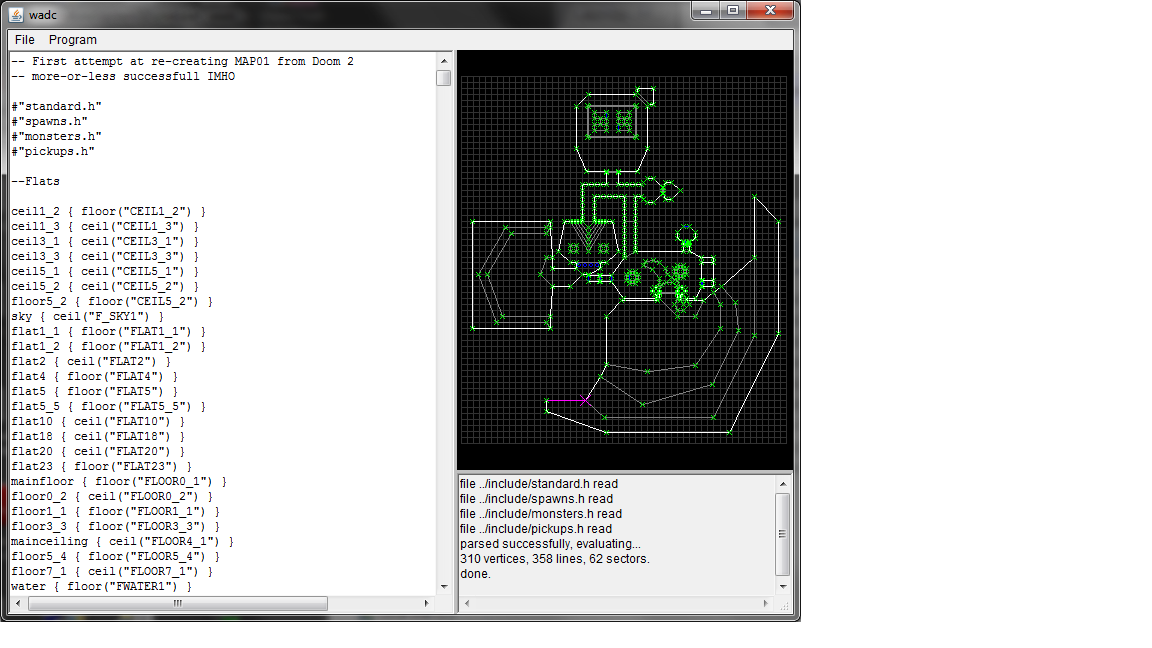
A WadC session A WadC session
WadC is a functional programming language for the composition of Doom-format maps. Originally created by Wouter "Aardappel" van Oortmerssen, I was granted permission to take over the project over a year ago, but didn't get around to releasing anything until now. This version adds a few functions that permit you to draw two-sided lines which are textured and impassible: important for a lot of detailing techniques. You can also create friendly monsters for Boom-compatible ports. There's a new example demonstrating these features; plus a recreation of Doom 2's "entryway", courtesy of GreyGhost. See WadC for a summary, or go straight to the binaries or source on github. Discussions: reddit, doomworld.

2 December 2011

Jon Dowland: Flowers for Algernon Daniel Keyes

A melancholic look at intellectual disability and how it was regarded and treated by the society of the time (1960s). Despite an inevitable conclusion, it was enjoyable and thought provoking.

29 November 2011

Jon Dowland: mail archiving

I wrote a quick proof-of-concept script that can traverse my email (in local Maildir format) and detach all attachments: saving them to another location and replacing them with a text attachment which documents where they've gone. This reduces my work mailbox size substantially and allows for more space-efficient storage of the attachments (utilising all 8 bits of the byte, at the very least, but with the potential for compression to be added to the mix). It maintains the link between email and attachment, however, which is crucial if the method of discovery of the attachment in the future is to find the email. For this to be future proof, the path where the mail is saved needs to be. The best scheme I can think of involves dedicating a sub-domain to the problem and using a URI scheme which is guaranteed1 to be unique for the attachment, such as a hash-sum:
https://file.example.com/sha1/509c2fe2eba509e93987c3024a74d74583c274bd
I could finish up my script, set my my own personal infrastructure for this and convert my mailbox with a few hours more work. Before I do, I have two questions:

  1. within the practical limitations of hashing algorithms, at least.

Next.

Previous.