The second pre-conference day was dedicated to books and beers, with a visit to an exquisite print studio, and a beer tasting session at one of the craft breweries in Canada. In addition we could grab a view into the Canadian lifestyle by visiting Pavneet s beautiful house in the countryside, as well as enjoying traditional style pastries from a bakery.
In short, a perfect combination for us typography and beer savvy freaks!
This morning we had somehow an early start from the hotel. Soon the bus left downtown Toronto and entered countryside Ontario, large landscapes filled with huge (for my Japanese feeling) estates and houses, separated by fields, forests and wild landscape. Very beautiful and inviting to live there. On our way to the printing workshop we stopped at Pavneet s house for a very short visit of the exterior, which includes mathematics in the bricking. According to Pavneet, his kids hate to see math on the wall I would be proud to have it.
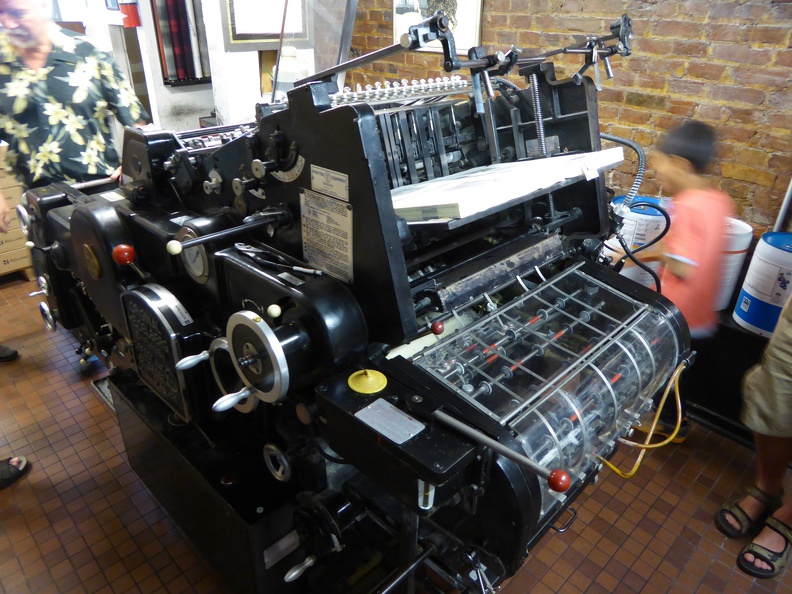
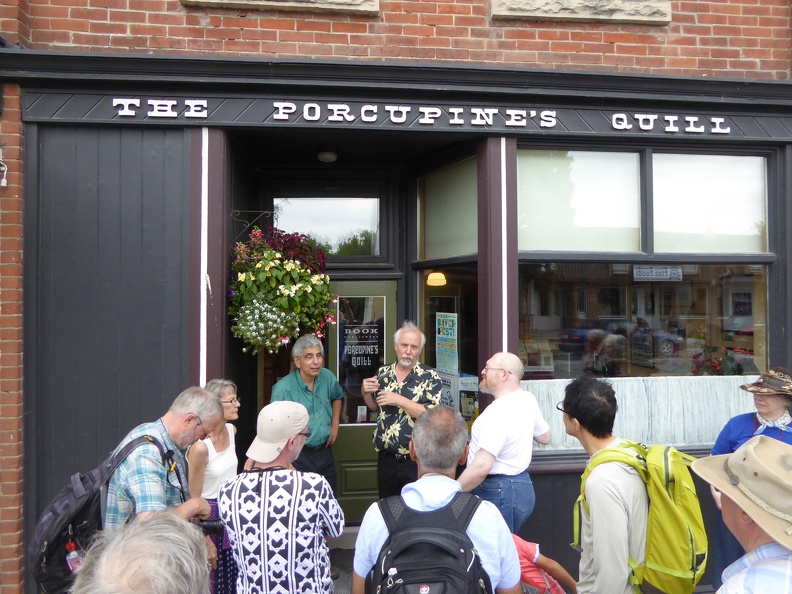
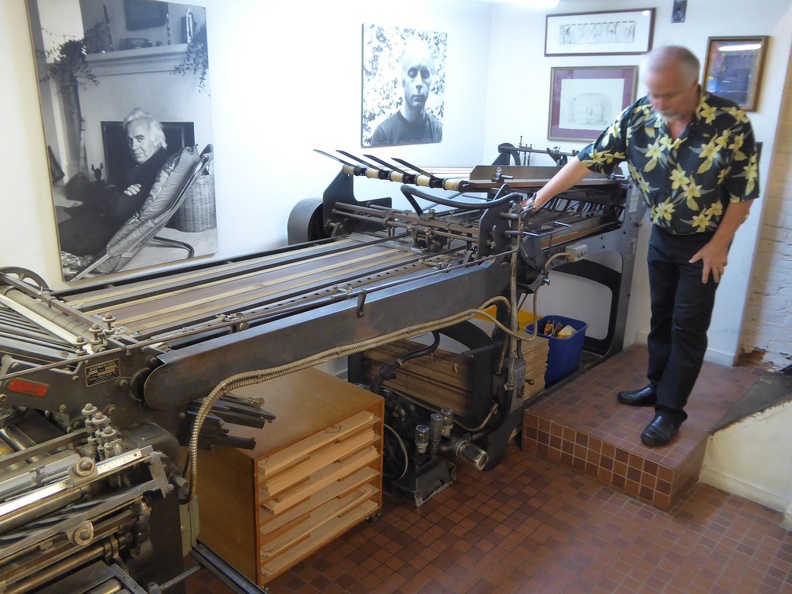
A bit further on we entered into Erin, where the Porcupine s Quill is located. A small building along the street, one could easily oversee that rare jewel! In addition considering that according to the owners, Google Maps has a bad error which would lead you to a completely different location. This printing workshop, led by Tim and Elke Inkster, is producing books in a traditional style using an old Heidelberg Offset printing machine.
Elke introduced us to the sewing of folded signatures together with a lovely old sewing machine. It was the first time I actually saw one in action.
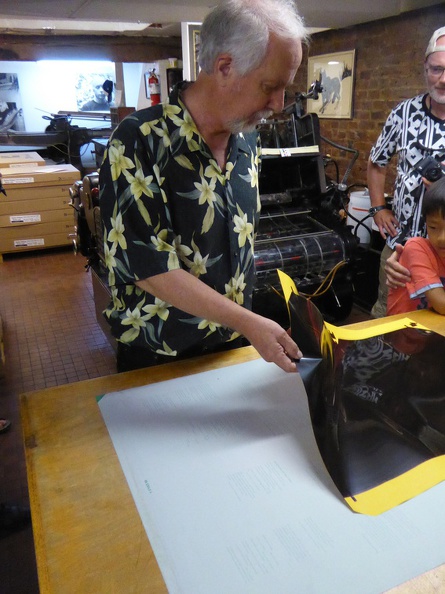
Tim, the head master of the printing shop, first entertained us with stories about Chinese publishers visiting them in the old cold-war times, before diving into explanations of the actual machines around, like the Heidelberg offset printing machine.
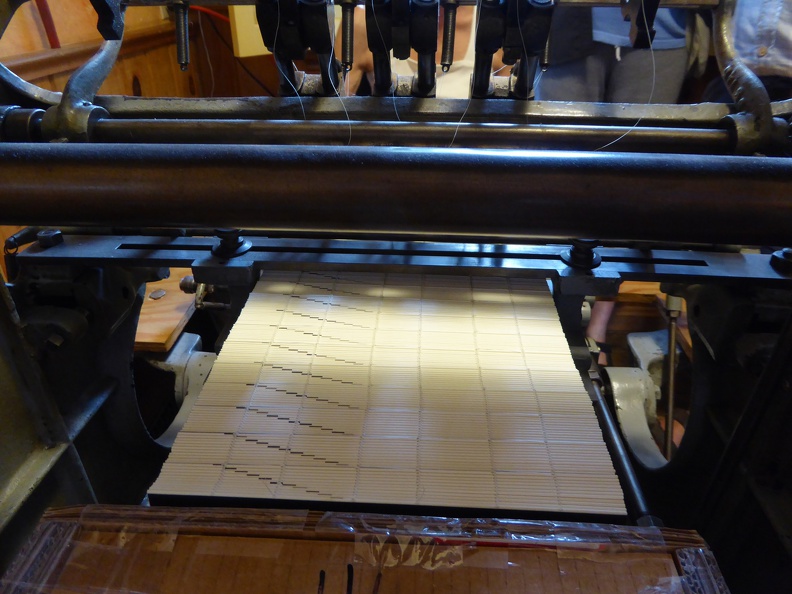
In the back of the basement of the little studio there is also a huge folding machine, which cuts up the big signatures of 16 pages and folds them into bundles. An impressive example of tricky engineering.
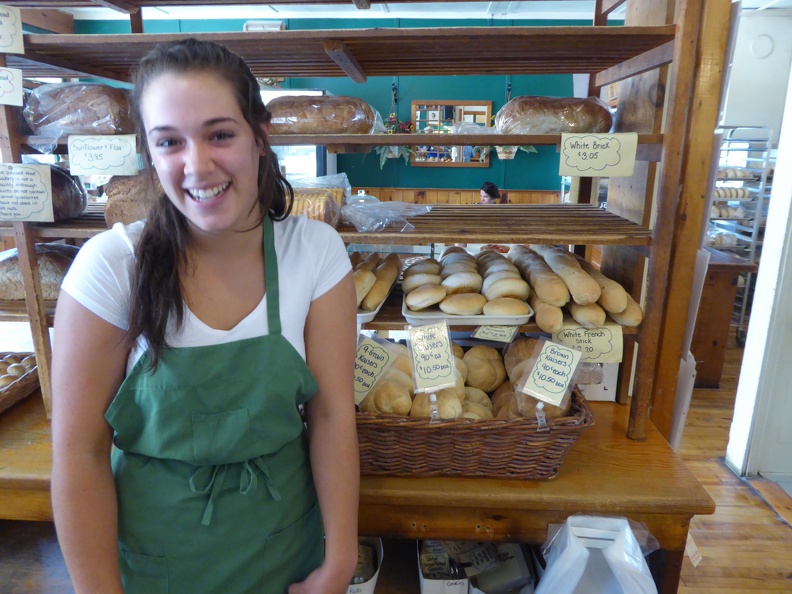
Due to the small size of the printing studio, our groups were actually split into two groups, and while the other group got its guided tour, we grabbed coffee and traditional cookies and pastries from the nearby Holtom s bakery. Loads of nice pastries with various filling, my favorite being the slightly salty cherry pie, and above all the rhubarb-raspberry pie.
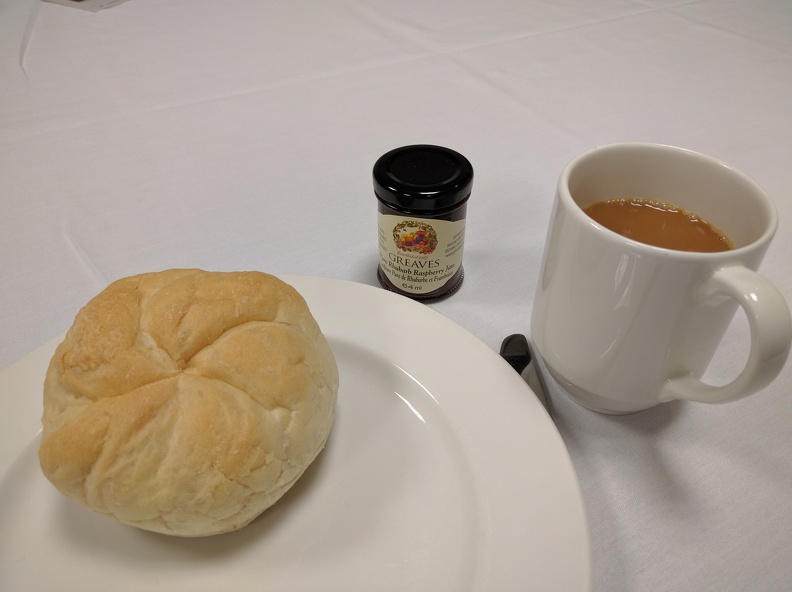
To my absolute astonishment I also found there a Viennese Kaisersemmel , called Kaiser bun here, but keeping the shape and the idea (but unfortunately not the crispy cracky quality of the original in Vienna). Of course I got two of them, together with a nice jam from the region, and enjoyed these Viennese breakfast the next day morning.
Leaving the Quill we headed for a lunch in a nice pizzeria (I got Pizza Toscana) which also served excellent local beer how would I like to have something like this over in Japan! Our last stop on this excursion was Stone Hammer Brewery, ne of the most famous craft breweries in Canada.
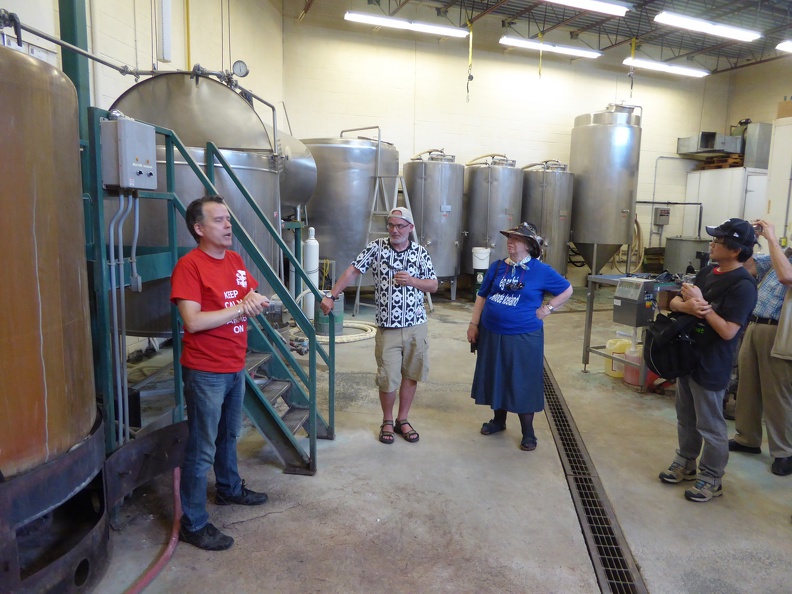
Although they wont win a prize for typography (besides one page of a coaster there that carried a nice pun), their beers are exquisite. We got five different beers to taste, plus extensive explanations on brewing methods and differences. Now I finally understand why most of the new craft breweries in Japan are making Ales: Ales don t need a long process and are ready for sale in rather short time, compared to e.g. lagers.)
Also at the Stone Hammer Brewery I spotted this very nice poster on the wall of the toilet. And I cannot agree more, everything can easily be discussed over a good beer it calms down aversions, makes even the worst enemies friends, and is healthy for both the mind and body.
Filled with excellent beer, some of us (notably an unnamed US TeXnician and politician), stacked up on beers to carry home. I was very tempted to get a huge batch, but putting cans into an airplane seems to be not the optimal idea. Since we are talking cans, I was surprised to hear that many craft beer brewers nowadays prefer cans due to their better protection of the beer from light and oxygen, both killers of good beer.
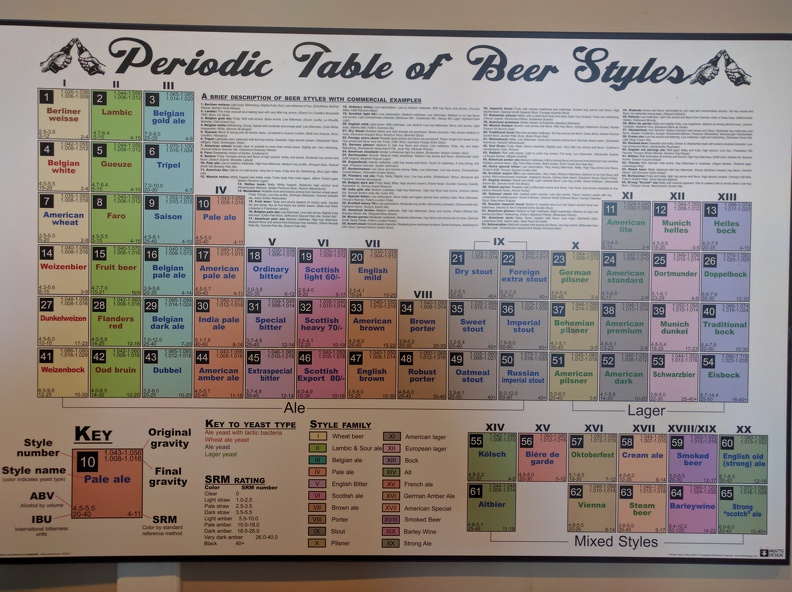
Before leaving we took a last look at the Periodic Table of Beer Types, which left me in awe about how much I don t know and I probably never will know. In particular, I heard the first time of a Vienna style beer Vienna is not really famous for beer, better to say, it is infamous. So maybe this is a different Vienna than my home town that is meant here.
Another two hour bus ride brought us back to Toronto, where we met with other participants at the reception in a restaurant of Mediterranean cuisine, where I could enjoy for the first time in years a good Tahina and Humus.
All around another excellent day, now I only would like to have two days of holidays, guess I need to relax in the lectures starting from tomorrow.
The second Armadillo release of the 7.* series came out a few weeks ago: version 7.200.2. And RcppArmadillo version 0.7.200.2.0 is now on CRAN and uploaded to Debian. This followed the usual thorough reverse-dependecy checking of by now over 240 packages using it.
For once, I let it simmer a little preparing only a package update via the GitHub repo without preparing a CRAN upload to lower the update frequency a little. Seeing that Conrad has started to release 7.300.0 tarballs, the time for a (final) 7.200.2 upload was now right.
Just like the previous, it now requires a recent enough compiler. As g++ is so common, we explicitly test for version 4.6 or newer. So if you happen to be on an older RHEL or CentOS release, you may need to get yourself a more modern compiler. R on Windows is now at 4.9.3 which is decent (yet stable) choice; the 4.8 series of g++ will also do. For reference, the current LTS of Ubuntu is at 5.4.0, and we have g++ 6.1 available in Debian testing.
This new upstream release adds new indexing helpers, additional return codes on some matrix transformations, increased speed for compound expressions via vectorise, corrects some LAPACK feature detections (affecting principally complex number use under OS X), and a rewritten sample() function thanks to James Balamuta.
Armadillo is a powerful and expressive C++ template library for linear algebra aiming towards a good balance between speed and ease of use with a syntax deliberately close to a Matlab.
Changes in this release (and the preceding GitHub-only release 0.7.200.1.0 are as follows:
Changes in RcppArmadillo version 0.7.200.2.0 (2016-07-22)
Upgraded to Armadillo release 7.200.2
The sampling extension was rewritten to use Armadillo vector types instead of Rcpp types (PR #101 by James Balamuta)
Changes in RcppArmadillo version 0.7.200.1.0 (2016-06-06)
Upgraded to Armadillo release 7.200.1
added .index_min() and .index_max()
expanded ind2sub() to handle vectors of indices
expanded sub2ind() to handle matrix of subscripts
expanded expmat(), logmat() and sqrtmat() to optionally return a bool indicating success
faster handling of compound expressions by vectorise()
The configure code now (once again) sets the values for the LAPACK feature #define correctly.
The sixth update in the 0.12.* series of Rcpp has arrived on the CRAN network for GNU R a few hours ago, and was just pushed to Debian. This 0.12.6 release follows the 0.12.0 release from late July, the 0.12.1 release in September, the 0.12.2 release in November, the 0.12.3 release in January, the 0.12.4 release in March, and the 0.12.5 release in May --- making it the tenth release at the steady bi-montly release frequency. Just like the previous release, this one is once again more of a refining maintenance release which addresses small bugs, nuisances or documentation issues without adding any major new features. That said, some nice features (such as caching support for sourceCpp() and friends) were added.
Rcpp has become the most popular way of enhancing GNU R with C or C++ code. As of today, 703 packages on CRAN depend on Rcpp for making analytical code go faster and further. That is up by about fourty packages from the last release in May!
Similar to the previous releases, we have contributions from first-time committers. Artem Klevtsov made na_omit run faster on vectors without NA values. Otherwise, we had many contributions from "regulars" like Kirill Mueller, James "coatless" Balamuta and Dan Dillon as well as from fellow Rcpp Core contributors. Some noteworthy highlights are encoding and string fixes, generally more robust builds, a new iterator-based approach for vectorized programming, the aforementioned caching for sourceCpp(), and several documentation enhancements. More details are below.
Changes in Rcpp version 0.12.6 (2016-07-18)
Changes in Rcpp API:
The long long data type is used only if it is available, to avoid compiler warnings (Kirill M ller in #488).
The compiler is made aware that stop() never returns, to improve code path analysis (Kirill M ller in #487 addressing issue #486).
String replacement was corrected (Qiang in #479 following mailing list bug report by Masaki Tsuda)
Allow for UTF-8 encoding in error messages via RCPP_USING_UTF8_ERROR_STRING macro (Qin Wenfeng in #493)
The R function Rf_warningcall is now provided as well (as usual without leading Rf_) (#497 fixing #495)
Changes in Rcpp Sugar:
Const-ness of min and max functions has been corrected. (Dan Dillon in PR #478 fixing issue #477).
Ambiguities for matrix/vector and scalar operations have been fixed (Dan Dillon in PR #476 fixing issue #475).
New algorithm header using iterator-based approach for vectorized functions (Dan in PR #481 revisiting PR #428 and addressing issue #426, with futher work by Kirill in PR #488 and Nathan in #503 fixing issue #502).
The na_omit() function is now faster for vectors without NA values (Artem Klevtsov in PR #492)
Changes in Rcpp Attributes:
Add cacheDir argument to sourceCpp() to enable caching of shared libraries across R sessions (JJ in #504).
Code generation now deals correctly which packages containing a dot in their name (Qiang in #501 fixing #500).
Changes in Rcpp Documentation:
A section on default parameters was added to the Rcpp FAQ vignette (James Balamuta in #505 fixing #418).
The Rcpp-attributes vignette is now mentioned more prominently in question one of the Rcpp FAQ vignette.
The Rcpp Quick Reference vignette received a facelift with new sections on Rcpp attributes and plugins begin added. (James Balamuta in #509 fixing #484).
The bib file was updated with respect to the recent JSS publication for RProtoBuf.
It's been four years since I last wrote about music players. In the
meantime of my Sansa Fuzes broke, and the third does not have great rockbox
support. I've also been using a Sansa Clip+ (a leaving present from my last
job, thanks again!) and a Sansa Clip Zip. Unfortunately Sandisk's newer Sansa
devices (Sport, Jam - the only ones still in production) are not supported by
Rockbox.
The Clips have been very reliable and sturdy players, but I have missed the
larger display of the Fuze. Since I've been exploring HD audio
I've also been interested in something with an A/D converter that can handle it.
I also still wish to carry my entire music library around with me, which limits
my options.
I decided to try an iPod. The older iPods had a Wolfson-manufacturered ADC
which had a good reputation and supported (in headline terms at least) 24/48.
The iPod colour (aka "4th gen") and subsequent models have a large colour
display. The click-wheel interface is also very nice. Apple have now
discontinued the "classic" iPod and their second hand value has greatly
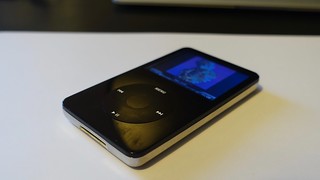
increased, but I managed to get an older 5th generation model ("video", with a
base capacity of 30G) whilst trading in some unwanted DVDs. The case was
scratched to heck but a replacement was readily and cheaply available from
auction sites.
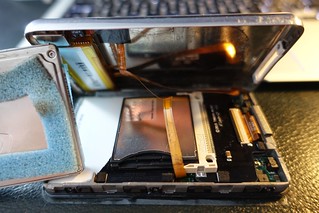
Rockbox support in these iPods is pretty good, and you can mod the hardware to
support CF or SD cards with kits such as the iFlash
kits by Tarkan Akdam, which I picked up, along with
a new 128G SD card.
Unfortunately I have found writing to the iPod to be very poor with Rockbox,
but it's fine for playback, and booting the iPod in OF or DFU mode is very easy
and works reliably.
Whilst Rockbox on the iPod works pretty well, installing it is far harder than
on the Sandisk Sansa devices. The difficulty in my case is because rockbox
requires a PC-formatted iPod to install, and I had a Mac-formatted one. I
couldn't find a way to convert the iPod to PC format using a Mac. I tried doing
so on a PC but for some reason the PC wasn't playing ball so I gave up after a
few hours. In the end I assembled the filesystem by hand using dd(1) and
dumps of partition tables from other people's iPods, via a Linux machine. This
was enough to convince iTunes on Mac to restore it's hidden partition and boot
software without reverting back to a Mac disklabel format.
With more than 10 million users, the Scratch online community is the largest online community where kids learn to program. Since it was created, a central goal of the community has been to promote remixing the reworking and recombination of existing creative artifacts. As the video above shows, remixing programming projects in the current web-based version of Scratch is as easy is as clicking on the see inside button in a project web-page, and then clicking on the remix button in the web-based code editor. Today, close to 30% of projects on Scratch are remixes.
Remixing plays such a central role in Scratch because its designers believed that remixing can play an important role in learning. After all, Scratch was designed first and foremost as a learning community with its roots in the Constructionist framework developed at MIT by Seymour Papert and his colleagues. The design of the Scratch online community was inspired by Papert s vision of a learning community similar to Brazilian Samba schools (Henry Jenkins writes about his experience of Samba schools in the context of Papert s vision here), and a comment Marvin Minsky made in 1984:
Adults worry a lot these days. Especially, they worry about how to make other people learn more about computers. They want to make us all computer-literate. Literacy means both reading and writing, but most books and courses about computers only tell you about writing programs. Worse, they only tell about commands and instructions and programming-language grammar rules. They hardly ever give examples. But real languages are more than words and grammar rules. There s also literature what people use the language for. No one ever learns a language from being told its grammar rules. We always start with stories about things that interest us.
In a new paper titled Remixing as a pathway to Computational Thinking that was recently published at the ACM Conference on Computer Supported Collaborative Work and Social Computing (CSCW) conference, we used a series of quantitative measures of online behavior to try to uncover evidence that might support the theory that remixing in Scratch is positively associated with learning.
Of course, because Scratch is an informal environment with no set path for users, no lesson plan, and no quizzes, measuring learning is an open problem. In our study, we built on two different approaches to measure learning in Scratch. The first approach considers the number of distinct types of programming blocks available in Scratch that a user has used over her lifetime in Scratch (there are 120 in total) something that can be thought of as a block repertoire or vocabulary. This measure has been used to model informal learning in Scratch in an earlier study. Using this approach, we hypothesized that users who remix more will have a faster rate of growth for their code vocabulary.
Controlling for a number of factors (e.g. age of user, the general level of activity) we found evidence of a small, but positive relationship between the number of remixes a user has shared and her block vocabulary as measured by the unique blocks she used in her non-remix projects. Intriguingly, we also found a strong association between the number of downloads by a user and her vocabulary growth. One interpretation is that this learning might also be associated with less active forms of appropriation, like the process of reading source code described by Minksy.
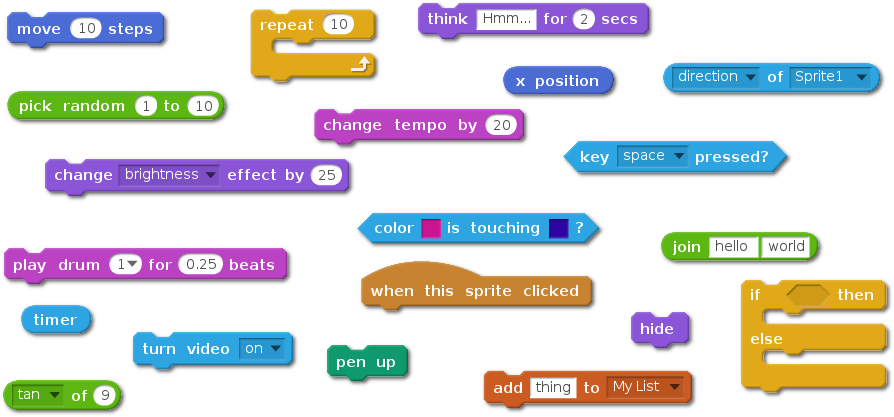
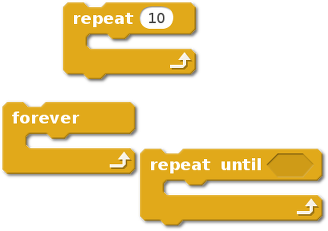
The second approach we used considered specific concepts in programming, such as loops, or event-handling. To measure this, we utilized a mapping of Scratch blocks to key programming concepts found in this paper by Karen Brennan and Mitchel Resnick. For example, in the image below are all the Scratch blocks mapped to the concept of loop .
We looked at six concepts in total (conditionals, data, events, loops, operators, and parallelism). In each case, we hypothesized that if someone has had never used a given concept before, they would be more likely to use that concept after encountering it while remixing an existing project.
Using this second approach, we found that users who had never used a concept were more likely to do so if they had been exposed to the concept through remixing. Although some concepts were more widely used than others, we found a positive relationship between concept use and exposure through remixing for each of the six concepts. We found that this relationship was true even if we ignored obvious examples of cutting and pasting of blocks of code. In all of these models, we found what we believe is evidence of learning through remixing.
Of course, there are many limitations in this work. What we found are all positive correlations we do not know if these relationships are causal. Moreover, our measures do not really tell us whether someone has understood the usage of a given block or programming concept.However, even with these limitations, we are excited by the results of our work, and we plan to build on what we have. Our next steps include developing and utilizing better measures of learning, as well as looking at other methods of appropriation like viewing the source code of a project.
Here comes my journey till the mid-term (June 21st) as a blog to share my experience.
I have previously worked on some social related projects such as smart guidance for blind and sensor based wireless controller . I have been selected as a speaker for FOSSASIA-16 (Asia s premier technological event)to talk on the project smart guidance for blind .FOSSASIA speakers. It was a great experience participating in the technological event in Singapore science centre.Got an opportunity to meet open source contributors from all over the world(even though it is an Asian event, participation was all over from the world). There were pre-meetups for FOSSASIA on the day before three-day event.I have attended the one organised by RedHat, Singapore.Discussed on many topics related to open source.
Three days of FOSSASIA event was a great experience.It was the second time as a speaker in an international conference.My talk was on the second day.Sharing is the best way to increase your knowledge. Talks and workshops were brainstorming.Learnt many new things and got the courage to contribute to the open source.Met Daniel Pocock in Debian exhibition table.Meeting awesome people can be the turning point of life.Had a discussion about the Debian projects and it motivated me for open source software.We have discussed about the Real Time Communication and was encouraged to apply for GSoC (Google Summer of Code). As per our discussion, prepared the project proposal on improving voice,video and chat communication with free software and submitted it for GSoC. I have been selected to contribute for Debian with stipend from Google.
This was my first application for GSoC and I have been selected to contribute for open source and free software. I would like to thank Google and Debian for giving this amazing experience.
Learning and coding have begun.Updated my laptop with Jessie, latest version of Debian.Get acquainted with the new platform.Got to learn many things about Real Time Communication.Learnt more about SIP, XMPP, peer-to-peer technology to work on my project.It s always better to be clear with theory before coding.When it comes to voice and video over IP, most people nowadays are quick to use Skype, Whatsapp, or Viber. My main goals of the project are helping people to avoid using proprietary communications tools like Skype, Viber and WhatsApp and simplifying the setup of free alternatives like Jitsi, Linphone, Ekiga, Tox (qtox), Mumble.Downloaded some of the already available open source VoIP to find the problems behind it and improve it further.Bootstrapping any business relevant network based on these free alternatives is still hard.
Would you like to list the senders, receivers and date of the messages in the inbox of your mail.Python has a library file IMAP which can be used to connect to an email account, examine every message in every folder and look at the To , From and CC headers of every email message in the folder.
Do you have phone numbers and other contact details in old emails? Would you like a quick way to data-mine your inbox to find them and help migrate them to your address book? Got the help from phonenumbers library for parsing, formatting, and validating international phone numbers.I would like to share how I imported this library file into my coding.Download the given library file and open the file in the terminal.Type
$ python setup.py install
to install the library file.Now you can call the functions by importing phonenumbers.
You can go through the code in my GitHub profile here.(Recently started committing my projects in GitHub)
Iain R. Learmonth joined my journey as a mentor.Helped in solving some issues in my coding through GitHub.
It was a wonderful journey till now.Will be working further to improve voice, video and chat communication with free software.Stay connected to know more about my further journey through GSoC.
Having seen some posts about this elsewhere on the 'Net:
Your copyright remains your own unless you assign it
Establish what you are being paid for: are you being paid for :
Your specific area of FLOSS expertise (or)
Your time / hours in an area unrelated to your FLOSS expertise (or)
A job that has no impact or bearing on your FLOSS expertise (or)
Your time / hours only - and negotiate accordingly
Your employer may be willing to negotiate / grant you an opt-out clause to protect your FLOSS expertise / accept an additional non-exclusive licence to your FLOSS code / be prepared to sign an assignment e.g.
"You should also get your employer (if you work as a programmer) or your school, if any, to sign a "copyright disclaimer" for the program, if necessary. Here is a sample; alter the names:
Yoyodyne, Inc., hereby disclaims all copyright
interest in the program  Gnomovision'
(which makes passes at compilers) written
by James Hacker.

signature of Ty Coon, 1 April 1989
Ty Coon, President of Vice"
If none of the above is feasible: don't contribute anything that crosses the streams and mingles commercial and FLOSS expertise, however much you're offered to do so.
Patents / copyrights
"In the 1980s I had not yet realized how confusing it was to speak of the issue of intellectual property . That term is obviously biased; more subtle is the fact that it lumps together various disparate laws which raise very different issues. Nowadays I urge people to reject the term intellectual property entirely, lest it lead others to suppose that those laws form one coherent issue. The way to be clear is to discuss patents, copyrights, and trademarks separately. See further explanation of how this term spreads confusion and bias." [http://www.gnu.org/gnu/manifesto.en.html - footnote 8.]
If you want to assert a patent - it's probably not FLOSS. Go away :)
If you want to assert a trademark of your own - it's probably not FLOSS. Go away :) [Trademarks may ordinarily be outside the scope of normal FLOSS legal considerations - but should be acknowledged wherever they occur both as a matter of law and as a matter of courtesy]
Copyright gives legal standing (locus standi in the terminology of English common law) to sue for infringement - that's the basis of licence enforcement actions.
Employees of governments and those doing government work
Still have the right to own authorship and copyrights and to negotiate accordingly
May need to establish more clearly what they're being paid for
May be able to advise, influence or direct policy towards FLOSS in their own respective national jurisdiction
Should, ideally, be primariily acknowledged as individuals, holding and maintaining an individual reputation and only secondarily as contractors/employees/others associated with government work.
Contribution to national / international standards, international agreements and shared working practices should be informed in the light of FLOSS work.
This is complex: some FLOSS contributors see a significant amount of this as immaterial to them in the same way that some indigenous populations do not acknowledge imposed colonial legal structures as valid - but both value systems can co-exist
texlive-bin/2016.20160513.41080-3 has been uploaded to unstable,
featuring support for FORCE_SOURCE_DATE. See the last post
for details on it.
doxygen/1.4.4-1 has been uploaded to unstable, fixing #822197
(upstream bug), which caused
some generated html file to contain unreproducible memory addresses of Python
objects used at build time.
debhelper/9.20160618 has been uploaded to unstable, fixing #824490,
which instructs ant to not save the username of the build user in the
generated files. Original patch by Emmanuel Bourg.
epydoc/3.0.1+dfsg-13 and 3.0.1+dfsg-14 have been uploaded by Kenneth J.
Pronovici which fixes nondeterministic ordering issues in generated
documentation and removes memory addresses. Original patches (#825968
and #827416) by Sascha Steinbiss.
With this upload of texlive-bin we decided to stop keeping our patched fork of
as most of the patches for SOURCE_DATE_EPOCH support had been integrated
upstream already, and the last one (making FORCE_SOURCE_DATE default to 1)
had been refused. So, we are now going to let the archive be rebuilt against
unstable's texlive-bin and see how many packages will become unreproducible
with this change; once enough data will be collected we will ponder whether
FORCE_SOURCE_DATE should be exported by helper tools (such as debhelper) or
manually exported by every package that needs it.
(For those wondering: we still recommend to follow SOURCE_DATE_EPOCH always
and don't recommend other projects to implement FORCE_SOURCE_DATE )
With the drop of texlive-bin we now have only three modified packages in our
experimental repository.
Reproducible work in other projects
Ed Maste sent a patch to have
ELF Tool Chain's elfcopy support SOURCE_DATE_EPOCH.
Ed Maste changed
FreeBSD's ar(1) to have a reproducible output by default when invoked with -s.
Ed Maste merged changes
from NetBSD's makefs to FreeBSD's to add a command line option for setting the
timestamp.
Holger Levsen spent some time thinking and documenting how to store package notes
and issues in a multi-distribution friendly manner, so that we can share
these issues and notes between reproducible efforts across different projects.
Thoughts we had about this topic
during the Athens meeting last December are included in the updated README.
Uploads with reproducibility fixes that currently fail to build:
ruby2.3/2.3.1-3 by Christian Hofstaedtler, avoids unreproducible rbconfig.rb files by always using bash for building.
Patches submitted that have not made their way to the archive yet:
#827109 against asciijump by Reiner Herrmann: sort source files for deterministic linking order.
#827112 against boswars by Reiner Herrmann: sort source files for deterministic linking order.
#827114 against overgod by Reiner Herrmann: use C locale for sorting source files.
#827115 against netpbm by Alexis Bienven e: honour SOURCE_DATE_EPOCH while generating output.
#827124 against funguloids by Reiner Herrmann: use C locale for sorting files.
#827145 against scummvm by Reiner Herrmann: don't embed extra fields in zip archive and build with proper host architecture.
#827150 against netpanzer by Reiner Herrmann: sort source files for deterministic linking order.
#827172 against reaver by Alexis Bienven e: sort object files for deterministic linking order.
#827187 against latex2html by Alexis Bienven e: iterate deterministic over Perl hashes; honour SOURCE_DATE_EPOCH for output; strip username from output; sort index keys.
#827313 against cherrypy3 by Sascha Steinbiss: prevent memory addresses in output.
#827361 against matplotlib by Alexis Bienven e: honour SOURCE_DATE_EPOCH in output and sort keys while iterating over dict.
#827382 against dwarfutils by Reiner Herrmann: fix array size, which caused memory from outside a table to be embedded into output.
#827384 against skytools3 by Sascha Steinbiss: use stable sorting order and remove timestamps from documentation.
#827419 against ldaptor by Sascha Steinbiss: sort list of input files and prevent home directory from leaking into documentation.
#827546 against git-buildpackage by Sascha Steinbiss: replace timestamps in documentation with changelog date; prevent temporary paths in documentation.
#827572 against xprobe by Reiner Herrmann: sort list of object files in static library archives.
Package reviews
36 reviews have been added, 12 have been updated and 31 have been removed in this week.
17 FTBFS bugs have been reported by Chris Lamb, Santiago Vila and Dominic Hargreaves.
diffoscope development
Satyam worked on argument completion (#826711) for diffoscope.
strip-nondeterminism development
Mattia Rizzolo uploaded strip-nondeterminism 0.019-1~bpo8+1 to
jessie-backports.
reprotest development
Ceridwen filed an Intent To Package (ITP) bug for reprotest as #827293.
tests.reproducible-builds.org
Mattia Rizzolo uploaded pbuilder 0.225 to unstable, providing built-in
support for eatmydata. We're planning to use it in armhf and i386 builders
where we don't build in tmpfs, to increase the build speed some more.
Valery Young reworked the appearance of the package page, hopefully making them more
intuitive and usable. In the process she changed the script generating them
to use a real templating system, thus improving
maintenance for the future.
Holger adjusted the scheduler to reschedule packages in state 'depwait' after
two days instead of three.
Mattia added the bug title next to the bug numbers in the notes.
Misc.
This week's edition was written by Mattia Rizzolo, Reiner Herrmann, Ed Maste and Holger Levsen and reviewed by a bunch of Reproducible builds folks on IRC.
This year a significant number of students are working on RTC-related projects as part of Google Summer of Code, under the umbrella of the Debian Project. You may have already encountered some of them blogging on Planet or participating in mailing lists and IRC.
WebRTC plugins for popular CMS and web frameworks
There are already a range of pseudo-WebRTC plugins available for CMS and blogging platforms like WordPress, unfortunately, many of them are either not releasing all their source code, locking users into their own servers or requiring the users to download potentially untrustworthy browser plugins (also without any source code) to use them.
Mesut is making plugins for genuinely free WebRTC with open standards like SIP. He has recently created the WPCall plugin for WordPress, based on the highly successful DruCall plugin for WebRTC in Drupal.
Keerthana has started creating a similar plugin for MediaWiki.
What is great about these plugins is that they don't require any browser plugins and they work with any server-side SIP infrastructure that you choose. Whether you are routing calls into a call center or simply using them on a personal blog, they are quick and convenient to install. Hopefully they will be made available as packages, like the DruCall packages for Debian and Ubuntu, enabling even faster installation with all dependencies.
Would you like to try running these plugins yourself and provide feedback to the students? Would you like to help deploy them for online communities using Drupal, WordPress or MediaWiki to power their web sites? Please come and discuss them with us in the Free-RTC mailing list.
You can read more about how to run your own SIP proxy for WebRTC in the RTC Quick Start Guide.
Finding all the phone numbers and ham radio callsigns in old emails
Do you have phone numbers and other contact details such as ham radio callsigns in old emails? Would you like a quick way to data-mine your inbox to find them and help migrate them to your address book?
Jaminy is working on Python scripts to do just that. Her project takes some inspiration from the Telify plugin for Firefox, which detects phone numbers in web pages and converts them to hyperlinks for click-to-dial. The popular libphonenumber from Google, used to format numbers on Android phones, is being used to help normalize any numbers found. If you would like to test the code against your own mailbox and address book, please make contact in the #debian-data channel on IRC.
A truly peer-to-peer alternative to SIP, XMPP and WebRTC
The team at Savoir Faire Linux has been busy building the Ring softphone, a truly peer-to-peer solution based on the OpenDHT distribution hash table technology.
Several students (Simon, Olivier, Nicolas and Alok) are actively collaborating on this project, some of them have been fortunate enough to participate at SFL's offices in Montreal, Canada. These GSoC projects have also provided a great opportunity to raise Debian's profile in Montreal ahead of DebConf17 next year.
Linux Desktop Telepathy framework and reSIProcate
Another group of students, Mateus, Udit and Balram have been busy working on C++ projects involving the Telepathy framework and the reSIProcate SIP stack. Telepathy is the framework behind popular softphones such as GNOME Empathy that are installed by default on the GNU/Linux desktop.
I previously wrote about starting a new SIP-based connection manager for Telepathy based on reSIProcate. Using reSIProcate means more comprehensive support for all the features of SIP, better NAT traversal, IPv6 support, NAPTR support and TLS support. The combined impact of all these features is much greater connectivity and much greater convenience.
The students are extending that work, completing the buddy list functionality, improving error handling and looking at interaction with XMPP.
Streamlining provisioning of SIP accounts
Currently there is some manual effort for each user to take the SIP account settings from their Internet Telephony Service Provider (ITSP) and transpose these into the account settings required by their softphone.
Pranav has been working to close that gap, creating a JAR that can be embedded in Java softphones such as Jitsi, Lumicall and CSipSimple to automate as much of the provisioning process as possible. ITSPs are encouraged to test this client against their services and will be able to add details specific to their service through Github pull requests.
The project also hopes to provide streamlined provisioning mechanisms for privately operated SIP PBXes, such as the Asterisk and FreeSWITCH servers used in small businesses.
Improving SIP support in Apache Camel and the Jitsi softphone
Apache Camel's SIP component and the widely known Jitsi softphone both use the JAIN SIP library for Java.
Nik has been looking at issues faced by SIP users in both projects, adding support for the MESSAGE method in camel-sip and looking at why users sometimes see multiple password prompts for SIP accounts in Jitsi.
If you are trying either of these projects, you are very welcome to come and discuss them on the mailing lists, Camel users and Jitsi users.
GSoC students at DebConf16 and DebConf17 and other events
Many of us have been lucky to meet GSoC students attending DebConf, FOSDEM and other events in the past. From this year, Google now expects the students to complete GSoC before they become eligible for any travel assistance. Some of the students will still be at DebConf16 next month, assisted by the regular travel budget and the diversity funding initiative. Nik and Mesut were already able to travel to Vienna for the recent MiniDebConf / LinuxWochen.at
As mentioned earlier, several of the students and the mentors at Savoir Faire Linux are based in Montreal, Canada, the destination for DebConf17 next year and it is great to see the momentum already building for an event that promises to be very big.
Explore the world of Free Real-Time Communications (RTC)
If you are interesting in knowing more about the Free RTC topic, you may find the following resources helpful:
Try Lumicall and Ring apps for Android with your freinds
RTC mentoring team 2016
We have been very fortunate to build a large team of mentors around the RTC-themed projects for 2016. Many of them are first time GSoC mentors and/or new to the Debian community. Some have successfully completed GSoC as students in the past. Each of them brings unique experience and leadership in their domain.
Helping GSoC projects in 2016 and beyond
Not everybody wants to commit to being a dedicated mentor for a GSoC student. In fact, there are many ways to help without being a mentor and many benefits of doing so.
Simply looking out for potential applicants for future rounds of GSoC and referring them to the debian-outreach mailing list or an existing mentor helps ensure we can identify talented students early and design projects around their capabilities and interests.
Testing the projects on an ad-hoc basis, greeting the students at DebConf and reading over the student wikis to find out where they are and introduce them to other developers in their area are all possible ways to help the projects succeed and foster long term engagement.
Google gives Debian a USD $500 grant for each student who completes a project successfully this year. If all 2016 students pass, that is over $10,000 to support Debian's mission.
As some of the world knows full well by now, I've been noodling with Go
for a few years, working through its pros, its cons, and thinking a lot
about how humans use code to express thoughts and ideas. Go's got a lot of
neat use cases, suited to particular problems, and used in the right place,
you can see some clear massive wins.
I've started writing Debian tooling in Go, because it's a pretty natural fit.
Go's fairly tight, and overhead shouldn't be taken up by your operating system.
After a while, I wound up hitting the usual blockers, and started to build up
abstractions. They became pretty darn useful, so, this blog post is announcing
(a still incomplete, year old and perhaps API changing) Debian package for Go.
The Go importable name is pault.ag/go/debian. This contains a lot of utilities
for dealing with Debian packages, and will become an edited down "toolbelt"
for working with or on Debian packages.
Module Overview
Currently, the package contains 4 major sub packages. They're a changelog
parser, a control file parser, deb file format parser, dependency parser
and a version parser. Together, these are a set of powerful building blocks
which can be used together to create higher order systems with reliable
understandings of the world.
changelog
The first (and perhaps most incomplete and least tested) is a changelog file
parser.. This provides the
programmer with the ability to pull out the suite being targeted in the
changelog, when each upload was, and the version for each. For example, let's
look at how we can pull when all the uploads of Docker to sid took place:
funcmain()resp,err:=http.Get("http://metadata.ftp-master.debian.org/changelogs/main/d/docker.io/unstable_changelog")iferr!=nilpanic(err)allEntries,err:=changelog.Parse(resp.Body)iferr!=nilpanic(err)for_,entry:=rangeallEntriesfmt.Printf("Version %s was uploaded on %s\n",entry.Version,entry.When)
The output of which looks like:
Version 1.8.3~ds1-2 was uploaded on 2015-11-04 00:09:02 -0800 -0800
Version 1.8.3~ds1-1 was uploaded on 2015-10-29 19:40:51 -0700 -0700
Version 1.8.2~ds1-2 was uploaded on 2015-10-29 07:23:10 -0700 -0700
Version 1.8.2~ds1-1 was uploaded on 2015-10-28 14:21:00 -0700 -0700
Version 1.7.1~dfsg1-1 was uploaded on 2015-08-26 10:13:48 -0700 -0700
Version 1.6.2~dfsg1-2 was uploaded on 2015-07-01 07:45:19 -0600 -0600
Version 1.6.2~dfsg1-1 was uploaded on 2015-05-21 00:47:43 -0600 -0600
Version 1.6.1+dfsg1-2 was uploaded on 2015-05-10 13:02:54 -0400 EDT
Version 1.6.1+dfsg1-1 was uploaded on 2015-05-08 17:57:10 -0600 -0600
Version 1.6.0+dfsg1-1 was uploaded on 2015-05-05 15:10:49 -0600 -0600
Version 1.6.0+dfsg1-1~exp1 was uploaded on 2015-04-16 18:00:21 -0600 -0600
Version 1.6.0~rc7~dfsg1-1~exp1 was uploaded on 2015-04-15 19:35:46 -0600 -0600
Version 1.6.0~rc4~dfsg1-1 was uploaded on 2015-04-06 17:11:33 -0600 -0600
Version 1.5.0~dfsg1-1 was uploaded on 2015-03-10 22:58:49 -0600 -0600
Version 1.3.3~dfsg1-2 was uploaded on 2015-01-03 00:11:47 -0700 -0700
Version 1.3.3~dfsg1-1 was uploaded on 2014-12-18 21:54:12 -0700 -0700
Version 1.3.2~dfsg1-1 was uploaded on 2014-11-24 19:14:28 -0500 EST
Version 1.3.1~dfsg1-2 was uploaded on 2014-11-07 13:11:34 -0700 -0700
Version 1.3.1~dfsg1-1 was uploaded on 2014-11-03 08:26:29 -0700 -0700
Version 1.3.0~dfsg1-1 was uploaded on 2014-10-17 00:56:07 -0600 -0600
Version 1.2.0~dfsg1-2 was uploaded on 2014-10-09 00:08:11 +0000 +0000
Version 1.2.0~dfsg1-1 was uploaded on 2014-09-13 11:43:17 -0600 -0600
Version 1.0.0~dfsg1-1 was uploaded on 2014-06-13 21:04:53 -0400 EDT
Version 0.11.1~dfsg1-1 was uploaded on 2014-05-09 17:30:45 -0400 EDT
Version 0.9.1~dfsg1-2 was uploaded on 2014-04-08 23:19:08 -0400 EDT
Version 0.9.1~dfsg1-1 was uploaded on 2014-04-03 21:38:30 -0400 EDT
Version 0.9.0+dfsg1-1 was uploaded on 2014-03-11 22:24:31 -0400 EDT
Version 0.8.1+dfsg1-1 was uploaded on 2014-02-25 20:56:31 -0500 EST
Version 0.8.0+dfsg1-2 was uploaded on 2014-02-15 17:51:58 -0500 EST
Version 0.8.0+dfsg1-1 was uploaded on 2014-02-10 20:41:10 -0500 EST
Version 0.7.6+dfsg1-1 was uploaded on 2014-01-22 22:50:47 -0500 EST
Version 0.7.1+dfsg1-1 was uploaded on 2014-01-15 20:22:34 -0500 EST
Version 0.6.7+dfsg1-3 was uploaded on 2014-01-09 20:10:20 -0500 EST
Version 0.6.7+dfsg1-2 was uploaded on 2014-01-08 19:14:02 -0500 EST
Version 0.6.7+dfsg1-1 was uploaded on 2014-01-07 21:06:10 -0500 EST
control
Next is one of the most complex, and one of the oldest parts of go-debian,
which is the control file parser
(otherwise sometimes known as deb822). This module was inspired by the way
that the json module works in Go, allowing for files to be defined in code
with a struct. This tends to be a bit more declarative, but also winds up
putting logic into struct tags, which can be a nasty anti-pattern if used too
much.
The first primitive in this module is the concept of a Paragraph, a struct
containing two values, the order of keys seen, and a map of string to string.
All higher order functions dealing with control files will go through this
type, which is a helpful interchange format to be aware of. All parsing of
meaning from the Control file happens when the Paragraph is unpacked into
a struct using reflection.
The idea behind this strategy that you define your struct, and let the Control
parser handle unpacking the data from the IO into your container, letting you
maintain type safety, since you never have to read and cast, the conversion
will handle this, and return an Unmarshaling error in the event of failure.
Additionally, Structs that define an anonymous member of control.Paragraph
will have the raw Paragraph struct of the underlying file, allowing the
programmer to handle dynamic tags (such as X-Foo), or at least, letting
them survive the round-trip through go.
The default decoder
contains an argument, the ability to verify the input control file using an
OpenPGP keyring, which is exposed to the programmer through the
(*Decoder).Signer() function. If the passed argument is nil, it will not
check the input file signature (at all!), and if it has been passed, any
signed data must be found or an error will fall out of the NewDecoder call.
On the way out, the opposite happens, where the struct is introspected,
turned into a control.Paragraph, and then written out to the io.Writer.
Here's a quick (and VERY dirty) example showing the basics of reading and
writing Debian Control files with go-debian.
packagemainimport("fmt""io""net/http""strings""pault.ag/go/debian/control")typeAllowedPackagestructPackagestringFingerprintstringfunc(a*AllowedPackage)UnmarshalControl(instring)errorin=strings.TrimSpace(in)chunks:=strings.SplitN(in," ",2)iflen(chunks)!=2returnfmt.Errorf("Syntax sucks: '%s'",in)a.Package=chunks[0]a.Fingerprint=chunks[1][1:len(chunks[1])-1]returnniltypeDMUAstructFingerprintstringUidstringAllowedPackages[]AllowedPackage control:"Allow" delim:"," funcmain()resp,err:=http.Get("http://metadata.ftp-master.debian.org/dm.txt")iferr!=nilpanic(err)decoder,err:=control.NewDecoder(resp.Body,nil)iferr!=nilpanic(err)fordmua:=DMUAiferr:=decoder.Decode(&dmua);err!=niliferr==io.EOFbreakpanic(err)fmt.Printf("The DM %s is allowed to upload:\n",dmua.Uid)for_,allowedPackage:=rangedmua.AllowedPackagesfmt.Printf(" %s [granted by %s]\n",allowedPackage.Package,allowedPackage.Fingerprint)
Output (truncated!) looks a bit like:
...
The DM Allison Randal <allison@lohutok.net> is allowed to upload:
   parrot [granted by A4F455C3414B10563FCC9244AFA51BD6CDE573CB]
...
The DM Benjamin Barenblat <bbaren@mit.edu> is allowed to upload:
   boogie [granted by 3224C4469D7DF8F3D6F41A02BBC756DDBE595F6B]
   dafny [granted by 3224C4469D7DF8F3D6F41A02BBC756DDBE595F6B]
   transmission-remote-gtk [granted by 3224C4469D7DF8F3D6F41A02BBC756DDBE595F6B]
   urweb [granted by 3224C4469D7DF8F3D6F41A02BBC756DDBE595F6B]
...
The DM     <aelmahmoudy@sabily.org> is allowed to upload:
   covered [granted by 41352A3B4726ACC590940097F0A98A4C4CD6E3D2]
   dico [granted by 6ADD5093AC6D1072C9129000B1CCD97290267086]
   drawtiming [granted by 41352A3B4726ACC590940097F0A98A4C4CD6E3D2]
   fonts-hosny-amiri [granted by BD838A2BAAF9E3408BD9646833BE1A0A8C2ED8FF]
   ...
...
deb
Next up, we've got the deb module. This contains code to handle reading
Debian 2.0 .deb files. It contains a wrapper that will parse the control
member, and provide the data member through the
archive/tar interface.
Here's an example of how to read a .deb file, access some metadata, and
iterate over the tar archive, and print the filenames of each of the
entries.
dependency
The dependency package provides an interface to parse and compute
dependencies. This package is a bit odd in that, well, there's no other
library that does this. The issue is that there are actually two different
parsers that compute our Dependency lines, one in Perl (as part of dpkg-dev)
and another in C (in dpkg).
To date, this has resulted in me filing
threedifferentbugs.
I also found a broken package in the
archive,
which actually resulted in another bug being (totally accidentally)
already fixed.
I hope to continue to run the archive through my parser in hopes of finding
more bugs! This package is a bit complex, but it basically just returns what
amounts to be an AST
for our Dependency lines. I'm positive there are bugs, so file them!
funcmain()dep,err:=dependency.Parse("foo bar, baz, foobar [amd64] bazfoo [!sparc], fnord:armhf [gnu-linux-sparc]")iferr!=nilpanic(err)anySparc,err:=dependency.ParseArch("sparc")iferr!=nilpanic(err)for_,possi:=rangedep.GetPossibilities(*anySparc)fmt.Printf("%s (%s)\n",possi.Name,possi.Arch)
Gives the output:
foo (<nil>)
baz (<nil>)
fnord (armhf)
version
Right off the bat, I'd like to thank
Michael Stapelberg for letting me graft this
out of dcs and into the go-debian package.
This was nearly entirely his work (with a one or two line function I added
later), and was amazingly helpful to have. Thank you!
This module implements Debian version comparisons and parsing, allowing for
sorting in lists, checking to see if it's native or not, and letting the
programmer to implement smart(er!) logic based on upstream (or Debian)
version numbers.
This module is extremely easy to use and very straightforward, and not worth
writing an example for.
Final thoughts
This is more of a "Yeah, OK, this has been useful enough to me at this point
that I'm going to support this" rather than a "It's stable!" or even
"It's alive!" post. Hopefully folks can report bugs and help iterate on
this module until we have some really clean building blocks to build
solid higher level systems on top of. Being able to have multiple libraries
interoperate by relying on go-debian will be a massive ease.
I'm in need of more documentation, and to finalize some parts of the older
sub package APIs, but I'm hoping to be at a "1.0" real soon now.
After introducing ourselves to the community, we start contributing to the open and free source software. Since this is the first week, I have went through theories which would help me in coding. Before coding it is always safer to refer to theories so that we don t need to spare time in debugging.
The following were my week 1-4 plans:
Getting familiar with Python and coding for connecting to an email account (using IMAP) and examines every message in every folder.
Writing a basic Python script to look at the To , From and CC headers of every email message in the folder. Identifying all the names and email addresses and writing them in a CSV file.
Scanning the body of each message looking for phone numbers.(for messages in plain text format)
Cleaning up the phone numbers and write them in international format and putting those in the CSV file too.(Telify recognizes phone numbers on web pages or in email messages and converts them into clickable links. This works with many CTI applications, SIP clients, Skype, Netmeeting, snom phones, the AGFEO TK-Suite client, SerVonic IXI-PCS and others. In general, all telephony software, devices or interfaces which can be controlled by using a URL, will most likely enable you to call a phone number directly from your browser or email client.
These two weeks I have completed my first two tasks in the list.I have committed and pushed my works in GitHub.https://github.com/Jaminy/GSoC
Successfully logged into the email account using IMAP and examined each folders.Examined inbox to extract To , From and CC of the last message received.Trying to extract all message details to put in CSV file.
Receive messages the moment they are sent without draining the battery
I am now fairly convined that both problems are well-solved on Android via the Conversations app and a well-tuned XMPP server (I had no idea how easy it was to install your own Prosody modulues -- the client state indicator module is only 22 lines of lua code!)
I think the current technical challenges could be better summarized as: adding iOS (iPhone) support. Both end-to-end encryption and receiving messages consistently seem to be hurdles. However, it seems that Chris Ballinger and the Chat Secure team are well on their way toward solving the push issue and facing funder skittishness on the encryption front. Nonetheless, but seem to be progressing.
With the obvious technical hurdles in progress, we have the luxury of talking about the less obvious ones - particularly the ones requiring trade-offs.
In particular: Signal replaces your SMS client. It looks and feels like an SMS client and automatically sends un-encrypted messages to everyone your address book that is not on signal and sends encrypted messages to those that are on signal.
The significance of this feature is hard to over-state. It differentiates tools by and for technically minded people and those designed for a mass audience.
When I convince people to use Conversations, in contrast, I have to teach them to:
Create an entirely new address book by entering addresses for your friends that you don't already have
Use a new and different app for sending encrypted messages
For most people who don't (yet) have their friends XMPP addresses or for people who don't have any friends who use XMPP, it means that they will install it, send me a few messages and then never use it again.
The price Signal pays for this convenience is steep: Signal seems to synchronize your entire address book to their servers so they can keep a map of cell phone numbers to signal users. It's not only creepy (I get a text message everytime someone in my address book joins Signal) but it's flies in the face of expectations for a privacy-minded application.
How could we take advantage of this feature, without the privacy problems?
What if...
Our app could send both XMPP messages and SMS messages
Everytime you added a new XMPP contact, it added the contact to your address book with a new XMPP field
Anytime you send a message to a contact with an XMPP field filled in, it would send via XMPP and otherwise it would send a normal SMS message
The main downside (which Signal faces as well) is that you have to contend with the complexities of sending SMS messages on top of the work needed to write a well-functioning XMPP client. As I mentioned in my Signal blog, there are no shortage of MMS bugs against Signal. Nobody wants that head-ache.
Additinally, we would still lose one Signal feature: with Signal, when a user joins, everyone automatically sends them encrypted messages. With this proposed app, each user would have to manually add the XMPP address and have no way of knowing when one of their friends gets an XMPP address.
Any other ideas?
April 23rd to May 23rd
The period of introducing ourselves to the Debian community. I have updated my debian wiki page to introduce more about myself to the Debian community.
https://wiki.debian.org/SummerOfCode2016/StudentApplications/Jaminy
There was a webRTC session of MiniDebconf through Jitsi on 3oth April to know more about the Debian resources.
During this period I have updated my PC with the Debian latest version, Jessie and got practised with the new platform.I have also learnt some basic theories on my project such as VoIP and IMAP. I was assigned by my mentor Daniel Pocock to work on telepathy reSIProcate.
Steps to install reSIProcate
System used
Debian GNU/Linux 8.3 (jessie)
Ubuntu 14.04.4 LTS (trusty)
Telepathy-Qt
First you have to configure the telepathy-qt library properly to be able to install reSIProcate. It s important to notice that you shouldn t install telepathy-qt from apt-get because in this way it wont have the telepathy-qt4-service shared library.
$ mkdir ~/telepathy-qt-stuff
$ cd ~/telepathy-qt-stuff
$ git clone https://github.com/dpocock/telepathy-qt-debian
$ cd telepathy-qt-debian
$ git checkout jessie-build-all-shared
$ cd ..
Now that I've gone down the signal road, when can I get off of it?
The two contenders I've found for more politically conscious mobile-friendly instant messaging are Tox and XMPP.
And the problems to solve are:
Implement end-to-end encryption
Receive messages the moment they are sent without draining the battery
The biggest problem is that there is no easy way to send push messages
between my app and your app. For me to send a push to one of your app s users
on iOS, I must first obtain an APNs SSL certificate/key pair from you, and
one of your user s push token that uniquely identifies their device to
Apple. These push tokens are potentially sensitive information because they
allow Apple to locate your device (in order to send it a push).
So, even if we manage to get one of these two standards for push notifications up and running, we have only succeeded in solving Signal's centralization problem, not the dependence on Google Play Services and Apple Push Network (in fact it's quite mysterious to me how you could even use the Prosody implementation of Push Notifications with GCM or APN).
So... what we really would need would be to figure out how to implement one of these two push standards and then get it to work with an alternative to GCM and APN (perhaps MQTT)? Which, I think would require changes to the XMPP client.
Geez. I may be on Signal longer than I planned.
I just installed Signal on my Android phone.
It wasn't an easy decision. I have been running Cyanogenmod, a Google-free version of Android, and installing apps from F-Droid, a repository of free software android apps, for several years now. This setup allows me to run all the applications I need without Google accessing any of my cell phone data. It has been a remarkably successful experiment leaving me with all the phone software I need. And it's consistent with my belief that Google's size, reach and goals are a menace to the left's ability to develop the autonomous communications systems on the Internet that we need to achieve any meaningful political change.
However, if I want to install Signal, I have to install Google Play, and the only way to install Google Play is to install Google's base line set of apps and to connect your cell phone to a Gmail account.
Why in the world would Signal require Google Play? There is plenty of discussion of the technical debate on this topic, but politically it boils down to this: security is about trade-offs, and the trade-offs you find important are based on your politics. While I consider Signal to be on the same team in the big picture, I think Signal's winning a short term victory for more massively adopted end-to-end encryption at the expense of a longer term and more important struggle for autonomous communication systems specifically for communities fighting corporate power (of which Google itself is an important target) and fighting US hegemony on a global scale.
Furthermore, Signal's lead developer's outright hostility to alternate clients connecting to the centralized signal servers demonstrates another political decision that favors central control over any confidence in a broader movement control over what could have become a power new protocol for secure communication. And his refusal to grant an exemption for other developers to use just the encryption algorythm is frustrating to say the least.
Given this reasoning, why install Signal? The main reason is because I have yet to convince anyone to remove Google Apps from their phone and Signal, right now, represents a dramatic improvement over most people's current communications habit. And, when it comes down to it, I need to run what I recommend.
I'm still running both conversations and Antox which are far better alternatives in the long run. However until they gain more widespread adoption, I'll be experimenting with Signal.
Technical Details
Oh, and by the way, installing Google Apps nearly bricked my phone.
Cyanogenmod's web site conveniently provides instructions for installing Google Apps. However, confusingly, they provide two different links to choose from, one is from OpenGapps which provided my a link to download the zip file to flash on a non-https page (the link itself was over https). The other link was to an https-enabled page on androidfilehost.com that offered a non-https download (but did provide a md5 checksum). I am now sure why people offering software downloads don't enable https from start to finish (well, maybe I do - I haven't yet enabled https on this site...).
However, more confusing is that both links were to different files. The OpenGapps one seemed to be a daily build and the androidfilehost was to a file with the date 20140606 in it's name, suggesting it was built nearly 2 years ago.
I went with the daily build.
When I restarted, I got the error "Unfortunately, Android Keyboard (Aosp) Has Stopped." If you search the web for this error you will see loads of people getting it. However, none of them seem to be using an encrypted disk. Yes, that is a bigger problem since you can't enter your encrypted disk passphrase if your keyboard app has crashed and you can't boot your phone if you can't even hit enter at the passphrase prompt. If you can't boot, you can't clear the keyboard app cache or most of the suggestions. In fact, when you press and hold the power key you don't even get the option to reboot into recovery mode. And, if you connect your device to your USB cable and run the adb tool on your computer, the tool reports that you are not authorized to connect your device.
Oh damn. Did I just brick my phone?
Fortunately, you can still boot into recovery mode on a Samsung S4 by powering it off. Then, press and hold the up volume button while turning it on.
In recovery mode, I as able to convince the adb tool to connect to my device and I copied over the other Gapps zip file from androidfilehost.com and flashing that one seems to have fixed the problem.
Once I booted, I ran Google Play and opted to create a new Google Account. I chose the option to not sync my data. Then, I checked in Settings -> Accounts I saw that a Google Account was there and was synchronizing. Great. What was it synchronizing? I clicked the account, then clicked "Accounts and Privacy" and ensured that everything was turned off. Let's hope that works.
[Update]
Signal's option to take over as your default SMS client and send un-encrypted normal SMS messages while sending encrypted messages to other Signal users is a very good way to smooth adoption. Unfortunately I had some problems with MMS message for which I found a work-around. But sheesh, lots of MMS problems at the moment.
This is your very first post. Click the Edit link to modify or delete it, or start a new post. If you like, use this post to tell readers why you started this blog and what you plan to do with it.
The wiki page TimestampsProposal has been extended to cover more usage examples and to list more softwares supporting SOURCE_DATE_EPOCH. (Axel Beckert, Dhole and Ximin Luo)
h01ger started a reference card for tools and information about reproducible builds but hasn't progressed much yet. Help with it is much welcome, this is also a good opportunity to learn about this project The idea is simply to have one coherent place with pointers to all the stuff we have and provide, without repeating nor replacing other documentation.
Toolchain fixes
Alexis Bienven e submitted a patch (#824050) against emacs24 for SOURCE_DATE_EPOCH support in autoloads files, but upstream already disabled timestamps by default some time before.
proj/4.9.2-3 uploaded by Bas Couwenberg (original patch by Alexis Bienven ) properly initializes memory with zero to prevent the nad2bin tool from leaking random memory content into output artefacts.
Reiner Herrmann submitted a patch (#825569, upstream) against Ruby to sort object files in generated Makefiles, which are used to compile C sources that are part of Ruby projects.
The kde pkg set was extended, though the change ain't visible yet, as there are currently non-installable packages in it (and so the set can't be computed). (h01ger)
Misc.
Mattia improved misc.git/reports (=the tools to help writing the weekly statistics for this blog) some more.
This week's edition was written by Reiner Herrmann and Holger Levsen and reviewed by a bunch of Reproducible builds folks on IRC.
Book reading is happening, and more book review posting will be
happening. I'm a bit behind in writing reviews, but the holiday weekend
is a good opportunity to do a bit of catching up.
In the meantime, here are some new acquisitions:
Roxanne J. Coady & Joy Johannessen (ed.) The Books That Changed My
Life (nonfiction)
James S.A. Corey Caliban's War (sff)
James S.A. Corey Abaddon's Gate (sff)
Max Gladstone Full Fathom Five (sff)
Max Gladstone Last First Snow (sff)
N.K. Jemisin The Fifth Season (sff)
Guy Gavriel Kay Children of Earth and Sky (sff)
Naomi Novik Uprooted (sff)
Ada Palmer Too Like the Lightning (sff)
Graydon Saunders Safely You Deliver (sff)
Neal Stephenson Seveneves (sff)
Jeff VanderMeer Annihilation (sff)
This is mostly catching up on books that were nominated for awards. I
want to read the (legitimate) nominees for Hugo best novel this year if I
can find the time, and VanderMeer won the Nebula last year. The rest of
Gladstone's series to date was on sale, and I really liked the first book.
And of course a new Guy Gavriel Kay is buy on sight.
I'm currently re-reading The Sarantine Mosaic, since I read that
before I started writing reviews and Children of Earth and Sky is
apparently set in historical contact with it. (It's possible all of Kay's
historical fantasies are set in the same universe, but they're usually
fairly disconnected.)
What happened in the Reproducible
Builds effort between May 15th and May 21st 2016:
Media coverage
Blog posts from our GSoC and Outreachy contributors:
Documentation update
Ximin Luo clarified instructions on how to set SOURCE_DATE_EPOCH.
Toolchain fixes
Joao Eriberto Mota Filho uploaded txt2man/1.5.6-4, which honours SOURCE_DATE_EPOCH to generate reproducible manpages (original patch by Reiner Herrmann).
Dmitry Shachnev uploaded sphinx/1.4.1-1 to experimental with improved support for SOURCE_DATE_EPOCH (original patch by Alexis Bienven e).
Emmanuel Bourg submitted a patch against debhelper to use a fixed username while building ant packages.
Other upstream fixes
Doxygen merged a patch by Ximin Luo, which uses UTC as timezone for embedded timestamps.
CMake applied a patch by Reiner Herrmann in their next branch, which sorts file lists obtained with file(GLOB).
GNU tar 1.29 with support for --clamp-mtimehas been released upstream, closing #816072, which was the blocker for #759886 "dpkg-dev: please make mtimes of packaged files deterministic" which we now hope will be closed soon.
#824639 against openblas by Alexis Bienven e: sort object files while linking
#824653 against elkcode by Alexis Bienven e: sort list of files locale-independently
#824668 against gmt by Alexis Bienven e: use SOURCE_DATE_EPOCH for embedded timestamp (similar patch by Bas Couwenberg already applied and forwarded upstream)
#824808 against gdal by Alexis Bienven e: sort object files while linking
#824951 against libtomcrypt by Reiner Herrmann: use SOURCE_DATE_EPOCH for timestamp embedded into metadata
Reproducibility-related bugs filed:
#824420 against python-phply by ceridwen: parsetab.py file is not included when building with DEB_BUILD_OPTIONS="nocheck"
#824572 against dpkg-dev by XImin Luo: request to export SOURCE_DATE_EPOCH in /usr/share/dpkg/*.mk.
Package reviews
51 reviews have been added, 19 have been updated and 15 have been removed in this week.
The preliminary results for testing have improved further:
testing/amd64 has 20944 / 90.2% reproducible packages now,
testing/i386 has reached 20013 / 86.3% reproducible packages,
testing/armhf has come close with 19951 / 86.0%.
Misc.
During the discussion on debian-devel about PIE, an archive rebuild was suggested by B lint R czey, and Holger Levsen suggested to coordinate this with a required archive rebuild for reproducible builds.
Ximin Luo improved misc.git/reports (=the tools to help writing the weekly statistics for this blog) quite a bit, h01ger contributed a little too.
This week's edition was written by Reiner Herrmann and Holger Levsen and reviewed by a bunch of Reproducible builds folks on IRC.
What happened in the Reproducible
Builds effort between May 1st and May 7th 2016:
Media coverage
There has been a surprising tweet last week: "Props to @FiloSottile for his nifty gvt golang tool. We're using it to get reproducible builds for a Zika & West Nile monitoring project." and to our surprise Kenn confirmed privately that he indeed meant "reproducible builds" as in "bit by bit identical builds". Wow. We're looking forward to learn more details about this; for now we just know that they are doing this for software quality reasons basically.
Two of the four GSoC and Outreachy participants for Reproducible builds posted their introductions to Planet Debian:
Toolchain fixes and other upstream developments
dpkg 1.18.5 was uploaded fixing two bugs relevant to us:
#719845 (make the file order within the data,control .tar.gz .deb members deterministic)
#819194 (add -fdebug-prefix-map to the compilers options)
This upload made it necessary to rebase our dpkg on the version on sid again, which Niko Tyni and Lunar promptly did. Then a few days later 1.18.6 was released to fix a regression in the previous upload, and Niko promptly updated our patched version again.
Following this Niko Tyni found #823428: "dpkg: many packages affected by dpkg-source: error: source package uses only weak checksums".
Alexis Bienven e worked on tex related packages and SOURCE_DATE_EPOCH:
pdftex upstream discussion by Alexis Bienven e began at tex-k mailing list to make \today honour SOURCE_DATE_EPOCH. Upstream already commited enhanced versions of the proposed patches.
Similar discussion on the luatex side at luatex mailing list. Upstream is working on it, and already committed some changes.
Package reviews
54 reviews have been added, 6 have been updated and 44 have been removed in this week.
18 FTBFS bugs have been reported by Chris Lamb, James Cowgill and Niko Tyni.
diffoscope development
Thanks to Mattia, diffoscope 52~bpo8+1 is available in jessie-backports now.
tests.reproducible-builds.org
All packages from all tested suites have finally been built on i386.
Due to GCC supporting SOURCE_DATE_EPOCH sid/armhf has finally reached 20k reproducible packages and sid/amd64 has even reached 21k reproducible packages. (These numbers are about our test setup. The numbers for the Debian archive are still all 0. dpkg and dak need to be fixed to get the numbers above 0.)
IRC notifications for non-Debian related jenkins job results go to #reproducible-builds now, while Debian related notifications stay on #debian-reproducible. (h01ger)
profitbricks-build4-amd64 has been fully set up now and is running 398 days in the future. Next: update coreboot/OpenWrt/Fedora/Archlinux/FreeBSD/NetBSD scripts to use it. Help (in form of patches to existing shell scripts) very much welcome! (Other help is much welcome (and needed) too, but some things might take longer to merge or explain )
Misc.
This week's edition was written by Reiner Herrmann, Holger Levsen and Mattia Rizzolo and reviewed by a bunch of Reproducible builds folks on IRC.
Mattia also wrote a small ikiwiki macro for this blog to ease linking reproducible issues, packages in the package tracker and bugs in the Debian BTS.
 The second pre-conference day was dedicated to books and beers, with a visit to an exquisite print studio, and a beer tasting session at one of the craft breweries in Canada. In addition we could grab a view into the Canadian lifestyle by visiting Pavneet s beautiful house in the countryside, as well as enjoying traditional style pastries from a bakery.


 Although they wont win a prize for typography (besides one page of a coaster there that carried a nice pun), their beers are exquisite. We got five different beers to taste, plus extensive explanations on brewing methods and differences. Now I finally understand why most of the new craft breweries in Japan are making Ales: Ales don t need a long process and are ready for sale in rather short time, compared to e.g. lagers.)


 The second

 iPod with rockbox
 open iPod with iFlash




 As some of the world knows full well by now, I've been noodling with Go
for a few years, working through its pros, its cons, and thinking a lot
about how humans use code to express thoughts and ideas. Go's got a lot of
neat use cases, suited to particular problems, and used in the right place,
you can see some clear massive wins.
I've started writing Debian tooling in Go, because it's a pretty natural fit.
Go's fairly tight, and overhead shouldn't be taken up by your operating system.
After a while, I wound up hitting the usual blockers, and started to build up
abstractions. They became pretty darn useful, so, this blog post is announcing
(a still incomplete, year old and perhaps API changing) Debian package for Go.
The Go importable name is


 The idea is simply to have one coherent place with pointers to all the stuff we have and provide, without repeating nor replacing other documentation.