Search Results: "hug"

25 April 2021

Russ Allbery: Review: Learning React

Review: Learning React, by Alex Banks & Eve Porcello
Publisher: O'Reilly
Copyright: June 2020
ISBN: 1-4920-5172-1
Format: Trade paperback
Pages: 287
My first JavaScript project was a React frontend to a REST service. As part of that project, I read two books: JavaScript: The Definitive Guide to learn the language foundation and this book to learn the framework on top of it. This was an unintentional experiment in the ways programming books can approach the topic. I commented in my review of JavaScript: the Definitive Guide that it takes the reference manual approach to the language. Learning React is the exact opposite. It's goal-driven, example-heavy, and has a problem and solution structure. The authors present a sample application, describe some desired new feature or deficiency in it, and then introduce the specific React technique that solves that problem. There is some rewriting of previous examples using more sophisticated techniques, but most chapters introduce new toy applications along with new parts of the React framework. The best part of this book is its narrative momentum, so I think the authors were successful at their primary goal. The first eight chapters of the book (more on the rest of the book in a moment) feel like a whirlwind tour where one concept flows naturally into the next and one's questions while reading about one technique are often answered in the next section. I thought the authors tried too hard in places and overdid the enthusiasm, but it's very readable in a way that I think may appeal to people who normally find programming books dry. Learning React is also firm and definitive about the correct way to use React, which may appeal to readers who only want to learn the preferred way of using the framework. (For example, React class components are mentioned briefly, mostly to tell the reader not to use them, and the rest of the book only uses functional components.) I had two major problems with this book, however. The first is that this breezy, narrative style turns out to be awful when one tries to use it as a reference. I read through most of this book with both enjoyment and curiosity, sat down to write a React component, and immediately struggled to locate the information I needed. Everything felt logically connected when I was focusing on the problems the authors introduced, but as soon as I started from my own problem, the structure of the book fell apart. I had to page through chapters to locate some nugget buried in the text, or re-read sections of the book to piece together which motivating problem my code was most similar to. It was a frustrating experience. This may be a matter of learning style, since this is why I prefer programming books with a reference structure. But be warned that I can't recommend this book as a reference while you're programming, nor does it prepare you to use the official React documentation as a reference. The second problem is less explicable and less defensible. I don't know what happened with O'Reilly's copy-editing for this book, but the code snippets are a train wreck. The Amazon reviews are full of people complaining about typos, syntax errors, omitted code, and glaring logical flaws, and they are entirely correct. It's so bad that I was left wondering if a very early, untested draft of the examples was somehow substituted into the book at the last minute by mistake. I'm not the sort of person who normally types code in from a book, so I don't care about a few typos or obvious misprints as long as the general shape is correct. The general shape was not correct. In a few places, the code is so completely wrong and incomplete that even combined with the surrounding text I was unable to figure out what it was supposed to be. It's possible this is fixed in a later printing (I read the June 2020 printing of the second edition), but otherwise beware. The authors do include a link to a GitHub repository of the code samples, which are significantly different than what's printed in the book, but that repository is incomplete; many of the later chapter examples are only links to JavaScript web sandboxes, which bodes poorly for the longevity of the example code. And then there's chapter nine of this book, which I found entirely baffling. This is a direct quote from the start of the chapter:
This is the least important chapter in this book. At least, that's what we've been told by the React team. They didn't specifically say, "this is the least important chapter, don't write it." They've only issued a series of tweets warning educators and evangelists that much of their work in this area will very soon be outdated. All of this will change.
This chapter is on suspense and error boundaries, with a brief mention of Fiber. I have no idea what I'm supposed to do with this material as a reader who is new to React (and thus presumably the target audience). Should I use this feature? When? Why is this material in the book at all when it's so laden with weird stream-of-consciousness disclaimers? It's a thoroughly odd editorial choice. The testing chapter was similarly disappointing in that it didn't answer any of my concrete questions about testing. My instinct with testing UIs is to break out Selenium and do integration testing with its backend, but the authors are huge fans of unit testing of React applications. Great, I thought, this should be interesting; unit testing seems like a poor fit for UI code because of how artificial the test construction is, but maybe I'm missing some subtlety. Convince me! And then the authors... didn't even attempt to convince me. They just asserted unit testing is great and explained how to write trivial unit tests that serve no useful purpose in a real application. End of chapter. Sigh. I'm not sure what to say about this book. I feel like it has so many serious problems that I should warn everyone away from it, and yet the narrative introduction to React was truly fun to read and got me excited about writing React code. Even though the book largely fell apart as a reference, I still managed to write a working application using it as my primary reference, so it's not all bad. If you like the problem and solution style and want a highly conversational and informal tone (that errs on the side of weird breeziness), this may still be the book for you. Just be aware that the code examples are a trash fire, so if you learn from examples, you're going to have to chase them down via the GitHub repository and hope that they still exist (or get a later edition of the book where this problem has hopefully been corrected). Rating: 6 out of 10

23 April 2021

Matthew Garrett: An accidental bootsplash

Back in 2005 we had Debconf in Helsinki. Earlier in the year I'd ended up invited to Canonical's Ubuntu Down Under event in Sydney, and one of the things we'd tried to design was a reasonable graphical boot environment that could also display status messages. The design constraints were awkward - we wanted it to be entirely in userland (so we didn't need to carry kernel patches), and we didn't want to rely on vesafb[1] (because at the time we needed to reinitialise graphics hardware from userland on suspend/resume[2], and vesa was not super compatible with that). Nothing currently met our requirements, but by the time we'd got to Helsinki there was a general understanding that Paul Sladen was going to implement this.

The Helsinki Debconf ended being an extremely strange event, involving me having to explain to Mark Shuttleworth what the physics of a bomb exploding on a bus were, many people being traumatised by the whole sauna situation, and the whole unfortunate water balloon incident, but it also involved Sladen spending a bunch of time trying to produce an SVG of a London bus as a D-Bus logo and not really writing our hypothetical userland bootsplash program, so on the last night, fueled by Koff that we'd bought by just collecting all the discarded empty bottles and returning them for the deposits, I started writing one.

I knew that Debian was already using graphics mode for installation despite having a textual installer, because they needed to deal with more complex fonts than VGA could manage. Digging into the code, I found that it used BOGL - a graphics library that made use of the VGA framebuffer to draw things. VGA had a pre-allocated memory range for the framebuffer[3], which meant the firmware probably wouldn't map anything else there any hitting those addresses probably wouldn't break anything. This seemed safe.

A few hours later, I had some code that could use BOGL to print status messages to the screen of a machine booted with vga16fb. I woke up some time later, somehow found myself in an airport, and while sitting at the departure gate[4] I spent a while staring at VGA documentation and worked out which magical calls I needed to make to have it behave roughly like a linear framebuffer. Shortly before I got on my flight back to the UK, I had something that could also draw a graphical picture.

Usplash shipped shortly afterwards. We hit various issues - vga16fb produced a 640x480 mode, and some laptops were not inclined to do that without a BIOS call first. 640x400 worked basically everywhere, but meant we had to redraw the art because circles don't work the same way if you change the resolution. My brief "UBUNTU BETA" artwork that was me literally writing "UBUNTU BETA" on an HP TC1100 shortly after I'd got the Wacom screen working did not go down well, and thankfully we had better artwork before release.

But 16 colours is somewhat limiting. SVGALib offered a way to get more colours and better resolution in userland, retaining our prerequisites. Unfortunately it relied on VM86, which doesn't exist in 64-bit mode on Intel systems. I ended up hacking the X.org x86emu into a thunk library that exposed the same API as LRMI, so we could run it without needing VM86. Shockingly, it worked - we had support for 256 colour bootsplashes in any supported resolution on 64 bit systems as well as 32 bit ones.

But by now it was obvious that the future was having the kernel manage graphics support, both in terms of native programming and in supporting suspend/resume. Plymouth is much more fully featured than Usplash ever was, but relies on functionality that simply didn't exist when we started this adventure. There's certainly an argument that we'd have been better off making reasonable kernel modesetting support happen faster, but at this point I had literally no idea how to write decent kernel code and everyone should be happy I kept this to userland.

Anyway. The moral of all of this is that sometimes history works out such that you write some software that a huge number of people run without any idea of who you are, and also that this can happen without you having any fucking idea what you're doing.

Write code. Do crimes.

[1] vesafb relied on either the bootloader or the early stage kernel performing a VBE call to set a mode, and then just drawing directly into that framebuffer. When we were doing GPU reinitialisation in userland we couldn't guarantee that we'd run before the kernel tried to draw stuff into that framebuffer, and there was a risk that that was mapped to something dangerous if the GPU hadn't been reprogrammed into the same state. It turns out that having GPU modesetting in the kernel is a Good Thing.

[2] ACPI didn't guarantee that the firmware would reinitialise the graphics hardware, and as a result most machines didn't. At this point Linux didn't have native support for initialising most graphics hardware, so we fell back to doing it from userland. VBEtool was a terrible hack I wrote to try to re-execute the system's graphics hardware through a range of mechanisms, and it worked in a surprising number of cases.

[3] As long as you were willing to deal with 640x480 in 16 colours

[4] Helsinki-Vantaan had astonishingly comfortable seating for time

comment count unavailable comments

22 April 2021

Shirish Agarwal: The Great Train Robbery

I had a twitter fight few days back with a gentleman and the article is a result of that fight. Sadly, I do not know the name of the gentleman as he goes via a psuedo name and then again I ve not taken permission from him to quote him in either way. So I will just state the observations I was able to make from the conversations we had. As people who read this blog regularly would know, I am and have been against Railway Privatization which is happening in India. And will be sharing some of the case studies from other countries as to how it panned out for them.

UK Railways
How Privatization Fails : Railways
The Above video is by a gentleman called Shaun who basically shared that privatization as far as UK is concerned is nothing but monopolies and while there are complex reasons for the same, the design of the Railways is such that it will always be a monopoly structure. At the most what you can do is have several monopolies but that is all that can happen. The idea of competition just cannot happen. Even the idea that subsidies will be less or/and trains will run on time is far from fact. Both of these facts have been checked and found to be truthful by fullfact.org. It is and argued that UK is small and perhaps it doesn t have the right conditions. It is probably true but still we do deserve to have a glance at the UK railway map.
UK railway map with operatorsUK railway map with operators
The above map is copyrighted to Map Marketing where you could see it today . As can be seen above most companies had their own specified areas. Now if you had looked at the facts then you would have seen that UK fares have been higher. In fact, an oldish article from Metro (a UK publication) shares the same. In fact, UK nationalized its railways effectively as many large rail operators were running in red. Even Scotland is set to nationalised back in March 2022. Remember this is a country which hasn t seen inflation go upwards of 5% in nearly a decade. The only outlier was 2011 where they indeed breached the 5% mark. So from this, what we see is Private Gains and Private Gains Public Losses perhaps seem fit. But then maybe we didn t use the right example. Perhaps Japan would be better. They have bullet trains while UK is still thinking about it. (HS2).

Japanese Railway Below is the map of Japanese Railway
Railway map of Japan with private ownership courtesy Wikimedia commons
Japan started privatizing its railway in 1987 and to date it has not been fully privatized. And on top of it, amount as much as 24 trillion of the long-term JNR debt was shouldered by the government at the expense of taxpayers of Japan while also reducing almost 1/4th of it employees. To add to it, while some parts of Japanese Railways did make profits, many of them made profits by doing large-scale non-railway business mostly real estate of land adjacent to railway stations. In many cases, it seems this went all the way up to 60% of the revenue. The most profitable has been the Shinkansen though. And while it has been profitable, it has not been without safety scandals over the years, the biggest in recent years was the 2005 Amagasaki derailment. What was interesting to me was the Aftermath, while the Wikipedia page doesn t share much, I had read at the time and probably could be found how a lot of ordinary people stood up to the companies in a country where it is a known fact that most companies are owned by the Yakuza. And this is a country where people are loyal to their corporation or company no matter what. It is a strange culture to west and also here in India where people change jobs on drop of hat, although nowadays we have record unemployment. So perhaps Japan too does not meet our standard as it doesn t do competition with each other but each is a set monopoly in those regions. Also how much subsidy is there or not is not really transparent.

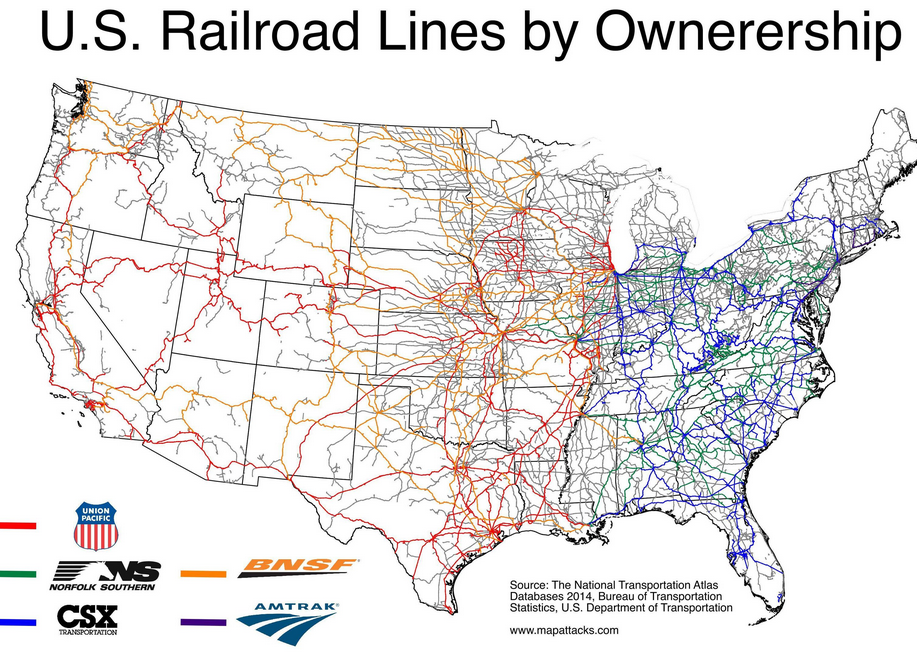
U.S. Railways Last, but not the least I share the U.S. Railway map. This is provided by A Mr. Tom Alison on reddit on channel maporn. As the thread itself is archived and I do not know the gentleman concerned, nor have taken permission for the map, hence sharing the compressed version


U.S. Railway lines with the different owners
Now the U.S. Railways is and has always been peculiar as unlike the above two the U.S. has always been more of a freight network. Probably, much of it has to do that in the 1960 s when oil was cheap, the U.S. made zillions of roadways and romanticized the road trip and has been doing it ever since. Also the creation of low-cost airlines definitely didn t help the railways to have more passenger services, in fact the opposite. There are and have been smaller services and attempts of privatization in both New Zealand and Australia and both have been failures. Please see papers in that regard. My simple point is this, as can be seen above, there have been various attempts at privatization of railways and most of them have been a mixed bag. The only one which comes close to what we think as good is Japanese but that also used a lot of public debt which we don t know what will happen on next. Also for higher-speed train services like a bullet train or whatever, you need to direct, no hair pen bends. In fact, a good talk on the topic is the TBD podcast which while it talks about hyperloop, the same questions is and would be asked if were to do in India. Another thing to be kept in mind is that the Japanese have been exceptional builders and this is because they have been forced to. They live in a seismically active zone which made Fukushima disaster a reality but at the same time, their buildings are earthquake-resistant. Standard Disclaimer The above is a simplified version of things. I could have added in financial accounts but that again has no set pattern. For e.g. some Railways use accrual, some use cash and some use hybrid. I could have also shared in either the guage or electrification but all have slightly different standards, although uniguage is something that all Railways aspire for and electrification is again something that all Railways want although in many cases it just isn t economically feasible.

Indian Railways Indian Railways itself recently made the move from Cash to Accrual couple of years back. In-between for a couple of years, it was hybrid. The sad part is and was you can now never measure against past performance in the old way because it is so different. Hence, whether the Railways will be making a loss or a profit, we would come to know only much later. Also, most accountants don t know the new system well, so it is gonna take more time, how much unknown. Sadly, what GOI did a few years back is merge the Railway budget into the Union Budget. Of course, the excuse they gave is too many pressures of new trains, while the truth is, by doing this, they decreased transparency about the whole thing. For e.g. for the last few years, the only state which had significant work being done is in U.P. (Uttar Pradesh) and a bit in Goa, although that is has been protested time and again. I being from the neighborly state of Maharashtra , and have been there several times. Now it does feels all like a dream, going to Goa :(.

Covid news Now before I jump on the news, I should share the movie Virus (2019) which was made by the talented Aashiq Abu. Even though, am not a Malayalee, I still have enjoyed many of his movies simply because he is a terrific director and Malayalam movies, at least most of them have English subtitles and lot of original content.. Interestingly, unlike the first couple of times when I saw it a couple of years back. The first time I saw it, I couldn t sleep a wink for a week. Even the next time, it was heavy. I had shared the movie with mum, and even she couldn t see it in one go. It is and was that powerful Now maybe because we are headlong in the pandemic, and the madness is all around us. There are two terms that helped me though understand a great deal of what is happening in the movie, the first term was altered sensorium which has been defined here. The other is saturation or to be more precise oxygen saturation . This term has also entered the Indian twitter lexicon quite a bit as India has started running out of oxygen. Just today Delhi High Court did an emergency hearing on the subject late at night. Although there is much to share about the mismanagement of the center, the best piece on the subject has been by Miss Priya Ramani. Yup, the same lady who has won against M.J. Akbar and this is when Mr. Akbar had 100 lawyers for this specific case. It would be interesting to see what happens ahead. There are however few things even she forgot in her piece, For e.g. reverse migration i.e. from urban to rural migration started again. Two articles from different entities sharing a similar outlook.Sadly, the right have no empathy or feeling for either the poor or the sick. Even the labor minister Santosh Gangwar s statement that around 1.04 crores were the only people who walked back home. While there is not much data, however some work/research has been done on migration to cites that the number could be easily 10 times as much. And this was in the lockdown of last year. This year, again the same issue has re-surfaced and migrants learning lessons started leaving cities. And I m ashamed to say I think they are doing the right thing. Most State Governments have not learned lessons nor have they done any work to earn the trust of migrants. This is true of almost all state Governments. Last year, just before the lockdown was announced, me and my friend spent almost 30k getting a cab all the way from Chennai to Pune, how much we paid for the cab, how much we bribed the various people just so we could cross the state borders to return home to our anxious families. Thankfully, unlike the migrants, we were better off although we did make a loss. I probably wouldn t be alive if I were in their situation as many didn t. That number is still in the air undocumented deaths  Vaccine issues Currently, though the issue has been the Vaccine and the pricing of the same. A good article to get a summation of the issues outlined has been shared on Economist. Another article that goes to the heart of the issue is at scroll. To buttress the argument, the SII chairman had shared this few weeks back
Adar Poonawala talking to Vishnu Som on Left, right center, 7th April 2021.
So, a licensee manufacturer wants to make super-profits during the pandemic. And now, as shared above they can very easily do it. Even the quotes given to nearby countries is smaller than the quotes given to Indian states

Prices of AstraZeneca among various states and countries.
The situation around beds, vaccines, oxygen, anything is so dire that people could go to any lengths to save their loved ones. Even if they know if a certain medicine doesn t work. For e.g. Remdesivir, 5 WHO trials have concluded that it doesn t increase mortality. Heck, even AIIMS chief said the same. But both doctors and relatives desperation to cling on hope has made Remdesivir as a black market drug with unoffical prices hovering anywhere between INR 14k/- to INR30k/- per vial. One of the executives of a top firm was also arrested in Gujarat. In Maharashtra, the opposition M.P. came to the rescue of the officials of Bruick pharms in Mumbai. Sadly, this strange affliction to the party in the center is also there in my extended family. At one end, they will heap praise on Mr. Modi, at the same time they can t get wait to get fast out of India. Many of them have settled in horrors of horror Dubai, as it is the best place to do business, get international schools for the young ones at decent prices, cheaper or maybe a tad more than what they paid in Delhi or elsewhere. Being an Agarwal or a Gupta makes it easier to compartmentalize both things. Ease of doing business, 5 days flat to get a business registered, up and running. And the paranoia is still there. They won t talk on the phone about him because they are afraid they may say something which comes back to bite them. As far as their decision to migrate, can t really blame them. If I were 20-25 yeas younger and my mum were in a better shape than she is, we probably would have migrated as well, although would have preferred Europe than anywhere else.

Internet Freedom and Aarogya Setu App.


Internet Freedom had shared the chilling effects of the Aarogya Setu App. This had also been shared by FSCI in the past, and recently had their handle being banned on Twitter. This was also apparent in a legal bail order which the high court judge gave. While I won t go into the merits and demerits of the bail order, it is astounding for the judge to say that the accused, even though he would be on bail install an app. so he can be surveilled. And this is a high court judge, such a sad state of affairs. We seem to be putting up new lows every day when it comes to judicial jurisprudence. One interesting aspect of the whole case was shared by Aishwarya Iyer. She shared a story that she and her team worked on quint which raises questions on the quality of the work done by Delhi Police. This is of course, up to Delhi Police to ascertain the truth of the matter because unless and until they are able to tie in the PMO s office in for a leak or POTUS s office it hardly seems possible. For e.g. the dates when two heads of state can meet each other would be decided by the secretaries of the two. Once the date is known, it would be shared with the press while at the same time some sort of security apparatus would kick in place. It is incumbent, especially on the host to take as much care as he can of the guest. We all remember that World War 1 (the war to end all wars) started due to the murder of Archduke Ferdinand.

As nobody wants that, the best way is to make sure that a political murder doesn t happen on your watch. Now while I won t comment on what it would be, it would be safe to assume that it would be z+ security along with higher readiness. Especially if it as somebody as important as POTUS. Now, it would be quite a reach for Delhi Police to connect the two dates. They either will have to get creative with the dates or some other way. Otherwise, with practically no knowledge in the public domain, they can t work in limbo. In either case, I do hope the case comes up for hearing soon and we see what the Delhi Police says and contends in the High Court about the same. At the very least, it would be irritating for them to talk of the dates unless they can contend some mass conspiracy which involves the PMO (and would bring into question the constant vetting done by the Intelligence dept. of all those who work in PMO). And this whole case is to kind of shelter to the Delhi riots which happened in which majorly the Muslims died but their deaths lay unaccounted till date

Conclusion In Conclusion, I would like to share a bit of humor because right now the atmosphere is humorless, both with authoritarian tendencies of the Central Govt. and the mass mismanagement of public health which they now have left to the state to do as they fit. The peice I am sharing is from arre, one of my goto sites whenever I feel low.

31 March 2021

Gunnar Wolf: And what does the FSF have, anyway?

Following up with my previous post, it seems the FSF s board is taking good care of undermining the FSF itself. Over few days, it has: Now Many people have pointed to the fact that the FSF has been a sort of a moral leader pushing free software awareness But if they lose their moral statre, what s in there? What power do they bear? Why do we care? And the answer, at least one of them, is simple and strong. The General Public License (GPL), both in its v2 and v3 revisions, read:
Each version is given a distinguishing version number.  If the
Program specifies that a certain numbered version of the GNU General
Public License "or any later version" applies to it, you have the
option of following the terms and conditions either of that numbered
version or of any later version published by the Free Software
Foundation.  If the Program does not specify a version number of the
GNU General Public License, you may choose any version ever published
by the Free Software Foundation.
Years ago there was a huge argument on why Linux was licensed as GPLv2 only, without the option to relicense under GPLv3. Of course, by then, Linux had had thousands of authors, and they would all have to agree to change license so it would have been impossible even if it were wanted. But yes, some people decried several terms of GPLv3 not being aligned with their views of freedom. Well, so if the FSF board manages to have it their way, and get everybody mark them as irrelevant, they will still be the stewards of the GPL. Thousands of projects are licensed under the GPL v2 or v3 or later . Will we continue to trust the FSF s stewardship, if it just becomes a board of big egos, with no respect of what happens in the free software ecosystem? My suggestion is, for all project copyright holders that are in a position to do so, to drop the or-later terms and stick to a single, known GPL version.

Chris Lamb: Free software activities in March 2021

Here is my monthly update covering what I have been doing in the free software world during March 2021 (previous month): Reproducible Builds One of the original promises of open source software is that distributed peer review and transparency of process results in enhanced end-user security. However, whilst anyone may inspect the source code of free and open source software for malicious flaws, almost all software today is distributed as pre-compiled binaries. This allows nefarious third-parties to compromise systems by injecting malicious code into ostensibly secure software during the various compilation and distribution processes. The motivation behind the Reproducible Builds effort is to ensure no flaws have been introduced during this compilation process by promising identical results are always generated from a given source, thus allowing multiple third-parties to come to a consensus on whether a build was compromised. The project is proud to be a member project of the Software Freedom Conservancy. Conservancy acts as a corporate umbrella allowing projects to operate as non-profit initiatives without managing their own corporate structure. If you like the work of the Conservancy or the Reproducible Builds project, please consider becoming an official supporter. This month, I:
I also made the following changes to diffoscope, including uploading versions 169, 170 and 171 to Debian: Debian Uploads
Debian LTS This month I worked 18 hours on Debian Long Term Support (LTS) and 12 hours on its sister Extended LTS project. You can find out more about the Debian LTS via the following video:

Timo Jyrinki: MotionPhoto / MicroVideo File Formats on Pixel Phones

Google Pixel phones support what they call Motion Photo which is essentially a photo with a short video clip attached to it. They are quite nice since they bring the moment alive, especially as the capturing of the video starts a small moment before the shutter button is pressed. For most viewing programs they simply show as static JPEG photos, but there is more to the files.
I d really love proper Shotwell support for these file formats, so I posted a longish explanation with many of the details in this blog post to a ticket there too. Examples of the newer format are linked there too.
Info posted to Shotwell ticket

There are actually two different formats, an old one that is already obsolete, and a newer current format. The older ones are those that your Pixel phone recorded as MVIMG_[datetime].jpg", and they have the following meta-data:
Xmp.GCamera.MicroVideo                       XmpText     1  1
Xmp.GCamera.MicroVideoVersion XmpText 1 1
Xmp.GCamera.MicroVideoOffset XmpText 7 4022143
Xmp.GCamera.MicroVideoPresentationTimestampUs XmpText 7 1331607
The offset is actually from the end of the file, so one needs to calculate accordingly. But it is exact otherwise, so one simply extract a file with that meta-data information:
#!/bin/bash
#
# Extracts the microvideo from a MVIMG_*.jpg file

# The offset is from the ending of the file, so calculate accordingly
offset=$(exiv2 -p X "$1" grep MicroVideoOffset sed 's/.*\"\(.*\)"/\1/')
filesize=$(du --apparent-size --block=1 "$1" sed 's/^\([0-9]*\).*/\1/')
extractposition=$(expr $filesize - $offset)
echo offset: $offset
echo filesize: $filesize
echo extractposition=$extractposition
dd if="$1" skip=1 bs=$extractposition of="$(basename -s .jpg $1).mp4"
The newer format is recorded in filenames called PXL_[datetime].MP.jpg , and they have a _lot_ of additional metadata:
Xmp.GCamera.MotionPhoto                      XmpText     1  1
Xmp.GCamera.MotionPhotoVersion XmpText 1 1
Xmp.GCamera.MotionPhotoPresentationTimestampUs XmpText 6 233320
Xmp.xmpNote.HasExtendedXMP XmpText 32 E1F7505D2DD64EA6948D2047449F0FFA
Xmp.Container.Directory XmpText 0 type="Seq"
Xmp.Container.Directory[1] XmpText 0 type="Struct"
Xmp.Container.Directory[1]/Container:Item XmpText 0 type="Struct"
Xmp.Container.Directory[1]/Container:Item/Item:Mime XmpText 10 image/jpeg
Xmp.Container.Directory[1]/Container:Item/Item:Semantic XmpText 7 Primary
Xmp.Container.Directory[1]/Container:Item/Item:Length XmpText 1 0
Xmp.Container.Directory[1]/Container:Item/Item:Padding XmpText 1 0
Xmp.Container.Directory[2] XmpText 0 type="Struct"
Xmp.Container.Directory[2]/Container:Item XmpText 0 type="Struct"
Xmp.Container.Directory[2]/Container:Item/Item:Mime XmpText 9 video/mp4
Xmp.Container.Directory[2]/Container:Item/Item:Semantic XmpText 11 MotionPhoto
Xmp.Container.Directory[2]/Container:Item/Item:Length XmpText 7 1679555
Xmp.Container.Directory[2]/Container:Item/Item:Padding XmpText 1 0
Sounds like fun and lots of information. However I didn t see why the length in first item is 0 and I didn t see how to use the latter Length info. But I can use the mp4 headers to extract it:
#!/bin/bash
#
# Extracts the motion part of a MotionPhoto file PXL_*.MP.mp4

extractposition=$(grep --binary --byte-offset --only-matching --text \
-P "\x00\x00\x00\x18\x66\x74\x79\x70\x6d\x70\x34\x32" $1 sed 's/^\([0-9]*\).*/\1/')

dd if="$1" skip=1 bs=$extractposition of="$(basename -s .jpg $1).mp4"
UPDATE: I wrote most of this blog post earlier. When now actually getting to publishing it a week later, I see the obvious ie the Length is again simply the offset from the end of the file so one could do the same less brute force approach as for MVIMG. I ll leave the above as is however for the of binary grepping.(cross-posted to my other blog)

28 March 2021

Norbert Preining: RMS, Debian, and the world

Too much has been written, a war of support letters is going on, Debian is heading head first like Lemmings into the same war. And then, there is this by the first female President of the American Civil Liberties Union (ACLU): Civil Rights Activist Nadine Strossen s Response To #CancelStallman:
I find it so odd that the strong zeal for revenge and punishment if someone says anything that is perceived to be sexist or racist or discriminatory comes from liberals and progressives. There are so many violations [in cases like Stallman s] of such fundamental principles to which progressives and liberals cling in general as to what is justice, what is fairness, what is due process.
One is proportionality: that the punishment should be proportional to the offense. Another one is restorative justice: that rather than retribution and punishment, we should seek to have the person constructively come to understand, repent, and make amends for an infraction. Liberals generally believe society to be too punitive, too harsh, not forgiving enough. They are certainly against the death penalty and other harsh punishments even for the most violent, the mass murderers. Progressives are right now advocating for the release of criminals, even murderers. To then have exactly the opposite attitude towards something that certainly is not committing physical violence against somebody, I don t understand the double standard!
Another cardinal principle is we shouldn t have any guilt by association. [To hold culpable] these board members who were affiliated with him and ostensibly didn t do enough to punish him for things that he said which by the way were completely separate from the Free Software Foundation is multiplying the problems of unwarranted punishment. It extends the punishment where the argument for responsibility and culpability becomes thinner and thinner to the vanishing point. That is also going to have an enormous adverse impact on the freedom of association, which is an important right protected in the U.S. by the First Amendment.
The Supreme Court has upheld freedom of association in cases involving organizations that were at the time highly controversial. It started with NAACP (National Association for the Advancement of Colored People) during the civil rights movement in the 1950s and 60s, but we have a case that s going to the Supreme Court right now regarding Black Lives Matter. The Supreme Court says even if one member of the group does commit a crime in both of those cases physical violence and assault that is not a justification for punishing other members of the group unless they specifically intended to participate in the particular punishable conduct.
Now, let s assume for the sake of argument, Stallman had an attitude that was objectively described as discriminatory on the basis on race and gender (and by the way I have seen nothing to indicate that), that he s an unrepentant misogynist, who really believes women are inferior. We are not going to correct those ideas, to enlighten him towards rejecting them and deciding to treat women as equals through a punitive approach! The only approach that could possibly work is an educational one! Engaging in speech, dialogue, discussion and leading him to re-examine his own ideas.
Even if I strongly disagree with a position or an idea, an expression of an idea, advocacy of an idea, and even if the vast majority of the public disagrees with the idea and finds it offensive, that is not a justification for suppressing the idea. And it s not a justification for taking away the equal rights of the person who espouses that idea including the right to continue holding a tenured position or other prominent position for which that person is qualified.
But a number of the ideas for which Richard Stallman has been attacked and punished are ideas that I as a feminist advocate of human rights find completely correct and positive from the perspective of women s equality and dignity! So for example, when he talks about the misuse and over use and flawed use of the term sexual assault, I completely agree with that critique! People are indiscriminantly using that term or synonyms to describe everything from the most appaulling violent abuse of helpless vulnerable victims (such as a rape of a minor) to any conduct or expression in the realm of gender or sexuality that they find unpleasant or disagreeable.
So we see the term sexual assault and sexual harrassment used for example, when a guy asks a woman out on a date and she doesn t find that an appealing invitation. Maybe he used poor judgement in asking her out, maybe he didn t, but in any case that is NOT sexual assault or harassment. To call it that is to really demean the huge horror and violence and predation that does exist when you are talking about violent sexual assault. People use the term sexual assault/ sexual harassment to refer to any comment about gender or sexuality issues that they disagree with or a joke that might not be in the best taste, again is that to be commended? No! But to condemn it and equate it with a violent sexual assault again is really denying and demeaning the actual suffering that people who are victims of sexual assault endure. It trivializes the serious infractions that are committed by people like Jeffrey Epstein and Harvey Weinstein. So that is one point that he made that I think is very important that I strongly agree with.
Secondly and relatedly, [Richard Stallman] never said that he endorse child pornography, which by definition the United States Supreme Court has defined it multiple times is the sexual exploitation of an actual minor. Coerced, forced, sexual activity by that minor, with that minor that happens to be filmed or photographed. That is the definition of child pornography. He never defends that! What the point he makes, a very important one, which the U.S. Supreme Court has also made, is mainly that we overuse and distort the term child pornography to refer to any depiction of any minor in any context that is even vaguely sexual.
So some people have not only denounced as child pornography but prosecuted and jailed loving devoted parents who committed the crime of taking a nude or semi-nude picture of their own child in a bathtub or their own child in a bathing suit. Again it is the hysteria that has totally refused to draw an absolutely critical distinction between actual violence and abuse, which is criminal and should be criminal, to any potentially sexual depiction of a minor. And I say potentially because I think if you look at a picture a parent has taken of a child in a bathtub and you see that as sexual, then I d say there s something in your perspective that might be questioned or challenged! But don t foist that upon the parent who is lovingly documenting their beloved child s life and activities without seeing anything sexual in that image.
This is a decision that involves line drawing. We tend to have this hysteria where once we hear terms like pedophilia of course you are going to condemn anything that could possibly have that label. Of course you would. But societies around the world throughout history various cultures and various religions and moral positions have disagreed about at what age do you respect the autonomy and individuality and freedom of choice of a young person around sexuality. And the U.S. Supreme Court held that in a case involving minors right to choose to have an abortion.
By the way, [contraception and abortion] is a realm of sexuality where liberals and progressives and feminists have been saying, Yes! If you re old enough to have sex. You should have the right to contraception and access to it. You should have the right to have an abortion. You shouldn t have to consult with your parents and have their permission or a judge s permission because you re sufficiently mature. And the Supreme Court sided in accord of that position. The U.S. Supreme Court said constitutional rights do not magically mature and spring into being only when someone happens to attain the state defined age of majority.
In other words the constitution doesn t prevent anyone from exercising rights, including Rights and sexual freedoms, freedom of choice and autonomy at a certain age! And so you can t have it both ways. You can t say well we re strongly in favor of minors having the right to decide what to do with their own bodies, to have an abortion what is in some people s minds murder but we re not going to trust them to decide to have sex with somewhat older than they are.
And I say somewhat older than they are because that s something where the law has also been subject to change. On all issues of when you obtain the age of majority, states differ on that widely and they choose different ages for different activities. When you re old enough to drive, to have sex with someone around your age, to have sex with someone much older than you. There is no magic objective answer to these questions. I think people need to take seriously the importance of sexual freedom and autonomy and that certainly includes women, feminists. They have to take seriously the question of respecting a young person s autonomy in that area.
There have been famous cases of 18 year olds who have gone to prison because they had consensual sex with their girlfriends who were a couple of years younger. A lot of people would not consider that pedophilia and yet under some strict laws and some absolute definitions it is. Romeo and Juliet laws make an exception to pedophilia laws when there is only a relatively small age difference. But what is relatively small? So to me, especially when he says he is re-examining his position, Stallman is just thinking through the very serious debate of how to be protective and respectful of young people. He is not being disrespectful, much less wishing harm upon young people, which seems to be what his detractors think he s doing.
Unfortunately, I don t think the Anti-Harassment Team of Debian and others of the usual group of warriors will ever read less understand what is written there. So sad.

24 March 2021

Bastian Venthur: Perfection is Achieved When There is Nothing Left to Take Away

In 14 years since starting this blog, I changed the software several times, with each iteration simplifying requirements and setup. Wordpress In 2007, I started blogging. Back then I used a self-hosted Wordpress instance, running on my server. I was never really comfortable with the technology stack involved: a programming language I didn't speak, a DB I had little experience with, a relatively heavy setup and of course, the occasional security issues related to that setup. All that just to have a somewhat dynamic website with pingbacks and comments generated by your visitors... totally worth it and exciting times! You wrote something to the "lazyweb" department and people would actually comment with useful advice! Then came the spammers. First, it was just a little, and you could easily fight it off with the askimet plugin. Over the years, however the spam-to-useful-comments-ratio shifted to ridiculous levels and the comment section itself became a burden. Hosting the comments on a separate platform like disqus was not an option for me, so I finally turned the comments off. Without the need for a comment section, the whole idea of storing mostly textual content in a DB just to have it served as a website, suddenly seemed like overkill and an unnecessary security risk. So I started looking for alternatives. I wanted to maintain my content as plain text files. Text files are cool because they are future proof, portable and can be managed in git. Consequently, I was searching for a static site generator. Pelican Around 2016 I finally migrated away from Wordpress to Pelican. Pelican met all my requirements. I could store my content as plain Markdown files in a git repository. Pelican is written in Python, a language with which I'm very comfortable with. Pelican deals with blog posts and "pages" (i.e. non blog articles) and most importantly: Pelican just generates static HTML. So all that's required on the server side is a simple web server. Conveniently, it also comes with an importer that allowed me to export the content of my old Wordpress instance straight into Markdown files. Migrating to Pelican was a huge relieve: I finally had a all my content as plain text in a git repository, my server was a lot more secure without the Wordpress instance running and removing MySQL freed up a lot of resources on that machine. blag Fast forward to 2021. While I was quite happy with Pelican, it still had too many features I don't need. My blogging experience can be stripped down to a bunch of Markdown files that serve either as articles or pages, some static files, some templating for a decent design and an Atom feed. Particularly, I do not need pages/articles in multiple languages, a plugin system, support for multiple authors and tons of settings. So I did what every self-respecting nerd would do: I wrote my own site generator. Not to write something better than Pelican, but rather something lesser. Something that does less while still being functionally adequate. I called the result "blag", named after the blag of the webcomic xkcd. blag is a blog-aware, static site generator written in Python. It supports the basic features you'd expect from a blog, like an archive, tags and an Atom feed. It converts Markdown (with fenced code blocks) and supports Jinja2 templating. With this setup I'm quite happy for now. Maybe sometime there will be a simpler RSS/Atom-successor that does not require site-specific metadata (i.e. only stuff that can be generated from the articles themselves), so I could get rid of blag's only required configuration.

23 March 2021

Antoine Beaupr : Major email crash with syncmaildir

TL:DR; lost half my mail (150,000 messages, ~6GB) last night. Cause uncertain, but possibly a combination of a dead CMOS battery, systemd OnCalendar=daily, a (locking?) bug in syncmaildir, and generally, a system too exotic and complicated.

The crash So I somehow lost half my mail:
anarcat@angela:~(main)$ du -sh Maildir/
7,9G    Maildir/
anarcat@curie:~(main)$ du -sh Maildir
14G     Maildir
anarcat@marcos:~$ du -sh Maildir
8,0G    Maildir
Those are three different machines:
  • angela: my laptop, not always on
  • curie: my workstation, mostly always on
  • marcos: my mail server, always on
Those mails are synchronized using a rather exotic system based on SSH, syncmaildir and rsendmail. The anomaly started on curie:
-- Reboot --
mar 22 16:13:00 curie systemd[3199]: Starting pull emails with syncmaildir...
mar 22 16:13:00 curie smd-pull[4801]: rm: impossible de supprimer '/home/anarcat/.smd/workarea/Maildir': Le dossier n'est pas vide
mar 22 16:13:00 curie systemd[3199]: smd-pull.service: Main process exited, code=exited, status=1/FAILURE
mar 22 16:13:00 curie systemd[3199]: smd-pull.service: Failed with result 'exit-code'.
mar 22 16:13:00 curie systemd[3199]: Failed to start pull emails with syncmaildir.
mar 22 16:14:00 curie systemd[3199]: Starting pull emails with syncmaildir...
mar 22 16:14:00 curie smd-pull[7025]:  4091 ?        00:00:00 smd-push
mar 22 16:14:00 curie smd-pull[7025]: Already running.
mar 22 16:14:00 curie smd-pull[7025]: If this is not the case, remove /home/anarcat/.smd/lock by hand.
mar 22 16:14:00 curie smd-pull[7025]: any: smd-pushpull@localhost: TAGS: error::context(locking) probable-cause(another-instance-is-running) human-intervention(necessary) suggested-actions(run(kill 4091) run(rm /home/anarcat/.smd/lock))
mar 22 16:14:00 curie systemd[3199]: smd-pull.service: Main process exited, code=exited, status=1/FAILURE
mar 22 16:14:00 curie systemd[3199]: smd-pull.service: Failed with result 'exit-code'.
mar 22 16:14:00 curie systemd[3199]: Failed to start pull emails with syncmaildir.
Then it seems like smd-push (from curie) started destroying the universe for some reason:
mar 22 16:20:00 curie systemd[3199]: Starting pull emails with syncmaildir...
mar 22 16:20:00 curie smd-pull[9319]:  4091 ?        00:00:00 smd-push
mar 22 16:20:00 curie smd-pull[9319]: Already running.
mar 22 16:20:00 curie smd-pull[9319]: If this is not the case, remove /home/anarcat/.smd/lock by hand.
mar 22 16:20:00 curie smd-pull[9319]: any: smd-pushpull@localhost: TAGS: error::context(locking) probable-cause(another-instance-is-running) human-intervention(necessary) suggested-actions(ru
mar 22 16:20:00 curie systemd[3199]: smd-pull.service: Main process exited, code=exited, status=1/FAILURE
mar 22 16:20:00 curie systemd[3199]: smd-pull.service: Failed with result 'exit-code'.
mar 22 16:20:00 curie systemd[3199]: Failed to start pull emails with syncmaildir.
mar 22 16:21:34 curie smd-push[4091]: default: smd-client@smd-server-anarcat: TAGS: stats::new-mails(0), del-mails(293920), bytes-received(0), xdelta-received(26995)
mar 22 16:21:35 curie smd-push[9374]: register: smd-client@smd-server-register: TAGS: stats::new-mails(0), del-mails(0), bytes-received(0), xdelta-received(215)
mar 22 16:21:35 curie systemd[3199]: smd-push.service: Succeeded.
Notice the del-mails(293920) there: it is actively trying to destroy basically every email in my mail spool. Then somehow push and pull started both at once:
mar 22 16:21:35 curie systemd[3199]: Started push emails with syncmaildir.
mar 22 16:21:35 curie systemd[3199]: Starting push emails with syncmaildir...
mar 22 16:22:00 curie systemd[3199]: Starting pull emails with syncmaildir...
mar 22 16:22:00 curie smd-pull[10333]:  9455 ?        00:00:00 smd-push
mar 22 16:22:00 curie smd-pull[10333]: Already running.
mar 22 16:22:00 curie smd-pull[10333]: If this is not the case, remove /home/anarcat/.smd/lock by hand.
mar 22 16:22:00 curie smd-pull[10333]: any: smd-pushpull@localhost: TAGS: error::context(locking) probable-cause(another-instance-is-running) human-intervention(necessary) suggested-actions(r
mar 22 16:22:00 curie systemd[3199]: smd-pull.service: Main process exited, code=exited, status=1/FAILURE
mar 22 16:22:00 curie systemd[3199]: smd-pull.service: Failed with result 'exit-code'.
mar 22 16:22:00 curie systemd[3199]: Failed to start pull emails with syncmaildir.
mar 22 16:22:00 curie smd-push[9455]: smd-client: ERROR: Data transmission failed.
mar 22 16:22:00 curie smd-push[9455]: smd-client: ERROR: This problem is transient, please retry.
mar 22 16:22:00 curie smd-push[9455]: smd-client: ERROR: server sent ABORT or connection died
mar 22 16:22:00 curie smd-push[9455]: smd-server: ERROR: Unable to open Maildir/.kobo/cur/1498563708.M122624P22121.marcos,S=32234,W=32792:2,S: Maildir/.kobo/cur/1498563708.M122624P22121.marco
mar 22 16:22:00 curie smd-push[9455]: smd-server: ERROR: The problem should be transient, please retry.
mar 22 16:22:00 curie smd-push[9455]: smd-server: ERROR: Unable to open requested file.
mar 22 16:22:00 curie smd-push[9455]: default: smd-client@smd-server-anarcat: TAGS: stats::new-mails(0), del-mails(293920), bytes-received(0), xdelta-received(26995)
mar 22 16:22:00 curie smd-push[9455]: default: smd-client@smd-server-anarcat: TAGS: error::context(receive) probable-cause(network) human-intervention(avoidable) suggested-actions(retry)
mar 22 16:22:00 curie smd-push[9455]: default: smd-server@localhost: TAGS: error::context(transmit) probable-cause(simultaneous-mailbox-edit) human-intervention(avoidable) suggested-actions(r
mar 22 16:22:00 curie systemd[3199]: smd-push.service: Main process exited, code=exited, status=1/FAILURE
mar 22 16:22:00 curie systemd[3199]: smd-push.service: Failed with result 'exit-code'.
mar 22 16:22:00 curie systemd[3199]: Failed to start push emails with syncmaildir.
There it seems push tried to destroy the universe again: del-mails(293920). Interestingly, the push started again in parallel with the pull, right that minute:
mar 22 16:22:00 curie systemd[3199]: Starting push emails with syncmaildir...
... but didn't complete for a while, here's pull trying to start again:
mar 22 16:24:00 curie systemd[3199]: Starting pull emails with syncmaildir...
mar 22 16:24:00 curie smd-pull[12051]: 10466 ?        00:00:00 smd-push
mar 22 16:24:00 curie smd-pull[12051]: Already running.
mar 22 16:24:00 curie smd-pull[12051]: If this is not the case, remove /home/anarcat/.smd/lock by hand.
mar 22 16:24:00 curie smd-pull[12051]: any: smd-pushpull@localhost: TAGS: error::context(locking) probable-cause(another-instance-is-running) human-intervention(necessary) suggested-actions(run(kill 10466) run(rm /home/anarcat/.smd/lock))
mar 22 16:24:00 curie systemd[3199]: smd-pull.service: Main process exited, code=exited, status=1/FAILURE
mar 22 16:24:00 curie systemd[3199]: smd-pull.service: Failed with result 'exit-code'.
mar 22 16:24:00 curie systemd[3199]: Failed to start pull emails with syncmaildir.
... and the long push finally resolving:
mar 22 16:24:00 curie smd-push[10466]: smd-client: ERROR: Data transmission failed.
mar 22 16:24:00 curie smd-push[10466]: smd-client: ERROR: This problem is transient, please retry.
mar 22 16:24:00 curie smd-push[10466]: smd-client: ERROR: server sent ABORT or connection died
mar 22 16:24:00 curie smd-push[10466]: smd-client: ERROR: Data transmission failed.
mar 22 16:24:00 curie smd-push[10466]: smd-client: ERROR: This problem is transient, please retry.
mar 22 16:24:00 curie smd-push[10466]: smd-client: ERROR: server sent ABORT or connection died
mar 22 16:24:00 curie smd-push[10466]: smd-server: ERROR: Unable to open Maildir/.kobo/cur/1498563708.M122624P22121.marcos,S=32234,W=32792:2,S: Maildir/.kobo/cur/1498563708.M122624P22121.marcos,S=32234,W=32792:2,S: No such file or directory
mar 22 16:24:00 curie smd-push[10466]: smd-server: ERROR: The problem should be transient, please retry.
mar 22 16:24:00 curie smd-push[10466]: smd-server: ERROR: Unable to open requested file.
mar 22 16:24:00 curie smd-push[10466]: default: smd-client@smd-server-anarcat: TAGS: stats::new-mails(0), del-mails(293920), bytes-received(0), xdelta-received(26995)
mar 22 16:24:00 curie smd-push[10466]: default: smd-client@smd-server-anarcat: TAGS: error::context(receive) probable-cause(network) human-intervention(avoidable) suggested-actions(retry)
mar 22 16:24:00 curie smd-push[10466]: default: smd-server@localhost: TAGS: error::context(transmit) probable-cause(simultaneous-mailbox-edit) human-intervention(avoidable) suggested-actions(retry)
mar 22 16:24:00 curie systemd[3199]: smd-push.service: Main process exited, code=exited, status=1/FAILURE
mar 22 16:24:00 curie systemd[3199]: smd-push.service: Failed with result 'exit-code'.
mar 22 16:24:00 curie systemd[3199]: Failed to start push emails with syncmaildir.
mar 22 16:24:00 curie systemd[3199]: Starting push emails with syncmaildir...
This pattern repeats until 16:35, when that locking issue silently recovered somehow:
mar 22 16:35:03 curie systemd[3199]: Starting pull emails with syncmaildir...
mar 22 16:35:41 curie smd-pull[20788]: default: smd-client@localhost: TAGS: stats::new-mails(5), del-mails(1), bytes-received(21885), xdelta-received(6863398)
mar 22 16:35:42 curie smd-pull[21373]: register: smd-client@localhost: TAGS: stats::new-mails(0), del-mails(0), bytes-received(0), xdelta-received(215)
mar 22 16:35:42 curie systemd[3199]: smd-pull.service: Succeeded.
mar 22 16:35:42 curie systemd[3199]: Started pull emails with syncmaildir.
mar 22 16:36:35 curie systemd[3199]: Starting pull emails with syncmaildir...
mar 22 16:36:36 curie smd-pull[21738]: default: smd-client@localhost: TAGS: stats::new-mails(0), del-mails(0), bytes-received(0), xdelta-received(214)
mar 22 16:36:37 curie smd-pull[21816]: register: smd-client@localhost: TAGS: stats::new-mails(0), del-mails(0), bytes-received(0), xdelta-received(215)
mar 22 16:36:37 curie systemd[3199]: smd-pull.service: Succeeded.
mar 22 16:36:37 curie systemd[3199]: Started pull emails with syncmaildir.
... notice that huge xdelta-received there, that's 7GB right there. Mysteriously, the curie mail spool survived this, possibly because smd-pull started failing again:
mar 22 16:38:00 curie systemd[3199]: Starting pull emails with syncmaildir...
mar 22 16:38:00 curie smd-pull[23556]: 21887 ?        00:00:00 smd-push
mar 22 16:38:00 curie smd-pull[23556]: Already running.
mar 22 16:38:00 curie smd-pull[23556]: If this is not the case, remove /home/anarcat/.smd/lock by hand.
mar 22 16:38:00 curie smd-pull[23556]: any: smd-pushpull@localhost: TAGS: error::context(locking) probable-cause(another-instance-is-running) human-intervention(necessary) suggested-actions(run(kill 21887) run(rm /home/anarcat/.smd/lock))
mar 22 16:38:00 curie systemd[3199]: smd-pull.service: Main process exited, code=exited, status=1/FAILURE
mar 22 16:38:00 curie systemd[3199]: smd-pull.service: Failed with result 'exit-code'.
mar 22 16:38:00 curie systemd[3199]: Failed to start pull emails with syncmaildir.
That could have been when i got on angela to check my mail, and it was busy doing the nasty removal stuff... although the times don't match. Here is when angela came back online:
anarcat@angela:~(main)$ last
anarcat  :0           :0               Mon Mar 22 19:57   still logged in
reboot   system boot  5.10.0-0.bpo.3-a Mon Mar 22 19:57   still running
anarcat  :0           :0               Mon Mar 22 17:43 - 18:47  (01:03)
reboot   system boot  5.10.0-0.bpo.3-a Mon Mar 22 17:39   still running
Then finally the sync on curie started failing with:
mar 22 16:46:35 curie systemd[3199]: Starting pull emails with syncmaildir...
mar 22 16:46:42 curie smd-pull[27455]: smd-server: ERROR: Client aborted, removing /home/anarcat/.smd/curie-anarcat__Maildir.db.txt.new and /home/anarcat/.smd/curie-anarcat__Maildir.db.txt.mtime.new
mar 22 16:46:42 curie smd-pull[27455]: smd-client: ERROR: Failed to copy Maildir/.debian/cur/1613401668.M901837P27073.marcos,S=3740,W=3815:2,S to Maildir/.koumbit/cur/1613401640.M415457P27063.marcos,S=3790,W=3865:2,S
mar 22 16:46:42 curie smd-pull[27455]: smd-client: ERROR: The destination already exists but its content differs.
mar 22 16:46:42 curie smd-pull[27455]: smd-client: ERROR: To fix this problem you have two options:
mar 22 16:46:42 curie smd-pull[27455]: smd-client: ERROR: - rename Maildir/.koumbit/cur/1613401640.M415457P27063.marcos,S=3790,W=3865:2,S by hand so that Maildir/.debian/cur/1613401668.M901837P27073.marcos,S=3740,W=3815:2,S
mar 22 16:46:42 curie smd-pull[27455]: smd-client: ERROR:   can be copied without replacing it.
mar 22 16:46:42 curie smd-pull[27455]: smd-client: ERROR:   Executing  cd; mv -n "Maildir/.koumbit/cur/1613401640.M415457P27063.marcos,S=3790,W=3865:2,S" "Maildir/.koumbit/cur/1616446002.1.localhost"  should work.
mar 22 16:46:42 curie smd-pull[27455]: smd-client: ERROR: - run smd-push so that your changes to Maildir/.koumbit/cur/1613401640.M415457P27063.marcos,S=3790,W=3865:2,S
mar 22 16:46:42 curie smd-pull[27455]: smd-client: ERROR:   are propagated to the other mailbox
mar 22 16:46:42 curie smd-pull[27455]: default: smd-client@localhost: TAGS: error::context(copy-message) probable-cause(concurrent-mailbox-edit) human-intervention(necessary) suggested-actions(run(mv -n "/home/anarcat/.smd/workarea/Maildir/.koumbit/cur/1613401640.M415457P27063.marcos,S=3790,W=3865:2,S" "/home/anarcat/.smd/workarea/Maildir/.koumbit/tmp/1613401640.M415457P27063.marcos,S=3790,W=3865:2,S") run(smd-push default))
mar 22 16:46:42 curie systemd[3199]: smd-pull.service: Main process exited, code=exited, status=1/FAILURE
mar 22 16:46:42 curie systemd[3199]: smd-pull.service: Failed with result 'exit-code'.
mar 22 16:46:42 curie systemd[3199]: Failed to start pull emails with syncmaildir.
It went on like this until I found the problem. This is, presumably, a good thing because those emails were not being destroyed. On angela, things looked like this:
-- Reboot --
mar 22 17:39:29 angela systemd[1677]: Started run notmuch new at least once a day.
mar 22 17:39:29 angela systemd[1677]: Started run smd-pull regularly.
mar 22 17:40:46 angela systemd[1677]: Starting pull emails with syncmaildir...
mar 22 17:43:18 angela smd-pull[3916]: smd-server: ERROR: Unable to open Maildir/.tor/new/1616446842.M285912P26118.marcos,S=8860,W=8996: Maildir/.tor/new/1616446842.M285912P26118.marcos,S=886
0,W=8996: No such file or directory
mar 22 17:43:18 angela smd-pull[3916]: smd-server: ERROR: The problem should be transient, please retry.
mar 22 17:43:18 angela smd-pull[3916]: smd-server: ERROR: Unable to open requested file.
mar 22 17:43:18 angela smd-pull[3916]: smd-client: ERROR: Data transmission failed.
mar 22 17:43:18 angela smd-pull[3916]: smd-client: ERROR: This problem is transient, please retry.
mar 22 17:43:18 angela smd-pull[3916]: smd-client: ERROR: server sent ABORT or connection died
mar 22 17:43:18 angela smd-pull[3916]: default: smd-server@smd-server-anarcat: TAGS: error::context(transmit) probable-cause(simultaneous-mailbox-edit) human-intervention(avoidable) suggested
-actions(retry)
mar 22 17:43:18 angela smd-pull[3916]: default: smd-client@localhost: TAGS: error::context(receive) probable-cause(network) human-intervention(avoidable) suggested-actions(retry)
mar 22 17:43:18 angela systemd[1677]: smd-pull.service: Main process exited, code=exited, status=1/FAILURE
mar 22 17:43:18 angela systemd[1677]: smd-pull.service: Failed with result 'exit-code'.
mar 22 17:43:18 angela systemd[1677]: Failed to start pull emails with syncmaildir.
mar 22 17:43:18 angela systemd[1677]: Starting pull emails with syncmaildir...
mar 22 17:43:29 angela smd-pull[4847]: default: smd-client@localhost: TAGS: stats::new-mails(29), del-mails(0), bytes-received(401519), xdelta-received(38914)
mar 22 17:43:29 angela smd-pull[5600]: register: smd-client@localhost: TAGS: stats::new-mails(2), del-mails(0), bytes-received(92150), xdelta-received(471)
mar 22 17:43:29 angela systemd[1677]: smd-pull.service: Succeeded.
mar 22 17:43:29 angela systemd[1677]: Started pull emails with syncmaildir.
mar 22 17:43:29 angela systemd[1677]: Starting push emails with syncmaildir...
mar 22 17:43:32 angela smd-push[5693]: default: smd-client@smd-server-anarcat: TAGS: stats::new-mails(0), del-mails(0), bytes-received(0), xdelta-received(217)
mar 22 17:43:33 angela smd-push[6575]: register: smd-client@smd-server-register: TAGS: stats::new-mails(0), del-mails(0), bytes-received(0), xdelta-received(219)
mar 22 17:43:33 angela systemd[1677]: smd-push.service: Succeeded.
mar 22 17:43:33 angela systemd[1677]: Started push emails with syncmaildir.
Notice how long it took to get the first error, in that first failure: it failed after 3 minutes! Presumably that's when it started deleting all that mail. And this is during pull, not push, so the error didn't come from angela.

Affected data It seems 2GB of mail from my main INBOX was destroyed. Another 2.4GB of spam (kept for training purposes) was also destroyed, along with 700MB of Sent mail. The rest is hard to figure out, because the folders are actually still there, just smaller. So I relied on ncdu to figure out the size changes. (Note that I don't really archive (or delete much of) my mail since I use notmuch, which is why the INBOX is so large...) Concretely, according to the notmuch-new.service which still runs periodically on marcos, here are the changes that happened on the server:
mar 22 16:17:12 marcos notmuch[10729]: Added 7 new messages to the database. Removed 57985 messages. Detected 1372 file renames.
mar 22 16:22:43 marcos notmuch[12826]: No new mail. Removed 143842 messages. Detected 6072 file renames.
mar 22 16:27:02 marcos notmuch[13969]: No new mail. Removed 82071 messages. Detected 1783 file renames.
mar 22 16:29:45 marcos notmuch[15079]: Added 22743 new messages to the database. Detected 1 file rename.
mar 22 16:31:48 marcos notmuch[16196]: Added 22779 new messages to the database. Removed 5 messages.
mar 22 16:33:11 marcos notmuch[17192]: Added 3711 new messages to the database.
mar 22 16:40:41 marcos notmuch[19122]: Added 74558 new messages to the database. Detected 1 file rename.
mar 22 16:43:21 marcos notmuch[20325]: Added 9061 new messages to the database. Detected 4 file renames.
mar 22 17:43:08 marcos notmuch[7420]: Added 1793 new messages to the database. Detected 6 file renames.
That is basically the entire mail spool destroyed at first (283 898 messages), and then bits and pieces of it progressively re-added (134 645 messages), somehow, so 149 253 mails were lost, presumably.

Recovery I disabled the services all over the place:
systemctl --user --now disable smd-pull.service smd-pull.timer smd-push.service smd-push.timer notmuch-new.service notmuch-new.timer
(Well, technically, I did that only on angela, as I thought the problem was there. Luckily, curie kept going but it seems like it was harmless.) I made a backup of the mail spool on curie:
tar cf - Maildir/   pv -s 14G   gzip -c > Maildir.tgz
Then I crossed my fingers and ran smd-push -v -s, as that was suggested by smd error codes themselves. That thankfully started restoring mail. It failed a few times on weird cases of files being duplicates, but I resolved this by following the instructions. Or mostly: I actually deleted the files instead of moving them, which made smd even unhappier (if there ever was such a thing). I had to recreate some of those files, so, lesson learned: do follow the advice smd gives you, even if it seems useless or strange. But then smd-push was humming along, uploading tens of thousands of messages, saturating the upload in the office, refilling the mail spool on the server... yaay!... ? Except... well, of course that didn't quite work: the mail spool in the office eventually started to grow beyond the size of the mail spool on the workstation. That is what smd-push eventually settled on:
default: smd-client@smd-server-anarcat: TAGS: error::context(receive) probable-cause(network) human-intervention(avoidable) suggested-actions(retry)
default: smd-client@smd-server-anarcat: TAGS: stats::new-mails(151697), del-mails(0), bytes-received(7539147811), xdelta-received(10881198)
It recreated 151 697 emails, adding about 2000 emails to the pool, kind of from nowhere at all. On marcos, before:
ncdu 1.13 ~ Use the arrow keys to navigate, press ? for help
--- /home/anarcat/Maildir ------------------------------------
    4,0 GiB [##########] /.notmuch
  717,3 MiB [#         ] /.Archives.2014
  498,2 MiB [#         ] /.feeds.debian-planet
  453,1 MiB [#         ] /.Archives.2012
  414,5 MiB [#         ] /.debian
  408,2 MiB [#         ] /.quoifaire
  389,8 MiB [          ] /.rapports
  356,6 MiB [          ] /.tor
  182,6 MiB [          ] /.koumbit
  179,8 MiB [          ] /tmp
   56,8 MiB [          ] /.nn
   43,0 MiB [          ] /.act-mtl
   32,6 MiB [          ] /.feeds.sysadvent
   31,7 MiB [          ] /.feeds.releases
   31,4 MiB [          ] /.Sent.2005
   26,3 MiB [          ] /.sage
   25,5 MiB [          ] /.freedombox
   24,0 MiB [          ] /.feeds.git-annex
   21,1 MiB [          ] /.Archives.2011
   19,1 MiB [          ] /.Sent.2003
   16,7 MiB [          ] /.bugtraq
   16,2 MiB [          ] /.mlug
 Total disk usage:   8,0 GiB  Apparent size:   7,6 GiB  Items: 184426
After:
ncdu 1.13 ~ Use the arrow keys to navigate, press ? for help
--- /home/anarcat/Maildir ------------------------------------
    4,7 GiB [##########] /.notmuch
    2,7 GiB [#####     ] /.junk
    1,9 GiB [###       ] /cur
  717,3 MiB [#         ] /.Archives.2014
  659,3 MiB [#         ] /.Sent
  513,9 MiB [#         ] /.Archives.2012
  498,2 MiB [#         ] /.feeds.debian-planet
  449,6 MiB [          ] /.Archives.2015
  414,5 MiB [          ] /.debian
  408,2 MiB [          ] /.quoifaire
  389,8 MiB [          ] /.rapports
  380,8 MiB [          ] /.Archives.2013
  356,6 MiB [          ] /.tor
  261,1 MiB [          ] /.Archives.2011
  240,9 MiB [          ] /.koumbit
  183,6 MiB [          ] /.Archives.2010
  179,8 MiB [          ] /tmp
  128,4 MiB [          ] /.lists
  106,1 MiB [          ] /.inso-interne
  103,0 MiB [          ] /.github
   75,0 MiB [          ] /.nanog
   69,8 MiB [          ] /.full-disclosure
 Total disk usage:  16,2 GiB  Apparent size:  15,5 GiB  Items: 341143
That is 156 717 files more. On curie:
ncdu 1.13 ~ Use the arrow keys to navigate, press ? for help
--- /home/anarcat/Maildir ------------------------------------------------------------------
    2,7 GiB [##########] /.junk
    2,3 GiB [########  ] /.notmuch
    1,9 GiB [######    ] /cur
  661,2 MiB [##        ] /.Archives.2014
  655,3 MiB [##        ] /.Sent
  512,0 MiB [#         ] /.Archives.2012
  447,3 MiB [#         ] /.Archives.2015
  438,5 MiB [#         ] /.feeds.debian-planet
  406,5 MiB [#         ] /.quoifaire
  383,6 MiB [#         ] /.debian
  378,6 MiB [#         ] /.Archives.2013
  303,3 MiB [#         ] /.tor
  296,0 MiB [#         ] /.rapports
  237,6 MiB [          ] /.koumbit
  233,2 MiB [          ] /.Archives.2011
  182,1 MiB [          ] /.Archives.2010
  127,0 MiB [          ] /.lists
  104,8 MiB [          ] /.inso-interne
  102,7 MiB [          ] /.register
   89,6 MiB [          ] /.github
   67,1 MiB [          ] /.full-disclosure
   66,5 MiB [          ] /.nanog
 Total disk usage:  13,3 GiB  Apparent size:  12,6 GiB  Items: 342465
Interestingly, there are more files, but less disk usage. It's possible the notmuch database there is more efficient. So maybe there's nothing to worry about. Last night's marcos backup has:
root@marcos:/home/anarcat# find /mnt/home/anarcat/Maildir   pv -l   wc -l
 341k 0:00:16 [20,4k/s] [                             <=>                                                                                                                                     ]
341040
... 341040 files, which seems about right, considering some mail was delivered during the day. An audit can be performed with hashdeep:
borg mount /media/sdb2/borg/::marcos-auto-2021-03-22 /mnt
hashdeep -c sha256 -r /mnt/home/anarcat/Maildir   pv -l -s 341k > Maildir-backup-manifest.txt
And then compared with:
hashdeep -c sha256 -k Maildir-backup-manifest.txt Maildir/
Some extra files should show up in the Maildir, and very few should actually be missing, because I shouldn't have deleted mail from the previous day the next day, or at least very few. The actual summary hashdeep gave me was:
hashdeep: Audit failed
   Input files examined: 0
  Known files expecting: 0
          Files matched: 339080
Files partially matched: 0
            Files moved: 782
        New files found: 107
  Known files not found: 106
So 106 files added, 107 deleted. Seems good enough for me... Postfix was stopped at Mar 22 21:12:59 to try and stop external events from confusing things even further. I reviewed the delivery log to see if mail that came in during the problem window disappeared:
grep 'dovecot:.*stored mail into mailbox' /var/log/mail.log  
  tail -20  
  sed 's/.*msgid=<//;s/>.*//'   
  while read msgid; do 
    notmuch count --exclude=false id:$msgid  
      grep 0 && echo $msgid missing;
  done
And things looked okay. Now of course if we go further back, we find mail I actually deleted (because I do do that sometimes), so it's hard to use this log as an audit trail. We can only hope that the curie spool is sufficiently coherent to be relied on. Worst case, we'll have to restore from last night's backup, but that's getting far away now: I get hundreds of mails a day in that mail spool, and reseting back to last night does not seem like a good idea. A dry run of smd-pull on angela seems to agree that it's missing some files:
default: smd-client@localhost: TAGS: stats::new-mails(154914), del-mails(0), bytes-received(0), xdelta-received(0)
... a number of mails somewhere in between the other two, go figure. A "wet" run of this was started, without deletion (-n), which gave us:
default: smd-client@localhost: TAGS: stats::new-mails(154911), del-mails(0), bytes-received(7658160107), xdelta-received(10837609)
Strange that it sync'd three less emails, but that's still better than nothing, and we have a mail spool on angela again:
anarcat@angela:~(main)$ notmuch new
purging with prefix '.': spam moved (0), ham moved (0), deleted (0), done
Note: Ignoring non-mail file: /home/anarcat/Maildir//.uidvalidity
Processed 1779 total files in 26s (66 files/sec.).
Added 1190 new messages to the database. Removed 3 messages. Detected 593 file renames.
tagging with prefix '.': spam, sent, feeds, koumbit, tor, lists, rapports, folders, done.
Notice how only 1190 messages were re-added, that is because I killed notmuch before it had time to remove all those mails from its database.

Possible causes I am totally at a loss as to why smd started destroying everything like it did. But a few things come to mind:
  1. I rewired my office on that day.
  2. This meant unplugging curie, the workstation.
  3. It has a bad CMOS battery (known problem), so it jumped around the time continuum a few times, sometimes by years.
  4. The smd services are ran from a systemd unit with OnCalendar=*:0/2. I have heard that it's possible that major time jumps "pile up" execution of jobs, and it seems this happened in this case.
  5. It's possible that locking in smd is not as great as it could be, and that it corrupted its internal data structures on curie, which led it to command a destruction of the remote mail spool.
It's also possible that there was a disk failure on the server, marcos. But since it's running on a (software) RAID-1 array, and no errors have been found (according to dmesg), I don't think that's a plausible hypothesis.

Lessons learned
  1. follow what smd says, even if it seems useless or strange.
  2. trust but verify: just backup everything before you do anything, especially the largest data set.
  3. daily backups are not great for email, unless you're ready to lose a day of email (which I'm not).
  4. hashdeep is great. I keep finding new use cases for it. Last time it was to audit my camera SD card to make sure I didn't forget anything, and now this. it's fast and powerful.
  5. borg is great too. the FUSE mount was especially useful, and it was pretty fast to explore the backup, even through that overhead: checksumming 15GB of mail took about 35 minutes, which gives a respectable 8MB/s, probably bottlenecked by the crap external USB drive I use for backups (!).
  6. I really need to finish my backup system so that I have automated offsite backups, although in this case that would actually have been much slower (certainly not 8MB/s!).

Workarounds and solutions I setup fake-hwclock on curie, so that the next power failure will not upset my clock that badly. I am thinking of switching to ZFS or BTRFS for most of my filesystems, so that I can use filesystem snapshots (including remotely!) as a backup strategy. This seems so much more powerful than crawling the filesystem for changes, and allows for truly offsite backups protected from an attacker (hopefully). But it's a long way there. I'm also thinking of rebuilding my mail setup without smd. It's not the first time something like this happens with smd. It's the first time I am more confident it's the root cause of the problem, however, and it makes me really nervous for the future. I have used offlineimap in the past and it seems it was finally ported to Python 3 so that could be an option again. isync/mbsync is another option, which I tried before but do not remember why I didn't switch. A complete redesign with something like getmail and/or nncp could also be an option. But alas, I lack the time to go crazy with those experiments. Somehow, doing like everyone else and just going with Google still doesn't seem to be an option for me. Screw big tech. But I am afraid they will win, eventually. In any case, I'm just happy I got mail again, strangely.

20 March 2021

Dirk Eddelbuettel: An Ode to Stable Interfaces: R and R Core Deserve So Much Praise

A few days ago, a friend and I were riffing about the wonderful stability of R and (subsets of) R packages. The rigorous ASAN/UBSAN/Valgrind/ checks, while at times frustrating for us package maintainers when we do not have easily replicable setups [1], really help in ensuring code quality. As do of course all other layers of quality control at CRAN, and for R. In passing, I mentioned there was an older blog post demonstrating a little power-law-alike behaviour between the most frequent R Core committer and everybody else. So I was intrigued. Could we just pick up a blog post I had written in August of 2007, or almost fourteen years ago, and run it as is? [2] Yes, we can. Which is truly, truly awesome. Back then I must have taken a minor shortcut and analysed just one calendar year of SVN that was pre-extracted (and a few more still exists here if one scrolls down). Maybe then I might not have had the r-devel SVN repo checkout. But these days (and for probably a decade now) I do, and just a few lines of bash get us a full log:
#!/bin/bash

## adjust as needed
svn=$ HOME /svn/r-devel

rev=$(cd $ svn  && svn info --show-item revision)
today=$(date +%Y-%m-%d)

echo -n "Extracting $ rev  revisions at $ today  ... "
(cd $ svn  && svn log --limit $ rev  )   gzip -9 > svn-log-$ today .txt.gz
echo "done"
So that leads to one code adjustments given the different input source. But otherwise the first paragraph runs as is (and now gives us 49.2% for the amazing Prof Ripley):
logfile <- "svn-log-2021-03-20.txt.gz"

## cf http://dirk.eddelbuettel.com/blog/2007/08/11/
x <- readLines(logfile)
rx <- x[grep("^r",x)]
who <- gsub(" ","",sapply(strsplit(rx,"\\ "),"[",2))
twho <- table(who)
twho["ripley"]/sum(twho)
That is what one gets by trusting stable interfaces: code untouched for fourteen years runs unchanged. R itself has had well over sixty releases since then, including two major and eighteen minor releases. Yet the code just runs, including the code for two graphs one can reproduce with the exact same code as we show next.
tod <- unlist(sapply(rx,function(x)strsplit(x,split=" ")[[1]][6]))
tod <- tod[who=="ripley"]

tz <- sub(pattern=".*(-[0-9] 4 ).*",replacement="\\1",x=rx)
tz <- tz[who=="ripley"]
tz <- as.numeric(tz)/100
offset <- 3600*tz

z <- strptime(tod,format="%H:%M:%S")
hist(z,"hours",main="Ripley Commit Times in SVN TZ")

h <- z - offset
h <- format(h,format="%H")
h <- factor(as.numeric(h), levels=0:23)
## added as.vector() here to suppress a warning
dotchart(as.vector(table(h)), main="Ripley Commit Times, By Hour in GMT",
         labels=paste(0:23,1:24,sep=":"))
The code reproduces the chart from 2008, but this time uses the full twenty plus years of SVN history. I added just one as.vector() to suppress one new warning which appears under current R and which was presumably added in the fourteen years since (at the chart is produces without it too). The remainder of the code also runs. I just added one library(zoo) my blog post had omitted. No other changes.
## rather extract both  date and time
dat <- unlist(sapply(rx, function(x)  
  txt <- strsplit(x,split=" ")[[1]]
  paste(txt[5], txt[6])
 ))
## subset on Prof Ripley
dat <- dat[who == "ripley"]
## and convert to POSIXct, correcting by tz as well
datpt <- as.POSIXct(strptime(dat,format="%Y-%m-%d %H:%M:%S")) - offset

## turn into zoo -- we use a constant series of ones as each
## committ is taken as a timestamped event
library(zoo)
datzoo <- zoo(1, order.by=datpt)
## and use zoo to aggregate into commits per date
daily <- aggregate(datzoo, as.Date(index(datzoo)), sum)

## now plot as grey bars
plot(daily, col='darkgrey', type='h', lwd=2,
     ylab="Nb of SVN commits, three-week median",
     xlab="R release dates 2.5.0 and 2.5.1 shown in orange",
     main="The amazing Prof. Ripley")
## mark the two R releases of 2007
abline(v=c(as.Date("2007-04-24"),as.Date("2007-06-28")),col='orange',lwd=1.5)
## and do a quick centered rolling median
lines(rollmedian(daily, 21, align="center"), lwd=3)
It produces this chart spanning two decades of commits. [3] The subtitle highlighting the then-most-recent releases is a little quaint now given that R has had eighten major.minor releases, and over sixty total releases, since then. Stable and rigourously maintained interfaces are a fantastic resource that is dramatically under-appreciated. Efforts such as the ten-year reproduction challenge demonstrate that this really is not a given. Maybe instead of celebrating band aides ( look, I reproduce via code I have frozen in a virtual environment / container / machine / ) we should celebrate languages, ecosystems, packages, that allow us to rely on just the code itself. Because we can. And we should strengthen and reinforce that ability. And discourage rapid changes just for changes sake. Code running for a decade, or even longer, is a huge boon to everybody relying on it. Three cheers to R Core. [1] Docker containers would be really good, and a step above the specs in the README. Winston s nice r-debug sumo container comes closest and helps a lot, and is updated regularly (which my earlier r-devel-san container is not). [2] The post owes some of its code ideas to Ben Bolker and Simon Jackman, but links to now-stale prior affiliations of theirs. [3] And the singularly impressive contributions charted remain unparalled, but were already the focus of the previous post. Yet over three times as a long period, they remain even more stunning. Edit 2021-03-21: Two minor fixes for grammar and typing.

12 March 2021

Ryan Kavanagh: Static Comments in Hugo

I switched from Jekyll to Hugo last week for a variety of reasons. One thing that was missing was a port of the jekyll-static-comments plugin that I used to use. I liked it because it saved readers from being tracked by Disqus or other comments solutions, and it required no javascript. To comment, users would email me their comment following a template attached to the bottom of each post. I then piped their email through a script to add it to the right post. As an added benefit, I could delegate comment spam detection to my mail server. I ve managed to reimplement this setup using Hugo. For those who are interested in a similar setup, here is what you need to do.

Pages with comments Instead of being single files, pages need to be leaf bundles. For example, this means that your blog post must be located at /content/blog/2021-03-12-static-comments-in-hugo/index.md instead of /content/blog/2021-03-12-static-comments-in-hugo.md. This lets you store the comments as page resources in the subdirectory /content/blog/2021-03-12-static-comments-in-hugo/comments/.

Partials You should create a comments.html partial and include it in the layout for the pages which should get comments:
<div class="post-comments">
  <p class="comment-notice"><b>Comments</b>: To comment on this post,
	send me an email following the template below. Your email address
	will not be posted, unless you choose to include it in
	the <span style="font-family: monospace;">link:</span> field.</p>
  <pre class="comment-notice">
To: Your Name &lt;your.email<span>@</span>example.org&gt;
Subject: [blog-comment]   .Page.RelPermalink  
post_id:   .Page.RelPermalink  
author: [How should you be identified? Usually your name or "Anonymous"]
link: [optional link to your website]
Your comments here. Markdown syntax accepted.</pre>
    $scratch := newScratch  
    $scratch.Set "comments" (.Resources.Match "comments/*yml")  
    if eq 1 (len ($scratch.Get "comments"))  
  <h2>1 Comment</h2>
    else  
  <h2>  len ($scratch.Get "comments")   Comments</h2>
    end  
    range ($scratch.Get "comments")  
  <div class="post-comment  % cycle 'odd', 'even' % ">
	  $comment := (.Content   transform.Unmarshal)  
	<span class="post-meta">
		 - $comment.date   dateFormat "Jan 2, 2006 at 15:04" - 
	</span>
	<h3 class="comment-header">
	    if $comment.link  
	  <a href="  $comment.link  ">  $comment.author  </a>
	    else  
	    $comment.author  
	    end  
	  <br />
	</h3>
	  $comment.comment   markdownify  
  </div>
    end  
</div>

Comments To associate comments received by email to posts, I pipe them from mutt (using the keybinding) to the following (admittedly janky) shell script. It takes the comment, reformats it appropriately, and puts it in the post s comments subdirectory. Note that it determines which filename to use based on the email s contents, so make sure to check that the email doesn t contain anything nefarious before you pipe it into the script!
#!/bin/sh
# Copyright (C) 2016-2021 Ryan Kavanagh <rak@rak.ac>
# Distributed under the ISC license
BLOG_BASE="/media/t/work/blog"
MESSAGE=$(cat)
EMAIL=$(echo "$ MESSAGE "   grep "From:"   sed -e 's/From[^<]*<\?\([^>]*\)>\?.*/\1/g;s/@/-at-/g')
DATE=$(echo "$ MESSAGE "   grep "Date:"   sed -e 's/Date:\s*//g'   xargs -0 date -Iseconds -u -d)
POST_ID=$(echo "$ MESSAGE "   grep "post_id:"   sed -e 's/post_id: //g')
COMMENTS_DIR="$ BLOG_BASE /content/$ POST_ID /comments/"
COMMENT_FILE="$ COMMENTS_DIR /$ DATE _$ EMAIL .yml"
# Strip out the email headers and whitespace until the start of the comment
COMMENT_WHOLE=$(echo "$ MESSAGE "   sed -e '/^\s*$/,$!d;/^[^\s]/,$!d')
# Indent everything after the comment header
COMMENT_INDENTED=$(echo "$ COMMENT_WHOLE "   sed -e '/^\s*$/,$ s/.*/  &/g ')
# And add the comment header
COMMENT_PREFIXED=$(echo "$ COMMENT_INDENTED "   sed -e '0,/^\s*$/ s/^\s*$/comment:  / ')
[ -d "$ COMMENTS_DIR " ]   mkdir -p "$ COMMENTS_DIR "
echo "Saving the comment to $ COMMENT_FILE "
echo "date: $ DATE "   tee "$ COMMENT_FILE "
echo "$ COMMENT_PREFIXED "   tee -a "$ COMMENT_FILE "
For example, the following comment in an email body:
post_id: /blog/2021-03-12-static-comments-in-hugo/
author: Ryan Kavanagh
link: https://rak.ac/
Dear self,
Here is a test comment for your blog post.
It supports *markdown* **syntax** and  stuff .
Best,
Yourself
results in a file content/blog/2021-03-12-static-comments-in-hugo/comments/2021-03-12T18:47:25+00:00_rak-at-example.org.yml containing:
date: 2021-03-12T18:47:25+00:00
post_id: /blog/2021-03-12-static-comments-in-hugo/
author: Ryan Kavanagh
link: https://rak.ac/
comment:  
  Dear self,

  Here is a test comment for your blog post.
  It supports *markdown* **syntax** and  stuff .

  Best,
  Yourself  
You can see the rendered output at the bottom of this page.

9 March 2021

Sylvestre Ledru: Debian running on Rust coreutils

tldr: Rust/coreutils ( https://github.com/uutils/coreutils/ ) is now available in Debian, good enough to boot a Debian with GNOME, install the top 1000 packages, build Firefox, the Linux Kernel and LLVM/Clang. Even if I wrote more than 100 patches to achieve that, it will probably be a bumpy ride for many other use cases.
It is also a terrific project to learn Rust. See the list of good first bugs. Even if I see Rust code every day at Mozilla, I was looking for an actual personal project (i.e. this isn't a Mozilla project) to learn Rust during the various COVID lockdowns. I started contributing to the alternative Coreutils developed in Rust. The project aims at proposing a drop-in replacement of the C-based GNU Coreutils, and I wanted to evaluate if this could be used to run a regular Debian. Similar to what I have done with clang.debian.net a few years ago (rebuilding the Debian archive using clang instead of gcc). I expect that most of the readers know what is the Coreutils. It is a set of programs performing simple operations (copy/move file, change permissions/ownership, etc). Even if some commands are from the 70s, they are at the base of Linux, Unix and macOS. While different implementations can be found, they are trying to remain compatible in terms of arguments, options, etc. This implementation of Coreutils isn t different! If you want to learn more about the history of Unix, I recommend this great Corecursive podcast with Brian Kernighan. While a lot of people contributed to this project, much was left to be done: To start easy, I defined 4 goals for this work:
  1. Package Coreutils in Debian/Ubuntu
  2. Boot a Debian system with a Rust-based coreutils
  3. Install the top 1000 packages in Debian - including GNOME
  4. Build Firefox, the Linux Kernel and LLV/Clang

Packaging of Coreutils in Debian Packaging in Debian isn't a trivial or even simple task. It requires uploading independently all the dependencies in the archive. Rust, with its new ecosystem and small crates, is making this task significantly harder. The package is called rust-coreutils - https://tracker.debian.org/pkg/rust-coreutils For Debian/Ubuntu users, to have an idea of the complexity of packaging such applications, just run
debtree --build-dep rust-coreutils dot -Tsvg > coreutils.svg (should be around 1M). Since it isn't production ready, the rust-coreutils is installable in parallel with coreutils. This package does NOT replace the GNU/coreutils files (yet?), the new files are installed in /usr/lib/cargo/bin/. They can be used with: export PATH=/usr/lib/cargo/bin/:$PATH Or, uglier, overriding the files with the new ones.

Booting Debian with rust-coreutils To achieve this, because I knew I would likely break the image a few times, I created a new project to quickly install a full Debian with PXE and preseed. The project is available here: https://github.com/opencollab/qemu-debian-install-pxe-preseed/ A script to create the full qemu image: build_qemu_debian_image.sh A second script to boot on the newly created image: boot.sh Then, building and installing coreutils on the system (yeah, it is ugly - don t do that at home): apt install rust-coreutils
cd /usr/lib/cargo/bin/
for f in *; do
cp -f $f /usr/bin/
done
First surprise, unlike the old init.d init system, as systemd is not relying on a series of scripts (it is mostly written in C), replacing the coreutils did not have an impact. Therefore, I didn't experience any issue during the boot process

Implementing missing options A significant number of problems could be easily identified as a lack of support for some options. Here is a list of most of the fixes I had to implement to make this plan work:

Different behavior Most of the programs behaved as expected. Here is a list of differences:
  • install doesn't support using /dev/null as source file
    Setting up libreoffice-common (1:6.1.5-3+deb10u6) ...
    install: error: install: cannot install /dev/null to /etc/apparmor.d/local/usr.lib.libreoffice.program.oosplash : the source path is not an existing regular file
    A limitation of rust itself https://github.com/rust-lang/rust/issues/79390

Compile Firefox, Clang and the Linux Kernel Build systems can vary significantly one from the other. To verify their usage of coreutils, I built these three major projects

Firefox As Firefox relies mostly on Python as a build system, it went smoothly. I didn t encounter any issue. The only unrelated issue that I noticed working on it was apt-key was broken because the script relied on a buggy option of mktemp.

Linux Kernel I identified only two issues compared to GNU Coreutils:
  • The chown command on a non-existing symlink target doesn t fail on the GNU version, the Rust one was triggering an error.
    https://github.com/uutils/coreutils/pull/1694
  • Linux kernel
    ln -fsn ../../x86/boot/bzImage ./arch/x86_64/boot/bzImage
    ln: error: Unrecognized option: 'n'

LLVM/Clang The llvm toolchain relies on Cmake. Just like for Firefox, I didn t face any issue.

Comparing with GNU coreutils using its testsuite Recently, James Robson added a new test to run the GNU testsuite on the Rust/coreutils.

# TOTAL: 611
# PASS: 144
# SKIP: 86
# XFAIL: 0
# FAIL: 342
# XPASS: 0
# ERROR: 39
compared to 546 test passing with the GNU version. Even if a bunch of errors are just different outputs, it demonstrates that there is still a long road ahead.

Next steps & contribute First, we will need more motivated contributors to work on this project. Many features remain to be implemented, optimizations to be done (e.g. decreasing the memory usage), etc.
I started to create a list of good first bugs for newcomers: https://github.com/uutils/coreutils/issues?q=is%3Aissue+is%3Aopen+label%3A%22Good+first+bug%22
I will update this list of there is some interest for this project.
Helping improve the support of the GNU coreutils testsuite would be a huge step while being a great way to learn Rust! Then, once it is in a better state, we will be able to make it a reliable alternative in Debian/Ubuntu to the GNU/Coreutils. This might be also interesting for other folks who prefer a BSD license over a GPL.

2 March 2021

Russ Allbery: Review: The Lion, the Witch and the Wardrobe

Review: The Lion, the Witch and the Wardrobe, by C.S. Lewis
Illustrator: Pauline Baynes
Series: Chronicles of Narnia #1
Publisher: Collier Books
Copyright: 1950
Printing: 1978
ISBN: 0-02-044220-3
Format: Mass market
Pages: 186
Although it's been more than 20 years since I last read it, I believe I have read The Lion, the Witch and the Wardrobe more times than any other book. The count is certainly in double digits. As you might guess, I also have strong opinions about it, some of which are unorthodox, and I've been threatening to write this review for years. It seemed a fitting choice for my 1000th review. There is quite a lot that can and has been said about this book and this series, and this review is already going to be much too long, so I'm only going to say a fraction of it. I'm going to focus on my personal reactions as someone raised a white evangelical Christian but no longer part of that faith, and the role this book played in my religion. I'm not going to talk much about some of its flaws, particularly Lewis's treatment of race and gender. This is not because I don't agree they're there, but only that I don't have much to say that isn't covered far better in other places. Unlike my other reviews, this one will contain major spoilers. If you have managed to remain unspoiled for a 70-year-old novel that spawned multiple movies and became part of the shared culture of evangelical Christianity, and want to stay that way, I'll warn you in ALL CAPS when it's time to go. But first, a few non-spoiler notes. First, reading order. Most modern publications of The Chronicles of Narnia will list The Magician's Nephew as the first book. This follows internal chronological order and is at C.S. Lewis's request. However, I think Lewis was wrong. You should read this series in original publication order, starting with The Lion, the Witch and the Wardrobe (which I'm going to abbreviate as TLtWatW like everyone else who writes about it). I will caveat this by saying that I have a bias towards reading books in the order an author wrote them because I like seeing the development of the author's view of their work, and I love books that jump back in time and fill in background, so your experience may vary. But the problem I see with the revised publication order is that The Magician's Nephew explains the origins of Narnia and, thus, many of the odd mysteries of TLtWatW that Lewis intended to be mysterious. Reading it first damages both books, like watching a slow-motion how-to video for a magic trick before ever seeing it performed. The reader is not primed to care about the things The Magician's Nephew is explaining, which makes it less interesting. And the bits of unexpected magic and mystery in TLtWatW that give it so much charm (and which it needs, given the thinness of the plot) are already explained away and lose appeal because of it. I have read this series repeatedly in both internal chronological order and in original publication order. I have even read it in strict chronological order, wherein one pauses halfway through the last chapter of TLtWatW to read The Horse and His Boy before returning. I think original publication order is the best. (The Horse and His Boy is a side story and it doesn't matter that much where you read it as long as you read it after TLtWatW. For this re-read, I will follow original publication order and read it fifth.) Second, allegory. The common understanding of TLtWatW is that it's a Christian allegory for children, often provoking irritated reactions from readers who enjoyed the story on its own terms and later discovered all of the religion beneath it. I think this view partly misunderstands how Lewis thought about the world and there is a more interesting way of looking at the book. I'm not as dogmatic about this as I used to be; if you want to read it as an allegory, there are plenty of carefully crafted parallels to the gospels to support that reading. But here's my pitch for a different reading. To C.S. Lewis, the redemption of the world through the death of Jesus Christ is as foundational a part of reality as gravity. He spent much of his life writing about religion and Christianity in both fiction and non-fiction, and this was the sort of thing he constantly thought about. If somewhere there is another group of sentient creatures, Lewis's theology says that they must fit into that narrative in some way. Either they would have to be unfallen and thus not need redemption (roughly the position taken by The Space Trilogy), or they would need their own version of redemption. So yes, there are close parallels in Narnia to events of the Christian Bible, but I think they can be read as speculating how Christian salvation would play out in a separate creation with talking animals, rather than an attempt to disguise Christianity in an allegory for children. It's a subtle difference, but I think Narnia more an answer to "how would Christ appear in this fantasy world?" than to "how do I get children interested in the themes of Christianity?", although certainly both are in play. Put more bluntly, where other people see allegory, I see the further adventures of Jesus Christ as an anthropomorphic lion, which in my opinion is an altogether more delightful way to read the books. So much for the preamble; on to the book. The Pevensie kids, Peter, Susan, Edmund, and Lucy, have been evacuated to a huge old house in the country due to the air raids (setting this book during World War II, something that is passed over with barely a mention and not a hint of trauma in a way that a modern book would never do). While exploring this house, which despite the scant description is still stuck in my mind as the canonical huge country home, Lucy steps into a wardrobe because she wants to feel the fur of the coats. Much to her surprise, the wardrobe appears not to have a back, and she finds herself eventually stepping into a snow-covered pine forest where she meets a Fawn named Mr. Tumnus by an unlikely lamp-post. MAJOR SPOILERS BELOW, so if you don't want to see those, here's your cue to stop reading. Two things surprised me when re-reading TLtWatW. The first, which I remember surprising me every time I read it, is how far into this (very short) book one has to go before the plot kicks into gear. It's not until "What Happened After Dinner" more than a third in that we learn much of substance about Narnia, and not until "The Spell Begins to Break" halfway through the book that things start to happen. The early chapters are concerned primarily with the unreliability of the wardrobe portal, with a couple of early and brief excursions by Edmund and Lucy, and with Edmund being absolutely awful to Lucy. The second thing that surprised me is how little of what happens is driven by the kids. The second half of TLtWatW is about the fight between Aslan and the White Witch, but this fight was not set off by the children and their decisions don't shape it in any significant way. They're primarily bystanders; the few times they take action, it's either off-camera or they're told explicitly what to do. The arguable exception is Edmund, who provides the justification for the final conflict, but he functions more as plot device than as a character with much agency. When that is combined with how much of the story is also on rails via its need to recapitulate part of the gospels (more on that in a moment), it makes the plot feel astonishingly thin and simple. Edmund is the one protagonist who gets to make some decisions, all of them bad. As a kid, I hated reading these parts because Edmund is an ass, the White Witch is obviously evil, and everyone knows not to eat the food. Re-reading now, I have more appreciation for how Lewis shows Edmund's slide into treachery. He starts teasing Lucy because he thinks it's funny (even though it's not), has a moment when he realizes he was wrong and almost apologizes, but then decides to blame his discomfort on the victim. From that point, he is caught, with some help from the White Witch's magic, in a spiral of doubling down on his previous cruelty and then feeling unfairly attacked. Breaking the cycle is beyond him because it would require admitting just how badly he behaved and, worse, that he was wrong and his little sister was right. He instead tries to justify himself by spreading poisonous bits of doubt, and looks for reasons to believe the friends of the other children are untrustworthy. It's simplistic, to be sure, but it's such a good model of how people slide into believing conspiracy theories and joining hate groups. The Republican Party is currently drowning in Edmunds. That said, Lewis does one disturbing thing with Edmund that leaped out on re-reading. Everyone in this book has a reaction when Aslan's name is mentioned. For the other three kids, that reaction is awe or delight. For Edmund, it's mysterious horror. I know where Lewis is getting this from, but this is a nasty theological trap. One of the problems that religion should confront directly is criticism that questions the moral foundations of that religion. If one postulates that those who have thrown in with some version of the Devil have an instinctual revulsion for God, it's a free intellectual dodge. Valid moral criticism can be hand-waved away as Edmund's horrified reaction to Aslan: a sign of Edmund's guilt, rather than a possible flaw to consider seriously. It's also, needless to say, not the effect you would expect from a god who wants universal salvation! But this is only an odd side note, and once Edmund is rescued it's never mentioned again. This brings us to Aslan himself, the Great Lion, and to the heart of why I think this book and series are so popular. In reinterpreting Christianity for the world of Narnia, Lewis created a far more satisfying and relatable god than Jesus Christ, particularly for kids. I'm not sure I can describe, for someone who didn't grow up in that faith, how central the idea of a personal relationship with Jesus is to evangelical Christianity. It's more than a theological principle; it's the standard by which one's faith is judged. And it is very difficult for a kid to mentally bootstrap themselves into a feeling of a personal relationship with a radical preacher from 2000 years ago who spoke in gnomic parables about subtle points of adult theology. It's hard enough for adults with theological training to understand what that phrase is intended to mean. For kids, you may as well tell them they have a personal relationship with Aristotle. But a giant, awe-inspiring lion with understanding eyes, a roar like thunder, and a warm mane that you can bury your fingers into? A lion who sacrifices himself for your brother, who can be comforted and who comforts you in turn, and who makes a glorious surprise return? That's the kind of god with which one can imagine having a personal relationship. Aslan felt physical and embodied and present in the imagination in a way that Jesus never did. I am certain I was not the only Christian kid for whom Aslan was much more viscerally real than Jesus, and who had a tendency to mentally substitute Aslan for Jesus in most thoughts about religion. I am getting ahead of myself a bit because this is a review of TLtWatW and not of the whole series, and Aslan in this book is still a partly unformed idea. He's much more mundanely present here than he is later, more of a field general than a god, and there are some bits that are just wrong (like him clapping his paws together). But the scenes with Susan and Lucy, the night at the Stone Table and the rescue of the statues afterwards, remain my absolute favorite parts of this book and some of the best bits of the whole series. They strike just the right balance of sadness, awe, despair, and delight. The image of a lion also lets Lewis show joy in a relatable way. Aslan plays, he runs, he wrestles with the kids, he thrills in the victory over evil just as much as Susan and Lucy do, and he is clearly having the time of his life turning people back to flesh from stone. The combination of translation, different conventions, and historical distance means the Bible has none of this for the modern reader, and while people have tried to layer it on with Bible stories for kids, none of them (and I read a lot of them) capture anything close to the sheer joy of this story. The trade-off Lewis makes for that immediacy is that Aslan is a wonderful god, but TLtWatW has very little religion. Lewis can have his characters interact with Aslan directly, which reduces the need for abstract theology and difficult questions of how to know God's will. But even when theology is unavoidable, this book doesn't ask for the type of belief that Christianity demands. For example, there is a crucifixion parallel, because in Lewis's world view there would have to be. That means Lewis has to deal with substitutionary atonement (the belief that Christ died for the sins of the world), which is one of the hardest parts of Christianity to justify. How he does this is fascinating. The Narnian equivalent is the Deep Magic, which says that the lives of all traitors belong to the White Witch. If she is ever denied a life, Narnia will be destroyed by fire and water. The Witch demands Edmund's life, which sets up Aslan to volunteer to be sacrificed in Edmund's place. This triggers the Deeper Magic that she did not know about, freeing Narnia from her power. You may have noticed the card that Lewis is palming, and to give him credit, so do the kids, leading to this exchange when the White Witch is still demanding Edmund:
"Oh, Aslan!" whispered Susan in the Lion's ear, "can't we I mean, you won't, will you? Can't we do something about the Deep Magic? Isn't there something you can work against it?" "Work against the Emperor's magic?" said Aslan, turning to her with something like a frown on his face. And nobody ever made that suggestion to him again.
The problem with substitutionary atonement is why would a supposedly benevolent god create such a morally abhorrent rule in the first place? And Lewis totally punts. Susan is simply not allowed to ask the question. Lewis does try to tackle this problem elsewhere in his apologetics for adults (without, in my opinion, much success). But here it's just a part of the laws of this universe, which all of the characters, including Aslan, have to work within. That leads to another interesting point of theology, which is that if you didn't already know about the Christian doctrine of the trinity, you would never guess it from this book. The Emperor-Beyond-the-Sea and Aslan are clearly separate characters, with Aslan below the Emperor in the pantheon. This makes rules like the above work out more smoothly than they do in Christianity because Aslan is bound by the Emperor's rules and the Emperor is inscrutable and not present in the story. (The Holy Spirit is Deity Not-appearing-in-this-book, but to be fair to Lewis, that's largely true of the Bible as well.) What all this means is that Aslan's death is presented straightforwardly as a magic spell. It works because Aslan has the deepest understanding of the fixed laws of the Emperor's magic, and it looks nothing like what we normally think of as religion. Faith is not that important in this book because Aslan is physically present, so it doesn't require any faith for the children to believe he exists. (The Beavers, who believed in him from prophecy without having seen him, are another matter, but this book never talks about that.) The structure of religion is therefore remarkably absent despite the story's Christian parallels. All that's expected of the kids is the normal moral virtues of loyalty and courage and opposition to cruelty. I have read this book so many times that I've scrutinized every word, so I have to resist the temptation to dig into every nook and cranny: the beautiful description of spring, the weird insertion of Lilith as Adam's first wife, how the controversial appearance of Santa Claus in this book reveals Lewis's love of Platonic ideals... the list is endless, and the review is already much longer than normal. But I never get to talk about book endings in reviews, so one more indulgence. The best thing that can be said about the ending of TLtWatW is that it is partly redeemed by the start of Prince Caspian. Other than that, the last chapter of this book has always been one of my least favorite parts of The Chronicles of Narnia. For those who haven't read it (and who by this point clearly don't mind spoilers), the four kids are immediately and improbably crowned Kings and Queens of Narnia. Apparently, to answer the Professor from earlier in the book, ruling magical kingdoms is what they were teaching in those schools? They then spend years in Narnia, never apparently giving a second thought to their parents (you know, the ones who are caught up in World War II, which prompted the evacuation of the kids to the country in the first place). This, for some reason, leaves them talking like medieval literature, which may be moderately funny if you read their dialogue in silly voices to a five-year-old and is otherwise kind of tedious. Finally, in a hunt for the white stag, they stumble across the wardrobe and tumble back into their own world, where they are children again and not a moment has passed. I will give Lewis credit for not doing a full reset and having the kids not remember anything, which is possibly my least favorite trope in fiction. But this is almost as bad. If the kids returned immediately, that would make sense. If they stayed in Narnia until they died, that arguably would also make sense (their poor parents!). But growing up in Narnia and then returning as if nothing happened doesn't work. Do they remember all of their skills? How do you readjust to going to school after you've lived a life as a medieval Queen? Do they remember any of their friends after fifteen years in Narnia? Argh. It's a very "adventures are over, now time for bed" sort of ending, although the next book does try to patch some of this up. As a single book taken on its own terms, TLtWatW is weirdly slight, disjointed, and hits almost none of the beats that one would expect from a children's novel. What saves it is a sense of delight and joy that suffuses the descriptions of Narnia, even when locked in endless winter, and Aslan. The plot is full of holes, the role of the children in that plot makes no sense, and Santa Claus literally shows up in the middle of the story to hand out plot devices and make an incredibly sexist statement about war. And yet, I memorized every gift the children received as a kid, I can still feel the coziness of the Beaver's home while Mr. Beaver is explaining prophecy, and the night at the Stone Table remains ten times more emotionally effective for me than the description of the analogous event in the Bible. And, of course, there's Aslan.
"Safe?" said Mr. Beaver. "Don't you hear what Mrs. Beaver tells you? Who said anything about safe? 'Course he isn't safe. But he's good. He's the king, I tell you."
Aslan is not a tame lion, to use the phrase that echos through this series. That, I think, is the key to the god that I find the most memorable in all of fantasy literature, even in this awkward, flawed, and decidedly strange introduction. Followed by Prince Caspian, in which the children return to a much-changed Narnia. Lewis has gotten most of the obligatory cosmological beats out of the way in this book, so subsequent books can tell more conventional stories. Rating: 7 out of 10

28 February 2021

Jamie McClelland: From openbox to sway

I've been running the Openbox window manager since 2005. That's longer then I've lived in any one apartment in my entire life! However, over the years I've been bracing for a change. It seems clear the Wayland is the future, although when that future is supposed to begin is much more hazy. Really, I've felt a bit like a ping pong ball, from panicking over whether Xorg is abandoned (with a follow up from a X server maintainer) to anxiously wondering if literally everything will break the moment I switch to Wayland. In fact, I started this blog post over a year ago when I first decided to switch from the Openbox to Sway. This is my third major attempt to make the change and I think it will finally stick this time. In retrospect, it would have been more sensible to first switch from openbox to i3 (which is a huge transition) and then from i3 to sway, but I decided to dive into the deep end with both changes. So... I'm on debian bullseye so I installed sway and friends (from sid). Then I copied /etc/sway/config to ~/.config/sway/config. I start openbox after logging in with exec startx so after rebooting, I ran exec sway and to my astonishment sway started. Hooray! However, I found that ssh-agent wasn't running so I couldn't ssh into any servers. That's kinda a problem. Launching ssh-agent under openbox was buried deep in /etc/X11/Xsession.d/90x11-common_ssh-agent and clearly was not going to happen via wayland. Since programs using ssh-agent depend on the environment variables SSH_AUTH_SOCK and SSH_AGENT_PID being globally available I thought I could simply run $(eval ssh-agent) via my tty terminal before running exec sway. And, that would have worked. Except... I like to add my keys via ssh-add -c so that everytime my key is being used I get a ssh-askpass prompt to confirm the use. It seems that since ssh-add is started before a window manager is running, it can't run the prompt. Ok, we can fix this. After searching the web, I came upon a solution of running ssh-agent via systemctl --user:
# This service myst be started manually after sway
# starts.
[Unit]
Description=OpenSSH private key agent
IgnoreOnIsolate=true
[Service]
Type=forking
Environment=SSH_AUTH_SOCK=%t/ssh-agent.socket
ExecStart=/usr/bin/ssh-agent -a $SSH_AUTH_SOCK
Then, in my ~/.bashrc file I have:
if [ -n WAYLAND_DISPLAY ]; then
  export SSH_AUTH_SOCK=/run/user/1000/ssh-agent.socket
fi
I think $SSH_AGENT_PID is only used by ssh-agent to kill itself. Now that is running via systemd - killing it should be do-able without a global environment variable. Done? Hardly. I've been using impass (nee assword) happily for years but alas it is tightly integrated with xdo and xclip. So... I've switched to keepassxc which works out of the box with wayland. My next challenge was the status bar. Farewell faithful tint2. One of the reasons I failed on my first two attempts to switch to Sway was the difficulty of getting the swaybar to work how I wanted, particularly with nm-applet. Two things allowed me to move forward: Next up: the waybar clock module doesn't work, but that is easy enough to work around. Replacing my uses of xclip with wl-clipboard was a little tedious but really not that difficult. Getting my screen shot and screen recorder functionality was a bit harder. I did a lot of searching before I finally found and compiled both swappy, screen shot and wf-recorder. In the course of all my adventures, I came across the following helpful tips:
Updates
  1. I've installed libreoffice-gtk3 to ensure libre office runs under wayland
  2. I've installed the latest Gimp via flatpak to get proper wayland support
  3. I've exported MOZ_ENABLE_WAYLAND to ensure firefox works properly.
  4. I've found that passing -c to my ssh-add command to ensure I am prompted for each use of my key seems to cause sway to crash intermittently.
  5. I am working on a questionable work around to get screen sharing to work in zoom. I haven't actually tried it on a real zoom call yet.
  6. Speaking of screen sharing - when using Firefox, I can only share Xwayland screens. Firefox is running under wayland so I can't share it. Chromium is running under xwayland, so I have to use Chromium when screen sharing.
  7. Wait, scratch that about screen sharing in Firefox. I've installed xdg-desktop-portal-wlr, added export XDG_CURRENT_DESKTOP=sway and export XDG_SESSION_TYPE=wayland to my .bashrc, and after hours of frustration, realize that I needed to configured firejail to allow it so that I can share my entire screen in Firefox. It doesn't yet support sharing a specific window, so I still have to keep chromium around for that (and Chromium can only share xwayland windows). Sigh. Oh, one more thing about Firefox: the option to choose what to share doesn't have "Entire Screen" as an option, you are just supposed to know that you should choose "Use operating system settings".
  8. I still am getting weekly crashes. Some of them I've fixed by switching to wayland friendly versions (e.g. Libre Office and Gimp) but others I haven't yet tracked down.
  9. My keyboard does not have an altgr key, so even though I have selected the "English (US) - English (intl., with AltGr dead keys)" I can't get accent marks. I went down a rabbit hole of trying to re-map the Alt key to the right of my space bar but it all seemed too complicated. So - I found a way easier approach. In my ~/.config/sway/config file I have: bindsym Mod4+e exec wtype " ". I have repeated that line for the main accent marks I need.
  10. Due to a Firefox Bug, when I share my desktop or mic or camera, the sharing indicator expands like a normal tiling window instead of remaining a tiny little box on each desktop reminding me that I'm sharing something. I'd prefer to have it be a tiny little box, but since I can't figure that out, I've disabled it by typing about:config in the Firefox location window, searching for privacy.webrtc.legacyGlobalIndicator and setting it to False. The reddit thread also suggested finding privacy.webrtc.hideGlobalIndicator and setting it to True, but that setting doesn't seem to be available and setting the first one alone seems to do the trick.
  11. Oh, one more environment variable to set: GDK_BACKEND=wayland,x11. First I just set it to wayland to get gtk3 apps to use wayland (like gajim). But that broke electron apps (like signal) which notice that variable but don't have a way to display via wayland (at least not yet). Setting it to "wayland,x11" shows the priority. Thank you ubuntu community.
  12. I've also finally consolidated where my environment variables go. I've added them all to ~/.config/sway/env. That seems like an official sway place to put them, but sway doesn't pay any attention to them. So I start sway via my own bash script which sources that file via [ -f "$HOME/.config/sway/env" ] && . "$HOME/.config/sway/env" before exec'ing sway.

24 February 2021

Rog rio Brito: Alternatives to ikiwiki?

It's been quite a long time since I last posted anything on this blog and I can say that one of the reasons for that I don't feel comfortable using ikiwiki anymore. I am actively looking for alternatives to ikiwiki that allow me, mainly, to write blog posts with the following characteristics (not necessarily in order of importance): Connected to the fact that I only can have static sites (no CGI, no forms, nothing else), I am, at this time, using Disqus to host the comments of my blog. I am also thinking of alternatives to this, like sending people to Twitter (or mastodon or email) or some site similar to Disqus, but with more of a Free Software inclination. Anyway, I am almost ready for any kind of transition, since I have already converted most posts (of course, not yet this one ) with some Python scripts to a format that I feel is a bit more format-agnostic than what ikiwiki uses.

  1. That's not to mention the myriad of hugo themes and theme authors that try to bribe you into using their hosted solutions (despite branding everything as "open source! OMG!"), like "wowchemy" you will have a hard time untangling the instructions of their so bloated themes to be usable on your local computer; so much so to the point that you give up with their convoluted configuration (which, potentially, doesn't "transfer" to other themes, if you are worried about possibly changing themes in the future).
  2. I like the style of fenced blocks that GitHub used, where you prefix the code with the name of the language to give a hint of how to highlight the code snipped.

22 February 2021

John Goerzen: Recovering Our Lost Free Will Online: Tools and Techniques That Are Available Now

As I ve been thinking and writing about privacy and decentralization lately, I had a conversation with a colleague this week, and he commented about how loss of privacy is related to loss of agency: that is, loss of our ability to make our own choices, pursue our own interests, and be master of our own attention. In terms of telecommunications, we have never really been free, though in terms of Internet and its predecessors, there have been times where we had a lot more choice. Many are too young to remember this, and for others, that era is a distant memory. The irony is that our present moment is one of enormous consolidation of power, and yet also one of a proliferation of technologies that let us wrest back some of that power. In this post, I hope to enlighten or remind us of some of the choices we have lost and also talk about the ways in which we can choose to regain them, already, right now. I will talk about the possibilities, the big dreams that are possible now, and then go into more detail about the solutions. The Problems & Possibilities The limitations of online We make the assumption that we must be online to exchange data. This is reinforced by many modern protocols; Twitter clients, for instance, don t tend to let you make posts by relaying them through disconnected devices. What would it be like if you could fully participate in global communities without a constant Internet connection? If you could share photos with your friends, read the news, read your email, etc. even if you don t have a connection at present? Even if the device you use to do that never has a connection, but can route messages via other devices that do? Would it surprise you to learn that this was once the case? Back in the days of UUCP, much email and Usenet news a global discussion forum that didn t require an Internet connection was relayed via occasional calls over phone lines. This technology remains with us, and has even improved. Sadly, many modern protocols make no effort in this regard. Some email clients will let you compose messages offline to send when you get online later, but the assumption always is that you will be connected to an IP network again soon. NNCP, on the other hand, lets you relay messages over TCP, a radio, a satellite, or a USB stick. Email and Usenet, since they were designed in an era where store-and-forward was valued, can actually still be used in an entirely offline fashion (without ever touching an IP-based network). All it takes is for someone to care to make it happen. You can even still do it over UUCP if you like. The physical and data link layers Many of us just accept that we communicate in a few ways: Wifi for short distances, and then cable modems or DSL for our local Internet connection, and then many people are fuzzy about what happens after that. Or, alternatively, we have 4G phones that are the local Internet connection, and the same fuzzy things happen after. Think about this for a moment. Which of these do you control in any way? Sometimes just wifi, sometimes maybe you have choices of local Internet providers. After that, your traffic is handled by enormous infrastructure companies. There is choice here. People in ham radio have been communicating digitally over long distances without the support of the traditional Internet for decades, but the technology to do this is now more accessible to anyone. Long-distance radio has had tremendous innovation in the last decade; cheap radios can now communicate over several miles/km without any other infrastructure at all. We all carry around radios (Wifi and Bluetooth) in our pockets that don t have to be used as mere access points to the Internet or as drivers of headphones, but can also form their own networks directly (Briar). Meshtastic is an example; it s an instant messenger that can form a mesh over many miles/km and requires no IP infrastructure at all. Briar is similar. XBee radios form a mesh in hardware, allowing peers to reach each other (also over many miles/km) with a serial or framed protocol. Loss of peer-to-peer Back in the late 90s, I worked at a university. I had a 386 on my desk for a workstation not a powerful computer even then. But I put the boa webserver on it and could just serve pages on the Internet. I didn t have to get permission. Didn t have to pay a hosting provider. I could just DO it. And of course that is because the university had no firewall and no NAT. Every PC at the university was a full participant on the Internet as much as the servers at Microsoft or DEC. All I needed was a DNS entry. I could run my own SMTP server if I wanted, run a web or Gopher server, and that was that. There are many reasons why this changed. Nowadays most residential ISPs will block SMTP for their customers, and if they didn t, others would; large email providers have decided not to federate with IPs in residential address spaces. Most people have difficulty even getting a static IP address in the first place. Many are behind firewalls, NATs, or both, meaning that incoming connections of any kind are problematic. Do you see what that means? It has weakened the whole point of the Internet being a network of peers. While IP still acts that way, as a practical matter, there are clients that are prevented from being servers by administrative policy they have no control over. Imagine if you, a person with an Internet connection to your laptop or phone, could just decide to host a website, or a forum on it. For moderate levels of load, they are certainly capable of this. The only thing in the way is the network management policies you can t control. Elaborate technologies exist to try to bridge this divide, and some, like Tor or cjdns, can work quite well. More on this below. Expense of running something popular Related to the loss of peer-to-peer infrastructure is the very high cost of hosting something popular. Do you want to share videos with lots of people? That almost certainly is going to require expensive equipment and bandwidth. There is a reason that there are only a small handful of popular video streaming sites online. It requires a ton of money to host videos at scale. What if it didn t? What if you could achieve economies of scale so much that you, an individual, could compete with the likes of YouTube? You wouldn t necessarily have to run ads to support the service. You wouldn t have to have billions of dollars or billions of viewers just to make it work. This technology exists right now. Of course many of you are aware of how Bittorrent leverages the swarm for files. But projects like IPFS, Dat, and Peertube have taken this many steps further to integrate it into a global ecosystem. And, at least in the case of Peertube, this is a thing that works right now in any browser already! Application-level walled gardens I was recently startled at how much excitement there was when Github introduced dark mode . Yes, Github now offers two colors on its interface. Already back in the 80s and 90s, many DOS programs had more options than that. Git is a decentralized protocol, but Github has managed to make it centralized. Email is a decentralized protocol pick your own provider, and they all communicate but Facebook and Twitter aren t. You can t just pick your provider for Facebook. It s Facebook or nothing. There is a profit motive in locking others out; these networks want to keep you using their platforms because their real customers are advertisers, and they want to keep showing you ads. Is it possible to have a world where you get to pick your own app for sharing photos, and it works even if your parents use a different one? Yes, yes it is. Mastodon and the Fediverse are fantastic examples for social media. Pixelfed is specifically designed for photos, Mastodon for short-form communication, there s Pleroma for more long-form communication, and they all work together. You can use Mastodon to read Pleroma content or look at Pixelfed photos, and there are many (free) providers of each. Freedom from manipulation I recently wrote about the dangers of the attention economy, so I won t go into a lot of detail here. Fundamentally, you are not the customer of Facebook or Google; advertisers are. They optimize their site to keep you on it as much as possible so that they can show you as many ads as possible which makes them as much money as possible. Ads, of course, are fundamentally seeking to manipulate your behavior ( buy this product ). By lowering the cost of running services, we can give a huge boost to hobbyists and nonprofits that want to do so without an ultimate profit motive. For-profit companies benefit also, with a dramatically reduced cost structure that frees them to pursue their mission instead of so many ads. Freedom from snooping (privacy and anonymity) These days, it s not just government snooping that people think about. It s data stolen by malware, spies at corporations (whether human or algorithmic), and even things like basic privacy of one s own security footage. Here the picture is improving; encryption in transit, at least at a basic level, has become much more common with TLS being a standard these days. Sadly, end-to-end encryption (E2EE) is not nearly as much, perhaps because corporations have a profit motive to have access to your plaintext and metadata. Closely related to privacy is anonymity: that is, being able to do things in an anonymous fashion. The two are not necessarily equal: you could send an encrypted message but reveal who the correspondents are, as with email; or, you could send a plaintext message over a Tor exit node that hides who the correspondents are. It is sometimes difficult to achieve both. Nevertheless, numerous answers exist here that tackle one or both problems, from the Signal messenger to Tor. Solutions That Exist Today Let s dive in to some of the things that exist today. One concept you ll see in many of these is integrated encryption with public keys used for addressing. In other words, your public key is akin to an IP address (and in some cases, is literally your IP address.) Data link and networking technologies (some including P2P) P2P Infrastructure While some of the technologies above, such as cjdns, explicitly facitilitate peer-to-peer communication, there are some other application-level technologies to look at. Instant Messengers and Chat I won t go into a lot of detail here since I recently wrote a roundup of secure mesh messengers and also a followup article about Signal and some hidden drawbacks of P2P. Please refer to those articles for some interesting things that are happening in this space. Matrix is a distributed IM platform similar in concept to Slack or IRC, but globally distributed in a mesh. It supports optional E2EE. Social Media I wrote recently about how to join the Fediverse, which covered joining Mastodon, a federeated, decentralized social network. Mastodon is the largest of these, with several million users, and is something of a much nicer version of Twitter. Mastodon is also part of what is known as the Fediverse , which are applications that are loosely joined together by their support of the ActivityPub protocol. Other popular Fediverse applications include Pixelfed (similar to Instagram) and Peertube for sharing video. Peertube is particularly interesting in that it supports Webtorrent for efficiently distributing popular videos. Webtorrent is akin to Bittorrent running efficiently inside your browser. Concluding Remarks Part of my goal with this is encouraging people to dream big, to ask questions like: What could you do if offline were easy? What is possible if you have freedom in the physical and data link layers? Dream big. We re so used to thinking that it s quite difficult for two devices on the Internet to talk to each other. What would be possible if this were actually quite easy? The assumption that costs rise dramatically as popularity increases is also baked into our thought processes. What if that weren t the case could you take on Youtube from your garage? Would lowering barriers to entry lower the ad economy and let nonprofits have more equal footing with large corporations? We have so many walled gardens, from Github to Facebook, that we almost forget it doesn t have to be that way. So having asked these questions, my secondary point is to suggest that these aren t pie-in-the-sky notions. These possibilites are with us right now. You ll notice from this list that virtually every one of these technologies is ad-free at its heart (though some would be capable of serving ads). They give you back your attention. Many preserve privacy, anonymity, or both. Many dramatically improve your freedom of association and communication. Technologies like IPFS and Bittorrent ease the burden of running something popular. Some are quite easy to use (Mastodon or Peertube) while others are much more complex (libp2p or the lower-level mesh network systems). Clearly there is still room for improvement in many areas. But my fundamental point is this: good technology is here, right now. Technical people can vote with their feet and wallets and start using it. Early adopters will help guide the way for the next set of improvements. Join us!

21 February 2021

Matthew Garrett: Making hibernation work under Linux Lockdown

Linux draws a distinction between code running in kernel (kernel space) and applications running in userland (user space). This is enforced at the hardware level - in x86-speak[1], kernel space code runs in ring 0 and user space code runs in ring 3[2]. If you're running in ring 3 and you attempt to touch memory that's only accessible in ring 0, the hardware will raise a fault. No matter how privileged your ring 3 code, you don't get to touch ring 0.

Kind of. In theory. Traditionally this wasn't well enforced. At the most basic level, since root can load kernel modules, you could just build a kernel module that performed any kernel modifications you wanted and then have root load it. Technically user space code wasn't modifying kernel space code, but the difference was pretty semantic rather than useful. But it got worse - root could also map memory ranges belonging to PCI devices[3], and if the device could perform DMA you could just ask the device to overwrite bits of the kernel[4]. Or root could modify special CPU registers ("Model Specific Registers", or MSRs) that alter CPU behaviour via the /dev/msr interface, and compromise the kernel boundary that way.

It turns out that there were a number of ways root was effectively equivalent to ring 0, and the boundary was more about reliability (ie, a process running as root that ends up misbehaving should still only be able to crash itself rather than taking down the kernel with it) than security. After all, if you were root you could just replace the on-disk kernel with a backdoored one and reboot. Going deeper, you could replace the bootloader with one that automatically injected backdoors into a legitimate kernel image. We didn't have any way to prevent this sort of thing, so attempting to harden the root/kernel boundary wasn't especially interesting.

In 2012 Microsoft started requiring vendors ship systems with UEFI Secure Boot, a firmware feature that allowed[5] systems to refuse to boot anything without an appropriate signature. This not only enabled the creation of a system that drew a strong boundary between root and kernel, it arguably required one - what's the point of restricting what the firmware will stick in ring 0 if root can just throw more code in there afterwards? What ended up as the Lockdown Linux Security Module provides the tooling for this, blocking userspace interfaces that can be used to modify the kernel and enforcing that any modules have a trusted signature.

But that comes at something of a cost. Most of the features that Lockdown blocks are fairly niche, so the direct impact of having it enabled is small. Except that it also blocks hibernation[6], and it turns out some people were using that. The obvious question is "what does hibernation have to do with keeping root out of kernel space", and the answer is a little convoluted and is tied into how Linux implements hibernation. Basically, Linux saves system state into the swap partition and modifies the header to indicate that there's a hibernation image there instead of swap. On the next boot, the kernel sees the header indicating that it's a hibernation image, copies the contents of the swap partition back into RAM, and then jumps back into the old kernel code. What ensures that the hibernation image was actually written out by the kernel? Absolutely nothing, which means a motivated attacker with root access could turn off swap, write a hibernation image to the swap partition themselves, and then reboot. The kernel would happily resume into the attacker's image, giving the attacker control over what gets copied back into kernel space.

This is annoying, because normally when we think about attacks on swap we mitigate it by requiring an encrypted swap partition. But in this case, our attacker is root, and so already has access to the plaintext version of the swap partition. Disk encryption doesn't save us here. We need some way to verify that the hibernation image was written out by the kernel, not by root. And thankfully we have some tools for that.

Trusted Platform Modules (TPMs) are cryptographic coprocessors[7] capable of doing things like generating encryption keys and then encrypting things with them. You can ask a TPM to encrypt something with a key that's tied to that specific TPM - the OS has no access to the decryption key, and nor does any other TPM. So we can have the kernel generate an encryption key, encrypt part of the hibernation image with it, and then have the TPM encrypt it. We store the encrypted copy of the key in the hibernation image as well. On resume, the kernel reads the encrypted copy of the key, passes it to the TPM, gets the decrypted copy back and is able to verify the hibernation image.

That's great! Except root can do exactly the same thing. This tells us the hibernation image was generated on this machine, but doesn't tell us that it was done by the kernel. We need some way to be able to differentiate between keys that were generated in kernel and ones that were generated in userland. TPMs have the concept of "localities" (effectively privilege levels) that would be perfect for this. Userland is only able to access locality 0, so the kernel could simply use locality 1 to encrypt the key. Unfortunately, despite trying pretty hard, I've been unable to get localities to work. The motherboard chipset on my test machines simply doesn't forward any accesses to the TPM unless they're for locality 0. I needed another approach.

TPMs have a set of Platform Configuration Registers (PCRs), intended for keeping a record of system state. The OS isn't able to modify the PCRs directly. Instead, the OS provides a cryptographic hash of some material to the TPM. The TPM takes the existing PCR value, appends the new hash to that, and then stores the hash of the combination in the PCR - a process called "extension". This means that the new value of the TPM depends not only on the value of the new data, it depends on the previous value of the PCR - and, in turn, that previous value depended on its previous value, and so on. The only way to get to a specific PCR value is to either (a) break the hash algorithm, or (b) perform exactly the same sequence of writes. On system reset the PCRs go back to a known value, and the entire process starts again.

Some PCRs are different. PCR 23, for example, can be reset back to its original value without resetting the system. We can make use of that. The first thing we need to do is to prevent userland from being able to reset or extend PCR 23 itself. All TPM accesses go through the kernel, so this is a simple matter of parsing the write before it's sent to the TPM and returning an error if it's a sensitive command that would touch PCR 23. We now know that any change in PCR 23's state will be restricted to the kernel.

When we encrypt material with the TPM, we can ask it to record the PCR state. This is given back to us as metadata accompanying the encrypted secret. Along with the metadata is an additional signature created by the TPM, which can be used to prove that the metadata is both legitimate and associated with this specific encrypted data. In our case, that means we know what the value of PCR 23 was when we encrypted the key. That means that if we simply extend PCR 23 with a known value in-kernel before encrypting our key, we can look at the value of PCR 23 in the metadata. If it matches, the key was encrypted by the kernel - userland can create its own key, but it has no way to extend PCR 23 to the appropriate value first. We now know that the key was generated by the kernel.

But what if the attacker is able to gain access to the encrypted key? Let's say a kernel bug is hit that prevents hibernation from resuming, and you boot back up without wiping the hibernation image. Root can then read the key from the partition, ask the TPM to decrypt it, and then use that to create a new hibernation image. We probably want to prevent that as well. Fortunately, when you ask the TPM to encrypt something, you can ask that the TPM only decrypt it if the PCRs have specific values. "Sealing" material to the TPM in this way allows you to block decryption if the system isn't in the desired state. So, we define a policy that says that PCR 23 must have the same value at resume as it did on hibernation. On resume, the kernel resets PCR 23, extends it to the same value it did during hibernation, and then attempts to decrypt the key. Afterwards, it resets PCR 23 back to the initial value. Even if an attacker gains access to the encrypted copy of the key, the TPM will refuse to decrypt it.

And that's what this patchset implements. There's one fairly significant flaw at the moment, which is simply that an attacker can just reboot into an older kernel that doesn't implement the PCR 23 blocking and set up state by hand. Fortunately, this can be avoided using another aspect of the boot process. When you boot something via UEFI Secure Boot, the signing key used to verify the booted code is measured into PCR 7 by the system firmware. In the Linux world, the Shim bootloader then measures any additional keys that are used. By either using a new key to tag kernels that have support for the PCR 23 restrictions, or by embedding some additional metadata in the kernel that indicates the presence of this feature and measuring that, we can have a PCR 7 value that verifies that the PCR 23 restrictions are present. We then seal the key to PCR 7 as well as PCR 23, and if an attacker boots into a kernel that doesn't have this feature the PCR 7 value will be different and the TPM will refuse to decrypt the secret.

While there's a whole bunch of complexity here, the process should be entirely transparent to the user. The current implementation requires a TPM 2, and I'm not certain whether TPM 1.2 provides all the features necessary to do this properly - if so, extending it shouldn't be hard, but also all systems shipped in the past few years should have a TPM 2, so that's going to depend on whether there's sufficient interest to justify the work. And we're also at the early days of review, so there's always the risk that I've missed something obvious and there are terrible holes in this. And, well, given that it took almost 8 years to get the Lockdown patchset into mainline, let's not assume that I'm good at landing security code.

[1] Other architectures use different terminology here, such as "supervisor" and "user" mode, but it's broadly equivalent
[2] In theory rings 1 and 2 would allow you to run drivers with privileges somewhere between full kernel access and userland applications, but in reality we just don't talk about them in polite company
[3] This is how graphics worked in Linux before kernel modesetting turned up. XFree86 would just map your GPU's registers into userland and poke them directly. This was not a huge win for stability
[4] IOMMUs can help you here, by restricting the memory PCI devices can DMA to or from. The kernel then gets to allocate ranges for device buffers and configure the IOMMU such that the device can't DMA to anything else. Except that region of memory may still contain sensitive material such as function pointers, and attacks like this can still cause you problems as a result.
[5] This describes why I'm using "allowed" rather than "required" here
[6] Saving the system state to disk and powering down the platform entirely - significantly slower than suspending the system while keeping state in RAM, but also resilient against the system losing power.
[7] With some handwaving around "coprocessor". TPMs can't be part of the OS or the system firmware, but they don't technically need to be an independent component. Intel have a TPM implementation that runs on the Management Engine, a separate processor built into the motherboard chipset. AMD have one that runs on the Platform Security Processor, a small ARM core built into their CPU. Various ARM implementations run a TPM in Trustzone, a special CPU mode that (in theory) is able to access resources that are entirely blocked off from anything running in the OS, kernel or otherwise.

comment count unavailable comments

Russ Allbery: Review: The Fated Sky

Review: The Fated Sky, by Mary Robinette Kowal
Series: Lady Astronaut #2
Publisher: Tor
Copyright: August 2018
ISBN: 0-7653-9893-1
Format: Kindle
Pages: 380
The Fated Sky is a sequel to The Calculating Stars, but you could start with this book if you wanted to. It would be obvious you'd missed a previous book in the series, and some of the relationships would begin in medias res, but the story is sufficiently self-contained that one could puzzle through. Mild spoilers follow for The Calculating Stars, although only to the extent of confirming that book didn't take an unexpected turn, and nothing that wouldn't already be spoiled if you had read the short story "The Lady Astronaut of Mars" that kicked this series off. (The short story takes place well after all of the books.) Also some minor spoilers for the first section of the book, since I have to talk about its outcome in broad strokes in order to describe the primary shape of the novel. In the aftermath of worsening weather conditions caused by the Meteor, humans have established a permanent base on the Moon and are preparing a mission to Mars. Elma is not involved in the latter at the start of the book; she's working as a shuttle pilot on the Moon, rotating periodically back to Earth. But the political situation on Earth is becoming more tense as the refugee crisis escalates and the weather worsens, and the Mars mission is in danger of having its funding pulled in favor of other priorities. Elma's success in public outreach for the space program as the Lady Astronaut, enhanced by her navigation of a hostage situation when an Earth re-entry goes off course and is met by armed terrorists, may be the political edge supporters of the mission need. The first part of this book is the hostage situation and other ground-side politics, but the meat of this story is the tense drama of experimental, pre-computer space flight. For those who aren't familiar with the previous book, this series is an alternate history in which a huge meteorite hit the Atlantic seaboard in 1952, potentially setting off runaway global warming and accelerating the space program by more than a decade. The Calculating Stars was primarily about the politics surrounding the space program. In The Fated Sky, we see far more of the technical details: the triumphs, the planning, and the accidents and other emergencies that each could be fatal in an experimental spaceship headed towards Mars. If what you were missing from the first book was more technological challenge and realistic detail, The Fated Sky delivers. It's edge-of-your-seat suspenseful and almost impossible to put down. I have more complicated feelings about the secondary plot. In The Calculating Stars, the heart of the book was an incredibly well-told story of Elma learning to deal with her social anxiety. That's still a theme here but a lesser one; Elma has better coping mechanisms now. What The Fated Sky tackles instead is pervasive sexism and racism, and how Elma navigates that (not always well) as a white Jewish woman. The centrality of sexism is about the same in both books. Elma's public outreach is tied closely to her gender and starts as a sort of publicity stunt. The space program remains incredibly sexist in The Fated Stars, something that Elma has to cope with but can't truly fix. If you found the sexism in the first book irritating, you're likely to feel the same about this installment. Racism is more central this time, though. In The Calculating Stars, Elma was able to help make things somewhat better for Black colleagues. She has a much different experience in The Fated Stars: she ends up in a privileged position that hurts her non-white colleagues, including one of her best friends. The merits of taking a stand on principle are ambiguous, and she chooses not to. When she later tries to help Black astronauts, she does so in a way that's focused on her perceptions rather than theirs and is therefore more irritating than helpful. The opportunities she gets, in large part because she's seen as white, unfairly hurt other people, and she has to sit with that. It's a thoughtful and uncomfortable look at how difficult it is for a white person to live with discomfort they can't fix and to not make it worse by trying to wave it away or point out their own problems. That was the positive side of this plot, although I'm still a bit wary and would like to read a review by a Black reviewer to see how well this plot works from their perspective. There are some other choices that I thought landed oddly. One is that the most racist crew member, the one who sparks the most direct conflict with the Black members of the international crew, is a white man from South Africa, which I thought let the United States off the hook too much and externalized the racism a bit too neatly. Another is that the three ships of the expedition are the Ni a, the Pinta, and the Santa Maria, and no one in the book comments on this. Given the thoughtful racial themes of the book, I can't imagine this is an accident, and it is in character for United States of this novel to pick those names, but it was an odd intrusion of an unremarked colonial symbol. This may be part of Kowal's attempt to show that Elma is embedded in a racist and sexist world, has limited room to maneuver, and can't solve most of the problems, which is certainly a theme of the series. But it left me unsettled on whether this book was up to fully handling the fraught themes Kowal is invoking. The other part of the book I found a bit frustrating is that it never seriously engaged with the political argument against Mars colonization, instead treating most of the opponents of space travel as either deluded conspiracy believers or cynical villains. Science fiction is still arguing with William Proxmire even though he's been dead for fifteen years and out of office for thirty. The strong argument against a Mars colony in Elma's world is not funding priorities; it's that even if it's successful, only a tiny fraction of well-connected elites will escape the planet to Mars. This argument is made in the book and Elma dismisses it as a risk she's trying to prevent, but it is correct. There is no conceivable technological future that leads to evacuating the Earth to Mars, but The Fated Sky declines to grapple with the implications of that fact. There's more that I haven't remarked on, including an ongoing excellent portrayal of the complicated and loving relationship between Elma and her husband, and a surprising development in her antagonistic semi-friendship with the sexist test pilot who becomes the mission captain. I liked how Kowal balanced technical problems with social problems on the long Mars flight; both are serious concerns and they interact with each other in complicated ways. The details of the perils and joys of manned space flight are excellent, at least so far as I can tell without having done the research that Kowal did. If you want a fictionalized Apollo 13 with higher stakes and less ground support, look no further; this is engrossing stuff. The interpersonal politics and sociology were also fascinating and gripping, but unsettling, in both good ways and bad. I like the challenge that Kowal presents to a white reader, although I'm not sure she was completely in control of it. Cautiously recommended, although be aware that you'll need to grapple with a sexist and racist society while reading it. Also a content note for somewhat graphic gastrointestinal problems. Followed by The Relentless Moon. Rating: 8 out of 10

18 February 2021

Russ Allbery: Review: Solutions and Other Problems

Review: Solutions and Other Problems, by Allie Brosh
Publisher: Gallery Books
Copyright: September 2020
ISBN: 1-9821-5694-5
Format: Hardcover
Pages: 519
Solutions and Other Problems is the long-awaited second volume of Allie Brosh's work, after the amazing Hyperbole and a Half. The first collection was a mix of original material and pieces that first appeared on her blog. This is all new work, although one of the chapters is now on her blog as a teaser. As with all of Brosh's previous work, Solutions and Other Problems is mostly drawings (in her highly original, deceptively simple style) with a bit of prose in between. It's a similar mix of childhood stories, off-beat interpretations of day-to-day life, and deeper and more personal topics. But this is not the same type of book as Hyperbole and a Half, in a way that is hard to capture in a review. When this book was postponed and then temporarily withdrawn, I suspected that something had happened to Brosh. I was hoping that it was just the chaos of her first book publication, but, sadly, no. We find out about some of what happened in Solutions and Other Problems, in varying amounts of detail, and it's heart-wrenching. That by itself gives the book a more somber tone. But, beyond that, I think Solutions and Other Problems represents a shift in mood and intention. The closest I can come to it is to say that Hyperbole and a Half felt like Brosh using her own experiences as a way to tell funny stories, and this book feels like Brosh using funny stories to talk about her experiences. There are still childhood hijinks and animal stories mixed in, but even those felt more earnest, more sad, and less assured or conclusive. This is in no way a flaw, to be clear; just be aware that if you were expecting more work exactly like Hyperbole and a Half, this volume is more challenging and a bit more unsettling. This does not mean Brosh's trademark humor is gone. Chapter seventeen, "Loving-Kindness Exercise," is one of the funniest things I've ever read. "Neighbor Kid" captures my typical experience of interacting with children remarkably well. And there are, of course, more stories about not-very-bright pets, including a memorable chapter ("The Kangaroo Pig Gets Drunk") on just how baffling our lives must be to the animals around us. But this book is more serious, even when there's humor and absurdity layered on top, and anxiety felt like a constant companion. As with her previous book, many of the chapters are stories from Brosh's childhood. I have to admit this is not my favorite part of Brosh's work, and the stories in this book in particular felt a bit less funny and somewhat more uncomfortable and unsettling. This may be a very individual reaction; you can judge your own in advance by reading "Richard," the second chapter of the book, which Brosh posted to her blog. I think it's roughly typical of the childhood stories here. The capstone of Hyperbole and a Half was Brosh's fantastic two-part piece on depression, which succeeded in being hilarious and deeply insightful at the same time. I think the capstone of Solutions and Other Problems is the last chapter, "Friend," which is about being friends with yourself. For me, it was a good encapsulation of both the merits of this book and the difference in tone. It's less able to find obvious humor in a psychological struggle, but it's just as empathetic and insightful. The ending is more ambiguous and more conditional; the tone is more wistful. It felt more personal and more raw, and therefore a bit less generalized. Her piece on depression made me want to share it with everyone I knew; this piece made me want to give Brosh a virtual hug and tell her I'm glad she's alive and exists in the world. That about sums up my reaction to this book. I bought Solutions and Other Problems in hardcover because I think this sort of graphic work benefits from high-quality printing, and I was very happy with that decision. Gallery Books used heavy, glossy paper and very clear printing. More of the text is outside of the graphic panels than I remember from the previous book. I appreciated that; I thought it made the stories much easier to read. My one quibble is that Brosh does use fairly small lettering in some of the panels and the color choices and the scrawl she uses for stylistic reasons sometimes made that text difficult for me to read. In those few places, I would have appreciated the magnifying capabilities of reading on a tablet. I don't think this is as good as Hyperbole and a Half, but it is still very good and very worth reading. It's harder reading, though, and you'll need to brace yourself more than you did before. If you're new to Brosh, start with Hyperbole and a Half, or with the blog, but if you liked those, read this too. Rating: 8 out of 10

15 February 2021

Russ Allbery: Review: Spheres of Influence

Review: Spheres of Influence, by Ryk E. Spoor
Series: Arenaverse #2
Publisher: Baen
Copyright: November 2013
ISBN: 1-4516-3937-6
Format: Kindle
Pages: 576
Spheres of Influence is a direct sequel to Grand Central Arena, which introduces the world background and is also a much better book. There is a detailed recap of the previous volume (thank you!) and a summary of things that happened between the volumes (that was odd), so it's easy to refresh your memory, but there's no point in reading this book if you've not read the first one. In this series, Spoor is explicitly writing a throw-back space adventure inspired by E.E. "Doc" Smith and similar SF from the 1920s to the 1950s. Grand Central Arena was the discovery and exploration story, which in my opinion is where that literary tradition is at its strongest. Spheres of Influence veers into a different and less appealing part of that tradition: the moment when the intrepid space explorer is challenged by the ignorant Powers That Be at home, who don't understand the importance of anything that's happening. Captain Ariane Austin and her crew made a stunning debut into the Arena, successfully navigated its politics (mostly via sheer audacity and luck), and achieved a tentatively strong position for humanity. However, humanity had never intended them to play that role. There isn't much government in Spoor's (almost entirely unexplained) anarcho-libertarian future, but there is enough for political maneuvering and the appointment of a more official ambassador to the Arena who isn't Ariane. But the Arena has its own rules that care nothing about human politics, which gives Ariane substantial leverage to try to prevent Earth politicians from making a mess of things. This plot could be worse. Unlike his source material, Spoor is not entirely invested in authoritarian politics, and the plot resolution is a bit friendlier to government oversight than one might expect. (It's disturbing, though, that this oversight seems to consist mostly of the military, and it's not clear how those people are selected.) But the tradition of investing vast powers in single people of great moral character is one of the less defensible tropes of early American SF, and Spoor chooses to embrace it to an unfortunate degree. Clearing out all the bureaucratic second-guessing to let the honorable person who has stumbled across vast power make all the decisions is a type of simplistic politics with a long, bad history in US fiction. The author can make it look like a good idea by yanking hard on the scales; Ariane makes all the right decisions because she's the heroine and therefore of course she does. I was unsettled, in this year of 2021, by the book's apparent message that her major failing is her unwillingness to consolidate her power. This isn't the only problem I had with this book. Before we get to the political maneuvering, the plot takes a substantial digression into the Hyperion Project. The Hyperion Project showed up in the first book as part of the backstory of one of the characters. I'll omit the details to avoid spoilers, but in the story it functioned as an excuse to model a character directly on E.E. "Doc" Smith characters. The details never seemed that interesting, but as background it was easy to read past, and the character in question was still moderately enjoyable. Unfortunately, the author was more invested in this bit of background than I was. Spheres of Influence introduces four more characters from the same project, including Wu Kong, a cliched mash-up of numerous different Monkey King stories who becomes a major viewpoint character. (The decision to focus on a westernized, exoticized version of a Chinese character didn't seem that wise to me.) One problem is that Spoor clearly thinks Wu Kong is a more interesting character than I do, but my biggest complaint is that introducing these new characters was both unnecessary and pulled the story away from the pieces I was interested in. I want to read more about the Arena and its politics, alien technology, and awesome vistas, not about some significantly less interesting historical human project devoted to bringing fictional characters to life. And that's the third problem with this book: not enough happens. Grand Central Arena had a good half-dozen significant plot developments set among some great sense-of-wonder exploration and alien first contact. There are only two major plot events in Spheres of Influence, both are dragged out with unnecessary description and posturing, and neither show us much that's exciting or new. The exploration of the Arena grinds nearly to a halt, postponing the one offered bit of deep exploration for the third book. There are some satisfying twists and turns in the bits of plot we do get, but nothing that justifies nearly 600 pages. This is not a very good book, and huge step down from the first book of the series. In its defense, it still offers the sort of optimistic (and, to be honest, simplistic) adventure that I was looking for after reading a book full of depressing politics. It's hard not to enjoy the protagonists taking audacious risks, revealing hidden talents, and winning surprising victories. But I wanted the version with more exploration, more new sights, less authoritarian and militaristic politics, and less insertion of fictional characters. Also, yes, we know that one of the characters is an E.E. "Doc" Smith character. Please give the cliched Smith dialogue tics a rest. All of the "check to nine decimal places" phrases are hard enough to handle in Smith's short and fast-moving books. They're agonizing in a slow-moving book three times as long. Not recommended, although I'm still invested enough in the setting that I'll probably read the third book when I'm feeling in the mood for some feel-good adventure. It appears to have the plot developments I was hoping would be in this one. Followed by Challenges of the Deeps. Rating: 5 out of 10

Next.

Previous.