This is somehow the featured website on https://earlyweblinks.com/ this week.
Read all about my web site here!
https://earlyweblinks.com/site-of-the-week/joey-hess
Kind of reminds me of back in 1995 or so when my website would randomly
end up picked by some best of the web list that I never heard of.
The web is still a small place I guess.
Maybe I should join a web ring or something?
Very happy to share that a new package rspdlite arrived on
CRAN today in its inaugural
version 0.1.0-1. It wraps and provides the (header-only) C++20 library
spdlite which its author
describes (aptly) as tiny, fast, capable. Just like its bigger
sibbling spdlog (which we
wrapped as rcppspdlog), it is
written by Gabi Melman. However,
with a focus on C++20 and compile-time configuration, it is lighter,
nimbler and faster. It is also still a fairly young project so changes
may occur.
I have been working on this for about a month, and it is ready for
use by R and C++. It contains the initial upstream release 0.1.0, and I
plan to follow the upstream versioning making this first release as
0.1.0-1.
The package itself provides the headers for use from other C++
projects (i.e. mostly other packages), as well as a simple R wrapper so
that logging can occur from either C++ or R. It will generally access
the single logger instance in a compilation unit. So for a package built
against these header it would be shared library of that package. At
present we provide the basic logging level setters and getters,
formatting accessors, and two (compile-time) options of a null logger
and a file-based logger. More options are availble from the C++ level,
multiple logging sinks are but one example. Some examples are provided
in the package as an R
example and a C++
example; these are probably best examined from the sources.
The NEWS entry for this release is simply and just announces that we
have a release. More details are in the ChangeLog
and the GitHub
repo.
The next Ubuntu Touch major release is approaching rapidly, yesterday we reached a major step in the preparation of the upcoming Ubuntu Touch 24.04-2.0 release: The branching-off (see below on what that is).
Ubuntu Touch 24.04-2.0 Beta is Now Available
Part of this development release step is the publication of the 24.04-2.0 Beta release images, for more details and information see: https://ubports.com/blog/ubports-news-1/ubuntu-touch-24-04-2-0-beta-is-n...
And additionally, find below some background information on how we maintain various Ubuntu Touch releases in parallel via Git(Lab). In fact, the release model of Ubuntu Touch has partially been adopted from how we in Debian maintains our various Debian versions in parallel, only that in Ubuntu Touch we use Git(Lab) for maintaining the different package versions and not, like in Debian, the APT archive itself.
What does 'Branching-Off' Mean?
Last Saturday, in the UBports Q&A, I explained Ubuntu Touch's "branching-off", an aspect of the Ubuntu Touch release workflow based on Git(Lab). To make this accessible to even more people, here it comes as a write-up:
We host many Git repositories on GitLab, and our primary work is done on the main branches, which contain the bleeding-edge code. When a merge request is deemed critical for stable versions of Ubuntu Touch, we cherry-pick it into a release series branch.
Currently, we land our changes in the main branches and then cherry-pick them to the ubports/24.04.1.x branches. The 'branching off' process for the upcoming 24.04-2.x release means that our current main branches will be copied over to create new branches for this release cycle, namely ubports/24.04-2.x.
This has two major implications. First, any item that hasn't been translated by the time of the branch-off will not receive any more translation updates during the 24.04-2.x cycle. This is why it is crucial that translation work is completed before the branching-off.
Warning of Breaking Changes arriving soon in 26.04-1.x Daily Development UT Images
Second, looking ahead to the release after 24.04-2.x, we will be approaching 26.04-1.x. The OS base will change to Ubuntu 26.04 LTS, hopefully being ready for release to Ubuntu Touch users before the end of the year. We already have a list of features we want to land there. Because we plan to include various major changes, such as the switch from Mir 1 to Mir 2, new calendar and contacts backends, Qt6-based core apps and service components, etc., the likelihood of breaking changes at the beginning of the 26.04-1.x release cycle (which will become the next main branches' target) is very high.
The Ubuntu Touch 24.04-2.0 Release Schedule
The current release schedule is estimated to be:
25 May 2026 [done]
Platform stability freeze 24.04-2.x
25 May 2026 [done]
String freeze 24.04-2.x
15 June 2026 [done]
Branching-off (and unfreeze 26.04-1.x development), UT image release: 24.04-2.0 Beta
22 or 29 June 2026 [coming]
Final freeze for 24.04-2.x, UT image release: 24.04-2.0 RC
6 or 13 July 2026 [coming]
Release version 24.04-2.0
In 2008, I landed my second job, in the network team at Orange
Portails1, the division behind the websites and search engine of the
French telecom operator Orange. The place ran like clockwork: a comprehensive
technical setup, a dedicated team for every part of the business, and room to
focus on what I do best. A few years later, none of that mattered: thanks to an
obsession with the numbers, we could no longer deliver new services on time.
Disclaimer
This is a story I like to tell to warn people about
Goodhart s law.2 As these events happened almost 15 years ago, my
recollection is a bit fuzzy. I left in 2012.
The first years
During my first years, the department operated like a startup. Its cradle was
the French company Echo. They built a search engine. France T l com bought it
and renamed it Voila. It was the most visited search engine in France in the
early 2000s. France T l com consolidated the portal activities into the Wanadoo
Portails division, later renamed Orange Portails.
The technical environment was excellent. We had many internal tools:3 a
ticket system, an RRD-based graphing tool, an IPAM, a reporting tool, and an
SNMP-based alerting tool.4 We deployed our Linux servers with
CFEngine. We installed systems and applications from internal Debian
repositories. We documented everything in a private MediaWiki instance.
Supervision was performed with an ancestor of Xymon. The network
architecture was clean and scalable with little legacy. We onboarded new people
in a day.
It was a nurturing environment for me. I developed several tools:
lldpd, an 802.1AB implementation, Snimpy, a pythonic binding for
Net-SNMP, Wiremaps, a layer-2 discovery tool with a time machine to know
which device is connected where, Kit r , a tool to simulate network
conditions, QCSS-3, a controller for load-balancers, and ipoo, a service
available through a Jabber chatbot and a Greasemonkey script to expose
IP-related information. I added SNMP support for Keepalived and
Quagga. I also started this blog, with articles like
Anycast DNS, TLS-related articles like TLS computational DoS
mitigation, SNMP-related articles like Integration of Net-SNMP into an
event loop, Linux-related articles like Tuning Linux IPv4 route cache,
and an article about VXLAN long before it was cool.
The collapse
When we needed new servers, the on-site team would take a set from the
inventory, install our base Linux distribution on them, put them in the
datacenter, and cable them to the top-of-the-rack switches. We opened a ticket
describing the servers we needed, and one week later, our servers were
available.
Orange wanted to know if this team was performing well, so they asked for KPIs.
They decided to use the number of tickets completed in a year. They asked to
double this number. So instead of one ticket for a new service, we would open
six tickets one per server. By the end of the year, the KPIs had more than
doubled.
Everybody saw it as a success for performance management. So, they asked to do
the same for the next year. Now, we needed to open a ticket per server and per
step. Again, the KPIs doubled. Behind the scenes, the tickets went to different
people and were no longer handled in order. So, for the next year, it was decided to
have meta-tickets and meetings to follow the progress of these tickets. Of
course, all these extra steps pushed the KPI even higher.
This performance management method spread to the other teams.5
Everything became slower. Instead of a couple of weeks, a new service now took
six months. We built a Soviet nail factory. But the KPIs were good, and we
stopped caring.
Let me give you another example. We had to estimate the impact of each night
operation. We weren t half bad: we declared most operations without any
expected impact. Most of the time, there was no impact. One time out of five,
there was a 5-second impact. We were told to try harder to meet our expected
impact. What did we do? We started declaring a 5-second expected impact. One
day, we got a 30-second impact and were told we failed to match the expected
impact. In the end, we declared most operations with a 10-minute expected
impact, and we stopped caring: instead of carefully shifting traffic around, we
allowed ourselves a 5-minute impact. And our KPIs were never better.
An artist's rendering of the evolution of impacts over the years.
KPIs are not bad, but they are easy to break. Use them carefully: let the people
doing the work help choose the metrics, and tie those metrics to the quality of
the service for example, with service level objectives. Otherwise, even
dedicated people stop caring, game the system, and eventually quit.6
Internally, this division was named Hebex. It was located in
Bagnolet (next to Paris) and Sophia-Antipolis (near Nice).
Goodhart s law often gets the credit, but Campbell s law
describes my experience even better: the more you lean on a number to make
decisions, the faster people corrupt it.
At the time, SaaS was not really a thing. I remember we considered,
with a couple of colleagues, selling Wiremaps as a SaaS, with
homomorphic encryption for the database. But who would outsource their
observability stack?
Snalert was a metacircular alerting tool in Perl. It was able to
poll a very large number of SNMP targets in a short timespan. All our
monitoring was SNMP-based, including system monitoring.
My team also managed the rules of many Linux-based firewalls. To
increase our KPIs, we used the same method: rather than accepting one ticket
with a flow matrix, we requested one ticket per flow.
Orange is not unique. Google s promotion process is another
well-known example of a broken KPI. Michael Lynch explains it in Why I
Quit Google to Work for Myself.
I have proposed the deletion of an obsolete
script,
but it makes me feel complicated feelings so I m going to try and
express those. This particular script was written in 2014, but the
concept goes back much further before git was invented.
When I started university in 2003, I seem to remember the computing
society used to run tutorials for first-year students on how to use
Apache Subversion for your group project a vast upgrade on CVS (or
worse, no version control at all). Back then, the idea of viewing
your changesets in a web browser was relatively new while it was
possible to look at an SVN repository through a web UI, features were
limited unless you installed something compicated like
Trac.
Figure 1: Data flow when distributing commits via a mailing list
Perhaps because reading email on your desktop computer (I don t think
I could afford an IBM ThinkPad?) was the only vaguely real-time
notification system available at the time (except I guess SMS, which
cost 10p per text), a common pattern seemed to be to use a
post-commit
hook
to send every single commit to a mailing list, named something like
foo-commits . Indeed, for a long time Fedora had an scm-commits list
which appears to be a topic of recent
discussion.
I can t really explain why people wanted to have every commit sent
to a mailing list except as a way of getting notified of activity I
can t believe people would import raw patches from those lists, ala
LKML, rather than run actual version control commands to fetch the new
source directly. Maybe you d have to go back to NNTP for this.
I do like the vendor-neutrality of the everything-as-text approach,
building on the open ecosystem of SMTP. But I doubt we d see a
widespread resurgence of commit lists now most code hosting must
allow anyone to subscribe to email notifications, I assume, and I
don t see a huge benefit in a mailing list archive of commit messages.
In the case of seL4, I m even more confused about why this script was
committed in 2014, shortly after the kernel was put on GitHub. I can
only assume it was imported from previous infrastructure. I do know
that the implementation is quite Python 2 heavy, with the conversion
between unicode and bytes featuring heavily. So rather than risk
breaking its logic with patching, I think it s time to thank it for
its service and let go.
Quick note to share that rbenchmark
is back on CRAN! The rbenchmark
package makes it easy to benchmark (and compare) simple R
expressions.
This package has been on CRAN for many years. At one point
fourteen years ago it appeared to be rudderless so I offered help but
things realigned. Now it was just tossed off CRAN, taking a number of packages
depending on it with it (as shown in this CRANberries
skeet listing a set of removed packages) so I offered again to help,
and CRAN agreed. So here we
are.
So far I just made a number of small editing changes, added CI
support, and enable dbsr-universe coverage . I do not expect to change
the package materially. So far the package has no NEWS file either so
maybe glance at the ChangeLog
at the git
repo.
Go default compatibility, by Helmut Grohne
At the MiniDebConf Hamburg, Andrew Lee
had prepared a talk on how Debian accidentally chooses Go compatibility.
Helmut joined Tobias Quathammer and Andrew Lee in looking into the problem.
Go has a compatibility system where modules declare a desired Go version to be
compatible with. This influences various features such as whether RSA keys
smaller than 1024 bits are accepted. Unfortunately, Debian s way of building Go
packages is unique in setting GO111MODULE=off, which practically implies a
very old compatibility version that enables a number of insecure settings. Most
Linux distributions use the default GO111MODULE=on and therefore consult a
go.mod file that often declares a sensible version. While doing so is the way
for Debian longer term, getting there involves major changes so we also sought
a more short term workaround. We developed a
patch to the Go compiler
that would enable it to pick up a compatibility version from the environment.
Tobias uploaded it to unstable. The next step is
communicating the declared compatibility version
from go.mod to the compiler via the new variable. Then, rebuilding the archive
resolves the immediate symptoms. This does not save us from having to perform
the larger transition to GO111MODULE=on, but this shortcut can be backported
to trixie.
Trimming build-essential, by Helmut Grohne
One of the harder problems of the architecture cross bootstrap is correctly
expressing the Build-Depends of glib during the toolchain bootstrap. It
implicitly depends on build-essential, which happens to depend on libc6-dev.
This poses a cycle. It applies even for cross building, because it is
interpreted for the host architecture and that there is no way of satisfying
this dependency during the toolchain bootstrap.
Given discussions at MiniDebConf Hamburg
with Jochen Sprickerhof and others, a seemingly stupid idea evolved: Let s
delete build-essential. What looks insane on the surface might deserve a
second look. Given how we moved away from C, C++ and autotools, what is in
build-essential no longer is required by much of the archive. With the rise of
debputy, debian/rules no longer has to be a makefile. While the task would
be huge, those packages relevant to architecture bootstrap could explicitly
support building without the implied dependency making their dependencies
explicit. In a number of cases, this amounts to issuing a dependency on
g++-for-host. This dependency requires the use of architecture-prefixed tools.
Therefore, Helmut wrote a debhelper change
that makes it always pass build tools to various build systems. This also
enables more packages to honour environment variables such as CC and CXX.
Python upstream engagement, by Stefano Rivera
Stefano attended PyCon US (at personal expense)
to improve upstream relations and ensure Debian s voice is heard where it needs
to be. On Friday there was a packaging summit
(notes) with good
discussion on the future of the wheel format, and some discussion of the new
abi3t shared library format for free-threaded python.
In preparation for the event, Stefano did a complete review of the current patch
stack.
Stefano s primary goal was to get some of Debian s patches merged during the
sprints, and results were mixed. Some trivial patches
(e.g. GH-150098, made progress
and merged, but the most consequential patch Debian is carrying
is still blocked. Stefano will
continue to try to drive progress on this.
Miscellaneous contributions
Carles worked on po-debconf-manager:
Reviewed Catalan translations for 6 packages, submitted 10 packages to
maintainers, and removed 3 packages from po-debconf-manager.
Carles worked on check-relations:
Continued improving the backend, including importing source package build
dependencies to better support analysis of Debian blends. Added support for
ignoring packages using regular expressions and source package names in response
to user feedback. Used the tool to report 5 new bugs and followed up on
previously reported issues.
Helmut sent a cross build patch on behalf of a customer.
Helmut uploaded debvm and guess_concurrency both featuring improved
reproducibility and documentation.
Helmut continued maintaining rebootstrap and made it correctly handle binNMUs
of gcc-defaults. Additionally, he poked at existing gcc patches giving answers,
rebasing or closing them.
Helmut supported the video team in Hamburg mixing audio.
Helmut continued to report undeclared file conflicts of various kinds and
corresponded with maintainers about them.
Antonio attended a debate during the Brazil Internet Forum
about the impacts of the child protection regulation (ECA Digital) on free
software operating systems.
Antonio worked on Debian CI to improve the system transparency for users. This
included listing any pending jobs explicitly in the job lists for each
package/architecture/suite page, as well as adding a
queue status page that users can check
for an estimate of test latency.
Antonio worked on several Debian CI maintenance tasks, including but not
limited to some monitoring improvements, replacing usage of fonts-font-awesome
with fonts-fork-awesome, and adding the ability in debci to configure a global
notice (which is being used in Debian CI to point to the system status pages).
Antonio started doing some tests related to the change of default Debian CI
backend from lxc to incus-lxc. This helped identify an omission in the creation
of incus-lxc images. It was missing dpkg-dev, which caused a few packages that
assumed its presence to fail. In the end, the incus-lxc backend will be fixed to
include dpkg-dev by default in the image, but that uncovered an undeclared
dependency in gem2deb (Ruby packaging helper) and in ruby-byebug, both
already fixed in unstable.
May included the discovery of several high-severity Linux kernel root
exploits. Stefano updated kernels and rebooted debian.social infrastructure
several times.
Stefano supported the Hamburg miniDebConf s
wafer website during the event, and set up an instance
for the 2027 edition too.
Stefano supported the bursary team issuing bursaries for
DebConf 26.
Stefano uploaded routine updates of python-pip, pystemmer, snowball-data,
snowball (making up a mini, uncoordinated snowball transition),
python-authlib, python-discovery, python-installer, python-mitogen,
python-pipx, python-cachecontrol, platformdirs, and python-virtualenv.
Stefano fixed a small number of bugs in dh-python, culminating in the
7.20260524 upload.
Thorsten finally managed to upload a new upstream version of hplip. He also
uploaded a new upstream version of epson-inkjet-printer-escpr. Last but not
least with the help of other contributors he could fix bugs in lprng.
Lucas and Santiago contributed significantly to the DebConf 26 Content team;
helping to organize the team, review and rate talk proposals.
Lucas also supported a packaging sprint held in India by rebuilding and
publishing the latest results of the Ruby 3.4 transition effort.
Santiago continued contributing to the efforts to organize DebConf 26,
especially supporting the local team with different tasks.
In collaboration with Emmanuel Arias, Santiago is mentoring Aryan Karamtoth,
a GSoC participant that is working to introduce linux live-patching support in
Debian. The GSoC project started in May, with community bonding and coding.
Santiago reviewed a merge request
to prepare the clang-extract package for debian. clang-extract is one of the
building blocks that will help to extract specific functions from large C code,
so only relevant code can be patched, without recompiling the whole original
basecode.
Anupa assisted Jean-Pierre Giraud with the point release announcements for
Debian 13.5 and Debian 12.14.
Colin backported various security fixes from OpenSSH 10.3 to all supported
releases (including LTS and ELTS).
Colin backported IP quality-of-service fixes to OpenSSH in trixie. The
situation there had been unsatisfactory for some time, and upstream reworked
their QoS support in OpenSSH 10.1 in a way that typically produces much better
results.
Colin imported new upstream versions of 26 Python packages, and fixed around
25 RC bugs for the Python team.
My youngest daughter and I recently started playing the tabletop game
HeroQuest. Specifically, the recently-issued, cut-down variant
HeroQuest: First Light. This is quite advanced for her age, and I'm
a little surprised she's taken to it, but she's really loving it,
It's pushed her to read bits of lore on cards and quest books that is
way above her expected reading level, and we've been exercising her
maths by adding up the gold we find on our quests and calculating what
the heroes can buy with it in the store afterwards.
Originally from 1989,
Hasbro re-issued HeroQuest in 2020. I read about it at the time but didn't
buy it. I wasn't
sure who I would play it with. It also seemed expensive to me. It probably
wasn't unusually expensive in 2020, nor now, for the sheer volume of
finely-sculpted miniatures included.
I also knew I had the original game in the loft, and
I wasn't that keen on buying something I already had,
although untangling the contents from several similar boxed games would
take me many hours, and I wasn't sure how much of the game I would find.
mix of old and new
First Light was compelling because it is much, much cheaper than the full
remake, so I was happy
to take a punt. It's cheaper because it doesn't have any plastic monsters or
furniture: instead cardboard cut-outs that stand up on plastic stands. For us,
that is a significant drawback: 3D miniatures are much more immersive, But I
can re-use the plastic miniatures I can find from the original game. First
Light has a newly written adventure, better suited to beginners than the
original game.
The re-issue(s) have new art and new model sculpts that look fantastic. They've
changed anything which tied into Games Workshop's IP and I'm really happy about
that. They've made an effort to add women, almost entirely absent from the
original. I'm certain my daughter wouldn't have tried it otherwise.
For almost two decades, the PackageKit package management abstraction layer has shipped with pkcon as its command-line client. pkcon does its job, but it was always kind of a testing front-end for the PackageKit daemon rather than a tool designed for everyday use. The focus has instead been on the GUI tools, automatic system updates, GUI application managers and other front-ends. Its command names mirror the D-Bus API almost one-to-one (get-details, get-updates, get-depends), output is very plain, and there is no machine-readable mode for scripting. Most importantly though, there has been no development on it at all for almost a decade, so pkcon was stuck in its rudimentary state from that era.
Since a lot of changes will be coming to PackageKit, and testing the daemon and working with it from the command-line was not very pleasant anymore in 2025/2026, I decided to modernize the tool as part of my work as fellow for the Sovereign Tech Agency last year. pkgcli is the new command-line client for PackageKit. It is built from the ground up to be pleasant to use interactively and easy to drive from scripts.
Why a new tool?
Of course, instead of introducing a new tool, I could have just expanded pkcon instead. The problem with that approach is that the pkcon utility has been around for so long and its command-line API had ossified so much, that rather than changing it and potentially breaking a lot of scripts relying on its quirks, I decided to introduce a new tool instead. pkcon can still be optionally compiled for people who need it in their scripts and workflows.
The goals for pkgcli, and the features it now has are:
Human-friendly command names. Verbs that read the way you d describe the task, instead of mirroring the D-Bus API 1:1: show, search, list-updates, what-provides, instead of get-details and friends.
Readable, colored output by default (still respecting NO_COLOR and degrading gracefully).
A real scripting mode. A global --json flag emits JSONL instead of fully human-readable output when possible, to make it easier to use the tool for scripting purposes.
Sensible defaults. A few defaults have been changed, such as the metadata cache-age, or automatic cleanup of unused dependencies being enabled by default. This is more in line with current defaults by other tools and frontends. We also print package information in a slightly different, more readable way.
Better handling of internationalized text. Text should now align properly in the terminal window, and we should no longer have completely chaotic text output on non-English locales (especially Chinese/Japanese).
Why not pkgctl?
Originally, this tool was called pkgctl, to match other common cross-distro tool names. However, that name was already taken by an Arch-specific distro development tool. When this issue was raised, we decided to just rename our tool to pkgcli with the next release, to avoid the name clash on Arch Linux.
Examples!
Here are some examples on how to use the new tool (some of which include the abridged output pkgcli prints).
Search for anything containing the string editor in name or description, then look at the details of one result:
$ pkgcli search editor
Querying [ ] 100%
ace-of-penguins1.5~rc2-7.amd64 [debian-testing-main]
acorn-fdisk3.0.6-14.amd64 [debian-testing-main]
ardour1:9.2.0+ds-1.amd64 [debian-testing-main]
audacity3.7.7+dfsg-1.amd64 [manual:debian-testing-main]
audacity-data3.7.7+dfsg-1.all [auto:debian-testing-main]
augeas-tools1.14.1-1.1.amd64 [debian-testing-main]
emacs1:30.2+1-3.all [debian-testing-main]
gedit48.1-9+b1.amd64 [debian-testing-main]
gedit-common48.1-9.all [debian-testing-main]
gedit-dev48.1-9+b1.amd64 [debian-testing-main]
[...]
$ pkgcli show nano
Package: nano
Version: 9.0-1
Summary: small, friendly text editor inspired by Pico
Description: GNU nano is an easy-to-use text editor originally designed as
a replacement for Pico, the ncurses-based editor from the non-free mailer
package Pine.
[...]
URL: https://www.nano-editor.org/
Group: publishing
Installed Size: 2.9 MB
Download Size: 646.0 KB
Search only within package names rather than descriptions:
$ pkgcli search name python3
Check for updates. refresh updates the metadata, then list-updates reports what s available:
You can also have JSON output for most commands! Attach --json to any query and pipe the result straight into jq. Each line is a self-contained JSON object:
pkgcli is built by default alongside the rest of PackageKit since PackageKit 1.3.4. If your distribution ships a recent enough PackageKit, it should already be on your PATH. You can read its man page man pkgcli for more information. Feedback, bug reports, and patches are very welcome.
Today we went to see a theater play in UNAM s Cultural Center, very near
our home. No, not inside any of the theaters in the square just between
Sala Nezahualc yotl, Foro Sor Juana and Sala Carlos
Ch vez.. So, yes, not only we had fun,
but we had fun for free!
UNAM s El Carro de
Comedias is an
itinerant theater company that often presents in this same spot (but you
can see the stage is foldable, and they do have presentations elsewhere, of
this same play even). I went with my family, and we enjoyed a very fun
adaptation of this great play (written by teenager Alfred Jarry in
1894). One of those plays that could be inspired any day by current
geopolitical events
I know most of the people that happen to stumble upon my blog are not in
Mexico City. But if you happen to be here, do consider going to their
function. Check their
schedule;
being it an itinerating show, they can also be found at other places, but
they are scheduled at the same place we saw them, every Saturday and Sunday
until June 28, 11:00AM. They mentioned they will likely continue during
August, but AFAICT it is not confirmed (or, at least, announced) yet.
Some pics, shot randomly by me throughout the play:
In the process of preparing a major Ubuntu Touch release (v24.04-2.0, coming soon...) we will also update Ayatana Indicators in Ubuntu Touch.
Last week various new features have been added to some of the indicators (toggle switch to keep the display switched on permanently, blue tooth pairing agent, redesign of the keyboard indicator, etc.) and those changes require translation updates.
If you can, please visit [1] this weekend and help translating Ayatana Indicators into your native language. Thanks so much!!!
light+love
Mike
[1] https://hosted.weblate.org/projects/ayatana-indicators/
I have been looking at seL4 some more recently, and had a small
patch
merged today to remove a legacy Python module from a helper script.
(I was trying to run the script on a system without that module
installed, and it was almost easier to patch it out.)
However, the more I think about this code and how it s used, the more
it seems wrong on at least five other levels.
The patch itself is quite uninteresting; this script was importing the
past module (part of future?) to use the xrange function.
Python 2 used to have separate xrange and range functions, where
range returned a list in memory while xrange generated an
iterator. Because this seL4 script is iterating over a large range of
values, it s important the list is not generated in-memory. But
Python 3 removed the xrange function and just has range return an
object, so it s trivial to avoid the module import.
Having thought carefully some more about the specific line, there s
surely an off-by-one error in it - range iterates over 0 to n-1, so
this line shouldn t be subtracting one if it s looking to test all
32-bit values:
for i in range(2**32-1):
But then again, this is being used for a sanity check of a magic bit
shift algorithm that speeds up division operations to convert CPU
ticks to microseconds on 32-bit arm platforms. Surely if the
algorithm s good, it shouldn t be necessary to validate it
exhaustively against every possible 32-bit value?
Also, 32 bits isn t enough, because this is 64-bit division.
include/api/types.h shows that ticks_t is always a uint64_t, so
if this were a proof by exhaustion it should run to 2**64 (though that
would take infeasibly long).
As discussed in issue
#1352, lots of people have
been running this code with the wrong divisor anyway. But because the
bit shift path is only used on 32-bit platforms, it s not clear to me
that there s even any point in specifying CLK_SHIFT/MAGIC on platforms
which are 64-bit only (e.g. the tx2 port).
And to follow this rabbit hole to the very end, in comments on PR
#1435
and issue #1509 it s clear
that the future of this code is to remove it, as it s 1. unnecessarily
clever (on 64-bit platforms the equivalent code just uses a division,
so performance can t be that important), and 2. the entire concept of
converting to microseconds breaks the seL4 principle of not
abstracting away details of the hardware.
So this has left me unclear on whether my small patch was a good thing
or not, but I certainly learnt something about this corner of seL4
timer handling. And I ve ordered a copy of Hacker s Delight on the
recommendation of a code comment.
I ve been asked a few times if it would be possible to use
virtnbdbackup as some kind of
replication utility, to keep cold standby virtual machines on other libvirt
hosts.
Usually i would tell to use underlying filesystem features (such as zfs
send/recv, with incremental snapshots) to keep cold, standby copies on other
hosts.
As for qcow based virtual machines, using the dirty bitmaps is not only a valid
feature to create backups, but to (incrementally) replicate virtual machines,
too.
I ve released vmsync. A small golang utility
that implements a simple replication tool using the NBD protocol to sync
virtual machines to other hosts.
Some of you might have noticed that the recent (or rather: previous) version of libayatana-appindicator (v0.5.94) notified users and developers of the library being deprecated.
This short post is to notify you, that with today's libayatana-appindicator v0.6.0 release [1] this deprecation warning has now been removed again. Another new feature (added to AppIndicator without ABI breakage) is tooltip support. The new package version has just been uploaded to Debian experimental. Please test if your application (if it gets linked against libayatana-appindicator) continues to work flawlessly. Thanks!
libayatana-appindicator will receive continued support until GTK-3 becomes end-of-life (because libayatana-appindicator has a baked-in GTK-3 dependency which should not be ported to GTK-4 imho). That said, in the future, GTK-3 applications can continue using libayatana-appindicator for sending AppIndicator-like icons and menus over DBus to KStatusNotifierItem-based system tray renderers.
If you are looking for an AppIndicator implementation for GTK-4 applications (or other), I'd like to encourage you to help making libayatana-appindicator-glib [2] a new standard (can be used in GTK and Qt applications alike, implementation is using pure Glib-2.0). Currently, there is only one renderer (ayatana-indicator-application), so more work needs to be done on the renderers' side. (One of the next work items here is to get AppIndicator-Glib support working in Lomiri's desktop/windowed mode).
[1] https://github.com/AyatanaIndicators/libayatana-appindicator/releases/ta...
[2] https://github.com/AyatanaIndicators/libayatana-appindicator-glib/
My Debian contributions this month were all sponsored by Freexian.
You can also support my work directly via Liberapay or GitHub Sponsors.
OpenSSH
I backported various security fixes from 10.3 to trixie, bookworm, bullseye, buster, and stretch. For trixie, I also backported several IPQoS fixes to line up with upstream s traffic management settings and drop a rather hacky Debian-specific patch; this needed a quick follow-up fix.
I upgraded trixie-backports to 10.3.
I fixed openssh uses pidof but does not depend on procps.
PuTTY
I upgraded from 0.83 to 0.84.
Python packaging
New upstream versions:
AI slop is invading the web. A recent story about disallowing LLM-generated
submissions on Lobsters triggered a lot of debate. My personal worst
offenders are LinkedIn articles with AI-generated images and uninspired
articles filled with emojis from people trying to masquerade as experts on a
subject they don t care enough to write themselves. While I am unhappy about
this situation, I rely on LLMs for grammar, copyediting, and
translation. I don t see this as a contradiction.
I am a native French speaker, but I blog in both English and French. When I
started writing this blog in 2011, I was composing in French and translating
to English, but I found it was better to work in the reverse order to
avoid unnatural and non-idiomatic constructions. One of my goals is to write
good English but I never felt it was my strong point.1 For example, verb
tenses are often an issue, even if I mostly stick with the present tense. I
learn the rules and forget them right away. I also don t feel like hiring an
editor for something I see as a hobby.
As an example, I have kept the history of the successive iterations when writing
Scaling Akvorado BMP RIB with sharding :
the first draft, authored with the help of a thesaurus,2
I know that LLMs may alter the author s voice when editing, but the
corrections in the second step are minor. The prompt asks to apply light
stylistic edits, with some guidance around avoiding passive voice, long
sentences, bland verbs, and filler words. It also defines the target audience:
technical with a B2 level in English.
In the following excerpt, I used long time instead of long-standing. The
former is missing a hyphen and applies to people a long-time friend, while
the later relates to a situation a long-standing agreement. I had a hard
time understanding the reason of the second change: the LLM prefers a
defining relative clause to provide the definition of RIB sharding.
As the Internet routing table contains more than 1 million routes, Akvorado
needs to scale to tens of millions of routes. This has been a long
time long-standing challenge, but I expect this issue is now
fixed by using RIB sharding, a method to split that
splits the routing database into several parts to enable concurrent
updates.
In the next modification, the LLM puts device instead of equipment. This is
correct as equipment is an uncountable noun. I know that, but I still fall
into this trap.
When Akvorado does not find a route from a specific device, it falls back to a
route sent by another equipment device.
I ask the LLM to use descriptive verbs and it complies by replacing a
multi-word predicate with a lexically rich verb:
The benchmarks demonstrate it has better performance than
outperforms other packages, both packages for
lookups, insertions, and memory usage.
It also fixes grammar errors. In the next excerpt, a list of routes is a
singular expression. Moreover, stored is a state and I should not use into
as it expresses a change.
The list of routes for each prefix are is not stored
directly into in the prefix tree.
As a last example, consider the following snippet. The require verb
accepts a noun or an object followed by a to-infinitive. I can t use it with
just a to-infinitive.
An alternative would be to have one prefix tree for each peer but it would
require to configure configuring all routers to export
their routes.
As someone who didn t grow up speaking English, I struggle with these grammar
rules despite reading a lot of English material.3 French is more
complex to get started but more systematic. English is full of irregularities.
On each page, I disclose in the footer whether an AI modified the content. There
are three levels:
: no AI or almost no AI (e.g., grammar corrections)
: enhanced (e.g., copyediting)
: generated (e.g., translated from another language, even if human-edited)
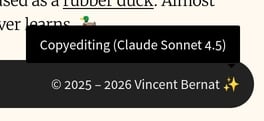
Hover or tap the icon to reveal the AI s name and its role in the document.
Example of AI usage disclosure: Claude Sonnet 4.5 edited this article.
The graph below shows which tool altered each post, year by year. Recently, I
applied the grammar skill to past articles. Since 2018,
French articles have been translated with the help of DeepL first, then of
an LLM. Since 2024, English articles are copyedited.
🖼 Graph showing the AI usage over the years. Each level get its own
color.
AI usage over the years. Hover or tap a band for the details.
If you are strongly against any usage of LLMs specifically for writing, I hope
you accept my more nuanced position on the usage of these tools as a trade-off
to provide clearer and more engaging articles. Years of literature on improving
English told us it is important to choose the right word to keep the reader
engaged.
[ ] Good writing consists of mastering the fundamentals (vocabulary,
grammar, the elements of style) and then filling the third level of your
toolbox with the right instruments.
Stephen King, On Writing
Note
Unlike other recent articles, I did not use an LLM to edit this post:
an unnamed person kindly accepted to proofread it. I translated it to French
without using an LLM either.
I am quite happy with the writing tools provided by Kagi. Both the
translate tool and the dictionary are a valuable help to find
different wordings. I also lean on Kagi s research assistant when
researching a topic.
When I was ten, I played Monkey Island 2 in English without having
taken any classes. I used a dictionary to translate word by word and I found
the irregular verbs confusing and not in the dictionary.
Official announcement
European Voxit community strengthens digital sovereignty: shared codebase completed.
Read the official announcement at: https://www.voxit.org/european-voxit-community-strengthens-digital-sover...
The Voxit community and platform development
The Voxit participation platform is originally based on the open source Polis platform developed by The Computational Democracy Project in the United States, but since its establishment in autumn 2025, the European Voxit community has been developing an independent solution, adapted to European needs.
The aim is to create an open source, interoperable and scalable participation infrastructure suited to Europe s regulatory environment and aligned with democratic values. Through this development work, Voxit is becoming a clearly distinct fork of the original Polis platform allowing Europe to develop participatory infrastructure at its own pace and according to its own governance needs, while the original Polis project continues to break new ground. This enables Europe to build its own open and trustworthy digital democracy tools, rooted in public governance and European democratic traditions.
Voxit 1.0 source code is now available
The source code for version 1.0 of the European community edition of the Voxit platform has now been published and is openly maintained on GitLab.com at: https://gitlab.com/voxit/voxit#
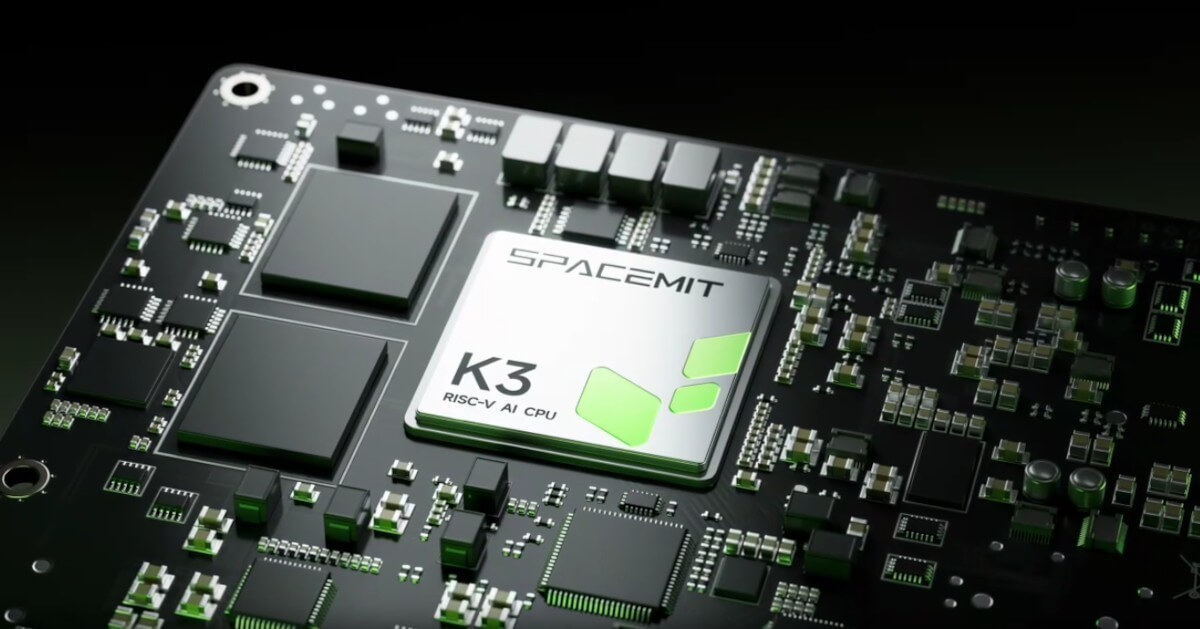
The RISC-V CPU architecture has been gaining a lot of popularity since it launched in 2014, and now that the industry is standardizing on the RVA23 level that includes vector support as a mandatory extension, we are likely to see a lot more edge- and IoT devices with the ability to run local LLMs at reasonable speed, and most importantly at very compelling prices.
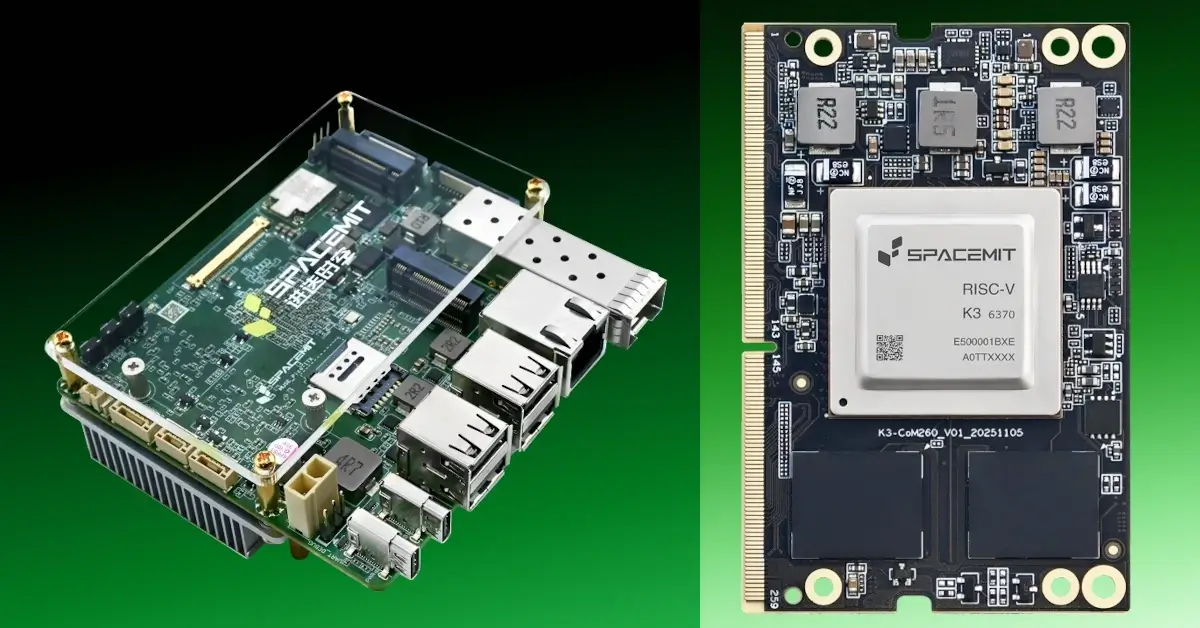
SpacemiT is a Chinese RISC-V CPU manufacturer that launched on May 11th, 2026, their long-anticipated next-gen RISC-V AI chip K3. It is among the earliest RISC-V CPUs that adhere to the RVA23 standard and performance-wise it is quite capable, providing 130 KDMIPS general computing power, 60 TOPS on INT4 which translates to about 15 tokens per second when running a 30 billion parameter large language model.
The aspect that really makes it stand out is:
Comparing the resellers
SpacemiT does not sell anything directly to consumers. Instead you need to buy a board that includes the K3 chip from an integrator. Currently the main resellers are:
All of the above are Chinese companies that ship to customers both inside and outside China. DeepComputing stands out as the only one that actually has done real integration and ships the K3 on a custom board, while the others simply resell the SpacemiT-produced K3 pico-ITX and K3 CoM260 Kit.
Milk-V
Milk-V is a RISC-V specialized integrator, as the name already implies. They sell the K3 under the name Jupiter2. Of all the K3 pico-ITX reseller product pages, the Jupiter2 presentation is the nicest and most detailed. Unfortunately their order page at arace.tech only states that it is a pre-order with no information about shipping schedule, taxes, or other details like what SSD is included (if any). Based on the pictures it does ship with a Milk-V branded case. The 32 GB RAM lists at 504 EUR, which is a very reasonable price. The @MilkV_Official account on X recently promoted the K3.
Documentation and support
As of this writing, the Milk-V Jupiter2 documentation site is just a stub and has no actual content, and only two links to the SpacemiT K3 documentation site. For support there is a web forum with a dedicated Jupiter2 section. There is also a Matrix space, but unlike their other products, there is no dedicated Jupiter (neither v1 nor v2) channel.
Community size and open source involvement
At least one prior Milk-V product was certified by Canonical, which indicates there is some collaboration in progress. Canonical also lists the Milk-V Titan on its official Ubuntu for RISC-V partner-built hardware page.
Sipeed
The Sipeed K3 announcement is well written (in English) with all the relevant details and links to additional PDF manuals. However, their main page at sipeed.com says nothing about the K3, so one must know the subpage URL to access it. They offer both the K3 CoM260 kit compatible with Jetson Orin Nano carrier boards, and the stand-alone K3 pico-ITX-sized motherboard. The CoM260 kit is only 10 USD cheaper than the full pico-ITX motherboard, so choosing the latter is a no-brainer if starting from scratch. The pico-ITX model with 32 GB DDR5 RAM sells for 639 USD. The product page does not mention anything about hard disk size, so you don t really know exactly what you will be getting if placing an order. There is no indication about case, Wi-Fi antennas or power supply either, so most likely they are not included.
Their store.sipeed.com website does not work at all, and their Taobao and AliExpress stores are not public and only accessible to registered users. The order page also says nothing about shipping time, delivery time, or taxes. The X account @SipeedIO is active and recently posted pictures of shipments in progress.
Documentation and support
The main documentation wiki does not yet have any K3 content at the time of writing. There is a Discord channel for general RISC-V discussion, and their MaixHub also has a discussion board, but I didn t find anything K3-specific.
Community size and open source involvement
Sipeed has had at least one of their previous devices certified by Canonical, which indicates they are active in the community.
Note that the other RISC-V company SiFive that also has had hardware certified and officially supported by Canonical is a different company, despite the very similar name.
Banana Pi
Banana Pi announced that they offer both the K3 CoM260 kit and the K3 pico-ITX motherboard version. Their product page for the K3 confusingly shows a MediaTek product in the page banner rather than the SpacemiT K3. Based on the product description and the fact they renamed the product as BPI-SM10, it seems to ship with some carrier board. The product pictures look identical to the SpacemiT documentation and there is no picture of the carrier board, and details are very sparse. The pico-ITX version with 8 GB RAM and 128 GB SSD sells for 293 USD and the CoM260 developer kit with the same specs sells for 287 USD and the 32 GB RAM with 128 GB SSD model sells for 595 USD. The shop page shows only five orders so far and items are currently out of stock. As there was no 32 GB RAM version of the pico-ITX available at all, this isn t an option for me as I want to run 30B parameter models that need the larger memory version.
Of all of these resellers, the Banana Pi website seems the most outdated. It does not have a search feature, it is not mobile-friendly, pictures can t be pinched to zoom in and so forth. Product names are also almost all identical, and as the product listings only show the beginning of the product name, figuring out what product is what requires extra effort that just makes the online purchase experience plain bad.
Documentation and support
I was only able to find the documentation page for the CoM260 kit, but none for the pico-ITX version. For support there is a forum, but the category list does not show any section for K3, and the forum search prohibits using the search term k3 as too short.
Community size and open source involvement
Banana Pi has a long history in the ARM single-board computer market, but their presence in the RISC-V ecosystem is still growing. Their X account @sinovoip has posted only once about the K3 and otherwise promotes their ARM boards. However, their community culture page does express a commitment to open hardware in general, but there is no visible K3-specific community activity.
Firefly
Firefly s K3 product page is comprehensive. Based on the details, they do not offer the K3 pico-ITX variant at all, but only the K3 CoM260 board inside the AIBOX-K3 Firefly RISC-V Edge Mini PC product. This is a feature-complete offering with a Jetson Orin Nano carrier board and case. The AIBOX-K3 with 32 GB RAM and 128 GB SSD in a case sells for 689 USD in their own Firefly.store. Unfortunately it only has HDMI and there is no USB-C with DisplayPort support, which is a deal-breaker for me personally.
Interestingly, Firefly also offers rack-mounted servers with K3 as the CPU.
Documentation and support
The wiki link on the product page is broken. The Firefly wiki does have a section for the AIBOX-K3, but it too has a broken link. It seems that as of the time of writing, there is no wiki section for this product yet.
For support there is a web forum, which does have at least one K3 thread covering guides such as Hermes Agent installation, though broader K3-specific sections are still sparse.
Community size and open source involvement
Firefly s X account @TeeFirefly has had no posts since 2024, and their GitLab/T-Firefly shows mostly 2024 activity, with only one repository updated in 2025 and nothing in 2026. Historically they have built a moderate community around their ARM-based Rockchip boards, with active forums and wiki contributions for those product lines. Their RISC-V K3 offerings are newer, and likely need a lot more polish to be attractive products overall.
DeepComputing
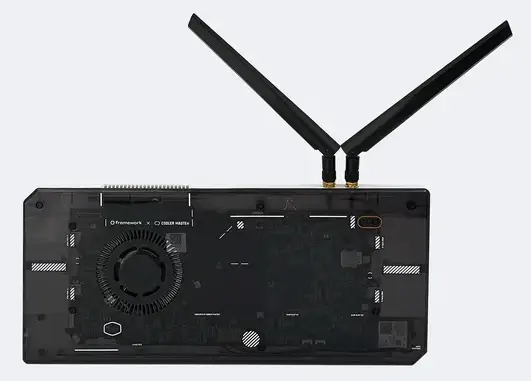
Last, but certainly not least, is the laptop manufacturer DeepComputing that offers a Framework laptop compatible motherboard with the SpacemiT K3 chip. They also sell the plain motherboard, or with the Cooler Master case, which allows one to easily connect it to an external monitor and keyboard and use it as a desktop computer. The plain board with 32 GB RAM and no SSD sells for about 882 EUR. Shipping of the first batch is expected to start by end of June 2026. Their X account @DeepComputingio promotes this DC-ROMA RISC-V Mainboard III as their flagship product, so they seem to put a lot of effort into it.
The overall product design and packaging seems good. Of all the K3 resellers and integrators that I was able to find, DeepComputing is the only one that actually designs their own boards with the K3 processor, while all the other vendors above are simply reselling the vanilla K3 boards with or without a case.
After reviewing all these options I decided to buy the DC-ROMA RISC-V Mainboard III for Framework Laptop 13 with 32 GB RAM, 1 TB SSD and the Cooler Master case, totalling about 1100 EUR.
Documentation and support
DeepComputing maintains product information for their RISC-V hardware at github.com/DC-DeepComputing/Framework, with documentation of the newest Mainboard III (FML13V05) still being finalized ahead of the first batch shipment. They provide community support through Discord and web forum, although the latter has very little activity.
Community size and open source involvement
DeepComputing has established itself as a pioneer in RISC-V laptops, beginning with the DC-ROMA. I have seen their stand at FOSDEM, which shows they are genuinely active in the open source community. Canonical lists DeepComputing s first mainboard / FML13V01 on its official Ubuntu for RISC-V partner-built hardware page, and it seems likely that they will continue to collaborate with Canonical with the new model once it ships. While the underlying Linux enablement depends on SpacemiT s upstream efforts, DeepComputing s involvement helps bridge the gap between reference hardware and consumer-ready products.
Conclusion
After weighing all the options, I ended up placing an order with DeepComputing for their custom K3 board with the Cooler Master case. Despite the premium price, the active community support and the properly documented promise of a complete, working system made it easy to place an order with confidence.
The SpacemiT K3 is poised to be one of the most significant RISC-V chips for local AI workloads, thanks to its RVA23 compliance and high tokens per second potential. Yet the buying experience in mid-2026 remains fragmented and incomplete. Hopefully this is just because the product is new, and they will get the purchase experience polished soon.
What struck me most during this process was how poor the customer experience is across nearly all of these vendor websites: broken links, missing search functions, outdated product banners, pages that show the wrong product entirely, and no information about shipping times, stock levels, taxes, and so on. One wonders why these companies don t fully invest in their web presence.
Personally I would assume they likely have enough customers already, primarily through domestic channels like Taobao and JD.com, that they do not feel any pressure to improve their international-facing sites. However, I did also review what was offered on Taobao, and the product details were very incomplete there too. Taobao, however, has a built-in live chat with almost all sellers, which can be used to ask questions and thus compensate for missing product details.
I don t fully understand why the sales process seems unpolished. The websites feel almost like an afterthought a checkbox to claim global reach while the real business apparently happens elsewhere via closed platforms or via inaccessible reseller channels. It is a frustrating reminder that in the RISC-V hardware world, the technology may be open and global, but the purchase experience is less so.
A new minor release 0.4.27 of RQuantLib,
the first in over a year, arrived on CRAN a couple of minutes ago, has
just now been uploaded to Debian,
and is being built for r2u as well.
QuantLib is a rather
comprehensice free/open-source library for quantitative
finance. RQuantLib
connects (some parts of) it to the R environment and language, and has
been part of CRAN for nearly
twenty-three years (!!) as it was one of the first packages I uploaded
to CRAN.
This release of RQuantLib
brings an update to the interface for all equity options, vanilla and
exotics as well as implied volatilities. We now support the option
maturity via either an actual maturity date, or the (fractional
business-day years) numeric. This uses a clever little Rcpp trick I should discuss in a
separate blog post. We also re-ran compileAttributes() to
re-create the RcppExports.cpp file now using a slightly
improved way of calling Rf_error for an ongoing Rcpp transition, and did some more
standard maintenance. The details from the NEWS file follow as
usual.
Changes in RQuantLib version 0.4.27 (2026-06-07)
All equity option functions can now take either a (fractional)
time span to expiry or a given date, and accept a daycounter
setter.
Two very old schedule helpers had a superfluous
try/catch removed.
The continuous integration setup received a minor
update.
The RcppExports.cpp file was updated to aid a
Rcpp transition.
 This is somehow the featured website on https://earlyweblinks.com/ this week.
Read all about my web site here!
https://earlyweblinks.com/site-of-the-week/joey-hess
Kind of reminds me of back in 1995 or so when my website would randomly
end up picked by some best of the web list that I never heard of.
The web is still a small place I guess.
Maybe I should join a web ring or something?
 Very happy to share that a new package
 The next Ubuntu Touch major release is approaching rapidly, yesterday we reached a major step in the preparation of the upcoming Ubuntu Touch 24.04-2.0 release: The branching-off (see below on what that is).
Ubuntu Touch 24.04-2.0 Beta is Now Available
Part of this development release step is the publication of the 24.04-2.0 Beta release images, for more details and information see:
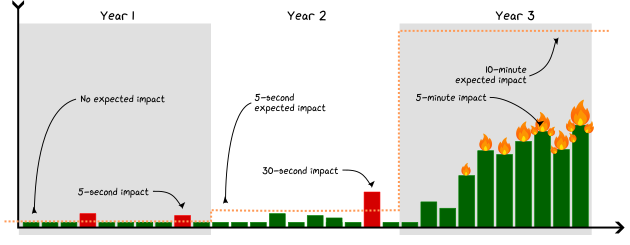
 Figure 1: Data flow when distributing commits via a mailing list
Perhaps because reading email on your desktop computer (I don t think
I could afford an IBM ThinkPad?) was the only vaguely real-time
notification system available at the time (except I guess SMS, which
cost 10p per text), a common pattern seemed to be to use a



 Today we went to see a theater play in UNAM s Cultural Center, very near
our home. No, not inside any of the theaters


 My Debian contributions this month were all

 The RISC-V CPU architecture has been gaining a lot of popularity since it launched in 2014, and now that the industry is standardizing on the RVA23 level that includes vector support as a mandatory extension, we are likely to see a lot more edge- and IoT devices with the ability to run local LLMs at reasonable speed, and most importantly at very compelling prices.