Search Results: "edd"

8 June 2024

Reproducible Builds: Reproducible Builds in May 2024

Welcome to the May 2024 report from the Reproducible Builds project! In these reports, we try to outline what we have been up to over the past month and highlight news items in software supply-chain security more broadly. As ever, if you are interested in contributing to the project, please visit our Contribute page on our website. Table of contents:
  1. A peek into build provenance for Homebrew
  2. Distribution news
  3. Mailing list news
  4. Miscellaneous news
  5. Two new academic papers
  6. diffoscope
  7. Website updates
  8. Upstream patches
  9. Reproducibility testing framework


A peek into build provenance for Homebrew Joe Sweeney and William Woodruff on the Trail of Bits blog wrote an extensive post about build provenance for Homebrew, the third-party package manager for MacOS. Their post details how each bottle (i.e. each release):
[ ] built by Homebrew will come with a cryptographically verifiable statement binding the bottle s content to the specific workflow and other build-time metadata that produced it. [ ] In effect, this injects greater transparency into the Homebrew build process, and diminishes the threat posed by a compromised or malicious insider by making it impossible to trick ordinary users into installing non-CI-built bottles.
The post also briefly touches on future work, including work on source provenance:
Homebrew s formulae already hash-pin their source artifacts, but we can go a step further and additionally assert that source artifacts are produced by the repository (or other signing identity) that s latent in their URL or otherwise embedded into the formula specification.

Distribution news In Debian this month, Johannes Schauer Marin Rodrigues (aka josch) noticed that the Debian binary package bash version 5.2.15-2+b3 was uploaded to the archive twice. Once to bookworm and once to sid but with differing content. This is problem for reproducible builds in Debian due its assumption that the package name, version and architecture triplet is unique. However, josch highlighted that
This example with bash is especially problematic since bash is Essential:yes, so there will now be a large portion of .buildinfo files where it is not possible to figure out with which of the two differing bash packages the sources were compiled.
In response to this, Holger Levsen performed an analysis of all .buildinfo files and found that this needs almost 1,500 binNMUs to fix the fallout from this bug. Elsewhere in Debian, Vagrant Cascadian posted about a Non-Maintainer Upload (NMU) sprint to take place during early June, and it was announced that there is now a #debian-snapshot IRC channel on OFTC to discuss the creation of a new source code archiving service to, perhaps, replace snapshot.debian.org. Lastly, 11 reviews of Debian packages were added, 15 were updated and 48 were removed this month adding to our extensive knowledge about identified issues. A number of issue types have been updated by Chris Lamb as well. [ ][ ]
Elsewhere in the world of distributions, deep within a larger announcement from Colin Percival about the release of version 14.1-BETA2, it was mentioned that the FreeBSD kernels are now built reproducibly.
In Fedora, however, the change proposal mentioned in our report for April 2024 was approved, so, per the ReproduciblePackageBuilds wiki page, the add-determinism tool is now running in new builds for Fedora 41 ( rawhide ). The add-determinism tool is a Rust program which, as its name suggests, adds determinism to files that are given as input by attempting to standardize metadata contained in binary or source files to ensure consistency and clamping to $SOURCE_DATE_EPOCH in all instances . This is essentially the Fedora version of Debian s strip-nondeterminism. However, strip-nondeterminism is written in Perl, and Fedora did not want to pull Perl in the buildroot for every package. The add-determinism tool eliminates many causes of non-determinism and work is ongoing to continue the scope of packages it can operate on.

Mailing list news On our mailing list this month, regular contributor kpcyrd wrote to the list with an update on their source code indexing project, whatsrc.org. The whatsrc.org project, which was launched last month in response to the XZ Utils backdoor, now contains and indexes almost 250,000 unique source code archives. In their post, kpcyrd gives an example of its intended purpose, noting that it shown that whilst there seems to be consensus about [the] source code for zsh 5.9 in various Linux distributions, it does not align with the contents of the zsh Git repository . Holger Levsen also posted to the list with a pre-announcement of sorts for the 2024 Reproducible Builds summit. In particular:
[Whilst] the dates and location are not fixed yet, however if you don help us with finding a suitable location soon, it is very likely that we ll meet again in Hamburg in the 2nd half of September 2024 [ ].
Lastly, Frederic-Emmanuel Picca wrote to the list asking for help understanding the non-reproducible status of the Debian silx package and received replies from both Vagrant Cascadian and Chris Lamb.

Miscellaneous news strip-nondeterminism is our tool to remove specific non-deterministic results from a completed build. This month strip-nondeterminism version 1.14.0-1 was uploaded to Debian unstable by Chris Lamb chiefly to incorporate a change from Alex Muntada to avoid a dependency on Sub::Override to perform monkey-patching and break circular dependencies related to debhelper [ ]. Elsewhere in our tooling, Jelle van der Waa modified reprotest because the pipes module will be removed in Python version 3.13 [ ].
It was also noticed that a new blog post by Daniel Stenberg detailing How to verify a Curl release mentions the SOURCE_DATE_EPOCH environment variable. This is because:
The [curl] release tools document also contains another key component: the exact time stamp at which the release was done using integer second resolution. In order to generate a correct tarball clone, you need to also generate the new version using the old version s timestamp. Because the modification date of all files in the produced tarball will be set to this timestamp.

Furthermore, Fay Stegerman filed a bug against the Signal messenger app for Android to report that their reproducible builds cannot, in fact, be reproduced. However, Fay is quick to note that she has:
found zero evidence of any kind of compromise. Some differences are yet unexplained but everything I found seems to be benign. I am disappointed that Reproducible Builds have been broken for months but I have zero reason to doubt Signal s security in any way.

Lastly, it was observed that there was a concise and diagrammatic overview of supply chain threats on the SLSA website.

Two new academic papers Two new scholarly papers were published this month. Firstly, Mathieu Acher, Beno t Combemale, Georges Aaron Randrianaina and Jean-Marc J z quel of University of Rennes on Embracing Deep Variability For Reproducibility & Replicability. The authors describe their approach as follows:
In this short [vision] paper we delve into the application of software engineering techniques, specifically variability management, to systematically identify and explicit points of variability that may give rise to reproducibility issues (e.g., language, libraries, compiler, virtual machine, OS, environment variables, etc.). The primary objectives are: i) gaining insights into the variability layers and their possible interactions, ii) capturing and documenting configurations for the sake of reproducibility, and iii) exploring diverse configurations to replicate, and hence validate and ensure the robustness of results. By adopting these methodologies, we aim to address the complexities associated with reproducibility and replicability in modern software systems and environments, facilitating a more comprehensive and nuanced perspective on these critical aspects.
(A PDF of this article is available.)
Secondly, Ludovic Court s, Timothy Sample, Simon Tournier and Stefano Zacchiroli have collaborated to publish a paper on Source Code Archiving to the Rescue of Reproducible Deployment. Their paper was motivated because:
The ability to verify research results and to experiment with methodologies are core tenets of science. As research results are increasingly the outcome of computational processes, software plays a central role. GNU Guix is a software deployment tool that supports reproducible software deployment, making it a foundation for computational research workflows. To achieve reproducibility, we must first ensure the source code of software packages Guix deploys remains available.
(A PDF of this article is also available.)

diffoscope diffoscope is our in-depth and content-aware diff utility that can locate and diagnose reproducibility issues. This month, Chris Lamb made a number of changes such as uploading versions 266, 267, 268 and 269 to Debian, making the following changes:
  • New features:
    • Use xz --list to supplement output when comparing .xz archives; essential when metadata differs. (#1069329)
    • Include xz --verbose --verbose (ie. double) output. (#1069329)
    • Strip the first line from the xz --list output. [ ]
    • Only include xz --list --verbose output if the xz has no other differences. [ ]
    • Actually append the xz --list after the container differences, as it simplifies a lot. [ ]
  • Testing improvements:
    • Allow Debian testing to fail right now. [ ]
    • Drop apktool from Build-Depends; we can still test APK functionality via autopkgtests. (#1071410)
    • Add a versioned dependency for at least version 5.4.5 for the xz tests as they fail under (at least) version 5.2.8. (#374)
    • Fix tests for 7zip 24.05. [ ][ ]
    • Fix all tests after additon of xz --list. [ ][ ]
  • Misc:
    • Update copyright years. [ ]
In addition, James Addison fixed an issue where the HTML output showed only the first difference in a file, while the text output shows all differences [ ][ ][ ], Sergei Trofimovich amended the 7zip version test for older 7z versions that include the string [64] [ ][ ] and Vagrant Cascadian relaxed the versioned dependency to allow version 5.4.1 for the xz tests [ ] and proposed updates to guix for versions 267, 268 and pushed version 269 to Guix. Furthermore, Eli Schwartz updated the diffoscope.org website in order to explain how to install diffoscope on Gentoo [ ].

Website updates There were a number of improvements made to our website this month, including Chris Lamb making the print CSS stylesheet nicer [ ]. Fay Stegerman made a number of updates to the page about the SOURCE_DATE_EPOCH environment variable [ ][ ][ ] and Holger Levsen added some of their presentations to the Resources page. Furthermore, IOhannes zm lnig stipulated support for SOURCE_DATE_EPOCH in clang version 16.0.0+ [ ], Jan Zerebecki expanded the Formal definition page and fixed a number of typos on the Buy-in page [ ] and Simon Josefsson fixed the link to Trisquel GNU/Linux on the Projects page [ ].

Upstream patches This month, we wrote a number of patches to fix specific reproducibility issues, including:

Reproducibility testing framework The Reproducible Builds project operates a comprehensive testing framework running primarily at tests.reproducible-builds.org in order to check packages and other artifacts for reproducibility. In May, a number of changes were made by Holger Levsen:
  • Debian-related changes:
    • Enable the rebuilder-snapshot API on osuosl4. [ ]
    • Schedule the i386 architecture a bit more often. [ ]
    • Adapt cleanup_nodes.sh to the new way of running our build services. [ ]
    • Add 8 more workers for the i386 architecture. [ ]
    • Update configuration now that the infom07 and infom08 nodes have been reinstalled as real i386 systems. [ ]
    • Make diffoscope timeouts more visible on the #debian-reproducible-changes IRC channel. [ ]
    • Mark the cbxi4a-armhf node as down. [ ][ ]
    • Only install the hdmi2usb-mode-switch package only on Debian bookworm and earlier [ ] and only install the haskell-platform package on Debian bullseye [ ].
  • Misc:
    • Install the ntpdate utility as we need it later. [ ]
    • Document the progress on the i386 architecture nodes at Infomaniak. [ ]
    • Drop an outdated and unnoticed notice. [ ]
    • Add live_setup_schroot to the list of so-called zombie jobs. [ ]
In addition, Mattia Rizzolo reinstalled the infom07 and infom08 nodes [ ] and Vagrant Cascadian marked the cbxi4a node as online [ ].

If you are interested in contributing to the Reproducible Builds project, please visit our Contribute page on our website. However, you can get in touch with us via:

4 June 2024

Dirk Eddelbuettel: ulid 0.4.0 on CRAN: Extended to Milliseconds

A new version of the ulid package is now on CRAN. The packages provides universally (unique) lexicographically (sortable) identifiers see the spec at GitHub for details on those which offer sorting which uuids lack. The R package provides access via the standard C++ library, had been put together by Bob Rudis and is now maintained by me. Mark Heckmann noticed that a ulid round trip of generating and unmarshalling swallowed subsecond informationm and posted on a well-known site I no longer go to. Duncan Murdoch was kind enough to open an issue to make me aware, and in it included the nice minimally complete verifiable example by Mark. It turns out that this issue was known, documented upstream in two issues and fixed in fork by the authors of those issues, Chris Bove. It replaces time_t as the value of record (constrained at the second resolution) with a proper std::chrono object which offers milliseconds (and much more, yay Modern C++). So I switched the two main files of library to his, and updated the wrapper code to interface from POSIXct to std::chrono object. And with that we are in business. The original example of five ulids create 100 millisecond part, then unmarshalled and here printed as a data.table as data.frame by default truncates to seconds:
> library(ulid)
> gen_ulid <- \(sleep) replicate(5,  Sys.sleep(sleep); generate() )
> u <- gen_ulid(.1)
> df <- unmarshal(u)
> data.table::data.table(df)
                        ts              rnd
                    <POSc>           <char>
1: 2024-05-30 16:38:28.588 CSQAJBPNX75R0G5A
2: 2024-05-30 16:38:28.688 XZX0TREDHD6PC1YR
3: 2024-05-30 16:38:28.789 0YK9GKZVTED27QMK
4: 2024-05-30 16:38:28.890 SC3M3G6KGPH7S50S
5: 2024-05-30 16:38:28.990 TSKCBWJ3TEKCPBY0
>
We updated the documentation accordingly, and added some new tests as well. The NEWS entry for this release follows.

Changes in version 0.4.0 (2024-06-03)
  • Switch two functions to fork by Chris Bove using std::chrono instead of time_t for consistent millisecond resolution (#3 fixing #2)
  • Updated documentation showing consistent millisecond functionality
  • Added unit tests for millisecond functionality

Courtesy of my CRANberries, there is also a diffstat report for this release. If you like this or other open-source work I do, you can sponsor me at GitHub.

This post by Dirk Eddelbuettel originated on his Thinking inside the box blog. Please report excessive re-aggregation in third-party for-profit settings.

31 May 2024

Dirk Eddelbuettel: RcppArmadillo 0.12.8.4.0 on CRAN: Upstream Bugfix

armadillo image Armadillo is a powerful and expressive C++ template library for linear algebra and scientific computing. It aims towards a good balance between speed and ease of use, has a syntax deliberately close to Matlab, and is useful for algorithm development directly in C++, or quick conversion of research code into production environments. RcppArmadillo integrates this library with the R environment and language and is widely used by (currently) 1151 other packages on CRAN, downloaded 34.6 million times (per the partial logs from the cloud mirrors of CRAN), and the CSDA paper (preprint / vignette) by Conrad and myself has been cited 584 times according to Google Scholar. Conrad released a new upstream bugfix yesterday (to improve views of sparse matrices). We uploaded it yesterday too but it once agfain took a day for the hard-working CRAN maintainers to concur that the two NOTEs from reverse-dependency checking over 1100 packages were in a fact false positves. And so it appeared on CRAN earlier today. We also increased the versioned dependency on Rcpp to match the use of optional entry-point headers Rcpp/Light, Rcpp/Lighter and Rcpp/Lightest. No other changes were made. The set of changes since the last CRAN release follows.

Changes in RcppArmadillo version 0.12.8.4.0 (2024-05-30)
  • Upgraded to Armadillo release 12.8.4 (Cortisol Injector)
    • Faster handling of sparse submatrix views
  • Update versioned Depends on Rcpp to 1.0.8 or later to match use of Light/Lighter/Lightest headers.

Courtesy of my CRANberries, there is a diffstat report relative to previous release. More detailed information is on the RcppArmadillo page. Questions, comments etc should go to the rcpp-devel mailing list off the Rcpp R-Forge page. If you like this or other open-source work I do, you can sponsor me at GitHub.

This post by Dirk Eddelbuettel originated on his Thinking inside the box blog. Please report excessive re-aggregation in third-party for-profit settings.

16 May 2024

John Goerzen: Review of Reputable, Functional, and Secure Email Service

I last reviewed email services in 2019. That review focused a lot of attention on privacy. At the time, I selected mailbox.org as my provider, and have been using them for these 5 years since. However, both their service and their support have gone significantly downhill since, so it is time for me to look at other options. Here I am focusing strongly on email. Some of the providers mentioned here provide other services (IM, video calls, groupware, etc.), and to the extent they do, I am ignoring them.

What Matters in 2024
I want to start off by acknowledging that what you need in email probably depends on your circumstances and the country in which you live. For me, I begin by naming that the largest threat most of us face isn t from state actors but from criminals: hackers, ransomware gangs, etc. It is important to take as many steps as possible to secure one s account against that. Privacy and security are both part of the mix. I still value privacy but I am acknowledging, as Migadu does, that Email as we know it and encryption are incompatible. Although some of these services strongly protect parts of the conversation, the reality is that most people will be emailing people using plain old email services which don t. For stronger security, something like Signal would be needed. (I wrote about Signal in 2021 also.) Interestingly, OpenPGP support seems to be something of a standard feature in the providers I reviewed by this point. All or almost all of them provide integration with browser-based encryption as well as server-side encryption if you prefer that. Although mailbox.org can automatically PGP-encrypt every message that arrives in plaintext, for general use, this is unwieldy; there isn t good tooling for searching mailboxes where every message is encrypted, etc. So I never enabled that feature at Mailbox. I still value security and privacy, but a pragmatic approach addresses the most pressing threats first.

My criteria
The basic requirements for an email service include:
  1. Ability to use my own domains
  2. Strong privacy policy
  3. Ability for me to use my own IMAP and SMTP clients on both desktop and mobile
  4. It must be extremely reliable
  5. It must not be free
  6. It must have excellent support for those rare occasions when it is needed
  7. Support for basic aliases
Why do I say it must not be free? Because if someone is providing a service with the quality I m talking about here, and not charging for it, it implies something is fishy: either they are unscrupulous, are financially unstable, or the product is something else like ads. I am not aware of any provider that matches the other criteria with a free account anyhow. These providers range from about $30 to $90 per year, so cheaper than a Netflix subscription. Immediately, this rules out several options:
  • Proton doesn t let me use my own clients on mobile (their bridge is desktop-only)
  • Tuta also doesn t let me use my own clients
  • Posteo doesn t let me use my own domain
  • mxroute.com lacks a strong privacy policy, and its policy has numerous causes for concern (for instance, If you repeatedly send email to invalid/unroutable recipients, they may be published on our GitHub )
I will have a bit more to say about a couple of these providers below. There are some additional criteria that are strongly desired but not absolutely required:
  1. Ability to set individual access passwords for every device/app
  2. Support for two-factor authentication (2FA/TFA/TOTP) for web-based access
  3. Support for basics in filtering: ability to filter on envelope recipient (so if I get BCC d, I can still filter), and ability to execute more than one action on filter match (eg, deliver to two folders, or deliver to a folder and forward to someone else)
IMAP and SMTP don t really support 2FA, so by setting individual passwords for every device, you can at least limit the blast radius and cut off a specific device if something is (or might be) compromised.

The candidates
I considered these providers: Startmail, Mailfence, Runbox, Fastmail, Kolab, Mailbox.org, and Migadu. I ll review each, and highlight the pricing of the plan I would most likely use. Each provider offers multiple plans; some may be more expensive and some may be cheaper than the one I reviewed. I included a link to each provider s full pricing information so you can compare for your needs. I set up trials with each of these (except Mailbox.org, with which I already had a paid account). It so happend that I had actual questions for support for each one, which gave me an opportunity to see how support responded. I did not fabricate questions, and would not have contacted support if I didn t have real ones. (This means that I asked different questions of each provider, because they were the REAL questions I had.) I ll jump to the spoiler right now: I eventually chose Migadu, with Fastmail and Mailfence as close seconds. I looked for providers myself, and also solicited recommendations in a Mastodon thread.

Mailbox.org
I begin with Mailbox, as it was my top choice in 2019 and the incumbent. Until this year, I had been quite happy with it. I had cause to reach their support less than once a year on average, and each time they replied the same day or next day. Now, however, they are failing on reliability and on support. Their spam filter has become overly aggressive. It has blocked quite a bit of legitimate mail. When contacting their support about a prior issue earlier this year, they initially took 4 days to reply, and then 6 days to reply after that. Ouch. They had me disable some spam settings. It didn t really help. I continue to lose mail. I don t know how much, because they block a lot of it before it even hits the spam folder. One of my friends texted to say mail was dropping. I raised a new ticket with mailbox, which took them 5 days to reply to. Their reply was unhelpful. As the Internet is not a static system, unforeseen events can always occur. Well yes, that s true, and I get it, false positives exist with email. But this was from an ISP s mail system with an address that had been established for years, and it was part of a larger pattern of rejecting quite a bit of legit mail. And every interaction with them recently hasn t resulted in them actually doing anything to resolve anything. It s just a paragraph or two of reply that does nothing and helps nothing. When I complained that it took 5 days to reply, they said We have not been able to reply sooner as we are currently experiencing a high volume of customer enquiries. Even though their SLA for my account is a not-great 48 business hour turnaround, they still missed it and their reason is we re busy. I finally asked what RBL had caught the blocked email, since when I checked, the sender wasn t on any RBL. Mailbox s reply: they only keep their logs for 7 days, so next time I should contact them within 7 days. Which, of course, I DID; it was them that kept delaying. Ugh! It s like they ve become a cable company. Even worse is how they have been blocking mail from GrapheneOS s discussion form. See their thread about it. In short, Graphene s mail server has a clean reputation and Mailbox has no problem with it. But because one of Graphene s IPv6 webservers has an IPv6 allocation of a size Mailbox doesn t like, they drop mail. It s ridiculous, and Mailbox was dismissive of this well-known and well-regarded Open Source project. So if the likes of GrapheneOS can t get good faith effort to deliver their mail, what chance does an individual like me have? I m sorry, but I m literally paying you to deliver email for me and provide good support. If you can t do either of those, you don t get to push that problem down onto me. Hire appropriate staff. On the technical side, they support aliases, my own clients, and have a reasonable privacy policy. Their 2FA support exists for the web interface (though weirdly not the support site), though it is somewhat weird. They do not support app passwords. A somewhat unique feature is the @secure.mailbox.org domain. If you try to receive mail at that address, mailbox.org will block it unless it uses TLS. Same for sending. This isn t E2EE, but it does at least require things not be in plaintext for the last hop to Mailbox. Verdict: not recommended due to poor reliability and support. Mailbox.Org summary:
  • Website: https://mailbox.org/en/
  • Reliability: iffy due to over-aggressive spam filtering
  • Support: Poor; takes 4-6 days for a reply and replies are unhelpful
  • Individual access passwords: No
  • 2FA: Yes, but with a PIN instead of a password as the other factor
  • Filtering: Full SIEVE feature set and GUI editor
  • Spam settings: greylisting on/off, reject some/all spam, etc. But they re insufficient to address Mailbox s overzealousness, which support says I cannot workaround within the interface.
  • Server storage location: Germany
  • Plan as reviewed: standard [pricing link]
    • Cost per year: EUR 30 (about $33)
    • Mail storage included: 10GB
    • Limits on send/receive volume: none
    • Aliases: 50 on your domain name, 25 on mailbox.org
    • Additional mailboxes: Available; each one at the same fee as the primary mailbox

Startmail
I really wanted to like Startmail. Its vault is an interesting idea and should contribute to the security and privacy of an account. They clearly care about privacy. It falls down in filtering. They have no way to filter on envelope recipient (BCC or similar). Their support confirmed this to me and that s a showstopper. Startmail support was also as slow as Mailbox, taking 5 days to respond to me. Two showstoppers right there. Verdict: Not recommended due to slow support responsiveness and weak filtering. Startmail summary:
  • Website: https://www.startmail.com/
  • Reliability: Seems to be fine
  • Support: Mediocre; Took 5 days for a reply, but the reply was helpful
  • Individual app access passwords: Yes
  • 2FA: Yes
  • Filtering: Poor; cannot filter on envelope recipient, and can t build filters with multiple actions
  • Spam settings: None
  • Server storage location: The Netherlands
  • Plan as reviewed: Custom domain (trial was Personal), [pricing link]
    • Cost per year: $70
    • Mail storage included: 20GB
    • Limits on send/receive volume: none
    • Aliases: unlimited, with lots of features: can set expiration, etc.
    • Additional mailboxes: not available

Kolab
Kolab Now is mainly positioned as a full groupware service, but they do have a email-only option which I investigated. There isn t much documentation about it compared to other providers, and also not much in the way of settings. You can turn greylisting on or off. And . that s it. It has a full suite of filtering options. They set an X-Envelope-To header which you can use with the arbitrary header match to do the right thing even for BCC situations. Filters can have multiple conditions and multiple actions. It is SIEVE-based and you can download your SIEVE definitions. If you enable 2FA, you disable IMAP and SMTP; not great. Verdict: Not an impressive enough email featureset to justify going with it. Kolab Now summary:
  • Website: https://kolabnow.com/
  • Reliability: Seems to be fine
  • Support: Fine responsiveness (next day)
  • Invidiaul app passwords: no
  • 2FA: Yes, but if you enable it, they disable IMAP and SMTP
  • Filtering: Excellent
  • Spam settings: Only greylisting on/off
  • Server storage location: Switzerland; they have lots of details on their setup
  • Plan as reviewed: Just email [pricing link]
    • Cost per year: CHF 60, about $66
    • Mail storage included: 5GB
    • Limitations on send/receive volume: None
    • Aliases: Yes. Not sure if there are limits.
    • Additional mailboxes: Yes if you set up a group account. Flexible pricing based on user count is not documented anywhere I could find.

Mailfence
Mailfence is another option, somewhat similar to Startmail but without the unique vault. I had some questions about filters, and support was quite responsive, responding in a couple of hours. Some of their copy on their website is a bit misleading, but support clarified when I asked them. They do not offer encryption at rest (like most of the entries here). Mailfence s filtering system is the kind I d like to see. It allows multiple conditions and multiple actions for each rule, and has some unique actions as well (notify by SMS or XMPP). Support says that Recipients matches envelope recipients. However, one ommission is that I can t match on arbitrary headers; only the canned list of headers they provide. They have only two spam settings:
  • spam filter on/off
  • whitelist
Given some recent complaints about their spam filter being overly aggressive, I find this lack of control somewhat concerning. (However, I discount complaints about people begging for more features in free accounts; free won t provide the kind of service I m looking for with any provider.) There are generally just very few settings for email as well. Verdict: Response and helpful support, filtering has the right structure but lacks arbitrary header match. Could be a good option. Mailfence summary:
  • Website: https://mailfence.com/
  • Reliability: Seems to be fine
  • Support: Excellent responsiveness and helpful replies (after some initial confusion about my question of greylisting)
  • Individual app access passwords: No. You can set a per-service password (eg, an IMAP password), but those will be shared with all devices speaking that protocol.
  • 2FA: Yes
  • Filtering: Good; only misses the ability to filter on arbitrary headers
  • Spam settings: Very few
  • Server storage location: Belgium
  • Plan as reviewed: Entry [pricing link]
    • Cost per year: $42
    • Mail storage included: 10GB, with a maximum of 50,000 messages
    • Limits on send/receive volume: none
    • Aliases: 50. Aliases can t be deleted once created (there may be an exeption to this for aliases on your own domain rather than mailfence.com)
    • Additional mailboxes: Their page on this is a bit confusing, and the pricing page lacks the information promised. It looks like you can pay the same $42/year for additional mailboxes, with a limit of up to 2 additional paid mailboxes and 2 additional free mailboxes tied to the account.

Runbox
This one came recommended in a Mastodon thread. I had some questions about it, and support response was fantastic I heard from two people that were co-founders of the company! Even within hours, on a weekend. Incredible! This kind of response was only surpassed by Migadu. I initially wrote to Runbox with questions about the incoming and outgoing message limits, which I hadn t seen elsewhere, as well as the bandwidth limit. They said the bandwidth limit is no longer enforced on paid accounts. The incoming and outgoing limits are enforced, and all email (even spam) counts towards the limit. Notably the outgoing limit is per recipient, so if you send 10 messages to your 50-recipient family group, that s the limit. However, they also indicated a willingness to reset the limit if something happens. Unfortunately, hitting the limit results in a hard bounce (SMTP 5xx) rather than a temporary failure (SMTP 4xx) so it can result in lost mail. This means I d be worried about some attack or other weirdness causing me to lose mail. Their filter is a pain point. Here are the challenges:
  • You can t directly match on a BCC recipient. Support advised to use a headers match, which will search for something anywhere in the headers. This works and is probably good enough since this data is in the Received: headers, but it is a little more imprecise.
  • They only have a contains , not an equals operator. So, for instance, a pattern searching for test@example.com would also match newtest@example.com . Support advised to put the email address in angle brackets to avoid this. That will work mostly. Angle brackets aren t always required in headers.
  • There is no way to have multiple actions on the filter (there is just no way to file an incoming message into two folders). This was the ultimate showstopper for me.
Support advised they are planning to upgrade the filter system in the future, but these are the limitations today. Verdict: A good option if you don t need much from the filtering system. Lots of privacy emphasis. Runbox summary:
  • Website: https://runbox.com/
  • Reliability: Seems to be fine, except returning 5xx codes if per-day limits are exceeded
  • Support: Excellent responsiveness and replies from founders
  • Individual app passwords: Yes
  • 2FA: Yes
  • Filtering: Poor
  • Spam settings: Very few
  • Server storage location: Norway
  • Plan as reviewed: Mini [pricing link]
    • Cost per year: $35
    • Mail storage included: 10GB
    • Limited on send/receive volume: Receive 5000 messages/day, Send 500 recipients/day
    • Aliases: 100 on runbox.com; unlimited on your own domain
    • Additional mailboxes: $15/yr each, also with 10GB non-shared storage per mailbox

Fastmail
Fastmail came recommended to me by a friend I ve known for decades. Here s the thing about Fastmail, compared to all the services listed above: It all just works. Everything. Filtering, spam prevention, it is all there, all feature-complete, and all just does the right thing as you d hope. Their filtering system has a canned dropdown for To/Cc/Bcc , it supports multiple conditions and multiple actions, and just does the right thing. (Delivering to multiple folders is a little cumbersome but possible.) It has a particularly strong feature set around administering multiple accounts, including things like whether users can prevent admins from reading their mail. The not-so-great part of the picture is around privacy. Fastmail is based in Australia, where the government has extensive power around spying on data, even to the point of forcing companies to add wiretap capabilities. Fastmail s privacy policy states user data may be held in Australia, USA, India, and Netherlands. By default, they share data with unidentified spam companies , though you can disable this in settings. On the other hand, they do make a good effort towards privacy. I contacted support with some questions and got back a helpful response in three hours. However, one of the questions was about in which countries my particular data would be stored, and the support response said they would have to get back to me on that. It s been several days and no word back. Verdict: A featureful option that just works , with a lot of features for managing family accounts and the like, but lacking in the privacy area. Fastmail summary:
  • Website: https://www.fastmail.com/
  • Reliability: Seems to be fine
  • Support: Good response time on most questions; dropped the ball on one tha trequired research
  • Individual app access passwords: Yes
  • 2FA: Yes
  • Filtering: Excellent
  • Spam settings: Can set filter aggressiveness, decide whether to share spam data with spam-fighting companies , configure how to handle backscatter spam, and evaluate the personal learning filter.
  • Server storage locations: Australia, USA, India, and The Netherlands. Legal jurisdiction is Australia.
  • Plan as reviewed: Individual [pricing link]
    • Cost per year: $60
    • Mail storage included: 50GB
    • Limits on send/receive volume: 300/hour
    • Aliases: Unlimited from what I can see
    • Additional mailboxes: No; requires a different plan for that

Migadu
Migadu was a service I d never heard of, but came recommended to me on Mastodon. I listed Migadu last because it is a class of its own compared to all the other options. Every other service is basically a webmail interface with a few extra settings tacked on. Migadu has a full-featured email admin console in addition. By that I mean you can:
  • View usage graphs (incoming, outgoing, storage) over time
  • Manage DNS (if you want Migadu to run your nameservers)
  • Manage multiple domains, and cross-domain relationships with mailboxes
  • View a limited set of logs
  • Configure accounts, reset their passwords if needed/authorized, etc.
  • Configure email address rewrite rules with wildcards and so forth
Basically, if you were the sort of person that ran your own mail servers back in the day, here is Migadu giving you most of that functionality. Effectively you have a web interface to do all the useful stuff, and they handle the boring and annoying bits. This is a really attractive model. Migadu support has been fantastic. They are quick to respond, and went above and beyond. I pointed out that their X-Envelope-To header, which is needed for filtering by BCC, wasn t being added on emails I sent myself. They replied 5 hours later indicating they had added the feature to add X-Envelope-To even for internal mails! Wow! I am impressed. With Migadu, you buy a pool of resources: storage space and incoming/outgoing traffic. What you do within that pool is up to you. You can set up users ( mailboxes ), aliases, domains, whatever you like. It all just shares the pool. You can restrict users further so that an individual user has access to only a subset of the pool resources. I was initially concerned about Migadu s daily send/receive message count limits, but in visiting with support and reading the documentation, what really comes out is that Migadu is a service with a personal touch. Hitting the incoming traffic limit will cause a SMTP temporary fail (4xx) response so you won t lose legit mail and support will work with you if it s a problem for legit uses. In other words, restrictions are soft and they are interpreted reasonably. One interesting thing about Migadu is that they do not offer accounts under their domain. That is, you MUST bring your own domain. That s pretty easy and cheap, of course. It also puts you in a position of power, because it is easy to migrate email from one provider to another if you own the domain. Filtering is done via SIEVE. There is a GUI editor which lets you accomplish most things, though it has an odd blind spot where you can t file a message into multiple folders. However, you can edit a SIEVE ruleset directly and you get the full SIEVE featureset, which is extensive (and does support filing a message into multiple folders). I note that the SIEVE :envelope match doesn t work, but Migadu adds an X-Envelope-To header which is just as good. I particularly love a company that tells you all the reasons you might not want to use them. Migadu s pro/con list is an honest drawbacks list (of course, their homepage highlights all the features!). Verdict: Fantastically powerful, excellent support, and good privacy. I chose this one. Migadu summary:
  • Website: https://migadu.com/
  • Reliability: Excellent
  • Support: Fantastic. Good response times and they added a feature (or fixed a bug?) a few hours after I requested it.
  • Individual access passwords: Yes. Create identities to support them.
  • 2FA: Yes, on both the admin interface and the webmail interface
  • Filtering: Excellent, based on SIEVE. GUI editor doesn t support multiple actions when filing into a folder, but full SIEVE functionality is exposed.
  • Spam settings:
    • On the domain level, filter aggressiveness, Greylisting on/off, black and white lists
    • On the mailbox level, filter aggressiveness, black and whitelists, action to take with spam; compatible with filters.
  • Server storage location: France; legal jurisdiction Switzerland
  • Plan as reviewed: mini [pricing link]
    • Cost per year: $90
    • Mail storage included: 30GB ( soft quota)
    • Limits on send/receive volume: 1000 messgaes in/day, 100 messages out/day ( soft quotas)
    • Aliases: Unlimited on an unlimited number of domains
    • Additional mailboxes: Unlimited and free; uses pooled quotas, but individual quotas can be set

Others
Here are a few others that I didn t think worthy of getting a trial:
  • mxroute was recommended by several. Lots of concerning things in their policy, such as:
    • if you repeatedly send mail to unroutable recipients, they may publish the addresses on Github
    • they will terminate your account if they think you are rude or want to contest a charge
    • they reserve the right to cancel your service at any time for any (or no) reason.
  • Proton keeps coming up, and I will not consider it so long as I am locked into their client on mobile.
  • Skiff comes up sometimes, but they were acquired by Notion.
  • Disroot comes up; this discussion highlights a number of reasons why I avoid them. Their Terms of Service (ToS) is inconsistent with a general-purpose email account (I guess for targeting nonprofits and activists, that could make sense). Particularly laughable is that they claim to be friends of Open Source, but then would take down your account if you upload copyrighted material. News flash: in order for an Open Source license to be meaningful, the underlying work is copyrighted. It is perfectly legal to upload copyrighted material when you wrote it or have the license to do so!

Conclusions
There are a lot of good options for email hosting today, and in particular I appreciate the excellent personal support from companies like Migadu and Runbox. Support small businesses!

14 May 2024

Dirk Eddelbuettel: RApiSerialize 0.1.3 on CRAN: Skipping XDR

A new bug fix release 0.1.3 of RApiSerialize got onto CRAN earlier today. This is the first release in well over a year, and permits the skip the XDR serialization format which is needed when transfering between big- and little-endian machines. But it comes at a certain run-time cost one can avoid on the (much more common) little-endian machines. This is a new option, and the old behavior is the default. Those who want to can now skip the step. The RApiSerialize package is used by both my RcppRedis as well as by Travers excellent qs package. We also addressed the recent nag by the CRAN concerning NO_REMAP .

Changes in version 0.1.3 (2024-05-13)
  • Add an xdr argument to disable XDR for an approx. threefold speed increase (Travers Ching and Dirk in #6)
  • Use R_NO_REMAP and Rf_* prefix for API calls
  • Minor continuous integration updates

Courtesy of my CRANberries, there is a diffstat report relative to previous release. More details are at the RApiSerialize page; code, issue tickets etc at the GitHub repositoryrapiserializerepo. If you like this or other open-source work I do, you can sponsor me at GitHub.

This post by Dirk Eddelbuettel originated on his Thinking inside the box blog. Please report excessive re-aggregation in third-party for-profit settings.

10 May 2024

Reproducible Builds: Reproducible Builds in April 2024

Welcome to the April 2024 report from the Reproducible Builds project! In our reports, we attempt to outline what we have been up to over the past month, as well as mentioning some of the important things happening more generally in software supply-chain security. As ever, if you are interested in contributing to the project, please visit our Contribute page on our website. Table of contents:
  1. New backseat-signed tool to validate distributions source inputs
  2. NixOS is not reproducible
  3. Certificate vulnerabilities in F-Droid s fdroidserver
  4. Website updates
  5. Reproducible Builds and Insights from an Independent Verifier for Arch Linux
  6. libntlm now releasing minimal source-only tarballs
  7. Distribution work
  8. Mailing list news
  9. diffoscope
  10. Upstream patches
  11. reprotest
  12. Reproducibility testing framework

New backseat-signed tool to validate distributions source inputs kpcyrd announced a new tool called backseat-signed, after:
I figured out a somewhat straight-forward way to check if a given git archive output is cryptographically claimed to be the source input of a given binary package in either Arch Linux or Debian (or both).
Elaborating more in their announcement post, kpcyrd writes:
I believe this to be the reproducible source tarball thing some people have been asking about. As explained in the README, I believe reproducing autotools-generated tarballs isn t worth everybody s time and instead a distribution that claims to build from source should operate on VCS snapshots instead of tarballs with 25k lines of pre-generated shell-script.
Indeed, many distributions packages already build from VCS snapshots, and this trend is likely to accelerate in response to the xz incident. The announcement led to a lengthy discussion on our mailing list, as well as shorter followup thread from kpcyrd about bootstrapping Autotools projects.

NixOS is not reproducible Morten Linderud posted an post on his blog this month, provocatively titled, NixOS is not reproducible . Although quickly admitting that his title is indeed clickbait , Morten goes on to clarify the precise guarantees and promises that NixOS provides its users. Later in the most, Morten mentions that he was motivated to write the post because:
I have heavily invested my free-time on this topic since 2017, and met some of the accomplishments we have had with Doesn t NixOS solve this? for just as long and I thought it would be of peoples interest to clarify[.]

Certificate vulnerabilities in F-Droid s fdroidserver In early April, Fay Stegerman announced a certificate pinning bypass vulnerability and Proof of Concept (PoC) in the F-Droid fdroidserver tools for managing builds, indexes, updates, and deployments for F-Droid repositories to the oss-security mailing list.
We observed that embedding a v1 (JAR) signature file in an APK with minSdk >= 24 will be ignored by Android/apksigner, which only checks v2/v3 in that case. However, since fdroidserver checks v1 first, regardless of minSdk, and does not verify the signature, it will accept a fake certificate and see an incorrect certificate fingerprint. [ ] We also realised that the above mentioned discrepancy between apksigner and androguard (which fdroidserver uses to extract the v2/v3 certificates) can be abused here as well. [ ]
Later on in the month, Fay followed up with a second post detailing a third vulnerability and a script that could be used to scan for potentially affected .apk files and mentioned that, whilst upstream had acknowledged the vulnerability, they had not yet applied any ameliorating fixes.

Website updates There were a number of improvements made to our website this month, including Chris Lamb updating the archive page to recommend -X and unzipping with TZ=UTC [ ] and adding Maven, Gradle, JDK and Groovy examples to the SOURCE_DATE_EPOCH page [ ]. In addition Jan Zerebecki added a new /contribute/opensuse/ page [ ] and Sertonix fixed the automatic RSS feed detection [ ][ ].

Reproducible Builds and Insights from an Independent Verifier for Arch Linux Joshua Drexel, Esther H nggi and Iy n M ndez Veiga of the School of Computer Science and Information Technology, Hochschule Luzern (HSLU) in Switzerland published a paper this month entitled Reproducible Builds and Insights from an Independent Verifier for Arch Linux. The paper establishes the context as follows:
Supply chain attacks have emerged as a prominent cybersecurity threat in recent years. Reproducible and bootstrappable builds have the potential to reduce such attacks significantly. In combination with independent, exhaustive and periodic source code audits, these measures can effectively eradicate compromises in the building process. In this paper we introduce both concepts, we analyze the achievements over the last ten years and explain the remaining challenges.
What is more, the paper aims to:
contribute to the reproducible builds effort by setting up a rebuilder and verifier instance to test the reproducibility of Arch Linux packages. Using the results from this instance, we uncover an unnoticed and security-relevant packaging issue affecting 16 packages related to Certbot [ ].
A PDF of the paper is available.

libntlm now releasing minimal source-only tarballs Simon Josefsson wrote on his blog this month that, going forward, the libntlm project will now be releasing what they call minimal source-only tarballs :
The XZUtils incident illustrate that tarballs with files that are not included in the git archive offer an opportunity to disguise malicious backdoors. [The] risk of hiding malware is not the only motivation to publish signed minimal source-only tarballs. With pre-generated content in tarballs, there is a risk that GNU/Linux distributions [ship] generated files coming from the tarball into the binary *.deb or *.rpm package file. Typically the person packaging the upstream project never realized that some installed artifacts was not re-built[.]
Simon s post goes into further details how this was achieved, and describes some potential caveats and counters some expected responses as well. A shorter version can be found in the announcement for the 1.8 release of libntlm.

Distribution work In Debian this month, Helmut Grohne filed a bug suggesting the removal of dh-buildinfo, a tool to generate and distribute .buildinfo-like files within binary packages. Note that this is distinct from the .buildinfo generation performed by dpkg-genbuildinfo. By contrast, the entirely optional dh-buildinfo generated a debian/buildinfo file that would be shipped within binary packages as /usr/share/doc/package/buildinfo_$arch.gz. Adrian Bunk recently asked about including source hashes in Debian s .buildinfo files, which prompted Guillem Jover to refresh some old patches to dpkg to make this possible, which revealed some quirks Vagrant Cascadian discovered when testing. In addition, 21 reviews of Debian packages were added, 22 were updated and 16 were removed this month adding to our knowledge about identified issues. A number issue types have been added, such as new random_temporary_filenames_embedded_by_mesonpy and timestamps_added_by_librime toolchain issues. In openSUSE, it was announced that their Factory distribution enabled bit-by-bit reproducible builds for almost all parts of the package. Previously, more parts needed to be ignored when comparing package files, but now only the signature needs to be deleted. In addition, Bernhard M. Wiedemann published theunreproduciblepackage as a proper .rpm package which it allows to better test tools intended to debug reproducibility. Furthermore, it was announced that Bernhard s work on a 100% reproducible openSUSE-based distribution will be funded by NLnet. He also posted another monthly report for his reproducibility work in openSUSE. In GNU Guix, Janneke Nieuwenhuizen submitted a patch set for creating a reproducible source tarball for Guix. That is to say, ensuring that make dist is reproducible when run from Git. [ ] Lastly, in Fedora, a new wiki page was created to propose a change to the distribution. Titled Changes/ReproduciblePackageBuilds , the page summarises itself as a proposal whereby A post-build cleanup is integrated into the RPM build process so that common causes of build irreproducibility in packages are removed, making most of Fedora packages reproducible.

Mailing list news On our mailing list this month:
  • Continuing a thread started in March 2024 about the Arch Linux minimal container now being 100% reproducible, John Gilmore followed up with a post about the practical and philosophical distinctions of local vs. remote storage of the various artifacts needed to build packages.
  • Chris Lamb asked the list which conferences readers are attending these days: After peak Covid and other industry-wide changes, conferences are no longer the must attend events they previously were especially in the area of software supply-chain security. In rough, practical terms, it seems harder to justify conference travel today than it did in mid-2019. The thread generated a number of responses which would be of interest to anyone planning travel in Q3 and Q4 of 2024.
  • James Addison wrote to the list about a quirk in Git related to its core.autocrlf functionality, thus helpfully passing on a slightly off-topic and perhaps not of direct relevance to anyone on the list today note that might still be the kind of issue that is useful to be aware of if-and-when puzzling over unexpected git content / checksum issues (situations that I do expect people on this list encounter from time-to-time) .

diffoscope diffoscope is our in-depth and content-aware diff utility that can locate and diagnose reproducibility issues. This month, Chris Lamb made a number of changes such as uploading versions 263, 264 and 265 to Debian and made the following additional changes:
  • Don t crash on invalid .zip files, even if we encounter their badness halfway through the file and not at the time of their initial opening. [ ]
  • Prevent odt2txt tests from always being skipped due to an (impossibly) new version requirement. [ ]
  • Avoid parens-in-parens in test skipping messages. [ ]
  • Ensure that tests with >=-style version constraints actually print the tool name. [ ]
In addition, Fay Stegerman fixed a crash when there are (invalid) duplicate entries in .zip which was originally reported in Debian bug #1068705). [ ] Fay also added a user-visible note to a diff when there are duplicate entries in ZIP files [ ]. Lastly, Vagrant Cascadian added an external tool pointer for the zipdetails tool under GNU Guix [ ] and proposed updates to diffoscope in Guix as well [ ] which were merged as [264] [265], fixed a regression in test coverage and increased verbosity of the test suite[ ].

Upstream patches The Reproducible Builds project detects, dissects and attempts to fix as many currently-unreproducible packages as possible. We endeavour to send all of our patches upstream where appropriate. This month, we wrote a large number of such patches, including:

reprotest reprotest is our tool for building the same source code twice in different environments and then checking the binaries produced by each build for any differences. This month, reprotest version 0.7.27 was uploaded to Debian unstable) by Vagrant Cascadian who made the following additional changes:
  • Enable specific number of CPUs using --vary=num_cpus.cpus=X. [ ]
  • Consistently use 398 days for time variation, rather than choosing randomly each time. [ ]
  • Disable builds of arch:any packages. [ ]
  • Update the description for the build_path.path option in README.rst. [ ]
  • Update escape sequences for compatibility with Python 3.12. (#1068853). [ ]
  • Remove the generic upstream signing-key [ ] and update the packages signing key with the currently active team members [ ].
  • Update the packaging Standards-Version to 4.7.0. [ ]
In addition, Holger Levsen fixed some spelling errors detected by the spellintian tool [ ] and Vagrant Cascadian updated reprotest in GNU Guix to 0.7.27.

Reproducibility testing framework The Reproducible Builds project operates a comprehensive testing framework running primarily at tests.reproducible-builds.org in order to check packages and other artifacts for reproducibility. In April, an enormous number of changes were made by Holger Levsen:
  • Debian-related changes:
    • Adjust for changed internal IP addresses at Codethink. [ ]
    • Automatically cleanup failed diffoscope user services if there are too many failures. [ ][ ]
    • Configure two new nodes at infomanik.cloud. [ ][ ]
    • Schedule Debian experimental even less. [ ][ ]
  • Breakage detection:
    • Exclude currently building packages from breakage detection. [ ]
    • Be more noisy if diffoscope crashes. [ ]
    • Health check: provide clickable URLs in jenkins job log for failed pkg builds due to diffoscope crashes. [ ]
    • Limit graph to about the last 100 days of breakages only. [ ]
    • Fix all found files with bad permissions. [ ]
    • Prepare dealing with diffoscope timeouts. [ ]
    • Detect more cases of failure to debootstrap base system. [ ]
    • Include timestamps of failed job runs. [ ]
  • Documentation updates:
    • Document how to access arm64 nodes at Codethink. [ ]
    • Document how to use infomaniak.cloud. [ ]
    • Drop notes about long stalled LeMaker HiKey960 boards sponsored by HPE and hosted at ETH. [ ]
    • Mention osuosl4 and osuosl5 and explain their usage. [ ]
    • Mention that some packages are built differently. [ ][ ]
    • Improve language in a comment. [ ]
    • Add more notes how to query resource usage from infomaniak.cloud. [ ]
  • Node maintenance:
    • Add ionos4 and ionos14 to THANKS. [ ][ ][ ][ ][ ]
    • Deprecate Squid on ionos1 and ionos10. [ ]
    • Drop obsolete script to powercycle arm64 architecture nodes. [ ]
    • Update system_health_check for new proxy nodes. [ ]
  • Misc changes:
    • Make the update_jdn.sh script more robust. [ ][ ]
    • Update my SSH public key. [ ]
In addition, Mattia Rizzolo added some new host details. [ ]

If you are interested in contributing to the Reproducible Builds project, please visit our Contribute page on our website. However, you can get in touch with us via:

9 May 2024

Dirk Eddelbuettel: RcppArmadillo 0.12.8.3.0 on CRAN: Upstream Bugfix

armadillo image Armadillo is a powerful and expressive C++ template library for linear algebra and scientific computing. It aims towards a good balance between speed and ease of use, has a syntax deliberately close to Matlab, and is useful for algorithm development directly in C++, or quick conversion of research code into production environments. RcppArmadillo integrates this library with the R environment and language and is widely used by (currently) 1144 other packages on CRAN, downloaded 34.2 million times (per the partial logs from the cloud mirrors of CRAN), and the CSDA paper (preprint / vignette) by Conrad and myself has been cited 583 times according to Google Scholar. Conrad released a new upstream bugfix yesterday (for a corner case with fftw3). We uploaded it yesterday too but it took a day for the hard-working CRAN maintainers to concur that the one (!) NOTE from reverse-dependency checking over 1100 packages was in a fact a false positve. And so it appeared on CRAN (very) early this morning. We also made a change removing a long-redundant setter for C++11 mode via the plugin. No other changes were made. The set of changes since the last CRAN release follows.

Changes in RcppArmadillo version 0.12.8.3.0 (2024-05-07)
  • Upgraded to Armadillo release 12.8.3 (Cortisol Injector)
    • Fix issue in fft() and fft2() in multi-threaded contexts with FFTW3 enabled
  • No longer set C++11 for the Rcpp plugin as this standard has been the default by R for very long time now.

Courtesy of my CRANberries, there is a diffstat report relative to previous release. More detailed information is on the RcppArmadillo page. Questions, comments etc should go to the rcpp-devel mailing list off the Rcpp R-Forge page. If you like this or other open-source work I do, you can sponsor me at GitHub.

This post by Dirk Eddelbuettel originated on his Thinking inside the box blog. Please report excessive re-aggregation in third-party for-profit settings.

7 May 2024

Melissa Wen: Get Ready to 2024 Linux Display Next Hackfest in A Coru a!

We re excited to announce the details of our upcoming 2024 Linux Display Next Hackfest in the beautiful city of A Coru a, Spain! This year s hackfest will be hosted by Igalia and will take place from May 14th to 16th. It will be a gathering of minds from a diverse range of companies and open source projects, all coming together to share, learn, and collaborate outside the traditional conference format.

Who s Joining the Fun? We re excited to welcome participants from various backgrounds, including:
  • GPU hardware vendors;
  • Linux distributions;
  • Linux desktop environments and compositors;
  • Color experts, researchers and enthusiasts;
This diverse mix of backgrounds are represented by developers from several companies working on the Linux display stack: AMD, Arm, BlueSystems, Bootlin, Collabora, Google, GravityXR, Igalia, Intel, LittleCMS, Qualcomm, Raspberry Pi, RedHat, SUSE, and System76. It ll ensure a dynamic exchange of perspectives and foster collaboration across the Linux Display community. Please take a look at the list of participants for more info.

What s on the Agenda? The beauty of the hackfest is that the agenda is driven by participants! As this is a hybrid event, we decided to improve the experience for remote participants by creating a dedicated space for them to propose topics and some introductory talks in advance. From those inputs, we defined a schedule that reflects the collective interests of the group, but is still open for amendments and new proposals. Find the schedule details in the official event webpage. Expect discussions on:

KMS Color/HDR
  • Proposal with new DRM object type:
    • Brief presentation of GPU-vendor features;
    • Status update of plane color management pipeline per vendor on Linux;
  • HDR/Color Use-cases:
    • HDR gainmap images and how should we think about HDR;
    • Google/ChromeOS GFX view about HDR/per-plane color management, VKMS and lessons learned;
  • Post-blending Color Pipeline.
  • Color/HDR testing/CI
    • VKMS status update;
    • Chamelium boards, video capture.
  • Wayland protocols
    • color-management protocol status update;
    • color-representation and video playback.
Display control
  • HDR signalling status update;
  • backlight status update;
  • EDID and DDC/CI.
Strategy for video and gaming use-cases
  • Multi-plane support in compositors
    • Underlay, overlay, or mixed strategy for video and gaming use-cases;
    • KMS Plane UAPI to simplify the plane arrangement problem;
    • Shared plane arrangement algorithm desired.
  • HDR video and hardware overlay
Frame timing and VRR
  • Frame timing:
    • Limitations of uAPI;
    • Current user space solutions;
    • Brainstorm better uAPI;
  • Cursor/overlay plane updates with VRR;
  • KMS commit and buffer-readiness deadlines;
Power Saving vs Color/Latency
  • ABM (adaptive backlight management);
  • PSR1 latencies;
  • Power optimization vs color accuracy/latency requirements.
Content-Adaptive Scaling & Sharpening
  • Content-Adaptive Scalers on display hardware;
  • New drm_colorop for content adaptive scaling;
  • Proprietary algorithms.
Display Mux
  • Laptop muxes for switching of the embedded panel between the integrated GPU and the discrete GPU;
  • Seamless/atomic hand-off between drivers on Linux desktops.
Real time scheduling & async KMS API
  • Potential benefits: lower latency input feedback, better VRR handling, buffer synchronization, etc.
  • Issues around async uAPI usage and async-call handling.

In-person, but also geographically-distributed event This year Linux Display Next hackfest is a hybrid event, hosted onsite at the Igalia offices and available for remote attendance. In-person participants will find an environment for networking and brainstorming in our inspiring and collaborative office space. Additionally, A Coru a itself is a gem waiting to be explored, with stunning beaches, good food, and historical sites.

Semi-structured structure: how the 2024 Linux Display Next Hackfest will work
  • Agenda: Participants proposed the topics and talks for discussing in sessions.
  • Interactive Sessions: Discussions, workshops, introductory talks and brainstorming sessions lasting around 1h30. There is always a starting point for discussions and new ideas will emerge in real time.
  • Immersive experience: We will have coffee-breaks between sessions and lunch time at the office for all in-person participants. Lunches and coffee-breaks are sponsored by Igalia. This will keep us sharing knowledge and in continuous interaction.
  • Spaces for all group sizes: In-person participants will find different room sizes that match various group sizes at Igalia HQ. Besides that, there will be some devices for showcasing and real-time demonstrations.

Social Activities: building connections beyond the sessions To make the most of your time in A Coru a, we ll be organizing some social activities:
  • First-day Dinner: In-person participants will enjoy a Galician dinner on Tuesday, after a first day of intensive discussions in the hackfest.
  • Getting to know a little of A Coru a: Finding out a little about A Coru a and current local habits.
Participants of a guided tour in one of the sectors of the Museum of Estrella Galicia (MEGA). Source: mundoestrellagalicia.es
  • On Thursday afternoon, we will close the 2024 Linux Display Next hackfest with a guided tour of the Museum of Galicia s favorite beer brand, Estrella Galicia. The guided tour covers the eight sectors of the museum and ends with beer pouring and tasting. After this experience, a transfer bus will take us to the Maria Pita square.
  • At Maria Pita square we will see the charm of some historical landmarks of A Coru a, explore the casual and vibrant style of the city center and taste local foods while chatting with friends.

Sponsorship Igalia sponsors lunches and coffee-breaks on hackfest days, Tuesday s dinner, and the social event on Thursday afternoon for in-person participants. We can t wait to welcome hackfest attendees to A Coru a! Stay tuned for further details and outcomes of this unconventional and unique experience.
1 May 2024

Dirk Eddelbuettel: RcppInt64 0.0.5 on CRAN: Minor Maintenance

The new-ish package RcppInt64 (announced last fall in this post, with three small updates following) arrived on CRAN yesterday as relase 0.0.5. RcppInt64 collects some of the previous conversions between 64-bit integer values in R and C++, and regroups them in a single package. It offers two interfaces: both a more standard as<>() converter from R values along with its companions wrap() to return to R, as well as more dedicated functions from and to . This release addresses an new nag from CRAN who no longer want us to use the non-API header function SET_S4_OBJECT so a small change was made. The brief NEWS entry follows:

Changes in version 0.0.5 (2024-04-30)
  • Minor refactoring of internal code to not rely on SET_S4_OBJECT.

Courtesy of my CRANberries, there is a diffstat report relative to the previous release. If you like this or other open-source work I do, you can sponsor me at GitHub.

This post by Dirk Eddelbuettel originated on his Thinking inside the box blog. Please report excessive re-aggregation in third-party for-profit settings.

29 April 2024

Tim Retout: seL4 Microkit Tutorial

Recently I revisited my previous interest in seL4 - a fast, highly assured operating system microkernel for building secure systems. The seL4 Microkit tutorial uses a simple Wordle game example to teach the basics of seL4 Microkit (formerly known as the seL4 Core Platform), which is a framework for creating static embedded systems on top of the seL4 microkernel. Microkit is also at the core of LionsOS, a new project to make seL4 accessible to a wider audience. The tutorial is easy to follow, needing few prerequisites beyond a QEMU emulator and an AArch64 cross-compiler toolchain (Microkit being limited to 64-bit ARM systems currently). Use of an emulator makes for a quick test-debug cycle with a couple of Makefile targets, so time is spent focusing on walking through the Microkit concepts rather than on tooling issues. This is an unusually good learning experience, probably because of the academic origins of the project itself. The Di taxis documentation framework would class this as truly a tutorial rather than a how-to guide - you do learn a lot by implementing the exercises.

27 April 2024

Dirk Eddelbuettel: qlcal 0.0.11 on CRAN: Calendar Updates

The eleventh release of the qlcal package arrivied at CRAN today. qlcal delivers the calendaring parts of QuantLib. It is provided (for the R package) as a set of included files, so the package is self-contained and does not depend on an external QuantLib library (which can be demanding to build). qlcal covers over sixty country / market calendars and can compute holiday lists, its complement (i.e. business day lists) and much more. Examples are in the README at the repository, the package page, and course at the CRAN package page. This releases synchronizes qlcal with the QuantLib release 1.34 and contains more updates to 2024 calendars.

Changes in version 0.0.11 (2024-04-27)
  • Synchronized with QuantLib 1.34
  • Calendar updates for Brazil, India, Singapore, South Africa, Thailand, United States
  • Minor continuous integration update

Courtesy of my CRANberries, there is a diffstat report for this release. See the project page and package documentation for more details, and more examples. If you like this or other open-source work I do, you can sponsor me at GitHub.

This post by Dirk Eddelbuettel originated on his Thinking inside the box blog. Please report excessive re-aggregation in third-party for-profit settings.

26 April 2024

Dirk Eddelbuettel: RcppSpdlog 0.0.17 on CRAN: New Upstream

Version 0.0.17 of RcppSpdlog arrived on CRAN overnight following and has been uploaded to Debian. RcppSpdlog bundles spdlog, a wonderful header-only C++ logging library with all the bells and whistles you would want that was written by Gabi Melman, and also includes fmt by Victor Zverovich. You can learn more at the nice package documention site. This releases updates the code to the version 1.14 of spdlog which was release yesterday. The NEWS entry for this release follows.

Changes in RcppSpdlog version 0.0.17 (2024-04-25)
  • Minor continuous integration update
  • Upgraded to upstream release spdlog 1.14.0

Courtesy of my CRANberries, there is also a diffstat report. More detailed information is on the RcppSpdlog page, or the package documention site. If you like this or other open-source work I do, you can sponsor me at GitHub.

This post by Dirk Eddelbuettel originated on his Thinking inside the box blog. Please report excessive re-aggregation in third-party for-profit settings.

25 April 2024

Dirk Eddelbuettel: RQuantLib 0.4.22 on CRAN: Maintenance

A new minor release 0.4.22 of RQuantLib arrived at CRAN earlier today, and has been uploaded to Debian. QuantLib is a rather comprehensice free/open-source library for quantitative finance. RQuantLib connects (some parts of) it to the R environment and language, and has been part of CRAN for more than twenty years (!!) as it was one of the first packages I uploaded there. This release of RQuantLib updates to QuantLib version 1.34 which was just released yesterday, and deprecates use of an access point / type for price/yield conversion for bonds. We also made two minor earlier changes.

Changes in RQuantLib version 0.4.22 (2024-04-25)
  • Small code cleanup removing duplicate R code
  • Small improvements to C++ compilation flags
  • Robustify internal version comparison to accommodate RC releases
  • Adjustments to two C++ files for QuantLib 1.34

Courtesy of my CRANberries, there is also a diffstat report for the this release. As always, more detailed information is on the RQuantLib page. Questions, comments etc should go to the rquantlib-devel mailing list. Issue tickets can be filed at the GitHub repo. If you like this or other open-source work I do, you can now sponsor me at GitHub.

This post by Dirk Eddelbuettel originated on his Thinking inside the box blog. Please report excessive re-aggregation in third-party for-profit settings.

18 April 2024

Thomas Koch: Good things come ... state folder

Posted on January 2, 2024
Just a little while ago (10 years) I proposed the addition of a state folder to the XDG basedir specification and expanded the article XDGBaseDirectorySpecification in the Debian wiki. Recently I learned, that version 0.8 (from May 2021) of the spec finally includes a state folder. Granted, I wasn t the first to have this idea (2009), nor the one who actually made it happen. Now, please go ahead and use it! Thank you.

17 April 2024

Dirk Eddelbuettel: RcppArmadillo 0.12.8.2.1 on CRAN: Micro Fix

armadillo image Armadillo is a powerful and expressive C++ template library for linear algebra and scientific computing. It aims towards a good balance between speed and ease of use, has a syntax deliberately close to Matlab, and is useful for algorithm development directly in C++, or quick conversion of research code into production environments. RcppArmadillo integrates this library with the R environment and language and is widely used by (currently) 1135 other packages on CRAN, downloaded 33.7 million times (per the partial logs from the cloud mirrors of CRAN), and the CSDA paper (preprint / vignette) by Conrad and myself has been cited 579 times according to Google Scholar. Yesterday s release accommodates reticulate by suspending a single test that now croaks creating a reverse-dependency issue for that package. No other changes were made. The set of changes since the last CRAN release follows.

Changes in RcppArmadillo version 0.12.8.2.1 (2024-04-15)
  • One-char bug fix release commenting out one test that upsets reticulate when accessing a scipy sparse matrix

Courtesy of my CRANberries, there is a diffstat report relative to previous release. More detailed information is on the RcppArmadillo page. Questions, comments etc should go to the rcpp-devel mailing list off the Rcpp R-Forge page. If you like this or other open-source work I do, you can sponsor me at GitHub.

This post by Dirk Eddelbuettel originated on his Thinking inside the box blog. Please report excessive re-aggregation in third-party for-profit settings.

11 April 2024

Reproducible Builds: Reproducible Builds in March 2024

Welcome to the March 2024 report from the Reproducible Builds project! In our reports, we attempt to outline what we have been up to over the past month, as well as mentioning some of the important things happening more generally in software supply-chain security. As ever, if you are interested in contributing to the project, please visit our Contribute page on our website. Table of contents:
  1. Arch Linux minimal container userland now 100% reproducible
  2. Validating Debian s build infrastructure after the XZ backdoor
  3. Making Fedora Linux (more) reproducible
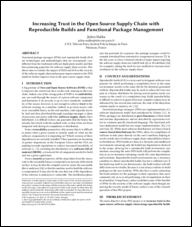
  4. Increasing Trust in the Open Source Supply Chain with Reproducible Builds and Functional Package Management
  5. Software and source code identification with GNU Guix and reproducible builds
  6. Two new Rust-based tools for post-processing determinism
  7. Distribution work
  8. Mailing list highlights
  9. Website updates
  10. Delta chat clients now reproducible
  11. diffoscope updates
  12. Upstream patches
  13. Reproducibility testing framework

Arch Linux minimal container userland now 100% reproducible In remarkable news, Reproducible builds developer kpcyrd reported that that the Arch Linux minimal container userland is now 100% reproducible after work by developers dvzv and Foxboron on the one remaining package. This represents a real world , widely-used Linux distribution being reproducible. Their post, which kpcyrd suffixed with the question now what? , continues on to outline some potential next steps, including validating whether the container image itself could be reproduced bit-for-bit. The post, which was itself a followup for an Arch Linux update earlier in the month, generated a significant number of replies.

Validating Debian s build infrastructure after the XZ backdoor From our mailing list this month, Vagrant Cascadian wrote about being asked about trying to perform concrete reproducibility checks for recent Debian security updates, in an attempt to gain some confidence about Debian s build infrastructure given that they performed builds in environments running the high-profile XZ vulnerability. Vagrant reports (with some caveats):
So far, I have not found any reproducibility issues; everything I tested I was able to get to build bit-for-bit identical with what is in the Debian archive.
That is to say, reproducibility testing permitted Vagrant and Debian to claim with some confidence that builds performed when this vulnerable version of XZ was installed were not interfered with.

Making Fedora Linux (more) reproducible In March, Davide Cavalca gave a talk at the 2024 Southern California Linux Expo (aka SCALE 21x) about the ongoing effort to make the Fedora Linux distribution reproducible. Documented in more detail on Fedora s website, the talk touched on topics such as the specifics of implementing reproducible builds in Fedora, the challenges encountered, the current status and what s coming next. (YouTube video)

Increasing Trust in the Open Source Supply Chain with Reproducible Builds and Functional Package Management Julien Malka published a brief but interesting paper in the HAL open archive on Increasing Trust in the Open Source Supply Chain with Reproducible Builds and Functional Package Management:
Functional package managers (FPMs) and reproducible builds (R-B) are technologies and methodologies that are conceptually very different from the traditional software deployment model, and that have promising properties for software supply chain security. This thesis aims to evaluate the impact of FPMs and R-B on the security of the software supply chain and propose improvements to the FPM model to further improve trust in the open source supply chain. PDF
Julien s paper poses a number of research questions on how the model of distributions such as GNU Guix and NixOS can be leveraged to further improve the safety of the software supply chain , etc.

Software and source code identification with GNU Guix and reproducible builds In a long line of commendably detailed blog posts, Ludovic Court s, Maxim Cournoyer, Jan Nieuwenhuizen and Simon Tournier have together published two interesting posts on the GNU Guix blog this month. In early March, Ludovic Court s, Maxim Cournoyer, Jan Nieuwenhuizen and Simon Tournier wrote about software and source code identification and how that might be performed using Guix, rhetorically posing the questions: What does it take to identify software ? How can we tell what software is running on a machine to determine, for example, what security vulnerabilities might affect it? Later in the month, Ludovic Court s wrote a solo post describing adventures on the quest for long-term reproducible deployment. Ludovic s post touches on GNU Guix s aim to support time travel , the ability to reliably (and reproducibly) revert to an earlier point in time, employing the iconic image of Harold Lloyd hanging off the clock in Safety Last! (1925) to poetically illustrate both the slapstick nature of current modern technology and the gymnastics required to navigate hazards of our own making.

Two new Rust-based tools for post-processing determinism Zbigniew J drzejewski-Szmek announced add-determinism, a work-in-progress reimplementation of the Reproducible Builds project s own strip-nondeterminism tool in the Rust programming language, intended to be used as a post-processor in RPM-based distributions such as Fedora In addition, Yossi Kreinin published a blog post titled refix: fast, debuggable, reproducible builds that describes a tool that post-processes binaries in such a way that they are still debuggable with gdb, etc.. Yossi post details the motivation and techniques behind the (fast) performance of the tool.

Distribution work In Debian this month, since the testing framework no longer varies the build path, James Addison performed a bulk downgrade of the bug severity for issues filed with a level of normal to a new level of wishlist. In addition, 28 reviews of Debian packages were added, 38 were updated and 23 were removed this month adding to ever-growing knowledge about identified issues. As part of this effort, a number of issue types were updated, including Chris Lamb adding a new ocaml_include_directories toolchain issue [ ] and James Addison adding a new filesystem_order_in_java_jar_manifest_mf_include_resource issue [ ] and updating the random_uuid_in_notebooks_generated_by_nbsphinx to reference a relevant discussion thread [ ]. In addition, Roland Clobus posted his 24th status update of reproducible Debian ISO images. Roland highlights that the images for Debian unstable often cannot be generated due to changes in that distribution related to the 64-bit time_t transition. Lastly, Bernhard M. Wiedemann posted another monthly update for his reproducibility work in openSUSE.

Mailing list highlights Elsewhere on our mailing list this month:

Website updates There were made a number of improvements to our website this month, including:
  • Pol Dellaiera noticed the frequent need to correctly cite the website itself in academic work. To facilitate easier citation across multiple formats, Pol contributed a Citation File Format (CIF) file. As a result, an export in BibTeX format is now available in the Academic Publications section. Pol encourages community contributions to further refine the CITATION.cff file. Pol also added an substantial new section to the buy in page documenting the role of Software Bill of Materials (SBOMs) and ephemeral development environments. [ ][ ]
  • Bernhard M. Wiedemann added a new commandments page to the documentation [ ][ ] and fixed some incorrect YAML elsewhere on the site [ ].
  • Chris Lamb add three recent academic papers to the publications page of the website. [ ]
  • Mattia Rizzolo and Holger Levsen collaborated to add Infomaniak as a sponsor of amd64 virtual machines. [ ][ ][ ]
  • Roland Clobus updated the stable outputs page, dropping version numbers from Python documentation pages [ ] and noting that Python s set data structure is also affected by the PYTHONHASHSEED functionality. [ ]

Delta chat clients now reproducible Delta Chat, an open source messaging application that can work over email, announced this month that the Rust-based core library underlying Delta chat application is now reproducible.

diffoscope diffoscope is our in-depth and content-aware diff utility that can locate and diagnose reproducibility issues. This month, Chris Lamb made a number of changes such as uploading versions 259, 260 and 261 to Debian and made the following additional changes:
  • New features:
    • Add support for the zipdetails tool from the Perl distribution. Thanks to Fay Stegerman and Larry Doolittle et al. for the pointer and thread about this tool. [ ]
  • Bug fixes:
    • Don t identify Redis database dumps as GNU R database files based simply on their filename. [ ]
    • Add a missing call to File.recognizes so we actually perform the filename check for GNU R data files. [ ]
    • Don t crash if we encounter an .rdb file without an equivalent .rdx file. (#1066991)
    • Correctly check for 7z being available and not lz4 when testing 7z. [ ]
    • Prevent a traceback when comparing a contentful .pyc file with an empty one. [ ]
  • Testsuite improvements:
    • Fix .epub tests after supporting the new zipdetails tool. [ ]
    • Don t use parenthesis within test skipping messages, as PyTest adds its own parenthesis. [ ]
    • Factor out Python version checking in test_zip.py. [ ]
    • Skip some Zip-related tests under Python 3.10.14, as a potential regression may have been backported to the 3.10.x series. [ ]
    • Actually test 7z support in the test_7z set of tests, not the lz4 functionality. (Closes: reproducible-builds/diffoscope#359). [ ]
In addition, Fay Stegerman updated diffoscope s monkey patch for supporting the unusual Mozilla ZIP file format after Python s zipfile module changed to detect potentially insecure overlapping entries within .zip files. (#362) Chris Lamb also updated the trydiffoscope command line client, dropping a build-dependency on the deprecated python3-distutils package to fix Debian bug #1065988 [ ], taking a moment to also refresh the packaging to the latest Debian standards [ ]. Finally, Vagrant Cascadian submitted an update for diffoscope version 260 in GNU Guix. [ ]

Upstream patches This month, we wrote a large number of patches, including: Bernhard M. Wiedemann used reproducibility-tooling to detect and fix packages that added changes in their %check section, thus failing when built with the --no-checks option. Only half of all openSUSE packages were tested so far, but a large number of bugs were filed, including ones against caddy, exiv2, gnome-disk-utility, grisbi, gsl, itinerary, kosmindoormap, libQuotient, med-tools, plasma6-disks, pspp, python-pypuppetdb, python-urlextract, rsync, vagrant-libvirt and xsimd. Similarly, Jean-Pierre De Jesus DIAZ employed reproducible builds techniques in order to test a proposed refactor of the ath9k-htc-firmware package. As the change produced bit-for-bit identical binaries to the previously shipped pre-built binaries:
I don t have the hardware to test this firmware, but the build produces the same hashes for the firmware so it s safe to say that the firmware should keep working.

Reproducibility testing framework The Reproducible Builds project operates a comprehensive testing framework running primarily at tests.reproducible-builds.org in order to check packages and other artifacts for reproducibility. In March, an enormous number of changes were made by Holger Levsen:
  • Debian-related changes:
    • Sleep less after a so-called 404 package state has occurred. [ ]
    • Schedule package builds more often. [ ][ ]
    • Regenerate all our HTML indexes every hour, but only every 12h for the released suites. [ ]
    • Create and update unstable and experimental base systems on armhf again. [ ][ ]
    • Don t reschedule so many depwait packages due to the current size of the i386 architecture queue. [ ]
    • Redefine our scheduling thresholds and amounts. [ ]
    • Schedule untested packages with a higher priority, otherwise slow architectures cannot keep up with the experimental distribution growing. [ ]
    • Only create the stats_buildinfo.png graph once per day. [ ][ ]
    • Reproducible Debian dashboard: refactoring, update several more static stats only every 12h. [ ]
    • Document how to use systemctl with new systemd-based services. [ ]
    • Temporarily disable armhf and i386 continuous integration tests in order to get some stability back. [ ]
    • Use the deb.debian.org CDN everywhere. [ ]
    • Remove the rsyslog logging facility on bookworm systems. [ ]
    • Add zst to the list of packages which are false-positive diskspace issues. [ ]
    • Detect failures to bootstrap Debian base systems. [ ]
  • Arch Linux-related changes:
    • Temporarily disable builds because the pacman package manager is broken. [ ][ ]
    • Split reproducible_html_live_status and split the scheduling timing . [ ][ ][ ]
    • Improve handling when database is locked. [ ][ ]
  • Misc changes:
    • Show failed services that require manual cleanup. [ ][ ]
    • Integrate two new Infomaniak nodes. [ ][ ][ ][ ]
    • Improve IRC notifications for artifacts. [ ]
    • Run diffoscope in different systemd slices. [ ]
    • Run the node health check more often, as it can now repair some issues. [ ][ ]
    • Also include the string Bot in the userAgent for Git. (Re: #929013). [ ]
    • Document increased tmpfs size on our OUSL nodes. [ ]
    • Disable memory account for the reproducible_build service. [ ][ ]
    • Allow 10 times as many open files for the Jenkins service. [ ]
    • Set OOMPolicy=continue and OOMScoreAdjust=-1000 for both the Jenkins and the reproducible_build service. [ ]
Mattia Rizzolo also made the following changes:
  • Debian-related changes:
    • Define a systemd slice to group all relevant services. [ ][ ]
    • Add a bunch of quotes in scripts to assuage the shellcheck tool. [ ]
    • Add stats on how many packages have been built today so far. [ ]
    • Instruct systemd-run to handle diffoscope s exit codes specially. [ ]
    • Prefer the pgrep tool over grepping the output of ps. [ ]
    • Re-enable a couple of i386 and armhf architecture builders. [ ][ ]
    • Fix some stylistic issues flagged by the Python flake8 tool. [ ]
    • Cease scheduling Debian unstable and experimental on the armhf architecture due to the time_t transition. [ ]
    • Start a few more i386 & armhf workers. [ ][ ][ ]
    • Temporarly skip pbuilder updates in the unstable distribution, but only on the armhf architecture. [ ]
  • Other changes:
    • Perform some large-scale refactoring on how the systemd service operates. [ ][ ]
    • Move the list of workers into a separate file so it s accessible to a number of scripts. [ ]
    • Refactor the powercycle_x86_nodes.py script to use the new IONOS API and its new Python bindings. [ ]
    • Also fix nph-logwatch after the worker changes. [ ]
    • Do not install the stunnel tool anymore, it shouldn t be needed by anything anymore. [ ]
    • Move temporary directories related to Arch Linux into a single directory for clarity. [ ]
    • Update the arm64 architecture host keys. [ ]
    • Use a common Postfix configuration. [ ]
The following changes were also made by:
  • Jan-Benedict Glaw:
    • Initial work to clean up a messy NetBSD-related script. [ ][ ]
  • Roland Clobus:
    • Show the installer log if the installer fails to build. [ ]
    • Avoid the minus character (i.e. -) in a variable in order to allow for tags in openQA. [ ]
    • Update the schedule of Debian live image builds. [ ]
  • Vagrant Cascadian:
    • Maintenance on the virt* nodes is completed so bring them back online. [ ]
    • Use the fully qualified domain name in configuration. [ ]
Node maintenance was also performed by Holger Levsen, Mattia Rizzolo [ ][ ] and Vagrant Cascadian [ ][ ][ ][ ]

If you are interested in contributing to the Reproducible Builds project, please visit our Contribute page on our website. However, you can get in touch with us via:

8 April 2024

Bastian Blank: Python dataclasses for Deb822 format

Python includes some helping support for classes that are designed to just hold some data and not much more: Data Classes. It uses plain Python type definitions to specify what you can have and some further information for every field. This will then generate you some useful methods, like __init__ and __repr__, but on request also more. But given that those type definitions are available to other code, a lot more can be done. There exists several separate packages to work on data classes. For example you can have data validation from JSON with dacite. But Debian likes a pretty strange format usually called Deb822, which is in fact derived from the RFC 822 format of e-mail messages. Those files includes single messages with a well known format. So I'd like to introduce some Deb822 format support for Python Data Classes. For now the code resides in the Debian Cloud tool. Usage Setup It uses the standard data classes support and several helper functions. Also you need to enable support for postponed evaluation of annotations.
from __future__ import annotations
from dataclasses import dataclass
from dataclasses_deb822 import read_deb822, field_deb822
Class definition start Data classes are just normal classes, just with a decorator.
@dataclass
class Package:
Field definitions You need to specify the exact key to be used for this field.
    package: str = field_deb822('Package')
    version: str = field_deb822('Version')
    arch: str = field_deb822('Architecture')
Default values are also supported.
    multi_arch: Optional[str] = field_deb822(
        'Multi-Arch',
        default=None,
    )
Reading files
for p in read_deb822(Package, sys.stdin, ignore_unknown=True):
    print(p)
Full example
from __future__ import annotations
from dataclasses import dataclass
from debian_cloud_images.utils.dataclasses_deb822 import read_deb822, field_deb822
from typing import Optional
import sys
@dataclass
class Package:
    package: str = field_deb822('Package')
    version: str = field_deb822('Version')
    arch: str = field_deb822('Architecture')
    multi_arch: Optional[str] = field_deb822(
        'Multi-Arch',
        default=None,
    )
for p in read_deb822(Package, sys.stdin, ignore_unknown=True):
    print(p)
Known limitations

5 April 2024

Dirk Eddelbuettel: RcppArmadillo 0.12.8.2.0 on CRAN: Upstream Fix

armadillo image Armadillo is a powerful and expressive C++ template library for linear algebra and scientific computing. It aims towards a good balance between speed and ease of use, has a syntax deliberately close to Matlab, and is useful for algorithm development directly in C++, or quick conversion of research code into production environments. RcppArmadillo integrates this library with the R environment and language and is widely used by (currently) 1136 other packages on CRAN, downloaded 33.5 million times (per the partial logs from the cloud mirrors of CRAN), and the CSDA paper (preprint / vignette) by Conrad and myself has been cited 578 times according to Google Scholar. This release brings a new upstream bugfix release Armadillo 12.8.2 prepared by Conrad two days ago. It took the usual day to noodle over 1100+ reverse dependencies and ensure two failures were independent of the upgrade (i.e., no change to worse in CRAN parlance). It took CRAN another because we hit a random network outage for (spurious) NOTE on a remote URL, and were then caught in the shrapnel from another large package ecosystem update spuriously pointing some build failures that were due to a missing rebuild to us. All good, as human intervention comes to the rescue. The set of changes since the last CRAN release follows.

Changes in RcppArmadillo version 0.12.8.2.0 (2024-04-02)
  • Upgraded to Armadillo release 12.8.2 (Cortisol Injector)
    • Workaround for FFTW3 header clash
    • Workaround in testing framework for issue under macOS
    • Minor cleanups to reduce code bloat
    • Improved documentation

Courtesy of my CRANberries, there is a diffstat report relative to previous release. More detailed information is on the RcppArmadillo page. Questions, comments etc should go to the rcpp-devel mailing list off the Rcpp R-Forge page. If you like this or other open-source work I do, you can sponsor me at GitHub.

This post by Dirk Eddelbuettel originated on his Thinking inside the box blog. Please report excessive re-aggregation in third-party for-profit settings.

Bits from Debian: apt install dpl-candidate: Andreas Tille

The Debian Project Developers will shortly vote for a new Debian Project Leader known as the DPL. The Project Leader is the official representative of The Debian Project tasked with managing the overall project, its vision, direction, and finances. The DPL is also responsible for the selection of Delegates, defining areas of responsibility within the project, the coordination of Developers, and making decisions required for the project. Our outgoing and present DPL Jonathan Carter served 4 terms, from 2020 through 2024. Jonathan shared his last Bits from the DPL post to Debian recently and his hopes for the future of Debian. Recently, we sat with the two present candidates for the DPL position asking questions to find out who they really are in a series of interviews about their platforms, visions for Debian, lives, and even their favorite text editors. The interviews were conducted by disaster2life (Yashraj Moghe) and made available from video and audio transcriptions: Voting for the position starts on April 6, 2024. Editors' note: This is our official return to Debian interviews, readers should stay tuned for more upcoming interviews with Developers and other important figures in Debian as part of our "Meet your Debian Developer" series. We used the following tools and services: Turboscribe.ai for the transcription from the audio and video files, IRC: Oftc.net for communication, Jitsi meet for interviews, and Open Broadcaster Software (OBS) for editing and video. While we encountered many technical difficulties in the return to this process, we are still able and proud to present the transcripts of the interviews edited only in a few areas for readability. 2024 Debian Project Leader Candidate: Andrea Tille Andreas' Interview Who are you? Tell us a little about yourself. [Andreas]:
How am I? Well, I'm, as I wrote in my platform, I'm a proud grandfather doing a lot of free software stuff, doing a lot of sports, have some goals in mind which I like to do and hopefully for the best of Debian.
And How are you today? [Andreas]:
How I'm doing today? Well, actually I have some headaches but it's fine for the interview. So, usually I feel very good. Spring was coming here and today it's raining and I plan to do a bicycle tour tomorrow and hope that I do not get really sick but yeah, for the interview it's fine.
What do you do in Debian? Could you mention your story here? [Andreas]:
Yeah, well, I started with Debian kind of an accident because I wanted to have some package salvaged which is called WordNet. It's a monolingual dictionary and I did not really plan to do more than maybe 10 packages or so. I had some kind of training with xTeddy which is totally unimportant, a cute teddy you can put on your desktop. So, and then well, more or less I thought how can I make Debian attractive for my employer which is a medical institute and so on. It could make sense to package bioinformatics and medicine software and it somehow evolved in a direction I did neither expect it nor wanted to do, that I'm currently the most busy uploader in Debian, created several teams around it. DebianMate is very well known from me. I created the Blends team to create teams and techniques around what we are doing which was Debian TIS, Debian Edu, Debian Science and so on and I also created the packaging team for R, for the statistics package R which is technically based and not topic based. All these blends are covering a certain topic and R is just needed by lots of these blends. So, yeah, and to cope with all this I have written a script which is routing an update to manage all these uploads more or less automatically. So, I think I had one day where I uploaded 21 new packages but it's just automatically generated, right? So, it's on one day more than I ever planned to do.
What is the first thing you think of when you think of Debian? Editors' note: The question was misunderstood as the worst thing you think of when you think of Debian [Andreas]:
The worst thing I think about Debian, it's complicated. I think today on Debian board I was asked about the technical progress I want to make and in my opinion we need to standardize things inside Debian. For instance, bringing all the packages to salsa, follow some common standards, some common workflow which is extremely helpful. As I said, if I'm that productive with my own packages we can adopt this in general, at least in most cases I think. I made a lot of good experience by the support of well-formed teams. Well-formed teams are those teams where people support each other, help each other. For instance, how to say, I'm a physicist by profession so I'm not an IT expert. I can tell apart what works and what not but I'm not an expert in those packages. I do and the amount of packages is so high that I do not even understand all the techniques they are covering like Go, Rust and something like this. And I also don't speak Java and I had a problem once in the middle of the night and I've sent the email to the list and was a Java problem and I woke up in the morning and it was solved. This is what I call a team. I don't call a team some common repository that is used by random people for different packages also but it's working together, don't hesitate to solve other people's problems and permit people to get active. This is what I call a team and this is also something I observed in, it's hard to give a percentage, in a lot of other teams but we have other people who do not even understand the concept of the team. Why is working together make some advantage and this is also a tough thing. I [would] like to tackle in my term if I get elected to form solid teams using the common workflow. This is one thing. The other thing is that we have a lot of good people in our infrastructure like FTP masters, DSA and so on. I have the feeling they have a lot of work and are working more or less on their limits, and I like to talk to them [to ask] what kind of change we could do to move that limits or move their personal health to the better side.
The DPL term lasts for a year, What would you do during that you couldn't do now? [Andreas]:
Yeah, well this is basically what I said are my main issues. I need to admit I have no really clear imagination what kind of tasks will come to me as a DPL because all these financial issues and law issues possible and issues [that] people who are not really friendly to Debian might create. I'm afraid these things might occupy a lot of time and I can't say much about this because I simply don't know.
What are three key terms about you and your candidacy? [Andreas]:
As I said, I like to work on standards, I d like to make Debian try [to get it right so] that people don't get overworked, this third key point is be inviting to newcomers, to everybody who wants to come. Yeah, I also mentioned in my term this diversity issue, geographical and from gender point of view. This may be the three points I consider most important.
Preferred text editor? [Andreas]:
Yeah, my preferred one? Ah, well, I have no preferred text editor. I'm using the Midnight Commander very frequently which has an internal editor which is convenient for small text. For other things, I usually use VI but I also use Emacs from time to time. So, no, I have not preferred text editor. Whatever works nicely for me.
What is the importance of the community in the Debian Project? How would like to see it evolving over the next few years? [Andreas]:
Yeah, I think the community is extremely important. So, I was on a lot of DebConfs. I think it's not really 20 but 17 or 18 DebCons and I really enjoyed these events every year because I met so many friends and met so many interesting people that it's really enriching my life and those who I never met in person but have read interesting things and yeah, Debian community makes really a part of my life.
And how do you think it should evolve specifically? [Andreas]:
Yeah, for instance, last year in Kochi, it became even clearer to me that the geographical diversity is a really strong point. Just discussing with some women from India who is afraid about not coming next year to Busan because there's a problem with Shanghai and so on. I'm not really sure how we can solve this but I think this is a problem at least I wish to tackle and yeah, this is an interesting point, the geographical diversity and I'm running the so-called mentoring of the month. This is a small project to attract newcomers for the Debian Med team which has the focus on medical packages and I learned that we had always men applying for this and so I said, okay, I dropped the constraint of medical packages. Any topic is fine, I teach you packaging but it must be someone who does not consider himself a man. I got only two applicants, no, actually, I got one applicant and one response which was kind of strange if I'm hunting for women or so. I did not understand but I got one response and interestingly, it was for me one of the least expected counters. It was from Iran and I met a very nice woman, very open, very skilled and gifted and did a good job or have even lose contact today and maybe we need more actively approach groups that are underrepresented. I don't know if what's a good means which I did but at least I tried and so I try to think about these kind of things.
What part of Debian has made you smile? What part of the project has kept you going all through the years? [Andreas]:
Well, the card game which is called Mao on the DebConf made me smile all the time. I admit I joined only two or three times even if I really love this kind of games but I was occupied by other stuff so this made me really smile. I also think the first online DebConf in 2020 made me smile because we had this kind of short video sequences and I tried to make a funny video sequence about every DebConf I attended before. This is really funny moments but yeah, it's not only smile but yeah. One thing maybe it's totally unconnected to Debian but I learned personally something in Debian that we have a do-ocracy and you can do things which you think that are right if not going in between someone else, right? So respect everybody else but otherwise you can do so. And in 2020 I also started to take trees which are growing widely in my garden and plant them into the woods because in our woods a lot of trees are dying and so I just do something because I can. I have the resource to do something, take the small tree and bring it into the woods because it does not harm anybody. I asked the forester if it is okay, yes, yes, okay. So everybody can do so but I think the idea to do something like this came also because of the free software idea. You have the resources, you have the computer, you can do something and you do something productive, right? And when thinking about this I think it was also my Debian work. Meanwhile I have planted more than 3,000 trees so it's not a small number but yeah, I enjoy this.
What part of Debian would you have some criticisms for? [Andreas]:
Yeah, it's basically the same as I said before. We need more standards to work together. I do not want to repeat this but this is what I think, yeah.
What field in Free Software generally do you think requires the most work to be put into it? What do you think is Debian's part in the field? [Andreas]:
It's also in general, the thing is the fact that I'm maintaining packages which are usually as modern software is maintained in Git, which is fine but we have some software which is at Sourceport, we have software laying around somewhere, we have software where Debian somehow became Upstream because nobody is caring anymore and free software is very different in several things, ways and well, I in principle like freedom of choice which is the basic of all our work. Sometimes this freedom goes in the way of productivity because everybody is free to re-implement. You asked me for the most favorite editor. In principle one really good working editor would be great to have and would work and we have maybe 500 in Debian or so, I don't know. I could imagine if people would concentrate and say five instead of 500 editors, we could get more productive, right? But I know this will not happen, right? But I think this is one thing which goes in the way of making things smooth and productive and we could have more manpower to replace one person who's [having] children, doing some other stuff and can't continue working on something and maybe this is a problem I will not solve, definitely not, but which I see.
What do you think is Debian's part in the field? [Andreas]:
Yeah, well, okay, we can bring together different Upstreams, so we are building some packages and have some general overview about similar things and can say, oh, you are doing this and some other person is doing more or less the same, do you want to join each other or so, but this is kind of a channel we have to our Upstreams which is probably not very successful. It starts with code copies of some libraries which are changed a little bit, which is fine license-wise, but not so helpful for different things and so I've tried to convince those Upstreams to forward their patches to the original one, but for this and I think we could do some kind of, yeah, [find] someone who brings Upstream together or to make them stop their forking stuff, but it costs a lot of energy and we probably don't have this and it's also not realistic that we can really help with this problem.
Do you have any questions for me? [Andreas]:
I enjoyed the interview, I enjoyed seeing you again after half a year or so. Yeah, actually I've seen you in the eating room or cheese and wine party or so, I do not remember we had to really talk together, but yeah, people around, yeah, for sure. Yeah.

2 April 2024

Dirk Eddelbuettel: ulid 0.3.1 on CRAN: New Maintainer, Some Polish

Happy to share that ulid is now (back) on CRAN. It provides universally unique identifiers that are lexicographically sortable, which improves over the more well-known uuid generators. ulid is a neat little package put together by Bob Rudis a few years ago. It had recently drifted off CRAN so I offered to brush it up and re-submit it. And as tooted earlier today, it took just over an hour to finish that (after the lead up work I had done, including prior email with CRAN in the loop, the repo transfer from Bob s to my ulid repo plus of course a wee bit of actual maintenance; see below for more). The NEWS entry follows.

Changes in version 0.3.1 (2024-04-02)
  • New Maintainer
  • Deleted several repository files no longer used or needed
  • Added .editorconfig, ChangeLog and cleanup
  • Converted NEWS.md to NEWS.Rd
  • Simplified R/ directory to one source file
  • Simplified src/ removing redundant Makevars
  • Added ulid() alias
  • Updated / edited roxygen and README.md documention
  • Removed vignette which was identical to README.md
  • Switched continuous integration to GitHub Actions
  • Placed upstream (header-only) library into src/ulid/
  • Renamed single interface file to src/wrapper

If you like this or other open-source work I do, you can sponsor me at GitHub.

This post by Dirk Eddelbuettel originated on his Thinking inside the box blog. Please report excessive re-aggregation in third-party for-profit settings.

Next.

Previous.