Kartik Mistry: KDE Needs You!
 * KDE Randa Meetings and make a donation!
I know that my contributions to KDE are minimal at this stage, but hey, I m doing my part this time for sure!
* KDE Randa Meetings and make a donation!
I know that my contributions to KDE are minimal at this stage, but hey, I m doing my part this time for sure!

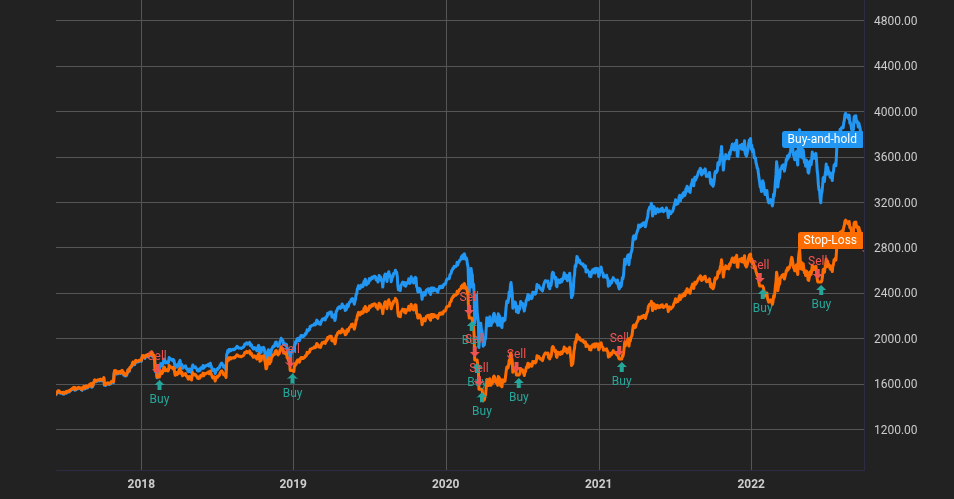 In January 2024 I wrote about the insanity of the Magnificent Seven dominating the MSCI World Index, and I wondered how long the number can continue to go up? It has continued to surge upward at an accelerating pace, which makes me worry that a crash is likely closer. As a software professional, I decided to analyze whether using stop-loss orders could reliably automate avoiding deep drawdowns.
As everyone with some savings in the stock market (hopefully) knows, the stock market eventually experiences crashes. It is just a matter of when and how deep the crash will be. Staying on the sidelines for years is not a good investment strategy, as inflation will erode the value of your savings. Assuming the current true inflation rate is around 7%, a restaurant dinner that costs 20 euros today will cost 24.50 euros in three years. Savings of 1000 euros today would drop in purchasing power from 50 dinners to only 40 dinners in three years.
Hence, if you intend to retain the value of your hard-earned savings, they need to be invested in something that grows in value. Most people try to beat inflation by buying shares in stable companies, directly or via broad market ETFs. These historically grow faster than inflation during normal years, but likely drop in value during recessions.
CACHE_DIR.mkdir(parents=True, exist_ok=True)
end_date = datetime.today().strftime("%Y-%m-%d")
cache_file = CACHE_DIR / f" TICKER - START_DATE -- end_date .parquet"
if cache_file.is_file():
dataframe = pandas.read_parquet(cache_file)
print(f"Loaded price data from cache:  cache_file ")
else:
dataframe = yfinance.download(
TICKER,
start=START_DATE,
end=end_date,
progress=False,
auto_adjust=False
)
dataframe.to_parquet(cache_file)
print(f"Fetched new price data from Yahoo Finance and cached to: cache_file ")print("First 5 rows of the raw data:")
print(df.head())
print("Last 5 rows of the raw data:")
print(df.tail())First 5 rows of the raw data
Price Adj Close Close High Low Open Volume
Ticker BNP.PA BNP.PA BNP.PA BNP.PA BNP.PA BNP.PA
Date
2014-01-02 29.956285 55.540001 56.910000 55.349998 56.700001 316552
2014-01-03 30.031801 55.680000 55.990002 55.290001 55.580002 210044
2014-01-06 30.080338 55.770000 56.230000 55.529999 55.560001 185142
2014-01-07 30.943321 57.369999 57.619999 55.790001 55.880001 370397
2014-01-08 31.385597 58.189999 59.209999 57.750000 57.790001 489940
Last 5 rows of the raw data
Price Adj Close Close High Low Open Volume
Ticker BNP.PA BNP.PA BNP.PA BNP.PA BNP.PA BNP.PA
Date
2025-12-11 78.669998 78.669998 78.919998 76.900002 76.919998 357918
2025-12-12 78.089996 78.089996 80.269997 78.089996 79.470001 280477
2025-12-15 79.080002 79.080002 79.449997 78.559998 78.559998 233852
2025-12-16 78.860001 78.860001 79.980003 78.809998 79.430000 283057
2025-12-17 80.080002 80.080002 80.150002 79.080002 79.199997 262818df["RSI"] = compute_rsi(df["price"], period=14) baseline_series = [
"time": ts, "value": val
for ts, val in df_plot[["timestamp", BASELINE_LABEL]].itertuples(index=False)
]
baseline_json = json.dumps(baseline_series)
template = jinja2.Template("template.html")
rendered_html = template.render(
title=title,
heading=heading,
description=description_html,
...
baseline_json=baseline_json,
...
)
with open("report.html", "w", encoding="utf-8") as f:
f.write(rendered_html)
print("Report generated!") variable in Jinja syntax gets replaced with the actual JSON:
<!DOCTYPE html>
<html lang="en">
<head>
<meta charset="UTF-8">
<title>  title  </title>
...
</head>
<body>
<h1>  heading  </h1>
<div id="chart"></div>
<script>
// Ensure the DOM is ready before we initialise the chart
document.addEventListener('DOMContentLoaded', () =>
// Parse the JSON data passed from Python
const baselineData =   baseline_json   safe  ;
const strategyData =   strategy_json   safe  ;
const markersData =   markers_json   safe  ;
// Create the chart
const chart = LightweightCharts.createChart(document.getElementById('chart'),
width: document.getElementById('chart').clientWidth,
height: 500,
layout:
background:   color: "#222"  ,
textColor: "#ccc"
 ,
grid:
vertLines:   color: "#555"  ,
horzLines:   color: "#555"

 );
// Add baseline series
const baselineSeries = chart.addLineSeries(
title: '  baseline_label  ',
lastValueVisible: false,
priceLineVisible: false,
priceLineWidth: 1
 );
baselineSeries.setData(baselineData);
baselineSeries.priceScale().applyOptions(
entireTextOnly: true
 );
// Add strategy series
const strategySeries = chart.addLineSeries(
title: '  strategy_label  ',
lastValueVisible: false,
priceLineVisible: false,
color: '#FF6D00'
 );
strategySeries.setData(strategyData);
// Add buy/sell markers to the strategy series
strategySeries.setMarkers(markersData);
// Fit the chart to show the full data range (full zoom)
chart.timeScale().fitContent();
 )
</script>
</body>
</html>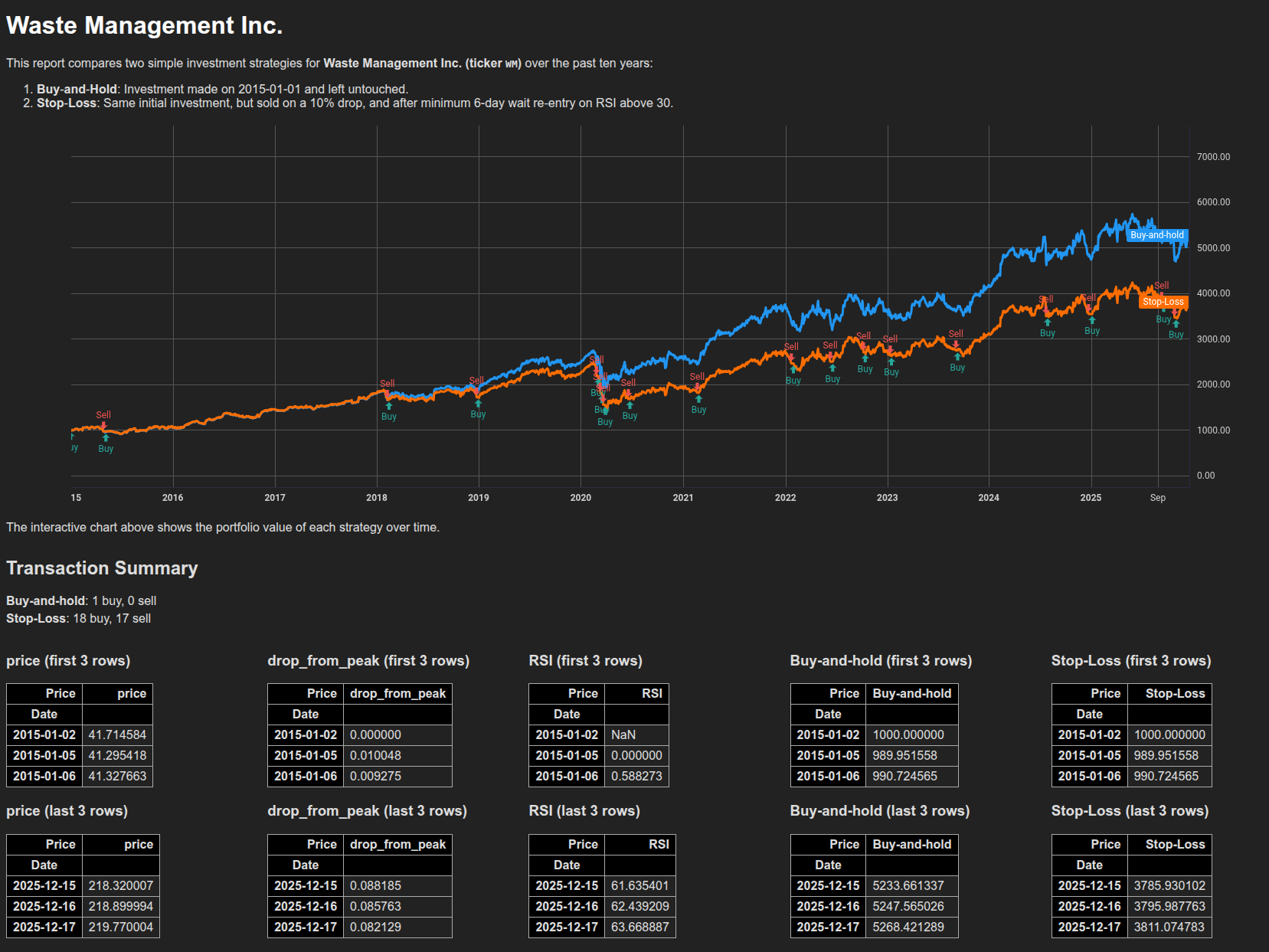
 We announced a public beta of
Debusine repositories
recently (Freexian
blog,
debian-devel-announce).
One thing I m very keen on is being able to use these to prepare
transitions : changes to multiple packages that need to be prepared
together in order to land in testing. As I said in my DebConf25
talk:
We have distribution-wide CI in unstable, but there s only one of it and it s shared between all of us. As a result it s very possible to get into tangles when multiple people are working on related things at the same time, and we only avoid that as much as we do by careful coordination such as transition bugs. Experimental helps, but again, there s only one of it and setting up another one is far from trivial. So, what we want is a system where you can run experiments on possible Debian changes at a large scale without a high setup cost and without fear of breaking things for other people. And then, if it all works, push the whole lot into Debian.Time to practice what I preach. Setup The setup process is documented on the Debian wiki. You need to decide whether you re working on a short-lived experiment, in which case you ll run the
create-experiment workflow and your workspace will expire
after 60 days of inactivity, or something that you expect to keep around for
longer, in which case you ll run the create-repository workflow. Either
one of those will create a new workspace for you. Then, in that workspace,
you run debusine archive suite create for whichever suites you want to
use. For the case of a transition that you plan to land in unstable, you ll
most likely use create-experiment and then create a single suite with the
pattern sid-<name>.
The situation I was dealing with here was moving to
Pylint 4. Tests showed that we
needed this as part of adding Python 3.14 as a supported Python version, and
I knew that I was going to need newer upstream versions of the astroid and
pylint packages. However, I wasn t quite sure what the fallout of a new
major version of pylint was going to be. Fortunately, the Debian Python
ecosystem has pretty good autopkgtest coverage, so I thought I d see what
Debusine said about it. I created an experiment called cjwatson-pylint
(resulting in
https://debusine.debian.net/debian/developers-cjwatson-pylint/ - I m not
making that a proper link since it will expire in a couple of months) and a
sid-pylint suite in it.
Iteration
From this starting point, the basic cycle involved uploading each package
like this for each package I d prepared:
$ dput -O debusine_workspace=developers-cjwatson-pylint \
       -O debusine_workflow=publish-to-sid-pylint \
       debusine.debian.net foo.changes
dput-ng profile to cut down on typing, but it
wasn t worth it here.
Then I looked at the workflow results, figured out which other packages I
needed to fix based on those, and repeated until the whole set looked
coherent. Debusine automatically built each upload against whatever else
was currently in the repository, as you d expect.
I should probably have used version numbers with tilde suffixes (e.g.
4.0.2-1~test1) in case I needed to correct anything, but fortunately that
was mostly unnecessary. I did at least run initial test-builds locally of
just the individual packages I was directly changing to make sure that they
weren t too egregiously broken, just because I usually find it quicker to
iterate that way.
I didn t take screenshots as I was going along, but here s what the list of
top-level
workflows
in my workspace looked like by the end:
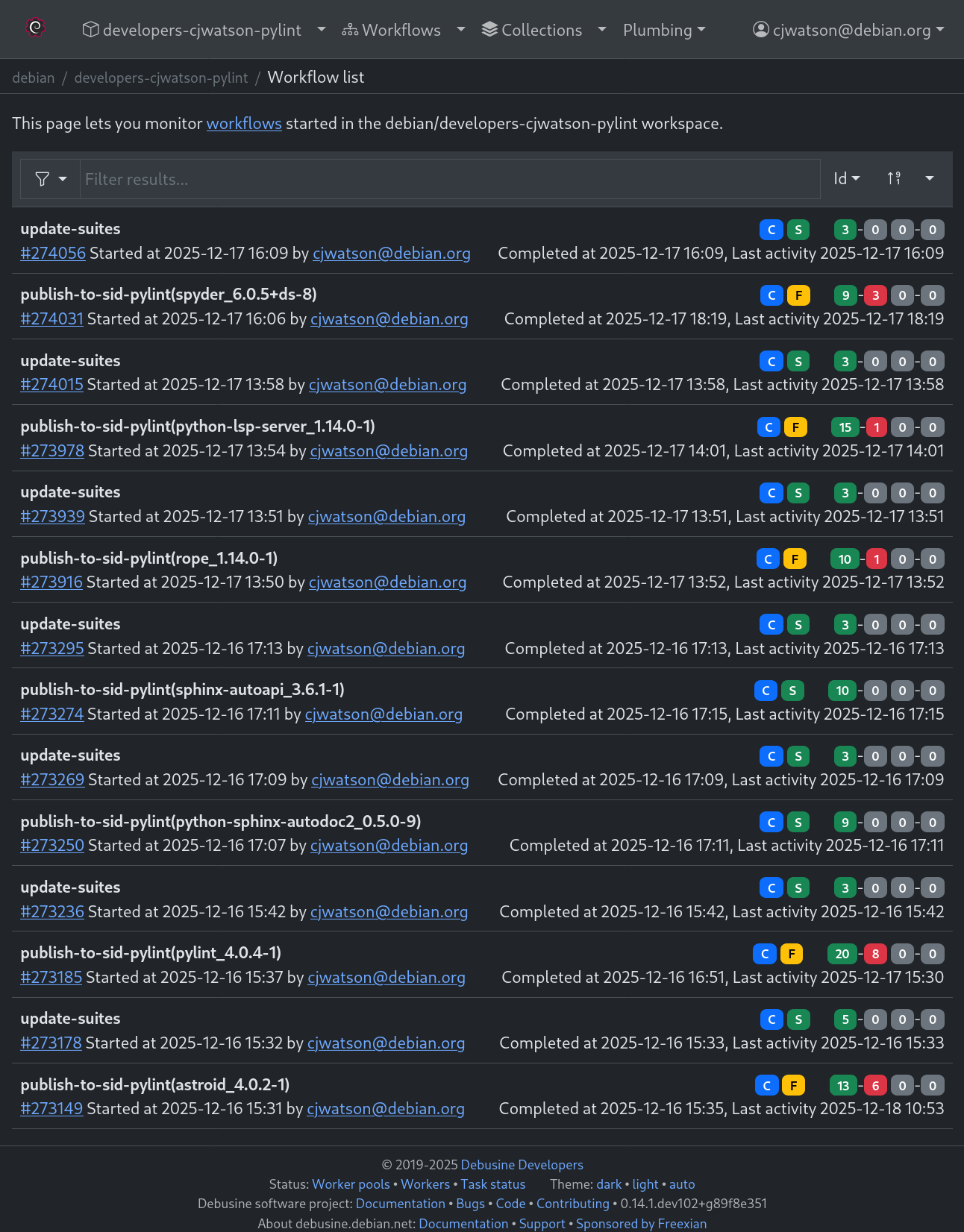 You can see that not all of the workflows are successful. This is because
we currently just show everything in every workflow; we don t consider
whether a task was retried and succeeded on the second try, or whether
there s now a newer version of a reverse-dependency so tests of the older
version should be disregarded, and so on. More fundamentally, you have to
look through each individual workflow, which is a bit of a pain: we plan to
add a dashboard that shows you the current state of a suite as a whole
rather than the current workflow-oriented view, but we haven t started on
that yet.
Drilling down into one of these workflows, it looks something like this:
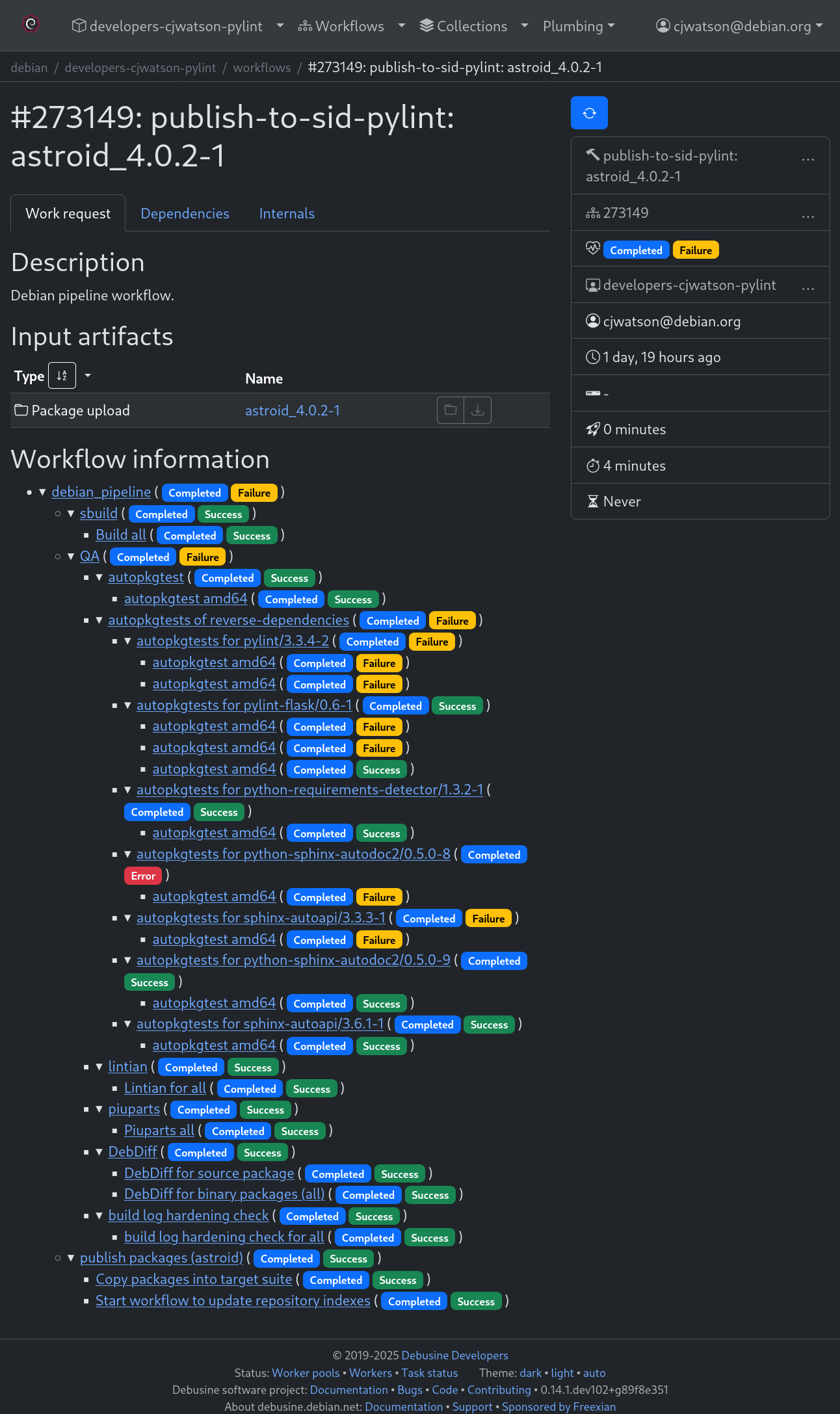 This was the first package I uploaded. The first pass of failures told me
about
pylint (expected), pylint-flask (an obvious consequence), and
python-sphinx-autodoc2 and sphinx-autoapi (surprises). The slightly odd
pattern of failures and errors is because I retried a few things, and we
sometimes report retries in a slightly strange way, especially when there
are workflows involved that might not be able to resolve their input
parameters any more.
The next level was:
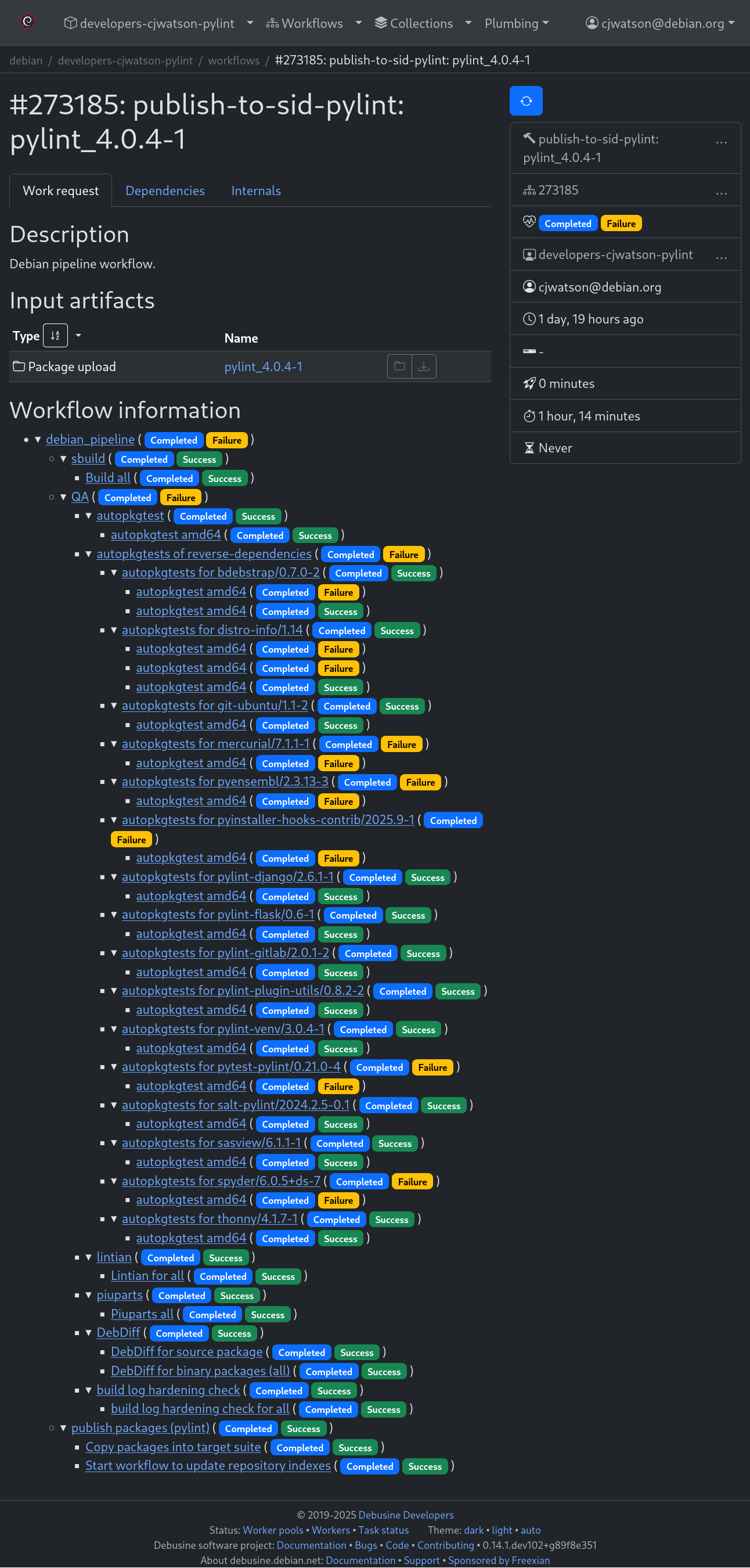 Again, there were some retries involved here, and also some cases where
packages were already failing in unstable so the failures weren t the fault
of my change; for now I had to go through and analyze these by hand, but
we ll soon have regression tracking to compare with reference runs and show
you where things have got better or worse.
After excluding those, that left
pytest-pylint (not caused by my changes,
but I fixed it anyway in unstable to clear out some noise) and spyder.
I d seen people talking about spyder on #debian-python recently, so after
a bit of conversation there I sponsored a rope upload by Aeliton Silva,
upgraded python-lsp-server, and patched spyder. All those went into my
repository too, exposing a couple more tests I d forgotten in spyder.
Once I was satisfied with the results, I uploaded everything to unstable.
The next day, I looked through the tracker as usual starting from
astroid, and while there are some
test failures showing up right now it looks as though they should all clear
out as pieces migrate to testing. Success!
Conclusions
We still have some way to go before this is a completely smooth experience
that I d be prepared to say that every developer can and should be using;
there are all sorts of fit-and-finish issues that I can easily see here.
Still, I do think we re at the point where a tolerant developer can use this
to deal with the common case of a mid-sized transition, and get more out of
it than they put in.
Without Debusine, either I d have had to put much more effort into searching
for and testing reverse-dependencies myself, or (more likely, let s face it)
I d have just dumped things into unstable and sorted them out afterwards,
resulting in potentially delaying other people s work. This way, everything
was done with as little disruption as possible.
This works best when the packages likely to be involved have reasonably good
autopkgtest coverage (even if the
tests themselves are relatively basic). This is an increasingly good
bet in Debian, but we have plans to
add installability comparisons (similar to how Debian s testing suite
works) as well as optional rebuild testing.
If this has got you interested, please try it out for
yourself and let us know how it
goes!
 21 years ago today I wrote my first blog post. Did I think I d still be writing all this time later? I ve no idea to be honest. I ve always had the impression my readership is small, and people who mostly know me in some manner, and I post to let them know what I m up to in more detail than snippets of IRC conversation can capture. Or I write to make notes for myself (I frequently refer back to things I ve documented here). I write less about my personal life than I used to, but I still occasionally feel the need to mark some event.
From a software PoV I started out with Blosxom, migrated to MovableType in 2008, ditched that, when the Open Source variant disappeared, for Jekyll in 2015 (when I also started putting it all in git). And have stuck there since. The static generator format works well for me, and I outsource comments to Disqus - I don t get a lot, I can t be bothered with the effort of trying to protect against spammers, and folk who don t want to use it can easily email or poke me on the Fediverse. If I ever feel the need to move from Jekyll I ll probably take a look at Hugo, but thankfully at present there s no push factor to switch.
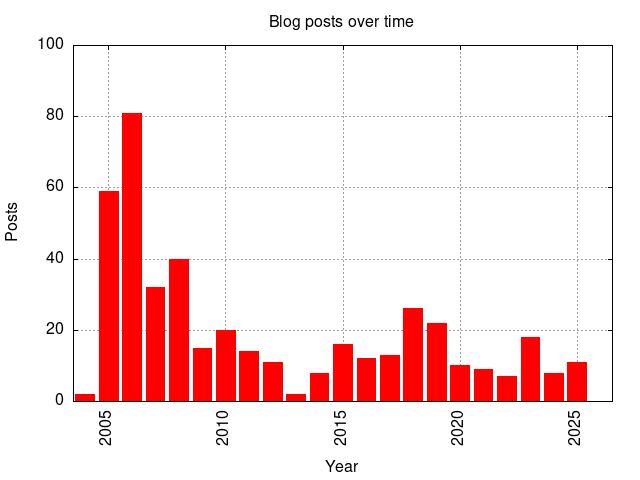
It s interesting to look at my writing patterns over time. I obviously started keen, and peaked with 81 posts in 2006 (I ve no idea how on earth that happened), while 2013 had only 2. Generally I write less when I m busy, or stressed, or unhappy, so it s kinda interesting to see how that lines up with various life events.
 During that period I ve lived in 10 different places (well, 10 different houses/flats, I think it s only 6 different towns/cities), on 2 different continents, working at 6 different employers, as well as a period where I was doing my Masters in law. I ve travelled around the world, made new friends, lost contact with folk, started a family. In short, I have lived, even if lots of it hasn t made it to these pages.
At this point, do I see myself stopping? No, not really. I plan to still be around, like Flameeyes, to the end. Even if my posts are unlikely to hit the frequency from back when I started out.
 I recently won a lawsuit against Roy and Rianne Schestowitz, the authors and publishers of the Techrights and Tuxmachines websites. The short version of events is that they were subject to an online harassment campaign, which they incorrectly blamed me for. They responded with a large number of defamatory online posts about me, which the judge described as
unsubstantiated character assassinationand consequently awarded me significant damages. That's not what this post is about, as such. It's about the sole meaningful claim made that tied me to the abuse.
The facts linking the Claimant to the sock puppet accounts include, on the IRC network: simultaneous dropped connections to the mjg59_ and elusive_woman accounts. This is so unlikely to be coincidental that the natural inference is that the same person posted under both names. "elusive_woman" here is an account linked to the harassment, and "mjg59_" is me. This is actually a surprisingly interesting claim to make, and it's worth going into in some more detail.
*elusive_woman has quit (Ping timeout: 2m30s), followed by one reading
*mjg59_ has quit (Ping timeout: 2m30s). The timestamp listed for the first is 09:52, and for the second 09:53. Is that actually simultaneous? We can actually gain some more information - if you hover over the timestamp links on the right hand side you can see that the link is actually accurate to the second even if that's not displayed. The first event took place at 09:52:52, and the second at 09:53:03. That's 11 seconds apart, which is clearly not simultaneous, but maybe it's close enough. Figuring out more requires knowing what a "ping timeout" actually means here.
# simple-ppa.conf
[CORE]
SignWith = 2906D748B7551BC8
ExportDir = /srv/www/simple-ppa
MailFrom: Simple-PPA <admin@simple-ppa.debian.net>
Codenames = sid forky trixie trixie-backports bookworm bookworm-backports
AlsoAllow = forky: unstable
            trixie: unstable
            bookworm: unstable
[simple-ppa-dev]
Label = Simple-PPA's self-hosted development repository
# ckk's key
Uploaders = allow * by key E76004C5CEF0C94C+
[ckk]
Label = Christian Kastner at Simple-PPA
Uploaders = allow * by key E76004C5CEF0C94C+
The CORE section just sets some defaults and sensible rules. Two PPAs are
defined, simple-ppa-dev and ckk, which accept packages signed by the
key with the ID E76004C5CEF0C94C. These PPAs use the global defaults, but
individual PPAs can override Architectures, Suites, and Components,
and of course allow an arbitrary number of users.
Users upload to this archive using SFTP (e.g.: with
dput-ng). Every 15 minutes,
uploads get processed, with ACCEPTED or REJECTED mails sent to the Maintainer
address. The APT archive of all PPAs is signed with a single global key.
I myself intend to use Debusine repositories soon, as the autobuilding and
the QA tasks Debusine offers are something I need. However, I do still see a
niche use case for Simple-PPA: when you need an APT archive, but don't want to
do a deep dive into reprepro (which is extremely powerful).
If you'd like to give Simple-PPA a try, head over to
simple-ppa.debian.net and follow the
instructions for users.
| Series: | Legends & Lattes #3 |
| Publisher: | Tor |
| Copyright: | 2025 |
| ISBN: | 1-250-33489-6 |
| Format: | Kindle |
| Pages: | 325 |
 We recently bought some Govee Glide Hexa Light Panels, because they have a local LAN API that is well integrated into Home Assistant.
Or so we thought.
Our network is not that complicated, but there is a dedicated VLAN for IOT devices.
Home Assistant runs in a container (with
network=host) on a box in the basement, and that box has a NIC in the IOT VLAN so it can reach devices there easily.
So far, this has never been a problem.
Enter the Govee LAN API.
Or maybe its Python implementation.
Not exactly sure who's to blame here.
The API involves sending JSON over multicast, which the Govee device will answer to.
No devices found on the networkAfter turning logging for
homeassistant.components.govee_light_local to 11, erm debug, we see:
DEBUG (MainThread) [homeassistant.components.govee_light_local.config_flow] Starting discovery with IP 192.168.42.2
DEBUG (MainThread) [homeassistant.components.govee_light_local.config_flow] No devices found with IP 192.168.42.2
Starting discovery with IP messages for all selected interfaces and adding of Govee Lights Local will work.
 By now, the /usr-merge is an old transition.
Effectively, it turns top-level directories such as
/bin into symbolic links pointing below /usr.
That way the entire operating system can be contained below the /usr hierarchy enabling e.g. image based update mechanisms.
It was first supported in Debian 9, which is no longer in active use at this point (except for users of Freexian s ELTS offer).
When it became mandatory in Debian 12, it wasn t really done though, because Debian s package manager was not prepared to handle file system objects being referred to via two different paths.
With nobody interested in handling the resulting issues, Freexian stepped in and funded a project lead by Helmut Grohne to resolve the remaining issues.
While the initial idea was to enhance the package manager, Debian s members disagreed.
They preferred an approach where files were simply tracked with their physical location while handling the resulting misbehavior of the package manager using package-specific workarounds.
This has been recorded in the DEP17 document.
During the Debian 13 release cycle, the plan has been implemented.
A tool for detecting possible problems was developed specifically for this transition.
Since all files are now tracked with their physical location and necessary workarounds have been added, problematic behavior is no longer triggered.
An upgrade from Debian 12 to Debian 13 is unlikely to run into aliasing problems as a result.
This whole project probably consumed more than 1500 hours of work from Debian contributors, of which 700 were sponsored by Freexian through the work of Helmut Grohne.
What remains is eventually removing the workarounds.
io/fs.FS
structure that can replace embed.FS in most contexts.1
package embed
import (
  "archive/zip"
  "bytes"
  _ "embed"
  "fmt"
  "io/fs"
  "sync"
)
//go:embed data/embed.zip
var embeddedZip []byte
var dataOnce = sync.OnceValue(func() *zip.Reader
  r, err := zip.NewReader(bytes.NewReader(embeddedZip), int64(len(embeddedZip)))
  if err != nil
    panic(fmt.Sprintf("cannot read embedded archive: %s", err))

  return r
 )
func Data() fs.FS
  return dataOnce()
embed.zip archive with a rule in a Makefile. We specify the
files to embed as dependencies to ensure changes are detected.
common/embed/data/embed.zip: console/data/frontend console/data/docs
common/embed/data/embed.zip: orchestrator/clickhouse/data/protocols.csv
common/embed/data/embed.zip: orchestrator/clickhouse/data/icmp.csv
common/embed/data/embed.zip: orchestrator/clickhouse/data/asns.csv
common/embed/data/embed.zip:
    mkdir -p common/embed/data && zip --quiet --recurse-paths --filesync $@ $^
$@ is the rule target, while $^ expands to all
the dependencies, modified or not.
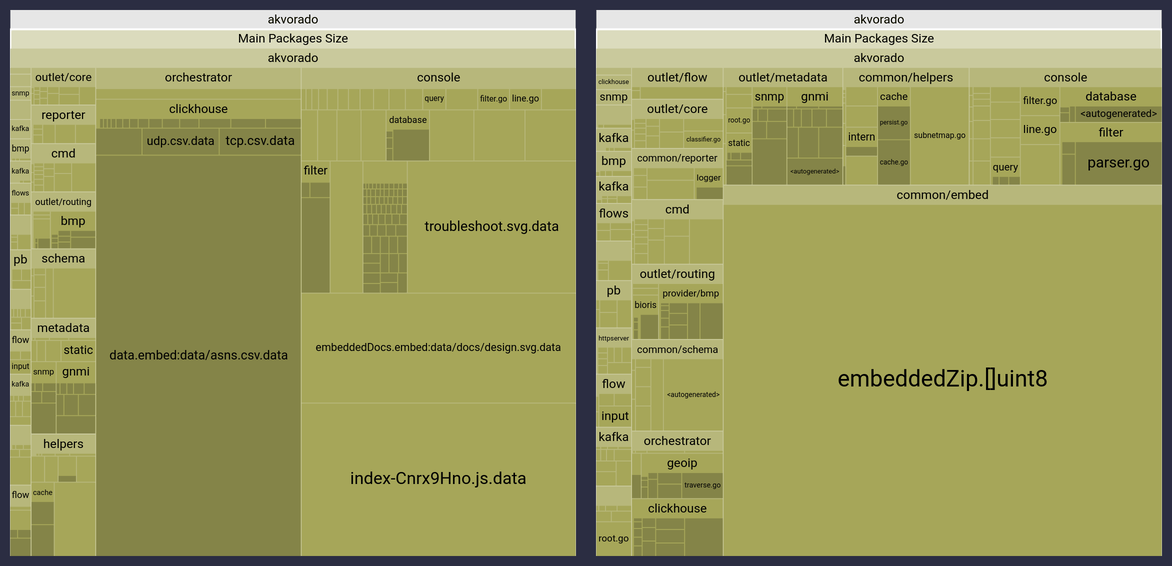
embed.zip.$ unzip -p common/embed/data/embed.zip wc -c numfmt --to=iec 7.3M $ ll common/embed/data/embed.zip -rw-r--r-- 1 bernat users 2.9M Dec 7 17:17 common/embed/data/embed.zip
goos: linux
goarch: amd64
pkg: akvorado/common/embed
cpu: AMD Ryzen 5 5600X 6-Core Processor
BenchmarkData/compressed-12     2262   526553 ns/op   610 B/op   10 allocs/op
BenchmarkData/uncompressed-12   9482   123175 ns/op     0 B/op    0 allocs/op
io.ReaderAt or io.Seeker
interfaces, unlike directly embedded files. This prevents some features, like
serving partial files or detecting MIME types when serving files over HTTP.
ReadDir() and ReadFile() methods.
archive/zip module does not support it.
apt-get install guix they use the official Guix guix-install.sh approach. Read more about that effort in the announcement of Debian with Guix.
The second step was to reconsider my approach to generate the Guix images. The earlier design had several stages. First, Debian+Guix containers were created. Then from those containers, a pure Guix container was created. Finally, using the pure Guix container another pure Guix container was created. The idea behind that GCC-like approach was to get to reproducible images that were created from an image that had no Debian left on it. However, I never managed to finish this. Partially because I hadn t realized that every time you build a Guix container image from Guix, you effectively go back in time. When using Guix version X to build a container with Guix on it, it will not put Guix version X into the container but will put whatever version of Guix is available in its package archive, which will be an earlier version, such as version X-N. I had hope to overcome this somehow (running a guix pull in newly generated images may work), but never finished this before Guix was removed from Debian.
So what could a better design look like?
For efficiency, I had already started experimenting with generating the final images directly from the Debian+Guix images, and after reproducibility bugs were fixed I was able to get to reproducible images. However, I was still concerned that the Debian container could taint the process somehow, and was also concerned about the implied dependency on non-free software in Debian.
I ve been using comparative rebuilds using similar distributions to confirm artifact reproducibility for my software projects, comparing builds on Trisquel 11 with Ubuntu 22.04, and AlmaLinux 9 with RockyLinux 9 for example. This works surprisingly well. Including one freedom-respecting distribution like Trisquel will detect if any non-free software has bearing on artifacts. Using different architectures, such as amd64 vs arm64 also help with deeper supply-chain concerns.
My conclusion was that I wanted containers with the same Guix commit for both Trisquel and Ubuntu. Given the similarity with Debian, adapting and launching the Guix on Trisquel/Debian project was straight forward. So we now have Trisquel 11/12 and Ubuntu 22.04/24.04 images with the same Guix on them.
Do you see where the debian-with-guix and guix-on-dpkg projects are leading to?
We are now ready to look at the modernized Guix Container Images project. The tags are the same as before:
registry.gitlab.com/debdistutils/guix/container:latest
registry.gitlab.com/debdistutils/guix/container:slim
registry.gitlab.com/debdistutils/guix/container:extra
registry.gitlab.com/debdistutils/guix/container:gashjas@kaka:~$ podman run -it --privileged --entrypoint=/bin/sh registry.gitlab.com/debdistutils/guix/container:latest
sh-5.2# env HOME=/ guix describe # https://issues.guix.gnu.org/74949
guix 21ce6b3
repository URL: https://git.guix.gnu.org/guix.git
branch: master
commit: 21ce6b392ace4c4d22543abc41bd7c22596cd6d2
sh-5.2# --entrypoint=/bin/sh is because Guix s pack command sets up the entry point differently than most other containers. This could probably be fixed if people want that, and there may be open bug reports about this.
The need for --privileged is more problematic, but is discussed upstream. The above example works fine without it, but running anything more elaborate with guix-daemon installing packages will trigger a fatal error. Speaking of that, here is a snippet of commands that allow you to install Guix packages in the container.
cp -rL /gnu/store/*profile/etc/* /etc/
echo 'root:x:0:0:root:/:/bin/sh' > /etc/passwd
echo 'root:x:0:' > /etc/group
groupadd --system guixbuild
for i in $(seq -w 1 10); do useradd -g guixbuild -G guixbuild -d /var/empty -s $(command -v nologin) -c "Guix build user $i" --system guixbuilder$i; done
env LANG=C.UTF-8 guix-daemon --build-users-group=guixbuild &
guix archive --authorize < /share/guix/ci.guix.gnu.org.pub
guix archive --authorize < /share/guix/bordeaux.guix.gnu.org.pub
guix install hello
GUIX_PROFILE="/var/guix/profiles/per-user/root/guix-profile"
. "$GUIX_PROFILE/etc/profile"
hello--disable-chroot to guix-daemon.
To use the containers to build something in a GitLab pipeline, here is an example snippet:
test-amd64-latest-wget-configure-make-libksba:
  image: registry.gitlab.com/debdistutils/guix/container:latest
  before_script:
  - cp -rL /gnu/store/*profile/etc/* /etc/
  - echo 'root:x:0:0:root:/:/bin/sh' > /etc/passwd
  - echo 'root:x:0:' > /etc/group
  - groupadd --system guixbuild
  - for i in $(seq -w 1 10); do useradd -g guixbuild -G guixbuild -d /var/empty -s $(command -v nologin) -c "Guix build user $i" --system guixbuilder$i; done
  - export HOME=/
  - env LANG=C.UTF-8 guix-daemon --build-users-group=guixbuild &
  - guix archive --authorize < /share/guix/ci.guix.gnu.org.pub
  - guix archive --authorize < /share/guix/bordeaux.guix.gnu.org.pub
  - guix describe
  - guix install libgpg-error
  - GUIX_PROFILE="//.guix-profile"
  - . "$GUIX_PROFILE/etc/profile"
  script:
  - wget https://www.gnupg.org/ftp/gcrypt/libksba/libksba-1.6.7.tar.bz2
  - tar xfa libksba-1.6.7.tar.bz2
  - cd libksba-1.6.7
  - ./configure
  - make V=1
- make check VERBOSE=t V=1 It's done! It's over!
I've graduated, I have the scroll, I'm staring at
the eye-watering prices for the official photographer snap, I'm
adjusting to post-thesis life.
My PhD thesis revisions have been accepted and my thesis
is now available from Newcastle University Library's eThesis
repository.
As part of submitting my corrections, I wrote a brief report
detailing the changes I made from my thesis at the time of
the viva. I also produced a latexdiff
marked-up copy of the thesis to visualise the exact changes.
In order to shed some light on the post-viva corrections process, at least at
my institution, and in the hope that they are some use to someone, I'm sharing
those documents:
$Name would be turned $Name~wikipesija.org
after the import.2 We also created empty user accounts that would take
ownership of the edits to be imported so that we could use the standard account
management tools on them later on. MediaWiki supports importing contributions
without a local account to attribute them to, but it doesn't seem to be possible
to convert an imported actor3 to a regular user later on which we wanted
to keep as a possibility, even with the minor downside of creating a few hundred
users that'll likely never get touched again later.
We also made specific decisions to add the username suffix to everyone, not to
just those names that'd conflicted with existing SUL accounts, and to deal with
renaming users that wanted their contributions linked to an existing SUL account
only after the import. This both reduced complexity and thus risk from the
import phase, which already had much more unknowns compared to the rest of the
process, but also were much better options ethically as well: suffixing all names
meant we would not imply that those people chose to be Wikimedians with those
specific usernames (when in reality it was us choosing to import those edits to
the Wikimedia universe), and doing renames using the standard MediaWiki account
management tooling meant that it produced the normal public log entries that
all other MediaWiki administrative actions create.
With all of the edits imported, the only major thing remaining was doing those merges
I mentioned earlier to attribute imported edits to people's existing SUL accounts.
Thankfully, the local account -based system makes it actually pretty simple. Usually
CentralAuth prevents renaming individual local accounts that are attached to a global
account, but that check can be bypassed with a maintenance script or a privileged
enough account. Renaming the user automatically detached it from the previous global
account, after which an another maintenance script could be used to attach the
user to the correct global account.
wikipesija.org was the domain where the old third-party wiki was hosted on, and
~ was used as a separator character in usernames during the
SUL finalization in the early
2010s so using it here felt appropriate as well.
Welcome to the report for November 2025 from the Reproducible Builds project!
 These monthly reports outline what we ve been up to over the past month, highlighting items of news from elsewhere in the increasingly-important area of software supply-chain security. As always, if you are interested in contributing to the Reproducible Builds project, please see the Contribute page on our website.
In this report:
 On Friday 8th November, Chris Lamb gave a talk called 10 years of Reproducible Builds at SeaGL in Seattle, WA.
Founded in 2013, SeaGL is a free, grassroots technical summit dedicated to spreading awareness and knowledge about free source software, hardware and culture. Chris talk:
[ ] introduces the concept of reproducible builds, its technical underpinnings and its potentially transformative impact on software security and transparency. It is aimed at developers, security professionals and policy-makers who are concerned with enhancing trust and accountability in our software. It also provides a history of the Reproducible Builds project, which is approximately ten years old. How are we getting on? What have we got left to do? Aren t all the builds reproducible now?
 In Debian this month, Jochen Sprickerhof created a merge request to replace the use of reprotest in Debian s Salsa Continuous Integration (CI) pipeline with debrebuild. Jochen cites the advantages as being threefold: firstly, that only one extra build needed ; it uses the same
sbuild and ccache tooling as the normal build ; and works for any Debian release . The merge request was merged by Emmanuel Arias and is now active.
 kpcyrd posted to our mailing list announcing the initial release of
repro-threshold, which implements an APT transport that defines a threshold of at least X of my N trusted rebuilders need to confirm they reproduced the binary before installing Debian packages. Configuration can be done through a config file, or through a curses-like user interface.
Holger then merged two commits by Jochen Sprickerhof in order to address a fakeroot-related reproducibility issue in the debian-installer, and J rg Jaspert deployed a patch by Ivo De Decker for a bug originally filed by Holger in February 2025 related to some Debian packages not being archived on snapshot.debian.org.
Elsewhere, Roland Clobus performed some analysis on the live Debian trixie images, which he determined were not reproducible. However, in a follow-up post, Roland happily reports that the issues have been handled. In addition, 145 reviews of Debian packages were added, 12 were updated and 15 were removed this month adding to our knowledge about identified issues.
Lastly, Jochen Sprickerhof filed a bug announcing their intention to binary NMU a very large number of the R programming language after a reproducibility-related toolchain bug was fixed.
 Bernhard M. Wiedemann posted another openSUSE monthly update for their work there.
 Julien Malka and Arnout Engelen launched the new hash collection
server for NixOS. Aside from improved reporting to help focus reproducible builds
efforts within NixOS, it collects build hashes as individually-signed attestations
from independent builders, laying the groundwork for further tooling.
307 was uploaded to Debian unstable (as well as version 309). These changes included further attempts to automatically attempt to deploy to PyPI by liaising with the PyPI developers/maintainers (with this experimental feature). [ ][ ][ ]
In addition, reprotest versions 0.7.31 and 0.7.32 were uploaded to Debian unstable by Holger Levsen, who also made the following changes:
debian/watch file, as Lintian now flags this as error for native Debian packages. [ ][ ]Standards-Version to 4.7.2, with no changes needed. [ ]Rules-Requires-Root header as it is no longer required.. [ ] Once again, there were a number of improvements made to our website this month including:
SOURCE_DATE_EPOCH page to fix the Lisp example syntax. [ ]

CONFIG_MODULE_HASHES patchset for the Linux kernel, which aims to enable reproducible kernel packages for Linux distributions .
.rpms.
 Via our mailing list, Martin Monperrus let us know about their recently-published page on the Software Supply Chain Security of Web3. The abstract of their paper is as follows:
Web3 applications, built on blockchain technology, manage billions of dollars in digital assets through decentralized applications (dApps) and smart contracts. These systems rely on complex, software supply chains that introduce significant security vulnerabilities. This paper examines the software supply chain security challenges unique to the Web3 ecosystem, where traditional Web2 software supply chain problems intersect with the immutable and high-stakes nature of blockchain technology. We analyze the threat landscape and propose mitigation strategies to strengthen the security posture of Web3 systems.Their paper lists reproducible builds as one of the mitigating strategies. A PDF of the full text is available to download.
SARndbox (race)clamav (rust toolchain)contrast/identity/loupe/mousai (need glib-macros update)cosmic (cosmic* HashMap)dealers-choice (nocheck)falcon (python-falcon date)FreeDoko (date)gnutls (FTBFS-CPU)gods-deluxe (jar mtimes)Kinect (date)libplasma6 (qmlcachegen race)llvm (rocm-omp date)rnp (FTBFS-2041)rocsolver (FTBFS-j1)switcheroo (FTBFS-j1)vdrift (date)ibus (parallelism)qmlcachegen (with Ulf Hermann)python-gffutils.python-biom-format.python-requests-cache.python-tld.smart-open.vanguards.pycifrw.golang-github-apptainer-container-library-client.python-ofxhome.python-lupa.mu-editor.python-spdx-tools.python-django-waffle.biosquid.dateparser.parsinsert.rdf2rml.python-et-xmlfile.deblur.ytcc.pgpainless.trillian.pywavelets.jsonpath-ng.presto.python-pyutil.python-os-apply-config.pydata-sphinx-theme.python-ciso8601.python-pymummer.qcat.tkgate.tkgate.ruby-gnuplot.python-nixio.python-altair.python-graphene.python-phabricator.python-slimmer.python-kafka.python-sshsig.python-babelgladeextractor.python-genson.flawfinder.crasm.insilicoseq.pychopper.pycparser.whipper.vt.pyxnat.golang-github-kshedden-statmodel.nim-hts.golang-github-emicklei-dot.golang-gonum-v1-plot.beangulp.virulencefinder.ansible-lint.entropybroker.namecheap.spopt.pyasn.python-pyvcf.python-pysaml2.#reproducible-builds on irc.oftc.net.
rb-general@lists.reproducible-builds.org
ssh root@192.168.1.1
$ schnapps list
#   Type        Size          Date                          Description
------+-----------+-------------+-----------------------------+------------------------------------
  500   post           15.98MiB   2025-08-09 11:27:48 -0700     Automatic post-update snapshot (TurrisOS 7.2.2 - hbs)
  506   pre            17.92MiB   2025-09-12 03:44:32 -0700     Automatic pre-update snapshot (TurrisOS 7.2.2 - hbs)
  507   post           17.88MiB   2025-09-12 03:45:14 -0700     Automatic post-update snapshot (TurrisOS 7.2.3 - hbs)
  515   time           20.03MiB   2025-11-02 01:05:01 -0700     Snapshot created by cron
  516   time           20.05MiB   2025-11-09 01:05:01 -0800     Snapshot created by cron
  517   time           20.29MiB   2025-11-16 01:05:00 -0800     Snapshot created by cron
  518   time           20.64MiB   2025-11-23 01:05:01 -0800     Snapshot created by cron
  519   time           20.83MiB   2025-11-30 01:05:00 -0800     Snapshot created by cron
  520   pre            87.91MiB   2025-11-30 07:41:10 -0800     Automatic pre-update snapshot (TurrisOS 7.2.3 - hbs)
  521   post          196.32MiB   2025-11-30 07:48:11 -0800     Automatic post-update snapshot (TurrisOS 9.0.0 - hbs)
  523   pre             4.44MiB   2025-11-30 20:47:31 -0800     Automatic pre-update snapshot
  524   post          224.00KiB   2025-11-30 20:47:43 -0800     Automatic post-update snapshot
  525   rollback      224.00KiB   2025-12-01 04:56:32 +0000     Rollback to snapshot factory
  526   pre             4.44MiB   2025-11-30 21:04:19 -0800     Automatic pre-update snapshot
  527   post          272.00KiB   2025-11-30 21:04:31 -0800     Automatic post-update snapshot
  528   rollback      272.00KiB   2025-12-01 05:13:38 +0000     Rollback to snapshot factory
  529   pre             4.52MiB   2025-11-30 21:28:44 -0800     Automatic pre-update snapshot
  530   single        208.00KiB
  531   rollback      224.00KiB   2025-12-01 05:29:47 +0000     Rollback to snapshot factory
$ schnapps rollback 520
Current state saved as snapshot number 532
Rolled back to snapshot 520
 Another short status update of what happened on my side last month. Hand holding the
release machinery for Phosh 0.51.0 but
there's more:
See below for details on the above and more:
phosh
DebugControl interface (MR)org.freedesktop.FileManager1 in the demo (MR, MR, MR)make run invocation (MR)None for parent in adw_dialog_choose (MR)


x-amz-copy-source to put an object and specifying an empty string as its content leads to the RGW daemon crashing, resulting in a DoS attack.
:wq for today.
| Series: | The Echo Archives #2 |
| Publisher: | Orbit |
| Copyright: | August 2025 |
| ISBN: | 0-316-30404-2 |
| Format: | Kindle |
| Pages: | 355 |
Next.