Although I've never written about them, I've been interested in music
synthesisers for ages. My colleagues know this. Whilst I've been
off sick, they had a whip-round and bought me a voucher for
Andertons, a UK-based music store, to cheer me up.
I'm absolutely floored by this generosity. And so, I'm now on a quest to
buy a synthesizer! Although, not my first one.
Alesis Micron on my desk, taunting me
I bought my first synth, an Alesis Micron, from a colleague at $oldjob,
16 years ago. For various reasons, I've struggled to engage with it, and
it's mostly been gathering dust on my desk in all that time. (I might
write more about the Micron in a later blog post). "Bad Gear" sums it up
better than I could:
So, I'm not truly buying my "first" synth, but for all intents and purposes I'm
on a similar journey to if I was, and I thought it might be fun to write about
it.
Goals
I want something which has as many of its parameters presented
physically, as knobs or sliders etc., as possible. One reason I've failed
to engage with the Micron (so far) is it's at the other end of this
spectrum, with hundreds of tunable parameters but a small handful of
knobs. To change parameters you have to go diving into menus presented on
a really old-fashioned, small LCD display. If you know what you are looking
for, you can probably find it; but if you just want to experiment and play
around, it's off-putting.
Secondly, I want something I can use away from a computer, as much as possible.
Computers are my day-job, largely dominate my existing hobbies, and are
unavoidable even in some of the others (like 3d printing).
Most of the computers I interact with run Linux. And for all its strengths,
audio management is not one of them. If I'm going to carve out some of my
extremely limited leisure time to explore this stuff, I don't to spend any
of it (at least now) fighting Pulseaudio/ALSA/Pipewire/JACK/OSS/whatever, or any
of the other foibles that might crop up1.
Thirdly, I'd like something which, in its soul, is an instrument. You can
get some amazing little synth boxes with a huge number of features in them.
Something with a limited number of features but which really feels well put
together would suit me better.
So next time, I'll write about the 2-3 top candidates on my list. Can you
guess what they might be?
To give another example. The other day I sat down to try and use the Micron,
which had its audio out wired into an external audio interface, in turn
plugged into my laptop's Thunderbolt dock. For a while I couldn't figure out
why I couldn't hear anything, until I realised the Thunderbolt dock was having
"a moment" and not presenting its USB devices to the laptop. Hobby time window
gone!
After (quite) a summer break, here comes the 4th article of the 5-episode blog post series on Polis, written by Guido Berh rster, member of staff at my company Fre(i)e Software GmbH.Have fun with the read on Guido's work on Polis,
Mike
Table of Contents of the Blog Post Series
Creating (a) new frontend(s) for Polis (this article)
Current status and roadmap
4. Creating (a) new frontend(s) for Polis
Why a new frontend was needed...
Our initial experiences of working with Polis, the effort required to implement
more invasive changes and the desire of iterating changes more rapidly
ultimately lead to the decision to create a new foundation for frontend
development that would be independent of but compatible with the upstream
project.
Our primary objective was thus not to develop another frontend but rather to
make frontend development more flexible and to facilitate experimentation and
rapid prototyping of different frontends by providing abstraction layers and
building blocks.
This also implied developing a corresponding backend since the Polis backend
is tightly coupled to the frontend and is neither intended to be used by
third-party projects nor supporting cross-domain requests due to the
expectation of being embedded as an iframe on third-party websites.
The long-term plan for achieving our objectives is to provide three abstraction
layers for building frontends:
a stable cross-domain HTTP API
a low-level JavaScript library for interacting with the HTTP API
a high-level library of WebComponents as a framework-neutral way of rapidly
building frontends
The Particiapp Project
Under the umbrella of the Particiapp project we have so far developed two
new components:
the example frontend project which currently contains both the client
library and an experimental example frontend built with it
Both the participation frontend and backend are fully compatible and require
an existing Polis installation and can be run alongside the upstream frontend.
More specifically, the administration frontend and common backend are required to
administrate conversations and send out notifications and the statistics
processing server is required for processing the voting results.
Particiapi server
For the backend the Python language and the Flask framework were
chosen as a technological basis mainly due to developer mindshare, a large
community and ecosystem and the smaller dependency chain and maintenance
overhead compared to Node.js/npm. Instead of integrating specific identity
providers we adopted the OpenID Connectstandard as an abstraction
layer for authentication which allows delegating authentication either to a
self-hosted identity provider or a large number of existing external
identity providers.
Particiapp Example Frontend
The experimental example frontend serves both as a test bed for the client
library and as a tool for better understanding the needs of frontend designers.
It also features a completely redesigned user interface and results
visualization in line with our goals. Branded variants are currently used for
evaluation and testing by the stakeholders.
In order to simplify evaluation, development, testing and deployment a Docker
Compose configuration is made available which contains all necessary
components for running Polis with our experimental example frontend. In
addition, a development environment is provided which includes a preconfigured
OpenID Connect identity provider (KeyCloak), SMTP-Server with web
interface (MailDev), and a database frontend (PgAdmin). The new
frontend can also be tested using our public demo server.
Last month, I traveled to Kenya to attend a conference called State of the Map 2024 ( SotM for short), which is an annual meetup of OpenStreetMap contributors from all over the world. It was held at the University of Nairobi Towers in Nairobi, from the 6th to the 8th of September.
University of Nairobi.
I have been contributing to OpenStreetMap for the last three years, and this conference seemed like a great opportunity to network with others in the community. As soon as I came across the travel grant announcement, I jumped in and filled the form immediately. I was elated when I was selected for the grant and couldn t wait to attend. The grant had an upper limit of 1200 and covered food, accommodation, travel and miscellaneous expenses such as visa fee.
Pre-travel tasks included obtaining Kenya s eTA and getting a yellow fever vaccine. Before the conference, Mikko from the Humanitarian OpenStreetMap Team introduced me to Rabina and Pragya from Nepal, Ibtehal from Bangladesh, and Sajeevini from Sri Lanka. We all booked the Nairobi Transit Hotel, which was within walking distance of the conference venue. Pragya, Rabina, and I traveled together from Delhi to Nairobi, while Ibtehal was my roommate in the hotel.
Our group at the conference.
The venue, University of Nairobi Towers, was a tall building and the conference was held on the fourth, fifth and sixth floors. The open area on the fifth floor of the building had a nice view of Nairobi s skyline and was a perfect spot for taking pictures. Interestingly, the university had a wing dedicated to Mahatma Gandhi, who is regarded in India as the Father of the Nation.
View of Nairobi's skyline from the open area on the fifth floor.
A library in Mahatma Gandhi wing of the University of Nairobi.
The diversity of the participants was mind-blowing, with people coming from a whopping 54 countries. I was surprised to notice that I was the only participant traveling from India, despite India having a large OpenStreetMap community. That said, there were two other Indian participants who traveled from other countries. I finally got to meet Arnalie (from the Phillipines) and Letwin (from Zimbabwe), both of whom I had only met online before. I had met Anisa (from Albania) earlier during DebConf 2023. But I missed Mikko and Honey from the Humanitarian OpenStreetMap Team, whom I knew from the Open Mapping Guru program.
I learned about the extent of OSM use through Pragya and Rabina s talk; about the logistics of running the OSM Board, in the OSMF (OpenStreetMap Foundation) session; about the Youth Mappers from Sajeevini, about the OSM activities in Malawi from Priscilla Kapolo, and about mapping in Zimbabwe from Letwin. However, I missed Ibtehal s lightning session. The ratio of women speakers and participants at the conference was impressive, and I hope we can get such gender representation in our Delhi/NCR mapping parties.
One of the conference halls where talks took place.
Outside of talks, the conference also had lunch and snack breaks, giving ample time for networking with others. In the food department, there were many options for a lacto-ovo vegetarian like myself, including potatoes, rice, beans, chips etc. I found out that the milk tea in Kenya (referred to as white tea ) is usually not as strong compared to India, so I switched to coffee (which is also called white coffee when taken with milk). The food wasn t spicy, but I can t complain :) Fruit juices served as a nice addition to lunch.
One of the lunch meals served during the conference.
At the end of the second day of the conference, there was a surprise in store for us a bus ride to the Bao Box restaurant. The ride gave us the experience of a typical Kenyan matatu (privately-owned minibuses used as share taxis), complete with loud rap music. I remember one of the songs being Kraff s Nursery Rhymes. That day, I was wearing an original Kenyan cricket jersey - one that belonged to Dominic Wesonga, who represented Kenya in four ODIs. This confused Priscilla Kapolo, who asked if I was from Kenya! Anyway, while it served as a good conversation starter, it didn t attract as much attention as I expected :) I had some pizza and chips there, and later some drinks with Ibtehal. After the party, Piyush went with us to our hotel and we played a few games of UNO.
Minibus which took us from the university to Bao Box restaurant.
This minibus in the picture gave a sense of a real matatu.
I am grateful to the organizers Laura and Dorothea for introducing me to Nikhil when I was searching for a companion for my post-conference trip. Nikhil was one of the aforementioned Indian participants, and a wildlife lover. We had some nice conversations; he wanted to go to the Masai Maara Natural Reserve, but it was too expensive for me. In addition, all the safaris were multi-day affairs, and I wasn t keen on being around wildlife for that long. Eventually I chose to go my own way, exploring the coastal side and visiting Mombasa.
While most of the work regarding the conference was done using free software (including the reimbursement form and Mastodon announcements), I was disappointed by the use of WhatsApp for coordination with the participants. I don t use WhatsApp and so was left out. WhatsApp is proprietary software (they do not provide the source code) and users don t control it. It is common to highlight that OpenStreetMap is controlled by users and the community, rather than a company - this should apply to WhatsApp as well.
My suggestion is to use XMPP, which shares similar principles with OpenStreetMap, as it is privacy-respecting, controlled by users, and powered by free software. I understand the concern that there might not be many participants using XMPP already. Although it is a good idea to onboard people to free software like XMPP, we can also create a Matrix group, and bridge it with both the XMPP group and the Telegram group. In fact, using Matrix and bridging it with Telegram is how I communicated with the South Asian participants. While it s not ideal - as Telegram s servers are proprietary and centralized - but it s certainly much better than creating a WhatsApp-only group. The setup can be bridged with IRC as well. On the other hand, self-hosted mailing lists for participants is also a good idea.
Finally, I would like to thank SotM for the generous grant, enabling me to attend this conference, meet the diverse community behind OSM and visit the beautiful country of Kenya. Stay tuned for the blog post on Kenya trip.
Thanks to Sahilister, Contrapunctus, Snehal and Badri for reviewing the draft of this blog post before publishing.
After years on the waiting list, May First was just
given a /24 block of IP addresses. Excellent.
Now we want to start using them for, among other things, sending email.
I haven t added a new IP address to our mail relays in a while and things seems
to change regularly in the world of email so I m curious: what s the best 2024
way to warm up IP addresses, particularly using postfix?
Sendergrid has a nice page on the
topic. It
establishes the number of messages to send per day. But I m not entirely sure
how to fit messages per day into our setup.
We use round robin DNS to direct email to one of several dozen email relay
servers using postfix. And unfortunately our DNS software
(knot) doesn t
have a way to add weights to ensure some IPs show up more often than others
(much less limit the specific number of messages a given relay should get).
Postfix has some nice knobs for rate limiting, particularly:
default_destination_recipient_limit
and
default_destination_rate_delay
If default_destination_recipient_limit is over 1, then
default_destination_rate_delay is equal to the minimum delay between sending
email to the same domain.
So, I m staring our IP addresses out at 30m - which prevents any single domain
from receiving more than 2 messages per hour. Sadly, there are a lot of
different domain names that deliver to the same set of popular corporate MX
servers, so I am not sure I can accurately control how many messages a given
provider sees coming from a given IP address. But it s a start.
A bigger problem is that messages that exceed the limit hang out in the
active queue until they can be sent without violating the rate limit. Since I
can t fully control the number of messages a given queue receives (due to my
inability to control the DNS round robin weights), a lot of messages are going
to be severely delayed, especially ones with an @gmail.com domain name.
I know I can temporarily set relayhost to a different queue and flush
deferred messages, however, as far as I can tell, it doesn t work with
active messages.
To help mitigate the problem I m only using our bulk mail queue to warm up IPs,
but really, this is not ideal.
Suggestions welcome!
Update #1
If you are running postfix in a multi-instance setup and you have instances
that are already warmed up, you can move active messages between queues with
these steps:
# Put the message on hold in the warming up instance
postsuper -c /etc/postfix-warmingup -h $queueid
# Copy to a warmed up instance
cp --preserve=mode,ownership,timestamp /var/spool/postfix-warmingup/hold/$queueid /var/spool/postfix-warmedup/incoming/
# Queue the message
postqueue -c /etc/postfix-warmedup -i $queueid
# Delete from the original queue.
postsuper -c /etc/postfix-warmingup -d $queueid
After just 12 hours we had thousands of messages piling up. This warm up method
was never going to work without the ability to move them to a faster queue.
[Additional update: be sure to reload the postfix instance after flushing the queue so
messages are drained from the active queue on the correct schedule. See update #4.]
Update #2
After 24 hours, most email is being accepted as far as I can tell. I am still
getting a small percentage of email deferred by Yahoo with:
421 4.7.0 [TSS04] Messages from 204.19.241.9 temporarily deferred due to unexpected volume or user complaints - 4.16.55.1; see https://postmaster.yahooinc.com/error-codes (in reply
So I will keep it as 30m for another 24 hours or so and then move to 15m. Now
that I can flush the backlog of active messages I am in less of a hurry.
Update #3
Well, this doesn t seem to be working the way I want it to.
When a message arrives faster than the designated rate limit, it remains in the active queue.
I m entirely sure how the timing is supposed to work, but at this point I m
down to a 5m rate delay, and the active messages are just hanging out for a lot
longer than 5m. I tried flushing the queue, but that only seems to affect the
deferred messages. I finally got them re-tried with systemctl reload. I
wonder if there is a setting to control this retry? Or better yet, why can t
these messages that exceed the rate delayed be deferred instead?
Update #4
I think I see why I was confused in Update #3 about the timing. I suspect that
when I move messages out of the active queue it screws up the timer. Reloading
the instance resets the timer. Every time you muck with active messages, you
should reload.
The relational model is probably the one innovation that brought computers to the mainstream for business users. This article by Donald Chamberlin, creator of one of the first query languages (that evolved into the ubiquitous SQL), presents its history as a commemoration of the 50th anniversary of his publication of said query language.
The article begins by giving background on information processing before the advent of today s database management systems: with systems storing and processing information based on sequential-only magnetic tapes in the 1950s, adopting a record-based, fixed-format filing system was far from natural. The late 1960s and early 1970s saw many fundamental advances, among which one of the best known is E. F. Codd s relational model. The first five pages (out of 12) present the evolution of the data management community up to the 1974 SIGFIDET conference. This conference was so important in the eyes of the author that, in his words, it is the event that starts the clock on 50 years of relational databases.
The second part of the article tells about the growth of the structured English query language (SEQUEL) eventually renamed SQL including the importance of its standardization and its presence in commercial products as the dominant database language since the late 1970s. Chamberlin presents short histories of the various implementations, many of which remain dominant names today, that is, Oracle, Informix, and DB2. Entering the 1990s, open-source communities introduced MySQL, PostgreSQL, and SQLite.
The final part of the article presents controversies and criticisms related to SQL and the relational database model as a whole. Chamberlin presents the main points of controversy throughout the years: 1) the SQL language lacks orthogonality; 2) SQL tables, unlike formal relations, might contain null values; and 3) SQL tables, unlike formal relations, may contain duplicate rows. He explains the issues and tradeoffs that guided the language design as it unfolded. Finally, a section presents several points that explain how SQL and the relational model have remained, for 50 years, a winning concept, as well as some thoughts regarding the NoSQL movement that gained traction in the 2010s.
This article is written with clear language and structure, making it easy and pleasant to read. It does not drive a technical point, but instead is a recap on half a century of developments in one of the fields most important to the commercial development of computing, written by one of the greatest authorities on the topic.
Review: The Wings Upon Her Back, by Samantha Mills
Publisher:
Tachyon
Copyright:
2024
ISBN:
1-61696-415-4
Format:
Kindle
Pages:
394
The Wings Upon Her Back is a political steampunk science fantasy
novel. If the author's name sounds familiar, it may be because Samantha
Mills's short story "Rabbit Test" won Nebula, Locus, Hugo, and Sturgeon
awards. This is her first novel.
Winged Zemolai is a soldier of the mecha god and the protege of Mecha
Vodaya, the Voice. She has served the city-state of Radezhda by defending
it against all enemies, foreign and domestic, for twenty-six years.
Despite that, it takes only a moment of errant mercy for her entire life
to come crashing down. On a whim, she spares a kitchen worker who was
concealing a statue of the scholar god, meaning that he was only
pretending to worship the worker god like all workers should. Vodaya is
unforgiving and uncompromising, as is the sleeping mecha god. Zemolai's
wings are ripped from her back and crushed in the hand of the god, and
she's left on the ground to die of mechalin withdrawal.
The Wings Upon Her Back is told in two alternating timelines. The
main one follows Zemolai after her exile as she is rescued by a young
group of revolutionaries who think she may be useful in their plans. The
other thread starts with Zemolai's childhood and shows the reader how she
became Winged Zemolai: her scholar family, her obsession with flying, her
true devotion to the mecha god, and the critical early years when she
became Vodaya's protege. Mills maintains the separate timelines through
the book and wraps them up in a rather neat piece of symbolic parallelism
in the epilogue.
I picked up this book on a recommendation from C.L. Clark, and yes, indeed, I can see why she liked this book. It's a
story about a political awakening, in which Zemolai slowly realizes that
she has been manipulated and lied to and that she may, in fact, be one of
the baddies. The Wings Upon Her Back is more personal than some
other books with that theme, since Zemolai was specifically (and
abusively) groomed for her role by Vodaya. Much of the book is Zemolai
trying to pull out the hooks that Vodaya put in her or, in the flashback
timeline, the reader watching Vodaya install those hooks.
The flashback timeline is difficult reading. I don't think Mills could
have left it out, but she says in the afterword that it was the hardest
part of the book to write and it was also the hardest part of the book to
read. It fills in some interesting bits of world-building and backstory,
and Mills does a great job pacing the story revelations so that both
threads contribute equally, but mostly it's a story of manipulative abuse.
We know from the main storyline that Vodaya's tactics work, which gives
those scenes the feel of a slow-motion train wreck. You know what's going
to happen, you know it will be bad, and yet you can't look away.
It occurred to me while reading this that Emily Tesh's
Some Desperate Glory told a similar type
of story without the flashback structure, which eliminates the stifling
feeling of inevitability. I don't think that would not have worked for
this story. If you simply rearranged the chapters of The Wings Upon
Her Back into a linear narrative, I would have bailed on the book.
Watching Zemolai being manipulated would have been too depressing and
awful for me to make it to the payoff without the forward-looking hope of
the main timeline. It gave me new appreciation for the difficulty of what
Tesh pulled off.
Mills uses this interwoven structure well, though. At about 90% through
this book I had no idea how it could end in the space remaining, but it
reaches a surprising and satisfying conclusion. Mills uses a type of
ending that normally bothers me, but she does it by handling the
psychological impact so well that I couldn't help but admire it. I'm
avoiding specifics because I think it worked better when I wasn't
expecting it, but it ties beautifully into the thematic point of the book.
I do have one structural objection, though. It's one of those problems I
didn't notice while reading, but that started bothering me when I thought
back through the story from a political lens. The Wings Upon Her
Back is Zemolai's story, her redemption arc, and that means she drives
the plot. The band of revolutionaries are great characters (particularly
Galiana), but they're supporting characters. Zemolai is older, more
experienced, and knows critical information they don't have, and she uses
it to effectively take over. As setup for her character arc, I see why
Mills did this. As political praxis, I have issues.
There is a tendency in politics to believe that political skill is
portable and repurposable. Converting opposing operatives to the cause is
welcomed not only because they indicate added support, but also because
they can use their political skill to help you win instead. To an extent
this is not wrong, and is probably the most true of combat skills (which
Zemolai has in abundance). But there's an underlying assumption that
politics is symmetric, and a critical reason why I hold many of the
political positions that I do hold is that I don't think politics is
symmetric.
If someone has been successfully stoking resentment and xenophobia in
support of authoritarians, converts to an anti-authoritarian cause, and
then produces propaganda stoking resentment and xenophobia against
authoritarians, this is in some sense an improvement. But if one believes
that resentment and xenophobia are inherently wrong, if one's politics are
aimed at reducing the resentment and xenophobia in the world, then in a
way this person has not truly converted. Worse, because this is an
effective manipulation tactic, there is a strong tendency to put this type
of political convert into a leadership position, where they will,
intentionally or not, start turning the anti-authoritarian movement into a
copy of the authoritarian movement they left. They haven't actually
changed their politics because they haven't understood (or simply don't
believe in) the fundamental asymmetry in the positions. It's the same
criticism that I have of realpolitik: the ends do not justify the
means because the means corrupt the ends.
Nothing that happens in this book is as egregious as my example, but the
more I thought about the plot structure, the more it bothered me that
Zemolai never listens to the revolutionaries she joins long enough to
wrestle with why she became an agent of an authoritarian state and they
didn't. They got something fundamentally right that she got wrong, and
perhaps that should have been reflected in who got to make future
decisions. Zemolai made very poor choices and yet continues to be the
sole main character of the story, the one whose decisions and actions
truly matter. Maybe being wrong about everything should be disqualifying
for being the main character, at least for a while, even if you think
you've understood why you were wrong.
That problem aside, I enjoyed this. Both timelines were compelling and
quite difficult to put down, even when they got rather dark. I could have
done with less body horror and a few fewer fight scenes, but I'm glad I
read it.
Science fiction readers should be warned that the world-building, despite
having an intricate and fascinating surface, is mostly vibes. I started
the book wondering how people with giant metal wings on their back can
literally fly, and thought the mentions of neural ports, high-tech
materials, and immune-suppressing drugs might mean that we'd get some sort
of explanation. We do not: heavier-than-air flight works because it looks
really cool and serves some thematic purposes. There are enough hints of
technology indistinguishable from magic that you could make up your own
explanations if you wanted to, but that's not something this book is
interested in. There's not a thing wrong with that, but don't get caught
by surprise if you were in the mood for a neat scientific explanation of
apparent magic.
Recommended if you like somewhat-harrowing character development with a
heavy political lens and steampunk vibes, although it's not the sort of
book that I'd press into the hands of everyone I know. The Wings
Upon Her Back is a complete story in a single novel.
Content warning: the main character is a victim of physical and emotional
abuse, so some of that is a lot. Also surgical gore, some torture, and
genocide.
Rating: 7 out of 10
Tobias Frost
did 2.5h (out of 7.75h assigned and 4.25h from previous period), thus carrying over 9.5h to the next month.
Evolution of the situation
In August, we have released 1 DLAs.
During the month of August Debian 11 "bullseye" officially transitioned to the responsibility of the LTS team (on 2024-08-15). However, because the final point release (11.11) was not made until 2024-08-31, LTS contributors were prevented from uploading packages to bullseye until after the point release had been made. That said, the team was not at all idle, and was busy at work on a variety of tasks which impacted both LTS and the broader Debian community, as well as preparing uploads which will be released during the month of September.
Of particular note, LTS contributor Bastien Roucari s prepared updates of the putty and cacti packages for bookworm (12) and bullseye (12), which were accepted by the old-stable release managers for the August point releases. He also analysed several security regressions in the apache2 package. LTS contributor Emilio Pozuelo Monfort worked on the Rust toolchain in bookworm and bullseye, which will be needed to support the upcoming Firefox ESR and Thunderbird ESR releases from the Mozilla project. Additionally, LTS contributor Thorsten Alteholz prepared bookworm and bullseye updates of the cups package (12), which were accepted by the old-stable release managers for the August point releases.
LTS contributor Markus Koschany collaborated with Emmanuel Bourg, co-maintainer of the tomcat packages in Debian. Regressions in a proposed security fix necessitated the updating of the tomcat10 package in Debian to the latest upstream release.
LTS contributors Bastien and Santiago Ruano Rinc n collaborated with the upstream developers and the Debian maintainer (Bernhard Schmidt) of the FreeRADIUS project towards addressing the BlastRADIUS vulnerability in the bookworm and bullseye versions of the freeradius package. If you use FreeRADIUS in Debian bookworm or bullseye, we encourage you to test the packages following the instructions found in the call for testers to help identifying any possible regression that could be introduced with these updates.
Testing is an important part of the work the LTS Team does, and in that vein LTS contributor Sean Whitton worked on improving the documentation and tooling around creating test filesystems which can be used for testing a variety of package update scenarios.
Thanks to our sponsors
Sponsors that joined recently are in bold.
I investigated a
regression for nftables
introduced in my final upload of linux to buster-security, and
passed on the information to the Freexian ELTS team.
For the Debian a56 package, which is a build-dependency of
firmware-free, I made an NMU fixing a build failure with gcc-14 and
many compiler warnings. These changes were included in
version 1.3+dfsg-11.
Welcome to the August 2024 report from the Reproducible Builds project!
Our reports attempt to outline what we ve been up to over the past month, highlighting news items from elsewhere in tech where they are related. As ever, if you are interested in contributing to the project, please visit our Contribute page on our website.
Table of contents:
Intermediate Autotools build artifacts removed from PostgreSQL distribution tarballs
Peter Eisentraut wrote a detailed blog post on the subject of The new PostgreSQL 17 make dist . Like many projects, the PostgreSQL database has previously pre-built parts of its GNU Autotools build system: the reason for this is a mix of convenience and traditional practice . Peter astutely notes that this arrangement in the build system is quite tricky as:
You need to carefully maintain the different states of clean source code , partially built source code , and fully built source code , and the commands to transition between them.
However, Peter goes on to mention that:
a lot more attention is nowadays paid to the software supply chain. There are security and legal reasons for this. When users install software, they want to know where it came from, and they want to be sure that they got the right thing, not some fake version or some version of dubious legal provenance.
And cites the XZ Utils backdoor as a reason to care about transparent and reproducible ways of distributing and communicating a source tarball and provenance. Because of this, intermediate build artifacts are now henceforth essentially disallowed from PostgreSQL distribution tarballs.
Distribution news
In Debian this month, 30 reviews of Debian packages were added, 17 were updated and 10 were removed this month adding to our knowledge about identified issues. One issue type was added by Chris Lamb, too. []
In addition, an issue was filed to update the Salsa CI pipeline (used by 1,000s of Debian packages) to no longer test for reproducibility with reprotest s build_path variation. Holger Levsen provided a rationale for this change in the issue, which has already been made to the tests being performed by tests.reproducible-builds.org.
In Arch Linux this month, Jelle van der Waa published a short blog post on the topic of Investigating creating reproducible images with mkosi, motivated by the desire to make it possible for anyone to re-recreate the official Arch cloud image bit-by-bit identical on their own machine as per [the] reproducible builds definition. In addition, Jelle filed a patch for pacman, the Arch Linux package manager, to respect the SOURCE_DATE_EPOCH environment variable when installing a package.
In openSUSE news, Bernhard M. Wiedemann published another report for that distribution.
In Android news, the IzzyOnDroid project added 49 new rebuilder recipes and now features 256 total reproducible applications representing 21% of the total offerings in the repository. IzzyOnDroid is an F-Droid style repository for Android apps[:] applications in this repository are official binaries built by the original application developers, taken from their resp. repositories (mostly GitHub).
Bernhard M. Wiedemann posted a brief message to the list with some helpful information regarding nondeterminism within Rust binaries, positing the use of the codegen-units = 16 default and resulting in a bug being filed in the Rust issue tracker. []
Bernhard also wrote to the list, following up to a thread in November 2023, on attempts to make the LibreOffice suite of office applications build reproducibly. In the thread from this month, Bernhard could announce that the four patches previously mentioned have landed in LibreOffice upstream.
Fay Stegerman linked the mailing list to a thread she made on the Signal issue tracker regarding whether device-specific binaries [can] ever be considered meaningfully reproducible . In particular: the whole part about allow[ing] multiple third parties to come to a consensus on a correct result breaks down completely when correct is device-specific and not something everyone can agree on. []
Developer kpcyrdposted an update for source code indexing project, whatsrc.org. Announcing that it now importing packages from live-bootstrap ( a usable Linux system [that is] created with only human-auditable, and wherever possible, human-written, source code ) into its database of provenance data.
Lastly, Mechtilde Stehmann posted an update to an earlier thread about how Java builds are not reproducible on the armhf architecture, enquiring how they might gain temporary access to such a machine in order to perform some deeper testing. []
diffoscopediffoscope is our in-depth and content-aware diff utility that can locate and diagnose reproducibility issues. This month, Chris Lamb released versions 274, 275, 276 and 277, uploaded these to Debian, and made the following changes as well:
New features:
Strip ANSI escapes usually colour codes from the output of the Procyon Java decompiler. []
Factor out a method for stripping ANSI escapes. []
Append output from dumppdf(1) in more cases, avoiding situations where we fallback to a binary diff. []
Add support for versions of Perl s IO::Compress::Zip version 2.212. []
Bug fixes:
Also catch RuntimeError exceptions when importing the PyPDF library so that it, or, crucially, its transitive dependencies, cannot not cause diffoscope to traceback at runtime and build time. []
Do not call marshal.load( ) of precompiled Python bytecode as it, alas, inherently unsafe. Replace for now with a brief summary of the code section of .pyc. [][]
Don t include excessive debug output when calling dumppdf(1). []
Testsuite-related changes:
Don t bother to check version number in test_python.py: the fixture for this test is fixed. [][]
Update test_zip text fixtures and definitions to support new changes to the Perl IO::Compress library. []
In addition, Mattia Rizzolo updated the available architectures for a number of test dependencies [] and Sergei Trofimovich fixed an issue to avoid diffoscope crashing when hashing directory symlinks [] and Vagrant Cascadian proposed GNU Guix updates for diffoscope versions 275 and 276 and 277.
Website updates
There were a rather substantial number of improvements made to our website this month, including:
Alba Herrerias:
Substantially extend the guidance on the Contribute page. []
Chris Lamb:
Set the future: true configuration value so we render all files and documents in the website, regardless of whether they have a date property in the future. After all, we don t re-generate the website on a timer, and have other ways of making unpublished, draft posts. [][]
Considerably overhaul the History page in the documentation, linking strip-nondeterminism and SOURCE_DATE_EPOCH [], fixing the test statistics link [], adjusting the Google Summer of Code application link [], a link to a Debian bug [], and removed a dead link to the debhelper utility [].
Use the jekyll-sitemap plugin to create a sitemap for the website. []
Use raw HTML to avoid a literal .lead directive appearing in the page. []
Upstream patches
The Reproducible Builds project detects, dissects and attempts to fix as many currently-unreproducible packages as possible. We endeavour to send all of our patches upstream where appropriate. This month, we wrote a large number of such patches, including:
Reproducibility testing framework
The Reproducible Builds project operates a comprehensive testing framework running primarily at tests.reproducible-builds.org in order to check packages and other artifacts for reproducibility. In August, a number of changes were made by Holger Levsen, including:
Temporarily install the openssl-provider-legacy package for the Debian unstable environments for running diffoscope due to Debian bug #1078944. [][][][]
Mark Debian armhf architecture nodes as being down due to proxy down. [][]
Detect proxy failures. [][][]
Run the index-buildinfo for the builtin-pho script with the -q switch. []
In addition, Mattia Rizzolo updated the website configuration to install the ruby-jekyll-sitemap package as it is now used in the website [], Roland Clobus updated the script to build Debian live images to treat openQA issues as warnings [], and Vagrant Cascadian marked the cbxi4b node as down [].
If you are interested in contributing to the Reproducible Builds project, please visit our Contribute page on our website. However, you can get in touch with us via:
Another short status update of what happened on my side last month.
Quite a bit of time went
into helping organize the FrOSCon FOSS on Mobile dev room (day 1, day 2, summary) but that was all worth it and fun - so was releasing Phosh 0.41.0 (which incidetally happened right before FrOScon). A three years old MR to xdg-spec to add call categories landed (thanks Matthias) allowing us to finally provide proper feedback for e.g. IM calls too. The rest was some OSK improvements (around Indic language support via varnam and layout configuration), some Cell Broadcast advancements (thanks to NGI0 for supporting this) but also some fixes. Here's the details:
Phosh
Debug crash when swiping away keyboard on lockscreen (MR).
Fix outdated clock when swiping back from lockscreen plugins (MR)
Allow to select OSK layouts (MR). This ensures only actually available layouts can be selected. Currently used by phosh-osk-stub but can easily be extended to squeekboard once it provides the information.
Rework most bits of Cell Broadcast to move it closer to undraft status (MR).
(Remaining bits affect enabling of unsolicited messages and setting channels).
Help Development
If you want to support my work see donations. This includes
a list of hardware we want to improve support for. Thanks a lot to all current and past donors.
Reasons Not to Worry is a self-help non-fiction book about
stoicism, focusing specifically on quotes from Seneca, Epictetus, and
Marcus Aurelius. Brigid Delaney is a long-time Guardian columnist
who has written on a huge variety of topics, including (somewhat
relevantly to this book) her personal experiences trying weird fads.
Stoicism is having a moment among the sort of men who give people life
advice in podcast form. Ryan Holiday, a former marketing executive, has
made a career out of being the face of stoicism in everyone's podcast feed
(and, of course, hosting his own). He is far from alone. If you pay
attention to anyone in the male self-help space right now (Cal Newport, in
my case), you have probably heard something vague about the "wisdom of the
stoics."
Given that the core of stoicism is easily interpreted as a strategy for
overcoming your emotions with logic, this isn't surprising. Philosophies
that lean heavily on college dorm room logic, discount emotion, and argue
that society is full of obvious flaws that can be analyzed and debunked by
one dude with some blog software and a free afternoon have been very
popular in tech circles for the past ten to fifteen years, and have spread
to some extent into popular culture. Intriguingly, though, stoicism is a
system of virtue
ethics, which means it is historically in opposition to consequentialist
philosophies like utilitarianism, the ethical philosophy behind
effective altruism and other
related Silicon Valley fads.
I am pretty exhausted with the whole genre of men talking to each other
about how to live a better life Cal Newport by himself more than
satisfies the amount of that I want to absorb but I was still mildly
curious about stoicism. My education didn't provide me with a satisfying
grounding in major historical philosophical movements, so I occasionally
look around for good introductions. Stoicism also has some reputation as
an anxiety-reduction technique, and I could use more of those. When I saw
a Discord recommendation for Reasons Not to Worry that specifically
mentioned its lack of bro perspective, I figured I'd give it a shot.
Reasons Not to Worry is indeed not a bro book, although I would
have preferred fewer appearances of the author's friend Andrew, whose
opinions on stoicism I could not possibly care less about. What it is,
though, is a shallow and credulous book that falls squarely in the middle
of the lightweight self-help genre. Delaney is here to explain why
stoicism is awesome and to convince you that a school of Greek and Roman
philosophers knew exactly how you should think about your life today. If
this sounds quasi-religious, well, I'll get to that.
Delaney does provide a solid introduction to stoicism that I think is a
bit more approachable than reading the relevant Wikipedia article. In her
presentation, the core of stoicism is the practice of four virtues:
wisdom, courage, moderation, and justice. The modern definition of
"stoic" as someone who is impassive in the presence of pleasure or pain is
somewhat misleading, but Delaney does emphasize a goal of
ataraxia, or tranquility of mind. By making that the goal rather
than joy or pleasure, stoicism tries to avoid the trap of the
hedonic treadmill
in favor of a more achievable persistent contentment.
As an aside, some quick Internet research makes me doubt Delaney's summary
here. Other material about stoicism I found focuses on apatheia
and associates ataraxia with Epicureanism instead. But I won't
start quibbling with Delaney's definitions; I'm not qualified and this
review is already too long.
The key to ataraxia, in Delaney's summary of stoicism, is to
focus only on those parts of life we can control. She summarizes those as
our character, how we treat others, and our actions and reactions.
Everything else wealth, the esteem of our colleagues, good health, good
fortune is at least partly outside of our control, and therefore we
should enjoy it when we have it but try to be indifferent to whether it
will last. Attempting to control things that are outside of our control
is doomed to failure and will disturb our tranquility. Essentially all of
this book is elaborations and variations on this theme, specialized to
some specific area of life like social media, anxiety, or grief and
written in the style of a breezy memoir.
If you're familiar with modern psychological treatment frameworks like
cognitive behavioral therapy or
acceptance and commitment therapy, this summary of stoicism may sound
familiar. (Apparently this is not an accident; the predecessor to CBT
used stoicism as a philosophical basis.) Stoicism, like those treatment
approaches, tries to refocus your attention on the things that you can
improve and de-emphasizes the things outside of your control. This is a
lot of the appeal, at least to me (and I think to Delaney as well).
Hearing that definition, you may have some questions. Why those virtues
specifically? They sound good, but all virtues sound good almost by
definition. Is there any measure of your success in following those
virtues outside your subjective feeling of ataraxia? Does the
focus on only things you can control lead to ignoring problems only mostly
outside of your control, where your actions would matter but only to a
small degree? Doesn't this whole philosophy sound a little self-centered?
What do non-stoic virtue ethics look like, and why do they differ from
stoicism? What is the consequentialist critique of stoicism?
This is where the shortcomings of this book become clear: Delaney is not
very interested in questions like this. There are sections on some of
those topics, particularly the relationship between stoicism and social
justice, but her treatment is highly unsatisfying. She raises the
question, talks about her doubts about stoicism's applicability, and then
says that, after further thought, she decided stoicism is entirely
consistent with social justice and the stoics were right after all. There
is a little bit more explanation than that, but not much. Stoicism can
apparently never be wrong; it can only be incompletely understood.
Self-help books often fall short here, and I suspect this may be what the
audience wants. Part of the appeal of the self-help genre is artificial
certainty. Becoming a better manager, starting a business, becoming more
productive, or working out an entire life philosophy are not problems
amenable to a highly approachable and undemanding book. We all know that
at some level, but the seductive allure of the self-help genre is the
promise of simplifying complex problems down to a few approachable bullet
points. Here is a life philosophy in a neatly packaged form, and if you
just think deeply about its core principles, you will find they can be
applied to any situation and any doubts you were harboring will turn out
to be incorrect.
I am all too familiar with this pattern because it's also how
fundamentalist Christianity works. The second time Delaney talked about
her doubts about the applicability of stoicism and then claimed a few
pages later that those doubts disappeared with additional thought and
discussion, my radar went off. This book was sounding less like a
thoughtful examination of one specific philosophy out of many and more
like the soothing adoption of religious certainty by a convert. I was
therefore entirely unsurprised when Delaney all but says outright in the
epilogue that she's adopted stoicism as her religion and approaches it
with the same dedicated practice that she used to bring to Catholicism. I
think this is where a lot of self-help books end up, although most of them
don't admit it.
There's nothing wrong with this, to be clear. It sounds like she was
looking for a non-theistic religion, found one that she liked, and is
excited to tell other people about it. But it's a profound mismatch with
what I was looking for in an introduction to stoicism. I wanted context,
history, and a frank discussion of the problems with adopting philosophy
to everyday issues. I also wanted some acknowledgment that it is highly
unlikely that a few men who lived 2000 years ago in a wildly different
social context, and with drastically limited information about cultures
other than their own, figured out a foolproof recipe for how to approach
life. The subsequent two millennia of philosophical debates prove that
stoicism didn't end the argument, and that a lot of other philosophers
thought that stoicism got a few things wrong. You would never know that
from this book.
What I wanted is outside the scope of this sort of undemanding self-help
book, though, and this is the problem that I keep having with philosophy.
The books I happen across are either nigh-incomprehensibly dense and
academic, or they're simplified into catechism. This was the latter.
That's probably more the fault of my reading selection than it is the
fault of the book, but it was still annoying.
What I will say for this book, and what I suspect may be the most useful
property of self-help books in general, is that it prompts you to think
about basic stoic principles without getting in the way of your thoughts.
It's like background music for the brain: nothing Delaney wrote was very
thorny or engaging, but she kept quietly and persistently repeating the
basic stoic formula and turning my thoughts back to it. Some of those
thoughts may have been useful? As a source of prompts for me to ponder,
Reasons Not to Worry was therefore somewhat successful. The
concept of not trying to control things outside of my control is simple
but valid, and it probably didn't hurt me to spend a week thinking about
it.
"It kind of works as an undemanding meditation aid" is not a good enough
reason for me to recommend this book, but maybe that's what someone else
is looking for.
Rating: 5 out of 10
It (was) that time of year again - last weekend we hosted a bunch
of nice people at our place in Cambridge for the annual Debian
UK OMGWTFBBQ!
Lots of friends, lots of good food and drink. Of course lots of
geeky discussions about Debian, networking, random computer languages
and... screws? And of course some card games to keep us
laughing into each night!
Many thanks to a number of awesome friendly people for again
sponsoring the important refreshments for the weekend. It's
hungry/thirsty work celebrating like this!
Around a decade ago, I was happy to learn about bcache a Linux block cache system that implements tiered storage (like a pool of hard disks with SSDs for cache) on Linux. At that stage, ZFS on Linux was nowhere close to where it is today, so any progress on gaining more ZFS features in general Linux systems was very welcome. These days we care a bit less about tiered storage, since any cost benefit in using anything else than nvme tends to quickly evaporate compared to time you eventually lose on it.
In 2015, it was announced that bcache would grow into its own filesystem. This was particularly exciting and it caused quite a buzz in the Linux community, because it brought along with it more features that compare with ZFS (and also btrfs), including built-in compression, built-in encryption, check-summing and RAID implementations.
Unlike ZFS, it didn t have a dkms module, so if you wanted to test bcachefs back then, you d have to pull the entire upstream bcachefs kernel source tree and compile it. Not ideal, but for a promise of a new, shiny, full-featured filesystem, it was worth it.
In 2019, it seemed that the time has come for bcachefs to be merged into Linux, so I thought that it s about time we have the userspace tools (bcachefs-tools) packaged in Debian. Even if the Debian kernel wouldn t have it yet by the time the bullseye (Debian 11) release happened, it might still have been useful for a future backported kernel or users who roll their own.
By total coincidence, the first git snapshot that I got into Debian (version 0.1+git20190829.aa2a42b) was committed exactly 5 years ago today.
It was quite easy to package it, since it was written in C and shipped with a makefile that just worked, and it made it past NEW into unstable in 19 January 2020, just as I was about to head off to FOSDEM as the pandemic started, but that s of course a whole other story.
Fast-forwarding towards the end of 2023, version 1.2 shipped with some utilities written in Rust, this caused a little delay, since I wasn t at all familiar with Rust packaging yet, so I shipped an update that didn t yet include those utilities, and saw this as an opportunity to learn more about how the Rust eco-system worked and Rust in Debian.
So, back in April the Rust dependencies for bcachefs-tools in Debian didn t at all match the build requirements. I got some help from the Rust team who says that the common practice is to relax the dependencies of Rust software so that it builds in Debian. So errno, which needed the exact version 0.2, was relaxed so that it could build with version 0.4 in Debian, udev 0.7 was relaxed for 0.8 in Debian, memoffset from 0.8.5 to 0.6.5, paste from 1.0.11 to 1.08 and bindgen from 0.69.9 to 0.66.
I found this a bit disturbing, but it seems that some Rust people have lots of confidence that if something builds, it will run fine. And at least it did build, and the resulting binaries did work, although I m personally still not very comfortable or confident about this approach (perhaps that might change as I learn more about Rust).
With that in mind, at this point you may wonder how any distribution could sanely package this. The problem is that they can t. Fedora and other distributions with stable releases take a similar approach to what we ve done in Debian, while distributions with much more relaxed policies (like Arch) include all the dependencies as they are vendored upstream.
As it stands now, bcachefs-tools is impossible to maintain in Debian stable. While my primary concerns when packaging, are for Debian unstable and the next stable release, I also keep in mind people who have to support these packages long after I stopped caring about them (like Freexian who does LTS support for Debian or Canonical who has long-term Ubuntu support, and probably other organisations that I ve never even heard of yet). And of course, if bcachfs-tools don t have any usable stable releases, it doesn t have any LTS releases either, so anyone who needs to support bcachefs-tools long-term has to carry the support burden on their own, and if they bundle it s dependencies, then those as well.
I ll admit that I don t have any solution for fixing this. I suppose if I were upstream I might look into the possibility of at least supporting a larger range of recent dependencies (usually easy enough if you don t hop onto the newest features right away) so that distributions with stable releases only need to concern themselves with providing some minimum recent versions, but even if that could work, the upstream author is 100% against any solution other than vendoring all its dependencies with the utility and insisting that it must only be built using these bundled dependencies. I ve made 6 uploads for this package so far this year, but still I constantly get complaints that it s out of date and that it s ancient. If a piece of software is considered so old that it s useless by the time it s been published for two or three months, then there s no way it can survive even a usual stable release cycle, nevermind any kind of long-term support.
With this in mind (not even considering some hostile emails that I recently received from the upstream developer or his public rants on lkml and reddit), I decided to remove bcachefs-tools from Debian completely. Although after discussing this with another DD, I was convinced to orphan it instead, which I have now done. I made an upload to experimental so that it s still available if someone wants to work on it (without having to go through NEW again), it s been removed from unstable so that it doesn t migrate to testing, and the ancient (especially by bcachefs-tools standards) versions that are in stable and oldstable will be removed too, since they are very likely to cause damage with any recent kernel versions that support bcachefs.
And so, my adventure with bcachefs-tools comes to an end. I d advise that if you consider using bcachefs for any kind of production use in the near future, you first consider how supportable it is long-term, and whether there s really anyone at all that is succeeding in providing stable support for it.
Diego wrote about his dislike for Advent of Code and that reminded me I hadn t written up my experience from 2023. Mostly because, spoiler, I never actually completed it and always intended to do so and then write it up. I think it s time to accept I m not going to do that, and write down some thoughts before I forget all of them. These are somewhat vague, given the time that s elapsed, but I think still relevant. You might also find Roger s problem write up interesting.
I ve tried AoC a couple of times before; I think I had a very brief attempt back in 2021, and I got 4 days in for 2022. For Advent of Code 2023 I tried much harder to actually complete the challenges, and got most of the way there. I didn t allow myself to move on to the next day until fully completing the previous day, and didn t end up doing the second half of December 24th, or any of December 25th.
Rust
First I want to talk about Rust, which is the language I chose to use for the problems. I ve dabbled a little in it, but I d like more familiarity with the basic language, and some programming problems seemed like a good way to get that. It s a language I want to like; I ve spent a lot of my career writing C, do more in Go these days, and generally think Rust promises a low level, run-time light environment like C but with the rough edges taken off.
I set myself the challenge of using just bare Rust; no external crates, no use of cargo. I was accused of playing on hard mode by doing this, but it really wasn t the intention - I figured that I should be able to do what I needed without recourse to anything outside the core language, and didn t want what seemed like the extra complexity of dealing with cargo.
That caused problems, however. I m used to by-default generic error handling in Go through the error type, but Rust seems to have much more tightly typed errors. I was pointed at anyhow as the right way to do this in Rust. I still find this surprising; I ended up using unwrap() a lot when I think with more generic error handling I could have used ?.
The other thing I discovered is that by default rustc is heavy on the debug output. I got significantly better results on some of the solutions with rustc -O -C target-cpu=native source.rs. I probably shouldn t be surprised by this, but worth noting.
Rust, to me, has a syntax only a C++ programmer could love. I am not a C++ programmer. Coming from C I found Go to be a nice, simple syntax to learn. Rust has not been the same. There s a lot more punctuation, and it s not always clear to me what it s doing. This applies more when reading other people s code than when writing it myself, obviously, but I see a lot of Rust code that could give Perl a run for its money in terms of looking like line noise.
The borrow checker didn t bug me too much, but did add overhead to my thinking. The Rust compiler is generally very good at outputting helpful error messages when the programmer is an idiot. I ended up having to use a RefCell for one solution, and using .iter() for loops rather than explicit iterators (why, why is this different?). I also kept forgetting to explicitly mark variables as mutable when declaring them.
Things I liked? There s a rich set of first class data types. Look, I m a C programmer, I m easily pleased. You give me some sort of hash array and I ll be happy. Rust manages that, tuples, strings, all the standard bits any modern language can provide. The whole impl thing for adding methods to structures I like as a way of providing some abstraction, though I think Go has a nicer syntax for it. The compiler, as mentioned, is great at spitting out useful errors for the most part. Also although I wasn t using external crates for AoC I do appreciate there s a decent ecosystem there now (though that brings up another gripe: rust seems to still be a fairly fast moving target, to the extent I can no longer rely on the compiler in Debian stable to be able to compile random projects I find).
Advent of Code
Let s talk about the advent of code bit now. Hopefully it s long enough since it came out that this won t be spoilers for anyone, but if you haven t attempted the 2023 AoC and might, you might want to stop reading here.
First, a refresher on the format for those who might not be aware of it. Problems are posted daily from December 1st until the 25th. Each is in 2 parts; the second part is not viewable until you have provided the correct answer for the first part. There s a whole leaderboard thing going on, but the puzzle opens at midnight UTC-5 so generally by the time I wake up and have time to look the problem has been solved many times over; no chance of getting listed.
Credit to AoC creator, Eric Wastl, for writing up the set of problems in an entertaining fashion. I quite enjoyed seeing how the puzzle would be phrased each day, and the whole thing obviously brings a lot of joy to folk I know.
I always start AoC thinking it ll be a fun set of puzzles to solve. Then something happens and I miss a day or two, and all of a sudden I ve a bunch of catching up to do and it s all a bit more of a chore. I hit that at some points this time, but made a concerted effort to try and power through it.
That perseverance was required up front, because I found the second part of Day 1 to be ill specified, and had to iterate a few times to actually calculate the desired solution (IIRC, issues about whether sevenone at the end of a line ended up as 7 or 1 really tripped me up). I don t recall any other problems that bit me as hard on the specification as this one, but it happening up front was unfortunate.
The short example input doesn t always help with this either; either it s not enough to be able to extrapolate patterns, or it doesn t show all the variations you need to account for (that aren t fully specified in the text), or in a few cases it turned out I needed to understand the shape of the actual data to produce a solution that could actually complete in a reasonable time.
Which brings me to another matter, sometimes brute force doesn t actually work. This is fine, but the second part of the day s problem can change the approach you d take. So sometimes I got lucky in the way I handled the first half, and doing the second half was a simple 5 minute tweak, and sometimes I had to entirely change the way I was storing data.
You might claim that if I was a better programmer I d have always produced a first half solution that was amenable to extension for the second half. First, I dispute that; I think there are always situations where the problem domain can change in enough directions that you can t handle all of them without a lot of effort. Secondly, I didn t find AoC an environment that encouraged me to optimise for generic solutions. Maybe some of the puzzles in isolation would allow for that, but a month of daily problems to solve while still engaging in regular life meant I hacked things up, took short cuts based on the knowledge I had of the input data, etc, etc.
Overall I can see the appeal, but the sheer quantity and the fact I write code as part of my day job just made it feel too much like a chore, rather than a fun mental exercise. I did wonder how they d look as a set of interview puzzles (obviously a subset, rather than all of them), but I m not sure how you d actually use them for that - I wouldn t want anyone to have to solve them in a live interview.
So, in case it s not obvious, I m not planning to engage in AoC again this yet. But I m continuing to persevere with Rust (though most of my work stuff is thankfully still Go).
These Burning Stars is a science fiction thriller with cyberpunk
vibes. It is Bethany Jacobs's first novel and the first of an expected
trilogy, and won the 2024 Philip K. Dick Award for the best SF paperback
original published in the US.
Generation starships brought humanity to the three star systems of the
Treble, where they've built a new and thriving culture of billions. The
Treble is ruled by the Kindom, a tripartite government structure built
around the worship of six gods and the aristocratic power of the First
Families. The Clerisy handle religion, the Secretaries run the
bureaucracy, and the Cloaksaan enforce the decisions of the other
branches.
The Nightfoots are one of the First Families. They control sevite, the
propellant required to move between the systems of the Treble now that the
moon Jeve and the sole source of natural jevite has been destroyed. Esek
Nightfoot is a cleric, theoretically following the rules of the Clerisy,
but she has made a career of training cloaksaan. She is is mercurial,
powerful, ruthless, ambitious, politically well-connected, and greatly
feared. She is also obsessed with a person named Six: an orphan she first
encountered at a training school who was too young to have a gender or a
name but who was already one of the best fighters in the school. In the
sort of manipulative challenge typical of Esek, she dangled the offer of a
place as a student and challenged the child to learn enough to do
something impressive. The subsequent twenty years of elusive taunts and
mysterious gifts from the impossible-to-locate Six have driven Esek wild.
Cleric Chono was beside Esek for much of that time. One of Six's
classmates and another of Esek's rescues, Chono is the rare student who
became a cleric rather than a cloaksaan. She is pious, cautious, and
careful, the opposite of Esek's mercurial rage, but it's impossible to
spend that much time around the woman and not be affected and manipulated
by her. As this story opens, Chono is summoned by the First Cleric to
join Esek on an assignment: recover a data coin that was stolen from a
pirate raid on the Nightfoot compound. He refuses to tell them what data
is on it, only saying that he believes it could be used to undermine
public trust in the Nightfoot family.
Jun is a hacker with considerably fewer connections to power or government
and no desire to meet any of these people. She and her partner Liis make
a dubiously legal living from smaller, quieter jobs. Buying a collection
of stolen data coins for an archivist consortium is riskier than she
prefers, but she's been tracking down rumors of this coin for months. The
deal is worth a lot of money, enough to make a huge difference for her
family.
This is the second book I've read recently with
strong cyberpunk vibes, although These Burning Stars mixes them
with political thriller. This is a messy world with complicated political
and religious systems, a lot of contentious history, and vast inequality.
The story is told in two interleaved time sequences: the present-day fight
over the data coin and the information that it contains, and a sequence of
flashbacks telling the history of Esek's relationship with Six and Chono.
Jun's story is the most cyberpunk and the one I found the most enjoyable
to read, but Chono is a good viewpoint character for Esek's vicious energy
and abusive charisma.
Six is not a viewpoint character. For most of the book, they're present
mostly in shadows, glimpses, and consequences, but they're the strongest
character of the book. Both Esek and Six are larger than life, creatures
of legend stuffed into mundane politics but too full of strong emotions,
both good and bad, to play by any of the rules. Esek has the power base
and access to the levers of government, but Six's quiet competence and
mercilessly targeted morality may make them the more dangerous of the
pair.
I found the twisty political thriller part of this book engrossing and
very difficult to put down, but it was also a bit too much drama for me in
places. Jacobs has some surprises in store, one of which I did not expect
at all, and they're set up beautifully and well-done within the story, but
Esek and Six become an emotional star that the other characters orbit
around and are in danger of getting pulled into. Chono is an accomplished
and powerful character in her own right, but she's also an abuse victim,
and while those parts are realistic, I didn't entirely enjoy reading them.
There is quiet competence here alongside the drama, but I think I wanted
the balance of emotion to tip a bit more towards the competence.
There is one thing that Jacobs does with the end of the book that greatly
impressed me. Unfortunately I can't even hint at it for fear of spoilers,
but the ending is unsettling in a way that I found surprising and
thought-provoking. I think what I can say is that this book respects the
intelligence and skill of secondary characters in a way that I think is
rare in a story with such overwhelming protagonists. I'm still thinking
about that, and it's going to pull me right into the sequel.
This is not going to be to everyone's taste. Esek is a viewpoint
character and she can be very nasty. There's a lot of violence and abuse,
including one rather graphic fight scene that I thought dragged on much
longer than it needed to. But it's a satisfying, complex story with a
true variety of characters and some real surprises. I'm glad I read it.
Followed by On Vicious Worlds, not yet published as I write this.
Content warnings: emotional and physical abuse, graphic violence,
off-screen rape and sexual abuse of minors.
Rating: 7 out of 10
As the expression goes, "Time flies when you are having fun", meaning you do
not normally account for the passage of time when you are distracted and
enjoying yourself. The expression is a well established English idiom, though
today for a moment the Debian Project pauses to reflect on that expression.
It has been 31 years now that we have been around.
It has been 31 amazing years of fun and amazement in watching the world around
us grow and ourselves grow into the world.
Let us tell you, we have had a great time in doing so.
We have been invited to nearly every continent and country for over 25 Debian
Developer Conferences, we have contributed to the sciences with our Debian Pure
Blends; we have not given up on or discounted aged hardware with Long Term
Support (LTS); we have encouraged and sponsored diversity with our Outreach
Programs. We have contributed to exploration of this lovely planet and the
vast vacuum of space (where no one hears Developers scream).
There is more to what we have done but from a cursory glance, we seem to have
done it all.
But we never noticed it.
Time does fly or "escape irretrievably" when having a good time and making
progress, though our pause at this moment is that we have also had a few
moments of honest self-evaluation and reflection. Over the years the project
has lost some significant loved ones who were dear to us - you may have called
them Developers while we called them Friends, we called them Mentors, we hurt,
we grieved, and in their memories we keep moving forward.
The course of the project has seen a few tragedies, has seen heated discourse
in the public domain, has addressed and weathered concerns, and has still
continually grown.
And we did that in the public sphere, because at the core this is an open
project. Our code is public, our bugs and failings are public, our
communications are public, our meetings are public, and our love of FLOSS is
most definitely public.
And now more than ever the Debian Project realizes that the "we" that is
sprinkled throughout this letter is just another way of saying: "you". You,
the user, contributor, sponsor, developer, maintainer, bug squasher; all of you
make the WE that is Debian. So what are WE waiting for? Lets celebrate!
Join the worldwide celebration or find an event local to you by visiting our
DebianDay events page - see you there!
So a common theme on the Internet about Debian is so old. And
right, I am getting close to the stage that I feel a little laggy: I
am using a bunch of backports for packages I need, and I'm missing a
bunch of other packages that just landed in unstable and didn't make
it to backports for various reasons.
I disagree that "old" is a bad thing: we definitely run Debian stable
on a fleet of about 100 servers and can barely keep up, I would make
it older. And "old" is a good thing: (port) wine and (any) beer
needs time to age properly, and so do humans, although some humans
never seem to grow old enough to find wisdom.
But at this point, on my laptop, I am feeling like I'm missing
out. This page, therefore, is an evolving document that is a twist
on the classic NewIn game. Last time I played seems to be
#newinwheezy
(2013!), so really, I'm due for an update. (To be fair to myself, I do
keep tabs on upgrades quite well at home and
work, which do have their share of "new in", just after the fact.)
New packages to explore
Those tools are shiny new things available in unstable or perhaps
Trixie (testing) already that I am not using yet, but I find
interesting enough to list here.
New packages I won't use
Those are packages that I have tested because I found them
interesting, but ended up not using, but I think people could find
interesting anyways.
kew: surprisingly fast music player, parsed my entire library
(which is huge) instantaneously and just started playing (I still
use Supersonic, for which I maintain a flatpak on my
Navidrome server)
mdformat: good markdown formatter, think black or gofmt but
for markdown), but it didn't actually do what I needed, and
it's not quite as opinionated as it should (or could) be)
Backports already in use
Those are packages I already use regularly, which have backports or
that can just be installed from unstable:
Last words
If you know of cool things I'm missing out of, then by all means let
me know!
That said, overall, this is a pretty short list! I have most of what I
need in stable right now, and if I wasn't a Debian developer, I don't
think I'd be doing the jump now. But considering how easier it is to
develop Debian (and how important it is to test the next release!),
I'll probably upgrade soon.
Previously, I was running Debian testing (which why the slug on that
article is why-trixie), but now I'm actually considering just
running unstable on my laptop directly anyways. It's been a long time
since we had any significant instability there, and I can typically
deal with whatever happens, except maybe when I'm traveling, and then
it's easy to prepare for that (just pin testing).
Electric Car
A while ago I got my hands on an electric car - after not having owned
a car for most of my life (there really is not much need here). It
wasn t planned nor a goal of mine, but it kind of came out of talks
with my boss , so now it s there.
Due to some special rules in the german tax system it turns out
really cheap for me - it comes from the company, which allows
personal use. So I have to pay taxes on the value of it plus whichever
amount of kilometers I have to drive to work. And the latter is what
is good for me - I have homeoffice in my contract, so no drive to
work, except maybe once a year for something. So no regular trip to
calculate, only if I ever really have to do a trip to the office.
And it being an electric car, running costs are also cheap. Way
below the outdated tech that needs gas to run, is annoyingly loud and
stinks.
The car
In the past I used either car sharing or renting a car when I needed
one, depending on what I actually needed. Last times renting I already
tried electric variants, so I could compare this with.
What I have now is a Citroen e-Berlingo XL from 2023 (so not the latest
change from 2024), which is on the huge size for space, but small
for battery. It has 7 seats (though I have the last 2 currently taken
out, no daily need) and more storage space than I need even on a
vacation trip.
The engine (or well, it s battery) is on the small side - a capacity
of 50 kWh means it only has 278km reach according to WLTP. That
actually is a good bit less - as usual, those numbers are lying for
the producer. Turns out that on highways in a more realistic mode than
WLTP (read: real driving) it s somewhat around 120km before one wants a
charger again. But, looking around, at least in Germany that is not a
big problem, there are more than enough chargers available.
Driving
Actually driving experience is good. It sure is a huge car (4.7m long,
1.85m high/wide) and feels more like driving a (small) bus, but it is
easy to handle. Maximum speed is limited (or the small battery would
suck even more) to 135km/h, but that is more than enough. Even on
german highways. Did my vacation trip with cruise control set to
115km/h and very few times only went above that manually. Real relaxed
driving that was.
Vacation trip
So we had a vacation just recently, and instead of renting a car for
the trip we, of course, wanted to take the e-Berlingo. Distance was
about double what the car can (realistically!) do, so one charging
stop in the middle somewhere was a must. Not having had to charge
on highways yet - and entirely new with this car - that made for a bit of
nervousness, but it all turned out really good. There are really nice
tools like ABRP to plan your trip
including charging, which can take live data of availability of
charging points into the planning.
And it turned out nice - we reached our planned charging point and
found a long queue of cars waiting. But turns out it was all those
poor folks that need actual gasoline for their outdated combustion
engines. The charging points for EV cars still had enough free space,
so we could bypass the queue and directly start charging. We also did
not need to repark the car after just a few minutes, we could directly
start our break.
With a charging time of approx. 30 minutes using the fast charger,
such a break is long enough to get enough energy for the next part of
the trip and short enough to not be annoying.
Charging prices
At home it depends. If one has some photovoltaic system to get power,
charging is basically free. If not it depends on whichever contract
one has, costs will be somewhat between 0 and ~30cent per kWh. Not
much, and way below gasoline costs.
Outside, using a fast charger, prices vary depending on where you
charge - and with what charging card. Prices between 40 and 70cent /
kWh, and the same charging point can vary, just from the card one
uses. That is a thing that the EU could actually go and better
regulate, similar to the phone regulations it took. Still, the costs
are still way below gasoline.
Charging cards
There is a huge amount of different providers available, and all do
their own things in pricing and how one can use them. They do have
standards (say, the plugs are standardized, by now the way to start
charging also), and that enables roaming (use a charging card of one
provider at a charging point of another), but other than that, it
seems to be random.
That is - if you use card A on a charging point of Provider B you may
pay 0.49cents, if you use card C on the same point, it may charge you
0.79cents. And card D isn t taken at all. Some (the newer ones) you
can pay directly by credit card, many you can t. Some may allow paypal
or Google/Apple Pay. So in the end you need more than just one
charging card - I collected 8 free ones by now - just to be sure you
can find a combination that isn t hugely overpriced.
Evolution of the situation
In July, we have released 1 DLA.
August will be the month that Debian 11 makes the transition to LTS. Our
contributors have already been hard at work with preparatorty tasks and also
with making contributions to packages in Debian 11 in close collaboration with
the Debian security team and package maintainers. As a result, users and
sponsors should not observe any especially notable differences as the transition
occurs.
While only one DLA was released in July (as a result of the transitional state
of Debian 11 bullseye ), there were some notable highlights. LTS contributor
Guilhem Moulin prepared an update of libvirt for Debian 11 (in collaboration
with the Old-Stable Release Managers and the Debian Security Team) to fix a
number of outstanding CVEs which did not rise to the level of a DSA by the
Debian Security Team. The update prepared by Guilhem will be included in Debian
11 as part of the final point release at the end of August, one of the final
transition steps by the Release Managers as Debian 11 moves entirely to the LTS
Team s responsibility. Notable work was also undertaken by contributors Lee Garrett
(fixes on the ansible test suite and a bullseye update), Lucas Kanashiro (Rust toolchain, utilized by the clamav,
firefox-esr, and thunderbird packages), and Sylvain Beucler (fixes on the ruby2.5/2.7 test
suites and CI infrastructure), which will help improve the quality of updates produced during
the next LTS cycle.
June was the final month of LTS for Debian 10 (as announced on the
debian-lts-announce
mailing list). No additional Debian 10 security updates will be made available
on security.debian.org.
However, Freexian and its team of paid Debian contributors will continue
to maintain Debian 10 going forward for customers of the
Extended LTS offer. Subscribe right
away if you still have Debian 10 systems which must be kept secure (and which
cannot yet be upgraded).
Thanks to our sponsors
Sponsors that joined recently are in bold.
Welcome to the July 2024 report from the Reproducible Builds project!
In our reports, we outline what we ve been up to over the past month and highlight news items in software supply-chain security more broadly. As always, if you are interested in contributing to the project, please visit our Contribute page on our website.
Table of contents:
Reproducible Builds Summit 2024
Last month, we were very pleased to announce the upcoming Reproducible Builds Summit, set to take place from September 17th 19th 2024 in Hamburg, Germany. We are thrilled to host the seventh edition of this exciting event, following the success of previous summits in various iconic locations around the world, including Venice, Marrakesh, Paris, Berlin and Athens. Our summits are a unique gathering that brings together attendees from diverse projects, united by a shared vision of advancing the Reproducible Builds effort. During this enriching event, participants will have the opportunity to engage in discussions, establish connections and exchange ideas to drive progress in this vital field. Our aim is to create an inclusive space that fosters collaboration, innovation and problem-solving.
If you re interesting in joining us this year, please make sure to read the event page, which has more details about the event and location. We are very much looking forward to seeing many readers of these reports there.
a bootstrappable build is one that builds existing software from scratch for example, building GCC without relying on an existing copy of GCC. In 2023, the Guix project announced that the project had reduced the size of the binary bootstrap seed needed to build its operating system to just 357-bytes not counting the Linux kernel required to run the build process.
The article goes onto to describe that now, the live-bootstrap project has gone a step further and removed the need for an existing kernel at all. and concludes:
The real benefit of bootstrappable builds comes from a few things. Like reproducible builds, they can make users more confident that the binary packages downloaded from a package mirror really do correspond to the open-source project whose source code they can inspect. Bootstrappable builds have also had positive effects on the complexity of building a Linux distribution from scratch [ ]. But most of all, bootstrappable builds are a boon to the longevity of our software ecosystem. It s easy for old software to become unbuildable. By having a well-known, self-contained chain of software that can build itself from a small seed, in a variety of environments, bootstrappable builds can help ensure that today s software is not lost, no matter where the open-source community goes from here
Towards Idempotent Rebuilds?Trisquel developer Simon Josefsson wrote an interesting blog post comparing the output of the .deb files from our tests.reproducible-builds.org testing framework and the ones in the official Debian archive. Following up from a previous post on the reproducibility of Trisquel, Simon notes that typically [the] rebuilds do not match the official packages, even when they say the package is reproducible , Simon correctly identifies that the purpose of [these] rebuilds are not to say anything about the official binary build, instead the purpose is to offer a QA service to maintainers by performing two builds of a package and declaring success if both builds match.
However, Simon s post swiftly moves on to announce a new tool called debdistrebuild that performs rebuilds of the difference between two distributions in a GitLab pipeline and displays diffoscope output for further analysis.
Reproducible Central is an initiative that curates a list of reproducible Maven libraries, but the list is limited and challenging to maintain due to manual efforts. [We] investigate the feasibility of automatically finding the source code of a library from its Maven release and recovering information about the original release environment. Our tool, AROMA, can obtain this critical information from the artifact and the source repository through several heuristics and we use the results for reproduction attempts of Maven packages. Overall, our approach achieves an accuracy of up to 99.5% when compared field-by-field to the existing manual approach [and] we reveal that automatic reproducibility is feasible for 23.4% of the Maven packages using AROMA, and 8% of these packages are fully reproducible.
Nichita Morcotilo reached out to the community, first to share their efforts to build reproducible packages cross-platform with a new build tool called rattler-build, noting that as you can imagine, building packages reproducibly on Windows is the hardest challenge (so far!) . Nichita goes onto mention that the Apple ecosystem appears to be using ZERO_AR_DATE over SOURCE_DATE_EPOCH. []
Roland Clobus announced that the Debian bookworm 12.6 live images are nearly reproducible , with more detail in the post itself and input in the thread from other contributors.
Daniel Gr ber asked for help in getting the Yosys documentation to build reproducibly, citing issues in inter alia the PDF generation causing differing CreationDate metadata values.
James Addison continued his long journey towards getting the Sphinx documentation generator to build reproducible documentation. In this thread, James concerns himself with the problem that even when SOURCE_DATE_EPOCH is configured, Sphinx projects that have configured their copyright notices using dynamic elements can produce nonsensical output under some circumstances. James query ended up generating a number of replies.
Allen gunner Gunner posted a brief update on the progress the core team is making towards introducing a Code of Conduct (CoC) such that it is in place in time for the RB Summit in Hamburg in September . In particular, gunner asks if you are interested in helping with CoC design and development in the weeks ahead, simply email rb-core@lists.reproducible-builds.org and let us know . []
[S]oftware repositories are a vital component of software development and release, with packages downloaded both for direct use and to use as dependencies for other software. Further, when software is updated due to patched vulnerabilities or new features, it is vital that users are able to see and install this patched version of the software. However, this process of updating software can also be the source of attack. To address these attacks, secure software update systems have been proposed. However, these secure software update systems have seen barriers to widespread adoption. The Update Framework (TUF) was introduced in 2010 to address several attacks on software update systems including repository compromise, rollback attacks, and arbitrary software installation. Despite this, compromises continue to occur, with millions of users impacted by such compromises. My work has addressed substantial challenges to adoption of secure software update systems grounded in an understanding of practical concerns. Work with industry and academic communities provided opportunities to discover challenges, expand adoption, and raise awareness about secure software updates. [ ]
Since build-tools >= 35.0.0-rc1, backwards-incompatible changes to apksigner break apksigcopier as it now by default forcibly replaces existing alignment padding and changed the default page alignment from 4k to 16k (same as Android Gradle Plugin >= 8.3, so the latter is only an issue when using older AGP). []
She documented multiple available workarounds and filed a bug in Google s issue tracker.
Lastly, diffoscope is our in-depth and content-aware diff utility that can locate and diagnose reproducibility issues. This month, Chris Lamb uploaded version 272 and Mattia Rizzolo uploaded version 273 to Debian, and the following changes were made as well:
Chris Lamb:
Ensure that the convert utility is from ImageMagick version 6.x. The command-line interface has seemingly changed with the 7.x series of ImageMagick. []
Factor out version detection in test_jpeg_image. []
Correct the import of the identify_version method after a refactoring change in a previous commit. []
Move away from using DSA OpenSSH keys in tests as support has been deprecated and removed in OpenSSH version 9.8p1. []
Move to assert_diff in the test_openssh_pub_key package. []
Update copyright years. []
Mattia Rizzolo:
Add support for ffmpeg version 7.x which adds some extra context to the diff. []
Rework the handling of OpenSSH testing of DSA keys if OpenSSH is strictly 9.7, and add an OpenSSH key test with a ed25519-format key [][][]
Temporarily disable a few packages that are not available in Debian testing. [][]
Stop ignoring the results of Debian testing in the continuous integration system. []
Adjust options in debian/source to make sure not to pack the Python sdist directory into the binary Debian package. []
Adjust Lintian overrides. []
Website updates
There were a number of improvements made to our website this month, including:
Bernhard M. Wiedemann updated the SOURCE_DATE_EPOCH page to include instructions on how to create reproducible .zip files from within Python using the zipfile module. []
Chris Lamb fixed a potential duplicate heading on the Projects page. []
Fay Stegerman added rbtlog to the Tools page [] and IzzyOnDroid to the Projects page [], also ensuring that the latter page was always sorted regardless of the ordering within the input data files. []
Upstream patches
The Reproducible Builds project detects, dissects and attempts to fix as many currently-unreproducible packages as possible. We endeavour to send all of our patches upstream where appropriate. This month, we wrote a large number of such patches, including:
Reproducibility testing framework
The Reproducible Builds project operates a comprehensive testing framework running primarily at tests.reproducible-builds.org in order to check packages and other artifacts for reproducibility. In July, a number of changes were made by Holger Levsen, including:
Grant bremner access to the ionos7 node. [][]
Perform a dummy change to force update of all jobs. [][]
In addition, Vagrant Cascadian performed some necessary node maintenance of the underlying build hosts. []
If you are interested in contributing to the Reproducible Builds project, please visit our Contribute page on our website. However, you can get in touch with us via:
 Although I've never written about them, I've been interested in music
synthesisers for ages. My colleagues know this. Whilst I've been
off sick, they had a whip-round and bought me a voucher for
Andertons, a UK-based music store, to cheer me up.
I'm absolutely floored by this generosity. And so, I'm now on a quest to
buy a synthesizer! Although, not my first one.
 Alesis Micron on my desk, taunting me
 After (quite) a summer break, here comes the 4th article of the 5-episode blog post series on Polis, written by Guido Berh rster, member of staff at my company Fre(i)e Software GmbH.
Have fun with the read on Guido's work on Polis,
 University of Nairobi.
 Our group at the conference.
 View of Nairobi's skyline from the open area on the fifth floor.
 A library in Mahatma Gandhi wing of the University of Nairobi.
 One of the conference halls where talks took place.
 One of the lunch meals served during the conference.
 Minibus which took us from the university to Bao Box restaurant.
 This minibus in the picture gave a sense of a real matatu.


 Like each month, have a look at the work funded by



 Another short status update of what happened on my side last month.
Quite a bit of time went
into helping organize the
 It (was) that time of year again - last weekend we hosted a bunch
of nice people at our place in Cambridge for the annual Debian
UK
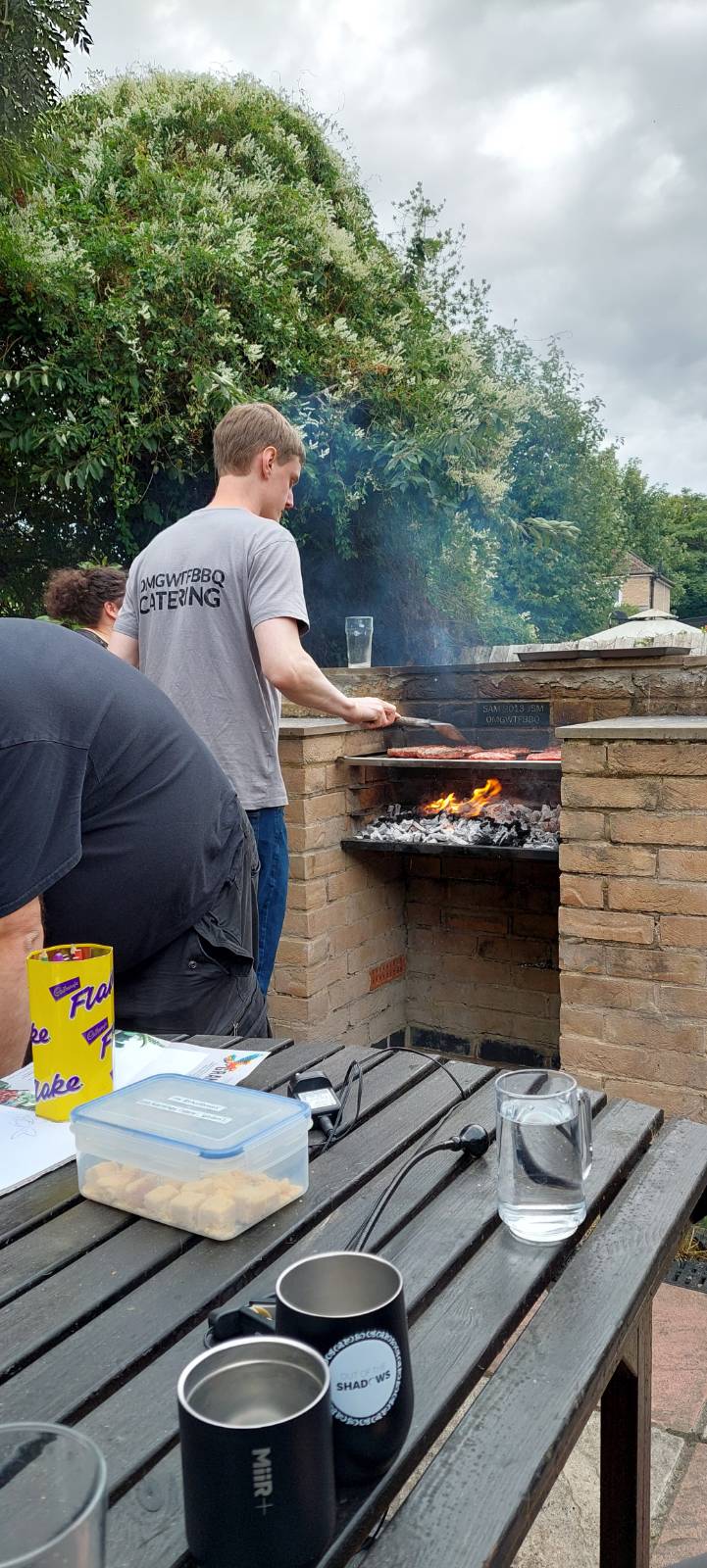 Lots of friends, lots of good food and drink. Of course lots of
geeky discussions about Debian, networking, random computer languages
and... screws? And of course some card games to keep us
laughing into each night!
 Many thanks to a number of awesome friendly people for again
sponsoring the important refreshments for the weekend. It's
hungry/thirsty work celebrating like this!
 Around a decade ago, I was happy to learn about bcache a Linux block cache system that implements tiered storage (like a pool of hard disks with SSDs for cache) on Linux. At that stage, ZFS on Linux was nowhere close to where it is today, so any progress on gaining more ZFS features in general Linux systems was very welcome. These days we care a bit less about tiered storage, since any cost benefit in using anything else than nvme tends to quickly evaporate compared to time you eventually lose on it.
In 2015, it was announced that bcache would grow into its own filesystem. This was particularly exciting and it caused quite a buzz in the Linux community, because it brought along with it more features that compare with
 Diego wrote about his