Search Results: "bab"

22 August 2024

Jonathan McDowell: Thoughts on Advent of Code + Rust

Diego wrote about his dislike for Advent of Code and that reminded me I hadn t written up my experience from 2023. Mostly because, spoiler, I never actually completed it and always intended to do so and then write it up. I think it s time to accept I m not going to do that, and write down some thoughts before I forget all of them. These are somewhat vague, given the time that s elapsed, but I think still relevant. You might also find Roger s problem write up interesting. I ve tried AoC a couple of times before; I think I had a very brief attempt back in 2021, and I got 4 days in for 2022. For Advent of Code 2023 I tried much harder to actually complete the challenges, and got most of the way there. I didn t allow myself to move on to the next day until fully completing the previous day, and didn t end up doing the second half of December 24th, or any of December 25th.

Rust First I want to talk about Rust, which is the language I chose to use for the problems. I ve dabbled a little in it, but I d like more familiarity with the basic language, and some programming problems seemed like a good way to get that. It s a language I want to like; I ve spent a lot of my career writing C, do more in Go these days, and generally think Rust promises a low level, run-time light environment like C but with the rough edges taken off. I set myself the challenge of using just bare Rust; no external crates, no use of cargo. I was accused of playing on hard mode by doing this, but it really wasn t the intention - I figured that I should be able to do what I needed without recourse to anything outside the core language, and didn t want what seemed like the extra complexity of dealing with cargo. That caused problems, however. I m used to by-default generic error handling in Go through the error type, but Rust seems to have much more tightly typed errors. I was pointed at anyhow as the right way to do this in Rust. I still find this surprising; I ended up using unwrap() a lot when I think with more generic error handling I could have used ?. The other thing I discovered is that by default rustc is heavy on the debug output. I got significantly better results on some of the solutions with rustc -O -C target-cpu=native source.rs. I probably shouldn t be surprised by this, but worth noting. Rust, to me, has a syntax only a C++ programmer could love. I am not a C++ programmer. Coming from C I found Go to be a nice, simple syntax to learn. Rust has not been the same. There s a lot more punctuation, and it s not always clear to me what it s doing. This applies more when reading other people s code than when writing it myself, obviously, but I see a lot of Rust code that could give Perl a run for its money in terms of looking like line noise. The borrow checker didn t bug me too much, but did add overhead to my thinking. The Rust compiler is generally very good at outputting helpful error messages when the programmer is an idiot. I ended up having to use a RefCell for one solution, and using .iter() for loops rather than explicit iterators (why, why is this different?). I also kept forgetting to explicitly mark variables as mutable when declaring them. Things I liked? There s a rich set of first class data types. Look, I m a C programmer, I m easily pleased. You give me some sort of hash array and I ll be happy. Rust manages that, tuples, strings, all the standard bits any modern language can provide. The whole impl thing for adding methods to structures I like as a way of providing some abstraction, though I think Go has a nicer syntax for it. The compiler, as mentioned, is great at spitting out useful errors for the most part. Also although I wasn t using external crates for AoC I do appreciate there s a decent ecosystem there now (though that brings up another gripe: rust seems to still be a fairly fast moving target, to the extent I can no longer rely on the compiler in Debian stable to be able to compile random projects I find).

Advent of Code Let s talk about the advent of code bit now. Hopefully it s long enough since it came out that this won t be spoilers for anyone, but if you haven t attempted the 2023 AoC and might, you might want to stop reading here. First, a refresher on the format for those who might not be aware of it. Problems are posted daily from December 1st until the 25th. Each is in 2 parts; the second part is not viewable until you have provided the correct answer for the first part. There s a whole leaderboard thing going on, but the puzzle opens at midnight UTC-5 so generally by the time I wake up and have time to look the problem has been solved many times over; no chance of getting listed. Credit to AoC creator, Eric Wastl, for writing up the set of problems in an entertaining fashion. I quite enjoyed seeing how the puzzle would be phrased each day, and the whole thing obviously brings a lot of joy to folk I know. I always start AoC thinking it ll be a fun set of puzzles to solve. Then something happens and I miss a day or two, and all of a sudden I ve a bunch of catching up to do and it s all a bit more of a chore. I hit that at some points this time, but made a concerted effort to try and power through it. That perseverance was required up front, because I found the second part of Day 1 to be ill specified, and had to iterate a few times to actually calculate the desired solution (IIRC, issues about whether sevenone at the end of a line ended up as 7 or 1 really tripped me up). I don t recall any other problems that bit me as hard on the specification as this one, but it happening up front was unfortunate. The short example input doesn t always help with this either; either it s not enough to be able to extrapolate patterns, or it doesn t show all the variations you need to account for (that aren t fully specified in the text), or in a few cases it turned out I needed to understand the shape of the actual data to produce a solution that could actually complete in a reasonable time. Which brings me to another matter, sometimes brute force doesn t actually work. This is fine, but the second part of the day s problem can change the approach you d take. So sometimes I got lucky in the way I handled the first half, and doing the second half was a simple 5 minute tweak, and sometimes I had to entirely change the way I was storing data. You might claim that if I was a better programmer I d have always produced a first half solution that was amenable to extension for the second half. First, I dispute that; I think there are always situations where the problem domain can change in enough directions that you can t handle all of them without a lot of effort. Secondly, I didn t find AoC an environment that encouraged me to optimise for generic solutions. Maybe some of the puzzles in isolation would allow for that, but a month of daily problems to solve while still engaging in regular life meant I hacked things up, took short cuts based on the knowledge I had of the input data, etc, etc. Overall I can see the appeal, but the sheer quantity and the fact I write code as part of my day job just made it feel too much like a chore, rather than a fun mental exercise. I did wonder how they d look as a set of interview puzzles (obviously a subset, rather than all of them), but I m not sure how you d actually use them for that - I wouldn t want anyone to have to solve them in a live interview. So, in case it s not obvious, I m not planning to engage in AoC again this yet. But I m continuing to persevere with Rust (though most of my work stuff is thankfully still Go).

16 August 2024

Antoine Beaupr : Why I should be running Debian unstable right now

So a common theme on the Internet about Debian is so old. And right, I am getting close to the stage that I feel a little laggy: I am using a bunch of backports for packages I need, and I'm missing a bunch of other packages that just landed in unstable and didn't make it to backports for various reasons. I disagree that "old" is a bad thing: we definitely run Debian stable on a fleet of about 100 servers and can barely keep up, I would make it older. And "old" is a good thing: (port) wine and (any) beer needs time to age properly, and so do humans, although some humans never seem to grow old enough to find wisdom. But at this point, on my laptop, I am feeling like I'm missing out. This page, therefore, is an evolving document that is a twist on the classic NewIn game. Last time I played seems to be #newinwheezy (2013!), so really, I'm due for an update. (To be fair to myself, I do keep tabs on upgrades quite well at home and work, which do have their share of "new in", just after the fact.)

New packages to explore Those tools are shiny new things available in unstable or perhaps Trixie (testing) already that I am not using yet, but I find interesting enough to list here.
  • backdown: clever file deduplicator
  • codesearch: search all of Debian's source code (tens of thousands of packages) from the commandline! (see also dcs-cli, not in Debian)
  • dasel: JSON/YML/XML/CSV parser, similar to jq, but different syntax, not sure I'd grow into it, but often need to parse YML like JSON and failing
  • fyi: notify-send replacement
  • git-subrepo: git-submodule replacement I am considering
  • gtklock: swaylock replacement with bells and whistles, particularly interested in showing time, battery and so on
  • hyprland: possible Sway replacement, but there are rumors of a toxic community (rebuttal, I haven't reviewed either in detail), so approach carefully)
  • kooha: simple screen recorder with audio support, currently using wf-recorder which is a more.. minimalist option
  • linescroll: rate graphs on live logs, mostly useful on servers though
  • ruff: faster Python formatter and linter, flake8/black/isort replacement, alas not mypy/LSP unfortunately, designed to be ran alongside such a tool, which is not possible in Emacs eglot right now, but is possible in lsp-mode
  • sfwbar: pretty status bar, may replace waybar, which i am somewhat unhappy with (my UTC clock disappears randomly)
  • spytrap-adb: cool spy gear

New packages I won't use Those are packages that I have tested because I found them interesting, but ended up not using, but I think people could find interesting anyways.
  • kew: surprisingly fast music player, parsed my entire library (which is huge) instantaneously and just started playing (I still use Supersonic, for which I maintain a flatpak on my Navidrome server)
  • mdformat: good markdown formatter, think black or gofmt but for markdown), but it didn't actually do what I needed, and it's not quite as opinionated as it should (or could) be)

Backports already in use Those are packages I already use regularly, which have backports or that can just be installed from unstable:
  • asn: IP address forensics
  • markdownlint: markdown linter, I use that a lot
  • poweralertd: pops up "your battery is almost empty" messages
  • sway-notification-center: used as part of my status bar, yet another status bar basically, a little noisy, stuck in a libc dep update
  • tailspin: used to color logs

Out of date packages Those are packages that are in Debian stable (Bookworm) already, but that are somewhat lacking and could benefit from an upgrade.

Last words If you know of cool things I'm missing out of, then by all means let me know! That said, overall, this is a pretty short list! I have most of what I need in stable right now, and if I wasn't a Debian developer, I don't think I'd be doing the jump now. But considering how easier it is to develop Debian (and how important it is to test the next release!), I'll probably upgrade soon. Previously, I was running Debian testing (which why the slug on that article is why-trixie), but now I'm actually considering just running unstable on my laptop directly anyways. It's been a long time since we had any significant instability there, and I can typically deal with whatever happens, except maybe when I'm traveling, and then it's easy to prepare for that (just pin testing).

12 August 2024

Freexian Collaborators: Monthly report about Debian Long Term Support, July 2024 (by Roberto C. S nchez)

Like each month, have a look at the work funded by Freexian s Debian LTS offering.

Debian LTS contributors In July, 13 contributors have been paid to work on Debian LTS, their reports are available:
  • Bastien Roucari s did 20.0h (out of 20.0h assigned).
  • Chris Lamb did 18.0h (out of 18.0h assigned).
  • Daniel Leidert did 5.0h (out of 4.0h assigned and 6.0h from previous period), thus carrying over 5.0h to the next month.
  • Guilhem Moulin did 8.75h (out of 4.5h assigned and 15.5h from previous period), thus carrying over 11.25h to the next month.
  • Lee Garrett did 51.5h (out of 10.5h assigned and 43.0h from previous period), thus carrying over 2.0h to the next month.
  • Lucas Kanashiro did 5.0h (out of 5.0h assigned and 15.0h from previous period), thus carrying over 15.0h to the next month.
  • Markus Koschany did 40.0h (out of 40.0h assigned).
  • Ola Lundqvist did 4.0h (out of 10.0h assigned and 14.0h from previous period), thus carrying over 20.0h to the next month.
  • Roberto C. S nchez did 5.0h (out of 5.25h assigned and 6.75h from previous period), thus carrying over 7.0h to the next month.
  • Santiago Ruano Rinc n did 6.0h (out of 16.0h assigned), thus carrying over 10.0h to the next month.
  • Sean Whitton did 2.25h (out of 6.0h assigned), thus carrying over 3.75h to the next month.
  • Sylvain Beucler did 39.5h (out of 2.5h assigned and 51.0h from previous period), thus carrying over 14.0h to the next month.
  • Thorsten Alteholz did 11.0h (out of 11.0h assigned).

Evolution of the situation In July, we have released 1 DLA. August will be the month that Debian 11 makes the transition to LTS. Our contributors have already been hard at work with preparatorty tasks and also with making contributions to packages in Debian 11 in close collaboration with the Debian security team and package maintainers. As a result, users and sponsors should not observe any especially notable differences as the transition occurs. While only one DLA was released in July (as a result of the transitional state of Debian 11 bullseye ), there were some notable highlights. LTS contributor Guilhem Moulin prepared an update of libvirt for Debian 11 (in collaboration with the Old-Stable Release Managers and the Debian Security Team) to fix a number of outstanding CVEs which did not rise to the level of a DSA by the Debian Security Team. The update prepared by Guilhem will be included in Debian 11 as part of the final point release at the end of August, one of the final transition steps by the Release Managers as Debian 11 moves entirely to the LTS Team s responsibility. Notable work was also undertaken by contributors Lee Garrett (fixes on the ansible test suite and a bullseye update), Lucas Kanashiro (Rust toolchain, utilized by the clamav, firefox-esr, and thunderbird packages), and Sylvain Beucler (fixes on the ruby2.5/2.7 test suites and CI infrastructure), which will help improve the quality of updates produced during the next LTS cycle. June was the final month of LTS for Debian 10 (as announced on the debian-lts-announce mailing list). No additional Debian 10 security updates will be made available on security.debian.org. However, Freexian and its team of paid Debian contributors will continue to maintain Debian 10 going forward for customers of the Extended LTS offer. Subscribe right away if you still have Debian 10 systems which must be kept secure (and which cannot yet be upgraded).

Thanks to our sponsors Sponsors that joined recently are in bold.

8 August 2024

Jonathan Carter: DebConf24 Busan, South Korea

I m finishing typing up this blog entry hours before my last 13 hour leg back home, after I spent 2 weeks in Busan, South Korea for DebCamp24 and DebCamp24. I had a rough year and decided to take it easy this DebConf. So this is the first DebConf in a long time where I didn t give any talks. I mostly caught up on a bit of packaging, worked on DebConf video stuff, attended a few BoFs and talked to people. Overall it was a very good DebConf, which also turned out to be more productive than I expeced it would. In the welcome session on the first day of DebConf, Nicolas Dandrimont mentioned that a benefit of DebConf is that it provides a sort of caffeine for your Debian motivation. I could certainly feel that affect swell as the days went past, and it s nice to be excited about some ideas again that would otherwise be fading.

Recovering DPL It s a bit of a gear shift being DPL for 4 years, and DebConf Committee for nearly 5 years before that, and then being at DebConf while some issue arise (as it always does during a conference). At first I jump into high alert mode, but then I have to remind myself it s not your problem anymore and let others deal with it. It was nice spending a little in-person time with Andreas Tille, our new DPL, we did some more handover and discussed some current issues. I still have a few dozen emails in my DPL inbox that I need to collate and forward to Andreas, I hope to finish all that up by the end of August. During the Bits from the DPL talk, the usual question came up whether Andreas will consider running for DPL again, to which he just responded in a slide Maybe . I think it s a good idea for a DPL to do at least two terms if it all works out for everyone, since it takes a while to get up to speed on everything. Also, having been DPL for four years, I have a lot to say about it, and I think there s a lot we can fix in the role, or at least discuss it. If I had the bandwidth for it I would have scheduled a BoF for it, but I ll very likely do that for the next DebConf instead!

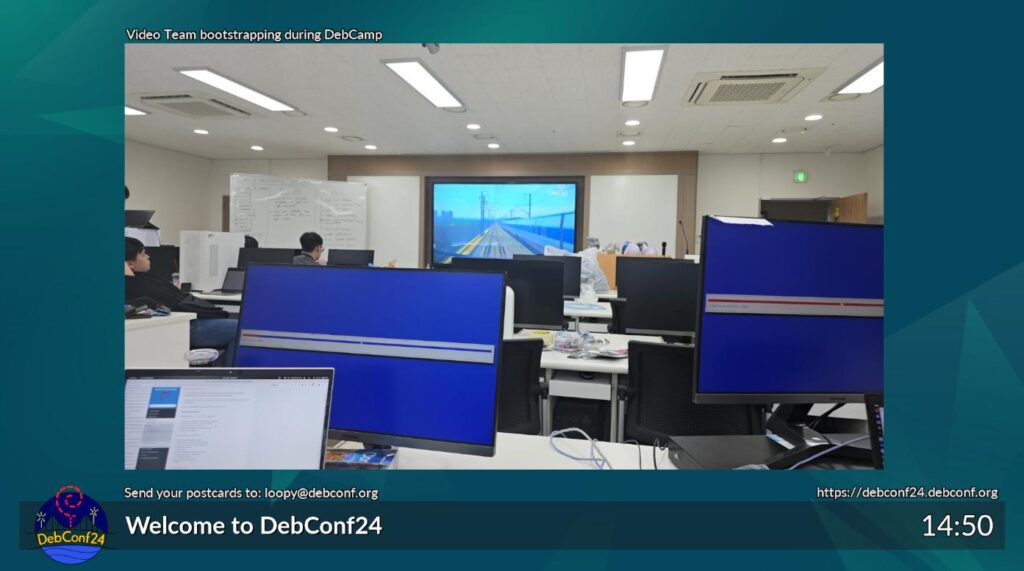
Video team I set up the standby loop for the video streaming setup. We call it loopy, it s a bunch of OBS scenes that provide announcements, shows sponsors, the schedule and some social content. I wrote about it back in 2020, but it s evolved quite a bit since then, so I m probably due to write another blog post with a bunch of updates on it. I hope to organise a video team sprint in Cape Town in the first half of next year, so I ll summarize everything before then.

It would ve been great if we could have some displays in social areas that could show talks, the loop and other content, but we were just too pressed for time for that. This year s DebConf had a very compressed timeline, and there was just too much that had to be done and that had to be figured out on the last minute. This put quite a lot of strain on the organisers, but I was glad to see how, for the most part, most attendees were very sympathetic to some rough edges (but I digress ). I added more of the OBS machine setup to the videoteam s ansible repository, so as of now it just needs an ansible setup and the OBS data and it s good to go. The loopy data is already in the videoteam git repository, so I could probably just add a git pull and create some symlinks in ansible and then that machine can be installed from 0% to 100% by just installing via debian-installer with our ansible hooks. This DebConf I volunteered quite a bit for actual video roles during the conference, something I didn t have much time for in recent DebConfs, and it s been fun, especially in a session or two where nearly none of the other volunteers showed up. Sometimes chaos is just fun :-)
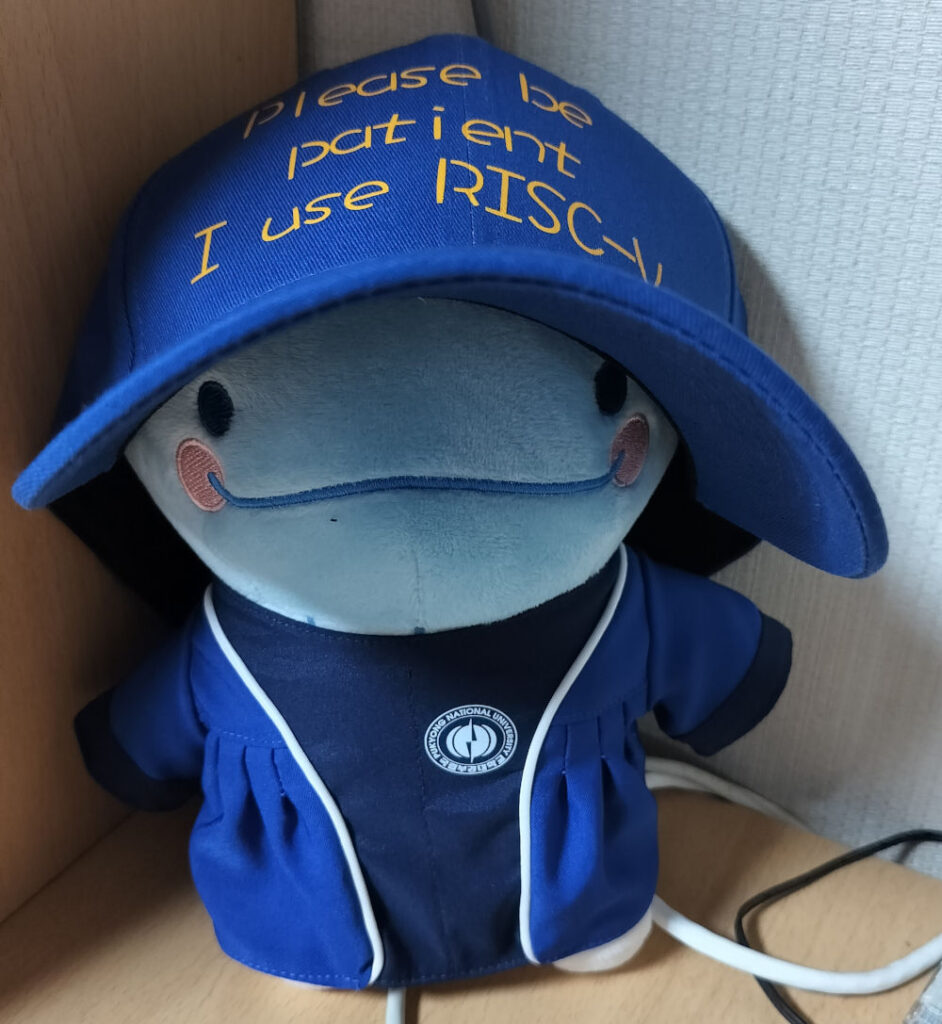
Baekyongee is the university mascot, who s visible throughout the university. So of course we included this four legged whale creature on the loop too!

Packaging I was hoping to do more packaging during DebCamp, but at least it was a non-zero amount:
  • Uploaded gdisk 1.0.10-2 to unstable (previously tested effects of adding dh-sequence-movetousr) (Closes: #1073679).
  • Worked a bit on bcachefs-tools (updating git to 1.9.4), but has a build failure that I need to look into (we might need a newer bindgen) update: I m probably going to ROM this package soon, it doesn t seem suitable for packaging in Debian.
  • Calamares: Tested a fix for encrypted installs, and uploaded it.
  • Calamares: Uploaded (3.3.8-1) to backports (at the time of writing it s still in backports-NEW).
  • Backport obs-gradient-source for bookworm.
  • Did some initial packaging on Cambalache, I ll upload to unstable once wlroots (0.18) hits unstable.
  • Pixelorama 1.0 I did some initial packaging for Pixelorama back when we did the MiniDebConf Gaming Edition, but it had a few stoppers back then. Version 1.0 seems to fix all of that, but it depends on Godot 4.2 and we re still on the 3 series in Debian, so I ll upload this once Godot 4.2 hits at least experimental. Godot software/games is otherwise quite easy to run, it s basically just source code / data that is installed and then run via godot-runner (godot3-runner package in Debian).

BoFs Python Team BoF Link to the etherpad / pad archive link and video can be found on the talk page: https://debconf24.debconf.org/talks/31-python-bof/ The session ended up being extended to a second part, since all the issues didn t fit into the first session. I was distracted by too many thing during the Python 3.12 transition (to the point where I thought that 3.11 was still new in Debian), so it was very useful listening to the retrospective of that transition. There was a discussion whether Python 3.13 could still make it to testing in time for freeze, and it seems that there is consensus that it can, although, likely with new experimental features like disabling the global interpreter lock and the just in time compiler disabled. I learned for the first time about the dead batteries project, PEP-0594, which removes ancient modules that have mostly been superseded, from the Python standard library. There was some talk about the process for changing team policy, and a policy discussion on whether we should require autopkgtests as a SHOULD or a MUST for migration to testing. As with many things, the devil is in the details and in my opinion you could go either way and achieve a similar result (the original MUST proposal allowed exceptions which imho made it the same as the SHOULD proposal). There s an idea to do some ongoing remote sprints, like having co-ordinated days for bug squashing / working on stuff together. This is a nice idea and probably a good way to energise the team and also to gain some interest from potential newcomers. Louis-Philipe V ronneau was added as a new team admin and there was some discussion on various Sphinx issues and which Lintian tags might be needed for Python 3.13. If you want to know more, you probably have to watch the videos / read the notes :)
    Debian.net BoF Link to the etherpad / pad archive link can be found on the talk page: https://debconf24.debconf.org/talks/37-debiannet-team-bof Debian Developers can set up services on subdomains on debian.net, but a big problem we ve had before was that developers were on their own for hosting those services. This meant that they either hosted it on their DSL/fiber connection at home, paid for the hosting themselves, or hosted it at different services which became an accounting nightmare to claim back the used funds. So, a few of us started the debian.net hosting project (sometimes we just call it debian.net, this is probably a bit of a bug) so that Debian has accounts with cloud providers, and as admins we can create instances there that gets billed directly to Debian. We had an initial rush of services, but requests have slowed down since (not really a bad thing, we don t want lots of spurious requests). Last year we did a census, to check which of the instances were still used, whether they received system updates and to ask whether they are performing backups. It went well and some issues were found along the way, so we ll be doing that again. We also gained two potential volunteers to help run things, which is great. Debian Social BoF Link to the etherpad / pad archive link can be found on the talk page: https://debconf24.debconf.org/talks/34-debiansocial-bof We discussed the services we run, you can view the current state of things at: https://wiki.debian.org/Teams/DebianSocial Pleroma has shown some cracks over the last year or so, and there are some forks that seem promising. At the same time, it might be worth while considering Mastodon too. So we ll do some comparison of features and maintenance and find a way forward. At the time when Pleroma was installed, it was way ahead in terms of moderation features. Pixelfed is doing well and chugging along nicely, we should probably promote it more. Peertube is working well, although we learned that we still don t have all the recent DebConf videos on there. A bunch of other issues should be fixed once we move it to a new machine that we plan to set up. We re removing writefreely and plume. Nice concepts, but it didn t get much traction yet, and no one who signed up for these actually used it, which is fine, some experimentation with services is good and sometimes they prove to be very popular and other times not. The WordPress multisite instance has some mild use, otherwise haven t had any issues. Matrix ended up to be much, much bigger than we thought, both in usage and in its requirements. It s very stateful and remembers discussions for as long as you let it, so it s Postgres database is continuously expanding, this will also be a lot easier to manage once we have this on the new host. Jitsi is also quite popular, but it could probably be on jitsi.debian.net instead (we created this on debian.social during the initial height of COVID-19 where we didn t have the debian.net hosting yet), although in practice it doesn t really matter where it lives. Most of our current challenges will be solved by moving everything to a new big machine that has a few public IPs available for some VMs, so we ll be doing that shortly. Debian Foundation Discussion BoF This was some brainstorming about the future structure of Debian, and what steps might be needed to get there. It s way too big a problem to take on in a BoF, but we made some progress in figuring out some smaller pieces of the larger puzzle. The DPL is going to get in touch with some legal advisors and our trusted organisations so that we can aim to formalise our relationships a bit more by the time it s DebConf again. I also introduced my intention to join the Debian Partners delegation. When I was DPL, I enjoyed talking with external organisations who wanted to help Debian, but helping external organisations help Debian turned out to be too much additional load on the usual DPL roles, so I m pursuing this with the Debian Partners team, more on that some other time. This session wasn t recorded, but if you feel like you missed something, don t worry, all intentions will be communicated and discussed with project members before anything moves forward. There was a strong agreement in the room though that we should push forward on this, and not reach another DebConf where we didn t make progress on formalising Debian s structure more.

    Social Conference Dinner
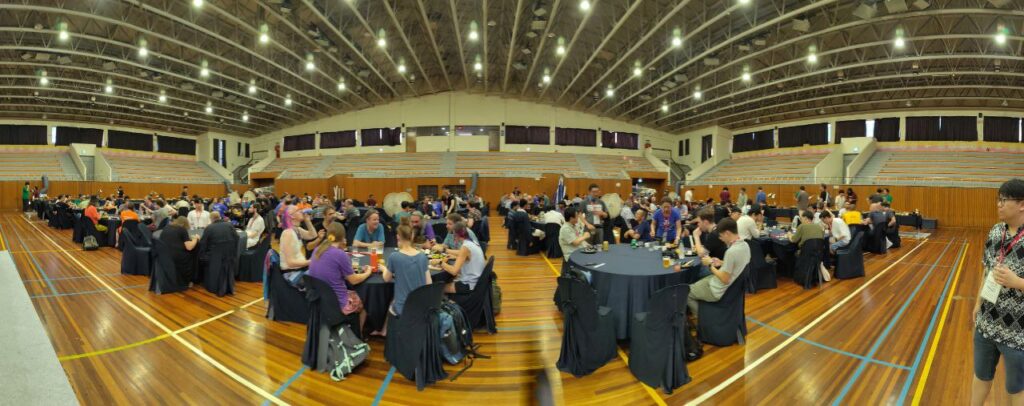
    Conference Dinner Photo from Santiago
    The conference dinner took place in the university gymnasium. I hope not many people do sports there in the summer, because it got HOT. There was also some interesting observations on the thermodynamics of the attempted cooling solutions, which was amusing. On the plus side, the food was great, the company was good, and the speeches were kept to a minimum, so it was a great conference dinner, even though it was probably cut a bit short due to the heat. Cheese and Wine Cheese and Wine happened on 1 August, which happens to be the date I became a DD at DebConf17 in Montr al seven years before, so this was a nice accidental celebration of my Debiversary :) Since I m running out of time, I ll add some more photos to this post some time after publishing it :P Group Photo As per DebConf tradition, Aigars took the group photo. You can find the high resolution version on Debian s GitLab instance.
    Debian annual conference Debconf 24, Busan, South Korea
    Photography: Aigars Mahinovs aigarius@debian.org
    License: CC-BYv3+ or GPLv2+
    Talking Ah yes, talking to people is a big part of DebConf, but I didn t keep track of it very well.
    • I mostly listened to Alper a bit about his ideas for his talk about debian installer.
    • I talked to Rhonda a bit about ActivityPub and MQTT and whether they could be useful for publicising Debian activity.
    • Listened to Gunnar and Julian have a discussion about GPG and APT which was interesting.
    • I learned that you can learn Hangul, the Korean alphabet, in about an hour or so (I wish I knew that in all my years of playing StarCraft II).
    • We had the usual continuous keysigning party. Besides it s intended function, this is always a good ice breaker and a way to for shy people to meet other shy people.
    • and many other fly-by discussions.

    Stuff that didn t happen this DebConf
    • loo.py A simple Python script that could eventually replace the obs-advanced-scene-switcher sequencer in OBS. It would also be extremely useful if we d ever replace OBS for loopy. I was hoping to have some time to hack on this, and try to recreate the current loopy in loo.py, but didn t have the time.
    • toetally This year videoteam had to scramble to get a bunch of resistors to assemble some tally light. Even when assembled, they were a bit troublesome. It would ve been nice to hack on toetally and get something ready for testing, but it mostly relies on having something like a rasbperry pi zero with an attached screen in order to work on further. I ll try to have something ready for the next mini conf though.
    • extrepo on debian live I think we should have extrepo installed by default on desktop systems, I meant to start a discussion on this, but perhaps it s just time I go ahead and do it and announce it.
    • Live stream to peertube server It would ve been nice to live stream DebConf to PeerTube, but the dependency tree to get this going got a bit too huge. Following our plans discussed in the Debian Social BoF, we should have this safely ready before the next MiniDebConf and should be able to test it there.
    • Desktop Egg there was this idea to get a stand-in theme for Debian testing/unstable until the artwork for the next release is finalized (Debian bug: #1038660), I have an idea that I meant to implement months ago, but too many things got in the way. It s based on Juliette Taka s Homeworld theme, and basically transforms the homeworld into an egg. Get it? Something that hasn t hatched yet? I also only recently noticed that we never used the actual homeworld graphics (featuring the world image) in the final bullseye release. lol.
    So, another DebConf and another new plush animal. Last but not least, thanks to PKNU for being such a generous and fantastic host to us! See you again at DebConf25 in Brest, France next year!

      24 July 2024

      Gunnar Wolf: DebConf24 Continuous Key-Signing Party

      Yay, party!

      Yay, crypto! DebCamp has started, and in a couple of days, we will fully be in DebConf24 mode! As most of you know, an important part that binds Debian together is our cryptographic identity assurance, and that is in good measure tightened by the Continuous Key-Signing Parties we hold at DebConfs and other Debian and Free Software gatherings. As I have done during (most of) the past DebConfs, I have prepared a set of pseudo-social maps to help you find where you are in the OpenPGP mesh of our conference. Naturally, Web-of-Trust maps should be user-centered, so find your own at: https://people.debian.org/~gwolf/dc24_ksp/ The list is now final and it will not receive any modifications (I asked for them some days ago); if your name still appears on the list and you don t want to be linked to the DC24 KSP in the future, tell me and I ll remove it from future versions of the list (but it is part of the final DC24 file, as its checksum is already final) Speaking of which! If you are to be a part of the keysigning, get the final DC24 file and, on a device you trust, check its SHA256 by running:
      $ sha256sum dc24_fprs.txt
      11daadc0e435cb32f734307b091905d4236cdf82e3b84f43cde80ef1816370a5  dc24_fprs.txt
      
      Make sure the resulting number matches the one I m presenting. If it doesn t, ensure your copy of the file is not corrupted (i.e. download again). If it still doess not match, notify me immediately. Does any of the above confuse you? Please come to (or at least, follow the stream for) my session on DebConf opening day, Continuous Key-Signing Party introduction, 10:30 Korean time; I will do my best to explain the details to you. PS- I will soon provide a simple, short PDF that will probably be mass-printed at FrontDesk so that you can easily track your KSP progress.

      23 July 2024

      Russell Coker: More About Kogan 5120*2160 Monitor

      On the 18th of May I blogged about my new 5120*2160 monitor [1]. One thing I noted was that one Netflix movie had run in an aspect ratio that used all space on the monitor. I still don t know if the movie in question was cropped in a letterbox manner but other Netflix shows in full screen mode don t extend to both edges. Also one movie I downloaded as in 3840*1608 resolution which is almost exactly the same aspect ratio as my monitor. I wonder if some company is using 5120*2160 screens for TVs, 4K and FullHD are rumoured to be cheaper than most other resolutions partly due to TV technology being used for monitors. There is the Anamorphic Format of between 2.35:1 and 2.40:1 [2] which is a close match for the 2.37:1 of my new monitor. I tried out the HDMI audio on a Dell laptop and my Thinkpad Yoga Gen3 and found it to be of poor quality, it seemed limited to 2560*1440, at this time I m not sure how much of the fault is due to the laptops and how much is due to the monitor. The monitor docs state that it needs HDMI version 2.1 which was released in 2017 and my Thinkpad Yoga Gen3 was released in 2018 so probably doesn t have that. The HDMI cable in question did 4K resolution on my previous monitor so it should all work at a minimum of 4K resolution. The switching between inputs is a problem. If I switch between DisplayPort for my PC and HDMI for a laptop the monitor will usually timeout before the laptop establishes a connection and then switch back to the DisplayPort input. So far I have had to physically disconnect the input source I don t want to use. The DisplayPort switch that I ve used doesn t seem designed to work with resolutions higher than 4K. I ve bought a new USB-C dock which is described as doing 8K which means that as my Thinkpad is described as supporting 5120 2880@60Hz over USB-C I should be able to get 5120*2160 without any problems, however for unknown reasons I only get 4K. For work I m using a Dell Latitude 7400 2in1 that s apparently only capable of 4096*2304 @24 Hz which is less pixels than 5120*2160 and it will also only do 4K resolution. But for both those cases it s still a significant improvement over 2560*1440. I tested with a Dell Latitude 7440 which gave the full 5120*2160 resolution, I was unable to find specs on what the maximum resolution of the 7440 is. I also have bought DisplayPort switch rated at 8K resolution. I got a switch that doesn t also do USB because the ones that do 8K resolution and USB are about $70. The only KVM switch I saw for 8K resolution at a reasonable price was one designed for switching between two laptops and there doesn t seem to be any adaptors to convert from regular DisplayPort to USB-C alternative mode so that wasn t viable. Currently I have the old KVM switch used for USB only (for keyboard and mouse) and the new switch which only does DisplayPort. So I have two buttons to push when switching between input sources which isn t too bad. It seems that for PCs resolutions with more pixels than 4K are as difficult and inconvenient now as 4K was 6 years ago when I started doing it. If you want higher than 4K resolution to just work at this time then you need Apple hardware. The monitor has a series of modes for different types of output, I ve found standard to be good for text and movie to be good for watching movies/TV and for playing RTS games. I previously wrote about how to use ddcutil to use a monitor as a KVM switch [3], unfortunately I can t do this with the new monitor as the time that the monitor waits for a good signal on a new input after changing is shorter than the time taken for Linux on the laptops I m using to enable HDMI output. I ve found the following commands to do the basics.
      # get display mode
      ddcutil getvcp DC
      # set standard mode
      ddcutil setvcp DC 0
      # set movie mode
      ddcutil setvcp DC 03
      Now that I have that going the next thing I want to do is to have it switch between standard and movie modes when I switch keyboard focus.

      21 July 2024

      Russell Coker: SE Linux Policy for Dell Management

      The recent issue of Windows security software killing computers has reminded me about the issue of management software for Dell systems. I wrote policy for the Dell management programs that extract information from iDRAC and store it in Linux. After the break I ve pasted in the policy. It probably needs some changes for recent software, it was last tested on a PowerEdge T320 and prior to that was used on a PowerEdge R710 both of which are old hardware and use different management software to the recent hardware. One would hope that the recent software would be much better but usually such hope is in vain. I deliberately haven t submitted this for inclusion in the reference policy because it s for proprietary software and also it permits many operations that we would prefer not to permit. The policy is after the break because it s larger than you want on a Planet feed. But first I ll give a few selected lines that are bad in a noteworthy way:
      1. sys_admin means the ability to break everything
      2. dac_override means break Unix permissions
      3. mknod means a daemon creates devices due to a lack of udev configuration
      4. sys_rawio means someone didn t feel like writing a device driver, maintaining a device driver for DKMS is hard and getting a driver accepted upstream requires writing quality code, in any case this is a bad sign.
      5. self:lockdown is being phased out, but used to mean bypassing some integrity protections, that would usually be related to sys_rawio or similar.
      6. dev_rx_raw_memory is bad, reading raw memory allows access to pretty much everything and execute of raw memory is something I can t imagine a good use for, the Reference Policy doesn t use this anywhere!
      7. dev_rw_generic_chr_files usually means a lack of udev configuration as udev should do that.
      8. storage_raw_write_fixed_disk shouldn t be needed for this sort of thing, it doesn t do anything that involves managing partitions.
      Now without network access or other obvious ways of remote control this level of access while excessive isn t necessarily going to allow bad things to happen due to outside attack. But if there are bugs in the software there s nothing to stop it from giving the worst results.
      allow dell_datamgrd_t self:capability   dac_override dac_read_search mknod sys_rawio sys_admin  ;
      allow dell_datamgrd_t self:lockdown integrity;
      dev_rx_raw_memory(dell_datamgrd_t)
      dev_rw_generic_chr_files(dell_datamgrd_t)
      dev_rw_ipmi_dev(dell_datamgrd_t)
      dev_rw_sysfs(dell_datamgrd_t)
      storage_raw_read_fixed_disk(dell_datamgrd_t)
      storage_raw_write_fixed_disk(dell_datamgrd_t)
      allow dellsrvadmin_t self:lockdown integrity;
      allow dellsrvadmin_t self:capability   sys_admin sys_rawio  ;
      dev_read_raw_memory(dellsrvadmin_t)
      dev_rw_sysfs(dellsrvadmin_t)
      dev_rx_raw_memory(dellsrvadmin_t)
      
      The best thing that Dell could do for their customers is to make this free software and allow the community to fix some of these issues.
      Here is dellsrvadmin.te:
      policy_module(dellsrvadmin,1.0.0)
      require  
        type dmidecode_exec_t;
        type udev_t;
        type device_t;
        type event_device_t;
        type mon_local_test_t;
       
      type dellsrvadmin_t;
      type dellsrvadmin_exec_t;
      init_daemon_domain(dellsrvadmin_t, dellsrvadmin_exec_t)
      type dell_datamgrd_t;
      type dell_datamgrd_exec_t;
      init_daemon_domain(dell_datamgrd_t, dell_datamgrd_t)
      type dellsrvadmin_var_t;
      files_type(dellsrvadmin_var_t)
      domain_transition_pattern(udev_t, dellsrvadmin_exec_t, dellsrvadmin_t)
      modutils_domtrans(dellsrvadmin_t)
      allow dell_datamgrd_t device_t:dir rw_dir_perms;
      allow dell_datamgrd_t device_t:chr_file create;
      allow dell_datamgrd_t event_device_t:chr_file   read write  ;
      allow dell_datamgrd_t self:process signal;
      allow dell_datamgrd_t self:fifo_file rw_file_perms;
      allow dell_datamgrd_t self:sem create_sem_perms;
      allow dell_datamgrd_t self:capability   dac_override dac_read_search mknod sys_rawio sys_admin  ;
      allow dell_datamgrd_t self:lockdown integrity;
      allow dell_datamgrd_t self:unix_dgram_socket create_socket_perms;
      allow dell_datamgrd_t self:netlink_route_socket r_netlink_socket_perms;
      modutils_domtrans(dell_datamgrd_t)
      can_exec(dell_datamgrd_t, dmidecode_exec_t)
      allow dell_datamgrd_t dellsrvadmin_var_t:dir rw_dir_perms;
      allow dell_datamgrd_t dellsrvadmin_var_t:file manage_file_perms;
      allow dell_datamgrd_t dellsrvadmin_var_t:lnk_file read;
      allow dell_datamgrd_t dellsrvadmin_var_t:sock_file manage_file_perms;
      kernel_read_network_state(dell_datamgrd_t)
      kernel_read_system_state(dell_datamgrd_t)
      kernel_search_fs_sysctls(dell_datamgrd_t)
      kernel_read_vm_overcommit_sysctl(dell_datamgrd_t)
      # for /proc/bus/pci/*
      kernel_write_proc_files(dell_datamgrd_t)
      corecmd_exec_bin(dell_datamgrd_t)
      corecmd_exec_shell(dell_datamgrd_t)
      corecmd_shell_entry_type(dell_datamgrd_t)
      dev_rx_raw_memory(dell_datamgrd_t)
      dev_rw_generic_chr_files(dell_datamgrd_t)
      dev_rw_ipmi_dev(dell_datamgrd_t)
      dev_rw_sysfs(dell_datamgrd_t)
      files_search_tmp(dell_datamgrd_t)
      files_read_etc_files(dell_datamgrd_t)
      files_read_etc_symlinks(dell_datamgrd_t)
      files_read_usr_files(dell_datamgrd_t)
      logging_search_logs(dell_datamgrd_t)
      miscfiles_read_localization(dell_datamgrd_t)
      storage_raw_read_fixed_disk(dell_datamgrd_t)
      storage_raw_write_fixed_disk(dell_datamgrd_t)
      can_exec(mon_local_test_t, dellsrvadmin_exec_t)
      allow mon_local_test_t dellsrvadmin_var_t:dir search;
      allow mon_local_test_t dellsrvadmin_var_t:file read_file_perms;
      allow mon_local_test_t dellsrvadmin_var_t:file setattr;
      allow mon_local_test_t dellsrvadmin_var_t:sock_file write;
      allow mon_local_test_t dell_datamgrd_t:unix_stream_socket connectto;
      allow mon_local_test_t self:sem   create read write destroy unix_write  ;
      allow dellsrvadmin_t self:process signal;
      allow dellsrvadmin_t self:lockdown integrity;
      allow dellsrvadmin_t self:sem create_sem_perms;
      allow dellsrvadmin_t self:fifo_file rw_file_perms;
      allow dellsrvadmin_t self:packet_socket create;
      allow dellsrvadmin_t self:unix_stream_socket   connectto create_stream_socket_perms  ;
      allow dellsrvadmin_t self:capability   sys_admin sys_rawio  ;
      dev_read_raw_memory(dellsrvadmin_t)
      dev_rw_sysfs(dellsrvadmin_t)
      dev_rx_raw_memory(dellsrvadmin_t)
      allow dellsrvadmin_t dellsrvadmin_var_t:dir rw_dir_perms;
      allow dellsrvadmin_t dellsrvadmin_var_t:file manage_file_perms;
      allow dellsrvadmin_t dellsrvadmin_var_t:lnk_file read;
      allow dellsrvadmin_t dellsrvadmin_var_t:sock_file write;
      allow dellsrvadmin_t dell_datamgrd_t:unix_stream_socket connectto;
      kernel_read_network_state(dellsrvadmin_t)
      kernel_read_system_state(dellsrvadmin_t)
      kernel_search_fs_sysctls(dellsrvadmin_t)
      kernel_read_vm_overcommit_sysctl(dellsrvadmin_t)
      corecmd_exec_bin(dellsrvadmin_t)
      corecmd_exec_shell(dellsrvadmin_t)
      corecmd_shell_entry_type(dellsrvadmin_t)
      files_read_etc_files(dellsrvadmin_t)
      files_read_etc_symlinks(dellsrvadmin_t)
      files_read_usr_files(dellsrvadmin_t)
      logging_search_logs(dellsrvadmin_t)
      miscfiles_read_localization(dellsrvadmin_t)
      
      Here is dellsrvadmin.fc:
      /opt/dell/srvadmin/sbin/.*        --        gen_context(system_u:object_r:dellsrvadmin_exec_t,s0)
      /opt/dell/srvadmin/sbin/dsm_sa_datamgrd        --        gen_context(system_u:object_r:dell_datamgrd_t,s0)
      /opt/dell/srvadmin/bin/.*        --        gen_context(system_u:object_r:dellsrvadmin_exec_t,s0)
      /opt/dell/srvadmin/var(/.*)?                        gen_context(system_u:object_r:dellsrvadmin_var_t,s0)
      /opt/dell/srvadmin/etc/srvadmin-isvc/ini(/.*)?        gen_context(system_u:object_r:dellsrvadmin_var_t,s0)

      17 July 2024

      Mike Gabriel: Weather Experts with Translation Skills Needed!

      Lomiri Weather App goes Open Meteo In Ubuntu Touch / Lomiri, Maciej Sopy o has updated Lomiri's Weather App to operate against a different weather forecast provider (Open Meteo). Additionally, the new implementation is generic and pluggable, so other weather data providers can be added-in later. Big thanks to Maciej for working on this just in time (the previous implementation's API has recently been EOL'ed and is not available anymore to Ubuntu Touch / Lomiri users). Lomiri Weather App - new Meteorological Terms part of the App now While the old weather data provider implementation obtained all the meteorological information as already localized strings from the provider, the new implementation requires all sorts of weather conditions being translated within the Lomiri Weather App itself. The meteorological terms are probably not easy to translate for the usual software translator, so special help might be required here. Call for Translations: Lomiri Weather App So, if you feel entitled to help here, please join the Hosted Weblate service [1] and start working on Lomiri Weather App. Thanks a lot! light+love
      Mike Gabriel (aka sunweaver) [1] https://hosted.weblate.org/
      [2] https://hosted.weblate.org/projects/lomiri/lomiri-weather-app/

      Russell Coker: Samsung Galaxy Note 9 Review

      After the VoLTE saga [1] and the problems with battery life on the PinePhonePro [2] (which lasted 4 hours while idle with the screen off in my last test a few weeks ago) I m running a Galaxy Note 9 [3] with the default Samsung OS as my daily driver. I don t think that many people will be rushing out to buy a 2018 phone regardless of my review. For someone who wants a phone of such age (which has decent hardware and a low price) then good options are the Pixel phones which are all supported by LineageOS. I recommend not buying this phone due to the fact that it doesn t have support for VoLTE with LineageOS (and presumably any other non-Samsung Android build) and doesn t have support from any other OS. The One Plus 6/6T has Mobian support [4] as well as LineageOS support and is worth considering. The Note 9 still has capable hardware by today s standards. A 6.4 display is about as big as most people want in their pocket and 2960 1440 resolution in that size (516dpi) is probably as high as most people can see without a magnifying glass. The model I m using has 8G of RAM which is as much as the laptop I was using at the start of this year. I don t think that many people will have things that they actually want to do on a phone which needs more hardware than this. The only hardware feature in new phones which beats this is the large folding screen in some recent phones, but $2500+ (the price of such phones in Australia) is too much IMHO and the second hand market for folding phones is poor due to the apparently high incidence of screens breaking. The Note 9 has the Dex environment for running as a laptop if you connect it to a USB-C dock. It can run nicely with a 4K monitor with USB keyboard and mouse. The UI is very similar to that of older versions of Windows. The Samsung version of Android seems mostly less useful than the stock Google version or the LineageOS version. The Samsung keyboard flags words such as gay as spelling errors and it can t be uninstalled even when you install a better keyboard app. There is a Bixby button on the side of the phone to launch the Bixby voice recognition app which can t be mapped to any useful purpose, The Google keyboard has a voice dictation option which I will try out some time but that s all I desire in terms of voice recognition. There are alerts about Samsung special deals and configuration options including something about signing in to some service and having it donate money to charity, I doubt that any users want such features. Apart from Dex the Samsung Android build is a good advert for LineageOS. The screen has curved sides for no good reason. This makes it more difficult to make a protective phone case as a case can t extend beyond the screen at the sides and therefore if it s dropped and hits an edge (step, table, etc) then the glass can make direct contact with something. Also the curved sides reflect sunlight in all directions, this means that the user has to go to more effort to avoid reflecting the sun into their eyes and that a passenger can more easily reflect sunlight into the eyes of a car driver. It s an impressive engineering feat to make a curved touch-screen but it doesn t do any good for users. The stylus is good as always and the screen is AMOLED so it doesn t waste much power when in dark mode. There is a configuration option to display a clock all the time when the screen is locked because that apparently doesn t use much power. I haven t felt inclined to enable the always on screen but it s a nice feature for those who like such things. The VoLTE implementation is apparently a bit unusual so it s not supported by LineageOS and didn t work on Droidian for the small amount of time that Droidian supported it. Generally this phone is quite nice hardware it s just a pity that it demonstrates all of the downsides to buying a non-Pixel phone.

      12 July 2024

      Freexian Collaborators: Monthly report about Debian Long Term Support, June 2024 (by Roberto C. S nchez)

      Like each month, have a look at the work funded by Freexian s Debian LTS offering.

      Debian LTS contributors In June, 18 contributors have been paid to work on Debian LTS, their reports are available:
      • Adrian Bunk did 47.0h (out of 74.25h assigned and 11.75h from previous period), thus carrying over 39.0h to the next month.
      • Arturo Borrero Gonzalez did 6.0h (out of 6.0h assigned).
      • Bastien Roucari s did 20.0h (out of 20.0h assigned).
      • Ben Hutchings did 15.5h (out of 16.0h assigned and 8.0h from previous period), thus carrying over 8.5h to the next month.
      • Chris Lamb did 18.0h (out of 18.0h assigned).
      • Daniel Leidert did 4.0h (out of 8.0h assigned and 2.0h from previous period), thus carrying over 6.0h to the next month.
      • Emilio Pozuelo Monfort did 23.25h (out of 49.5h assigned and 10.5h from previous period), thus carrying over 36.75h to the next month.
      • Guilhem Moulin did 4.5h (out of 13.0h assigned and 7.0h from previous period), thus carrying over 15.5h to the next month.
      • Lee Garrett did 17.0h (out of 25.0h assigned and 35.0h from previous period), thus carrying over 43.0h to the next month.
      • Lucas Kanashiro did 5.0h (out of 10.0h assigned and 10.0h from previous period), thus carrying over 15.0h to the next month.
      • Markus Koschany did 40.0h (out of 40.0h assigned).
      • Ola Lundqvist did 10.0h (out of 6.5h assigned and 17.5h from previous period), thus carrying over 14.0h to the next month.
      • Roberto C. S nchez did 5.25h (out of 7.75h assigned and 4.25h from previous period), thus carrying over 6.75h to the next month.
      • Santiago Ruano Rinc n did 22.5h (out of 14.5h assigned and 8.0h from previous period).
      • Sean Whitton did 6.5h (out of 6.0h assigned and 0.5h from previous period).
      • Stefano Rivera did 0.5h (out of 0.0h assigned and 10.0h from previous period), thus carrying over 9.5h to the next month.
      • Sylvain Beucler did 9.0h (out of 24.5h assigned and 35.5h from previous period), thus carrying over 51.0h to the next month.
      • Thorsten Alteholz did 14.0h (out of 14.0h assigned).

      Evolution of the situation In June, we have released 31 DLAs. Notable security updates in June included:
      • git: multiple vulnerabilities, which may result in privilege escalation, denial of service, and arbitrary code execution
      • sendmail: SMTP smuggling allowed remote attackers bypass SPF protection checks
      • cups: arbitrary remote code execution
      Looking further afield to the broader Debian ecosystem, LTS contributor Bastien Roucari s also patched sendmail in Debian 12 (bookworm) and 11 (bullseye) in order to fix the previously mentioned SMTP smuggling vulnerability. Furthermore, LTS contributor Thorsten Alteholz provided fixes for the cups packages in Debian 12 (bookworm) and 11 (bullseye) in order to fix the aforementioned arbitrary remote code execution vulnerability. Additionally, LTS contributor Ben Hutchings has commenced work on an updated backport of Linux kernel 6.1 to Debian 11 (bullseye), in preparation for bullseye transitioning to the responsibility of the LTS (and the associated closure of the bullseye-backports repository). LTS Lucas Kanashiro also began the preparatory work of backporting parts of the rust/cargo toolchain to Debian 11 (bullseye) in order to make future updates of the clamav virus scanner possible. June was the final month of LTS for Debian 10 (as announced on the debian-lts-announce mailing list). No additional Debian 10 security updates will be made available on security.debian.org. However, Freexian and its team of paid Debian contributors will continue to maintain Debian 10 going forward for the customers of the Extended LTS offer. Subscribe right away if you sill have Debian 10 which must be kept secure (and which cannot yet be upgraded).

      Thanks to our sponsors Sponsors that joined recently are in bold.

      10 July 2024

      Petter Reinholdtsen: Some notes from the 2024 LinuxCNC Norwegian developer gathering

      The Norwegian The LinuxCNC developer gathering 2024 is over. It was a great and productive weekend, and I am sad that it is over. Regular readers probably still remember what LinuxCNC is, but her is a quick summary for those that forgot? LinuxCNC is a free software system for numerical control of machines such as milling machines, lathes, plasma cutters, routers, cutting machines, robots and hexapods. It eats G-code and produce motor movement and other changes to the physical world, while reading sensor input. I am not quite sure about the total head count, as not all people were present at the gathering the entire weekend, but I believe it was close to 10 people showing their faces at the gathering. The "hard core" of the group, who stayed the entire weekend, were two from Norway, two from Germany and one from England. I am happy with the outcome from the gathering. We managed to wrap up a new stable LinuxCNC release 2.9.3 and even tested it on real hardware within minutes of the release. The release notes for 2.9.3 are still being written, but should show up on on the project site in the next few days. We managed to go through around twenty pull requests and merge then into either the stable release (2.9) or the development branch (master). There are still around thirty pull requests left to process, so we are not out of work yet. We even managed to fix/improve a slightly worn lathe, and experiment with running a mechanical clock using G-code. The evening barbeque worked well both on Saturday and Sunday. It is quite fun to light up a charcoal grill using compressed air. Sadly the weather was not the best, so we stayed indoors most of the time. This gathering was made possible partly with sponsoring from both Redpill Linpro, Debian and NUUG Foundation, and we are most grateful for the support. I would also like to thank the local school for lending us some furniture, and of course the rest of the members of the organizers team, Asle and Bosse, for their countless contributions. The gathering was such success that we want to do it again next year. We plan to organize the next Norwegian LinuxCNC developer gathering at the end of June next year, the weekend Friday 27th to Sunday 29th of June 2025. I recommend you reserve the dates on your calendar today. Other related communities are also welcome to join in, for example those working on systems like FreeCAD and opencamlib, as I am sure we have much in common and sharing experiences would be very useful to all involved. We are of course looking for sponsors for this gathering already. The total budget for this gathering was around NOK 25.000 (around EUR 2.300), so our needs are quite modest. Perhaps a machine or tools company would like to help out the free software manufacturing community by sponsoring food, lodging and transport for such gathering?

      7 July 2024

      Russ Allbery: DocKnot v8.0.0

      DocKnot is my static web site generator, with additional features for managing software releases and package documentation. This release switches to semantic versioning for the Perl modules, hence the v prefix to the version number. This appears to be the standard in the Perl world for indicating that the version follows the semantic versioning standard. That also required adding support to DocKnot for release tarballs whose version string starts with v. I plan to convert all of my Perl modules to semantic versioning in their next releases. The main change in this release is that it incorporates my old faq2html script that was previously used to convert text documents to HTML for publication. This code was imported into DocKnot and integrated with the rest of the package, so text documents can now be referenced by *.spin pointers rather than the (now-deprecated) *.faq files. The long delay in the release is because I was hoping to refactor the faq2html code to work as a proper module with no global state and to follow my current Perl coding guidelines before releasing a version of DocKnot containing it, but the refactoring is taking forever and support for v-prefixed versions was blocking other releases, so I'm releasing it in a less-than-ideal state and hoping to fix it later. There are also a few other bug fixes and improvements, the most notable of which is probably that the footer on generated web pages now points properly to the DocKnot distribution page rather than my old spin page. You can get the latest version from CPAN or from the DocKnot distribution page.

      Niels Thykier: Improving packaging file detection in Debian

      Debian packaging consists of a directory (debian/) containing a number of "hard-coded" filenames such as debian/control, debian/changelog, debian/copyright. In addition to these, many packages will also use a number of optional files that are named via a pattern such as debian/ PACKAGE .install. At a high level the patterns looks deceptively simple. However, if you start working on trying to automatically classify files in debian/ (which could be helpful to tell the user they have a typo in the filename), you will quickly realize these patterns are not machine friendly at all for this purpose.
      The patterns deconstructed To appreciate the problem fully, here is a primer on the pattern and all its issues. If you are already well-versed in these, you might want to skip the section. The most common patterns are debian/package.stem or debian/stem and usually the go to example is the install stem ( a concrete example being debian/debhelper.install). However, the full pattern consists of 4 parts where 3 of them are optional.
      • The package name followed by a period. Optional, but must be the first if present.
      • The name segment followed by a period. Optional, but must appear between the package name (if present) and the stem. If the package name is not present, then the name segment must be first.
      • The stem. Mandatory.
      • An architecture restriction prefixed by a period. Optional, must appear after the stem if present.
      To visualize it with [foo] to mark optional parts, it looks like debian/[PACKAGE.][NAME.]STEM[.ARCH] Detecting whether a given file is in fact a packaging file now boils down to reverse engineering its name against this pattern. Again, so far, it might still look manageable. One major complication is that every part (except ARCH) can contain periods. So a trivial "split by period" is not going to cut it. As an example:
      debian/g++-3.0.user.service
      This example is deliberately crafted to be ambiguous and show this problem in its full glory. This file name can be in multiple ways:
      • Is the stem service or user.service? (both are known stems from dh_installsystemd and dh_installsystemduser respectively). In fact, it can be both at the same time with "clever" usage of --name=user passed to dh_installsystemd.
      • The g++-3.0 can be a package prefix or part of the name segment. Even if there is a g++-3.0 package in debian/control, then debhelper (until compat 15) will still happily match this file for the main package if you pass --name=g++-3.0 to the helper. Side bar: Woe is you if there is a g++-3 and a g++-3.0 package in debian/control, then we have multiple options for the package prefix! Though, I do not think that happens in practice.
      Therefore, there are a lot of possible ways to split this filename that all matches the pattern but with vastly different meaning and consequences.
      Making detection practical To make this detection practical, lets look at the first problems that we need to solve.
      1. We need the possible stems up front to have a chance at all. When multiple stems are an option, go for the longest match (that is, the one with most periods) since --name is rare and "code golfing" is even rarer.
      2. We can make the package prefix mandatory for files with the name segment. This way, the moment there is something before the stem, we know the package prefix will be part of it and can cut it. It does not solve the ambiguity if one package name is a prefix of another package name (from the same source), but it still a lot better. This made its way into debhelper compat 15 and now it is "just" a slow long way to a better future.
      A simple solution to the first problem could be to have a static list of known stems. That will get you started but the debhelper eco-system strive on decentralization, so this feels like a mismatch. There is also a second problem with the static list. Namely, a given stem is only "valid" if the command in question is actually in use. Which means you now need to dumpster dive into the mess that is Turning-complete debhelper configuration file known as debian/rules to fully solve that. Thanks to the Turning-completeness, we will never get a perfect solution for a static analysis. Instead, it is time to back out and instead apply some simplifications. Here is a sample flow:
      1. Check whether the dh sequencer is used. If so, use some heuristics to figure out which addons are used.
      2. Delegate to dh_assistant to figure out which commands will be used and which debhelper config file stems it knows about. Here we need to know which sequences are in use from step one (if relevant). Combine this with any other sources for stems you have.
      3. Deconstruct all files in debian/ against the stems and known package names from debian/control. In theory, dumpster diving after --name options would be helpful here, but personally I skipped that part as I want to keep my debian/rules parsing to an absolute minimum.
      With this logic, you can now:
      • Provide typo detection of the stem (debian/foo.intsall -> debian/foo.install) provided to have adequate handling of the corner cases (such as debian/*.conf not needing correction into debian/*.config)
      • Detect possible invalid package prefix (debian/foo.install without foo being a package). Note this has to be a weak warning unless the package is using debhelper compat 15 or you dumpster dived to validate that dh_install was not passed dh_install --name foo. Agreed, no one should do that, but they can and false positives are the worst kind of positives for a linting tool.
      • With some limitations, detect files used without the relevant command being active. As an example, the some integration modes of debputy removes dh_install, so a debian/foo.install would not be used.
      • Associate a given file with a given command to assist users with the documentation look up. Like debian/foo.user.service is related to dh_installsystemduser, so man dh_installsystemduser is a natural start for documentation.
      I have added the logic for all these features in debputy though the documentation association is currently not in a user facing command. All the others are now diagnostics emitted by debputy in its editor support mode (debputy lsp server) or via debputy lint. In the editor mode, the diagnostics are currently associated with the package name in debian/control due to technical limitations of how the editor integration works. Some of these features will the latest version of debhelper (moving target at times). Check with debputy lsp features for the Extra dh support feature, which will be enabled if you got all you need. Note: The detection is currently (mostly) ignoring files with architecture restrictions. That might be lifted in the future. However, architecture restricted config files tend to be rare, so they were not a priority at this point. Additionally, debputy for technical reasons ignores stem typos with multiple matches. That sadly means that typos of debian/docs will often be unreported due to its proximity to debian/dirs and vice versa.
      Diving a bit deeper on getting the stems To get the stems, debputy has 3 primary sources:
      1. Its own plugins can provide packager provided files. These are only relevant if the package is using debputy.
      2. It is als possible to provide a debputy plugin that identifies packaging files (either static or named ones). Though in practice, we probably do not want people to roll their own debputy plugin for this purpose, since the detection only works if the plugin is installed. I have used this mechanism to have debhelper provide a debhelper-documentation plugin to enrich the auto-detected data and we can assume most people interested in this feature would have debhelper installed.
      3. It asks dh_assistant list-guessed-dh-config-files for config files, which is covered below.
      The dh_assistant command uses the same logic as dh to identify the active add-ons and loads them. From there, it scans all commands mentioned in the sequence for the PROMISE: DH NOOP WITHOUT ...-hint and a new INTROSPECTABLE: CONFIG-FILES ...-hint. When these hints reference a packaging file (as an example, via pkgfile(foo)) then dh_assistant records that as a known packaging file for that helper. Additionally, debhelper now also tracks commands that were removed from the sequence. Several of the dh_assistant subcommand now use this to enrich their (JSON) output with notes about these commands being known but not active.
      The end result With all of this work, you now get:
      $ apt satisfy 'dh-debputy (>= 0.1.43~), debhelper (>= 13.16~), python3-lsprotocol, python3-levenshtein'
      # For demo purposes, pull two known repos (feel free to use your own packages here)
      $ git clone https://salsa.debian.org/debian/debhelper.git -b debian/13.16
      $ git clone https://salsa.debian.org/debian/debputy.git -b debian/0.1.43
      $ cd debhelper
      $ mv debian/debhelper.install debian/debhelper.intsall
      $ debputy lint
      warning: File: debian/debhelper.intsall:1:0:1:0: The file "debian/debhelper.intsall" is likely a typo of "debian/debhelper.install"
          File-level diagnostic
      $ mv debian/debhelper.intsall debian/debhleper.install
      $ debputy lint
      warning: File: debian/debhleper.install:1:0:1:0: Possible typo in "debian/debhleper.install". Consider renaming the file to "debian/debhelper.debhleper.install" or "debian/debhelper.install" if it is intended for debhelper
          File-level diagnostic
      $ cd ../debputy
      $ touch debian/install
      $ debputy lint --no-warn-about-check-manifest
      warning: File: debian/install:1:0:1:0: The file debian/install is related to a command that is not active in the dh sequence with the current addons
          File-level diagnostic
      
      As mentioned, you also get these diagnostics in the editor via the debputy lsp server feature. Here the diagnostics appear in debian/control over the package name for technical reasons. The editor side still needs a bit more work. Notably, changes to the filename is not triggered automatically and will first be caught on the next change to debian/control. Likewise, changes to debian/rules to add --with to dh might also have some limitations depending on the editor. Saving both files and then triggering an edit of debian/control seems to work reliable but ideally it should not be that involved. The debhelper side could also do with some work to remove the unnecessary support for the name segment with many file stems that do not need them and announce that to debputy. Anyhow, it is still a vast improvement over the status quo that was "Why is my file silently ignored!?".

      2 July 2024

      Dima Kogan: vnlog.slurp() with non-numerical data

      For a while now I'd see an annoying problem when trying to analyze data. I would be trying to import into numpy an innocuous-looking data file like this:
      #  image   x y z temperature
      image1.png 1 2 5 34
      image2.png 3 4 1 35
      
      As usual, I would be using vnlog.slurp() (a thin wrapper around numpy.loadtxt()) to read this in, but that doesn't work: the image filenames aren't parseable as numerical values. Up until now I would work around this by using the suprocess module to fork off a vnl-filter -p !image and then slurp that, but it's a pain and slow and has other issues. I just solved this conclusively using the numpy structured dtypes. I can now do this:
      dtype = np.dtype([ ('image',       'U16'),
                         ('x y z',       int, (3,)),
                         ('temperature', float), ])
      arr = vnlog.slurp("data.vnl", dtype=dtype)
      
      This will read the image filename, the xyz points and the temperature into different sub-arrays, with different types each. Accessing the result looks like this:
      print(arr['image'])
      ---> array(['image1.png', 'image2.png'], dtype='<U16')
      print(arr['x y z'])
      ---> array([[1, 2, 5],
                  [3, 4, 1]])
      print(arr['temperature'])
      ---> array([34., 35.])
      
      Notes: We still do not support records with any null values (-). This could probably be handled with the converters kwarg of numpy.loadtxt(), but that sounds slow. I'll look at that later. This is available today in vnlog 1.38.

      Colin Watson: Free software activity in June 2024

      My Debian contributions this month were all sponsored by Freexian. You can support my work directly via Liberapay.

      1 July 2024

      Russell Coker: VoLTE in Australia

      Introduction In Australia the 3G mobile frequencies are to be reused so they are in the process of shutting down the 3G service. That means that everyone has to use VoLTE (Voice Over LTE) for phone calls (including emergency calls). The shutdown time varies by telco, Kogan Mobile (one of the better services which has good value for money and generally works well) shut down their 3G service in January. Aldi Mobile (another one of the good services which is slightly more expensive but has included free calls to most first-world countries and uses the largest phone network) will shut theirs down at the end of August. For background there s a Fosdem talk about OpenSIPS with VoLTE and VoNR [1], it s more complex than you want to know. Also VoNR (Voice over New Radio) is the standard for 5G voice and it s different from VoLTE and has a fallback to VoLTE. Another good lecture for background information is the Fosdem talk on VoLTE at the handset end [2]. The PinePhonePro In October 2023 I tried using my PinePhonePro as my main phone but that only lasted a few days due to problems with calls and poor battery life [3]. Since then I went back to the Huawei Mate 10 Pro that I bought refurbished in June 2019 for $389. So that has been my main phone for 5 years now, giving a cost of $1.50 per week. I had tried using a Huawei Nova 7i running Android without Google Play as an experiment but that had failed, I do many things that need Android apps [4]. I followed the PinePhone wiki to get my PinePhonePro working with VoLTE [5]. That worked fine for me, the only difference from the instructions is that I had to use device /dev/ttyUSB3 and that the modem kept resetting itself during the process and when that happened I had to kill minicom and start again. After changing the setting and saving it the PinePhonePro seemed to work well with VoLTE on a Kogan Mobile SIM (so definitely not using 3G). One issue I have found is that Plasma Mobile (my preferred FOSS phone GUI) appears to have a library issue that results in polling every 14ms even when the screen is locked [6]. If you have a few processes doing that (which means the most lightly used Plasma system) it really hurts battery use. The maintainer has quite reasonably deferred action on this bug report given the KDE 6 transition. Later on in the Trixie development cycle I hope to get this issue resolved, I don t expect it to suddenly make battery life good. But it might make battery life acceptable. I am now idly considering carrying around my PinePhonePro in a powered off state for situations where I might need to do high security operations (root logins to servers or online banking) but for which carrying a laptop isn t convenient. It will do well for the turn on, do 30 mins of work that needs security, and then turn off scenario. Huawei Mate 10 Pro and Redmi 9A The Huawei Mate 10 Pro has been my main phone for 5 years and it has worked well, so it would be ideal if it could do VoLTE as the PinePhonePro isn t ready yet. All the web pages I ve seen about the Mate 10 Pro say that it will either allow upgrading to a VoLTE configuration if run with the right SIM or only support it with the right SIM. I did a test with a Chinese SIM which gave an option of turning on VoLTE but didn t allow any firmware updates and the VoLTE option went away when I put an Australian SIM in. Some forum comments had led me to believe that it would either permanently enable VoLTE or allow upgrading the firmware to one that enables VoLTE if I used a Chinese SIM but that is not the case. I didn t expect a high probability of success but I had to give it a go as it s a nice phone. I did some tests on a Redmi 9A (a terrible phone that has really bad latency on the UI in spite of having reasonably good hardware). The one I tested on didn t have VoLTE enabled when I got it, to test that I used the code *#*#4636#*#* in the dialler to get the menu of SIM information and it showed that VoLTE was not provisioned. I then had to update to the latest release of Android for that phone and enter *#*#86583#*#* in the dialler to enable VoLTE, the message displayed after entering that magic number must end in DISABLE . I get the impression that the code in question makes the phone not check certain aspects of whether the carrier is good for VoLTE and just do it. So apparently Kogan Mobile somehow gives the Redmi 9A the impression that VoLTE isn t supported but if the phone just goes ahead and connects it will work. I don t plan to use a Redmi 9A myself as it s too slow, but I added it to my collection to offer to anyone else I know who needs a phone with VoLTE and doesn t use the phone seriously or to someone who needs a known good phone for testing things. Samsung Galaxy Note 9 I got some Samsung Galaxy Note 9 phones to run Droidian as an experiment [7]. But Droidian dropped support for the Note 9 and I couldn t figure out how to enable VoLTE via Droidian, which was very annoying after I had spent $109 on a test phone and $215 on a phone for real use (I have no plans to try Droidian again at this time). I tried installing LineageOS on one Note 9 [8] which was much easier than expected (especially after previously installing Droidian). But VoLTE wasn t an option. According to Reddit LineageOS doesn t support VoLTE on Samsung devices and you can use a magisk module or a VoLTE enabler module but those aren t supported by LineageOS either [9]. I downloaded an original image for the Note 9 from SamsMobile.com [10]. That image booted past the orange stage (where if you have problems then your phone is probably permanently useless) but didn t boot into the OS. A friend helped me out with that and it turned out that the Heimdal flash tool on Linux didn t do something it needed to do and that Odin on Windows was required. After using Odin everything was fine and I have a Note 9 with VoLTE running the latest Samsung firmware which is security patch level 1st July 2022!!! So I have a choice between using a Note 9 for data and SMS while running a current version of Lineage OS with all security fixes or running a Samsung image with no security updates for 2 years which supports phone calls. So based on this I have to recommend Pixel as the phone of choice, it has a decent level of support from Google and long term support from LineageOS. According to the LineageOS web site you can run the current version of Lineage on the original Pixel phone from 2016! Of course getting VoLTE to work on it might be another saga, but it would probably be easier to do with LineageOS on a Pixel than on a Samsung phone. Conclusion The operation of the Note 9 for me is decent now apart from the potential security issues. The same goes for selling one of the phones. The PinePhonePro still has potential to become my daily driver at some future time if I and others can optimise power use. Also a complicating factor is that I want to have both Jabber and Matrix be actually instant IM systems not IM with a 5 minute delay, so suspend mode isn t a good option. Pixel phones will be a much higher priority when looking at phones to buy in future. The older Pixel phones go for as little as $100 on eBay and can still run the latest LineageOS. VoLTE seems needlessly complicated.

      Niels Thykier: Debian packaging with style black

      When I started working on the language server for debputy, one of several reasons was about automatic applying a formatting style. Such that you would not have to remember to manually reformat the file. One of the problems with supporting automatic formatting is that no one agrees on the "one true style". To make this concrete, Johannes Schauer Marin Rodrigues did the numbers of which wrap-and-sort option that are most common in https://bugs.debian.org/895570#46. Unsurprising, we end up with 14-15 different styles with various degrees of popularity. To make matters worse, wrap-and-sort does not provide a way to declare "this package uses options -sat". So that begged the question, how would debputy know which style it should use when it was going to reformat file. After a couple of false-starts, Christian Hofstaedtler mentioned that we could just have a field in debian/control for supporting a "per-package" setting in responds to my concern about adding a new "per-package" config file. At first, I was not happy with it, because how would you specify all of these options in a field (in a decent manner)? But then I realized that one I do not want all these styles and that I could start simpler. The Python code formatter black is quite successful despite not having a lot of personalized style options. In fact, black makes a statement out of not allowing a lot of different styles. Combing that, the result was X-Style: black (to be added to the Source stanza of debian/control), which every possible reference to the black tool for how styling would work. Namely, you outsource the style management to the tool (debputy) and then start using your focus on something else than discussing styles. As with black, this packaging formatting style is going to be opinionated and it will evolve over time. At the starting point, it is similar to wrap-and-sort -sat for the deb822 files (debputy does not reformat other files at the moment). But as mentioned, it will likely evolve and possible diverge from wrap-and-sort over time. The choice of the starting point was based on the numbers posted by Johannes #895570. It was not my personal favorite but it seemed to have a majority and is also close to the one suggested by salsa pipeline maintainers. The delta being -kb which I had originally but removed in 0.1.34 at request of Otto Kek l inen after reviewing the numbers from Johannes one more time. To facilitate this new change, I uploaded debputy/0.1.30 (a while back) to Debian unstable with the following changes:
      • Support for the X-Style: black header.
      • When a style is defined, the debputy lsp server command will now automatically reformat deb822 files on save (if the editor supports it) or on explicit "reformat file" request from the editor (usually indirectly from the user).
      • New subcommand debputy reformat command that will reformat the files, when a style is defined.
      • A new pre-commit hook repo to run debputy lint and debputy reformat. These hooks are available from https://salsa.debian.org/debian/debputy-pre-commit-hooks version v0.1 and can be used with the pre-commit tool (from the package of same name).
      The obvious omission is a salsa-pipeline feature for this. Otto has put that on to his personal todo list and I am looking forward to that.
      Beyond black Another thing I dislike about our existing style tooling is that if you run wrap-and-sort without any arguments, you have a higher probability of "trashing" the style of the current package than getting the desired result. Part of this is because wrap-and-sort's defaults are out of sync with the usage (which is basically what https://bugs.debian.org/895570 is about). But I see another problem. The wrap-and-sort tool explicitly defined options to tweak the style but provided maintainers no way to record their preference in any machine readable way. The net result is that we have tons of diverging styles and that you (as a user of wrap-and-sort) have to manually tell wrap-and-sort which style you want every time you run the tool. In my opinion that is not playing to the strengths of neither human nor machine. Rather, it is playing to the weaknesses of the human if anything at all. But the salsa-CI pipeline people also ran into this issue and decided to work around this deficiency. To use wrap-and-sort in the salsa-CI pipeline, you have to set a variable to activate the job and another variable with the actual options you want. The salsa-CI pipeline is quite machine readable and wrap-and-sort is widely used. I had debputy reformat also check for the salsa-CI variables as a fallback. This fallback also works for the editor mode (debputy lsp server), so you might not even have to run debputy reformat. :) This was a deliberate trade-off. While I do not want all us to have all these options, I also want Debian packaging to be less painful and have fewer paper cuts. Having debputy go extra lengths to meet wrap-and-sort users where they are came out as the better solution for me. A nice side-effect of this trade-off is that debputy reformat now a good tool for drive-by contributors. You can safely run debputy reformat on any package and either it will apply the styling or it will back out and inform you that no obvious style was detected. In the latter case, you would have to fallback to manually deducing the style and applying it.
      Differences to wrap-and-sort The debputy reformat has some limitations or known differences to wrap-and-sort. Notably, debputy reformat (nor debputy lsp server) will not invoke wrap-and-sort. Instead, debputy has its own reformatting engine that provides similar features. One reason for not running wrap-and-sort is that I want debputy reformat to match the style that debputy lsp server will give you. That way, you get consistent style across all debputy commands. Another reason is that it is important to me that reformatting is safe and does not change semantics. This leads to two regrettable known differences to the wrap-and-sort behavior due to safety in addition to one scope limitation in debputy:
      1. debputy will ignore requests to sort the stanzas when the "keep first" option is disabled (-b --no-keep-first). This combination is unsafe reformatting. I feel it was a mistake for wrap-and-sort to ever allow this but at least it is no longer the default (-b is now -bk by default). This will be less of a problem in debhelper-compat 15, since the concept of "main package" will disappear and all multi-binary source packages will be required to use debian/package.install rather than debian/install.
      2. debputy will not reorder the contents of debhelper packaging files such as debian/install. This is also an (theoretical) unsafe thing to do. While the average package will not experience issues with this, there are rare corner cases where the re-ordering can affect the end result. I happen to know this, because I ran into issues when trying to optimize dh_install in a way that assumed the order did not matter. Stuff broke and there is now special-case code in dh_install to back out of that optimization when that happens.
      3. debputy has a limited list of wrap-and-sort options it understands. Some options may cause debputy to back out and disable reformatting entirely with a remark that it cannot apply that style. If you run into a case of this, feel free to file a feature request to support it. I will not promise to support everything, but if it is safe and trivially doable with the engine already, then I probably will.
      As stated, where debputy cannot implement the wrap-and-sort styles fully, then it will currently implement a subset that is safe if that can be identified or back out entirely of the formatting when it cannot. In all cases, debputy will not break the formatting if it is correct. It may just fail at correcting one aspect of the wrap-and-sort style if you happen to get it wrong. It is also important to remember that the prerequisite for debputy applying any wrap-and-sort style is that you have set the salsa-CI pipeline variables to trigger wrap-and-sort with the salsa-CI pipeline. So there is still a CI check before the merge that will run the wrap-and-sort in its full glory that provides the final safety net for you.
      Just give me a style In conclusion, if you, like me, are more interested in getting a consistent style rather than discussing what that style should be, now you can get that with X-Style: black. You can also have your custom wrap-and-sort style be picked up automatically for drive-by contributors.
      $ apt satisfy 'dh-debputy (>= 0.1.30), python3-lsprotocol'
      # Add  X-Style: black  to  debian/control  for "just give me a style"
      #
      # OR, if there is a specific  wrap-and-sort  style for you then set
      # SALSA_CI_DISABLE_WRAP_AND_SORT=no plus set relevant options in
      # SALSA_CI_WRAP_AND_SORT_ARGS in debian/salsa-ci.yml (or .gitlab-ci.yml)
      $ debputy reformat
      
      It is sadly not yet in the salsa-ci pipeline. Otto is looking into that and hopefully we will have it soon. :) And if you find yourself often doing archive-wide contributions and is tired of having to reverse engineer package formatting styles, consider using debputy reformat or debputy lsp server. If you use debputy in this way, please consider providing feedback on what would help you.

      30 June 2024

      Joachim Breitner: Do surprises get larger?

      The setup Imagine you are living on a riverbank. Every now and then, the river swells and you have high water. The first few times this may come as a surprise, but soon you learn that such floods are a recurring occurrence at that river, and you make suitable preparation. Let s say you feel well-prepared against any flood that is no higher than the highest one observed so far. The more floods you have seen, the higher that mark is, and the better prepared you are. But of course, eventually a higher flood will occur that surprises you. Of course such new record floods are happening rarer and rarer as you have seen more of them. I was wondering though: By how much do the new records exceed the previous high mark? Does this excess decrease or increase over time? A priori both could be. When the high mark is already rather high, maybe new record floods will just barley pass that mark? Or maybe, simply because new records are so rare events, when they do occur, they can be surprisingly bad? This post is a leisurely mathematical investigating of this question, which of course isn t restricted to high waters; it could be anything that produces a measurement repeatedly and (mostly) independently weather events, sport results, dice rolls. The answer of course depends on the distribution of results: How likely is each possible results.

      Dice are simple With dice rolls the answer is rather simple. Let our measurement be how often you can roll a die until it shows a 6. This simple game we can repeat many times, and keep track of our record. Let s say the record happens to be 7 rolls. If in the next run we roll the die 7 times, and it still does not show a 6, then we know that we have broken the record, and every further roll increases by how much we beat the old record. But note that how often we will now roll the die is completely independent of what happened before! So for this game the answer is: The excess with which the record is broken is always the same. Mathematically speaking this is because the distribution of rolls until the die shows a 6 is memoryless. Such distributions are rather special, its essentially just the example we gave (a geometric distribution), or its continuous analogue (the exponential distributions, for example the time until a radioactive particle decays).

      Mathematical formulation With this out of the way, let us look at some other distributions, and for that, introduce some mathematical notations. Let X be a random variable with probability density function (x) and cumulative distribution function (x), and a be the previous record. We are interested in the behavior of Y(a) = X a X > x i.e. by how much X exceeds a under the condition that it did exceed a. How does Y change as a increases? In particular, how does the expected value of the excess e(a) = E(Y(a)) change?

      Uniform distribution If X is uniformly distributed between, say, 0 and 1, then a new record will appear uniformly distributed between a and 1, and as that range gets smaller, the excess must get smaller as well. More precisely, e(a) = E(X a X > a) = E(X X > a) a = (1 a)/2 This not very interesting linear line is plotted in blue in this diagram:
      The expected record surpass for the uniform distribution The expected record surpass for the uniform distribution
      The orange line with the logarithmic scale on the right tries to convey how unlikely it is to surpass the record value a: it shows how many attempts we expect before the record is broken. This can be calculated by n(a) = 1/(1 (a)).

      Normal distribution For the normal distribution (with median 0 and standard derivation 1, to keep things simple), we can look up the expected value of the one-sided truncated normal distribution and obtain e(a) = E(X X > a) a = (a)/(1 (a)) a Now is this growing or shrinking? We can plot this an have a quick look:
      The expected record surpass for the normal distribution The expected record surpass for the normal distribution
      Indeed it is, too, a decreasing function! (As a sanity check we can see that e(0) = (2/ ), which is the expected value of the half-normal distribution, as it should.)

      Could it be any different? This settles my question: It seems that each new surprisingly high water will tend to be less surprising than the previously assuming high waters were uniformly or normally distributed, which is unlikely to be helpful. This does raise the question, though, if there are probability distributions for which e(a) is be increasing? I can try to construct one, and because it s a bit easier, I ll consider a discrete distribution on the positive natural numbers, and consider at g(0) = E(X) and g(1) = E(X 1 X > 1). What does it take for g(1) > g(0)? Using E(X) = p + (1 p)E(X X > 1) for p = P(X = 1) we find that in order to have g(1) > g(0), we need E(X) > 1/p. This is plausible because we get equality when E(X) = 1/p, as it precisely the case for the geometric distribution. And it is also plausible that it helps if p is large (so that the next first record is likely just 1) and if, nevertheless, E(X) is large (so that if we do get an outcome other than 1, it s much larger). Starting with the geometric distribution, where P(X > n X n) = pn = p (the probability of again not rolling a six) is constant, it seems that these pn is increasing, we get the desired behavior. So let p1 < p2 < pn < be an increasing sequence of probabilities, and define X so that P(X = n) = p1 pn 1 (1 pn) (imagine the die wears off and the more often you roll it, the less likely it shows a 6). Then for this variation of the game, every new record tends to exceed the previous more than previous records. As the p increase, we get a flatter long end in the probability distribution.

      Gamma distribution To get a nice plot, I ll take the intuition from this and turn to continuous distributions. The Wikipedia page for the exponential distribution says it is a special case of the gamma distribution, which has an additional shape parameter , and it seems that it could influence the shape of the distribution to be and make the probability distribution have a longer end. Let s play around with = 2 and = 0.5, 1 and 1.5:
      The expected record surpass for the gamma distribution The expected record surpass for the gamma distribution
      • For = 1 (dotted) this should just be the exponential distribution, and we see that e(a) is flat, as predicted earlier.
      • For larger (dashed) the graph does not look much different from the one for the normal distribution not a surprise, as for , the gamma distribution turns into the normal distribution.
      • For smaller (solid) we get the desired effect: e(a) is increasing. This means that new records tend to break records more impressively.
      The orange line shows that this comes at a cost: for a given old record a, new records are harder to come by with smaller .

      Conclusion As usual, it all depends on the distribution. Otherwise, not much, it s late.

      28 June 2024

      Matthew Palmer: Checking for Compromised Private Keys has Never Been Easier

      As regular readers would know, since I never stop banging on about it, I run Pwnedkeys, a service which finds and collates private keys which have been disclosed or are otherwise compromised. Until now, the only way to check if a key is compromised has been to use the Pwnedkeys API, which is not necessarily trivial for everyone. Starting today, that s changing. The next phase of Pwnedkeys is to start offering more user-friendly tools for checking whether keys being used are compromised. These will typically be web-based or command-line tools intended to answer the question is the key in this (certificate, CSR, authorized_keys file, TLS connection, email, etc) known to Pwnedkeys to have been compromised? .

      Opening the Toolbox Available right now are the first web-based key checking tools in this arsenal. These tools allow you to:
      1. Check the key in a PEM-format X509 data structure (such as a CSR or certificate);
      2. Check the keys in an authorized_keys file you upload; and
      3. Check the SSH keys used by a user at any one of a number of widely-used code-hosting sites.
      Further planned tools include live checking of the certificates presented in TLS connections (for HTTPS, etc), SSH host keys, command-line utilities for checking local authorized_keys files, and many other goodies.

      If You Are Intrigued By My Ideas and wish to subscribe to my newsletter, now you can! I m not going to be blogging every little update to Pwnedkeys, because that would probably get a bit tedious for readers who aren t as intrigued by compromised keys as I am. Instead, I ll be posting every little update in the Pwnedkeys newsletter. So, if you want to keep up-to-date with the latest and greatest news and information, subscribe to the newsletter.

      Supporting Pwnedkeys All this work I m doing on my own time, and I m paying for the infrastructure from my own pocket. If you ve got a few dollars to spare, I d really appreciate it if you bought me a refreshing beverage. It helps keep the lights on here at Pwnedkeys Global HQ.

      22 June 2024

      Russ Allbery: Review: And the Stars Will Sing

      Review: And the Stars Will Sing, by Michelle Browne
      Series: The Meaning Wars #1
      Publisher: Michelle Browne
      Copyright: 2012, 2021
      Printing: 2021
      ASIN: B0075G7GEA
      Format: Kindle
      Pages: 85
      And the Stars Will Sing is a self-published science fiction novella, the first of a (currently) five book series. I believe it may be Browne's first publication, although I don't have a good data source to confirm. Crystal Weiss is a new graduate from Mars, about to leave the solar system to her first job assignment: installation of a permanent wormhole in the vicinity of Messier 14. Her expertise is the placement calculations. The heavy mathematical lifting is of course done by computers, but humans have to do the mapping and some of the guidance. And the Stars Will Sing is an epistolary novel, told in the form of her letters to her friend Sarah. I feel bad when I stumble across a book like this. I want to stick with my habit of writing a review of each book I read, but it's one thing to pan a bad book by a famous author and another thing to pick on a self-published novella that I read due to some recommendation or mention whose details I've forgotten. Worse, I think this wasn't even the recommended book; I looked up the author, saw that the first of a series was on sale, and thought "oh, hey, I like epistolary novels and I'm in the mood for some queer space opera." This book didn't seem that queer (there is a secondary lesbian relationship but the main relationship seemed rather conventional), but I'll get to the romance in a moment. I was not the reader for this book. There's a reason why most of the books I read are from traditional publishers; I'm too critical of a reader for a lot of early self-published work. It's not that I dislike self-publishing as a concept many self-published books are excellent and the large publishers have numerous problems but publishers enforce a quality bar. Inconsistently, unfairly, and by rejecting a lot of good work, but still, they do. I'm fairly sure traditional publishers would have passed on this book; the quality of the writing isn't there yet. (It's certainly a better book than I could have written! But that's why I'm writing my reviews over in my quiet corner of the Internet and not selling fiction to other people.) The early chapters aren't too bad, although they have a choppy, cliched style that more writing experience usually smoothes out. The later chapters have more dialogue, enough that I started wondering how Crystal could remember that much dialogue verbatim to put into a letter, and it's not good. All of the characters talk roughly the same (even the aliens), the dialogue felt even more cliched than the rest of the writing, and I started getting distracted by the speech tags. Crystal comes across as very young, impulsive, and a drama magnet who likes being all up in her coworkers' business. None of these are objective flaws in the book, but I could tell early on that I was going to find her annoying. She has a heavily-foreshadowed enemies-to-lovers thing with one of her male coworkers. Her constant complaining about him at the start of the story was bad enough, but the real problem is that in the very few places where he has more personality than plastic lawn furniture, he's being obnoxious to Crystal. I'm used to being puzzled by a protagonist's choice in love interests, but this one felt less like an odd personality choice and more a lack of writing skill. Even if the relationship is being set up for failure (not true by the end of this book), you've got to help me understand what the protagonist saw in him or was getting out of the relationship. The plot was so predictable that it ironically surprised me. I was sure that some sort of twist or complication was coming, but no. I will give Browne some credit for writing a slightly more realistic character reaction to violence than most SF authors, but there was nothing in the plot to hold my interest. The world-building was generic science fiction with aliens. It had a few glimmers of promise, but there was some sort of psychic hand-waving involved in siting wormholes that didn't work for me and the plot climax made no sense to me whatsoever. This is the kind of bad book that I don't want to hold against the writer. Twelve years later and with numerous other novels and novellas under her belt, her writing is probably much better. I do think this book would have benefited from an editor telling her it wasn't good enough for publication yet, but that's not how the Kindle self-publishing world works. Mostly, this is my fault: I half-followed a recommendation into an area of publishing that I know from past experience I should avoid without a solid review from an equally critical reader. Followed by The Stolen, a two-story collection. Rating: 3 out of 10

      Next.

      Previous.