Search Results: "Martin"

7 February 2012

MJ Ray: Stop ACTA Marches Map

Further to last week s blog post that mentioned this Saturday s (11 Feb) London Stop ACTA march, there s a map of anti-ACTA marches on Google s website (thanks to Martin Houston for the link). There s also been a new Anti-Counterfeiting Trade Agreement factsheet from European Digital RIghts (EDRI), as apparently there are a lot of misconceptions about ACTA. I don t feel that has been helped by some spectacular misdirection from the European Commission in its latest 10 Myths paper (linked from the EDRI factsheet) which is almost as interesting for what it doesn t mention (like sneaking ACTA through the parliament fisheries committee), what it misunderstands (like the near-uselessness of a non-commercial exemption to Free and Open Source Software or Creative Commons users), and the way it fails to rebut the final point that ACTA was done this way to avoid the oversight of the World Trade Organisation! I mean, if they can t even get it past the usually very pro-enforcement WTO, surely that should tell you something? If you can, would you please go along and join your nearest march? Recent marchers seem to have been wearing stylised Guy Fawkes masks, but how would that be viewed in London?

4 February 2012

Stefano Zacchiroli: bits from the DPL for January 2012

Fresh from the oven, monthly report of what I've been working on as DPL during January 2012.
Dear Developers,
here is another monthly report of what happened in DPL-land, this time for January 2012. There's quite a bit to report about --- including an insane amount of legal-ish stuff --- so please bear with me. Or not. Legal stuff Most of the above wouldn't have been possible without the precious help of folks at SFLC working for SPI and Debian. Be sure to thank SFLC for what they're doing for us and many other Free Software projects. Coordination Nobody stepped up to coordinate the artwork collection for Wheezy I've mentioned last month, so I've tried to do a little bit of that myself. The -publicity team is now preparing the call for artwork and hopefully we'll send it out RSN. In case you want to help, there is still a lot of room for that; just show up on the debian-desktop mailing list. Sprints A Debian Med sprint has happened in January, and Andreas Tille has provided a nice and detailed report about it. Some more sprints are forthcoming this spring, how about yours? Money Important stuff going on Other important stuff has been going on in various area of the project in January. I'd like to point your attention to a couple of things: Miscellanea In the unlikely case you've read thus far, thanks for your attention! Happy Debian hacking.
PS as usual, the boring day-to-day activity log is available at master:/srv/leader/news/bits-from-the-DPL.*

1 February 2012

Raphaël Hertzog: My Debian Activities in January 2012

This is my monthly summary of my Debian related activities. If you re among the people who made a donation to support my work (213.68 , thanks everybody!), then you can learn how I spent your money. Otherwise it s just an interesting status update on my various projects. Dpkg The biggest change I made is a small patch that brings to an end years and years of recurring discussions about the build-arch and build-indep targets of debian/rules (see #229357). Last year the technical committee took this issue in its hands (see #629385) but it failed to take any resolution. Fortunately thanks to this we got some concrete numbers on the colateral damages inflicted on the archive for each possible approach. In the end, Guillem and I managed to agree on the way forward. The remaining of what I did as dpkg maintainer has not much to do with coding. I reviewed the work of Gianluca Ciccarelli on dpkg-maintscript-helper who is trying to provide helper functions to handle migration between directories and symlinks. I also reviewed a 2000-lines patch from Patrick Schoenfeld who s trying to provide a perl API to parse dpkg log files and extract meaningful data out of them. I updated the dpkg-architecture manual page to document the Makefile snippet /usr/share/dpkg/architecture.mk and to drop information that s no longer releveant nowadays. I reviewed a huge patch prepared by Russ Alberry to update the Debian policy and document the usage of symbols files for libraries. As the author of dpkg-gensymbols, I was keen to see it properly documented at the policy level. I brought up for discussion a detail that was annoying me for quite some time: some copyright notices were embedded in translatable strings and updating them resulted in useless work for translators. In the end we decided to drop those notices and to keep them only at the source level. I updated my multiarch branch on top of Guillem s branch several times, all the fixes that were in my branch have been integrated (often in a modified form). Unfortunately even if the code works quite well, Guillem doesn t want to release anything to Debian until he has finished to review everything and many people are annoyed by the unreasonable delay that it imposes. Cyril Brulebois tried to release a snapshot of the current multiarch branch to experimental but Guillem has been prompt to revert this upload. I m somewhat at a loss in this situation. I offered my help to Guillem multiple times but he keeps doing his work in private, he doesn t share many details of his review except some comments in commit logs or when it affects the public interface. I complained once more of this sad situation. Debian Package Maintenance Hub That s the codename I use for a new infrastructure that I would like to develop to replace the Package Tracking System and the DDPO and several other services. I started to draft a Debian Enhancement Proposal (DEP), see DEP-2, and requested some comments within the QA team. For now, it looks like that nobody had major objections on the driving idea behind this project. Those who commented were rather enthusiastic. I will continue to improve this DEP within the QA team and at some point I will bring the discussion to a larger audience like debian-devel@lists.debian.org. Package Tracking System Even if I started to design its replacement, the PTS will still be used for quite some time so I implemented two new features that I deemed important: displaying a TODO notice when there is (at least) one open bug related to a release goal, displaying a notice when the package is involved in an ongoing or upcoming transition. Misc packaging tasks I created and uploaded the dh-linktree package which is a debhelper addon to create symlink trees (useful to replace embedded copies of PHP/JavaScript libraries by symlinks to packaged copies of those files). I packaged quilt 0.50. I helped the upstream authors to merge a Debian patch that had been forwarded by Martin Quinson (a quilt s co-maintainer). I packaged a security release of WordPress (3.3.1) and a new upstream release of feed2omb and gnome-shell-timer. I prepared a new Debian release of python-django with a patch cherry-picked from the upstream SVN repository to fix the RC bug #655666. Book update We re again making decent progress in the translation of the Debian Administrator s Handbook, about 12 chapters are already translated. The liberation campaign is also (slowly) going forward. We re at 72% now (thanks to 63 new supporters!) while we were only at 67% at the start of January. Thanks See you next month for a new summary of my activities.

5 comments Liked this article? Click here. My blog is Flattr-enabled.

3 January 2012

Martin-Éric Racine: xf86-video-geode 2.11.13

A few days ago, I pushed out version 2.11.13 of the Geode X driver. This is the driver used by the OLPC XO-1, by a plethora of thin clients such as the ThinCan, by low-power desktops such as the Linutop and by a few notebooks such as the eCaf EC800. While this release indeed features a few bugfixes (mainly to keep this driver compilable on the latest X server), the lion's share of the changes involve a complete overhaul of the build scripts, courtesy of Gaetan Nadon. The key motivation for this overhaul was to acknowledge the efforts made by third-party contributors to make the driver compile on BSD variants. Sure enough, this release finally compiles on FreeBSD and, low and behold, on Hurd. However, the hybrid nature of Debian's FreeBSD kernel-based GNU operating system variant posed an additional challenge, because it provides usable support for Video for Linux version 2 (V4L2), but without the full complement of Linux definitions. This resulted in one post-release commit (included in Debian and Ubuntu package 2.11.13-2), following which my assertion that we could now safely define this package as Architecture: any-i386 finally proved to be a safe one for Debian-based operating systems. At this point, I'm curious as to how many more operating systems, especialy BSD variants, can finally use this driver. Patches to further improve support of non-Linux systems are welcome.

15 December 2011

Martin F. Krafft: The rating agencies' circus

This is not about any real or alleged might of (private) rating agencies you know, the ones roughening up the financial markets these days. Given the recent influx of news about downgrades of banks and nations, I simply start to wonder what will happen when the triple-A category empties out (which it will the last few nations will be ejected as a consequence of currency explosions (CHF) and forced bailouts of others (EU). Will the whole circus start anew? And if so, why do we even pay any attention?? Gosh do I wish that people started to form their own opinions again. NP: Fila Brazillia: Power Clown

12 December 2011

Simon Josefsson: Small syslog server

My home network has several devices that do not have large persistent storage to keep log files. For example, my wireless routers based on OpenWRT doesn t log to the limited local storage it has, and a Flukso energy metering device log power readings to a ramdisk. These devices log a fair amount of information that I ideally would like to keep for later analysis. I have never before seen a need to setup a syslogd server, thinking that storing logs locally and keeping regular backups of the machine is good enough. However, it appears like this situation calls for a syslogd server. I found an old NSLU2 in my drawer and installed Debian Squeeze on it following Martin Michlmayr s instructions. I m using a 4GB USB memory stick for storage, which should hold plenty of log data. I keep backups of the machine in case the USB memory stick wears out. After customizing the installation to my preferences (disable ssh passwords, disable portmap/rpc.statd/exim4, installing etckeeper, emacs23-nox, etc) I am ready to configure Rsyslog. I found what looked like the perfect configuration example, Storing messages from a remote system into a specific file , but it requires me to hard code a bit too much information in the configuration file for my taste. Instead, I found the DynFile concept. With a file /etc/rsyslogd.d/logger.conf as below I can point any new device to my log server and it will automatically create a new file for it. And since the dates are embedded into the filename, I get log rotation suitable for rsync-style backups for free.
$ModLoad imudp
$UDPServerRun 514 $ModLoad imtcp
$InputTCPServerRun 514 $template DynFile, /var/log/network-%HOSTNAME%-%$year%-%$month%-%$day%.log
:fromhost-ip, !isequal, 127.0.0.1 ?DynFile
:fromhost-ip, !isequal, 127.0.0.1 ~

flattr this!

11 December 2011

Stefano Zacchiroli: bits from the DPL for November 2011

Mako's IronBlogger is a great idea. I often find myself postponing blog posts for a very long time, simply out of laziness. IronBlogger provides a nice community incentive to counter (my) laziness and blogging more often. As a related challenge, we have to face the fact that different subsets of our communities use different media to stay informed: mailing lists, blog (aggregators), social media, IRC, etc. Disparities in how they stay informed are a pity and can be countered using multiple medias at a time. Although I haven't blogged very often as of lately, I managed to keep the Debian (Developer) community informed of what happens in "DPL land" on a monthly basis, by the means of bits from the DPL mails sent to d-d-a. While the target of bits mails perfectly fits d-d-a, there is no reason to exclude a broader public from them. After all, who knows, maybe we'll find the next DPL victim^W candidate among Planet readers! Bonus point: blogging this also helped me realize that my mails are not as markdown-clean as I thought they were. I still have no IronBlogger squad, though. (And sharing beers with folks in the Boston area is not terribly handy for me ). Anyone interested in setting up a BloggeurDeFer in the Paris area? (SCNR)
Dear Project Members,
another month has passed, it's time to bother you again about what has happened in DPL land in November (this time, with even less delay than the last one, ah!). Call for Help: press/publicity team I'd like to highlight the call for help by the press / publicity teams. They are "hiring" and have sent out a call for new members a couple of weeks ago. The work they do is amazing and is very important for Debian, as important as maintaining packages or fixing RC bugs during a freeze. It is only by letting the world know what Debian is and what we do, that we can keep the Project thriving. And letting the world know is exactly what the publicity and press teams do. If you're into writing, blogging, or simply have a crush for social media, please read the call and "apply"! Interviews November has apparently been the "let's interview the DPL" month. I've spent quite some time giving interviews to interested journalists about various topics. For both my embarrassment and transparency on what I've said on behalf of Debian, here are the relevant links: Assets Legal advice (work in progress) Relationships with others Miscellanea Thanks for reading thus far,
and happy hacking.
PS as usual, the boring day-to-day activity log is available at master:/srv/leader/news/bits-from-the-DPL.*

9 December 2011

Christian Perrier: 10 years being Debian Developer - part 5: being a newbie DD...and working on l10n

I left you 2.5 months ago with the last question asked by my applicaiton manager, Martin Michlmayr : "Please tell me about about yourself and what you intend to do for Debian". Interesting question to revisit now, indeed. Here is what I answered: About myself first. I'm a 40 year old project manager and system administrator working in French National Aerospace Research Center. My best definition of my skills in computing is "Know more or less about a Lot of Things and be a Specialist of Nothing"...:-). I'm definitely not a programmer, nor a real system administrator, nor a RDBMS administrator, nor a personal workstation designer, though I do all of these daily. I think I'm perfect for finding the good person for having a defined job done. Besides this, I'm a genealogist for several years now. This is what finally decided me to apply for becoming a package maintainer : there are some quite good free genealogy software for Unix, though for various reasons they are not used very widely, even Unix geeks (my main software for genealogy still runs on Another Operatin System and is evertythig but free).I think that I can bring something here to the Free Software World, by helping some of these good programs in getting into the best Linux distribution I know.... For me, this is a mean for giving back to the free software movement what I gives to me since I discovered Linux 6-7 years ago. My very first intention as soon as I get my way into the Debian Developers Heaven is adopting the Geneweb package currently maintained by Brent Flugham. I'm in close contact with the author (who happens to be french, which helps) as well as a daily user of it. The current package which is in the distribution is already my work for a great part. I gave it to Brent, the current maintainer and we both agreed that it would be better for me to apply to becoming anofficial maintainer. I also contributed to the package for lifelines, another genealogy software. The last version of the package is also 80% my work, acknowledged by Javier, the official maintainer. Concerning that package, I do not have "plans" for adopting it (we didn't discussed of this with Javier, and I'm not sure I could bring him that much things). I came to Linux thanks to a great friend of mine, Ren Cougnenc. Ren opened my eyes to the free software world when I still thought that it was only a variant of free beers. I got really involved into Linux when I forced me to remove any other Operating System from my computer at work and tried to do my daily job with Linux. I have now succeeded at ONERA in getting free software to be accepted as a credible alternative for important projects. At this time, especially for server and network-related projects. I absolutely cannot tell why and how I came to be a Debian user. I simply don't remember. But I know why I am still a Debian user : this is a distribution which is controlled by only one organisation--->its users. And I want to be part of it. Finally, I did not mention above the somewhat "political" nature of my personal involvment into free software. Except for the physical appearence, I think I mimic RMS on several points (though he probably speaks better french than I try to speak english....which does not help for expressing complex ideas like the ones above!). As anyone can see, I was already very verbose when writing, sorry for this. Funnily Martin summed this up in one paragraph when he posted his AM report about my application. From what I see, also, my English didn't improve that much since then. It seems this is a desperatecause, I'm afraid. Anyway, all this was apparently OK for Martin and, on July 21st 2001, he wrote and posted his AM report and, on July 30th 2001, I got a mail by James Troup: An account has been created for you on developer-accessible machines with username 'bubulle'. bubulle@debian.org was born. Now I can more easily destro^W contribute to my favourite Linux distro. Indeed, I don't remember that much about the 2001-2003 years. I was probably not that active in Debian. Mostly, I was maintaining geneweb, for which I polished the package to have it reach a quite decent state, with elaborated debconf configuration. Indeed, at that time, I was still also deeply involved in genealogy research and still contributing to several mutual help groups for this. This is about the time where I did setup my web site (including pages to keep the link with our US family, which we visited in 2002). I think that the major turn in my Debian activities happened around september 2002 when Denis Barbier contacted me to add support in geneweb for a new feature he introduced in Debian : po-debconf. At that time, I knew nearly nothing about localization and internationalization. Denis was definitely one of the "leaders" in this effort in Debian. During these years, he did a tremendous job setting up tools and infrastructure to make the translation work easier. One of his achievements was "po-debconf", this set of tools and scripts that allows translation debconf "templates", the questions asked to users when configuring packages. All this lead me to discover an entire new world : the world of translating software. As often when I discover something I like, I jumped into it very deeply. Indeed, in early January 2003, I did my very first contributions to debian-l10n-french and began working on systematic translation of debconf templates. Guess what was the goal : 100%, of course! Have ALL packages that have debconf templates...translated to French. We reached that goal.....on June 2nd 2008 in unstable (indeed "virtually" : all packages were either 100% translated...or had a bug report with a complete translation) and on December 21st 2010 for testing. Squeeze was indeed the first Debian release with full 100% for French. Something to learn with localization work: it's never finished and you have to be patient. So, back in 2003, we were starting this effort. Indeed, debian-l10n-french was, at that time, an incredibly busy list and the translation rate was very high: I still remember spending my summer holidays translating 2-3 packages debconf templates every day for two weeks. Meanwhile, my packaging activities were low: only geneweb and lifelines, that was all. Something suddenly changed this and it has been the other "big turn" in my Debian life. After summer 2003, I suddenly started coming on some strange packages that were needing translation: they were popping up daily in lists with funny names like "languagechooser", "countrychooser", "choose-mirror", etc. I knew nothing about them and started "translating" their strings too, and sending bug reports after a decent review on debian-l10n-french. Then, Denis Barbier mailed me and explained me that these things were belonging to a new shiny project named Debian Installer and meant to replace the good old boot-floppies. Denis explained me that it would maybe be more efficient to work directly in the "D-I" team and "commit" my work instead of sending bug reports. Commit? What's that? You mean this wizard tool that only Real Power Developers use, named "CVS"? But this is an incredibly complicated tool, Denis. Do you really want me, the nerd DD, to play with it? Oh, and in this D-I development, I see people who are close to be semi-gods. Names I read in mailing lists and always impress me with their Knowledge and Cleverness: Martin Michlmayr (my AM, doh), Tollef Fog Heen, Petter Reinholdtsen and so many others and, doh, this impressive person named "Joey Hess" who seems to be so clever and knowledgeable, and able to write things I have no clue about. Joey Hess, really? But this guy has been in Debian forever. Me, really? Work with the Elite of Debian? Doh, doh, doh. Anyway, in about two months time, I switched from the clueless guy status to the status of "the guy who nags people about l10n in D-I", along with another fellow named Denny "seppy" Stampfer". And then we started helping Joey to release well localized D-I alphas and betas at the end of 2003 (the release rate at the time was incredible: Sarge installer beta1 in November 2003, beta2 in January 2004). I really remember spending my 2003 Christmas holidays hunting for....100% completion of languages we were supporting, and helping new translators to work on D-I translation. Yes, 8 years ago, I was already doing all this..:-)...painting the world in red. All this leads up to the year 2004. Certainly the most important year in my Debian life because it has been....the year of my first DebConf. But you'll learn about this....in another post (hopefully not in 2.5 months).

7 December 2011

Gustavo Noronha Silva: WebKitGTK+ hackfest \o/

It s been a couple days since I returned from this year s WebKitGTK+ hackfest in A Coru a, Spain. The weather was very nice, not too cold and not too rainy, we had great food, great drinks and I got to meet new people, and hang out with old friends, which is always great!

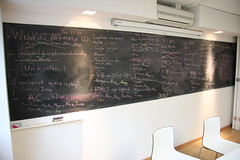
Hackfest black board, photo by Mario

I think this was a very productive hackfest, and as usual a very well organized one! Thanks to the GNOME Foundation for the travel sponsorship, to our friends at Igalia for doing an awesome job at making it happen, and to Collabora for sponsoring it and granting me the time to go there! We got a lot done, and although, as usual, our goals list had many items not crossed, we did cross a few very important ones. I took part in discussions about the new WebKit2 APIs, got to know the new design for GNOME s Web application, which looks great, discussed about Accelerated Compositing along with Joone, Alex, Nayan and Martin Robinson, hacked libsoup a bit to port the multipart/x-mixed-replace patch I wrote to the awesome gio-based infrastructure Dan Winship is building, and some random misc. The biggest chunk of time, though, ended up being devoted to a very uninteresting (to outsiders, at least), but very important task: making it possible to more easily reproduce our test results. TL;DR? We made our bots and development builds use jhbuild to automatically install dependencies; if you re using tarballs, don t worry, your usual autogen/configure/make/make install have not been touched. Now to the more verbose version! The need

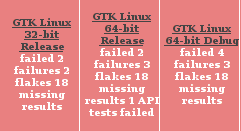
Our three build slaves reporting a few failures

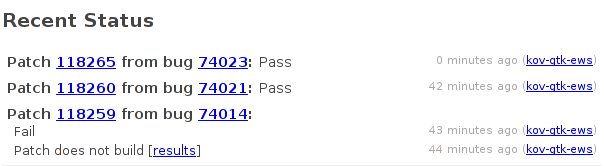
For a couple years now we have supported an increasingly complex and very demanding automated testing infrastructure. We have three buildbot slaves, one provided by Collabora (which I maintain), and two provided by Igalia (maintained by their WebKitGTK+ folks). Those bots build as many check ins as possible with 3 different configurations: 32 bits release, 64 bits release, and 64 bits debug. In addition to those, we have another bot called the EWS, or Early Warning System. There are two of those at this moment: one VM provided by Collabora and my desktop, provided by myself. These bots build every patch uploaded to the bugzilla, and report build failures or passes (you can see the green bubbles). They are very important to our development process because if the patch causes a build failure for our port people can often know that before landing, and try fixes by uploading them to bugzilla instead of doing additional commits. And people are usually very receptive to waiting for EWS output and acting on it, except when they take way too long. You can have an idea of what the life of an EWS bot looks like by looking at the recent status for the WebKitGTK+ bots. Maintaining all of those bots is at times a rather daunting task. The tests require a very specific set of packages, fonts, themes and icons to always report the same size for objects in a render. Upgrades, for instance, had to be synchronized, and usually involve generating new baselines for a large number of tests. You can see in these instructions, for instance, how strict the environment requirements are yes, we need specific versions of fonts, because they often cause layouts to change in size! At one point we had tests fail after a compiler upgrade, which made rounding act a bit different! So stability was a very important aspect of maintaining these bots. All of them have the same version of Debian, and most of the packages are pinned to the same version. On the other hand, and in direct contradition to the stability requirement, we often require bleeding edge versions of some libraries we rely on, such as libsoup. Since we started pushing WebKitGTK+ to be libsoup-only, its own progress has been pretty much driven by WebKitGTK+ s requirements, and Dan Winship has made it possible to make our soup backend much, much simpler and way more featureful. That meant, though, requiring very recent versions of soup. To top it off, for anyone not running Debian testing and tracking the exact same versions of packages as the bots it was virtually impossible to get the tests to pass, which made it very difficult for even ourselves to make sure all patches were still passing before committing something. Wow, what a mess. The explosion^Wsolution So a few weeks back Martin Robinson came up with a proposed solution, which, as he says, is the nuclear bomb solution. We would have a jhbuild environment which would build and install all of the dependencies necessary for reproducing the test expectations the bots have. So over the first three days of the hackfest Martin and myself hacked away in building scripts, buildmaster integration, a jhbuild configuration, a jhbuild modules file, setting up tarballs, and wiring it all in a way that makes it convenient for the contributors to get along with. You ll notice that our buildslaves now have a step just before compiling called updated gtk dependencies (gtk is the name we use for our port in the context of WebKit), which runs jhbuild to install any new dependencies or version bumps we added. You can also see that those instructions I mentioned above became a tad simpler. It took us way more time than we thought for the dust to settle, but it eventually began to. The great thing of doing it during the hackfest was that we could find and fix issues with weird configurations on the spot! Oh, you build with AR_FLAGS=cruT and something doesn t like it? OK, we fix it so that the jhbuild modules are not affected by that variable. Oh, turns out we missed a dependency, no problem, we add it to the modules file or install them on the bots, and then document the dependency. I set up a very clean chroot which we could use for trying out changes so as to not disrupt the tree too much for the other hackfest participants, and I think overall we did good. The aftermath By the time we were done our colleagues who ran other distributions such as Fedora were already being able to get a substantial improvements to the number of tests passing, and so did we! Also, the ability to seamlessly upgrade all the bots with a simple commit made it possible for us to very easily land a change that required a very recent (as in unreleased) version of soup which made our networking backend way simpler. All that red looks great, doesn t it? And we aren t done yet, we ll certainly be making more tweaks to this infrastructure to make it more transparent and more helpful to the users (contributors and other people interested in running the tests). If you ve been hit by the instability we caused, sorry about that, poke mrobinson or myself in the #webkitgtk+ IRC channel on FreeNode, and we ll help you out or fix any issues. If you haven t, we hope you enjoy all the goodness that a reproducible testing suite has to offer! That s it for now, folks, I ll have more to report on follow-up work started at the hackfest soon enough, hopefully =).

2 December 2011

Raphaël Hertzog: My Debian Activities in November 2011

This is my monthly summary of my Debian related activities. If you re among the people who made a donation to support my work (310.73 , thanks everybody!), then you can learn how I spent your money. Otherwise it s just an interesting status update on my various projects. Dpkg: Multi-Arch Saga I know lots of people are waiting the landing of multiarch in Debian unstable, and so am I. Things are progressing, though not as quickly as I hoped. Guillem merged about half of the branch between the 24th October and the 6th of November. After that most of the work happened on his personal repository in his pu/multiarch/master branch. I verify this repository from time to time because Guillem does not inform me when he has made progress. I noticed changes on his repository on the 10th, 19th, 23th, 28th of November and on the 1th of December. He announced a long time ago that he had some interface changes and up to now only wrote about the switch from the command-line option --foreign-architecture (to put in /etc/dpkg/dpkg.cfg) to the explicit command dpkg --add-architecture that only needs to be called once (see mail here). As of today (December 2th), the promised email for the other interface changes is still not here. On November 23th, I reviewed Guillem s work and tried to run the code in his branch. I spent the whole day chasing up regressions and submitted lots of fixes to Guillem. Thanks to the extensive test-suite I wrote when I developed my branch, it has been fairly easy to track them all down. All the issues I reported have been fixed in the latest version of Guillem s branch although the fixes are often slightly different from those that I submitted. Dpkg: Squeeze Backport At the start of the month, I uploaded what I expected to be a fairly uncontroversial backport of dpkg 1.16.1.1. It turns out I was wrong. After some discussion, I think we came to an agreement that it was acceptable to backport dpkg-dev and libdpkg-perl only. My goal was not to bring the latest dpkg to users but to make it easier for package maintainers to backport packages using new features provided by dpkg-dev >= 1.16 (such as hardening build flags, the makefile snippets provided in /usr/share/dpkg/, or the improved dpkg-buildflags interface). Thus I modified the source package uploaded to squeeze-backports to build only dpkg-dev and libdpkg-perl. It has been uploaded on November 23th and it s waiting in the NEW queue for a backports admin to process it. Misc Dpkg Work I merged a patch of Colin Watson to be able to verify build-dependencies for a foreign architecture (taking into account the Multi-Arch status of each package listed). I released dpkg 1.16.1.2 with two minor fixes that were sitting in the sid branch. I wanted to get rid of this so that the path is clear for a 1.16.2 upload with multiarch. The package just migrated to testing so we re fine. I spent another day doing dpkg bug triaging on Launchpad, we re now down to 77 bugs with many of them tagged as incomplete and likely to expire in 2 months. The Debian Administrator s Handbook eBookWe released a sample chapter so that it s easier to have an idea of the quality of the book. The chapter covers the APT tools quite extensively. I bet that even you could learn something about apt-get/aptitude The crowfunding campaign on Ulule ended on November 28th.
With 675 supporters, we raised 24385 EUR. Of those, 14935 EUR have been put in the liberation fund and the rest corresponds to the various pre-orders and rewards offered. This means that the translation will happen (we just started) but that the book is currently not going to be released under a free license. Don t despair As planned, the liberation campaign is carried on until the 25 K target is reached! Instead of being hosted on Ulule, this permanent campaign is on the project website at debian-handbook.info/liberation/. Note that any contribution of 10 EUR or more means that you get a copy of the ebook as soon as it s available (even if the liberation target is not reached). Package Tracking System At the start of the month, I filed two ideas of improvements for the PTS in the bug tracking system: #647258 is about showing outstanding bugs that relate to a release goal and #647901 is about warning maintainers that the package is affected by a current transition. If you re a coder and want to start contributing to Debian and its QA team, those bugs could be interesting targets for a start. :-) In both cases, I have been in contact with members of the release team because those ideas require some structured data from the release team as input. Thanks to Meddi Dohguy and Niels Thykier for their help. Later in the month, the topic of relocating the PTS once again came up. For historical reasons, the PTS was hosted on master.debian.org together with the BTS. Nowadays the BTS has its own host and it made no sense anymore to have the PTS separate from the rest of the QA services hosted on qa.debian.org (currently quantz.debian.org). So together with Martin Zobel Helas we took care to plan the migration and on November 19th we executed the plan. It worked like a charm and almost nobody noticed (only one undocumented dependency was missed, which broke the SOAP interface). Misc Packaging Work WordPress was broken in Ubuntu and it was also not properly synchronized with Debian due to an almost useless change on their side. Thus I requested a sync so that the working version from Debian gets imported in Ubuntu. I sponsored the docbook-xsl 1.76.1 upload that I needed for Publican. Then I updated Publican just to discover that the test-suite triggers a new bug in fop (filed as #649476). I disabled the test-suite temporarily and uploaded Publican 2.8 to unstable. BTW, I also filed 2 upstream bugs with patches for issues I discovered while trying to generate the sample chapter of my book (see here and here). I uploaded a version 0.7.1 of nautilus-dropbox and fixed #648215 at the same time. I made an NMU of bison to fix a long-standing release critical bug that hit me once more during an upgrade (see #645038). I uploaded to experimental a new version of gnome-shell-timer compatible with GNOME 3.2. I took the opportunity to install from experimental the few GNOME 3.2 packages which are not yet in unstable Thanks See you next month for a new summary of my activities.

7 comments Liked this article? Click here. My blog is Flattr-enabled.

22 November 2011

Raphaël Hertzog: People behind Debian: Stefano Zacchiroli, Debian Project Leader

picture by Tiago Bortoletto Vaz, CC BY-NC-SA 2.0


It s been one year since the first People behind Debian interview. For this special occasion, I wanted a special guest and I m happy that our Debian Project Leader (DPL) Stefano Zacchiroli accepted my invitation. He has a difficult role in the community, but he s doing a really great job of it. He s a great mediator in difficult situations, but he s also opinionated and can push a discussion towards a conclusion. Read on to learn how he became a Debian developer and later DPL, what he s excited about in the next Debian release, and much more. Raphael: Who are you? Stefano: I m Stefano Zacchiroli, but I prefer to be called Zack, both on the Internet and in real life. I m 32, Italian, emigrated to France about 4 years ago. I live in Paris, and I find it to be one of the most gorgeous and exciting cities in the world. As my day job I m a Computer Science researcher and teacher at University Paris Diderot and IRILL. In my copious free time I contribute to Debian, and I m firmly convinced that doing so is an effective way to help the cause of Free Software. Besides, I find it to be a lot of fun! Raphael: How did you start contributing to Debian? Stefano: Flash back to 1999, when I was a 2nd year student in Computer Science at the University of Bologna. Back then in Italy it was uncommon for young geeks to get exposed to Free Software: Internet was way less pervasive than today and most computer magazines didn t pay much attention to GNU/Linux. Luckily for me, the professor in charge of the student lab was a Free Software enthusiast and all students machines there were running Debian. Not only that, but there was also a student program that allowed volunteers to become sysadmins after having shown their skills and convinced the director they were trustworthy. Becoming one of those volunteer Debian admins quickly became one of my top objectives for the year, and that is were I ve learned using Debian. The year after that, I got in touch with a research group that was to become the happy bunch of hackers with whom I would have done both my master and PhD theses. They were designing a new proof assistant. Most of the development was in OCaml and happened on Debian. OCaml was available in Debian, but many of the libraries we needed were not. So I approached the Debian OCaml Team offering to help. Before I realize what was going on I was (co-)maintainer of tens of OCaml-related packages. At some point I got told I think you should apply as a Debian Developer . So I did and in a couple of months I went through the New Member (NM) process, that was back then in its infancy. I still remember my happiness while reading the account created mail, the day after my 22nd birthday. I know the NM process went through some bad publicity in the past, but I m happy to see that nowadays the process can be as swift as it has been for me 10 years ago. Raphael: It s your second year as Debian Project Leader (DPL). Are you feeling more productive in the role? Do you fear to burn out? Stefano: I m feeling way more productive, no doubts. The task of the Debian Project Leader is not necessarily difficult, but it is a complex and scarcely documented one. It is also profoundly different from any other task that Debian people usually work on, so that experience doesn t help much in getting started. Before becoming effective as DPL one needs to get to know many people and mechanisms he is not familiar with. More importantly, one needs to set up a personal work-flow that allows to keep up with day-to-day DPL tasks (which are aplenty) as well as with urgencies (that tend to pop-up in the leader@debian.org INBOX at the least convenient time). Finally, one also needs to do proper traffic shaping and always retain enough motivation bandwidth to keep the Project informed about what is going on in DPL-land. Finding the right balance among all these ingredients can take some time. Once one is past it, everything goes way more smoothly. The above is why I m constantly encouraging people interested in running for DPL in the future to reach out to me and work on some tasks of the current DPL s TODO list. I swear it is not just a cheap attempt at slavery!. It is rather an attempt at DPL mentoring that could be beneficial: both to give future candidates more awareness of the task, and to reduce the potential downtime when handing over from one DPL to the next. Regarding burn out, I don t feel prone to its risk these days. If I look back, I can say that my contributions as DPL have been pretty constant in volume over time; my enthusiasm for the task, if anything, is on the rise. The effectiveness of my contributions as DPL are, on the other hand, not mine to judge. Raphael: If you had to single out two achievements where you were involved as DPL, what would they be? Stefano: I d go for the following two, in no particular order: OK, let me cheat and add a third one I m also proud of having been able to report to the Project my whereabouts as DPL, thoroughly and periodically, since the very beginning is first term. People annoyed by my reporting logorrhea now have all my sympathies. Raphael: Among the possible new features of Debian Wheezy, which one gets you excited most? Stefano: It s multi-arch, no doubt. Even though it is not a directly user visible change, it s a very far reaching one. It is also one of those changes that make me feel that moment of truth of coders, when you realize you are finally doing the right thing and ditching piles of ugly hacks.
It s multi-arch [ ] you realize you are finally doing the right thing and ditching piles of ugly hacks.
Raphael: If you were not DPL and could spend all your time on Debian, what project would you do? Stefano: I would sit down and do software development for Debian. It s impressive how many important and beneficial changes for Debian could be delivered by specific software improvements in various parts of our infrastructure. We tend to attract many packagers, but not so many people willing to maintain Debian infrastructure softwares like dak, britney, debbugs, the PTS, etc. Their maintenance burden then falls on the shoulders of the respective teams which are generally very busy with other important tasks. As a project, we seem to be more appealing to packagers than to software developers. That is a pity given the amount of exciting coding tasks that are everywhere in Debian. Part of the reason we are not appealing to developers is that we are not particularly good at collecting coding tasks in a place where interested developers could easily pick them up. It also takes quite a bit of inside knowledge to spot infrastructure bugs and understand how to fix them. I long for some spare hacking time to check if I m still good enough of a coder to hunt down longstanding bugs in our infrastructure, which have ended up being my pet peeves. I d also love to dive again into RCBW. It s less committing than package maintenance, more diverse and challenging, and also an immensely useful activity to get Debian releases done. Raphael: Martin Michlmayr is worried that there is so few paid opportunities around Debian. Do you agree with his sentiment, and if yes do you have ideas on how to improve this situation? Stefano: The idealistic me wishes Debian to be a community made only of volunteers that devote their free time to the Project. Oh, and that me also wishes Debian to be competitive with similar projects, no matter how many full-time employees others have! That is coherent with a view of society where everyone has a day job, but also engages in volunteering activities ensuring that public interest is pursued by people motivated by interests other than profit. But I do realize that for Free Software to succeed companies, employees, and salaries should all have a role. I admire projects that strike a good balance between volunteer and paid work. The Linux kernel is emblematic in that respect: many developers are paid by companies that have a commercial or strategic interest in Linux. Nevertheless volunteers contributions are aplenty and the Linux community gives a convincing impression that choices are driven by the community itself (or by its benevolent dictator) without money-driven impositions.
I do realize that for Free Software to succeed companies, employees, and salaries should all have a role.
Such an ecosystem does not exist around Debian. We do have a partner program that allows for it to happen, but we have very few partners with an interest in doing distribution development work. Like Martin, I m worried by this state of affairs, because it de facto means we lag behind in terms of available people power. In a community of volunteers, that might frustrate people and that is not good. To improve over the status quo the first step is to federate together small and medium companies that have a strategic interest in Debian and listen to their needs. I m already in touch with representatives of such companies that, in many cases, already employ Debian Developers to do some distribution work in Debian. We will be soon sending out a call to reach out to more such companies, but since we are discussing this, why waiting? If some of our readers here are representative of such companies, I encourage them to get in touch with me about this. Raphael: You know that the fundraising campaign for the Debian Administrator s Handbook is on good track but the liberation of the book is not yet assured. What do you think of this project? Stefano: I m happy about the project, to the point that I ve accepted writing a testimonial for it :-) . I m sad about the scarce availability of up to date and high quality (DFSG-)Free books about Debian and I welcome any initiative that might help closing that gap.
I m sad about the scarce availability of up to date and high quality (DFSG-)Free books about Debian.
Free Culture is a great offspring of Free Software and I m convinced we need to stand up against double standards in the two camps. Letting aside software-specific licensing details, the basic freedoms to be defended are the same. They are those freedoms that ensure that a reader is in full control of his book, pretty much as they ensure that a computer user is in full control of the software that runs on it. I m therefore proud that Debian has long resolved that the Debian Free Software Guidelines (DFSG) apply not only to software but also to books and other pieces of documentation. But the status quo implies that not only we have very few up to date, high quality books about Debian. It also implies that, at present, we have no such book that we can distribute in the Debian archive, showing off the Free Software (and Free Culture!) values we stand for.
Crowdfunding is considered to be a good mate for Free Culture, where the services model that applies to Free Software is more difficult to exploit. I so wish any luck to yours and Roland s initiative. A different matter is whether Debian, as a project, should endorse the initiative and actively campaign for it. As you know, I think it should not. While we do advertise general project donations, we don t do mission-specific fundraising campaign for Debian itself. Coherently with that, I don t think we should relay crowdfunding campaigns for 3rd parties, even when the result would be beneficial to Debian. Raphael: Is there someone in Debian that you admire for their contributions? Stefano: There are two classes of people that I particularly admire in Debian:
Thank you to Zack for the time spent answering my questions. I hope you enjoyed reading his answers as I did.

Subscribe to my newsletter to get my monthly summary of the Debian/Ubuntu news and to not miss further interviews. You can also follow along on Identi.ca, Google+, Twitter and Facebook .

7 comments Liked this article? Click here. My blog is Flattr-enabled.

21 November 2011

Siegfried Gevatter: Debian Games Team Meeting

This announcement was provided by Martin Erik Werner. I m reproducing it for Planet Ubuntu. The Debian/Ubuntu Games Team is organizing another meeting. If you re into developing and/or packaging of games, or just generally curious about games in Debian/Ubuntu, you should join! It will be held next Saturday, the 26th of November, in the #debian-games channel on irc.debian.org (also know as irc.oftc.net) at 10:00 UTC. More information is available on the wiki page Games/Meetings/2011-11-26. The agenda starts off with the usual round of introductions, so if you re new to the Team, say hi! Then we ll be going through the action items from the last meeting, including work on the Debian Games LiveCD, and what s up with the /usr/games/ path anyways? Next we ll be moving onto how the Games Team is faring in terms of members: are new recruits finding it comfortable, should we advertise more? Next up it s the squeeky penguin: Wheezy is somewhere in the not-completely-distant future, how does that affect the Games Team, should we be scuffling to get specific tasks done? Then onto the recurring question of Sponsoring, and how to improve it, should we be utilising DebExpo more? What about our favourite PET? Lastly, PlayDeb is doing some really neat stuff, would it make sense for our team to push some changes to PlayDeb? Would it make sense for PlayDeb to push changes to Debian Games? Hopes are for a good discussion, and a merry time, hope to see you all there! Related posts:
  1. Debious A dubious Debian packaging GUI
  2. One week with Debian
  3. A list of some commercial GNU/Linux games

No comments
Siegfried-Angel Gevatter Pujals, 2011. Permalink License Post tags: , ,

flattr this!

Paul Wise: Debian/Ubuntu games team meeting #6

The Debian/Ubuntu games team is organizing another meeting, if you're into developing and/or packaging of games, or just generally curious about games in Debian/Ubuntu, you should join! It will be held next Saturday, on the 26th of November, in the #debian-games channel on irc.debian.org (also know as irc.oftc.net). More information is available on the meeting wiki page. The agenda starts off with the usual round of introductions, so if you're new to the team, say hi! Then we'll be going through the action items from the last meeting, including work on the Debian Games LiveCD, and what's up with the /usr/games/ path anyways? Next we'll be moving onto how the games team is faring in terms of members: are new recruits finding it comfortable, should we advertise more? Next up it's the squeeky penguin: Wheezy is somewhere in the not-completely-distant future, how does that affect the games team, should we be scuffling to get specific tasks done? Then onto the recurring question of sponsoring, and how to improve it, should we be utilising DebExpo more? What about our favourite PET? Lastly, PlayDeb is doing some really neat stuff, would it make sense for our team to push some changes to PlayDeb? Would it make sense for PlayDeb to push changes to Debian Games? Hopes are for a good discussion, and a merry time, hope to see you all there! (This text provided by Martin Erik Werner)

14 November 2011

MJ Ray: Growing Your Co-operative, Bristol

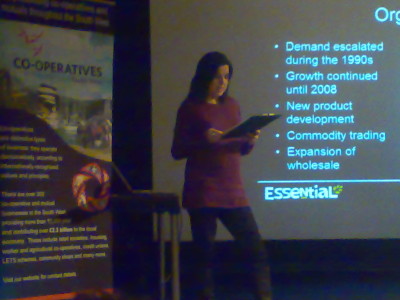
Photo of Eli Sarre

Eli Sarre from Essential Trading speaking at C-SW Annual Conference

Last Friday (11 November 2011), I was at the Cooperatives-SW annual conference at the Cube Cinema in Bristol, titled Growing Your Co-operative and sponsored by the Co-operative Membership South and West. It was another sold-out event, featuring headline talks from Co-op Party member and Labour MP Kerry McCarthy, Eli Sarre of Essential Trading worker co-op (pictured), Carole Theyer of Sparks Inc and Jim Pettipher from Co-operative Futures. There were also some great workshops I went to a finance workshop led by Ian Rothwell from Co-operative and Community Finance and a regulations one with Paul Martin of Kabin (details may appear on their event page) and a brilliant lunch from Runcible Spoon (and those of you who know me will know I have been livid with some co-op event lunches!) with some time to chat and network, although I also went to a fringe meeting about the RISE problems. The event concluded with the formal AGM of Co-operatives SW (electing a new chairperson and approving transfer to a new co-op corporation) as well as a bit more chat afterwards. I felt it was a great event and well worth my time being there. I m glad that some people from outside the co-op movement, from community businesses like the Strawberry Line Cafe and a few people considering joining or forming co-ops, were there and I hope it was good for them too.

9 November 2011

Martin Zobel-Helas: How to read Debian's mailing list archives locally

From time to time i want to answer on mails on Debian mailinglists that i am not subcribed to. To have proper reply-headers set, i usually copied the archive mbox from master.debian.org to my local machine. Now i found a much nicer way.
apt-get install fuse afuse sshfs
adduser zobel fuse
mkdir ~/fuse/
afuse -o mount_template="sshfs %r:/ %m" -o unmount_template="fusermount -u -z %m" -o timeout=60 ~/fuse
mutt -f /home/zobel/fuse/master.debian.org/home/debian/lists/debian-user/debian-user.201111

30 October 2011

Martin F. Krafft: How They Save the Euro in Brussels

Unbeknown to the participants of last week s Euro Summit in Brussels, the clueless leaders of Europe in whose hands it lies to save our asses have been recorded on film. I do not understand why they are dressed up, but I understand now why things are as they are.

24 October 2011

Russell Coker: Stop HRL

Today I attended the Stop HRL demonstration [1]. The government plans to spend $100,000,000 of federal money and $50,000,000 of Victorian state money to build a new coal power station. The state government has imposed some unreasonable restrictions on renewable energy which includes allowing a single person who objects within 2Km of a wind turbine to block the project while also not allowing anyone to object to coal power plants or fracking (both of which have proven health implications). Today VCAT had a hearing about this issue, HRL wants to double the size of the proposed coal power plant while Environment Victoria, Doctors for the Environment Australia, local climate action group Locals Into Victoria s Environment Martin Shield from Climate Action Moreland are opposing the plan. What the government should be doing is permitting (if not encouraging) renewable energy production, particularly wind power which will drive down energy prices by undercutting the energy auctions due to it s almost zero marginal cost. The government should not be spending tax payer money on new coal projects due to climate change and air pollution in addition to the fact that coal is simply more expensive in the long term. As usual it s disappointing that the National party which supposedly represents farmers is supporting the government in such things. The pollution caused by coal power and fracking ends up damaging farmland. The Liberal party doesn t have a majority on it s own in either house of the state government, so this proposed coal power plant could be stopped immediately if the National party supported renewable power, or even if they merely opposed giving $50,000,000 of state tax money to HRL. The demonstration went reasonably well, there was about 80 people there when I arrived and by the time it ended there were more than 150 people. I took the above picture at the start and it missed many people who were off to the right. I think that s a good result for a demonstration that had little publicity and was held in business hours with really bad weather. Update: On Sunday the 13th of November at 13:00-14:30 there is a Going Backwards Under Baillieu demonstration at Parliament House. This is to mark the negative affects that the Liberal state government has had on the environment of Victoria.

17 October 2011

Martin Meredith: Adventures with the Galaxy SII

Good morning all! It feels like forever since I last blogged . Which is extremely bad of me *slaps own wrist*. However, I m been horrendously stupidly busy. As some of you may know, I m very much an Android fan. Recently, I ve gotten myself a shiny Galaxy SII. Given the fact that alongside my day job of being a Web Developer for an Online Retailer, I m also a Voluntary Ambulance Person I thought it d be useful to ask my current workplace if they d provide me a mobile phone cover for my new phone. Of course, work were more than happy to provide me with a shiny Samsung Galaxy S2 case (I actually went for the Case-Mate Barely There in brushed aluminium). Being a voluntary Ambulance Person, I regularly have to go to random places to pick up an ambulance/attend an event. Because of that I rely quite heavily on Google Maps and it s navigation features (Free Sat Nav in my opinion, the killer feature of Android). Having only had my phone a week, I started to find that there were a few problems with the GPS. Whereas previously, I d been able to lock on almost instantly, It d now take me about half an hour (literally) to get a lock on anything. I tried Googling, I tried everything I could think of, but to no avail. I downloaded GPS Test, and it was showing that while it was picking up a couple of sattelites, it wasn t picking up enough to get a decent lock The image above is a screenshot of the GPS test from directly outside my front door, taken after it had settled down. As you can imagine, I wasn t happy and was ready to send the phone back. Then, for some reason, a brainwave hit me (It doesn t happen often). What changed from when it was working to now? I know! The Case *takes case off, tries GPS test again* It can be amazing what happens when you realise that shiny case you have is mainly made of aluminium. Guess what works well at deflecting radio signals and the like You got it, aluminium. So now I need to decide whether to get another case or whether to just take the case off when I need to do sensible things. Other than the case problem, I m finding that the Samsung Galaxy SII is a great phone (as soon as I got rid of Touchwiz). I m not a fan of the OEM Samsung crap that s been bolted onto the phone, and will, as soon as there s a decent release, be putting a copy of CyanogenMod on the phone (I ve already made most of the tweaks I just want rid of SNS) In other news I ve started more and more gaming again. If you re interested in a couple of rounds of TF2 or some SC2 (or some Portal 2 Co-Op) then give me a shout with your Steam ID / Battle.net ID and I ll see what I can do. I m thinking of starting doing some Let s Play Videos, as my Youtube Channel is looking a bit sparse! I m going to try and start blogging a bit more aswell so if there s anything you want to see me blog about pop a post in the comments below! Till next time..

14 October 2011

Martin F. Krafft: Deutsche Bahn frequent traveller: a joke!

It has been a while since I last ranted about the Deutsche Bahn, our national train service monopoly. Out of necessity, I ve since become one of their frequent travellers. Together with the spiffy, silver card, I received a pamphlet, in which the advantages of frequent travellers are listed. When I compare those advantages to what was promised, I cannot help but notice quite a few differences to my disadvantage. Since I refused to believe that the Deutsche Bahn could be this stupid, I double-checked with the service hotline, and I now have the information to report:
  1. While the website promises free access to DB lounges for two , the pamphlet clarifies this: free access to DB lounges for you and your partner, provided each of you owns a first-class, long-distance ticket. What they left out: Oh, you don t need the frequent traveller status for that, the ticket suffices. Or, put differently: the frequent traveller status does not give you any access to the lounges. False advertising, anyone?
  2. The pamphlet explains that there are special seat areas reserved for frequent travellers. However, one must not be a frequent traveller to use them. So should I expect people to prompt me to show my card or clear my seat. And should I be expected to prompt people to flash the card or leave? Not feasible, anyone?
  3. I am told that I get priority treatment at the counter, except there is only one counter (in Munich), usually with a line of people for 1st-class and frequent travellers. All other travellers get delegated to 12 counters by an efficient number system, which means one is better off picking a number and standing in line. The other day, a lady came and flashed her frequent traveller card, expecting people to make way, but obviously noone did. Did they actually think about this, anyone?
I don t need to go into detail on the other benefits : they claim that there is special, reserved parking, but that s probably only on paper. They claim reductions in hotels and rental cars, but probably limited to availability, they claim exclusive events, but those are likely the ones noone goes to anyway. And they claim a service hotline, but it s a premium-rate number. So all in all, Deutsche Bahn have once again managed to disappoint. The frequent traveller card does not give any benefits. It rather makes me regret having spent so much money on this company. Scratch frequent traveller , make it repeat idiot . NP: Steven Wilson: Grace for Drowning

6 October 2011

Colin Watson: Top ideas on Ubuntu Brainstorm (August 2011)

The Ubuntu Technical Board conducts a regular review of the most popular Ubuntu Brainstorm ideas (previous reviews conducted by Matt Zimmerman and Martin Pitt). This time it was my turn. Apologies for the late arrival of this review. Contact lens in the Unity Dash (#27584) Unity supports Lenses, which provide a consistent way for users to quickly search for information via the Dash. Current lenses include Applications, Files, and Music, but a number of people have asked for contacts to be accessible using the same interface. While Canonical's DX team isn't currently working on this for Ubuntu 11.10 or 12.04, we'd love somebody who's interested in this to get involved. Allison Randal explains how to get started, including some skeleton example code and several useful links. Displaying Ubuntu version information (#27460) Several people have asked for it to be more obvious what Ubuntu version they're running, as well as other general information about their system. John Lea, user experience architect on the Unity team, responds that in Ubuntu 11.10 the new LightDM greeter shows the Ubuntu version number, making that basic information very easily visible. For more detail, System Settings -> System Info provides a simple summary. Volume adjustments for headphone use (#27275) People often find that they need to adjust their sound volume when plugging in or removing headphones. It seems as though the computer ought to be able to remember this kind of thing and do it automatically; after all, a major goal of Ubuntu is to make the desktop Just Work. David Henningson, a member of Canonical's OEM Services group and an Ubuntu audio developer, responds on his blog with a summary of how PulseAudio jack detection has improved matters in Ubuntu 11.10, and what's left to do:
The good news: in the upcoming Ubuntu Oneiric (11.10), this is actually working. The bad news: it isn't working for everyone.
Making it easier to find software to handle a file (#28148) Ubuntu is not always as helpful as it could be when you don't have the right software installed to handle a particular file. Michael Vogt, one of the developers of the Ubuntu Software Center, responded to this. It seems that most of the pieces to make this work nicely are in place, but there are a few more bits of glue required:
Thanks a lot for this suggestion. I like the idea and it's something that software-center itself supports now. In the coming version 5.0 we will offer to "sort by top-rated" (based on the ratings&reviews data). It's also possible to search for an application based on its mime data. To search for a mime-type, you can enter "mime:text/html" or "mime:audio/ogg" into the search field. What is needed however is better integration into the file manager nautilus. I will make sure this gets attention at the next developer meeting and filed bug #860536 about it. In nautilus, there is now a button called "Find applications online" available as an option when opening an unknown file or when the user selects "open with...other application" in the context menu. But that will not use the data from software-center.
Show pop-up alert on low battery (#28037) Some users have reported on Brainstorm that they are not alerted frequently enough when their laptop's battery is low, as they clearly ought to be. This is an odd one, because there are already several power alert levels and this has been working well for us for some time. Nevertheless, enough people have voted for this idea that there must be something behind it, perhaps a bug that only affects certain systems. Martin Pitt, technical lead of the Ubuntu desktop team, has responded directly to the Brainstorm idea with a description of the current system and how to file a bug when it does not work as intended.

Next.

Previous.