Search Results: "dom"

13 January 2010

Matt Brubeck: Finding SI unit domain names with Node.js

I'm working on some ideas for finance or news software that deliberately updates infrequently, so it doesn't reward me for checking or reloading it constantly. I came up with the name "microhertz" to describe the idea. (1 microhertz once every eleven and a half days.) As usual when I think of a project name, I did some DNS searches. Unfortunately "microhertz.com" is not available (but "microhertz.org" is). Then I went off on a tangent and got curious about which other SI units are available as domain names. This was the perfect opportunity to try node.js so I could use its asynchronous DNS library to run dozens of lookups in parallel. I grabbed a list of units and prefixes from NIST and wrote the following script:
var dns = require("dns"), sys = require('sys');
var prefixes = ["yotta", "zetta", "exa", "peta", "tera", "giga", "mega",
  "kilo", "hecto", "deka", "deci", "centi", "milli", "micro", "nano",
  "pico", "femto", "atto", "zepto", "yocto"];
var units = ["meter", "gram", "second", "ampere", "kelvin", "mole",
  "candela", "radian", "steradian", "hertz", "newton", "pascal", "joule",
  "watt", "colomb", "volt", "farad", "ohm", "siemens", "weber", "henry",
  "lumen", "lux", "becquerel", "gray", "sievert", "katal"];
for (var i=0; i<prefixes.length; i++)  
  for (var j=0; j<units.length; j++)  
    checkAvailable(prefixes[i] + units[j] + ".com", sys.puts);
   
 
function checkAvailable(name, callback)  
  var resolution = dns.resolve4(name);
  resolution.addErrback(function(e)  
    if (e.errno == dns.NXDOMAIN) callback(name);
   )
 
Out of 540 possible .com names, I found 376 that are available (and 10 more that produced temporary DNS errors, which I haven't investigated). Here are a few interesting ones, with some commentary: To get the complete list, just copy the script above to a file, and run it like this: node listnames.js Along the way I discovered that the API documentation for Node's dns module was out-of-date. This is fixed in my GitHub fork, and I've sent a pull request to the author Ryan Dahl.

10 January 2010

Decklin Foster: man ascii

I find myself opening a shell and typing "man ascii" more than I would like. More recently, I've found myself looking (with no success) for a equivalent web page that isn't ugly -- sometimes a browser tab is just more convenient. Yesterday, I decided to stop searching and just write one myself: man ascii. (I was a bit surprised that this domain, and all the variants of it Joker came up with, were available!) I think it gives me everything I got out of ascii(7), but I would love any bug reports.

Gunnar Wolf: Winter in the tropics

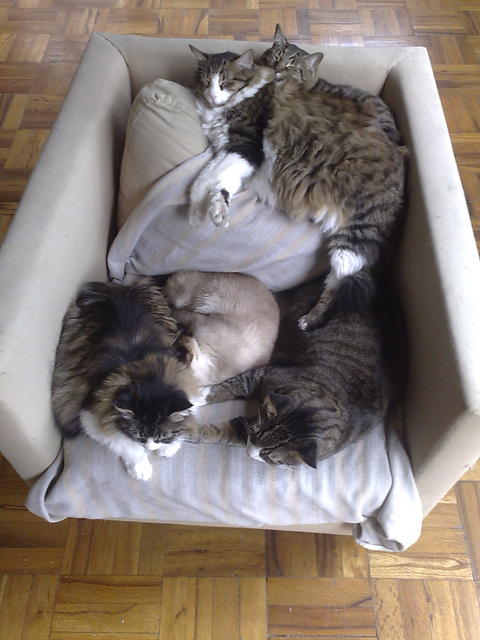
Five out of six experts agree: Five out of six cats cannot be mistaken
It. Is. Cold.
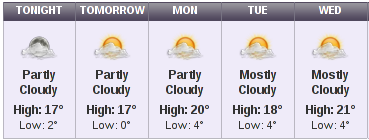
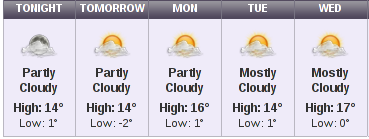
No, we are far from this very impressive picture of a fully-snowed UK seen from the sky that everybody and their dog must have seen by now. Still, in Mexico City we are experiencing the traditional one-or-two-weeks-a-year where it is genuinely cold. And, very strange being this Winter (the rainy season is Summer around here, January should be dry!) we have rain all day long. The Ajusco mountain is around 15Km south from my home, and it is the closest of the giants that surround our valley. Yesterday I managed to get some peeks at it behind the very thick layer of clouds we have. Ajusco looks really gorgeous all snowed, maybe down to the 3400m line (while the city's main area is at 2300m). This picture was not taken this year, we have snow in Ajusco almost every year (although very seldom as much as this time): (last photo is not current, we have not yet had a clear day to take a picture of our Ajusco yet this year) How does it feel? Well, I live in Coyoac n, in the flat area of the valley. Remember that houses here are not built to endure extreme temperatures (and this week is what we call extreme, of course ;-) ). According to Yahoo! Weather: And while the difference appears to be small, what about Magdalena Contreras, ~200m higher, where many people dear to me live (and have even a window pending to be installed)? People say this cold wave is the strongest in 120 years, since records are being taken. Every year people get excited, expecting that this time we will get snow. This has only happened once in at least a century, in 1966 AFAIR. I do not think this year to be atypical. Still, I have a reputation for being insensible to cold weather. Everybody wears heavy jackets while I still go to work with my usual long-sleeved shirt and that's it. But the last two days, I have been using jacket and scarf... But, of course, I don't look as gratious or cute as my cats :-

8 January 2010

Russell Coker: Ext4 and Debian/Lenny

I want to use the Ext4 filesystem on Xen DomUs. The reason for this is that the problem of fsck times on ext4 (as described in my previous post about Ext4 [1]) is compounded if you have multiple DomUs running fsck at the same time. One issue that makes this difficult is the fact that it is very important to be able to mount a DomU filesystem in the Dom0 and it is extremely useful to be able to fsck a DomU filesystem from a Dom0 (for example when you want to resize the root filesystem of the DomU). I have Dom0 systems running CentOS5, RHEL5, and Debian/Lenny, and I have DomU systems running CentOS5, RHEL4, Debian/Lenny, and Debian/Unstable. So to get Ext4 support on all my Xen servers I need it for Debian/Lenny and RHEL4 (Debian/Unstable has full support for Ext4 and RHEL5 and CentOS5 have been updated to support it [2]). The Debian kernel team apparently don t plan to add kernel support for Ext4 in Lenny (they generally don t do such things) and even backports.debian.org doesn t have a version of e2fsprogs that supports ext4. So getting Lenny going with Ext4 requires a non-default kernel and a back-port of the utilities. In the past I ve used CentOS and RHEL kernels to run Debian systems and that has worked reasonably well. I wouldn t recommend doing so for a Dom0 or a non-virtual install, but for a DomU it works reasonably well and it s not too difficult to recover from problems. So I have decided to upgrade most of my Lenny virtual machines to a CentOS 5 kernel. When installing a CentOS 5 kernel to replace a Debian/Lenny kernel you have to use console=tty0 as a kernel parameter instead of xencons=tty , you have to use /dev/xvc0 as the name of the terminal for running a getty (IE xvc0 is a parameter to getty) and you have to edit /etc/rc.local (or some other init script) to run killall -9 nash-hotplug as a nash process from the Red Hat initrd goes into an infinite loop. Of course upgrading a CentOS kernel on a Debian system is a little more inconvenient (I upgrade a CentOS DomU and then copy the kernel modules to the Debian DomUs and the vmlinuz and initrd to the Dom0). The inconvenience of this can be an issue in an environment where multiple people are involved in running the systems, if a sysadmin who lacks skills or confidence takes over they may be afraid to upgrade the kernel to solve security issues. Also apt-get dist-upgrade won t show that a CentOS kernel can be updated, so a little more management effort is required in tracking which machines need to be upgraded. deb http://www.coker.com.au lenny misc To backport the e2fsprogs package I first needed to backport util-linux, debhelper, libtool, xz-utils, base-files, and dpkg. This is the most significant and invasive back-port I ve done. The above apt repository has all the packages for AMD64 and i386 architectures. For a Debian system after the right kernel is installed and e2fsprogs (and it s dependencies) are upgraded the command tune2fs -O flex_bg,uninit_bg /dev/xvda can be used to enable the ext4 filesystem. At the next reboot the system will prompt for the root password and allow you to manually run e2fsck -y /dev/xvda to do the real work of transitioning the filesystem (unlike Red Hat based distributions which do this automatically). So the state of my Debian systems running this is that the DomUs run the CentOS kernel and my backported utilities while the Dom0 just runs the backported utilities with the Lenny kernel. Thus the Debian Dom0 can t mount filesystems from the DomUs which makes things very difficult when there is a problem that needs to be fixed in a DomU, I have to either mount the filesystem from another DomU or boot with init=/bin/bash .

4 January 2010

Russell Coker: Ext4 and RHEL5/CentOS5

I have just noticed that Red Hat added Ext4 support to RHEL-5 in kernel 2.6.18-110.el5. They also added a new package named e4fsprogs (a break from the e2fsprogs name that has been used for so long). Hopefully they will use a single package for utilities for Ext2/3/4 filesystems in RHEL-6 and not continue this package split. Using commands such as e4fsck and tune4fs is a minor inconvenience. Converting a RHEL 5 or CentOS 5 system to Ext4 merely requires running the command tune4fs -O flex_bg,uninit_bg /dev/WHATEVER to enable Ext4 on the devices, editing /etc/fstab to change the filesystem type to ext4, running a command such as mkinitrd -f /boot/initrd-2.6.18-164.9.1.el5xen.img 2.6.18-164.9.1.el5xen to generate a new initrd with Ext4 support (which must be done after editing /etc/fstab), and then rebooting. When the system is booted it will run fsck on the filesystems automatically but not display progress reports which is rather disconcerting. The system will display / contains a file system with errors, check forced. and apparently hang for a large amount of time. This is however slightly better than the situation on Debian/Unstable where upgrading to Ext4 results in an fsck error on boot which forces you to login in single user mode to run fsck [1] which would be unpleasant if you don t have convenient console access. Hopefully this will be fixed before Squeeze is released. I now have a couple of my CentOS 5 DomUs running with Ext4, it seems to work well.

1 January 2010

Thorsten Glaser: RCBD #1

My first RC Bug-squashing Day (or rather night): I picked all of them mostly randomly from the list Zack gave me, and except dietlibc they are packages I had not even heard of before. The first one begun easily (track down licencing information, pimp debian/copyright, but I ended up fixing compiler and lintian warnings and even wrote a manpage for it while there (but for this one, I didn t bump the Standards-Version). The second one was only the second one to complete because the others took longer; it s basically a change of a d mon to use two instead of one listening socket, to work with a doble stack OS instead of just a dual stack OS by not using v4-mapped IPv6 addresses (I considered if to use select(2) or poll(2), or to just fork and have two d mons running, but that seemed too ressource-consuming to me so I chose the less-complicated poll(2) method, looking at popa3d(8) s source code (inherited from OpenBSD) in the MirBSD tree since I could not find my network programming book. The third one was basically communicating with upstream; the bug can be blosed with no change to the package. The fourth one took me a while; luckily I have qemu 0.11.0 on MirBSD, and aurel32 s mipsel qemu images helped a great deal; however, cowbuilder --create failed for me, so I ended up waiting almost the entire night for a-g d-u to finish; in the end, it was simply a bug in upstream s configure.ac which is only exposed due to a toolchain bug on mips(el). To do: my AM Zack needs to upload the NMUs (after checking, of course); I need to communicate some of the fixes upstream (the gidentd upstream is NXDOMAIN ), produce a very small testcase for the mipsel toolchain bug, maybe fix some more mipsel FTBFSen as I have a working qemu instance now, but maybe I ll do that at the BSP when I can t find IPv6 bugs or so that I feel I can fix (I also want to do an mksh release which has to be prepared first RSN, and there s still the need to formally publish the MirBSD-current bi-arch snapshot and make another ISO out of it for BT and prepare the multi-BSD USB stick for allbsd.de ). Annoyances: a-g d-u could ask me things at the start before working for some four+ hours instead of in the middle, and the same questions several times (PAM restart). The sid kernel doesn t boot today but did yesterday, the lenny kernel produces this:
Starting the hotplug events dispatcher: udevdudevd[320]: udev: missing sysfs features; please update the kernel or disable the kernel's CONFIG_SYSFS_DEPRECATED option; udev may fail to work correctly
(I hate udev.) And, worst of all, these annoying fireworks (some sounded like originating from inside our staircase, I pity the neighbour s cats) when one wants to hack Finally, I *loathe* CDBS. Debhelper v5 rules! Oh, and I also was under the impression that Firstname LASTNAME was a French thing, and to a much lesser extent Asian. (@bubulle)

29 December 2009

Neil Williams: Intermittent tasks

Sometimes, the main task at any one time is simply going to take time and cannot be shortened. With my poor network connection, this tends to occur any time I need to do network tasks like multistrap and debootstrap tests, archive updates and the rest. The problem is that my network connection is so bad, most apt type tasks completely saturate all available bandwidth, especially when downloading a single large package like those built from gcc or OOo.

Thankfully, gpdftext has provided an intermittent task that is useful, intermittent, non-network dependent and relatively straightforward (so as not to be too distracting from the main task) without being sufficiently routine to make me think about automating it.
I've downloaded some 70 public domain novels as A4 PDF and I'm gradually working through them in gpdftext to tidy up the chapter headings and reformat as an A5 PDF, ready to be transferred back to my ebook reader.

This version of gpdftext isn't released yet (it's current SVN, 0.1.0) as it's in string freeze. However, it provides a fairly robust test of the next release. :-)

Current list includes: Little Women, Fairy Tales of Hans Christian Andersen, Lady Susan, Northanger Abbey, Pride and Prejudice, Sense and Sensibility, Peter Pan (Peter and Wendy), Lorna Doone: A Romance Of Exmoor, The Gap in the Curtain, The Thirty-Nine Steps, Through the Looking Glass (And What Alice Found There), Fanny Hill: Memoirs of a Woman of Pleasure, Moll Flanders, Robinson Crusoe, The Further Adventures of Robinson Crusoe, A Tale of Two Cities, David Copperfield, Great Expectations, Little Dorrit, Oliver Twist, The Life And Adventures Of Nicholas Nickleby, The Adventures of Sherlock Holmes, The Casebook of Sherlock Holmes, The Hound of the Baskervilles, The Memoirs of Sherlock Holmes, The Return of Sherlock Holmes, Cranford, The Wind in the Willows, King Solomon's Mines, Tess of the d'Urbervilles, The Hunchback of Notre Dame, Declaration of Independence, Just so Stories, Kim, The Jungle Book, The Man Who Would be King, The Arabian Nights, Lady Chatterley's Lover, Sons and Lovers, Women in Love, The Story of Doctor Dolittle, The Call of the Wild, The Game, White Fang, Moby Dick, Anne of Green Gables, The Well at the World's End, Pygmalion, An Inquiry into the Nature and Causes of the Wealth of Nations, East is West, Strange Case of Dr Jekyll and Mr Hyde, The Jewel of Seven Stars, Anna Karenina, The Adventures of Huckleberry Finn, The Adventures of Tom Sawyer, The Kama Sutra, 20,000 Leagues Under the Sea, The Aeneid of Virgil.

That should be enough for now.... (21 converted so far).

Craig Small: Updated: psmisc, gw6c and gjay

Time away from work and its been either raining or hot. So I've updated and released some software. It always seems to happen there is a lot of Free Software development during the breaks.

psmisc got a bunch of updates, including a new program called prtstat which formats the stat file in the procfs for a pid in (hopefully) a nice way. No sooner had I released the latest update when a bug report came in. It seems fuser -m -k is a little too happy about killing itself. The fix is in the CVS but anoying I missed that.

Next up was the Debian gw6c package. I was asked why it didn't get moved from unstable to testing. The problem is that while Linux has iproute, kfreebsd does not so the lack of a dependency was stopping it transitioning. To make matters worse the freebsd template was missing from their package. After some deb-substvars evilness to fix the dependencies and some dh_install overrides in the debian/rules file it should all be happy when its finished.

Finally, I miss having good random playlists. I'm too lazy to make them myself so I use some random thing which often gives me rubbish. A program called Gjay used to be in the Debian archive but got removed, mainly because the upstream stopped supporting it. I can write C (the programming language its written in) and I wanted to use it, so I fixed it. My version is 64-bit clean, so it works on my amd64 and it works with audacious not the old xmms which is great. More importantly, it compiles, it runs and it even works properly.
I'm just wondering if I want to release it out to the wider world or not.

25 December 2009

Erich Schubert: Media Players

Somehow, I'm still lacking the optimal media player application. Many popular ones are totally overloaded (e.g. amarok). Others like totem seems to be just a minimalistic frontend for a particular backend.My current choice: However, there is one thing I'm really not satisfied with: when putting together a CD compilation for friends (say, as Christmas present), they are quite useless. A key issue here is the total playlist length. Guess what, I want to make sure it fits on a single CD. So I really need to know the total playlist length. Why do so many media players (e.g. totem, alsa-player-gtk, xfmedia4, vlc, mplayer, ...) not show you the total playlist length? They did read all the files to get artist and title. Many even have the individual song lengths, just not the total sum.In the past I've been using old XMMS1 to check for the total length, or a CD burning application like K3B by repeatedly importing my current folder.Right now, I'm using Quod Libet (since I like the tag-editing component exfalso a lot) to arrange the playlist. It also gives me the total length, albeit I belive I've had incorrect song lengths in it before (broken VBR files?), and it's not perfect, too: being database-driven it has really long startup times for occasional users (because of updating the database) and is much more heavyweight. I also believe I've lost some playlists because I had moved my files around once ... so I'm a bit sceptical.Anyway, there are still hundreds of media players I havn't looked at. Don't bother me to send me an email about one I havn't mentioned!But if you are developing a media player, please consider the use case of putting together a music CD for your friends. In particular, for users that do not use your player all day.

23 December 2009

Benjamin Mako Hill: What's in a name?

Over the summer, there was a bit of a tussle at the highest level of Ubuntu governance over whether or not Canonical Ltd., the company that funds the majority of work done directly in Ubuntu, should name its file syncing and backup service Ubuntu One. Canonical's service involved a freely licensed client included in the Ubuntu distribution but, as a network service running on Canonical servers, it was not clearly a part of Ubuntu (the GNU/Linux distribution) or Ubuntu (the community) in the way the term was usually used within the community. Although the network service itself was not Franklin Street Statement free, this was not the most important issue for everyone who objected to the name. The major issue for many seemed to boil down to the fact that, free or not, Ubuntu One is a service run entirely by Canonical outside the reaches of the Ubuntu governance structures. Decisions were made and not everybody -- and maybe not anybody -- was absolutely happy with the outcome. My goal is not try to revive old arguments here. As far as I'm concerned, the issues are settled and the service is called Ubuntu One. That said, the questions raised during the episode are fundamental to Ubuntu and to other firm-sponsored FLOSS projects. Now that the dust has settled, they are worth reflecting on. From a legal perspective, there never was any ambiguity. Canonical "owns" the Ubuntu trademark. In this important sense, "Ubuntu" means whatever Canonical says it means. This is hardly new. As just one example, the Official Ubuntu Book (of which I am an author) was written by community members but became official because Canonical blessed it. But despite the fact that they don't need to, Canonical has often consulted with the community and its governance structures about trademark licensing policy. This was also not a case of Canonical not listening to the community. Canonical employees approached the Ubuntu Community Council (Ubuntu's highest governance board of which I am a member), listened carefully to concerns, and responded thoughtfully. The question was not even about a clash between what Canonical and the CC thought about the issue. An unambiguous majority of the board, including all the Canonical employees and several of the community members, supported the idea of Canonical using the trademark. The question was one about who gets to make the decisions about the Ubuntu name and about what role the community and Canonical would each play. Despite the fact that a majority of the Ubuntu community council was likely to support the proposed name, the CC was told by Canonical CEO Mark Shuttleworth that a vote was irrelevant. Canonical made it clear that decisions about the Ubuntu trademark were simply not in the CC's purview. The decision on how the name was to be used was something that Canonical was not willing to delegate to an "outside" (the firm) governance body. Few businesses would. And although I don't agree with the decision as a community representative, I might have even made the same call from Canonical's shoes. In traditional firms, it's usually pretty clear where the organization's boundary lies. In FLOSS projects -- and especially in FLOSS project like Ubuntu who are sponsored in very large part by a single for-profit company -- boundaries are fuzzier. The conversation about "Ubuntu One" can be seen as a fight over what "Ubuntu" refers to, and, more importantly, who gets to answer that question. In deciding whether to call a service "Ubuntu", a decision is made on what Ubuntu is. Names are powerful. Is Ubuntu just a Canonical project? Are Ubuntu's contributors really just Canonical contributors by proxy? I think the answer to both questions is "no" but the boundary issues involved are complicated and under constant negotiation. Every time Canonical uses the Ubuntu name itself or grants others the ability to do so, these boundary issues are negotiated, one way or another. This boundary setting work reveals an important tension that firms releasing FLOSS must all struggle with. To what extent and in what ways do communities get to decide what a FLOSS project is and to what extent do sponsoring firms get to do so? How should projects and firms do this most effectively? What should we even be optimizing for? I think that any resulting balance has a huge effect on whether a FLOSS project is, on one hand, released under a free license but run like any old corporate project or, on the other, a true "bazaar" style project where no single firm dominates -- or where they fall on that spectrum. Names and trademarks are one way that projects define their own identities and act as an important frontier in this balancing act. As every firm/project negotiates their own answers to questions of names and boundaries, there are important implications for the project's ability to attract volunteers, solicit contributions from other firms, and more. The confusion around conversations about Ubuntu One shows that we still have a lot to learn.

22 December 2009

Gustavo Noronha Silva: WebKitGTK+ HackFest!

The WebKit hackfest is now over, and I think it was a very productive week. Thank you very much to all who attended, to Igalia for organizing the hackfest, and hosting us so well, to Collabora for having sponsored the event, and allowed me to spend the week working on it, and to the GNOME foundation for having payed all of my costs!
Xan blogged about day 0, and also a summary of all that was done, so I ll focus on the stuff he forgot to mention ;D. The hackfest, for me, started on day -1 with me not allowing Xan to go sleep before he had reviewed a couple patches of mine to fix DOM context menu handling. It always bothered me that Epiphany failed to open right-click menus in some pages, or let pages handle the right click. Well, this is fixed now, and Zimbra users can now have their right click menus, and WoW players can remove talent points from their calculators =P. It turns out that many of the attendees don t like pages messing with their context menus, though, and they had some good points to back up their positions (like pages making it hard to save images, for instance), so I implemented a way to force openning the custom menu: Ctrl-rightclick. We wanted to use a GtkInfoBar to display questions regarding the form saving - our initial implementation always saved all credentials, but that didn t sound good enough. Xan and I thought it would be very complicated to make this work, because there were assumptions in the code regarding which widget contains which, but it turned out to be quite trivial - making EphyEmbed a descendant of GtkVBox instead of GtkScrolledWindow, fixing a small number of assumptions, and that was it. The passwords are saved in the GNOME Keyring. It s interesting to point out that GNOME Keyring seems to be unhappy with the number of passwords a browser stores - Xan s daemon was hanging, crashing, and spawning a large number of threads. My daemon decided to take up some 300MB of RAM at one point. It s somewhat funny to see how much a browser pushes the limits of our platform. We are hoping this will improve with the new keyring APIs, and the rewrite that is ongoing. It s nice to see my browser form passwords in seahorse, though, and be able to manage them like any other. One more thing worth of notice, although this post is already a bit too big: one of the main concerns people had during the Hackfest was on making build time smaller. Touching a single file in WebCore causes a debug build of 10 minutes on my laptop. Evan Martin and Benjamin Otte made a push at removing unnecessary includes from WebCore, and WebKitGTK+ files, which brough the build time down a bit. They end up inspiring Aroben, from Apple, to go even further into this, and remove many includes from files all over WebKit. Evan was also able to bring linking time down by making it possible to link libwebkit without having to build all the intermediate libraries, which brought build time down to 1 minute, when touching a single file in WebCore. Behdad and I also started looking into breaking WebCore up into lots of shared libraries for Debug builds, since we don t care too much about speed penalties in those. None of these experiments got committed yet, but I am hoping we will be having a better time hacking on WebKitGTK+ in the near future. It was awesome meeting everyone, by the way! See you around =).

21 December 2009

Robert Millan: GRUB i18n


Better late than never. We promised internationalization and here comes GRUB with gettext support. Many thanks to Carles Pina for bringing GRUB a bit closer to end users. Here s GRUB menu in Catalan: GRUB menu And here s the Catalan version of GRUB command-line interface: GRUB command-line Help is much welcome from translators who want to add their own languages! Like many other GNU projects, translation support for GRUB is coordinated by the Translation Project. If you re excited by the idea that your strings will be the very first localized message that is displayed on every user s box, or simply want to bring our cause for computer freedom further, get in touch with your language team.

20 December 2009

Dirk Eddelbuettel: Rcpp and inline example

Following up on yesterday's Rcpp 0.7.0 release, here is a quick example of why the new feastures can be so useful. The following R code defines a character variable gslrng. This variable contains a short C++ code segment, which is then transformed by the function cfunction into a function of two arguments assigned to funx: <body style="background-color:#ffffff">
    ## now use Rcpp to pass down a parameter for the seed, and a vector size
    gslrng <- '
       int seed = RcppSexp(s).asInt();
       int len = RcppSexp(n).asInt();
       gsl_rng *r;
       gsl_rng_env_setup();
       std::vector<double> v(len);
       r = gsl_rng_alloc (gsl_rng_default);
       gsl_rng_set (r, (unsigned long) seed);
       for (int i=0; i<len; i++)  
           v[i] = gsl_rng_get (r);
        
       gsl_rng_free(r);
       return RcppSexp(v).asSexp();
    '
    ## turn into a function that R can call
    ## compileargs redundant on Debian/Ubuntu as gsl headers are found anyway
    funx <- cfunction(signature(s="numeric", n="numeric"),
                      gslrng,
                      includes="#include <gsl/gsl_rng.h>",
                      Rcpp=TRUE,
                      cppargs="-I/usr/include",
                      libargs="-lgsl -lgslcblas")
    print(funx(0, 5))
</body> The signature argument to cfunction defines two variables s and n -- which the C++ function then reads in from R and converts to two integers seed and len. seed is used to initialize the random-number generator, and len draws are then taken and stored in the STL vector v which returned at the end. As the R level, we now have a function of two arguments returning a vector of RNG draws of the given lenth and using the given seed. Also note how we tell cfunction to add the GSL include line, specify that we want to compile and link against Rcpp and provide -I and -L arguments to compile and link with the GSL. (The include statement is not needed as the compiler would have found them in /usr/include anyway, but it shows how to set this if needed.) Finally, we simply call our freshly compiled, linked and loaded C++ function with arguments zero for the seed and five for the length, and print the results vector returned to R from C++.

Torsten Landschoff: Restoring a package selection on new system

I am moving from my old Debian development system to a new one, changing architectures from i386 to amd64. So I need to do a fresh install, but basically I want to keep my package selection. Conventional wisdom is to use dpkg --get-selections and dpkg --set-selections to preserve the package selection. However, this does not keep the information about automatically installed packages. Instead, I used
aptitude search '?installed?not(?automatic)' -F %p > packages.txt
to dump the packages I installed manually. Installing these was a matter of running:
aptitude install  cat packages.txt 
In fact this was taking so long that I loaded the packages in batches using
cat packages.txt xargs -n 100 aptitude install --schedule-only; aptitude
While I was at it, it ran
aptitude remove '?obsolete'
on the original system, killing of a few hundred packages that accumulated since 2003.

18 December 2009

Asheesh Laroia: Diversity in Free Software: South Asians as an example

As someone born in India, I sometimes look around and wonder, Where are the Indians (and other South Asians) in Free Software? (I don't mean to exclude South Asians from other countries, so I will lump us together. I believe that we are more similar than we are different, although I know more about India than about the rest of South Asia.) There is no shortage of Indians performing information technology jobs in the United States. The same is true in academia; the Computing Research Association uses National Science Foundation data to show about 15% of computer science bacholor's degrees are awarded to "Asians or Pacific Islanders." These are not precise numbers targeted at South Asians in particular, but they confirm a general feeling that plenty of technologists in the United States are from that part of the world. South Asia is quite a populous region, coming in at over one billion people. It, too, has plenty of technology workers. So much FLOSS conversation happens in English, and India is well-suited to handle this; English is an "official language". Indian academia reports that there are 350 million English users and about 90 million English speakers. So let's visually compare the Debian developers map for South Asia (over one billion people) and that of New Zealand, a country of four million. India: New Zealand: These two countries have about the same number of Debian developers (at least, who have marked their location in the Debian LDAP database). About four. South Asians comprise about one sixth of the world's population. There are about one thousand Debian developers; we represent at best 1% of that. These numbers are comparable to the under-representation of women in Free Software, especially when you compare the figure to South Asians' over-representation in the rest of information technology. That makes me sad. Take a look at the Debian developer map again. You'll see that Debian is certainly not an Americans-only project, or even an English-speakers-only project. South America has a respectable dotting of developers, and Western- to Central-Europe are packed. I have strong feelings about Free Software. It emerges from an ethos of personal empowerment, and with open source it has become a dominant force in computing. Yet there are plenty of sharp people -- at least women and South Asians -- who, somehow, become culturally excluded from participating.

Why care about diversity? Consider the diversity of contributors we already have. Some contribute to Free Software because of particular business needs, such as what caused Avi Kivity to write KVM, the new leader in Linux-based virtualization. Everaldo's art background gave us the "Crystal" icon set that set the standard for sharp-looking icons on the Free Desktop for years. Josh Coalson knew about compressing sound, and his Free Lossless Audio Codec is now the standard in high quality audio. We already have a great deal of diversity. We should be celebrating! Back in 2001, FLAC's users were celebrating. In that year, I decided to ditch proprietary operating systems because I felt I could achieve all my computing needs in the Free world. A happy user of FLAC myself, I lurked on the mailing list as I watched grateful people thank Josh for the great software he wrote. Different contributions will excite different sorts of users. The more different people we have improving FLOSS, the more happy users we can make. Happy users of FLOSS are Free users. Happy users can become contributors, putting forth code, documentation, translations, and word-of-mouth marketing. The first reason to improve diversity in FLOSS is to better suit our users' needs. The more diversity we have in our contributors, the more chance we have of tickling our users in the ways that please them the most. I wish to see an end to software that restricts users' freedom, so I want to see us build the tools that users want. One thing that pleases me is when I see other people contributing who seem similar to me. When I went to Debconf, I was thrilled to be surrounded by people who cared about software freedom and technical excellence. I had even more fun being social, chatting about rainforests, mutual friends, websites, and music. I might have had the most fun playing the card game Mao. A second reason, then, to improve diversity in FLOSS is to increase contributor retention by increasing joy. Mao was an example of a cultural bond I happened to share with a handful of Debianites. The more diversity we have, the more frequent these sorts of coincidences will be. The final, most obvious, reason to reach out to groups of people who do not typically contribute is that we can increase our numbers. That by itself is so valuable. Ubuntu sees 100 new bugs per week, even after the bug squad's efforts. If we can do a better job of recruiting new contributors, the raw numbers give us more strength in creating and maintaining world-class software as well as letting the world know about it.

Changing the balance I believe that there are plenty of South Asians quite capable of contributing to FLOSS. I believe the same of women. I believe the same of men. Back to the topic at hand. Why do the South Asians vanish when we look at Free Software, not tech in general? There are plenty of reasons I can dream up, based on my experience with Indians.
  • Plenty of South Asian parents urge their children to make low-risk career choices.
  • My mother reports that schools in India focus on memorization instead of creativity. This can leave little room for extracurricular pursuits.
It's tough for FLOSS advocates to work directly on these distant issues. But I think we can focus some problems we can help solve. Crucially, awareness of Free Software spreads best by social circles. I learned about Linux from a friend at a summer camp. I'll repeat that:
  • Awareness of Free Software spreads best by social networks.
So if you want to spread that awareness, try to be a bridge. If you meet someone from an unusual background for open source who needs support or mentorship, try to help. That is an investment in the diversity and growth of Free Software. Those people can now unlock more "open source minorities."

What success looks like Google Summer of Code helps some new contributors get started and provides that mentorship. Rachel McCreary was invited to the SciPy conference after a successful summer. Her father left a comment explaining how her sisters participated in FLOSS via Google's Highly Open Participation (GHOP) Contest:
Rachel was inspired and motivated by BOTH of her little sisters, each completing six GHOP tasks (if memory serves).
GHOP and GSOC has been a game-changer for these girls. Rachel's younger sister is applying to schools such as MIT with an interest in a science major. The youngest daughter now has a Caltech poster on her wall with the intent to eventually attend.
Their proud Dad
Soon, these stories will be commonplace. Until then, we have work to do. (I'm still researching these topics. If you can help me find any sort of data to help me learn more about diversity in FLOSS, even if it seems like I wouldn't like it, leave a comment.)

Simon McVittie: Announcing gfcombinefs

gfcombinefs is a side project I did some work on a few weeks ago. It combines several "shares" of a secret file previously split using Shamir secret sharing, to produce the original secret, and presents it as a file in a FUSE filesystem. It uses libgfshare for the actual mathematics, and expects its input to have been split with the gfsplit tool shipped with libgfshare. At this stage of development, I suggest not trusting it with important data, like the GnuPG secret keyrings it's designed for. However, I hope that with some feedback from others I can get it into a state where it's ready to be released and packaged (perhaps I'm being unnecessarily conservative, but for something that deals with GnuPG keys, it seems wise to be careful). Source code is available in a git repository, and I'd welcome contributions, bug reports (other than the limitations that are already listed in the documentation) and in particular, a systematic code audit from someone (the good news is that there isn't very much code, so that shouldn't actually take long).

13 December 2009

Russell Coker: Links December 2009

Dan Gilbert gave an insightful TED talk about our mistaken expectations of happiness [1]. Don Marti has an insightful post about net neutrality and public property [2]. When net access requires access to public property then it should be sold in a neutral manner. Rachel Pike gave an interesting TED talk about the scientific research behind a climate headline [3]. The people who claim to be skeptical of the science should watch this. Mark Peters wrote an interesting article A Happy Writer Is a Lousy Writer about the correlation between emotional state and work quality [4]. Apparently watching a film about cancer will make people more careful and focussed on details. CERIAS has an interesting short article about Firefox security as well as some philosophy on why web browser security generally sucks [5]. Cory Doctorow writes in the Guardian about Peter Mandelson s new stupidity in trying to legislate against file sharing [6]. This is going to seriously damage the economy of every country that implements it. Charles Stross has been blogging a series of non-fiction essays about space colonisation, in The Myth of the Starship he describes how most ideas of space travel are bad and how the word ship is always going to be unsuitable [7]. Brent T. White is an associate professor of law at the University of Arizona who has written an interesting paper about mortgages [8]. He says that anyone who is underwater (IE owing more than the value of their house) should walk away. The credit damage from abandoning a bad mortgage apparently isn t that bad, and there is the possibility of negotiating with the bank to reduce the value of the loan to match the value of the house. Mako is working on a project to allow prisoners to blog [9]. It s basically a snail-mail to web gateway as the prisonsers are not allowed Internet access. PracticalEthicsnews.com has an article about the special status that homeopathy is given [10]. It also notes that homeopathic medicines include arsenic and mercury. Such quackery should be outlawed, a life sentence for homeopathy would be appropriate IMHO. Cory Doctorow wrote an interesting essay about why he is not selling one of his books in audio form (he s giving it away) [11]. He concludes by noting that he wants no license agreement except don t violate copyright law . The fact that he can t get anyone to sell an audio book under such terms is a good demonstration of how broken the marketplace is. Thulasiraj Ravilla gave an inspiring TED talk about the Aravind Eye Care System a program to bring the efficiency of McDonalds to eye surgery [12]. Hopefully that program can spawn similar programs for other branches of medicine and spread to more countries. In many ways they are providing better service (both in quality and speed) than people in first-world countries who pay a lot of money can expect to receive. Scott Kim gave an interesting TED talk about his work designing puzzles [13]. He is also a big fan of social networking, unfortunately (for people like me who don t like social networking) his web site ShuffleBrain.com relies on Facebook. Gordon Brown (UK Prime Minister) gave an inspiring TED talk about global ethic vs the national interest [14], with a particular focus on the global effort required to tackle the climate change problem. Now if only we could get Kevin Rudd to listen to that. Brough has written an interesting analysis of the AT&T network problems that are blamed on the iPhone [15]. His essential claim is that the problem is due to overly large buffers which don t cause TCP implementations to throttle the throughput. This seems similar to my observations of the Three network in Australia where ping times of 8 seconds or more will periodically occur. One particularly nasty corner case with this is when using a local DNS server I can have a DNS packet storm where basic requests time out while BIND uses a significant portion of available bandwidth (including ICMP messages from receiving ports that BIND has closed). To alleviate this I am now using the Google public DNS service [16] (the Three DNS servers never worked properly).

12 December 2009

Daniel Kahn Gillmor: dealing with entropy on a virtual machine

I've been using virtual machines (KVM, these days) as isolated environments to do things like build packages as root. Unfortunately, some of these activities require decent-sized chunks of random data (pulled from /dev/random). But /dev/random pulls from the kernel's entropy pool, which in turn is replenished from "hardware" events. But a virtual machine has no actual hardware, and if it is only doing isolated package builds, there is very little activity to feed the kernel's entropy pool. So the builds and test suites that rely on this randomness all hang for a long long time. :( My current way to get around this is to replace /dev/random with the /dev/urandom device, which does not block if the entropy pool is depleted:
mknod /dev/newrandom c 1 9
chmod --reference=/dev/random /dev/newrandom
mv -f /dev/newrandom /dev/random
This has the consequence that the "randomness" these commands use doesn't have as much "real" entropy, though some operating systems (like FreeBSD) have a non-blocking /dev/random by default (and it's also questionable what "real" entropy means for a virtual machine in the first place). I'm also using cowbuilder within these VMs to do package builds. But cowbuilder has its own /dev tree, with its own device nodes, so this needs to be fixed too. So after you have successfully done cowbuilder --create, you need to modify the random device within the cowbuilder chroot:
mknod /var/cache/pbuilder/base.cow/dev/newrandom c 1 9
chmod --reference=/var/cache/pbuilder/base.cow/dev/random /var/cache/pbuilder/base.cow/dev/newrandom
mv -f /var/cache/pbuilder/base.cow/dev/newrandom /var/cache/pbuilder/base.cow/dev/random
Hopefully this will be useful for other people using cowbuilder (or other build strategies) on isolated virtual machines. If you've worked around this problem in other ways (or if there's a security concern about this approach), i'd be happy to hear about the details.

9 December 2009

Kees Cook: install from official repositories only

As quickly pointed out by Rick, don t install random software that isn t in the official distribution archive unless you really know what you re doing (and copy/pasting commands from a website doesn t count). You re just asking to be made part of a botnet.

Steve Kemp: Where the hell can I get eyes like that?

This week I've been mostly migrating guests from Xen to KVM. This has been a a pretty painless process, and I'm happy with the progress. The migration process is basically: The main delay in the migration comes from the rsync step which can take a while when there are a lot of small files involved. In the future I guess I should ask users to do this themselves in advance, or investigate the patches to rsync that let block devices be transferred - rather than filesystem contents. Thankfully all of the guests I've moved thus far have worked successfully post-migration, and performance is good. (The KVM host is going to be saturated with I/O when the rsyncing of a new guest is carried out - so I expect performance to dip while that happens, but once everybody is moved it should otherwise perform well.) So Xen vs. KVM? Its swings and roundabouts really. In terms of what I'm offering to users there isn't too much difference between them. The only significant change this time round is that I'll let users upload their own kernel and one brave soul has already done that! ObFilm: Pitch Black

Next.

Previous.