Search Results: "bod"

31 May 2009

Russell Coker: LG U990 Viewty

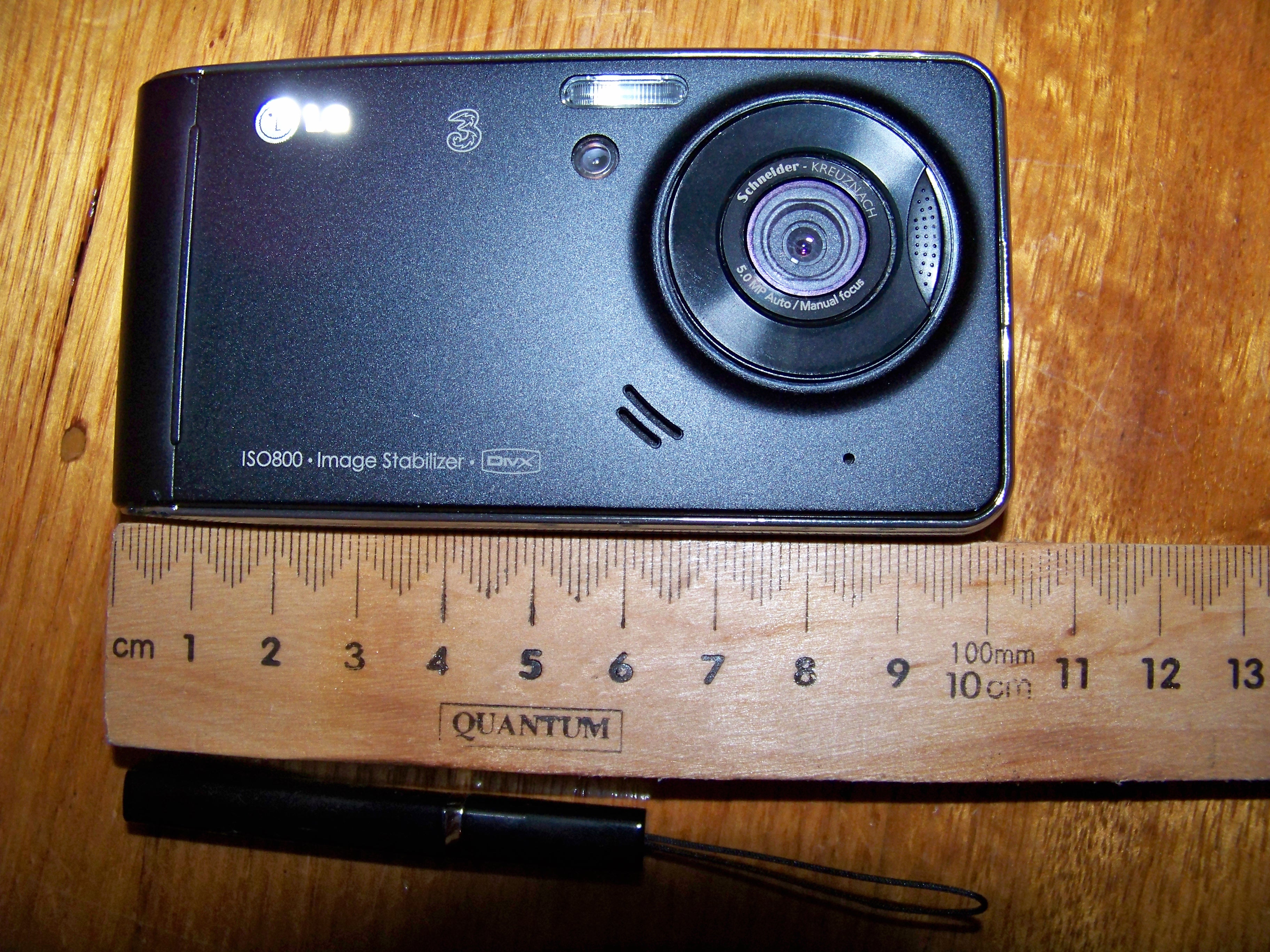
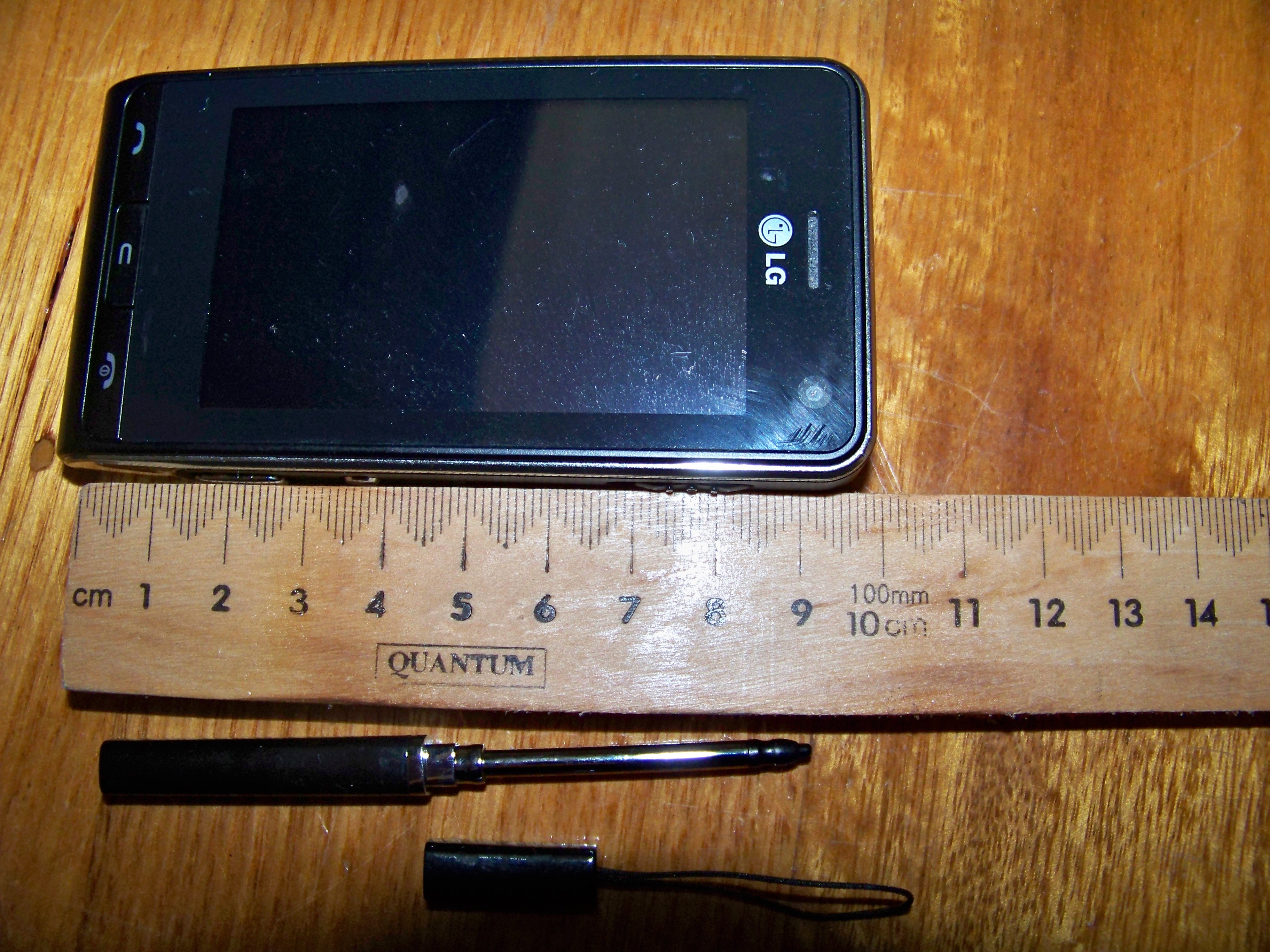
I have just got a LG U990 Viewty mobile phone [1]. It s a 3G phone and came free on the $29 monthly cap plan from Three (minimum monthly spend is $29 - but this is free if you use $29 per month). My previous plan was the $29 cap but had a minimum spend of $20 per month, as I never happened to use less than $29 per month I am not paying more. For a modern mobile phone the actual phone functionality is a sideline. If a device was strictly designed to be a phone then I think it would be very similar to the Nokia phones that were available 5+ years ago - the Nokia I had in 1999 performed every phone function that I desired of it. Like most modern phones the LG U990 Viewty suffers in it s phone functionality from the desire to make it do non-phone tasks and from the desire to cripple it to meet the desires of the carriers (not the desires of the users). For example the home screen will always have at least two buttons for paid Three services and I have no configuration option to remove them. Replacing them with speed dial options for a couple of numbers that I regularly call would be handy. As the main screen is a touch-screen there is no excuse for this, they should allow the software to be reconfigured with more useful options. Eventually the Android will kill most of the other phones and this problem of phones being designed to suit the telephone companies instead of the users will be solved. One of the most annoying mis-features of the phone is that it doesn t properly handle address book entries with multiple phone numbers. One of my friends turns his mobile off when he is at home, so I regularly call his mobile and then immediately call his home number if the mobile is unavailable. With my previous two mobile phones I could press the dial button to bring up the list of previous calls and then use the arrow buttons to select from the other numbers that are attached to the same address-book entry, so with three button presses I would be dialing his other number. With the Viewty I have to go back to the address book. The compelling feature of the Viewty is the camera and display. It has a 5MP camera which makes it the second highest resolution camera-phone offered by Three - the LG Renoir (KC910) has 8MP but needs a $99 plan for it to be free. It also has a 240*320 resolution touch-screen display (in a quick search in January when I bought my phone the best resolution display I could find on a phone is 240*400 in the LG Renoir). While the camera is documented as being 5mp there are no specs available about the resolution of the CCD. I want to use the native resolution of the CCD for pictures (I think interpolation is a waste of space). The CCD might actually be 5mp, a picture of the 1400*1050 resolution screen on my Thinkpad allows me to read all the text even when small fonts are in use, so the CCD resolution must be significantly greater than 1400*1050. This is a really important feature as the Viewty will work well for making screen-shots for bug reports about crashed computers (several of my clients have expressed interest in getting one after seeing such a demonstration). One annoying problem is that the camera software takes a while to load, my trusty Sony digital camera starts a lot faster and the LG U890 phone I used for the past two years is also a lot faster and more convenient. This won t work well for photographing unexpected events. When I am traveling by public transport I will photograph the relevant pages of my street directory as I can zoom in to photos of the maps and read the street names, it saves some weight when traveling. The 2G micro-SD card (which incidentally cost $10 from OfficeWorks) will allow me to store a lot of maps. One interesting feature is the video recording capabilities. It can do 640*480 resolution at 30fps (which is pretty good) and 320*240 resolution at 120fps (they claim that you can film a balloon popping). In my quick tests the standard 640*480*30fps mode works well, but the 120fps mode requires much brighter light than most of my test environments, so I have not yet got it working properly. The phone has a reasonable voice recording function, it can record considerably more than 34 hours of audio and the quality is reasonably good if you use an external microphone. It is however quite poor if you use the built-in microphone for a dictaphone function, it seems that quality is poor at any distance. I had wanted to record my LCA mini-conf talks with my phone but unfortunately forgot to bring the adapter for the external microphone. It s a pity that the phone doesn t have a standard microphone socket as I have misplaced my Viewty microphone, when designing the phone they should assume that misplacing attachments is a common occurrence and design it to use common parts. I recently spoke to a journalist who uses his mobile phone to record interviews. He said that his phone supported phone calls, voice recording, and taking pictures - all the essential tasks for his work. It seems that the Viewty would be better than most phones for journalistic work apart from the issue of low quality voice recording when you have misplaced your external microphone. The text editor is unfriendly in the keyboard mode (I have not tried hand-writing recognition), one thing I don t like is the fact that the letters jump when you press them. This does allow changing a letter by moving the stylus before releasing the press (some people consider this a great feature). There are no cursor control keys (which is a serious omission), and the keyboard doesn t resemble a real keyboard. My iPaQ is far better for writing (I once wrote a full-length magazine article on an iPaQ). The stylus is quite strange and interesting. In the picture of the front of the phone the stylus is compacted with it s lid on. In the picture of the back of the phone the stylus is extended with the lid off. The end of the stylus clips in to the lid so that removing the lid drags the central part out of the body. It s an interesting design and with the string on the lid allows the stylus to be attached to the phone when it s not being used. But I have never used it. Even with an iPaQ (which had a proper stylus that attached firmly inside the body of the device) I often used a fingernail on the touch screen. I have not felt the need to ever use a stylus with my Viewty. One final noteworthy thing is the support for Google services. It seems to have client support for YouTube, Google Maps, GMail, and Blogger. This seems to be a major win for Google, the Viewty is one of the most popular phones at the moment and I expect that lots of people who buy them will now have an incentive to use the Google services. Between these sorts of deals and the Android I think that it will be necessary to have some sort of anti-trust action against Google. Google are generally doing good things for the users. I have been quite satisfied to use Google search, Google advertising on my blog, and Gmail. Also I have been moderately happy with Blogger (it was good when I started blogging) and Google Maps is useful on occasion. So generally I am happy with Google, but monopolies are bad for the users so I think that if things continue on their current trend then Google may have to be split into several little Googlets some time in the next few years.

John Goerzen: Free Software enforcing DRM?!

So I just recently switched to KDE 4 (still using it with xmonad, of course) and I just now ran into my first really big annoyance. I just downloaded a PDF, and tried to copy and paste a bit of text from it. I used the selection tool, and Okular (KDE s document viewer) offered to speak it to me, but said Copy forbidden by DRM. pdftotext was able to convert the entire file to text format in an instant. Why are people intentionally adding code to KDE to remove my freedom? This is crazy and nuts. Nobody should be doing this, least of all in Free Software!

30 May 2009

Dirk Eddelbuettel: JPM Chase Corporate Challenge 2009

The 28th annual JP Morgan Chase Corporate Challenge race took place a couple of days ago May 21. Participation was down from the record of 23,000 runners set last year at around 17,125. With splendid weather, it is always a nice way to start the Memorial day weekend. We fielded a small but spirited team of nine runners. I finished with a decent (hand-stopped) time of 22 minutes and 27.93 seconds for the 3.5 miles -- or a 6:25 min/mile pace. That is among the fasters times but not quite the fastest compared to the other six times I have run this. Most importantly, everybody seems to have had a blast. And we did set a record for longer post-race party which sets a nice precedent for 2010.

Marc 'Zugschlus' Haber: The grub drama

This is a rant. A rant which goes to the grub maintainers, and one that could go nearly identically to many people in the KDE environment or many other open source projects. I really like grub. I really like grub 0.97 despite that it s been unmaintained for years and not booting on two of my important machines. I should like grub 2 because its configuration looks more straightforward and for its better features - direct booting of .iso images, from LVM and RAID. But actually, I have learned to hate grub 2 since it is not finished and badly documented, and that its existence is already being used as an excuse for grub 0 s development having stopped years ago (and it being renamed to grub-legacy to clearly show that it s the unloved child) - and things looks like this is not going to change any time soon. grub 0.97 is the de facto standard in booting Linux, its most prevalent advantages probably being its capability of reading filesystems and its command shell, which allows booting kernels and other software that one wasn t planning to boot when the system was shut down. There is a small fraction of people who still use lilo despite its disadvantages, for example on achitectures that are not supported by grub, if one wants to have the boot FS on LVM, if one just prefers lilo for non-technical reasons or on systems that grub doesn t work on. The last three systems, by the way, that I still run lilo on are Pyramid pizzaboxes with supermicro-made mainboards from 2002, which just refuse to boot if grub is used and the vendor just says that grub 0.97 is still beta and that they do not support grub on their systems: Use Lilo. Grub s last upstream release, 0.97, dates back to 2005, and upstream has stopped developing this grub release years ago. grub 2, the new way to go, had its first release in 2003, and the last stable release that people are supposed to use dates back to februar 2008. grub 2 is clearly a step in the right direction, but there are still bugs, and the most prevalent show stopper against grub 2 is the almost complete absence of any documentation. I have, for example, not yet found good documentation about the new config file format, which is a completely different deal from what we are used to with grub 0. The commands manual pages do little more than list the (obvious!) command line options without giving much more information about what the actually do, let alone usage examples. The documentation (which used to be really excellent for grub 0), has been moved to a wiki, which has some useful content but cannot keep up with the excellent documentation that grub 0 used to have. Additionally, grub2 does not seem to have a grub shell which can be called from within the host system, which makes installing grub 2 in exotic situations much harder than it used to be with grub 0. I am also quite disappointed that despite the grub upstream web pages claiming that grub 2 is under active development, the last release is more than fifteen months in the past while there are still so many shortcomings. The Debian maintainers of grub 2 are regularly packaging grub 2 subversion snapshots, which is a good idea in face of upstream s release policy which is quite different from what s being told in the wiki. I am, however, reluctant to rely on a development snapshot of a software to boot productive systems. Guys, you cannot declare a widely used, well-documented software legacy when the replacement is still in a nearly unuseable shape and the docs are hidden in the helpful files named .c and .h. This is simply unacceptable. It s a drama that the docs are still in such a pitiful shape fifteen months after your last release. But, grub is not the only free software project that so blatantly scores developer fun over the needs of the end user. I know that it is a boring task to fix bugs and to work around design shortcomings in the existing version of software, and that it is much more fun to hack away on new designs and new code, but dropping old versions before the new version is up to par with the old one is annoying the users and driving people away to other software packages. This applies to grub, a quite low-level program, but also to larger and more complex projects like KDE who has recently pulled the same stunt by dropping development and support for KDE 3.5 while KDE 4 is still missing many many features and KDE 3.5 s stablity, thus driving people (back) to GNOME or alternative desktop environments. This we give a damn about people who actually use our software, our compilers run without users as well attitude is a show of disrespect for the user base and makes me very sad as this does indeed show that free software is in no way superior to its commercial counterparts. Sadly, I do not have a solution for this issue since I know that free software developers are usually volunteers who do not have to report to anybody, and that they do not need to care for their user base. But I hope that people begin to reconsider their attitude and think about what kind of horrible damage is being done to the user base and to free software s reputation.

Steve McIntyre: age++

On Thursday it was my birthday, and I fulfilled a promise I made to myself many years ago. I've always been a car nut, and when I was about 6 years old and had posters of Lamborghinis on my bedroom walls I promised myself that by the time I reached 35 I would have one. That would be long enough in the future that it might happen, but I'd still be young enough to still be able to appreciate it. Well, as it got to the beginning of this year I realised I was running out of time and my bank balance didn't quite look large enough to buy a Lamborghini. So, I cheated a little and I hired one for the day on Thursday. Toy! More pictures here. I had one car booked a few weeks ago, but unfortunately the company involved had to let me down as the car developed problems a couple of days before I was due to have it and needed to go away for repairs. I'm not going to complain too much about them, as it wasn't their fault and they did their level best to make things right: offering a different car, a refund or a later replacement hire. But dammit! I wanted the Lamborghini and I wanted it on my birthday! I quickly rang around on Wednesday to find somebody else, and thankfully the folks at Signature Car Hire were very helpful, sorting out a car with just a few hours' notice. Yay! When they guys turned up on Thursday morning to deliver the car to my office, I couldn't stop myself grinning like the 6-year old boy whose promise I was keeping. Here was a gorgeous car, and it was mine for the day!!! I planned a route for the day to take in some nice driving roads and, importantly, some tunnels. I've watched Top Gear on the TV and I read Autocar every week, and they had both said that taking a fast sports car through a tunnel with the roof down was a good thing to do. I now know that's an understatement! As a whole, the car was awesome: the acceleration, the handling, the brakes were all wonderful. But, as I found out on that day, the noise from the engine was just astonishing. I went through several tunnels that day, heading down past Baldock to Hatfield and back, and at full throttle I could not help but laugh out loud at the music coming from the 5-litre V10 orchestra just inches behind me. It's an experience I'm never going to forget. grin. I also gave short rides to quite a few of the people at work; oddly I had lots of friends that day... :-) I'd also planned other things for the day. I bought myself a new camera in advance to make sure I got some nice photos of the day. Then at the end of the day I went out to the pub with a huge group of friends and I was forced to drink lots of beer. It was horrible, horrible I tell you.

Christian Perrier: Yet another silly name change for a country

After Venezuela changed its official "short" name from "Venezuela" to "Venezuela, Bolivarian Republic of", it's now the turn of Bolivia to take the same silly decision. From now, Bolivia's "short" name is "Bolivia, Plurinational state of". Don't take me wrong. I'm fine with such changes in official country names...when it comes at the official long name of the country. Most long names have some kind of political meaning. For Bolivia, the change is meant to reflect the consideration of the current government of the country for all "minorities" of Bolivia. That's for sure definitely any country's decision. But, for $ DEITY 's sake, why change the *short* name? For everybody, Bolivia is "Bolivia" and Venezuela is "Venezuela" and not some funky long and politically correct (or incorrect) name! So, once again, the iso-codes package maintainers will use a new "common name" for another country so that lists of countries that display in various places do not show ridiculously long names for some countries while others have the name...everybody uses. Remember "Taiwan" back in 2004?

29 May 2009

Michal Čihař: Translate over web or not?

Recently we opened up translation of phpMyAdmin documentation over web using Pootle tool. As you can see on summary page, it gained some attention, but not much. You are still invited to translate! However this is not original reason for my post. The reason is that we got question, whether we want to use translatewiki.net for translating phpMyAdmin itself. Currently we use simple PHP files with strings to localize what probably won't change in near future and translatewiki.net seems to already support similar ways of localizing PHP applications. Now the question is whether to invest effort into this direction. Web based interface definitely lowers barrier for translating, but nobody is really responsible there and you may end up with poor quality. What is better, no translation, or not perfect translation? PS: I'd really prefer to migrate to gettext based solution for phpMyAdmin, but this seems unlikely, mostly because gettext as integrated in PHP is quite painful. Once you load translation, it is kept opened and any changes in the file lead to segfault and any replacing of the file is deleted. So the only way to make it see updated translation is to restart PHP (or Apache if you use mod_php).

25 May 2009

Erich Schubert: If you're wondering why your circle is a diamond ...

... you might be bitten by this Java bug rendering arcs as straight lines at large zoom levels.It looks like a classic to me: in order to improve rendering performance, you approximate arcs with straight lines at small resolutions (if it's just 2 pixels big, nobody will be able to tell the difference). Except of course, when you end up doing the same approximation at a large zoom value - of course a 100-pixel circle looks different from a 100-pixel diamond.Reported in 2005, still not fixed in current Java (we're in 2009 now).Sun is really slow at fixing Java bugs.See also a related Apache Batik bug report. Fortunately, this only applies to Java rendered graphics - SVG export, PDF, Postscript are all fine.

24 May 2009

Christian Perrier: News from the samba packaging team

Some (not so) short news from the samba packaging team... Recent package uploads: Other things are coming, such as the work on having samba3 and samba4 packages coexist. Jelmer Vernooij prepared everything after our discussions at the SambaXP conference and it should be uploaded "soon". A few patches we have should be integrated upstream as well, therefore making the Debian diff smaller and smaller. Also, Luk Claes joined the maintenance team and helped setting up the unofficial repository for backports. The bug count is going up again these days as I don't spend much time triaging the bugs and some are very tricky to reproduce. As usual, help would be welcomed. I'm fairly sure that several of these are user errors but I often lack time to prove this enough for closing the bug. We should go to to 50-60 bugs or so.

21 May 2009

Kurt Roeckx: Audio ripping: Drive offsets

Thanks to Thomas Vander Stichele I've found out that when ripping an audio CD you get a different file depending on the CD drive you use because they don't all start reading at the same position and that for most drives this is a constant offset. So if you know what offset your drive has, you can compare rips done with a different drive. I was under the impression that this offset was always a multiple of the sector size, because audio CDs do not have a reliable way to detect the position. But it seems this offset can in the middle of a sector too. It looks like they agreed on some standard to compare the drive offsets. You can find a list of drives here and here. Cdparanoia has an option you can use to correct for that offset. But I started wondering where this error comes from. There is no real reason why all CD drives shouldn't be able to return the same thing. There is very little real info about it out there, and I basically get the impression that someone just decided to use something as base value. It isn't really a problem, since this is about very small time. To fully understand this, I think it's important to understand the basic layout of an audio CD. A sector (frame) of a CD contains 2352 bytes (588 samples) main data and 96 byte of sub-channel data. You have 75 such sectors per second, giving you a total of 44100 samples per second. A sector is made up of 98 sub-frames. Each such sub-frame has 24 bytes (6 samples) of main data, 4 bytes of C1 error correction and 4 bytes of C2 error correction, and 1 "byte" of sub-channel data. The first 2 sub-frames are used to mark the beginning of the sector. It contains a special pattern at the location of the sub-channel data. The first sub-frame contains S0 and the second S1. So you are left with 96 byte of sub-channel data. The highest bit of the sub-channel byte is used for the P sub-channel, bit 6 for the Q sub-channel, and so on until the W sub-channel. So the sub-channel has 96 bits (12 byte) per sector and each bit is in a different sub-frame. If you go look at the offsets, you'll notice there are a lot of drives that have an offset that's a multiple of 6 samples, but there are also a lot that aren't a multiple of 6. In the P and Q sub-channels you can see at what place you're reading. The P channel is a "pause" flag. At least 2 seconds before the track starts the P flag is turned on and the second sector of the track it's turned off again. All bits of P sub-channel should be the same for the whole sector, it can only change after an S0/S1. In the Q channel you can have different information depending on what is in the first byte. The most useful one is "mode 1", which contain things like the track number, index in the track, and time indication for both the current track and the whole disc, and a CRC. Mode 1 should be in at least 9 out of 10 sectors. So you known perfectly at which location you are. There is just 1 small problem, the sub-channels do not have any error correction, but does have a CRC. And there are lots of sectors with the information in it. So I wondered if the drives just didn't look at S0/S1 and that the sub channel data was shifted too. So I changed cdparanoia to log the sub-channel data and dumped it. I've tried this with a total of 6 drives, and also look at what the drive offset is. This are the drives I've used and the offsets they have:
Driveoffset
SONY DVD RW DRU-700A VY03 +12
PLEXTOR CD-R PX-W4012A 1.00 +98
PLEXTOR CD-R PX-R412C 1.06 +355
TSSTcorp CD/DVDW TS-L532A TI5a1 +116
HL-DT-ST DVD-ROM GDR-H30N 1.00i +6
ASUS CD-S520/A 1.7L +1858
Some notes: I can perfectly understand that it might be off by 1 or more sector, like the ASUS. I could also understand that it might be off by 1 or more sub-frames, but then I wouldn't expect to get proper values for the sub-channel data. Having an offset not be a multiple of the sub-frame makes no sense to me. So I can only come to the conclusion that this are all firmware issues.

19 May 2009

Gunnar Wolf: ftp.mx.debian.org back online

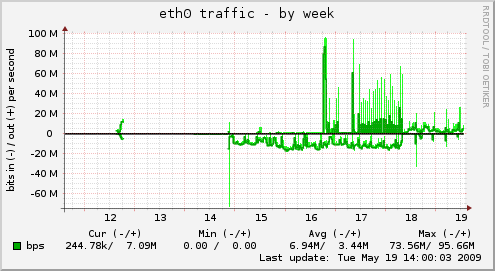
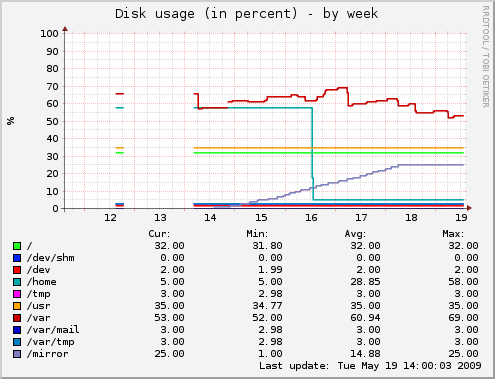
You might have noticed that during last week the Mexican Debian mirror, nisamox.fciencias.unam.mx (a.k.a. ftp.mx.debian.org, a.k.a. debian.unam.mx), went offline. The motherboard died on us, and Facultad de Ciencias was kind enough to give us a brand new one. So, excuse us for the blackout, but we are back Meaner and badder than ever before! Now, Sergio (nisamox's main admin) prefered to rebuild the whole mirror, as there was a shadow of doubt regarding the data integrity. So, rsync was pulling as fast as he could for the whole weekend (leading to some people scratching their heads regarding the 404 for the missing files; sorry, we should have left Apache shut down until the mirror was complete!). After three days of sustaining a 10-20Mbps download from the main mirrors, all 364GB of Debian are finally installed and as you can clearly see we are back to normality, with small, regular mirror pulses and a nice sustained 5-10Mbps (with some up to 40Mbps peaks We have seen up to 100Mbps peaks in the past, and I doubt with the current network infrastructure we won't top that). You can see we have currently plenty of disk space still to fill up. Among our plans is to host the most popular ISOs, which are a common request, and... What else? Well, ask us and we shall do so (quite probably). Ethernet usage over the last week Disk space usage over the last week So, if you switched away from ftp.mx.debian.org due to our downtime, readjust your mirror settings. Nisamox is back!
AttachmentSize
Nisamox Ethernet statistics for the last week23.38 KB
Nisamox disk space statistics for the last week24.29 KB

17 May 2009

Gunnar Wolf: Politicians time once again

It is time for stupid, empty politicians slogans once again in my dear country. And, as always, while we had lively, controversial presidential elections three years ago (and I won't rant this time on why so many Mexicans still believe the current president can only be called a de facto president), the mid-term elections... Fail to get any attention and cause only bored reactions. I am writing today mostly because I stumbled upon Francisco's post on why the Mexican Ecologist Green Party (PVEM) campaign does not impress him. As many, many other people with strong political opinions I know, I will go to the voting booth next July 5th, as I have done every time since I was of age - But I will most probably void my ballot, as I have found nobody worth my vote. And even if I am (and have always been) a leftist person, none of the four so-called leftist parties inspire the smallest bit of confidence. But hell, even the rightist or centrist parties fail to inspire confidence to their voters - After the 2006 electoral fiasco, we got a political system nobody believes in. And all analysts seem to concur that we moved from the most complete presidential regime to an utter partidocracy, where all of the (strong enough) parties cover each other's back not to lose the respective privileges (largely, money, but also law-making faculties and influence, which of course translates to impunity). Worth a very special mention is the crown jewel of political clowns in Mexico - PVEM, the Mexican Ecologist Green Party. A party that gets the gold medal for the most corrupt in our country (which is no small feat). A party where the National Party Presidents to date have only been father and son. And it is alarming because it is the only party apparently gathering more voters than they had before. But also, because of its utter pragmatism and lack of respect for anything they might once have stood for. I still remember on the 1994 elections, the first time they participated in general elections, their slogan was don't vote for a politician Vote for an ecologist... Little did the society know by then they were worse off than our oft-hated politicians. Can you imagine a so-called ecologist party that is expelled of the Global Greens as its behaviour is completely antithetical to anything a green party stands for? A party that promotes reinstating the death penalty (which was abolished from our Constitution, after decades of not being applied, less than a decade ago)? Or they say that, if a given medicine is not available at the Social Security hospitals, the government should pay the citizen so he can go and buy it at a drug store? (of course, if a needed medicine is not available at the Social Security it is most probably because the government is underfunded, not because the lazy administrators don't want to buy the medicines. And yes, with those two retrograde, stupid and -thankfully- completely unfeasible promises they have doubled their probable voters outcome in the past couple of months. The campaigns are only officially starting now. They are all really pathetic. A voter turnout of ~30% is expected. But yes, I am a politized person and just cannot help inviting everybody who has the right to go and vote. If there is somebody worth voting for in your district, please vote for him/her. However... Together with many people I admire, together with many of my friends, together with the people who still believe it is possible to make something out of this forsaken country's politic system... I invite you to void your ballots. Hopefully they will be enough so they must be heard this time.

16 May 2009

Marco d'Itri: Installing Debian on the Sheevaplug

This document explains how to use deboostrap --foreign to build from scratch and install a minimal Debian system on the Sheevaplug (but it is equally applicable to many other embedded systems). The only piece missing to be able to install from bare metal is a working kernel and initramfs pair, so this document assumes that you already have a kernel which can mount the root file system from a USB key. For the Sheevaplug, the factory kernel in the internal NAND flash will work fine. The Debian kernel package puts us in a chicken and egg situation: it cannot mount the root without an initramfs (because all drivers are modular), but we cannot build one until we can boot the system. I suppose that, as an exercise of style, somebody could create a minimal initramfs with busybox and the kernel modules needed to mount the root and then mount it manually, but if you really lack a working kernel then it's probably faster to boot the file system image for the first time using qemu and the "versatile" debian-installer target. The first step is to run the first stage of debootstrap on another system (which does not need to be ARM), to build a temporary root file system. I use the --variant and --include options to build the smallest possible system with network support, but they can be omitted.
debootstrap \
         --foreign --arch=armel \
         --variant=minbase \
         --include=linux-image-2.6-kirkwood,module-init-tools,udev,netbase,
                   net-tools,ifupdown,iproute,whiptail,vim-tiny \
         sid ./target/ http://ftp.it.debian.org/debian/
As usual when using debootstrap, some manual configuration is needed:
cd target/
echo bokassa.mi.bofh.it > etc/hostname
vi etc/network/interfaces
vi etc/resolv.conf
echo LANG=C > etc/default/locale
echo '127.0.0.1 localhost' > etc/hosts
cat <<END > etc/fstab
/dev/root / ext3 noatime 0 1
tmpfs /tmp tmpfs defaults 0 0
#/tmp /var/tmp none bind 0 0
END
I took some hints from http://wiki.debian.org/ReadonlyRoot to reduce writes to the flash file system:
# the blkid cache is evil anyway
ln -s /dev/null etc/blkid.tab
# this link will be created anyway by the package
ln -s /var/lib/initscripts/nologin etc/nologin
# it's better to not use a static mtab with modern kernels
ln -s /proc/mounts etc/mtab
# unless you plan to use multiple removable network interfaces, persistent
# interface names are not needed
: > etc/udev/rules.d/75-persistent-net-generator.rules
Two small workarounds are needed:
# if this is not set then the preinst of linux-image-* will die trying
# to ask a debconf question in the debootstrap second stage
echo 'do_initrd = yes' > etc/kernel-img.conf
# a workaround for bug #520742
: > etc/udev/disabled
Now you can format a USB pen drive and copy the root file system on it:
mke2fs /dev/sdb1
tune2fs -i 0 -c 0 /dev/sdb1
mount /dev/sdb1 /mnt/
rsync -aH target/ /mnt/
umount /mnt/
After powering the plug press a key to get to the U-Boot prompt and use the factory kernel to boot from USB:
setenv bootargs console=ttyS0,115200 root=/dev/sda1 rootdelay=10 panic=10 init=/bin/bash
run bootcmd
Then you can run the second stage of debootstrap, finish the bare minimal configuration and start init:
./debootstrap/debootstrap --second-stage
# disable the gettys for /dev/tty[1-6], which do not exist
vi /etc/inittab
# and add one for the serial console
echo 'T0:2345:respawn:/sbin/getty -L ttyS0 115200 linux' >> /etc/inittab
# do not forget to set the root password or you will not be able to login...
vi /etc/shadow
rm /etc/udev/disabled
exec /bin/bash
mount / -o ro,remount
exec /sbin/init
Congratulations, now you can login on the system and start to install the packages you like:
echo 'deb http://ftp.it.debian.org/debian/ unstable main' > /etc/apt/sources.list
echo 'APT   Install-Recommends "false";  ;' > /etc/apt/apt.conf.d/no-recommends
apt-get update
# dash is much faster
apt-get install dash
dpkg-divert --add /bin/sh
ln -sf dash /bin/sh
# I do not like these, YMMV
rm /vmlinuz /initrd.img
rmdir /selinux /srv
# the kernel is able to read the time from the RTC by itself, and this
# will allow using a read only root
echo HWCLOCKACCESS=no >> /etc/default/rcS
# faster boot
echo CONCURRENCY=shell >> /etc/default/rcS
# useless on this platform
mv /etc/rcS.d/S01glibc.sh /etc/rcS.d/K01glibc.sh
dpkg-reconfigure tzdata
apt-get install openssh-server screen iptables wget less
U-Boot requires that the kernel and initramfs have a special header:
apt-get uboot-mkimage
cd /boot/
mkimage -A arm -O linux -T kernel  -C none -a 0x00008000 -e 0x00008000 \
  -n Linux-2.6.29-2 -d vmlinuz-2.6.29-2-kirkwood uImage
mkimage -A arm -O linux -T ramdisk -C gzip -a 0x00000000 -e 0x00000000 \
  -n initramfs -d initrd.img-2.6.29-2-kirkwood uInitrd
Now you can reboot and configure u-boot to boot from the USB device. This is the variables scheme I like and it is not mandatory in any way, so I recommend that you read and understand the existing configuration before modifying it (some lines have been broken for readability):
setenv bootargs_nand $(bootargs)
setenv bootcmd_nand $(bootcmd)
setenv bootargs_root root=/dev/sda1
setenv bootargs_misc 'ro panic=10
  mtdparts=nand_mtd:0x400000@0x100000(uImage),0x1fb00000@0x500000(rootfs)'
setenv bootcmd_usb 'usb start; ext2load usb 0:1 0x00200000 /boot/uImage;
  ext2load usb 0:1 0x01100000 /boot/uInitrd'
setenv bootcmd 'setenv bootargs $(console) $(bootargs_root) $(bootargs_misc)
  $(bootargs_more); run bootcmd_usb; bootm 0x00200000 0x01100000'
Since now you are not using anymore the Marvell kernel tree it is mandatory to set these two variables and reboot:
setenv mainlineLinux yes
setenv arcNumber 2097
saveenv
reset
Installation to SD is identical, but requires an updated version of U-Boot with SD support. Due to a kernel bug which prevents autoloading the driver you will need to add mvsdio and mmc_block to /etc/initramfs-tools/modules and rebuild the initramfs. (Yes, the naming theme I use at home is "african dictators"...)

15 May 2009

Philipp Kern: Infinote-based Gobby hits Karmic

Gobby 0.5 (or to be more precise 0.4.92) just hit the Karmic Koala. Below you can see a screenshot of the new version (just click on it to get a large version). It is sadly not protocol compatible to the old version but it features local undo and redo! Furthermore it's not yet stable on-the-wire wise. The software itself is fairly stable but it could be a bit bumpy if the server protocol version goes out of date. Gobby 0.4.92 thumbnail If you want to try it out on earlier versions, I offer backports in the Infinote PPA for Intrepid and up. I hope to get to Hardy soon, sadly it needs some more backports. There is a public server available on gobby.0x539.de if you want to try it out (connections are encrypted, but all contents are public and can be deleted by everybody, wiki-like; so please be considerate and non-destructive). On local networks Gobby will look for servers through Avahi. That said Gobby is not yet able to host servers by itself, like the old version did. You have to install the infinoted server. You can do this on any computer, even on the local network and take advantage of Avahi. If you want encrypted connections you need to create certificates but if an unencrypted session is acceptable you can get an ad-hoc server by invoking infinoted --security-policy=no-tls without further configuration. It will persist content across invocations, too. Thanks to Greg Heynes, there will also be a KDE client for Gobby, called... Kobby! The first time someone actually uses the fact that the software uses a library for interoperability. Interesting that it's done now when the library's C instead of C++ (which obby was written in), with Qt being C++ anyway. I'm not yet aware of packages but I really hope that we can release with both. If you encounter problems, please report them to our Trac (preferred) or Launchpad.

Eddy Petri&#537;or: svn-buildpackage is now orphaned

I have decided that is high time to declare svn-buildpackage orphaned since many people are replying on it to be useful, but nobody cared enough to answer to the RFH Eduard Bloch made some 3 years ago.

I know it would have been better if I would have asked a request for adoption, but, honestly, the package didn't had a maintainer in the last year and that would have been lying to everybody.

The package is quite important and I would hate to see it leave the official archive since many people do need it and use it regularly (I know for sure the GNOME, Perl and the Debian Games Team use it) and I have enjoyed working on the package while I was motivated.

The code is maintained in SVN and the trunk can be viewed at:

http://svn.debian.org/wsvn/collab-maint/deb-maint/svn-buildpackage/trunk/

and can be checked out with any of these commands:

# read-only copy
svn co svn://svn.debian.org/svn/collab-maint/deb-maint/svn-buildpackage/trunk svn-buildpackage

# read write, if you have an account on alioth.debian.org:

svn co svn+ssh://svn.debian.org/svn/collab-maint/deb-maint/svn-buildpackage/trunk


Also, note that the package has several features which the new maintainer(s) should be aware of and must make sure they all work when changing the code. Also, there are some things to remember:

These being said, I am really hoping svn-buildpackage will find a new maintainer since it deserves a lot more attention than I am providing. Don't forget, 0.6.24 is wating for an upload already.


Update: Neil Williams answered and agreed to take over maintenance, but he doesn't usually use svn-inject and svn-upgrade, so somebody taking care of those would be needed. Ironically, those two scripts are the ones in the worst shape of the three main scripts.

14 May 2009

Antti-Juhani Kaijanaho: Asynchronous transput and gnutls

CC0
To the extent possible under law,
Antti-Juhani Kaijanaho has waived all copyright and related or neighboring rights to
Asynchronous transput and gnutls. This work is published from Finland.
GnuTLS is a wonderful thing. It even has a thick manual but nevertheless its documentation is severely lacking from the programmer s point of view (and there doesn t even seem to be independent howtos floating on the net). My hope is to remedy with this post, in small part, that problem. I spent the weekend adding STARTTLS support to the NNTP (reading) server component of Alue. Since Alue is written in C++ and uses the Boost ASIO library as its primary concurrency framework, it seemed prudent to use ASIO s SSL sublibrary. However, the result wasn t stable and debugging it looked unappetizing. So, I wrote my own TLS layer on top of ASIO, based on gnutls. Now, the gnutls API looks like it works only with synchronous transput: all TLS network operations are of the form do this and return when done ; for example gnutls_handshake returns once the handshake is finished. So how does one adapt this to asynchronous transput? Fortunately, there are (badly documented) hooks for this purpose. An application can tell gnutls to call application-supplied functions instead of the read(2) and write(2) system calls. Thus, when setting up a TLS session but before the handshake, I do the following:
                gnutls_transport_set_ptr(gs, this);
                gnutls_transport_set_push_function(gs, push_static);
                gnutls_transport_set_pull_function(gs, pull_static);
                gnutls_transport_set_lowat(gs, 0);
Here, gs is my private copy of the gnutls session structure, and the push_static and pull_static are static member functions in my sesssion wrapper class. The first line tells gnutls to give the current this pointer (a pointer to the current session wrapper) as the first argument to them. The last line tells gnutls not to try treating the this pointer as a Berkeley socket. The pull_static static member function just passes control on to a non-static member, for convenience:
ssize_t session::pull_static(void * th, void *b, size_t n)
 
        return static_cast<session *>(th)->pull(b, n);
 
The basic idea of the pull function is to try to return immediately with data from a buffer, and if the buffer is empty, to fail with an error code signalling the absence of data with the possibility that data may become available later (the POSIX EAGAIN code):
class session
 
        [...]
        std::vector<unsigned char> ins;
        size_t ins_low, ins_high;
        [...]
 ;
ssize_t session::pull(void *b, size_t n_wanted)
 
        unsigned char *cs = static_cast<unsigned char *>(b);
        if (ins_high - ins_low > 0)
         
                errno = EAGAIN;
                return -1;
         
        size_t n = ins_high - ins_low < n_wanted
                ?  ins_high - ins_low
                :  n_wanted;
        for (size_t i = 0; i < n; i++)
         
                cs[i] = ins[ins_low+i];
         
        ins_low += n;
        return n;
 
Here, ins_low is an index to the ins vector specifying the first byte which has not already been passed on to gnutls, while ins_high is an index to the ins vector specifying the first byte that does not contain data read from the network. The assertions 0 <= ins_low, ins_low <= ins_high and ins_high <= ins.size() are obvious invariants in this buffering scheme. The push case is simpler: all one needs to do is buffer the data that gnutls wants to send, for later transmission:
class session
 
        [...]
        std::vector<unsigned char> outs;
        size_t outs_low;
        [...]
 ;
ssize_t session::push(const void *b, size_t n)
 
        const unsigned char *cs = static_cast<const unsigned char *>(b);
        for (size_t i = 0; i < n; i++)
         
                outs.push_back(cs[i]);
         
        return n;
 
The low water mark outs_low (indicating the first byte that has not yet been sent to the network) is not needed in the push function. It would be possible for the push callback to signal EAGAIN, but it is not necessary in this scheme (assuming that one does not need to establish hard buffer limits). Once gnutls receives an EAGAIN condition from the pull callback, it suspends the current operation and returns to its caller with the gnutls condition GNUTLS_E_AGAIN. The caller must arrange for more data to become available to the pull callback (in this case by scheduling an asynchronous write of the data in the outs buffer scheme and scheduling an asynchronous read to the ins buffer scheme) and then call the operation again, allowing the operation to resume. The code so far does not actually perform any network transput. For this, I have written two auxiliary methods:
class session
 
        [...]
        bool read_active, write_active;
        [...]
 ;
void session::post_write()
 
        if (write_active) return;
        if (outs_low > 0 && outs_low == outs.size())
         
                outs.clear();
                outs_low = 0;
         
        else if (outs_low > 4096)
         
                outs.erase(outs.begin(), outs.begin() + outs_low);
                outs_low = 0;
         
        if (outs_low < outs.size())
         
                stream.async_write_some
                        (boost::asio::buffer(outs.data()+outs_low,
                                             outs.size()-outs_low),
                         boost::bind(&session::sent_some,
                                     this, _1, _2));
                write_active = true;
         
 
void session::post_read()
 
        if (read_active) return;
        if (ins_low > 0 && ins_low == ins.size())
         
                ins.clear();
                ins_low = 0;
                ins_high = 0;
         
        else if (ins_low > 4096)
         
                ins.erase(ins.begin(), ins.begin() + ins_low);
                ins_high -= ins_low;
                ins_low = 0;
         
        if (ins_high + 4096 >= ins.size()) ins.resize(ins_high + 4096);
        stream.async_read_some(boost::asio::buffer(ins.data()+ins_high,
                                                   ins.size()-ins_high),
                               boost::bind(&session::received_some,
                                           this, _1, _2));
        read_active = true;
 
Both helpers prune the buffers when necessary. (I should really remove those magic 4096s and make them a symbolic constant.) The data members read_active and write_active ensure that at most one asynchronous read and at most one asynchronous write is pending at any given time. My first version did not have this safeguard (instead trying to rely on the ASIO stream reset method to cancel any outstanding asynchronous transput at need), and the code sent some TLS records twice which is not good: sending the ServerHello twice is guaranteed to confuse the client. Once ASIO completes an asynchronous transput request, it calls the corresponding handler:
void session::received_some(boost::system::error_code ec, size_t n)
 
        read_active = false;
        if (ec)   pending_error = ec; return;  
        ins_high += n;
        post_pending_actions();
 
void session::sent_some(boost::system::error_code ec, size_t n)
 
        write_active = false;
        if (ec)   pending_error = ec; return;  
        outs_low += n;
        post_pending_actions();
 
Their job is to update the bookkeeping and to trigger the resumption of suspended gnutls operations (which is done by post_pending_actions). Now we have all the main pieces of the puzzle. The remaining pieces are obvious but rather messy, and I d rather not repeat them here (not even in a cleaned-up form). But their essential idea goes as follows: When called by the application code or when resumed by post_pending_actions, an asynchronous wrapper of a gnutls operation first examines the session state for a saved error code. If one is found, it is propagated to the application using the usual ASIO techniques, and the operation is cancelled. Otherwise, the wrapper calls the actual gnutls operation. When it returns, the wrapper examines the return value. If successful completion is indicated, the handler given by the application is posted in the ASIO io_service for later execution. If GNUTLS_E_AGAIN is indicated, post_read and post_write are called to schedule actual network transput, and the wrapper is suspended (by pushing it into a queue of pending actions). If any other kind of failure is indicated, it is propagated to the application using the usual ASIO techniques. The post_pending_actions merely empties the queue of pending actions and schedules the actions that it found in the queue for resumption. The code snippets above are not my actual working code. I have mainly removed from them some irrelevant details (mostly certain template parameters, debug logging and mutex handling). I don t expect the snippets to compile. I expect I will be able to post my actual git repository to the web in a couple of days. Please note that my (actual) code has received only rudimentary testing. I believe it is correct, but I won t be surprised to find it contains bugs in the edge cases. I hope this is, still, of some use to somebody :)

13 May 2009

Jonathan McDowell: Breaking the Web of Trust

With all the discussion about SHA-1 weaknesses and generation of new OpenPGP keys going on there's some concern about how the web of trust will be affected. I'm particularly interested in the impact on Debian; while it's possible to add new keys and keep the old ones around that hasn't worked so well for us with the migration away from PGPv3 keys. We still have 125 v3 keys left, many of them for users who also have a v4 key but haven't asked for the v3 key to be removed or responded to my email prodding them about it. I don't want to repeat that.

So if we're looking at key replacement we need to have some idea about where our Web of Trust currently stands, and what effect various changes might have on it. I managed to find the keyrings Debian shipped all the way back to slink and ran the keyanalyze and cwot stats against them. I then took the current keyring, pull in all the updates for the keys in it (so that any signatures from newly generated keys would be included) and ran the stats again. Finally I took details of 12 key migrations (mostly from Debian Planet but also a couple of others I knew about) and calculated what the effect of removing each key would be. These stats are cumulative and I replaced the most well connected (by centrality) keys first.

The results are below.

TotalSCSReachableMSDCentrality
1999-02-06 (slink)22836(15.78%)50 (21.92%)2.9022
2000-01-03 (potato)375104 (27.73%)180 (48.00%)4.3382
2001-09-22 (woody)948538 (56.75%)704 (74.26%)4.73202008.6249
2005-05-28 (sarge/etch) 1106883 (79.83%)969 (87.61%)3.34852074.6604
2007-12-0411911001 (84.04%)1062 (89.16%)3.11032113.3747
2009-01-18 (lenny)1126947 (84.10%)1010 (89.69%)3.04891941.2594
2009-04-04 (squeeze/sid)1121946 (84.38%)1008 (89.91%)3.04661936.9761
2009-05-06 (current)1067894 (83.78%)958 (89.78%)2.96701759.4363
TotalSCSReachableMSDCentrality
base1067904 (84.72%)959 (89.87%)2.96401776.4389
update-93sam1067902 (84.53%) 958 (89.78%)2.97341780.9874
update-joerg1067900 (84.34%) 958 (89.78%)2.97761780.7578
update-aurel321067898 (84.16%) 957 (89.69%)2.98031779.2497
update-noodles1067896 (83.97%) 956 (89.59%)2.98311777.8326
update-jaldhar1067896 (83.97%) 955 (89.50%)2.98551779.9193
update-srivasta1067896 (83.97%) 955 (89.50%)2.99041784.3382
update-ana1067895 (83.88%) 954 (89.40%)2.99261784.3102
update-nobse1067893 (83.69%) 953 (89.31%)2.99471782.2392
update-neilm1067892 (83.59%) 951 (89.12%)2.99741782.6098
update-reg1067891 (83.50%) 950 (89.03%)2.99771780.8515
update-rmayorga1067890 (83.41%) 949 (88.94%)2.99841779.4910
update-evgeni1067889 (83.31%) 948 (88.84%)2.99741776.6445

This is actually more hopeful than I thought. There's an obvious weakening as a result of the migrations, but the MSD stays under 3 and the centrality stays fairly constant too. The reachable/SCS counts do decrease, but at this point it looks fairly linear rather than an instant partition. Of course the more keys that are removed the more likely this is to drop off suddenly. Counteracting that DebConf9 is coming up which will provide a good opportunity for normally geographically disperse groups to cross sign, reinforcing the WoT for these new keys.

Either way I at least have a better handle on the current state of play, which gives me something to work with when thinking about how to proceed. For now, bed.

12 May 2009

Eddy Petri&#537;or: To the person that almost ran over us

Yesterday, as I was driving towards towards Bucharest, just after exiting Ro iori de Vede, somebody driving a white van with a trailer almost ran over us. I had to drive on the opposite lane to avoid the collision.

During the incident I was cold blooded and managed to keep a clear mind, but right after it, I felt my knees softening and had to stop to recover.

So, in the remote case that person will read this post, thanks for at least breaking when I horned.

11 May 2009

Fabio Tranchitella: Are you looking for a job?

I tried hard, but it seems impossible to find Python programmers for our start-up. I know, living in Pecs (Hungary) limits the choices, but I also tried in Budapest and I was unable to find anybody with a good knowledge of Python and Zope. For this reason, we finally decided with my business partner to experiment with telecommuting.

We are looking for talented Python programmers to join our team, based in Pecs and Budapest (Hungary) with a satellite office in Turin (Italy). You will be able to work from home, planning your time based on your schedule and goals. You will work on the development of a free (as in speech) CRM and marketing platform built on the Zope Toolkit (aka Zope 3).

About you:

Requirements:

Nice-to-haves:

If you are interested, drop me a line at kobold@debian.org.

10 May 2009

Steve Kemp: Did you feel it in your knees

This post is being made from my EEEEEeeee PC, using a 3G modem plugged into the USB port. The fact that I'm sat on my sofa, within easy reach of both a network cable and multiple WiFi access points is irrelevant! I started my adventure yesterday evening, getting pretty annoyed along the way that that it wasn't just plug and go. It turns out I was suffering from two problems: In short from my Lenny installation I had to upgrade to Sid to get a copy of Network Manager with a "Mobile Broadband" section in its preferences. (I looked for backports, to no avail, and I didn't have the patience to make one mysefl). The new connection looks like this:
Number*99#
Username[blank]
Passwordpassword
APNm-bb.o2.co.uk
PIN0000
PUK0000
Once I added the connection discovered the USB modem device (/dev/ttyUSB0) just didn't work - and I learned about the dual-nature of the device. Thankfully switching is nice and easy "apt-get install usb-modeswitch" then:
# disable storage
usb_modeswitch -v 12d1 -p 1003 -d 1
# enable modem
usb_modeswitch -v 12d1 -p 1003 -H 1
Once that was done the connection worked almost immediately. (I just had to upgrade to a 2.6.29 kernel because I got panics on the Lenny kernel; something the upgrade installed but I'd previously ignored. Kernels: Bane of my life.) Update: I do see some kernel weirdness talking about timeouts talking to the USB-serial device. Perhaps something to investigate in the future. Anyway running a 3G O2 PAYG (pay as you go) modem on Debian, on an EEEPC is possible, it is justfiddlier than I had expected, and it required an upgrade to Sid - since Lenny didn't have a network manager with mobile broadband support. For google's benefit the modem is described by O2 as a "mobile broadband USB modem - E160". This appears under lsusb as :
Bus 001 Device 005: ID 12d1:1003 Huawei Technologies Co., Ltd.
E220 HSDPA Modem / E270 HSDPA/HSUPA Modem
Hope that helps somebody else spend less than 5 hours getting it working. I guess the friends who said "It just worked" were running Ubuntu and so had a slightly newer network manager by default - and possibly their modems didn't need to toggle between "dumb storage" and "actual modem" modes. Anyway it works now, and even though it was fiddly the issue wasn't insurmountable. I'm just a little grumpy because I've gotten used to a world in which Debian just works - the last time I struggled to get new hardware toys playing nice was .. a long time ago. ObFilm: Pretty In Pink

Next.

Previous.