Search Results: "az"

15 April 2009

Julien Danjou: Taking the other direction

I've started to develop awesome more than 18 months ago, and somehow I feel it's time to stop a bit and think where we come from and where we are going to. The motivation I never though I'd be written a window manager one day. That seems kinda stupid when you see how many window manager there's around. As many people, I've tested and have been using tons of window manager: Window Maker, Fluxbox, etc. In August 2007, I was using fvwm since 2004 and was quite happy with it. I used the famous fvwm-crystalhttp://www.fvwm-crystal... as a configuration starter and then rewrote lots of stuff. Digging into fvwm configuration files was boring, and since I'm lazy, I never really configured it to fit entirely my needs. The thing is that, in July 2007, my workstation died. I bought a new one based on the amd64 architecture. Too bad, with this new box, fvwm decided that it will not longer runs and was segfaulting almost every time I logged in. I was really upset. Another failure in the window manager world. So I decided to get the yearly ride of testing many window managers. I went on the no more developed stuff like the *boxes, ion3, etc but well, I did not like them, there were not powerful enough, too bugged or upstream was insane. Then I found xmonad. The Haskell configuration file format made my cry. I did not want to learn Haskell, it seemed too obfuscated to me. At that time it was even not packaged for Debian, so I gave up. But I found dwm in the meantime, and I loved it. It was simple, and the source code was almost understandable and easy to hack. I subscribed to the dwm mailing-list, in order to participate to its development, etc But I got really disappointed. No patch were welcome and the development seemed to be almost finish in this sight. People patches were lying around, but no one really care. Each user was managing its own set of patches. That's not what I learnt and what I love in free software. So, as many users, I began to maintain my patches in my corner. But I began to have more ideas The jdwm I just added a 'j' in front of dwm and started to hack it days and nights to add many feature I missed, like multi-head, etc On 5th September 2007, I created a git repository to host my code. That's gonna be awesome. Five days later, on 10th September, I finally found a name for my new pet: awesome, borrowed from Barney Stinson who heavily uses and abuses this word. The 1.x branch The first releases until December were noted 1.x. It was just a better dwm with a simple flat configuration file.. The configuration file used libconfig, but it was a very poor choice. And I was not able to put in into Debian because of name clash. The 2.x branch The 2.x branch came in January 2008 with a brand new configuration file format based on libconfuse, which was a bit more powerful. Many concepts and features that have been added in this branch are still used in the current 3.x branch. At this time, between December 2007 and April 2008, the community was growing smoothly. But as I said, awesome 2 was based on a flat configuration file. That raised a problem very soon: users expectation were growing and the development team (me and a couple of regular contributors) was unable to cope with them. One of the event that started to change my mind was the support for titlebars. When I've added titlebar support, it was minimal. It was on top of a window, with the window title. Dot. Then I've started to add a lot of options, like the application icon drawing, the position (left, right, bottom) etc. And then users started to ask for more, like: "add titlebar on windows only when the window is floating". That's ok, but that's complicated: that's again another option to do some stuff conditionally. And then, why don't add titlebar on windows when <insert random events here>? The 3.x branch Why At that time, around April 2008, I'd totally stopped development. I was trying to find a solution which was simple and powerful. But after 2 weeks of thinking, I was not able to find anything else than: use a real language for configuration. So, I've started prototyping awesome 3 using Lua. The choice was not obvious, and despite the problem Lua might suffer, it's one of the easiest language to integrate into an existing application. There's still a video of a first version here. But, let's go a little back: in January 2008, Arnaud Fontaine contacted me because he was interested to use awesome as one of its school project. He decided to port awesome from Xlib to XCB, a modern asynchronous X library. His work took some time, but in May 2008, Arnaud did finished to port git master version of awesome to use XCB. Consequently, I decided to start a new major branch, using XCB instead of Xlib (no change for users in this regard) and Lua instead of our previous flat configuration file format. Development It took me a while to get from here to there, but in September 2008, it was ready. We had a simple Lua API, and the XCB port was working perfectly. It took us some time to release and have something totally working, because we had to work on XCB and contribute back to the project. It was really not ready to use by an application, but we did great work in this area and it's now really fine. We're still here Releases continue to happens, 3.1 around December 2008, and 3.2 around March 2009. 3.3 should be here in June. One of the drawback we had, is that we moved many stuff from C to Lua. Why? Because writing things in Lua is quicker and easier to maintain than C, and makes thing more configurable for the user. For example, the layout algorithm used to organize window were written in C until 3.2 came out. At that time, users had no choice than using a set of predefined layout to organize their windows. Starting with 3.2, if they have minimal knowledge about geometry, they can start writing a layout function organising windows on the screen. But this kind of API changes was a bit rough for users, since they had to port some part of their configuration file to the new API. The thing is that the project was still a teenager at that time, not really knowing were it will go. But I'm happy to announce that API breakage are more and more rare (so far only one minor between 3.2 and 3.3), and anyway always for the Good. But I admit that it built a bad reputation around awesome 3.x during its first month of existence. Future direction I am currently working on 3.3 development. We have still many things to do. Time passing, we get more idea, and more users. And more users bring more ideas. We also have many more contributors, and some guys are even taking maintainer-ship of some code area. Conclusion My post title is "Taking the other direction" because I feel this way. I've got that feeling that some approaches in projects like GNOME are sometimes bad. Please don't misread me, I know we are not playing in the same yard. When adding a key shortcut for starting an application makes you dig into gconf, I wonder how this is a win for the user. Well, it's probably a win for the end-user, but I surely am not one of them. And I don't intend to target them with my software, anyway. And now, when I hear things like GNOME 3.0 and the "desktop shell" approach, that makes me smile. Guys, it was time, but have luck. What I see from here, is that any desktop control interface is wrong somehow, and that there's no approach that can fulfill all users wishes. I think that we, the awesome development team (no pun intended) took the direction of building a frame-work window manager rather than a solution written in marble. We (partially) solved the issue of UI ergonomic by not writing one and allowing the user to write his own. I don't say that's easy to do for most of users, but it's doable. And I think it's worth it: I use window managers since I use Linux, around 1998. If something like awesome came 5 years ago, I'd be using it so far, because you can write Fluxbox or WindowMaker using awesome in a hundred of Lua code. And you can write your own version of it. And it starts in less than 3 seconds, supporting almost all standard desktop specification (ICCCM, EWMH, XDG, system tray, message notification, D-Bus, etc), whereas many of the window mangers do not. You can even write and play space invaders. Finally, I'm happy about the the road we took so far, and hope we will continue into that direction. The rants I read about our project are not that big, compared to the kudos we received.


Julien Danjou: Taking the other direction

I've started to develop awesome more than 18 months ago, and somehow I feel it's time to stop a bit and think where we come from and where we are going to. The motivation I never though I'd be written a window manager one day. That seems kinda stupid when you see how many window manager there's around. As many people, I've tested and have been using tons of window manager: Window Maker, Fluxbox, etc. In August 2007, I was using fvwm since 2004 and was quite happy with it. I used the famous fvwm crystal as a configuration starter and then rewrote lots of stuff. Digging into fvwm configuration files was boring, and since I'm lazy, I never really configured it to fit entirely my needs. The thing is that, in July 2007, my workstation died. I bought a new one based on the amd64 architecture. Too bad, with this new box, fvwm decided that it will not longer runs and was segfaulting almost every time I logged in. I was really upset. Another failure in the window manager world. So I decided to get the yearly ride of testing many window managers. I went on the no more developed stuff like the *boxes, ion3, etc but well, I did not like them, there were not powerful enough, too bugged or upstream was insane. Then I found xmonad. The Haskell configuration file format made my cry. I did not want to learn Haskell, it seemed too obfuscated to me. At that time it was even not packaged for Debian, so I gave up. But I found dwm in the meantime, and I loved it. It was simple, and the source code was almost understandable and easy to hack. I subscribed to the dwm mailing-list, in order to participate to its development, etc But I got really disappointed. No patch were welcome and the development seemed to be almost finish in this sight. People patches were lying around, but no one really care. Each user was managing its own set of patches. That's not what I learnt and what I love in free software. So, as many users, I began to maintain my patches in my corner. But I began to have more ideas The jdwm I just added a 'j' in front of dwm and started to hack it days and nights to add many feature I missed, like multi-head, etc On 5th September 2007, I created a git repository to host my code. That's gonna be awesome. Five days later, on 10th September, I finally found a name for my new pet: awesome, borrowed from Barney Stinson who heavily uses and abuses this word. The 1.x branch The first releases until December were noted 1.x. It was just a better dwm with a simple flat configuration file.. The configuration file used libconfig, but it was a very poor choice. And I was not able to put in into Debian because of name clash. The 2.x branch The 2.x branch came in January 2008 with a brand new configuration file format based on libconfuse, which was a bit more powerful. Many concepts and features that have been added in this branch are still used in the current 3.x branch. At this time, between December 2007 and April 2008, the community was growing smoothly. But as I said, awesome 2 was based on a flat configuration file. That raised a problem very soon: users expectation were growing and the development team (me and a couple of regular contributors) was unable to cope with them. One of the event that started to change my mind was the support for titlebars. When I've added titlebar support, it was minimal. It was on top of a window, with the window title. Dot. Then I've started to add a lot of options, like the application icon drawing, the position (left, right, bottom) etc. And then users started to ask for more, like: "add titlebar on windows only when the window is floating". That's ok, but that's complicated: that's again another option to do some stuff conditionally. And then, why don't add titlebar on windows when <insert random events here>? The 3.x branch Why At that time, around April 2008, I'd totally stopped development. I was trying to find a solution which was simple and powerful. But after 2 weeks of thinking, I was not able to find anything else than: use a real language for configuration. So, I've started prototyping awesome 3 using Lua. The choice was not obvious, and despite the problem Lua might suffer, it's one of the easiest language to integrate into an existing application. There's still a video of a first version here. But, let's go a little back: in January 2008, Arnaud Fontaine contacted me because he was interested to use awesome as one of its school project. He decided to port awesome from Xlib to XCB, a modern asynchronous X library. His work took some time, but in May 2008, Arnaud did finished to port git master version of awesome to use XCB. Consequently, I decided to start a new major branch, using XCB instead of Xlib (no change for users in this regard) and Lua instead of our previous flat configuration file format. Development It took me a while to get from here to there, but in September 2008, it was ready. We had a simple Lua API, and the XCB port was working perfectly. It took us some time to release and have something totally working, because we had to work on XCB and contribute back to the project. It was really not ready to use by an application, but we did great work in this area and it's now really fine. We're still here Releases continue to happens, 3.1 around December 2008, and 3.2 around March 2009. 3.3 should be here in June. One of the drawback we had, is that we moved many stuff from C to Lua. Why? Because writing things in Lua is quicker and easier to maintain than C, and makes thing more configurable for the user. For example, the layout algorithm used to organize window were written in C until 3.2 came out. At that time, users had no choice than using a set of predefined layout to organize their windows. Starting with 3.2, if they have minimal knowledge about geometry, they can start writing a layout function organising windows on the screen. But this kind of API changes was a bit rough for users, since they had to port some part of their configuration file to the new API. The thing is that the project was still a teenager at that time, not really knowing were it will go. But I'm happy to announce that API breakage are more and more rare (so far only one minor between 3.2 and 3.3), and anyway always for the Good. But I admit that it built a bad reputation around awesome 3.x during its first month of existence. Future direction I am currently working on 3.3 development. We have still many things to do. Time passing, we get more idea, and more users. And more users bring more ideas. We also have many more contributors, and some guys are even taking maintainer-ship of some code area. Conclusion My post title is "Taking the other direction" because I feel this way. I've got that feeling that some approaches in projects like GNOME are sometimes bad. Please don't misread me, I know we are not playing in the same yard. When adding a key shortcut for starting an application makes you dig into gconf, I wonder how this is a win for the user. Well, it's probably a win for the end-user, but I surely am not one of them. And I don't intend to target them with my software, anyway. And now, when I hear things like GNOME 3.0 and the "desktop shell" approach, that makes me smile. Guys, it was time, but have luck. What I see from here, is that any desktop control interface is wrong somehow, and that there's no approach that can fulfill all users wishes. I think that we, the awesome development team (no pun intended) took the direction of building a frame-work window manager rather than a solution written in marble. We (partially) solved the issue of UI ergonomic by not writing one and allowing the user to write his own. I don't say that's easy to do for most of users, but it's doable. And I think it's worth it: I use window managers since I use Linux, around 1998. If something like awesome came 5 years ago, I'd be using it so far, because you can write Fluxbox or WindowMaker using awesome in a hundred of Lua code. And you can write your own version of it. And it starts in less than 3 seconds, supporting almost all standard desktop specification (ICCCM, EWMH, XDG, system tray, message notification, D-Bus, etc), whereas many of the window mangers do not. You can even write and play space invaders. Finally, I'm happy about the the road we took so far, and hope we will continue into that direction. The rants I read about our project are not that big, compared to the kudos we received.

Stefano Zacchiroli: xmonad + gnome on Debian

... finally I'm tiling too! Short story: I've just switched to xmonad as my window manager of choice within a Gnome desktop environment; I give some tips on how to achieve that quickly on a current Debian/unstable machine. /me and tiling window managers I switched to Gnome a long time ago. The benefit of that over good old window managers is enjoying an integrated environment and a workplace that you can find on other machines (e.g., the netbook you installed for your mother, the office desktop, the student lab machines, ...). Still, I've never been particularly happy about Gnome's default window manager: metacity. The feature I was missing the most is the ability to configure windows programmatically so that they appear where and how I want by default; sadly enough, the Gnome session mechanism is not yet able to do that properly. Hence, I've tried various time switching to a tiling window manager, imposing the extra requirement that it should integrate with Gnome. The coolest guy on the block of that area seems to be awesome and I gave it a try some months ago. I liked most of its (sometime revolutionary) principles, like window tagging, but I equally hated various aspects of it: People nowadays tell me that awesome works fine with Gnome, so maybe I've just been unlucky back then, but sometime the first impression does count. I've never considered seriously xmonad, thinking (with no sound reason, apparently) that it was a project of the series: "I'm a fan of programming language $LANG, all my apps should be written in $LANG, my window manager is no exception", with LANG=haskell. Then two things happened:
  1. a couple of weeks ago I stumbled upon the xmonad wiki and documentation, and I was impressed by the average quality of the information shipped there. It is not something you usually find in "language showcase" projects.
  2. Patrick blogged about its switch to xmonad + Gnome, with enthusiastic feedback. If that's not a sign I don't know what it can be :-)
Getting started with xmonad + Gnome on Debian There is a page explaining how to use xmonad with Gnome in the xmonad wiki, but a handful of additional tips will help you get started in Debian, even if you know (almost) nothing about Haskell (yet). The (crazy) way in which xmonad works is that you create your config file as ~/.xmonad/xmonad.hs. That file is a full fledged Haskell program, which gets compiled to obtain your own xmonad executable which you run as your own window manager. /usr/bin/xmonad is the executable you initially run, but is just a wrapper around the compilation + run mechanism The modMask setting means that ALT will get delivered to applications, while all xmonad commands are delivered via the infamous windows key: no more conflicts between apps and WM \o/. The default Gnome configuration is quite nice: you can retain your Nautilus desktop (in spite of what is written on the wiki), mod-p will get you a gnome-run dialog box, and appropriate padding for the (upper!) Gnome panel. The only glitch is that you will get 9 desktops which can clutter your workspace switched. My solution is to have the appler show workspaces on 2 rows but beware of bug 524065, which is really annoying. The above example will make the pidgin buddy list and run application dialog box float by default. The commented line is an example of how to deliver specific windows to arbitrary workspaces. To find out window properties on which match in your xmonad.hs, my magic command is xprop egrep "CLASS NAME". Note that you don't need to care about panel placement because it is already taken care of by the default gnome config. Still beware of not using myManageHook as your only management hook, you should update the default one using the <+> monad as I did above. xmonad rant So, what's wrong with xmonad + Gnome in Debian? Well, the fact that it will take about 200 Mb of disk space on amd64 by default. o_O Why so? Because xmonad is affected by the static linking hell which seems to be shared by modern statically typed functional languages, including in the category both Haskell and my beloved OCaml. In short, applications written for those language link statically code written in the implementation language in most cases; they rely on legacy shared libraries only for bindings to C libraries. For xmonad that means that if you are fine with the default configuration you will get a cheap 2 Mb binary package. If you are not, you will need to write your conffile ... which is a Haskell program ... using several contrib libraries ... and needing ghc6 to be compiled and run as your own window manager executable. This is plainly dumb and induces all the usual problems of static linking, like disk consumption due to non-shared (Haskell) code, and worries about staying up to date with the latest library release in case of fixes (including security fixes) need to be propagated to user executables. Truth to be said, /usr/bin/xmonad does a wonderful job in hiding all this to the final user, but still the design choice is an unpleasant one.

14 April 2009

Biella Coleman: Paris in June (and better with hackers)

========================================================================
/tmp/lab announces the second Hacker Space Festival
(Paris, 26-30 June 2009)
======================================================================== Hacker Space Festival 2009 Call For Proposals HSF2009 In 2008, we organized HSF[1] on the spot, as an ad-hoc meeting for
hackerspaces-related networks, technical and artistic research emerging
from them and social questionning arising from them. This sudden
experiment proved to be a huge success, as much as on the
self-organizing level as on the participants and meetings quality, as
well as the emotionally-charged ambient, the kind of which you make
fond memories. The 2008 edition generated a strong emulation in France, from its
historical role as the first official hack meeting there, and in Europe
with the subsequent creation of the Hacker Space Brussels[2], the
rapprochement with The Fiber in Amsterdam and the hackerspaces.org[3]
network. Initiatives of hackerspace openings in Grenoble or Lille, or
the upcoming FrHack[4] conference show an actual enthusiasm in the
French hackers community that was doomed to the underground not so
long ago. We salute these initiatives and their diversity! Soon enough, we wanted to reiterate the HSF experience : however, it
was out of the question to institutionalize this temporary autonomous
zone, nor make it an ersatz of the previous edition, nor even to wrap
it into an elite or underground aura. On the opposite, we ardently
desire; and especially to explore further, in all directions some
lesser known domains (see below) et foster meeting and sharing around
experiences at the confluence of art, technology and politics. The world financial crisis, the decay of democracy in Europe, the
obscurantism, paranoia and lack of culture presiding over legislation
(Internet and Reaction Err Creation Law[5][6]) seem a fertile
environment for the sensible development of new (social ) life forms.
Quick! Let s rest for a few days in jubilation and ecstasy to take a
deep breathe of freedom under the indelicate smells of the medicine
factory nearby! For if the public space is shrinking to oblivion, where any side-step
becomes suspect, and that, from an early age (deviant behavior
detection in nursery school), where moving without a mobile phone
becomes suspect (hello you Julien Coupat[7], a French political
prisoner in France!), there s a domain that the Leviathan would have a
lot of trouble to contain, and for a reason: that of sensitivity. Even
the desperate attempts of the State to block the free and premonitory
expression of sense (hello you Demeure du Chaos![8]) cannot do anything
against a loud laughter or a knowing glance, a sensual kiss or an
explosion of colors. Sensitivity, we could say, is what is left to a human being when she
has nothing anymore, and differenciates her from the body corporate or
the institution, that are, in essence, devoid of it. Therefore, Art
definitely remains the public space to share between humans, and only
between us. And if it the last one to share, we propose to explore it
and take it over during the upcoming edition of the Hacker Space
Festival, from the 26th to 30th of June, 2009 at Vitry sur Seine[9]. ========================================================================
Keynote Speakers: Sergey Grim and Larry Fake with Eric Schmoudt
Groogle Summer of Crode, Survivor style
VLC, I vote against you because you really fucked up when ========================================================================
== W A N T E D ========================================================= Focus on solutions rather than problems. * The Final (Hardware) Frontier: Open FPGA Cores, Reverse Engineering
* Designer Religions and Creative Beliefs Systems
* WiFiDoors & WiFi System-on-Chip controllers firmware hacking,
infection & backdooring
* Telecom Core Network Equipment Reverse Engineering: MSC, STP,
Switches,
* Algebraic Attacks and Modern Cryptography Attacks
* Autonomous, Parasitic and Viral Drones
* Enhanced or Infected Reality Swarms
* Auto-Builders / Self-Fabrication
* Embedded OS breakins stories & recipes
* Actualization rather than mere concepts
* FPGA & ASIC hacking / backdooring
* Cloud+Privacy+Open Source: O Brave New World?
* Explosion-Proof clothing
* Radio Appz & Hackz: Mesh @ RF Layer 1-3
* Database & Privacy
* Problematic & Ethical Open Source/Content Licenses
* Institutional Relationships: Lobbying or Licking?
* Non Lethal Protection (anti-taser vests?)
* Survival in the Age of the Ministry of Immigration and National
Identity
* Mental asylum improvised visit
* Open Source Legacy Media(TM) Production Solutions (TV, Radio, Press,
DRM)
* Gas Sensors & Environmental Benchmarking
* Building Hackerspaces Without Money
* Milsatcomm hacking: Military satellites shots, broken birds in the
sky
* Other research topics on security and insecurity
* Academics and Hackers
* Organics and Fermentation
* Clean Food in Tainted Environment
* Low Impact Energy & Recycling
* Media Sandwich: layers of crap makes good food?
* Deconstructing Carla Sarkozy
* Knitting DIY Factory (jazzy, eh?)
* Signs of life among industrial wasteland
* Hallucinogenic & Computing: Can you Code on Acid?
* Mesh Networking (Wireless BattleMesh Royal!)
* Legal Sabotage: When Democracy Needs You And anything that does not fit. ========================================================================
== P R O P O S E ======================================================= Send you contributions to HSF2009-CFP@lists.tmplab.org + Type of the proposal: 1. conference (45min. presentation + 10min. for questions)
2. workshop / demo (30min. 2 heures)
3. installation / performance (music, plastic, sound, video) Lightning talks can be proposed and organized until the last moment,
according to available space and schedule, in the form of BarCamps or
Blitz Conferences. + Required Information: * Title of the presentation
* Type (see above)
* Language : French or English
* Name of speaker(s)
* Affiliation (organization / company)
* Short biography
* Abstract (5 to 10 lines)
* Topics / Keywords
* Includes a demo? YES NO
* Release during the festival? YES NO
* Internet connection required? YES NO + Acceptable Formats * Open Document
* PDF
* Plain Text
* RTF + Agenda * beginning of proposals : now
* end of proposals : 01 May 2009
* selection notification : 07 May 2009
* publication of program : 15 May 2009 + Evaluation criteria for proposals: 1. Innovating Topic
2. Open Technology
3. Demonstration / Live Act
4. DIY Reproducibility
5. Fun Potential The Programming Committee resembles that of last year
See : http://hackerspace.net/committee ========================================================================
== V E N U E =========================================================== /tmp/lab
6 Bis rue Leon Geffroy
94400 Vitry sur Seine
France http://hackerspace.net/directions ========================================================================
== P A R T I C I P A T E =============================================== Email : http://lists.tmplab.org/listinfo.cgi/hsf2009-talk-tmplab.org
CFPmail: HSF2009-CFP@lists.tmplab.org
IRC : irc://irc.freenode.net/frlab
Jabber : xmpp:hsf2009@space.cepheide.org?join
Wiki : http://hackerspace.net/hsf2009 ========================================================================
== L I N K S =========================================================== The CFP is available online at http://hackerspace.net/cfp [1] http://hackerspace.net/hsf2008
[2] http://hsb.wikidot.com/
[3] http://hackerspaces.org/
[4] http://www.frhack.org/
[5] http://jaimelesautistes.fr/
[6] http://laquadrature.net/
[7] http://fr.wikipedia.org/wiki/Julien_Coupat
[8] http://www.demeureduchaos.org/
[9] http://hackerspace.net/
Philippe Langlois
Email: philippelanglois@free.fr
PGP Key: 8DAEE244

13 April 2009

Tiago Bortoletto Vaz: Spam of the day


From: Stuart Draper
If you can t change yourself, change at least your watch.
Posted in english

Andrew Pollock: [tech] Queensland Rail to get WiFi

I just read that they plan to put WiFi on the trains in Brisbane. I had one of my crazy business ideas to try and do this years ago. I think it'd be great for public transport adoption. Imagine being able to be on top of your email by the time you arrive at your desk? Of course, with mobile broadband becoming more and more ubiquitous, you don't really need WiFi on the train, so it may be too late...

12 April 2009

Biella Coleman: The the book we should be celebrating

I agree. This is the book that really engages with the craft of writing.

Biella Coleman: The the book we should be celebrating

I agree. This is the book that really engages with the craft of writing.

Biella Coleman: Memefactory, the video

I have found myself, at least on a few occasions, talking to a person whose relationship to the Internets is much thinner than my own, trying to explain the nature of certain Internet memes. I find this a pretty tough task to pull off as I tend to make memes sound really infantile (and perhaps that is just what they are). To explain this world to the uninitiated, I either: 1) very quickly give up and move onto some other less obscure 2) go into semi-professorial lecture mode and give a mini-low down on memes, some of the early examples, a small theory of self-referential irony, 4chan, rickrolls, encyclopedia dramatic etc etc and then show a bunch of memes as really you can t do it justice without the audio visul component. Now, I can just point people to the Meme Factory to three youngish guys from Brooklyn who put together a **fantastic show**** a few weeks ago on, yes, Internet Memes. It was a dazzling ride into the (sometimes very obnoxious) territory that is memeology, addressing and displaying both the happy-cheery-cute side of memes as well as its darker side. The video they have on their site documents their presentation and the word is out that they will soon craft something more like a stand-alone video-essay about Internet memes. As we wait for this next step in their project, this video is an amusing watch (though the interesting stuff starts about 3 minutes in).

Sean Finney: a productive weekend for debian stuff

(note that i've just tried enabling the comments feature of ikiwiki, so feel free to use it :) ) (update: okay so i apparently failed to enable comments earlier... but it should be working now :) ) compiz(-fusion) 0.8.2 uploaded to unstable for all you lovers of desktop bling, the latest stable release of compiz-fusion has been uploaded to unstable. new features of note: new one-off script for building compiz packages the biggest problem with trying to maintain compiz packages is that they're for some reason distributed as almost a dozen different source projects upstream, but extremely interdependant wrt their API. therefore updating the packages to a new upstream version is a Big Pain. i've numbed that pain a bit with a new helper script, which should amongst other things make it easier to manage backports to lenny, which i've already seen people requesting. compiz 0.8.2 lenny packages available for testing ..which brings us to our next topic. before i upload them to somewhere a little more official, i figure i could put a call out to teh lazywebs to do some QA work and make sure that it doesn't totally explode on your system (unless you're using the explode animation plugin, in which case it's functioning properly) sources.list entry to try it out on an amd64 lenny system:
deb http://people.debian.org/~seanius/compiz/lenny-backports/amd64 ./

sources.list entry to try it out on an i386 lenny system:
deb http://people.debian.org/~seanius/compiz/lenny-backports/i386 ./

and then apt-get install compiz compiz-fusion-plugins-main (etc) so give it a try and let me know how it goes! pkg-php moving to git with some initial legwork from Mark Hershberger we've migrated to a git repository for the php packaging vcs. due to the long and convoluted history of our svn repository, we decided it wasn't worth the effort of trying to get every single svn commit mapped into the new repo. as a compromise to having to start from scratch, we used the existing branches/tags on top of a series of upstream tarball imports to get an accurate representation of the release history. new git<->bts integration hook for debian packaging i've been dabbling with a new hook to make for more useful integration from a git-buildpackage oriented workflow. in this workflow the changelog is often the last thing prepared, possibly days or even weeks after a fix has been committed for a bug. therefore the standard tagpending and typical changelog-scanning hooks aren't incredibly useful. instead, this hook scans for "Closes:" meta-info in the commits, similar to how "git dch" does, and then sends a notification and/or control commands to the bts. here's an example. note that it also mentions the branch that recieved the fix in the notification, so it's easier to see which branches have a fix at a quick glance. how to use this for your own git repo:
REPO_PATH=/path/to/your/repo.git
HOOK_REPO_PATH=/somewhere/you/want/to/put/it
git clone git://git.debian.org/users/seanius/vcs-hooks/git-hooks.git $HOOK_REPO_PATH
ln -sf $HOOK_REPO_PATH/git-post-receive-url-notifications.py $REPO_PATH/hooks/post-receive

there's a number of configurable options (take a look at the top of the file for some fairly verbose comments), but it should work with some fairly reasonable defaults out of the box. it can also be configured to do the more traditional changelog-scanning, but i'm finding it to be a better workflow to avoid combining changelog entries with the actual fixes (makes them harder to cherry-pick later), and a notification with a link to the changelog entry really isn't that useful beyond what "bts tag nnn pending" can already do. plus i don't like the typical duplication involved in manually managing the changelog. i find it better to generate the changelog via git-dch and automatically get all the "closes:" tags, and then just do a bit of editorial touchups before preparing/releasing the upload. so give it a try if you like, feel free to send feedback/fixes/etc. for example i think the utf-8 support might still be a bit dodgy, as well as possibly the automatic gitweb url detection and changelog scanning.

John Goerzen: Flowers, Music, and Grandparents

Flowers I ve written a lot lately about my Grandma Klassen, who passed away this week. But I m going to start this post about my Grandma Goerzen. She died when I was just an infant. I never knew her, but as the years pass, it seems that I remember her better and better. After we moved out to the farm where she and Grandpa Goerzen lived for decades, we noticed some flowers she had planted 30 years ago were still coming up, having withstood hail, hot summers, frost, construction equipment, and neglect all that time. Terah said, It s like your grandma left us a housewarming gift. Some of these flowers had never bloomed. Until this week. One bloomed for the first time the day Grandma Klassen died. A second bloom appeared the day of her funeral. Music #1 My jr. high and high school band teacher loves music (and old engines, but that s another story). You couldn t sign up for band at my high school; you d sign up for the class called LIFE. To him, music and life are indistinguishable. He says that anybody can speak to somebody, but music is the best way to speak to the heart. My Grandpa Klassen died when I was 11. Grandma Klassen, before her health declined, loved to tell me the story of the music at his funeral. At his funeral, my mom and I played a piano duet of Nearer, My God to Thee which we had already learned for a different event. When we were done, Rev. Epp went to the pulpit and said something along the lines of, If the music in heaven is as good as that, it ll be a great place indeed. I was just 11, and though music did speak to me at that age already, I don t think I understood how it moved people, such as my grandma, until many years later. Music #2 Grandma Klassen loved music, too, and that s reflected in each of her children all of them play trumpet, for instance. So it s no surprise that there was a lot of music this week. She died as two of her children were singing hymns to her at her room in the nursing home. Two of her grandchildren played trumpet for her at her burial. And my brother and his wife played trumpet and piano at her funeral. It was all beautiful, and like my band teacher said, it spoke to my heart. Music #3 I knew about gradma s love of music for quite awhile. When she was in better health, I took her to concerts sometimes. One of her favorite hymns was Joyful, Joyful, but she hadn t known it was based on Beethoven s 9th Symphony. I learned that the Wichita Symphony Orchestra was performing the 9th, and took her to the performance. She loved it, and I seem to recall that she kept talking about it for a few years afterwards. It certainly didn t hurt that the singing on the 4th movement was in German. I burned her a new-fangled CD of it, which I frequently saw in or near her CD player. The Kansas Mennonite Men s Chorus is an all-volunteer choir with about 300 members. They give a couple of concerts a year, and occasionally tour throughout North America and Europe. Their motto is we sing that others may live because 100% of money collected at their concerts goes directly to charity. Attending one of their concerts is a powerful experience not easily forgotten. I think the only time I ve heard a choir come close to being as amazing as that was when I had the opportunity to attend a Robert Shaw concert a few years ago. I went with grandma to one of the Kansas Mennonite Men s Chorus performances a few years ago. As you might expect, she loved it I think she called it powerfully good. This year, I finally joined the choir. I still remember that first practice. We warmed up by singing Holy God, We Praise Thy Name a song that has opened every KMMC concert for years. These people hadn t sung together for almost a year, and there were plenty of new people like me there too. But it only took a few bars of singing before I realized just what it was I had joined. The choir started out with the quietest, but most powerful singing you can imagine: Holy God, we praise thy name. By the time we got to the end of the page, the building was ringing from 300 men singing Infinite thy vast domain, everlasting is thy reign! at the top of their voices, in perfect harmony. We got to the end. The director said. . . Wow. I don t think a first practice ever spoke to my heart before that day. Music #4 Nearly 20 years ago, Grandma Klassen bought me a new bible. After she gave it to me, I asked her what some of her favorite passages were. She took me straight to the blessing in Numbers 6, and made sure I underlined it and bookmarked it. It goes like this:
The Lord bless you,
The Lord keep you,
Make his face to shine upon you and be gracious unto you,
The Lord life up his countenance upon you and give you peace.
My uncle had read this blessing to her the last time he talked to her. And the KMMC for years has ended their concerts with a beautiful benediction based on this passage. Grandma heard it at the concert I attended with her. It has been a favorite of my mom for years, too. So I had the thought: we really ought to sing it as a benediction at her funeral. It was hard to find the right mix of people on short notice, but we wound up with me singing baritone, my brother singing 2nd tenor (we both normally sing bass), and his wife both playing piano and singing 1st tenor, and relying on the piano to fill in the bass part. We had a little chance to practice before the funeral, but not a lot. The two of them have done a lot musically, but I haven t nearly as much, so I got in some extra practice at home, too. When it came time to sing, it was an emotional moment for sure more than a bit hard to focus, knowing the history and meaning of these words. When we got to and give you peace , and moved into the chorus of amen that finishes the song, I almost broke down right there, but didn t quite. We didn t give a perfect performance, for sure, on such short notice. (And they had me singing with them, so we wouldn t have been perfect even with plenty of notice!) But it didn t have to be perfect. After we ended the last, quiet amen , I think I heard about a half-dozen noses blowing all at once. My band teacher was right about music speaking to the heart. Later, during lunch, my aunt said to me, Wow, John, I ve never heard you sing before! That s right, and this may be the last time you hear me sing, too! I don t normally sing in a small group like this. A few minutes later, my uncle that gave the message came over and talked to the three of us. John, today you three brainwashed me. Oh? Yes. For years, I thought that there was no music as beautiful as the trumpet. After hearing you three sing, I have to reconsider. And so my band teacher was also right: music is life. My grandma was a person that could hardly speak without touching the heart. That beautiful melody of her life didn t stop when she died Tuesday afternoon. I ve been hearing it all week.

11 April 2009

Benjamin Mako Hill: American Gothic and the Free Culture Imperative

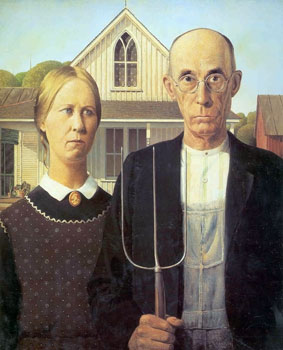
About a year ago, I read American Gothic by Steven Biel and the book has left a surprising lasting impression on me. The book describes the background, history, and life of "American Gothic: America's most famous painting" by Grant Wood. Even if you don't recognize the name "American Gothic", you are likely to recognize the picture or the scene. The book is a serious and -- as far as I can tell -- reasonably comprehensive treatment of the subject that is interesting, insightful at points, and a breeze to read. Thumbnail of the American Gothic Painting Of course, the book is not actually about the painting that hangs in the Art Institute of Chicago -- although it will certainly teach you more than you probably ever wanted to know about that painting, its subjects, its settings, etc. The book is really the story of how that paining has been received, understood, and used. Nearly half of the book focuses on examples of people who have remixed, reworked, reimagined, and reproduced the painting in myriad forms, formats, settings, and ways. The book contains scores of photographs of celebrities posing in American Gothic style settings, dozens of political cartoons based on the paintings, images of talk shows, magazine covers, Broadway plays, product advertisements, toys, gifts, kitch, and more, done up in recognizeable representations of the basic American Gothic form. There is a very incomplete of references to American Gothic in popular culture at Wikipedia that can give a tiny taste of what is out there. The last chapter of the book is devoted to these "parodies" and there's some brief talk of issues around copyright and control of the image. Wood's sister Nan was the owner of the copyright for much of the second half of the twentieth century and is also the woman in the painting. She famously charged several makers of more lurid take-offs with defamation and successfully blocked a number of remixes. In 1988, Nan transferred ownership to the Visual Artists and Galleries Association (VAGA) which will hold the copyright until 2025. VAGA also claims "rights of publicity" in Nan's image which will last until 2060. VAGA takes a very expansive view of its copyright claims and argues that it has both veto power and royalty rights to any recognizably similar work. For example, VAGA does not want the American Gothic image used in alcohol advertisements and has successfully had such ads pulled. Biel's book contains no reference to the amount of money made from licensing the work but one can only conclude that it must be massive. VAGA blocked a plan by Iowa to use the picture on the back of the Iowa state quarter due to licensing disagreements; instead Iowa used a different Wood painting that was clearly in the public domain. What struck me most about Biel's book is related to just how deeply ingrained in American culture the American Gothic image has become. The book cites simple surveys that show that almost every American recognizes the painting (although only a small fraction know the painting's name or who painted it). The thousands of parodies that the book documents are testament to the fact that the painting has become a way of representing something essential about American culture and its values. But in a strange way, the painting's popularity and incessant reuse has also made it part of the culture that it so effectively captured. We can think of culture as a set of shared values and references that help us related to each other and to communicate. Just like idioms in language, culture helps us communicate more effectively, certainly, but also lets us communicate messages that would not be communicable otherwise. When Out Magazine, Coors, or any of several dozen others replace the figures in American Gothic with a gay or lesbian couple, they are succinctly sending a message about homosexual relationships and American traditional values that could not be made any other way. In this way, American Gothic -- both the painting and Biel's book -- represent a strong argument for free culture. If American Society has infused American Gothic with so much value, how can it be fair to let one person or organization own it? Are they not owning an essential mode through which a society can relate, experience, and communicate? I can't help but conclude that it shouldn't matter if VAGA does not like alcohol, advertisements, homosexuality, or wants to make a some money every time someone makes a cartoon parody. These are trivial concerns next to the importance of our society's need to communicate about these issues. If doing so requires the use of a shared cultural reference in VAGA's painting, I find it hard to justify VAGA's position of control. We need to be able to reproduce and reimagine American Gothic because it has become part of us. It's a striking example of the way that art becomes culture and the reason that truly free culture is the only appropriate response. We can't afford to let our experience of the world and each other -- to let ourselves at a very fundamental level -- be owned and controlled.

Randall Donald: 180.44, 2.6.29 and bears, oh my!

I just uploaded nvidia-graphics-drivers 180.44 that work with Debian's 2.6.29 thanks to package team member Len Sorensen. If anyone wants to be as amazing as Len you may join the packaging team too.

I also did some BTS cleaning in regards to bugs reported by people not using the debian packages (and even said so) but reassigned to us anyway.

I am also battling a bad cold. I always get sick on holidays.

Oh one more thing. Go Canucks!

Christian Perrier: First KDE4 impressions

I finally more or less completed my switch to KDE4. Thanks the great great KDE maintenance team we have. Simultaneously, X.org packages were updated so possible problems may have ben triggerred by it more than KDE, though. At first glance, this new KDE is nice and has great improvements but generally speaking painfully slow..:-) So, I began deactivating again all visual effects so that my poor old Dell X1 survives the upgrade. I was also greatly annoyed by losing the "Terminal sessions" which I was very actively using with Konsole. No more "Terminal Sessions" menu in my task bar to connect to various hosts over the network. Bleh. I have to redo everything with Konsole's "profiles". Also sucking a lot is the default setting for fonts in Konsole (antialiased fonts). It makes scrolling painfully slooooooow. I just deactivated this and it's much much much better. I also lost my old mail notification utility (Korn). It is still working but having it running leaves a kio_mbox process eating all my CPU. Actually, korn is still something from KDE3, so I might expect it to be rebuilt for KDE4, hopefully. I never found anything as good as it in the gazillion of mail notification utilities we have. Maybe my dear Lazyweb will help. I'm still left with weird keyboard behaviour which is hard to identify. Apparently the delay before key repetition starts when one leaves a finger on a key has changed in some way and despite my attempts to restore this in the adequate KDE thing, it doesn't change that much. I suspect some weird interaction with X.org stuff. Such "minor" details are very annoying as they interfere with year of (bad) typing habits. In general, as a very old KDE user (I adopted it back in 2001 or so because of Kbabel), I'm somewhat happy with that upgrade but it will take time to be used to all the new concepts (ah, these "Plasmoids" thing...) and also restore the overall speed of my machine...:-)

10 April 2009

Joey Hess: Racing the Beam

I devoured Racing the Beam last night. It does a great job at getting inside the Atari 3600 platform and explaining how it affected the early games that ran on it. Full of great examples, like Yars Revenge displaying its own code onscreen as a visual effect, to avoid needing a random number generator. Teaches how to analyse screenshots of 3600 games and see how the crazily limited hardware was coaxed into drawing them. Highly recommended, just wish it were twice as long. (I also enjoyed that the book itself is a nice recursive hack. Its (fairly cheap) printing process didn't allow reproducing the detailed color photos of the games needed for reference. So they printed them on the inside of the dust jacket instead.)
While I just missed out on the heyday of the Atari 3600, I was writing similar games on my 130XE a bit later, mostly limited by having to use slow BASIC. This was probably the first video game I ever wrote, judging by its filename ("VIDIO").
You're the green dot, zipping across the screen. Each time it reaches the right side, it wraps back to the left, leaving a wall behind. Crash into the wall and you lose a life.
As I've mentioned before, I still enjoy VIDIO, both its simplicity and gameplay. And the key to its gameplay is that the dot moves fast and the controls are not very precise, making it hard to go thru a given hole in the wall. And the controls are not very precise because of a limitation of the platform. The BASIC program can only sample the joystick position occasionally, and so there's little fine control. So, Racing the Beam has helped me realize that the platform made this game what it is.
BTW, here's the code to VIDIO. (more)

Obey Arthur Liu: Google Summer of Code 2009: Debian s Shortlist

Copy of http://lists.debian.org/debian-devel/2009/04/msg00421.html. Hi folks, We have been pretty busy these past few weeks with the whole Google Summer of Code 2009 student application process.
I can say that we have this year a very good set of proposals and I d like to thank all the students and mentors for this. I am going to present to you our shortlist of projects that we would like to be funded and believe we can reasonably manage to get funded. As always, remember that the number of slots is not final yet at this point so we can t promise anything. The first preliminary slot count given today was *10* (same as last year) and we hope to get *2* more (as we did last year). This shortlist is alphabetically ordered because we don t want to reveal the current internal rankings. I am inviting you to debate what you think is cool, what is useful, what is important to Debian, maybe give us pointers to resources or people that could be helpful for the projects. We will try to alter our current rankings to reflect the zeitgeist in Debian, while taking into account the personal information that we have about each student involved. The deadline for any modification is on the 15th, so get everything in by the 14th. The final selected projects will be announced by Google April 20th, ~12 noon PDT / 19:00 UTC. We ll have another announcement then. Three proposals need or may need a mentor, I indicated it. For more information about the projects or mentoring and how to talk to us directly, scroll down past the list. Debian s Shortlist : - Aptitude Package Management History Tracking
- Automatic Debug Packages Creation and Handling
- Debbugs Web UI: Amancay Strikes Back
- Control Files Parsing/Editing Library/Qt4-Debconf Qt4-Perl bindings
- Debian-Installer Support for GNU/kFreeBSD
- KDE/Qt4 Adept 3.0 Package Manager
- Large Scientific Dataset Package Management
- MIPS N32 ABI Port
- MTD Embedded Onboard flash Partitioning and Installation
- On-demand Cloud Computing with Amazon EC2 and Eucalyptus Integration
- Port back update-manager to Debian and all Derivatives
- Debian Autobuilding Infrastructure Rewrite And the details: Aptitude Package Management History Tracking Student: Cristian Mauricio Porras Duarte, Mentor: Daniel Burrows Aptitude currently does not track actions that the user has performed beyond a single session of the program. One of the most frequent requests from users is to find out when they made a change to a package, or why a package was changed; we want to store this information and expose it in the UI in convenient locations. As a side effect, this might also provide some ability to revert past changes. Automatic Debug Packages Creation and Handling Student: Emilio Pozuelo Monfort, Mentor: Marc Brockschmidt This proposal aims at providing debug binary packages for the packages in the Debian archive in an automatic manner, moving them away from the official Debian archive to an special one. This has the benefits of providing thousands of debug packages without any work needed from the developers, for all the architectures, without bloating
the archive. Debbugs Web UI: Amancay Strikes Back Student: Diego Escalante Urrelo, Mentor: Margarita Manterola The Amancay project aims to be a new read/write web frontend to Debian s BTS; allowing DDs and contributors to easily interact with bugs via an intuitive yet powerful interface, enabling new workflows and creating new contribution opportunities like triaging while upholding reporting quality. Control Files Parsing/Editing Library/Qt4-Debconf Qt4-Perl bindings Student: Jonathan Yu, Mentor: (probably) Dominique Dumont see below This project proposes a common library for parsing and manipulating Debian Control files, including control, copyright and changelog. Main ideas include validating and parsing of these files, with both Strict and Quirks modes for the parser. The second idea is a new frontend for Debconf using Qt4 (for which Perl bindings will be written). Debian-Installer Support for GNU/kFreeBSD Student: Luca Favatella, Mentor: Aurelien Jarno GNU/kFreeBSD is currently using a hacked version of the FreeBSD installer combined with crosshurd as its own installer. While this works more or less correctly for standard installations (read: the exact same installation as in the documentation), it does not allow any changes in the installation process except the hard disk partitioning. This project is about porting debian-installer on GNU/kFreeBSD, and to a bigger extent, make debian-installer less Linux dependant. KDE/Qt4 Adept 3.0 Package Manager Student: Mateusz Marek, Mentor: NEEDS MENTOR, see below. Finish Adept 3.0, a fully integrated package manager for Qt4/KDE4. Adept is currently the only viable path to a Debian native package manager on KDE that would support modern features such as tags, indexed search or good conflict resolving. With Aptitude-gtk still in development and only available for GTK+ and (K)PackageKit having fundamental problems, Debian needs this project to stay in control of its package management on KDE after much neglect in the recent years. Large Scientific Dataset Package Management Student: Roy Flemming Hvaara, Mentor: Charles Plessy Large public datasets, like databases for bioinformatics are typically too big and too volatile to fit the traditional source/binary packaging scheme of Debian. There are some programs that are distributed in Debian, like blast and emboss, that can index specialised databases, but Debian lacks a tool to install or update the datasets they need and keep their indexing in sync. MIPS N32 ABI Port Student: Sha Liu, Mentor: Anthony Fok This project first focuses on creating a new MIPS N32 ABI port for Debian. Different from O32 and N64, N32 is an address model which has most 64-bit capabilities but using 32-bit data structures to save space and process time. A second focus will be given on making such a mipsn32el arch fully optimized for the Loongson 2F CPU which gains more and more popularity in subnotebooks/netbooks in many countries. MTD Embedded Onboard flash Partitioning and Installation Student: Per Andersson, Mentor: Wookey Many embedded devices have MTD onboard flash as persistent storage like the Kurobox Pro NAS, the Neo Freerunner, the Sheeva Plug or the OLPC. With MTD flash being so popular and with increases in capacity, support for MTD partition/installation would make Debian even more interesting to a wide range of of devices, making it one step closer to being universal. On-demand Cloud Computing with Amazon EC2 and Eucalyptus Integration Student: David Wendt Jr, Mentor: (probably) Steffen Moeller see below In many academic fields, as well as commercial industries, people use clusters to distribute tasks among multiple machines. Many times this is done by packaging a whole operating system disk image, uploading it onto the cluster, and having the cluster run it in a VM. This project intends to make it easier for Debian to distribute prepared disk images templates like they distribute CD images now, for the users to recreate or customise these templates with Debian packages and for administrators to host such clusters with Debian. Port back update-manager to Debian and all Derivatives Student: Stephan Peijnik, Mentor: Michael Vogt The project would involve taking the distribution-(Ubuntu-)specific update-manager code, analyzing it, and creating a package with just its core functionality, decoupling the distribution-specific parts and thus making the core code extensible by distribution-specific add-ons. This in turn would remove the need of porting update-manager to Debian with every upstream release. An additional optional goal would be replacing the synaptics-backend with a python-apt based one. Debian Autobuilding Infrastructure Rewrite Student: Philipp Kern, Mentor: Luk Claes Rewrite the software that currently runs the Debian autobuilding infrastructure in a way that makes it more maintainable and robust. It will use Python as its programming language and PostgreSQL for the database backend. By harmonizing buildds, many build failures can be prevented and wasteful workload on buildd volunteers can be reduced. On mentoring: Petr Rockai, the original developer of Adept has offered help to anyone willing to adopt Adept. Sune Vuorela has offered help for any Qt4 and KDE related issues. *We really need a mentor here*. The student is quite competent but Google dictates that we provide a mentor to handle student management. Dominique Dumont, although not DD, has signaled interest in mentoring this, although it hasn t been confirmed yet. Sune Vuorela has offered to help co-mentor for the Qt4-Debconf and Qt4-Perl bindings part. Steffen Moeller has signaled interest in mentoring this, although it hasn t been formally confirmed yet. Charles Plessy of the Debian Med team will provide help for use cases related issues. Eric Hammond, developer of the original vmbuilder image creation tool and maintainer of a set of Debian and Ubuntu images will provide help for Amazon EC2 and image creation issues. Chris Grzegorczyk from the Eucalyptus team will provide help for Eucalyptus and Eucalyptus/Debian integration issues. Contacting us: Considering the tight schedule, most stuff happens live on IRC: #debian-soc on irc.debian.org You can also consult our wiki page for some additional information:
<http://wiki.debian.org/SummerOfCode2009> We have a mailing-list at:
<http://lists.alioth.debian.org/mailman/listinfo/soc-coordination> Keep this discussion on debian-devel@lists.debian.org while cc-ing soc-coordination@lists.alioth.debian.org. This thread is for debian-devel primarily.

9 April 2009

Manoj Srivastava: Manoj: kernel-package: Add support for kernel image debug package

A new version of kernel-package in Incoming at the time of writing adds support for creating a package which contains the Linux kernel debug image. This means the debugging information for the modules in the kernel image package, and the uncompressed vmlinux image. This builds on suggestions and code from Troy Heber, Theodore Y. Ts o, and Dann Frazier. As support for kexec/kdump support becomes more real, it will be very useful to be able to build kernels that have debugging information available, but not necessarily to install the debugging information on every single client system. The .ko object files are stripped of the debugging information before they are placed in the standard linux-image installation package. However, before that, a copy of the vmlinux and unstripped .ko files are saved in a debuginfo package, and everything except for the debugging information is removed from them using objcopy --keep-only-debug. This means that if someone ends up with a crash dump, they can send it to a support engineer and only the support engineer needs to install the debuginfo package and use the crash utility to debug the crash dump. It s also useful for developers, since the debuginfo information can be stored somewhere outside of /lib for storing its debug information, for example. This is useful for keeping the size of the root partition small, for those who keep / separate from /usr. The locations used are compatible also with SystemTap, which provides free software infrastructure to simplify the gathering of information about the running Linux system. This assists diagnosis of a performance or functional problem. SystemTap eliminates the need for the developer to go through the tedious and disruptive instrument, recompile, install, and reboot sequence that may be otherwise required to collect data. Also, I had to clear out some FUD about kernel-package from the ircbot dpkg on the OFTC Debian IRC channel, since someone had implied that kernel-package was some how obsolete. As can be seen, it is being actively developed, and features are being added apace.

MJ Ray: Switched over to LLU and ADSL-2+

A couple of months ago, I switched over to ThePhoneCoop s LLU package. The new service is good so far. The ADSL is blazingly fast (I wonder if it will remain so good) and the main drawbacks so far are a lack of reverse DNS (currently escalating that one up through tech support) and a slightly noisy dialling tone on the phone. I was initially switched to a dynamic IP address (which was a change I wasn t told about in advance), but got a static on request so we could restrict the VPNs a bit more. As usual, LUGgers were a source of help when it looked like going a bit wrong. Thanks to oddbloke for positive feedback about Buffalo routers (they work fine with OpenWRT, but not tried ADSL). Big thanks to Noodles for pointing out that the Buffalo router I linked wasn t an ADSL router, despite being listed as such, that the only ADSL chipset to have full open source support is the AR7 (but the wifi is dodgy) and that the Broadcom chipsets have 2.6 support but maybe with a binary blob. I m still not sure if a new router is necessary. The infernal Belkin seems to be working, but it s disconnecting and rebooting a lot more often. I seem to be on the TalkTalk/CPW network - anyone know of problems with Belkin routers? I ve not seen anything yet. Also, who else has unbundled and how was it for you?

8 April 2009

David Welton: New LangPop.com stats, open source bits and pieces

I released some new statistics on LangPop.com. There are some new things:
  • The normalized results are now user configurable - you can put in your own weights for the various data sources (such as Amazon, Craigslist, and so on), and see how the results change.
  • Freshmeat.net fiddled with their web site, and statistics are not going to be available this month. Hopefully they will be able to correct the problem soon.
  • On the other hand, I wrote some code to grab the data from Ohloh, so there's something new to look at while we wait for Freshmeat to come back on line.
So there is a fair amount going on. Hopefully Freshmeat will come back soon, and I can also add a few fixes to the IRC statistics which I've been thinking about. In the process of doing the above, I also managed to do some open source work, albeit of a minor nature:
  • I updated LangPop.com to use the Flotr Javascript chart library instead of Plotr. So I also updated my Ruby code to integrate it. It's a fairly thin layer at this point, but it does what I need. It's available here: http://github.com/davidw/chartr/tree/master
  • I did some hacking on the Simile Timeline code, (used here on LangPop.com), correcting a bug, and also creating a system to install the whole thing with a simple command. Normally, it's kind of difficult to just use the Simile code on your own site, so I created an (admittedly hacky) way of making it easier to install. That code is here: http://github.com/davidw/standalone-timeplot/tree/master
Oh, yeah, and we moved from Innsbruck, Austria back to Padova, Italy!

Next.

Previous.