Search Results: "agi"

28 October 2011

Lars Wirzenius: On the future of Linux distributions

Executive summary Debian should consider: Introduction I've taken a job with Codethink, as part of a team to develop a new embedded Linux system, called Baserock. Baserock is not a distribution as such, but deals with many of the same issues. I thought it might be interesting to write out my new thoughts related to this, since they might be useful for proper distributions to think about too. I'll hasten to add that many of these thoughts are not originally mine. I shamelessly adopt any idea that I think is good. The core ideas for Baserock come from Rob Taylor, Daniel Silverstone, and Paul Sherwood, my colleagues and bosses at Codethink. At the recent GNOME Summit in Montreal, I was greatly influenced by Colin Walters. This is also not an advertisment for Baserock, but since my of my current thinking come from that project, I'll discuss things in the context of Baserock. Finally, I'm writing this to express my personal opinion and thoughts. I'm not speaking for anyone else, least of all Codethink. On the package abstraction Baserock abandons the idea of packages for all individual programs. In the early 1990s, when Linux was new, and the number of packages in a distribution could be counted on two hands in binary, packages were a great idea. It was feasible to know at least something about every piece of software, and pick the exact set of software to install on a machine. It is still feasible to do so, but only in quite restricted circumstances. For example, picking the packages to install a DNS server, or an NFS server, or a mail server, by hand, without using meta packages or tasks (in Debian terminology), is still quite possible. On embedded devices, there's also usually only a handful of programs installed, and the people doing the install can be expected to understand all of them and decide which ones to install on each specific device. However, those are the exceptions, and they're getting rarer. For most people, manually picking software to install is much too tedious. In Debian, we've realised this a great many years ago, and developed meta packages (whose only purpose is to depend on other packages) and tasks (solves the same problem, but differently). These make it possible for a user to say "I want to have the GNOME desktop environment", and not have to worry about finding every piece that belongs in GNOME, and install that separately. For much of the past decade, computers have had sufficient hard disk space that it is no longer necessary to be quite so picky about what to install. A new cheap laptop will now typically come with at least 250 gigabytes of disk space. An expensive one, with an SSD drive, will have at least 128 gigabytes. A fairly complete desktop install uses less than ten gigabytes, so there's rarely a need to pick and choose between the various components. From a usability point of view, choosing from a list of a dozen or two options is much easier than from a list of thirty five thousand (the number of Debian packages as I write this). This is one reason why Baserock won't be using the traditional package abstraction. Instead, we'll collect programs into larger collections, called strata, which form some kind of logical or functional whole. So there'll be one stratum for the core userland software: init, shell, libc, perhaps a bit more. There'll be another for a development environment, one for a desktop environment, etc. Another, equally important reason, to move beyond packages is the problems caused by the combinatorial explosion of packages and versions. Colin Walters talks about this very well. When every system has a fairly unique set of packages, and versions of them, it becomes much harder to ensure that software works well for everyone, that upgrades work well, and that any problems get solved. When the number of possible package combinations is small, getting the interactions between various packages right is easier, QA has a much easier time to test all upgrade paths, and manual test coverage improves a lot when everyone is testing the same versions. Even debugging gets easier, when everyone can easily run the same versions. Grouping software into bigger collections does reduce flexibility of what gets installed. In some cases this is important: very constrainted embedded devices, for example, still need to be very picky about what software gets installed. However, even for them, the price of flash storage is low enough that it might not matter too much, anymore. The benefit of a simpler overall system may well outweigh the benefit of fine-grained software choice. Everything in git In Baserock, we'll be building everything from source in git. It will not be possible to build anything, unless the source is committed. This will allow us to track, for each binary blob we produce, the precise sources that were used to bulid it. We will also try to achieve something a bit more ambitious: anything that affects any bit in the final system image can be traced to files committed to git. This means tracking also all configuration settings for the build, and the whole build environment, in git. This is important for us so that we can reproduce an image used in the field. When a customer is deploying a specific image, and needs it to be changed, we want to be able to make the change with the minimal changes compared to the previous version of the image. This requires that we can re-create the original image, from source, bit for bit, so that when we make the actual change, only the changes we need to make affect the image. We will make it easy to branch and merge not just individual projects, but the whole system. This will make it easy to do large changes to the system, such as transitioning to a new version of GNOME, or the toolchain. Currently, in Debian, such large changes need to be serialised, so that they do not affect each other. It is easy, for example, for a GNOME transition to be broken by a toolchain transition. Branching and merging has long been considered the best available solution for concurrent development within a project. With Baserock, we want to have that for the whole system. Our build servers will be able to build images for each branch, without requiring massive hardware investment: any software that is shared between branches only gets built once. Launchpad PPAs and similar solutions provide many of the benefits of branching and merging on the system level. However, they're much more work than "git checkout -b gnome-3.4-transition". I believe that the git based approach will make concurrent development much more efficient. Ask me in a year if I was right. Git, git, and only git There are a lot of version control systems in active use. For the sake of simplicity, we'll use only git. When an upstream project uses something else, we'll import their code into git. Luckily, there are tools for that. The import and updates to it will be fully automatic, of course. Git is not my favorite version control system, but it's clearly the winner. Everything else will eventually fade away into obscurity. Or that's what we think. If it turns out that we're wrong about that, we'll switch to something else. However, we do not intend to have to deal with more than one at a time. Life's too short to use all possible tools at the same time. Tracking upstreams closely We will track upstream version control repositories, and we will have an automatic mechanism of building our binaries directly from git. This will, we hope, make it easy to follow closely upstream development, so that when, say, GNOME developers make commits, we want to be able to generate a new system image which includes those changes the same day, if not within minutes, rather than waiting days or weeks or months. This kind of closeness is greatly enhanced by having everything in version control. When upstream commits changes to their version control system, we'll mirror them automatically, and this then triggers a new system image build. When upstream makes changes that do not work, we can easily create a branch from any earlier commit, and build images off that branch. This will, we hope, also make it simpler to make changes, and give them back to upstream. Whenever we change anything, it'll be done in a branch, and we'll have system images available to test the change. So not only will upstream be able to easily get the change from our git repository, they'll also be easily verify, on a running system, that the change fixes the problem. Automatic testing, maybe even test driven development We will be automatically building system images from git commits for Baserock. This will potentially result in a very large number of images. We can't possibly test all of them manually, so we will implement some kind of automatic testing. The details of that are still under discussion. I hope to be able to start adding some test driven development to Baserock systems. In other words, when we are requested to make changes to the system, I want the specification to be provided as executable tests. This will probably be impossible in real life, but I can hope. I've talked about doing the same thing for Debian, but it's much harder to push through such changes in an established, large project. Solving the install, upgrade, and downgrade problems All mainstream Linux distributions are based on packages, and they all, pretty much, do installations and upgrades by unpacking packages onto a running system, and then maybe running some scripts from the packages. This works well for a completely idle system, but not so well on systems that are in active use. Colin Walters again talks about this. For installation of new software, the problem is that someone or something may invoke it before it is fully configured by the package's maintainer script. For example, a web application might unpack in such a way that the web server notices it, and a web browser may request the web app to run before it is configured to connect to the right database. Or a GUI program may unpack a .desktop file before the executable or its data files are unpacked, and a user may notice the program in their menu and start it, resulting in an error. Upgrades suffer from additonal problems. Software that gets upgraded may be running during the upgrade. Should the package manager replace the software's data files with new versions, which may be in a format that the old program does not understand? Or install new plugins that will cause the old version of the program to segfault? If the package manager does that, users may experience turbulence without having put on their seat belts. If it doesn't do that, it can't install the package, or it needs to wait, perhaps for a very long time, for a safe time to do the upgrade. These problems have usually been either ignored, or solved by using package specific hacks. For example, plugins might be stored in a directory that embeds the program's version number, ensuring that the old version won't see the new plugins. Some people would like to apply installs and upgrades only at shutdown or bootup, but that has other problems. None of the hacks solve the downgrade problem. The package managers can replace a package with an older version, and often this works well. However, in many cases, any package maintainer scripts won't be able to deal with downgrades. For example, they might convert data files to a new format or name or location upon upgrades, but won't try to undo that if the package gets downgraded. Given the combinatorial explosion of package versions, it's perhaps just as well that they don't try. For Baserock, we absolutely need to have downgrades. We need to be able to go back to a previous version of the system if an upgrade fails. Traditionally, this has been done by providing a "factory reset", where the current version of the system gets replaced with whatever version was installed in the factory. We want that, but we also want to be able to choose other versions, not just the factory one. If a device is running version X, and upgrades to X+1, but that version turns out to be a dud, we want to be able to go back to X, rather than all the way back to the factory version. The approach we'll be taking with Baserock relies on btrfs and subvolumes and snapshots. Each version of the system will be installed in a separate subvolume, which gets cloned from the previous version, using copy-on-write to conserve space. We'll make the bootloader be able to choose a version of the system to boot, and (waving hands here) add some logic to be able to automatically revert to the previous version when necessary. We expect this to work better and more reliably than the current package based one. Making choices Debian is pretty bad at making choices. Almost always, when faced with a need to choose between alternative solutions for the same problem, we choose all of them. For example, we support pretty much every init implementation, various implementations of /bin/sh, and we even have at least three entirely different kernels. Sometimes this is non-choice is a good thing. Our users may need features that only one of the kernels support, for example. And we certainly need to be able to provide both mysql and postresql, since various software we want to provide to our uses needs one and won't work with the other. At other times, the inability to choose causes trouble. Do we really need to support more than one implemenation of /bin/sh? By supporting both dash and bash for that, we double the load on testing and QA, and introduce yet another variable to deal with into any debugging situation involving shell scripts. Especially for core components of the system, it makes sense to limit the flexibility of users to pick and choose. Combinatorial explosion d j vu. Every binary choice doubles the number of possible combinations that need to be tested and supported and checked during debugging. Flexibility begets complexity, complexity begets problems. This is less of a problem at upper levels of the software stack. At the very top level, it doesn't really matter if there are many choices. If a user can freely choose between vi and Emacs, and this does not add complexity at the system level, since nothing else is affected by that choice. However, if we were to add a choice between glibc, eglibc, and uClibc for the system C library, then everything else in the system needs to be tested three times rather than once. Reducing the friction coefficient for system development Currently, a Debian developer takes upstream code, adds packaging, perhaps adds some patches (using one of several methods), builds a binary package, tests it, uploads it, and waits for the build daemons and the package archive and user-testers to report any problems. That's quite a number of steps to go through for the simple act of adding a new program to Debian, or updating it to a new version. Some of it can be automated, but there's still hoops to jump through. Friction does not prevent you from getting stuff done, but the more friction there is, the more energy you have to spend to get it done. Friction slows down the crucial hack-build-test cycle of software development, and that hurts productivity a lot. Every time a developer has to jump through any hoops, or wait for anything, he slows down. It is, of course, not just a matter of the number of steps. Debian requires a source package to be uploaded with the binary package. Many, if not most, packages in Debian are maintained using version control systems. Having to generate a source package and then wait for it to be uploaded is unnecessary work. The build daemon could get the source from version control directly. With signed commits, this is as safe as uploading a tarball. The above examples are specific to maintaining a single package. The friction that really hurts Debian is the friction of making large-scale changes, or changes that affect many packages. I've already mention the difficulty of making large transitions above. Another case is making policy changes, and then implementing them. An excellent example of that is in Debian is the policy change to use /usr/share/doc for documentation, instead of /usr/doc. This took us many years to do. We are, I think, perhaps a little better at such things now, but even so, it is something that should not take more than a few days to implement, rather than half a decade. On the future of distributions Occasionally, people say things like "distributions are not needed", or that "distributions are an unnecessary buffer between upstream developers and users". Some even claim that there should only be one distribution. I disagree. A common view of a Linux distribution is that it takes some source provided by upstream, compiles that, adds an installer, and gives all of that to the users. This view is too simplistic. The important part of developing a distribution is choosing the upstream projects and their versions wisely, and then integrating them into a whole system that works well. The integration part is particularly important. Many upstreams are not even aware of each other, nor should they need to be, even if their software may need to interact with each other. For example, not every developer of HTTP servers should need to be aware of every web application, or vice versa. (It they had to be, it'd be a combinatorial explosion that'd ruin everything, again.) Instead, someone needs to set a policy of how web apps and web servers interface, what their common interface is, and what files should be put where, for web apps to work out of the box, with minimal fuss for the users. That's part of the integration work that goes into a Linux distribution. For Debian, such decisions are recorded in the Policy Manual and its various sub-policies. Further, distributions provide quality assurance, particularly at the system level. It's not realistic to expect most upstream projects to do that. It's a whole different skillset and approach that is needed to develop a system, rather than just a single component. Distributions also provide user support, security support, longer term support than many upstreams, and port software to a much wider range of architectures and platforms than most upstreams actively care about, have access to, or even know about. In some cases, these are things that can and should be done in collaboration with upstreams; if nothing else, portability fixes should be given back to upstreams. So I do think distributions have a bright future, but the way they're working will need to change.

Raphaël Hertzog: Debian joins Dropbox s officially supported platforms along with Fedora and Ubuntu

If you checkout Dropbox s Linux download page, you will see that Debian packages are provided. Up to a few days ago, they only provided packages for Ubuntu and Fedora. I m glad to see that packaging nautilus-dropbox for Debian and being in touch with them due to this led to this result. Another positive outcome is that the version 0.7.0 now ensures the origin of the downloaded binaries with GPG.

7 comments Liked this article? Click here. My blog is Flattr-enabled.

26 October 2011

Russ Allbery: Review: Scrum and XP from the Trenches

Review: Scrum and XP from the Trenches, by Henrik Kniberg
Publisher: InfoQ
Copyright: 2007
ISBN: 1-4303-2264-0
Format: Trade paperback
Pages: 127
For those not already familiar with it, Scrum is a project management methodology that's most often seen in the agile software development community. It attempts to do for project management what agile techniques do for software development (and, other than test-driven development, I think is more useful than most of agile). I'm not going to explain it here in detail, but if you do software development or project management of software-style projects (including integration and computing infrastructure), it's worth your attention. It provides some nice techniques for dealing with some of the banes of technical projects, particularly constantly changing requirements and the difficulties of estimates. Scrum and XP from the Trenches is subtitled "How we do Scrum" and is exactly what it says on the tin. It is a fairly detailed description of how Crisp (an agile Java development company in Sweden) does Scrum (with a little discussion of Extreme Programming). It doesn't explain what Scrum is, although it does provide a few pointers to resources if you've never heard of it (but this isn't the sort of book you'd be buying if you'd never heard of it). It also doesn't try to convince you that Scrum is wonderful, which is a nice trap to avoid. It gets right down to business and packs quite a bit of relentlessly practical content into a small number of pages. I've been doing Scrum for about a year, across two large projects, both times not entirely following the full Scrum model. Both times, most of the team was learning Scrum during the project. I've gone to some Scrum training and read a bit, largely on-line, but I haven't made an exhaustive study of it. I think I'm exactly the ideal audience for this book, although my guess is that people who have been doing Scrum for longer will also get something out of it. This is not an introduction; I don't think one is likely to get much benefit out of it without a couple of Scrum projects under one's belt so that one has a feel for the problems and failure modes. As Kniberg accurately points out, Scrum is a framework, not a precise rule set, and it can't be applied blindly in one situation using analysis from another. For that audience, though, this book is great. Kniberg has used Scrum in a variety of different situations and tried multiple solutions to many of its problems, so he can provide guidance not only on his preferred solutions but on the other solutions he's tried and why they don't work. I started taking extensive notes just a few pages in; it was exactly the book I needed to read for the full-project retrospective on how Scrum worked for a just-concluded work project, and for planning what changes we'll want to make for the next project. He goes through every step of the Scrum cycle and offers advice on each step, particularly for the sprint planning (which was extremely helpful). He then walks through release planning and advance estimation (one of the best parts of the book; I've seen the concept of a focus factor before, but this is one of the best and clearest explanations I've seen), talks about XP (Extreme Programming) techniques and testing, and then discusses how to coordinate multiple Scrum teams in a larger organization. The chapter on testing was the reason why I bought the book; the rest of the book lives up to it. As mentioned, my Scrum exposure is not broad, so Kniberg may just be following different orthodoxies. That said, he broke with the ones I was previously familiar with in some useful places. One is to attach a time unit to story points, something that I was told was close to anethema, but as presented here looks very useful. Another, not so much a break but an idea that I'd not encountered elsewhere, is downtime between sprints, an brilliant solution to a problem that I'd not even fully articulated but which had been plaguing our Scrum process. He also has some suggestions about communication that, while fairly obvious and common-sense stuff, still were things that hadn't occurred to me and that we should adopt. I paid for a hard-copy version of this book from Lulu because I like things like this on paper and am happy to support the author financially, but you can download a PDF file and read it for free from InfoQ and see whether it works as well for you as it did for me. If you're ramping up on Scrum, seeing some problems, and looking for good ideas on how to fix them, I highly recommend it. I'd love to read two or three more case studies like this to get some more perspectives on how to make Scrum work. The paper book will likely be making a circuit around our office to serve as fodder for our upcoming Scrum projects. Rating: 8 out of 10

24 October 2011

Russell Coker: Stop HRL

Today I attended the Stop HRL demonstration [1]. The government plans to spend $100,000,000 of federal money and $50,000,000 of Victorian state money to build a new coal power station. The state government has imposed some unreasonable restrictions on renewable energy which includes allowing a single person who objects within 2Km of a wind turbine to block the project while also not allowing anyone to object to coal power plants or fracking (both of which have proven health implications). Today VCAT had a hearing about this issue, HRL wants to double the size of the proposed coal power plant while Environment Victoria, Doctors for the Environment Australia, local climate action group Locals Into Victoria s Environment Martin Shield from Climate Action Moreland are opposing the plan. What the government should be doing is permitting (if not encouraging) renewable energy production, particularly wind power which will drive down energy prices by undercutting the energy auctions due to it s almost zero marginal cost. The government should not be spending tax payer money on new coal projects due to climate change and air pollution in addition to the fact that coal is simply more expensive in the long term. As usual it s disappointing that the National party which supposedly represents farmers is supporting the government in such things. The pollution caused by coal power and fracking ends up damaging farmland. The Liberal party doesn t have a majority on it s own in either house of the state government, so this proposed coal power plant could be stopped immediately if the National party supported renewable power, or even if they merely opposed giving $50,000,000 of state tax money to HRL. The demonstration went reasonably well, there was about 80 people there when I arrived and by the time it ended there were more than 150 people. I took the above picture at the start and it missed many people who were off to the right. I think that s a good result for a demonstration that had little publicity and was held in business hours with really bad weather. Update: On Sunday the 13th of November at 13:00-14:30 there is a Going Backwards Under Baillieu demonstration at Parliament House. This is to mark the negative affects that the Liberal state government has had on the environment of Victoria.

Gregor Herrmann: managing $HOME

I'm not the first one who thought about managing their dotfiles & scripts in a (D)VCS in order to be able to have them in sync across different machines, & I even haven't re-invented the wheel for doing so. short report on my experiences:

after looking around a bit I decided to try movein (info page with links to downloads & a README, blog post, git repo) because it looked liked it would easily do what I'd like to do without getting in my way too much; which means e.g.: no symlink farm, & only one simple command to manage the whole setup.

movein is a simple shell script that allows to setup & manage multiple modular repos tracking different sets of files quite easily, taking advantage of the powers of git & mr. & being written in shell means I also was able to make a few changes, which stew kindly accepted & applied to his tree already.

in fact I'm just starting to use it for real, but it looks good so far, & I think I'm going to stick with it for the time being.

2 minor observations: </promotion_time>

23 October 2011

Luca Falavigna: Stats, more stats and, guess what? Even more stats!

We all love stats, don t we? So, here we go! Let s start with a graph: NEW graph It shows the number of packages in the NEW queue since last year. You can see a big drop during April 2011, and a reasonably low rate during the last six months. You could think fellow Debian Developers stopped to upload NEW packages. Sorry, you re wrong! :) Since Squeeze release, 3.832 .changes files with NEW components were processed by dak, with an average of 14,85 NEW packages per day. On the FTP Team side, we had 3.732 accepts (14,47 per day), 339 rejects (1,31 per day) and 178 comments to maintainers (0,69 per day).
Who were the most prolific maintainers who got a NEW processing? Here is our special top ten:
  1. Debian Haskell Group (362 packages)
  2. Debian Perl Group (343 packages)
  3. Debian Java Maintainers (161 packages)
  4. Debian Ruby Extras Maintainers (124 packages)
  5. Debian Multimedia Maintainers (100 packages)
  6. Debian Fonts Task Force (96 packages)
  7. Debian Med Packaging Team (79 packages)
  8. Debian Install System Team (61 packages)
  9. Debian Javascript Maintainers (54 packages)
  10. Debian Python Modules Team (50 packages)
That s bad packaging teams cannot bake cookies!
Let s do the same with Changed By, this time:
  1. Ben Hutchings (159 packages)
  2. Joachim Breitner (138 packages)
  3. Clint Adams (134 packages)
  4. Jonas Smedegaard (124 packages)
  5. TANIGUCHI Takaki (97 packages)
  6. Nicholas Bamber (61 packages)
  7. Alessio Treglia (60 packages)
  8. maximilian attems (54 packages)
  9. David Paleino (51 packages)
  10. Torsten Werner (45 packages)
Much better now go and heat up your ovens, we know who you are ;)
Another nice aspect to look at is the speed of NEW processing. Some maintainers were very happy for a fast NEW processing, someone even complained for having been too quick! :) So, let s find out which upload was the quickest ever. Try to gamble a bit before reading the answer, to see whether you are near to the real value ;) Alessio Treglia, you probably already know, because your gwc_0.21.16~dfsg-1 upload has been processed in 41 seconds (yes, forty-one seconds!). Here s an excerpt from ftp-master log to certify it:
20110516120252 process-upload dak Processing changes file gwc_0.21.16~dfsg-1_amd64.changes
20110516120258 process-upload dak Moving to new gwc_0.21.16~dfsg-1_amd64.changes
20110516120339 process-new tolimar NEW ACCEPT: gwc_0.21.16~dfsg-1_amd64.changes
Alex was the super-fast FTP Team member behind the quickest accept, do you want to beat him? Join FTP Team ;)

21 October 2011

Tollef Fog Heen: Today's rant about RPM

Before I start, I'll admit that I'm not a real RPM packager. Maype I'm approaching this from completely the wrong direction, what do I know? I'm in the process of packaging Varnish 3.0.2 which includes mangling the spec file. The top of the spec file reads:
%define v_rc
%define vd_rc % ?v_rc:-% ?v_rc 
Apparently, this is not legal, since we're trying to define v_rc as a macro with no body. It's however not possible to directly define it as an empty string which can later be tested on, you have to do something like:
%define v_rc % nil 
%define vd_rc % ?v_rc:-% ?v_rc 
Now, this doesn't work correctly either. % ?macro tests if macro is defined, not whether it's an empty string so instead of two lines, we have to write:
%define v_rc % nil 
%if 0% ?v_rc  != 0
%define vd_rc % ?v_rc:-% ?v_rc 
%endif
The 0 ?v_rc != 0 workaround is there so that we don't accidentially end up with == 0 which would be a syntax error. I think having four lines like that is pretty ugly, so I looked for a workaround and figured that, ok, I'll just rewrite every use of % vd_rc to % ?v_rc:-% ?v_rc . There are only a couple, so the damage is limited. Also, I'd then just comment out the v_rc definition, since that makes it clear what you should uncomment to have a release candidate version. In my naivety, I tried:
# %define v_rc ""
# is used as a comment character in spec files, but apparently not for defines. The define was still processed and the build process stopped pretty quickly. Luckily, doing # % define "" seems to work fine and is not processed. I have no idea how people put up with this or if I'm doing something very wrong. Feel free to point me at a better way of doing this, of course.

20 October 2011

Kai Wasserb ch: WEB.DE offers Phish

[UPDATE 2011-10-26] The story has developed.[/UPDATE] Recently I was talking with somebody about the WEB.DE toolbar, and today I finally got around to look something up I was told then. And while I searched for the information on the download page for the WEB.DE toolbar, I stumbled over the download URL for the installer:
http://wa.ui-portal.de/webde/webde/s?produkte.browserdownload.link.download.ff7&bd_mc=undef_undef&ns_type=pdf&ns_url=http://dl.web.de/browser/firefox/WEB.DE_MFF7_Setup.exe
There I was magically attracted by the ns_url parameter, because it smelled like something where you could just pass any URL along. And indeed you can: http://wa.ui-portal.de/webde/webde/s?produkte.browserdownload.link.download.ff7&bd_mc=undef_undef&ns_type=pdf&ns_url=http://bundestrojaner.net/inhalt-bundestrojaner-gratis-download-3.html. That should redirect you to http://bundestrojaner.net/inhalt-bundestrojaner-gratis-download-3.html instead of http://dl.web.de/browser/firefox/WEB.DE_MFF7_Setup.exe. This is a serious flaw, as it might allow an attacker to request a username and password combination from an unsuspecting user. With a harvest page designed to look like another WEB.DE page you should have a high return rate. This is, by the way, a flaw on the OWASP Top 10 (2010 edition). I've informed somebody working for United Internet and expect the bug to be resolved pretty soon, hopefully it won't work anylonger when you read this.

18 October 2011

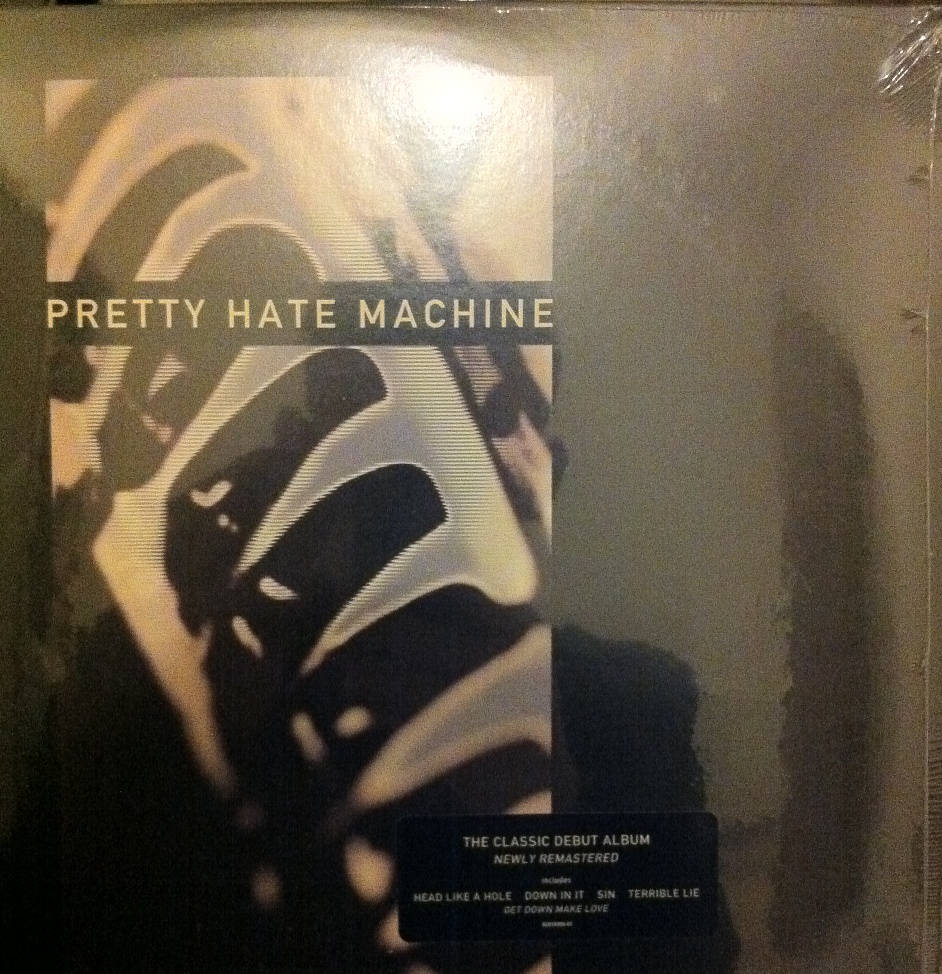
Jon Dowland: NIN album collection now complete

[pic]
With this, my NIN vinyl album collection is now complete. I don't have a comprehensive NIN vinyl collection by any account: I don't have all the singles nor the remix albums, rarities, etc., but I do have all the albums. This is the newly-remastered version of "Pretty Hate Machine", which sites proudly next to an original. I'm still waiting for the much-anticipated remaster of The Fragile, which turned 12 last month. It appears to have been sidelined by movie soundtrack work.

17 October 2011

Peter Makholm: Splicing two sockets in Perl (request for help)

A couple of times I have written code which basically does this:

  1. accept() an incoming connection
  2. do some magic to get another socket
  3. start passing bit between the two sockets
  4. perform a correct close down sequence
An example use case of this is a proxy implementing the HTTP CONNECT method, but in for some known hostnames it will log a message and mangle the hostname before proceeding. This has been used as a legacy fall back solution while changing a network setup. But my uses are not restricted to HTTP proxies I have done the same for a few legacy protocols where the magic has been of different complexities. The two final steps are quite general and it would be nice to have a module doing just that. Take two sockets and make it easy (or even automatic) to pass bytes between them. The na ve non-blocking solution would use a scalar string buffer for each direction and perform a select loop while maintaining the write vector depending on which buffers contain data. I have written this code multiple times. In development this is usually quite successful, in production less so. While Perl might be quite suited for the magic in step 2, the na ve way of passing bytes have quite an overhead for the buffer management. A less na ve way would use a array of strings for buffers, but I m not quite sure if this would be a win in all cases. You might be able to get away with some string operations on the read side of the buffer, but it might be more expensive on the write side. I have not benchmarked this. Most of the time I don t care about Perl level IO handles. I know that there is a real C level file descriptor beneath. So an even better POSIX compliant solution might be to use XS to have plain C strings and use readv()/writev() and a iovec structure as buffer. Can we do even better? At least on Linux we can. With the Linux splice() specific system call it is possible to us a pipe as buffer and never to have to copy data from and to user space. I have not been able to find any off the shelf solution on CPAN. So I think I need to write it myself, but what would the nice and general API be? I guess the basic interface would be something like:
    my $chain = IO::Splice->new($fh1, $fh2);
    $chain->pump(); # read and write from both handles if possible and needed
    $chain->read($fh1);  # read to buffer from one specific handle
    $chain->write($fh2); # write from buffer to one specific handle
    $chain->can_write(); # returns the handles it needs to write to
but it might be simpler to have two callbacks for setting a file handle in write or no-write state:
    my $readset  = IO::Select->new( $fh1, $fh2);
    my $writeset = IO::Select->new();
    my $chain = IO::Splice->new( $fh1, $fh2,
        writable => sub    $writeset->add( shift )  ,
        unwritable => sub   $writeset->remove( shift )  
    );
    while ( ... select ... )  
        $chain->pump();
     
As said, I think I have plenty of implementations of the na ve way but before releasing some code it would be nice to get some input on the API. But the best feedback would be a module that already have a usable API but might not implement the Linux specific way. That would allow me to steal the interface

Martin Meredith: Adventures with the Galaxy SII

Good morning all! It feels like forever since I last blogged . Which is extremely bad of me *slaps own wrist*. However, I m been horrendously stupidly busy. As some of you may know, I m very much an Android fan. Recently, I ve gotten myself a shiny Galaxy SII. Given the fact that alongside my day job of being a Web Developer for an Online Retailer, I m also a Voluntary Ambulance Person I thought it d be useful to ask my current workplace if they d provide me a mobile phone cover for my new phone. Of course, work were more than happy to provide me with a shiny Samsung Galaxy S2 case (I actually went for the Case-Mate Barely There in brushed aluminium). Being a voluntary Ambulance Person, I regularly have to go to random places to pick up an ambulance/attend an event. Because of that I rely quite heavily on Google Maps and it s navigation features (Free Sat Nav in my opinion, the killer feature of Android). Having only had my phone a week, I started to find that there were a few problems with the GPS. Whereas previously, I d been able to lock on almost instantly, It d now take me about half an hour (literally) to get a lock on anything. I tried Googling, I tried everything I could think of, but to no avail. I downloaded GPS Test, and it was showing that while it was picking up a couple of sattelites, it wasn t picking up enough to get a decent lock The image above is a screenshot of the GPS test from directly outside my front door, taken after it had settled down. As you can imagine, I wasn t happy and was ready to send the phone back. Then, for some reason, a brainwave hit me (It doesn t happen often). What changed from when it was working to now? I know! The Case *takes case off, tries GPS test again* It can be amazing what happens when you realise that shiny case you have is mainly made of aluminium. Guess what works well at deflecting radio signals and the like You got it, aluminium. So now I need to decide whether to get another case or whether to just take the case off when I need to do sensible things. Other than the case problem, I m finding that the Samsung Galaxy SII is a great phone (as soon as I got rid of Touchwiz). I m not a fan of the OEM Samsung crap that s been bolted onto the phone, and will, as soon as there s a decent release, be putting a copy of CyanogenMod on the phone (I ve already made most of the tweaks I just want rid of SNS) In other news I ve started more and more gaming again. If you re interested in a couple of rounds of TF2 or some SC2 (or some Portal 2 Co-Op) then give me a shout with your Steam ID / Battle.net ID and I ll see what I can do. I m thinking of starting doing some Let s Play Videos, as my Youtube Channel is looking a bit sparse! I m going to try and start blogging a bit more aswell so if there s anything you want to see me blog about pop a post in the comments below! Till next time..

14 October 2011

John Goerzen: Greece part 2: History (and sauntering up to guys with machine guns)

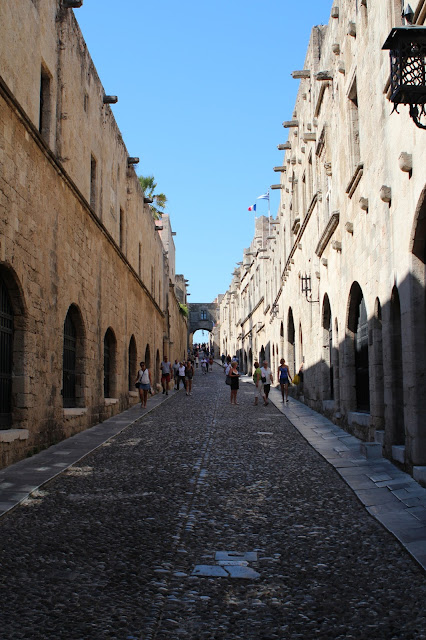
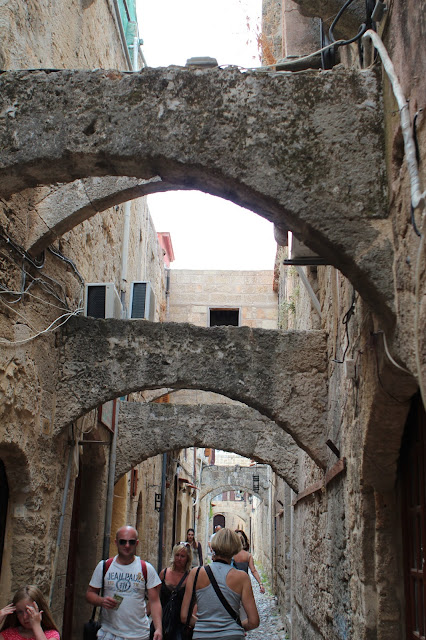
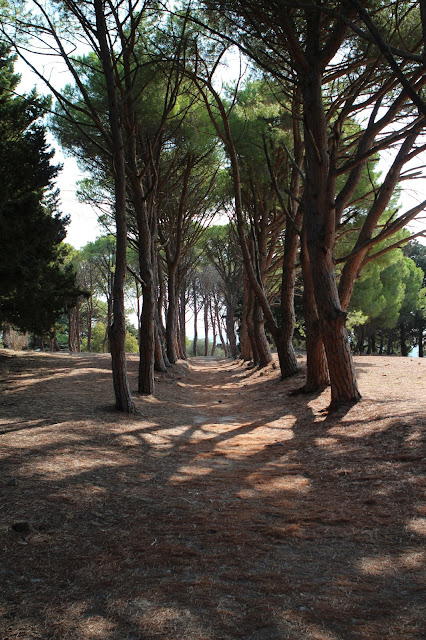
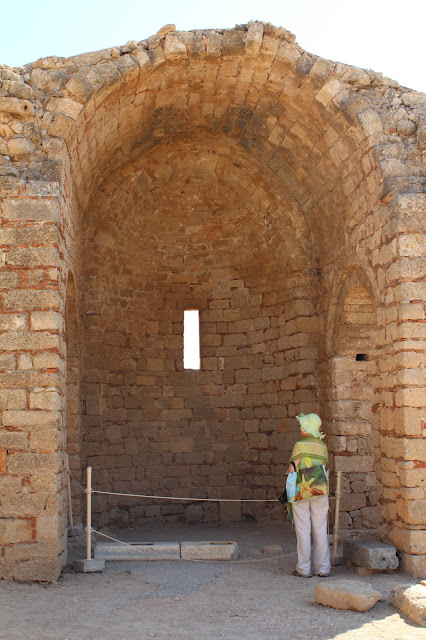
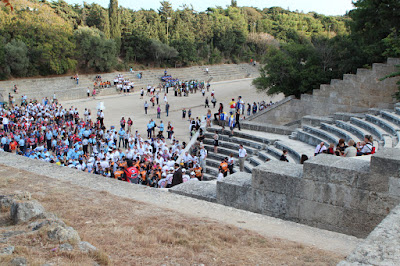
Terah and I went to the Greek island Rhodes recently. This is the second in a series about it. I am one to enjoy history. There is something deeply, well, connecting, about standing in an old place. There is a timeless quality to it a feeling of being connected to so many people of the past, and yet still being connected to change, visible in things such as weathering of stones. To gaze at pottery that s 300 years old, walk past 700-year-old walls, or pass through what remains of the grand portico of an ancient temple to Athena stirs a feeling I can barely explain, of timelessness. Although Rhodes doesn t have the famous Greek sites such as the Parthenon or Delphi, I can t help but wonder why the Rhodes sites aren t better known. They were incredible and it is hard to condense all that we saw into a short blog post. I have to start with the medieval Rhodes Old Town. We got off the bus a few blocks from it one bright morning, and our first task was to find a gate across the moat. Oh yes, A GATE ACROSS THE MOAT. It s a dry moat, and that bridge off in the distance is the gate we were headed to. Outside of the outer wall is a nice quiet walking area. The moat and walls completely surround Old Town and, for the most part, date back about 500 years. The round stones you see on that picture, we were told, were likely surplus from catapults and other projectile weapons. Cross one line of walls and you come to another, with original canons still present. The Knights Hospitaller of St. John, which held Rhodes for a few centuries until the Ottomans captured it, sure knew how to build to impress. The gate we happened to use was Amboise, the Grand Master s Gate. Right there is the stunningly rebuilt landmark Palace of the Grand Master. It is absolutely impossible for any photograph to begin to do this building justice. Between its imported Greek and Roman floors, to the grand nature of everything in it, and the archaeological museum in one corner, it was a fitting start to a visit to Old Town. Here s one of the main staircases. Just near the Palace is quiet courtyard with an old door. Pass through that door and suddenly you re in the midst of the busy Old Town. And among the landmarks in Old Town, the most prominent is Ippoton, the Avenue of the Knights. Along this avenue are the buildings built by the various nationalities of knights, many of which are historical sites in their own. Taken together, it is quite clear why Rhodes is said to be one of the world s best-preserved medieval cities. Down at the other end of Ippoton is the Knights Hospital, which is now part of the archaeological museum. Step off the Avenue a few blocks and you get to some quieter narrow streets just as old, in many cases. On Sunday morning, we were able to visit Mount Filerimos. In contrast to the busy Rhodes, Filerimos had an air of quiet and still to it. It was the site of a monastery, two historic churches, and a landmark Italian cross on the mountaintop. We arrived, and begin our visit with a walk up the quiet stone path. When we got to the top, we walked past this peaceful church. As we walked past the outside, we heard the beautiful music of chant from indoors. We got to step in and listen to mass for a few minutes. In typical fashion, directly in front of the church are two much older sites: one, the ruins of a temple to Athena, and the other a 4th-century Christian bapistery. Rhodes is a popular tourist destination, and of course we saw plenty of popular sites (such as the grandmaster s palace). Filerimos had a few tourists too, but not as many. I frequently like to operate on the plan of going wherever all the tourists aren t. And so, on Filerimos, that meant seeing what was behind the monastery. It started with this peaceful tree-lined path. And the deserted, but intentionally open, gate led to the remains of a Byzantine fortress, which had been a staging area for both the Knights and the Ottomans before their campaigns to capture Rhodes. It also provided incredible views of the surrounding countryside. The first historic site we had visited on our trip was the Acropolis of Lindos, parts of which are 2300 years old. Here s a view of the mountain from the rooftop of the Kalypso, our favorite restaurant in Lindos. The columns of the temple to Athena Lindia are visible, and of course so are the walls. The road up to the acropolis is accessible only on foot or by donkey. It is apparently the only road that has ever been used to get to the acropolis. Here is the partially-restored grand portico to the temple. There s an old Christian church (4th century, if memory serves) at the Acropolis too. The Acropolis makes some pretty good use of natural defenses too. Here s a view from one level of it. There s a manmade wall up there at the very top. And, of course, the beautiful Aegean always in the background. There are lots of cats on Rhodes. Here is a kitten napping at the top of the Lindos Acropolis: Lindos itself is a beautiful town. Here s one of the quieter streets: Notice the pebble steps leading into the houses those intricate pieces of artwork are all over. This post won t be complete without the story of our visit to the Acropolis of Rhodes. We walked there from Old Town. At the Acropolis, there are the remains of a temple to Apollo, an ancient theater, and an ancient stadium where qualifying matches for the Olympics were held. As we got closer to the area, we were repeatedly passed by people dressed in uniforms of various types. And as we got there, we joined a stream of people entering the area. The ancient stadium had apparently thousands of people in it, country names were being read off over the loudspeakers, policemen wielding machine guns were standing by, and we had absolutely no idea what was going on. At this point, you can appreciate the difference between Terah and me. Terah thought that we have no idea what is happening, she was tired from the walk, and so thought we should just leave. I thought that we have no idea what is happening, which is a great reason to stay. So Terah opted to sit and read a bit under some trees while I explored. Here s a view of the stadium as it was emptying out, seen from the theater: I explored the temple and theater, and eventually we were ready to head back. We knew there was a bus back to the New Market (from where we could get a bus back to our hotel), but didn t know where the bus stop was. The obvious place to ask were the policemen, which I thought I would do. Terah thought she would just stay sitting under the trees, on the grounds that the policemen nearest us were all carrying machine guns and perhaps wouldn t like to be disturbed. This led to my cryptic tweet:
Only ONE of us is the kind of person that goes up to guys with machine guns to ask what s happening. Me to Terah today
They told me that it was the preparations for the opening ceremony for a global shooting contest, and also gave me directions to the bus stop.

11 October 2011

Thomas Koch: Gemeinsam f r globalen Wandel

english abstract: call to assembly on October 15th in Constance (Germany).

ATTAC Konstanz und www.echte-demokratie-jetzt.de laden ein zur Versammlung "Gemeinsam f r globalen Wandel" am 15. Oktober 2011 um 15:10 Uhr auf die Marktst tte (in Bankenn he)
  • United for global change
  • Wir sind die 99%!
  • Wir zahlen nicht f r Eure Krise!
  • Echte Demokratie jetzt!
Weltweit gehen an diesem Tag Menschen auf die Stra e, um dar ber ins Gespr ch zu kommen, in welcher Gesellschaft sie leben wollen. Mit ihnen gemeinsam emp ren wir uns dar ber, dass heute die Interessen von Banken und Konzernen vielfach ber die Interessen der Menschen gestellt werden, und die Kluft zwischen Arm und Reich immer gr er wird. Wir sehen uns durch Politik und Wirtschaft nicht mehr repr sentiert und wollen selbst f r grundlegende Ver nderungen eintreten. Wir engagieren uns f r neue Wege aus der Krise, jenseits von Parteien, Gewerkschaften und anderen Gruppeninteressen.Dar ber wollen wir auch in Konstanz auf der Marktst tte miteinander reden. Zur Information, wie sich Menschen in anderen L ndern f r ihre Anliegen einsetzen, wird es einen Informationsstand ber die Protestbewegungen in Spanien, Griechenland, Israel, Chile und den USA geben.Weitere Informationen:

Christian Perrier: RWC 2011 : after 1/4 finals

I was expecting to write more about the 7th Rugby World Cup, but real life, Debian work and running activities prevented me to do so.. Still, I watched several games and I can share my feelings now. First of all, this is a tremendous organization from New Zealand. It seems that about the entire country is working on making this even a great success and I really appreciate to see a place I certainly have to visit some day receiving such wordlwide attention (OK, admitedly, mostly in the part of the world that understands rugby). First round already gave several surprises even if the 1/4 finals were after all kinda expected (at least, the list of countries). Which lead us to the following 1/4 finals (in parenthesis are my bets): If you know about the results, you know I screwed it nearly completely..:-) The Welsh team played a great game against an uninspired Irish team. It has certainly been the best 1/4 final and they certainly deserve their win. Even though I usually tend to be supprotive of Ireland, I was very balanced here, and finally turned out to be in favor of the Welsh. We really have to fear them in semi-finals. Australia-South Africa was theoretically the most exciting 1/4 final but finally turned out to be quite boring. Both teams insisted on playing mostly to occupy their opponents part of the field, more than trying to score, then relying on penalties to score. That was apparently the good tactics for Australia ad they also deserve their win against a South-African team where forward players were not as decisive as they sometimes are. Argentina was again there and really there. It has been the only team up to now who lead score against New Zealand. And that was deserved. What a wonderful 1st halftime! Obviously, it was impossible for them to resist during second halftime and it slowly became obvious that the Blacks (saved during 1st half by the kicks of a very inspired Kiri Weepu) would finally manage to score tries. But, still, our argentinian friends, for instance the inoxydable "Super Mario" Ledesma, or the tireless Felipe Contepomi, were not here as a sacrificial victim. What to say about England-France? First half was astonishing for us, of course. This is what we love (and hate) with our beloved French team. Definitely the team that can make surprises and, imho, the only one that can beat New Zealand if that has to happen (but also the only one that can be entirely crushed by them). The defeat against Tonga and the week that followed completely transformed them. A stunning 3rd row, defending each and every single bit of England trying to invade "la patrie en danger". Rear lanes with the magicians of Toulouse (Clerc and M dard) as the ideal finishers of magic play by Parra, Trinh Duc, Mermoz, Palisson (the good surprise of this world cup, Alexis). And, during second half, a trilling resistance to assaults of the British White Knights, concluded by this delivering drop-goal by Trinh Duc. For sure, with games like this, they can beat everybody and by everybody, I mean everybody. Remember Millenium Stadium in 2007..:-) So, well. Australia-New Zealand and France-Wales. I know where my heart is balancing for both games. The Blacks and Les Bleus in final, thi is what we hope (and fear...), but both teams, particularly France, will have to first climb a quite big wall before reaching this.

10 October 2011

Vincent Bernat: SSL termination: stunnel, nginx & stud, round 2

A month ago, I published an article on the compared performances of stunnel, nginx and stud as SSL terminators. The conclusion was to use stud on a 64-bit system, with session caching and AES. stunnel was unable to scale properly and nginx exhibited important latency issues. I got constructive comments on many aspects. Therefore, here is the second round. The protagonists are the same but both the conditions and the conclusions have changed a bit.

Benchmarks The hardware platform remains unchanged: We focus on the following environment:
  • Ubuntu Lucid, featuring a patched version of OpenSSL 0.9.8k with AES-NI builtin and enabled by default
  • 2.6.39 kernel (250 HZ)
  • 64-bit
  • 1 core for HAProxy, 2 cores for network cards1, 4 cores for SSL, 1 core for the system
  • system limit of 100,000 file descriptors per process
On the SSL side, the main components are:
  • 2048-bit certificates
  • AES128-SHA cipher suite
  • 8 HTTP/1.0 requests per client
  • HTTP response payload of 1024 bytes
If you are interested in different conditions (32-bit, number of cores, 1024-bit certificates, proportion of session reuses), have a look at the previous article whose results on the matter are still valid. I only consider 2048-bit certificates because most certificates issued today are 2048-bit. In SP800-57, NIST advises that 1024-bit RSA keys will no longer be viable after 2010 and advises moving to 2048-bit RSA keys:
If information is initially signed in 2009 and needs to remain secure for a maximum of ten years (i.e., from 2009 to 2019), a 1024-bit RSA key would not provide sufficient protection between 2011 and 2019 and, therefore, it is not recommended that 1024-bit RSA be used in this case.
And the protagonists are: UPDATED: Configuration of nginx has been updated to switch to off both multi_accept and accept_mutex thanks to the feedback of Maxim Dounin on latency issues that were present in the previous article (and still present in the early version of this article). HAProxy (configuration) is used for stunnel and stud to add load-balancing. For each test, we want to maximize the number of HTTP transactions per second (TPS) while minimizing latency and unsucessful transactions. The maximum number of allowed failed transactions is set at 1 transaction out of 1000. The maximum allowed average latency is 100 ms2.

Control case Below is the first comparison between stud, nginx and stunnel on plain Ubuntu Lucid. Like in previous benchs, stunnel is not able to scale, with a maximum of 400 TPS. However, early latency issues of nginx has been solved, thanks to the change in configuration. stud and nginx gets similar performance but, as you can see on the bottom plot (whose scale is logarithmic) stud starts with an initial latency of 40 ms. This is pretty annoying. I have tried some micro optimization to solve this issue but without luck. If latency matters for you, stick with stunnel or nginx (or find where the problem lies in stud). UPDATED: After reporting this issue, a fix has been commited. The culprit was Nagle s algorithm which improves bandwidth at the expense of latency. With the fix, performances are mostly the same but there is no latency penalty any more. stud, nginx, stunnel on Ubuntu Lucid

OpenSSL 1.0.0e When I published the first round of benchmarks, Micha Trojnara was dubious about the bad results of stunnel. He told me on Twitter:
I solved it! You compiled stunnel against a 4 years old OpenSSL with MT-unsafe SSL_accept. Upgrade OpenSSL and rebuild stunnel. This bug was fixed in OpenSSL 1.0.0b. I implemented a (slow) workaround, so stunnel doesn t crash with earlier versions of OpenSSL.
Therefore, I backported Ubuntu Oneiric OpenSSL 1.0.0e to Ubuntu Lucid3 and, as you can see yourself on the plot below, there is a huge performance boost for stunnel: about 400%! stud features a slight improvement too (about 8%) but still starts with a latency of 40 ms while nginx does not improve. stud, nginx, stunnel with OpenSSL 1.0.0e

Intel Accelerator Engine Most Linux distributions are still using OpenSSL 0.9.8. For example, Debian Squeeze ships with OpenSSL 0.9.8o, Ubuntu Lucid with 0.9.8k and RHEL 5.7 with 0.9.8e. Therefore, they are not eligible to recent performance improvements. To solve this, Intel released Intel Accelerator Engine, which also brings, among other things, AES-NI support:
This is essentially a collection of assembler modules from development OpenSSL branch, packed together as a standalone engine. Standalone means that it can be compiled outside OpenSSL source tree without patching the latter. Idea is to provide a way to utilize new code in already released OpenSSL versions constrained by support and release policies limiting their evolvement to genuine bug fixes.
Alas, in my tests, there was no improvement compared to OpenSSL 1.0.0e (already patched with AES-NI support). stunnel comes with out-of-the-box support for additional engines. Just add something like this to your stunnel.conf:
engine=dynamic
engineCtrl=SO_PATH:/WOO/intel-accel-1.4/libintel-accel.so
engineCtrl=ID:intel-accel
engineCtrl=LIST_ADD:1
engineCtrl=LOAD
engineCtrl=INIT
For stud, you should grab support for engine selection from GitHub and for nginx, just specify the engine with ssl_engine.

Intel Performance Primitives In his great article Accelerated SSL , Simon Kuhn shows huge performance improvements by using Intel s IPP library, a library aimed at leveraging power of multi-core processors and including some cryptographic primitives and a patch to make use of them in OpenSSL. Unfortunately, this library is not free, not even as in free beer . The patch provided by Intel only applies on OpenSSL 0.9.8j. Simon updated it for OpenSSL 1.0.0d. It also applies with a slight modification to OpenSSL 1.0.0e. Look at Simon s article for instructions on how to compile OpenSSL with IPP. Simon measured 220% improvement on RSA 1024-bit private key operations by using this library. Unfortunately, we don t get such a performance burst with stud which exhibits a 15% improvement (but remember that private key operations only happen once every 8 transactions thanks to session reuse). Worst, with stunnel, performances are reduced by one third and nginx just segfaults. I think such a library is risky to use in production. stud and stunnel with IPP

Hyperthreading During the previous tests, only half the capacity of each core were used. For stud, adding more workers per core only slightly improves this situation (less than 10% with 4 workers per core). Therefore, I thought using hyperthreading could rectify the situation here. In this case, stud, stunnel and nginx are allocated 8 virtual cores instead of 4. stud only got a small improvement of 5%, nginx a moderate improvement of 11% while stunnel got a significant improvement of 26%. stud, stunnel and nginx with hyperthreading

Conclusion Here is a quick recap of the maximum TPS reached on each tests (while keeping average response time below 100 ms). All tests were run on 4 physical cores with 2048-bit certificates, AES128-SHA cipher suite. Each client makes 8 HTTP requests and reuse the first SSL session.
Context nginx 1.1.4 stunnel 4.44 stud @e207dbc5a3
OpenSSL 0.9.8k 1489 TPS 400 TPS 1492 TPS
OpenSSL 1.0.0e 1501 TPS 1561 TPS 1609 TPS
OpenSSL 1.0.0e + IPP - 1101 TPS 1857 TPS
OpenSSL 1.0.0e + HT 1718 TPS 1973 TPS 1694 TPS
I also would like to stress that below 1500 TPS, stunnel adds an overhead of a few milliseconds while stud adds 40 milliseconds. With OpenSSL 1.0.0e and hyperthreading enabled, stunnel has both good performance and low latency on low loads to moderate loads. You may just want to limit the number of allowed connections to avoid collapsing on high loads. While in the previous round, stud was the champion and stunnel lagged behind, the situation is now reversed : stunnel is on top! UPDATED: As said earlier, the latency issue with stud has been solved. Performances remain mostly the same.

  1. HAProxy and network cards don t need dedicated core for this kind of load. However, if you also want to handle non SSL traffic, those dedicated cores can get busy.
  2. The real condition is more complex. Each point is considered valid if the corresponding average latency is less than 100 ms or if the average on the next 8 points is less than 100 ms. Temporary latency bursts are therefore allowed. We are not so forgiveful with failed transactions.
  3. This is pretty straighforward: I just dropped multiarch support. I chose to use Ubuntu version of OpenSSL instead of upstream because there are some interesting patches, like automatic support of AES-NI.

9 October 2011

Axel Beckert: Git Snapshot of GNU Screen in Debian Experimental

I just uploaded a snapshot of GNU Screen to Debian Experimental. The package (4.1.0~20110819git450e8f3-1) is based on upstream s HEAD whose most recent commit currently dates to the 19th of August 2011. While the upload fixes tons of bugs which accumulated over the past two years in Debian s, Ubuntu s and upstream s bug tracker, I don t yet regard it as suitable for the next stable release (and hence for Debian Unstable) since there s one not so nice issue about it: Nevertheless it fixes a lot of open issues (of which the oldest is a wishlist bug report dating back to 1998 :-) and I didn t want to withhold it from the rest of the Debian community so I uploaded it to Debian Experimental. Issues closed in Debian ExperimentalIssues which will be closed in UbuntuPlease test the version from Experimental If you are affected by one of the issues mentioned above, please try the version from Debian Experimental and check if they re resolved for you, too. Thanks to all who contributed! A lot of the fixes have been made or applied upstream by Sadrul Habib Chowdhury who also industriously tagged Debian bug reports as fixed-upstream . Thanks! Thanks also to Brian P Kroth who gave the initial spark to this upload by packaging Fedora 15 s git snapshot for Debian and filing bug although the upload is based on the current HEAD version of GNU Screen as this fixes some more important issues than the snapshot Fedora 15 includes. That way also two patches from Fedora/RedHat s screen package are included in this upload. (Co-) Maintainer wanted! Oh, and if you care about the state of GNU Screen in Debian, I d really appreciate if you d join in and contribute to our collab-maint git repository there are still a lot of issues unresolved and I know that I won t be able to fix all of them myself. And since Hessophanes unfortunately currently has not enough time for the package, we definitely need more people maintaining this package. P.S. Yes, I know about tmux and tried to get some of my setups working with it, too. But I still prefer screen over tmux. :-)

7 October 2011

Matt Zimmerman: Ada Lovelace Day 2011: Dr. Marian C. Diamond

For Ada Lovelace Day this year, I want to share my appreciation for Dr. Marian C. Diamond. In years past, I ve saluted women in the field of computing, which is my field as well. Dr. Diamond, however, is a biologist. Her research includes neuroanatomy, environment, immune functions, and hormones. In particular, she is interested in studying the effects of the external environment, aging, and immune responses on the cerebral neocortex. She has, in her words, had a love affair with the brain for about 70 years. I know very little about biology. The content and methods of her research are, frankly, beyond me, though some of her results have garnered popular attention. She has inspired me by demonstrating that rare combination of gifts: a deep understanding of a technical subject, and the ability to explain it to other people in an accessible way. In her interviews, articles and lectures, many of which are available online, Dr. Diamond displays these gifts in abundance. Her skill and enthusiasm for both learning and teaching is unmistakable. After applying her gifts in the classroom for many years, digital distribution has now enabled many more people to see and hear her, through millions of YouTube views. In 1960, she became the first female graduate student in UC Berkeley s anatomy department, and was apparently given the job of sewing a cover for a magnifying machine. I can only imagine the persistence required to continue from there to become a recognized leader in her field. She has gone on to help many other students along their way, and was named an unsung, everyday hero for the support she provided to students outside of the classroom or lab. As if that weren t enough, she has also traveled to Cambodia to apply her expertise in helping children injured by land mines. She still teaches today, just across the bay from where I write this, and will turn 85 next month.

Rapha&#235;l Hertzog: My Debian activities in September 2011

This is my monthly summary of my Debian related activities. If you re among the people who made a donation to support my work (144.3 , thanks everybody!), then you can learn how I spent your money. Otherwise it s just an interesting status update on my various projects. Dpkg work While taking care of the last details for the hardening feature in dpkg 1.16.1, I have mailed debian-devel to find volunteers to handle a hardening release goal. The objective is to ensure a large number of packages have been converted/rebuilt to actually use the new hardening build flags. Then I prepared the draft of the announce of the dpkg 1.16.1 upload (aka Bits of dpkg maintainers sent to debian-devel-announce) which got expanded by Guillem to also cover new features since dpkg 1.15.7. update-alternatives got some refactoring by Guillem which resulted in a regression that has been fortunately discovered by Sven Joachim. I fixed that regression and did some further cleanup inspired by the root cause of this regression (see top 4 commits here). Note that Sven is one of the few persons who are running the git version of dpkg. Hopefully the number of tester will increase since I recently documented the APT repositories with autobuilt versions of dpkg in the wiki. At the end of the month, I started working on a bugfix release (what s going to be 1.16.1.1) by fixing some of the unavoidable problems discovered after an upload that accumulated more than 4 months worth of work (see top 4 commits here). The Debian Administrator s Handbook I spent countless hours finalizing the launch of the crowdfunding campaign for the Debian Administrator s Handbook and it went live on September 27th. So far it s on good track with more than 63% of the base funding already secured. But we still have a long way to go to reach the liberation goal (we re at 21%). It s still worth nothing that more than 55% of the money raised has been put in the liberation fund so there are many persons who care about getting the book freed. More than 250 persons are supporting the project currently with an average contribution of 38 EUR. I would have expected much less for the average contribution but many more supporters. I still hope we can get more people on board with the perspective of a good DFSG-free Debian ebook. Did you order your copy? If not, click here and fix this! ;-) By the way Paypal used to be required but it s no longer the case, you can support the project just with your usual credit card. Misc blog updates Over time, I have written many useful articles for Debian users and Debian contributors. But scattered in the history, they are somewhat difficult to find. To fix this I have created some index pages listing them. Check them out: Two new articles joined those pages this month: How to triage bugs in the Debian Bug Tracking System and Understand dpkg and don t get stuck with a maintainer script failure. While writing the first article, I noticed we lacked a good page showing the most buggy packages so I quickly created it (with the help of UDD): http://qa.debian.org/cgi-bin/bugs-by-source Misc packaging work I did a small update to the developer s reference. Luca Falavigna submitted a patch to clarify how one is supposed to deal with meta-packages (cf #569219), I improved it and integrated the result in the SVN repository. I upgraded nautilus-dropbox to version 0.6.9 and while doing this I discovered a bug in mergechanges (filed as #640782). I uploaded a new release of quilt mainly to add the Multi-Arch: foreign field so that it can satisfy dependencies of foreign packages (i.e. packages of a different architecture). Django released some security advisories (tracked in #641405) and since the maintainer did not deal with the issue, I stepped up to the task (I m a backup maintainer) and released the fixed version 1.3.1 to unstable. I took the opportunity to switch from python-support to dh_python2, and do some misc improvements to the packaging (see changelog). I wanted to update publican to a newer version but it turned out to be not possible because Debian doesn t have the latest version of docbook-xsl yet. I also discovered some bugs in the test suite and forwarded upstream the patch I created (see upstream bug). On top of this, fop was failing due to some java problem related to the introduction of multiarch. After having reported the bug, the java maintainers quickly released a fixed version. So now publican is ready in the git repository but it s waiting on the docbook-xsl update. I got in touch with the maintainer who said he would have the time to take care of it by mid-october. Thanks See you next month for a new summary of my activities.


One comment Liked this article? Click here. My blog is Flattr-enabled.

5 October 2011

Tollef Fog Heen: The SugarCRM rest interface

We use SugarCRM at work and I've complained about its not-very-RESTy REST interface. John Mertic a (the?) SugarCRM Community Manager asked me about what problems I'd had (apart from its lack of RESTfulness) and I said I'd write a blog post about it. In our case, the REST interface is used to integrate Sugar and RT so we get a link in both interfaces to jump from opportunities to the corresponding RT ticket (and back again). This should be a fairly trivial exercise or so you would think. The problems, as I see it are: My first gripe is the complete lack of REST in the URLs. Everything is just sent to https://sugar/service/v2/rest.php. Usually a POST, but sometimes a GET. It's not documented what to use where. The POST parameters we send when logging in are:
method=>"login"
input_type=>"JSON"
response_type=>"JSON"
rest_data=>json($params)
$params is a hash as follows:
user_auth =>  
            user_name => $USERNAME,
            password => $PW,
            version => "1.2",
 ,
application => "foo",
Nothing seems to actually care about the value of application, nor about the user_auth.version value. The password is the md5 of the actual password, hex encoded. I'm not sure why it is, as this adds absolutely no security, but it is. This is also not properly documented. This gives us a JSON object back with a somewhat haphazard selection of attributes (reformatted here for readability):
 
     "id":"<hex session id>,
     "module_name":"Users",
     "name_value_list":  
             "user_id":  
                     "name":"user_id",
                     "value":"1"
              ,
             "user_name":  
                     "name":"user_name",
                     "value":"<username>"
              ,
             "user_language":  
                     "name":"user_language",
                     "value":"en_us"
              ,
             "user_currency_id":  
                     "name":"user_currency_id",
                 "value":"-99"
              ,
             "user_currency_name":  
                     "name":"user_currency_name",
                     "value":"Euro"


What is the module_name? No real idea. In general, when you get back an id and a module_name field, it tells you that the id exists is an object that exists in the context of the given module. Not here, since the session id is not a user. The worst here is the name_value_list concept which is used all over the REST interface. First, it's not a list, it's a hash. Secondly, I have no idea what would be wrong by just using keys directly in the top level object, so the object would have looked somewhat like:
 
     "id":"<hex session id>,
     "user_id": 1,
     "user_name": "<username>,
     "user_language":"en_us",
     "user_currency_id": "-99",
     "user_currency_name": "Euro"
 
Some people might argue that since you can have custom field names this can cause clashes. Except, it can't, since they're all suffixed with _c. So we're now logged in and can fetch all opportunities. This we do by posting:
method=>"get_entry_list",
input_type=>"JSON",
response_type=>"JSON",
rest_data=>to_json([
            $sid,
            $module,
            $where,
            "",
            $next,
            $fields,
            $links,
            1000
])
Why this is a list rather than a hash? Again, I don't know. A hash would make more sense to me. The resulting JSON looks like:
 
    "result_count" : 16,
    "relationship_list" : [],
    "entry_list" : [
        
          "name_value_list" :  
             "rt_status_c" :  
                "value" : "resolved",
                "name" : "rt_status_c"
              ,
             [ ]
           ,
          "module_name" : "Opportunities",
          "id" : "<entry_uuid>"
        ,
       [ ]
    ],
    "next_offset" : 16
 
Now, entry_list actually is a list here, which is good and all, but there's still the annoying name_value_list concept. Last, we want to update the record in Sugar, to do this we do:
method=>"set_entry",
input_type=>"JSON",
response_type=>"JSON",
rest_data=>to_json([
    $sid,
    "Opportunities",
    $fields
])
$fields is not a name_value_list, but instead is:
 
    "rt_status_c" : "resolved",
    "id" : "<status text>"
 
Why this works and my attempts at using a proper name_value_list didn't work? I have no idea. I think that pretty much sums it up. I'm sure there are other problems in there (such as the over 100 lines of support code for the about 20 lines of actual code that does useful work), though.

Jonathan McDowell: Thanks for the offer, but...

I was due for another Google interview mail it seems. I have to say I wasn't expecting it, but this week I had a follow up to my polite mail from 6 months ago that said "No thanks, I'm not looking" asking if it was still the case. Normally I welcome this little bit of ego stroking; it's always nice to be wanted. Except that's not really the case, is it? It's an invitation to interview for something, not any indication that you've done more than tick some initial boxes. Google mails inevitably ask me if I'd like to work in SRE. It's always SRE. No one ever emails and asks if I want to work on self-replicating nanobots that will roam Mars searching for the perfect spot to build a beach house. And that's where things fall down. If someone currently has a job, then emailing them out of the blue to ask if they want to come and interview for something vague is hoping that they're either looking, and just haven't come to you yet, or not looking but unhappy enough with their current role that all they needed to start was an email asking them to submit a recent CV. For the former, if you're Google, do you really think that person doesn't know where to find you? For the latter, you're being quite presumptuous, aren't you? The act of updating my CV my be some effort (actually it's usually not, because the stuff that's not on it is the stuff I can't talk about because it's not released yet, or stuff that's specific and thus wouldn't go on a CV for a vague job spec). Even if it's not the act of interviewing is potentially a waste of time for both of us, if the role isn't clear. One argument used is that people will be placed according to the skills they show during the interview process. That's fine from the employers point of view, but if you're actively trying to get some interest from people who are gainfully employed you really need to grab their attention somehow. I can't remember the last time I had an unsolicited email interview offer that actually wowed me, or indeed even showed more than a passing sign of tailoring a spec to my profile. When I was running Black Cat I made a point of always replying to unsolicited CVs. How polite I was depended on how the covering emails were worded (a Word document with nothing else was likely to get short shrift, something well targeted in a Linux friendly format would normally get some comment about how we weren't hiring and were unlikely to be, but if that changed it would be mentioned on the website), but I felt people deserved a reply - I have been disappointed by not receiving responses myself to what I considered well targeted job inquiries. So far I've so far taken the same approach with mails from corporate recruiters (less so with recruiters that are associated with recruitment firms, rather than directly with the companies they are hiring for), but I'm starting to feel like changing that stance. Candidates are told to tailor CVs to the role being applied for, provide a decent cover letter, and in general make companies want to talk to them. Companies who are sending out recruitment emails should be held to the same standard. Even assuming you do a basic phone screen first, I can probably expect to need to take a day off work assuming that goes well. You need to convince me I can justify that before I'm going to feel like engaging at all. (And if I'm honest, based on what I've seen so far, it's unlikely to happen. All of the things I've considered have come from conversations with people I know directly about companies they own or work for, never some random contact via email. I try hard not to think of recruitment mail as spam, but I can how that line of thought follows through.) I should apologize to Google here. They got mentioned as an example, but I don't think they're particularly bad. I did interview with them at one point, and made the decision not to continue that process after deciding a different, more certain, path was better for me. So I've displayed interest. And in response to my reply today of "I know where to find you, so please assume I'll do so if I change my mind." they've said they'll make a note on their records.

Next.

Previous.