Search Results: "ads"

6 July 2020

Jonathan Dowland: Review: Roku Express

I don't generally write consumer reviews, here or elsewhere; but I have been so impressed by this one I wanted to mention it. For Holly's birthday this year, taking place under Lockdown, we decided to buy a year's subscription to "Disney+". Our current TV receiver (A Humax Freesat box) doesn't support it so I needed to find some other way to get it onto the TV. After a short bit of research, I bought the "Roku Express" streaming media player. This is the most basic streamer that Roku make, bottom of their range. For a little bit more money you can get a model which supports 4K (although my TV obviously doesn't: it, and the basic Roku, top out at 1080p) and a bit more gets you a "stick" form-factor and a Bluetooth remote (rather than line-of-sight IR). I paid 20 for the most basic model and it Just Works. The receiver is very small but sits comfortably next to my satellite receiver-box. I don't have any issues with line-of-sight for the IR remote (and I rely on a regular IR remote for the TV itself of course). It supports Disney+, but also all the other big name services, some of which we already use (Netflix, YouTube BBC iPlayer) and some of which we didn't, since it was too awkward to access them (Google Play, Amazon Prime Video). It has now largely displaced the FreeSat box for accessing streaming content because it works so well and everything is in one place. There's a phone App that remote-controls the box and works even better than the physical remote: it can offer a full phone-keyboard at times when you need to input text, and can mute the TV audio and put it out through headphones attached to the phone if you want. My aging Plasma TV suffers from burn-in from static pictures. If left paused for a duration the Roku goes to a screensaver that keeps the whole frame moving. The FreeSat doesn't do this. My Blu Ray player does, but (I think) it retains some static elements.

5 July 2020

Thorsten Alteholz: My Debian Activities in June 2020

FTP master This month I accepted 377 packages and rejected 30. The overall number of packages that got accepted was 411. Debian LTS This was my seventy-second month that I did some work for the Debian LTS initiative, started by Raphael Hertzog at Freexian. This month my all in all workload has been 30h. During that time I did LTS uploads of: I started to work on curl as well but did not upload a fixed version, so this has to go to ELTS now. Last but not least I did some days of frontdesk duties. Debian ELTS This month was the twenty fourth ELTS month. Unfortunately in the last month of Wheezy ELTS even I did not find any package to fix a CVE, so during my small allocated time I didn t uploaded anything. But at least I did some days of frontdesk duties und updated my working environment for the new ELTS Jessie. Other stuff I uploaded a new upstream version of

4 July 2020

Dirk Eddelbuettel: Rcpp now used by 2000 CRAN packages and one in eight!

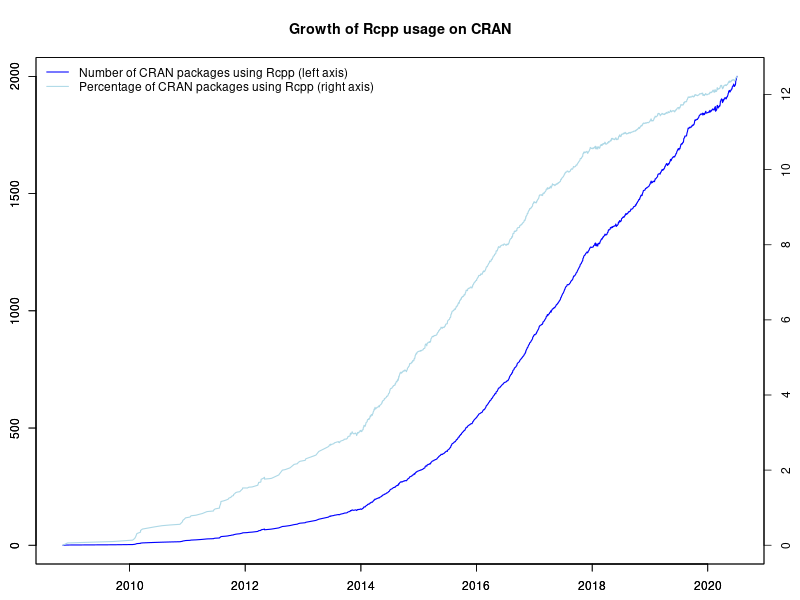
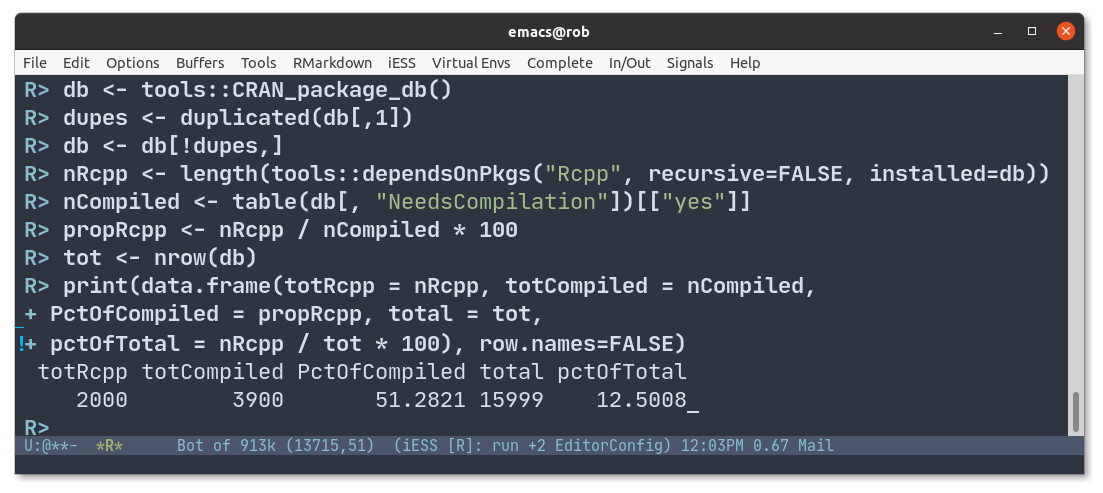
2000 Rcpp packages As of yesterday, Rcpp stands at exactly 2000 reverse-dependencies on CRAN. The graph on the left depicts the growth of Rcpp usage (as measured by Depends, Imports and LinkingTo, but excluding Suggests) over time. Rcpp was first released in November 2008. It probably cleared 50 packages around three years later in December 2011, 100 packages in January 2013, 200 packages in April 2014, and 300 packages in November 2014. It passed 400 packages in June 2015 (when I tweeted about it), 500 packages in late October 2015, 600 packages in March 2016, 700 packages last July 2016, 800 packages last October 2016, 900 packages early January 2017, 1000 packages in April 2017, 1250 packages in November 2017, 1500 packages in November 2018 and then 1750 packages last August. The chart extends to the very beginning via manually compiled data from CRANberries and checked with crandb. The next part uses manually saved entries. The core (and by far largest) part of the data set was generated semi-automatically via a short script appending updates to a small file-based backend. A list of packages using Rcpp is available too. Also displayed in the graph is the relative proportion of CRAN packages using Rcpp. The four per-cent hurdle was cleared just before useR! 2014 where I showed a similar graph (as two distinct graphs) in my invited talk. We passed five percent in December of 2014, six percent July of 2015, seven percent just before Christmas 2015, eight percent in the summer of 2016, nine percent mid-December 2016, cracked ten percent in the summer of 2017 and eleven percent in 2018. We now passed 12.5 percent so one in every eight CRAN packages dependens on Rcpp. Stunning. There is more detail in the chart: how CRAN seems to be pushing back more and removing more aggressively (which my CRANberries tracks but not in as much detail as it could), how the growth of Rcpp seems to be slowing somewhat outright and even more so as a proportion of CRAN as one would expect a growth curve to. To mark the occassion, I sent out two tweets yesterday: first a shorter one with just the numbers , followed by a second one also containing the few calculation steps. The screenshot from the second one is below. 2000 Rcpp packages 2000 user packages is pretty mind-boggling. We can use the progression of CRAN itself compiled by Henrik in a series of posts and emails to the main development mailing list. Not that long ago CRAN itself did have only 1000 packages, then 5000, 10000, and here we are at just over 16000 with Rcpp at 12.5% and still growing (though maybe more slowly). Amazeballs. The Rcpp team continues to aim for keeping Rcpp as performant and reliable as it has been. A really big shoutout and Thank You! to all users and contributors of Rcpp for help, suggestions, bug reports, documentation or, of course, code. If you like this or other open-source work I do, you can now sponsor me at GitHub. For the first year, GitHub will match your contributions.

This post by Dirk Eddelbuettel originated on his Thinking inside the box blog. Please report excessive re-aggregation in third-party for-profit settings.

3 July 2020

Michael Prokop: Grml 2020.06 Codename Ausgehfuahangl

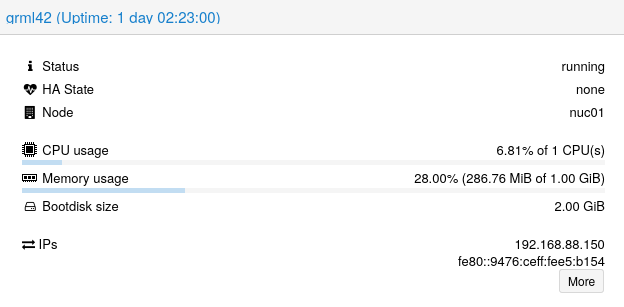
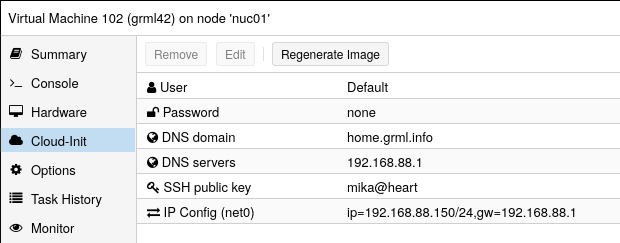
We did it again , at the end of June we released Grml 2020.06, codename Ausgehfuahangl. This Grml release (a Linux live system for system administrators) is based on Debian/testing (AKA bullseye) and provides current software packages as of June, incorporates up to date hardware support and fixes known issues from previous Grml releases. I am especially fond of our cloud-init and qemu-guest-agent integration, which makes usage and automation in virtual environments like Proxmox VE much more comfortable. Once as the Qemu Guest Agent setting is enabled in the VM options (also see Proxmox wiki), you ll see IP address information in the VM summary: Screenshot of qemu guest agent integration Using a cloud-init drive allows using an SSH key for login as user "grml", and you can control network settings as well: Screenshot of cloud-init integration It was fun to focus and work on this new Grml release together with Darsha, and we hope you enjoy the new Grml release as much as we do!

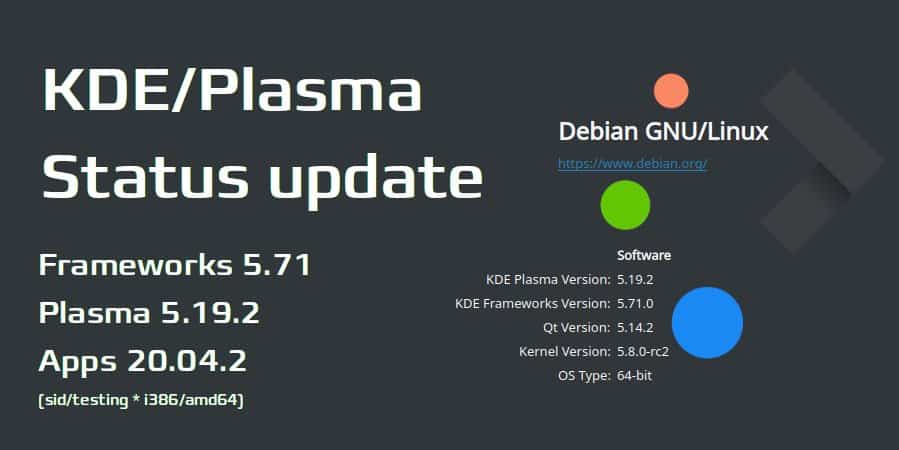
Norbert Preining: KDE/Plasma Status Update 2020-07-04

Great timing for 4th of July, here is another status update of KDE/Plasma for Debian. Short summary: everything is now available for Debian sid and testing, for both i386 and am64 architectures! (Update 2020-07-07: Plasma 5.19.3 is included!) (Update 2020-07-15: Frameworks 5.72 and KDE Apps 20.04.3 are included!) With Qt 5.14 arriving in Debian/testing, and some tweaks here and there, we finally have all the packages (2 additional deps, 82 frameworks, 47 Plasma, 216 Apps, 3 other apps) built on both Debian unstable and Debian testing, for both amd64 and i386 architectures. Again, big thanks to OBS! Repositories:
For Unstable:
deb https://download.opensuse.org/repositories/home:/npreining:/debian-kde:/other-deps/Debian_Unstable/ ./
deb https://download.opensuse.org/repositories/home:/npreining:/debian-kde:/frameworks/Debian_Unstable/ ./
deb https://download.opensuse.org/repositories/home:/npreining:/debian-kde:/plasma519/Debian_Unstable/ ./
deb https://download.opensuse.org/repositories/home:/npreining:/debian-kde:/apps/Debian_Unstable/ ./
deb https://download.opensuse.org/repositories/home:/npreining:/debian-kde:/other/Debian_Unstable/ ./
For Testing:
deb https://download.opensuse.org/repositories/home:/npreining:/debian-kde:/other-deps/Debian_Testing/ ./
deb https://download.opensuse.org/repositories/home:/npreining:/debian-kde:/frameworks/Debian_Testing/ ./
deb https://download.opensuse.org/repositories/home:/npreining:/debian-kde:/plasma519/Debian_Testing/ ./
deb https://download.opensuse.org/repositories/home:/npreining:/debian-kde:/apps/Debian_Testing/ ./
deb https://download.opensuse.org/repositories/home:/npreining:/debian-kde:/other/Debian_Testing/ ./
As usual, don t forget that you need to import my OBS gpg key: obs-npreining.asc, best to download it and put the file into /etc/apt/trusted.gpg.d/obs-npreining.asc. Enjoy.

Dirk Eddelbuettel: #28: Welcome RSPM and test-drive with Bionic and Focal

Welcome to the 28th post in the relatively random R recommendations series, or R4 for short. Our last post was a double entry in this R4 series and the newer T4 video series and covered a topic touched upon in this R4 series multiple times: easy binary install, especially on Ubuntu. That post already previewed the newest kid on the block: RStudio s RSPM, now formally announced. In the post we were only able to show Ubuntu 18.04 aka bionic. With the formal release of RSPM support has been added for Ubuntu 20.04 aka focal and we are happy to announce that of course we added a corresponding Rocker r-rspm container. So you can now take full advantage of RSPM either via docker pull rocker/r-rspm:18.04 or via docker pull rocker/r-rspm:20.04 covering the two most recent LTS releases. RSPM is a nice accomplishment. Covering multiple Linux distributions is an excellent achievement. Allowing users to reason in terms of the CRAN packages (i.e. installing xml2, not r-cran-xml2) eases use. Doing it from via the standard R command install.packages() (or wrapper around it like our install.r from littler package) is very good too and an excellent technical achievement. There is, as best as I can tell, only one shortcoming, along with one small bit of false advertising. The shortcoming is technical. By bringing the package installation into the user application domain, it is separated from the system and lacks integration with system libraries. What do I mean here? If you were to add R to a plain Ubuntu container, say 18.04 or 20.04, then added the few lines to support RSPM and install xml2 it would install. And fail. Why? Because the system library libxml2 does not get installed with the RSPM package whereas the .deb from the distribution or PPAs does. So to help with some popular packages I added libxml2, libunits and a few more for geospatial work to the rocker/r-rspm containers. Being already present ensures packages xml2 and units can run immediately. Please file issue tickets at the Rocker repo if you come across other missing libraries we could preload. (A related minor nag is incomplete coverage. At least one of my CRAN packages does not (yet?) come as a RSPM binary. Then again, CRAN has 16k packages, and the RSPM coverage is much wider than the PPA one. But completeness would be neat. The final nag is lack of Debian support which seems, well, odd.) So what about the small bit of false advertising? Well it is claimed that RSPM makes installation so much faster on Linux . True, faster than the slowest possible installation from source. Also easier. But we had numerous posts on this blog showing other speed gains: Using ccache. And, of course, using binaries. And as the initial video mentioned above showed, installing from the PPAs is also faster than via RSPM. That is easy to replicate. Just set up the rocker/r-ubuntu:20.04 (or 18.04) container alongside the rocker/r-rspm:20.04 (or also 18.04) container. And then time install.r rstan (or install.r tinyverse) in the RSPM one against apt -y update; apt install -y r-cran-rstan (or ... r-cran-tinyverse). In every case I tried, the installation using binaries from the PPA was still faster by a few seconds. Not that it matters greatly: both are very, very quick compared to source installation (as e.g. shown here in 2017 (!!)) but the standard Ubuntu .deb installation is simply faster than using RSPM. (Likely due to better CDN usage so this may change over time. Neither method appears to do downloads in parallel so there is scope for both for doing better.) So in sum: Welcome to RSPM, and nice new tool and feel free to drive it using rocker/r-rspm:18.04 or rocker/r-rspm:20.04. If you like this or other open-source work I do, you can now sponsor me at GitHub. For the first year, GitHub will match your contributions.

This post by Dirk Eddelbuettel originated on his Thinking inside the box blog. Please report excessive re-aggregation in third-party for-profit settings.

Reproducible Builds (diffoscope): diffoscope 150 released

The diffoscope maintainers are pleased to announce the release of diffoscope version 150. This version includes the following changes:
[ Chris Lamb ]
* Don't crash when listing entries in archives if they don't have a listed
  size (such as hardlinks in .ISO files).
  (Closes: reproducible-builds/diffoscope#188)
* Dump PE32+ executables (including EFI applications) using objdump.
  (Closes: reproducible-builds/diffoscope#181)
* Tidy detection of JSON files due to missing call to File.recognizes that
  checks against the output of file(1) which was also causing us to attempt
  to parse almost every file using json.loads. (Whoops.)
* Drop accidentally-duplicated copy of the new --diff-mask tests.
* Logging improvements:
  - Split out formatting of class names into a common method.
  - Clarify that we are generating presenter formats in the opening logs.
[ Jean-Romain Garnier ]
* Remove objdjump(1) offsets before instructions to reduce diff noise.
  (Closes: reproducible-builds/diffoscope!57)
You find out more by visiting the project homepage.

2 July 2020

Ben Hutchings: Debian LTS work, June 2020

I was assigned 20 hours of work by Freexian's Debian LTS initiative, and worked all 20 hours this month. I sent a final request for testing for the next update to Linux 3.16 in jessie. I also prepared an update to Linux 4.9, included in both jessie and stretch. I completed backporting of kernel changes related to CVE-2020-0543, which was still under embargo, to Linux 3.16. Finally I uploaded the updates for Linux 3.16 and 4.9, and issued DLA-2241 and DLA-2242. The end of June marked the end of long-term support for Debian 8 "jessie" and for Linux 3.16. I am no longer maintaining any stable kernel branches, but will continue contributing to them as part of my work on Debian 9 "stretch" LTS and other Debian releases.

Mike Gabriel: My Work on Debian LTS (June 2020)

In June 2020, I have worked on the Debian LTS project for 8 hours (of 8 hours planned). LTS Work Other security related work for Debian References

Emmanuel Kasper: Test a webcam from the command line on Linux with VLC

Since this info was too well hidden on the internet, here is the information:
cvlc v4l2:///dev/video0
and there you go.
If you have multiple cameras connected, you can try /dev/video0 up to /dev/video5

Evgeni Golov: Automatically renaming the default git branch to "devel"

It seems GitHub is planning to rename the default brach for newly created repositories from "master" to "main". It's incredible how much positive PR you can get with a one line configuration change, while still working together with the ICE. However, this post is not about bashing GitHub. Changing the default branch for newly created repositories is good. And you also should do that for the ones you create with git init locally. But what about all the repositories out there? GitHub surely won't force-rename those branches, but we can! Ian will do this as he touches the individual repositories, but I tend to forget things unless I do them immediately Oh, so this is another "automate everything with an API" post? Yes, yes it is! And yes, I am going to use GitHub here, but something similar should be implementable on any git hosting platform that has an API. Of course, if you have SSH access to the repositories, you can also just edit HEAD in an for loop in bash, but that would be boring ;-) I'm going with devel btw, as I'm already used to develop in the Foreman project and devel in Ansible. acquire credentials My GitHub account is 2FA enabled, so I can't just use my username and password in a basic HTTP API client. So the first step is to acquire a personal access token, that can be used instead. Of course I could also have implemented OAuth2 in my lousy script, but ain't nobody have time for that. The token will require the "repo" permission to be able to change repositories. And we'll need some boilerplate code (I'm using Python3 and requests, but anything else will work too):
#!/usr/bin/env python3
import requests
BASE='https://api.github.com'
USER='evgeni'
TOKEN='abcdef'
headers =  'User-Agent': '@ '.format(USER) 
auth = (USER, TOKEN)
session = requests.Session()
session.auth = auth
session.headers.update(headers)
session.verify = True
This will store our username, token, and create a requests.Session so that we don't have to pass the same data all the time. get a list of repositories to change I want to change all my own repos that are not archived, not forks, and actually have the default branch set to master, YMMV. As we're authenticated, we can just list the repositories of the currently authenticated user, and limit them to "owner" only. GitHub uses pagination for their API, so we'll have to loop until we get to the end of the repository list.
repos_to_change = []
url = ' /user/repos?type=owner'.format(BASE)
while url:
    r = session.get(url)
    if r.ok:
        repos = r.json()
        for repo in repos:
            if not repo['archived'] and not repo['fork'] and repo['default_branch'] == 'master':
                repos_to_change.append(repo['name'])
        if 'next' in r.links:
            url = r.links['next']['url']
        else:
            url = None
    else:
        url = None
create a new devel branch and mark it as default Now that we know which repos to change, we need to fetch the SHA of the current master, create a new devel branch pointing at the same commit and then set that new branch as the default branch.
for repo in repos_to_change:
    master_data = session.get(' /repos/evgeni/ /git/ref/heads/master'.format(BASE, repo)).json()
    data =  'ref': 'refs/heads/devel', 'sha': master_data['object']['sha'] 
    session.post(' /repos/ / /git/refs'.format(BASE, USER, repo), json=data)
    default_branch_data =  'default_branch': 'devel' 
    session.patch(' /repos/ / '.format(BASE, USER, repo), json=default_branch_data)
    session.delete(' /repos/ / /git/refs/heads/ '.format(BASE, USER, repo, 'master'))
I've also opted in to actually delete the old master, as I think that's the safest way to let the users know that it's gone. Letting it rot in the repository would mean people can still pull and won't notice that there are no changes anymore as the default branch moved to devel. So announcement I've updated all my (those in the evgeni namespace) non-archived repositories to have devel instead of master as the default branch. Have fun updating! code
#!/usr/bin/env python3
import requests
BASE='https://api.github.com'
USER='evgeni'
TOKEN='abcd'
headers =  'User-Agent': '@ '.format(USER) 
auth = (USER, TOKEN)
session = requests.Session()
session.auth = auth
session.headers.update(headers)
session.verify = True
repos_to_change = []
url = ' /user/repos?type=owner'.format(BASE)
while url:
    r = session.get(url)
    if r.ok:
        repos = r.json()
        for repo in repos:
            if not repo['archived'] and not repo['fork'] and repo['default_branch'] == 'master':
                repos_to_change.append(repo['name'])
        if 'next' in r.links:
            url = r.links['next']['url']
        else:
            url = None
    else:
        url = None
for repo in repos_to_change:
    master_data = session.get(' /repos/evgeni/ /git/ref/heads/master'.format(BASE, repo)).json()
    data =  'ref': 'refs/heads/devel', 'sha': master_data['object']['sha'] 
    session.post(' /repos/ / /git/refs'.format(BASE, USER, repo), json=data)
    default_branch_data =  'default_branch': 'devel' 
    session.patch(' /repos/ / '.format(BASE, USER, repo), json=default_branch_data)
    session.delete(' /repos/ / /git/refs/heads/ '.format(BASE, USER, repo, 'master'))

1 July 2020

Joachim Breitner: Template Haskell recompilation

I was wondering: What happens if I have a Haskell module with Template Haskell that embeds some information from the environment (time, environment variables). Will such a module be reliable recompiled? And what if it gets recompiled, but the source code produced by Template Haskell is actually unchanged (e.g., because the environment variable has not changed), will all depending modules be recompiled (which would be bad)? Here is a quick experiment, using GHC-8.8:

/tmp/th-recom-test $ cat Foo.hs
 -# LANGUAGE TemplateHaskell #- 
 -# OPTIONS_GHC -fforce-recomp #- 
module Foo where
import Language.Haskell.TH
import Language.Haskell.TH.Syntax
import System.Process
theMinute :: String
theMinute = $(runIO (readProcess "date" ["+%M"] "") >>= stringE)
[jojo@kirk:2] Mi, der 01.07.2020 um 17:18 Uhr  
/tmp/th-recom-test $ cat Main.hs
import Foo
main = putStrLn theMinute
Note that I had to set -# OPTIONS_GHC -fforce-recomp #- by default, GHC will not recompile a module, even if it uses Template Haskell and runIO. If you are reading from a file you can use addDependentFile to tell the compiler about that depenency, but that does not help with reading from the environment. So here is the test, and we get the desired behaviour: The Foo module is recompiled every time, but unless the minute has changed (see my prompt), Main is not recomipled:
/tmp/th-recom-test $ ghc --make -O2 Main.hs -o test
[1 of 2] Compiling Foo              ( Foo.hs, Foo.o )
[2 of 2] Compiling Main             ( Main.hs, Main.o )
Linking test ...
[jojo@kirk:2] Mi, der 01.07.2020 um 17:20 Uhr  
/tmp/th-recom-test $ ghc --make -O2 Main.hs -o test
[1 of 2] Compiling Foo              ( Foo.hs, Foo.o )
Linking test ...
[jojo@kirk:2] Mi, der 01.07.2020 um 17:20 Uhr  
/tmp/th-recom-test $ ghc --make -O2 Main.hs -o test
[1 of 2] Compiling Foo              ( Foo.hs, Foo.o )
[2 of 2] Compiling Main             ( Main.hs, Main.o ) [Foo changed]
Linking test ...
So all well! Update: It seems that while this works with ghc --make, the -fforce-recomp does not cause cabal build to rebuild the module. That s unfortunate.

Sylvain Beucler: Debian LTS and ELTS - June 2020

Debian LTS Logo Here is my transparent report for my work on the Debian Long Term Support (LTS) and Debian Extended Long Term Support (ELTS), which extend the security support for past Debian releases, as a paid contributor. In June, the monthly sponsored hours were split evenly among contributors depending on their max availability - I was assigned 30h for LTS (out of 30 max; all done) and 5.25h for ELTS (out of 20 max; all done). While LTS is part of the Debian project, fellow contributors sometimes surprise me: suggestion to vote for sponsors-funded projects with concorcet was only met with overhead concerns, and there were requests for executive / business owner decisions (we're currently heading towards consultative vote); I heard concerns about discussing non-technical issues publicly (IRC team meetings are public though); the private mail infrastructure was moved from self-hosting straight to Google; when some got an issue with Debian Social for our first video conference, there were immediate suggestions to move to Zoom...
Well, we do need some people to make those LTS firmware updates in non-free :) Also this was the last month before shifting suites: goodbye to Jessie LTS and Wheezy ELTS, welcome Stretch LTS and Jessie ELTS. ELTS - Wheezy LTS - Jessie Documentation/Scripts

Junichi Uekawa: Already July and still stuck at home.

Already July and still stuck at home.

Utkarsh Gupta: FOSS Activites in June 2020

Here s my (ninth) monthly update about the activities I ve done in the F/L/OSS world.

Debian
This was my 16th month of contributing to Debian. I became a DM in late March last year and a DD last Christmas! \o/ This month was a little intense. I did a lot of different kinds of things in Debian this month. Whilst most of my time went on doing security stuff, I also sponsored a bunch of packages. Here are the following things I did this month:

Uploads and bug fixes:

Other $things:
  • Hosted Ruby team meeting. Logs here.
  • Mentoring for newcomers.
  • FTP Trainee reviewing.
  • Moderation of -project mailing list.
  • Sponsored ruby-ast for Abraham, libexif for Hugh, djangorestframework-gis and karlseguin-ccache for Nilesh, and twig-extensions, twig-i18n-extension, and mariadb-mysql-kbs for William.

GSoC Phase 1, Part 2! Last month, I got selected as a Google Summer of Code student for Debian again! \o/
I am working on the Upstream-Downstream Cooperation in Ruby project. The first half of the first month is blogged here, titled, GSoC Phase 1.
Also, I log daily updates at gsocwithutkarsh2102.tk. Whilst the daily updates are available at the above site^, I ll breakdown the important parts of the later half of the first month here:
  • Documented the first cop, GemspecGit via PR #2.
  • Made an initial release, v0.1.0!
  • Spread the word/usage about this tool/library via adding them in the official RuboCop docs.
  • We had our third weekly meeting where we discussed the next steps and the things that are supposed to be done for the next set of cops.
  • Wrote more tests so as to cover different aspects of the GemspecGit cop.
  • Opened PR #4 for the next Cop, RequireRelativeToLib.
  • Introduced rubocop-packaging to the outer world and requested other upstream projects to use it! It is being used by 6 other projects already
  • Had our fourth weekly meeting where we pair-programmed (and I sucked :P) and figured out a way to make the second cop work.
  • Found a bug, reported at issue #5 and raised PR #6 to fix it.
  • And finally, people loved the library/tool (and it s outcome):


    (for those who don t know, @bbatsov is the author of RuboCop, @lienvdsteen is an amazing fullstack engineer at GitLab, and @pboling is the author of some awesome Ruby tools and libraries!)

Debian LTS
Debian Long Term Support (LTS) is a project to extend the lifetime of all Debian stable releases to (at least) 5 years. Debian LTS is not handled by the Debian security team, but by a separate group of volunteers and companies interested in making it a success. This was my ninth month as a Debian LTS paid contributor. I was assigned 30.00 hours and worked on the following things:

CVE Fixes and Announcements:

Other LTS Work:
  • Triaged sympa, apache2, qemu, and coturn.
  • Add fix for CVE-2020-0198/libexif.
  • Requested CVE for bug#60251 against apache2 and prodded further.
  • Raised issue #947 against sympa reporting an incomplete patch for CVE-2020-10936. More discussions internally.
  • Created the LTS Survey on the self-hosted LimeSurvey instance.
  • Attended the third LTS meeting. Logs here.
  • General discussion on LTS private and public mailing list.

Other(s)
Sometimes it gets hard to categorize work/things into a particular category.
That s why I am writing all of those things inside this category.
This includes two sub-categories and they are as follows.

Personal: This month I did the following things:
  • Wrote and published v0.1.0 of rubocop-packaging on RubyGems!
    It s open-sourced and the repository is here.
    Bug reports and pull requests are welcomed!
  • Integrated a tiny (yet a powerful) hack to align images in markdown for my blog.
    Commit here.
  • Released v0.4.0 of batalert on RubyGems!

Open Source: Again, this contains all the things that I couldn t categorize earlier.
Opened several issues and PRs:
Thank you for sticking along for so long :) Until next time.
:wq for today.

Paul Wise: FLOSS Activities June 2020

Focus This month I didn't have any particular focus. I just worked on issues in my info bubble.

Changes

Issues

Review

Administration
  • Debian BTS: usertags QA
  • Debian IRC channels: fixed a channel mode lock
  • Debian wiki: unblock IP addresses, approve accounts, ping folks with bouncing email

Communication
  • Respond to queries from Debian users and developers on the mailing lists and IRC

Sponsors The ifenslave and apt-listchanges work was sponsored by my employer. All other work was done on a volunteer basis.

30 June 2020

Chris Lamb: Free software activities in June 2020

Here is my monthly update covering what I have been doing in the free software world during June 2020 (previous month): For Lintian, the static analysis tool for Debian packages:

Reproducible Builds One of the original promises of open source software is that distributed peer review and transparency of process results in enhanced end-user security. However, whilst anyone may inspect the source code of free and open source software for malicious flaws, almost all software today is distributed as pre-compiled binaries. This allows nefarious third-parties to compromise systems by injecting malicious code into ostensibly secure software during the various compilation and distribution processes. The motivation behind the Reproducible Builds effort is to ensure no flaws have been introduced during this compilation process by promising identical results are always generated from a given source, thus allowing multiple third-parties to come to a consensus on whether a build was compromised. The project is proud to be a member project of the Software Freedom Conservancy. Conservancy acts as a corporate umbrella allowing projects to operate as non-profit initiatives without managing their own corporate structure. If you like the work of the Conservancy or the Reproducible Builds project, please consider becoming an official supporter. This month, I:

Elsewhere in our tooling, I made the following changes to diffoscope including preparing and uploading versions 147, 148 and 149 to Debian: trydiffoscope is the web-based version of diffoscope. This month, I specified a location for the celerybeat scheduler to ensure that the clean/tidy tasks are actually called which had caused an accidental resource exhaustion. (#12)

Debian I filed three bugs against: Debian LTS This month I have worked 18 hours on Debian Long Term Support (LTS) and 5 hours on its sister Extended LTS project. You can find out more about the project via the following video:
Uploads

Emmanuel Kasper: Learning openshift: a good moment to revisit awk too

I can t believe I spent all these years using only grep. Most of us know how to use awk to print the nth column of a file:
$ awk ' print $1 ' /etc/hosts
will print all IP addresses from /etc/hosts But you can also do filtering before printing the chosen column:
$ awk '$5 >= 2  print $2 ' /path/to/file
will print the second column of all lines, where the 5th column is greater than 2. That would have been hard with grep. Now I can use that to find out all deployments on my openshift cluster, where the number of current replicas is greater than 2.
$ oc get deployments --all-namespaces   awk '$5 >= 2  print $2 '
NAME
oauth-openshift
console
downloads
router-default
etcd-quorum-guard
prometheus-adapter
thanos-querier
packageserver
I know that openshift/kubernetes both have a powerful query selector syntax, but for the moment awk will do.

Norbert Preining: TeX Live Debian update 20200629

More than a month has passed since the last update of TeX Live packages in Debian, so here is a new checkout!
All arch all packages have been updated to the tlnet state as of 2020-06-29, see the detailed update list below. Enjoy. New packages akshar, beamertheme-pure-minimalistic, biblatex-unified, biblatex-vancouver, bookshelf, commutative-diagrams, conditext, courierten, ektype-tanka, hvarabic, kpfonts-otf, marathi, menucard, namedef, pgf-pie, pwebmac, qrbill, semantex, shtthesis, tikz-lake-fig, tile-graphic, utf8add. Updated packages abnt, achemso, algolrevived, amiri, amscls, animate, antanilipsum, apa7, babel, bangtex, baskervillef, beamerappendixnote, beamerswitch, beamertheme-focus, bengali, bib2gls, biblatex-apa, biblatex-philosophy, biblatex-phys, biblatex-software, biblatex-swiss-legal, bibleref, bookshelf, bxjscls, caption, ccool, cellprops, changes, chemfig, circuitikz, cloze, cnltx, cochineal, commutative-diagrams, comprehensive, context, context-vim, cquthesis, crop, crossword, ctex, cweb, denisbdoc, dijkstra, doclicense, domitian, dps, draftwatermark, dvipdfmx, ebong, ellipsis, emoji, endofproofwd, eqexam, erewhon, erewhon-math, erw-l3, etbb, euflag, examplep, fancyvrb, fbb, fbox, fei, fira, fontools, fontsetup, fontsize, forest-quickstart, gbt7714, genealogytree, haranoaji, haranoaji-extra, hitszthesis, hvarabic, hyperxmp, icon-appr, kpfonts, kpfonts-otf, l3backend, l3build, l3experimental, l3kernel, latex-amsmath-dev, latexbangla, latex-base-dev, latexdemo, latexdiff, latex-graphics-dev, latexindent, latex-make, latexmp, latex-mr, latex-tools-dev, libertinus-fonts, libertinust1math, lion-msc, listings, logix, lshort-czech, lshort-german, lshort-polish, lshort-portuguese, lshort-russian, lshort-slovenian, lshort-thai, lshort-ukr, lshort-vietnamese, luamesh, lua-uca, luavlna, lwarp, marathi, memoir, mnras, moderntimeline, na-position, newcomputermodern, newpx, nicematrix, nodetree, ocgx2, oldstandard, optex, parskip, pdfcrop, pdfpc, pdftexcmds, pdfxup, pgf, pgfornament, pgf-pie, pgf-umlcd, pgf-umlsd, pict2e, plautopatch, poemscol, pst-circ, pst-eucl, pst-func, pstricks, pwebmac, pxjahyper, quran, rec-thy, reledmac, rest-api, sanskrit, sanskrit-t1, scholax, semantex, showexpl, shtthesis, suftesi, svg, tcolorbox, tex4ht, texinfo, thesis-ekf, thuthesis, tkz-doc, tlshell, toptesi, tuda-ci, tudscr, twemoji-colr, univie-ling, updmap-map, vancouver, velthuis, witharrows, wtref, xecjk, xepersian-hm, xetex-itrans, xfakebold, xindex, xindy, xltabular, yathesis, ydoc, yquant, zref.

29 June 2020

Norbert Preining: Cinnamon 4.6 for Debian

After a few rounds of testing in experimental, I have uploaded Cinnamon 4.6 packages to Debian/unstable. Nothing spectacular new besides the usual stream of fixes. Enjoy the new Cinnamon!

Next.

Previous.