Search Results: "ag"

10 February 2006

Michael Janssen: Pet peeve number 1

Okay, something bugs me, and it's somewhat irrational, and somewhat rational. I totally hate really long URLs needed to "verify" that the sign-up is valid. There are more than one type of these, sometimes they are required to continue into the site, sometime just for extra features, but they are more often that not, very long. Now, I don't like long URLs in general in emails, because there are many services which allow you to shorten them for public use. Recently I signed up for 30 boxes and they sent me this monstrosity:

http://30boxes.com/signup.php?action=finishSignup&d=aSDFJKLa43da
safjdAL5RLKj4afjrafa45J5kljtyTGJrALKJgFKLsaj5klJ4jkljakljdkalflk
fASJKjdfa4r23890fdfjskl342390fakjlei309dk390ujkal39032kd03j9djd9

Okay, so lets look at this rationally for a bit. How many unique strings can they have from that huge behemoth of an identifier. There are 145 characters. They are using the entire uppercase (26), lowercase (26) and numbers (10), so there are a total of 62 unique symbols for each spot. That gives us a total of 62145 different strings. That's

78848779858160540639233408124436328679807474352650645474403652978
77812230999983634922053904324829205441837830921209410767866820350
39259149646534571887966722870103317751633817974743087029882020930
78213775489032524047364643001443429901072761743321026356976812032

different combinations. In scientific notation, thats 7.8 × 10259. Just for comparison, the entire number of atoms in the universe is high-balled at 6 × 1079 (on this page). That's more than a googol of identifiers for EACH ATOM, EVERYWHERE. Isn't naming each atom once enough? Then you would only need 45 characters, which would nicely fit in one line of my email client if you just shortened your "finishSignup" to "fS" and action to "a". As a bonus, it also saves you approximately 117 bytes of bandwidth per email. UPDATE: Apparently it has ALL the information, in addition to being completely too long. I replaced it with random crap.

Erich Schubert: Why a blog software should be XML based

Simple answer: because RSS and Atom are XML formats. So please generate valid output. Adhere to the standards! The RSS feeds of Planet Gnome and Planet Ubuntu, for example, are currently broken. (Planet Gnome due to a bug in Planetplanet AFAICT, Planet Ubuntu due to a broken RSS feed from Wordpress... Yes, you must escape single < characters in XML...) Templating systems such as the default templating of the Django Framework, or the popular Clearsilver templating engine are unfortunately not suited for XML output. Oh, and please never ever write XML using 'print' commands either. Use a proper XML writer, which can handle charset issues and escaping properly. Good examples for XML-enabled templating engines include TAL and METAL used by Zope (but available for a variety of languages), and KID (again python, used by the Turbogears Framework). Closely related is the "HTML fragments" issue, which basically is why I want XML to be used internally, too (you could also store StructuredText only, and convert it to XML just for transformation to the output): HTML fragments in my blog should be valid slices of an XHTML file, to avoid issues when generating both the web pages as well as when integrating the feed into other pages. With RSS, the HTML code is AFAICT escaped in one big data chunk, so it doesn't matter there. It probably does for Atom. So what a good blog tool (including a rewrite of planetplanet which has way too many bugs) needs to do is to parse it's input data (plain text, HTML provided by a web browsers WYSIWYG edit component, mail, structured text, XML, ...) and either reject broken entries or try to guess whats intended, but guarantee that the output is valid XML. Then generate proper feeds and output from that. Thanks to all those who already replied to my previous posting. One thing I was pointed at, and I'll probably look into is Apache Forrest. Although I likely will use KID instead, if I happen to write my own tool after or despite my upcoming final exams.

9 February 2006

Ian Murdock: Yahoo?

Lily Tomlin As regular readers of my blog should know by now, I’m a big fan of SaaS (software-as-a-service). I’d go so far as to say it’s the future of software. Like all things, though, SaaS has its drawbacks, the biggest of which are questions of reliability, as the recent outages of salesforce.com have made painfully clear to its customers. It’s great if your data lives on the network, but what happens when your data isn’t available, either because the network isn’t available or because the servers it lives on are down? (The rhetorical question brings to mind Leslie Lamport’s famous observation that “a distributed system is one in which the failure of a computer you didn’t even know existed can render your own computer unusable”.) Security and trust are important too. Prime example: saleforce.com’s less than forthright acknowledgment of the recent outages. Another: Just today, Google launched version 3.0 of its desktop search software, which gives users the incredibly useful ability to search their local documents from any computer in the world. Of course, it does this by storing the index (and, apparently, the documents themselves) on Google servers. Hmm. Do I really want my business plans stored somewhere on the web outside of my direct control? Then again, an increasing number of people keep their email on the web, so chances are, if I’m collaborating with someone, they’re already there. As much time as I’ve spent thinking about SaaS, though, this was a new one: A friend of mine managed to get himself locked out of his Yahoo account, and after hours on the phone with Yahoo support, he seems unable to convince the Yahoo bureaucracy he is who he says he is so they will let him back in. He even offered to fly to Sunnyvale to present his driver license. Apparently, the zip code Yahoo has on file is different than the zip code he’s had his entire life, and the support staff say they can’t unlock his account until he gives them the right answer, which he’s already doing. (Apparently, the best one particularly dim bulb in Yahoo customer service could come up with is that he call back each day with a different guess till he gets it right.) In short, there seems to be some sort of an immovable object/irresistible force thing going on, and he’s not sure how to break the deadlock so he can get back to his data. The most pressing problem is that he’s got some tax related information in his email account, and on the current path, there seems to be no way for him to get to it by April 15. So, I pose two questions here: First, if you work at Yahoo, how in the hell can my friend get his access back? As already stated, he’s spent hours on the phone to no avail. I’ve tried inquiries on the backchannel but have received no responses. Second, for the larger SaaS community, if our data lives on the network, what happens if Google, Yahoo and the like become the phone company?

Erich Schubert: Anyone knows of a nice XML-based blog software?

Dear Lazyweb, Anyone aware of a nice blog software that And I bet I forgot some additional restrictions... Thanks for any suggestions..

John Goerzen: My new podcast: The Sound of History

Well, it's finally time to announce my new podcast, Sound of History! The Sound of History is a weekly podcast featuring full-length, unedited, and uncut historic audio. You'll hear speeches, broadcasts, and events from around the world. Sometimes you'll hear famous people, sometimes not. Episode 1 is up now. On this episode, you'll find John F. Kennedy cracking jokes about Marx in front of a bunch of newspaper publishers, Ronald Reagan talking about the Challenger, some blues from 1922, and an Edison recording from 1902. Thanks to Cliff for mentioning that Reagan speech in a comment. That prompted me to go find it. I'm finding material for this podcast from around the Internet. Some of that music comes from archive.org, and there are various sources for presidential speeches. I'd like to find some British prime minister's speeches as well, but I'm having difficulty with that. If any of you Brits reading this know of a good site for uncut audio, accessible to Americans, please do let me know.

Ian Murdock: Release early, release often is no panacea

Joel Spolsky: “Listen, I know that everybody is saying that the cool thing to do these days is Ship Early and Often, but when you ship half-baked ajax calendars that don’t do much and then get Scoble to go nuts about how great they are, well, you’re going to have a lot of people like me checking it out and realizing that, for example, no thought whatsoever has gone into printing, which is fine, it’s a 1.0 release, but you know what? I’m not going to look at 30 Boxes again — I’ve spent enough time evaluating it. G’bye. I’ve talked about this before — it’s the Marimba phenomenon — when you get premature publicity, lots of people check out your thing, and it’s not done yet, so now most of the people that tried your thing think it’s lame, and now you have two problems: your thing is lame and everybody knows it.” “Release early, release often” is a strategy that works because it allows for incremental improvement—you don’t have these “big bang” releases every few years where you try to anticipate what your users will want, because your users are telling you what they want every step of the way while the thing is coming together. That said, Joel makes some very good points, and companies following the “release early, release often” formula would do well to consider them. In short, for “release early, release often” not to backfire, its proponents need to do a better job differentiating between the users that want to actively participate in the development of a new product and the users that are simply looking to solve a problem, because that latter group is ultimately going to be disappointed if the thing isn’t fully baked.

Ian Murdock: Search paths, library paths, incorrect dependencies,

Ted Leung: “There does seem to be a common thread, though. Almost all of these systems/languages have their roots in Unix.”

Simon Richter: Back to normal (comma) whining about ISDN

Hooray, back to my daily routine. The switch wasn't too hard on the first day, however I'm still not fully restored, so perhaps starting the day with a pretzel wasn't the best idea, something like hot tea would have been more appropriate. On the Debian front, I have received interesting bug reports. One says that my modules package doesn't compile with m-a against a backported 2.6.15, the other one asks for yet another new version of a package that is maintained to at least some degree by people who could not care less about other architectures than i386, so I'm still working on fixing an older version.

8 February 2006

Mike Hommey: xulrunner 1.8.0.1-2

You know, nothing can be perfect from the first time, so I had to fix a few issues in a new upload. Well, for you, it makes no difference, since 1.8.0.1-1 never reached the archive, but these changes were needed so that epiphany and friends could properly build against xulrunner. I also started filing wishlist bugs with patches to build some packages against xulrunner as soon as it gets into the archive. Galeon is undergoing. Next one might be kazehakase. Stay tuned. Update: Patches for galeon, kazehakase, and devhelp sent.

Uwe Hermann: How to detect and defeat hardware backdoors and wiretaps?

A network card How nice. The FCC wants "a "back door" be built into all Internet-communications hardware and software to provide access for law enforcement agencies". This and similar horror scenarios for the freedom and privacy of the people are nothing unusual these days. A more general (and more paranoid) question: How do we know whether our software or hardware is backdoored/wiretapped? We all know that using a certain OS from Redmond opens a lot of security holes in itself. Add to that all the now-public attempts of agencies and companies ranging from the FBI, NSA, Sony to antivirus-software vendors who install backdoors on your PC, and you've got some very good reasons to never trust any closed-source software again. This is not a problem for most of us using Free Software and free operating systems (Linux, *BSD, etc.). Theoretically, we can read the source code of almost every single instruction being executed on our hardware, and verify that the software doesn't do any funny things like phoning home, logging keystrokes, opening backdoors and so on. However, how can we know whether or not our hardware has been backdoored/wiretapped/trojaned (or whatever you want to call it)? Given that almost all devices we own nowadays (PDA, iPod, cell phone, hardware VOIP phone, and all the other gadgets) as well as most parts of our PCs and laptops have some sort of microcontrollers on them, how can we be sure that there is no secret code hidden in there which spies on us or provides hidden backdoors to them (whoever that may be)? With some devices you can dump the firmware and analyze that, but most parts are probably not easily analyzable by mere mortals. Think network cards, builtin wireless cards, sound cards, bluetooth chips and so on. IMHO, a good first step in the right direction are things like OpenBIOS (Free Software firmware/BIOS) and OpenEZX (Free Software GSM phones). Alas, I think DRM will pose a major threat here in future, as we probably cannot easily replace custom firmware/software anymore if DRM in the worst form becomes reality. So, how would you go about to ensure that your hardware has not been backdoored? How can we detect such things? How can we defend against such things? How can we remove backdoors if we find any? Do you know of any relevant research, papers, documents, HOWTOs? Any cases you know of where such things happened? Any practical tips or advice?

Joachim Breitner: Announcing the RiskRecorder

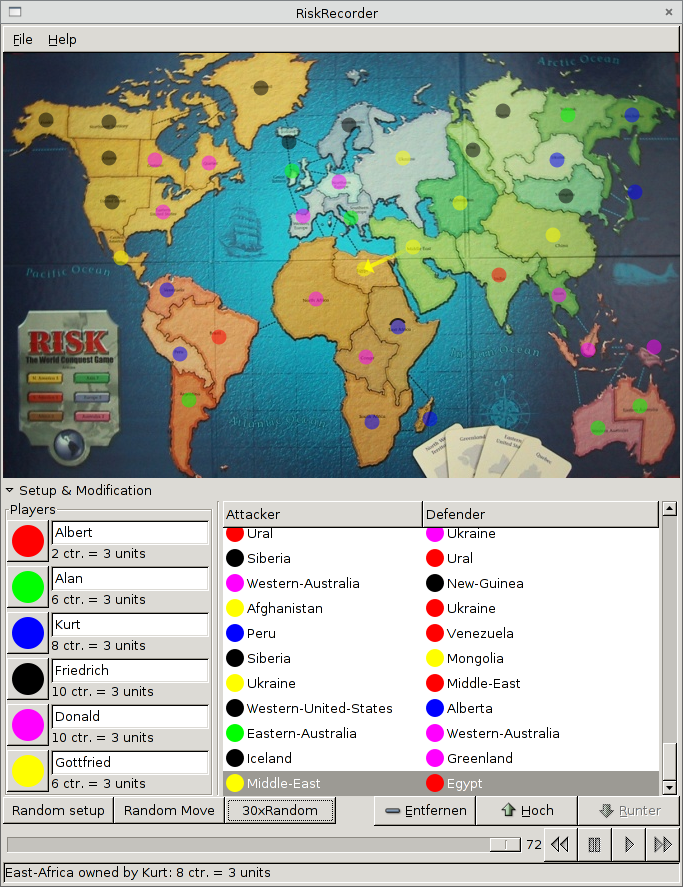
Last week, some friends and I played a very exciting and long (6 hours) game of Risk. At the end, I thought: Too bad we can’t rewind the game and play it fast forward, just see how the tides of colors are waging.Well, on Sunday, I though, why not, and started writing “RiskRecorder”. It is my first larger project with python and gtk+, and I am quite content with both of them. The map is stolen from JRisk, and with that the idea of a gif file that maps pixels to countries. The RiskRecorder is meant to be used during a game of regular risk, to - well - record the moves. As a side benefit, you don’t have to calcuate the number of units you get anymore, as the RiskRecorder can tell you that. You can then save the whole game for later review.It should be in a usable state by now, but I plan to add more features sometime, like better animations and graphs showing development of the game.To try it yourself, you need the program itself (one file so far), then get at least the board.map, board_map.gif and board_pic.jpg from the jrisk CVS repository (you can open any other JRisk map in RiskRecorder, too). You might need to download the python bindings for gtk and cairo, too. On debian, I assume that apt-get install python-gtk2 python-cairo will get you what you need.As always, comments, bugreports and patches are welcome. To follow development, have a look at my svn repository.

Aigars Mahinovs: Superball/bowl. So ... I tried to understand what ...

Superball/bowl.
So ... I tried to understand what this american football thing is all about. What got me interested in it was an anime from Japan called Eyeshield 21 where a boy that ran errants for bullies his whole school life goes into american football as a runner with his great speed and agility. That get me thinking about looking into that sport - it looked quite interesting in the anime.
Boy was I wrong.
So I watched the Superbowl XL - the biggest and most important event in the american football year. The first half was absolutely empty - nothing happened at all. The ads were much more interesting then the game. The halftime show was ok, not as good as ads.
And the second half just showed why this is the definitive american sport in the worst meaning of that - legalese. Steelers would have lost it the judges would have not interfered so much with the game. This sport has like hundreds of tiny rules that are very dependent on interpretation by the judges - that is what I call a sport for all the american lawyers to like. Cancelling several good Seahawks trows just because some guy was holding someone on the other part of the field, that must be givin an ecstasy for every law student. Not for me though.
And even without all that dilation with ridiculous rules (what's that stupidity with running clock and two minute warning ?!?) the game itself is kind of dumb - there are just too many people in the field for anything that a regular person can really understand. Strategies that almost never work out because of the other team interfering with their strategy. Too much chaos and still each person only does a one single thing. Even more - many of the players never will get any attention in the game just because they are on a supporting position, but the quarterback will always be the center of attention.
A very unbalanced game that is even more screwed by a ton of ads, a very heavy leaning on judging nitpicks and just 3-4 nice moments in the whole 1 hour game. I'll just stick back with hockey and anime :)

Norbert Tretkowski: Testers wanted

Steve Langasek just posted this mail to the debian-alpha mailinglist: As of two days ago, the debian-installer svn tree has been switched to use Linux 2.6.15 exclusively on alpha, instead of the previous 2.4.27. This means that with the most recent daily builds, all installer images for alpha are using 2.6 kernels *only*, and the current plan is that d-i beta2 will be the same. If you haven't tried 2.6 on your alpha yet, now would be a good time so you can let us know if it doesn't work before we drop 2.4 for etch completely. http://www.debian.org/devel/debian-installer/

http://cdimage.debian.org/cdimage/daily-builds/daily/arch-latest/alpha/iso-cd/debian-testing-alpha-netinst.iso

http://cdimage.debian.org/cdimage/daily-builds/daily/arch-latest/alpha/iso-cd/debian-testing-alpha-businesscard.iso

http://people.debian.org/~vorlon/d-i/alpha/daily/ Good timing, I have to install my new PC164 next weekend... :-)

Matthew Palmer: LCA 2006: The Hackfest Results

I previously raved about the LCA 2006 hackfest, and how cool it was this year. Chris Yeoh has now put the questions which were attempted, along with the top 10 hackers online. Holy Crap, I came 8th! Considering that there were something like 40 entries, from some very clever people, I'm blown away with my results. Getting pipped by one place by a Samba hacker, of all people, is a pretty major ego boost. Again, to all the hackfest organisers: Thankyou. The hackfest rocked, which was completely in line with the rest of LCA this year.

7 February 2006

Edd Dumbill: Scripting for the Semantic Web

I have the honour of having been asked to be on the programme committee for the 2nd Workshop on Scripting for the Semantic Web. Whereas a lot of semantic web conferences are heavily academic, this workshop mixes the learned approach with real world deployment experience and sharp-end grassroots semweb hacking. The topics the workshop seeks to cover are close to my heart and represent the place where a lot of discovery and experimental deployment of the semantic web is taking place. So, you should consider submitting a paper to this workshop if you're doing serious implementation work around RDF, wikis, syndication, FOAF and related topics. I was a little flattered to see DOAP in the list of buzzwords in the call for participation too! The workshop also includes the Scripting Challenge, where an iPod nano is up for grabs for "the most innovative small scripting application or mashup. The application must be implemented using a scripting language and Semantic Web technologies. It should access, visualize or combine information from different sources in new unforeseen ways." You can find the call for participation online at semanticscripting.org. The workshop itself will be held on June 11 in Budva, Montenegro--the day before the 3rd European Semantic Web Conference.

Matthew Palmer: Microsoft Patent Indemnification Not Worth Squat

It seems that all of Microsoft's hoo-hah about patent indemnification and the associated attacks on Linux aren't even worth the electrons they're excited with. According to an article in The Register, a patent infringement suit brought by a Guatemalan inventor has resulted in all users of newer versions of Microsoft Office needing to install a new, presumably non-infringing, version of the software next time they reinstall. Users who fail to do so "will no longer be covered by Microsoft's guarantee against patent infringement liability." I don't see how this is any different to what you get with patent infringement in the FLOSS realm. Someone says "that code violates my patent rights", the developers reimplement to avoid infringing, users have to upgrade. I'm just not seeing the difference here.

David Welton: Conditional Compilation in Java

We've hit something of a stumbling block with Hecl, and it's proving tricky. Far from being "write once run anywhere", Java has many versions, when you take into considerations the wide array of devices that run one of several configurations roughly lumped together as "J2ME". My cell phone's implementation doesn't have floats, for instance. This necessitates that the J2ME and J2SE versions contain different code, but Java doesn't make this easy, because there are no macros or other ways of conditionally compiling code. The solution we've adapted so far is problematic because it's not very fine grained: we have two separate directories, one for 'core' Hecl (sans floats) and another that contains the exact same classes, but with floating point. For instance: BasicMathCmd.java - no floating point. BasicMathCmd.java - the floating point version. As you can imagine, this means that code is replicated in two places, and each change has to be done twice, carefully, keeping track of the actual differences between the two files. This can only get worse as the code grows. I've seen some hacky ways of doing macros and things like that, but they don't look very satisfying. I'm too much of a Java novice to think of anything better than what we've got, though.

Erich Schubert: More on P2P obfuscation

Julien Danjou and others replied to my "please don't obfuscate BitTorrent" post, pointing out providers in France, Canada that already filter BitTorrent one way or another. I've read similar things about some DSL providers in Germany (Telekom however is proud that they don't do that). But basically this only shows my point: by having the major p2p filesharing protocols use non-standard ports and non-detectable protocols, more and more providers take measures like doing QoS for non-standard ports or filtering them altogether. And just as you reported, this has bad side effects on the ability of other users to e.g. use VoIP or play online games. Remember: my point is to make P2P protocols easy to filter/limit by routers, so provider do NOT block/throttle all non-HTTP connections, but can selectively throttle only P2P filesharing when they think they need to. Because otherwise they'll break other stuff such as online games and VoIP. Now by putting your BitTorrent on ports such as 80 or some VoIP port which isn't throttled, you only cause these providers to e.g. install a transparent proxy for these services. You make it only worse. I agree that you don't have that much choice in countries where there is some kind of monopoly there. But then this increase in filtering will probably allow new companies to enter the market.

Mike Hommey: xulrunner 1.8.0.1-1

Checking Signature on .changes
(…)
Good signature on /home/mh/pbuilder/sid/result/xulrunner_1.8.0.1-1_i386.changes.
Checking Signature on .dsc
(…)
Good signature on /home/mh/pbuilder/sid/result/xulrunner_1.8.0.1-1.dsc.
Uploading via ftp xulrunner_1.8.0.1-1.dsc: done.
Uploading via ftp xulrunner_1.8.0.1.orig.tar.gz: done.
Uploading via ftp xulrunner_1.8.0.1-1.diff.gz: done.
Uploading via ftp libnspr4-dev_1.8.0.1-1_all.deb: done.
Uploading via ftp libmozjs-dev_1.8.0.1-1_all.deb: done.
Uploading via ftp libsmjs1_1.8.0.1-1_all.deb: done.
Uploading via ftp libsmjs1-dev_1.8.0.1-1_all.deb: done.
Uploading via ftp libxul-dev_1.8.0.1-1_all.deb: done.
Uploading via ftp libnss3-dev_1.8.0.1-1_all.deb: done.
Uploading via ftp xulrunner_1.8.0.1-1_i386.deb: done.
Uploading via ftp xulrunner-gnome-support_1.8.0.1-1_i386.deb: done.
Uploading via ftp libnspr4-0d_1.8.0.1-1_i386.deb: done.
Uploading via ftp libmozjs0d_1.8.0.1-1_i386.deb: done.
Uploading via ftp spidermonkey-bin_1.8.0.1-1_i386.deb: done.
Uploading via ftp libxul0d_1.8.0.1-1_i386.deb: done.
Uploading via ftp libnss3-0d_1.8.0.1-1_i386.deb: done.
Uploading via ftp xulrunner_1.8.0.1-1_i386.changes: done.
Successfully uploaded packages. I wonder how long it will take to the ftp-masters to accept it. It seems the NEW queue is not as fast as it used to be. It’s been a week I’ve been waiting for libxml2 and libxslt to get through, and they still haven’t made it. If enough people is interested in the package before it comes out of NEW, I’ll probably upload it in my repository. I have a patch for epiphany-browser that I’ll send soon to the BTS. I’ll come up with a patch for yelp as well. Then, bye bye mozilla-browser. I’m also going to build an unofficial firefox on top of xulrunner, and maybe upload it to experimental, so that we can have some feedback about that. I’ll see with Eric about that.

Erich Schubert: Let there be light!

I redecorated my (physical) desktop today. I still need some more posters, too much empty wall. But it's nice to lean back and have some colorful stuff to look at. Workplace photograph But do you know what's best? My laptop is back from repair. I have backlight again! Though I think they used a too short light tube, it feels somewhat darker on the left and right. But the laptop is old anyway. And the old tubes used to have a reddish tint there... I love having my 15" 1600x1200 screen back. ;-)

Next.

Previous.