Search Results: "zed"

3 December 2007

Biella Coleman: The other AAA s

The (overpriced) Amtrak train is rapidly hurling itself north toward New York City, the vanishing light gently illuminating the first snowfall of the year. I am heading back from the American Anthropological Association annual meetings, which were held in Washington D.C this year. After a year’s hiatus, I attended to present a short version of my paper on hacker conferences, which I have pushed along further to entertain more general questions and ideas about the role of conferences in ensuring forms of solidarity among publics that are dispersed geographically. While there are other events that are far more visceral or more profoundly produce what Emile Durkheim has called collective effervescence, conferences are probably one of the most common social forms for ensuring a steady state of moral solidarity among connected but geographically dispersed groups of people. Their importance and role is often overlooked, I think, because of their sheer ubiquity (and I am sure the fact that many are held in creepy corporate hotels populated by seriously over sized & gaudy furniture where you can sit and sip your overpriced Starbuck’s coffee does not help). But it is because they are so common that I think we need to take them a little more seriously as distinctly 20th century events that combine much older elements of ritual and pilgrimage. Because I have attended so many developer and hacker conferences, which tend to be longer as well as far more more enveloping, festive, and, frankly, well executed than academic ones, I tend to think of academic conferences as tepid, lightweight versions. But as I make my way back home, I am pretty worn yet inspired from this one as I decided to sort of let go to give it my all, sleeping far less than I really should have. I usually hold back some, perhaps because most academic conferences I attend are smack in the middle of the academic year, so my mind is partially occupied with the pile of work that awaits me, somewhat depressingly, at the end of your journey. Academic conferences can also produce a fair bit of anxiety, especially for younglings like myself, given that you are performing your skills (or lack of) and ideas (or lack of) to people you respect and admire too. Perhaps it is also due to the hotel environment, which I find not only particularly uninspiring but in all honesty, sort of soul sucking, though albeit, *very* conveniently so. This time, however, I was not going to let the hotel suck any more soul out of me because I was thrilled to see friends from time’s past, had a great time on my panel on digital subjectivities, and was excited to meet new folks and talk about those topics that I spend a lot of time thinking about. I also think the proliferation of (very cute) babies among my friends and the now visible crow’s feet adorning the smiling eyes of my friends made me feel the passing of time a little more forcefully than really I wanted to. So I did my best to turn that pesky faucet of time of off so as to give way to immersion, drawing those from past into the shared nest of the present, so that I would want to see them again in the future. And in the end, that is the point: social reproduction and shouldn’t procreation be fun? I think so… Now back to that pile of work.

1 December 2007

Stefano Zacchiroli: pts face lift

PTS: face lifting (i.e. tell me what PTS layout you like) My personal PTS small marathon is almost over. The latest addition is a shiny new look and feel. The rationale for that is partly aesthetic (the proposed new colors are mimicking wiki.debian.org and should be more debianish, thanks H01ger for the suggestion!) but mostly functional (the current layout is too "large" and too few information fits on a single average physical screen). So, here are some screenshots you can actually see:
  1. current version . You can see this layout in action on whatever package in the PTS;
  2. tighter layout (smaller fonts, less padding, wiki.d.o-like colors). You can see this layout in action on whatever package in the PTS since the CSS is listed as alternate: just access a page and (assuming you're using firefox) do "View > Page Style > Compact rendering";
  3. tighter and reorganized layout (as for the point above + 3 columns layout, thanks MadCoder for the latter!). Unfortunately you can't try this out by yourself, as it isn't yet committed ... trust the screenshot then :-)
So, question type, what do you like more of the above 3? I'm all for the latter (tighter and 3 columns) and plan to commit it RSN. If you have other preferences please mail me them; also suggestions for improvement are, of course, welcome.

Benjamin Mako Hill: Me++

My birthday is Sunday, December 2nd. To celebrate, my friends in Zagreb have organized a party for me at the club and cafe Kset at 20:00. It should be low-key and lots of fun. Since I don't actually know too many people here, other folks reading this should definitely feel free to drop by if they'd like to meet up. Rumor has it that we'll have another party at the Acetarium after I get back to Cambridge on the evening of Saturday, December 8th. Let us know if you want to drop by for that one.

28 November 2007

Ondřej Čertík: How to connect to the internet using T-Mobile and bluetooth

I have a laptop with Debian, cell phone (Nokia N70) with bluetooth and this howto describes how to connect to the internet.

Connect USB bluetooth dongle to the laptop and check it:

$ hciconfig
hci0: Type: USB
BD Address: 00:02:72:D2:23:12 ACL MTU: 310:10 SCO MTU: 64:8
UP RUNNING PSCAN ISCAN
RX bytes:686 acl:0 sco:0 events:22 errors:0
TX bytes:337 acl:0 sco:0 commands:21 errors:0

Scan for the phone:

$ hcitool scan
Scanning ...
00:19:79:86:EB:BC Nokia N70

Create a serial device for communicating with the modem in the phone:

$ rfcomm connect /dev/rfcomm0 00:19:79:86:EB:BC 3
Connected /dev/rfcomm0 to 00:19:79:86:EB:BC on channel 3
Press CTRL-C for hangup

(A dialog will popup on the phone asking me to allow the laptop to connect.)

Connect using wvdial:

$ wvdial
--> WvDial: Internet dialer version 1.56
--> Cannot get information for serial port.
--> Initializing modem.
--> Sending: ATZ
ATZ
OK
--> Sending: ATQ0 V1 E1 S0=0 &C1 &D2 +FCLASS=0
ATQ0 V1 E1 S0=0 &C1 &D2 +FCLASS=0
OK
--> Modem initialized.
--> Sending: ATDT*99***1#
--> Waiting for carrier.
ATDT*99***1#
CONNECT
~[7f] #@! ! 2 # $@# ! $ %\ " & * g %~
--> Carrier detected. Starting PPP immediately.
--> Starting pppd at Wed Nov 28 12:58:55 2007
--> Pid of pppd: 4378
--> Using interface ppp0
--> pppd: [08][06][08] [10][06][08]
--> local IP address 172.24.171.97
--> pppd: [08][06][08] [10][06][08]
--> remote IP address 10.6.6.6
--> pppd: [08][06][08] [10][06][08]
--> primary DNS address 62.141.0.2
--> pppd: [08][06][08] [10][06][08]
--> secondary DNS address 213.162.65.1
--> pppd: [08][06][08] [10][06][08]

And that's it, I am connected.

Prerequisities

$ wajig install wvdial bluez-utils

And setup the /etc/wvdial.conf file:

$ cat /etc/wvdial.conf
[Dialer Defaults]
Init1 = ATZ
Init2 = ATQ0 V1 E1 S0=0 &C1 &D2 +FCLASS=0
Modem Type = USB Modem
Baud = 460800
New PPPD = yes
Modem = /dev/rfcomm0
ISDN = 0
Phone = *99***1#
Password = doesnt_matter
Username = doesnt_matter
Stupid Mode = 1

27 November 2007

Bernd Zeimetz: svn-uscan

svn-uscan Might be useful if you use svn-buildpackage and co-maintain packages or have to sponsor/review them:
0 bzed@hal:~$ type svn-uscan
svn-uscan is aliased to  uscan --verbose --force-download --rename --repack --destdir=../tarballs'
0 bzed@hal:~$

25 November 2007

Manoj Srivastava: Manoj: Filtering Accuracy: Brown paper bag time

After posting about filtering accuracy I got to thinking about the test I was using. It appeared to me that there should be no errors in the mails that crm114 had already been trained upon but here I was, coming up with errors when I trained the css files until there were no errors, and then used a reg exp that tried to find the accuracy of classification for all the files, not just new ones. This did not make sense. The only explanation was that my css files were not properly created and I thought to try an experiment where isntead of trying to throw my whole corpus as one chunk at a blank css file, I would feed the corpus in chunks. I cam up with an initialization script to feed my corpus to a blank css file in 200 mail chunks; and, while it was at it, renumber the corpus mails (over the years, as I cleaned the corpus, gaps had appeared in the numbering). I have also updated the retraining script Voila. I am getting a new set of css files which do not appear to show any errors for mails crm114 has already learned about in other words, for mails it has seen, the accuracy is now 100%, not 99.5% as it was a couple of days ago. While it is good news in that my classification accuracy is better than it was last week; the bad news is that I no longer have concrete number on accuracy for crm114 anymore the mechanism used now gives 100% accuracy all the time. The funny thing is, I recall going through this analysis a couple of years ago, where I predicted that one could only check for accuracy with a test corpus that had the same characteristics as real mail inflow, and which had not been used for learning. That wold mean I would have classified testing corpus that could improve the efficiency of my filter, but was not being used to provide accuracy numbers I have gone for improving the filter, at the cost of knowing how accurate they actually are.

Manoj Srivastava: Manoj: The children of men

A nicely placed movie about a bleak future, and how people cope with despair and desperate times. While it did not quite come together in the details (anything outside of England was a big unknown blur), and the London of 2027 seemed not much different from any current day city under semi martial law (technology, for instance, seems to have frozen at todays levels), it was still fast paced, and enjoyable, and anyway, this is not primarily a sci-fi flick. Recommended.

Manoj Srivastava: Manoj: 300, and the history channel perspective.

Yes, this is about a movies based on a comic based on a movie from the 50 s. And they did a wonderful job of conveying to comic book feel and yet, though you could appreciate the abstract, stylized presentation of the comic, most of the movie still came straight from Herodotus. The training of the Spartans, the throwing of the Persian emissaries into a pit and a well this cleaving to the historic details was a pleasant surprise. The history channel presentation is recommended for the perspective it brings to the tale. There were some poetic licenses the whole bit about a highly placed Spartan traitor was made out of plain cloth; and the current convention wisdom is that Leonidas went to Thermopylae because of his religious beliefs, and conviction about the sacred prophecy of the oracle at Delphi, not because he thought Persia would destroy Greece (remember, Xerxes won, and sacked Athens). Indeed, there was little concept of Greece at that point. Indeed, the whole stick about the last stand at Thermopylae saving democracy seems suspect the stand bloodied Persia s nose, and delayed them by perhaps 5 days in an advance that took the better part of a year that the Greeks knew about. No, it was the combination of Marathon, Thermopylae, Salamis, Plataea over the course of half a century that ensure that the no name David of the Greek city states survived against the Goliath of Persia. And, then, of course, came the boy wonder out of Macedonia. Highly recommended.

Christian Perrier: News from D-I i18n

It's quite some time since I didn't blog about D-I i18n and the number of new languages we'll support in the next Debian version, lalala... A few works are on their way, indeed:

24 November 2007

Adam Rosi-Kessel: ADR for Property Damage in China

As a litigator, I’m always interested in novel and more efficient mechanism for resolving disputes, especially where the transaction costs of fighting it out in court can trump the benefits to either party. This process (full article not available online) for resolving property damage claims in China is about as streamlined as it gets:
Near the Lama Temple, as we waited to make the last left turn of the day, we were hit by another car. The driver backed into our side and then pulled away. There wasn’t time to fumble with my crutches, so I hopped out on my good leg. Fortunately, traffic was backed up, and I caught him in about seven hops. I pounded on the window. “You hit my car!” The driver looked up, surprised: a one-legged foreigner, hopping mad and smacking the glass. He stepped out and apologized, saying that he hadn’t felt the impact. Together, we inspected the Jetta–fresh dent above the left rear wheel. The man said, “I’ll give you a hundred.” That was about thirteen dollars. In China, after a minor accident people usually settle the matter on the street, in cash. This routine has become a standard part of life–once, I saw two small children playing a game in which they repeatedly rammed their bikes and shouted, “Pei qian! Pei qian!” — “Compensate! Compensate!” Leslie used her cell phone to call the rental company. Mr. Liu didn’t sound the least bit surprised to hear that we’d had another accident. All he said was “Ask for two hundred.” “That’s too much,” the other driver said. “This is really minor.” “It’s not our decision.” “Well, then, we’ll have to call the police,” he said, but it was clear that he didn’t want to do this. A dozen bystanders had gathered around the cars, which were parked in the middle of the snowy street. With Chinese accidents, the crowd is more like a jury than an audience, and a middle-aged woman bent over to inspect the dent. She stood up and announced, “A hundred is enough.” “What do you have to do with it?” Leslie snapped. “You can’t even drive!” That must have been correct, because the woman shut up. But the driver refused to pay two hundred. “Should we accept one-fifty?” Leslie asked me, in English. Lao-tzu said it best: A man standing on crutches in the snow will not bargain long over a dent to a crappy Jetta rental. Later that day, Leslie returned the car and the one-fifty in cash. Mr. Liu noticed that another light cover had been broken when she hit the brick wall. He said, happily, “What did you kill this time?” When I hit the dog, the same cover was twelve dollars; this time, he asked for only three. It must have been a special price because we did so well at the Lama Temple.
I don’t think this system would work to resolve patent infringement disputes, but it might make sense for some of our domestic fender-benders. Technorati Tags: ,

23 November 2007

Sune Vuorela: Debianized splash screens part 3?

Oh well.. I asked for a couple of brave testers some time ago. I guess it is time to try make my attempted work public. Use it at your own risk and fun. And please don’t comment on my ability to (not) use gimp and (not) to remove white. For brave people, try look at http://users.alioth.debian.org/~pusling-guest/.desktop-base/ Comments are welcome

21 November 2007

Daniel Burrows: Good ideas in customer service: kill the hold period

The lender for one of my student loans has apparently started using a rather cool system to manage incoming customer service calls. If all the call-takers are busy, then instead of forcing you to sit there listening to a call telling you how important your business is to them, they let you request a call-back. They ask you to enter a phone number where they can reach you, then give you a time window in which they'll be calling (in my case I think it was about two minutes wide). When my turn came up, they called me and I was able to speak with a human immediately.

This is such a huge improvement over the typical call center experience that I'm amazed it hasn't caught on more broadly.


I'm guessing that this option will be available in more and more places as companies computerize their telephone systems. Another nice twist, if there are any telephony guys reading this, would be to allow me to request the customer service call from a Web page, eliminating the toll-free call altogether and presumably saving some expense for the company.

An interesting question for me is how they generate those estimates of when they'll be able to help you. I'm guessing that they use some queueing theory to estimate the most likely wait time for the next incoming customer, but this is something I have only a fuzzy awareness of. However they did it, the estimate seemed accurate enough to me.

Russell Coker: BoingBoing and Licenses

Today I was thrilled to see that Cory Doctorow (who among other things wrote one of my favourite Sci-fi novels [1]) copied one of my blog posts on to BoingBoing.net [2]. Then I reviewed the licence conditions (which had previously been contained in the About Page and is now a post on my documents blog [3]) and discovered that I had not permitted such use! In the second part of this post (not included in the RSS feed) I have the old and new license conditions for my blog content. My plan is that my document blog [4] will have the current version of such documents while this blog will have every iteration along the way. The new version of my license explicitly permits BoingBoing to do what they want with my content. I don’t have any objection to what Cory did, and I would have been rather unhappy if he had sent me an email saying “I wanted to feature your post on BoingBoing but sorry you miss out because of your license”. But his procedure does not work well. Now I am wondering, how do I construct a license agreement that permits my content to be used by big popular sites that give my blog new readers and my ideas a wider audience while denying the content to sploggers who just want to use my patterns of words for google hits? How do I permit my content to be used by people who contribute as much to the community as Cory but deny it to talentless people who want to exploit my work while contributing nothing to the world? How can I ensure that people who want to reference my work can learn about the licence conditions (the About Page apparently doesn’t work)? These are serious questions and I invite suggestions as to how to solve them. The fact that I have forgiven Cory for not abiding by my license and granted him permission to do the same thing again whenever he wishes is not the ideal solution. For authors to find people who copy their work and respond with forgiveness or DMCA take-down notices according to who does the copying and the reason for it is a losing game and a distraction from the work of creating the useful content. I understand the BoingBoing situation, they deliver summaries and copies of blog posts rapidly and frequently. Discovering conditions of use and asking for clarification from the authors (which may take days or weeks) would really affect the process. Also anyone who reads my blog would probably realise that I want to have such posts copied on sites such as BoingBoing. (more…)

20 November 2007

Russell Coker: RAID and Bus Bandwidth

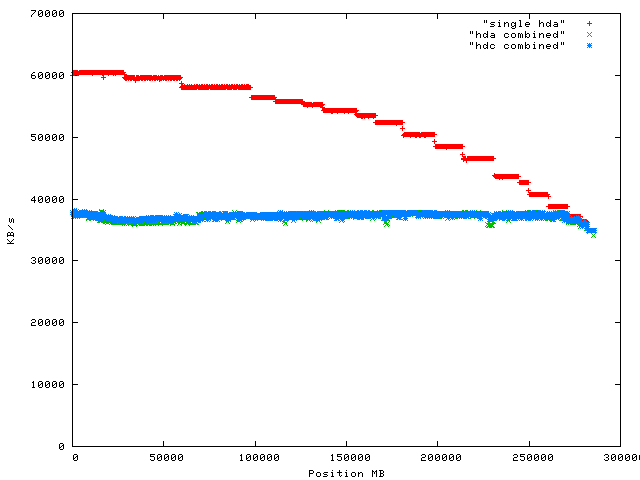
As correctly pointed out by cmot [1] my previous post about software RAID [2] made no mention of bus bandwidth. I have measured the bus bottlenecks of a couple of desktop machines running IDE disks with my ZCAV [3] benchmark (part of the Bonnie++ suite). The results show that two typical desktop machines had significant bottlenecks when running two disks for contiguous read operations [4]. Here is one of the graphs which shows that when two disks were active (on different IDE cables) the aggregate throughput was just under 80MB/s on a P4 1.5GHz while the disks were capable of delivering up to 120MB/s:
On a system such as the above P4 using software RAID will give a performance hit when compared to a hardware RAID device which is capable of driving both disks at full speed. I did not benchmark the relative speeds of read and write operations (writing is often slightly slower), but if for the sake of discussion we assume that read and write give the same performance then software RAID would only give 2/3 the performance of a theoretical perfect hardware RAID-1 implementation for large contiguous writes. On a RAID-5 array the bandwidth for large contiguous writes is the data size multiplied by N/(N-1) (where N is the number of disks), and on a RAID-6 array it is N/(N-2). For the case of a four disk RAID-6 array that would give the same overhead as writing to a RAID-1 and for the case of a minimal RAID-5 array it would be 50% more writes. So from the perspective of “I need X bandwidth, can my hardware deliver it” if I needed 40MB/s of bandwidth for contiguous writes then a 3 disk RAID-5 might work but a RAID-1 definitely would hit a bottleneck. Given that large contiguous writes to a RAID-1 is a corner case and that minimal sized RAID-5 and RAID-6 arrays are rare in most cases there should not be a significant overhead. As the number of seeks increases the actual amount of data transferred gets quite small. A few years ago I was running some mail servers which had a very intense IO load, four U320 SCSI disks in a hardware RAID-5 array was a system bottleneck - yet the IO was only 600KB/s of reads and 3MB/s of writes. In that case seeks were the bottleneck and write-back caching (which is another problem area for Linux software RAID) was necessary for good performance. For the example of my P4 system, it is quite obvious that with a four disk software RAID array consisting of disks that are reasonably new (anything slightly newer than the machine) there would be some bottlenecks. Another problem with Linux software RAID is that traditionally it has had to check the consistency of the entire RAID array in the case of an unexpected power failure. Such checks are the best way to get all disks in a RAID array fully utilised (Linux software RAID does not support reading from all disks in a mirror and checking that they are consistent for regular reads), so of course the issue of a bus bottleneck becomes an issue. Of course the solution to these problems is to use a server for server tasks and then you will not run out of bus bandwidth so easily. In the days before PCI-X and PCIe there were people running Linux software RAID-0 across multiple 3ware hardware controllers to get better bandwidth. A good server will have multiple PCI buses so getting an aggregate throughput greater than PCI bus bandwidth is possible. Reports of 400MB/s transfer rates using two 64bit PCI buses (each limited to ~266MB/s) were not uncommon. Of course then you run into the same problem, but instead of being limited to the performance of IDE controllers on the motherboard in a desktop system (as in my test machine) you would be limited to the number of PCI buses and the speed of each bus. If you were to install enough disks to even come close to the performance limits of PCIe then I expect that you would find that the CPU utilisation for the XOR operations is something that you want to off-load. But then on such a system you would probably want the other benefits of hardware RAID (dynamic growth, having one RAID that has a number of LUNs exported to different machines, redundant RAID controllers in the same RAID box, etc). I think that probably 12 disks is about the practical limit of Linux software RAID due to these issues and the RAID check speed. But it should be noted that the vast majority of RAID installations have significantly less than 12 disks. One thing that cmot mentioned was a RAID controller that runs on the system bus and takes data from other devices on that bus. Does anyone know of such a device?

19 November 2007

Benjamin Mako Hill: My Balkan Tour

I recently mentioned that I would visiting some friends at mi2 in Zagreb and would be traveling around the Balkans a bit to give some talks and workshops. Here's what the current plan includes: If you're in Novi Sad, Belgrade, Ljubljana, or Zagreb and would like to meet up, please consider coming to the events and exhibitions. If you can, and especially if you can not but would like to meet up anyway, feel free to drop me an email and let's try to organize a meeting. Thanks go to Tomislav Medak and Marcell Mars who organized System.hack(), this whole tour, and who helped do the work to bring me over. I'm looking forward to the next couple weeks.

Manoj Srivastava: Manoj: Eragon

I liked the book. Sure, it is The Lord of the Rings meets Star Wars , but, the book had a nice flow and it was written by a fifteen year old, fer gawds sake. The very fact that he can turn out a page turner of a book when others of his age can t string together a grammatical sentence spelled correctly is amazing. Overall, derivative, unoriginal, and simplistic though the book is, it has an original charm a very good book for children, and one that adults can read through as well. So I went to this movie with high hopes. What a let down. This was merely a notch above the Beowulf debacle. Lack luster performances, bland, drudge of a movie, with all kinds of interesting elements and nuances from the book removed. Crude, unimaginative, ham handed performances all around. The plot line, which did not follow the book, was dumbed down, there were implications that the Elven princess was a potential love interest (faugh), and the refreshing pace of the book fell off to a plodding soporific caricature. It is an offense to the book, and to the author. I was going to point out the differences between the movie and the book; and why they difference made the movie worse, but after 30 or so items this post would have gotten to be too big. And, having written it, I have the release of the rant, so I no longer have to include it here. Anyway, Wikipedia says that the film came in at #235 in the all time worldwide box office chart but was met with dismal critical reviews, scoring only a 16% composite score on Rotten Tomatoes I feel sorry for you if you suffered through this, as did I.

18 November 2007

Manoj Srivastava: Manoj: The movie vaguely resembling Beowulf: an IMAX 3d experience

This should really be titled A movie vaguely representing Beowulf, but all sexed up with various salubrious elements . Hrothgar was treated much better in the original; and all the blatant and gratuitous sexuality brought in into the movie was a turn off. But then, I might be in the minority of the audience who had any familiarity with the poem. The characters in the movie seemed two dimensional caricatures (the only compelling performance was from Grendel s mother). And the changes made to the story line also lost the prowling menace of the latter years of the king of the Geats. After watching Hollywood debacles like this one, I am driven to wonder about why Hollywood writers seem to think they can so improve upon the work of writers whose story has stood the test of time. Making Beowulf into a boastful liar and cheat (even in the tale of the sea monsters his men imply that that they knew their lord was a liar) in an age where honor and battle prowess were everything I mean, what were the producers thinking? Most certainly not a movie I am going to recommend. I had not researched the movie much before I went into the show, and it was a surprise to me to see that this was an animated movie a la Final Fantasy , and while I was impressed with the computer graphics (reflections in general, and reflections of ripples in the water were astounding), the not a cartoon but not a realistic movie experience was a trifle distracting, and detracted from telling the tale. I like IMAX 3d, and the glasses are improving.

Holger Levsen: shiny and localized tuxmath

Yesterday I've uploaded a shiny new upstream version of tuxmath. Besides many bugfixes, new "crystal" icons, hall of fame, a demo mode, being able to track completed lessons and better configuration options (you can create your own lessons now), this version also finally supports localisation. Yay!

But, as this feature is really new, there are only translations for dutch, czech, norwegian bokm l and nynorsk available. So if you have a moment to spare, please consider translating those 84 strings, which are probably 20-30 unique strings, the rest being variations. (Divided by 3, divided by 4, etc...)

Please file them as wishlist bugs against the package. Thanks!

Theodore Ts'o: Does perfect code exist? (Abstractions, Part 1)

Bryan Cantrill recently wrote a blog entry, where among other things, he philosophized on the concept of “perfect code”. He compares software to math, arguing that Euclid’s greatest common denominator algorithm shows no sign of wearing out, and that when code achieves perfection (or gets close to perfection), “it sediments into the information infrastructure” and the abstractions defined by that code becomes “the bedrock that future generations may build upon”. Later, in the comments of his blogs, when pressed to give some examples of such perfection, he cites a clever algorithm coded by his mentor to divide a high resolution timestamp by a billion extremely efficiently, and Solaris’s “cyclic subsystem”, a timer dispatch function. Watching his talk at Google where his introduction and sidebar book review on Scott Rosenberg’s “On Dreaming in Code”, it’s clear that he very passionately believes that it is possible to write perfect code, and that one should strive for that at all times. Perhaps that’s because he mostly writes code for operating systems, where the requirements change slowly, and for one OS in particular, Solaris, which tries far harder than most software projects to keep published interfaces stable for as long as possible. In contrast, the OS I’ve spent a lot of time hacking around, Linux, quite proudly states that at least inside the kernel, interfaces can not and should not be stable. Greg Kroah-Hart’s “Stable API Nonsense” is perhaps one of the strongly and most passionate expositions of that philosophy. I can see both sides of the argument, and in their place, both have something to offer. To Bryan’s first point, it is absolutely true that interfaces can become “bedrock” upon which entire ecosystems are built. Perhaps one of the most enduring and impactful example would be the Unix programming interface, which has since become enshrined by POSIX.2 and successor standards. I would argue, though, that it is the interface that is important, and not the code which initially implemented it. If the interface is powerful enough, and if it appears at the right time, and the initial implementation is good enough (not perfect!), then it can establish itself by virtue of the software which uses it becoming large enough that it assumes an important all out of scale with its original intention. Of course, sometimes such an interface is not perfect. There is an apocryphal story that when S. Feldman at AT&T labs first wrote the ‘make’ utility, that he did so rather quickly, and then put it available for his fellow lab members to use, and then went home to sleep. In some versions of the story he had stayed up late and/or pulled an all-nighter to write it, so he slept a long time. When he came back to work, he had come up with a number of ways to improve the syntax of the Makefile. Unfortunately, (so goes the story) that too many teams were already using the ‘make’ utility, so he didn’t feel he could change the Makefile syntax. I have no evidence that this ever took place, and I suspect it is an urban myth that was invented to explain why Makefiles have a rather ugly and unfortunate syntax that many would call defects, including the use of syntactically significant tab characters which are indistinguishable from other forms of leading whitespace. Another example which is the bane of filesystem designers everywhere are the Unix readdir(2), telldir(2), and seekdir(2) interfaces. These interfaces fundamentally assume that directories are stored in linear linked lists, and filesystems that wish to use more sophisticated data structures, such as b-trees, have to go to extraordinary lengths in order support these interfaces. Very few programs use telldir(2) and seekdir(2), but some filesystems such as JFS maintain two b-trees instead of one just to cater to telldir/seekdir. And yet, it is absolutely true that interfaces can be the bedrock for an entire industry. Certainly no matter what its warts, the Unix/Posix interface has proven the test of time, and it has been responsible for the success of many a company and many billions of dollars of market capitalization. But is this the same as perfect code? No, but if billions of dollars of user applications are going to be depending on that code, it’s best if code which implement such an interface be high quality, and should attempt to achieve perfection. But what does it mean for code to be perfect? For a particular environment, if the requirements can be articulated clearly, I can accept that code can reach perfection, in that it becomes as fast as possible (for the given computer platform), and it handles all exception cases, etc., etc. Unfortunately, in the real world, the environment and the requirements inevitably change over time. For example, Bryan’s cyclic subsystem, which he proudly touts as being if not perfect, almost so, and which executes at least 100 times a second on every Solaris system in the world. I haven’t looked at the cyclic system in any detail, since I don’t want to get myself contaminated (the CDDL and GPLv2 licenses are intentionally incompatible, and given that companies — including Sun — have sued over IPR issues, well, one can’t be too careful), but waking up the CPU from its low-power state 100 times a second isn’t a good thing at all if you are worried about energy conservation in data centers — or in laptops. For example, on my laptop, it is possible to keep wakeups down to no more than 30-35 times a second and it would be possible to do more but for an abstraction limitation. Suppose for example an process wants to be sleep and then receive a wakeup 1 milliseconds later, and so requests this via usleep(). At the same time, another application wants to sleep until some file descriptor activity takes place, or after 1.2 milliseconds takes place. 0.3 milliseconds later, a third process requests a sleep, this time for 0.8 milliseconds. Now, it could be that in all of the above cases, the applications don’t actually need exact timing; if they all get their wakeups plus or minus some fraction of a millisecond, they would be quite cool with that. Unfortunately, the standard timer interfaces have no way of expressing this, and so the OS can’t combine the three wakeups at T+1.0, T+1.1, and T+1.2 milliseconds into one wakeup at T+1.1ms. So this is where Greg K-H’s “Stable API Nonsense” comes into play. We may not be able to solve this problem at the userspace level, but we darn well can solve this problem inside the kernel. Inside the kernel, we can change the timer abstraction to allow device drivers and kernel routines to provide a timer delta plus a notion of how much accuracy is required for a particular timer request. Doing so might change a timer structure that previously external device drivers had depended upon — but too bad, that’s why stable ABI/API’s are not supported for internal kernel interfaces. Is this that the interface could have been extended? Well, perhaps, and perhaps not; if an interface is well designed, it is possible it can be extended in an API and/or ABI compatible way. There usually is a performance cost to doing so, and sometimes it may make sense to pay that that cost, and sometimes it may not. I’ll talk more about that in a future essay. Yet note what happened to the timer implementation. We have a pretty sophisticated timer implementation inside Linux, that uses heap data structures and buckets of timers for efficiency. So while I might not call it perfect, it is pretty good. But, oops! Thanks to this new requirement of energy efficiency, it will likely need to get changed to support variable levels of accuracy and the ability to fire multiple timers that are (more or less) coming due in a single CPU wakeup cycle. Does that make it no longer perfect, or no longer pretty good? Well, it just had a new requirement impact the code, and if criteria for perfection is for the abstraction defined by the code to be “bedrock” and never-changing, and no need to make any changes in said code over multiple years, I would argue that little to no code, even OS code, can ever achieve perfection by that definition — unless that code is no longer being used. (This is the first of a multi-part series of essays on abstractions that I have planned. The next essay which I plan to write will be entitled “Layer surfing, or jumping between layers”, and will be coming soon to a blog near you….)

16 November 2007

Guido Trotter: LISA: done!

LISA’07 is over, and just concluded with a great talk about “Cooking at the Keyboard”, which of course I liked a lot, being this one of my favorite hobbies! This was my first LISA conference, and I had an all-round experience, giving an invited talk, hosting a BoF and speaking during the Hit The Ground Running track. Of those three the most fun has been the HTGR talk, in which I quickly summarized the Ganeti platform in 10′ and was able to answer a few questions in the last 5′. I definitely liked giving the invited talk, and I think the idea my teammates had to not just talk but actually give a live demo of our platform was very successful, even if it took some time and effort to prepare. The BoF was nice because it gave people chance to give more feedback and to talk about their ideas, it’s probably the session I learned more from. The slides for the talk are on the conference page, and the ones for HTGR will be soon! Globally it’s been a very intense week of talks, sessions, hallway chats, work and fun, and I definitely hope to be at LISA’08, next November in San Diego (it’s a bit like going back home, isnt it?)! I’m really glad to have come and want really to thank all the people who made this possible and all the people I met here, who made this event so good!

Next.

Previous.