Search Results: "reg"

29 October 2014

Rhonda D'Vine: Feminist Year

If someone would have told me that I would visit three feminist events this year I would have slowly nodded at them and responded with "yeah, sure..." not believing it. But sometimes things take their own turns. It all started with the Debian Women Mini-Debconf in Barcelona. The organizers did ask me how they have to word the call for papers so that I would feel invited to give a speech, which felt very welcoming and nice. So we settled for "people who identify themselves as female". Due to private circumstances I didn't prepare well for my talk, but I hope it was still worth it. The next interesting part though happened later when there were lightning talks. Someone on IRC asked why there are male people in the lightning talks, which was explicitly allowed for them only. This also felt very very nice, to be honest, that my talk wasn't questioned. Those are amongst the reasons why I wrote My place is here, my home is Debconf. Second event I went to was the FemCamp Wien. It was my first event that was a barcamp, I didn't know what to expect organization wise. Topic-wise it was set about Queer Feminism. And it was the first event that I went to which had a policy. Granted, there was an extremely silly written part in it, which naturally ended up in a shit storm on twitter (which people from both sides did manage very badly, which disappointed me). Denying that there is sexism against cis-males is just a bad idea, but the background of it was that this wasn't the topic of this event. The background of the policy was that usually barcamps but events in general aren't considered that save of a place for certain people, and that this barcamp wanted to make it clear that people usually shying away from such events in the fear of harassment can feel at home there.
And what can I say, this absolutely was the right thing to do. I never felt any more welcomed and included in any event, including Debian events sorry to say that so frankly. Making it clear through the policy that everyone is on the same boat with addressing each other respectfully totally managed to do exactly that. The first session of the event about dominant talk patterns and how to work around or against them also made sure that the rest of the event was giving shy people a chance to speak up and feel comfortable, too. And the range of the sessions that were held was simply great. This was the event that I came up with the pattern that I have to define the quality of an event on the sessions that I'm unable to attend. The thing that hurt me most in the afterthought was that I couldn't attend the session about minorities within minorities. :/ Last but not least I attended AdaCamp Berlin. This was a small unconference/barcamp dedicated to increase women's participation in open technology and culture named after Ada Lovelace who is considered the first programmer. It was a small event with only 50 slots for people who identify as women. So I was totally hyper when I received the mail that was accepted. It was another event with a policy, and at first reading it looked strange. But given that there are people who are allergic to ingredients of scents, it made sense to raise awareness of that topic. And given that women are facing a fair amount of harassment in the IT and at events, it also makes sense to remind people to behave. After all it was a general policy for all AdaCamps, not for this specific one with only women.
I enjoyed the event. Totally. And that's not only because I was able to meet up with a dear friend who I haven't talked to in years, literally. I enjoyed the environment, and the sessions that were going on. And quite similar to the FemCamp, it started off with a session that helped a lot for the rest of the event. This time it was about the Impostor Syndrome which is extremely common for women in IT. And what can I say, I found myself in one of the slides, given that I just tweeted the day before that I doubted to belong there. Frankly spoken, it even crossed my mind that I was only accepted so that at least one trans person is there. Which is pretty much what the impostor syndrome is all about, isn't it. But when I was there, it did feel right. And we had great sessions that I truly enjoyed. And I have to thank one lady once again for her great definition on feminism that she brought up during one session, which is roughly that feminism for her isn't about gender but equality of all people regardless their sexes or gender definition. It's about dropping this whole binary thinking. I couldn't agree more. All in all, I totally enjoyed these events, and hope that I'll be able to attend more next year. From what I grasped all three of them think of doing it again, the FemCamp Vienna already has the date announced at the end of this year's event, so I am looking forward to meet most of these fine ladies again, if faith permits. And keep in mind, there will always be critics and haters out there, but given that thy wouldn't think of attending such an event anyway in the first place, don't get wound up about it. They just try to talk you down. P.S.: Ah, almost forgot about one thing to mention, which also helps a lot to reduce some barrier for people to attend: The catering during the day and for lunch both at FemCamp and AdaCamp (there was no organized catering at the Debian Women Mini-Debconf) did take off the need for people to ask about whether there could be food without meat and dairy products by offering mostly Vegan food in the first place, even without having to query the participants. Often enough people otherwise choose to go out of the event or bring their own food instead of asking for it, so this is an extremely welcoming move, too. Way to go!

/personal permanent link Comments: 2 Flattr this

28 October 2014

Keith Packard: Goodbye-Barnes-and-Noble

Goodbye Barnes & Noble I've read books on electronic devices for many years now; the convenience of having a huge library with me while traveling makes up for the lower quality of the presentation. I've read books on a selection of Palm devices, an old OpenInkpot compatible ereader, my phone and, most recently, on my Kobo Aura. To get reading material, I've used a variety of sources, including the venerable Project Gutenberg, the Internet Archive, directly from authors like Cory Doctorow and even our local Multnomah County Public Library. I like to have books in epub format; it's a published standard, based on HTML and CSS. My recent devices have all happily supported that, and it allows for editing when I feel the need to correct typos or formatting problems. Purchasing Books When I wanted to actually purchase a book, I bought from Barnes & Noble; they have a good selection, and reasonable automatic recommendations. According to their web site, since I started shopping there, I've purchased 51 books. I can't tell how much I've spent, but probably in excess of $500. Not knowing which device I'd be reading on at any one time, and liking to have the assurance of ongoing access to my library, I would always download the epub files to my laptop and then transfer them to whichever device I wanted to read on. This ensured that my books would be available even when I didn't have a network connection (as happened yesterday during a wind storm which cut the power to the DSLAM which connects me to the internet). I'd created a simple shell script which captured the file after it was downloaded on my laptop and prepared it for my reader. A bit of browser configuration and it really was as simple as clicking the 'download' button to get a book onto both my laptop and my reading device. Barnes & Noble Disables Downloading I was traveling in Bordeaux a couple of weeks ago and wanted to get the latest volume in a series I was reading. My library didn't have it available, and so I decided that it was worth a few dollars to purchase it for the flight home. After clicking through the Barnes & Noble store, I was ready to download the book so that I could transfer it to my reader. Going to 'My Library', I found my new purchases but the usual 'Download' button was missing. I was a bit surprised as I'd purchased and downloaded the previous volume just before leaving without any troubles. At first, I assumed there was some kind of region restriction on the distribution of this book. I'm familiar with that from DVD region locking of movies, and supposed that the same could be done with books for some reason. However, after setting up a VPN back to home and browsing through that (to ensure that my browser would appear with an Oregon address), the download button was still not present. The unhelpful Barnes & Noble representative that I accessed through the 'help' button disclosed that the 'download' "feature" had been disabled for "security" reasons. Not really having any alternative, I requested a refund for the new book. Barnes & Noble Loses a Customer With no way to actually use ebooks purchased through the Barnes & Noble store, I won't be spending any more money with them. I'm not sure how that helps their "security" issues, although if they lose enough customers and they close their doors, I guess that would make them about as secure as imaginable. Kobo Makes a Sale Having purchased a Kobo Aura, it had built-in access to their book store, which made it easy to download the book that I wanted. Then, I simply connected my reader to my laptop and copied the file over for safe keeping. Buying Books under Linux After I got home, I had to figure out how to get Adobe Digital Editions installed on my laptop. Fortunately, I discovered that version 2.0.1 runs fine under wine. Now, purchasing books can be done with my laptop (a vastly superior browsing experience). The .acsm file can be dragged straight from the iceweasel download menu to Adobe Digital Editions, which happily downloads the actual .epub file and makes it available for transferring to my reader. Of course, now that I've got Adobe Digital Editions working, I can also get digitally restricted books from all over the net, greatly expanding my options for purchasing (or borrowing) books. It's a bit less convenient, and requires that I run an icky Windows binary under wine, but at least I have choices, which is some consolation.

27 October 2014

Petter Reinholdtsen: First Jessie based Debian Edu released (alpha0)

I am happy to report that I on behalf of the Debian Edu team just sent out this announcement:
The Debian Edu Team is pleased to announce the release of Debian Edu
Jessie 8.0+edu0~alpha0
Debian Edu is a complete operating system for schools. Through its
various installation profiles you can install servers, workstations
and laptops which will work together on the school network. With
Debian Edu, the teachers themselves or their technical support can
roll out a complete multi-user multi-machine study environment within
hours or a few days. Debian Edu comes with hundreds of applications
pre-installed, but you can always add more packages from Debian.
For those who want to give Debian Edu Jessie a try, download and
installation instructions are available, including detailed
instructions in the manual[1] explaining the first steps, such as
setting up a network or adding users. Please note that the password
for the user your prompted for during installation must have a length
of at least 5 characters!
 [1] <URL: https://wiki.debian.org/DebianEdu/Documentation/Jessie >
Would you like to give your school's computer a longer life? Are you
tired of sneaker administration, running from computer to computer
reinstalling the operating system? Would you like to administrate all
the computers in your school using only a couple of hours every week?
Check out Debian Edu Jessie!
Skolelinux is used by at least two hundred schools all over the world,
mostly in Germany and Norway.
About Debian Edu and Skolelinux
===============================
Debian Edu, also known as Skolelinux[2], is a Linux distribution based
on Debian providing an out-of-the box environment of a completely
configured school network. Immediately after installation a school
server running all services needed for a school network is set up just
waiting for users and machines being added via GOsa , a comfortable
Web-UI. A netbooting environment is prepared using PXE, so after
initial installation of the main server from CD or USB stick all other
machines can be installed via the network.  The provided school server
provides LDAP database and Kerberos authentication service,
centralized home directories, DHCP server, web proxy and many other
services.  The desktop contains more than 60 educational software
packages[3] and more are available from the Debian archive, and
schools can choose between KDE, Gnome, LXDE, Xfce and MATE desktop
environment.
 [2] <URL: http://www.skolelinux.org/ >
 [3] <URL: http://people.skolelinux.org/pere/blog/Educational_applications_included_in_Debian_Edu___Skolelinux__the_screenshot_collection____.html >
Full release notes and manual
=============================
Below the download URLs there is a list of some of the new features
and bugfixes of Debian Edu 8.0+edu0~alpha0 Codename Jessie. The full
list is part of the manual. (See the feature list in the manual[4] for
the English version.) For some languages manual translations are
available, see the manual translation overview[5].
 [4] <URL: https://wiki.debian.org/DebianEdu/Documentation/Jessie/Features >
 [5] <URL: http://maintainer.skolelinux.org/debian-edu-doc/ >
Where to get it
---------------
To download the multiarch netinstall CD release (624 MiB) you can use
 * ftp://ftp.skolelinux.org/skolelinux-cd/debian-edu-8.0+edu0~alpha0-CD.iso
 * http://ftp.skolelinux.org/skolelinux-cd/debian-edu-8.0+edu0~alpha0-CD.iso
 * rsync -avzP ftp.skolelinux.org::skolelinux-cd/debian-edu-8.0+edu0~alpha0-CD.iso .
The SHA1SUM of this image is: 361188818e036ce67280a572f757de82ebfeb095
New features for Debian Edu 8.0+edu0~alpha0 Codename Jessie released 2014-10-27
===============================================================================
Installation changes
--------------------
 * PXE installation now installs firmware automatically for the hardware present.
Software updates
----------------
Everything which is new in Debian Jessie 8.0, eg:
 * Linux kernel 3.16.x
 * Desktop environments KDE "Plasma" 4.11.12, GNOME 3.14, Xfce 4.10,
   LXDE 0.5.6 and MATE 1.8 (KDE "Plasma" is installed by default; to
   choose one of the others see manual.)
 * the browsers Iceweasel 31 ESR and Chromium 38 
 * !LibreOffice 4.3.3
 * GOsa 2.7.4
 * LTSP 5.5.4
 * CUPS print system 1.7.5
 * new boot framework: systemd
 * Educational toolbox GCompris 14.07 
 * Music creator Rosegarden 14.02
 * Image editor Gimp 2.8.14
 * Virtual stargazer Stellarium 0.13.0
 * golearn 0.9
 * tuxpaint 0.9.22
 * New version of debian-installer from Debian Jessie.
 * Debian Jessie includes about 42000 packages available for
   installation.
 * More information about Debian Jessie 8.0 is provided in the release
   notes[6] and the installation manual[7].
 [6] <URL: http://www.debian.org/releases/jessie/releasenotes >
 [7] <URL: http://www.debian.org/releases/jessie/installmanual >
Fixed bugs
----------
 * Inserting incorrect DNS information in Gosa will no longer break
   DNS completely, but instead stop DNS updates until the incorrect
   information is corrected (Debian bug #710362)
 * and many others.
Documentation and translation updates
------------------------------------- 
 * The Debian Edu Jessie Manual is fully translated to German, French,
   Italian, Danish and Dutch. Partly translated versions exist for
   Norwegian Bokmal and Spanish.
Other changes
-------------
 * Due to new Squid settings, powering off or rebooting the main
   server takes more time.
 * To manage printers localhost:631 has to be used, currently www:631
   doesn't work.
Regressions / known problems
----------------------------
 * Installing LTSP chroot fails with a bug related to eatmydata about
   exim4-config failing to run its postinst (see Debian bug #765694
   and Debian bug #762103).
 * Munin collection is not properly configured on clients (Debian bug
   #764594).  The fix is available in a newer version of munin-node.
 * PXE setup for Main Server and Thin Client Server setup does not
   work when installing on a machine without direct Internet access.
   Will be fixed when Debian bug #766960 is fixed in Jessie.
See the status page[8] for the complete list.
 [8] <URL: https://wiki.debian.org/DebianEdu/Status/Jessie >
How to report bugs
------------------
<URL: http://wiki.debian.org/DebianEdu/HowTo/ReportBugs >
About Debian
============
The Debian Project was founded in 1993 by Ian Murdock to be a truly
free community project. Since then the project has grown to be one of
the largest and most influential open source projects. Thousands of
volunteers from all over the world work together to create and
maintain Debian software. Available in 70 languages, and supporting a
huge range of computer types, Debian calls itself the universal
operating system.
Contact Information
For further information, please visit the Debian web pages[9] or send
mail to press@debian.org.
 [9] <URL: http://www.debian.org/ >

26 October 2014

Gregor Herrmann: RC bugs 2014/38-43

it's this time of the year^Wrelease cycle again almost. in ten days (& roughly two hours), the freeze for the next debian release, codenamed jessie, will start. by this time packages must be in testing in order to be candidates for the release, as explained in the release team's detailed freeze policy. this also means, with the regular testing migration time set to ten days, that tonight's dinstall run closed the regular upload window. & this also means that we should all concentrate on fixing RC bugs to make the freeze as short as possible & jessie yet another great release. before I head over to the UDD bugs page, I'd like to summarize my work on RC bugs in the last weeks, which was again focussed on packages in the Debian Perl Group.

Russ Allbery: California general election

Probably only of interest to California residents. Time again for the general election voting. This is probably too late to be helpful for a lot of people voting permanent absentee, but may as well write this down anyway. (Hm, I apparently didn't do this in 2012.) Propositions: Proposition 1: YES. Now is one of the best times in history to borrow money for infrastructure improvements, and our water infrastructure in the state can certainly use it. Proposition 2: YES. I have somewhat mixed feelings about this, since I hate passing complex legislation like this via proposition, but this already went through the legislature. It would be dumb for the federal government, which can more easily borrow money, but given how the finances of state governments work in the US, this sort of rainy day fund is probably prudent. This one seems reasonably well-designed, and the opposition is panic about a secondary effect on how school reserves are managed that can be changed with later legislative action and which is rather unconvincing. Proposition 45: YES. I can't get very enthused about yet more bandaids on top of our completely broken health care system, but forcing insurance companies to justify rate increases results in some public pressure against profit-taking by insurance companies. Single payer is what we actually need, but this might be mildly helpful. Plus, the argument against is more incoherent nonsense. So, I'm voting yes, but I don't think it's important and I won't mind if it loses. Proposition 46: NO. There are a lot of things that we should do about preventable medical errors, starting with funding our health care system properly, testing drugs properly, and investing in proper inspections and medical licensing investigations. Drug testing doctors is not among those things. This is a well-meaning but horrible idea pushed by a victim's advocacy group that won't do anything to improve our health care system. The fear-mongering of the opponents about malpractice lawsuits is a bit much, but there are essentially no positive benefits here. Proposition 47: YES. Requires that misdemeanor crimes actually be misdemeanors, rather than giving prosecutors discretion to charge them as felonies if the person charged happens to be black-- er, I mean, if the prosecutor doesn't like them for some reason. Obviously a good idea on all fronts: stop over-charging crimes, stop giving prosecutors discretion to choose the impact of laws on particular people (since they rarely use it appropriately), and further try to decriminalize our completely worthless "war on drugs." Proposition 48: YES. I'm opposed to the Indian gaming system in general, but this proposition appears to be a rather cynical attempt to block new casino development by tribes that already have casinos. My general feeling is that if we're going to have casinos, they should generally be legal; the bizarre system where each casino is subject to public approval seems designed to create political cronyism. State offices: I'm not going to comment on the partisan offices, since no one interesting survived the primaries. Across the board, it's basically the Democratic incumbants against various Republicans. The state Republican party in California is dominated by science denialists, Randian objectivists, and people who think the solution to all problems is ensuring rich people don't pay taxes, so it takes rather a lot to get me to vote for any of them. At the moment, the Democrats are doing a reasonably good job running the state, so while I'd vote for challengers from the left against several of them, given the boring candidate slate, I'm just voting Democrat down the line. California has a system that requires voter approval for various state judicial offices. In general, I don't agree with voter approval for judges, since voters are rarely in a position to make reasonable choices about justices. Since there's a Democratic administration in power at the moment, these are probably the best judges that we're going to get (the few I've heard of are good choices), and I don't think the yes/no approval voting is useful anyway. So I'm voting to approve across the board. Superintendent of Public Instruction: Tom Torlakson. I'm not a huge fan of Torlakson, but Tuck is a Harvard MBA who ran charter schools and then a school privatization initiative. Everyone always claims that they want to reduce bureaucracy and empower teachers, but Tuck has a past track record of trying to do so by taking public education private, something that I am passionately opposed to. So Torlakson it is. Local measures: Measure B: YES. Increases the local hotel tax and uses it for local infrastructure. I'm generally in favor of raising taxes, and the amount certainly won't be significant in the ridiculous Palo Alto hotel market. The arguments against feature one of my favorite stupid right-wing talking points: the tax is unfair because it isn't earmarked to benefit the people paying it. Measure C: YES. Reasonable, small reform of the local utility tax, opposed by the Libertarian Party and "taxpayer associations" using an "all taxation is theft" argument. What's not to like? Measure D: NO. Reduces the size of the city council for no clear reason. The stated reasons are saving money (not credible given how little money is involved) and making city meetings not take as long. I'm going to need something better than that to vote for this. Local offices: Judge of the Superior Court, Office #24: Matthew S. Harris. I'm making one exception for my normal rule against voting for former prosecutors for judges because the incumbant, Diane Ritchie, is apparently a train wreck. All it takes is a quick Google search to reveal multiple news stories about strange behavior, clear conflicts of interest, and other serious problems, including a rebuke by the local bar association. Even if not all of that information is true, judges should be above reproach, or at least farther above reproach than this. Palo Alto City Council: I have an agenda here: I think housing density is about the best thing that the local community could support. Housing density enables better mass transit options, makes housing more affordable and brings more housing under possible rent control, and simply makes more sense given the cost of housing in the area. A lot of the city council members run on low-density or anti-growth platforms; I vote against those and for people who support development. And, of course, I'll filter out candidates who believe stupid things, like claiming a minimum wage is un-American (Seelam-Sea Reddy). The best seem to be Greg Scharff, A.C. Johnston, Nancy Shepherd, Cory Wolbach, and Wayne Douglass. Palo Alto Unified School District: The Democratic party has endorsed four out of the five candidates, so it probably doesn't matter too much. Gina Dalma and Ken Dauber sound like the best of the candidates to me, so I will probably vote for them. Santa Clara Valley Water District #7: I voted for Brian Schmidt last time, and I don't see a reason to change my mind. His opponent is a Silicon Valley millionaire who is spending a surprisingly large amount of money on this race and is involved with a business that sells software to water boards, which raises some eyebrows.

24 October 2014

Wouter Verhelst: Not using adirent

About a month ago, I received an upstream bugreport that the nbd-server wouldn't build on Solaris and its derivatives. This was because nbd-server uses the d_type field of struct dirent, which is widely implemented (in Linux and FreeBSD, at least), but not part of POSIX and therefore not implemented on Solaris (which tends to be more conservative about implementing new features). The bug reporter pointed towards a blog post by a Solaris user who had written something he calls "adirent", meant to work around the issue by implementing something that would wrap readdir() so that it would inject a stat() call when needed. While that approach works, it seems a bit strange to add a function which wraps readdir to become portable. After all, readdir() does not always return the file type in d_type, not even on systems that do implement it. One example in which this is true is XFS; if one runs readdir() on a directory on an XFS filesystem, then everything will have DT_UNKNOWN as its filetype, indicating that you need to run stat() after all. As such, I think a better approach is to use that fact so that things will just work on systems where d_type isn't available. The GNU autotools even have a test for it (AC_STRUCT_DIRENT_D_TYPE), which makes things easier. In the case of NBD, I've added that to configure.ac, and then added a touch of preprocessor magic to reuse the infrastructure for dealing with DT_UNKNOWN which is already there:
#ifdef HAVE_STRUCT_DIRENT_D_TYPE
#define NBD_D_TYPE de->d_type
#else
#define NBD_D_TYPE 0
#define DT_UKNOWN 0
#define DT_REG 1
#endif
(...opendir(), readdir(), ...)
switch(NBD_D_TYPE)  
    case DT_UNKNOWN:
(...call stat(), figure out if it is a file...)
    case DT_REG:
(...we know it is a file...)
    default:
(...we know it is not a file...) this seems cleaner to me than using a wrapper, and has the additional advantage that the DT_UNKNOWN code path could receive some more testing.

Stefano Zacchiroli: Italy puts Free Software first in public sector

Debian participation in Italy's CAD68 committee (The initial policy change discussed in this document is a couple of years old now, but it took about the same time to be fully implemented, and AFAIK the role Debian played in it has not been documented yet.) In October 2012 the Italian government, led at the time by Mario Monti, did something rather innovative, at least for a country that is not usually ahead of its time in the area of information technology legislation. They decided to change the main law (the "CAD", for Codice dell'Amministrazione Digitale) that regulates the acquisition of software at all levels of the public administration (PA), giving an explicit preference to the acquisition of Free Software. The new formulation of article 68 of the CAD first lists some macro criteria (e.g., TCO, adherence to open standards, security support, etc.) that public administrations in Italy shall use as ranking criteria in software-related calls for tenders. Then, and this is the most important part, the article affirms that the acquisition of proprietary software solutions is permitted only if it is impossible to choose Free Software solutions instead; or, alternatively, to choose software solutions that have already being acquired (and paid for) by the PA in the past, reusing preexisting software. The combined effect of these two provisions is that all new software acquisitions by PAs in Italy will be Free Software, unless it is motivated in writing, challengable by a judge that it was impossible to do otherwise. Isn't it great? It is, except that such a law is not necessarily easy to adhere to in practice, especially for small public administrations (e.g., municipalities of a few hundred people, not uncommon in Italy) which might have very little clue about software in general, and even less so about Free Software. This is why the government also tasked the relevant Italian agency to provide guidelines on how to choose software in a way that conforms with the new formulation of article 68. The agency decided to form a committee to work on the guidelines (because you always need a committee, right? :-) ). To my surprise, the call for participation to be part of the committee explicitly listed representatives of Free Software communities as privileged software stakeholders that they wanted to have on the committee kudos to the agency for that. (The Italian wording on the call was: Costituir titolo di preferenza rivestire un ruolo di [ ] referenti di community del software a codice sorgente aperto.) Therefore, after various prods by fellow European Free Software activists that were aware of the ongoing change in legislation, I applied to be a volunteer CAD68 committee member, got selected, and ended up working over a period of about 6 months (March-September 2013) to help the agency writing the new software acquisition guidelines. Logistically, it hasn't been entirely trivial, as the default meeting place was in Rome, I live in Paris, and the agency didn't really have a travel budget for committee members. That's why I've sought sponsorship from Debian, offering to represent Debian views within the committee; Lucas kindly agreed to my request. So what did I do on behalf of Debian as a committee member during those months? Most of my job has been some sort of consulting on how community-driven Free Software projects like Debian work, on how the software they produce can be relied upon and contributed to, and more generally on how the PA can productively interact with such projects. In particular, I've been happy to work on the related work section of the guidelines, ensuring they point to relevant documents such as the French government guidelines on how to adopt Free Software (AKA circulaire Ayrault). I've also drafted the guidelines section on Free Software directories, ensuring that important resources such as FSF's Free Software Directory are listed as starting points for PAs that looking for software solutions for specific needs. Another part of my job has been ensuring that the guidelines do not end up betraying the principle of Free Software preference that is embodied in article 68. A majority of committee members came from a Free Software background, so that might not seem a difficult goal to accomplish. But it is important to notice that: (a) the final editor of the guidelines is the agency itself, not the committee, so having a "pro-Free Software" majority within the committee doesn't mean much per se; and (b) lobbying from the "pro-proprietary software" camp did happen, as it is entirely natural in these cases. In this respect I'm happy with the result: I do believe that the software selection process recommended by the guidelines, finally published in January 2014, upholds the Free Software preference principle of article 68. I credit both the agency and the non-ambiguity of the law (on this specific point) for that result. All in all, this has been a positive experience for me. It has reaffirmed my belief that Debian is a respected, non-partisan political actor of the wider software/ICT ecosystem. This experience has also given me a chance to be part of country-level policy-making, which has been very instructive on how and why good ideas might take a while to come into effect and influence citizen lives. Speaking of which, I'm now looking forward to the first alleged violations of article 68 in Italy, and how they will be dealt with. Abundant popcorn will certainly be needed. Links & press If you want to know more about this topic, I've collected below links to resources that have documented, in various languages, the publication of the CAD68 guidelines.

23 October 2014

Petter Reinholdtsen: I spent last weekend recording MakerCon Nordic

I spent last weekend at Makercon Nordic, a great conference and workshop for makers in Norway and the surrounding countries. I had volunteered on behalf of the Norwegian Unix Users Group (NUUG) to video record the talks, and we had a great and exhausting time recording the entire day, two days in a row. There were only two of us, Hans-Petter and me, and we used the regular video equipment for NUUG, with a dvswitch, a camera and a VGA to DV convert box, and mixed video and slides live. Hans-Petter did the post-processing, consisting of uploading the around 180 GiB of raw video to Youtube, and the result is now becoming public on the MakerConNordic account. The videos have the license NUUG always use on our recordings, which is Creative Commons Navngivelse-Del p samme vilk r 3.0 Norge. Many great talks available. Check it out! :)

Gunnar Wolf: Listadmin *YES*

Petter posted yesterday about Listadmin, the quick way to moderate mailman lists. Petter: THANKS. I am a fan of automatization. But, yes, I had never thouguht of doing this. Why? Don't know. But this is way easier than using the Web interface for Mailman:
$ listadmin 
fetching data for conoc_des@my.example.org ... nothing in queue
fetching data for des_polit_pub@my.example.org ... nothing in queue
fetching data for econ_apl@my.example.org ... nothing in queue
fetching data for educ_ciencia_tec@my.example.org ... nothing in queue
fetching data for est_hacend_sec_pub@my.example.org ... 
[1/1] ============== est_hacend_sec_pub@my.example.org ======
From:     sender@example.org                                            
Subject:  Invitaci n al Taller Insumo Producto                          
Reason:   El cuerpo del mensaje es demasiado grande: 777499    Spam? 0  
Approve/Reject/Discard/Skip/view Body/Full/jump #/Undo/Help/Quit ? a
Submit changes? [yes] 
fetching data for fiscal_fin@my.example.org ... nothing in queue
fetching data for historia@my.example.org ... nothing in queue
fetching data for industrial@my.example.org ... nothing in queue
fetching data for medio_amb@my.example.org ... nothing in queue
fetching data for mundial@my.example.org ... nothing in queue
fetching data for pol_des@my.example.org ... nothing in queue
fetching data for sec_ener@my.example.org ... nothing in queue
fetching data for sec_prim@my.example.org ... nothing in queue
fetching data for trab_tec@my.example.org ... nothing in queue
fetching data for urb_reg@my.example.org ... nothing in queue
fetching data for global@my.example.org ... nothing in queue
I don't know how in many years of managing several mailing lists I never thought about this! I'm echoing this, as I know several of my readers run mailman as well, and might not be following Planet Debian.

Dirk Eddelbuettel: Introducing Rocker: Docker for R

You only know two things about Docker. First, it uses Linux
containers. Second, the Internet won't shut up about it. -- attributed to Solomon Hykes, Docker CEO

So what is Docker? Docker is a relatively new open source application and service, which is seeing interest across a number of areas. It uses recent Linux kernel features (containers, namespaces) to shield processes. While its use (superficially) resembles that of virtual machines, it is much more lightweight as it operates at the level of a single process (rather than an emulation of an entire OS layer). This also allows it to start almost instantly, require very little resources and hence permits an order of magnitude more deployments per host than a virtual machine. Docker offers a standard interface to creation, distribution and deployment. The shipping container analogy is apt: just how shipping containers (via their standard size and "interface") allow global trade to prosper, Docker is aiming for nothing less for deployment. A Dockerfile provides a concise, extensible, and executable description of the computational environment. Docker software then builds a Docker image from the Dockerfile. Docker images are analogous to virtual machine images, but smaller and built in discrete, extensible and reuseable layers. Images can be distributed and run on any machine that has Docker software installed---including Windows, OS X and of course Linux. Running instances are called Docker containers. A single machine can run hundreds of such containers, including multiple containers running the same image. There are many good tutorials and introductory materials on Docker on the web. The official online tutorial is a good place to start; this post can not go into more detail in order to remain short and introductory.

So what is Rocker? rocker logo At its core, Rocker is a project for running R using Docker containers. We provide a collection of Dockerfiles and pre-built Docker images that can be used and extended for many purposes. Rocker is the the name of our GitHub repository contained with the Rocker-Org GitHub organization. Rocker is also the name the account under which the automated builds at Docker provide containers ready for download.

Current Rocker Status

Core Rocker Containers The Rocker project develops the following containers in the core Rocker repository
  • r-base provides a base R container to build from
  • r-devel provides the basic R container, as well as a complete R-devel build based on current SVN sources of R
  • rstudio provides the base R container as well an RStudio Server instance
We have settled on these three core images after earlier work in repositories such as docker-debian-r and docker-ubuntu-r.

Rocker Use Case Containers Within the Rocker-org organization on GitHub, we are also working on
  • Hadleyverse which extends the rstudio container with a number of Hadley packages
  • rOpenSci which extends hadleyverse with a number of rOpenSci packages
  • r-devel-san provides an R-devel build for "Sanitizer" run-time diagnostics via a properly instrumented version of R-devel via a recent compiler build
  • rocker-versioned aims to provided containers with 'versioned' previous R releases and matching packages
Other repositories will probably be added as new needs and opportunities are identified.

Deprecation The Rocker effort supersedes and replaces earlier work by Dirk (in the docker-debian-r and docker-ubuntu-r GitHub repositories) and Carl. Please use the Rocker GitHub repo and Rocker Containers from Docker.com going forward.

Next Steps We intend to follow-up with more posts detailing usage of both the source Dockerfiles and binary containers on different platforms. Rocker containers are fully functional. We invite you to take them for a spin. Bug reports, comments, and suggestions are welcome; we suggest you use the GitHub issue tracker.

Acknowledgments We are very appreciative of all comments received by early adopters and testers. We also would like to thank RStudio for allowing us the redistribution of their RStudio Server binary. Published concurrently at rOpenSci blog and Dirk's blog.

Authors Dirk Eddelbuettel and Carl Boettiger

This post by Dirk Eddelbuettel originated on his Thinking inside the box blog. Please report excessive re-aggregation in third-party for-profit settings.

Alessio Treglia: Bits from the Debian Multimedia Maintainers

This brief announcement was released yesterday to the debian-devel-announce mailing list. Ciao! The Debian Multimedia Maintainers have been quite active since the Wheezy release, and have some interesting news to share for the Jessie release. Here we give you a brief update on what work has been done and work that is still ongoing. Let s see what s cooking for Jessie then. Frameworks and libraries Support for many new media formats and codecs. The codec library libavcodec, which is used by popular media playback applications including vlc, mpv, totem (using gstreamer1.0-libav), xine, and many more, has been updated to the latest upstream release version 11 provided by Libav. This provides Debian users with HEVC playback, a native Opus decoder, Matroska 3D support, Apple ProRes, and much more. Please see libav s changelog for a full list of functionality additions and updates. libebur128 libebur128 is a free implementation of the European Broadcasting Union Loudness Recommendation (EBU R128), which is essentially an alternative to ReplayGain. The library can be used to analyze audio perceived loudness and subsequentially normalize the volume during playback. libltc libltc provides functionalities to encode and decode Linear (or Longitudinal) Timecode (LTC) from/to SMPTE data timecode. libva libva and the driver for Intel GPUs has been updated to the 1.4.0 release. Support for new GPUs has been added. libva now also supports Wayland. Pure Data A number of new additional libraries (externals) will appear in Jessie, including (among others) Eric Lyon s fftease and lyonpotpourrie, Thomas Musil s iemlib, the pdstring library for string manipulation and pd-lua that allows to write Pd-objects in the popular lua scripting language. JACK and LADI LASH Audio Session Handler was abandoned upstream a long time ago in favor of the new session management system, called ladish (LADI Session Handler). ladish allows users to run many JACK applications at once and save/restore their configuration with few mouse clicks. The current status of the integration between the session handler and JACK may be summarized as follows: Note that ladish uses the D-Bus interface to the jack daemon, therefore only Jessie s jackd2 provides support for and also cooperates fine with it. Plugins: LV2 and LADSPA Debian Jessie will bring the newest 1.10.0 version of the LV2 technology. Most changes affect the packaging of new plugins and extensions, a brief list of packaging guidelines is now available.
A number of new plugins and development tools too have been made available during the Jessie development cycle: LV2 Toolkit LVTK provides libraries that wrap the LV2 C API and extensions into easy to use C++ classes. The original work for this was mostly done by Lars Luthman in lv2-c++-tools. Vee One Suite The whole suite by Rui Nuno Capela is now available in Jessie, and consists of three components: All three are provided in both forms of LV2 plugins and stand-alone JACK client. JACK session, JACK MIDI, and ALSA MIDI are supported too. x42-plugins and zam-plugins LV2 bundles containing many audio plugins for high quality processing. Fomp Fomp is an LV2 port of the MCP, VCO, FIL, and WAH plugins by Fons Adriaensen. Some other components have been upgraded to more recent upstream versions: We ve packaged ste-plugins, Fons Adriaensen s new stereo LADSPA plugins bundle. A major upgrade of frei0r, namely the standard collection for the minimalistic plugin API for video effects, will be available in Jessie. New multimedia applications Advene Advene (Annotate Digital Video, Exchange on the NEt) is a flexible video
annotation application. Ardour3 The new generation of the popular digital audio workstation will make its very first appearance in Debian Jessie. Cantata Qt4 front-end for the MPD daemon. Csound Csound for jessie will feature the new major series 6, with the improved IDE CsoundQT. This new csound supports improved array data type handling, multi-core rendering and debugging features. din DIN Is Noise is a musical instrument and audio synthesizer that supports JACK audio output, MIDI, OSC, and IRC bot as input sources. It could be extended and customized with Tcl scripts too. dvd-slideshow dvd-slideshow consists of a suite of command line tools which come in handy to make slideshows from collections of pictures. Documentation is provided and available in /usr/share/doc/dvd-slideshow/ . dvdwizard DVDwizard can fully automate the creation of DVD-Video filesystem. It supports graphical menus, chapters, multiple titlesets and multi-language streams. It supports both PAL and NTSC video modes too. flowblade Flowblade is a video editor like the popular KDenlive based on the MLT engine, but more lightweight and with some difference in editing concepts. forked-daapd Forked-daapd switched to a new, active upstream again dropping Grand Central Dispatch in favor of libevent. The switch fixed several bugs and made forked-daapd available on all release architectures instead of shipping only on amd64 and i386. Now nothing prevents you from setting up a music streaming (DAAP/DACP) server on your favorite home server no matter if it is based on mips, arm or x86! harvid HTTP Ardour Video Daemon decodes still images from movie files and serves them via HTTP. It provides frame-accurate decoding and is main use-case is to act as backend and second level cache for rendering the
videotimeline in Ardour. Groove Basin Groove Basin is a music player server with a web-based user interface inspired by Amarok 1.4. It runs on a server optionally connected to speakers. Guests can control the music player by connecting with a laptop, tablet, or smart phone. Further, users can stream their music libraries remotely.
It comes with a fast, responsive web interface that supports keyboard shortcuts and drag drop. It also provides the ability to upload songs, download songs, and import songs by URL, including YouTube URLs. Groove Basin supports Dynamic Mode which automatically queues random songs, favoring songs that have not been queued recently.
It automatically performs ReplayGain scanning on every song using the EBU R128 loudness standard, and automatically switches between track and album mode. Groove Basin supports the MPD protocol, which means it is compatible with MPD clients. There is also a more powerful Groove Basin protocol which you can use if the MPD protocol does not meet your needs. HandBrake HandBrake, a versatile video transcoder, is now available for Jessie. It could convert video from nearly any format to a wide range of commonly supported codecs. jack-midi-clock New jackd midiclock utility made by Robin Gareus. laborejo Laborejo, Esperanto for Workshop , is used to craft music through notation. It is a LilyPond GUI frontend, a MIDI creator and a tool collection to inspire and help music composers. mpv mpv is a movie player based on MPlayer and mplayer2. It supports a wide variety of video file formats, audio and video codecs, and subtitle types. The project focuses mainly on modern systems and encourages developer activity. As such, large portions of outdated code originating from MPlayer have been removed, and many new features and improvements have been added. Note that, although there are still some similarities to its predecessors, mpv should be considered a completely different program (e.g. lacking compatibility with both mplayer and mplayer2 in terms of command-line arguments and configuration). smtube SMTube is a stand-alone graphical video browser and player, which makes YouTube s videos browsing, playing, and download such a piece of cake.
It has so many features that, we are sure, will make YouTube lovers very, very happy. sonic-visualiser Sonic Visualiser Application for viewing and analysing the contents of music audio files. SoundScapeRenderer SoundScapeRenderer (aka SSR) is a (rather) easy to use render engine for spatial audio, that provides a number of different rendering algorithms, ranging from binaural (headphone) playback via wave field synthesis to higher-order ambisonics. Videotrans videotrans is a set of scripts that allow its user to reformat existing movies into the VOB format that is used on DVDs. XBMC XBMC has been partially rebranded as XBMC from Debian to make it clear that it is changed to conform to Debian s Policy. The latest stable release, 13.2 Gotham will be part of Jessie making Debian a good choice for HTPC-s. zita-bls1 Binaural stereo signals converter made by Fons Adriaensen zita-mu1 Stereo monitoring organiser for jackd made by Fons Adriaensen zita-njbridge Jack clients to transmit multichannel audio over a local IP network made by Fons Adriaensen radium-compressor Radium Compressor is the system compressor of the Radium suite. It is provided in the form of stand-alone JACK application. Multimedia Tasks With Jessie we are shipping a set of multimedia related tasks.
They include package lists for doing several multimedia related tasks. If you are interested in defining new tasks, or tweaking the current, existing ones, we are very much interested in hearing from you. Upgraded applications and libraries What s not going to be in Jessie With the aim to improve the overall quality of the multimedia software available in Debian, we have dropped a number of packages which were abandoned upstream: We ve also dropped mplayer, presently nobody seems interested in maintaining it.
The suggested replacements for users are mplayer2 or mpv. Whilst the former is mostly compatible with mplayer in terms of command-line arguments and configuration (and adds a few new features too), the latter adds a lot of new features and improvements, and it is actively maintained upstream. Please note that although the mencoder package is no longer available anymore, avconv and mpv do provide encoding functionality. For more information see avconv s manual page and documentation, and mpv s encoding documentation. Broken functionalities rtkit under systemd is broken at the moment. Activity statistics More information about team s activity are available. Where to reach us The Debian Multimedia Maintainers can be reached at pkg-multimedia-maintainers AT lists.alioth.debian.org for packaging related topics, or at debian-multimedia AT lists.debian.org for user and more general discussion.
We would like to invite everyone interested in multimedia to join us there. Some of the team members are also in the #debian-multimedia channel on OFTC. Cheers! Alessio Treglia
on behalf of the Debian Multimedia Maintainers

Erich Schubert: Clustering 23 mio Tweet locations

To test scalability of ELKI, I've clustered 23 million Tweet locations from the Twitter Statuses Sample API obtained over 8.5 months (due to licensing restrictions by Twitter, I cannot make this data available to you, sorry.
23 million points is a challenge for advanced algorithms. It's quite feasible by k-means; in particular if you choose a small k and limit the number of iterations. But k-means does not make a whole lot of sense on this data set - it is a forced quantization algorithm, but does not discover actual hotspots.
Density-based clustering such as DBSCAN and OPTICS are much more appropriate. DBSCAN is a bit tricky to parameterize - you need to find the right combination of radius and density for the whole world. Given that Twitter adoption and usage is quite different it is very likely that you won't find a single parameter that is appropriate everywhere.
OPTICS is much nicer here. We only need to specify a minimum object count - I chose 1000, as this is a fairly large data set. For performance reasons (and this is where ELKI really shines) I chose a bulk-loaded R*-tree index for acceleration. To benefit from the index, the epsilon radius of OPTICS was set to 5000m. Also, ELKI allows using geodetic distance, so I can specify this value in meters and do not get much artifacts from coordinate projection.
To extract clusters from OPTICS, I used the Xi method, with xi set to 0.01 - a rather low value, also due to the fact of having a large data set.
The results are pretty neat - here is a screenshot (using KDE Marble and OpenStreetMap data, since Google Earth segfaults for me right now):
Screenshot of Clusters in central Europe
Some observations: unsurprisingly, many cities turn up as clusters. Also regional differences are apparent as seen in the screenshot: plenty of Twitter clusters in England, and low acceptance rate in Germany (Germans do seem to have objections about using Twitter; maybe they still prefer texting, which was quite big in Germany - France and Spain uses Twitter a lot more than Germany).
Spam - some of the high usage in Turkey and Indonesia may be due to spammers using a lot of bots there. There also is a spam cluster in the ocean south of Lagos - some spammer uses random coordinates [0;1]; there are 36000 tweets there, so this is a valid cluster...
A benefit of OPTICS and DBSCAN is that they do not cluster every object - low density areas are considered as noise. Also, they support clusters of different shape (which may be lost in this visualiation, which uses convex hulls!) and different size. OPTICS can also produce a hierarchical result.
Note that for these experiments, the actual Tweet text was not used. This has a rough correspondence to Twitter popularity "heatmaps", except that the clustering algorithms will actually provide a formalized data representation of activity hotspots, not only a visualization.
You can also explore the clustering result in your browser - the Google Drive visualization functionality seems to work much better than Google Earth.
If you go to Istanbul or Los Angeles, you will see some artifacts - odd shaped clusters with a clearly visible spike. This is caused by the Xi extraction of clusters, which is far from perfect. At the end of a valley in the OPTICS plot, it is hard to decide whether a point should be included or not. These errors are usually the last element in such a valley, and should be removed via postprocessing. But our OpticsXi implementation is meant to be as close as possible to the published method, so we do not intend to "fix" this.
Certain areas - such as Washington, DC, New York City, and the silicon valley - do not show up as clusters. The reason is probably again the Xi extraction - these region do not exhibit the steep density increase expected by Xi, but are too blurred in their surroundings to be a cluster.
Hierarchical results can be found e.g. in Brasilia and Los Angeles.
Compare the OPTICS results above to k-means results (below) - see why I consider k-means results to be a meaningless quantization?
k-means clusters
Sure, k-means is fast (30 iterations; not converged yet. Took 138 minutes on a single core, with k=1000. The parallel k-means implementation in ELKI took 38 minutes on a single node, Hadoop/Mahout on 8 nodes took 131 minutes, as slow as a single CPU core!). But you can see how sensitive it is to misplaced coordinates (outliers, but mostly spam), how many "clusters" are somewhere in the ocean, and that there is no resolution on the cities? The UK is covered by 4 clusters, with little meaning; and three of these clusters stretch all the way into Bretagne - k-means clusters clearly aren't of high quality here.
If you want to reproduce these results, you need to get the upcoming ELKI version (0.6.5~201410xx - the output of cluster convex hulls was just recently added to the default codebase), and of course data. The settings I used are:
-dbc.in coords.tsv.gz
-db.index tree.spatial.rstarvariants.rstar.RStarTreeFactory
-pagefile.pagesize 500
-spatial.bulkstrategy SortTileRecursiveBulkSplit
-time
-algorithm clustering.optics.OPTICSXi
-opticsxi.xi 0.01
-algorithm.distancefunction geo.LngLatDistanceFunction
-optics.epsilon 5000.0 -optics.minpts 1000
-resulthandler KMLOutputHandler -out /tmp/out.kmz
and the total runtime for 23 million points on a single core was about 29 hours. The indexes helped a lot: less than 10000 distances were computed per point, instead of 23 million - the expected speedup over a non-indexed approach is 2400.
Don't try this with R or Matlab. Your average R clustering algorithm will try to build a full distance matrix, and you probably don't have an exabyte of memory to store this matrix. Maybe start with a smaller data set first, then see how long you can afford to increase the data size.

22 October 2014

Petter Reinholdtsen: listadmin, the quick way to moderate mailman lists - nice free software

If you ever had to moderate a mailman list, like the ones on alioth.debian.org, you know the web interface is fairly slow to operate. First you visit one web page, enter the moderation password and get a new page shown with a list of all the messages to moderate and various options for each email address. This take a while for every list you moderate, and you need to do it regularly to do a good job as a list moderator. But there is a quick alternative, the listadmin program. It allow you to check lists for new messages to moderate in a fraction of a second. Here is a test run on two lists I recently took over:
% time listadmin xiph
fetching data for pkg-xiph-commits@lists.alioth.debian.org ... nothing in queue
fetching data for pkg-xiph-maint@lists.alioth.debian.org ... nothing in queue
real    0m1.709s
user    0m0.232s
sys     0m0.012s
%
In 1.7 seconds I had checked two mailing lists and confirmed that there are no message in the moderation queue. Every morning I currently moderate 68 mailman lists, and it normally take around two minutes. When I took over the two pkg-xiph lists above a few days ago, there were 400 emails waiting in the moderator queue. It took me less than 15 minutes to process them all using the listadmin program. If you install the listadmin package from Debian and create a file ~/.listadmin.ini with content like this, the moderation task is a breeze:
username username@example.org
spamlevel 23
default discard
discard_if_reason "Posting restricted to members only. Remove us from your mail list."
password secret
adminurl https:// domain /mailman/admindb/ list 
mailman-list@lists.example.com
password hidden
other-list@otherserver.example.org
There are other options to set as well. Check the manual page to learn the details. If you are forced to moderate lists on a mailman installation where the SSL certificate is self signed or not properly signed by a generally accepted signing authority, you can set a environment variable when calling listadmin to disable SSL verification:
PERL_LWP_SSL_VERIFY_HOSTNAME=0 listadmin
If you want to moderate a subset of the lists you take care of, you can provide an argument to the listadmin script like I do in the initial screen dump (the xiph argument). Using an argument, only lists matching the argument string will be processed. This make it quick to accept messages if you notice the moderation request in your email. Without the listadmin program, I would never be the moderator of 68 mailing lists, as I simply do not have time to spend on that if the process was any slower. The listadmin program have saved me hours of time I could spend elsewhere over the years. It truly is nice free software. As usual, if you use Bitcoin and want to show your support of my activities, please send Bitcoin donations to my address 15oWEoG9dUPovwmUL9KWAnYRtNJEkP1u1b. Update 2014-10-27: Added missing 'username' statement in configuration example. Also, I've been told that the PERL_LWP_SSL_VERIFY_HOSTNAME=0 setting do not work for everyone. Not sure why.

Steve Kemp: On writing test-cases and testsuites.

Last night I mostly patched my local copy of less to build and link against the PCRE regular expression library. I've wanted to do that for a while, and reading Raymond Chen's blog post last night made me try it out. The patch was small and pretty neat, and I'm familiar with GNU less having patched it in the past. But it doesn't contain tests. Test cases are hard. Many programs, such as less, are used interactively which makes writing a scaffold hard. Other programs suffer from a similar fate - I'm not sure how you'd even test a web browser such as Firefox these days - mangleme would catch some things, eventually, but the interactive stuff? No clue. In the past MySQL had a free set of test cases, but my memory is that Oracle locked them up. SQLite is famous for its decent test coverage. But off the top of my head I can't think of other things. As a topical example there don't seem to be decent test-cases for either bash or openssl. If it compiles it works, more or less. I did start writing some HTTP-server test cases a while back, but that was just to automate security attacks. e.g. Firing requests like:
GET /../../../etc/passwd HTTP/1.0
GET //....//....//....//etc/passwd HTTP/1.0
etc
(It's amazing how many toy HTTP server components included in projects and products don't have decent HTTP-servers.) I could imagine that being vaguely useful, especially because it is testing the protocol-handling rather than a project-specific codebase. Anyway, I'm thinking writing test cases for things is good, but struggling to think of a decent place to start. The project has to be: Comments welcome; but better yet why not think about the test-coverage of any of your own packages and projects...?

20 October 2014

Michal &#268;iha&#345;: Hosted Weblate has new UI

The biggest part of this HackWeek will be spent on Weblate. The major task is to complete new UI for it. There have been already some blog posts about that here, so regular readers of my blog already know it is using Twitter Bootstrap. Today it has reached point where I think it's good enough for wider testing and I've deployed it at Hosted Weblate (see Weblate website for conditions for getting hosting there). I expect there will be some rough edges, so don't hesitate to report any issues, so that I can quickly fix them.

Filed under: English phpMyAdmin SUSE Weblate 0 comments Flattr this!

19 October 2014

Dirk Eddelbuettel: littler 0.2.1

max-heap image A new maintenance release of littler is available now. The main change are a few updates and extensions to the examples provided along with littler. Several of those continue to make use of the wonderful docopt package by Edwin de Jonge. Carl Boettiger and I are making good use of these littler examples, particularly to install directly from CRAN or GitHub, in our Rocker builds of R for Docker (about which we should have a bit more to blog soon too). Full details for the littler release are provided as usual at the ChangeLog page. The code is available via the GitHub repo, from tarballs off my littler page and the local directory here. A fresh package has gone to the incoming queue at Debian; Michael Rutter will probably have new Ubuntu binaries at CRAN in a few days too. Comments and suggestions are welcome via the mailing list or issue tracker at the GitHub repo.

This post by Dirk Eddelbuettel originated on his Thinking inside the box blog. Please report excessive re-aggregation in third-party for-profit settings.

Benjamin Mako Hill: Another Round of Community Data Science Workshops in Seattle

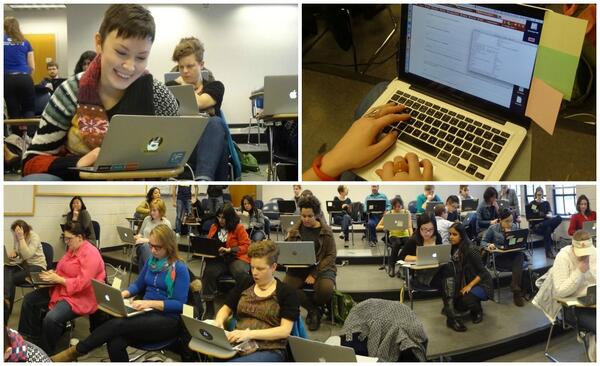
Pictures from the CDSW sessions in Spring 2014Pictures from the CDSW sessions in Spring 2014
I am helping coordinate three and a half day-long workshops in November for anyone interested in learning how to use programming and data science tools to ask and answer questions about online communities like Wikipedia, free and open source software, Twitter, civic media, etc. This will be a new and improved version of the workshops run successfully earlier this year. The workshops are for people with no previous programming experience and will be free of charge and open to anyone. Our goal is that, after the three workshops, participants will be able to use data to produce numbers, hypothesis tests, tables, and graphical visualizations to answer questions like: If you are interested in participating, fill out our registration form here before October 30th. We were heavily oversubscribed last time so registering may help. If you already know how to program in Python, it would be really awesome if you would volunteer as a mentor! Being a mentor will involve working with participants and talking them through the challenges they encounter in programming. No special preparation is required. If you re interested, send me an email.

18 October 2014

Erich Schubert: Beware of trolls - do not feed

A particularly annoying troll has been on his hate crusade against systemd for months now.
Unfortunately, he's particularly active on Debian mailing lists (but apparently also on Ubuntu and the Linux Kernel mailing list) and uses a tons of fake users he keeps on setting up. Our listmasters have a hard time blocking all his hate, sorry.
Obviously, this is also the same troll that has been attacking Lennart Poettering.
There is evidence that this troll used to go by the name "MikeeUSA", and has quite a reputation with anti-feminist hate for over 10 years now.
Please, do not feed this troll.
Here are some names he uses on YouTube: Gregory Smith, Matthew Bradshaw, Steve Stone.
Blacklisting is the best measure we have, unfortunately.
Even if you don't like the road systemd is taking or Lennart Poetting personall - the behaviour of that troll is unacceptable to say the least; and indicates some major psychological problems... also, I wouldn't be surprised if he is also involved in #GamerGate.
See this example (LKML) if you have any doubts. We seriously must not tolerate such poisonous people.
If you don't like systemd, the acceptable way of fighting it is to write good alternative software (and you should be able to continue using SysV init or openRC, unless there is a bug, in Debian - in this case, provide a bug fix). End of story.

13 October 2014

Dirk Eddelbuettel: Seinfeld streak at GitHub

Early last year, I referred to a Seinfeld Streak in a blog post referring to almost two months of updates to the Rcpp Gallery. This is sometimes called Jerry Seinfeld's secret to productivity: Just keep at it. Don't break the streak. I now have different streak:
github activity october 2013 to october 2014
Now we'll see how far this one will go.

This post by Dirk Eddelbuettel originated on his Thinking inside the box blog. Please report excessive re-aggregation in third-party for-profit settings.

12 October 2014

Iustin Pop: Day trip on the Olympic Peninsula

Day trip on the Olympic Peninsula TL;DR: drove many kilometres on very nice roads, took lots of pictures, saw sunshine and fog and clouds, an angry ocean and a calm one, a quiet lake and lots and lots of trees: a very well spent day. Pictures at http://photos.k1024.org/Daytrips/Olympic-Peninsula-2014/. Sometimes I travel to the US on business, and as such I've been a few times in the Seattle area. Until this summer, when I had my last trip there, I was content to spend any extra days (weekend or such) just visiting Seattle itself, or shopping (I can spend hours in the REI store!), or working on my laptop in the hotel. This summer though, I thought - I should do something a bit different. Not too much, but still - no sense in wasting both days of the weekend. So I thought maybe driving to Mount Rainier, or something like that. On the Wednesday of my first week in Kirkland, as I was preparing my drive to the mountain, I made the mistake of scrolling the map westwards, and I saw for the first time the Olympic Peninsula; furthermore, I was zoomed in enough that I saw there was a small road right up to the north-west corner. Intrigued, I zoomed further and learned about Cape Flattery ( the northwestern-most point of the contiguous United States! ), so after spending a bit time reading about it, I was determined to go there. Easier said than done - from Kirkland, it's a 4h 40m drive (according to Google Maps), so it would be a full day on the road. I was thinking of maybe spending the night somewhere on the peninsula then, in order to actually explore the area a bit, but from Wednesday to Saturday it was a too short notice - all hotels that seemed OK-ish were fully booked. I spent some time trying to find something, even not directly on my way, but I failed to find any room. What I did manage to do though, is to learn a bit about the area, and to realise that there's a nice loop around the whole peninsula - the 104 from Kirkland up to where it meets the 101N on the eastern side, then take the 101 all the way to Port Angeles, Lake Crescent, near Lake Pleasant, then south toward Forks, crossing the Hoh river, down to Ruby Beach, down along the coast, crossing the Queets River, east toward Lake Quinault, south toward Aberdeen, then east towards Olympia and back out of the wilderness, into the highway network and back to Kirkland. This looked like an awesome road trip, but it is as long as it sounds - around 8 hours (continuous) drive, though skipping Cape Flattery. Well, I said to myself, something to keep in mind for a future trip to this area, with a night in between. I was still planning to go just to Cape Flattery and back, without realising at that point that this trip was actually longer (as you drive on smaller, lower-speed roads). Preparing my route, I read about the queues at the Edmonds-Kingston ferry, so I was planning to wake up early on the weekend, go to Cape Flattery, and go right back (maybe stop by Lake Crescent). Saturday comes, I - of course - sleep longer than my trip schedule said, and start the day in a somewhat cloudy weather, driving north from my hotel on Simonds Road, which was quite nicer than the usual East-West or North-South roads in this area. The weather was becoming nicer, however as I was nearing the ferry terminal and the traffic was getting denser, I started suspecting that I'll spend a quite a bit of time waiting to board the ferry. And unfortunately so it was (photo altered to hide some personal information): Waiting for the ferry. The weather at least was nice, so I tried to enjoy it and simply observe the crowd - people were looking forward to a weekend relaxing, so nobody seemed annoyed by the wait. After almost half an hour, time to get on the ferry - my first time on a ferry in US, yay! But it was quite the same as in Europe, just that the ship was much larger. Once I secured the car, I went up deck, and was very surprised to be treated with some excellent views: Harbour view Looking towards the sun   and away from it The crossing was not very short, but it seemed so, because of the view, the sun, the water and the wind. Soon we were nearing the other shore; also, see how well panorama software deals with waves :P! Near the other shore And I was finally on the "real" part of the trip. The road was quite interesting. Taking the 104 North, crossing the "Hood Canal Floating Bridge" (my, what a boring name), then finally joining the 101 North. The environment was quite varied, from bare plains and hills, to wooded areas, to quite dense forests, then into inhabited areas - quite a long stretch of human presence, from the Sequim Bay to Port Angeles. Port Angeles surprised me: it had nice views of the ocean, and an interesting port (a few big ships), but it was much smaller than I expected. The 101 crosses it, and in less than 10 minutes or so it was already over. I expected something nicer, based on the name, but Anyway, onwards! Soon I was at a crossroads and had to decide: I could either follow the 101, crossing the Elwha River and then to Lake Crescent, then go north on the 113/112, or go right off 101 onto 112, and follow it until close to my goal. I took the 112, because on the map it looked "nicer", and closer to the shore. Well, the road itself was nice, but quite narrow and twisty here and there, and there was some annoying traffic, so I didn't enjoy this segment very much. At least it had the very interesting property (to me) that whenever I got closer to the ocean, the sun suddenly disappeared, and I was finding myself in the fog: Foggy road So my plan to drive nicely along the coast failed. At one point, there was even heavy smoke (not fog!), and I wondered for a moment how safe was to drive out there in the wilderness (there were other cars though, so I was not alone). Only quite a bit later, close to Neah Bay, did I finally see the ocean: I saw a small parking spot, stopped, and crossing a small line of trees I found myself in a small cove? bay? In any case, I had the impression I stepped out of the daily life in the city and out into the far far wilderness: Dead trees on the beach Trees growing on a rock Small panorama of the cove There was a couple, sitting on chairs, just enjoying the view. I felt very much intruding, behaving like I did as a tourist: running in, taking pictures, etc., so I tried at least to be quiet . I then quickly moved on, since I still had some road ahead of me. Soon I entered Neah Bay, and was surprised to see once more blue, and even more blue. I'm a sucker for blue, whether sky blue or sea blue , so I took a few more pictures (watch out for the evil fog in the second one): View towards Neah Bay port Sea view from Neah Bay Well, the town had some event, and there were lots of people, so I just drove on, now on the last stretch towards the cape. The road here was also very interesting, yet another environment - I was driving on Cape Flattery Road, which cuts across the tip of the peninsula (quite narrow here) along the Waatch River and through its flooding plains (at least this is how it looked to me). Then it finally starts going up through the dense forest, until it reaches the parking lot, and from there, one goes on foot towards the cape. It's a very easy and nice walk (not a hike), and the sun was shining very nicely through the trees: Sunny forest Sun shinning down Wooden path But as I reached the peak of the walk, and started descending towards the coast, I was surprised, yet again, by fog: Ugly fog again! I realised that probably this means the cape is fully in fog, so I won't have any chance to enjoy the view. Boy, was I wrong! There are three viewpoints on the cape, and at each one I was just "wow" and "aah" at the view. Even thought it was not a sunny summer view, and there was no blue in sight, the combination between the fog (which was hiding the horizon and even the closer islands), the angry ocean which was throwing wave after wave at the shore, making a loud noise, and the fact that even this seemingly inhospitable area was just teeming with life, was both unexpected and awesome. I took here waay to many pictures, here are just a couple inlined: First view at the cape Birds 'enjoying' the weather Foggy shore I spent around half an hour here, just enjoying the rawness of nature. It was so amazing to see life encroaching on each bit of land, even though it was not what I would consider a nice place. Ah, how we see everything through our own eyes! The walk back was through fog again, and at one point it switched over back to sunny. Driving back on the same road was quite different, knowing what lies at its end. On this side, the road had some parking spots, so I managed to stop and take a picture - even though this area was much less wild, it still has that outdoors flavour, at least for me: Waatch River Back in Neah Bay, I stopped to eat. I had a place in mind from TripAdvisor, and indeed - I was able to get a custom order pizza at "Linda's Woodfired Kitchen". Quite good, and I ate without hurry, looking at the people walking outside, as they were coming back from the fair or event that was taking place. While eating, a somewhat disturbing thought was going through my mind. It was still early, around two to half past two, so if I went straight back to Kirkland I would be early at the hotel. But it was also early enough that I could - in theory at least - still do the "big round-trip". I was still rummaging the thought as I left On the drive back I passed once more near Sekiu, Washington, which is a very small place but the map tells me it even has an airport! Fun, and the view was quite nice (a bit of blue before the sea is swallowed by the fog): Sekiu view After passing Sekiu and Clallam Bay, the 112 curves inland and goes on a bit until you are at the crossroads: to the left the 112 continues, back the same way I came; to the right, it's the 113, going south until it meets the 101. I looked left - remembering the not-so-nice road back, I looked south - where a very appealing, early afternoon sun was beckoning - so I said, let's take the long way home! It's just a short stretch on the 113, and then you're on the 101. The 101 is a very nice road, wide enough, and it goes through very very nice areas. Here, west to south-west of the Olympic Mountains, it's a very different atmosphere from the 112/101 that I drove on in the morning; much warmer colours, a bit different tree types (I think), and more flat. I soon passed through Forks, which is one of the places I looked at when searching for hotels. I did so without any knowledge of the town itself (its wikipedia page is quite drab), so imagine my surprise when a month later I learned from a colleague that this is actually a very important place for vampire-book fans. Oh my, and I didn't even stop! This town also had some event, so I just drove on, enjoying the (mostly empty) road. My next planned waypoint was Ruby Beach, and I was looking forward to relaxing a bit under the warm sun - the drive was excellent, weather perfect, so I was watching the distance countdown on my Garmin. At two miles out, the "Near waypoint Ruby Beach" message appeared, and two seconds later the sun went out. What the I was hoping this is something temporary, but as I slowly drove the remaining mile I couldn't believe my eyes that I was, yet again, finding myself in the fog I park the car, thinking that asking for a refund would at least allow me to feel better - but it was I who planned the trip! So I resigned myself, thinking that possibly this beach is another special location that is always in the fog. However, getting near the beach it was clear that it was not so - some people were still in their bathing suits, just getting dressed, so it seems I was just unlucky with regards to timing. However, I the beach itself was nice, even in the fog (I later saw online sunny pictures, and it is quite beautiful), the the lush trees reach almost to the shore, and the way the rocks are sitting on the beach: A lonely dinghy Driftwood  and human construction People on the beach Since the weather was not that nice, I took a few more pictures, then headed back and started driving again. I was soo happy that the weather didn't clear at the 2 mile mark (it was not just Ruby Beach!), but alas - it cleared as soon as the 101 turns left and leaves the shore, as it crosses the Queets river. Driving towards my next planned stop was again a nice drive in the afternoon sun, so I think it simply was not a sunny day on the Pacific shore. Maybe seas and oceans have something to do with fog and clouds ! In Switzerland, I'm very happy when I see fog, since it's a somewhat rare event (and seeing mountains disappearing in the fog is nice, since it gives the impression of a wider space). After this day, I was a bit fed up with fog for a while Along the 101 one reaches Lake Quinault, which seemed pretty nice on the map, and driving a bit along the lake - a local symbol, the "World's largest spruce tree". I don't know what a spruce tree is, but I like trees, so I was planning to go there, weather allowing. And the weather did cooperate, except that the tree was not so imposing as I thought! In any case, I was glad to stretch my legs a bit: Path to largest spruce tree Largest spruce tree, far view Largest spruce tree, closer view Very short path back to the road However, the most interesting thing here in Quinault was not this tree, but rather - the quiet little town and the view on the lake, in the late afternoon sun: Quinault Quinault Lake view The entire town was very very quiet, and the sun shining down on the lake gave an even stronger sense of tranquillity. No wind, not many noises that tell of human presence, just a few, and an overall sense of peace. It was quite the opposite of the Cape Flattery and a very nice way to end the trip. Well, almost end - I still had a bit of driving ahead. Starting from Quinault, driving back and entering the 101, driving down to Aberdeen: Afternoon ride then turning east towards Olympia, and back onto the highways. As to Aberdeen and Olympia, I just drove through, so I couldn't make any impression of them. The old harbour and the rusted things in Aberdeen were a bit interesting, but the day was late so I didn't stop. And since the day shouldn't end without any surprises, during the last profile change between walking and driving in Quinault, my GPS decided to reset its active maps list and I ended up with all maps activated. This usually is not a problem, at least if you follow a pre-calculated route, but I did trigger recalculation as I restarted my driving, so the Montana was trying to decide on which map to route me - between the Garmin North America map and the Open StreeMap one, the result was that it never understood which road I was on. It always said "Drive to I5", even though I was on I5. Anyway, thanks to road signs, and no thanks to "just this evening ramp closures", I was able to arrive safely at my hotel. Overall, a very successful, if long trip: around 725 kilometres, 10h:30m moving, 13h:30m total: Track picture There were many individual good parts, but the overall think about this road trip was that I was able to experience lots of different environments of the peninsula on the same day, and that overall it's a very very nice area. The downside was that I was in a rush, without being able to actually stop and enjoy the locations I visited. And there's still so much to see! A two nights trip sound just about right, with some long hikes in the rain forest, and afternoons spent on a lake somewhere. Another not so optimal part was that I only had my "travel" camera (a Nikon 1 series camera, with a small sensor), which was a bit overwhelmed here and there by the situation. It was fortunate that the light was more or less good, but looking back at the pictures, how I wish that I had my "serious" DSLR So, that means I have two reasons to go back! Not too soon though, since Mount Rainier is also a good location to visit . If the pictures didn't bore you yet, the entire gallery is on my smugmug site. In any case, thanks for reading!

Next.

Previous.