Search Results: "ema"

1 March 2014

Sune Vuorela: Diploma thesis about media choice and usage in Free Software communities: I need your help

My hard-working KDE friend Mario asked me to help him to get Debian people to help him with his thesis. Here is what he writes: Dear Free Software contributor* I m currently in the process of writing my diploma thesis. I ve worked hard during the last few weeks and months on a questionnaire which shall collect some data for my thesis. Furthermore the data of this survey will be interesting for the Free Software communities as well. So please take some time or add it to your todo list or, even better, go directly to my questionnaire and help me make a great diploma thesis and improve the Free Software community in some ways. The questionnaire takes some 20 to 30 minutes. At the end of the questionnaire you ll find a way to participate in a draw where you can even win something nice. In a first round I got the feedback that the length of the questionnaire and that some questions (mostly the ones at the beginning of the questionnaire about the 12 different tasks) are quite abstract and difficult. But please try it, try your best and take the time and brain power. The remaining part of the questionnaire [1] (after these two pages with the tasks questions) is quite
easy and quickly done. And you have the possibility to come back to where you
have left filling in the questionnaire after a shorter or longer break. And if there are any questions, feedback or you need help don t hesitate a moment to write me an email or ping me on IRC (freenode.net and oftc.net) as unormal. This survey will be open till Sunday, the 9th of March 2014, 23.59 UTC. Thanks to all for reading and helping and towards the summer of 2014 you can read here what all the data you gave me showed us and where we can learn and improve. Thanks in advance and best regards
Mario Fux * By contributor I mean not just developers but translators, artist, usability
people, documentation writers and many more. Everybody who contributes in one
way or the other to Free Software.

Michael Prokop: Jenkins on-demand slave selection through labels

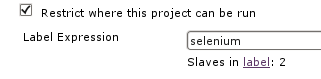
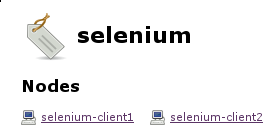
Problem description: One of my customers had a problem with their Selenium tests in the Jenkins continuous integration system. While Perl s Test::WebDriver still worked just fine the Selenium tests using Ruby s selenium-webdriver suddenly reported failures. The problem was caused by Debian wheezy s upgrade of the Iceweasel web browser. Debian originally shipped Iceweasel version 17.0.10esr-1~deb7u1 in wheezy, but during a security-update version 24.3.0esr-1~deb7u1 was brought in through the wheezy-security channel. Because the selenium tests are used in an automated fashion in a quite large and long-running build pipeline we immediately rolled back to Iceweasel version 17.0.10esr-1~deb7u1 so everything can continue as expected. Of course we wanted to get the new Iceweasel version up and running, but we didn t want to break the existing workflow while working on it. This is where on-demand slave selection through labels comes in. Basics: As soon as you re using Jenkins slaves you can instruct Jenkins to run a specific project on a particular (slave) node. By attaching labels to your slaves you can also use a label instead of a specific node name, providing more flexibility and scalability (to e.g. avoid problems if a specific node is down or you want to scale to more systems). Then Jenkins decides which of the nodes providing the according label should be considered for job execution. In the following screenshot a job uses the selenium label to restrict its execution to the slaves providing selenium and currently there are two nodes available providing this label: TIP 1: Visiting $JENKINS_SERVER/label/$label/ provides a list of slaves that provide that given $label (as well as list of projects that use $label in their configuration), like:

TIP 2: Execute the following script on $JENKINS_SERVER/script to get a list of available labels of your Jenkins system:
import hudson.model.*
labels = Hudson.instance.getLabels()
labels.each  label -> println label.name  
Solution: In the according customer setup we re using the swarm plugin (with automated Debian deployment through Grml s netscript boot option, grml-debootstrap + Puppet) to automatically connect our Jenkins slaves to Jenkins master without any manual intervention. The swarm plugin allows you to define the labels through the -labels command line option. By using the NodeLabel Parameter plugin we can configure additional parameters in Jenkins jobs: node and label . The label parameter allows us to execute the jobs on the nodes providing the requested label: This is what we can use to gradually upgrade from the old Iceweasel version to the new one by keeping a given set of slaves at the old Iceweasel version while we re upgrading other nodes to the new Iceweasel version (same for the selenium-server version which we want to also control). We can include the version number of the Iceweasel and selenium-server packages inside the labels we announce through the swarm slaves, with something like:
if [ -r /etc/init.d/selenium-server ] ; then
  FLAGS="selenium"
  ICEWEASEL_VERSION="$(dpkg-query --show --showformat='$ Version ' iceweasel)"
  if [ -n "$ICEWEASEL_VERSION" ] ; then
    ICEWEASEL_FLAG="iceweasel-$ ICEWEASEL_VERSION%%.* "
    EXTRA_FLAGS="$EXTRA_FLAGS $ICEWEASEL_FLAG"
  fi
  SELENIUM_VERSION="$(dpkg-query --show --showformat='$ Version ' selenium-server)"
  if [ -n "$SELENIUM_VERSION" ] ; then
    SELENIUM_FLAG="selenium-$ SELENIUM_VERSION%-* "
    EXTRA_FLAGS="$EXTRA_FLAGS $SELENIUM_FLAG"
  fi
fi
Then by using -labels $FLAGS EXTRA_FLAGS in the swarm invocation script we end up with labels like selenium iceweasel-24 selenium-2.40.0 for the slaves providing the Iceweasel v24 and selenium v2.40.0 Debian packages and selenium iceweasel-17 selenium-2.40.0 for the slaves providing Iceweasel v17 and selenium v2.40.0. This is perfect for our needs, because instead of using the selenium label (which is still there) we can configure the selenium jobs that should continue to work as usual to default to the slaves with the iceweasel-17 label now. The development related jobs though can use label iceweasel-24 and fail as often as needed without interrupting the build pipeline used for production. To illustrate this here we have slave selenium-client2 providing Iceweasel v17 with selenium-server v2.40. When triggering the production selenium job it will get executed on selenium-client2, because that s the slave providing the requested labels: Whereas the development selenium job can point to the slaves providing Iceweasel v24, so it will be executed on slave selenium-client1 here: This setup allowed us to work on the selenium Ruby tests while not conflicting with any production build pipeline. By the time I m writing about this setup we ve already finished the migration to support Iceweasel v24 and the infrastructure is ready for further Iceweasel and selenium-server upgrades.

Vasudev Kamath: Gzipped response for CSS/JS with Apache and mod_uwsgi

So it may sound normal to receive compressed response for CSS/JS file from Apache2 but what I faced is completely different behavior, here I saw not just body of response but also header are getting compressed and send to browser and browser was unable to interpret the response there by leading page rendered without CSS and JS. That was long story short, so let me explain in detail the case and what I found out. I have hosted SILPA on my VPS using uWSGI. I had used till date using libapache2-mod-proxy-uwsgi plugin for which uWSGI should be using network socket and in Apache2 config I need ProxyPass directive pointing to uwsgi://host:port and everything used to work out of box. There is a drawback for using network socket in uWSGI that is limited amount of ports (65535) and possible clash with other services if we use wrong port number, additionally network sockets will be slower compared to the file socket so yesterday I thought of changing it to file socket and removed socket directive in the ini file for uWSGI application container for SILPA and here is where all problems started. My updated configuration can be seen in our documentation page that is if you are interested to look my configuration file :-).
Problem Reporting We got selected to Gsoc again this year and we have lot of students jumping in our channel #silpa on irc.freenode.net and yesterday night some students reported they are facing 500 internal server error and subsequently others mentioned there is no theme being rendered. I checked and found everything was fine for me only to notice that my browser was using cached content, and when I clear cache there I go everything vanished, no theme no css no javascript just plain html!!!.
Investigation So I thought I should investigate this and fired up firebug on my iceweasel to observe the network traffic. And below is what I observed in firebug network console!. No response headers So you can see no response header in the above image but there is a response and below how is response content visible on firebug. gzipped response Still weird part was when using wget/curl directly to get the CSS I was getting correct reply and the file, which is puzzling. So I went ahead opened the CSS url directly using browser and saved the resulting file. When I used file command on it, output suggested the saved file in gzip compressed!. I went ahead uncompressed it and opened the file and inside it I found response header and the response body! So what just happened? Did apache some how manage to compress entire respone not just response body? The more puzzling question was why did it work when I was using mod_proxy_uwsgi and failed when I switched to mod_uwsgi. I had no clue at this point why this behavior is coming up.
Possible Solution I was still not sure how to resolve this, and started searching in the network but nothing was coming up in search result which can explain me this. And finally I stumbled on a link which is totally unrelated but I saw the word mod_deflate in the content and wandered on my system to see if its enabled. Yes mod_deflate was enabled I just opened the conf file and saw following.
<IfModule mod_deflate.c>
       # these are known to be safe with MSIE 6
       AddOutputFilterByType DEFLATE text/html text/plain text/xml
       # everything else may cause problems with MSIE 6
       AddOutputFilterByType DEFLATE text/css
       AddOutputFilterByType DEFLATE application/x-javascript application/javascript application/ecmascript
       AddOutputFilterByType DEFLATE application/rss+xml
</IfModule>
Interesting so it suggests to compress css, javascript files etc. So I thought possibly its compressing the result of mod_uwsgi, yeah possibly so why not try disabling mod_deflate and check if it works well and good if not I'm not gonna loose anything. So I disabled mod_deflate and voila! Everything is working fine!
What might be the reason for this behavior? Well I'm not exactly sure but here is my assumption. The whole behavior depends on internal implementation of mod_uwsgi and mod_proxy_uwsgi module. To confirm this I switched back to use mod_proxy_uwsgi module and enabled mod_deflate and observed request response in Firebug network console and below is what I observed. Response with mod_proxy_uwsgi So response is still gziped but this time only response body was gziped and Content-Encoding field was set properly which makes browser to properly uncompress the response body and use it. So it seems like there is a difference between mod_uwsgi and mod_proxy_uwsgi implementation. mod_uwsgi was sending the response along with response headers which was compressed by mod_deflate there by rendering browser helpless to interpret the response. But mod_proxy_uwsgi seems to be only sending the response content without response body and this content was later compressed by mod_deflate and proper response headers were set by apache before sending it to browser. So now whose fault is this? Is it the bug in mod_uwsgi or, mod_deflate not being able to exclude response headers from compression? I've no clue! If you have a clue and you want to share it with me, please consider writing to me over email. My details are available in Contacts

28 February 2014

Daniel Pocock: Google Summer of Code opportunities in data science and machine learning with Ganglia

As mentioned in my blog on Monday, the Ganglia Project is proud to be part of Google Summer of Code in 2014 The Ganglia team are offering various types of projects and different parts of Ganglia would welcome students with different skills, for example:
Component Skills
gmond agent C
gmond modules C or Python
JMXetric Java
gmetad and rrdtool for storing time series data C
Ganglia web interface JavaScript and jQuery
Ganglia integration (e.g. ganglia-nagios-bridge) Python
Big data right under your nose I have had many queries from students about how to get into data science. Very few students will be lucky enough to get an internship where they can study time-series from the financial markets and experiment making their own trading algorithms. On the other hand, network performance data is everywhere. It is real-time. It is surprisingly similar in some ways to processing financial data and it provides excellent opportunities for students to practice data science skills and make a meaningful contribution to solving real problems. Finding public Ganglia data with Google Many large organizations, including universities, governments and corporations are using Ganglia to gather metrics from all the hosts in their networks. Some of them even expose this data to the public. Here are two Google searches you can use to find them:
Courtesy of Universit Montpellier 2, France Some sites may even expose their data as an XML feed, you can try and extract it by connecting to the Ganglia server on one of these ports
Port Comments
8649 gmond: sends an XML snapshot to anybody who connects
8651 gmetad: sends an XML snapshot to anybody who connects
8651 gmetad: works a little bit like HTTP, returns a subset of the XML snapshot when you make a GET request
You can discover a Ganglia environment in your campus by looking for a gmond process on your machine and the gmond.conf file, often in /etc/gmond.conf or /etc/ganglia/gmond.conf. That file may contain a clue about the name of the host where Ganglia data is aggregated:
udp_send_channel  
  host = ganglia-reports.example.edu
  port = 8649
  ttl = 1
 
This tells you that the host ganglia-reports.example.edu is collecting the data - you could try the URL http://ganglia-reports.example.edu/ganglia/ in a web browser or try connecting to one of the TCP ports 8649, 8651 or 8652 on that host. Here is an example with netcat:
$ nc ganglia-reports.example.edu 8649   grep ^.H
It will return a list of all hosts that Ganglia knows about. Once you have a data feed, you can then configure a gmetad process on your own system to poll the remote system and generate local RRDs for you to study. Install your own Ganglia It is very easy to get your own Ganglia setup. On a Debian or Ubuntu system, just do:
# apt-get update
# apt-get install ganglia-monitor ganglia-webfrontend
On Fedora and RPM-based systems (such as CentOS or RHEL with EPEL) you can do:
# yum install ganglia-gmond ganglia-web
Everything should be autoconfigured. You can then browse to http://localhost/ganglia to see the charts. If you have several hosts with the gmond agent (just the ganglia-monitor.deb or ganglia-gmond.rpm) on the same LAN, they will automatically find each other using multicast and you will see an aggregated report on the machine with the web server. The data is real-time It is important to keep in mind that the data is real-time. This means you can often detect problems in real-time. If this blog appears on slashdot, for example, then that image from Universit Montpellier 2 will be hit many times. The image actually shows the network load on the web server producing the image, so you will see the slashdot effect graphically in the image itself. Processing real-time data is often the most advanced step in any data science exercise. Initially, you may simply log a few days of data to RRD files to start studying a static data set with your tool of choice, whether it is the R project, Weka or Hadoop Once you have a a hypothesis (for example, an algorithm that understands the normal characteristics of each metric) you may then take each new real-time value from the gmetad XML and test it with the algorithm. The algorithm would then raise an alert if any metric on any host deviates from its normal behavior. Mixing in other sources of data Depending upon the computing environment in your campus or organization, you may also be able to get other data sources, such as a list of people logged in to different machines at different times and the processes that each user starts and stops. This might help to make more accurate predictions about when network or computing resources will be under stress. For example, if users bob, alice and eve all appear on the same host, your algorithm might conclude that the load average will reach an excessive level within 15 minutes and send those three users a suggestion to each try other machines. Making a successful application for GSoC 2014 Here are some tips
  • For all organizations/projects
  • For Ganglia and the data science project in particular
    • Join the ganglia-general mailing list and send an email to introduce yourself
    • Try Ganglia on your own Linux system. Use the packages, it is really easy. Send an email to the list with any questions.
    • Explore the source code in github - ask us questions about it. For the data science project, you may also need to look at RRDtool source code and documentation about making a plugin for R (using C)
    • You don't have to do it our way: if you prefer to work with another tool instead of R, please tell us your idea
    • Write some skeleton code or make a diagram to explain what you want to do. While you do this, do you think of any new questions or problems? Make a list of them.
    • We want to give every student a small coding task as a test. Please tell us which language you prefer (e.g. C, Java, Python) so we can give you a suitable test. If you are really keen, follow the link to bugs I reported in Debian, look for one that is easy and try to write a small patch for it - helping fix bugs that annoy your mentor is likely to be a good way to get on the short-list for selection.

27 February 2014

Stefano Zacchiroli: moar stats for sources.debian.net

Debian: watch your stats! Over the past few weeks, myself and Matthieu Caneill have worked quite a bit on Debsources. As we have now deployed most of the new features on http://sources.debian.net, it's time for another "What's new with Debsources?" blog post. Here is what's new: Want more? Sure, we'll be happy to! But it'll happen faster if you help. Speaking of which: we've got Debsources into the new contributors game (see announcement) and we're looking forward to mentor new contributors.

Andrew Pollock: [life] Day 30, A full day on Coochie

Last night went pretty well. Once I got Zoe to sleep, she slept well, with only a brief wake up around 2am. Any mosquito bites she sustained didn't seem to give her any grief. She woke this morning at 6am. It makes me think the blackout curtains at home aren't really contributing to her sleeping in. We had a lazy start to the day. Zoe watched some TV after breakfast, and after I had a shower, fed some bread crusts to the chickens and then we played with the box of dress up costumes for a little while. After that, we jumped on the bike and went down to check out the trademark of Quirky Cottages, a bunch of converted rail cars and "zoo". There were chickens, geese, guinea pigs, a sheep and a donkey. The rail cars weren't anything much to phone home about (much like the Cow House). In fact the whole affair looked a bit dilapidated. Then we continued on the bike down to the local playground, where Zoe had a swing for a bit. We walked over to the jetty and watched the passenger ferry arrive, and then bought a loaf of bread at the store and biked back to the house. It was too early to have lunch, so we just pottered around in the yard. We inspected the chicken coop, and Zoe played on the swings and swung from the rope swing. We tried and failed to catch a chicken, because Zoe wanted me to pick one up. We had lunch, and then Zoe had some fabulous self-directed imaginative play indoors with the various props the house had to offer, while I put my feet up. Then she declared she wanted to take a nap anyway. After her nap, I wanted to go back to the beach. I'd gotten myself all organised so that we could try and jump on the bike as soon as possible once Zoe woke up, but there was the requisite amount of stuffing around. I'd put Zoe's water shoes on, so she could ride in the trailer in her swim gear ready to go, but she had a mosquito bite on her foot that was giving her grief, so I cut my losses, and took the water shoes off and put her sandals back on, and promptly left the water shoes behind. We got all the way to the beach before I realised, and so we had to go back and get them. Once we finally made it back to the beach, I chose a different location than yesterday, just so we would not have any memories of the mud crab incident to deal with. It turned out to be a good choice, because we had a fabulous time exploring. The tide was even lower than yesterday, and the water was a bit silty, so we didn't do much paddling around in it, instead we explored the rock pools. We found some tiny (1 centimetre and smaller) hermit crabs. These didn't seem to freak Zoe out, and she was even prepared to hold them. We saw some really small mud crabs. Once we were still for a little while heaps of soldier crabs started coming out, right near us. That was pretty cool. On the walk back to the bike, I found a crab claw on the beach, so Zoe got to take that as souvenir. I showed her how the claw opened and closed. I think we'll have to eat a crab in the near future, just so she can get a good look at one up close. I most liked how as the excursion progressed, Zoe became more and more confident with the rocks and the tide pools. Initially she was apprehensive of everything, but starting with the soldier crabs, she'd become more and more comfortable with everything. I'd poke at stuff, she'd poke at stuff. It finished with her being comfortable wandering off to explore on her own. We got home, Zoe had a shower and then I made dinner while she watched TV. We read some stories and so far bedtime appears to have gone pretty smoothly, which is good. I'm feeling quite exhausted. Tomorrow morning we have to pack everything up and be on the 9am barge out of here so we can race home, and repack to fly down to Melbourne for the weekend.

26 February 2014

Vincent Sanders: There are only two hard things in Computer Science: cache invalidation and naming things.

It is the first of these which I have recently been attempting and I think Phil Karlton might have a good point.
What are we talking about?Web browsers are pretty complex beasties but the basic concept is pretty easy to understand. They fetch a bunch of files that make up a web page and render those source files into something suitable for human consumption.

It is also intuitive that fetching all the files that make up a web page, every time you browse to a new page, might be wasteful, especially if most of the files had not changed from the previous page.

In order to address this browsers hang onto copies of these files in case your browsing needs them again, this is known as a source file cache. Caches are a widely used technique throughout many aspects of computer technology but the basic idea is that they trade one resource for another.

In this case we are trading local storage space (memory or disc) for access time. This type of trade may give large benefits due to the large differences in access times (sometimes known as latency) between local and network resources.

For example, if the source files that make up a web page are a Megabyte in size accessed with a 2013 era PC with a 10Mbit connection to the Internet:
From this example it becomes startlingly obvious why a source cache is so desirable. I have greatly simplified the browsers operation here as they usually implement many layers of additional caching in other areas to make the browsing experience subjectively smoother.

And before the observant reader suggests that we could just make the network faster it ought to be mentioned that due to fundamental physical constraints, like the speed of light, it would be unlikely that the average practical network reply will ever drop much below 150,000 s [1] or some 40 times slower than disc. Still a worthwhile gain.
Knowing the cost of everything and the value of nothingHaving shown the benefits it might be nice to think there are no downsides to caching, this is not the case, as I mentioned we are trading storage for time and as in any trade one must expect there to be overheads.

In the case of a browser we face several obstacles. Firstly not every file that goes to make up a web page can be cached. The HTTP specification contains an entire section on caching which contains numerous rules and operations to ensure that only objects that should be cached are and determines for how long they can be kept before going "stale".

A great deal of this complexity comes from just how desirable caching is to network providers. Many ISPs will have web proxy servers to cache requests for all users to reduce their bandwidth usage, or increasingly, to implement content filtering according to the local government censorship rules. The browsers cache must know how to interact with these proxies without getting erroneous results.

Then comes the problem alluded to in the section title. A browsers cache cannot grow indefinitely. Eventually a system would run out of memory and disc if a browser kept every file. To deal with this the cache is limited sometimes by the number of files it holds, but more commonly by size both in memory and on disc.

The caching structure used by a web browser is hierarchical in that it will first evict (move) files from memory to a backing store (disc) and when the disc cache size limit is exceeded files are evicted to the next tier. Which in this case, will involve deleting the local copy (invalidating) and requiring performing a fetch from the network if the file is needed again.

Tardis at the Beeb by Sarah G from flikrWhen the cache size is exceeded the decision is made about what to remove from the cache using a cache strategy or algorithm. The aim of this decision is to discard the data that will not be required again for the longest time.

If we had a blue box with a madman inside, who we could persuade to bring our browsing history back from the future, implementing b l dy's algorithm might be possible. Failing a perfect solution we are reduced to making a judgement based on the information available to us.

This involves computing a cost for replacing each entry in the cache and evicting those with the lowest values. The selected algorithm has a large impact on the effectiveness of the cache and often needs fine tuning for the task at hand.
Never has so little been measured so muchHaving established that caching is useful and that we need to make decisions on what to keep it follows that those decisions must be based on information. This information consists of two main groups:
Maintaining all of this information is a significant part of the overheads involved with caching and a compromise must be struck between having the necessary information to make good caching choices and the cost maintaining that data.
Cache metricsMost cache implementations maintain at least some basic metrics, at the very least how much storage is being used so a decision on if evicting entries from the cache to reclaim space is necessary.

It is also common to keep a record of how well the cache is performing. The cache efficiency (the hit rate) is usually measured as the ratio of successful accesses provided from the cache (a cache hit) to the total number of requests to the cache.

A perfect cache would have all hits and no misses (a hit rate of 1) while using as little storage as possible (but as already noted that requires a special madman). The hit rate can be used to automatically change the behaviour of the eviction algorithm, perhaps using more storage if the hit rate drops too low or changing the eviction frequency.
MetadataEach object must carry with it the data necessary to regain its state when retrieved from the cache. This information is essential for the correct operation of the cache but in of itself provides no direct value.

In the case of browser source data this includes all the headers sent in the original network fetch. These headers are themselves just metadata sent along with the object by the web server which must be preserved.

Two particularly useful value for making a good eviction decision are how long it has been since the object was last used and how many times it has been used. This is because an object that was cached a long time ago and then never used again is much less valuable than one that has recently been repeatedly used.
An ImplementationIt is all very well talking about the general solution but a full understanding can only be gained by examining a real implementation. The NetSurf cache was chosen as it is a suitably small amount of code but still demonstrates all the major design features.
InterfaceThe cache deals with all source data and provides the browser with a single unified object request interface regardless of if the source data can be cached or not. This is useful to hide the implementation details allowing for changes without affecting the rest of the browsers code.

The implementation effectively consists of two lists of objects, those that can be cached and those that cannot. Each object on these lists is reference counted against one or more users and while there is at least one user the source data is maintained in memory.

Objects determined to be non cached are always directly fetched from their source and are immediately released once they have no users remaining.

For cacheable objects an attempt is made to fulfil the request in descending order:
  1. from objects already in memory.
  2. from the backing store.
  3. from a network fetch.
Irrespective of the source of the data the remaining operations on the object (determining freshness etc.) are exactly as if the request had been fulfilled from the network. This approach means the use of the cache is transparent to the object users.
WriteoutObjects are placed in the backing store asynchronously to any other operations. When an object has been fetched from the network a background task is scheduled for when the browser is otherwise idle.

This writeout task constructs a list of all cacheable objects not yet in the backing store, associates a cost value with each object and then proceeds to write those objects to the backing store in highest to lowest value order.
CleaningA periodically scheduled task deals with ensuring the cache is cleaned. This consists of destroying stale objects and arranging fresh objects are not using more memory than the configuration permits.

Memory usage is reduced within the cleaning task by discarding the source data for objects already held in the backing store (where the data can be retrieved relatively cheaply)

Additional memory may be recovered by simply discarding unused objects held only in memory. These objects are usually those which have only recently become unused otherwise the writeout task would have committed them to the backing store.

The most recently used objects are statistically likely to be used again soon, because of this there is a high risk of a cache miss associated with discarding these objects. In order to mitigate this undesirable effect the cleaning heuristic favours using more memory than configured for short periods rather than discarding from memory.
Backing storeThe backing store is a simple key-value database. Each source data object and its metadata (its headers etc.) is associated with a unique key (the URL used to fetch it). The backing store is simply required to store and retrieve the object data associated with the given URL.

The backing store implementation in NetSurf is pluggable, this flexibility is required for dealing with the greatly varying capabilities and limits of the various systems the browser is required to execute on.

A novel aspect of this backing store interface is that if an implementation returns the wrong object it is not considered an error and is simply treated as a cache miss. This is possible because the metadata contains the URL of the stored object enabling object verification.

This behaviour is permitted because techniques which significantly improve key-value store performance (principally key hashing) become available if they are not required to always give the correct answer.

The backing store is also required to manage its size within the configured limits and deal with any filesystem behaviour details.

The reference backing store is trivial in that it performs a hash operation on the input URL, encodes the result with base64url encoding and uses that as the object filename. The length of the hash can be configured allowing use of the reference implementation in any situation where using the filesystem as a database is acceptable.

The reference backing store default hash is SHA-1 yielding almost unique [2] 160 bit key values stored in much the same way as the git DVCS. Note we are not using this hash for its cryptographic properties and at worst a collision will result in the cache being a tiny amount less efficient.
ConclusionHopefully this has shown what a browser source file cache is, why it is useful and a basic understanding of how they are implemented.

I will admit I have glossed over some of the more challenging aspects especially in relation to actually implementing the cache strategy but I hope that the reader will forgive those omissions of detail in a quest for a little more clarity of the general principles.

I would like to thank John-Mark Bell for implementing the NetSurf cache and to Melodie Parry for proof reading and providing feedback.

[1] Speed of light is 3x10^8m/s earth circumference is 4x10^7m, divide circumference by speed gives 133,000 s which gives longest round trip time from anywhere on surface of earth to point furthest from. So assuming a whole megabyte can be transferred in one round trip and allowing for some overhead the lower bound estimate of 150,000 s looks reasonable.

[2] Mathematically speaking this hash would allow us to say that with the current estimated 1x10^11 URLs on the internet the likelihood of a collision is still vanishingly small (at least 1x10^-15)

25 February 2014

Steve Kemp: What do you pay for, and what would you pay for?

There are times when I consider launching my own company again, most often when it is late at night and the inpetitude of so many other companies gets me too worked up. Then I sit back and think about details and write it off. I've worked for myself in the past a couple of times, and each time it was both more fun and more difficult than expected. Getting a couple of clients is usually easy, getting a ten more is common, but getting "many" is hard and getting "lots" is something I've never done - lots of users for free sites though, along with the associated support burdon! So the though dies away once I sit down and work out the net profit I'd need to live. My expenses are low, so let us pretend I can easily live on 1000 a month. So the "company" has to make more than that, to cover costs, but perhaps not much. Pretend you were offering DNS hosting you'd probably be able to implement that easily on, say 10, virtual machines, net of 150 a month. Imagine clients pay 5 for an unlimited number of domains that means you need to have 1000+150/5 = 230 clients. Not impossible, but also not easy. Pretend instead you're offering backup space, and the numbers get bigger because disk is expensive. Again getting some users would be easy, but getting lots would be hard because your competition is dropbox, skydrive, etc, etc. Once you start thinking of "ideas" they come easily, but the hard part is being realistic about what people would pay for. As always the idea is the easy part, the execution is the hardest part. Realistically if I were to be desperate to work for myself at short notic I'd do the obvious thing - I'd buy a pair of ladders, a bucket, and clean windows. Low overheads, reasonable demand, and I'd be both "fit" and "outdoors". When it comes to paying for online services off the top of my head I personally pay for maybe two things, both of them niche (although profitable for their providers I'm sure), and I know many people who live on the internet but pay for nothing.
For example I'm a VIP member of an online modeling community, which in theory allows me a higher chance of persuading interesting people to pose for me. In practice the turnover on those sites is immense. Lots of cute boys and girls hear constantly "You're so pretty, you should be a model", which is true in perhaps 1% of cases, and the net result is you have a few hard working people who do good things day in day out, and many flighty teenagers who'll pose for two-three people, and then never do it again because they realise it is neither glamourous nor easy money.
Two things I've semi-serously considered recently where hosted "status pages", and hosted "domain parking", but both have many competitors and both I can see a) some people would pay for but b) not very many. I suspect there is no universal "I'd pay for this" online service hwich is both competition free and genuinely trivial to setup, but I'd be curious to see what people are missing, and even more curious to see what people do pay for.

Bits from Debian: Call for participants in the Google Summer of Code for Debian

GSoC 2014 logo The Google Summer of Code is a program that allows post-secondary students aged 18 and older to earn a stipend writing code for Free and Open Source Software projects during the summer. Debian has just been accepted as a mentoring organization for this year's program! We're looking for students and mentors to make this GSoC in Debian the best ever! Eligible students, now is the time to take a look at our project ideas list, engage with the mentors for the projects you find interesting, and start working on your application! For more information, please read the FAQ and the Program Timeline on Google's website. Mentors for prospective projects can still submit proposals on the project ideas list. You also need to send an email to the mailing list linked below to present your project in a few words. Feel also free to propose yourself as a co-mentor for one of the listed projects, more help is always welcome! If you are interested, we encourage you to come and chat with us on irc (#debian-soc on irc.oftc.net), or to send an email to the SoC coordination mailing-list (subscribe). Most of the Debian-specific GSoC information can be found on our wiki pages, but don't be afraid to ask us directly on irc or via email. We're looking forward to work with an amazing team of students and mentors again this summer!

24 February 2014

Vincent Bernat: Coping with the TCP TIME-WAIT state on busy Linux servers

TL;DR: Do not enable net.ipv4.tcp_tw_recycle. The Linux kernel documentation is not very helpful about what net.ipv4.tcp_tw_recycle does:
Enable fast recycling TIME-WAIT sockets. Default value is 0. It should not be changed without advice/request of technical experts.
Its sibling, net.ipv4.tcp_tw_reuse is a little bit more documented but the language is about the same:
Allow to reuse TIME-WAIT sockets for new connections when it is safe from protocol viewpoint. Default value is 0. It should not be changed without advice/request of technical experts.
The mere result of this lack of documentation is that we find numerous tuning guides advising to set both these settings to 1 to reduce the number of entries in the TIME-WAIT state. However, as stated by tcp(7) manual page, the net.ipv4.tcp_tw_recycle option is quite problematic for public-facing servers as it won t handle connections from two different computers behind the same NAT device, which is a problem hard to detect and waiting to bite you:
Enable fast recycling of TIME-WAIT sockets. Enabling this option is not recommended since this causes problems when working with NAT (Network Address Translation).
I will provide here a more detailed explanation in the hope to teach people who are wrong on the Internet. xkcd illustration As a sidenote, despite the use of ipv4 in its name, the net.ipv4.tcp_tw_recycle control also applies to IPv6. Also, keep in mind we are looking at the TCP stack of Linux. This is completely unrelated to Netfilter connection tracking which may be tweaked in other ways1.

About TIME-WAIT state Let s rewind a bit and have a close look at this TIME-WAIT state. What is it? See the TCP state diagram below2: TCP state diagram Only the end closing the connection first will reach the TIME-WAIT state. The other end will follow a path which usually permits to quickly get rid of the connection. You can have a look at the current state of connections with ss -tan:
$ ss -tan   head -5
LISTEN     0  511             *:80              *:*     
SYN-RECV   0  0     192.0.2.145:80    203.0.113.5:35449
SYN-RECV   0  0     192.0.2.145:80   203.0.113.27:53599
ESTAB      0  0     192.0.2.145:80   203.0.113.27:33605
TIME-WAIT  0  0     192.0.2.145:80   203.0.113.47:50685

Purpose There are two purposes for the TIME-WAIT state:
  • The most known one is to prevent delayed segments from one connection being accepted by a later connection relying on the same quadruplet (source address, source port, destination address, destination port). The sequence number also needs to be in a certain range to be accepted. This narrows a bit the problem but it still exists, especially on fast connections with large receive windows. RFC 1337 explains in details what happens when the TIME-WAIT state is deficient3. Here is an example of what could be avoided if the TIME-WAIT state wasn t shortened:
Duplicate segments accepted in another connection
  • The other purpose is to ensure the remote end has closed the connection. When the last ACK is lost, the remote end stays in the LAST-ACK state4. Without the TIME-WAIT state, a connection could be reopened while the remote end still thinks the previous connection is valid. When it receives a SYN segment (and the sequence number matches), it will answer with a RST as it is not expecting such a segment. The new connection will be aborted with an error:
Last ACK lost RFC 793 requires the TIME-WAIT state to last twice the time of the MSL. On Linux, this duration is not tunable and is defined in include/net/tcp.h as one minute:
#define TCP_TIMEWAIT_LEN (60*HZ) /* how long to wait to destroy TIME-WAIT
                                  * state, about 60 seconds     */
There have been propositions to turn this into a tunable value but it has been refused on the ground the TIME-WAIT state is a good thing.

Problems Now, let s see why this state can be annoying on a server handling a lot of connections. There are three aspects of the problem:
  • the slot taken in the connection table preventing new connections of the same kind,
  • the memory occupied by the socket structure in the kernel, and
  • the additional CPU usage.
The result of ss -tan state time-wait wc -l is not a problem per se!

Connection table slot A connection in the TIME-WAIT state is kept for one minute in the connection table. This means, another connection with the same quadruplet (source address, source port, destination address, destination port) cannot exist. For a web server, the destination address and the destination port are likely to be constant. If your web server is behind a L7 load-balancer, the source address will also be constant. On Linux, the client port is by default allocated in a port range of about 30,000 ports (this can be changed by tuning net.ipv4.ip_local_port_range). This means that only 30,000 connections can be established between the web server and the load-balancer every minute, so about 500 connections per second. If the TIME-WAIT sockets are on the client side, such a situation is easy to detect. The call to connect() will return EADDRNOTAVAIL and the application will log some error message about that. On the server side, this is more complex as there is no log and no counter to rely on. In doubt, you should just try to come with something sensible to list the number of used quadruplets:
$ ss -tan 'sport = :80'   awk ' print $(NF)" "$(NF-1) '   \
>     sed 's/:[^ ]*//g'   sort   uniq -c
    696 10.24.2.30 10.33.1.64
   1881 10.24.2.30 10.33.1.65
   5314 10.24.2.30 10.33.1.66
   5293 10.24.2.30 10.33.1.67
   3387 10.24.2.30 10.33.1.68
   2663 10.24.2.30 10.33.1.69
   1129 10.24.2.30 10.33.1.70
  10536 10.24.2.30 10.33.1.73
The solution is more quadruplets5. This can be done in several ways (in the order of difficulty to setup):
  • use more client ports by setting net.ipv4.ip_local_port_range to a wider range,
  • use more server ports by asking the web server to listen to several additional ports (81, 82, 83, ),
  • use more client IP by configuring additional IP on the load balancer and use them in a round-robin fashion,
  • use more server IP by configuring additional IP on the web server6.
Of course, a last solution is to tweak net.ipv4.tcp_tw_reuse and net.ipv4.tcp_tw_recycle. Don t do that yet, we will cover those settings later.

Memory With many connections to handle, leaving a socket open for one additional minute may cost your server some memory. For example, if you want to handle about 10,000 new connections per second, you will have about 600,000 sockets in the TIME-WAIT state. How much memory does it represent? Not that much! First, from the application point of view, a TIME-WAIT socket does not consume any memory: the socket has been closed. In the kernel, a TIME-WAIT socket is present in three structures (for three different purposes):
  1. A hash table of connections, named the TCP established hash table (despite containing connections in other states) is used to locate an existing connection, for example when receiving a new segment. Each bucket of this hash table contains both a list of connections in the TIME-WAIT state and a list of regular active connections. The size of the hash table depends on the system memory and is printed at boot:
    $ dmesg   grep "TCP established hash table"
    [    0.169348] TCP established hash table entries: 65536 (order: 8, 1048576 bytes)
    
    It is possible to override it by specifying the number of entries on the kernel command line with the thash_entries parameter. Each element of the list of connections in the TIME-WAIT state is a struct tcp_timewait_sock, while the type for other states is struct tcp_sock7:
    struct tcp_timewait_sock  
        struct inet_timewait_sock tw_sk;
        u32    tw_rcv_nxt;
        u32    tw_snd_nxt;
        u32    tw_rcv_wnd;
        u32    tw_ts_offset;
        u32    tw_ts_recent;
        long   tw_ts_recent_stamp;
     ;
    struct inet_timewait_sock  
        struct sock_common  __tw_common;
        int                     tw_timeout;
        volatile unsigned char  tw_substate;
        unsigned char           tw_rcv_wscale;
        __be16 tw_sport;
        unsigned int tw_ipv6only     : 1,
                     tw_transparent  : 1,
                     tw_pad          : 6,
                     tw_tos          : 8,
                     tw_ipv6_offset  : 16;
        unsigned long            tw_ttd;
        struct inet_bind_bucket *tw_tb;
        struct hlist_node        tw_death_node;
     ;
    
  2. A set of lists of connections, called the death row , is used to expire the connections in the TIME-WAIT state. They are ordered by how much time left before expiration. It uses the same memory space as for the entries in the hash table of connections. This is the struct hlist_node tw_death_node member of struct inet_timewait_sock.
  3. A hash table of bound ports, holding the locally bound ports and the associated parameters, is used to determine if it is safe to listen to a given port or to find a free port in the case of dynamic bind. The size of this hash table is the same as the size of the hash table of connections:
    $ dmesg   grep "TCP bind hash table"
    [    0.169962] TCP bind hash table entries: 65536 (order: 8, 1048576 bytes)
    
    Each element is a struct inet_bind_socket. There is one element for each locally bound port. A TIME-WAIT connection to a web server is locally bound to the port 80 and shares the same entry as its sibling TIME-WAIT connections. On the other hand, a connection to a remote service is locally bound to some random port and does not share its entry.
So, we are only concerned by the space occupied by struct tcp_timewait_sock and struct inet_bind_socket. There is one struct tcp_timewait_sock for each connection in the TIME-WAIT state, inbound or outbound. There is one dedicated struct inet_bind_socket for each outbound connection and none for an inbound connection. A struct tcp_timewait_sock is only 168 bytes while a struct inet_bind_socket is 48 bytes:
$ sudo apt-get install linux-image-$(uname -r)-dbg
[...]
$ gdb /usr/lib/debug/boot/vmlinux-$(uname -r)
(gdb) print sizeof(struct tcp_timewait_sock)
 $1 = 168
(gdb) print sizeof(struct tcp_sock)
 $2 = 1776
(gdb) print sizeof(struct inet_bind_bucket)
 $3 = 48
So, if you have about 40,000 inbound connections in the TIME-WAIT state, it should eat less than 10MB of memory. If you have about 40,000 outbound connections in the TIME-WAIT state, you need to account for 2.5MB of additional memory. Let s check that by looking at the output of slabtop. Here is the result on a server with about 50,000 connections in the TIME-WAIT state, 45,000 of which are outbound connections:
$ sudo slabtop -o   grep -E '(^  OBJS tw_sock_TCP tcp_bind_bucket)'
  OBJS ACTIVE  USE OBJ SIZE  SLABS OBJ/SLAB CACHE SIZE NAME                   
 50955  49725  97%    0.25K   3397       15     13588K tw_sock_TCP            
 44840  36556  81%    0.06K    760       59      3040K tcp_bind_bucket
There is nothing to change here: the memory used by TIME-WAIT connections is really small. If your server need to handle thousands of new connections per second, you need far more memory to be able to efficiently push data to clients. The overhead of TIME-WAIT connections is negligible.

CPU On the CPU side, searching for a free local port can be a bit expensive. The work is done by the inet_csk_get_port() function which uses a lock and iterate on locally bound ports until a free port is found. A large number of entries in this hash table is usually not a problem if you have a lot of outbound connections in the TIME-WAIT state (like ephemeral connections to a memcached server): the connections usually share the same profile, the function will quickly find a free port as it iterates on them sequentially.

Other solutions If you still think you have a problem with TIME-WAIT connections after reading the previous section, there are three additional solutions to solve them:
  • disable socket lingering,
  • net.ipv4.tcp_tw_reuse, and
  • net.ipv4.tcp_tw_recycle.

Socket lingering When close() is called, any remaining data in the kernel buffers will be sent in the background and the socket will eventually transition to the TIME-WAIT state. The application can continue to work immediatly and assume that all data will eventually be safely delivered. However, an application can choose to disable this behaviour, known as socket lingering. There are two flavors:
  1. In the first one, any remaining data will be discarded and instead of closing the connection with the normal four-packet connection termination sequence, the connection will be closed with a RST (and therefore, the peer will detect an error) and will be immediatly destroyed. No TIME-WAIT state in this case.
  2. With the second flavor, if there is any data still remaining in the socket send buffer, the process will sleep when calling close() until either all the data is sent and acknowledged by the peer or the configured linger timer expires. It is possible for a process to not sleep by setting the socket as non-blocking. In this case, the same process happens in the background. It permits the remaining data to be sent during a configured timeout but if the data is succesfully sent, the normal close sequence is run and you get a TIME-WAIT state. And on the other case, you ll get the connection close with a RST and the remaining data is discarded.
In both cases, disabling socket lingering is not a one-size-fits-all solution. It may be used by some applications like HAProxy or Nginx when it is safe to use from the upper protocol point of view. There are good reasons to not disable it unconditionnaly.

net.ipv4.tcp_tw_reuse The TIME-WAIT state prevents delayed segments to be accepted in an unrelated connection. However, on certain conditions, it is possible to assume a new connection s segment cannot be misinterpreted with an old connection s segment. RFC 1323 presents a set of TCP extensions to improve performance over high-bandwidth paths. Among other things, it defines a new TCP option carrying two four-byte timestamp fields. The first one is the current value of the timestamp clock of the TCP sending the option while the second one is the most recent timestamp received from the remote host. By enabling net.ipv4.tcp_tw_reuse, Linux will reuse an existing connection in the TIME-WAIT state for a new outgoing connection if the new timestamp is strictly bigger than the most recent timestamp recorded for the previous connection: an outgoing connection in the TIME-WAIT state can be reused after just one second. How is it safe? The first purpose of the TIME-WAIT state was to avoid duplicate segments to be accepted in an unrelated connection. Thanks to the use of timestamps, such a duplicate segments will come with an outdated timestamp and therefore be discarded. The second purpose was to ensure the remote end is not in the LAST-ACK state because of the lost of the last ACK. The remote end will retransmit the FIN segment until:
  1. it gives up (and tear down the connection), or
  2. it receives the ACK it is waiting (and tear down the connection), or
  3. it receives a RST (and tear down the connection).
If the FIN segments are received in a timely manner, the local end socket will still be in the TIME-WAIT state and the expected ACK segments will be sent. Once a new connection replaces the TIME-WAIT entry, the SYN segment of the new connection is ignored (thanks to the timestamps) and won t be answered by a RST but only by a retransmission of the FIN segment. The FIN segment will then be answered with a RST (because the local connection is in the SYN-SENT state) which will allow the transition out of the LAST-ACK state. The initial SYN segment will eventually be resent (after one second) because there was no answer and the connection will be established without apparent error, except a slight delay: Last ACK lost and timewait reuse It should be noted that when a connection is reused, the TWRecycled counter is increased (despite its name).

net.ipv4.tcp_tw_recycle This mechanism also relies on the timestamp option but affects both incoming and outgoing connections which is handy when the server usually closes the connection first8. The TIME-WAIT state is scheduled to expire sooner: it will be removed after the retransmission timeout (RTO) interval which is computed from the RTT and its variance. You can spot the appropriate values for a living connection with the ss command:
$ ss --info  sport = :2112 dport = :4057
State      Recv-Q Send-Q    Local Address:Port        Peer Address:Port   
ESTAB      0      1831936   10.47.0.113:2112          10.65.1.42:4057    
         cubic wscale:7,7 rto:564 rtt:352.5/4 ato:40 cwnd:386 ssthresh:200 send 4.5Mbps rcv_space:5792
To keep the same guarantees the TIME-WAIT state was providing, while reducing the expiration timer, when a connection enters the TIME-WAIT state, the latest timestamp is remembered in a dedicated structure containing various metrics for previous known destinations. Then, Linux will drop any segment from the remote host whose timestamp is not strictly bigger than the latest recorded timestamp, unless the TIME-WAIT state would have expired:
if (tmp_opt.saw_tstamp &&
    tcp_death_row.sysctl_tw_recycle &&
    (dst = inet_csk_route_req(sk, &fl4, req, want_cookie)) != NULL &&
    fl4.daddr == saddr &&
    (peer = rt_get_peer((struct rtable *)dst, fl4.daddr)) != NULL)  
        inet_peer_refcheck(peer);
        if ((u32)get_seconds() - peer->tcp_ts_stamp < TCP_PAWS_MSL &&
            (s32)(peer->tcp_ts - req->ts_recent) >
                                        TCP_PAWS_WINDOW)  
                NET_INC_STATS_BH(sock_net(sk), LINUX_MIB_PAWSPASSIVEREJECTED);
                goto drop_and_release;
         
 
When the remote host is in fact a NAT device, the condition on timestamps will forbid allof the hosts except one behind the NAT device to connect during one minute because they do not share the same timestamp clock. In doubt, this is far better to disable this option since it leads to difficult to detect and difficult to diagnose problems. The LAST-ACK state is handled in the exact same way as for net.ipv4.tcp_tw_recycle.

Summary The universal solution is to increase the number of possible quadruplets by using, for example, more server ports. This will allow you to not exhaust the possible connections with TIME-WAIT entries. On the server side, do not enable net.ipv4.tcp_tw_recycle unless you are pretty sure you will never have NAT devices in the mix. Enabling net.ipv4.tcp_tw_reuse is useless for incoming connections. On the client side, enabling net.ipv4.tcp_tw_reuse is another almost-safe solution. Enabling net.ipv4.tcp_tw_recycle in addition to net.ipv4.tcp_tw_reuse is mostly useless. And a final quote by W. Richard Stevens, in Unix Network Programming:
The TIME_WAIT state is our friend and is there to help us (i.e., to let old duplicate segments expire in the network). Instead of trying to avoid the state, we should understand it.

  1. Notably, fiddling with net.netfilter.nf_conntrack_tcp_timeout_time_wait won t change anything on how the TCP stack will handle the TIME-WAIT state.
  2. This diagram is licensed under the LaTeX Project Public License 1.3. The original file is available on this page.
  3. The first work-around proposed in RFC 1337 is to ignore RST segments in the TIME-WAIT state. This behaviour is controlled by net.ipv4.rfc1337 which is not enabled by default on Linux because this is not a complete solution to the problem described in the RFC.
  4. While in the LAST-ACK state, a connection will retransmit the last FIN segment until it gets the expected ACK segment. Therfore, it is unlikely we stay long in this state.
  5. On the client side, older kernels also have to find a free local tuple (source address and source port) for each outgoing connection. Increasing the number of server ports or IP won t help in this case. Linux 3.2 is recent enough to be able to share the same local tuple for different destinations. Thanks to Willy Tarreau for his insight on this aspect.
  6. This last solution may seem a bit dumb since you could just use more ports but some servers are not able to be configured this way. The before last solution can also be quite cumbersome to setup, depending on the load-balancing software, but uses less IP than the last solution.
  7. The use of a dedicated memory structure for sockets in the TIME-WAIT is here since Linux 2.6.14. The struct sock_common structure is a bit more verbose and I won t copy it here.
  8. When the server closes the connection first, it gets the TIME-WAIT state while the client will consider the corresponding quadruplet free and hence may reuse it for a new connection.

Bits from Debian: Invitation to the MiniDebConf 2014 Barcelona: 15-16 March 2014

Debian Women will hold a MiniDebConf in Barcelona on Saturday 15th and Sunday 16th of March, 2014. Everyone is invited to both talks and social events, but the speakers will all be people who identify themselves as female. This is not a conference about women in Free Software, or women in Debian, rather a usual Debian Mini-DebConf where all the speakers are women. The talks schedule has already been published. It is going to be an exciting event, packed with interesting talks for all audiences, in a beautiful venue, in one of the most famous European cities. Registration is not mandatory, but strongly encouraged, as it helps the event's organisation and logistics. Please, register in the wiki. We are still raising funds to cover the costs of running the conference and to offer travel sponsorship to people who can't pay for it. Please, consider donating any amount you can in our crowd-funding campaign, or contact us if you would like to become a sponsor. The conference organisers want to thank the organisations that have already became sponsors, making this event possible, and specially our Platinum sponsor, Google; our Gold sponsors, C tedra de Programari Lliure - Universitat Polit cnica de Catalunya, Blue Systems and our Silver sponsors, CAtalan LInux Users, CAPSiDE and Fluendo. For more information, visit the website of the event: http://bcn2014.mini.debconf.org

Daniel Kahn Gillmor: Inline-PGP considered harmful

We changed the default PGP signatures generated by enigmail in debian from Inline PGP to PGP/MIME last year, and the experiment has gone well enough that we're now using it in jessie and wheezy (where it arrived as part of a security update to make the extension work with the security-updated icedove package). After having several people poke me in different contexts about why inline cleartext PGP signatures are a bad idea, i got sufficiently tired of repeating myself, and finally documented some of the problems explicitly. The report includes a demonstration of a content-tampering attack that changes the meaning of a signed inline-PGP message without breaking the signature, which i first worked out on the notmuch mailing list, but hadn't gotten around to demonstrating until recently. The attack is demonstrated against clearsigned messages, but also works against inline encrypted messages (but is harder to demonstrate since a demonstration would require sharing secret key material for the decryption step). Please don't generate Inline-PGP messages. And if you must parse and accept them, please consider carefully the risks you expose your users to and think about ways to mitigate the problems.Tags: charset, inline-pgp, openpgp, security

23 February 2014

Russell Coker: Electric Car Charging in Melbourne

GoGet plug-in Prius chargingChargePoint Chargers This morning I noticed some parking bays reserved for car charging in a car park at the corner of Sydney Rd and Glenlyon St in Brunswick (near Aldi). One of the parking spots was occupied by a Plug-in Prius from GoGet [1]. I didn t even realise that you could get a plug-in Prius in Australia. The charging station is run by Charge Point [2]. The charging points are about 1.5m high and the cable is about 3cm thick (about as thick as the pipe used for filling a car with petrol), so it would charge a car much faster than could be done with a regular power point. One big problem with the Charge Point web site is that they don t give any information on pricing. They sell home charge points (which I guess means just an all-weather two-phase power point) but don t give a price for that. They sell charge points that can be used by commercially but don t give a price for them either. Also their infrastructure for billing is apparently based on companies installing charge points and setting a price for the service. Some charge points may offer free service (I guess staff car parks and some government agencies) and others will charge varying rates none of which is available on the web site. Apparently they have an online portal which gives information on such things to registered users so you have to register to discover what it costs. Of course hardly anyone is going to register before discovering the price, not even when registration is free. But while registration is free the web site demands the make and model of the electric car, so presumably one has to spend $40,000 or more on a vehicle before discovering the price and availability of charging it. Charge Point can be used as an example of how not to design a web site that promotes a service, or at least how not to promote a service that is aimed at saving money (electricity is significantly cheaper than petrol so it s of interest to people and organisations that want to save money). The Charge Point site seems to be better suited to showing that the concept can work than convincing people that they should sign up for it. It seems to me that the best thing that they could do would be to prominently display the average cost of all non-free charge points that are open to the public along with an explanation of the price of driving a desirable car (such as a plug-in Prius or a Nissan Leaf) with such an electricity cost. The contact section on the web site only has a link for careers . I don t think it s possible to get widespread use of electric vehicles without getting better information out there. It appears that Charge Point is relying on councils to do the work of promoting their business by installing their stations and reserving car parking as Moreland council has done in this case.

22 February 2014

Dirk Eddelbuettel: RcppBDT 0.2.2

A new maintenance release of the RcppBDT package is now on CRAN. There is no new code in this; it mainly accomodates a request by CRAN to standardize the \code Imports: and \code Depends: relationships in the \code DESCRIPTION file. We also updated the build process now that we can use Rcpp 0.11.0. Having said that, there is a lot of new code in the git repository but I guess I'll talk about that when I can make a new upload. Yesterday, this balked because win-builder felt the need for a long long int in 64-bit mode which we can provide once C++11 will be permitted under R 3.1.0, due out in April. Oddly, no such need arose in 64-bit Linux. Oh well. The complete NEWS entry is below:
Changes in version 0.2.2 (2014-02-21)
  • Updates to current CRAN Policy standards for Depends: and Imports: in DESCRIPTION
  • Also take advantage of new Rcpp 0.11.0 build options
  • New code remains in GitHub repo master branch until R 3.1.0 is release so that we can use C++11 in order to get the long long int support without which the package does not build on Windows (whereas Linux is fine)
Courtesy of CRANberries, there is also a diffstat report for 0.2.2 relative to 0.2.1. As always, feedback is welcome and the rcpp-devel mailing list off the R-Forge page for Rcpp is the best place to start a discussion.

This post by Dirk Eddelbuettel originated on his Thinking inside the box blog. Please report excessive re-aggregation in third-party for-profit settings.

21 February 2014

Joey Hess: subverting hierarchy with git

Did you ever want to be able to tag your files, and use the tags to query and select the files you want? For many sorts of files we use, this is clearly better than being locked into a single hierarchial view of nested directories. Semantic file systems are a way to do things like this. But that's an entire separate filesystem, often implemented as a FUSE layer. I have never wanted tagging enough to take on that layer of complications. A week ago I realized that there was a way to do this without using an entirely separate filesystem. When we use git, we're used to having different views of our files, called branches, that we switch between. What then, if a git branch were generated from tags and other metadata that meet a query, providing a custom view that meet the user's current needs and could be incrementally refined. Here's a short screencast demoing these views.

And here's a walkthrough for setting it up. To build this, I needed a nice way to store metadata in git, and since git-annex happens to have a very nice way of using git as a database, I naturally built it on top of git-annex. This means that the tags and other metadata are automatically synchronized between different clones of the repository. Multiple users can be tagging and setting other metadata at the same time, and their changes will merge in a consistent way. I have a long list of things to do to fully integrate views into git-annex. However, they're already basically usable, and I'm very pleased with how these dymanic views of the contents of a repository are working out. Today's release of git-annex includes views support, so give them a try!

18 February 2014

Christoph Egger

Writing this because there seems to be no correct documentation on the relevant google websites and it turns out to be non-trivial. Our goal here is to unsubscribe from a ordinary google group. Mails from the google group contain the quoted footer:

-- 
You received this message because you are subscribed to the Google
Groups "FOO" group.
To unsubscribe from this group and stop receiving emails from it, send
an email to FOO+unsubscribe@googlegroups.com.
Visit this group at http://groups.google.com/group/FOO
For more options, visit https://groups.google.com/groups/opt_out.
Seems easy enough, so let's send a Mail to this FOO+unsubscribe address. Back comes a E-Mail:
From: FOO <FOO+unsubconfirm@googlegroups.com>
Subject: Unsubscribe request for FOO [ EJzZjpgFhDHd9seTdRA0 ]
To: Christoph Egger <christoph@example.com>
Date: Tue, 18 Feb 2014 18:55:24 +0000 (38 minutes, 53 seconds ago)
 [Leave This Group]
Visit Go 
[Start] your own group, [visit] the help center, or [report]
abuse.
So click on the [Leave This Group] link and be done? Unfortunately not. Looking at the link you notice it's called http://groups.google.com/group/FOO/subscribe -- no token and "subscribe"? I actually want to unsubscribe! And indeed, clicking gets an Interface that offers to "Enter the email address to subscribe:" + Captcha. And whatever it does, it -- of course -- doesn't unsubscribe. (My guess is, it would actually work if you had a real google account associated with that email address and were logged in to that account but there's no way of verifying this as already the first condition is false in this case) Now if you disable HTML completely for the email, a totally different content emerges:
Hello christoph@example.com,
We have received your request to unsubscribe from FOO. In order for us to complete the request, please reply to this email or visit the following confirmation URL:
http://groups.google.com/group/FOO/subscribe
If you have questions related to this or any other Google Group, visit the Help Center at http://groups.google.com/support/.
Thanks,
Google Groups
Still the non-functional link, however it also mentions a different solution: "please reply to this email" which was not present in the HTML mail at all. And it works.

Thomas Koch: Waiting for a STATE folder in the XDG basedir spec

The XDG Basedirectory specification proposes default homedir folders for the categories DATA (~/.local/share), CONFIG (~/.config) and CACHE (~/.cache). One category however is missing: STATE. This category has been requested several times but nothing happened.
Examples for state data are:
The missing STATE category is especially annoying if you're managing your dotfiles with a VCS (e.g. via VCSH) and you care to keep your homedir tidy.
If you're as annoyed as me about the missing STATE category, please voice your opinion on the XDG mailing list.
Of course it's a very long way until applications really use such a STATE directory. But without a common standard it will never happen.

Margarita Manterola: MiniDebConf 2014 Barcelona

Debian Women is proud to announce that it will hold a MiniDebConf in Barcelona on 15-16 March 2014, where Debian enthusiasts from far and wide will gather to talk about the latest Debian changes and the Debian community, as well as to meet new and old friends. The MiniDebConf is fast approaching, be sure to make your travel arrangements! It is going to be an exciting event, in a beautiful venue, in one of the most famous European cities! Schedule A draft schedule (still subject to some last minute changes) is already available. The list of talks promises two days packed with great talks! If you have an exciting idea for a talk, but missed the deadline, please get in touch with us, we might still have a slot for you. Crowd-funding We are still raising funds to cover the costs of running the conference and to offer travel sponsorship to people who can't pay for it. Please, consider donating any amount you can, everything helps! Sponsorship If you want to attend the conference, but are unable to cover the costs. Please contact us! We don't have a big budget, but we will make our best to help. Naturally, priority will be given to participants who have an accepted talk. About this MiniDebConf We want to have a MiniDebConf with both talks and social events, to which everyone in Debian is invited but where the speakers in the talks are all people who identify themselves as female. We consider this important to The idea behind the conference is not to talk about women in free software, or women in Debian, but rather to make discussion about Debian subjects more inclusive for women. If you agree with this goal, spread the word. Forward this announcement and help us make this event a great success! About our sponsors This event is possible thanks to the help provided by our generous sponsors. In particular, we'd like to thank our platinum sponsor, Google. We hope to see you in Barcelona! For more information, visit http://bcn2014.mini.debconf.org

Mario Lang: Conntributing on GitHub

I really like to read code written by different people. I've always been the type of learner that can cover a lot of ground by looking at examples. A few of the programming tricks I acquired over time have definitely been learnt by reading programs written by other people. There are of course cases of disagrement with coding style (lets put that very mildly), so not every project is fun to read. But I tend to find projects I like enough to actually look at their source code. Now, if you get into this habit, there is also the occasional spotting of a bug. Many are really cosmetic, like typos in comments or documentation. Others are maybe more serious, who knows what can happen if you read a few lines of code written by someone you have never met in person. This is one of the original arguments of open source and free software. It basically goes like: "People will read your code and report problems." I know that happens, but I also know that there are cases of people finding relatively minor things during a small code review, which they don't report, or which get lost in some developers INBOX. I remember waiting months to see memory corruption fixes for a particular project I submitted by email to actually appear in the development repository. In some cases you really need to track your patches and prod someone to remind them about your contribution if need be. True, some of these issues are probably minor enough to not really hurt if they get lost, but I have a feel that a lot of minor things also sort of add up. This is where GitHub comes into play. We have had project hosting services since at least a decade now, but none of them (to my experience) have ever made it so easy for all involved parties to submit and merge changes into projects. Pull requests are just amazing. Well, at least for me, they are since a few months. I have a sort of mixed hate-love relationship with GitHub when it comes to a topic that is very important to me, Accessibility. The last project hosting site I really liked for their simple web interface (read, still usable with Lynx) was Google Code. That was in the days when Google still seemed to care about such things. These days, their newer services are next to unusable to me (with the tools I prefer). SourceForge was always a catastrophy. Many things were cumbersome to do, because the site is so loaded with links to all sorts of things I never need. However, at the time I was using it, all the things I really needed did work. GitHub is a different beast, in a different era of the internet. While I can read project pages and a few basic things perfectly fine, some parts of the GitHub site are simply unusable for no particular reason. For instance, I can edit (some of my) preferences and even save them. But I can not star a project, nor can I follow other developers. Invoking these links gives me a 404, which seems to indicate that some JavaScript (read, client side code execution) is required which my browser does not perform. However, I really wonder why. Because something like "I want to star this project" will eventually have to end up as a request on the server anyway, so it seems technically unnecessary to rely on Javascript for such an operation to succeed. Luckily, these days, hip projects do have an API. An GitHub is no exception. I want to emphasis that an API alone is not an accessibility fix, since you rarely have the time to implement a clinet for a random API, just to get access to a service you want to use. Sometimes you do, and an API is a great enabler in such situations, but a reference client with a rich feature-set is much better. I have to admit that I haven't evaluated any of the possible alternatives, but one client I found for GitHub's API did really boost my productivity in the last year. I am talking about Hub. It is a simple wrapper around Git that adds a few and enhances some other git commands. Most importantly, hub fork will fork the current checkout on GitHub, and hub pull-request allows you to quickly (and I really mean quickly!) open a pull request for some commits you've just done to your fork of some project. This is very helpful, and very accessible. While it does not solve all my accessibility problems with GitHub, it at least enables me to take part in the GitHub workflow. I can easily fork projects and submit pull reuqests for changes I did. And that is what I did, at least a bit, in roughly the past year. I am not sure exactly, but I think it was spring when someone made me aware of Hub. One approach would be to check my GitHub activity graph, but I probably don't have to mention that it is not accessible. Here is a list of some of my contributions to open source projects on GitHub since I discovered a good client for the GitHub API: To summarize: I love GitHub for what it does to the free software community. I think the simplicity (and transparency) of contributions is to the benefit of free and open source software. However, I also hate GitHub sometimes when I need to ask a friend to do relatively trivial changes for me. What I actually want, is a command-line client like Hub that makes most or even all functionality provided on the website available. True, some things like graphs are not immediately easy to adapt. But I really shouldn't need to use a modern full-fledged web browser to tell GitHub that I am interested in the activities of a certain user. Or delete a fork. Yes, thats right. I can use Hub to fork a project, but there is no way to delete it again. Sort of strange for casual small-scale contributions. I guess the workflow there is: fork, commit, pull-request, wait for merge, delete. I don't want to have all sorts of forks on GitHub that I actually don't actively use/maintain. So once a pull request was merged, and I don't have any other things I am working on right now, I actually want to get rid of the fork again. It is easy enough to do a fork should I ever need it again.

Mario Lang: Contributing on GitHub

I really like to read code written by different people. I've always been the type of learner that can cover a lot of ground by looking at examples. A few of the programming tricks I acquired over time have definitely been learnt by reading programs written by other people. There are of course cases of disagrement with coding style (lets put that very mildly), so not every project is fun to read. But I tend to find projects I like enough to actually look at their source code. Now, if you get into this habit, there is also the occasional spotting of a bug. Many are really cosmetic, like typos in comments or documentation. Others are maybe more serious, who knows what can happen if you read a few lines of code written by someone you have never met in person. This is one of the original arguments of open source and free software. It basically goes like: "People will read your code and report problems." I know that happens, but I also know that there are cases of people finding relatively minor things during a small code review, which they don't report, or which get lost in some developers INBOX. I remember waiting months to see memory corruption fixes for a particular project I submitted by email to actually appear in the development repository. In some cases you really need to track your patches and prod someone to remind them about your contribution if need be. True, some of these issues are probably minor enough to not really hurt if they get lost, but I have a feel that a lot of minor things also sort of add up. This is where GitHub comes into play. We have had project hosting services since at least a decade now, but none of them (to my experience) have ever made it so easy for all involved parties to submit and merge changes into projects. Pull requests are just amazing. Well, at least for me, they are since a few months. I have a sort of mixed hate-love relationship with GitHub when it comes to a topic that is very important to me, Accessibility. The last project hosting site I really liked for their simple web interface (read, still usable with Lynx) was Google Code. That was in the days when Google still seemed to care about such things. These days, their newer services are next to unusable to me (with the tools I prefer). SourceForge was always a catastrophy. Many things were cumbersome to do, because the site is so loaded with links to all sorts of things I never need. However, at the time I was using it, all the things I really needed did work. GitHub is a different beast, in a different era of the internet. While I can read project pages and a few basic things perfectly fine, some parts of the GitHub site are simply unusable for no particular reason. For instance, I can edit (some of my) preferences and even save them. But I can not star a project, nor can I follow other developers. Invoking these links gives me a 404, which seems to indicate that some JavaScript (read, client side code execution) is required which my browser does not perform. However, I really wonder why. Because something like "I want to star this project" will eventually have to end up as a request on the server anyway, so it seems technically unnecessary to rely on Javascript for such an operation to succeed. Luckily, these days, hip projects do have an API. An GitHub is no exception. I want to emphasis that an API alone is not an accessibility fix, since you rarely have the time to implement a clinet for a random API, just to get access to a service you want to use. Sometimes you do, and an API is a great enabler in such situations, but a reference client with a rich feature-set is much better. I have to admit that I haven't evaluated any of the possible alternatives, but one client I found for GitHub's API did really boost my productivity in the last year. I am talking about Hub. It is a simple wrapper around Git that adds a few and enhances some other git commands. Most importantly, hub fork will fork the current checkout on GitHub, and hub pull-request allows you to quickly (and I really mean quickly!) open a pull request for some commits you've just done to your fork of some project. This is very helpful, and very accessible. While it does not solve all my accessibility problems with GitHub, it at least enables me to take part in the GitHub workflow. I can easily fork projects and submit pull reuqests for changes I did. And that is what I did, at least a bit, in roughly the past year. I am not sure exactly, but I think it was spring when someone made me aware of Hub. One approach would be to check my GitHub activity graph, but I probably don't have to mention that it is not accessible. Here is a list of some of my contributions to open source projects on GitHub since I discovered a good client for the GitHub API: To summarize: I love GitHub for what it does to the free software community. I think the simplicity (and transparency) of contributions is to the benefit of free and open source software. However, I also hate GitHub sometimes when I need to ask a friend to do relatively trivial changes for me. What I actually want, is a command-line client like Hub that makes most or even all functionality provided on the website available. True, some things like graphs are not immediately easy to adapt. But I really shouldn't need to use a modern full-fledged web browser to tell GitHub that I am interested in the activities of a certain user. Or delete a fork. Yes, thats right. I can use Hub to fork a project, but there is no way to delete it again. Sort of strange for casual small-scale contributions. I guess the workflow there is: fork, commit, pull-request, wait for merge, delete. I don't want to have all sorts of forks on GitHub that I actually don't actively use/maintain. So once a pull request was merged, and I don't have any other things I am working on right now, I actually want to get rid of the fork again. It is easy enough to do a fork should I ever need it again.

Next.

Previous.