Search Results: "don"

7 February 2017

Vincent Bernat: Write your own terminal emulator

I was an happy user of rxvt-unicode until I got a laptop with an HiDPI display. Switching from a LoDPI to a HiDPI screen and back was a pain: I had to manually adjust the font size on all terminals or restart them. VTE is a library to build a terminal emulator using the GTK+ toolkit, which handles DPI changes. It is used by many terminal emulators, like GNOME Terminal, evilvte, sakura, termit and ROXTerm. The library is quite straightforward and writing a terminal doesn t take much time if you don t need many features. Let s see how to write a simple one.

A simple terminal Let s start small with a terminal with the default settings. We ll write that in C. Another supported option is Vala.
#include <vte/vte.h>
int
main(int argc, char *argv[])
 
    GtkWidget *window, *terminal;
    /* Initialise GTK, the window and the terminal */
    gtk_init(&argc, &argv);
    terminal = vte_terminal_new();
    window = gtk_window_new(GTK_WINDOW_TOPLEVEL);
    gtk_window_set_title(GTK_WINDOW(window), "myterm");
    /* Start a new shell */
    gchar **envp = g_get_environ();
    gchar **command = (gchar *[]) g_strdup(g_environ_getenv(envp, "SHELL")), NULL  ;
    g_strfreev(envp);
    vte_terminal_spawn_sync(VTE_TERMINAL(terminal),
        VTE_PTY_DEFAULT,
        NULL,       /* working directory  */
        command,    /* command */
        NULL,       /* environment */
        0,          /* spawn flags */
        NULL, NULL, /* child setup */
        NULL,       /* child pid */
        NULL, NULL);
    /* Connect some signals */
    g_signal_connect(window, "delete-event", gtk_main_quit, NULL);
    g_signal_connect(terminal, "child-exited", gtk_main_quit, NULL);
    /* Put widgets together and run the main loop */
    gtk_container_add(GTK_CONTAINER(window), terminal);
    gtk_widget_show_all(window);
    gtk_main();
 
You can compile it with the following command:
gcc -O2 -Wall $(pkg-config --cflags --libs vte-2.91) term.c -o term
And run it with ./term: Simple VTE-based terminal

More features From here, you can have a look at the documentation to alter behavior or add more features. Here are three examples.

Colors You can define the 16 basic colors with the following code:
#define CLR_R(x)   (((x) & 0xff0000) >> 16)
#define CLR_G(x)   (((x) & 0x00ff00) >>  8)
#define CLR_B(x)   (((x) & 0x0000ff) >>  0)
#define CLR_16(x)  ((double)(x) / 0xff)
#define CLR_GDK(x) (const GdkRGBA)  .red = CLR_16(CLR_R(x)), \
                                    .green = CLR_16(CLR_G(x)), \
                                    .blue = CLR_16(CLR_B(x)), \
                                    .alpha = 0  
vte_terminal_set_colors(VTE_TERMINAL(terminal),
    &CLR_GDK(0xffffff),
    &(GdkRGBA)  .alpha = 0.85  ,
    (const GdkRGBA[]) 
        CLR_GDK(0x111111),
        CLR_GDK(0xd36265),
        CLR_GDK(0xaece91),
        CLR_GDK(0xe7e18c),
        CLR_GDK(0x5297cf),
        CLR_GDK(0x963c59),
        CLR_GDK(0x5E7175),
        CLR_GDK(0xbebebe),
        CLR_GDK(0x666666),
        CLR_GDK(0xef8171),
        CLR_GDK(0xcfefb3),
        CLR_GDK(0xfff796),
        CLR_GDK(0x74b8ef),
        CLR_GDK(0xb85e7b),
        CLR_GDK(0xA3BABF),
        CLR_GDK(0xffffff)
 , 16);
While you can t see it on the screenshot1, this also enables background transparency. Color rendering

Miscellaneous settings VTE comes with many settings to change the behavior of the terminal. Consider the following code:
vte_terminal_set_scrollback_lines(VTE_TERMINAL(terminal), 0);
vte_terminal_set_scroll_on_output(VTE_TERMINAL(terminal), FALSE);
vte_terminal_set_scroll_on_keystroke(VTE_TERMINAL(terminal), TRUE);
vte_terminal_set_rewrap_on_resize(VTE_TERMINAL(terminal), TRUE);
vte_terminal_set_mouse_autohide(VTE_TERMINAL(terminal), TRUE);
This will:
  • disable the scrollback buffer,
  • not scroll to the bottom on new output,
  • scroll to the bottom on keystroke,
  • rewrap content when terminal size change, and
  • hide the mouse cursor when typing.

Update the window title An application can change the window title using XTerm control sequences (for example, with printf "\e]2;$ title \a"). If you want the actual window title to reflect this, you need to define this function:
static gboolean
on_title_changed(GtkWidget *terminal, gpointer user_data)
 
    GtkWindow *window = user_data;
    gtk_window_set_title(window,
        vte_terminal_get_window_title(VTE_TERMINAL(terminal))?:"Terminal");
    return TRUE;
 
Then, connect it to the appropriate signal, in main():
g_signal_connect(terminal, "window-title-changed", 
    G_CALLBACK(on_title_changed), GTK_WINDOW(window));

Final words I don t need much more as I am using tmux inside each terminal. In my own copy, I have also added the ability to complete a word using ones from the current window or other windows (also known as dynamic abbrev expansion). This requires to implement a terminal daemon to handle all terminal windows with one process, similar to urxvtcd. While writing a terminal from scratch 2 suits my need, it may not be worth it. evilvte is quite customizable and can be lightweight. Consider it as a first alternative. Honestly, I don t remember why I didn t pick it. UPDATED: evilvte has not seen an update since 2014. Its GTK+3 support is buggy. It doesn t support the latest versions of the VTE library. Therefore, it s not a good idea to use it. You should also note that the primary goal of VTE is to be a library to support GNOME Terminal. Notably, if a feature is not needed for GNOME Terminal, it won t be added to VTE. If it already exists, it will likely to be deprecated and removed.

  1. Transparency is handled by the composite manager (Compton, in my case).
  2. For some definition of scratch since the hard work is handled by VTE.

Carl Chenet: The Gitlab database incident and the Backup Checker project

The Gitlab.com database incident of 2017/01/31 and the resulting data loss reminded everyone (at least for the next days) how it s easy to lose data, even when you think all your systems are safe. Being really interested by the process of backing up data, I read with interest the report (kudos to the Gitlab company for being so transparent about it) and I was soooo excited to find the following sentence:
Regular backups seem to also only be taken once per 24 hours, though team-member-1 has not yet been able to figure out where they are stored. According to team-member-2 these don t appear to be working, producing files only a few bytes in size.
Whoa, guys! I m so sorry for you about the data loss, but from my point of view I was so excited to find a big FOSS company publicly admitting and communicating about a perfect use case for the Backup Checker project, a Free Software I ve been writing these last years. Data loss: nobody cares before, everybody cries after Usually people don t care about the backups. It s a serious business for web hosters and the backup team from big companies but otherwise and in other places, nobody cares. Usually everybody agrees about how backups are important but few people make them or install an automatized system to create backups and the day before, nobody verifies they are usable. The reason is obvious: it s totally boring, and in some cases e.g for large archives, difficult. Because verifying backups is boring for humans, I launched the Backup Checker project in order to automatize this task. Backup Checker offers a wide range of features, checking lots of different archives (tar. gz,bz2,xz , zip, tree of files and offer lots of different tests (hash sum, size equal, smaller/greater than , unix rights, ,). Have a look at the official documentation for a exhaustive list of features and possible tests. Automatize the controls of your backups with Backup Checker Checking your backups means to describe in a configuration file how a backup should be, e.g a gzipped database dump. You usually know about what size the archive is going to be, what the owner and the group owner should be. Even easier, with Backup Checker you can generate this list of criterias from an actual archive, and remove uneeded criterias to create a template you can re-use for different kind of archives. Ok, 2 minutes of your time for a real word example, I use an existing database sql dump in an tar.gz archive to automatically create the list describing this backup:
$ backupchecker -G database-dump.tar.gz
$ cat database-dump.list
[archive]
mtime  1486480274.2923253
[files]
database.sql  =7854803 uid 1000 gid 1000 owner chaica group chaica mode 644 type f mtime 1486480253.0
Now, just remove parameters too precise from this list to get a backup template. Here is a possible result:
[files]
database.sql  >6m uid 1000 gid 1000 mode 644 type f
We define here a template for the archive, meaning that the database.sql file in the archive should have a size greater than 6 megabytes, be owned by the user with the uid of 1000 and the group with a gid of 1000, this file should have the mode 644 and be a regular file. In order to use a template instead of the complete list, you also need to remove the sha512 from the .conf file. Pretty easy hmm? Ok, just for fun, lets replicate the part of the Gitlab.com database incident mentioned above and write an archive with an empty sql dump inside an archive:
$ touch /tmp/database.sql && \
tar zcvf /tmp/database-dump.tar.gz /tmp/database.sql && \
cp /tmp/database-dump.tar.gz .
Now we launch Backup Checker with the previously created template. If you didn t change the name of database-dump.list file, the command should only be:
$ backupchecker -C database-dump.conf
$ cat a.out 
WARNING:root:1 file smaller than expected while checking /tmp/article-backup-checker/database-dump.tar.gz: 
WARNING:root:database.sql size is 0. Should have been bigger than 6291456.
The automatized controls of Backup Checker trigger a warning in the log file. The empty sql dump has been identified inside the archive. A step further As you could read in this article, verifying some of your backups is not a time consuming task, given the fact you have a FOSS project dedicated to this task, with an easy way to realize a template of your backups and to use it. This article provided a really simple example of such a use case, the Backup Checker has lots of features to offer when verifying your backups. Read the official documentation for more complete descriptions of the available possibilities. Data loss, especially for projets storing user data is always a terrible event in the life of an organization. Lets try to learn from mistakes which could happen to anyone and build better backup systems. More information about the Backup Checker project

Olivier Berger: Making Debian stable/jessie images for OpenStack with bootstrap-vz and cloud-init

I m investigating the creation of VM images for different virtualisation solutions. Among the target platforms is a destop as a service platform based on an OpenStack public cloud. We ve been working with bootstrap-vz for creating VMs for Vagrant+VirtualBox so I wanted to test its use for OpenStack. There are already pre-made images available, including official Debian ones, but I like to be able to re-create things instead of depending on some external magic (which also means to be able to optimize, customize and avoid potential MitM, of course). It appears that bootstrap-vz can be used with cloud-init provided that some bits of config are specified. In particular the cloud_init plugin of bootstrap-vz requires a metadata_source set to NoCloud, ConfigDrive, OpenStack, Ec2 . Note we explicitely spell it OpenStack and not Openstack as was mistakenly done in the default Debian cloud images (see https://bugs.debian.org/854482). The following snippet of manifest provides the necessary bits :
---
name: debian- system.release - system.architecture - %Y %m %d 
provider:
  name: kvm
  virtio_modules:
  - virtio_pci
  - virtio_blk
bootstrapper:
  workspace: /target
  # create or reuse a tarball of packages
  tarball: true
system:
  release: jessie
  architecture: amd64
  bootloader: grub
  charmap: UTF-8
  locale: en_US
  timezone: UTC
volume:
  backing: raw
  partitions:
    #type: gpt
    type: msdos
    root:
      filesystem: ext4
      size: 4GiB
    swap:
      size: 512MiB
packages:
  # change if another mirror is closer
  mirror: http://ftp.fr.debian.org/debian/
plugins:
  root_password:
    password: whatever
  cloud_init:
    username: debian
    # Note we explicitely spell it 'OpenStack' and not 'Openstack' as done in the default Debian cloud images (see https://bugs.debian.org/854482)
    metadata_sources: NoCloud, ConfigDrive, OpenStack, Ec2
  # admin_user:
  #   username: Administrator
  #   password: Whatever
  minimize_size:
    # reduce the size by around 250 Mb
    zerofree: true
I ve tested this with the bootstrap-vz version in stretch/testing (0.9.10+20170110git-1) for creating jessie/stable image, which were booted on the OVH OpenStack public cloud. YMMV. Hope this helps

Joachim Breitner: Why prove programs equivalent when your compiler can do that for you?

Last week, while working on CodeWorld, via a sequence of yak shavings, I ended up creating a nicely small library that provides Control.Applicative.Succs, a new applicative functor. And because I am trying to keep my Haskell karma good1, I wanted to actually prove that my code fulfills the Applicative and Monad laws. This led me to inserted writing long comments into my code, filled with lines like this:
The second Applicative law:
  pure (.) <*> Succs u us <*> Succs v vs <*> Succs w ws
= Succs (.) [] <*> Succs u us <*> Succs v vs <*> Succs w ws
= Succs (u .) (map (.) us) <*> Succs v vs <*> Succs w ws
= Succs (u . v) (map ($v) (map (.) us) ++ map (u .) vs) <*> Succs w ws
= Succs (u . v) (map (($v).(.)) us ++ map (u .) vs) <*> Succs w ws
= Succs ((u . v) w) (map ($w) (map (($v).(.)) us ++ map (u .) vs) ++ map (u.v) ws)
= Succs ((u . v) w) (map (($w).($v).(.)) us ++ map (($w).(u.)) vs ++ map (u.v) ws)
= Succs (u (v w)) (map (\u -> u (v w)) us ++ map (\v -> u (v w)) vs ++ map (\w -> u (v w)) ws)
= Succs (u (v w)) (map ($(v w)) us ++ map u (map ($w) vs ++ map v ws))
= Succs u us <*> Succs (v w) (map ($w) vs ++ map v ws)
= Succs u us <*> (Succs v vs <*> Succs w ws)
Honk if you have done something like this before! I proved all the laws, but I was very unhappy. I have a PhD on something about Haskell and theorem proving. I have worked with Isabelle, Agda and Coq. Both Haskell and theorem proving is decades old. And yet, I sit here, and tediously write manual proofs by hand. Is this really the best we can do? Of course I could have taken my code, rewritten it in, say, Agda, and proved it correct there. But (right now) I don t care about Agda code. I care about my Haskell code! I don t want to write it twice, worry about copying mistakes and mismatchs in semantics, and have external proofs to maintain. Instead, I want to prove where I code, and have the proofs checked together with my code! Then it dawned to me that this is, to some extent, possible. The Haskell compiler comes with a sophisticated program transformation machinery, which is meant to simplify and optimize code. But it can also be used to prove Haskell expressions to be equivalent! The idea is simple: Take two expressions, run both through the compiler s simplifier, and check if the results are the same. If they are, then the expressions are, as far as the compiler is concerned, equivalent. A handful of hours later, I was able to write proof tasks like
app_law_2 = (\ a b (c::Succs a) -> pure (.) <*> a <*> b <*> c)
        === (\ a b c -> a <*> (b <*> c))
and others into my source file, and the compiler would tell me happily:
[1 of 1] Compiling Successors       ( Successors.hs, Successors.o )
GHC.Proof: Proving getCurrent_proof1  
GHC.Proof: Proving getCurrent_proof2  
GHC.Proof: Proving getCurrent_proof3  
GHC.Proof: Proving ap_star  
GHC.Proof: Proving getSuccs_proof1  
GHC.Proof: Proving getSuccs_proof2  
GHC.Proof: Proving getSuccs_proof3  
GHC.Proof: Proving app_law_1  
GHC.Proof: Proving app_law_2  
GHC.Proof: Proving app_law_3  
GHC.Proof: Proving app_law_4  
GHC.Proof: Proving monad_law_1  
GHC.Proof: Proving monad_law_2  
GHC.Proof: Proving monad_law_3  
GHC.Proof: Proving return_pure  
GHC.Proof proved 15 equalities
This is how I want to prove stuff about my code! Do you also want to prove stuff about your code? I packaged this up as a GHC plugin in the Haskell library ghc-proofs (not yet on Hackage). The README of the repository has a bit more detail on how to use this plugin, how it works, what its limitations are and where this is heading. This is still only a small step, but finally there is a step towards low threshold program equivalence proofs in Haskell.

  1. Or rather recover my karma after such abominations such as ghc-dup, seal-module or ghc-heap-view.

6 February 2017

Martin Pitt: Migrated blog from WordPress to Hugo

My WordPress blog got hacked two days ago and now twice today. This morning I purged MySQL and restored a good backup from three days ago, changed all DB and WordPress passwords (both the old and new ones were long and autogenerated ones), but not even an hour after the redeploy the hack was back. (It can still be seen on Planet Debian and Planet Ubuntu. Neither the Apache logs nor the Journal had anything obvious, nor were there any new files in global or user www directories, so I m a bit stumped how this happened. Certainly not due to bruteforcing a password, that would both have shown in the logs and also have triggered ban2fail, so this looks like an actual vulnerability. I upgraded to WordPress 4.7.1 a few days ago, and apparently 4.7.2 fixes a few vulnerabilities, although all of them don t sound like they would match my situation. jessie-backports is still at 4.7.1, so I missed that update. But either way, all WordPress blogs hosted on my server are down for the time being. I took this as motivation to finally migrate to something more robust. WordPress has tons of features that I never need, and also a lot of overhead (dynamic generation, MySQL, its own user/passwords, etc.). I had a look around, and it seems Hugo and Blogofile are nice contenders no privileges, no database, outputting static files, input is Markdown (so much nicer to type than HTML!), and maintaining your blog in git and previewing the changes on my local laptop are straightforward. I happened to try Hugo first, and like it enough to give it an extended try you have plenty of themes to choose from and they are straightforward to customize, so I don t need to spend a lot of time learning and crafting CSS. I ran the WordPress to Hugo Exporter, and it produced remarkable results fairly usable HTML Markdown and metadata conversion, it keeps all the original URLs, and it s painless to use. Nicely done! So here it is, on to a much more secure server now! \o/

Wouter Verhelst: FOSDEM 2017 is finished...

... but that doesn't mean the work is over. One big job that needs to happen after the conference is to review and release the video recordings that were made. With several hundreds of videos to be checked and only a handful of people with the ability to do so, review was a massive job that for the past three editions took several months; e.g., in 2016 the last video work was done in July, when the preparation of the 2017 edition had already started. Obviously this is suboptimal, and therefore another solution was required. After working on it for quite a while (in my spare time), I came up with SReview, a video review and transcoding system written in Perl. An obvious question that could be asked is why I wrote yet another system, though, and did not use something that already existed. The short answer to that is "because what's there did not exactly do what I wanted to". The somewhat longer answer also involves the fact that I felt like writing something from scratch. The full story, however, is this: there isn't very much out there, and what does exist is flawed in some ways. I am aware of three other review systems that are or were used by other conferences:
  1. A bunch of shell scripts that were written by the DebConf video team and hooked into the penta database. Nobody but DebConf ever used it. It allowed review via an NFS share and a webinterface, and required people to watch .dv files directly from the filesystem in a media player. For this and other reasons, it could only ever be used from the conference itself. If nothing else, that final limitation made it impossible for FOSDEM to use it, but even if that wasn't the case it was still too basic to ever be useful for a conference the size of FOSDEM.
  2. A review system used by the CCC "voc" team. I've never actually seen it in use, but I've heard people describe it. It involves a complicated setup of Samba servers, short MPEG transport stream segments, a FUSE filesystem, and kdenlive, which took someone several days to set up as an experiment back at DebConf15. Critically, important parts of it are also not licensed as free software, which to me rules it out for a tool in support of FOSDEM. Even if that wasn't the case, however, I'm still not sure it would be ideal; this system requires intimate knowledge of how it works from its user, which makes it harder for us to crowdsource the review to the speaker, as I had planned to.
  3. Veyepar. This one gets many things right, and we used it for video review at DebConf from DebConf14 onwards, as well as FOSDEM 2014 (but not 2015 or 2016). Unfortunately, it also gets many things wrong. Most of these can be traced back to the fact that Carl, as he freely admits, is not a programmer; he's more of a sysadmin type who also manages to cobble together a few scripts now and then. Some of the things it gets wrong are minor issues that would theoretically be fixable with a minimal amount of effort; others would be more involved. It is also severely underdocumented, and so as a result it is rather tedious for someone not very familiar with the system to be able to use it. On a more personal note, veyepar is also written in the wrong language, so while I might have spent some time improving it, I ended up starting from scratch.
Something all these systems have in common is that they try to avoid postprocessing as much as possible. This only makes sense; if you have to deal with loads and loads of video recordings, having to do too much postprocessing only ensures that it won't get done... Despite the issues that I have with it, I still think that veyepar is a great system, and am not ashamed to say that SReview borrows many ideas and concepts from it. However, it does things differently in some areas, too:
  1. A major focus has been on making the review form be as easy to use as possible. While there is still room for improvement (and help would certainly be welcome in that area from someone with more experience in UI design than me), I think the SReview review form is much easier to use than the veyepar one (which has so many options that it's pretty hard to understand sometimes).
  2. SReview assumes that as soon as there are recordings in a given room sufficient to fill all the time that a particular event in that room was scheduled for, the whole event is available. It will then generate a first rough cut, and send a notification to the speaker in question, as well as the people who organized the devroom. The reviewer will then almost certainly be required to request a second (and possibly third or fourth) cut, but I think the advantage of that is that it makes the review workflow be more intuitive and easier to understand.
  3. Where veyepar requires one or more instances of per-state scripts to be running (which will then each be polling the database and just start a transcode or cut or whatever script as needed), SReview uses a single "dispatch" script, which needs to be run once for the whole system (if using an external scheduler) or once per core that may be used (if not using an external scheduler), and which does all the database polling required. The use of an external scheduler seemed more appropriate, given that things like gridengine exist; gridengine is a job scheduler which allows one to submit a job to be ran on any node in a cluster, along with the resources that this particular job requires, and which will then either find an appropriate node to run the job on, or will put the job in a "pending" state until the required resources can be found. This allows me to more easily add extra encoding capacity when required, and allows me to also do things like allocate less resources to a particular part of the whole system, even while jobs are already running, without necessarily needing to abort jobs that might be using those resources.
The system seems to be working fine, although there's certainly still room for improvement. I'm thinking of using it for DebConf17 too, and will therefore probably work on improving it during DebCamp. Additionally, the experience of using it for FOSDEM 2017 has given me ideas of where to improve it further, so it can be used more easily by different parties, too. Some of these have been filed as issues against a "1.0" milestone on github, but others are only newly formed in my gray matter and will need some thinking through before they can be properly implemented. Certainly, it looks like this will be something that'll give me quite some fun developing further. In the mean time, if you're interested in the state of a particular video of FOSDEM 2017, have a look at the video overview page, which lists all talks along with their review/transcode status. Also, if you were a speaker or devroom organizer at FOSDEM 2017, please check your mailbox and review your talk! With your help, we should hopefully be able to release all our videos by the end of the week. Update (2017-02-06 17:18): clarified my position on the qualities of some of the other systems after feedback from people who were a bit disappointed by my description of them... and which was fair enough. Apologies. Update (2017-02-08 16:26): Fixes to the c3voc stuff after feedback from them.

Jaldhar Vyas: Don't Believe Everything You Read on Debian Planet

Martin Pitt won the popular vote.

Russell Coker: SE Linux in Debian/Stretch

Debian/Stretch has been frozen. Before the freeze I got almost all the bugs in policy fixed, both bugs reported in the Debian BTS and bugs that I know about. This is going to be one of the best Debian releases for SE Linux ever. Systemd with SE Linux is working nicely. The support isn t as good as I would like, there is still work to be done for systemd-nspawn. But it s close enough that anyone who needs to use it can use audit2allow to generate the extra rules needed. Systemd-nspawn is not used by default and it s not something that a new Linux user is going to use, I think that expert users who are capable of using such features are capable of doing the extra work to get them going. In terms of systemd-nspawn and some other rough edges, the issue is the difference between writing policy for a single system vs writing policy that works for everyone. If you write policy for your own system you can allow access for a corner case without a lot of effort. But if I wrote policy to allow access for every corner case then they might add up to a combination that can be exploited. I don t recommend blindly adding the output of audit2allow to your local policy (be particularly wary of access to shadow_t and write access to etc_t, lib_t, etc). But OTOH if you have a system that s running in enforcing mode that happens to have one daemon with more access than is ideal then all the other daemons will still be restricted. As for previous releases I plan to keep releasing updates to policy packages in my own apt repository. I m also considering releasing policy source to updates that can be applied on existing Stretch systems. So if you want to run the official Debian packages but need updates that came after Stretch then you can get them. Suggestions on how to distribute such policy source are welcome. Please enjoy SE Linux on Stretch. It s too late for most bug reports regarding Stretch as most of them won t be sufficiently important to justify a Stretch update. The vast majority of SE Linux policy bugs are issues of denying wanted access not permitting unwanted access (so not a security issue) and can be easily fixed by local configuration, so it s really difficult to make a case for an update to Stable. But feel free to send bug reports for Buster (Stretch+1).

5 February 2017

Iustin Pop: Short rant/review of La La Land

Warning: Spoilers below. Rant below. Much angry, MANY ALL-CAPS. You've been warned! So, today we went to see "La La Land", because I've heard good things about it, and because I do enjoy good musicals. And because of this, I wrote this post, instead of what I originally had in mind (related to kernel configuration). Was it a good movie? Definitely yes. Was it a good musical? So and so. Did I like the ending? HELL NO, over and over NO. The movie itself was much better than I expected. I don't read plot details in advance nor real reviews, so I expected more of a musical, and less of a good plot. But the movie had a very good plot. Two young people, striving to fulfil their artistic dreams, fall in love, and they fight through-sometimes helping, sometimes hindering each other until, finally, each gets their own breakthrough, etc. The choice of actress was spot on halfway through the movie, I was thinking that I can't imagine the same plot played by a different actress. Of course many other actresses could have played the part, but Emma Stone played so well, I have trouble seeing the same character with the same always half-happy, half-sad attitude. The choice of actor was I think OK at first I was in doubt, but he played also well. Or maybe it was just that I couldn't identify with him at first. Not that I identify well with artists in general The dance scenes were OK, and the singing good, but as I said, the musical part was secondary to the actual struggles of the characters. The movie itself was, technically, very well done; a lot of filming was in bars/clubs/locations with difficult lighting, and the shooting was very good. They also had a scene on a pier, looking towards the ocean and the setting sun, and the characters walking towards the beach so heavily back-lighted, and I kept thinking "If I get only one shot this perfectly exposed and colour correct(ed), I'm happy". So high notes here. Back to the plot. The story of how she and him fought their own struggles was very nicely told. Tick-tack, up and down (hope and rejection), leaning on the other to get morale back, is a captivating story. The cliff-hanger at the pre-end with her career, the going back home, the last minute save, all very well told. So at this stage, I would have given the movie a 9/10. And I was happy. Then we have the usual "one character has to go away to a far away country for a long time", except in this case it was just 4 months. And they have the usual discussion "what do we do with our relation, where do we take it", and she says "I will always love you", to which he replies "And I will too" (or equivalent). In my mind, this means they'll have to survive during the break, they'll have to also survive through his touring months/years, but in the end love will be stronger. Because this is what the movie told us until now, that she made it because of him, and he made it because of her. Neither of them would have been this strong without the other (he wouldn't have picked up the invitation from his old pal, she wouldn't have gone to the final audition request nor write the play which got her the audition/recognition). Estimated movie ending: awesome. And then something happens. The timeline jumps 5 years in the future (as expected), and she is famous, married (WITH SOMEONE ELSE) and happy mother of a 3-year old. Through fate, she and her husband enter the club of Sebastian (as he also fulfilled his dream), she and Sebastian see each other, he plays their song, during which we're served a re-run of the movie but in stupid "everything goes well" style (all bad events eliminated), in which it is she and Sebastian who enter the club (which belongs now to somebody else), and then we're back in real time, song ends, she and her husband leave, but before that she and Sebastian exchange one last smile, THE END. And I'm sitting there, not believing my eyes. WHAT THE? So I get home, not write this post for four hours to calm down, but I can't. Because this doesn't make sense. AT ALL. What does the internet say? Quoting from this CNN article, written exactly today. The director says:
"That ending was there from the get-go," [director Damien Chazelle] told CNN in a recent interview. "I think I just have a thing about love stories where the lovers don't wind up together at the end; I find it very romantic."
Huh, excuse me?
"I think there's a reason why most of the greatest love stories in history don't end with happily ever after," Chazelle said. "To me, if you're telling a story about love, love has to be bigger than the characters." Chazelle sees Mia and Sebastian's love as a "third character" and something that "lives on." "[The ending gives] you that sense that even if the relationship itself might be over in practical terms, the love is not over," he said. "The love lasts, and I think that's just a beautiful kind of thing."
OH FOR THE LOVE OF. This is a wishy-washy explanation that tries to approach the thing from the artistic side. No, this is bullshit, because of multiple things. Let me try to roll back and explain what I think was the intention.
  1. An earlier fight between Mia and Sebastian points to the fact that they're both very dedicated to their careers, and this means it's hard for them to stay together if they both chase their dream. He has to be on tour, and she has to rehearse for her play, so they won't see each other for at least two weeks (in this instance). Later, she calls him and leaves a message that she hasn't seen him in a while (complex scene which ends in another fight, which is very well done). So we see the conflict that seems to say "You can't have a relation of equals; one party has to give up their dream". While this might be partially true in the real world, I don't go to movies to see the real world.
  2. After the year-long window into their life, I can't think that either Sebastian or Mia can be really successful without the other; because they are so alike, so passionate about their dreams, that a normal person wouldn't be able to understand and push the other when they need. However, the ending show both Mia and Sebastian quite successful, so one has to wonder: did they make it alone? Sebastian seems so (we don't see a partner for him), Mia unclear, likely not. How did Sebastian get through? What did Mia find in her husband?
  3. This is very one-sided, since I'm a man, so bear with me: Sebastian helped Mia through her tough time. Once she got the breakthrough (and they split), she found somebody else, and I have to wonder in what circumstances they met. In the sense that maybe her husband only knew "successful Mia" and not "struggling/aspiring Mia". Her husband seems completely oblivious to all the eye contact between Mia and Sebastian in the club, seems to know Sebastian/about Sebastian not. How deep is their relation?
  4. This is still one sided, sorry. When they break up (before Mia leaves for Paris), Sebastian asks "so where do we go from here?". Mia says "Nowhere". He asks once more, she rejects him again. So after one year of mad love and cries and happy moments, he gives up over two sentences? He's been following his dream (proper Jazz) in spite of all downturns in life until then, but he gives up on his real love over this? It doesn't make sense; trying to identify my self with the character, I can't reconcile this scene at all, unless he didn't really love her.
So no, I don't see them ending apart as romantic. I see it as the director is saying "You can't have both love and your [career] dreams. Choose either.", and he gives the "love" fake ending in the mini-re-roll of the movie, and the "career" wrong ending in the actual ending. And worse, he does it by negating significant parts of the character development done until now. Moreover, this conclusion is wrong. Wrong because this is a movie, and if movies don't manage to make you dream that you can achieve all, if movies tell you "choose either", then all is lost. Their love is not a separate character; them struggling to find each other in the successful phase of their life, learning to adapt to the new "he" and "she", would be the third thing. As it was shown, their love is simply a young love, that can't really survive the changes in life; they each said "I'll love you forever", but with this ending it sounds more "I'll cherish the memory of young you forever". Or differently said, it sounded like a cheap excuse to use when ending their relationship, in order to not negate the relationship itself. My version of the movie is another half hour long. It explains how Sebastian get over the "only jazz is pure old jazz" and manages to build a successful business around his old-style-but-modern jazz, instead of the pop-style jazz of the touring band (while thinking about her). It explains how Mia becomes a successful actress and gets over her first/second movies (while thinking about him), because one movie doesn't make one really successful (that reminds me: 3 year old child after 5 year forward-jump? when/how did her career go?). Hell, make it even more bitter show how their correspondence starts strong but becomes more and more sporadic over time, dying after the first 2 years. Show how both of them try other relations, and not find the same spark that they had before. And then, after they have matured, they meet again. And, just like the first time, they fall for each other, once again. She for his music, him for her passion for acting/for acting itself. She finds that him naming his club after her suggestion is oh-so-grown-up-and-sweet, he is happy that she finally grew into what he saw in her from the beginning. And he sings their song once more. But no. I'm not an artist, so I can only get the "die hope die die die love because I can" version. I still recommend the movie, but not the "after 5 years" scenes. Also, I didn't get time to bike today nor yesterday, so all you really get here is an ANGRY RANT. Because while I drink the coffee black and the tea without sugar, I like my happy endings, DAMN IT.

Vincent Bernat: A Makefile for your Go project

My most loathed feature of Go is the mandatory use of GOPATH: I do not want to put my own code next to its dependencies. Hopefully, this issue is slowly starting to be accepted by the main authors. In the meantime, you can workaround this problem with more opinionated tools (like gb) or by crafting your own Makefile. For the later, you can have a look at Filippo Valsorda s example or my own take which I describe in more details here. This is not meant to be an universal Makefile but a relatively short one with some batteries included. It comes with a simple Hello World! application.

Project structure For a standalone project, vendoring is a must-have1 as you cannot rely on your dependencies to not introduce backward-incompatible changes. Some packages are using versioned URLs but most of them aren t. There is currently no standard tool to handle vendoring. My personal take is to vendor all dependencies with Glide. It is a good practice to split an application into different packages while the main one stay fairly small. In the hellogopher example, the CLI is handled in the cmd package while the application logic for printing greetings is in the hello package:
.
  cmd/
    hello.go
    root.go
    version.go
  glide.lock (generated)
  glide.yaml
  vendor/ (dependencies will go there)
  hello/
    root.go
    root_test.go
  main.go
  Makefile
  README.md

Down the rabbit hole Let s take a look at the various features of the Makefile.

GOPATH handling Since all dependencies are vendored, only our own project needs to be in the GOPATH:
PACKAGE  = hellogopher
GOPATH   = $(CURDIR)/.gopath
BASE     = $(GOPATH)/src/$(PACKAGE)
$(BASE):
    @mkdir -p $(dir $@)
    @ln -sf $(CURDIR) $@
The base import path is hellogopher, not github.com/vincentbernat/hellogopher: this shortens imports and makes them easily distinguishable from imports of dependency packages. However, your application won t be go get-able. This is a personal choice and can be adjusted with the $(PACKAGE) variable. We just create a symlink from .gopath/src/hellogopher to our root directory. The GOPATH environment variable is automatically exported to the shell commands of the recipes. Any tool should work fine after changing the current directory to $(BASE). For example, this snippet builds the executable:
.PHONY: all
all:   $(BASE)
    cd $(BASE) && $(GO) build -o bin/$(PACKAGE) main.go

Vendoring dependencies Glide is a bit like Ruby s Bundler. In glide.yaml, you specify what packages you need and the constraints you want on them. Glide computes a glide.lock file containing the exact versions for each dependencies (including recursive dependencies) and download them in the vendor/ folder. I choose to check into the VCS both glide.yaml and glide.lock files. It s also possible to only check in the first one or to also check in the vendor/ directory. A work-in-progress is currently ongoing to provide a standard dependency management tool with a similar workflow. We define two rules2:
GLIDE = glide
glide.lock: glide.yaml   $(BASE)
    cd $(BASE) && $(GLIDE) update
    @touch $@
vendor: glide.lock   $(BASE)
    cd $(BASE) && $(GLIDE) --quiet install
    @ln -sf . vendor/src
    @touch $@
We use a variable to invoke glide. This enables a user to easily override it (for example, with make GLIDE=$GOPATH/bin/glide).

Using third-party tools Most projects need some third-party tools. We can either expect them to be already installed or compile them in our private GOPATH. For example, here is the lint rule:
BIN    = $(GOPATH)/bin
GOLINT = $(BIN)/golint
$(BIN)/golint:   $(BASE) #  
    go get github.com/golang/lint/golint
.PHONY: lint
lint: vendor   $(BASE) $(GOLINT) #  
    @cd $(BASE) && ret=0 && for pkg in $(PKGS); do \
        test -z "$$($(GOLINT) $$pkg   tee /dev/stderr)"   ret=1 ; \
     done ; exit $$ret
As for glide, we let the user a chance to override which golint executable to use. By default, it uses a private copy. But a user can use its own copy with make GOLINT=/usr/bin/golint. In , we have the recipe to build the private copy. We simply issue go get3 to download and build golint. In , the lint rule executes golint on each package contained in the $(PKGS) variable. We ll explain this variable in the next section.

Working with non-vendored packages only Some commands need to be provided with a list of packages. Because we use a vendor/ directory, the shortcut ./... is not what we expect as we don t want to run tests on our dependencies4. Therefore, we compose a list of packages we care about:
PKGS = $(or $(PKG), $(shell cd $(BASE) && \
    env GOPATH=$(GOPATH) $(GO) list ./...   grep -v "^$(PACKAGE)/vendor/"))
If the user has provided the $(PKG) variable, we use it. For example, if they want to lint only the cmd package, they can invoke make lint PKG=hellogopher/cmd which is more intuitive than specifying PKGS. Otherwise, we just execute go list ./... but we remove anything from the vendor directory.

Tests Here are some rules to run tests:
TIMEOUT = 20
TEST_TARGETS := test-default test-bench test-short test-verbose test-race
.PHONY: $(TEST_TARGETS) check test tests
test-bench:   ARGS=-run=__absolutelynothing__ -bench=.
test-short:   ARGS=-short
test-verbose: ARGS=-v
test-race:    ARGS=-race
$(TEST_TARGETS): test
check test tests: fmt lint vendor   $(BASE)
    @cd $(BASE) && $(GO) test -timeout $(TIMEOUT)s $(ARGS) $(PKGS)
A user can invoke tests in different ways:
  • make test runs all tests;
  • make test TIMEOUT=10 runs all tests with a timeout of 10 seconds;
  • make test PKG=hellogopher/cmd only runs tests for the cmd package;
  • make test ARGS="-v -short" runs tests with the specified arguments;
  • make test-race runs tests with race detector enabled.

Tests coverage go test includes a test coverage tool. Unfortunately, it only handles one package at a time and you have to explicitely list the packages to be instrumented, otherwise the instrumentation is limited to the currently tested package. If you provide too many packages, the compilation time will skyrocket. Moreover, if you want an output compatible with Jenkins, you ll need some additional tools.
COVERAGE_MODE    = atomic
COVERAGE_PROFILE = $(COVERAGE_DIR)/profile.out
COVERAGE_XML     = $(COVERAGE_DIR)/coverage.xml
COVERAGE_HTML    = $(COVERAGE_DIR)/index.html
.PHONY: test-coverage test-coverage-tools
test-coverage-tools:   $(GOCOVMERGE) $(GOCOV) $(GOCOVXML) #  
test-coverage: COVERAGE_DIR := $(CURDIR)/test/coverage.$(shell date -Iseconds)
test-coverage: fmt lint vendor test-coverage-tools   $(BASE)
    @mkdir -p $(COVERAGE_DIR)/coverage
    @cd $(BASE) && for pkg in $(PKGS); do \ #  
        $(GO) test \
            -coverpkg=$$($(GO) list -f '  join .Deps "\n"  ' $$pkg   \
                    grep '^$(PACKAGE)/'   grep -v '^$(PACKAGE)/vendor/'   \
                    tr '\n' ',')$$pkg \
            -covermode=$(COVERAGE_MODE) \
            -coverprofile="$(COVERAGE_DIR)/coverage/ echo $$pkg   tr "/" "-" .cover" $$pkg ;\
     done
    @$(GOCOVMERGE) $(COVERAGE_DIR)/coverage/*.cover > $(COVERAGE_PROFILE)
    @$(GO) tool cover -html=$(COVERAGE_PROFILE) -o $(COVERAGE_HTML)
    @$(GOCOV) convert $(COVERAGE_PROFILE)   $(GOCOVXML) > $(COVERAGE_XML)
First, we define some variables to let the user override them. We also require the following tools (in ):
  • gocovmerge merges profiles from different runs into a single one;
  • gocov-xml converts a coverage profile to the Cobertura format;
  • gocov is needed to convert a coverage profile to a format handled by gocov-xml.
The rules to build those tools are similar to the rule for golint described a few sections ago. In , for each package to test, we run go test with the -coverprofile argument. We also explicitely provide the list of packages to instrument to -coverpkg by using go list to get a list of dependencies for the tested package and keeping only our owns.

Final result While the main goal of using a Makefile was to work around GOPATH, it s also a good place to hide the complexity of some operations, notably around test coverage. The excerpts provided in this post are a bit simplified. Have a look at the final result for more perks!

  1. In Go, vendoring is about both bundling and dependency management. As the Go ecosystem matures, the bundling part (fixed snapshots of dependencies) may become optional but the vendor/ directory may stay for dependency management (retrieval of the latest versions of dependencies matching a set of constraints).
  2. If you don t want to automatically update glide.lock when a change is detected in glide.yaml, rename the target to deps-update and make it a phony target.
  3. There is some irony for bad mouthing go get and then immediately use it because it is convenient.
  4. I think ./... should not include the vendor/ directory by default. Dependencies should be trusted to have run their own tests in the environment they expect them to succeed. Unfortunately, this is unlikely to change.

Francois Marier: IPv6 and OpenVPN on Linode Debian/Ubuntu VPS

Here is how I managed to extend my OpenVPN setup on my Linode VPS to include IPv6 traffic. This ensures that clients can route all of their traffic through the VPN and avoid leaking IPv6 traffic, for example. It also enables clients on IPv4-only networks to receive a routable IPv6 address and connect to IPv6-only servers (i.e. running your own IPv6 broker).

Request an additional IPv6 block The first thing you need to do is get a new IPv6 address block (or "pool" as Linode calls it) from which you can allocate a single address to each VPN client that connects to the server. If you are using a Linode VPS, there are instructions on how to request a new IPv6 pool. Note that you need to get an address block between /64 and /112. A /116 like Linode offers won't work in OpenVPN. Thankfully, Linode is happy to allocate you an extra /64 for free.

Setup the new IPv6 address If your server only has an single IPv4 address and a single IPv6 address, then a simple DHCP-backed network configuration will work fine. To add the second IPv6 block on the other hand, I had to change my network configuration (/etc/network/interfaces) to this:
auto lo
iface lo inet loopback
allow-hotplug eth0
iface eth0 inet dhcp
    pre-up iptables-restore /etc/network/iptables.up.rules
iface eth0 inet6 static
    address 2600:3c01::xxxx:xxxx:xxxx:939f/64
    gateway fe80::1
    pre-up ip6tables-restore /etc/network/ip6tables.up.rules
iface tun0 inet6 static
    address 2600:3c01:xxxx:xxxx::/64
    pre-up ip6tables-restore /etc/network/ip6tables.up.rules
where 2600:3c01::xxxx:xxxx:xxxx:939f/64 (bound to eth0) is your main IPv6 address and 2600:3c01:xxxx:xxxx::/64 (bound to tun0) is the new block you requested. Once you've setup the new IPv6 block, test it from another IPv6-enabled host using:
ping6 2600:3c01:xxxx:xxxx::1

OpenVPN configuration The only thing I had to change in my OpenVPN configuration (/etc/openvpn/server.conf) was to change:
proto udp
to:
proto udp6
in order to make the VPN server available over both IPv4 and IPv6, and to add the following lines:
server-ipv6 2600:3c01:xxxx:xxxx::/64
push "route-ipv6 2000::/3"
to bind to the right V6 address and to tell clients to tunnel all V6 Internet traffic through the VPN. In addition to updating the OpenVPN config, you will need to add the following line to /etc/sysctl.d/openvpn.conf:
net.ipv6.conf.all.forwarding=1
and the following to your firewall (e.g. /etc/network/ip6tables.up.rules):
# openvpn
-A INPUT -p udp --dport 1194 -j ACCEPT
-A FORWARD -m state --state NEW -i tun0 -o eth0 -s 2600:3c01:xxxx:xxxx::/64 -j ACCEPT
-A FORWARD -m state --state NEW -i eth0 -o tun0 -d 2600:3c01:xxxx:xxxx::/64 -j ACCEPT
-A FORWARD -m state --state ESTABLISHED,RELATED -j ACCEPT
in order to ensure that IPv6 packets are forwarded from the eth0 network interface to tun0 on the VPN server. With all of this done, apply the settings by running:
sysctl -p /etc/sysctl.d/openvpn.conf
ip6tables-apply
systemctl restart openvpn.service

Testing the connection Now connect to the VPN using your desktop client and check that the default IPv6 route is set correctly using ip -6 route. Then you can ping the server's new IP address:
ping6 2600:3c01:xxxx:xxxx::1
and from the server, you can ping the client's IP (which you can see in the network settings):
ping6 2600:3c01:xxxx:xxxx::1002
Once both ends of the tunnel can talk to each other, you can try pinging an IPv6-only server from your client:
ping6 ipv6.google.com
and then pinging your client from an IPv6-enabled host somewhere:
ping6 2600:3c01:xxxx:xxxx::1002
If that works, other online tests should also work.

Bits from Debian: Debian welcomes its Outreachy interns

Outreachy logo Better late than never, we'd like to welcome our three Outreachy interns for this round, lasting from the 6th of December 2016 to the 6th of March 2017. Elizabeth Ferdman is working in the Clean Room for PGP and X.509 (PKI) Key Management. Maria Glukhova is working in Reproducible builds for Debian and free software. Urvika Gola is working in improving voice, video and chat communication with free software. From the official website: Outreachy helps people from groups underrepresented in free and open source software get involved. We provide a supportive community for beginning to contribute any time throughout the year and offer focused internship opportunities twice a year with a number of free software organizations. The Outreachy program is possible in Debian thanks to the effort of Debian developers and contributors that dedicate part of their free time to mentor students and outreach tasks, and the help of the Software Freedom Conservancy, who provides administrative support for Outreachy, as well as the continued support of Debian's donors, who provide funding for the internships. Debian will also participate in the next round for Outreachy, during the summer of 2017. More details will follow in the next weeks. Join us and help extend Debian! You can follow the work of the Outreachy interns reading their blogs (they are syndicated in Planet Debian), and chat with us in the #debian-outreach IRC channel and mailing list. Congratulations, Elizabeth, Maria and Urvika!

Shirish Agarwal: Flights of fancy how to figure trends for Airline tickets.

Google Flights Fees tracking

Google Flights Fees tracking between PNQ and YUL and back, economy fares.

Couple of weeks ago, either on some mailing list, on IRC or somewhere else, somebody mentioned that people always put higher amount of airline expenditure for self when asking for sponsorship. Now last year, between sending the application and getting the approval for sponsorship, there was 3 months of difference between the two. Now if you put up an application for sponsorship like I did last year, I had added 10% to the cost of flight tickets of the cheapest prevailing prices at that point in time on skyscanner or any of the meta-search-engines were showing me at that point in time. I was sceptical whether the amount that I had put for the to and fro tickets would be enough or not. Strangely, I was lucky enough to get my ticket around the new estimated price. I would have to mention though that there were only 2 tickets left at the new price and if I had waited just a few hours more, those tickets would have gone too and all other tickets were around 25% more than before. The only reasons I could fathom are a. Luck, pure and simple. b. Going at the end of the tourism season This was evident as I was able to book my extended stay at any hostel just 2 days before my stay at UCT (University of Cape Town) was over. Was corroborated by hostel staff, shop-owners as well as whatever info. I found on the web before and during my stay in SA. c. South Africa being more lenient than probably Canada is giving and processing visas. While looking at the third point, thought I better check world tourism rankings and saw the Wikipedia page for it. Interestingly, South Africa seems to have a slight edge over Canada when it comes to statistics and hence strengthens my assumptions that probably more people apply for SA than Canada as they know the possibility of more people making through visa processing. It would stand to be logical that more people would apply for a tourist or similar short-term resident visas if they know they have a good chance going through. While researching on the topic I also came across/ hunted to find the hardest places to get a Visa for and was surprised to find India being lasted therein.Coincidentally, that site also has a UK domain.It does burst the bubble in Incredible India a little bit. As a newbie who had no clue I knew I was probably a victim of Information Asymmetry where the airlines have much more information about travel trends, ongoing trends at Airports, Politics and Economics of Countries, Price of Crude Oil, Profit, Competition and probably many more factors that I haven t taken into account which decide fares. While researching on the topic, one of the interesting finds I had while trying to figure the above is that Airlines didn t pass on fuel savings to their customers. Now I don t know whether this was the same around the world or was this only in UK. I am shocked that British (and by definition EU, as UK was part of EU at that time) travellers or consumer groups didn t file a suit in the court of law as reading the above smells of anticompetitive behaviour. The most shocking statement was this Average fares to Spain rose by 10 per cent over the same period. Telegraph, UK. In order to lessen this information asymmetry a bit, I used google flights and its data of the past 2 months to see how the fares have been changing to have some insight of where the fares might end up. I know google is hated by one and all, but in this instance I couldn t find any comparable site which does this kind of thing. As can be seen in the graph, the tickets had started relatively cheap from around INR 65k ish to around 80k ish at this point in time. That is a jump of around 30% in the last couple of months. All of these flights have a layover somewhere in Europe and taking a second flight from there to Canada. The one which didn t show much of action is the direct plan between BOM YUL and back but then this seems to be a premium service . Taking a direct flight from BOM YUL is north of INR 90k/- which doesn t make much sense unless one is fond of spending 13+ hours in flight. Definitely not my cup of tea. With layovers it makes the experience a bit more bearable. While the real action is probably 3 or bit more months away, its interesting to see how things are panning out at least on airline price tickets and the dynamics involved therein. Even with all the above attempts at finding the answer, I m no closer to figuring out to estimate airline ticket prices when window is largish 3 months in making. Any ideas anybody? If the previous jump is any indication, then 10-15% escalation bit might not hack this time around. Any strategies that people could advise while trying to put a ball-park figure.
Filed under: Miscellenous Tagged: #air-travel, #Airfares, #Competition, #Price Estimation, #Sponsorship

4 February 2017

Markus Koschany: My Free Software Activities in January 2017

Welcome to gambaru.de. Here is my monthly report that covers what I have been doing for Debian. If you re interested in Java, Games and LTS topics, this might be interesting for you. Debian Games Debian Java Debian LTS This was my eleventh month as a paid contributor and I have been paid to work 12,75 hours on Debian LTS, a project started by Rapha l Hertzog. In that time I did the following: Misc

Ross Gammon: My Monthly Update for January 2017

It has been a quiet start to the year due to work keeping me very busy. Most of my spare time (when not sitting shattered on the sofa) was spent resurrecting my old website from backups. My son had plenty of visitors coming to visit as well, which prompted me to restart work on my model railway in the basement. Last year I received a whole heap of track, and also a tunnel formation from a friend at work. I managed to finish the supporting structure for the tunnel, and connect one end of it to the existing track layout. The next step (which will be a bit harder) is to connect the other end of the tunnel into the existing layout. The basement is one of the favourite things for me to keep my son and his friends occupied when there is a visit. The railway and music studio are very popular with the little guests. Debian Ubuntu Other Plan status from last month & update for next month Debian Before the 5th February 2017 Debian Stretch hard freeze I hope to: For the Debian Stretch release: Generally: Ubuntu Other

Niels Thykier: The stretch freeze is coming

The soft freeze has been on going for almost a month now and the full stretch freeze will start tomorrow night (UTC). It has definitely been visible in the number of unblock requests that we have received so far. Fortunately, we are no where near the rate of the jessie freeze. At the moment, all unblock requests are waiting for the submitter (either for a clarification or an upload). Looking at stretch at a glance (items are in no particular order): Secure boot support Currently, we are blocked on two items: After they are done, we are missing a handful of uploads to provide a signed bootloader etc. plus d-i and some infrastructure bits need to be updated. At the moment, we are waiting for a handful of key people/organisations to move on their part. As such, there is not a lot you can do to assist here (unless you are already involved in the work).
On the flip side, if both of these items are resolved soon, there is a good chance that we can support secure boot in stretch.See bug#820036 and blockers for more information on the remaining items. Where can you help with the release? At the moment, the best you can do is to: Release Critical Bug report The UDD bugs interface currently knows about the following release critical bugs:
Filed under: Debian, Release-Team

3 February 2017

Holger Levsen: Going to FOSDEM after switching away from Debian

So last weekend I attended Devconf.cz in Brno and together with Dennis Gilmore gave a talk about Reproducible Builds and Fedora (Slides) which was fun and - I think - pretty well received. Then on the following Tuesday, so three days ago, after using Debian as the primary OS on my primary computer for more than two decades, I finally made the long anticipated switch and I must say, so far I'm really happy with my new environment, even though I'm not yet again using a tiled window manager (but instead Xfce), cannot yet do all the things I could do before and even have to reconfigure a VM twice and restart another to get back wireless network after suspend and resume So what have I done? Nothing too dramatic: I've switched to Qubes OS and now I'm running Debian jessie and stretch and Fedora and Whonix on my primary computer, just not as my primary OS :-) IOW: hardware is basically software and while I want the red pill, who knows what's really inside the box? If you have no idea what I'm talking about, this intro about Qubes OS might be helpful. Or you dive directly into this six year old post, where Joanna Rutkowska described how she partitioned her digital life using Qubes. I'm not sure where this journey will lead me to, but I'm confident this is the right direction. And in case you wondered, I'll keep working on Debian, as far as I know now ;-)

Marc 'Zugschlus' Haber: insecssh

Yes, You Should Not discard cached ssh host keys without looking. An unexpected change of an ssh host key is always a reason to step back from the keyboard and think. However, there are situations when you know that a systems ssh host key has changed, for example when the system reachable under this host name has been redeployed, which happens increasingly often proportionally to the devopsness of your environment, or for example in test environments. Later versions of ssh offer you the ssh-keygen -R command line to paste from the error message, so that you can abort the connection attempt, paste the command and reconnect again. This will still ask for confirmation of the new host key though. Almost every sysadmin has an alias or wrapper to make handling of this situation easier. Solutions range from using StrictHostKeyChecking no and/or UserKnownHostsFile /dev/null , turning off this layer of securit altogether either globally or usually too broadly, to more-or-less sophisticated solutions that involve turning off know-host file hashing, parsing client output and/or grep-sed-awk magic. grml even comes with an insecssh script that is rather neat and that I used until I developed my own. Later ssh versions (not including the 6.7 in Debian jessie, but the 7.4 in debian sid) do offer a -G command line option which will give access to configuration options after the complete client configurtion was processed. This will allow you to neatly get access to the actual hostname the ssh client will connect to. This can, in turn be used to obtain the IP address so that all traces of the host and its IP addresses can be removed from the known_hosts file before the actual connection is done. The following script is the insecssh that I currently use. It only uses documented interfaces to the ssh client which I consider rather neat.
#!/bin/bash
HOSTNAME=$(ssh -G  $@    grep  ^hostname '   awk  print $2 )
CNAME= 1 
while [ -n  $CNAME  ]; do
  CNAME=$(dig +short +search -t CNAME  $HOSTNAME )
  if [ -n  $CNAME  ]; then
    HOSTNAME= $CNAME 
  fi
done
IP4ADDRESS=$(dig +short +search -t A  $HOSTNAME )
IP6ADDRESS=$(dig +short +search -t AAAA  $HOSTNAME )
echo  HOSTNAME $HOSTNAME 
echo  IP4ADDRESS $IP4ADDRESS 
echo  IP6ADDRESS $IP6ADDRESS 
[ -n  $HOSTNAME  ] && ssh-keygen -R  $HOSTNAME 
[ -n  $IP4ADDRESS  ] && ssh-keygen -R  $IP4ADDRESS 
[ -n  $IP6ADDRESS  ] && ssh-keygen -R  $IP6ADDRESS 
ssh -oStrictHostKeyChecking=no -oVisualHostKey=yes  $@ 
Ugliness results from the necessity of following CNAMEs manually since there is - to my knowlegde (educate me!) - no command line utility that has the output simplicity and selection powers of dig which can automatically follow CNAMEs without relying on the recursor having the CNAME cached or not. Use this script if you know that a host has changed its host key. It will first zap all knowledge of the previous host key from known_hosts and then invoke the ssh client with the given arguments from its command line, with options added so that you ll see the new host key in random art and that you don t need to manually confirm the new host key.

Petter Reinholdtsen: A day in court challenging seizure of popcorn-time.no for #domstolkontroll

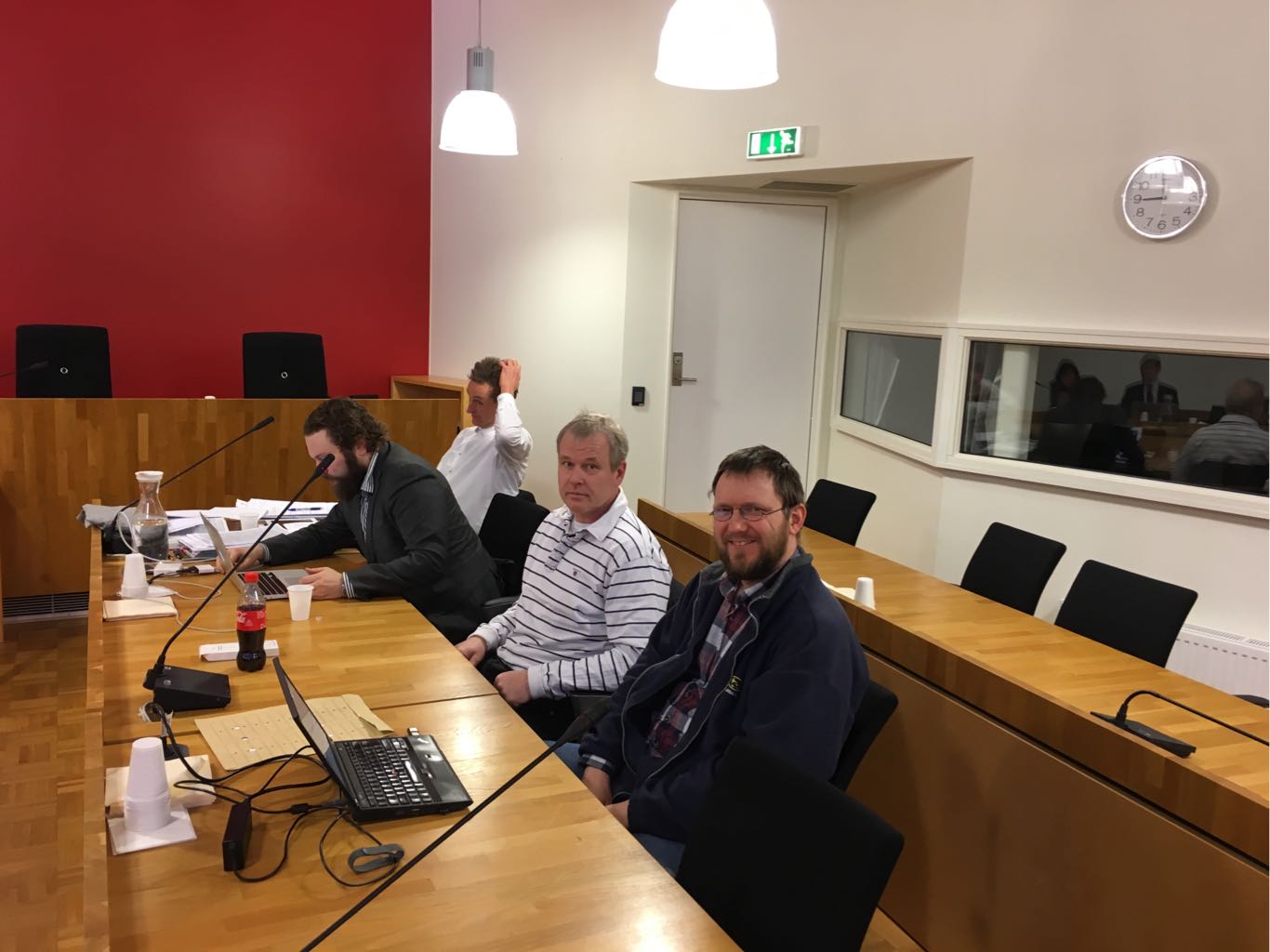
On Wednesday, I spent the entire day in court in Follo Tingrett representing the member association NUUG, alongside the member association EFN and the DNS registrar IMC, challenging the seizure of the DNS name popcorn-time.no. It was interesting to sit in a court of law for the first time in my life. Our team can be seen in the picture above: attorney Ola Tellesb , EFN board member Tom Fredrik Blenning, IMC CEO Morten Emil Eriksen and NUUG board member Petter Reinholdtsen. The case at hand is that the Norwegian National Authority for Investigation and Prosecution of Economic and Environmental Crime (aka kokrim) decided on their own, to seize a DNS domain early last year, without following the official policy of the Norwegian DNS authority which require a court decision. The web site in question was a site covering Popcorn Time. And Popcorn Time is the name of a technology with both legal and illegal applications. Popcorn Time is a client combining searching a Bittorrent directory available on the Internet with downloading/distribute content via Bittorrent and playing the downloaded content on screen. It can be used illegally if it is used to distribute content against the will of the right holder, but it can also be used legally to play a lot of content, for example the millions of movies available from the Internet Archive or the collection available from Vodo. We created a video demonstrating legally use of Popcorn Time and played it in Court. It can of course be downloaded using Bittorrent. I did not quite know what to expect from a day in court. The government held on to their version of the story and we held on to ours, and I hope the judge is able to make sense of it all. We will know in two weeks time. Unfortunately I do not have high hopes, as the Government have the upper hand here with more knowledge about the case, better training in handling criminal law and in general higher standing in the courts than fairly unknown DNS registrar and member associations. It is expensive to be right also in Norway. So far the case have cost more than NOK 70 000,-. To help fund the case, NUUG and EFN have asked for donations, and managed to collect around NOK 25 000,- so far. Given the presentation from the Government, I expect the government to appeal if the case go our way. And if the case do not go our way, I hope we have enough funding to appeal. From the other side came two people from kokrim. On the benches, appearing to be part of the group from the government were two people from the Simonsen Vogt Wiik lawyer office, and three others I am not quite sure who was. kokrim had proposed to present two witnesses from The Motion Picture Association, but this was rejected because they did not speak Norwegian and it was a bit late to bring in a translator, but perhaps the two from MPA were present anyway. All seven appeared to know each other. Good to see the case is take seriously. If you, like me, believe the courts should be involved before a DNS domain is hijacked by the government, or you believe the Popcorn Time technology have a lot of useful and legal applications, I suggest you too donate to the NUUG defense fund. Both Bitcoin and bank transfer are available. If NUUG get more than we need for the legal action (very unlikely), the rest will be spend promoting free software, open standards and unix-like operating systems in Norway, so no matter what happens the money will be put to good use. If you want to lean more about the case, I recommend you check out the blog posts from NUUG covering the case. They cover the legal arguments on both sides.

2 February 2017

Steinar H. Gunderson: Not going to FOSDEM but a year of Nageru

It's that time of the year :-) And FOSDEM is fun. But this year I won't be going; there was a scheduling conflict, and I didn't really have anything new to present (although I probably could have shifted around priorities to get something). But FOSDEM 2017 also means there's a year since FOSDEM 2016, where I presented Nageru, my live video mixer. And that's been a pretty busy year, so I thought I'd do a live cap from high up above. First of all, Nageru has actually been used in production we did Solskogen and Fyrrom, and both gave invaluable input. Then there have been some non-public events, which have also been useful. The Nageru that's in git right now is evolved considerably from the 1.0.0 that was released last year. diffstat shows 19660 insertions and 3543 deletions; that's counting about 2500 lines of vendored headers, though. Even though I like deleting code much more than adding it, the doubling (from ~10k to ~20k lines) represents a significant amount of new features: 1.1.x added support for non-Intel GPUs. 1.2.x added support for DeckLink input cards (through Blackmagic's proprietary drivers), greatly increasing hardware support, and did a bunch of small UI changes. 1.3.x added x264 support that's strong enough that Nageru has really displaced VLC as my go-to tool for just video-signal-to-H.264-conversion (even though it feels overkill), and also added hotplug support. 1.4.x added multichannel audio support including support for MIDI controllers, and also a disk space indicator (because when you run out of disk during production without understanding that's what happens, it really sucks), and brought extensive end-user documentation. And 1.5.x, in development right now, will add HDMI/SDI output, which, like all the previous changes, requires various rearchitecting and fixing. Of course, there are lots of things that haven't changed as well; the basic UI remains the same, including the way the theme (governing the look-and-feel of the finished video stream) works. The basic design has proved sound, and I don't think I would change a lot if I were to design something like 1.0.0 again. As a small free software project, you have to pick your battles, and I'm certainly glad I didn't start out doing something like network support (or a distributed architecture in general, really). So what's for the next year of Nageru? It's hard to say, and it will definitely depend on the concrete needs of events. A hot candidate (since I might happen to need it) is chroma keying, although good keying is hard to get right and this needs some research. There's also been some discussion around other concrete features, but I won't name them until a firm commitment has been made; priorities can shift around, and it's important to stay flexible. So, enjoy FOSDEM! Perhaps I'll return with a talk in 2018. In the meantime, I'll preparing the stream for the 2017 edition of Fyrrom, and I know for sure there will be more events, more features and more experiences to be had. And, inevitably, more bugs. :-)

Next.

Previous.