Search Results: "az"

28 April 2009

Steve Kemp: I just want them to know that they didn't break me.

I'd forgotten how sexy, useful, and great mod_perl is. I've recently been struggling with a friend's CGI-based site, and after a minor effort we made it run with Apache::PerlRun:
Apache::PerlRun gives you the benefit of preloaded Perl and its modules. This module's handler emulates the CGI environment, allowing programmers to write scripts that run under CGI or mod_perl without any change
Because the site code wasn't very clean we had to make a lot of changes to get it working under Apache::Registry.
Apache::Registry is the Apache module allowing you to run CGI scripts very fast under mod_perl, by compiling all scripts once and then caching them in memory.
But the payoff is very noticeable - the site is now blazingly fast! At some point I should write a guide to doing basic things with mod_perl. Mostly I guess the challenge is that you can write toy applications in moments, but to demonstrate how useful it is you need to apply it to something the reader is familiar with. Or demonstrate why the effort is worthwhile, given that it ties you to the Apache + mod_perl platform. Any links to existing guides, or suggestions on how to approach the guide-writing in a beginner-friendly but still useful fashion are welcome. (For what its worth I mostly write web applications using CGI::Application & jQuery these days.) ObFilm: Pretty In Pink

26 April 2009

Florian Ragwitz: Declaring Catalyst Actions

For a long time the Catalyst Framework has been using code attributes to allow users to declare actions that certain URLs get dispatched to. That looks something like this:
sub base    : Chained('/')    PathPart('') CaptureArgs(0)   ...  
sub index   : Chained('base') PathPart('') Args(0)          ...  
sub default : Chained('base') PathPart('') Args             ...  
It's a nice and clean syntax that keeps all important information right next to the method it belongs to. However, attributes in perl have a couple of limitations. For one, the interface the perl core provides to use them is horrible and doesn't provide nearly enough information to do a lot of things, but most importantly attributes are just plain strings. That means you will need to parse something like "Chained('base')" into (Chained => 'base') yourself to make proper use of them. While that's easy for the above example, it can be very hard in the general case because only perl can parse Perl. It's one of the reasons you can't use Catalyst::Controller::ActionRole to apply parameterized roles to your action instances, because parsing parameters out of things like Does(SomeRole => names => [qw/affe tiger/], answer_re => qr/42/ ) would be awful and wrong. With Catalyst 5.8 most of the attribute related code has been removed from the internals. It's now using MooseX::MethodAttributes to do all the heavy lifting. Also the internals of how actions are registered have been refactored to make it easier to implement alternate ways without changing the Catalyst core. As a proof of concept for this I implemented a new way of declaring actions that's very similar to how Moose provides it's sugar functions. You can get it from github. With that, the above example looks like this:
action base    => (Chained => '/',    PathPart => '', CaptureArgs => 0) => sub   ...  ;
action index   => (Chained => 'base', PathPart => '', Args    => 0    ) => sub   ...  ;
action default => (Chained => 'base', PathPart => '', Args    => undef) => sub   ...  ;
It also moves method declaration from compiletime to runtime, making this possible:
for my $action (qw/foo bar baz/)  
    action $action => (Chained => 'somewhere', Args => 0) => sub  
        my ($self, $ctx) = @_;
        $ctx->stash->  $action   = $ctx->model('Foo')->get_stuff($action);
     ;
 
Admittedly, that's all very ugly, but illustrates well what kind of things we're able to do now. But it doesn't need to be ugly. With Devel::Declare we have a great tool to add our own awesome syntax to perl, similar to how things like MooseX::Method::Signatures, MooseX::MultiMethods and MooseX::Declare do. So how would a declarative syntax for Catalyst controllers look like? I don't know. Ideas include something like this:
under /some/where, action foo ('foo', $id)   ...  
to mean:
sub foo : Chained('/some/where') PathPart('foo') CaptureArgs(1)   ...  
Adding Moose type constraints to this would be interesting, too, and make validation of captures and arguments a lot easier. Multi dispatch similar to MooseX::MultiMethods could be handy as well:
under /some/where  
    action ('foo', Int $id)  
        # find and stash an item by id
     
    action ('foo', Str $name)  
        # search items using $name
     
    action ('foo', Any $thing)  
        # display error page
     
 
So you see there are a lot of possibilities that should be explored. Unfortunately I have no idea what kind of syntax and features people would like to have, so your feedback on this would be much appreciated. :-)

25 April 2009

Biella Coleman: What We Know So Far

So, when I like something, I tend to yap about it for weeks and weeks. Take Icelandic Yogurt, for example. After re-discovering it a month ago, I went on a mini-binge (not a mega as it is too expensive) and spread the word to anyone who would listen. The stuff, especially with fun flavors like ginger and orange, just made my morning. Another fine fine thing out there is the performance group What We Know So Far who give performance-based lectures that mix intellectual insight with artistic flair. They put us regular academics to shame who are a bit more staid, to put it mildly. After seeing them a few weeks ago at the 3rd Ward, I snagged them to give a version of their A-mazing talk on Memes in my class and am organizing a much larger event at NYU for the fall of 2009. This is a sort of long winded way of announcing their up and coming show on April 27th the Hannah Complex, which entertains, among other topics, the nature of common sense: Can there be more than one common sense? they ask on their site. And I can t wait to hear the answer as this is a recurrent topic that anthropologists like to entertain. And in fact one of my favorite essays to teach is on this topic, Clifford Geertz Common Sense as Cultural System, a short excerpt which I found here and below is his thesis in a nutshell:
There are a number of reasons why treating common sense as a relatively organized body of considered thought, rather than just what anyone clothed and in his right mind knows, should lead on to some useful conclusions; but perhaps the most important is that it is an inherent characteristic of common-sense thought precisely to deny this and to affirm that its tenets are immediate deliverances of experience, not deliberated reflections upon it. Knowing that rain wets and that one ought to come in out of it, or that fire burns and one ought not to play with it (to stick to our own culture for the moment) are conflated into comprising one large realm of the given and undeniable, a catalog of in-the-grain-of-nature realities so peremptory as to force themselves upon any mind sufficiently unclouded to receive them. Yet this is clearly not so. No one, or no one functioning very well, doubts that rain wets; but there may be some people around who question the proposition that one ought to come in out of it, holding that it is good for one s character to brave the elements hatlessness is next to godliness. And the attractions of playing with fire often, with some people usually, override the full recognition of the pain that will result. Religion rests its case on revelation, science on method, ideology on moral passion; but common sense rests its on the assertion that it is not a case at all, just life in a nutshell. The world is its authority.

Russell Coker: Creating a Double-Ended Bun


The people who made the above magazine advert gave it two top-halves to the burger bun. But I think that there is actually a demand for such buns, and that it is possible to make them! Traditional buns have a flat bottom where they rest on a baking tray. One solution to this problem would be to bake in outer space, another possible solution would be to develop a rapid baking process that allows baking in a free-fall aeroplane, but both of these would be unreasonably expensive. It seems that it would be viable to bake double-ended buns by having a rapidly rising column of hot air to suspend the bun. The terminal velocity of a bun would probably not be that high (maybe 60Km/h) and it should be quite easy to have a pipe full of hot air that bakes the buns. As slight variations in the density and shape of the bun would affect the air-flow it would be necessary to closely monitor the process and adjust the air speed to keep the bun afloat. Manufacturing cheap ovens that use LASERs to monitor the position of the bun should not be difficult. This might blow the sesame seeds off the bun, but this problem may also be solvable through careful design of the bun shape to make it less aerodynamic and by strongly attaching the seeds. I m not sure how you would do this.

24 April 2009

Gunnar Wolf: Some prefer marathoning... I prefer going to my old workplace

I was invited to talk about Free Software at yesterday's FLISOL. Yesterday? Aren't FLISOLs organized on Saturday? Well, not this one, for various reasons which I won't quote here. And no, I am not a supporter of the installfests idea, but I went gladly to talk about what is Free Software all about - The philosophy behind Free Software. Besides, the talk was at FES Iztacala, where I worked for four happy years, 1999-2003. I have not been often to Iztacala since 2003 (probably I have visited only three or four times), partly because of the distance (~25Km from home in a straight line, but the city's Northern part is quite poorly communicated). The last time I was there, last October, I went by bike, just to test my endurance and... because I could. Yesterday, I also did, not to be outdone by my fellow Debianers Christian and Dirk. Think they are so cool because they can run for 43Km? Well, I had my 55Km yesterday, and I was not even in a competition! (yes, yes, running and biking is not the same. So sue me. I just didn't want to stand still and let them walk away with all of the fun!) I took slightly different routes (my route to get there on Nokia Sportstracker and OpenStreetMap trace, my route back on Nokia Sportstracker and OpenStreetMap trace), crossing diagonally Azcapotzalco, a region of the city (delegaci n) I hardly know... The Sourthern of it seems like a continuation of Tacuba to the North, small and not-very-well-communicated prior villages engulfed by our hungry, huge city. The Northern half is a mostly industrial area, with very sparse population, lots of trucks, and streets that are not in the best shape. You can end up feeling lonely in those regions, and I am glad not to have crossed back by night. And the trip back was interesting as well... Mexico City is home to many more bikers you would expect given its size, and it is very common to find other people doing nice long stretches. In this case, I started cycling quite close to another guy in a white bike more or less when I got to Calzada Camarones. Possibly we had passed each other over and over until after Tlatelolco, arriving to Guerrero, where I approached him at a stoplight:
Hi! Where to?
Near Vocacional 7, Iztapalapa!
Nice! I'm just going to Copilco Every now and then we crossed each other... Turns out he does this ~30Km commute daily between Iztapalapa and Azcapotzalco. Quite admirable, to be honest. I also crossed my road with Sergio Mendoza, fellow Debianer (and co-administrator of our Mexican mirror) around Centro M dico (about 7Km north from my destination), whom I had only seen before around the University. Nice surprise. And yes, getting to know the city by bike is the best way to go! Back to the conference... my first thought when I was invited was to present Qu es el Software Libre?, a talk I have given over and over since... 2002 (although, yes, with updates). I must say it's one of the best structured talks I have prepared and has almost always been very successful - But give the same talk based on the same script over and over (AFAICT, around 20 times), and you will be fed up with it. And yes, yesterday I didn't take my laptop along, and didn't put my presentation on a USB stick - I took a pen and some paper, and during the presentation prior to mine, wrote some points to go over. And yes, it was a refreshing change. The talk was as successful as expected, and it's much more refreshing to talk about the same topics bot on a different way, and without being constrained to a predefined script. I know that organizing formally your ideas makes sure you don't miss out important points and that the audience is sometimes encouraged to pay attention by having some bullet points to look at - But on the other hand, it is much easier to follow your audience's interest if you are not bound by the script. And the few times I've spoken that way, it has felt refreshing and nice.

Stefano Zacchiroli: howto: uploading to people.d.o using dput

dput + mini-dinstall to ease people.d.o uploads As DDs we often want to offer unofficial packages, but still preserving a bit of "authoritativeness". A widespread solution is to upload somewhere under http://people.debian.org/~LOGIN as an APT repository. I've been using that solution too since ... ever, but I've never been happy about how to advertise the packages, probably just because I've never liked dpkg-scan packages,sources and hackish scripts built on top of them. My goal, as simple as it can be, is to work as I do to prepare "real" packages to be uploaded to the Debian archive, and just upload to people.d.o as the final step. Thanks to DSA which satisfied a request of mine by installing a while ago mini-dinstall on ravel, today I've finally set up a work-flow that enabled me to reach my goal. This post is a quick howto to implement that setup. If you have suggestions about where (wiki.d.o? devref?) to paste these info so that other DDs can more easily find them in the future, please let me know, via comments or mailing me. Step 1: configure mini-dinstall on people.debian.org On people.debian.org, create a ~/.mini-dinstall.conf file containing something like the following:
    [DEFAULT]
    mail_to = zack
    incoming_permissions = 0750
    architectures = all, i386, amd64
    archive_style = flat
    dynamic_reindex = 1
    archivedir = /home/zack/public_html/debian/
    generate_release = 1
    release_origin = Zack
    release_label = Zack
    release_description = Unofficial Debian packages maintained by Stefano Zacchiroli
    [zack-unstable]
    release_suite = zack-unstable

Highlights of that conf: The resulting repository will be accessible using the following /etc/apt/sources.list lines:
    deb http://people.debian.org/~zack/debian zack-unstable/
    deb-src http://people.debian.org/~zack/debian zack-unstable/

Step 2: configure dput The default incoming dir of mini-dinstall, relative to the configured archivedir, is mini-dinstall/incoming. The following entry for your ~/.dput.cf (on the machine you upload from) will therefore setup your dput for uploads:
    [people.debian.org]
    fqdn = people.debian.org
    method = scp
    login = *
    incoming = /home/zack/public_html/debian/mini-dinstall/incoming
    post_upload_command = ssh people.debian.org mini-dinstall -b

The only interesting detail here is the post upload command, which will run a "pulse" of mini-dinstall on people.d.o just after the upload, to process the uploaded file. Alternatively, you can leave mini-dinstall running on people.d.o, but I consider it unnecessary (because usually you are the only one able to upload to your home dir), unelegant, and complicated (because you then need to verify mini-dinstall is running). Step 3: enjoy (i.e., upload) Now you can prepare your packages as you always do (which means using cowbuilder!) and, when you are done with your foo_1.0-1_amd64.changes, upload it doing:
    $ dput people.debian.org foo_1.0-1_amd64.changes

Signing the Release file The above setup does not sign Release files, which means your APT users will receive complaints from the secure APT machinery. To fix that you must sign the Release file with some key and distribute the key to your users to be processed by apt-key add. You have a couple of ways to sign the release file automatically:
  1. (/me doesn't like this) use a GPG key created for the occasion, store that key (including the private part) on people.d.o, and use the mini-dinstall contrib script sign-release.sh by adding something like the following to your mini-dinstall.conf:
      release_signscript = ~/bin/sign-release.sh
    
    
  2. (/me likes this) use some script to sign the Release file remotely and send the resulting deatched signature back to people.d.o just after the mini-dinstall pulse; that way you can sign with your own private key, which will be reasonably felt as more trustworthy, being part of the Debian keyring. To achieve that, the most elegant way would be to fix debsign wishlist #465240 (volunteers? :-) ). As I'm lazy, I'm using my own sign-remote script, which is a bit more generic. Remote signing should be attached to dput upload hook as well. All in all, here is my actual ~/.dput.cf stanza:
      [people.debian.org]
      fqdn = people.debian.org
      method = scp
      login = *
      incoming = /home/zack/public_html/debian/mini-dinstall/incoming
      post_upload_command = ssh people.debian.org "mini-dinstall --batch" && sign-remote people.debian.org:~/public_html/debian/zack-unstable/Release
    
    
Enjoy! Update: do both mini-dinstall run and signing in post_upload_command, following gregoa's suggestion via comment

23 April 2009

Biella Coleman: Viral Videos

I am sure many have seen this video pirates. drugs. gay marriage and I think it speaks for itself. But I have to say, this video caught be off guard early this morning when I am first exposed to the day s viral videos, memes, and other savory and unsavory delights. Though I have been consuming and digesting this stuff for awhile now, I am still amazed by the craziness, creativity, outrageousness (often offense) that circulates every day, without fail, on the internets. Most of the stuff, even if pretty low brow can be said to be artistic in one classical sense of art: l art pour l art , with the aesthetics being focused on some combination of shock, irony, and humor. But how about the political activists? They are not dipping into this genre enough and it s high time they use start using these tactics/viral videos to shock/shame their opponents, using the sugar coating of humor and raw audacity to spread their message.

Romain Beauxis: Lastfm no longer free as in free beer (and some bits about xml in OCaml)

Lastfm no longer free as in free beer As I was trying move the code of ocaml-lastfm [1] from the unmaintained xml-light [2] to xmlm [3], I discovered that it now fails to request track in anonymous mode. Then, I went on the lastfm [4] site, and discovered that now I cannot find any full content available for anonymous users. Some more researches and I found this [5]:
Today we are making the changes to the radio that were previously announced here. This means that from today, listeners to Last.fm Radio outside of the USA, UK and Germany will be asked to subscribe for 3.00 per month, after a 30 track free trial period. In the USA, UK and Germany, where it's feasible to run an ad-supported radio service, there won't be any changes. Everything else on Last.fm (scrobbling, recommendations, charts, biographies, events, videos etc.) will remain free in all countries, like it is now.
JPEG - 42.5 kb
Alcool ! Voil l'ennemi.
Poster by French painter and missionary Fr d ric Christol (1850-1933) warning of the dangers of absinthe and other alcoholic drinks.
Although I will not comment this with the same violence as in the comments of the above message, this is not a good news at all. I totally understand how it can be difficult to find financial resources for this kind of business, and how complicated it can be after few years to maintain an activity that initially was breaking new and attracting investors. However, given the current global [6] propaganda [7] campaign [8] that is organized [9] by the major music companies, I do not believe this decision has only to do with lastfm's financial resources. In particular, also the legality of Deezer [10] was challenged by universal [11] such that they had to require registration [12] and also limit drastically the available titles. The current situation is now really becoming worse and worse. Not only the music companies are trying to push for dangerous laws for the civil rights while pretending to fight against illegal music sharing, but also they are trying to shutdown all the new competitors that were successful in doing exactly what they refused to do during the same time. All of this is just simply pathetic, and I strongly hope there will soon be an end to this, which will surely mean for these companies adapt or perish.. Or perhaps they plan to impose their restricting and dangerous laws in any country in the world ? Another remark about all this is that it clearly demonstrate the importance of having the right to copy and store for your own usage any copyrighted material. Indeed, these are not only products but also artistic productions, and for this reason it is important to be able to save them in some place in order to not loose track of it if the streaming company was to be shutdown, as it seems to be the trend now.
JPEG - 71 kb
Viktor Oliva: The Absinthe Drinker.
The original painting can be found in the Caf Slavia in Prague.

Moving from xml-light to Xmlm The other part of this post is about moving from xml-light to xmlm. This is in fact very easy, and should only be a matter of adding a piece of code like this:
type xml =
Element of (string * (string * string) list * xml list)
PCData of string

let parse_string s =
let source = String (0,s) in
let input = Xmlm.make_input source in
(* Map a tag representation in xmlm to
* (name, attributes list) where attribute = string*string. *)
let make_tag (x,l) =
(* Forget about the uri attribute *)
let l =
List.map (fun ((_,y),z) -> (y,z)) l
in
snd x,l
in
let rec get_elems l =
if Xmlm.eoi input then
l
else
match Xmlm.input input with
El_start tag ->
let elem = get_elems [] in
let (name,attributes) = make_tag tag in
get_elems ((Element (name, attributes, List.rev elem)) :: l)
El_end -> l
Data s ->
get_elems ((PCData s) :: l)
Dtd _ -> get_elems l
in
let elems = get_elems [] in
Element ("", [], List.rev elems)
This is a very simple code that surely needs more fixes, but starting from that, you can parse a string into an equivalent representation of the xml data, and then use it as before in your code..


[1] Ocaml-lastfm: http://www.rastageeks.org/lastfm.html [2] Xml-light: http://tech.motion-twin.com/xmlligh... [3] Xmlm: http://erratique.ch/software/xmlm [4] Lastfm: http://www.last.fm/ [5] "Radio Subscriptions": http://blog.last.fm/2009/04/22/radi... [6] "New Zealand: safe from Big Music. Or is it?": http://www.p2pnet.net/story/19074 [7] " La Quadrature du Net discr dit e aupr s des d put s anti-Hadopi": http://www.numerama.com/magazine/12.... Link is in french. It explains how, after filling a so-called petition with hundreds of signatures from employees presented as artists, or artists abused by the presentation of the content, these companies complain about the "totalitarian methods" used to verify the validity of the signature, which were simply based on the public available information on these names on the web, while they propose a system that would automatically cut the internet access to probably 1.000 people a day in France... [8] "Faux proc s : Les pirates paient": http://www.ecrans.fr/Faux-proces-Le.... again, in french, the article reports a Danish study that prove once again that people who tend to download a lot of music are also much more likely to spend their money in the music business, being concert, records or else.. [9] ""Three strikes" for Ireland - Eircom, music industry settle filtering case": http://tjmcintyre.com/2009/01/three... [10] Deezer: http://www.deezer.com/ [11] "Universal Music challenges the legality of Deezer, a free streaming website": http://french-law.net/universal-mus... [12] "Now Deezer Required Registration": http://forums.techarena.in/technolo...

22 April 2009

Alastair McKinstry: pkg-config, -as-needed and multiple compilers

At work I've been promoting the use of pkg-config and modules to solve the problems of avoiding hard-coded paths and an environment where we've multiple compilers. In summary, "module load intel-cc" to load the intel compiler, "module load netcdf-intel" to, which among other things appends /ichec/packages/netcdf/4.0-intel/pkgconfig to $PKG_CONFIG_PATH, and then:
NCDF_INCS :=  pkg-config netcdf --cflags 
NCDF_LIBS :=  pkg-config netcdf --libs 
in the application code. Replace "intel-cc" and "netcdf-intel" with "gcc" and "netcdf-gcc", and it builds with gcc. This would work better if upstream supplied .pc files, which means the next stage in world domination is to send patches to do just that. But it's not that easy, apparently. netcdf (for example) supplies two libraries, libnetcdf.so and libnetcff.so, with the second including code only needed for Fortran. So, for gcc I have the following netcdf file:
prefix=/ichec/packages/netcdf/4.0-gcc
exec_prefix=$ prefix 
libdir=$ prefix /lib
includedir=$ prefix /include
Name: netcdf
Description: netCDF libraries, include files and development tools (gcc version)
Version: 4.0
Libs: -L$ libdir  -Wl,--as-needed -lnetcdf   -lnetcdff 
Cflags: -I$ includedir 
While for Intel I have:
prefix=/ichec/packages/netcdf/4.0-intel
# Add fortran libs 
forlibs=/ichec/packages/intel/fce/11.0.081/lib/intel64
exec_prefix=$ prefix 
libdir=$ prefix /lib
includedir=$ prefix /include
Name: netcdf
Description: netCDF libraries, include files and development tools
Version: 4.0
Libs: -L$ libdir  -lnetcdf -L$ forlibs   -lnetcdff -lifcore
Cflags: -I$ includedir 
The main problem is that --as-needed is not understood by non GNU-ld linkers, and must be conditionally removed somehow. Any ideas ? (There is a second wrinkle of needing to add additional libraries for Intel Fortran here, but I'm sure I can remove that with the addition of more .pc files.). A second issue is that --as-needed can break otherwise working pkg-config usages. Thanks to galtgendo at PhP Bugs for this example:
alastair@ailm:~$ cc -o testx  -Wl,--as-needed  pkg-config glib-2.0 --cflags  test.c  pkg-config glib-2.0 --libs 
works, but:
alastair@ailm:~$ cc -o testx  -Wl,--as-needed  pkg-config glib-2.0 --cflags    pkg-config glib-2.0 --libs  test.c
/tmp/ccsUEwtk.o: In function  main':
test.c:(.text+0x20): undefined reference to  g_print'
collect2: ld returned 1 exit status
The problem being that --as-needed removes libraries as unnecessary before the linker sees the test.o code. Tags , , , , ,

Martin Michlmayr: OSI signs an MOU with the Korea Software Copyright Committee

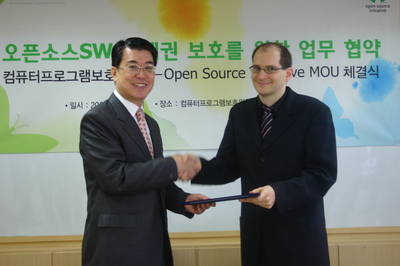
I visited Seoul last week to represent the Open Source Initiative (OSI) at an open source conference and to sign a Memorandum of Understanding (MOU) with the Korea Software Copyright Committee (SOCOP). SOCOP organized a conference with the title "Free Open Source Software License Insight Conference", and the international speakers included Brett Smith of the FSF, Brendan Scott of Open Source Law, Michael Cot of RedMonk and myself. From the questions we received, it seems that there is a lot of interest in legal questions related to open source. There were a number of folks from hardware companies that asked specific questions what they could do and couldn't do (e.g. related to including sources for GPL code and properly giving credit for BSD code). I think the conference was a great success. The talks were of high value and we got good questions. The audience was quite mixed, ranging from managers to developers. Even though they had simultaneous translation of the talks, the majority of the people listened in English... this gives me hope that some of these folks will end up becoming involved in the international open source community. Mr Koo and Dr Michlmayr signing MOU SOCOP is working on a number of activities related to open source, including: The day after the conference, I went to the SOCOP office to sign the MOU between SOCOP and OSI with Mr Yung Bo Koo, the chairman of SOCOP. The MOU says that we'll share knowledge and expertise, help with promotional activities and support each other's activities in other ways. I was delighted to sign the MOU between SOCOP and OSI, and I look forward to a fruitful cooperation between our organizations in the future. It's great to see so much interest and so many activities around open source in the Republic of Korea.

21 April 2009

Nico Golde: newsbeuter 2.0 released

Yay, newsbeuter 2.0 was just released! I am way too lazy to summarize all the new features and bugfixes, It's just to many of them. Here is the changelog:
Added more flexible dialog handling
Improved position handling in article list (fixes #112; thanks to Isaac Good)
Fixed a lot of bugs (#102, #111, #117, #130, #131).
Added ability to specify a list of OPML URLs when using OPML as URL source.
Added config option "keep-articles-days" to optionally keep articles only for a limited number of days.
Added config option "bookmark-interactive" to indicate that the configured bookmarking command is interactive.
Don't display authentication information in URLs (fixes #121).
Replaced mrss with new RSS/Atom parser.
Added ability to search for text from the article view.
Added basic support for Yahoo Media RSS.
Made article view pager configurable.
Improved HTML rendering of links and underlined and bold text.
Added ":source" commandline command to (re)load configuration files.
Implemented "pipe-to" key to pipe articles to external commands.
Implemented backtick evaluation for configuration files.
Extended filter language with "between" operator.
Added "age" attribute for articles to filter them for relative age (in days).
Extended "set" commandline command to toggle boolean variables and reset configuration variables of all types to their default.
Added ability to configure local files as feeds.
Added a "random-unread" key to go to a random unread article.
When opening articles from a search result dialog, make search phrase stand out in article view.
Persist commandline and search history.
Implemented commandline completion.
Improved help dialog so that it now shows unbound functions.
Added ability to sort feed list and article list by interactively choosing the sort method.
Improved and extended conditional HTTP download handling.

The full release annoucement by ak is available on: http://newsbeuter.wordpress.com/2009/04/21/newsbeuter-20-released/

Also just uploaded the package to Debian unstable.

20 April 2009

Adeodato Sim : Five films (#5)

Ok, here we go again. I do hope somebody, somewhere is finding these posts of some use. *g* Isaac watched Love Actually recently, and I oooh ed quite a bit when he told me, because that movie has one of my favourite or should I say powerful scenes of all times for me, and recalling it brings me instant joy and often instant tears. I think these three (spoiling) minutes are so powerful because, albeit they are fully anticipated for the spectator, they come as a complete surprise to both protagonists (obviously to her, but also to him, given the dialog that takes place once she gets down the stairs; that tiny dialog is in fact the most powerful bit of it all).

19 April 2009

Miriam Ruiz: Debian packages for Structure Synth

Structure Synth is an application for creating 3D structures from a set of user specified rules. It is an attempt to make a 3D version of Context Free (a free -GPL ed- program that generates images from written instructions called a grammar). The cool thing about Structure Synth is that it has a simple language for writing recursive scripts that can generate complex structures (kinda Processing, but in 3D), and you can feed the result into Sunflow (a rendering system for photo-realistic image synthesis, already available in Debian) to generate Escher-like cool images. The program is waiting in the NEW queue, but you can temporarily download my packages (for Debian SID amd64) if you want. Even though I ve tried hard to be the one to blog about this, my friend Javier Candeira has won the competition and has been able to write about this earlier than me :P Spanish readers might want to have a look at JoSeKBlog, where he describes how to combine Structure Synth and Sunflow, and where I first read about the existence of the program.

Biella Coleman: Paris in June (and better with hackers)

/tmp/lab announces the second Hacker Space Festival
(Paris, 26-30 June 2009) Hacker Space Festival 2009 Call For Proposals HSF2009 In 2008, we organized HSF[1] on the spot, as an ad-hoc meeting for
hackerspaces-related networks, technical and artistic research emerging
from them and social questionning arising from them. This sudden
experiment proved to be a huge success, as much as on the
self-organizing level as on the participants and meetings quality, as
well as the emotionally-charged ambient, the kind of which you make
fond memories. The 2008 edition generated a strong emulation in France, from its
historical role as the first official hack meeting there, and in Europe
with the subsequent creation of the Hacker Space Brussels[2], the
rapprochement with The Fiber in Amsterdam and the hackerspaces.org[3]
network. Initiatives of hackerspace openings in Grenoble or Lille, or
the upcoming FrHack[4] conference show an actual enthusiasm in the
French hackers community that was doomed to the underground not so
long ago. We salute these initiatives and their diversity! Soon enough, we wanted to reiterate the HSF experience : however, it
was out of the question to institutionalize this temporary autonomous
zone, nor make it an ersatz of the previous edition, nor even to wrap
it into an elite or underground aura. On the opposite, we ardently
desire; and especially to explore further, in all directions some
lesser known domains (see below) et foster meeting and sharing around
experiences at the confluence of art, technology and politics. The world financial crisis, the decay of democracy in Europe, the
obscurantism, paranoia and lack of culture presiding over legislation
(Internet and Reaction Err Creation Law[5][6]) seem a fertile
environment for the sensible development of new (social ) life forms.
Quick! Let s rest for a few days in jubilation and ecstasy to take a
deep breathe of freedom under the indelicate smells of the medicine
factory nearby! For if the public space is shrinking to oblivion, where any side-step
becomes suspect, and that, from an early age (deviant behavior
detection in nursery school), where moving without a mobile phone
becomes suspect (hello you Julien Coupat[7], a French political
prisoner in France!), there s a domain that the Leviathan would have a
lot of trouble to contain, and for a reason: that of sensitivity. Even
the desperate attempts of the State to block the free and premonitory
expression of sense (hello you Demeure du Chaos![8]) cannot do anything
against a loud laughter or a knowing glance, a sensual kiss or an
explosion of colors. Sensitivity, we could say, is what is left to a human being when she
has nothing anymore, and differenciates her from the body corporate or
the institution, that are, in essence, devoid of it. Therefore, Art
definitely remains the public space to share between humans, and only
between us. And if it the last one to share, we propose to explore it
and take it over during the upcoming edition of the Hacker Space
Festival, from the 26th to 30th of June, 2009 at Vitry sur Seine[9]. ========================================================================
Keynote Speakers: Sergey Grim and Larry Fake with Eric Schmoudt
Groogle Summer of Crode, Survivor style
VLC, I vote against you because you really fucked up when ========================================================================
== W A N T E D ========================================================= Focus on solutions rather than problems. * The Final (Hardware) Frontier: Open FPGA Cores, Reverse Engineering
* Designer Religions and Creative Beliefs Systems
* WiFiDoors & WiFi System-on-Chip controllers firmware hacking,
infection & backdooring
* Telecom Core Network Equipment Reverse Engineering: MSC, STP,
Switches,
* Algebraic Attacks and Modern Cryptography Attacks
* Autonomous, Parasitic and Viral Drones
* Enhanced or Infected Reality Swarms
* Auto-Builders / Self-Fabrication
* Embedded OS breakins stories & recipes
* Actualization rather than mere concepts
* FPGA & ASIC hacking / backdooring
* Cloud+Privacy+Open Source: O Brave New World?
* Explosion-Proof clothing
* Radio Appz & Hackz: Mesh @ RF Layer 1-3
* Database & Privacy
* Problematic & Ethical Open Source/Content Licenses
* Institutional Relationships: Lobbying or Licking?
* Non Lethal Protection (anti-taser vests?)
* Survival in the Age of the Ministry of Immigration and National
Identity
* Mental asylum improvised visit
* Open Source Legacy Media(TM) Production Solutions (TV, Radio, Press,
DRM)
* Gas Sensors & Environmental Benchmarking
* Building Hackerspaces Without Money
* Milsatcomm hacking: Military satellites shots, broken birds in the
sky
* Other research topics on security and insecurity
* Academics and Hackers
* Organics and Fermentation
* Clean Food in Tainted Environment
* Low Impact Energy & Recycling
* Media Sandwich: layers of crap makes good food?
* Deconstructing Carla Sarkozy
* Knitting DIY Factory (jazzy, eh?)
* Signs of life among industrial wasteland
* Hallucinogenic & Computing: Can you Code on Acid?
* Mesh Networking (Wireless BattleMesh Royal!)
* Legal Sabotage: When Democracy Needs You And anything that does not fit. ========================================================================
== P R O P O S E ======================================================= Send you contributions to HSF2009-CFP@lists.tmplab.org + Type of the proposal: 1. conference (45min. presentation + 10min. for questions)
2. workshop / demo (30min. 2 heures)
3. installation / performance (music, plastic, sound, video) Lightning talks can be proposed and organized until the last moment,
according to available space and schedule, in the form of BarCamps or
Blitz Conferences. + Required Information: * Title of the presentation
* Type (see above)
* Language : French or English
* Name of speaker(s)
* Affiliation (organization / company)
* Short biography
* Abstract (5 to 10 lines)
* Topics / Keywords
* Includes a demo? YES NO
* Release during the festival? YES NO
* Internet connection required? YES NO + Acceptable Formats * Open Document
* PDF
* Plain Text
* RTF + Agenda * beginning of proposals : now
* end of proposals : 01 May 2009
* selection notification : 07 May 2009
* publication of program : 15 May 2009 + Evaluation criteria for proposals: 1. Innovating Topic
2. Open Technology
3. Demonstration / Live Act
4. DIY Reproducibility
5. Fun Potential The Programming Committee resembles that of last year
See : http://hackerspace.net/committee ========================================================================
== V E N U E =========================================================== /tmp/lab
6 Bis rue Leon Geffroy
94400 Vitry sur Seine
France http://hackerspace.net/directions ========================================================================
== P A R T I C I P A T E =============================================== Email : http://lists.tmplab.org/listinfo.cgi/hsf2009-talk-tmplab.org
CFPmail: HSF2009-CFP@lists.tmplab.org
IRC : irc://irc.freenode.net/frlab
Jabber : xmpp:hsf2009@space.cepheide.org?join
Wiki : http://hackerspace.net/hsf2009 ========================================================================
== L I N K S =========================================================== The CFP is available online at http://hackerspace.net/cfp [1] http://hackerspace.net/hsf2008
[2] http://hsb.wikidot.com/
[3] http://hackerspaces.org/
[4] http://www.frhack.org/
[5] http://jaimelesautistes.fr/
[6] http://laquadrature.net/
[7] http://fr.wikipedia.org/wiki/Julien_Coupat
[8] http://www.demeureduchaos.org/
[9] http://hackerspace.net/
Philippe Langlois
Email: philippelanglois@free.fr
PGP Key: 8DAEE244


Biella Coleman: Tooooooorcamp

This conference looks like a blast. I am pretty much squirreling away for the summer to finish the first draft of my book now that I have a due date so I can t go to all these amazing events but I guess next time??

17 April 2009

Biella Coleman: Open up yr Wifi

Make your Wifi-open but not painfully slow (at Eyebeam)

16 April 2009

Peter Eisentraut: Web browsers vs. debtags

So I wanted to see what web browsers are available in Debian. The first stop was http://packages.debian.org/. Going to the page of one browser package and clicking on "Browser" in the tags area only gives you the explanation of the tag, but not the list of other packages with that tag. Is that available somewhere?

So next try maybe grep-dctrl ... oh, grep-debtags appears to be the ticket.

$ grep-debtags -n -sPackage web::browser
arora
browser-history
caudium-dev
caudium-modules
caudium-perl
caudium-pixsl
caudium-ultralog
chimera2
conkeror
cookietool
dhelp
edbrowse
elinks
elinks-lite
elvis
elvis-console
epiphany-browser
epiphany-browser-dev
epiphany-extensions
epiphany-gecko
ezmlm-browse
galeon
galeon-common
gtkcookie
iceweasel
jsmath
junior-internet
kazehakase
konq-plugins
links
links2
lynx
lynx-cur
lynx-cur-wrapper
mozilla-firefox-adblock
mozilla-noscript
netrik
netsurf
saods9
stripclub
sugar-web-activity
surfraw
w3m
w3m-el
w3m-img
wapua
claws-mail-dillo-viewer
dillo
konqueror
midori

How many of those are actually web browsers? Probably about half of them. (Example: caudium (not listed) is a web server, caudium-dev is its development package, not very close to a web browser.)

This would actually be quite a useful interface if the tags had any relationship to reality. I was in fact looking for a lightweight graphical browser, so this is a plausible command:

$ grep-debtags -n -d -sPackage web::browser -a interface::x11 -a -! suite::gnome -a -! suite::kde

which gives me 15 hits, of which 8 or 9 are actual web browsers.

Well, my search for a lightweight browser stopped here:

iceweasel
lightweight web browser based on Mozilla

Yeah! ;-)

15 April 2009

Michael Banck: 15 Apr 2009

Over the Easter holidays, I finally did a bit of real programming again, adding some quantum chemistry related C++ code to OpenBabel and Avogadro. I added support for molecular vibrations to the NWChem and Molden file formats, as well as writing support for the MOLPRO input and output formats mostly from scratch. The latter was something I wanted to do for a long time, as I have been almost exclusively using MOLPRO for my Ph.D. over the last couple of years. The event which sparked my interest was the addition of animated vibrations in the Avogadro 0.9.3 release on April 1st, something I considered one of the last missing features in Avogadro in order for it to be useful as a general purpose quantum chemistry visualization app. Once I had started coding, I decided to also do contribute to the visualization of molecular orbitals in Avogadro. So far, it was required to have formatted Gaussian or Q-Chem checkpoint files (both seem to use the same format, but you do not usually have those around) or Mopac2000 logfiles (Mopac2000 is non-free, unlike Mopac7, which is in Debian). My patch adds support for reading orbitals from MOLPRO logfiles on top of that. It has to be said that rendering molecular orbitals (while a bit unintuitive from a GUI perspective) is really impressive in Avogadro, thanks to the work done by Marcus Hanwell. See for exampe this picture for a Povray rendered molecular orbital exported by Avogadro. If I manage to find some more time, I would like to (i) move the basis set and molecular orbital parsing code to OpenBabel, where it rightfully belongs and (ii) enhance and unify the OpenBabel quantum chemistry input file export code, so that they can be used by Avogadro directly. Right now, Avogadro reimplements a GUI and code for exporting an input file for each supported quantum chemistry package (Gaussian, Q-Chem, GAMESS and Mopac2000, currently).

Christian Perrier: Patux

Just found by my son who's as crazy as I am abut SpongeBob Square Pants:

Next.

Previous.