Search Results: "agi"

21 November 2011

Alastair McKinstry: From a comment by Brad K at Causon's Book:

From a comment by Brad K at Causon's Book: It is a couple of days old now, so I imagine you have seen this. One hedge broker for grain and cattle, Barnhardt Capital Management (http://barnhardt.biz/) has called it quits. Most agribusiness deals with futures and options on their crops to make a good part of their annual income. According to Ann: "The reason for my decision to pull the plug was excruciatingly simple: I could no longer tell my clients that their monies and positions were safe in the futures and options markets because they are not. And this goes not just for my clients, but for every futures and options account in the United States. The entire system has been utterly destroyed by the MF Global collapse. " Interesting times. As the global financial system (not just banks) is wobbling, we need to ensure the food supplies. Time to plant veg and stock up on tins?

Siegfried Gevatter: Debian Games Team Meeting

This announcement was provided by Martin Erik Werner. I m reproducing it for Planet Ubuntu. The Debian/Ubuntu Games Team is organizing another meeting. If you re into developing and/or packaging of games, or just generally curious about games in Debian/Ubuntu, you should join! It will be held next Saturday, the 26th of November, in the #debian-games channel on irc.debian.org (also know as irc.oftc.net) at 10:00 UTC. More information is available on the wiki page Games/Meetings/2011-11-26. The agenda starts off with the usual round of introductions, so if you re new to the Team, say hi! Then we ll be going through the action items from the last meeting, including work on the Debian Games LiveCD, and what s up with the /usr/games/ path anyways? Next we ll be moving onto how the Games Team is faring in terms of members: are new recruits finding it comfortable, should we advertise more? Next up it s the squeeky penguin: Wheezy is somewhere in the not-completely-distant future, how does that affect the Games Team, should we be scuffling to get specific tasks done? Then onto the recurring question of Sponsoring, and how to improve it, should we be utilising DebExpo more? What about our favourite PET? Lastly, PlayDeb is doing some really neat stuff, would it make sense for our team to push some changes to PlayDeb? Would it make sense for PlayDeb to push changes to Debian Games? Hopes are for a good discussion, and a merry time, hope to see you all there! Related posts:
  1. Debious A dubious Debian packaging GUI
  2. One week with Debian
  3. A list of some commercial GNU/Linux games

No comments
Siegfried-Angel Gevatter Pujals, 2011. Permalink License Post tags: , ,

flattr this!

Paul Wise: Debian/Ubuntu games team meeting #6

The Debian/Ubuntu games team is organizing another meeting, if you're into developing and/or packaging of games, or just generally curious about games in Debian/Ubuntu, you should join! It will be held next Saturday, on the 26th of November, in the #debian-games channel on irc.debian.org (also know as irc.oftc.net). More information is available on the meeting wiki page. The agenda starts off with the usual round of introductions, so if you're new to the team, say hi! Then we'll be going through the action items from the last meeting, including work on the Debian Games LiveCD, and what's up with the /usr/games/ path anyways? Next we'll be moving onto how the games team is faring in terms of members: are new recruits finding it comfortable, should we advertise more? Next up it's the squeeky penguin: Wheezy is somewhere in the not-completely-distant future, how does that affect the games team, should we be scuffling to get specific tasks done? Then onto the recurring question of sponsoring, and how to improve it, should we be utilising DebExpo more? What about our favourite PET? Lastly, PlayDeb is doing some really neat stuff, would it make sense for our team to push some changes to PlayDeb? Would it make sense for PlayDeb to push changes to Debian Games? Hopes are for a good discussion, and a merry time, hope to see you all there! (This text provided by Martin Erik Werner)

19 November 2011

Dominique Dumont: Debian SDL packaging team revival

Hello Most SDL packages are outdated, people are complaining in the BTS, and the team is mostly inactive. That s bad news for my project. What can I do ? Well, it s Debian project, I just have to step up. Thanks to Sam Hocevar, I m now admin on Debian Alioth SDL packaging project. I d like to revive the team. (Note that I don t have the bandwidth to be the team all by myself). Here are the first steps I plan (mostly inspired by the way Debian-perl team is working): Now, there are some ground rules I wish to push forward: If you don t agree with the above points, now is the time to say it. Feel free to join by:
  1. Creating an account on Alioth
  2. request to join sdl-team
  3. Last but not least, send a short introduction mail to pkg-sdl-maintainers AT lists.alioth.debian.org so we can know each other.
See you soon :-)

17 November 2011

Raphaël Hertzog: People Behind Debian: Mark Shuttleworth, Ubuntu s founder

I probably don t have to present Mark Shuttleworth he was already a Debian developer when he became millionaire after having sold Thawte to Verisign in 1999. Then in 2002 he became the first African (and first Debian developer) in space. 2 years later, he found another grandiose project to pursue: bring the Microsoft monopoly to an end with a new alternative operating system named Ubuntu (see bug #1). I have met Mark during Debconf 6 in Oaxtepec (Mexico), we were both trying to find ways to enhance the collaboration between Debian and Ubuntu. The least I can say is that Mark is opinionated but any leader usually is, and in particular the self-appointed ones! :-) Read on to discover his view on the Ubuntu-Debian relationship and much more. Raphael: Who are you? Mark: At heart I m an explorer, inventor and strategist. Change in technology, society and business is what fascinates me, and I devote almost all of my time and wealth to the catalysis of change in a direction that I hope improves society and the environment. I m 38, studied information systems and finance at the University of Cape Town. My hearts home is Cape Town, and I ve lived there and in Star City and in London, now I live in the Isle of Man with my girlfriend Claire and 14 precocious ducks. I joined Debian in around 1995 because I was helping to setup web servers for as many groups as possible, and I thought Debian s approach to packaging was very sensible but there was no package for Apache. In those days, the NM process was a little easier ;-) Raphael: What was your initial motivation when you decided to create Ubuntu 7 years ago? Mark: Ubuntu is designed to fulfill a dream of change; a belief that the potential of free software was to have a profound impact on the economics of software as well as its technology. It s obvious that the technology world is enormously influenced by Linux, GNU and the free software ecosystem, but the economics of software are still essentially unchanged. Before Ubuntu, we have a two-tier world of Linux: there s the community world (Debian, Fedora, Arch, Gentoo) where you support yourself, and the restricted, commercial world of RHEL and SLES/SLED. While the community distributions are wonderful in many regards, they don t and can t meet the needs of the whole of society; one can t find them pre-installed, one can t get certified and build a career around them, one can t expect a school to deploy at scale a platform which is not blessed by a wide range of institutions. And the community distributions cannot create the institutions that would fix that. Ubuntu brings those two worlds together, into one whole, with a commercial-grade release (inheriting the goodness of Debian) that is freely available but also backed by an institution. The key to that dream is economics, and as always, a change in economics; it was clear to me that the flow of money around personal software would change from licensing ( buying Windows ) to services ( paying for your Ubuntu ONE storage ). If that change was coming, then there might be room for a truly free, free software distribution, with an institution that could make all the commitments needed to match the commercial Linux world. And that would be the achievement of a lifetime. So I decided to dedicate a chunk of my lifetime to the attempt, and found a number of wonderful people who shared that vision to help with the attempt. It made sense to me to include Debian in that vision; I knew it well as both a user and insider, and believed that it would always be the most rigorous of the community distributions. I share Debian s values and those values are compatible with those we set for Ubuntu.
Debian would always be the most rigorous of the community distributions.
Debian on its own, as an institution, could not be a partner for industry or enterprise. The bits are brilliant, but the design of an institution for independence implies making it difficult to be decisive counterparty, or contractual provider. It would be essentially impossible to achieve the goals of pre-installation, certification and support for third-party hardware and software inside an institution that is designed for neutrality, impartiality and independence. However, two complementary institutions could cover both sides of this coin. So Ubuntu is the second half of a complete Debian-Ubuntu ecosystem. Debian s strengths complement Ubuntu s, Ubuntu can achieve things that Debian cannot (not because its members are not capable, but because the institution has chosen other priorities) and conversely, Debian delivers things which Ubuntu cannot, not because its members are not capable, but because it chooses other priorities as an institution. Many people are starting to understand this: Ubuntu is Debian s arrow, Debian is Ubuntu s bow. Neither instrument is particularly useful on its own, except in a museum of anthropology ;)
Ubuntu is Debian s arrow, Debian is Ubuntu s bow.
So the worst and most frustrating attitude comes from those who think Debian and Ubuntu compete. If you care about Debian, and want it to compete on every level with Ubuntu, you are going to be rather miserable; you will want Debian to lose some of its best qualities and change some of its most important practices. However, if you see the Ubuntu-Debian ecosystem as a coherent whole, you will celebrate the strengths and accomplishments of both, and more importantly, work to make Debian a better Debian and Ubuntu a better Ubuntu, as opposed to wishing Ubuntu was more like Debian and vice versa. Raphael: The Ubuntu-Debian relationship was rather hectic at the start, it took several years to mature . If you had to start over, would you do some things differently? Mark: Yes, there are lessons learned, but none of them are fundamental. Some of the tension was based on human factors that cannot really be altered: some of the harshest DD critics of Canonical and Ubuntu are folk who applied for but were not selected for positions at Canonical. I can t change that, and wouldn t change that, and would understand the consequences are, emotionally, what they are. Nevertheless, it would have been good to be wiser about the way people would react to some approaches. We famously went to DebConf 5 in Porto Allegre and hacked in a room at the conference. It had an open door, and many people popped a head in, but I think the not-a-cabal collection of people in there was intimidating and the story became one of exclusion. If we d wanted to be exclusive, we would have gone somewhere else! So I would have worked harder to make that clear at the time if I d known how many times that story would be used to paint Canonical in a bad light. As for engagement with Debian, I think the situation is one of highs and lows. As a high, it is generally possible to collaborate with any given maintainer in Debian on a problem in which there is mutual interest. There are exceptions, but those exceptions are as problematic within Debian as between Debian and outsiders. As a low, it is impossible to collaborate with Debian as an institution, because of the design of the institution.
It is generally possible to collaborate with any given maintainer [ ] [but] it is impossible to collaborate with Debian as an institution.
In order to collaborate, two parties must make and keep commitments. So while one Debian developer and one Ubuntu developer can make personal commitments to each other, Debian cannot make commitments to Ubuntu, because there is no person or body that can make such commitments on behalf of the institution, on any sort of agile basis. A GR is not agile ;-) . I don t say this as a critique of Debian; remember, I think Debian has made some very important choices, one of those is the complete independence of its developers, which means they are under no obligation to follow a decision made by anyone else. It s also important to understand the difference between collaboration and teamwork. When two people have exactly the same goal and produce the same output, that s just teamwork. When two people have different goals and produce different product, but still find ways to improve one anothers product, that s collaboration. So in order to have great collaboration between Ubuntu and Debian, we need to start with mutual recognition of the value and importance of the differences in our approach. When someone criticises Ubuntu because it exists, or because it does not do things the same way as Debian, or because it does not structure every process with the primary goal of improving Debian, it s sad. The differences between us are valuable: Ubuntu can take Debian places Debian cannot go, and Debian s debianness brings a whole raft of goodness for Ubuntu. Raphael: What s the biggest problem of Debian? Mark: Internal tension about the vision and goals of Debian make it difficult to create a harmonious environment, which is compounded by an unwillingness to censure destructive behaviour. Does Debian measure its success by the number of installs? The number of maintainers? The number of flamewars? The number of packages? The number of messages to mailing lists? The quality of Debian Policy? The quality of packages? The freshness of packages? The length and quality of maintenance of releases? The frequency or infrequency of releases? The breadth of derivatives? Many of these metrics are in direct tension with one another; as a consequence, the fact that different DD s prioritise all of these (and other goals) differently makes for interesting debate. The sort of debate that goes on and on because there is no way to choose between the goals when everyone has different ones. You know the sort of debate I mean :-) Raphael: Do you think that the Debian community improved in the last 7 years? If yes, do you think that the coopetition with Ubuntu partly explains it? Mark: Yes, I think some of the areas that concern me have improved. Much of this is to do with time giving people the opportunity to consider a thought from different perspectives, perhaps with the benefit of maturity. Time also allows ideas to flow and and of course introduces new people into the mix. There are plenty of DD s now who became DD s after Ubuntu existed, so it s not as if this new supernova has suddenly gone off in their galactic neighbourhood. And many of them became DD s because of Ubuntu. So at least from the perspective of the Ubuntu-Debian relationship, things are much healthier. We could do much better. Now that we are on track for four consecutive Ubuntu LTS releases, on a two-year cadence, it s clear we could collaborate beautifully if we shared a freeze date. Canonical offered to help with Squeeze on that basis, but institutional commitment phobia reared its head and scotched it. And with the proposal to put Debian s first planned freeze exactly in the middle of Ubuntu s LTS cycle, our alignment in interests will be at a minimum, not a maximum. Pure <facepalm />. Raphael: What would you suggest to people (like me) who do not feel like joining Canonical and would like to be paid to work on improving Debian? Mark: We share the problem; I would like to be paid to work on improving Ubuntu, but that s also a long term dream ;-) Raphael: What about using the earnings of the dormant Ubuntu Foundation to fund some Debian projects? Mark: The Foundation is there in the event of Canonical s failure to ensure that commitments, like LTS maintenance, are met. It will hopefully be dormant for good ;-) Raphael: The crowdfunding campaign for the Debian Administrator s Handbook is still going on and I briefly envisioned the possibility to create the Ubuntu Administrator s Handbook. What do you think of this project? Mark: Crowdfunding is a great match for free software and open content, so I hope this works out very well for you. I also think you d find a bigger market for an Ubuntu book, not because Ubuntu is any more important than Debian but because it is likely to appeal to people who are more inclined to buy or download a book than to dive into the source. Again, this is about understanding the difference in audiences, not judging the projects or the products. Raphael: Is there someone in Debian that you admire for their contributions? Mark: Zack is the best DPL since 1995; it s an impossible job which he handles with grace and distinction. I hope praise from me doesn t tarnish his reputation in the project!
Thank you to Mark for the time spent answering my questions. I hope you enjoyed reading his answers as I did.

Subscribe to my newsletter to get my monthly summary of the Debian/Ubuntu news and to not miss further interviews. You can also follow along on Identi.ca, Google+, Twitter and Facebook .

32 comments Liked this article? Click here. My blog is Flattr-enabled.

13 November 2011

Guido G nther: Testing libvirt and KVM/QEMU with libvirt-tck

Debian's libvirt in unstable finally passes the Technology Compatibility Kit (libvirt-tck) for qemu:///system:
Files=59, Tests=1579, 315 wallclock secs ( 0.77 usr  1.02 sys + 31.40 cusr 10.14 csys = 43.33 CPU)
Result: PASS
We're running libvirt's internal test suite since 0.9.0 but this doesn't launch any real virtual machines to check things like suspend, resume, snapshotting, migration and it doesn't create storage pools and volumes or networks. This means a lot of testing was done manually with each release. libvirt-tck provides a framework to perform these kinds of integration testing between libvirt and it's drivers, comes with hundreds of testcases already and it's easy to set up since it's available in experimental:
apt-get install -t experimental libvirt-tck
Edit /etc/libvirt-tck/default.cfg if you don't want to use the default connection URI. Then just run libvirt-tck:
libvirt-tck
Since this is supposed to stress libvirtd and the hypervisor and since it creates and deletes storage pools, networks and virtual machines it's recommended to run this on a dedicated system to make sure the tests don't blow away any precious config. If a test fails one can debug that single test using:
LIBVIRT_TCK_CONFIG=/etc/libvirt-tck/default.cfg prove --verbose /usr/share/libvirt-tck/tests/hooks/051-daemon-hook.t
This already revealed errors in our package like a missing parted build dependency breaking the creation of disk based storage pools, bugs in libvirt, crashes in QEMU and minor errors in the test suite itself. We're currently cheating a bit since the tests for hooks and nwfilter are currently disabled due to license problems with the used Perl modules. libvirt-tck can easily be integrated into Jenkins since it can now use libtap-formatter-junit-perl to generate JUnit XML. To do so simply configure a free-style software project to execute these commands:
rm -f libvirt-tck.xml
sudo libvirt-tck --timer --format junit --force > libvirt-tck.xml
allow Jenkins to run libvirt-tck as root
jenkins ALL=(ALL) NOPASSWD: /usr/bin/libvirt-tck --timer --format junit --force
and configure it to publish a JUnit test result report. Currently I'm only running the tests for qemu:///system so any help running and debugging this for LXC, VirtualBox or XEN is very welcome. Many thanks go to Salvatore Bonaccorso for packaging the missing Perl modules needed by libvirt-tck.

12 November 2011

John Goerzen: Greece part 5: Friends and Radios

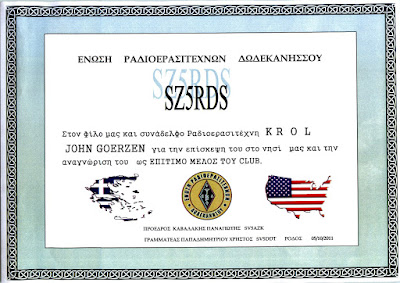
See also parts 1, 2, 3, and 4. This is the biggest highlight of our trip to Greece for me. I enjoy having the chance to meet people, visit for awhile, and make new friends and that certainly happened in Greece. In one of the shops we happened to step into, I noticed a radio behind the counter. That s not unusual itself; radios often catch my eye these days. But this radio was tuned to 21.070, an amateur radio frequency. So I asked the shop owner if he happened to be a ham. And indeed he was. He was Lakis (SV5KKU), and Terah and I had a great time visiting with him. Terah took some photos of us, and then we made our purchases and headed out. I had brought my HT (handheld radio, weighs a few ounces and is powered by batteries) with me, and Lakis told me about the repeaters in the area. I had known about some of that since I had emailed Panos of the amatuer radio club in Rhodes before leaving home (I found his name via Google). A couple of days later, on Tuesday, we found ourselves back in Lindos. It was mid-afternoon, so the shops were quiet. After a late lunch, I thought it would be nice to drop in on Lakis one more time, since we were scheduled to fly back the following morning. I m not sure how long we stayed it must have been at least an hour and enjoyed the fresh orange juice he prepared. After we got back to our hotel Tuesday, I learned that our flights on Wednesday were canceled due to a nationwide air traffic controller strike in Greece. After 3 hours on the phone with Delta (more on that experience later), we got rescheduled to fly back Friday. On Wednesday morning, I remembered that the Rhodes amateur radio club meets every Wednesday evening, and now I would be able to go! I knew how to contact Lakis by email and on the radio, and he kindly offered to pick me up and take me there. So that evening, I got a tour of his impressive mountaintop installation, and then it was on to the club the Radio Amateur Association of the Dodecanese (SZ5RDS). There I met Panos, whom I had emailed earlier (and I think surprised him a bit). It was a friendly group, and they translated into English for me every so often so I knew what was being discussed. When I was about to leave, they gave me this: The translation, partly from my memory and partly with the help of Google Translate, is:
Radio Amateur Association of the Dodecanese, SZ5RDS Our friend and radio colleague KR0L JOHN GOERZEN, who visited the island, has our recognition as an HONORARY CLUB MEMBER. PRESIDENT KAVALAKIS PANAGIOTIS SV5AZK (Panos) SECRETARY PAPADIMITRIOU CHRISTOS SV5DDT RHODES Oct. 5, 2011
(I hope that any Greeks reading this will send me corrections.) I truly appreciated that gesture and meeting all the people in the club. On the way back to the hotel, Lakis and I stopped by a restaurant, which I believe had the best souvlaki I ve ever tasted thanks! We brought some back for Terah. She had chosen to stay at the hotel that evening and had a small hotel meal earlier, but enjoyed the souvlaki and pita. Terah had explained to the ma tre d that I wasn t along that evening because I had gone to an amateur radio club meeting. Judging by the surprised reaction, this was probably the first time they had heard that particular comment! Experiences like this make travel fun and worthwhile. Thank you very much, Lakis and everyone in the club I hope to have a chance to visit again.

Kai Wasserb ch: New Greasemonkey script available for WotC's Magic section

No matter whether you're a professional or hobby player, if you play Magic: The Gathering, you certainly visit Wizards of the Coast's homepage from time to time. And while other parts of the WotC's page have been made unusable without ECMAScript enabled, the MTG part can be used without it mostly. The one part, that didn't work (and I needed) was card links. They have some ECMAScript to fetch the image from the Gatherer and overlay that on the current page, if you hover over a card link. If you click, it's again some script, that opens a Gatherer window. I just want all card links to be plain links pointing to the respective entries in the rather lightweight magiccards.info card search, which displays all relevant data in a compact layout. Today I finally got around to throw the ten or so lines of ECMAScript together, Greasemonkey needs to make that happen. If you like to give it a try, you can download it from my Greasemonkey script collection (direct link for the impatient: wotc_with_noscript_and_card_links.user.js). As an additional note: I'd like to point out, that there are other scripts available from userscripts.org which can do the same. But all those scripts did a lot else (like using jQuery to fetch the image on mouse over from magiccards.info).

11 November 2011

Jon Dowland: Retiring from the Debian games team

After over five years, I've decided to retire from the Debian Games Team. The games team has been a fun group to work within Debian: packaging doom-related programs was my route into Debian and I've really enjoyed it. Spare time is very tight at the moment, and I'm not dedicating much at all to Debian work. Within that, I'd quite like to try and focus on some other areas. Good luck to the team going forward!

8 November 2011

Jan Hauke Rahm: On GNOME 3

Since there have been a few blog posts about GNOME 3 already, I m sure you don t mind me adding one. I m one of those who don t do any work, just lurk around and wait for stuff to be fixed or working in the first place. I also don t like compiling GNOME myself. I barely touched the already packaged stuff in the repository of our Debian GNOME packaging team. But I run unstable plus stuff from experimental. I ll thus have a bit of a different experience with GNOME 3 than current testing users who at least in parts don t seem to like what they re getting. That being said I love it. No, I don t mind running network manager on my systems, I even have it on my netbook (Atom processor). I used wicd for a long time because network manager really got nothing done back in the days (half a year ago or what :)). Nowadays, since version 0.9, it works fine for me. No fiddling around with config files, perfect integration in the desktop, and LAN and WLAN Just Work [tm]. No, I don t like if some weird dependencies dictate what tools to use. I usually used pidgin for messaging, for instance. Now I m using empathy, simply because it s best integrated in GNOME. And no, I won t switch from mutt to evolution. :-P And there are more such cases. Also, these weird accessibility tools that are stuck in the gnome-shell top panel , I don t need them. Still there. (There s an extension to remove it, by the way.) Also, I must say, GNOME 3.2 is a lot better than 3.0 already. And I think 3.4 might do the final trick for me. Fact is, with GNOME 3 I have a much cleaner desktop, there is more room for windows (which is nice on a netbook display), there are web apps which I already use a lot, and it has a professional, not too playful look (i.e. a few effects, clear and consistent theming, no bubbling windows). And the new notification stuff is just awesome, especially with the empathy integration. Oh, and too many mouse click to access an application? 1) Put your most used apps in the favorites bar (or whatever it is called); it s just one click then. 2) Press your meta-key (that way our name for the windows key, or was that the ESC key? Whatever, press your windows key), type in the first two or three letters of your application, and hit enter; you don t need a mouse at all. There. It had to be said. :)

7 November 2011

Jo Shields: Bansheegeddon

It s seeming increasingly likely that reports regarding the future of Banshee, Tomboy, and the rest of the Mono stack in the default Ubuntu desktop install are accurate. Ubuntu 12.04 will likely be the first Ubuntu release since 5.10 not to ship with any Mono apps in the default install ending a run of 12 releases over 6 years. The decision seems to have come about during the default apps session at the Ubuntu Developer Summit just ended in Orlando, Florida. Prior to heavy vandalism, the only reasons cited for the change in the UDS session log are Banshee not well maintained and porting music store to GTK3 is blocked on banshee ported to GTK3 . Other reasons mentioned but not in the session logs are complaints that it doesn t work on ARM. I m using a lot of conjecture in this first paragraph because the news about the decision appeared on the blogosphere before anywhere else. The first many Banshee or Tomboy developers read about it was reading a flurry of activity on the Tweetosphere from the anti-Mono activists declaring victory. So first, a word on the cited reasoning. Banshee works fine on ARM, since Mono works fine on ARM. Xamarin, the company behind most upstream Mono work, earns their income almost entirely from ARM versions of Mono, running on the varied ARM implementations found in smartphones. Every major Banshee release is personally tested on my Genesi EfikaMX, an ARM system with a Freescale i.mx51 processor. I ve also demonstrated Banshee running in an Ubuntu chroot on my HP Touchpad, an ARM-based tablet. What is known is that Banshee has some problems running on Texas Instruments OMAP4 processors the target ARM platform for Canonical s ARM work. None of the Banshee upstream developers, Mono upstream developers, or Mono Ubuntu team has ever been able to reproduce the cited problems, since problems specific to an exact ARM chip are impossible to reproduce without the requisite hardware and none of us owns an ARM system matching Canonical s target. That Banshee is still a GTK+2 app is true. A port to GTK+3 is almost complete, but blocking on a single technical bug deep within GTK# s guts, which could be fixed by someone with sufficient knowledge of GTK+ semantics. Nobody with the required GTK+ knowledge has stepped forward with a fix at this point in time. As for the final point, that Banshee is not well maintained, this seems like a directed personal insult against the active and responsive Banshee maintainer, Chow Loong Jin, and upstream bug triager David Nielsen, in addition to the immeasurable hours contributed free of charge for the benefit of Ubuntu users by various other members of related Mono app and library teams, including myself. I need to stress at this point that my annoyance with this decision has nothing to do with the actual app changes. Keeping Tomboy and gbrainy, at a cost of about 25 meg of unsquashed disk space, is a hard argument to make compared with those two plus Banshee for 40 meg. Dropping gbrainy and Tomboy, and switching to Rhythmbox, will save about 30 meg of unsquashed space, all told.I m unconvinced that Rhythmbox is a technically superior app to Banshee several features which were gained by the first app swap will be lost again but that s another long tedious argument to be had. No, what has me deeply angered is the shambolic way the changes were made and announced. Significant accommodations were made by Banshee upstream in order to make life easier for Canonical to integrate Banshee into their OS. For one thing, that s why the Ubuntu One Music Store support is a core Banshee feature, not part of the third-party community extensions package. If Banshee was being considered for replacement due to unresolved technical issues, then perhaps it would have been polite to, I don t know, inform upstream that it was on the cards? Or, if Canonical felt that problems specific to their own itches required scratching, then is it completely beyond the realm of possibility to imagine they might have spent developer resources on bug fixing their OS and sending those fixes upstream? Or even and call me crazy providing access for upstream to specialized hardware such as a $174 Pandaboard to empower upstream to isolate and fix unreproducible bugs specific to Canonical s target hardware? And here s where it gets more astonishing for me Canonical paid money to ship one of the community-based packagers responsible for the stack, Iain Lane, to Orlando for UDS, and didn t think it was worth bothering to perhaps inform him hey, the stuff you work on is in danger of being axed from the default install, maybe you should go to this session . So I m not cross that the stuff I work on has been removed from the default install. I intend to continue working on it as I have for the last 4 years, through my work in Debian. No, why I m cross that I heard about it from fucking Boycott Novell. Regardless of your opinions regarding Banshee or its stack, if you read the above and don t see it as an abysmal failure of community engagement by a company whose community manager wrote a book on the damn topic, then there s something seriously wrong with your understanding of how community labour should be seen as a resource. Maybe someone at Canonical should try reading Jono s book. It s not a first-time offence, and this mail from a PiTiVi developer regarding changes in 11.10 makes for useful further reading. [edit] There is some worthwhile discussion going on on the ubuntu-desktop mailing list covering the technical issues surrounding the decision, I would suggest it s a good place for ongoing technical discussion.

6 November 2011

Iain Lane: Goodbye Orlando

After a tiring UDS in which I very nearly achieved my goal of mentioning Debian in every session and conversation, I ventured out to a nearby outlet mall. scary monster Imagine my surprise when this little chap ended up in my bag! err and then I found out where the Angry Birds hang out when taking a break from destroying those evil pigs shoes and after this twin impact, I needed some retail therapy. This is probably the second pair of shoes I have ever purchased for myself. Good week :-). And so to the delayed flight home

5 November 2011

Dominique Dumont: Debian NM process: it s not bureaucracy, it s

Hello Before entering Debian NM process (formerly New Maintainer process, now New Member process) , I ve often read that it was too long, too hard, or too bureaucratic. It s certainly true that becoming a Debian Developer takes some time. Even if you re already actively packaging. You have to answer a lot of questions regarding several aspects of Debian project. Some of them are not fun but necessary: All in all, the NM process was time well spent. I ve learned a lot. IMHO, Debian NM process isn t bureaucracy, it s more like a training. And an interesting one. So, if you re thinking about becoming a Debian Member, to paraphrase someone, what the bloody hell are you waiting for ? :-) Many thanks to all people that helped me become a DD: All the best

4 November 2011

Josselin Mouette: This is not a giant root exploit, this is a feature

So, there is some history of organisations doing a poor job at managing security bugs. We saw the This is not really a security hole jokes just to avoid having bad statistics in the front page. We saw the OMFG you must update to the latest version RIGHT NOW and no I m not telling why panic. We still frequently see security fixes hidden in unrelated public commits, just to make them harder to backport for distributors. But really, there is absolutely no match for that. Kudos for setting a new standard in the worse way of dealing with security issues, guys. Update: one of the developers has started insulting a pair of professional IT security experts who came and tried to educate him. Awesome reading, don t forget the popcorn.

3 November 2011

Josselin Mouette: The lies of Merkozy

When George Papandreou announced its will to submit the European help program to the approbation of the Greek people, I don t know whether he wanted to scare people, but man, he really achieved something. From Wall Street to the Bundestag, through the lys e Palace, they are all in a state of advanced panic. There s a joke that s been circulating since: for next Hallowe en, disguise yourself as a referendum. Yes, these guys are afraid. Afraid of the people. They are afraid because it is now clear that their interests are not the same as the interests of the people. And what do you do when you are afraid? Well, you find yourself some way out, often by lying. And indeed, Mrs Merkel and Mr Sarkozy have been repeating over and over something that has been then repeated over and over by most so-called journalists: that Greeks can only choose between two endings:
  1. they pay their debts to banks and rich people, and stay in the Euro zone;
  2. they don t pay their debts to banks and rich people, and find themselves another currency.
That s it: Mrs Merkel and Mr Sarkozy are outrageous liars. There is another option for Greek people:
3. they don t pay their debts to banks and rich people, and they stay in the Euro zone.
It s as simple as that: nothing in European treaties can force a country to leave the Euro zone. And nothing in these treaties can force a country to honor their bonds. Greece is a sovereign state and, as such, can choose not to honor its sovereign debt. And choose to stay in the Euro zone: why would they want to go out? What does it have to do with the currency those bonds have been emitted in? If California were to cease payment of its public debt (something not likely to happen at all, hmm?), would it have to abandon the Dollar? But here is a thing that has been forbidden for a long time in European treaties: for a country to help financially another one to pay its debts. This rule was introduced by Jacques Delors (a man who knows what being European means) precisely in order to avoid the contagion we are facing currently because of stupid help plans all across Europe. Yes: the whole idea of Merkozy s grand plan to save Euro while helping Greece (a weird kind of help, starving people, really) is illegal. So in addition to being liars, Mrs Merkel and Mr Sarkozy are delinquents. So let Greece cease payment of its debt. A few banks will sink: so what? This will create less unemployment than letting our whole economy sink. European States will guarantee citizens savings up to 30 k , that s one of the other clever European rules (some countries guarantee more). Other people, rich people only, will lose their savings. Will that prevent you from sleeping? Not me. But that could prevent from sleeping a number of friends of Mrs Merkel s and Mr Sarkozy s. And wouldn t that be a good reason for lying and violating European treaties?

2 November 2011

Benjamin Mako Hill: Slouching Toward Autonomy

I care a lot about free network services. Recently, I have been given lots of reasons to be happy with the progress the free software community has made in developing services that live up to my standards. I have personally switched from a few proprietary network services to alternative systems that respect my autonomy and have been very happy both with the freedom I have gained and with the no-longer-rudimentary feature sets that the free tools offer. Although there is plenty left to do, here are four tools I'm using now instead of the proprietary tools that many people use, or that I used to use myself: In trying to switch away from proprietary services, I have found that there still a lack of good information comparing the different systems out there and giving folks advice on who might be able to help with things like setup or hosting. I really value hearing from other people about what they use and what they find useful but finding this information online still seems to be a struggle. The autonomo.us wiki seems like the natural place to host or summarize this discussion and to collect and share information useful for those of us slouching (or running) toward autonomy in our use of network services. I invite folks to get involved in improving that already useful resource. For example, this week, I spent a few hours researching free social bookmarking tools and produced a major update to the (already useful) social bookmarking page on the autonomo.us wiki. Of course, I can imagine lots of ways to improve that page and to collect similar information on other classes of network services. Please join me in that effort!

Paul Wise: Convenient login to Debian porterboxen

Whenever I want to login to a Debian porterbox to figure out some architecture-specific issue I typically do not care which particular host I am going to login to, just what architecture the host is. After discovering that it is not yet easy for the Debian sysadmins (DSA) to add aliases to DNS for this purpose, I whipped up a quick script to grab the relevant data about Debian machines from the Debian LDAP server and work around this in my OpenSSH config. To use the script you should run the script and place the magic comment lines suggested by the script into your ~/.ssh/config file and then run the script again, which will contact the Debian LDAP server using python-ldap, download the relevant information and replace the relevant part of your ~/.ssh/config file with some OpenSSH configuration directives to map Debian architecture names to hostnames. Within just a few seconds you will be able to login to armel, powerpc.port or kfreebsd-amd64.port.debian.org instead of needing to manually look up which servers to login for a particular architecture. Update: paravoid mentioned his dsa-porterbox script (see below) which is much simpler, does not need to modify your OpenSSH configuration and can be run as like ssh $(dsa-porterbox armel head -n1). I'm hoping we can add this and a possible ssh-porterbox to the devscripts package.
#!/bin/sh
test -z $1 && exit 1
exec ldapsearch -LLL -x -h db.debian.org -b ou=hosts,dc=debian,dc=org \
 "(&(purpose=porterbox)(architecture=$1))" hostname   \
 sed -n 's/^hostname: //p'

1 November 2011

Sylvain Beucler: Build a SFML project with CMake

[Latest version of these instructions can be found at the SFML Wiki] CMake allows your project to be built in various environments, including command-line make, Code::Blocks project files, Eclipse project files, etc. It's used in SFML 2.0. In this tutorial we'll write a simple CMake configuration file with centralized version numbering, and see how to integrate SFML in it. The source files First, create a cmake_modules directory and copy FindSFML.cmake in it. FindXXXX is automatically searched by CMake's find_package command. Then create a main.cpp, for instance:
#include "config.h"
#include <iostream>
#include <SFML/Window.hpp>
using namespace std;
int main(int argc, char* argv[])  
  cout << "Version " << myproject_VERSION_MAJOR << "." << myproject_VERSION_MINOR << endl;
  sf::Window screen(sf::VideoMode(800, 600), "myproject");
  bool running = true;
  while (running)  
    screen.Display();
   
 
We use a config.h file that is built by CMake, let's also create a config.h.in file:
#define myproject_VERSION_MAJOR @myproject_VERSION_MAJOR@
#define myproject_VERSION_MINOR @myproject_VERSION_MINOR@
And place your project license (such as the GNU GPL) in a file named COPYING. CMake configuration Let's describe our project configuration in the CMakeLists.txt file:
cmake_minimum_required(VERSION 2.6)
project(myproject)
# Set version information in a config.h file
set(myproject_VERSION_MAJOR 1)
set(myproject_VERSION_MINOR 0)
configure_file(
  "$ PROJECT_SOURCE_DIR /config.h.in"
  "$ PROJECT_BINARY_DIR /config.h"
  )
include_directories("$ PROJECT_BINARY_DIR ")
# Define sources and executable
set(EXECUTABLE_NAME "myproject")
add_executable($ EXECUTABLE_NAME  main.cpp)
# Detect and add SFML
set(CMAKE_MODULE_PATH "$ CMAKE_SOURCE_DIR /cmake_modules" $ CMAKE_MODULE_PATH )
find_package(SFML 1.6 REQUIRED system window graphics network audio)
target_link_libraries($ EXECUTABLE_NAME  $ SFML_LIBRARIES )
# Install target
install(TARGETS $ EXECUTABLE_NAME  DESTINATION bin)
# CPack packaging
include(InstallRequiredSystemLibraries)
set(CPACK_RESOURCE_FILE_LICENSE "$ CMAKE_SOURCE_DIR /COPYING")
set(CPACK_PACKAGE_VERSION_MAJOR "$ myproject_VERSION_MAJOR ")
set(CPACK_PACKAGE_VERSION_MINOR "$ myproject_VERSION_MINOR ")
include(CPack)
The interesting part is:
# Detect and add SFML
set(CMAKE_MODULE_PATH "$ CMAKE_SOURCE_DIR /cmake_modules" $ CMAKE_MODULE_PATH )
find_package(SFML 1.6 REQUIRED system window graphics network audio)
target_link_libraries($ EXECUTABLE_NAME  $ SFML_LIBRARIES )
Compilation To build with Make and the GCC compiler on the command-line:
cd build/  # a separate directory so we can easily remove all the CMake work files
cmake ..  # generate Makefile's
make
To create Code::Blocks project files:
cmake .. -G "CodeBlocks - Unix Makefiles"
and open project.cbp with Code::Blocks. Installation CMake supports the classic:
make install
It also supports DESTDIR, useful in packaging:
make install DESTDIR= pwd /myworkdir
You can also define CMAKE_INSTALL_PREFIX when invoking cmake to change the default install path (/usr/local under Unix). DESTDIR would still override this setting. Packaging You then can use cpack to make a project release:
# Binary package:
cpack -C CPackConfig.cmake
# Source package:
cpack -C CPackSourceConfig.cmake
You will get a nice myproject-1.0.tar.gz, among others. Further information
$ cmake --help-variable CMAKE_SOURCE_DIR
cmake version 2.8.5
  CMAKE_SOURCE_DIR
       The path to the top level of the source tree.
       This is the full path to the top level of the current CMake source
       tree.  For an in-source build, this would be the same as
       CMAKE_BINARY_DIR.

Rapha&#235;l Hertzog: My Debian activities in October 2011

This is my monthly summary of my Debian related activities. If you re among the people who made a donation to support my work (130.30 , thanks everybody!), then you can learn how I spent your money. Otherwise it s just an interesting status update on my various projects. Dpkg work The month started with fixing newly reported bugs to prepare the 1.16.1.1 release: With the help of Guillem, we decided on a proper fix for a race condition sometimes triggered by parallel builds when 2 concurrent dpkg-gencontrol try to update debian/files (see #642608). This ended up requiring a new package (libfile-fcntllock-perl) that the Debian perl team kindly packaged for us. With all this sorted, it was a rather easy fix. Multiarch progress I also spent lots of time on multiarch. I fixed an old bug that requested to support the multi-arch paths in case of cross-building (see #595144), the discussion was not really conclusive on which of the two proposed patches was better so I ended up picking my own patch because it was closer to how we currently deal with cross-building. Then I fixed 2 issues that have been reported on Ubuntu s dpkg. The first one (LP #863675) was rather severe since an installed package ended being disappeared in favor of its foreign counterpart that was removed (but that had some config files left). The second one (LP #853679) only affected dselect users (apparently there are still some!) who had a self-conflicting library (Provides: foo, Conflicts: foo) installed for multiple architectures. But the bulk of the time spent on multiarch has been spent discussing with various parties on how to go forward with multiarch. The release team commented on the schedule of the merge to ensure it makes it into Wheezy, and the Debian project leader also commented on the problems encountered so far. While not the best course of action I could have hoped for, it certainly helped since Guillem started pushing some reviewed commits. Out of the 66 commits that were in my pu/multiarch/full branch one week ago, 20 have been merged in the master branch already. Python-django security update and RC bug Since python-django s maintainer did not manage to prepare the required security updates, I stepped in and prepared version 1.2.3-3+squeeze2 for Squeeze and 1.0.2-1+lenny3 for Lenny. Unfortunately this security update is an example of how an inactive maintainer is likely to result in a severe delay for the release of security updates. Furthermore in this specific case, the security team did not want to release the Squeeze security update until the Lenny one had been investigated (which required some time since upstream no longer supports the version in Lenny) but they did not make this very clear. Later another release critical bug had been filed against the package (#646634) but after investigation, it turned out to be a local configuration problem so I downgraded it. I still forwarded the test suite failure to upstream authors since the test could be enhanced. In any case, co-maintainers for python-django are welcome. I really preferred the situation where I can quietly sit down as backup maintainer :-) WordPress packaging WordPress sounds similar to python-django. I m also only a backup maintainer but Giuseppe has been inactive for many months and I had to step in August because I wanted the new upstream version. I discovered a bit late that I was not subscribed to wordpress bugs and thus the release critical bug #639733 (that I introduced with my new upstream version) went unattended for a rather long time. Once aware, though, I quickly fixed it. I also took the opportunity to start a discussion on debian-devel about how to deal with embedded javascript libraries and proposed a mechanism of opportunistic replacement with symlinks . WordPress is my testbed package for this mechanism, you can check out its debian/dh_linktree that implements the replacement logic. The discussion has not been very interesting but at least I learned that Debian now requires that each source package shipping minified javascript files includes the original files too. It s somewhat of a pain since it s not a license requirement in many cases (many of those libraries are not under the GPL), but just a Debian requirement that many upstreams are not complying with. WordPress is affected and Jakub Wilk thus opened #646729 which is going to be a long-standing RC bug. To give good measures, I spent several hours investigating the case of each javascript file in the WordPress source package and I filed a new ticket on the upstream bugtracker. Dropbox packaging work A few months after the introduction of nautilus-dropbox to Debian and Ubuntu, I can say that the decision to only support the download of dropbox in the postinst has been a mistake. Because of this decision I had to make the postinst fail if the download failed. Even if the error message is relatively clear, this lead to many (mostly automated) bug reports on the Ubuntu side. Various other problems cropped up on top of this (trying to start dropbox while the package was not configured would result in an error because the user did not have the required rights to install the software, reinstalling the package while dropbox was running would result in a failure too, etc.). I have fixed all those issues in the version 0.7.0-2 of the package. Now if the user has to install dropbox, it will use PolicyKit to request the root rights. The postinst will no longer fail if the dropbox download fails since it can be run later by the user. And I fixed the download code to remove the replaced file before unpacking a new file (insead of overwriting the existing file). All this work has been forwarded upstream. The Debian Administrator s Handbook Update I m glad to tell you that the translation will happen because we reached the minimal funding goal on October 22th with the help of 380 supporters. Now the fundraising continues, but this time the goal is the liberation of the resulting book. For this to happen, we need to reach 25000 EUR in the liberation fund. So far we re at 37% of this goal with 9400 EUR in the liberation fund (which means that 59% of the money raised has been put in the liberation fund).

Click here if you want to contribute towards the liberation of this book. With (less than) 27 days left, it s going to be a challenge to meet the goal, but we do like challenges, don t we? Misc work

Thanks See you next month for a new summary of my activities.

2 comments Liked this article? Click here. My blog is Flattr-enabled.

29 October 2011

Joey Hess: GitTogether2011

I attended the Git Together earlier this week. I was tenative about this, since I'm not really much of a git developer; all my git work is building stuff on top of it. It turned out great though. At first it seemed like one of those parties where you don't know anyone. But then I got to reconnect with Avery Pennarun for the first time since DebConf 2, and got to know Jonathan Nieder better, and it was also nice to see Jelmer Vernooij. And the core developers were also very welcoming. Junio Hamano knew of my work (and I am in awe of his), and Jeff King thinks my take on SHA1 security issues has value, and has been expanding on it. Shawn Pearce managed the unconference subtly and well. Lots of very smart people. At one point I found myself accross the table from Android's lead developer. I was very happy that everything I think needs improvement in git was discussed during the unconference:

Next.

Previous.