Ulrike Uhlig: How do kids conceive the internet?
 I wanted to understand how kids between 10 and 18 conceive the internet.
Surely, we have seen a generation that we call digital natives grow up with
the internet. Now, there is a younger generation who grows up with pervasive
technology, such as smartphones, smart watches, virtual assistants and so on.
And only a few of them have parents who work in IT or engineering
Pervasive technology contributes to the idea that the internet is immaterial
With their search engine website design, Google has put in place an extremely
simple and straightforward user interface. Since then, designers and
psychologists have worked on making user interfaces more and more intuitive to
use. The buzzwords are usability and user experience design . Besides this
optimization of visual interfaces, haptic interfaces have evolved as well,
specifically on smartphones and tablets where hand gestures have replaced more
clumsy external haptic interfaces such as a mouse. And beyond interfaces, the
devices themselves have become smaller and slicker. While in our generation
many people have experienced opening a computer tower or a laptop to replace
parts, with the side effect of seeing the parts the device is physically
composed of, the new generation of end user devices makes this close to
impossible, essentially transforming these devices into black boxes, and
further contributing to the idea that the internet they are being used to
access with would be something entirely intangible.
What do kids in 2022 really know about the internet?
So, what do kids of that generation really know about the internet, beyond
purely using services they do not control? In order to find out, I decided to
interview children between 10 and 18.
I conducted 5 interviews with kids aged 9, 10, 12, 15 and 17, two boys and
three girls. Two live in rural Germany, one in a German urban area, and two
live in the French capital.
I wrote the questions in a way to stimulate the interviewees to tell me a story
each time. I also told them that the interview is not a test and that there are
no wrong answers.
Except for the 9 year old, all interviewees possessed both, their own
smartphone and their own laptop. All of them used the internet mostly for
chatting, entertainment (video and music streaming, online games), social media
(TikTok, Instagram, Youtube), and instant messaging.
Let me introduce you to their concepts of the internet. That was my first story
telling question to them:
If aliens had landed on Earth and would ask you what the internet is, what would you explain to them?
The majority of respondents agreed in their replies that the internet is
intangible while still being a place where one can do anything and
everything .
Before I tell you more about their detailed answers to the above question, let
me show you how they visualize their internet.
If you had to make a drawing to explain to a person what the internet is, how would this drawing look like?
Each interviewee had some minutes to come up with a drawing.
As you will see, that drawing corresponds to what the kids would want an
alien to know about the internet and how they are using the internet
themselves.
Movies, series, videos
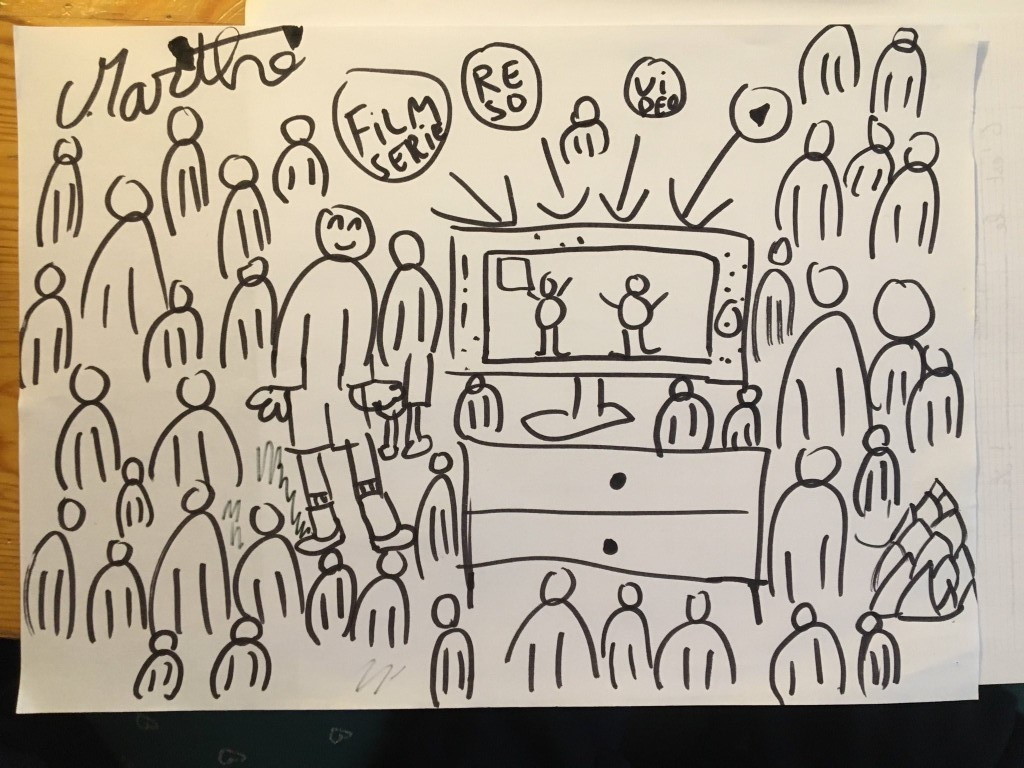 The youngest respondent, a 9 year old girl, drew a screen with lots of people
around it and the words film, series, network, video , as well as a play
icon. She said that she mostly uses the internet to watch movies. She was the
only one who used a shared tablet and smartphone that belonged to her family,
not to herself. And she would explain the net like this to an alien:
"Internet is a er one cannot touch it it s an, er [I propose
the word idea ], yes it s an idea. Many people use it not necessarily to
watch things, but also to read things or do other stuff."
User interface elements
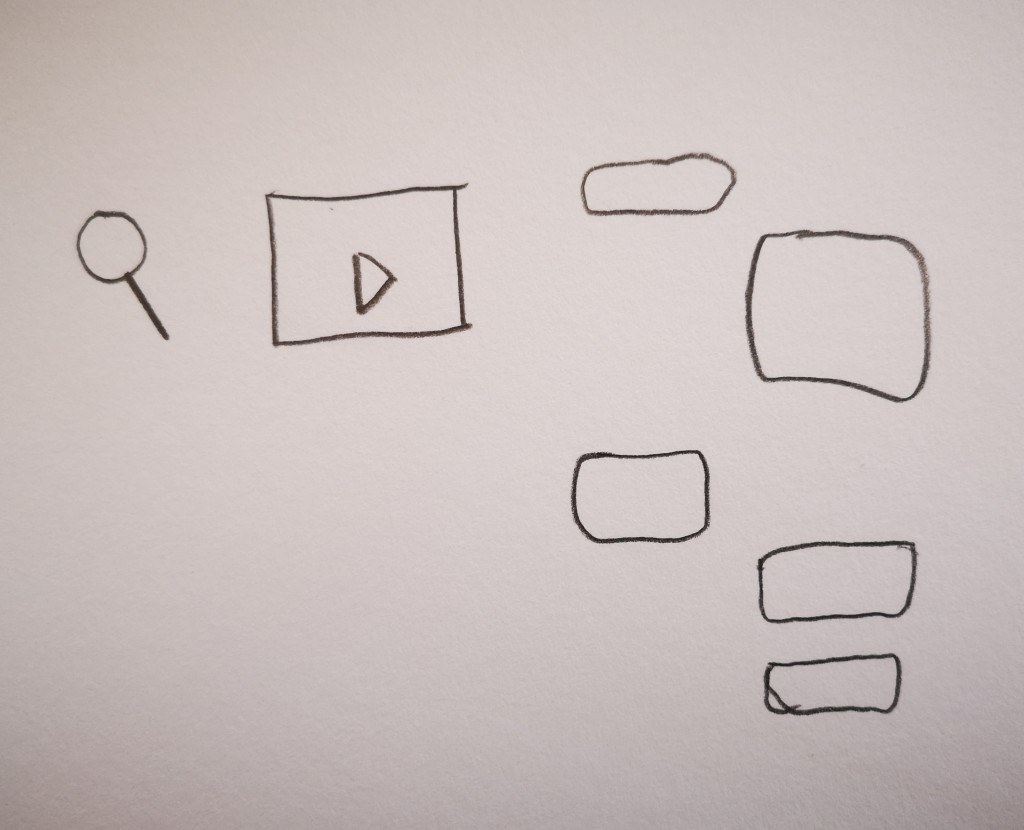 A 10 year old boy represented the internet by recalling user interface
elements he sees every day in his drawing: a magnifying glass (search
engine), a play icon (video streaming), speech bubbles (instant
messaging). He would explain the internet like this to an alien:
"You can use the internet to learn things or get information,
listen to music, watch movies, and chat with friends. You can do nearly
anything with it."
Another planet
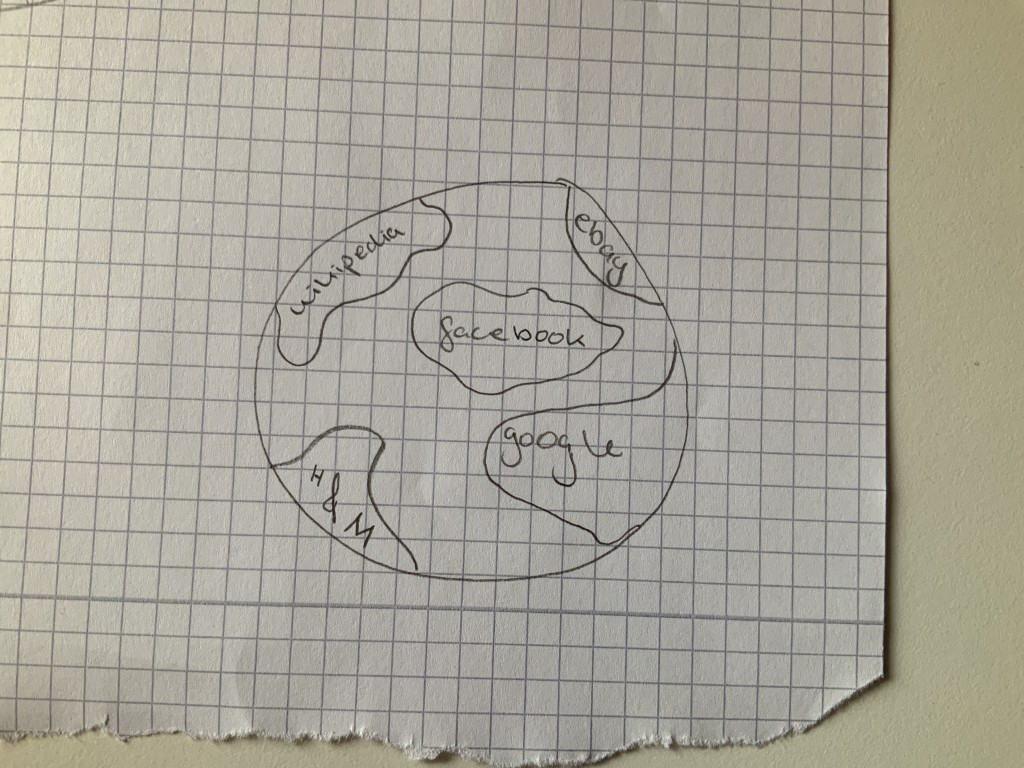 A 12 year old girl imagines the internet like a second, intangible, planet
where Google, Wikipedia, Facebook, Ebay, or H&M are continents that one enters
into.
"And on [the] Ebay [continent] there s a country for clothes, and
,trousers , for example, would be a federal state in that
country."
Something that was unique about this interview was that she told me she had an
email address but she never writes emails. She only has an email account to
receive confirmation emails, for example when doing online shopping, or when
registering to a service and needing to confirm one s address. This is
interesting because it s an anti-spam measure that might become outdated with a
generation that uses email less or not at all.
Home network
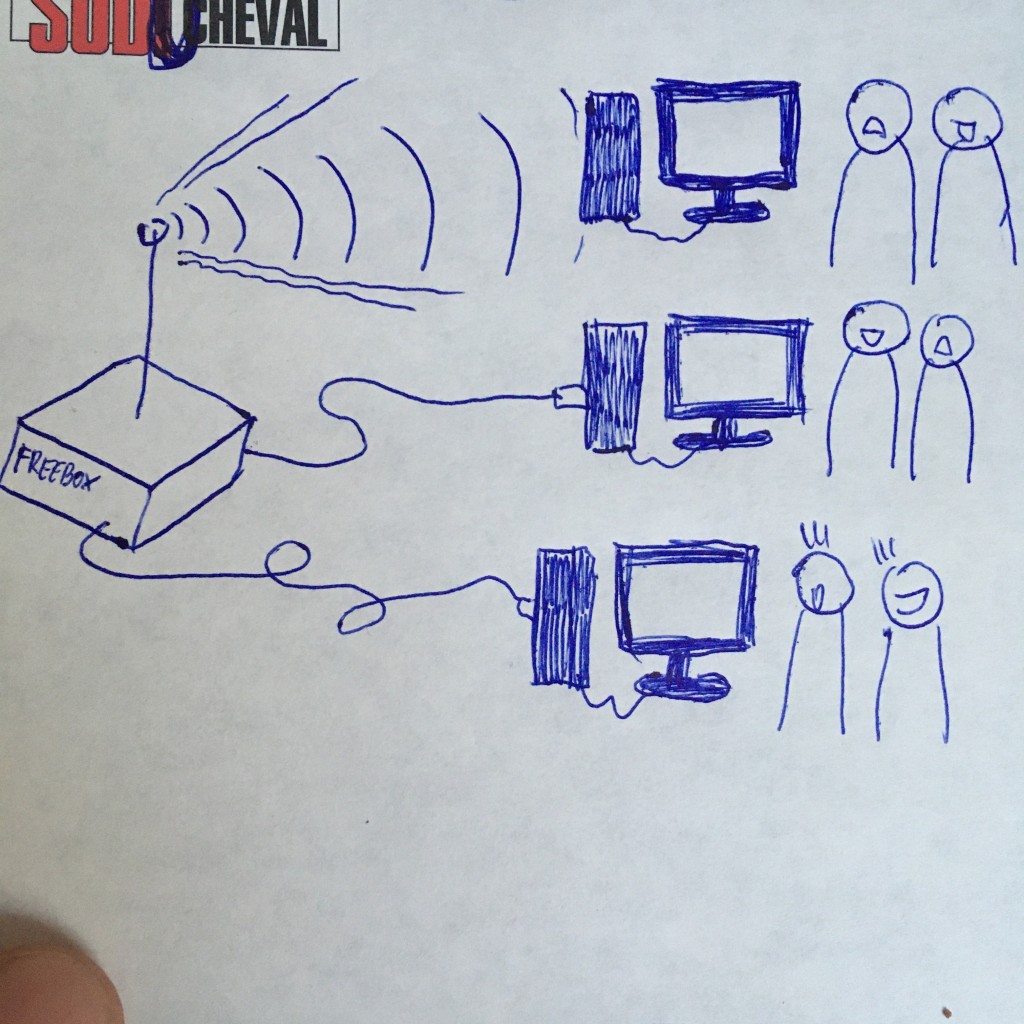 A 15 year old boy knew that his family s devices are connected to a home router
(Freebox is a router from the French ISP Free) but lacked an imagination of the
rest of the internet s functioning. When I asked him about what would be behind
the router, on the other side, he said what s behind is like a black hole to
him. However, he was the only interviewee who did actually draw cables, wifi
waves, a router, and the local network. His drawing is even extremely precise,
it just lacks the cable connecting the router to the rest of the internet.
Satellite internet
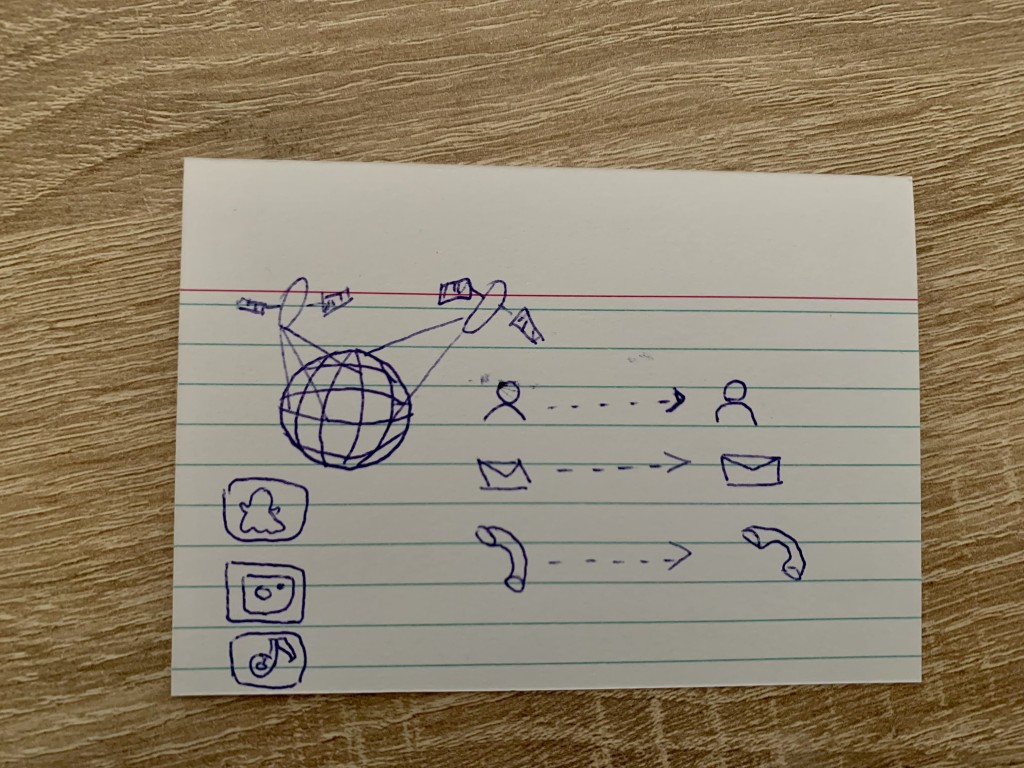 A 17 year old girl would explain the internet to an alien as follows:
"The internet goes around the entire globe. One is networked with
everyone else on Earth. One can find everything. But one cannot touch the
internet. It s like a parallel world. With a device one can look into the
internet. With search engines, one can find anything in the world, one can
phone around the world, and write messages. [The internet] is a gigantic
thing."
This interviewee stated as the only one that the internet is huge. And
while she also is the only one who drew the internet as actually having
some kind of physical extension beyond her own home, she seems to
believe that internet connectivity is based on satellite technology and
wireless communication.
Imagine that a wise and friendly dragon could teach you one thing about the internet that you ve always wanted to know. What would you ask the dragon to teach you about?
A 10 year old boy said he d like to know how big are the servers behind all of
this . That s the only interview in which the word server came up.
A 12 year old girl said I would ask how to earn money with the internet. I
always wanted to know how this works, and where the money comes from. I love
the last part of her question!
The 15 year old boy for whom everything behind the home router is out of his
event horizon would ask How is it possible to be connected like we are? How
does the internet work scientifically?
A 17 year old girl said she d like to learn how the darknet works, what hidden
things are there? Is it possible to get spied on via the internet? Would it be
technically possible to influence devices in a way that one can listen to
secret or telecommanded devices?
Lastly, I wanted to learn about
what they find annoying, or problematic about the internet.
Imagine you could make the internet better for everyone. What would you do first?
Asked what she would change if she could, the 9 year old girl advocated for a
global usage limit of the internet in order to protect the human brain.
Also, she said, her parents spend way too much time on their phones and people
should rather spend more time with their children.
Three of the interviewees agreed that they see way too many advertisements and
two of them would like ads to disappear entirely from the web. The other one
said that she doesn t want to see ads, but that ads are fine if she can at
least click them away.
The 15 year old boy had different ambitions. He told me he would change:
"the age of access to the internet. More and more younger people
access the internet ; especially with TikTok there is a recommendation
algorithm that can influcence young people a lot. And influencing young
people should be avoided but the internet does it too much. And that can be
negative. If you don t yet have a critical spirit, and you watch certain
videos you cannot yet moderate your stance. It can influence you a lot.
There are so many things that have become indispensable and that happen on
the internet and we have become dependent. What happens if one day it
doesn t work anymore? If we connect more and more things to the net, that s not
a good thing."
The internet - Oh, that s what you mean!
On a sidenote, my first interview tentative was with an 8 year old girl
from my family. I asked her if she uses the internet and she denied, so
I abandoned interviewing her. Some days later, while talking to her, she
proposed to look something up on Google, using her smartphone. I said:
Oh, so you are using the internet! She replied: Oh, that s
what you re talking about?
I think she knows the word Google and she knows that she can search
for information with this Google thing. But it appeared that she
doesn t know that the Google search engine is located somewhere else on
internet and not on her smartphone. I concluded that for her, using the
services on the smartphone is as natural as switching on a light in
the house: we also don t think about where the electricity comes from
when we do that.
What can we learn from these few interviews?
Unsurprisingly, social media, streaming, entertainment, and instant messaging
are the main activities kids undertake on the internet. They are completely at
the mercy of advertisements in apps and on websites, not knowing how to get rid
of them. They interact on a daily basis with algorithms that are unregulated
and known to perpetuate discrimination and to create filter bubbles, without
necessarily being aware of it. The kids I interviewed act as mere service users
and seem to be mostly confined to specific apps or websites.
All of them perceived the internet as being something intangible. Only the
older interviewees perceived that there must be some kind of physical expansion
to it: the 17 year old girl by drawing a network of satellites around the
globe, the 15 year old boy by drawing the local network in his home.
To be continued
If aliens had landed on Earth and would ask you what the internet is, what would you explain to them?
The majority of respondents agreed in their replies that the internet is
intangible while still being a place where one can do anything and
everything .
Before I tell you more about their detailed answers to the above question, let
me show you how they visualize their internet.
If you had to make a drawing to explain to a person what the internet is, how would this drawing look like?
Each interviewee had some minutes to come up with a drawing.
As you will see, that drawing corresponds to what the kids would want an
alien to know about the internet and how they are using the internet
themselves.
Movies, series, videos
The youngest respondent, a 9 year old girl, drew a screen with lots of people
around it and the words film, series, network, video , as well as a play
icon. She said that she mostly uses the internet to watch movies. She was the
only one who used a shared tablet and smartphone that belonged to her family,
not to herself. And she would explain the net like this to an alien:
"Internet is a er one cannot touch it it s an, er [I propose
the word idea ], yes it s an idea. Many people use it not necessarily to
watch things, but also to read things or do other stuff."
User interface elements
A 10 year old boy represented the internet by recalling user interface
elements he sees every day in his drawing: a magnifying glass (search
engine), a play icon (video streaming), speech bubbles (instant
messaging). He would explain the internet like this to an alien:
"You can use the internet to learn things or get information,
listen to music, watch movies, and chat with friends. You can do nearly
anything with it."
Another planet
A 12 year old girl imagines the internet like a second, intangible, planet
where Google, Wikipedia, Facebook, Ebay, or H&M are continents that one enters
into.
"And on [the] Ebay [continent] there s a country for clothes, and
,trousers , for example, would be a federal state in that
country."
Something that was unique about this interview was that she told me she had an
email address but she never writes emails. She only has an email account to
receive confirmation emails, for example when doing online shopping, or when
registering to a service and needing to confirm one s address. This is
interesting because it s an anti-spam measure that might become outdated with a
generation that uses email less or not at all.
Home network
A 15 year old boy knew that his family s devices are connected to a home router
(Freebox is a router from the French ISP Free) but lacked an imagination of the
rest of the internet s functioning. When I asked him about what would be behind
the router, on the other side, he said what s behind is like a black hole to
him. However, he was the only interviewee who did actually draw cables, wifi
waves, a router, and the local network. His drawing is even extremely precise,
it just lacks the cable connecting the router to the rest of the internet.
Satellite internet
A 17 year old girl would explain the internet to an alien as follows:
"The internet goes around the entire globe. One is networked with
everyone else on Earth. One can find everything. But one cannot touch the
internet. It s like a parallel world. With a device one can look into the
internet. With search engines, one can find anything in the world, one can
phone around the world, and write messages. [The internet] is a gigantic
thing."
This interviewee stated as the only one that the internet is huge. And
while she also is the only one who drew the internet as actually having
some kind of physical extension beyond her own home, she seems to
believe that internet connectivity is based on satellite technology and
wireless communication.
Imagine that a wise and friendly dragon could teach you one thing about the internet that you ve always wanted to know. What would you ask the dragon to teach you about?
A 10 year old boy said he d like to know how big are the servers behind all of
this . That s the only interview in which the word server came up.
A 12 year old girl said I would ask how to earn money with the internet. I
always wanted to know how this works, and where the money comes from. I love
the last part of her question!
The 15 year old boy for whom everything behind the home router is out of his
event horizon would ask How is it possible to be connected like we are? How
does the internet work scientifically?
A 17 year old girl said she d like to learn how the darknet works, what hidden
things are there? Is it possible to get spied on via the internet? Would it be
technically possible to influence devices in a way that one can listen to
secret or telecommanded devices?
Lastly, I wanted to learn about
what they find annoying, or problematic about the internet.
Imagine you could make the internet better for everyone. What would you do first?
Asked what she would change if she could, the 9 year old girl advocated for a
global usage limit of the internet in order to protect the human brain.
Also, she said, her parents spend way too much time on their phones and people
should rather spend more time with their children.
Three of the interviewees agreed that they see way too many advertisements and
two of them would like ads to disappear entirely from the web. The other one
said that she doesn t want to see ads, but that ads are fine if she can at
least click them away.
The 15 year old boy had different ambitions. He told me he would change:
"the age of access to the internet. More and more younger people
access the internet ; especially with TikTok there is a recommendation
algorithm that can influcence young people a lot. And influencing young
people should be avoided but the internet does it too much. And that can be
negative. If you don t yet have a critical spirit, and you watch certain
videos you cannot yet moderate your stance. It can influence you a lot.
There are so many things that have become indispensable and that happen on
the internet and we have become dependent. What happens if one day it
doesn t work anymore? If we connect more and more things to the net, that s not
a good thing."
The internet - Oh, that s what you mean!
On a sidenote, my first interview tentative was with an 8 year old girl
from my family. I asked her if she uses the internet and she denied, so
I abandoned interviewing her. Some days later, while talking to her, she
proposed to look something up on Google, using her smartphone. I said:
Oh, so you are using the internet! She replied: Oh, that s
what you re talking about?
I think she knows the word Google and she knows that she can search
for information with this Google thing. But it appeared that she
doesn t know that the Google search engine is located somewhere else on
internet and not on her smartphone. I concluded that for her, using the
services on the smartphone is as natural as switching on a light in
the house: we also don t think about where the electricity comes from
when we do that.
What can we learn from these few interviews?
Unsurprisingly, social media, streaming, entertainment, and instant messaging
are the main activities kids undertake on the internet. They are completely at
the mercy of advertisements in apps and on websites, not knowing how to get rid
of them. They interact on a daily basis with algorithms that are unregulated
and known to perpetuate discrimination and to create filter bubbles, without
necessarily being aware of it. The kids I interviewed act as mere service users
and seem to be mostly confined to specific apps or websites.
All of them perceived the internet as being something intangible. Only the
older interviewees perceived that there must be some kind of physical expansion
to it: the 17 year old girl by drawing a network of satellites around the
globe, the 15 year old boy by drawing the local network in his home.
To be continued
A 10 year old boy represented the internet by recalling user interface
elements he sees every day in his drawing: a magnifying glass (search
engine), a play icon (video streaming), speech bubbles (instant
messaging). He would explain the internet like this to an alien:
"You can use the internet to learn things or get information, listen to music, watch movies, and chat with friends. You can do nearly anything with it."
Another planet
A 12 year old girl imagines the internet like a second, intangible, planet
where Google, Wikipedia, Facebook, Ebay, or H&M are continents that one enters
into.
"And on [the] Ebay [continent] there s a country for clothes, and
,trousers , for example, would be a federal state in that
country."
Something that was unique about this interview was that she told me she had an
email address but she never writes emails. She only has an email account to
receive confirmation emails, for example when doing online shopping, or when
registering to a service and needing to confirm one s address. This is
interesting because it s an anti-spam measure that might become outdated with a
generation that uses email less or not at all.
Home network
A 15 year old boy knew that his family s devices are connected to a home router
(Freebox is a router from the French ISP Free) but lacked an imagination of the
rest of the internet s functioning. When I asked him about what would be behind
the router, on the other side, he said what s behind is like a black hole to
him. However, he was the only interviewee who did actually draw cables, wifi
waves, a router, and the local network. His drawing is even extremely precise,
it just lacks the cable connecting the router to the rest of the internet.
Satellite internet
A 17 year old girl would explain the internet to an alien as follows:
"The internet goes around the entire globe. One is networked with
everyone else on Earth. One can find everything. But one cannot touch the
internet. It s like a parallel world. With a device one can look into the
internet. With search engines, one can find anything in the world, one can
phone around the world, and write messages. [The internet] is a gigantic
thing."
This interviewee stated as the only one that the internet is huge. And
while she also is the only one who drew the internet as actually having
some kind of physical extension beyond her own home, she seems to
believe that internet connectivity is based on satellite technology and
wireless communication.
Imagine that a wise and friendly dragon could teach you one thing about the internet that you ve always wanted to know. What would you ask the dragon to teach you about?
A 10 year old boy said he d like to know how big are the servers behind all of
this . That s the only interview in which the word server came up.
A 12 year old girl said I would ask how to earn money with the internet. I
always wanted to know how this works, and where the money comes from. I love
the last part of her question!
The 15 year old boy for whom everything behind the home router is out of his
event horizon would ask How is it possible to be connected like we are? How
does the internet work scientifically?
A 17 year old girl said she d like to learn how the darknet works, what hidden
things are there? Is it possible to get spied on via the internet? Would it be
technically possible to influence devices in a way that one can listen to
secret or telecommanded devices?
Lastly, I wanted to learn about
what they find annoying, or problematic about the internet.
Imagine you could make the internet better for everyone. What would you do first?
Asked what she would change if she could, the 9 year old girl advocated for a
global usage limit of the internet in order to protect the human brain.
Also, she said, her parents spend way too much time on their phones and people
should rather spend more time with their children.
Three of the interviewees agreed that they see way too many advertisements and
two of them would like ads to disappear entirely from the web. The other one
said that she doesn t want to see ads, but that ads are fine if she can at
least click them away.
The 15 year old boy had different ambitions. He told me he would change:
"the age of access to the internet. More and more younger people
access the internet ; especially with TikTok there is a recommendation
algorithm that can influcence young people a lot. And influencing young
people should be avoided but the internet does it too much. And that can be
negative. If you don t yet have a critical spirit, and you watch certain
videos you cannot yet moderate your stance. It can influence you a lot.
There are so many things that have become indispensable and that happen on
the internet and we have become dependent. What happens if one day it
doesn t work anymore? If we connect more and more things to the net, that s not
a good thing."
The internet - Oh, that s what you mean!
On a sidenote, my first interview tentative was with an 8 year old girl
from my family. I asked her if she uses the internet and she denied, so
I abandoned interviewing her. Some days later, while talking to her, she
proposed to look something up on Google, using her smartphone. I said:
Oh, so you are using the internet! She replied: Oh, that s
what you re talking about?
I think she knows the word Google and she knows that she can search
for information with this Google thing. But it appeared that she
doesn t know that the Google search engine is located somewhere else on
internet and not on her smartphone. I concluded that for her, using the
services on the smartphone is as natural as switching on a light in
the house: we also don t think about where the electricity comes from
when we do that.
What can we learn from these few interviews?
Unsurprisingly, social media, streaming, entertainment, and instant messaging
are the main activities kids undertake on the internet. They are completely at
the mercy of advertisements in apps and on websites, not knowing how to get rid
of them. They interact on a daily basis with algorithms that are unregulated
and known to perpetuate discrimination and to create filter bubbles, without
necessarily being aware of it. The kids I interviewed act as mere service users
and seem to be mostly confined to specific apps or websites.
All of them perceived the internet as being something intangible. Only the
older interviewees perceived that there must be some kind of physical expansion
to it: the 17 year old girl by drawing a network of satellites around the
globe, the 15 year old boy by drawing the local network in his home.
To be continued
A 15 year old boy knew that his family s devices are connected to a home router
(Freebox is a router from the French ISP Free) but lacked an imagination of the
rest of the internet s functioning. When I asked him about what would be behind
the router, on the other side, he said what s behind is like a black hole to
him. However, he was the only interviewee who did actually draw cables, wifi
waves, a router, and the local network. His drawing is even extremely precise,
it just lacks the cable connecting the router to the rest of the internet.



 A minor maintenance release for the
 Freexian has set itself
 I've been digging through the firmware for an AMD laptop with a Ryzen 6000 that incorporates Pluton for the past couple of weeks, and I've got some rough conclusions. Note that these are extremely preliminary and may not be accurate, but I'm going to try to encourage others to look into this in more detail. For those of you at home, I'm using an image from
 That s why a discussion space about saying NO did not seem out of place
at the feminist hackers assembly :) I based my workshop on the original,
created by the Institute of War and Peace Reporting and distributed
through their holistic security training manual.
I like this workshop because sharing happens in a small groups and has
an immediately felt effect. Several people reported that the exercises
allowed them to identify the exact moment when they had said yes to
something despite really having wanted to say no. The exercises from the
workshop can easily be done with a friend or trusted person, and they
can even be done alone by writing them down, although the effect in
writing might be less pronounced.