Search Results: "ads"

18 July 2020

Abhijith PA: Workstation setup

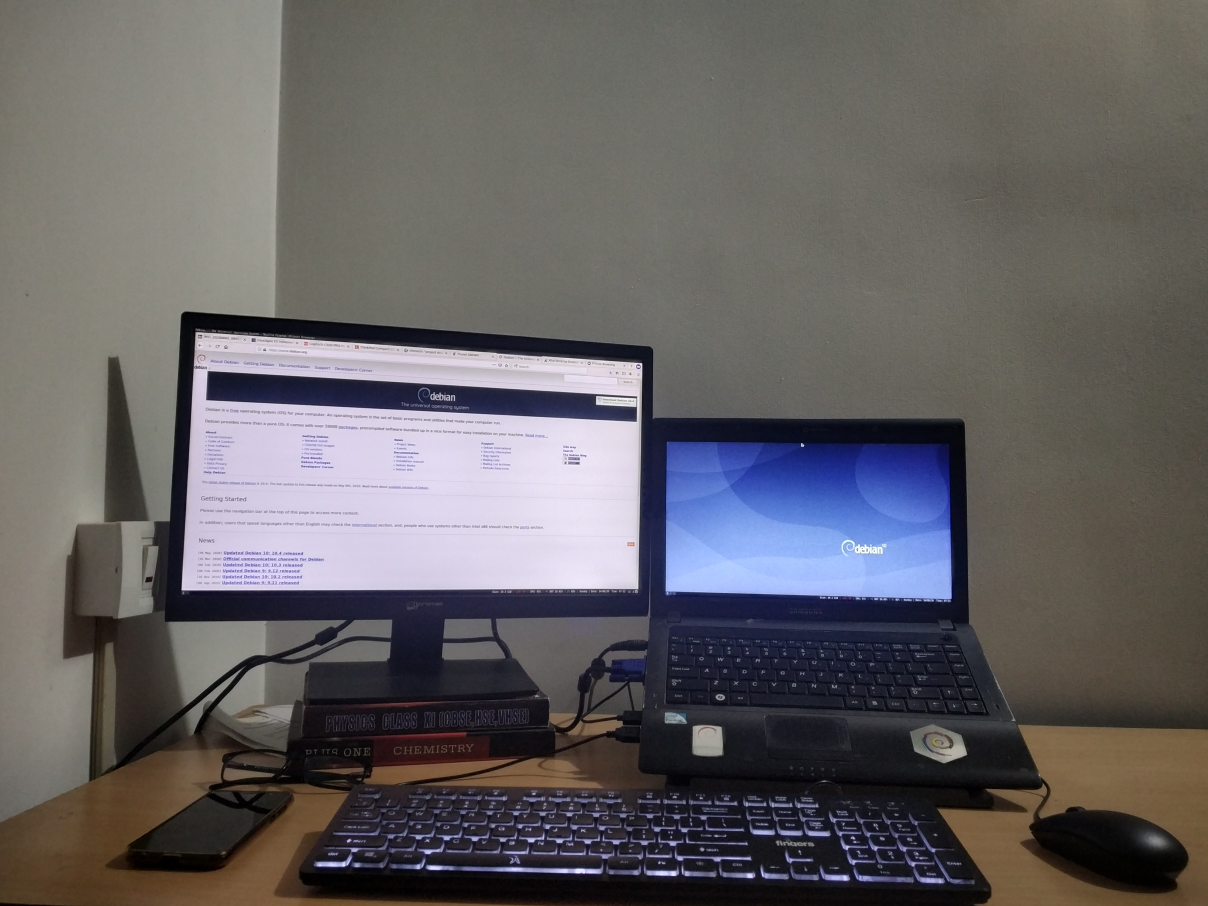
Workstation Hello, Recently I ve seen lot of people sharing about their home office setup. I thought why don t I do something similar. Not to beat FOMO, but in future when I revisit this blog, it will be lovely to understand that I had some cool stuffs. There are people who went deep down in the ocean to lay cables for me to have a remote job and I am thankful to them. Being remote my home is my office. On my work table I have a Samsung R439 laptop. I ve blogged about it earlier. New addition is that it have another 4GB RAM, a total of 6GB and 120GB SSD. I run Debian testing on it. Laptop is placed on a stand. Dell MS116 as external mouse always connected to it. I also use an external keyboard from fingers. The keys are very stiff so I don t recommend this to anyone. The only reason I took this keyboard that it is in my budget and have a backlit, which I needed most. I have a Micromax MM215FH76 21 inch monitor as my secondary display which stacked up on couple of old books to adjust the height with laptop stand. Everything is ok with this monitor except that it don t have a HDMI point and stand is very weak. I use i3wm and this small script help me to manage my monitor arrangement.
# samsung r439
xrandr --output LVDS1 --primary --mode 1366x768 --pos 1920x312 --rotate normal --output DP1 --off --output HDMI1 --off --output VGA1 --mode 1920x1080 --pos 0x0 --rotate normal --output VIRTUAL1 --off
# thinkpad t430s
#xrandr --output LVDS1 --primary --mode 1600x900 --pos 1920x180 --rotate normal --output DP1 --off --output DP2 --off --output DP3 --off --output HDMI1 --off --output HDMI2 --off --output HDMI3 --off --output VGA1 --mode 1920x1080 --pos 0x0 --rotate normal --output VIRTUAL1 --off
i3-msg workspace 2, move workspace to left
i3-msg workspace 4, move workspace to left
i3-msg workspace 6, move workspace to left
I also have another Viewsonic monitor 19 inch, it started to show some lines and unpleasant colors. Thus moved back to shelf. I have an orange pi zero plus 2 running Armbian which serve as my emby media server. I don t own any webcam or quality headset at the moment. I have a boat, and Mi, headphones. My laptop inbuilt webcam is horrible, so for my video conferencing need I use jitsi app on my mobile device.

17 July 2020

Dirk Eddelbuettel: RcppArmadillo 0.9.900.2.0

armadillo image Armadillo is a powerful and expressive C++ template library for linear algebra aiming towards a good balance between speed and ease of use with a syntax deliberately close to a Matlab. RcppArmadillo integrates this library with the R environment and language and is widely used by (currently) 757 other packages on CRAN. Conrad just released a new minor upstream version 9.900.2 of Armadillo which we packaged and tested as usual first as a release candidate build and then as the release. As usual, logs from reverse-depends runs are in the rcpp-logs repo. All changes in the new release are noted below.

Changes in RcppArmadillo version 0.9.900.2.0 (2020-07-17)
  • Upgraded to Armadillo release 9.900.2 (Nocturnal Misbehaviour)
    • In sort(), fixes for inconsistencies between checks applied to matrix and vector expressions
    • In sort(), remove unnecessary copying when applied in-place to vectors function when applied in-place to vectors

Courtesy of CRANberries, there is a diffstat report relative to previous release. More detailed information is on the RcppArmadillo page. Questions, comments etc should go to the rcpp-devel mailing list off the R-Forge page. If you like this or other open-source work I do, you can now sponsor me at GitHub. For the first year, GitHub will match your contributions.

This post by Dirk Eddelbuettel originated on his Thinking inside the box blog. Please report excessive re-aggregation in third-party for-profit settings.

Sven Hoexter: Debian and exFAT

As some might have noticed we now have Linux 5.7 in Debian/unstable and subsequently the in kernel exFAT implementation created by Samsung available. Thus we now have two exFAT implementations, the exfat fuse driver and the Linux based one. Since some comments and mails I received showed minor confusions, especially around the available tooling, it might help to clarify a bit what is required when. Using the Samsung Linux Kernel Implementation Probably the most common use case is that you just want to use the in kernel implementation. Easy, install a Linux 5.7 kernel package for your architecture and either remove the exfat-fuse package or make sure you've version 1.3.0-2 or later installed. Then you can just run mount /dev/sdX /mnt and everything should be fine. Your result will look something like this:
$ mount grep sdb
/dev/sdb on /mnt type exfat (rw,relatime,fmask=0022,dmask=0022,iocharset=utf8,errors=remount-ro
In the past this basic mount invocation utilized the mount.exfat helper, which was just a symlink to the helper which is shipped as /sbin/mount.exfat-fuse. The link was dropped from the package in 1.3.0-2. If you're running a not so standard setup, and would like to keep an older version of exfat-fuse installed you must invoke mount -i to prevent mount from loading any helper to mount the filesystem. See also man 8 mount. For those who care, mstone@ and myself had a brief discussion about this issue in #963752, which quickly brought me to the conclusion that it's in the best interest of a majority of users to just drop the symlink from the package. Sticking to the Fuse Driver If you would like to stick to the fuse driver you can of course just do it. I plan to continue to maintain all packages for the moment. Just keep the exfat-fuse package installed and use the mount.exfat-fuse helper directly. E.g.
$ sudo mount.exfat-fuse /dev/sdb /mnt
FUSE exfat 1.3.0
$ mount grep sdb
/dev/sdb on /mnt type fuseblk (rw,nosuid,nodev,relatime,user_id=0,group_id=0,default_permissions,allow_other,blksize=4096)
In case this is something you would like to make permanent, I would recommend that you create yourself a mount.exfat symlink pointing at the mount.exfat-fuse helper. mkfs and fsck - exfat-utils vs exfatprogs Beside of the filesystem access itself we now also have two implementations of tooling, which support filesystem creation, fscking and label adjustment. The older one is exfat-utils by the creator of the fuse driver, which is also part of Debian since the fuse driver was packaged in 2012. New in Debian is the exfatprogs package written by the Samsung engineers. And here the situation starts to get a bit more complicated. Both packages ship a mkfs.exfat and fsck.exfat tool, so we can not co-install them. In the end both packages declare a conflict with each other at the moment. As outlined in this thread I do not plan to overcomplicate the situation by using the alternatives system. I do feel strongly that this would just create more confusion without a real benefit. Since the tools do not have matching cli options, that could also cause additional issues and confusion. I plan to keep that as is, at least for the bullseye release. Afterwards it's possible, depending on how the usage evolves, to drop the mkfs.exfat and fsck.exfat from exfat-utils, they are in fact again only symlinks. pain point might be tools interfacing with the differing implementations. Currently I see only three reverse depedencies, so that should be manageable to consolidate if required. Last but not least it might be relevant to mention that the exfat-utils package also contains a dumpexfat tool which could be helpful if you're more into forensics, or looking into other lower level analysis of an exFAT filsystem. Thus there is a bit of an interest to have those tools co-installed in some - I would say - niche cases. buster-backports Well if you use buster with a backports kernel you're a bit on your own. In case you want to keep the fuse driver installed, but would still like to mount, e.g. for testing, with the kernel exFAT driver, you must use mount -i. I do not plan any uploads to buster-backports. If you need a mkfs.exfat on buster, I would recommend to just use the one from exfat-utils for now. It has been good enough for the past years, should not get sour before the bullseye release, which ships exfatprogs for you. Kudos My sincere kudos go to:

16 July 2020

Louis-Philippe V ronneau: DebConf Videoteam Sprint Report -- DebConf20@Home

DebConf20 starts in about 5 weeks, and as always, the DebConf Videoteam is working hard to make sure it'll be a success. As such, we held a sprint from July 9th to 13th to work on our new infrastructure. A remote sprint certainly ain't as fun as an in-person one, but we nonetheless managed to enjoy ourselves. Many thanks to those who participated, namely: We also wish to extend our thanks to Thomas Goirand and Infomaniak for providing us with virtual machines to experiment on and host the video infrastructure for DebConf20. Advice for presenters For DebConf20, we strongly encourage presenters to record their talks in advance and send us the resulting video. We understand this is more work, but we think it'll make for a more agreeable conference for everyone. Video conferencing is still pretty wonky and there is nothing worse than a talk ruined by a flaky internet connection or hardware failures. As such, if you are giving a talk at DebConf this year, we are asking you to read and follow our guide on how to record your presentation. Fear not: we are not getting rid of the Q&A period at the end of talks. Attendees will ask their questions either on IRC or on a collaborative pad and the Talkmeister will relay them to the speaker once the pre-recorded video has finished playing. New infrastructure, who dis? Organising a virtual DebConf implies migrating from our battle-tested on-premise workflow to a completely new remote one. One of the major changes this means for us is the addition of Jitsi Meet to our infrastructure. We normally have 3 different video sources in a room: two cameras and a slides grabber. With the new online workflow, directors will be able to play pre-recorded videos as a source, will get a feed from a Jitsi room and will see the audience questions as a third source. This might seem simple at first, but is in fact a very major change to our workflow and required a lot of work to implement.
               == On-premise ==                                          == Online ==
                                                      
              Camera 1                                                 Jitsi
                                                                          
                 v                 ---> Frontend                         v                 ---> Frontend
                                                                                            
    Slides -> Voctomix -> Backend -+--> Frontend         Questions -> Voctomix -> Backend -+--> Frontend
                                                                                            
                 ^                 ---> Frontend                         ^                 ---> Frontend
                                                                          
              Camera 2                                           Pre-recorded video
In our tests, playing back pre-recorded videos to voctomix worked well, but was sometimes unreliable due to inconsistent encoding settings. Presenters will thus upload their pre-recorded talks to SReview so we can make sure there aren't any obvious errors. Videos will then be re-encoded to ensure a consistent encoding and to normalise audio levels. This process will also let us stitch the Q&As at the end of the pre-recorded videos more easily prior to publication. Reducing the stream latency One of the pitfalls of the streaming infrastructure we have been using since 2016 is high video latency. In a worst case scenario, remote attendees could get up to 45 seconds of latency, making participation in events like BoFs arduous. In preparation for DebConf20, we added a new way to stream our talks: RTMP. Attendees will thus have the option of using either an HLS stream with higher latency or an RTMP stream with lower latency. Here is a comparative table that can help you decide between the two protocols:
HLS RTMP
Pros
  • Can be watched from a browser
  • Auto-selects a stream encoding
  • Single URL to remember
  • Lower latency (~5s)
Cons
  • Higher latency (up to 45s)
  • Requires a dedicated video player (VLC, mpv)
  • Specific URLs for each encoding setting
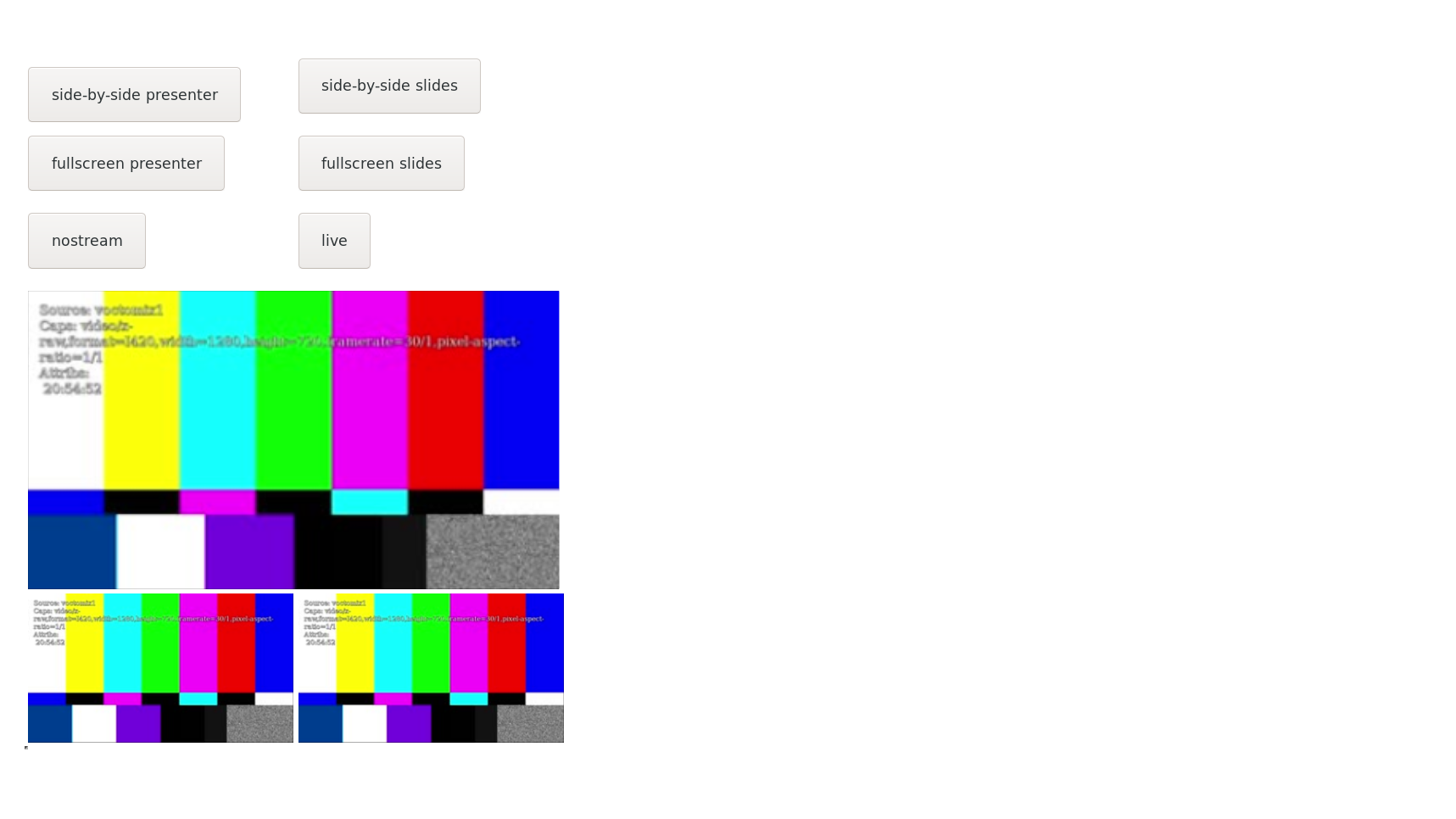
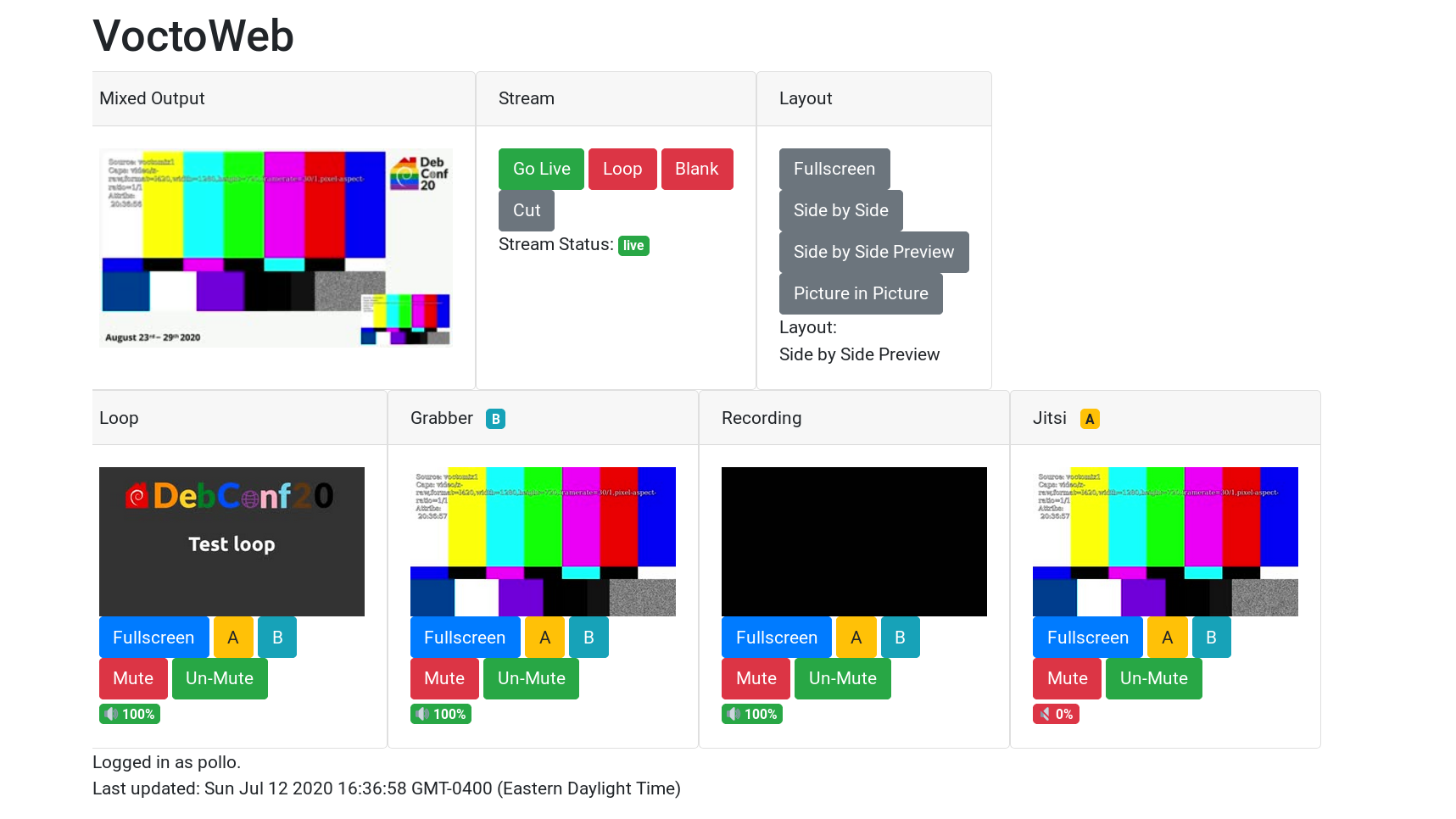
Live mixing from home with VoctoWeb Since DebConf16, we have been using voctomix, a live video mixer developed by the CCC VOC. voctomix is conveniently divided in two: voctocore is the backend server while voctogui is a GTK+ UI frontend directors can use to live-mix. Although voctogui can connect to a remote server, it was primarily designed to run either on the same machine as voctocore or on the same LAN. Trying to use voctogui from a machine at home to connect to a voctocore running in a datacenter proved unreliable, especially for high-latency and low bandwidth connections. Inspired by the setup FOSDEM uses, we instead decided to go with a web frontend for voctocore. We initially used FOSDEM's code as a proof of concept, but quickly reimplemented it in Python, a language we are more familiar with as a team. Compared to the FOSDEM PHP implementation, voctoweb implements A / B source selection (akin to voctogui) as well as audio control, two very useful features. In the following screen captures, you can see the old PHP UI on the left and the new shiny Python one on the right. The old PHP voctowebThe new Python3 voctoweb Voctoweb is still under development and is likely to change quite a bit until DebConf20. Still, the current version seems to works well enough to be used in production if you ever need to. Python GeoIP redirector We run multiple geographically-distributed streaming frontend servers to minimize the load on our streaming backend and to reduce overall latency. Although users can connect to the frontends directly, we typically point them to live.debconf.org and redirect connections to the nearest server. Sadly, 6 months ago MaxMind decided to change the licence on their GeoLite2 database and left us scrambling. To fix this annoying issue, Stefano Rivera wrote a Python program that uses the new database and reworked our ansible frontend server role. Since the new database cannot be redistributed freely, you'll have to get a (free) license key from MaxMind if you to use this role. Ansible & CI improvements Infrastructure as code is a living process and needs constant care to fix bugs, follow changes in DSL and to implement new features. All that to say a large part of the sprint was spent making our ansible roles and continuous integration setup more reliable, less buggy and more featureful. All in all, we merged 26 separate ansible-related merge request during the sprint! As always, if you are good with ansible and wish to help, we accept merge requests on our ansible repository :)

Enrico Zini: Build Qt5 cross-builder with raspbian sysroot: compiling with the sysroot

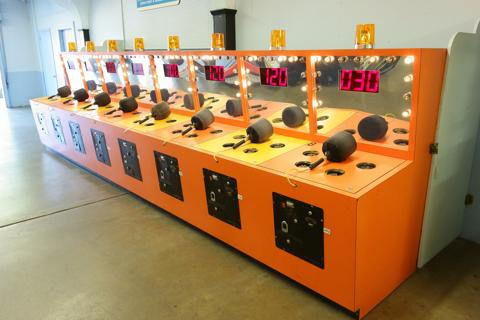
Whack-A-Mole machines from <https://commons.wikimedia.org/wiki/File:Whac-A-Mole_Cedar_Point.jpg> This is part of a series of posts on compiling a custom version of Qt5 in order to develop for both amd64 and a Raspberry Pi. Now that I have a sysroot, I try to use it to build Qt5 with QtWebEngine. Nothing seems to work straightforwardly with Qt5's build system, and hit an endless series of significant blockers to try and work around.
Problem in wayland code QtWayland's source currently does not compile:
../../../hardwareintegration/client/brcm-egl/qwaylandbrcmeglwindow.cpp: In constructor  QtWaylandClient::QWaylandBrcmEglWindow::QWaylandBrcmEglWindow(QWindow*) :
../../../hardwareintegration/client/brcm-egl/qwaylandbrcmeglwindow.cpp:131:67: error: no matching function for call to  QtWaylandClient::QWaylandWindow::QWaylandWindow(QWindow*&) 
     , m_eventQueue(wl_display_create_queue(mDisplay->wl_display()))
                                                                   ^
In file included from ../../../../include/QtWaylandClient/5.15.0/QtWaylandClient/private/qwaylandwindow_p.h:1,
                 from ../../../hardwareintegration/client/brcm-egl/qwaylandbrcmeglwindow.h:43,
                 from ../../../hardwareintegration/client/brcm-egl/qwaylandbrcmeglwindow.cpp:40:
../../../../include/QtWaylandClient/5.15.0/QtWaylandClient/private/../../../../../src/client/qwaylandwindow_p.h:97:5: note: candidate:  QtWaylandClient::QWaylandWindow::QWaylandWindow(QWindow*, QtWayland
Client::QWaylandDisplay*) 
     QWaylandWindow(QWindow *window, QWaylandDisplay *display);
     ^~~~~~~~~~~~~~
../../../../include/QtWaylandClient/5.15.0/QtWaylandClient/private/../../../../../src/client/qwaylandwindow_p.h:97:5: note:   candidate expects 2 arguments, 1 provided
make[5]: Leaving directory '/home/build/armhf/qt-everywhere-src-5.15.0/qttools/src/qdoc'
I am not trying to debug here. I understand that Wayland support is not a requirement, and I'm adding -skip wayland to Qt5's configure options. Next round. nss not found Qt5 embeds Chrome's sources. Chrome's sources require libnss3-dev to be available for both host and target architectures. Although I now have it installed both on the build system and in the sysroot, the pkg-config wrapper that Qt5 hooks into its Chrome's sources, failes to find it:
Command: /usr/bin/python2 /home/build/armhf/qt-everywhere-src-5.15.0/qtwebengine/src/3rdparty/chromium/build/config/linux/pkg-config.py -s /home/build/sysroot/ -a arm -p /usr/bin/arm-linux-gnueabihf-pkg-config --system_libdir lib nss -v -lssl3
Returned 1.
stderr:
Package nss was not found in the pkg-config search path.
Perhaps you should add the directory containing  nss.pc'
to the PKG_CONFIG_PATH environment variable
No package 'nss' found
Traceback (most recent call last):
  File "/home/build/armhf/qt-everywhere-src-5.15.0/qtwebengine/src/3rdparty/chromium/build/config/linux/pkg-config.py", line 248, in <module>
    sys.exit(main())
  File "/home/build/armhf/qt-everywhere-src-5.15.0/qtwebengine/src/3rdparty/chromium/build/config/linux/pkg-config.py", line 143, in main
    prefix = GetPkgConfigPrefixToStrip(options, args)
  File "/home/build/armhf/qt-everywhere-src-5.15.0/qtwebengine/src/3rdparty/chromium/build/config/linux/pkg-config.py", line 82, in GetPkgConfigPrefixToStrip
    "--variable=prefix"] + args, env=os.environ).decode('utf-8')
  File "/usr/lib/python2.7/subprocess.py", line 223, in check_output
    raise CalledProcessError(retcode, cmd, output=output)
subprocess.CalledProcessError: Command '['/usr/bin/arm-linux-gnueabihf-pkg-config', '--variable=prefix', 'nss']' returned non-zero exit status 1
See //build/config/linux/nss/BUILD.gn:15:3: whence it was called.
  pkg_config("system_nss_no_ssl_config")  
  ^---------------------------------------
See //crypto/BUILD.gn:218:25: which caused the file to be included.
    public_configs += [ "//build/config/linux/nss:system_nss_no_ssl_config" ]
                        ^--------------------------------------------------
Project ERROR: GN run error!
It's trying to look into $SYSROOT/usr/lib/pkgconfig, while it should be $SYSROOT//usr/lib/arm-linux-gnueabihf/pkgconfig. I worked around this this patch to qtwebengine/src/3rdparty/chromium/build/config/linux/pkg-config.py:
--- pkg-config.py.orig  2020-07-16 11:46:21.005373002 +0200
+++ pkg-config.py   2020-07-16 11:46:02.605296967 +0200
@@ -61,6 +61,7 @@
   libdir = sysroot + '/usr/' + options.system_libdir + '/pkgconfig'
   libdir += ':' + sysroot + '/usr/share/pkgconfig'
+  libdir += ':' + sysroot + '/usr/lib/arm-linux-gnueabihf/pkgconfig'
   os.environ['PKG_CONFIG_LIBDIR'] = libdir
   return libdir
Next round. g++ 8.3.0 Internal Compiler Error Qt5's sources embed Chrome's sources that embed the skia library sources. One of the skia library sources, when cross-compiled to ARM with -O1 or -O2 with g++ 8.3.0, produces an Internal Compiler Error:
/usr/bin/arm-linux-gnueabihf-g++ -MMD -MF obj/skia/skcms/skcms.o.d -DUSE_UDEV -DUSE_AURA=1 -DUSE_NSS_CERTS=1 -DUSE_OZONE=1 -DOFFICIAL_BUILD -DTOOLKIT_QT -D_FILE_OFFSET_BITS=64 -D_LARGEFILE_SOURCE -D_LARGEFILE64_SOURCE -DNO_UNWIND_TABLES -D__STDC_CONSTANT_MACROS -D__STDC_FORMAT_MACROS -DCR_SYSROOT_HASH=76e6068f9f6954e2ab1ff98ce5fa236d3d85bcbd -DNDEBUG -DNVALGRIND -DDYNAMIC_ANNOTATIONS_ENABLED=0 -I../../3rdparty/chromium/third_party/skia/include/third_party/skcms -Igen -I../../3rdparty/chromium -w -std=c11 -mfp16-format=ieee -fno-strict-aliasing --param=ssp-buffer-size=4 -fstack-protector -fno-unwind-tables -fno-asynchronous-unwind-tables -fPIC -pipe -pthread -march=armv7-a -mfloat-abi=hard -mtune=generic-armv7-a -mfpu=vfpv3-d16 -mthumb -Wall -U_FORTIFY_SOURCE -D_FORTIFY_SOURCE=2 -Wno-psabi -Wno-unused-local-typedefs -Wno-maybe-uninitialized -Wno-deprecated-declarations -fno-delete-null-pointer-checks -Wno-comments -Wno-packed-not-aligned -Wno-dangling-else -Wno-missing-field-initializers -Wno-unused-parameter -O2 -fno-ident -fdata-sections -ffunction-sections -fno-omit-frame-pointer -g0 -fvisibility=hidden -std=gnu++14 -Wno-narrowing -Wno-class-memaccess -Wno-attributes -Wno-class-memaccess -Wno-subobject-linkage -Wno-invalid-offsetof -Wno-return-type -Wno-deprecated-copy -fno-exceptions -fno-rtti --sysroot=../../../../../../sysroot/ -fvisibility-inlines-hidden -c ../../3rdparty/chromium/third_party/skia/third_party/skcms/skcms.cc -o obj/skia/skcms/skcms.o
during RTL pass: expand
In file included from ../../3rdparty/chromium/third_party/skia/third_party/skcms/skcms.cc:2053:
../../3rdparty/chromium/third_party/skia/third_party/skcms/src/Transform_inl.h: In function  void baseline::exec_ops(const Op*, const void**, const char*, char*, int) :
../../3rdparty/chromium/third_party/skia/third_party/skcms/src/Transform_inl.h:766:13: internal compiler error: in convert_move, at expr.c:218
 static void exec_ops(const Op* ops, const void** args,
             ^~~~~~~~
Please submit a full bug report,
with preprocessed source if appropriate.
See <file:///usr/share/doc/gcc-8/README.Bugs> for instructions.
I reported the bug at https://gcc.gnu.org/bugzilla/show_bug.cgi?id=96206 Since this source compiles with -O0, I attempted to fix this by editing qtwebkit/src/3rdparty/chromium/build/config/compiler/BUILD.gn and replacing instances of -O1 and -O2 with -O0. Spoiler: wrong attempt. We'll see it in the next round. Impossible constraint in asm Qt5's sources embed Chrome's sources that embed the ffmpeg library sources. Even if ffmpeg's development libraries are present both in the host and in the target system, the build system insists in compiling and using the bundled version. Unfortunately, using -O0 breaks the build of ffmpeg:
/usr/bin/arm-linux-gnueabihf-gcc -MMD -MF obj/third_party/ffmpeg/ffmpeg_internal/opus.o.d -DHAVE_AV_CONFIG_H -D_POSIX_C_SOURCE=200112 -D_XOPEN_SOURCE=600 -DPIC -DFFMPEG_CONFIGURATION=NULL -DCHROMIUM_NO_LOGGING -D_ISOC99_SOURCE -D_LARGEFILE_SOURCE -DUSE_UDEV -DUSE_AURA=1 -DUSE_NSS_CERTS=1 -DUSE_OZONE=1 -DOFFICIAL_BUILD -DTOOLKIT_QT -D_FILE_OFFSET_BITS=64 -D_LARGEFILE_SOURCE -D_LARGEFILE64_SOURCE -DNO_UNWIND_TABLES -DCR_SYSROOT_HASH=76e6068f9f6954e2ab1ff98ce5fa236d3d85bcbd -DNDEBUG -DNVALGRIND -DDYNAMIC_ANNOTATIONS_ENABLED=0 -DOPUS_FIXED_POINT -I../../3rdparty/chromium/third_party/ffmpeg/chromium/config/Chromium/linux/arm -I../../3rdparty/chromium/third_party/ffmpeg -I../../3rdparty/chromium/third_party/ffmpeg/compat/atomics/gcc -Igen -I../../3rdparty/chromium -I../../3rdparty/chromium/third_party/opus/src/include -fPIC -Wno-deprecated-declarations -fomit-frame-pointer -w -std=c99 -pthread -fno-math-errno -fno-signed-zeros -fno-tree-vectorize -fno-strict-aliasing --param=ssp-buffer-size=4 -fstack-protector -fno-unwind-tables -fno-asynchronous-unwind-tables -fPIC -pipe -pthread -march=armv7-a -mfloat-abi=hard -mtune=generic-armv7-a -mfpu=vfpv3-d16 -mthumb -g0 -fvisibility=hidden -Wno-psabi -Wno-unused-local-typedefs -Wno-maybe-uninitialized -Wno-deprecated-declarations -fno-delete-null-pointer-checks -Wno-comments -Wno-packed-not-aligned -Wno-dangling-else -Wno-missing-field-initializers -Wno-unused-parameter -O0 -fno-ident -fdata-sections -ffunction-sections -std=gnu11 --sysroot=../../../../../../sysroot/ -c ../../3rdparty/chromium/third_party/ffmpeg/libavcodec/opus.c -o obj/third_party/ffmpeg/ffmpeg_internal/opus.o
In file included from ../../3rdparty/chromium/third_party/ffmpeg/libavutil/intmath.h:30,
                 from ../../3rdparty/chromium/third_party/ffmpeg/libavutil/common.h:106,
                 from ../../3rdparty/chromium/third_party/ffmpeg/libavutil/avutil.h:296,
                 from ../../3rdparty/chromium/third_party/ffmpeg/libavutil/audio_fifo.h:30,
                 from ../../3rdparty/chromium/third_party/ffmpeg/libavcodec/opus.h:28,
                 from ../../3rdparty/chromium/third_party/ffmpeg/libavcodec/opus_celt.h:29,
                 from ../../3rdparty/chromium/third_party/ffmpeg/libavcodec/opus.c:32:
../../3rdparty/chromium/third_party/ffmpeg/libavcodec/opus.c: In function  ff_celt_quant_bands :
../../3rdparty/chromium/third_party/ffmpeg/libavutil/arm/intmath.h:77:5: error: impossible constraint in  asm 
     __asm__ ("usat %0, %2, %1" : "=r"(x) : "r"(a), "i"(p));
     ^~~~~~~
The same source compiles with using -O2 instead of -O0. I worked around this by undoing the previous change, and limiting -O0 to just the source that causes the Internal Compiler Error. I edited qtwebengine/src/3rdparty/chromium/third_party/skia/third_party/skcms/skcms.cc to prepend:
#pragma GCC push_options
#pragma GCC optimize ("O0")
and append:
#pragma GCC pop_options
Next round. Missing build-deps for i386 code Qt5's sources embed Chrome's sources that embed the V8 library sources. For some reason, torque, that is part of V8, wants to build some of its sources into 32 bit code with -m32, and I did not have i386 cross-compilation libraries installed:
/usr/bin/g++ -MMD -MF v8_snapshot/obj/v8/torque_base/csa-generator.o.d -DUSE_UDEV -DUSE_AURA=1 -DUSE_NSS_CERTS=1 -DUSE_OZONE=1 -DOFFICIAL_BUILD -DTOOLKIT_QT -D_FILE_OFFSET_BITS=64 -D_LARGEFILE_SOURCE -D_LARGEFILE64_SOURCE -DNO_UNWIND_TABLES -D__STDC_CONSTANT_MACROS -D__STDC_FORMAT_MACROS -DNDEBUG -DNVALGRIND -DDYNAMIC_ANNOTATIONS_ENABLED=0 -DV8_TYPED_ARRAY_MAX_SIZE_IN_HEAP=64 -DENABLE_MINOR_MC -DV8_INTL_SUPPORT -DV8_CONCURRENT_MARKING -DV8_ENABLE_LAZY_SOURCE_POSITIONS -DV8_EMBEDDED_BUILTINS -DV8_SHARED_RO_HEAP -DV8_WIN64_UNWINDING_INFO -DV8_ENABLE_REGEXP_INTERPRETER_THREADED_DISPATCH -DV8_31BIT_SMIS_ON_64BIT_ARCH -DV8_DEPRECATION_WARNINGS -DV8_TARGET_ARCH_ARM -DCAN_USE_ARMV7_INSTRUCTIONS -DCAN_USE_VFP3_INSTRUCTIONS -DUSE_EABI_HARDFLOAT=1 -DV8_HAVE_TARGET_OS -DV8_TARGET_OS_LINUX -DDISABLE_UNTRUSTED_CODE_MITIGATIONS -DV8_31BIT_SMIS_ON_64BIT_ARCH -DV8_DEPRECATION_WARNINGS -Iv8_snapshot/gen -I../../3rdparty/chromium -I../../3rdparty/chromium/v8 -Iv8_snapshot/gen/v8 -fno-strict-aliasing --param=ssp-buffer-size=4 -fstack-protector -fno-unwind-tables -fno-asynchronous-unwind-tables -fPIC -pipe -pthread -m32 -msse2 -mfpmath=sse -mmmx -Wall -U_FORTIFY_SOURCE -D_FORTIFY_SOURCE=2 -Wno-unused-local-typedefs -Wno-maybe-uninitialized -Wno-deprecated-declarations -fno-delete-null-pointer-checks -Wno-comments -Wno-packed-not-aligned -Wno-dangling-else -Wno-missing-field-initializers -Wno-unused-parameter -fno-omit-frame-pointer -g0 -fvisibility=hidden -Wno-strict-overflow -Wno-return-type -O3 -fno-ident -fdata-sections -ffunction-sections -std=gnu++14 -Wno-narrowing -Wno-class-memaccess -Wno-attributes -Wno-class-memaccess -Wno-subobject-linkage -Wno-invalid-offsetof -Wno-return-type -Wno-deprecated-copy -fvisibility-inlines-hidden -fexceptions -frtti -c ../../3rdparty/chromium/v8/src/torque/csa-generator.cc -o v8_snapshot/obj/v8/torque_base/csa-generator.o
In file included from ../../3rdparty/chromium/v8/src/torque/csa-generator.h:8,
                 from ../../3rdparty/chromium/v8/src/torque/csa-generator.cc:5:
/usr/include/c++/8/iostream:38:10: fatal error: bits/c++config.h: No such file or directory
 #include <bits/c++config.h>
          ^~~~~~~~~~~~~~~~~~
compilation terminated.
New build dependencies needed:
apt install lib32stdc++-8-dev
apt install libc6-dev-i386
dpkg --add-architecture i386
apt install linux-libc-dev:i386
Next round. OpenGL build issues Next bump are OpenGL related compiler issues:
/usr/bin/arm-linux-gnueabihf-g++ -MMD -MF obj/QtWebEngineCore/gl_ozone_glx_qt.o.d -DCHROMIUM_VERSION=\"80.0.3987.163\" -DUSE_UDEV -DUSE_AURA=1 -DUSE_NSS_CERTS=1 -DUSE_OZONE=1 -DOFFICIAL_BUILD -DTOOLKIT_QT -D_FILE_OFFSET_BITS=64 -D_LARGEFILE_SOURCE -D_LARGEFILE64_SOURCE -DNO_UNWIND_TABLES -D__STDC_CONSTANT_MACROS -D__STDC_FORMAT_MACROS -DCR_SYSROOT_HASH=76e6068f9f6954e2ab1ff98ce5fa236d3d85bcbd -DNDEBUG -DNVALGRIND -DDYNAMIC_ANNOTATIONS_ENABLED=0 -DQT_NO_LINKED_LIST -DQT_NO_KEYWORDS -DQT_USE_QSTRINGBUILDER -DQ_FORWARD_DECLARE_OBJC_CLASS=QT_FORWARD_DECLARE_CLASS -DQTWEBENGINECORE_VERSION_STR=\"5.15.0\" -DQTWEBENGINEPROCESS_NAME=\"QtWebEngineProcess\" -DBUILDING_CHROMIUM -DQTWEBENGINE_EMBEDDED_SWITCHES -DQT_NO_EXCEPTIONS -D_LARGEFILE64_SOURCE -D_LARGEFILE_SOURCE -DQT_NO_DEBUG -DQT_QUICK_LIB -DQT_GUI_LIB -DQT_QMLMODELS_LIB -DQT_WEBCHANNEL_LIB -DQT_QML_LIB -DQT_NETWORK_LIB -DQT_POSITIONING_LIB -DQT_CORE_LIB -DQT_WEBENGINECOREHEADERS_LIB -DVK_NO_PROTOTYPES -DGL_GLEXT_PROTOTYPES -DUSE_GLX -DUSE_EGL -DGOOGLE_PROTOBUF_NO_RTTI -DGOOGLE_PROTOBUF_NO_STATIC_INITIALIZER -DHAVE_PTHREAD -DU_USING_ICU_NAMESPACE=0 -DU_ENABLE_DYLOAD=0 -DUSE_CHROMIUM_ICU=1 -DU_STATIC_IMPLEMENTATION -DICU_UTIL_DATA_IMPL=ICU_UTIL_DATA_FILE -DUCHAR_TYPE=uint16_t -DWEBRTC_NON_STATIC_TRACE_EVENT_HANDLERS=0 -DWEBRTC_CHROMIUM_BUILD -DWEBRTC_POSIX -DWEBRTC_LINUX -DABSL_ALLOCATOR_NOTHROW=1 -DWEBRTC_USE_BUILTIN_ISAC_FIX=1 -DWEBRTC_USE_BUILTIN_ISAC_FLOAT=0 -DHAVE_SCTP -DNO_MAIN_THREAD_WRAPPING -DSK_HAS_PNG_LIBRARY -DSK_HAS_WEBP_LIBRARY -DSK_USER_CONFIG_HEADER=\"../../skia/config/SkUserConfig.h\" -DSK_GL -DSK_HAS_JPEG_LIBRARY -DSK_USE_LIBGIFCODEC -DSK_VULKAN_HEADER=\"../../skia/config/SkVulkanConfig.h\" -DSK_VULKAN=1 -DSK_SUPPORT_GPU=1 -DSK_GPU_WORKAROUNDS_HEADER=\"gpu/config/gpu_driver_bug_workaround_autogen.h\" -DVK_NO_PROTOTYPES -DLEVELDB_PLATFORM_CHROMIUM=1 -DLEVELDB_PLATFORM_CHROMIUM=1 -DV8_31BIT_SMIS_ON_64BIT_ARCH -DV8_DEPRECATION_WARNINGS -I../../3rdparty/chromium/skia/config -I../../3rdparty/chromium/third_party -I../../3rdparty/chromium/third_party/boringssl/src/include -I../../3rdparty/chromium/third_party/skia/include/core -Igen -I../../3rdparty/chromium -I/home/build/armhf/qt-everywhere-src-5.15.0/qtwebengine/src/core -I/home/build/armhf/qt-everywhere-src-5.15.0/qtwebengine/src/core/api -I/home/build/armhf/qt-everywhere-src-5.15.0/qtdeclarative/include/QtQuick/5.15.0 -I/home/build/armhf/qt-everywhere-src-5.15.0/qtdeclarative/include/QtQuick/5.15.0/QtQuick -I/home/build/armhf/qt-everywhere-src-5.15.0/qtbase/include/QtGui/5.15.0 -I/home/build/armhf/qt-everywhere-src-5.15.0/qtbase/include/QtGui/5.15.0/QtGui -I/home/build/armhf/qt-everywhere-src-5.15.0/qtdeclarative/include -I/home/build/armhf/qt-everywhere-src-5.15.0/qtdeclarative/include/QtQuick -I/home/build/armhf/qt-everywhere-src-5.15.0/qtbase/include -I/home/build/armhf/qt-everywhere-src-5.15.0/qtbase/include/QtGui -I/home/build/armhf/qt-everywhere-src-5.15.0/qtdeclarative/include/QtQmlModels/5.15.0 -I/home/build/armhf/qt-everywhere-src-5.15.0/qtdeclarative/include/QtQmlModels/5.15.0/QtQmlModels -I/home/build/armhf/qt-everywhere-src-5.15.0/qtdeclarative/include/QtQml/5.15.0 -I/home/build/armhf/qt-everywhere-src-5.15.0/qtdeclarative/include/QtQml/5.15.0/QtQml -I/home/build/armhf/qt-everywhere-src-5.15.0/qtbase/include/QtCore/5.15.0 -I/home/build/armhf/qt-everywhere-src-5.15.0/qtbase/include/QtCore/5.15.0/QtCore -I/home/build/armhf/qt-everywhere-src-5.15.0/qtdeclarative/include/QtQmlModels -I/home/build/armhf/qt-everywhere-src-5.15.0/qtwebchannel/include -I/home/build/armhf/qt-everywhere-src-5.15.0/qtwebchannel/include/QtWebChannel -I/home/build/armhf/qt-everywhere-src-5.15.0/qtdeclarative/include/QtQml -I/home/build/armhf/qt-everywhere-src-5.15.0/qtbase/include/QtNetwork -I/home/build/armhf/qt-everywhere-src-5.15.0/qtlocation/include -I/home/build/armhf/qt-everywhere-src-5.15.0/qtlocation/include/QtPositioning -I/home/build/armhf/qt-everywhere-src-5.15.0/qtbase/include/QtCore -I/home/build/armhf/qt-everywhere-src-5.15.0/qtwebengine/include -I/home/build/armhf/qt-everywhere-src-5.15.0/qtwebengine/include/QtWebEngineCore -I/home/build/armhf/qt-everywhere-src-5.15.0/qtwebengine/include/QtWebEngineCore/5.15.0 -I/home/build/armhf/qt-everywhere-src-5.15.0/qtwebengine/include/QtWebEngineCore/5.15.0/QtWebEngineCore -I.moc -I/home/build/sysroot/opt/vc/include -I/home/build/sysroot/opt/vc/include/interface/vcos/pthreads -I/home/build/sysroot/opt/vc/include/interface/vmcs_host/linux -Igen/.moc -I/home/build/armhf/qt-everywhere-src-5.15.0/qtbase/mkspecs/devices/linux-rasp-pi2-g++ -Igen -Igen -I../../3rdparty/chromium/third_party/libyuv/include -Igen -I../../3rdparty/chromium/third_party/jsoncpp/source/include -I../../3rdparty/chromium/third_party/jsoncpp/generated -Igen -Igen -I../../3rdparty/chromium/third_party/khronos -I../../3rdparty/chromium/gpu -I../../3rdparty/chromium/third_party/vulkan/include -I../../3rdparty/chromium/third_party/perfetto/include -Igen/third_party/perfetto/build_config -Igen -Igen -Igen/third_party/dawn/src/include -I../../3rdparty/chromium/third_party/dawn/src/include -Igen -I../../3rdparty/chromium/third_party/boringssl/src/include -I../../3rdparty/chromium/third_party/protobuf/src -Igen/protoc_out -I../../3rdparty/chromium/third_party/protobuf/src -I../../3rdparty/chromium/third_party/ced/src -I../../3rdparty/chromium/third_party/icu/source/common -I../../3rdparty/chromium/third_party/icu/source/i18n -I../../3rdparty/chromium/third_party/webrtc_overrides -I../../3rdparty/chromium/third_party/webrtc -Igen/third_party/webrtc -I../../3rdparty/chromium/third_party/abseil-cpp -I../../3rdparty/chromium/third_party/skia -I../../3rdparty/chromium/third_party/libgifcodec -I../../3rdparty/chromium/third_party/vulkan/include -I../../3rdparty/chromium/third_party/skia/third_party/vulkanmemoryallocator -I../../3rdparty/chromium/third_party/vulkan/include -Igen/third_party/perfetto -Igen/third_party/perfetto -Igen/third_party/perfetto -Igen/third_party/perfetto -Igen/third_party/perfetto -Igen/third_party/perfetto -Igen/third_party/perfetto -Igen/third_party/perfetto -Igen/third_party/perfetto -Igen/third_party/perfetto -I../../3rdparty/chromium/third_party/crashpad/crashpad -I../../3rdparty/chromium/third_party/crashpad/crashpad/compat/non_mac -I../../3rdparty/chromium/third_party/crashpad/crashpad/compat/linux -I../../3rdparty/chromium/third_party/crashpad/crashpad/compat/non_win -I../../3rdparty/chromium/third_party/libwebm/source -I../../3rdparty/chromium/third_party/leveldatabase -I../../3rdparty/chromium/third_party/leveldatabase/src -I../../3rdparty/chromium/third_party/leveldatabase/src/include -I../../3rdparty/chromium/v8/include -Igen/v8/include -I../../3rdparty/chromium/third_party/mesa_headers -fno-strict-aliasing --param=ssp-buffer-size=4 -fstack-protector -fno-unwind-tables -fno-asynchronous-unwind-tables -fPIC -pipe -pthread -march=armv7-a -mfloat-abi=hard -mtune=generic-armv7-a -mfpu=vfpv3-d16 -mthumb -Wall -U_FORTIFY_SOURCE -D_FORTIFY_SOURCE=2 -Wno-psabi -Wno-unused-local-typedefs -Wno-maybe-uninitialized -Wno-deprecated-declarations -fno-delete-null-pointer-checks -Wno-comments -Wno-packed-not-aligned -Wno-dangling-else -Wno-missing-field-initializers -Wno-unused-parameter -O2 -fno-ident -fdata-sections -ffunction-sections -fno-omit-frame-pointer -g0 -fvisibility=hidden -g -O2 -fdebug-prefix-map=/home/build/armhf/qt-everywhere-src-5.15.0=. -fstack-protector-strong -Wformat -Werror=format-security -Wdate-time -D_FORTIFY_SOURCE=2 -O2 -fno-exceptions -Wall -Wextra -D_REENTRANT -I/home/build/sysroot/usr/include/nss -I/home/build/sysroot/usr/include/nspr -std=gnu++14 -Wno-narrowing -Wno-class-memaccess -Wno-attributes -Wno-class-memaccess -Wno-subobject-linkage -Wno-invalid-offsetof -Wno-return-type -Wno-deprecated-copy -fno-exceptions -fno-rtti --sysroot=../../../../../../sysroot/ -fvisibility-inlines-hidden -g -O2 -fdebug-prefix-map=/home/build/armhf/qt-everywhere-src-5.15.0=. -fstack-protector-strong -Wformat -Werror=format-security -Wdate-time -D_FORTIFY_SOURCE=2 -O2 -std=gnu++1y -fno-exceptions -Wall -Wextra -D_REENTRANT -Wno-unused-parameter -Wno-unused-variable -Wno-deprecated-declarations -c /home/build/armhf/qt-everywhere-src-5.15.0/qtwebengine/src/core/ozone/gl_ozone_glx_qt.cpp -o obj/QtWebEngineCore/gl_ozone_glx_qt.o
In file included from ../../3rdparty/chromium/ui/gl/gl_bindings.h:497,
                 from ../../3rdparty/chromium/ui/gl/gl_gl_api_implementation.h:12,
                 from /home/build/armhf/qt-everywhere-src-5.15.0/qtwebengine/src/core/ozone/gl_ozone_glx_qt.cpp:49:
../../3rdparty/chromium/ui/gl/gl_bindings_autogen_egl.h:227:5: error:  EGLSetBlobFuncANDROID  has not been declared
     EGLSetBlobFuncANDROID set,
     ^~~~~~~~~~~~~~~~~~~~~
../../3rdparty/chromium/ui/gl/gl_bindings_autogen_egl.h:228:5: error:  EGLGetBlobFuncANDROID  has not been declared
     EGLGetBlobFuncANDROID get);
     ^~~~~~~~~~~~~~~~~~~~~
../../3rdparty/chromium/ui/gl/gl_bindings_autogen_egl.h:571:46: error:  EGLSetBlobFuncANDROID  has not been declared
                                              EGLSetBlobFuncANDROID set,
                                              ^~~~~~~~~~~~~~~~~~~~~
../../3rdparty/chromium/ui/gl/gl_bindings_autogen_egl.h:572:46: error:  EGLGetBlobFuncANDROID  has not been declared
                                              EGLGetBlobFuncANDROID get) = 0;
                                              ^~~~~~~~~~~~~~~~~~~~~
cc1plus: warning: unrecognized command line option  -Wno-deprecated-copy 
/usr/bin/arm-linux-gnueabihf-g++ -MMD -MF obj/QtWebEngineCore/display_gl_output_surface.o.d -DCHROMIUM_VERSION=\"80.0.3987.163\" -DUSE_UDEV -DUSE_AURA=1 -DUSE_NSS_CERTS=1 -DUSE_OZONE=1 -DOFFICIAL_BUILD -DTOOLKIT_QT -D_FILE_OFFSET_BITS=64 -D_LARGEFILE_SOURCE -D_LARGEFILE64_SOURCE -DNO_UNWIND_TABLES -D__STDC_CONSTANT_MACROS -D__STDC_FORMAT_MACROS -DCR_SYSROOT_HASH=76e6068f9f6954e2ab1ff98ce5fa236d3d85bcbd -DNDEBUG -DNVALGRIND -DDYNAMIC_ANNOTATIONS_ENABLED=0 -DQT_NO_LINKED_LIST -DQT_NO_KEYWORDS -DQT_USE_QSTRINGBUILDER -DQ_FORWARD_DECLARE_OBJC_CLASS=QT_FORWARD_DECLARE_CLASS -DQTWEBENGINECORE_VERSION_STR=\"5.15.0\" -DQTWEBENGINEPROCESS_NAME=\"QtWebEngineProcess\" -DBUILDING_CHROMIUM -DQTWEBENGINE_EMBEDDED_SWITCHES -DQT_NO_EXCEPTIONS -D_LARGEFILE64_SOURCE -D_LARGEFILE_SOURCE -DQT_NO_DEBUG -DQT_QUICK_LIB -DQT_GUI_LIB -DQT_QMLMODELS_LIB -DQT_WEBCHANNEL_LIB -DQT_QML_LIB -DQT_NETWORK_LIB -DQT_POSITIONING_LIB -DQT_CORE_LIB -DQT_WEBENGINECOREHEADERS_LIB -DVK_NO_PROTOTYPES -DGL_GLEXT_PROTOTYPES -DUSE_GLX -DUSE_EGL -DGOOGLE_PROTOBUF_NO_RTTI -DGOOGLE_PROTOBUF_NO_STATIC_INITIALIZER -DHAVE_PTHREAD -DU_USING_ICU_NAMESPACE=0 -DU_ENABLE_DYLOAD=0 -DUSE_CHROMIUM_ICU=1 -DU_STATIC_IMPLEMENTATION -DICU_UTIL_DATA_IMPL=ICU_UTIL_DATA_FILE -DUCHAR_TYPE=uint16_t -DWEBRTC_NON_STATIC_TRACE_EVENT_HANDLERS=0 -DWEBRTC_CHROMIUM_BUILD -DWEBRTC_POSIX -DWEBRTC_LINUX -DABSL_ALLOCATOR_NOTHROW=1 -DWEBRTC_USE_BUILTIN_ISAC_FIX=1 -DWEBRTC_USE_BUILTIN_ISAC_FLOAT=0 -DHAVE_SCTP -DNO_MAIN_THREAD_WRAPPING -DSK_HAS_PNG_LIBRARY -DSK_HAS_WEBP_LIBRARY -DSK_USER_CONFIG_HEADER=\"../../skia/config/SkUserConfig.h\" -DSK_GL -DSK_HAS_JPEG_LIBRARY -DSK_USE_LIBGIFCODEC -DSK_VULKAN_HEADER=\"../../skia/config/SkVulkanConfig.h\" -DSK_VULKAN=1 -DSK_SUPPORT_GPU=1 -DSK_GPU_WORKAROUNDS_HEADER=\"gpu/config/gpu_driver_bug_workaround_autogen.h\" -DVK_NO_PROTOTYPES -DLEVELDB_PLATFORM_CHROMIUM=1 -DLEVELDB_PLATFORM_CHROMIUM=1 -DV8_31BIT_SMIS_ON_64BIT_ARCH -DV8_DEPRECATION_WARNINGS -I../../3rdparty/chromium/skia/config -I../../3rdparty/chromium/third_party -I../../3rdparty/chromium/third_party/boringssl/src/include -I../../3rdparty/chromium/third_party/skia/include/core -Igen -I../../3rdparty/chromium -I/home/build/armhf/qt-everywhere-src-5.15.0/qtwebengine/src/core -I/home/build/armhf/qt-everywhere-src-5.15.0/qtwebengine/src/core/api -I/home/build/armhf/qt-everywhere-src-5.15.0/qtdeclarative/include/QtQuick/5.15.0 -I/home/build/armhf/qt-everywhere-src-5.15.0/qtdeclarative/include/QtQuick/5.15.0/QtQuick -I/home/build/armhf/qt-everywhere-src-5.15.0/qtbase/include/QtGui/5.15.0 -I/home/build/armhf/qt-everywhere-src-5.15.0/qtbase/include/QtGui/5.15.0/QtGui -I/home/build/armhf/qt-everywhere-src-5.15.0/qtdeclarative/include -I/home/build/armhf/qt-everywhere-src-5.15.0/qtdeclarative/include/QtQuick -I/home/build/armhf/qt-everywhere-src-5.15.0/qtbase/include -I/home/build/armhf/qt-everywhere-src-5.15.0/qtbase/include/QtGui -I/home/build/armhf/qt-everywhere-src-5.15.0/qtdeclarative/include/QtQmlModels/5.15.0 -I/home/build/armhf/qt-everywhere-src-5.15.0/qtdeclarative/include/QtQmlModels/5.15.0/QtQmlModels -I/home/build/armhf/qt-everywhere-src-5.15.0/qtdeclarative/include/QtQml/5.15.0 -I/home/build/armhf/qt-everywhere-src-5.15.0/qtdeclarative/include/QtQml/5.15.0/QtQml -I/home/build/armhf/qt-everywhere-src-5.15.0/qtbase/include/QtCore/5.15.0 -I/home/build/armhf/qt-everywhere-src-5.15.0/qtbase/include/QtCore/5.15.0/QtCore -I/home/build/armhf/qt-everywhere-src-5.15.0/qtdeclarative/include/QtQmlModels -I/home/build/armhf/qt-everywhere-src-5.15.0/qtwebchannel/include -I/home/build/armhf/qt-everywhere-src-5.15.0/qtwebchannel/include/QtWebChannel -I/home/build/armhf/qt-everywhere-src-5.15.0/qtdeclarative/include/QtQml -I/home/build/armhf/qt-everywhere-src-5.15.0/qtbase/include/QtNetwork -I/home/build/armhf/qt-everywhere-src-5.15.0/qtlocation/include -I/home/build/armhf/qt-everywhere-src-5.15.0/qtlocation/include/QtPositioning -I/home/build/armhf/qt-everywhere-src-5.15.0/qtbase/include/QtCore -I/home/build/armhf/qt-everywhere-src-5.15.0/qtwebengine/include -I/home/build/armhf/qt-everywhere-src-5.15.0/qtwebengine/include/QtWebEngineCore -I/home/build/armhf/qt-everywhere-src-5.15.0/qtwebengine/include/QtWebEngineCore/5.15.0 -I/home/build/armhf/qt-everywhere-src-5.15.0/qtwebengine/include/QtWebEngineCore/5.15.0/QtWebEngineCore -I.moc -I/home/build/sysroot/opt/vc/include -I/home/build/sysroot/opt/vc/include/interface/vcos/pthreads -I/home/build/sysroot/opt/vc/include/interface/vmcs_host/linux -Igen/.moc -I/home/build/armhf/qt-everywhere-src-5.15.0/qtbase/mkspecs/devices/linux-rasp-pi2-g++ -Igen -Igen -I../../3rdparty/chromium/third_party/libyuv/include -Igen -I../../3rdparty/chromium/third_party/jsoncpp/source/include -I../../3rdparty/chromium/third_party/jsoncpp/generated -Igen -Igen -I../../3rdparty/chromium/third_party/khronos -I../../3rdparty/chromium/gpu -I../../3rdparty/chromium/third_party/vulkan/include -I../../3rdparty/chromium/third_party/perfetto/include -Igen/third_party/perfetto/build_config -Igen -Igen -Igen/third_party/dawn/src/include -I../../3rdparty/chromium/third_party/dawn/src/include -Igen -I../../3rdparty/chromium/third_party/boringssl/src/include -I../../3rdparty/chromium/third_party/protobuf/src -Igen/protoc_out -I../../3rdparty/chromium/third_party/protobuf/src -I../../3rdparty/chromium/third_party/ced/src -I../../3rdparty/chromium/third_party/icu/source/common -I../../3rdparty/chromium/third_party/icu/source/i18n -I../../3rdparty/chromium/third_party/webrtc_overrides -I../../3rdparty/chromium/third_party/webrtc -Igen/third_party/webrtc -I../../3rdparty/chromium/third_party/abseil-cpp -I../../3rdparty/chromium/third_party/skia -I../../3rdparty/chromium/third_party/libgifcodec -I../../3rdparty/chromium/third_party/vulkan/include -I../../3rdparty/chromium/third_party/skia/third_party/vulkanmemoryallocator -I../../3rdparty/chromium/third_party/vulkan/include -Igen/third_party/perfetto -Igen/third_party/perfetto -Igen/third_party/perfetto -Igen/third_party/perfetto -Igen/third_party/perfetto -Igen/third_party/perfetto -Igen/third_party/perfetto -Igen/third_party/perfetto -Igen/third_party/perfetto -Igen/third_party/perfetto -I../../3rdparty/chromium/third_party/crashpad/crashpad -I../../3rdparty/chromium/third_party/crashpad/crashpad/compat/non_mac -I../../3rdparty/chromium/third_party/crashpad/crashpad/compat/linux -I../../3rdparty/chromium/third_party/crashpad/crashpad/compat/non_win -I../../3rdparty/chromium/third_party/libwebm/source -I../../3rdparty/chromium/third_party/leveldatabase -I../../3rdparty/chromium/third_party/leveldatabase/src -I../../3rdparty/chromium/third_party/leveldatabase/src/include -I../../3rdparty/chromium/v8/include -Igen/v8/include -I../../3rdparty/chromium/third_party/mesa_headers -fno-strict-aliasing --param=ssp-buffer-size=4 -fstack-protector -fno-unwind-tables -fno-asynchronous-unwind-tables -fPIC -pipe -pthread -march=armv7-a -mfloat-abi=hard -mtune=generic-armv7-a -mfpu=vfpv3-d16 -mthumb -Wall -U_FORTIFY_SOURCE -D_FORTIFY_SOURCE=2 -Wno-psabi -Wno-unused-local-typedefs -Wno-maybe-uninitialized -Wno-deprecated-declarations -fno-delete-null-pointer-checks -Wno-comments -Wno-packed-not-aligned -Wno-dangling-else -Wno-missing-field-initializers -Wno-unused-parameter -O2 -fno-ident -fdata-sections -ffunction-sections -fno-omit-frame-pointer -g0 -fvisibility=hidden -g -O2 -fdebug-prefix-map=/home/build/armhf/qt-everywhere-src-5.15.0=. -fstack-protector-strong -Wformat -Werror=format-security -Wdate-time -D_FORTIFY_SOURCE=2 -O2 -fno-exceptions -Wall -Wextra -D_REENTRANT -I/home/build/sysroot/usr/include/nss -I/home/build/sysroot/usr/include/nspr -std=gnu++14 -Wno-narrowing -Wno-class-memaccess -Wno-attributes -Wno-class-memaccess -Wno-subobject-linkage -Wno-invalid-offsetof -Wno-return-type -Wno-deprecated-copy -fno-exceptions -fno-rtti --sysroot=../../../../../../sysroot/ -fvisibility-inlines-hidden -g -O2 -fdebug-prefix-map=/home/build/armhf/qt-everywhere-src-5.15.0=. -fstack-protector-strong -Wformat -Werror=format-security -Wdate-time -D_FORTIFY_SOURCE=2 -O2 -std=gnu++1y -fno-exceptions -Wall -Wextra -D_REENTRANT -Wno-unused-parameter -Wno-unused-variable -Wno-deprecated-declarations -c /home/build/armhf/qt-everywhere-src-5.15.0/qtwebengine/src/core/compositor/display_gl_output_surface.cpp -o obj/QtWebEngineCore/display_gl_output_surface.o
In file included from ../../3rdparty/chromium/gpu/command_buffer/client/gles2_interface.h:8,
                 from ../../3rdparty/chromium/gpu/command_buffer/client/client_transfer_cache.h:15,
                 from ../../3rdparty/chromium/gpu/command_buffer/client/gles2_implementation.h:28,
                 from /home/build/armhf/qt-everywhere-src-5.15.0/qtwebengine/src/core/compositor/display_gl_output_surface.cpp:47:
/home/build/sysroot/opt/vc/include/GLES2/gl2.h:78: warning: "GL_FALSE" redefined
 #define GL_FALSE                          (GLboolean)0
In file included from ../../3rdparty/chromium/gpu/command_buffer/client/client_context_state.h:10,
                 from ../../3rdparty/chromium/gpu/command_buffer/client/gles2_implementation.h:27,
                 from /home/build/armhf/qt-everywhere-src-5.15.0/qtwebengine/src/core/compositor/display_gl_output_surface.cpp:47:
../../3rdparty/chromium/third_party/khronos/GLES3/gl3.h:85: note: this is the location of the previous definition
 #define GL_FALSE                          0
In file included from ../../3rdparty/chromium/gpu/command_buffer/client/gles2_interface.h:8,
                 from ../../3rdparty/chromium/gpu/command_buffer/client/client_transfer_cache.h:15,
                 from ../../3rdparty/chromium/gpu/command_buffer/client/gles2_implementation.h:28,
                 from /home/build/armhf/qt-everywhere-src-5.15.0/qtwebengine/src/core/compositor/display_gl_output_surface.cpp:47:
/home/build/sysroot/opt/vc/include/GLES2/gl2.h:79: warning: "GL_TRUE" redefined
 #define GL_TRUE                           (GLboolean)1
In file included from ../../3rdparty/chromium/gpu/command_buffer/client/client_context_state.h:10,
                 from ../../3rdparty/chromium/gpu/command_buffer/client/gles2_implementation.h:27,
                 from /home/build/armhf/qt-everywhere-src-5.15.0/qtwebengine/src/core/compositor/display_gl_output_surface.cpp:47:
../../3rdparty/chromium/third_party/khronos/GLES3/gl3.h:86: note: this is the location of the previous definition
 #define GL_TRUE                           1
In file included from ../../3rdparty/chromium/gpu/command_buffer/client/gles2_interface.h:8,
                 from ../../3rdparty/chromium/gpu/command_buffer/client/client_transfer_cache.h:15,
                 from ../../3rdparty/chromium/gpu/command_buffer/client/gles2_implementation.h:28,
                 from /home/build/armhf/qt-everywhere-src-5.15.0/qtwebengine/src/core/compositor/display_gl_output_surface.cpp:47:
/home/build/sysroot/opt/vc/include/GLES2/gl2.h:600:37: error: conflicting declaration of C function  void glShaderSource(GLuint, GLsizei, const GLchar**, const GLint*) 
 GL_APICALL void         GL_APIENTRY glShaderSource (GLuint shader, GLsizei count, const GLchar** string, const GLint* length);
                                     ^~~~~~~~~~~~~~
In file included from ../../3rdparty/chromium/gpu/command_buffer/client/client_context_state.h:10,
                 from ../../3rdparty/chromium/gpu/command_buffer/client/gles2_implementation.h:27,
                 from /home/build/armhf/qt-everywhere-src-5.15.0/qtwebengine/src/core/compositor/display_gl_output_surface.cpp:47:
../../3rdparty/chromium/third_party/khronos/GLES3/gl3.h:624:29: note: previous declaration  void glShaderSource(GLuint, GLsizei, const GLchar* const*, const GLint*) 
 GL_APICALL void GL_APIENTRY glShaderSource (GLuint shader, GLsizei count, const GLchar *const*string, const GLint *length);
                             ^~~~~~~~~~~~~~
cc1plus: warning: unrecognized command line option  -Wno-deprecated-copy 
I'm out of the allocated hour budget, and I'll stop here for now. Building Qt5 has been providing some of the most nightmarish work time in my entire professional life. If my daily job became being required to deal with this kind of insanity, I would strongly invest in a change of career. Update Andreas Gruber wrote:
Long story short, a fast solution for the issue with EGLSetBlobFuncANDROID is to remove libraspberrypi-dev from your sysroot and do a full rebuild. There will be some changes to the configure results, so please review them - if they are relevant for you - before proceeding with your work.
And thanks to Andreas, the story can continue...
Enrico Zini: Build Qt5 cross-builder with raspbian sysroot: building the sysroot

This is part of a series of posts on compiling a custom version of Qt5 in order to develop for both amd64 and a Raspberry Pi. As an attempt to get webview to compile, I'm reattempting to build a Qt5 cross-compiling environment using a raspbian sysroot, instead of having dependencies for both arm and amd64 installed in the build system. Using dependencies installed in a straightforward way in the build system has failed because of issues like #963136, where some of the build dependencies are needed for both architectures, but the corresponding Debian -dev packages are not yet coinstallable. This is something that causes many people much pain.
Start from a clean sysroot Looking for a Raspbian image, I found out that it has been renamed to "Raspberry Pi OS". I realised that software names are like underwear: as soon as they become well used, they need to be changed. I downloaded RaspbianRaspberry Pi OS Lite from https://www.raspberrypi.org/downloads/raspberry-pi-os/ to start with something minimal. It came out as something like 1.5G uncompressed, which wasn't as minimal as I would have hoped, but that'll be what I'll have to work with. Adding build dependencies I have acquired significant experience manipulating RaspbianRaspberry Pi OS images from working with Himblick. This time I'm working with the disk image directly, instead of an SD card, since I will be needing it as a sysroot during the build, and I won't need to actually boot it on real hardware. The trick is to work with kpartx to make the partitions in the image available as loopback block devices. I have extracted a lot of relevant code from Himblick into a Python library I called Transilience The result is this provisioning script, which is able to take a RaspbianRaspberry Pi OS image, enlarge it, and install Debian packages into it. I find this script pretty cool, also in the way it embeds quite a bit of experience gathered on the field. I can also be integrated in a fully automated setup and provisioning system. The next step will be to use the result as a sysroot to build Qt.

15 July 2020

Evgeni Golov: Scanning with a Brother MFC-L2720DW on Linux without any binary blobs

Back in 2015, I've got a Brother MFC-L2720DW for the casual "I need to print those two pages" and "I need to scan these receipts" at home (and home-office ;)). It's a rather cheap (I paid less than 200 in 2015) monochrome laser printer, scanner and fax with a (well, two, wired and wireless) network interface. In those five years I've never used the fax or WiFi functions, but printed a scanned a few pages. Brother offers Linux drivers, but those are binary blobs which I never really liked to run. The printer part works just fine with a "Generic PCL 6/PCL XL" driver in CUPS or even "driverless" via AirPrint on Linux. You can also feed it plain PostScript, but I found it rather slow compared to PCL. On recent Androids it works using the built in printer service or Mopria Printer Service for older ones - I used to joke "why would you need a printer on your phone?!", but found it quite useful after a few tries. However, for the scanner part I had to use Brother's brscan4 driver on Linux and their iPrint&Scan app on Android - Mopria Scan wouldn't support it. Until, last Friday, I've seen a NEW package being uploaded to Debian: sane-airscan. And yes, monitoring the Debian NEW queue via Twitter is totally legit! sane-airscan is an implementation of Apple's AirScan (eSCL) and Microsoft's WSD/WS-Scan protocols for SANE. I've never heard of those before - only about AirPrint, but thankfully this does not mean nobody has reverse-engineered them and created something that works beautifully on Linux. As of today there are no packages in the official Fedora repositories and the Debian ones are still in NEW, however the upstream documentation refers to an openSUSE OBS repository that works like a charm in the meantime (on Fedora 32). The only drawback I've seen so far: the scanner only works in "Color" mode and there is no way to scan in "Grayscale", making scanning a tad slower. This has been reported upstream and might or might not be fixable, as it seems the device does not announce any mode besides "Color". Interestingly, SANE has an eSCL backend on its own since 1.0.29, but it's disabled in Fedora in favor of sane-airscan even though the later isn't available in Fedora yet. However, it might not even need separate packaging, as SANE upstream is planning to integrate it into sane-backends directly.

Jonathan Dowland: Lockdown music

Last Christmas, to make room for a tree, I dis-assembled my hifi unit and (temporarily, I thought) lugged my hi-fi and records up to the study.
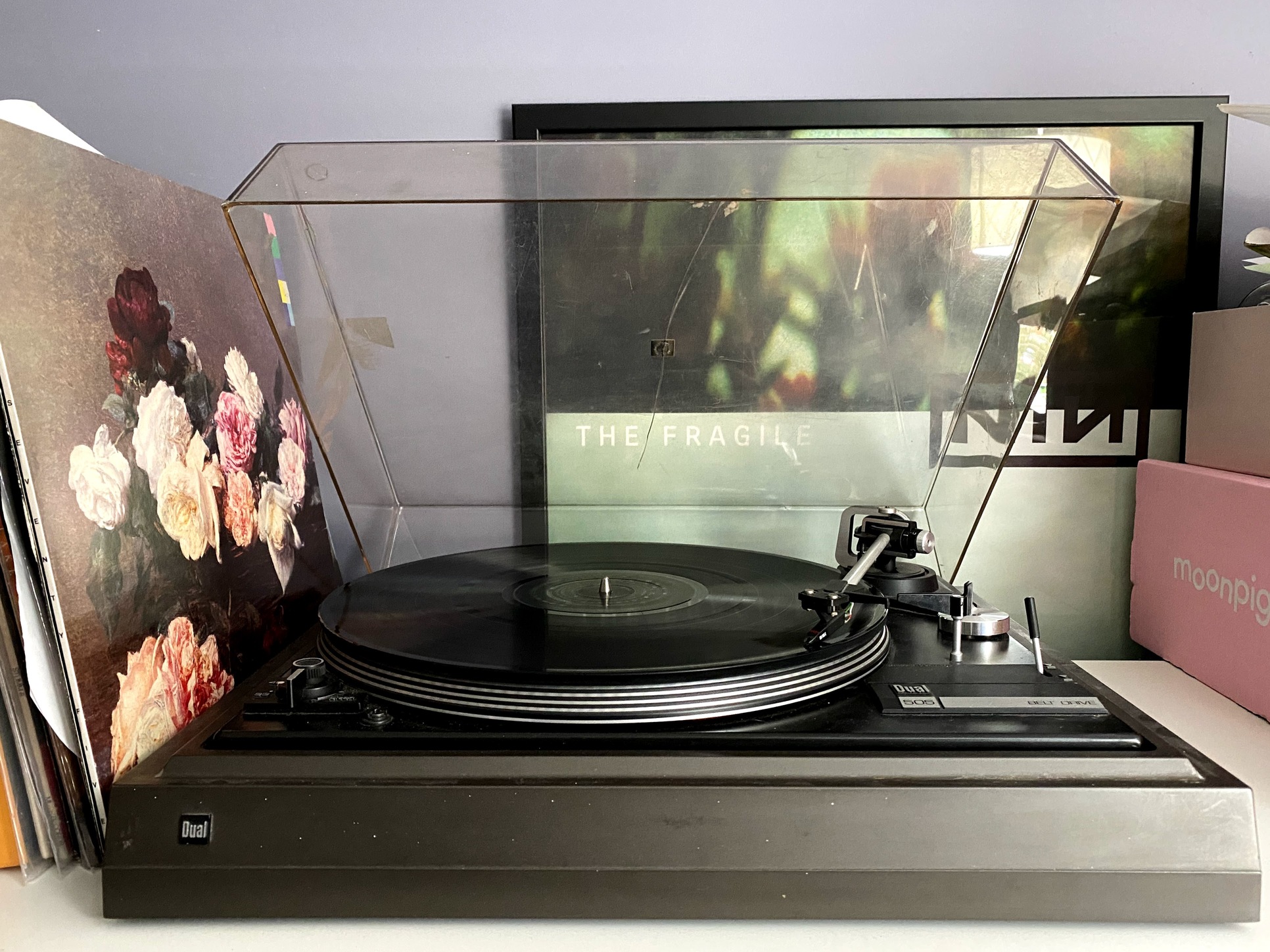
Power, Corruption & Lies
I had been thinking about expanding the amount of storage I had for hifi and vinyl, perhaps moving from 2x2 storage cubes to 2x3, although Ikea don't make a 2x3 version of their stalwart vinyl storage line, the Kallax. I had begun exploring other options, both at Ikea and other places. Meanwhile, I re-purposed my old Expedit unit as storage for my daughter's Sylvanian Families. Under Lockdown, I've spent a lot more time in my study, and so I've set up the hifi there. It turns out I have a lot more opportunity to enjoy the records up here, during work, and I've begun to explore some things which I haven't listened to in a long time, or possibly ever. I thought I'd start keeping track of some of them. Power, Corruption and Lies is not something rarely listened to. It's steadily become my favourite New Order album. When I came across this copy (Factory, 1983), it was in pristine condition, but it now bears witness to my (mostly careful) use. There's now a scratch somewhere towards the end of the first track Age of Consent which causes my turntable to loop. By some good fortune the looping point is perfectly aligned to a bar. I don't always notice it straight away. This record rarely makes it back down from the turntable to where it's supposed to live.

14 July 2020

Ian Jackson: MessagePack vs CBOR (RFC7049)

tl;dr: Use MessagePack, rather than CBOR. Introduction I recently wanted to choose a binary encoding. This was for a project using Rust serde, so I looked at the list of formats there. I ended up reading about CBOR and MessagePack. Both of these are binary formats for a JSON-like data model. Both of them are "schemaless", meaning you can decode them without knowing the structure. (This also provides some forwards compatibility.) They are, in fact, quite similar (although they are totally incompatible). This is no accident: CBOR is, effectively, a fork of MessagePack. Both formats continue to exist and both are being used in new programs. I needed to make a choice but lacked enough information. I thought I would try to examine the reasons and nature of the split, and to make some kind of judgement about the situation. So I did a lot of reading [11]. Here are my conclusions. History and politics Between about 2010 and 2013 there was only MessagePack. Unfortunately, MessagePack had some problems. The biggest of these was that it lacked a separate string type. Strings were to be encoded simply as byte blocks. This caused serious problems for many MessagePack library implementors: for example, when decoding a MessagePack file the Python library wouldn't know whether to produce a Python bytes object, or a string. Straightforward data structures wouldn't round trip through MessagePack. [1] [2] It seems that in late 2012 this came to the attention to someone with an IETF background. According to them, after unsatisfactory conversations with MessagePack upstream, they decided they would have to fork. They submitted an Internet Draft for a partially-incompatible protocol [3] [4]. Little seemed to happen in the IETF until soon before the Orlando in-person IETF meeting in February 2013.[5] These conversations sparked some discussion in the MessagePack issue tracker. There were long threads including about process [1,2,4 ibid]. But there was also a useful technical discussion, about proposed backward compatible improves to the MessagePack spec.[5] The prominent IETF contributor provided some helpful input in these discussions in the MessagePack community - but also pushed quite hard for a "tagging" system, which suggestion was not accepted (see my technical analysis, below). An improved MessagePack spec resulted, with string support, developed largely by the MessagePack community. It seems to have been available in useable form since mid-2013 and was officially published as canonical in August 2013. Meanwhile a parallel process was pursued in the IETF, based on the IETF contributor's fork, with 11 Internet-Drafts from February[7] to September[8]. This seems to have continued even though the original technical reason for the fork - lack of string vs binary distinction - no longer applied. The IETF proponent expressed unhappiness about MessagePack's stewardship and process as much as they did about the technical details [4, ibid]. The IETF process culminated in the CBOR RFC[9]. The discussion on process questions between the IETF proponent and MessagePack upstream, in the MessagePack issue tracker [4, ibid] should make uncomfortable reading for IETF members. The IETF acceptance of CBOR despite clear and fundamental objections from MessagePack upstream[13] and indeed other respected IETF members[14], does not reflect well on the IETF. The much vaunted openness of the IETF process seems to have been rather one-sided. The IETF proponent here was an IETF Chair. Certainly the CBOR author was very well-spoken and constantly talks about politeness and cooperation and process; but what they actually did was very hostile. They accused the MessagePack community of an "us and them" attitude while simultaneously pursuing a forked specification! The CBOR RFC does mention MessagePack in Appendix E.2. But not to acknowledge that CBOR was inspired by MessagePack. Rather, it does so to make a set of tendentious criticisms of MessagePack. Perhaps these criticisms were true when they were first written in an I-D but they were certainly false by the time the RFC was actually published, which occurred after the MessagePack improvement process was completely concluded, with a formal spec issued. Since then both formats have existed in parallel. Occasionally people discuss which one is better, and sometimes it is alleged that "yes CBOR is the successor to MessagePack", which is not really fair.[9][10] Technical differences The two formats have a similar arrangement: initial byte which can encode small integers, or type and length, or type and specify a longer length encoding. But there are important differences. Overall, MessagePack is very significantly simpler. Floating point CBOR supports five floating point formats! Not only three sizes of IEEE754, but also decimal floating point, and bigfloats. This seems astonishing for a supposedly-simple format. (Some of these are supported via the semi-optional tag mechanism - see below.) Indefinite strings and arrays Like MessagePack, CBOR mostly precedes items with their length. But CBOR also supports "indefinite" strings, arrays, and so on, where the length is not specified at the beginning. The object (array, string, whatever) is terminated by a special "break" item. This seems to me to be a mistake. If you wanted the kind of application where MessagePack or CBOR would be useful, streaming sub-objects of unknown length is not that important. This possibility considerably complicates decoders. CBOR tagging system CBOR has a second layer of sort-of-type which can be attached to each data item. The set of possible tags is open-ended and extensible, but the CBOR spec itself gives tag values for: two kinds of date format; positive and negative bignums; decimal floats (see above); binary but expected to be encoded if converted to JSON (in base64url, base64, or base16); nestedly encoded CBOR; URIs; base64 data (two formats); regexps; MIME messages; and a special tag to make file(1) work. In practice it is not clear how many of these are used, but a decoder must be prepared to at least discard them. The amount of additional spec complexity here is quite astonishing. IMO binary formats like this will (just like JSON) be used by a next layer which always has an idea of what the data means, including (where the data is a binary blob) what encoding it is in etc. So these tags are not useful. These tags might look like a middle way between (i) extending the binary protocol with a whole new type such as an extension type (incompatible with old readers) and encoding your new kind data in a existing type (leaving all readers who don't know the schema to print it as just integers or bytes or string). But I think they are more trouble than they are worth. The tags are uncomfortably similar to the ASN.1 tag system, which is widely regarded as one of ASN.1's unfortunate complexities. MessagePack extension mechanism MessagePack explicitly reserves some encoding space for users and for future extensions: there is an "extension type". The payload is an extension type byte plus some more data bytes; the data bytes are in a format to be defined by the extension type byte. Half of the possible extension byte values are reserved for future specification, and half are designated for application use. This is pleasingly straightforward. (There is also one unused primary initial byte value, but that would be rejected by existing decoders and doesn't seem like a likely direction for future expansion.) Minor other differences in integer encoding The encodings of integers differ. In MessagePack, signed and unsigned integers have different typecodes. In CBOR, signed and unsigned positive integers have the same typecodes; negative integers have a different set of typecodes. This means that a CBOR reader which knows it is expecting a signed value will have to do a top-bit-set check on the actual data value! And a CBOR writer must check the value to choose a typecode. MessagePack reserves fewer shortcodes for small negative integers, than for small positive integers. Conclusions and lessons MessagePack seems to have been prompted into fixing the missing string type problem, but only by the threat of a fork. However, this fork went ahead even after MessagePack clearly accepted the need for a string type. MessagePack had a fixed protocol spec before the IETF did. The continued pursuit of the IETF fork was ostensibly been motivated by a disapproval of the development process and in particular a sense that the IETF process was superior. However, it seems to me that the IETF process was abused by CBOR's proponent, who just wanted things their own way. I have seen claims by IETF proponents that the open decisionmaking system inherently produces superior results. However, in this case the IETF process produced a bad specification. To the extent that other IETF contributors had influence over the ultimate CBOR RFC, I don't think they significantly improved it. CBOR has been described as MessagePack bikeshedded by the IETF. That would have been bad enough, but I think it's worse than that. To a large extent CBOR is one person's NIH-induced bad design rubber stamped by the IETF. CBOR's problems are not simply matters of taste: it's significantly overcomplicated. One lesson for the rest of us is that although being the upstream and nominally in charge of a project seems to give us a lot of power, it's wise to listen carefully to one's users and downstreams. Once people are annoyed enough to fork, the fork will have a life of its own. Another lesson is that many of us should be much warier of the supposed moral authority of the IETF. Many IETF standards are awful (Oauth 2 [12]; IKE; DNSSEC; the list goes on). Sometimes (especially when network adoption effects are weak, as with MessagePack vs CBOR) better results can be obtained from a smaller group, or even an individual, who simply need the thing for their own uses. Finally, governance systems of public institutions like the IETF need to be robust in defending the interests of outsiders (and hence of society at large) against eloquent insiders who know how to work the process machinery. Any institution which nominally serves the public good faces a constant risk of devolving into self-servingness. This risk gets worse the more powerful and respected the institution becomes. References
  1. #13: First-class string type in serialization specification (MessagePack issue tracker, June 2010 - August 2013)
  2. #121: Msgpack can't differentiate between raw binary data and text strings (MessagePack issue tracker, November 2012 - February 2013)
  3. draft-bormann-apparea-bpack-00: The binarypack JSON-like representation format (IETF Internet-Draft, October 2012)
  4. #129: MessagePack should be developed in an open process (MessagePack issue tracker, February 2013 - March 2013)
  5. Re: JSON mailing list and BoF (IETF apps-discuss mailing list message from Carsten Bormann, 18 February 2013)
  6. #128: Discussions on the upcoming MessagePack spec that adds the string type to the protocol (MessagePack issue tracker, February 2013 - August 2013)
  7. draft-bormann-apparea-bpack-01: The binarypack JSON-like representation format (IETF Internet-Draft, February 2013)
  8. draft-bormann-cbor: Concise Binary Object Representation (CBOR) (IETF Internet-Drafts, May 2013 - September 2013)
  9. RFC 7049: Concise Binary Object Representation (CBOR) (October 2013)
  10. "MessagePack should be replaced with [CBOR] everywhere ..." (floatboth on Hacker News, 8th April 2017)
  11. Discussion with very useful set of history links (camgunz on Hacker News, 9th April 2017)
  12. OAuth 2.0 and the Road to Hell (Eran Hammer, blog posting from 2012, via Wayback Machine)
  13. Re: [apps-discuss] [Json] msgpack/binarypack (Re: JSON mailing list and BoF) (IETF list message from Sadyuki Furuhashi, 4th March 2013)
  14. "no apologies for complaining about this farce" (IETF list message from Phillip Hallam-Baker, 15th August 2013)
    Edited 2020-07-14 18:55 to fix a minor formatting issue, and 2020-07-14 22:54 to fix two typos


comment count unavailable comments

Markus Koschany: My Free Software Activities in June 2020

Welcome to gambaru.de. Here is my monthly report (+ the first week in July) that covers what I have been doing for Debian. If you re interested in Java, Games and LTS topics, this might be interesting for you. Debian Games Short news

Debian Java Misc Debian LTS This was my 52. month as a paid contributor and I have been paid to work 60 hours on Debian LTS, a project started by Rapha l Hertzog. In that time I did the following: Thanks for reading and see you next time.

13 July 2020

Antoine Beaupr : Not recommending Purism

This is just a quick note to mention that I have updated my hardware documentation on the Librem 13v4 laptop. It has unfortunately turned into a rather lengthy (and ranty) piece about Purism. Let's just say that waiting weeks for your replacement laptop (yes, it died again) does wonders for creativity. To quote the full review:
TL;DR: I recommend people avoid the Purism brand and products. I find they have questionable politics, operate in a "libre-washing" fashion, and produce unreliable hardware. Will not buy again.
People who have read the article might want to jump directly to the new sections: I have also added the minor section of the missing mic jack. I realize that some folks (particularly at Debian) might still work at Purism, and that this article might be demoralizing for their work. If that is the case, I am sorry this article triggered you in any way and I hope this can act as a disclaimer. But I feel it is my duty to document the issues I am going through, as a user, and to call bullshit when I see it (let's face it, the anti-interdiction stuff and the Purism 5 crowd-funding campaign were total bullshit). I also understand that the pandemic makes life hard for everyone, and probably makes a bad situation at Purism worse. But those problems existed before the pandemic happened. They were issues I had identified in 2019 and that I simply never got around to document. I wish that people wishing to support the free software movement would spend their energy towards organisations that actually do honest work in that direction, like System76 and Pine64. And if you're going to go crazy with an experimental free hardware design, why not go retro with the MNT Reform. In the meantime, if you're looking for a phone, I recommend you give the Fairphone a fair chance. It really is a "fair" (as in, not the best, but okay) phone that you can moderately liberate, and it actually frigging works. See also my hardware review of the FP2. Update: this kind of blew up, for my standards: 10k visitors in ~24h while I usually get about 1k visitors after a week on any regular blog post. There were more discussions on the subject here: Trigger warning: some of those threads include personal insults and explicitly venture into the free speech discussion, with predictable (sad) consequences...

Bits from Debian: Debian Long Term Support (LTS) users and contributors survey

On July 18th Stretch LTS starts, offering two more years of security support to the Debian Stretch release. Stretch LTS will be the fourth iteration of LTS, following Squeeze LTS which started in 2014, Wheezy LTS in 2016 and Jessie LTS in 2018. However, for the first time, we have prepared a small survey about our users and contributors, who they are and why they are using LTS. Filling out the survey should take less than 10 minutes. We would really appreciate if you could participate in the survey online! In two weeks (July 27th 2020) we will close the survey, so please don't hesitate and participate now! After that, there will be a followup email with the results. More information about Debian LTS is available at https://wiki.debian.org/LTS, including generic contact information. Click here to fill out the survey now!

12 July 2020

Evgeni Golov: Using Ansible Molecule to test roles in monorepos

Ansible Molecule is a toolkit for testing Ansible roles. It allows for easy execution and verification of your roles and also manages the environment (container, VM, etc) in which those are executed. In the Foreman project we have a collection of Ansible roles to setup Foreman instances called forklift. The roles vary from configuring Libvirt and Vagrant for our CI to deploying full fledged Foreman and Katello setups with Proxies and everything. The repository also contains a dynamic Vagrant file that can generate Foreman and Katello installations on all supported Debian, Ubuntu and CentOS platforms using the previously mentioned roles. This feature is super helpful when you need to debug something specific to an OS/version combination. Up until recently, all those roles didn't have any tests. We would run ansible-lint on them, but that was it. As I am planning to do some heavier work on some of the roles to enhance our upgrade testing, I decided to add some tests first. Using Molecule, of course. Adding Molecule to an existing role is easy: molecule init scenario -r my-role-name will add all the necessary files/examples for you. It's left as an exercise to the reader how to actually test the role properly as this is not what this post is about. Executing the tests with Molecule is also easy: molecule test. And there are also examples how to integrate the test execution with the common CI systems. But what happens if you have more than one role in the repository? Molecule has support for monorepos, however that is rather limited: it will detect the role path correctly, so roles can depend on other roles from the same repository, but it won't find and execute tests for roles if you run it from the repository root. There is an undocumented way to set MOLECULE_GLOB so that Molecule would detect test scenarios in different paths, but I couldn't get it to work nicely for executing tests of multiple roles and upstream currently does not plan to implement this. Well, bash to the rescue!
for roledir in roles/*/molecule; do
    pushd $(dirname $roledir)
    molecule test
    popd
done
Add that to your CI and be happy! The CI will execute all available tests and you can still execute those for the role you're hacking on by just calling molecule test as you're used to. However, we can do even better. When you initialize a role with Molecule or add Molecule to an existing role, there are quite a lot of files added in the molecule directory plus an yamllint configuration in the role root. If you have many roles, you will notice that especially the molecule.yml and .yamllint files look very similar for each role. It would be much nicer if we could keep those in a shared place. Molecule supports a "base config": a configuration file that gets merged with the molecule.yml of your project. By default, that's ~/.config/molecule/config.yml, but Molecule will actually look for a .config/molecule/config.yml in two places: the root of the VCS repository and your HOME. And guess what? The one in the repository wins (that's not yet well documented). So by adding a .config/molecule/config.yml to the repository, we can place all shared configuration there and don't have to duplicate it in every role. And that .yamllint file? We can also move that to the repository root and add the following to Molecule's (now shared) configuration:
lint: yamllint --config-file $ MOLECULE_PROJECT_DIRECTORY /../../.yamllint --format parsable .
This will define the lint action as calling yamllint with the configuration stored in the repository root instead of the project directory, assuming you store your roles as roles/<rolename>/ in the repository. And that's it. We now have a central place for our Molecule and yamllint configurations and only need to place role-specific data into the role directory.

Dirk Eddelbuettel: drat 0.1.7: New functionality

drat user A new version of drat arrived on CRAN yesterday. Once again, this release is mostly the work of Felix Ernst who extended some work from the previous release, and added support for repository updates (outside of package insertion) and more. drat stands for drat R Archive Template, and helps with easy-to-create and easy-to-use repositories for R packages. Since its inception in early 2015 it has found reasonably widespread adoption among R users because repositories with marked releases is the better way to distribute code. As your mother told you: Friends don t let friends install random git commit snapshots. Rolled-up releases it is. drat is easy to use, documented by five vignettes and just works. The NEWS file summarises the release as follows:

Changes in drat version 0.1.7 (2020-07-10)
  • Functions insertPackages, archivePackages and prunePackages are now vectorised (Patrick Schratz and Felix Ernst in #93, #100).
  • The new functionality is supported by unit tests (Felix Ernst in #93, and #102 fixing #101).
  • Added new function updateRepo (Felix Ernst in #95, #97).

Courtesy of CRANberries, there is a comparison to the previous release. More detailed information is on the drat page. If you like this or other open-source work I do, you can now sponsor me at GitHub. For the first year, GitHub will match your contributions.

This post by Dirk Eddelbuettel originated on his Thinking inside the box blog. Please report excessive re-aggregation in third-party for-profit settings.

11 July 2020

Simon Quigley: Adventures in Writing

The Linux community is a fascinating and powerful space.When I joined the Ubuntu project approximately five years ago, I (vaguely at the time) understood that there was a profound sense of community and passion everywhere that is difficult to find in other spaces. My involvement has increased, and so has my understanding. I had thought of starting a blog as a means of conveying the information that I stumbled across, but my writing skills were very crude and regrettable, being in my early teenage years.I have finally decided to take the leap. In this blog, I would like to occasionally provide updates on my work, either through focused deep dives on a particular topic, or broad updates on low hanging fruit that has been eliminated. While the articles may be somewhat spontaneous, I decided that an initial post was in order to explain my goals. Feel free to subscribe for more detailed posts in the future, as there are many more to come.

10 July 2020

Iain R. Learmonth: Light OpenStreetMapping with GPS

Now that lockdown is lifting a bit in Scotland, I ve been going a bit further for exercise. One location I ve been to a few times is Tyrebagger Woods. In theory, I can walk here from my house via Brimmond Hill although I m not yet fit enough to do that in one go. Instead of following the main path, I took a detour along some route that looked like it wanted to be a path but it hadn t been maintained for a while. When I decided I d had enough of this, I looked for a way back to the main path but OpenStreetMap didn t seem to have the footpaths mapped out here yet. I ve done some OpenStreetMap surveying before so I thought I d take a look at improving this, and moving some of the tracks on the map closer to where they are in reality. In the past I ve used OSMTracker which was great, but now I m on iOS there doesn t seem to be anything that matches up. My new handheld radio, a Kenwood TH-D74 has the ability to record GPS logs so I thought I d give this a go. It records the logs to the SD card with one file per session. It s a very simple logger that records the NMEA strings as they are received. The only sentences I see in the file are GPGGA (Global Positioning System Fix Data) and GPRMC (Recommended Minimum Specific GPS/Transit Data). I tried to import this directly with JOSM but it seemed to throw an error and crash. I ve not investigated this, but I thought a way around could be to convert this to GPX format. This was easier than expected:
apt install gpsbabel
gpsbabel -i nmea -f "/sdcard/KENWOOD/TH-D74/GPS_LOG/25062020_165017.nme" \
                 -o gpx,gpxver=1.1 -F "/tmp/tyrebagger.gpx"
This imported into JOSM just fine and I was able to adjust some of the tracks to better fit where they actually are. I ll take the radio with me when I go in future and explore some of the other paths, to see if I can get the whole woods mapped out nicely. It is fun to just dive into the trees sometimes, along the paths that looks a little forgotten and overgrown, but also it s nice to be able to find your way out again when you get lost.

7 July 2020

Dirk Eddelbuettel: RcppSimdJson 0.1.0: Now on Windows, With Parsers and Faster Still!

A smashing new RcppSimdJson release 0.1.0 containing several small updates to upstream simdjson (now at 0.4.6) in part triggered by very excisting work by Brendan who added actual parser from file and string and together with Daniel upstream worked really hard to make Windows builds as well as complete upstream tests on our beloved (ahem) MinGW platform possible. So this version will, once the builders have caught up, give everybody on Windows a binary with a JSON parser running circles around the (arguably more feature-rich and possibly easier-to-use) alternatives. Dave just tweeted a benchmark snippet by Brendan, the full set is at the bottom our issue ticket for this release. RcppSimdJson wraps the fantastic and genuinely impressive simdjson library by Daniel Lemire and collaborators, which in its upstream release 0.4.0 improved once more (also see the following point releases). Via very clever algorithmic engineering to obtain largely branch-free code, coupled with modern C++ and newer compiler instructions, it results in parsing gigabytes of JSON parsed per second which is quite mindboggling. The best-case performance is faster than CPU speed as use of parallel SIMD instructions and careful branch avoidance can lead to less than one cpu cycle use per byte parsed; see the video of the recent talk by Daniel Lemire at QCon (which was also voted best talk). As mentioned, this release expands the reach of the package to Windows, and adds new user-facing functions. A big thanks for most of this is owed to Brendan, so buy him a drink if you run across him. The full NEWS entry follows.

Changes in version 0.1.0 (2020-07-07)
  • Upgraded to simdjson 0.4.1 which adds upstream Windows support (Dirk in #27 closing #26 and #14, plus extensive work by Brendan helping upstream with mingw tests).
  • Upgraded to simdjson 0.4.6 with further upstream improvements (Dirk in #30).
  • Change Travis CI to build matrix over g++ 7, 8, 9, and 10 (Dirk in #31; and also Brendan in #32).
  • New JSON functions fparse and fload (Brendan in #32) closing #18 and #10).

Courtesy of CRANberries, there is also a diffstat report for this release. For questions, suggestions, or issues please use the issue tracker at the GitHub repo. If you like this or other open-source work I do, you can now sponsor me at GitHub. For the first year, GitHub will match your contributions.

This post by Dirk Eddelbuettel originated on his Thinking inside the box blog. Please report excessive re-aggregation in third-party for-profit settings.

Dirk Eddelbuettel: AsioHeaders 1.16.1-1 on CRAN

An updated version of the AsioHeaders package arrived on CRAN today (after a we days of rest in the incoming directory of CRAN). Asio provides a cross-platform C++ library for network and low-level I/O programming. It is also included in Boost but requires linking when used as part of Boost. This standalone version of Asio is a header-only C++ library which can be used without linking (just like our BH package with parts of Boost). This release brings a new upstream version. Its changes required a corresponding change in one of (only) three reverse depends which delayed the CRAN admisstion by a few days.

Changes in version 1.16.1-1 (2020-06-28)
  • Upgraded to Asio 1.16.1 (Dirk in #5).
  • Updated README.md with standard set of badges

Via CRANberries, there is a diffstat report relative to the previous release. Comments and suggestions about AsioHeaders are welcome via the issue tracker at the GitHub GitHub repo. If you like this or other open-source work I do, you can now sponsor me at GitHub. For the first year, GitHub will match your contributions.

This post by Dirk Eddelbuettel originated on his Thinking inside the box blog. Please report excessive re-aggregation in third-party for-profit settings.

Gunnar Wolf: Raspberry Pi 4, now running your favorite distribution!

Great news, great news! New images available!Grab them while they are hot! With lots of help (say, all of the heavy lifting) from the Debian Raspberry Pi Maintainer Team, we have finally managed to provide support for auto-building and serving bootable minimal Debian images for the Raspberry Pi 4 family of single-board, cheap, small, hacker-friendly computers! The Raspberry Pi 4 was released close to a year ago, and is a very major bump in the Raspberry lineup; it took us this long because we needed to wait until all of the relevant bits entered Debian (mostly the kernel bits). The images are shipping a kernel from our Unstable branch (currently, 5.7.0-2), and are less tested and more likely to break than our regular, clean-Stable images. Nevertheless, we do expect them to be useful for many hackers and even end-users throughout the world. The images we are generating are very minimal, they carry basically a minimal Debian install. Once downloaded, of course, you can install whatever your heart desires (because Face it, if your heart desires it, it must free and of high quality. It must already be in Debian!) Oh And very important: Due to a change in the memory layout, if you get the 8GB model (currently the top-of-the-line RPi4), it will still not have USB support, due to a change in its memory layout (that means, no local keyboard/mouse ). We are working on getting it ironed out!

6 July 2020

Dirk Eddelbuettel: Rcpp 1.0.5: Several Updates

rcpp logo Right on the heels of the news of 2000 CRAN packages using Rcpp (and also hitting 12.5 of CRAN package, or one in eight), we are happy to announce release 1.0.5 of Rcpp. Since the ten-year anniversary and the 1.0.0 release release in November 2018, we have been sticking to a four-month release cycle. The last release has, however, left us with a particularly bad taste due to some rather peculiar interactions with a very small (but ever so vocal) portion of the user base. So going forward, we will change two things. First off, we reiterate that we have already made rolling releases. Each minor snapshot of the main git branch gets a point releases. Between release 1.0.4 and this 1.0.5 release, there were in fact twelve of those. Each and every one of these was made available via the drat repo, and we will continue to do so going forward. Releases to CRAN, however, are real work. If they then end up with as much nonsense as the last release 1.0.4, we think it is appropriate to slow things down some more so we intend to now switch to a six-months cycle. As mentioned, interim releases are always just one install.packages() call with a properly set repos argument away. Rcpp has become the most popular way of enhancing R with C or C++ code. As of today, 2002 packages on CRAN depend on Rcpp for making analytical code go faster and further, along with 203 in BioConductor. And per the (partial) logs of CRAN downloads, we are running steady at around one millions downloads per month. This release features again a number of different pull requests by different contributors covering the full range of API improvements, attributes enhancements, changes to Sugar and helper functions, extended documentation as well as continuous integration deplayment. See the list below for details.

Changes in Rcpp patch release version 1.0.5 (2020-07-01)
  • Changes in Rcpp API:
    • The exception handler code in #1043 was updated to ensure proper include behavior (Kevin in #1047 fixing #1046).
    • A missing Rcpp_list6 definition was added to support R 3.3.* builds (Davis Vaughan in #1049 fixing #1048).
    • Missing Rcpp_list 2,3,4,5 definition were added to the Rcpp namespace (Dirk in #1054 fixing #1053).
    • A further updated corrected the header include and provided a missing else branch (Mattias Ellert in #1055).
    • Two more assignments are protected with Rcpp::Shield (Dirk in #1059).
    • One call to abs is now properly namespaced with std:: (Uwe Korn in #1069).
    • String object memory preservation was corrected/simplified (Kevin in #1082).
  • Changes in Rcpp Attributes:
    • Empty strings are not passed to R CMD SHLIB which was seen with R 4.0.0 on Windows (Kevin in #1062 fixing #1061).
    • The short_file_name() helper function is safer with respect to temporaries (Kevin in #1067 fixing #1066, and #1071 fixing #1070).
  • Changes in Rcpp Sugar:
    • Two sample() objects are now standard vectors and not R_alloc created (Dirk in #1075 fixing #1074).
  • Changes in Rcpp support functions:
    • Rcpp.package.skeleton() adjusts for a (documented) change in R 4.0.0 (Dirk in #1088 fixing #1087).
  • Changes in Rcpp Documentation:
    • The pdf file of the earlier introduction is again typeset with bibliographic information (Dirk).
    • A new vignette describing how to package C++ libraries has been added (Dirk in #1078 fixing #1077).
  • Changes in Rcpp Deployment:
    • Travis CI unit tests now run a matrix over the versions of R also tested at CRAN (rel/dev/oldrel/oldoldrel), and coverage runs in parallel for a net speed-up (Dirk in #1056 and #1057).
    • The exceptions test is now partially skipped on Solaris as it already is on Windows (Dirk in #1065).
    • The default CI runner was upgraded to R 4.0.0 (Dirk).
    • The CI matrix spans R 3.5, 3.6, r-release and r-devel (Dirk).

Thanks to CRANberries, you can also look at a diff to the previous release. Questions, comments etc should go to the rcpp-devel mailing list off the R-Forge page. Bugs reports are welcome at the GitHub issue tracker as well (where one can also search among open or closed issues); questions are also welcome under rcpp tag at StackOverflow which also allows searching among the (currently) 2455 previous questions. If you like this or other open-source work I do, you can now sponsor me at GitHub. For the first year, GitHub will match your contributions.

This post by Dirk Eddelbuettel originated on his Thinking inside the box blog. Please report excessive re-aggregation in third-party for-profit settings.

Next.

Previous.