Search Results: "sten"

16 March 2006

Jonathan McDowell: Open Source Accessibility

While driving to Oxford yesterday (more on that tomorrow I feel) I was listening to Radio 1. The Scott Mills show had someone ring in asking for Laura's autograph. (I'm not sure exactly who she is other than someone who's having her diary from university read out on the show and appears to work for it somehow.) Scott then proceeded to try and get people to ring in with more pointless autographs that they had. This got me thinking. I don't think I've asked anyone for an autograph since Eddie Izzard signed my jacket when I was 15. I don't think I'd be that bothered about getting anyone's these days. But there are probably a bunch of people I'd quite like to have a drink and a chat with. And that led me down the path of the people I consider famous in the Free Software world that I've met and had what I consider proper conversations with. They probably don't remember them or me, but it's a level of access that I don't think is mirrored in other industries, such as the music biz. If I were a lowly guy with a band in my garage then I'm unlikely to get to meet the movers and shakers of the record industry and even if I managed to be in the same room as them they're unlikely to have a decent conversation with me. Yet in the Free Software community even a lowly unknown like me can rub shoulders with people who really make things happen and actually have meaningful exchanges with them. How cool is that? All you have to tend to do is make the effort to turn up to events; sometimes just your local LUG if you're lucky, or maybe a free LinuxExpo, or maybe something like Debconf. I think this is a pretty low barrier to entry. And I think it's a real strength of the community. In fact, it's part of what helps us have the community. (Maybe I'm just easily impressed by people though. And to be fair the people I'm viewing as famous probably aren't widely known to the non IT world. I still think it's a remarkable thing about the way in which we operate, something to be proud of and to not forget about.)

14 March 2006

Enrico Zini: Debsums

apt-get install debsums I forget the name every time (confused with dpkg-sig or debsigs or debsigs-verify), so I'll try to blog it. It's a cool stuff. It checks every installed file against its MD5 sum in the dpkg database. It's good for a quick consistency check in your machine in case you suspect that some hardware failure or system crash corrupted some of your files. It won't protect against malicious attacks, of course, as the attacker can easily change the dpkg database, or a kernel rootkit can easily show debsums the unchanged version of files. But it's a cool thing to have installed. Also, when you install a package that doesn't have the md5sums informations in it, it would regenerate them at install time. Good work!

Matt Brown: SSC - Open Source Legal Guidelines

The State Services Commission (SSC) (the NZ government body that oversees NZ government departments) released a guide to legal issues in using Open Source Software recently. The publication of this guide has caused a certain amount of consternation in the open source community and even manged to make it to Slashdot and Groklaw as well as spawning a fairly active thread on the NZ Open Source Society’s openchat mailing list. Through all of this I’ve found myself very much on the opposite side of opinion to most other people commenting on it. My initial thoughts on the document are quite nicely summarised by the Groklaw comment that Stuart points out. While the document uses some unfortunate language, there is nothing in it that is actually untrue. In fact my initial feelings towards the document (without having read it thoroughly) were that it was good to see the SSC taking enough notice of open source to feel the need to advise departments on the particular issues that it can bring up. Particularly dissapointing to me are the conspiracy theories that have been flying around. Groklaw surmises that the paper is a Microsoft hatchet job simply because it was authored by Chapman Tripp (a large NZ law firm) who happen to also represent Microsoft NZ on a range of intellectual property issues. I’ve yet to hear a single shred of evidence to back up this assertion and I find it quite ridiculous. Large firms working in a small market such as NZ will often run into conflict of interest issues and have well established procedures for dealing with them. Without seeing evidence to the contrary I cannot accept that a reputable firm like Chapman Tripp would risk their reputation by trying to intentionally mislead the goverment in a report like this. A far more like scenario, to my mind, is simply that the author(s) of the report are not very familiar with open source issues and didn’t do quite as much research as they should have to bring themselves up to speed with the unique IP features of open source licenses. Having read the document more thoroughly now, I can agree that it is far from perfect. I think the single most glaring problem is that it focusses only on open source software and doesn’t mention that many of the risks also exist when using proprietary software. This could leave an uneducated reader completely scared off open source due to a mistaken belief that it is far too risky. On the other hand we shouldn’t completely dismiss the document either as it does raise a number of clear risks that a department will face in adding open source software to their IT environment. We’re not going to do ourselves any favours by pretending that open source is a panacea to all the worlds software ills and can just be dropped in to any IT environment to make things better! It’s worth pointing out at this point that previous evidence from the SSC indicates that they are open source friendly. They have a very clear policy stating that Departments are encouraged to consider open source software alongside proprietary software and use it in cases where it wins on the basis of cost, functionality, interoperability, and security. Given this history, I am alarmed at the hostile reactions many participants on the NZOSS open-chat mailing list had to the document. Quite frankly I think some people are responding far too emotively to the language in the document (which is problematic - but not that bad) and missing the chance to evaluate the rest of it in an objective manner. We have a SSC that has indicated a friendliness towards open source in the past, and I don’t think that they would turn around and reverse their position in this manner. This report is intended to support their overall policy after all. Rather than jumping down their throats and shouting about how poor the document is we need to engage in a civil dialog, point out the issues with the document and offer constructive suggestions for how the document can be improved. To that end, Peter Harrisson has started some pages on the NZOSS wiki where we are going to co-ordinate our impressions and responses to the document so we can present a consistent NZOSS position to the SSC in response. I’d encourage everyone with an interest in the document to read and contribute to those pages. As for exactly what I form our response should take and what it should consist of? I’ll follow up with another post on that later in the weekend when I’ve had a bit more time to reflect.
What I do know (if you haven’t guessed already) is that I think we should be very careful not to respond in a hostile and emotive manner that will result in our relationship with the SSC becoming worse. That means we should take time to consider the document objectively, evaluate its propositions and provide a well researched and substantiated list of suggested improvements to the SSC.

13 March 2006

Martin F. Krafft: Brief touchdown at Chemnitzer Linux-Tage

It's now been over a week since I visited my brother in Leipzig, with the intention to head over to Chemnitz on Saturday morning to attend the Chemnitzer Linux-Tage. It turned out that Saturday was just too nice a day (and Friday night too long), so I skipped the fair on that day and stayed with my brother, which wasn't a problem as my only required appearance in Chemnitz was Sunday morning for a talk on the Debian package lifecycle. So Saturday we ate an extensive breakfast, hung around, took a walk, met some folks, listened to a bunch of tunes, played countless Stratego games (this will have to be my favourite board game), and generally had a marvelous chilling time. So Sunday morning I got up early, hopped on a train and arrived in Chemnitz around 9:40 with ample time to make it to the campus where my talk was to be held at 11:00. Ample time -- or so I thought. Public transport in Chemnitz doesn't really wake up until 10:30, and the train schedule isn't descriptive of what actually happens on the track. So with a bunch of running, I finally ended up on a train to the south station, from where I walked. My talk went very nicely. I talked about what happens to a package between the developer's machine and Debian stable, giving insights into dak, the various parallel archives (such as stable-proposed-updates and experimental), and describing how security updates as well as volatile and backports fit in. The slides are accessible through your browser (but are German-only, sorry), thanks to the wonderful magic of docutils and S5 -- a great presentation system based on XHTML and CSS2 (it's written by one of the CSS gods). You can get my template with bzr. It and the slides are available under the terms of the Artistic Licence. Also in Chemnitz, my publisher Open Source Press officially released the German translation of my Debian book. It's good to see that finally out of my way. :) I left the campus early because I was too tired. I regret it because the Chemnitzer Linux-Tage seem like a nice event, and there were a bunch of talks I really wanted to see, but I simply couldn't. Till next year.

Andrew Pollock: [life] Scrapbooking

I had no idea what scrapbooking actually was until our friend Sarah showed us some of her handiwork when we were in Phoenix. It's just themed photo albums really. She'd done some nice work. Sarah's made friends with Louise, Sean's wife (they recently relocated here from Canberra, but we didn't know them in Canberra), and she's into scrapbooking too. Heck, it seems like everyone's into it. Today I went with Sarah to Scrapbook Dreams at Sunnyvale to get some bits and pieces for some cards that Sarah wants to make, and I got to see just how big a business scrapbooking is. This place had so much stuff. Card and paper stock, stickers, cutouts, tools, you name it. I can see how this could get very addictive, and it didn't seem all that expensive either. At the back of the store, they had some tables and heaps of stencils and other equipment so you could do some of your assembly work on the spot. I thought that was a great idea, because you've got all of the store's resources at your fingertips. They also do classes there apparently. I think what we might do for family Christmas presents this year is send home a scrapbook each of photos from the year in the US. Should be fun to make, and it's something that we can make progressively throughout the year.

11 March 2006

Clint Adams: Everyone loves Magical Trevor

All this niggling about delegations disturbs me. You would have thought that Ian Jackson would have cleared this up but he seems to have confounded the issue by paragraphs of equivocation after a firm and sensible statement. For someone used to nearly-nonexistent labor protections, the idea of not being able to fire someone without due process is one step away from a totalitarian dystopia. Americans look at European employment laws with amazement and horror. The employees might see the added job security as comforting, but the knowledge that one can quit on 5 minutes' notice is comforting as well, and it is not a freedom that most would sacrifice. Employers see the added security as a potential nicety, but also as a terrible burden. Not only do we have to keep paying them after we fire them, we have to give them places to sit! It's tantamount to Evil Communism. I'm sure you can guess what Europeans think of American labor laws. Anyway, having anyone with augmented privileges not be fireable at the drop of a hat seems like madness to me. So I'll continue to believe that we can can anyone on the org chart any time we damn well please. Any other situation would mean that they have too much power.

9 March 2006

Philipp Kern: SSH control connections

Thanks to the one who posted this little hint some weeks ago The ControlMaster? feature recently provided by ssh is really helpful. (If you are on Darwin, you need to install openssh through DarwinPorts first.) It's quite easy to enable it. Consider the following snipplet for ~/.ssh/config:
ControlMaster? auto
ControlPath? ~/.ssh/ssh_control_%h_%p_%r
It creates a control channel for a server connection upon the first connect. It is persistent as long as the first SSH process is running. It will block after the logout though if there are still childs connected to the master process. If that annoys you, just open some SSH masters which pre-authenticate into the background by using ssh -M -fn. What do you gain from that? Well, consider you have a SSH connection open to some host and want to scp something. You won't have to go through any authentication again and the copy process starts immediately because it is multiplexed over the connection which already exists. The same counts if you want to start a second shell to that host with the same username. I use ssh-agent for authentication (gpg-agent probably soon to come...), but sometimes the negotiation just needs quite a long time, so this snipplet is a serious SSH improvement for me.

Martin Michlmayr: The role of the DPL... and of you

Since Joey Hess posted a short conversation we had on IRC today about the role of the DPL, I thought it's a good time to express some of my thoughts. Basically, I think that most people have a bad understanding of which tasks are really involved in being DPL (e.g. much more purely administrative crap that nobody else wants to do) and that they're quite naive about what the DPL can achieve, at least in the current climate. Let's just look at the current discussions on the -vote list. It's this time of the year when everyone pretends that its Christmas, expresses their feelings of what's wrong with Debian and where Santa Claus^W^Wthe candidates reassure them that everything will be fine. "Will you fix NM? Fix or replace ftp-master? etc." "Oh, sure I will, all of that (and more)." Honestly, would you elect someone if they told you they won't or can't? The strange thing is that the same questions get asked every year, and yet people don't get the hint and look for other solutions. I'm not overly happy with any of the candidates this year, and I was seriously considering running again, not next year but possibly later. However, this Christmas wankfest reminded me again why that may not be such a good idea after all. I remember how much time I spent answering questions on -vote myself, and while I'm all for transparency, many of the questions were just a waste of time. This year, the questions were relatively sane in the beginning but now it's just a waste of time most questions are posed in a way that it's clear what kind of answer people want to hear. I spent hours and hours answering questions, but at some point I thought "cannot we just stop talking for hours about what I'd do if elected and actually start doing all that stuff?". That would have been so much more productive. Instead of asking the DPL what they'll do to solve All The Problems In Debian, why don't you ask yourself what you can do to improve the situation? There's a bottleneck with the DAM, you say. Right, the chances that you'll be added as DAM are relatively small. But have you ever considered helping the DAM and to make their life easier? How about signing up as an Application Manager and producing such good reports that it'll be a piece of cake for the DAM to approve people based on your reports? Right, it won't fix the bottleneck, but it will make the situation so much better. Instead of bitching about the security team, why don't you prepare a package, write the text for the DSA and get everything ready in a way that a DSA member can simply take your work, recompile the package and issue the advisory? Now I'm sure some people will say that they've tried that and failed. Yes, not every upload for DSA will be accepted as it is, but how hard have you tried? And people always complain about the cabal and how hard it is to join teams. And while I agree that this is partly true, there are so many counter examples too. Look at me as an example. In 2.5 years, I became the most productive Application Manager, joined (and took over) the NM Front Desk, became a "senior" Quality Assurance member, and got elected as project leader. Am I special? No, in no way I just put in a lot of effort. Look at Jeroen van Wolffelaar, who joined at the end of 2004, and who is involved in QA (especially MIA) and lintian, is the co-author of the new packages.d.o code and an ftp assistant. Andi Barth (who got an account in January 2004) has done important QA work (bts2ldap), is a maintainer of the developers reference and a release manager. So it's not possible to join a team, you say? Maybe you're just not trying hard enough (and the right way!). (Hint: "make me a DAM/ftp-master/whatever" doesn't work as well as "how can I make your job easier?"). What I'm trying to say is that people should stop believing that the DPL will fix everything and that they should actually help out themselves. If we all work together and put effort into the areas that need work we might actually achieve something. People have been asking for a strong leader and this urge got stronger over the last few years. But, face it, we currently don't have a culture which accepts a strong leader. Joey Hess mentioned that he wants to see a DPL who pushes technical changes. I did that too, to some degree (mostly in private since that works much better than on a mailing list where a big flamewar is guaranteed). For example, I kindly asked Joey to lower the priority of the non-free question so it would not get asked in a default installation. And he did because Joey is a reasonable guy. (He also told me that me making this request made it easier for him to justify.) However, unfortunately, not everyone is like Joey. And what are you going to do if a maintainer refuses to listen, as many do? I mean, seriously, what can you do? Some are increasingly talking about the good old times of Bruce Perens who would tell people what to do and make decisions. The urge for a strong leader increased over the last years. I think that's partly a reason why Branden got elected last year people expected him to completely shake things up. I haven't talked to him and I wasn't part of the leadership team, so I don't really know what happened, but from what (little) I've heard, it seems that he tried, quickly realized just how rigid some of the structures are and gave up. You have to see things in a historical perspective (and I can only recommend that people who have access to the debian-private archives take the time to read through them). There's a reason we have had "weak" leaders since Bruce. While now a large number of people think that Bruce was the best thing since sliced bread, lots of people were really pissed off back then with him commanding people around. And what was the result? A constitution that would ensure that no leader would ever have such power again. And that's what we're currently stuck with. I think that one of the biggest problems Debian is currently facing is the inability to make decisions. There are so many endless, completely futile (and repetitive) discussions going on. We need someone who comes in, tells people to shut up and makes a decision on behalf of the project. A decision people will follow, even if they personally disagree with it. But seriously, do you think our culture would currently accept such a leader? I can tell you from experience that even people who have been asking for a "strong" leader won't actually follow a leader who tells them to take a certain course of action. We really need to fix this problem, and the problem is in our culture. And since our culture is defined by who we are, you should start with yourself first. Start by asking yourself a few questions. Do you think before posting something to our lists, and ask yourself twice whether it really adds value to the discussion? If there's an area that is problematic, will you try to help out? If asked to do something you're not particularly interested in but which is good for the project will you do it? And most importantly, will you contribute to make our culture something that is fun? The project leader is important, but don't wait for them to fix all of our problems. If there's a problem, try to figure out a way how you can solve it!

8 March 2006

Eduard Bloch: Rewritting apt-cacher

Something in apt-cacher did always suck... I adopted the package short before the Sarge release and tried to make it work better. At that time the package was not in the best state, too many changes have done without big design (or any design?) in mind. I made some changes on the cache structure to make it easier maintainable, introduced a basic signaling mechanism and consistency checks, so it should not get stuck or deliver wrong data any longer. However, there was the one big flaw, and Bug 354925 brought it to daylight. Storing all files in a flat directory was a very cheap way to merge multiple mirror contents and allow users choosing just any valid mirror. But it had also some costs: file collisions on identical names, happening more often since Ubuntu's is out there. The more I looked trough the code to find a good solution, the more I realized a need for a complete overhaul of the internal structure. For example, the simpliest change would be just putting the files into a nested directory structure. Great. But you will have duplicated files everywhere. They can still be re-unified using hardlinks, but that should be done offline since lookups with checksummng cause too much delay. And there was still the problem with persistent connections and forks, LWP does not allow connection reusing in forked clients so you get too many server connections. And the logging has been done synchronously and required flock'ing. Acceptable and not very memory-expensive but causes delays on filesystems with some load. So, the final software architecture for apt-cacher that I came up can be described with few characteristics: But first I need to get past my exams period :-( And I hope the final implementation will not become a memory monster, I didn't have the impression that Perl threads are really memory-efficient in the few first tests.

Simon Richter: Nokia and SyncML

Ross, I also have one of those, and if you look at the output of sdptool browse, you will see the following snippet: Service Name: SyncML Client
Service RecHandle: 0x1000e
Service Class ID List:
  "Error: This is UUID-128" (0x00000002-0000-1000-8000-0002ee000002)
Protocol Descriptor List:
  "L2CAP" (0x0100)
  "RFCOMM" (0x0003)
    Channel: 11
  "OBEX" (0x0008)
Language Base Attr List:
  code_ISO639: 0x656e
  encoding: 0x6a
  base_offset: 0x100
IOW, what you need is a SyncML server that goes out, connects to that RFCOMM channel and then awaits commands from a client. Your other option is to have a SyncML server on the Internet, create a user-defined server profile for it, and initiate sync from the phone. Neither works with multisync ATM. The former because multisync does not like SyncML over Bluetooth, the latter because SyncML is too stupid to listen on a port.

7 March 2006

Aigars Mahinovs: Pandora music stream

I just discovered Pandora. It is a online flash streaming music player that plays the music that you like much like last.fm radio, just simpler and with instant feedback. You simply go to the site and tell them what artist or track do you like and the music starts playing in a Flash applet. Then similar music starts playing and you can say whether you like this particular song or not. There are even keyboard shortcuts, so it is enough to focus the windows with the player and press "+" if you like the song or "-" if you don't and it immediately adjusts its playlist to your input. Those kinds of services could replace downloading of music via BitTorrent for most of "background noise" kind of use. Update: now that's one screwy service. After you listen to a bunch of songs, the player stops and requires you to register. It gets even better - the registration is US only. Just great! Well - back to last.fm radio to me.

Axel Beckert: Back from Chemnitz

I’m back from Chemnitzer Linux-Tage (CLT) which were really great. The CLT organizers really know how to make an event for the community without forgetting the business people. So, although Murphy hunted me with forgotten laptop power supplies, forgotten laptop power supply power cords (Thanks for the spare, Venty!), missed trains, late trains, unfitting train schedules, defective mobile phones (Hi Sven! :-), heavy snowing, addictive Play Station Portables and no time for attending a single talk except mine (I’m sorry, blindcoder), I held all three talks as planned — maybe except the duration — and had a lot of fun as expected. The slides for my commandline beginner’s talk on Sunday were finished the same day at about 2am and are online since then. It was too long, but except the next presenter (Hi Werner!), nobody told me. I even thought that all those people entering the room were late listeners. I just didn’t notice at all that time was flying by so fast, since there was a lot of interesting discussion with and in the audience, something I didn’t expect from a beginners talk. Thanks to all who already gave feedback to my talks. And thanks to Sven Kühnel and Hendrik Heigl with whom I could drive back to Frankfurt.

John Goerzen: Kennedy at the Berlin Wall

I've got episode 2 of my new podcast Sound of History online. It's been really interesting to find these old recordings. For this episode, I found Kennedy's famous 1963 speech in West Berlin. I keep being struck with what an amazing orator Kennedy was. It is quite the captivating and amazing speech. Reagan's speech to West Berlin in 1987 is also in this episode. It's three times longer than Kennedy's, and probably less inspirational, but still an interesting listen. Next week I'm going to have one of the forgotten opposition speeches, trying to argue against Reagan. Also some good material out there from that perspective. In other news, ourmedia.org is being terribly annoying. It's much easier to upload to archive.org directly. I don't know why I ever bothered with ourmedia.org (or why anyone does, really).

4 March 2006

Michael Banck: 3 Mar 2006

FOSDEM 2006 This year, the days before FOSDEM were the stressful ones, as I got to organize accomodation. Initially, we wanted to have similar appartments as last year, but by the time I was less busy at uni to actually look into it, most of them were already booked, so we had to put up with a youth hostel instead. The positive sides of this were the much lower expenses and a location in the city centre, making us actually look at Bruxelles a bit in detail this time. "Us" were the Hurd people, including Martin "earliest Hurd adopter present" Michlmayr. I got to FOSDEM by car again, picking up Marcus Brinkmann, Neal Walfield and Olaf Buddenhagen on the way in Cologne. Finding the youth hostel seemed to be pretty hard as we just had a street address and a map without street names, but we managed to find it pretty quickly to my great surprise (driving around in Bruxelles usually ended up being a complete disaster over the last years). After a strange encounter with a Guillem Jover lookalike in front of the hostel, we met the other guys (Thomas Schwinge, Marco Gerards, Stefan Siegl and Ognyan Kulev) and had a discussion about Neal's and Marcus' plan to move to a persistent system. After dinner, I met the other Debian people in the Roi d'Espagne and hat some longer chats with Jeroen van Wolffelaar, Rob Bradford, Martin Michlmayr and Jordi Mallach, who I finally met for the first time and who did not cop out of FOSDEM this year as usual... The pub is getting more and more crowded each year, all the hackers barely fit even though they opened the balustrade this time as well. It was great to see everybody again and have a few beers. Martin and I then managed to find the way back to the hostel by foot. We had no developer room, and no talks in the Debian room either, so FOSDEM was a pretty relaxed event this year. I met some more familiar faces like Noel Koethe and Andreas Mueller and listened to a couple of talks, most notably Richard Stallman's and Jeff Waugh's keynotes and Hanna Wallach's talk about FLOSSPOLS. Stefan Siegl also managed to get GNU Mach working for both my 3Com PCMCIA NIC and my Orinoco PCMCIA WLAN card, confirming his title as Hurd "hacker of the month". On Saturday evening, we (at this time, Guillem Jover, Gianluca Guida, Bas Wijnen and Jeroen Dekkers had joined) had dinner with the french Hurd guys (Manuel Menal, Marc Dequenes, Richard Braun, Arnaud Fontaine and others) in an italian restaurant. At 10:40 PM, the waiter told us in a rather unfriendly tone that they would close at 11 and presented us with the bill, along with handing out the menu again so that we could look up our share. By the time the bill arrived the french part of the table (at 10:55 PM), the guys were pretty surprised by this whole business and complained loudly that they did not have a dessert yet and insistent on having one. After some more minutes of discussion, the waiter gave in and served their desserts, after which each of them paid his share with his carte bleue. I believe we left the restaurant around 11:30. On Sunday evening, we had dinner again (the french guys had left Bruxelles already) and then drove back to Germany after having desserts and coffee in a bar. We left Bruxelles at around midnight and arrived in Duesseldorf at 2:30 PM, so we were glad that Neal offered us to stay at his place. We had breakfast the next morning with him and Isabel and then I proceeded to drive back to Frankfurt in the early afternoon. FOSDEM rocked, as usual. After being with the Debian crowd for the first three years or so, and mostly sticking with the Hurd crowd last year, I think I managed a pretty good balance between the two this year. This will not have been my last FOSDEM.

2 March 2006

MJ Ray: Other Views of the DPL 06 Platforms

  • Julien Blache gives crap reasons for a good conclusion, in my opinion. I'd like to see a list code adopted because debian is not a socially-consistent group, but they should be minimal standards that accept debian is not a monoculture, rather than a charter for cloneliness. FWIW, I don't like Ubuntu - but I have no strong opinion about it at the time of writing - and I agree about the inconsistent behaviour of some who want codes of conduct and expulsions for offensive emails: review the notorious August 2005 -private discussion and see who sent the most personally-insulting posts. That said, I don't understand the "raise your voice" call. Where was Julien Blache in the list discussions about social topics?
  • Aigars Mahinovs quotes a post from 2 years ago. How far back do you want to go? Best hope I never stand for DPL, as some stuff I posted in 1994 was really bad. Give him some rope and see if he hangs himself this year: yep, he already has, IMO.

1 March 2006

Adam Rosi-Kessel: Nowhere to Go in Downtown Boston

Earlier this week, my cousin, who is a medical resident in New York City, came to visit my office in Downtown Boston after work. After giving him a quick tour of my office, we thought we’d chat over a cup of coffee. I’m not aware of any locally-owned downtown cafés or coffee shops, so we thought we’d have to settle for a Starbucks. The Starbucks across the street from my office, however, had just closed at 6pm. Although I’d been to the Peet’s Coffee around the corner dozens of times, it wasn’t until I actually tried to go there with my cousin that I realized that they don’t have any seating. We attempted to go to five other similar venues, and they were all either closed or without seating (including an Au Bon Pain right near Downtown Crossing that just has a walk-up counter). Finally, we settled for a Dunkin’ Donuts that had two tables and was open for another half hour. The staff were busy mopping up and listening to a loud radio that was half-tuned to pure FM static. I realize Downtown Boston isn’t the most residential area, but aren’t there other people who want to meet up after work at some place other than a bar? Isn’t this supposed to be a world class city? What about all the luxury condominiums that have been built recently in walking distance to the financial district… is it all a fiction? It’s times like this that I have to admit feelings of New York envy.

MJ Ray: Angry Radio Show

I was just listening to a radio show which claims to be for Linux users and it spent about 10 minutes at the start comparing Windows and MacOS. Who cares? Not all Linux users. That is the sort of silly discussion which irritated me at Cambridge LUG when I last visited it (years ago now): most of the conversation seemed to be about Python on Windows or similar. Those discussions have other places, other media. Don't clutter the Linux space with them too. The show redeemed itself with a strong interview with a flock web browser maintainer. One particularly good question asked why it doesn't work with many self-hosted applications and privacy-compromising web app service sites are supported first. I don't think the answer was brilliant, but it was OK: the services publish APIs more than self-hostable apps. Apparently, flock's default search is Yahoo. Although they share some of the google bugs like China and index manipulation, they also have a Creative Commons search which could fit well with flock's collaborative web ambitions (if CC 3.0 fixes the bugs). Rather irritating that the copyright licence (CC-by-nc-nd 2.0: yes, that's an old version) doesn't permit cutting the annoying Windows-MacOS guff off the front. That's why the show doesn't get a web link. I linked it from the blog last summer, if you really want to find it. Sadly, flock also contains non-free software by default, but you can cut them out. Update: later in the show, they comment about their strong free software beliefs (hahahaha, ulp!) and there's a bad interview too: should have quit while ahead. While writing this, I tried to find flock's web page without a search engine because of other projects and a C function sharing its name. From my bookmarks, W3C has no browser directory(wow!), browser.org seems dead, browserwatch.com seems an irrelevant redirect, vlib.org.uk hasn't a good link for this. I found it in the Open Directory. What's good for this any more? Is the web decomposing?

28 February 2006

Arnaud Vandyck: FOSDEM2006

I was not a part of the devrooms team this year (like the last two years), Pascal did all the job! I was just a simple visitor and it’s a very cool position. Mark already bloged about the Classpath’s presentations, so you can find some interresting slides there. Saturday (25th February 2006) RMS Excellent talk about the patent. As always, Richard Stallman has great images to explain complex things. I still can’t understand all the GPL3 changes but I’ll try to read some more articles about it. Putting ‘Free’ into JFreeChart The presentation from David Gilbert was very cool. I did not know JFreeChart and it is really cool! This is a very big project and it makes very beautiful charts. I’d like to find some charts to do just to use it! Eclipse for GNU Classpath Development Tom Tromey did a fantastic presentation again. I already saw his presentations past years and it was still excellent. He already tried to explain me how to set up this Eclipse/GNU Classpath setup on IRC but I missed the “Don’t build automatically” hack. Everything should be on the Classpath’s wiki. Xen A presentation by Ian Pratt, leader of the Xen Source project. I heard about this project but I didn’t know that you could move an instance from a machine to another one! Amazing! Sunday (26th February 2006) I met Wouter in the bus but he lost his voice and asked me to introduce the speakers of the Debian room. I’m sorry for the three speakers I announced if it was not just as good as if Wouter did it. I wanna intend to the two conferences anyway. Women in Free Software I already wanna be at the talk of last year but I was in the Classpath devroom. Hanna M Wallach did a fantastic talk. I learned a lot of things and I know now that there really is a need of the debian-women project. I proposed her to put a phrase or a logo or something on the Debian-Java projects web pages and she seems to be pleased. Tonight, I went on #debian-women and it seems I did not understand nothing :-D . So maybe I’d better do nothing about this unless I understand what I could do to help. Debian GNU/kFreeBSD port After the talk of Hanna, I introduced the kFreeBSD talk of Aurelien Jarno. I wanna listen to this talk because I completely don’t know *BSD… I’m sorry but I don’t know more. And I still don’t know the difference with Linux and don’t know why I should, as a simple user change to some *BSD port? Debian-Java Meeting After the kFreeBSD talk, I introduced the SLIND talk in the Debian Room, told Wouter that I go to the Classpath Devroom… and listen to the end of the talk of Christian Thalinger (CacaoJVM — the site was down when I tried). Sorry Christian, I just don’t understant these thing :-D During the talk (or was this just after the talk of Robert about JamVM?), I went eating with Wolfgang Baer. We went back during the Christian’s talk. Then we had a Debian-Java talk (I should be writing down the summary of this meeting instead of blogging)… I’ll send an email about the meeting, don’t worry ;-) Future of Classpath It is the time when Mark ask everybody: What do you do? How can we help you? It’s a great social/technical time when everybody listen carrefully to everybody. It’s wonderful. Maybe it’s the part I prefer in free software. I must say that I read some mailing lists before joining some project and the ‘Classpath’ (and friends) projects were the one I prefer because of that respect. Then came the camera… A team came in the room to film us. They claim they were making a movie about Free Software. Funny ;-) I discussed a little bit with the woman that seems to be the director and she asked for my email (no, Hanna, it was not because she felt I am sexy ;-) , nobody tells me 100 times I’m sexy ;-) ). I told her I was not one of the main contributor but she just wanna talk about free software and understand how it works. Closing Talk: The Challenge of the GNU/Linux Desktop by Jeff Waugh Jeff Waugh is an excellent speaker, I really enjoyed the presentation. A lot of humour, a lot of facts, it was really an excellent presentation. But Jeff, I still do not understand the Ubuntu business plan. I’m not a native english speaker and I did not understand a lot of jokes and some responses. Back! I messed up with my GSM, lost my PIN number or someting I don’t know (I did it a thousand times!), I went to the shop today (Feb. 28) to be able to call again. I also went to the office and the alarm was on… I asked for the security guard (I did not want to take risks the day of my birthday: February 28th)… we found nobody but someone tryied to enter on Sunday. I’ll try to prepare some report about Debian-Java tomorrow. The report will be reviewed by Wolfgang and Michael and I’ll send it on the debian-java list on Saturday or on Sunday.

Jacobo Tarrío Barreiro: Selfbanning

Anthony: if that happened to me, I’d have left too. Normally I try to be a nice person, etc., etc., but I don’t like it when it’s imposed on me. If I’m in a channel where there’s such a charter, and some channel regulars make hostile comments towards me, I’d leave immediately as I can’t respond effectively, lest the Long Arm of the Charter descends upon me, as I know I can’t win. Moreover, when you remind somebody about the existence of the Charter, that’s a threat: “hey, remember there’s a Charter and there are consequences for not following it”. If that happened to me, I’d leave immediately, too. In fewer words: the existence of a charter makes the environment almost as hostile as I can bear. Add something (some loud words, a “reminder”, etc.) that increases my anxiety and I’ll leave, for I can’t win. That’s what I think happened to “anon” and “foo”.

23 February 2006

Simon Law: CodeCon 2006, Day 2


House
Originally uploaded by sfllaw.
I woke up to a breakfast of pancakes, cooked by the wonderful [info]riseorbleed. I don't know about you but waking up to a hot breakfast is heavenly. After some morning ablutions, we hailed a cab and along the way we chatted with the cabbie as I looked out the window. Luxor cabbies are really nice, every time I travelled with them, they had some interesting story to tell and big, broad smiles. Smiling is the way to fatter tips! The weather in San Francisco is supposed to be rather variable. You know how that is, rain one minute and then sun the next. Well, the entire time I was there, it was bright and sunny and gorgeous. San Francisco really put on her best to charm me and she really succeeded. I didn't think that postcard-perfect pictures were possible, but I saw them everywhere. I was happy to walk around without needing a winter coat. And everyone else smirked at how happy I was. Daniel seemed to have recovered from the previous night's revelry. His talk on delta was excellent because he's a very good public speaker. Which is good, because he gave two presentations at CodeCon. When I talked to him on Thursday night, he seemed a little embarassed at how successful delta had become since it such a simple piece of software. But people like GCC use it to fare down their bug reports to the lines of code that reproduce its bugs. Rob and Tristan sidled up to my bar and asked me if I could get them some juice. For their laptops. They were working on their presentation all the way until the last minute, which involved a drunken Tristan stumbling around on stage. Except that Tristan doesn't drink, so his imitation was quite poor. They were presenting Djinni, which is their implementation of a fast simulated-annealing algorithm that takes also pressure into account. Sadly, they didn't explain their algorithm but their talk was entertaining nevertheless.

Shoes
Originally uploaded by sfllaw.
At lunch, Spider snuck me out of the building and she showed me around San Francisco. She pointed out the Eagle Tavern with a glimmer in her eye. I think she's trying to corrupt me. Or she's trying to pimp me out. Then we went to Stompers where she tried on some boots. We were stymied, however, by the fact that a very annoying woman and her husband were trying on every single pair of boots in the entire store. iGlance is a real-world video-conferencing and screen-sharing application that has some fairly good usability built into it. It also has a fairly sensible privacy model and does some NAT punching to boot. Although it's only got a Win32 port for now, it's free software so someone will fix it up. Sometime in the afternoon, the beautiful and fair [info]wealhtheow came behind the bar and surprised me with a hug and a sandwich! I was happy with the random hug from a new friend, but the sandwich was wonderful. I had not eaten lunch on Friday so I was very grateful. She put a huge smile on my face. I munched on the sandwich while listening to the OASIS talk. This technology is a locality-aware server-selection resolver, which is pretty good for distributing servers around the world and finding the fastest one. They implement this as a DNS redirector so that lookups are transparent to normal Internet software. This made me feel a little bad for [info]holdenk, whose SelfDirectedProject happens to be on a very similar topic. It does, however, validate his approach. [info]maradydd's presentation about Query by Example was up next. She did a very good introduction to data-mining, which segued into her hack on PostgreSQL where you can specify examples of things you want to search for. That is not how SQL normally works, where you specify constraints. With QBE, you just specify things similiar to what you want, and things similar to what you don't want.

Proposal
Originally uploaded by sfllaw.
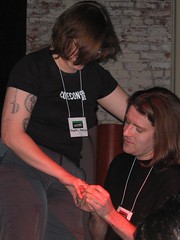
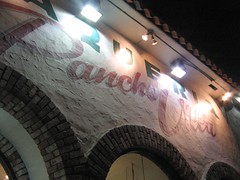
I was chatting with Rob Pascual when I noticed Len lining up in the Q&A; queue. Suddenly, my ears perked up as I sensed something important was going to happen. So I pulled out my camera, stepped on some toes, and got into position. When it was his turn at the microphone, he started saying random stuff that wasn't question at all! Something cheesy like how Meredith had changed his life and how he wanted to be with her. Then he got up on stage and asked The Question. It was beautiful. The audience broke out into cheers and applause, except for the heartless bastards beside me. But who cares about them? This was such an awesome occurance that an interview was taped. After teardown, some people were going to head to a franchise Mexican restaurant. Spider insisted that I get real food, so we walked down to the Mission. We made a detour to Good Vibrations which is a San Francisco landmark if ever there was one. I swear that she's trying to corrupt me. Anyway, as we were walking out, I must have mentioned that I was from Canada. Because Cohen, a Torontonian, came out of nowhere and introduced himself to us. Well, what was I to do but to invite my fellow countryman to dinner? So we set off to find a Taqueria that served nopales. This failed since Californians don't seem to like eating cactus. Instead, we went to Pancho Villa where I ate enchiladas and salsa verde and guacamole and churros and I was so very happy! We bid farewell to Cohen after exchanging contact information and tried to find everyone else. Unfortunately, we couldn't reach anyone by cellphone, so we sat around dejected for a while. Then we realised that we could go to Annie's Social Club where an event was happening. This turned out to be a good and a bad idea.

Taqueria
Originally uploaded by sfllaw.
It was a good idea because we found everyone at CodeCon. It was a bad idea because Annie's Social Club double-booked us with bad karaoke! And then were quite rude when we complained. And then kicked out John Gilmore. So I just want to say that Annie's Social Club hates geeks and freedom. So Len hailed a black stretch limousine, we all climbed into it, invited some reporters along and moved the entire party to the XYZ bar. The XYZ staff were very awesome, accommodating an extra hundred patrons and getting an extra bartender. And they were very nice about it. Unfortunately, the bar was full, so I had to lead a bunch of introverts in the fine art of taking over an establishment. We walked in, started talking, I encouraged people to sit down in empty spots on the couches. They did a very admirable job of taking over the back. I got the stunningly adorable [info]akashayi a seat and a drink, before I taked to the people sitting with us. They were a couple who had moved from Florida to San Francisco, and a man from New York who was quite the boor. The man in the couple knew the New Yorker and seemed quite embarassed about him. After twenty minutes of conversation, they excused themselves and bid us good night. This gave us plenty of seating space to talk about geeky things until the manager kindly kicked us out. I made sure Akasha got safely to her hostel and then took a taxi back to the guest room. It was quite the challenge to direct the cab driver, since I had lost the directions back, but I managed!

Next.

Previous.