Search Results: "sf"

22 May 2010

Russell Coker: A School IP Project

The music industry seems fairly aggressive in taking legal action against children when they break the licence terms of copyright material. I think it would be good to teach children about how the IP industry really works. It seems to me that you could have a school project that involves an entire year level (maybe 100 students depending on the size of the school) each of whom can produce copyright material (everything they do in art and English classes would be suitable as a start). Then they could register their work (make digital photographs and then store them in a school database that records the entry date) and sue anyone who infringes their work. Every student would receive licence fees for their work, but if they are sued for infringement they would have to pay all revenue plus damages. Other students could work as lawyers and take a portion of the proceeds of any successful law suit, and finally some students could run recording companies and spend their time hunting for infringing work for the purpose of launching legal action. In terms of the licence fees paid, this could be done by just allocating a fixed value per item to each student as a way to get the system running without regard to the fact that some students just aren t able to create good art. It could however have a large portion of the value coming from what other students choose to spend, every student gets to spend $10 per week on art and they can choose from the database what they want to buy copies of. The most popular art could then be printed on every notice-board in the school as an incentive for students to vote with their play-money for something that they don t mind seeing all the time. It s obvious that popularity would be a significant factor in the success of some artists, but that s OK, a casual review of the chart topping music reveals that it s quite obviously not created by the world s best musicians so it seems that rewarding popularity rather than skill just adds some realism. One possibility would be to allow the students to elect representatives to create their own IP laws. It would be interesting to see how the IP laws voted on by representatives of the students (who are all in some way involved with the process of creating, buying, selling, and distributing artistic products) differ from those which we have foisted upon us in the real-world. Also an interesting possibility would be to allow corruption in the election process and observe how the results differ from year levels where corruption is not permitted. I expect that teaching children how political corruption works would be a little controversial, but it s nothing that they can t learn from reading news reports about what the entertainment industry is really doing. Really being a corrupt politician for a school project shouldn t be as bad as playing a murderer in a school play! Naturally this couldn t be done with real money, but giving higher marks at the end of the year to the students who accumulate the most play money would be quite reasonable. I don t think that there would be a problem with giving higher marks to a student who succeeded through political corruption as long as they gave a good written report of how they did so and the implications for society. Please note that I am not suggesting this for a subject that is used for university entrance, I think it would be a good project for years 8-10 which in Australia have no relevance to university entrance. So the marks would just be letters on a bit of paper that might make parents happy or unhappy and otherwise mean nothing. I anticipate responses from people who believe that educating children about how the world works is not appropriate for a school. Such people are never going to convince me, but if anyone thinks that they can make a good point to convince some of the readers then I encourage them to write it up in the comments section if it s short or on their own blog if it s longer.

20 May 2010

Dirk Eddelbuettel: RcppArmadillo 0.2.0 (and 0.2.1)

With the Rcpp 0.8.0 release on Monday, Romain, Doug and I were able to follow-up with a new RcppArmadillo release. RcppArmadillo uses Rcpp (and a few dozen lines of 'glue') to provide a transparent interface from R to Conrad Sanderson's impressive Armadillo library for linear algebra. This new release offers a number of key improvements: While we had tested this quite rigourously, the combination of some last minute changes that were meant to be stylistic-only, some troubles with the tests and builds at CRAN that were not apparent in all our tests (hint: do not yet use dynamic help features referencing other packages even if you have a Depends: on them) and an upcoming travel deadline meant that we missed a gotcha on Windows---so release 0.2.1 had to follow a few hours after the short-lived 0.2.0. More information is on the RcppArmadillo page. Questions, comments etc should go to the rcpp-devel mailing list off the R-Forge page.

17 May 2010

Francois Marier: List of Open Source Conference Management Systems

Conference Management systems are web applications designed to make the lives of conference organisers easier. They usually include features such as registration, payment, paper submission and review, scheduling and publishing of announcements.

Since Wikipedia is apparently not a place for such a "spammy list," I figured I should at least post this here:
NameUsed byLicenseProgramming Language
A Conference ToolkitYAPC::EuArtistic LicensePerl
ConManUtah Open Source Conference, Texax Linux FestGPLPython (Django)
Open Conference Systemsvarious academic conferencesGPLPHP
OpenConferenceWareOpen Source BridgeMITRuby on Rails
PentabarfDebConf, FOSDEM, CCCGPLRuby on Rails
SCALEregSCALEGPLPython (Django)
Zookeeprlinux.conf.auGPLPython (Pylons)


If you know of any other Open Source systems, please leave a comment!

Enrico Zini: fuss-launcher: an application launcher built on apt-xapian-index

fuss-launcher: an application launcher built on apt-xapian-index Long ago I blogged about using apt-xapian-index to write an application launcher. Now I just added a couple of new apt-xapian-index plugins that look like they have been made just for that. In fact, they have indeed been made just for that. After my blog post in 2008, people from Truelite and the FUSS project took up the challenge and wrote a launcher applet around my example engine. The prototype has been quite successful in FUSS, and as a consequence I've been asked (and paid) to bring in some improvements. The result, that I have just uploaded to NEW, is a package called fuss-launcher:
* New upstream release
   - Use newer apt-xapian-index: removed need of local index
   - Dragging a file in the launcher shows the applications that can open it
   - Remembers the applications launched more frequently
   - Allow to set a list of favourite applications
To get it: It requires apt-xapian-index >= 0.35. To try it:
  1. Make sure your index is up to date, especially if you just installed app-install-data: just run update-apt-xapian-index as root.
  2. Run fuss-launcher.
  3. Click on the new tray icon to open the launcher dialog.
  4. Type some keywords and see the list of matching applications come to life as you type.
It's worth mentioning again that all this work was sponsored by Truelite and the Fuss project, which rocks. Some screenshots: When you open the launcher, by default it shows the most frequently started applicationss and the favourite applications: launcher just opened When you type some keywords, you get results as you type, and context-sensitive completion: keyword search When you drag a file on the launcher you only see the applications that can open that file: drag files to the launcher

10 May 2010

Colin Watson: OpenSSH 5.5p1 for Lucid

For various reasons, I chose to leave Ubuntu 10.04 LTS using OpenSSH 5.3p1. The new features in 5.4p1 such as certificate authentication, the new smartcard handling, netcat mode, and tab-completion in sftp are great, but unfortunately it was available just a little bit too late for me to be able to land it for 10.04 LTS. I realise that many Lucid users want to make use of these features for one reason or another, though, so as a compromise here's a PPA containing OpenSSH 5.5p1 for Lucid. I intend to keep this up to date for as long as I reasonably can, and I'm happy to accept bug reports on it in the usual place.

9 May 2010

Gunnar Wolf: You will not be renumbered

I woke up with a loud BZZZT It happens every couple of years. The electric transformer for the circuit where my house is located, at the Northern edge of Ciudad Universitaria, decided to die (or at least, to take a break literally). About one hour later, I decided it was time to wake up and start being a useful person. I gave breakfast to my cats and had breakfast myself, and called the electrical company to report this mishap. They told me the report was registered, and I hope to have electricity soon (meanwhile, I'm sitting at a nearby restaurant, as there is some job to do Yes, besides writing blog entries). And they told me, as is often told in Mexico, a general anticorruption phrase With a twist: recuerde que usted no debe renumerar ning n servicio que realice el personal de la Comisi n Federal de Electricidad . (You should not renumber any service done by the Federal Electrical Commission personnel). Yes, remunerado (not renumerado). This shows once again the power of asking people to read things they don't understand.

Robert Collins: Maintainable pyunit test suites

There s a test code maintenance issue I ve been grappling with, and watching others grapple with for a while now. I ve blogged about some infrastructural things related to it before, but now I think its time to talk about the problem itself. The problem shows up as soon as you start writing setUp functions, or custom assertThing functions. And the problem is where do you put this code?
If you have a single TestCase, its easy. But as soon as you have two test classes it becomes more difficult. If you choose either class, the other class cannot use your setUp or assertion code. If you create a base class for your tests and put the code there you end up with a huge base class, and every test paying the total overhead of your test needs, rather than just the overhead needed to test the particular system you want to test. Or with a large and growing list of assertions most of which are irrelevant for most tests.
The reason the choices have to be made is because test code is just code; and all the normal issues there separation of concerns, composition often being better than inheritance, do-one-thing-well all apply to our test code. These issues are exacerbated by pyunit (that is the Python unittest module included with the standard library and extended by various projects)
Lets look some (some) of the concerns involved in a test environment: Test execution, fixture management, outcome decision making. I m using slightly abstract terms here because I don t want to bind the discussion down to an existing implementation. However the down side is that I need to define these terms a little.
Test execution by this I mean the basic machinery of running a single test: the test framework calling into user code and receiving back an outcome with details. E.g. in pyunit your test_method() code is called, success is determined by it returning successfully, and other outcomes by raising specific exceptions. Other languages without exceptions might do this returning an outcome object, or passing some object into the user code to be called by the test.
Fixture management the non trivial code that prepares a situation where you can make assertions. On the small side, creating a few object instances and glueing them together, on the large end, loading data into a database (and creating the database instance at the same time). Isolation issues such as masking out environment variables and creating temp directories are included in this category in my opinion.
Outcome decision making possibly the most obtuse label I ve ever given this, I m referring the process of deciding *what* outcome you wish to have happen. This takes different forms depending on your testing framework. For instance, in Python s doctest:
>>> x
45
provides a specification the test framework calls str(x) and then compares that to the string 45 . In pyunit assertions are typically used:
self.assertEqual(45, x)
Will call 45 == x and if the result is not True, raise an exception indicating a Failure has occured. Unexpected exceptions cause Errors, and in the most recent pyunit, and some extensions, other exceptions can signal that a test should not be run, or should have failed.
So, those are the three concerns that we have when testing; where should each be expressed (in pyunit)? Pragmatically the test execution code is the hardest to separate out: Its partly outside of user control , in that the contract is with the test framework. So lets start by saying that this core facility, which we should very rarely need to change, should be in TestCase.
That leaves fixture management and outcome decision making. Lets tackle decision making if you consider the earlier doctest and assertion examples, I think its fairly clear that there are multiple discrete components at play. Two in particular I d like to highlight are: matching and signalling. In the doctest example the matching is done by string matching the reference object(s) are stringified and compared to an example the test writer provides. In the pyunit example the matching is done by the __eq__ protocol. The signalling in the doctest example is done inside the test framework (so we don t see any evidence of it at all). In the pyunit example the signalling is done by the assertion method calling self.fail(), that being the defined contract for causing a failure. Now for a more complex example: testing a float. In doctest:
>>> %0.3f % x
0.123
In pyunit:
self.assertAlmostEqual(0.123, x, places=3)
This very simple check that a floating point number is effectively 0.123 exposes two problems immediately. The first, in doctest, is that literal string comparisons are extremely limited. A regex or other language would be much more powerful (and there are some extensions to doctest; the point remains though the operator is not enough). The second problem is in pyunit. It is that the contract of assertEqual and assertAlmostEqual are different: you cannot substitute one in where the other was expected without partial function application something that while powerful is not the most obvious thing to reach for, or to read in code. The JUnit folk came up with a nice way to address this: they decoupled /matching/ and /deciding/ with a new assertion called assertThat and a language for matching expressed as classes. The initial matcher library, hamcrest, is pretty ugly in Python; I don t use it because it tries too hard to be english like rather than being honest about being code. (Aside, what would is_() in a python library mean to you? Unless you ve read the hamcrest code, or are not a Python programmer, you ll probably get it wrong. However the concept is totally sound. So, outcome decision making should be done by using a matching language totally seperate from testing, and a small bit of glue for your test framework. In testtools that glue is assertThat , and the matching language is a narrow Matcher contract (in testtools.matchers) which I m going to describe here, in case you cannot or don t want to use the testtools one.
class Matcher:
    def __str__(self):
        "Describe this matcher."""
    def match(self, something):
        """Determine if something is matched.
        :param something: Something to match.
        :return: None if something matched, or a Mismatch object otherwise.
        """
class Mismatch:
    def describe(self):
        """Describe a mismatch that has occured."""
This permits composition and inheritance within your matching code in a pretty clean way. Using == only permits this if you can simultaneously define an __eq__ for your objects that matches with arbitrarily sensitivity (e.g. you might not want to be examining the process_id value for a process a test ran, but do want to check other fields).
Now for fixture management. This one is pretty simple really: stop using setUp (and other similar on-TestCase methods). If you use them, you will end up with a hierarchy like this:
BaseTestCase1
 +TestCase1
 +TestCase2
 +BaseTestCase2
   +TestCase3
   +TestCase4
   +BaseTestCase3
     +TestCase5
     ...
That is, you ll have a tree of base classes, and hanging off them actual test cases. Instead, write on your base TestCase a single glue method e.g.
def useFixture(self, fixture):
      fixture.setUp()
      self.addCleanup(fixture.tearDown)
      return fixture
And then rather than having a setUp function which performs complex operations, define a fixture an object with a setUp and a tearDown method. Use this in tests that need that code::
def test_foo(self):
      server = self.useFixture(NewServerWithUsers())
      self.assertThat(server, HasUser('fred'))
Note that there are some things around that offer this sort of convention already: thats all it is convention. Pick one, and run with it. But please don t use setUp; it was a conflated idea in the first place and is a concrete problem. Something like testresources or testscenarios may fit your needs if it does, great! However they are not the last word they aren t convenient enough to replace just calling a simple helper like I ve presented here.
To conclude, the short story is:
  • use assertThat and have a seperate hierarchy of composable matchers
  • use or create a fixture/resouce framework rather than setUp/tearDown
  • any old TestCase that has the outcomes you want should do at this point (but I love testtools).

5 May 2010

Ana Beatriz Guerrero Lopez: KDE 4.4.3 in unstable

Following Qt 4.6.2, uploaded a couple of weeks ago, KDE 4.4.3, has finally found its way to unstable in the last 48 hours.
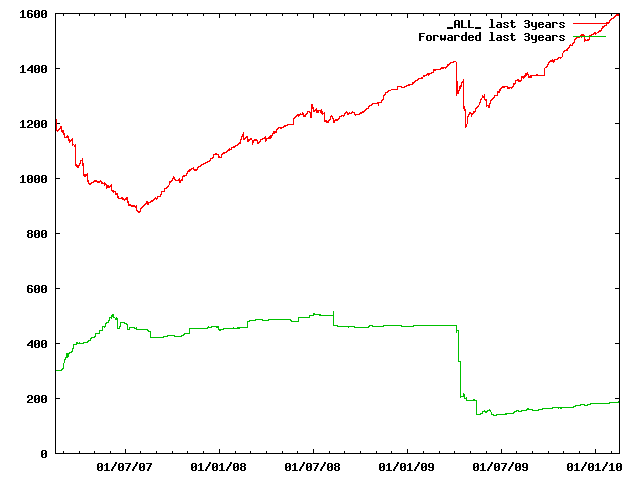
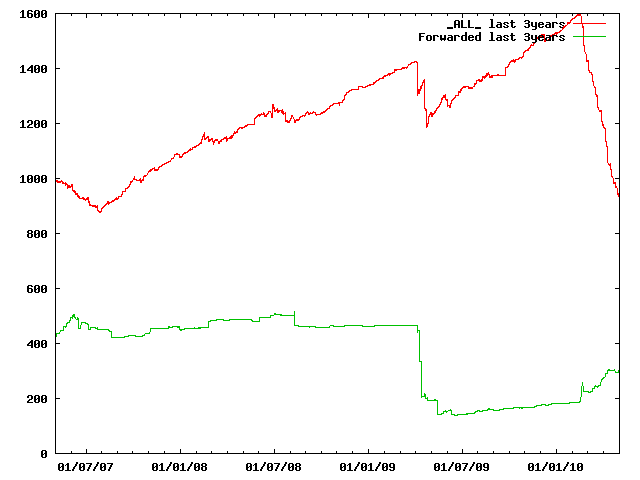
Given KDE 4.5.0 is not expected until August, it is likely the next point release, 4.4.4, will be the KDE version included in next Debian stable, Squeeze. What this means: go and update to 4.4.3, test, and when you find a bug, please, follow this instructions. If you are lazy to read it: report upstream bugs at the KDE Bugzilla and report the packaging/integration bugs in the Debian BTS. When in doubt, you have the Debian KDE mailing list, that is being successful so far in maintaining a good signal-noise ratio. I would like highlight the drop in the open bugs in the BTS experimented in the last 2-3 months, I published this graph in February: Number of bugs reported against KDE in Debian in the last 3 years - February 2010 And look at the situation now: Number of bugs reported against KDE in Debian in the last 3 years -May 2010 This is mainly due to the great work of Eckhart W rner. Also there is other people who contributed to it more modestly, a big thank you to all of you! As you can see in the second graph, there are less than 1000 bugs open now in the BTS, they are still too much and time has taught us it is very easy going over 1000 again, so we still welcome more volunteers looking at bugs. If you are not the bugsquasher type, you can write HTML and you do some IRC, we also need somebody to help us reorganize a bit the pkg-kde website. I will help you personally on this task, but it is good if you can lurk by IRC and you are not scared to share your doubts with the rest of the team there. Finally, I promise I will publish something about the status of KOffice pre-2.2 in Debian, but I still can not say whether it will be in Squeeze.

Ritesh Raj Sarraf: Debian Developer

Finally, I am proud to be officially part of one of the most successful and well organized Free/Open project, the Debian project.I would like to thank everyone who have worked with me. I would also like to thank my Advocate Giridhar and my AM Pablo. It was and is really awesome working with you guys.

3 May 2010

David Welton: Mochiweb proto-deb and hacking

I had some time over the weekend to play a bit with Mochiweb. It's a very nice little bit of work, but kind of strange for an open source project. I think both things come from the fact that it was built to do some very specific things in a business, and once those goals were accomplished, that suited the owner just fine. There is no nice/fancy project home page, no links to documentation, and in general, all of the stuff you're supposed to do for a successful open source project. The code, however, is good, fast, and pretty easy to deal with. Anyway, I wanted to use it for a thing or two I'm working on, so I created some .deb packaging for it. It's been ages since I've done that (indeed, I officially retired from Debian), so it's probably missing something, but I thought I'd throw it out there for people to have a look. The git repository is here: http://github.com/davidw/mochiweb - my changes live in the 'deb' branch. The big thing I've tried to do is make it so that if you have several mochiweb projects on the same machine, they'll all be started/stopped by the init scripts, if you so choose. What you do is add a file with the path to the application to the /etc/mochiweb/apps directory, and when you do /etc/init.d/mochiweb start, it will start all of those. At stop time, it will run the stop.sh script, which shuts things down. It runs things as the user that owns the start.sh script, unless it's root, in which case it simply doesn't run. The thing that's missing right now is a way to get the thing to write logs somewhere, and I'm not quite sure how to do that, so here's hoping someone will write in with a suggestion. The .deb file I generated ought to be attached to this post, although there are no guarantees that I'll keep it up to date.

1 May 2010

Filippo Giunchedi: how to ship spidermonkey in your autotools project

While working on freej we'd need to update spidermonkey/mozjs to the latest version and while doing that integrate it better with the rest of autoconf/automake. AFAICT spidermonkey/mozjs is distributed as part of XULRunner nowadays. The requirements are to make it easy to put a new version of spidermonkey into the tree and redistribute it with make dist and also to have a successful make distcheck. The first step is a trick explained in automake manual about third-party Makefiles so we're using a GNUMakefile.in (git) to "proxy" the targets down to the real Makefile or to ignore some targets called by autotools, e.g:
# otherwise linking static libmozjs.a with dynamic libfreej.so won't work
CFLAGS += -fPIC
# the makefile to proxy targets to
js_makefile = $(builddir)/Makefile
# proxy these targets to the real makefile
all export js-config clean libs tools:
  $(MAKE) -f $(js_makefile) $(AM_MAKEFLAGS) $@
# targets required by autotools but which we don't need at all
.PHONY: dvi pdf ps info html installcheck check install uninstall
dvi pdf ps info html installcheck check install uninstall:
This more or less fixes the make part, now for the autoconf part there's a similar tecnique in the autoconf manual involving running arbitrary configuration commands. I first tried to treat spidermonkey as a separate project via AC_CONFIG_SUBDIRS as expained in Configuring Other Packages in Subdirectories but it didn't work and I forgot exactly why. The configure.ac (git) snippet is something like this: (sorry no highlighting, highlight doesn't support m4 yet)
if test x$have_mozjs = xno   test x$static_mozjs = xyes; then
  dnl run lib/javascript/configure after freej's configure, building it static
  AC_CONFIG_COMMANDS([lib/javascript/.xulrunner-subdir],
    (cd lib/javascript &&
      CXXFLAGS="$GLOBAL_CFLAGS $CXXFLAGS -fPIC" \
      CFLAGS="$GLOBAL_CFLAGS $CFLAGS -fPIC" \
      $ac_srcdir/configure --enable-static \
        --enable-js-static-build --disable-jit)   exit $?
  ])
fi
This will run spidermonkey configure after the main configure, at this point config.status will also expand GNUmakefile.in into GNUmakefile with the correct variables. The final step after all this work is of course to add the spidermonkey directory to SUBDIRS (e.g. SUBDIRS += lib/javascript), after that make will hopefully recurse into lib/javascript and use our GNUmakefile. While this is nice it doesn't cater for the make dist family of autotools targets which build the real distribution tarball. To accomplish this I've used an explicit list of spidermonkey files that will end up in the tarball and made make distdir to copy only those files plus GNUmakefile.in and the list itself (.js-distfiles). Which is the second part of the GNUmakefile.in above, i.e. distdir/distfiles targets plus distclean to clean them up, see comments in the file as well. I hope this is somewhat useful to people who are trying to properly (autotools-wise) ship spidermonkey in their project, comments welcome as usual :)

30 April 2010

Russell Coker: CPL Still Sucks

I previously described my experience with Computers and Parts Land (CPL) [1] who gave me a product that didn t do what I wanted (because they thought that they knew better than me) and then gave me attitude when I returned it. As it s almost a year since that incident I had to buy something else from them to use the credit note as I decided that it s not worth making a Trade Practices Act (TPA) [2] issue out of it. Thanks Tim for the suggestion though. Firstly I went to their new store that is advertised on their web site. The people at the new store refused to honor the credit note (they probably hoped that I would just let it go and give them an extra $60 in profit). Claiming that I need to take a credit note back to the store it came from is bogus. Anyway I went back to the original store and bought a new 1.5TB SATA hard drive which seems to work well enough. The service was really slow, I was the only customer in the store and there were several employees not doing much but it still took them ages to print a receipt and give me the hard drive. It will be the last CPL purchase I ever make. In the unlikely situation that there is ever any new gear that is only sold by CPL then I will wait a year and buy it on ebay. It would be good if someone started working as a TPA complainant. They would take donations from dis-satisfied customers who want to pay for an investigation of a shonky company (I d pay $10 for an investigation of CPL). When enough donations were collected they would buy some stuff and make a video of every interaction with the employees and then launch a private legal action under the TPA if they do anything wrong. The TPA complainant would get to keep everything that they buy, any excess donation money after proving the case, and any money offered by the company to settle law suits. While it s not a good use of my time and money to go after CPL directly it would be good to give some money to someone who would then see them dealt with properly.

26 April 2010

Jan Hauke Rahm: Talking about Free Software

When I first started using Free Software yes, that s quite some time ago I found it the right thing to do. It felt like I was first time ever really controlling what my computer does. Took just a bit of time to notice I really never knew anything about it. Well, almost at least. Then when I started contributing to Free Software this obviously changed. One of the freedoms is to learn from the code you re running. And I did it by reading, contributing, doing nonsense with it, reimplementing it you know the deal. Starting to work on Debian was something that just evolved out of it. Doing so gave me the opportunity to give back. I never achieved that actually, though. At least I don t consider my contributions even remotely sufficient to make up for the great deal of software that I use sometimes without noticing it. Still there s lots of stuff that I don t have a clue of and I rely on other developers to do their (volunteer) job. Otherwise my knowledge wouldn t help much. I could never continue kernel development if those kernel hackers all stepped back for instance. I guess, it s getting more and more difficult the closer the piece of code is to hardware. Another thought I had was about Free Software in general. It s more than just the code (although it might be the most important part), it s also a concept that needs to be communicated. Firefox on Windows shows how Free Software can have a big market share in an otherwise closed source environment. Yet I m not sure all users know about it being open source and what that means (hear them talk about Freeware instead). And who is dealing with this conceptual stuff? I decided to do something about all that. Now I don t really have money but a bit I thought I could share. And I could set yet another sign by publicly talking about it, or casually mentioning that I consider Free Software and Linux a good thing. So you will see a mail signature now below all my mails. I always wondered what one might gain with such and now I found a reason to include one. It reads:
Debian Developer                                 www.debian.org
Member of the Linux Foundation                    www.linux.com
Fellow of the Free Software Foundation Europe      www.fsfe.org

25 April 2010

Matt Zimmerman: Ten TED talks I took in today

Starting about a year ago, I started following the release of videos from TED events. If one looked interesting, I would download the video to watch later. In this way, I accumulated a substantial collection of talks which I never managed to watch. I spent a Saturday evening working my way through the list. These are my favorites out of this batch.

24 April 2010

Adam Rosi-Kessel: Green Lemonade Success

My most successful Green Lemonade to date:

Green Lemonade

Green Lemonade

Approximate recipe: Juice and consume. I have heard from green-juice skeptics before. It may be hopeless for some poor souls. But don t knock it until you ve tried it.

Russell Coker: Is the NBN a Good Idea

Since writing my post about whether the National Broadband Network can ever break even [1] I ve had a number of people try to convince me of it s merit. He is my summary and rebuttal of some of the arguments for the NBN: The FUD Claims are made that Australia may fall behind the rest of the world, children may be disadvantaged in their education, or many other bad things may unless a faster net access is provided to everyone. That is FUD. If we are going to spend $43,000,000,000 then we should have some evidence that it will do some good. One thing to note is that rural areas will not get anything near the 100Mb/s speeds that FTTH will deliver to people in the cities. So if faster net access is actually essential then it would probably make sense to start by delivering ADSL2+ speeds to rural areas something that is not planned to be part of the NBN. Some people claim that having slow net access (ADSL2+) is going to preclude unknown future uses of the Internet. However the NBN is only going to be 100MB/s so any such claim is essentially that unknown things will happen in the future to make 24Mb/s too slow, but those unknown things won t make 100Mb/s too slow . I started using computer networks when a 1200/75 modem was considered fast. Over about the last 25 years typical net access speeds have increased from 1200b/s to about 12Mb/s, that s a factor of 10,000 speed improvement! Now the people who believe that we only need to multiply the current speed by a factor of 4 to address all future needs could be correct, but it seems unlikely and doesn t seem like a good idea for a $43,000,000,000 bet. If they were talking about 1Gb/s net access then things would be different in this regard. Technological Development Some people compare the NBN to the Apollo Program and suggest that the scientific research involved in implementing a FTTH network might result in useful developments in other areas. The Wikipedia page about Fiber to the premises by country indicates that Hong Kong had 1Gb/s available in 2006. It seems that a service which is rolled out 4 years later and 10 times slower than in Hong Kong is not going to involve a huge amount of research. Certainly nothing like the Apollo Program. It would allow multiple HDTV channels to be viewed at the same time According to the Australian Bureau of Statistics in 2001 the average Australian household had 2.6 people (3.0 in NT) [2]. The incidence of every member of a household wanting to watch a different live TV channel at the same time is probably quite low, it seems that young people nowadays spend as much time watching Youtube as they do watching TV. Based on the Wikipedia bit-rate page it seems that an ADSL2+ link could stream two HDTV channels. I could use fiber speeds today There are some people who claim that they need faster speeds for their data transfers right now. The problem is that the latency of data transfer is a bottleneck in transfer rates. In some quick tests between servers that have reasonably fast connections to the Internet I was only able to get one international transfer in excess of ADSL2+ speed (24Mb/s or 3MB/s). I was able to transfer data between London and Germany at a speed of 11MB/s which was possibly limited by the 100baseT Ethernet connection in the data center in Germany. Now if the people who pay for that German server were to pay more then they would get a higher speed. So anyone who downloads anything from my web site in it s current configuration would get a significant performance boost by using an NBN connection if they live in Europe! But if they live in Australia then they will probably get a fraction of that speed (a quick test indicates that my ADSL2+ connection gives me about 500KB/s from my web server. I need to have at least three transfers going at the same time to get more than 600KB/s when downloading files from other countries, and it s rare to have a single download run at a speed higher than 100KB/s. It would be handy if I could download at higher speeds from my ISP s mirror (which seems to be the only way someone in Australia can even use full ADSL2+ speeds). But it s certainly not worth the $5,000 per household installation cost of the NBN to get that. I m sure that there are some people who really do have usage patterns that could take advantage of fiber net access, one possibility would be downloading large files from a local source such as a major web site that uses a CDN. It seems likely to me that the majority of people who fit this category are using major porn services. Fiber would be good for Video-Conferencing To be better than ADSL for video-conferencing a NBN connection would need a faster upload speed. Internode is already selling NBN connections for the trial areas [3]. The cheapest fiber plans that they offer are at the 50/2 speed, that s 50Mb/s download and 2Mb/s upload in theory ADSL2+ should have a higher upload speed. In my tests the best result I ve got from sending files over my ADSL2+ link to another country is about 110KB/s (880Kb/s). The fact that the theoretical speed of a fiber connection is better than the measured speed of an ADSL2+ connection in this regard doesn t mean much, let s not assume that a fiber connection will get it s theoretical maximum speed. Not that you necessarily need higher speeds for video-conferencing, Youtube is one of many services that uses a lot less bandwidth than the upload speed of an ADSL2+ connection. Also video-calls which are supported on most 3G mobile phones use even less bandwidth again. I want an NBN connection to run a server at home The fastest connection for uploading that Internode offers to home users is the Home High plan at 100/8 speed, that is maybe a bit more than twice as fast for uploading as ADSL2+. They also offer a SOHO plan that supports 16Mb/s upload speed (at extra expense) and suggest that customers who want higher speeds contact their business sales department. But they include both sending and receiving data in the bandwidth quota for the fiber connections. Transmitting data at 16Mb/s isn t that great for a server. The cheapest virtual server plan on offer from Linode [4] includes 200GB of data transfer per month and has significantly higher transmission speeds. You could get a Linode virtual server plus an Internode ADSL2+ connection for about the same price as an Internode fiber connection to the home. There are two down-sides to virtual servers, one is that they are limited in the amount of RAM that they have (I can easily afford to buy 8G of RAM for a home system but renting an 8G virtual server is going to be expensive) and the other is that the storage is limited. Shared storage on virtual servers can be slow and is limited in size. If you need to run a server with a few terabytes of data storage (which is cheap on commodity SATA disks but expensive on server-grade disks) and you don t need to transfer much of it then a home server on the NBN might do well. Otherwise it s probably not going to work well for server use. The NBN will avoid people leaving their PC on to do downloads and save electricity To save electricity you would have to have a significant incidence of situations where a download can complete fast enough over the NBN to allow the user to turn their PC off before going to bed but be slow enough over ADSL to require that it be left on overnight. That would probably only apply to downloads from a CDN or from a local ISP mirror. From the Internode mirror I can download a test file at a speed of 850KB/s (I guess this means that my ADSL connection is not delivering full speed I suspect poor quality wiring in my home and would try to fix it if the current speed was too slow). In 5 minutes spend brushing my teeth I could download 250M of data, in the same time if I had a 100/4 connection on the NBN I might be able to download almost 3G of data. So in the unlikely event that I wanted to download a CD or DVD image and turn off my PC immediately before going to bed then the NBN would be a good thing. But then of course I would want to burn the CD or DVD image to disc and that would take long enough that I would leave it on overnight My ADSL connection gives really low speeds or I m out of range for ADSL Some people who live only a short distance from an exchange are unable to get ADSL2+. Some people live a long way from exchanges and are outside ADSL range. The ideal solution to these problems is not to provide fiber access to the majority of the population, it is to provide ADSL to everyone who is near an exchange and maybe provide fiber access to some people who are a long way from exchanges. I find it rather ironic that some people in the country are essentially saying because net access in the country is so slow we need fiber in the cities . The NBN is not going to give fiber to rural areas, satellite is one of the options that will be used. Really High Speeds I have been informed that to get the distances needed for the NBN they have to use Single Mode Fiber, this permits scaling up to higher speeds at some later time by changing the hardware at the end points. So we could end up with a Hong Kong speed network at some future time with the same fibers. This is a good thing. But I don t think that we need to get fiber installed right now so that we can use 100Mb, we could wait until there is enough need to get the faster transmission rates from the start. At the moment it s just a waste of money.

23 April 2010

Ingo Juergensmann: DDoS, Apache2 and mod_qos

For two or three weeks now someone seems to dislike me. It happens from time to time that during the night, about 1.30 a.m., my webserver got hit by a sync dDoS. Maybe it's someone specific, maybe it's just a random botnet. Anyway, the result is the same: the service is no longer available.

For this problem there exists mod_qos, which was mentioned in the last LinuxMagazin issue (German). Ok, so I download mod_qos, followed the instructions and built the module with "apxs2 -ci mod_qos.c". When I've enabled mod_qos I get the following error:

mod_qos, requires OpenSSL, compile Apache using "--enable-ssl"


Which is quite interesting, because the Apache2 runs a HTTPS site as well. So, some sort of SSL should be available and mod_ssl is loaded as well. Anyway, I added mod_gnutls as well, but no change: it still reports the above error.

System is Debian Lenny and Apache2 is version 2.2.9-10+lenny7.

Any tipps, hints, pointers or advices, please? :-)

UPDATE:
After "apt-get install apache2-threaded-dev libgnutls-dev libssl-dev" mod_qos was loaded successfully and hopefully will prevent me from suffering of another dDoS. Sometimes the solution is so simple... ;-)

22 April 2010

Matt Zimmerman: On Cloud

If you re convinced that cloud is a useless buzzword, being used to describe everything under the sun, old and new, then well, you re right that is, except for the useless part. It s true that this word is being (ab)used in many different products, services and technologies, which do not seem to relate to each other in any concrete way. Cloud in the abstract is being defined in many different ways, based on different fundamental characteristics of cloud technology . Nonetheless, there is something genuinely important going on here, and this is my view of what it s about. The hype Countless business which only had web sites or web applications in 2008 now call them cloud services . They aren t delivering any new benefits to their users, and they haven t redesigned their infrastructure. What do they mean by this? Cloud is defined, some say, by where your data is kept, and cloud means storing your data on remote servers instead of internal ones. Millions of Gmail and Flickr users have been in the cloud without even knowing it, and so has everyone who reads their mail over IMAP, or uses voicemail. In short, cloud is just data that is somewhere else.

Credit: jurvetson

Last September, I watched a presentation on Cloud computing where Symantec pitched their anti-virus product as having something like three different cloud computing technologies. These, it turned out, all involved downloading files over the Internet. In this view, cloud is essentially about the network, derived from our habit of using a drawing of a cloud in our network diagrams for so many years. Wikipedia currently shares this view, as its Cloud computing article opens with Cloud computing is Internet-based computing . No Internet, no cloud. Maybe cloud is just SaaS, and any service provided on a pay-per-use basis over the Internet is a cloud service. It would seem that cloud is about paying for things, especially on a utility basis. The cloud is computing by the hour; it s something you buy. Others maintain that cloud is just virtualization, so if you re using KVM or VMWare, you ve got a cloud already. In this view, cloud is about operating systems, and whether they re running on real or virtual hardware. Cloud means deploying applications as virtual appliances, and creating new servers entirely in software. If your servers only have one OS on them, then they re not cloud-ready. If this vagueness and contradiction irritates you, then you re not alone. It bugs me, and a lot of other people who are getting on with developing, using and providing technology and services. Cloud is not just a new name for these familiar technologies. In fact, it isn t a technology at all. I don t think it even makes sense to categorize technologies as cloud and non-cloud , though some may be more cloudy than others. Nonetheless, there is some meaning and validity in each of these interpretations of cloud. So what is it? A different perspective

Credit: TangYauHoong

Cloud is a transition, a trend, a paradigm shift. It isn t something which exists or not: it is happening, and we won t understand its essential nature until it s over. Simon Wardley explains this, in presentation format, much better than I could in this blog post, so if you haven t already, I suggest that you take 14 minutes of your time and go and watch him do his thing. This change doesn t have a clear beginning or an end. Early on, it was a disconnected set of ideas without any identity. We re now somewhere in the middle of the bell curve, with enough insight to give it a name, and sufficient momentum to guess at what happens next. In the end, it will be absorbed into the way things are . What s going on? So, what is actually changing? The key trends I see are:
  1. People and organizations are becoming more comfortable relying on resources which do not exist in any particular place. Rather than storing precious metals under our beds, we entrust our finances to banks, which store our data and provide us with services which let us use our money . In computing terms, we re no longer enamored with keeping all of our programs and our data on our hard drive: as it turns out, it s not very safe there after all, and in some ways we can actually exercise more control over programs and data out there than in here . We can no longer hoard our gold, or drive off would-be thieves with a pistol, but that wasn t a productive way to spend our energies anyway. While we can t put our hands on our money, we can know exactly what s happening with it from minute to minute, and use it in a variety of ways at a moment s notice.
  2. IT products are ceding ground to services. In many cases, we no longer need to build software, or even buy it: we can simply use it. As computing needs become better understood, and can be met by commodity products, it becomes more feasible to develop services to meet them on-demand. This is why we see a spike in acronyms ending in aaS . Simon explains the progression in detail in his talk, linked above.
  3. Hardware, software and data are being reorganized according to new models, in order to provide these services effectively. Architectural patterns, such as hardware/OS/framework/application are giving way to new ones, like hardware/OS/IaaS/OS/PaaS/SaaS/Internet/web browser/OS/hardware . These are still evolving, and the lines between them are blurry. It s a bit early to say what the dominant patterns will be, but system, network, data and application architecture are all being transformed. No single technology or architecture defines cloud, but virtualization (at the infrastructure level) and the web (at the application level) both seem to resonate strongly with cloudy design patterns.
These trends are reinforcing and accelerating each other, driving information technologies and businesses in a common direction. That, in a nutshell, is what cloud is all about. So what? This transformation is disruptive in many different ways, but the angles which most interest me at the moment are: I d like to explore some of these topics in future posts.

21 April 2010

Russell Coker: Upgrading a SE Linux system to Debian/Testing (Squeeze)

Upgrade Requirements Debian/Squeeze (the next release of Debian) will be released some time later this year. Many people are already upgrading test servers, and development systems and workstations that are used to develop code that will be deployed next year. Also there are some significant new features in Squeeze that compel some people to upgrade production systems now (such as a newer version of KVM and Ext4 support). I ve started working on an upgrade plan for SE Linux. The first thing you want when upgrading between releases is a way of supporting booting a new kernel independently of the other parts of the upgrade. Either supporting the old user-space with the new kernel or the new kernel with the old user-space. It s not that uncommon for a new kernel to have a problem when under load so it s best to be able to back out of a kernel upgrade temporarily while trying to find the cause of the problem. For workstations and laptops it s not uncommon to have a kernel upgrade not immediately work with some old hardware, this can usually be worked around without much effort, but it s good to be able to keep systems running while waiting for a response to a support request. Running a Testing/Unstable kernel with Lenny Policy deb http://www.coker.com.au lenny selinux In Lenny the version of selinux-policy-default is 2:0.0.20080702-6. In the above APT repository I have version 2:0.0.20080702-18 which is needed if you want to run a 2.6.32 kernel. The main problem with the older policy is that the devtmpfs filesystem that is used by the kernel for /dev in the early stages of booting [1] is not known and therefore unlabeled so most access to /dev is denied and booting fails. So before upgrading to testing or unstable it s a really good idea to install the selinux-policy-default package from my Lenny repository and then run selinux-policy-upgrade to apply the new changes (by default upgrading the selinux-policy-default package doesn t change the policy that is running we consider the running policy to be configuration files that are not changed unless the user requests it). There are also some other kernel changes which require policy changes such as a change to the way that access controls are applied to programs that trigger module load requests. Upgrading to the Testing/Unstable Policy While some details of the policy are not yet finalised and there are some significant bugs remaining (in terms of usability not security) the policy in Unstable is usable. There is no need to rush an upgrade of the policy, so at this stage the policy in Unstable and Testing is more for testers than for serious production use. But when you upgrade one thing you need to keep in mind is that we don t to support upgrading the SE Linux policy between different major versions of Debian while in multi-user mode. The minimum requirement is that after the new policy package is installed you run the following commands and then reboot afterwards: setenforce 0
selinux-policy-upgrade
touch /.autorelabel If achieving your security goals requires running SE Linux in enforcing mode all the time then you need to do this in single-user mode. The changes to names of domains and labeling of files that are entry-points for domains is significant enough that it s not practical to try and prove that all intermediate states of partial labeling are safe and that there are suitable aliases for all domains. Given that you need to reboot to install a new kernel anyway the reboot for upgrading the SE Linux policy shouldn t be that much of an inconvenience. The relabel process on the first boot will take some time though. Running a Lenny kernel with Testing/Unstable Policy In the original design SE Linux didn t check open as a separate operation, only read/write etc. The reason for this is that the goal for SE Linux was to control information flows. The open() system call doesn t transfer any data so there was no need to restrict access to it as a separate operation (but if you couldn t read or write a file then an attempt to open it would fail). Recent versions of the SE Linux policy have added support for controlling file open, the reason for this is to allow a program in domain A to open a file and then let a program in domain B inherit the file handle and continue using the file even if it is not normally permitted to open the file this matches the Unix semantics where a privileged process can allow an unprivileged child to inherit file handles or use Unix domain sockets to pass file handles to another process with different privileges. SELinux: WARNING: inside open_file_mask_to_av with unknown mode:c1b6 Unfortunately when support was added for this a bug was discovered in the kernel, this post to the SE Linux mailing list has the conclusion to a discussion about it [2]. The symptom of this problem is messages such as the above appearing in your kernel message log. I am not planning to build a kernel package for Lenny with a fix for this bug. The command dmesg -n 1 will prevent such messages from going to the system console which is something you want to do if you plan to login at the console as they can occur often.

20 April 2010

Julian Andres Klode: GNOME Icon Theme 2.30 looks really ugly

The 2.30 version of gnome-icon-theme is really one of the worst icon themes I ve ever seen in the last years. First of all, it does not fit into the system due to the colors chosen. I was always satisfied with the GNOME icon theme, but with the 2.30 release I can t use it anymore since it makes my system look like a piece of sh**. Secondly, it just does not fit with the tango icon theme. I m currently using the tango icon theme on my laptop, and after installing g-i-t 2.30, some logos suddenly started to turn black and they just did not fit anymore. For now, I downgraded gnome-icon-theme to 2.28 to have a usable UI again. But once there are new icons in gnome-icon-theme I will be lost. Hopefully someone with a sense for UI design will fix this design hell created by the idiots those who created this icon theme. We don t need a 90s icon theme. Update: Here s one problem, the network icon just does not fit:
(not under the same license as the blog, due to legal reasons). Update 2: I don t like changes, but after a months or so I will probably accept it. Anyway, Google did even worse things with reordering the icons in Chromium 5. Previously, all actions were on the left (IIRC); now some are on the left, and some in the input box. Anyway, I replaced the idiots with those now, as some people felt this was overly offensive. Update 3: I just filed two bugs at gnome.org: 616324 and 616325. Others will probably follow.
Filed under: General

Next.

Previous.