Search Results: "dom"

9 February 2010

Martin F. Krafft: Baffling Exchange

I found out yesterday that my university s Microsoft Exchange Server account stopped forwarding my mail on 8 December 2009. As a result, mail accumulated there and remained unseen. Dear examiners, paper authors, supervisors, sponsors, participants, and peers who responded to my calls and cries related to my PhD thesis. I am terribly sorry that you were subjected to this. You replied usually within a few days, but I still sent you reminder after reminder in the weeks to follow. You must have thought that I was a real dork. Please forgive me. I really appreciate your patience! I filed a ticket with my university s IT service provider, which got closed the next day with it should now work again . That wasn t going to cut it for me, so I reopened the ticket, asking for an explanation. Next, I received an apology with a bit of speculation. After a bit of research, it seems that the reason was to be found in the inconsistency of being an external staff member (i.e. an e-mail address outside of the Active Directory domain), but still having an account on the server. On 8 December 2009, the server was upgraded with a service pack. This caused Exchange to go a little manic on the housekeeping. After all, why would anyone ever want to forward their e-mail elsewhere, and still have an account? Well, I certainly don t want an account, and yet I have to have one: Microsoft has bought their ways into the university and spread their germs all across, I need credentials to be able to access shared files, print, browse the library, or search the phone book. However, considering that UL s Outlook Web Access instance does not let users of decent browsers search their mailboxes (a premium feature reserved for users of Internet Exploder), one cannot manipulate more than a page-full of e-mails at a time, bounce messages, or do many of the other operations that make dealing with large amounts of e-mail possible, and because Exchange mail if it doesn t get lost in the first place sucks in so many other ways, I certainly prefer my mail to be handled by a real mail server with a proper mail filter (writeup in progress). Maybe the Exchange service pack was simply designed to get rid of outcasts like me who don t buy into the low-Microsoft-quality vendor lock-in? We ll never know, thanks to the proprietarity of their software (and the fact that the university service provider apparently does not keep logs of changes). NP: AC/DC: Back in Black

Kees Cook: rng-tools with TPM

In Ubuntu, I uploaded an rng-tools that supports the RNG in TPM devices (my patch is waiting in Debian). This hardware is available on a bunch of systems, including several Thinkpads and the Intel Q35, Q45 and newer main boards. While most TPM RNGs aren t really heavy-duty hardware RNGs, they are at least a mild source of randomness. I ll be using an entropy key eventually, but for now, the TPM can supplement my collected entropy. /etc/default/rng-tools:
HRNGDEVICE=/dev/null
RNGDOPTIONS= hrng=tpm fill-watermark=90% feed-interval=1
After it s been running a bit:
Feb 8 19:10:51 linux rngd[13143]: stats: bits received from HRNG source: 6180064
Feb 8 19:10:51 linux rngd[13143]: stats: bits sent to kernel pool: 6166144
Feb 8 19:10:51 linux rngd[13143]: stats: entropy added to kernel pool: 4624608
Feb 8 19:10:51 linux rngd[13143]: stats: FIPS 140-2 successes: 309
Feb 8 19:10:51 linux rngd[13143]: stats: FIPS 140-2 failures: 0
Feb 8 19:10:51 linux rngd[13143]: stats: FIPS 140-2(2001-10-10) Monobit: 0
Feb 8 19:10:51 linux rngd[13143]: stats: FIPS 140-2(2001-10-10) Poker: 0
Feb 8 19:10:51 linux rngd[13143]: stats: FIPS 140-2(2001-10-10) Runs: 0
Feb 8 19:10:51 linux rngd[13143]: stats: FIPS 140-2(2001-10-10) Long run: 0
Feb 8 19:10:51 linux rngd[13143]: stats: FIPS 140-2(2001-10-10) Continuous run: 0
Feb 8 19:10:51 linux rngd[13143]: stats: HRNG source speed: (min=5.207; avg=6.145; max=6.200)Kibits/s
Feb 8 19:10:51 linux rngd[13143]: stats: FIPS tests speed: (min=66.925; avg=75.789; max=112.861)Mibits/s
Feb 8 19:10:51 linux rngd[13143]: stats: Lowest ready-buffers level: 0
Feb 8 19:10:51 linux rngd[13143]: stats: Entropy starvations: 308
Feb 8 19:10:51 linux rngd[13143]: stats: Time spent starving for entropy: (min=3150263; avg=3178447.994; max=3750848)us
And now the kernel entropy pool is high:
$ echo $(cat /proc/sys/kernel/random/entropy_avail)/$(cat /proc/sys/kernel/random/poolsize)
3968/4096

Martin F. Krafft: Sign me up to social networking!

I do not like it when people tell Web 2.0 sites to send me invitation e-mail. I won t enumerate the reasons here. But there is one reason for why I don t like you passing on my address to those sites, which is subject of this article: Unlike popular belief, the Web 2.0 is not a money-printing machine. It s a long road until you can actually generate real money with user content. Therefore, some shadey sites are probably selling contact details to advertisers to make ends meet while hoping for the big cashflow. I don t have any data to back this up, and I want to change that:
Please tell all your Web 2.0 sites to send me an invitation! Please use an address in the signmeup.madduck.net domain for that, and make sure to include the domain name of the service to which you sign me up before the @ symbol. Also append a hyphen/dash and a random, short string. More on that in just a sec. For instance, if you are one of those people that believes that letting people know where you are (and have been) at any point in time, tell Foursquare to send an invitation to:
foursquare.com-ponies@signmeup.madduck.net
The reason for the random, short string ( ponies ) is simply so that I can later cross-check that a message receiving spam actually went through a social networking site I intend to catalog the invitation messages.
Thank you for your time. Keep in mind: the more, the merrier. I ll make sure to report back on the outcome of this little experiment right here, so watch this space. NP: Billy Joel: Cold Spring Harbor

6 February 2010

Steve Kemp: You seem uncomfortable.

I've been trying to remember to post the pictures I like online for the past few months. So this is a reminder to myself. This image below didn't turn out quite how I wanted it to: But that said I keep on coming back to look at it. I like the lighting, and I love the way that the brick wall on the right hand side angles towards the building on the horizon. Enjoy. Or not. Sunset A similarly "not perfect" image is this outdoor shot. I have only one irritation with this shot - and that is that the trees are clipped at the top. Meh, such is life. (I have two styles of photography; semi-random where I snap what is in front of me, and staged where I try to construct a particular picture - the two images above? One of each.) ObFilm: Bound

Biella Coleman: Hard to imagine but it is our history

Stowe v Thomas (1853) where the court argued that a German translation of Uncle s Tom s Cabins did not constitute copyright infringement (quoted from Meredith McGill s excellent bookAmerican Literature and the Culture of Reprinting, 1834-1853:
Before publication [the author] has the exclusive possession of his invention. His dominion is perfect. But when he has published his book and given his thoughts, sentiments, knowledge or discoveries to the world, he can have no longer an exclusive possession of them. Such an appropriation becomes impossible, and is inconsistent with the object of publication. The author s conceptions have become common property of his readers, who cannot be deprived of the use of them, or their right to communicate them to others clothed in their own language, by lecture or by treatise

Robert Collins: Adding new languages to Ubuntu


Scott recently noted that we don t have Klingon available in Ubuntu. Klingon is available in ISO 639, so adding it should be straight forward. Last time I blogged about this three packages needed changing, as well as Launchpad needing a translation team for the language. The situation is a little better now: only two packages need changing as gdm now dynamically looks for languages based on installed locales. libx11 still needs changing a minimal diff would be:
=== modified file 'nls/compose.dir.pre'
--- libx11-1.2.1/nls/compose.dir.pre
+++ libx11-1.2.1/nls/compose.dir.pre
@@ -406,0 +406,1 @@
+en_US.UTF-8/Compose:     tlh_GB.UTF-8
=== modified file 'nls/locale.alias.pre'
--- libx11-1.2.1/nls/locale.alias.pre
+++ libx11-1.2.1/nls/locale.alias.pre
@@ -1083,0 +1083,1 @@
+tlh_GB.utf8:           tlh_GB.UTF-8
 === modified file 'nls/locale.dir.pre'
--- libx11-1.2.1/nls/locale.dir.pre
+++ libx11-1.2.1/nls/locale.dir.pre
@@ -429,0 +429,1 @@
+en_US.UTF-8/XLC_LOCALE:       tlh_GB.UTF-8
 
Secondly, langpack-locales has to change for two reasons. Firstly a locale definition has to be added (and locales define a place a language and locale information like days of the week, phone number formatting etc. Secondly the language needs to be added to the SUPPORTED list in that package, so that language packs are generated from Launchpad translations. Now, gdm autodetects, but it turns out that only complete locales were being shown. And that on Ubuntu, this was not looking at language pack directories, rather at
/usr/share/locale
which langpack-built packages do not install translations into. So it could be a bit random about whether a language shows up in gdm. Martin Pitt has kindly turned on the with-incomplete-locales configure flag to gdm, and this will permit less completely translated locales to show up (when their langpack is installed without the langpack nothing will show up).

5 February 2010

Marco Túlio Gontijo e Silva: Using sup-mail


Some time ago I wanted some features that evolution wouldn t give to me, such as a good user experience without using the mouse, and the possibility to use an external editor for writing e-mails. I always liked gmail web interface, but I don t like using software that I can t change or see the code, so I wanted threaded view, but I was not with a very high expectative of finding it, since I ve never seen it anywhere else. I tried icedove, sylpheed, claws and mutt, but none of them was good enough for me. I couldn t use very well icedove, sylpheed and claws only with the keyboard, and mutt wouldn t show me a list of folders with how many unread messages there was in each of them. mutt-patched tries to do this, but the number of messages aren t updated automatically. So I kept with evolution. At that time, I even tried evolution from experimental, which contained a plugin to use an external editor. The result was that I got even more crashes, and the external editor was not very nice. I gave up about it when I had to remove totem because of broken dependencies with the evolution from experimental. Some days ago Rafael (Pre ) Cunha de Almeida told me that he heard of this sup, and tried using it, but didn t like very much, because it was not good for accessing the mail from two different machines. As I use only my notebook most of the time, I decided to try it out. And i m liking it: it s mostly like gmail, but with a very good feature I don t remember seeing in gmail: you can kill a thread, and even if more mail arrives from that thread, it ll not be shown in your inbox. Other thing I liked about it is that it s highly customizable in Ruby, which made me feel a little bit like in XMonad. The first problem I found on it was the handling of UTF-8. I found this bug about it, and installed the recommended package, so it worked. I hope this correction, or the better one suggested here, get to Debian. I took a look at the Hooks page on the sup wiki, and used the fetchmail suggestion. I noticed that the code that was there in the time didn t worked here (maybe a bashism?):
fetchmail >& /dev/null
So I replaced it in the wiki with:
fetchmail 2>&1 > /dev/null
which worked here. I wanted to create a new binding, to kill the thread, kill the buffer, and move to the next message in thread-view-mode, so I tried some possibilities without success, until I got to this, with the help of hyperbolis@#sup@irc.freenode.net:
class Redwood::ThreadViewMode
@@keymaps[self].add :kill_and_next,
"Kill this thread, kill buffer, and view next", '&'
def kill_and_next; kill_and_then :next end
def kill_and_then op
dispatch op do
multi_kill [@thread]
end
end
# From lib/modes/thread-index-mode.rb
## m-m-m-m-MULTI-KILL
def multi_kill threads
UndoManager.register killing # threads.size.pluralize thread do
threads.each do t
t.remove_label :killed
add_or_unhide t.first
Index.save_thread t
end
regen_text
end threads.each do t
t.apply_label :killed
# hide_thread t
end regen_text
BufferManager.flash # threads.size.pluralize thread killed.
threads.each t Index.save_thread t
end
end This is the content of the file ~/.sup/hooks/startup.rb. I copied a function from the source code of sup, commenting one line that was relative to that context.

4 February 2010

Christian Perrier: X.org 7.4 packages for squeeze, anyone?

I'm experiencing random crashes since X.org moved to 7.5. As of now, I could take the needed time to properly report them as I hate reporting just "keeps crashing on my system" bugs and make them RC (but, for me they are). I couldn't even take time to downgrade to 7.4 by using testing package while they were here. They mostly seem to be related to my dual screen setup at work (no crashes at home) and/or VirtualBox use (I use VB at work to host my work Windows machine). Of course, as expected, X.org 7.5 migrated to testing and now I'm screwed. I still have the crashes...and can't even easily downgrade..:-( Apart from beating myself, would there be a chance that someone still has these packages somewhere? I probably need 7.4+4 packages.

3 February 2010

Enrico Zini: Cropping images with GDAL

Cropping images with GDAL I am working to get a better integration between Meteosatlib and GDAL. A nice aspect of GDAL is that it allows to create read/write drivers around two functions: Open and CreateCopy. Open opens a datset read only, and to implement that all you have to do is to implement read access to your data using the GDALDataset interface. To implement CreateCopy, all you have to do is to create a new file reading information from a GDALDataset; then call Open on it. This means that there is no need to support incremental updates, and that all the data required to create a new file is readily available. This simplifies matters a lot. GDAL provides some interesting image manipulation functions, that can work over just these two calls. The way it does it is by exploiting the concept of a virtual dataset, which wraps an existing dataset but changes some parameters on the fly. This means that you can wrap a read only dataset with a virtual dataset that transforms it somehow, and then pass the virtual dataset to CreateCopy to save the transformed image in a format of your choice. On top of that, for many transformations you do not need to create your own virtual datasets, but you can use the functions provided by the VRT GDAL driver. One can learn a lot on how to use VRTDataset by reading the source code for gdal_translate. By doing that I could come up with this code for cropping an image, which is an interesting VRTDataset example.
GDALDataset* crop(GDALDataset* poDS, int xoff, int yoff, int xsize, int ysize)
 
        VRTDataset *poVDS = (VRTDataset*)VRTCreate(xsize, ysize);
        // Copy dataset info
        const char* pszProjection = poDS->GetProjectionRef();
        if (pszProjection != NULL && strlen(pszProjection) > 0)
                poVDS->SetProjection(pszProjection);
        double adfGeoTransform[6];
        if (poDS->GetGeoTransform(adfGeoTransform) == CE_None)
         
                // Adapt the geotransform matrix to the subarea
                adfGeoTransform[0] += xoff * adfGeoTransform[1]
                        + yoff * adfGeoTransform[2];
                adfGeoTransform[3] += xoff * adfGeoTransform[4]
                        + yoff * adfGeoTransform[5];
                poVDS->SetGeoTransform(adfGeoTransform);
         
        poVDS->SetMetadata(poDS->GetMetadata());
        // Here I also copy metadata from my own domain
        char **papszMD;
        papszMD = poDS->GetMetadata(MD_DOMAIN_MSAT);
        if (papszMD != NULL)
                poVDS->SetMetadata(papszMD, MD_DOMAIN_MSAT);
        for (int i = 0; i < poDS->GetRasterCount(); ++i)
         
                GDALRasterBand* poSrcBand = poDS->GetRasterBand(i + 1);
                GDALDataType eBandType = poSrcBand->GetRasterDataType();
                poVDS->AddBand(eBandType, NULL);
                VRTSourcedRasterBand* poVRTBand = (VRTSourcedRasterBand*)poVDS->GetRasterBand(i + 1);
                poVRTBand->AddSimpleSource(poSrcBand,
                                xoff, yoff,
                                xsize, ysize,
                                0, 0, xsize, ysize);
                poVRTBand->CopyCommonInfoFrom(poSrcBand);
                // Again, I copy my own metadata
                papszMD = poSrcBand->GetMetadata(MD_DOMAIN_MSAT);
                if (papszMD != NULL)
                        poVRTBand->SetMetadata(papszMD, MD_DOMAIN_MSAT);
         
        return poVDS;
 
This function wraps a dataset with a virtual dataset that crops it. Just pass the resulting dataset to GDALCreateCopy to save it in the format that you need.

Russell Coker: Michael Atkinson Lies

The South Australian government wanted to force bloggers to disclose their name and post-code when commenting on an election [1]. According to Adelaide Now this included posts on Twitter and Facebook [2]. As expected there was a strong public reaction to this and Michael Atkinson (state Attorney General) stated that the law was not going to be enforced and that it would be retrospectively repealed after the election [3]. Which might have been the end of the issue, but he also said All MPs and all parties voted for Electoral law. Hope Libs, Greens, Family First, Independents etc will join us to support repeal which seems to be a clear claim that the Greens supported that legislation. The Greens are pretty good about freedom of speech issues so I immediately enquired as to what was going on. The following is from a Greens media brief issued yesterday by the office of Mark Parnell MLC (the Greens MLC in SA) which was issued before the new law was retracted: Attorney General Michael Atkinson must urgently clarify the scope of new electoral laws covering public comment on the internet, in the wake of concerns that the impact will be much wider than expected.

With only weeks to go before the election kicks off, there is an urgent need for the Attorney General to explain exactly what his laws are
intended to capture, said Greens MLC Mark Parnell.

When this was debated in Parliament last year, we were told that the law change would only affect electronic versions of a journal . Now there is
concern that the laws could extend further, restricting public commentary on media sites like AdelaideNow and ABC Online, he said.

When the Bill was debated in the Lower House, Michael Atkinson originally wanted to include ALL material on the web. However, the Government
backed down on this by the time it got to the Upper House, with Minister Holloway saying:
The intention is to limit the coverage of section 116 as it applies to the internet to electronic versions of a journal rather than any electronic publication on the internet.

A journal was narrowly defined as a newspaper, magazine or other periodical . Now I don t have a great objection to a law that demands that journalists identify themselves when commenting on an election, and I think that most people would not care about that. It seems that Michael Atkinson is repeatedly changing his claims to try and match popular sentiment. He has got form for this sort of thing, his past achievements include censoring the censorship debate about an R18+ rating for computer games [4].

2 February 2010

David Moreno: Eben Moglen 'Freedom in the Cloud' 2/5 @ NYU

Biella passed this flyer around on the Debian-NYC mailing list. If you are in New York City this Friday, you won't want to miss this Eben Moglen's talk.

<object data="http://d1.scribdassets.com/ScribdViewer.swf" height="600" id="doc_178351046781277" name="doc_178351046781277" style="outline:none;" type="application/x-shockwave-flash" width="100%"><param name="movie" value="http://d1.scribdassets.com/ScribdViewer.swf"><param name="wmode" value="opaque"><param name="bgcolor" value="#ffffff"><param name="allowFullScreen" value="true"><param name="allowScriptAccess" value="always"><param name="FlashVars" value="document_id=26266103&amp;access_key=key-ie370f25lousi01fmdj&amp;page=1&amp;viewMode=list"></object>

If you can't see the embedded object, go here or to this post's permalink.

Russell Coker: Precision vs Accuracy in Identifying People

Andrew Dowdell and Michael McGuire have an interesting article in the Adelaide Now about censorship in the South Australian election [1]. The South Australian government wants to force everyone who comments on the upcoming SA election to provide their name and postcode. Attorney-General Michael Atkinson said the law was all about honesty . However a law that forces someone to not comment as Anonymous and instead forces them to use a name that sounds like something that might appear on a birth certificate and a postcode is not going to increase honesty at all. I think it s much better to honestly say I m not telling you my name than to lie and claim to be revealing your name. When the government forces people to give precise but totally inaccurate information it seems that it s going to be bad for everyone. It s even bad for the people who want to be identified, if most people who comment on a blog post are anonymous then I d like to be distinguished as the person who uses their real name! In the vast majority of cases the effort of determining who is using their real name will not be worth the effort. If someone comments on my blog under the name John Howard from Bennelong I will be very suspicious that they are using a fake name. But probably the vast majority of the English speaking population of the world wouldn t immediately identify such a name as fake. If someone wants to comment on my blog and they don t have a published phone number then I won t have any good way of identifying their address. If their name and postcode match an entry in a phone book then they still might be faking it they could take a random name from a phone book. If I was to demand that people who enter blog comments provide their phone numbers then I would have to pay the expense of phoning them as well as dealing with cases of people who are away from home, should I delay a blog comment for a month until the author returns from their European vacation? I have had a moderate amount of experience in writing letters to the editors of newspapers, and I have only once had an editor phone me to verify my details. In all other cases I guess I could have fooled them if I wished. I believe that there are already precedents regarding libel, if I approve a blog comment (or fail to unapprove it in a reasonable amount of time if it meats the automatic approval criteria) then I could be sued for libel if the contents of the comment are deemed to be suitably damaging. So if I was to try to get the real names of people who make comments on my blog then it wouldn t make it any easier for an idiot who wants to sue also anyone who wants to sue regarding an Australian political issue will probably find me a better target than most people who comment on my blog (a significant portion of whom are from the US and have much greater legal protections of their freedom of speech). Extending such a law to US based services such as Twitter is just silly. The stockholders and employees of a US based corporation can freely laugh at Australian censorship laws. Also it s pretty stupid to have a global scope on such laws, as a Victorian why should I care about the South Australian state laws? Implementing laws that can be easily broken inadvertently and can never be enforced against anyone who cares is just pitiful and will result in the MPs who vote for such laws being the object of derision. Vote for the small parties and independent candidates. Both Labour and Liberal want to censor us, put them in the second last two spots on your vote card! Now this law doesn t take affect until the writs for the March 20 election are issued. I encourage Australian bloggers to write bad things about the Liberal and Labour parties after the writs are released which are not libelous and which don t include your postcode. If they try to apply the new law then your blog post gets wide attention. If you plan to be a professional blogger then you could consider the $5,000 fine to be an advertising fee. If you don t want to be known then you can use a US based blogging service. I m going to continue to write political blog posts whenever I feel like it and I won t be telling anyone where I live. I will rely on the Streisand effect to save me. Update:
The politicians in SA have surrendered, the law in question won t be enforced and will supposedly be repealed after the election [2]. It will be interesting to see whether they really do repeal that law.

29 January 2010

Biella Coleman: Freedom in the Cloud

Eben Moglen, Professor of Law and Legal History at Columbia University,
and founder, Director-Counsel and Chairman of the Software Freedom Law
Center, will speak about Freedom in the Cloud: Software Freedom,
Privacy and Security for Web 2.0 and Cloud Computing on Friday,
February 5, 2010, 7-9 pm. This event will be webcast live. * What: ISOC-NY Public Meeting: Eben Moglen Freedom In The Cloud
* When: Fri. Feb 5 2010 7pm-9pm
* Where: Room 109, Warren Weaver Hall, 251 Mercer Street NYC (SW corner
of West 4th) (See note below)
* Webcast: http://www.livestream.com/isocny * Note: Use the entrance on the west side since construction blocks the
Mercer Street entrance. Must bring ID.

28 January 2010

Martin F. Krafft: DistroSummit 2010

Linux.conf.au 2010 has come to an end and I am looking back at an intense week of conferencing. A big shout out to the organisers for their excellent work. I think LCA (as well as DebConf) just keeps getting better every year. This does not at all discredit previous organisers, because they were the best at their times and then passed on the wisdom and experience to help make it even better in the following year. The week started off with the DistroSummit, which Fabio and I organised. Slides are forthcoming, as I failed to get them off the speakers right after their talks it s interesting how stress levels and adrenaline can cause one to forget the most obvious things. This is where experience comes in. I ll be there again next year, I hope, to do things better. The theme of the day was cross-distro collaboration, and we started the day a little bit on the Debian-side with Lucas Nussbaum telling us about quality assurance in Debian, alongside an overview of available resources. We hoped to give people from other distros pointers, and solicit feedback that would enable us to tie quality assurance closer together. Next up was Bdale Garbee who talked about the status of the Linux Standard Base. While I am really interested in such standardisation efforts, I realised during his talks that I had considerable difficulties paying attention because as organiser of the conference, I had all sorts of other things occupying my thoughts. I proceeded to tell the audience the room was mostly filled throughout the day with an estimated 40 50 folks, and I d say about half of them stayed throughout, while the other half came in and left the room between talks. I could not get the projector to work with my laptop after the upgrade to Kernel Mode Setting, and thus used the whiteboard to give a brief introduction to vcs-pkg.org, talk about the current state of affairs, summarise the trends in discussions around patch management and collaboration, give an outlook of what s up next, and solicit some discussion. Sadly, just like during Bdale s talk, I found myself worrying over the organisation of the day, rather than actually taking in most of the discussion. Fortunately, others have written about the most important points, so I defer to them. Michael Homer then told us about GoboLinux s Aliens system, which is a way to integrate domain-specific packages with distro-specific package maintenance e.g. how to get APT to handle CPAN directly, or how to let YUM manage Python packages. The ensuing discussion was interesting, and we carried it over to the next slot, because Scott, the next speaker, was stuck in traffic. To summarise briefly: scripting languages have a lot of NIH-style solutions because it works for them, but these are a nightmare to distro packagers. One symptom of the status quo is that complex software packages like Zimbra are forced to distribute all required components in their installation packages, which make distro packaging, quality assurance, and security support even harder. I don t think we found a solution, other than the need for further standardisation (like the LSB), but the road seems to be a long and windy one. Laszlo Peter introduced the audience to SourceJuicer, a new build system used by OpenSolaris. The idea is that contributors submit packages via a web interface, kicking off a workflow incorporating discussion and vetting, and only after changes have been signed-off are packages forwarded to auto-builders and eventually end up in the package repository. This is very similar to upload ideas I ve had a while ago, which I ve started to (finally) implement. Unfortunately, SourceJuicer seems very specific to OpenSolaris, as well as non-modular, so that I probably won t be able to reuse e.g. the web interface on top of a Debian-specific package builder. After the break, Dustin Kirkland stepped up to tell us about his user experience of Launchpad. Unfortunately, I found his talk a bit too enthusiastic. Launchpad undoubtedly has some very cool features and ideas, but it s just one of the available solutions. The dicussion of Launchpad also dominated the next talk, in which Lucas Nussbaum told us about the Debian-Ubuntu relationship. While his presentation showed that the relationship was improving (Matt Zimmerman made the point that there are rather many relationships, rather than one relationship), I was a bit disturbed by the comments of Launchpad developers in the room, ranging from Debian is declining anyway to Just use Launchpad if you want to collaborate with others and not go down . There was a slight aura of arrogance in their comments which tainted my experience of the otherwise constructive discussions of the day. Overall I had a great time. Debian and Ubuntu made up the vast majority of attendants, with only a handful of representatives from other distros present. I wonder why that would be. One reason might be that around 70% of LCA attendants declared themselves Debian or Ubuntu users, and so there weren t many other distros around. Another might be that I still haven t spread the word enough. Let s hope to do better next year! Thanks to all the speakers. We may have organised the day, but you made it happen and interesting! Slides and recordings of the talks will be linked from the archived website when they become available (yes, the archive page does not exist yet either).

27 January 2010

Bastian Venthur: Query Google Scholar using Python

In desperate need to organize my collection of scientific papers, I had a look at various tools which could help me organizing them. Probably one of the best out there is Mendeley. Mendeley seems to be a very good tool to keep your massive collection of pdfs under control. Unfortunately a very basic function, namely looking up a newly imported paper in Google Scholar to get attributes like: Authors, Year, etc. right, is bundled with a Mendeley account. I guess that s their way of forcing the user to participate to their community stuff, since without the Google Scholar lookup Mendeley is pretty useless unless you want to fill all the attributes manually. So I decided to write my own tool to make the lookup. Unfortunately Google does not really want to give away that precious data: they don t provide an API and even block certain User-Agents from accessing the page. Then, there is also the problem of scraping the results page to get the right data. The first problem can be trivially solved by setting a common User-Agent string, the second one can be elegantly circumvented by using the bibtex files provided in the search results. The bibtex entries are however only showed if you enabled them in the settings, which are stored in a cookie. After a few tries, I figured that the CF attribute (citation format?) controls which bibliography format should be offered in the results page and CF=4 corresponds to bibtex. Generating a fake cookie is easy, but you have to know what must be included. In this case it looks like a 16 digit hex as ID and the CF attribute is sufficient. The ID is probably supposed to be your id, but a randomly generated one also works like a charm. The resulting cookie looks like this: GSP=ID=762a112b5c765732:CF=4 All you have to do now is to query Google Scholar using the user string and the cookie:

...
# fake google id (looks like it is a 16 elements hex)
google_id = hashlib.md5(str(random.random())).hexdigest()[:16]
GOOGLE_SCHOLAR_URL =  http://scholar.google.com 
HEADERS =  User-Agent  :  Mozilla/5.0 ,
         Cookie  :  GSP=ID=%s:CF=4  % google_id  
def query(searchstr):
     "Return a list of bibtex items. " 
    searchstr =  /scholar?q= +urllib2.quote(searchstr)
    url = GOOGLE_SCHOLAR_URL + searchstr
    request = urllib2.Request(url, headers=HEADERS)
    response = urllib2.urlopen(request)
    html = response.read()
    # grab the bibtex links
     

And Google Scholar will offer you links to the bibtex files of the results. Getting those links is easy since they all start with "/scholar.bib". Just search for those and download the targets. The complete code is available on github. It can be used as a python library or a standalone application, you just call it like this: gscolar "some author or title" and it will print the first ten results in bibtex to stdout.

Russell Coker: Costs and Benefits of Search Engines

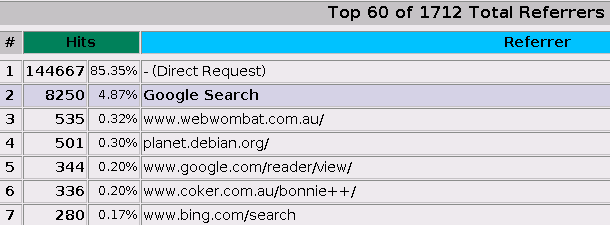
Chris Smart writes about the latest money making schemes for OS distributors, Canonical is getting paid by Yahoo to make them stop using Google as the default Firefox search engine [1]. I think this is OK, the user can easily change it back if desired and it allows them to pay the salaries of more employees who contribute code back to upstream projects. MSN uses 455M, Google uses 189M, and Yahoo uses 109MGoogle referrs 8250 hits, but Bing only refers 280 Above are sections of my Webalizer output related to my blog which show the data transfer use of search.msn.com (Bing presumably) which is 50% greater than that of Google and Yahoo combined. Why does MSN need to do 455MB of transfer so far this month to scan my blog when Google gets the job done with 189M and Yahoo only takes 109M? Also judging by the referrals Bing is only 3% as much use to me as Google. MSN uses 525M, Yahoo uses 132M, and Google only uses 35M Above is a sample of the Webalizer output from www.coker.com.au, MSN is using 525MB of data to scan the site which contains about 1.2G of static files that change very rarely. A Russian malware site seems to be downloading it three times a month, and Google only takes 35MB of data transfer to scan the site (which is probably still excessive). If Bing was a quality search engine that returned appropriate results then this could be forgiven. But however it is a very poor search engine that returns bad results. For example if you query Google or Yahoo for bonnie++ you will get an entire page of search results concerning my Bonnie++ benchmark, and those results are ordered in a sensible way. If you ask Bing then the first four results concern Bonnie (three women and a plant) and most of the first page don t concern my benchmark. Some time ago I had blocked MSN from scanning a server that I ran. The server in question had all the web servers for my domain plus quite a few other small domains. The total MSN data transfer was 3G per month which was almost half the data allowance for the server in question (data plans in Australia suck that s why my web servers are hosted in Germany now), so it was a question of whether to allow normal operation of the business or MSN searches. With Microsoft not running a popular search engine (then or now) it was an easy decision. I think that anyone who accepts money from Microsoft/Bing is doing their users a mis-service. Bing is simply an inferior search engine, it gets bad results and imposes excessive costs on service providers. Yahoo however seems to be a reasonable service, not as good as Google for the web hosters but not too bad. I wonder what would happen if Yahoo offered some sponsorship money to the Debian project in exchange for being the default search engine. I m sure it would be dramatic.

25 January 2010

Lucas Nussbaum: How free is the Nokia N900?

Dear readers, So, I ve been looking into buying a Nokia N900. However, what it provides regarding freedom is still not completely clear to me. And given that it is significantly more expensive than other smartphones, I d like to make sure that it s not a loss of money :-) - Can I download the full source, recompile it, build a firmware from it and re-install my Nokia N900 from scratch? Is the process documented? It seems that you need to accept a EULA to download updated firmwares, and I couldn t find the source for them. What exactly is available from firmware that is not available through normal repositories? (Are normal repositories only for extras apps, or is the base system also installable / upgradable from them? - What s the content of /etc/apt/sources.list? What exactly is http://repository.maemo.org/pool/maemo5.0/nokia-binaries/? What does Nokia need to hide? :-) - Would it be possible to develop a Centos-like distribution, installing the Maemo firmware, but then upgrading everything to rebuilt versions using an unofficial repository? Are there some applications that are not packaged, or that would break if re-installed that way? - Could I install Debian or Ubuntu on the N900? Is the process documented? Is it possible to dual-boot between, say, Maemo5 and Debian? (I m not talking about setting up a chroot, of course) - Besides the non-free telephony stack, are there any other antifeatures I should be aware of? Thanks.

David Welton: Flippa experiment

I decided to try a little experiment with Flippa.com, a site where you can auction off domains or web sites. I put http://www.innsbruck-apartments.com up for auction:
http://flippa.com/auctions/83341/Innsbruck-Austria-rental-listing-site---Ski-Season
We'll see how it goes and whether the site is worth using for other sites that I'd like to sell on. It's a good test case, because it's a site I threw together years ago simply to aid our search for a new apartment in Innsbruck, and then requested by friends.

Next.

Previous.