Search Results: "az"

11 May 2009

Wouter Verhelst: Console-setup sucks

I have a few reasons for this:
  1. It wants to change the framebuffer font without asking. I seriously dislike the font it sets up.
  2. I have a habit of writing my own Xkb keymap. With xorg <= 7.3, that meant creating a file /usr/share/X11/xkb/symbols/wouter and having something like Option "XkbLayout" "wouter" in xorg.conf. Console-setup doesn't pick that up, though, and loads a default keymap that somehow looks closely similar to what I'm using.
  3. What's worse, the default keymap it picks up on my Apple Powerbook (which isn't my primary laptop anymore, but considering how my actual primary laptop is in for repairs, is what I need to use for now) is a PC Belgian AZERTY keymap, rather than the Apple AZERTY. This is *wrong*.
I might understand why they did this kind of thing, but the current implementation of autodetection is horribly broken.

10 May 2009

Ond&#345;ej &#268;ert&iacute;k: My experience with running an opensource project

Nir Aides, the author of the excellent winpdb debugger, sent me the following email on September 21, 2008, so I asked him if I can copy his email and reply in form of a blog post (so that other people can comment and join the discussion) and he agreed. It took me almost a year to reply, but I made it. :)

Hi Ondrej,

How are you?

I am about to publish a new free software project, a new simple PHP framework, and I am interested in your advice.

You started SymPy and were able to make other people join you and develop it with you.
How did you do it?
How did it happen?
Did you actively call for other people or they spontaneously showed interest and joined you?
Are the other major contributor people who were your friends before you started the project?
Did you need to create or manage the project in a particular way to make it attractive to other people?
Are there things you are aware of that promote collaboration or demote it?

I was never successful in doing the same with Winpdb, which while it became reasonably popular, no one has ever joined me to develop it, except for a notable tutorial contribution by Chris Lasher which was developed independently.

Now with the new project, I am wondering what are my chances of making other people try it and take it on. On the one hand it is a new and fresh code base in an interesting field, on the other hand, why would anyone bother to spend their energy on this new project when they have Symfony or Drupal?

What do you think?

BTW, Ohloh believes you have a median of 19,000 lines of changed code per month since the start of their log. Can this be true? Is this humanly possible? According to it SymPy has over 1,000,000 lines of code? I can't understand these numbers. Winpdb has about 25,000 lines after 3 years of development. And from my experience 1,000,000 lines of code projects need about 20-50 full time developers to work on for 2-5 years which is about 40-250 man years. And as if this is not enough you are listed as owner in a dozen other projects in Google code and have enough time to become an awarded scientist. How is this possible?

http://www.ohloh.net/p/sympy/contributors/

BTW2, do you still use Winpdb? If you find yourself using it less, can you say what are the reasons, or what it would take to make it more useful?

BTW3, How is SymPy doing?

Cheers,
Nir


So my most honest answer how to run a successful opensource project is: I don't know.

But nevertheless I tried to summarize some of my ideas and experience and some guidelines that I try to follow, maybe it will be useful to you Nir, or anyone else.

First of all, there has to be a public mailinglist (easily accessible), public bug tracker, nice webpage, easy to find downloads, frequent releases (once a month is good, but in the worst case at least 4 times a year) and a set of guidelines to follow in order to contribute. So that's a must, if the project doesn't have the above, it's almost impossible to become successful. However, that is just a start, just a playground. There are still many projects that have the above and yet they totally fail to attract developers.

So I think the most important principle is that I always think how to employ other people in what I do. If I have some plan in my head how to do something, e.g. how to move some things forward, I always create exact steps and put it to issues, or our mailinglist, so that each step can be done by someone who is completely new to sympy. So I try to look at things from other people's perspective and think -- ok, I quite like this SymPy project and I'd like to get this done (for example a new release, or something fixed, or implemented), but I have no idea how to start and what exactly needs to be done.

So what I try to do if someone comes to our list and asks for something, is that I create a new issue for it and think how I would fix it if I had time. Then write the necessary steps in the issue and invite the submitter to fix it and I offer help with explaining anything and guiding. Now there are two things that can happen. Either the submitter has time and a will to go forward and in this case he starts wrestling with it and whenever he has some code or a question, I need to find time, review it and offer some way out. Or the submitter is too busy, in which case the instructions simply rest in the issues and the next time someone asks for the feature, the instructions are already there. I don't have estimates how frequent either case is.

When I am working on something myself, I try not to code privately, but also put up issues first and put the steps needed in the issues, so that it's easy for other people to join in.

In general, the most precious value for me is the fact that someone else had to sit down at his computer and wrote the patch. So I do everything possible to get new (or more) people interested in the development. Some people think that only super programmers can do a decent job and it's useless to invest time in people that may just have started with Python. They are wrong. Among the SymPy developers (around 65 people total have contributed patches so far at the time of writing this post), we have all kinds of people. We have people from high school, we have a retired US army engineer, we have physicists, mathematicians, biologists, engineers, teachers, or just hobbyists, who do it for fun. Unfortunately, we do not have many women (I think no patch that made it into sympy was contributed by a woman, but I may be wrong), so if anyone has any ideas how to get more women involved, let me know (I know we have several women fans, so that's a good start:). We have people whose first open source project they ever contributed to was sympy and people who are new to Python.

Many times the first patch that a new potential developer submits is not perfect, usually it's faster for me to write it myself, than to help with the first patch, however my rule is to always help the submitter do that. Sometimes he sends a second patch, or a third, and usually it needs less and less work on my side and it already pays off, because he is then able to fix things himself, if he discovers a bug and sympy has just won a one more contributor.

So I came to the conclusion that all that is needed is an enthusiasm. You don't even have to know Python (as you can learn all these things on the way) and you can still do useful things for us and really spare our time.

To answer another question from Nir's email, SymPy has about 130000 lines of code and another about 20000 lines of tests, so I think those stats are wrong. Also the changed lines of code is in my opinion wrong, we usually have about 250 new patches per release (this depends how often we release and other things).

Yes, I am involved in couple other projects, e.g. Debian, Sage, ipython, scipy, hpfem.org (and couple more), basically everything that has to do with numeric simulation and Python, but my activity there varies. The most time consuming thing in the last couple years was definitely school, I was finishing my master in Theoretical Physics in Prague and then moved to the Nevada/Reno and I just finished my first semester here at PhD in Chemical Physics, and sometimes it was just crazy, e.g. I finished teaching at 7pm and instead of going home and sleep, I stayed in my office, fixed 10 sympy issues that were holding off a release, finished at 1am, went home (by bike, since I don't have a car yet), slept couple hours and then did just school again for a week, other people reviewed the issues in the meantime, and then I made the release (instead of sleeping again). In the last semester it was not unusual that I got home at 1am every week day, then slept most of Saturday to catch up, on Sunday I did some laundry and shopping, and the rest of time I did grading and homeworks for all my classes and teaching, no time for anything else (e.g. no friends, no girls, no rest, no hobby, no opensource stuff, nothing). So sometimes one has to work pretty hard to get through it, but fortunately it's behind me finally, if all goes well, I should be just doing research from now on and have a real life too. Also I am sorry I didn't manage to reply sooner. :)

To answer the other questions:
Are the other major contributor people who were your friends before you started the project?
No, not a single major contributor was my friend before I started the project. Every single one of them become a developer using the procedure I described above, e.g. first showed on the list or in the issues, and maybe even the very first patch was not a high quality one (and if I was stupid and arrogant, or didn't see the big potential, I would just ignore them). But when given a chance, they became extremely good developers and sympy would simply just not be here without them.

Did you actively call for other people or they spontaneously showed interest and joined you?
I very much encourage everyone to contribute, but the initial interest must be in them, e.g. they at least have to show around the mailinglist/issues, so that I know about them. But once I know they are interested in some issue, yes, I try to invite them to fix it, with my help.

One observation I made is that I have to always think in the spirit "how to earn new money, not how to spare the money I already have", e.g. when applied to sympy, how to get new developers, how to develop the new great things etc. Even if I am super busy as I was, I still have to think this way. Once I start thinking how to conserve and preserve what we already have, I am done, finished and that's the road to hell.

If I am open, positive, full of energy, I can see people joining me and we can do great things together. It probably sounds obvious, but it was not for me, when for example some people I worked with, started their own projects, when I got busy, and started to compete, instead of helping sympy out. And I felt betrayed, after so much work that I invested into it and started to become protective. And then I realised that's wrong. I can never stop other people do what they want to do. If they want to have their own project, they will have it. If they don't want to help sympy out, they won't (and what is more important, there is nothing wrong with either of that). It's that simple and being protective only makes things worse.

There is also a question of the license that you use for the project, e.g. one should basically only choose between BSD (maybe also MIT or Apache), LGPL and GPL (there are also several versions of the GPL licenses). Unfortunately the fact is, that there are people who will never contribute a code under a permissive BSD license (because it's not protecting their work enough) and there are also other people who really want to code to be BSD (or other permissive license) so they can sell it and they don't need to consult with lawyers what they are or aren't allowed to do and also so that they can combine it with any other code (opensource or not). It also depends if one wants to combine (and distribute) other codes together. So choosing a license is also important. I believe that for sympy BSD is the best and for other projects (like Sage) GPL is the best and one has to decide on a case by case basis. For Winpdb, I would make it BSD too, since you can get more people using it.

To conclude, SymPy is a little more than 2 years old, and it has been a great ride so far and more things are coming, e.g. this summer we have 5 Google Summer of Code students and people are starting it to use in their research and we plan to use it in our codes at our group here in Reno too, so things look promising. I am really glad, we managed to build such a community, so that when I am busy, as I was the last semester, other people help out with patches, reviews and other things, so that the project doesn't stall and when I got rid of my school duties now, we can move things forward a lot.

So maybe you can get inspired by some of the ideas above. I am also interested in any discussion about this (feel free to post a comment below, or send me an email, or just write to a sympy list about what you think).

Marc 'Zugschlus' Haber: Pushing a packet back and forth between Linux subsystems

Linux policy routing is still incredibly painful if one wants to have more sophisticated routing than just take source and destination IP address for the routing decision . The mechanisms that have been in use seven years ago still work though, and I didn t find any possibility to do it any easier. In this article, I ll try to explain the old mechanisms and hope that somebody from lazyweb will comment and say it can be done so much easier . This is a translation of the Usenet article <gu48cs$rul$1@news1.tnib.de> in de.comp.os.unix.networking.misc in the hope that the english-speaking blogosphere can give additional insights. Given a Linux-based router with one internal network (int0), one perimeter network (per0) and two Internet connections (ext0, ext1) with one IP address each. We need to do source NAT to deliver Internet to the internal and perimeter networks. The internet connection on ext0 will be used for http and https, while all other traffic needs to go out on ext1. The perimeter network is reachable from the outside via destination NAT.
1: ext0:  mtu 1500 qdisc noqueue
    inet 10.81.221.145/29 brd 10.1.221.151 scope global ext0
2: ext1:  mtu 1500 qdisc noqueue
    inet 10.82.83.225/29 brd 10.82.83.231 scope global ext1
3: per0:  mtu 1500 qdisc noqueue
    inet 172.16.1.254/24 brd 172.16.1.255 scope global per0
4: int0:  mtu 1500 qdisc noqueue
    inet 192.168.8.254/24 brd 192.168.8.255 scope global int0
We have the following routing rules:
0:      from all lookup 255
10:     from all lookup main
32:     from all fwmark 0x12e lookup to_ext0
32:     from all fwmark 0x12f lookup to_ext1
32000:  from all lookup defaultroute
32766:  from all lookup main
32767:  from all lookup default
Table main contains all rules for the directly connected networks, but no default route. Both to_ tables have one default route each, pointing to the respective ISP, and the table defaultroute has once more a default gateway pointing to ext1 s gateway. The PREROUTING chain of the mangle table has these rules:
iptables --protocol tcp --dport 80 --in-int int+ --set-mark 0x12e
iptables --protocol tcp --dport 443 --in-int int+ --set-mark 0x12e
iptables --in-int int+ --set-mark 0x12f
and the POSTROUTING chain of the nat table has these:
iptables --match mark --mark 0x12e --out-int ext0 --jump SNAT --to-source 10.81.221.145
iptables --match mark --mark 0x12f --out-int ext1 --jump SNAT --to-source 10.82.83.225
If now somebody from the internal network accesses a web server on the Internet. The outgoig packet will first be marked in the PREROUTING chain, then the routing rules will use the firewall mark to consult the correct routing table and pass the packet back to the packet filter, where the POSTROUTING chain will use the outgoing interface and the firewall mark to SNAT the packet to the correct source IP so that the answer will actually reach us. Has a less ugly way available way to do this become available in the last five years? Or is it still necessary to have the different parts of the networking subsystems play ping-pong with the packet? I particularly dislike that someone not familiar with policy routing will not see any default route in the routing table printed by route or ip route , which will probably be very confusing. Is there any possibility to interact with the routing code without firewall marks, maybe by directly setting a gateway from a firewall rule?

9 May 2009

Rapha&#235;l Hertzog: Quilt patch management with debhelper 7

Since quilt 0.46-7 (see #527255) you can automatically apply/unapply a quilt patch serie with debhelper s dh command. It s very practical in tiny rules files:
%:
	dh --with quilt $@
There s also dh_quilt_patch and dh_quilt_unpatch for those who don t use tiny rules files. Enjoy ! Partagez cet article / Share This

Andrew Pollock: [life] A few days in British Columbia

We got back from our brief visit to Canada last night. We had a great time, Vancouver and Victoria were both very nice. YVR (Vancouver Airport) This airport has to win the award for nicest airport I've seen. Clearly they pulled out all the stops in preparation for the Winter Olympics next year. The airport is very bright, airy and open. Before you even hit the immigration line, you pass through a couple of water features, some indigenous art, all of that jazz. Immigration is done in the open in a huge hall, instead of in the dark bowels of the airport, which was a pleasant change from the usual US airport immigration experience. (That said, Houston airport had a pretty nice immigration experience). Oh, and it was blanketed with free WiFi, which was a nice touch. Ferry to Victoria The brief geography lesson I got was that Victoria is on Vancouver Island, and Vancouver (the city) is not on Vancouver (the island). Go figure. Getting to Victoria from the airport via BC Ferries was a very seamless experience. You board a bus from the side of the airport terminal, and it drives to Tsawwassen, drives onto the ferry, and then you get off the bus and go sit on one of the passenger levels of the ferry. BC Ferries BC Ferries deserves special mention. The ferry itself is huge - 7 decks (three of them for vehicles). It's a veritable shopping mall on water. It's got some stores, buffets, exclusive $10 entry lounges, video arcades, cellular payphones, the works. The trip to Victoria The ferry ride took about 1.5 hours, and was very scenic. We passed by a few smaller islands, and I had an instant flashback to the TV show The Beachcombers that I used to watch as a kid, particularly the opening sequence. Victoria Victoria is a beautiful city. It's the capital of the province of British Columbia, and I likened it to Canberra in a lot of ways. It had more modern conveniences than a town with a population of its size would otherwise normally have. It was a government and university town. Nice houses, very green in general, and being an island, there was water everywhere. It seemed to have lots of bays, and harbours and rivers. It was very nice. Flight back to Vancouver We took a Harbour Air seaplane back to Vancouver on Sunday afternoon. That was fun. I've never been on a seaplane before. It took about 35 minutes. Vancouver First order of business in Vancouver was the purpose of the whole trip: renewing our visas. That went fine, I'll write a separate post about the process. Afterwards, we bought tickets for the Big Bus, and toured the city for the remainder of Monday and Tuesday. Drive to Whistler For Wednesday and Thursday, we hired a car, and went a bit further afield. On Wednesday, we drove up to Whistler to check it out. The drive up took about 5 hours, because we stopped at every scenic spot we came by. Waterfalls abounded. There was a lot of work being done on the roads between Vancouver and Whistler, upgrading them for the Olympics. Whistler itself was pretty spectacular. Some crazy looking ski runs. The village looked like Squaw Village on steroids. The drive back only took about 2 hours. Cleveland Dam, Lynn Canyon suspension bridge For the last day, we drove to Cleveland Dam, where there was a salmon hatchery, and checked out the dam, hatchery and surrounding area. It was lovely and green. After that, we drove to Lynn Canyon to check out the suspension bridge there (unlike the Capilano Suspension Bridge, which costs $26 a pop, the Lynn Canyon one is free). That was all we had time for really. The weather wasn't fantastic during our stay, but it didn't really prevent us from doing anything either. I'd have liked to have checked out Stanley Park if we had more time, and Sarah wanted to go to Grouse Mountain. We had a near-100% success rate at being picked as Australians, unlike when we're in the US, where more often than not, people ask us if we're British. Apparently this is mainly attributed to the fact that Australians run all of the ski lifts at Whistler. We certainly heard a lot of Australian accents while we were getting around. I'd also never seen such a saturation of Starbucks before. In Vancouver, there were literally Starbucks across the road from Starbucks, and around the corner from another one. Whistler village had two. The Canadian accent is cute. They really do tack "eh?" on the end of everything, although it's phonetically more like "ay?". "House" and "about" are also pronounced distinctively differently. Overall, Vancouver wasn't what I'd call bursting at the seams with tourist attractions, but seemed like a nice city. It was fairly flat. The beggars were well dressed. Everyone was very friendly. A lot of the taxis were Priuses. It seemed pretty clean. I could handle living there. Not sure how bad it gets in winter.

8 May 2009

Jaldhar Vyas: New GnuPG Key

-----BEGIN PGP SIGNED MESSAGE-----
Hash: SHA1 - -----BEGIN PGP SIGNED MESSAGE-----
Hash: SHA256 Recently there has been some brouhaha about migrating away from SHA-1 digests as used in GnuPG and to this end I followed the procedure described by Daniel Kahn Gillmor and created a new key which I will get signed at the Debian NYC meetup tonight and use to replace my existing key for signing packages. The old key (which is still valid btw) is: pre. pub 1024D/EE6DC66A 1999-12-16
Key fingerprint = 48DF D000 3BE7 1FF8 D9C1 5832 DA46 0E47 EE6D C66A And the new key is: pre. pub 2048R/C4794DAF 2009-05-08
Key fingerprint = 37EF 5B02 19C3 0C6E 47B2 51D0 EAA6 38FA C479 4DAF You can fetch the new key from http://people.debian.org/~jaldhar/gpg.txt or from the public keyservers (I don't know if there is a lag in how quickly new keys are made available.) This message has been signed with both the old and new keys.
- -----BEGIN PGP SIGNATURE-----
Version: GnuPG v1.4.9 (GNU/Linux) iQEcBAEBCAAGBQJKBLrsAAoJEOqmOPrEeU2vfzIH/A99fMg6fC30GEm6SavJY4lt
hNS7N95dAn8iSGWfWgRv7t3ePAwmiIAZrcsFsjFgpS5IlZOTj9cFjTTz9Tgj030V
s55BSiM8yVrwnsgmZOHoVcQitS7i3b/I4AD/7Nrgx711GEIKesi1/O7eY1h0NaBM
kKlgIxg4GW1BFWd6P6XGtquO5ERYKUAkWRuPpxwUThlLbkXt0AOkWD13pmVD6adw
ZZwTPbFHQ/xvdYLwwSCZWXoPsrmuYcxlTcCzGkWISBPof6wmOkVshUAO6flVqKJ/
lm6rhpDKVgC/M1dOyDR9yh+Na3rgBFP0lOrJZpjW93Wld19v/yY6DSyZdJZoIOE=
=mDg8
- -----END PGP SIGNATURE-----
-----BEGIN PGP SIGNATURE-----
Version: GnuPG v1.4.9 (GNU/Linux) iEYEARECAAYFAkoEuwsACgkQ2kYOR+5txmp31gCgjoG/Y5W0QMkVY9fafZPb5SUb
MzEAn253UwCq+8UbdyD+ls7ZAcSvSt4h
=/lhN
-----END PGP SIGNATURE-----

7 May 2009

Biella Coleman: Make our words glisten


glisten vs hardened words, originally uploaded by the biella.
Now that I am (thankfully) done teaching until September, I have time to devour two small mountains of readings that I need to finish before I return to my manuscript, which I will be working on, I hope uber-productively, all summer long. One pile of readings deals with coding, open source, and the commons, such as Scott Rosenberg s Dreaming in Code and David Bollier s Viral Spiral. Another pile of reading edges toward the theoretical side of things, having to do with craft, pleasure, and humor, since it is pleasure in its many many many guises from from the calm feeling of self-satisfaction that underlies pride in one s craft, to the more sublime feeling of ecstatic bliss that powers many creative sprints. If one entertains pleasure, one must also entertain its darker side, for all of this feel good stuff is nonetheless often springs forth from a deep sea of passionate frustration. This seems to be the driving theme of Dreaming in Code and it is also what animates Ellen Ullman s fictional account of pure frustration, The Bug. I am quite fond of native expressions of geek frustration and recently was provided with an exquisite example a rant against the Adobe PSD format. The author of Xee, A light-weight, fast and convenient image viewer for Mac OS X explained his utter contempt for the Adobe PSD in the following way:
At this point, I d like to take a moment to speak to you about the Adobe PSD format. PSD is not a good format. PSD is not even a bad format. Calling it such would be an insult to other bad formats, such as PCX or JPEG. No, PSD is an abysmal format. Having worked on this code for several weeks now, my hate for PSD has grown to a raging fire that burns with the fierce passion of a million suns. If there are two different ways of doing something, PSD will do both, in different places. It will then make up three more ways no sane human would think of, and do those too. PSD makes inconsistency an art form. Why, for instance, did it suddenly decide that *these* particular chunks should be aligned to four bytes, and that this alignement should *not* be included in the size? Other chunks in other places are either unaligned, or aligned with the alignment included in the size. Here, though, it is not included. Were it within my power, I would gather every single copy of those specs, and launch them on a spaceship directly into the sun.
Even if this account represents unadulterated irritation, he leaves us, the reader, with nothing of the irritation, only pleasure. This aftermath of frustration is delivered through the vehicle of humor, which within the hacker context, is the cultural container that best captures the spirit of hacker pleasure or so I will be arguing. Like many humorous rants from the world of hacking (and please send me any others you know of), this text dances with liveliness; it exudes its own rhythm; it glistens to use Ronald Barthes apt phrasing from his short book The Pleasure of Text, which I just finished as part of my theoretical escape into the pleasure-dome. Although there are parts of his book which are to be frank, *really* *not* *pleasurable*, partly due to obscure references to High French Theory, which elide even an academic pair of eyes, the book generally pleases. And one of the most pleasing chunks is his definition of a stereotype:
The stereotype is the word repeated without any magic, any enthusiasm, as though it were natural, as though by some miracle this recurring words were adequate on each occasion for different reasons, as though to imitate could no longer be sensed as an imitation: an unconstrained word that claims consistency and is unaware of its own insistence
In contrast to the stereotype, a string of words that enchants does so by slipping off the page to hit you squarely in the heart or the gut. Unfortunately, while academic writing steers clear of stereotypes, often trying to present the detailed singularity of a phenomena (even when conditioned by social forces), it does not exactly glisten, though there are a handful of exceptions. I think we need more texts that glisten, even if only during sections or parts of our books and articles (much like the rant helped enliven the more staid technical document). In recent years, in large part due to the influence of free software, there has been an explosion, a move toward going open access. All of this is laudable and I fully embrace it (and have gotten into some small battles over it). But without an aesthetic politics that values pleasure in reading and writing we are doomed to obscurity anyway. A move toward making our knowledge public also required a move toward thinking about the literary aesthetics of pleasure.

Biella Coleman: Not Crazy Just Nuts

So I am sipping some hot chocolate made from a recently purchased cream substitute by the name of Mimiccreme. Honestly, the stuff tastes good and better, it froths, unlike most non-dairy substitutes. Yet there is a hitch (there always is). As I was whisking away at my cream (mixed with water), I was staring blankly at the box and noticed that they have applied for a patent, which is indeed the case. Since their formula is made out of nuts, their motto is Not Crazy Just Nuts and if they are granted the patent (though I am confused as to what they are trying to patent) it will be Nuts and Crazy as well. update: Ettienne pointed us in the comments to the the patent application

Pablo Lorenzzoni: Another small victory - don't relax just yet

Months (even years) of activism, over 140 thousand signatures, and finally another small victory: Brazilian Minister of Justice Mr. Tarso Genro sent a letter [pt-BR] stating that Sen. Azeredo s bill is dangerous, and that the Ministry is working in an alternative (among other things). We had already incited a public hearing that were very fruitful [pt-BR] and might have brought the Ministry to the issue. But don t relax just yet, folks! Right now, working in this alternative , are people with every kind of agenda It s safe to assume that some of them are from the same lobby that pushed Sen. Azeredo first version of the thing. So, yes, this was another victory, but nothing really changed The bill is still approved by the Senate and still has to be reviewed by the Chamber-of-Deputies, and the alternative that will be presented by the Ministry is still under construction. What we accomplished is nothing more than making the Minister aware of the issue So, keep the pressure over your representatives, send messages to the Ministry, stating how you feel about the issue! Let s show them what we want them to do After all, that s why we elected them, in the first place, isn t it? [Published also at Trezentos, in portuguese]

6 May 2009

Tiago Bortoletto Vaz: Homage to Augusto Boal


The 9 may, 2009 at 20:00 UTC, the Center of The Theater of the Oppressed in Rio de Janeiro will pay homage to Augusto Boal. There will be a live video and audio streaming available at: http://aovivo.pontaodaeco.org:8000/homenagemboal.ogg.m3u It s recommended using the free software VLC to watch it: http://www.videolan.org/vlc/ There will also be an IRC chat room open for everyone in FreeNode, channel #homenagemboal. Posted in english Tagged: augusto boal, theater, theater of the oppressed

5 May 2009

Jan Hauke Rahm: Avelsieve 1.9.8

Today the SquirrelMail plugin avelsieve happened to be released with version 1.9.8. Thanks and kudos to Alexandros who after so long time still was in the mood to put things together. The new features promise to be amazing: a new user interface, much code rewriting, and an entirely new SPAM handling. Unfortunately after installing it my SquirrelMail installation went badly down somehow. While everything alse is delivered properly by apache2, SquirrelMail now runs into one timeout after another. I need to figure out what s actually going on there. The error.log is quiet so far Anyways, for all you people who are looking forward to see this new fancy and shiny version in sid, I have to ask for patience. I think the package is ready but before testing no uploading! Until then you can (if you re brave) test the package by installing it from http://downloads.jhr-online.de/avelsieve_1.9.8-1_all.deb And all you others just have a look at the changelog that s probably (hopefully) hitting sid in a few days:
  * New upstream release
     + A large part of the code has been rewritten.
     + A new-style SPAM rule has been implemented.
     + A new, global Whitelist rule has been implemented, for
       the SPAM rules to take advantage of.
     + New, "Custom Sieve Code" rule has been implemented; this allows users
       to enter directly Sieve code snippets as a rule. (experimental)
     + Miscellaneous code movement and restructuring.
     + UI: The "Add New Rule" buttons are now links, and are displayed
       both at the top and at the bottom of the rule table.
     + UI: Major rework in the UI of both the Rules Table and the Add New
       Rule / Edit Rule pages.
     + UI: If a vacation rule is active, then display a notice in the
       rules table page and upon logging in to Squirrelmail, that reminds
       the user.
     + UI: Vacation options have been aligned properly; text has been
       changed accordingly.
     + Sieve: Vacation Subject is now supported.
     + New functionality: "Insert New Rule Here"
     + New functionality: "Move Rule to Position" (requires Javascript)
     + Avelsieve now highly recommends the use of javascript_libs plugin
       for some visual effects / UI improvements.
     + UI: Added new icons and used different ones, to improve usability.
       Icons are provided by Mark James' famfamfam.com.
     + UI: Added new icon "theme" based also on famfamfam.com. This theme
       is the default from now on.
     + UI: Removed unnecessary text / clutter from rules table page.
     + UI: The notify action options have been aligned in a table.
     + Added an LDAP Sieve storage backend, compatible with Sun Messaging
       Server's Sieve features.
     + The DO_Sieve_* backends should have a separate retrieve() method
       for retrieving the raw Sieve script. Currently, only the Managesieve
       backend has it.

Martin-&#201;ric Racine: Debian CUPS transition in progress

Since Lenny was the first Debian release to feature CUPS under its new package naming strategy, I started going through 'rdepends' results to see which packages in Squeeze still present dependencies for *cupsys* packages. Much to my amazement, there's quite many. If you are the maintainer of a package that still has those dependencies, please fix them ASAP. Alternately, if you're aware of any favorite package that does, please do not hesitate at filing a patch to help the maintainer update their debian/control. Comes June 2009, transitional CUPS packages will be removed from our debian/control.

4 May 2009

Manoj Srivastava: Manoj: Reflections on streetcars

Recently, I have made fairly major changes to kernel-package, and there were some reports that I had managed to mess up cross compilation. And, not having a cross-compilation tool chain handy, I had to depend on the kindness of strangers to address that issue. And, given that I am much less personable than Ms Vivien Leigh, this is not something I particularly look forward to repeating. At the onset, building a cross compiling tool chain seems a daunting task. This is not an activity one does frequently, and so one may be pardoned for being non-plussed by this. However, I have done this before, the most recent effort being creating one to compile rockbox binaries, so I had some idea where to start. Of course, since it is usually years between attempts to create cross-compiling tool chains, I generally forget how it is all done, and have to go hunting for details. Thank god for google. Well, I am not the only one in the same pickle, apparently, for there are gobs of articles and HOWTOs out there, including some pretty comprehensive (and intimidating) general tool sets to designed to create cross compilers in the most generic fashion possible. Using them was not really an option, since I would forget how to drive them in a few months, and have a miniature version of the current problem again. Also, you know, I don t feel comfortable using scripts that are too complex for me to understand I mean, without understanding, how can there be trust? Also, this time around, I could not decide whether to cross compile for arm-elf, as I did the last time, or for the newfangled armel target. A need for quickly changing the target for the cross compiler build mechanism would be nice. Manually building the tool chain makes a wrong decision here expensive, and I hate that. I am also getting fed up with having to root around on the internet every time I wanted to build a cross compiler. I came across a script by Uwe Hermann, which started me down the path of creating a script, with a help option, to store the instructions, without trying to be too general and thus getting overly complex. However, Uwe s script hard coded too many things like version numbers and upstream source locations, and I know I would rapidly find updating the script irritating. Using Debian source packages would fix both of these issues. I also wanted to use Debian sources as far as I could, to ensure that my cross compiler was as compatible as I could make it, though I did want to use newlib (I don t know why, except that I can, and the docs sound cool). And of course the script should have a help option and do proper command line parsing, so that editing the script would be unnecessary. Anyway, all this effort culminated in the following script: build cross toolchain, surprisingly compact. So I am now all set to try and cross compile a kernel the next time a kernel-package bug comes around. I thought that I would share this with the lazy web, while I was at it. Enjoy. The next thing, of course, is to get my script to create a qemu base image every week so I can move from user mode Linux to the much more nifty kvm, which is what all the cool kids use. And then I can even create an arm virtual machine to test my kernels with, something that user mode linux can t easily do.

2 May 2009

Lior Kaplan: Checking OLPC usability with children


Last semester I took a usability course in my university, as a final project I decided to test the OLPC usability for/with children. The full report is available (in Herew), but I ll summerise the main points. The checks goal was to see how do small children interact with the OLPC, and how does the language barrier affects them. In Israel the children starts to learn reading and writing in Hebrew at the age of 6, and most also start their English (very common as the second language) at the age of 8. So the language also creates another challenge for the child and he must relay on his other skills, as he can t understand the interface language. My target audience were children between 4 and 10, while the official target audience for the OLPC is between 6 and 12. I used 5 children:
  • a boy, age 4.5
  • a girl, age 9.5
  • a girl, age 4
  • a girl, age 7.5
  • a boy, age 7
The test environment was a OLPC laptop running Sugar with an English interface. After some of the tests I found out the mouse pad wasn t functioning all the time, but it was intersting to see how that effected the children. The tests:
  • Can a child find how to open the computer?
  • Can the child find how to use the computer? Mainly understand the main screen icons and open programs.
  • Can a child find how to exit a program back to the main screen? Don t forget he can t look for the butten says exit/quit .
  • Recored the child s first impression for the laptop and his thoughts after using the computer.
  • Check whether the child got some educational benefit from the use of the laptop.
Summery of the results: Only once child (the oldest) succseeded with understanding how to open the laptop without help. The other needed a hint or directions. The small children found in difficelt (physically) to open the laptop. Seems that there should be some marks near the antenas that indicate they should be opened first. And maybe making the antenas to open with less force (but still insuring the locking mechanisem works in the laptop falls to the ground). All the children recognized the general meaning of the icons in the main screen as programs or stuff the comptuer does . Not all the icons are clear to the children (and also to me). The language (English) was the main method the big children found out the meaning of the game, while the small one could only guess or just start the program. Clear icons were paint, maze, memory (although one tought it s tik-tak-toe). Unclear icons were: the snake (python/pippy), the dolphin (distance), tamtam s multipal icons and the browse icon. The exit button was a challenge to all children, the old ones used trail and error while reading the buttons labels, but the other needed direction about how can them exit the program. The icon just isn t clear enough. The mouse usage seemed to also be an issue, partly by been half brokem and partly becuase the young children don t handle it so smoothly and can t always be very accurate. While in most actions that wasn t a problem, in the task of exiting a program that was a big issue. As the exit button is near the frame edges, missing it makes the frame menu to appear and move or hide the exit button. For some children that was a very annoying experience. All the children said the computer is heavy for them, but the degree changed wih the age. The 4 years old children said it is heavier than the 9 years old children. Don t forget the from the first grade (age 6) the children start taking a bag to scholl and carry books. So any improvement in the wieght is good, but I don t think it s critical. Finally, I found out that all the children got some educational benefit from the use of the OLPC. The small one got some math practice with the memory game, or by trying to solve their way out of the maze (I actually saw how they improve while playing). The bigger children got a good practice with spelling words with speak, and one even surprised me and his mother with his spelling. In the end, the OLPC is indeed revolutionary machine and interface (thought Sugar), but some small changes should be made. The overall experience of the children was very good. Posted in Proud to use free software Tagged: OLPC, usability

Dirk Eddelbuettel: Brad Mehldau at the CSO

Just got home from a wonderful concert by Brad Mehldau at the CSO. This was long overdue as I kept reading about Mehldau. And even though he performs quite regularly around here, I had never seen him. Big mistake. The first set was performed as a (strictly acoustic) trio with Larry Grenadier on bass and Jeff Ballard on drums. After several compositions by Mehldau and a brazilian samba piece, the first set closed with a rendition of 'Holland' from Sufjan Stevens' album Michigan which was truly beautiful. The second set had Mehldau performing solo, again with several compositions of his own as well as one from Neil Young's classic 'The Needle and the Damage Done' leading two two pieces from the Sound of Music including an amazing, yet really different 'My favourite things' that just hushed a piece of the central melody along with a strond rhythmic element. Lovely. And then to cap it all off, four encores. Highly recommended.

Jonny Lamb: Debugging Telepathy

So we all know how awesome Telepathy is, but sometimes debugging it can be rather a pain. I die a little every time I see so, just run gabble from the command line with GABBLE_DEBUG=all etc on #telepathy. Daf started implementing a debug interface in gabble but he fled the country, so I finished it off, and added a hot new dialog to Empathy. So now that your debug messages are appearing on D-Bus, you could easily write a simple script to tweet them. Sounds like a good idea, right? Additionally, if you re a Telepathy developer, this may be overkill^Wuseful for your zshrc:
g ()  
    project=$(basename  pwd )
    GABBLE_DEBUG=all SALUT_DEBUG=all EMPATHY_DEBUG=all HAZE_DEBUG=all \
        GABBLE_PERSIST=1 SALUT_PERSIST=1 HAZE_PERSIST=1  EMPATHY_SRCDIR=. \
        libtool --mode=execute gdb -q --args ./src/$project --g-fatal-warnings
 

1 May 2009

Obey Arthur Liu: Z rich, Switzerland for the summer (housing? DebConf?)

Z rich Google Earth I got a summer internship at Google in Z rich, Switzerland, so I ll be moving there this summer. Any DD working there ? I already went to Z rich once last year and it was quite a cool place. I briefly met Cate and I know that there are other DDs there (hi Madduck!). I look forward to meeting more of you. Now there are two issues I d like help with, dear Z richer Lazyweb, housing and flight to DebConf. Can I haz apartment Looking for an apartment in Z rich seems very very very hard.. So far I only found a few apartment/hotel geared towards rich expats staying for few months (the kind like Citadines). It s ungodly expensive (like 2200+ CHF a month for one room), but sure available and well placed.. Here s what I need:

I don t have much more criterias, as long as I can find something. We re about a few dozens Google interns all (desperately) looking for accomodation in Z rich. We re all good neighbours, don t party all night and all have very good references. Please contact me if you \<know someone who\>* know something, I d be very grateful. Can I haz DebConf I m going to DebConf this year in Spain, along with all the Google Summer of Code students who can make it. I m going to reserve my flight in the next few days. I think I ll only go to DebConf proper, arriving on the 23rd and leaving on the 31st of July. I m not decided yet on the last point. So, any of you coming to DebConf from Z rich ?

Simon McVittie: Implementing D-Bus clients with telepathy-glib (and telepathy-qt4)

(The much-delayed part 2 in an ongoing series: shiny things in telepathy-glib) Over a year ago I explained my first major round of work on telepathy-glib, with which it could be used to implement D-Bus services. I started to write this post shortly after, but then got distracted by a bee or something; recent discussion about having a D-Bus binding in GLib has finally prompted me to finish it. The second major round of work on telepathy-glib dealt with implementing client code, and went sufficiently well that telepathy-qt4 (currently under development) uses essentially the same model. Again, while telepathy-glib is intended for Telepathy implementors, I think TpProxy's ideas are generically useful, particularly for "large" D-Bus APIs.
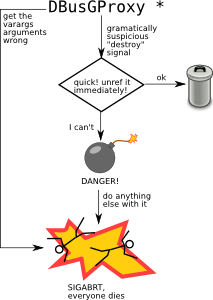
Some background: dbus-glib and libtelepathy
GObject-CRITICAL: Assertion failed: proxy->convenient
The life-cycle of a DBusGProxy (PD clipart credit: karderio and Andy)
The API provided by dbus-glib for client code is, er, rather less than ideal. The basic object is DBusGProxy, which has a few problems. There's one per interface, rather than one per object; this leads to a maze of twisty GObjects, all suspiciously similar. Our old client library, libtelepathy, got round this by subclassing DBusGProxy to make helper objects called TpChan, TpConn etc., which were simultaneously the proxy for the "main" interface (Channel, Connection etc.), and a factory for proxies for the other interfaces (like Channel.Type.Text and Channel.Interface.Password). This still wasn't ideal, but it was a start. If you use a DBusGProxy in any way after it has emitted the destroy signal, this is considered to be invalid use of the API, and dbus-glib asserts all over the place. We'd rather it didn't do that - remote objects becoming invalid is a fact of life, and if you don't immediately discard all your references to those objects, remote operations on them should just give you a runtime error. You have to be prepared to handle such runtime errors already, because any IPC call can fail at any time. The main API for calling methods uses varargs and is rather subtle. Notably, the calling convention for variant parameters (of D-Bus signature 'v') is not consistent with the calling convention for any other container. For any other container, for instance a GPtrArray *, you pass in a GPtrArray ** pointing to a GPtrArray * variable containing NULL; on success, a pointer to a new GPtrArray is written into that variable. For variant parameters, though, you must pass in a GValue * pointing to a zero-filled GValue, and the result will be written into that GValue. dbus-binding-tool generates thin wrappers around this method-calling API which provide type-safety, although they can't directly specify a non-default timeout. As for signals, before binding to a signal, you have to tell dbus-glib about its signature. This tells dbus-glib how it should push the signal arguments onto the C stack (in GObject terminology: how it should marshal them), to match the signature of the signal-handler function. The documentation claims that this isn't necessary for objects supporting the Introspect method, but that's untrue - on the other hand, if the documented behaviour actually happened, I would consider this to be a critical bug in dbus-glib, since it would enable remote objects to crash dbus-glib clients (by causing signal arguments to be pushed onto the stack in a way that does not match the signature of the signal handler). Of course, the signal-adding function takes varargs, and has to be called exactly once per signal per object. If you don't, dbus-glib asserts when you connect to the signal; if you call it twice, dbus-glib asserts anyway.

TpProxy TpProxy is a GObject subclass vaguely inspired by Python's dbus.proxy.ProxyObject. It isn't a subclass of DBusGProxy, which lets us encapsulate dbus-glib almost completely - in fact, all the references to DBusGProxy are in a separate header, proxy-subclass.h, only used by subclasses of TpProxy (as opposed to normal library API users). TpProxy instances are per-remote-object (per-object-path) like in dbus-python, rather than per-interface like in dbus-glib or QtDBus. As explained below, I believe that this is the most natural object mapping for D-Bus interfaces; in practice it tends to lead to clearer code for us, since one remote object often maps nicely to one UI element (of course, if your objects only have one interface, this approach is no better or worse than dbus-glib's). TpProxy provides support for the following common D-Bus things:
  • Calling methods
  • Connecting to signals
  • Objects becoming invalid
  • Objects with optional interfaces
  • Extensibility
It doesn't currently provide any particular help with Properties - the Properties interface is just another interface as far as we're concerned. We find that, in practice, that's not a problem (even though we use D-Bus properties extensively). In telepathy-qt4 we basically reinvented TpProxy in C++, as Tp::DBusProxy. I've put in some comments below illustrating how the general ideas we used in TpProxy translate into a different object mapping.

Calling methods Method calls on TpProxy are done through auto-generated wrapper functions, much like DBusGProxy. These look something like this:
typedef void (*tp_cli_channel_callback_for_close) (TpChannel *proxy,
    /* any 'out' arguments would go here - Close() doesn't have any */
    const GError *error, gpointer user_data,
    GObject *weak_object);
TpProxyPendingCall *tp_cli_channel_call_close (TpChannel *proxy,
    gint timeout_ms,
    /* any 'in' arguments would go here - Close() doesn't have any */
    tp_cli_channel_callback_for_close callback,
    gpointer user_data,
    GDestroyNotify destroy,
    GObject *weak_object);
Methods for some interfaces, like DBus.Properties, are available on TpProxy itself; others, like Telepathy's Channel.anything, are only available on a particular subclass, like TpChannel. Things to note here:
  • It's an asynchronous call with a callback. General design principle: "this is IPC, get over it". We don't try to hide the fact that IPC is taking place by doing pseudo-blocking calls.
  • The timeout is explicit (although you can always pass -1 to let libdbus pick a "reasonable" default for you). This is because the remote service might not respond, and API users should be at least vaguely aware of this: "this is IPC, get over it".
  • The callback isn't a GCallback; it has an explicit signature, for some semblance of type-safety (it's not much, but it's better than nothing).
  • The callback takes a GError, because any IPC call can fail for any reason.
  • A TpProxyPendingCall * is returned. This is a pointer to an object that only exists until just after the callback is called (so you can ignore it if you don't want it), with a method you can call to cancel the method call (with hindsight this is not ideal, and if I was writing this API now, I'd use gio's GCancellable). "Cancel" is perhaps slightly misleading: the method call still takes place (it was already in libdbus's outgoing queue) but the result gets ignored and the callback isn't called. This is mostly so you an object can forget all the calls it was busy making at the time that the results become irrelevant (e.g. the object is destroyed).
  • There is an extra weak_object argument, which is weakly referenced and is passed to the callback: in practice, most users of telepathy-glib use this as well as or instead of user_data. If the weak_object runs out of references, the callback is automatically cancelled, which means that in practice, explicit cancellation is almost never needed.
  • The generated code has as its first argument a suitable subclass of TpProxy, in this case TpChannel (we tell the code generator about subclasses).
  • You can't see it in the API, but the TpProxy gains an extra ref while a method call is in progress, so you never have to worry about what happens if the proxy gets unreffed during a method call.
  • There's an explicit destructor for the user_data, which is called even if you "cancel" the method call.
In telepathy-qt4, these methods are on small generated helper classes similar to dbus-python's dbus.Interface, one per interface (we provide accessors for them on the non-generated DBusProxy subclass). Instead of using callbacks, we return a temporary QObject per call, which emits a Qt signal on success or failure (that's how all async calls in QtDBus work).

Connecting to signals Similarly, signals have some generated functions:
typedef void (*tp_cli_channel_signal_callback_closed) (TpChannel *proxy,
    /* any arguments would go here - Closed doesn't have any */
    gpointer user_data, GObject *weak_object);
TpProxySignalConnection *tp_cli_channel_connect_to_closed (TpChannel *proxy,
    tp_cli_channel_signal_callback_closed callback,
    gpointer user_data,
    GDestroyNotify destroy,
    GObject *weak_object,
    GError **error);
API notes for these:
  • The callback doesn't take a GError any more, because signals can't fail; the weak_object and the user_data are the same as for method calls
  • This isn't actually a GObject signal at all: those aren't particularly typesafe, and lack namespacing. This might not be very binding-friendly, we haven't tried doing that yet... it might be worth introducing a signal with details, like in dbus-glib, for which these functions are "C bindings".
  • The returned TpProxySignalConnection lets you disconnect from the signal, just like the TpProxyPendingCall above; it can safely be ignored
  • Similarly, if the weak_object dies, then the signal automatically disconnects
  • It is possible for connecting to a signal to fail: this happens if the proxy doesn't actually have the requested interface. If this happens, it's graceful, not a crash. In practice, the flow of code is almost always such that error can safely be NULL because the interfaces are already known.
In telepathy-qt4 the per-interface generated helper classes emit Qt signals. In many cases, we end up proxying these signals by responding to them in the hand-written Tp::DBusProxy subclass by emitting a different signal, in order to give them a nicer representation.

Becoming invalid This is IPC, and any error can happen to you at any time. We found that it was useful to have a general concept of "this object is no longer useful", so we introduced the concept of an object becoming invalidated. The invalidation reason is stored on the object as a GError. If this GError is NULL (as it is initially), then the object is still expected to be valid; if it's non-NULL, the remote object has vanished and the local proxy no longer works. There are several ways a TpProxy can become invalid:
  • its bus name falls off the bus (the process exited or crashed)
  • application-specific reasons (usually triggered by a D-Bus signal in a subclass, like the Telepathy Channel's Closed signal)
  • the GObject gets disposed
Method calls on an invalidated object always fail, with the invalidation reason as the error. This means that calling a method on a TpProxy should never crash your process. The method's callback has to be prepared to handle an error in any case, because this is Sparta^WIPC, so there's no loss in giving it another error. Connecting to signals on an invalidated object always fails, and any existing signal connections are disconnected when it becomes invalidated. This means that if a new remote object appears, and it happens to have the same object path, bus name etc. as the old one, you won't get its signals. A TpProxy can either be bound to a unique bus name or a well-known bus name. In the equivalent code in telepathy-qt4, we call this "stateful" or "stateless" - these names don't capture the intention perfectly, but they're the best we could come up with. A proxy for a stateful API like Telepathy's Channel should always bind to a unique name - when the unique name falls off the bus, the TpProxy becomes invalidated automatically, representing the fact that the Channel you had no longer exists, and nothing can be a perfect replacement for it (the VoIP call has already been terminated, you've already left the chatroom, or whatever - if you make another Channel, that's e.g. a distinct VoIP call). A proxy for a stateless API like Telepathy's ConnectionManager, where an exiting process can disappear, be service-activated again, and still have exactly the same API, should bind to the well-known name. Proxies for well-known names aren't invalidated when the process exits. Qt doesn't have a natural equivalent for GError, so the invalidation reasons in telepathy-qt4 are just a pair of strings, the namespaced name and the message - basically a libdbus DBusError. The principle is the same, though.

Optional interfaces As mentioned above, TpProxy instances are per-remote-object (per-object-path) like in dbus-python, rather than per-interface like in dbus-glib or QtDBus. I believe that this is the most natural object mapping for the D-Bus object model, because the D-Bus interfaces on a remote object can behave like any of these:
  • classes and subclasses (Telepathy.Channel.Type.Text is a Telepathy.Channel)
  • shared interfaces (some Telepathy.Channel objects, of many Types, implement Telepathy.Channel.Interface.Group; any D-Bus object can implement DBus.Properties)
  • optional features (some Telepathy.Channel.Type.Text objects implement Telepathy.Channel.Interface.ChatStates, some do not)
  • discoverable extensions (some Telepathy.Channel.Type.Text objects implement Telepathy.Channel.Interface.Messages, which is more or less Text 2.0)
The way in which interfaces are discovered is also variable. The "classic" D-Bus way to discover interfaces would be to call Introspect. Telepathy services still support that style of introspection, but we don't use it for anything beyond d-feet:
  • Introspect returns a blob of XML, which you have to parse into something useful; if it was in a D-Bus data structure, you'd already have some sensible data structure.
  • Finding out more information about the supported interfaces than their names isn't very useful: in a static language like C you already need to know the methods, signals, properties and their signatures in order to write and compile your code, and in a dynamic language like Python consumers of Introspect end up being remotely crashable by services with unexpected method signatures (this is one of dbus-python's big mistakes in my opinion).
  • If a method that you want to call turns out to be missing, the worst that can happen (in a competently written service) is that it fails with a D-Bus error - and you have to handle D-Bus errors anyway, because this is IPC and anything could fail.
  • Static bindings like dbus-glib have poor support for removing interfaces for which C code exists at runtime, whereas Telepathy needs features like an IM connection that might or might not support avatars (we don't get to find out until we've successfully connected to the server).
Instead, our older interfaces have a method on the "base class" (Channel, Connection etc.) called GetInterfaces, which just returns an array of strings. Newer interfaces (like Account), and older interfaces that have been ported (like Channel), have a property called Interfaces which is, again, an array of strings - this lets us combine the download of the interfaces list with downloading other basic information in a GetAll call. To cater for all these ways to use interfaces, the TpProxy base class has very basic support for interface discovery - you can ask it whether it supports an interface, and you can tell it that it does, in fact, support an interface. Asking which interfaces are supported is directly useful for library users; it's also used as a check by the generated method-call and signal-connection stubs, which return a canned error (Telepathy.Error.NotImplemented in Telepathy's case) if the object isn't known to have the interface. Telling TpProxy that it does support an interface is intended for use by subclasses, and might have been protected if we were writing C++: what happens in practice is that a concrete subclass like TpChannel knows how to discover the fully supported interfaces for this particular object, does so, and calls methods on the TpProxy to tell it which interfaces can work.

Extensibility The API stubs used by TpProxy to call methods and bind to signals are generated from XML documents containing an augmented form of D-Bus introspection data. These XML documents contain various Telepathy-specific extensions, but none of the extensions are language-specific - telepathy-glib, telepathy-python and telepathy-qt4 all operate from exactly the same XML specification. telepathy-qt4's different object-mapping did require us to tighten up some rules that were previously only conventions, but even so, the format is the same. I think this is vitally important - it just doesn't scale to have one set of language-specific annotations in a D-Bus API for each language that will have bindings. One thing that we make heavy use of is what I call "Ugly_Case", which is camel-case with underscores at word boundaries. This gives us a simple, unambiguous and foolproof rule to use in code generators whenever we generate any of the popular conventions for identifiers:
  • CamelCase: delete underscores
  • javaCamelCase: force everything before the first underscore to lower case, then delete underscores
  • lower_case: force everything to lower case, retain underscores
  • UPPER_CASE: force everything to upper case, retain underscores
dbus-glib, by contrast, applies a complex and subtly buggy algorithm to the CamelCase D-Bus names, which results in our SendDTMF method being mapped into GLib as send_dt_mf, and requires that telepathy-glib's Python reimplementation of dbus-binding-tool uses a bug-for-bug compatible implementation (we ended up reimplementing dbus-binding-tool in order to generate the TpProxy-based bindings). Our code generation tools are still rather ad-hoc, because so is our spec format, but for draft interfaces it's possible to copy them into individual projects and use them to generate additional methods for TpProxy or any subclass. This is how we implement unfinished APIs like geolocation in Empathy, for instance. The Interfaces or GetInterfaces hook described above is entirely usable for these extension interfaces, and in fact that's how they're set up. In telepathy-qt4, the generated method stubs are genuine C++ methods, so we can't just append methods to an existing class: this is why we have one helper class per interface, so individual clients can generate a helper class for their particular version of an unfinished API, and instantiate an object of this class attached to a particular Tp::DBusProxy. When an interface becomes stable, it can be added to the set of interfaces for which code is generated in telepathy-glib or telepathy-qt4, at which point any client or service that was already using the final draft of that interface can easily be ported to the library version using sed (the API remains the same).

Becoming ready The concept of being "ready" does not directly exist in TpProxy, but is implemented in TpChannel, TpConnection and TpConnectionManager. The idea is that a freshly created proxy object isn't really fully usable yet - you have to connect to basic signals and recover the initial state of the remote object, as well as checking which extension interfaces are supported. In many well-designed D-Bus APIs you can do this initial setup with a few signal connections and a DBus.Properties.GetAll call. After doing that initial setup (which has to be done asynchronously, because it's IPC), the TpProxy subclass has a local cache of the remote object's state (not necessarily in the same format as the representation on the bus), which can be accessed synchronously at any time, and will be updated in response to change-notification signals. TpChannel and subclasses like it have explicit support for checking for readiness, and having a callback called when the object is ready or invalidated (whichever happens first). The "ready" property also supports the GObject notify signal. telepathy-qt4 took this concept and ran with it - there is library support for objects that can become ready, including a mixin. If I had as much time to work on telepathy-glib as I wish I had, this would be one of the first telepathy-qt4 features to be added to telepathy-glib.

Features becoming ready Going beyond that, in an extensible framework like Telepathy it's probable that not every client understands (or wants to understand) every feature of every object, so it's highly inefficient for every proxy object to subscribe to all the change notification signals and cache all the remote state on the off-chance that the library user wants them. In the API for TpContact (which is not actually a TpProxy for various reasons) we introduced the concept of optional features; telepathy-qt4 extended this idea throughout the library. The idea is that each library user knows which of the optional features are "interesting" to it, and makes a single asynchronous call (which expands into a series of D-Bus calls inside the library) to download the state for core functionality plus all of the selected features, and subscribe to change notification for all of those. This is another telepathy-qt4 thing that telepathy-glib still needs to catch up with; until someone works out how to make the clone() syscall apply to programmers, I fear all libraries are doomed to lag behind how their designers want them to look :-) (license: CC-BY-3.0 / LGPL-2.1+)

Dirk Eddelbuettel: GSoC 2009 Chicago area meeting

Thanks to the effort of the tireless Borja Sotomayor for the local ACM chpater as well as the good folks at Google in Chicago, we had a local kickoff meeting for this year's Google Summer of Code at Google's Chicago office. A few accepted GSoC students, mentors, and a few Google engineers gave short presentations to a bunch of ACM-affiliated students from U of C, Northwestern, DePaul, IIT, UIC, ... I gave my first ever 'lightning talk' --- on R and the GSoC --- and after chatting a bit more rushed home to catch the end of the amazing triple-overtime win of the Bulls over the Celtics. Go Bulls for the improbable game seven in Boston!

Next.

Previous.