Search Results: "ana"

26 March 2015

Daniel Pocock: WebRTC: DruCall in Google Summer of Code 2015?

I've offered to help mentor a Google Summer of Code student to work on DruCall. Here is a link to the project details. The original DruCall was based on SIPml5 and released in 2013 as a proof-of-concept. It was later adapted to use JSCommunicator as the webphone implementation. JSCommunicator itself was updated by another GSoC student, Juliana Louback, in 2014. It would be great to take DruCall further in 2015, here are some of the possibilities that are achievable in GSoC:
  • Updating it for Drupal 8
  • Support for logged-in users (currently it just makes anonymous calls, like a phone box)
  • Support for relaying shopping cart or other session cookie details to the call center operative who accepts the call
Help needed: could you be a co-mentor? My background is in real-time and server-side infrastructure and I'm providing all the WebRTC SIP infrastructure that the student may need. However, for the project to have the most impact, it would also be helpful to have some input from a second mentor who knows about UI design, the Drupal way of doing things and maybe some Drupal 8 experience. Please contact me ASAP if you would be keen to participate either as a mentor or as a student. The deadline for student applications is just hours away but there is still more time for potential co-mentors to join in. WebRTC at mini-DebConf Lyon in April The next mini-DebConf takes place in Lyon, France on April 11 and 12. On the Saturday morning, there will be a brief WebRTC demo and there will be other opportunities to demo or test it and ask questions throughout the day. If you are interested in trying to get WebRTC into your web site, with or without Drupal, please see the RTC Quick Start guide.

24 March 2015

Russ Allbery: Review: Fukushima

Review: Fukushima, by David Lochbaum, et al.
Author: David Lochbaum
Author: Edwin Lyman
Author: Susan Q. Stranahan
Author: Union of Concerned Scientists
Publisher: The New Press
Copyright: 2014
ISBN: 1-59558-927-9
Format: Kindle
Pages: 320
This is a very interesting book, and I can recommend it, but there are two things you should be aware of up-front. The packaging does not necessarily make clear what expectations you should have of it going in. First, the subtitle (The Story of a Nuclear Disaster) should have appended to it And Its Implications for US Nuclear Power Policy. This book is very concerned with the impact of the Fukushima disaster on US policy and nuclear regulation, to the point where I think more than half of the book is about US agencies, nuclear regulatory history, and US reaction. There's nothing wrong with that, of course: the US should take a hard look at its own nuclear energy policy given the events at Fukushima, and it's a worthy topic for a book. But if you go into this book expecting a broader perspective, you will be disappointed. For example, I think the fact that France has a lot of nuclear power was mentioned maybe twice in the whole book, and French reaction was never discussed at all. There is a very detailed examination of exactly what happened at Fukushima (more on that in a moment), but most of the policy implications are examined purely from a US perspective. Even Japanese nuclear policy gets somewhat short shrift. Second, note that the fourth listed co-author is the Union of Concerned Scientists. For those not familiar with US environmental groups, the UCS has a reputation as an anti-nuclear advocacy organization. I don't think that's entirely fair; I think the UCS's position on nuclear power is better summarized as holding that it is theoretically possible to run a nuclear power plant safely, but the actual US nuclear power industry is not very close to that standard, and it would require much tighter regulation and more investment in safety systems to reach that standard. But be aware that the authors of this book have a clear position on the adequacy of current nuclear power safety standards, namely that they aren't. And they don't try to conceal that position in this book. Personally, I prefer authors to be open about their perspective in books like this, but your mileage may vary. There, disclaimers out of the way. I bought this book for a specific reason: I had followed some of the news coverage at the time of the earthquake and tsunami, and then (like many people, I suspect) lost track of the final outcome as the story fell out of the news and I started ignoring people who didn't understand how large the Pacific Ocean is. Now that we've had the benefit of several years of analysis and thoughtful reconstruction of events, I wanted to know what had actually happened. I'm happy to say that this book delivers quite well on that front. Roughly the first half of the book is a detailed blow-by-blow description of exactly what happened at Fukushima, at least as well as we've been able to reconstruct, told as an engrossing and dramatic narrative. There may be a little too much interleaving of reactions within the US government, which I suspect will particularly annoy non-US readers, but the level of factual detail is excellent, clear, and well-explained. What I wasn't expecting, but was pleasantly surprised by, is that it's also a great story. There's tension, conflict, heroism, hard choices, and moral quandries, and the authors do a great job conveying factual information while still giving the reader the sense of being in the middle of the unfolding drama. They resist the urge to disclose all the results of later analysis in the middle of the story, which may provide a slightly less clear view of the disaster, but which makes the telling far more compelling. I usually read non-fiction more slowly than fiction, but Fukushima dragged me in. I found myself grabbing moments to read just another few pages. Unfortunately, this is only about half the book. The other half is a mix of other things that won't have as broad of appeal: an analysis of the challenges of US nuclear regulation, a history of the US nuclear power industry, and a presentation of the authors' opinions about the best path forward for regulation of nuclear power in the US. Since I'm a US citizen and resident with an interest in both nuclear power and regulation of nuclear power in my country, I found this interesting, if not as engrossing as the rest of the book. But it felt a bit oddly tacked on, and I think it's a stretch to say that it's part of the story of Fukushima. The authors try to draw that link by presenting the Japanese nuclear power industry as heavily influenced by their US counterparts, and their regulatory problems as similar to the problems in the US, but there is nowhere near enough detail about Japanese regulatory practices here to support that conclusion. I think the largest weakness, and the most obvious gap, in this book is the lack of detailed analysis of the history and players in the Japanese nuclear regulatory environment. This is an odd miss. If one is concerned about regulatory inadequacy, Japanese government policy is far more obviously part of the story of Fukushima than US policy. I can only speculate that the authors had inside sources for the US policy discussions but not for the Japanese policy discussions (and, sadly, fall back on painting with a rather broad brush and making unsupported generalizations about Japanese regulatory approaches in a few spots). The result feels like two partly-unrelated books stacked and partly shuffled together. So, there are parts of Fukushima that are rather disappointing, particularly for non-US readers. But I still recommend it as a great detailed history of the actual incident and a summary of what we now think happened. That summary is unfortunately sketchy and still very unclear, but I don't think that's the fault of the authors. The inside of a nuclear power plant during a meltdown is a very difficult environment to measure or analyze, and there's a lot of data that we will probably never have. Some details may never be known. But what we do know, and how that knowledge unfolded, is told very well. This is the only book-length treatment on Fukushima I've read, so I can't compare it against other books on the same topic. But it satisfied my curiousity nicely. If you have a similar curiosity, I recommend this book to your attention, although be aware of its approach and its US-centric analysis going in so that you're not surprised by a mismatch of expectations. Rating: 8 out of 10

22 March 2015

Rhonda D'Vine: Yasmo

Friday the 13th was my day. In so many different ways. I received a package which was addressed to Rhonda D'Vine with a special hoodie in it. The person at the post office desk asked me whether it was for my partner, my response was a (cowardly) "no, it's my pseudonym" but that settled any further questions and I got my package. Later I received an email which made me hyper happy (but which I can't share right now, potentially later). In the evening there was the WortMacht FemSlam (WordMight FemSlam) poetry slam to which the host asked me to attend just the day before. I was hyper nervous about it. The room was fully packed, there were even quite some people who didn't have a place to sit and were standing at the side. I presented Mermaids because I wasn't able to write anything new on the topic. One would think I am attached enough to the poem by now to not be nervous about it, but it was the environment that made my legs shake like hell while presenting. Gladly I hope it wasn't possible to see it enough under my skirt, but given that it was the first time that I presented it in my home town instead of the "anonymous" internet made me extra anxious. In the end I ended up in place 5 of 7 attendees, which I consider a success given that it was the only text presented in English and not in typical poetry slam style.
(Small addition to the last part: I've been yesterday to the Free Hugs Vienna event at the Schloss Sch nbrunn, and one of the people I hugged told me I know you, I've seen you at the FemSlam!. That was extra sweet. :)) I'm happy that I was notified about the FemSlam on such short notice, it was a great experience. So today's entry goes out to the host of that event. This is about Yasmo. One can just be envious about what she already accomplished in her still young life. And she is definitely someone to watch out for in the years to come. I have to excuse to my readers who don't understand German yet again, but I'll get back to something English next time, I promise. :) Like always, enjoy!

/music permanent link Comments: 0 Flattr this

Lars Wirzenius: Obnam 1.9 released (backup software)

I have just released version 1.9 of Obnam, my backup program. See the website at http://obnam.org for details. The new version is available from git (see http://git.liw.fi) and as Debian packages from http://code.liw.fi/debian. Due to the freeze of Debian for the jessie release, I've not uploaded this version to Debian yet (not experimental and not backports). This is the first Obnam release since May 13, 2014, 313 days ago. That's a long time. I make no excuses: Obnam is a hobby project, which I work on when I have the time and energy. The past year has been very /interesting/ year for me, in all sorts of stressful ways: I've changed jobs, moved to another country, and dealt with the loss of a close relative. Because of this, I've not been able to spend as much time on Obnam as I'd like. The NEWS file extract below gives the highlights of what has happened to Obnam during this time. There's been a lot of things, actually. My plans for Obnam next are mainly centered around performance. This will require developing a new repository format, to allow things that are not possible with the current format. For example, the current format stores each data chunk in its own file in the repository, and that is quite wasteful when live data files (and therefore their chunks) are quite small. As preparation for this work, the silly-looking "simple" format has been added, mostly to make sure the internal code infrastructure is ready to support multiple repository formats in the same Obnam version. Those interested in discussing ways to make Obnam fast should join the obnam-dev mailing list. Version 1.9, released 2015-03-22 New features: Minor changes: Bug fixes:

20 March 2015

Zlatan Todori : Interviews with FLOSS developers: Laura Arjona

One of fresh additions to Debian, that is showing Debian's commitment to diversity in all fields is Laura Arjona Reina. A helpful hand on channels and a great flux of FLOSS energy she brings with herself. Although applied for non-packaging Debian Developer status, Laura does recognize that there are still some technical aspects what must grasp on. Her dedication to FLOSS and trying to solve some of its issues is astonishing, as this woman is doing a lot of self-hosting and system administration. Yes, you read it right - she does all of that and still applied for non-packaging Debian Developer. She is perfect example how FLOSS enhances humans in many ways. Hello Laura. Picture of Laura Who are you? I am Laura Arjona, I work as IT assistant at Technic University of Madrid, I am married and I have a son, and I use and promote free (libre) software both at job and at home and with friends. I have a nice time contributing in Debian and other FLOSS projects but I always want to do more than what I manage to actually do (I hope I can improve that, as time goes by... and maybe when I get retired I am the SuperLArjona that you wrote about!). What parts of FLOSS community are you engaged? I use Debian, and CyanogenMod + F-Droid in my phone. I coordinate the translation of the Debian website into Spanish, help with FSFE website translation too, and translate some other free software (GNU MediaGoblin, F-Droid, Android apps that I use, web services that we use at work...). I use and promote some free social networks: pump.io, GNU Social, and XMPP. My work/friends environment is mostly Windows/Android so I try to find/promote libre software replacements or interesting applications for them. I give free FLOSS stickers to everybody showing interest for libre software, and a nice Debian sticker if they finally install it in their computers. Setup of your main machine? My machine is a humble Compaq Mini 110C laptop (32bits, Atom N270@1.60GHz, 1GB RAM) and I have Debian Jessie (future-stable ATM) with xfce on it. I'm not tied to particular tools, for example I use Mousepad for editing here in my xfce, Kate in my desktop at work, nano in the server. The only "tuning" that I always do is to set a dark background for terminals and text editors, but I don't even switch to a desktop dark theme... (BTW I love Jessie's theme, "Lines"!). I know there are awesome pieces of software out there (hey emacs-org-mode!), but I just don't have fun having to learn them by myself (no LUG near, I'm afraid...). Some memorable moments from Debian conferences? I've only been at Barcelona MiniDebConf Women 2014 and it was great. It was memorable that I promoted the keysigning for that MiniDebConf, and came home with lots of signatures and papers to verify and sign... and then I was not remembering my GPG main key passphrase! so I hid under my desk for two months, and then, decided to start again (created a new key and tried to meet some Debian people in Madrid...). So I guess I should go to some (Mini)DebConf again. You are currently involved in process of becoming non-packaging Debian Developer - what made you take that step? I began translating in 2011, and since then, I enjoyed contributing in Debian (women, l10n-es, website, publicity). I'm quite regular with the translation work, and applying for DD is a plan to 'force' myself to find chunks of time to contribute more in the other areas too. I also believe that applying I may help other people to also apply or get more involved or become more visible. So here I am. Although you applied for non-packaging Debian Developer you recognize that there is still a technical learning curve in Debian even for that - what are the technical aspects a non-Developer should grasp? Well, I suppose it depends on the area you are contributing. In Publicity you find repositories in git (bits.debian.org), and subversion (Debian Project News). The website uses CVS (www.debian.org)... So you need the basics of 3 different version control systems to commit your changes (or send them to the mailing list and wait somebody to commit them). We use a mail robot to coordinate the translation work, so you need to write the subject with a certain format, and some people complains when somebody send mail in HTML (plain text is preferred). There are some other tools such as IRC and GPG that I began using just for contributing to Debian. Once that you learn them a bit and you learn how Debian works, you understand they are the great tools and you get in love (hey meetbot and KGB! hey i18n.debian.org!), but I wonder how people with no technical background, or even Computer Engineering students nowadays, accostumed to instant messaging in the mobile, fancy web interfaces and so on, look at these tools and just don't even try. How do you see future of Debian development? I don't know, Debian is huge... Some areas in which I hope we, as a community, find the way to work more: packaging (or help configuring) web applications or network services, provide LTS support, and keep on improving outreach/diversity. What are your future plans in Debian, what would you like to work on? In the Spanish team area, my plan is to go on translating the website, jump more often into translating package descriptions too, and help first-time-contributors to keep themselves involved. In the website and publicity teams, I hope I manage to put some weekly time to help with pending tasks/bugs, and serve as liaison with the other areas in which I'm involved (women, l10n, contributors...). If I become DD, I would like to create/adopt some data sources for contributors.debian.org, or convince people to do it I'm not sure if I will be able to attend DebConf some year; meanwhile, at least, I'll continue trying to help with the blog and promotion (as -publicity-team member). Why should developers and users join Debian community? What makes Debian a great and happy place? For using it: the desktop experience has improved very much in the last years, there's a clear separation between free and non-free software so the Debian users always know where are we, and there is wide documentation (in English, at least. Probably in other languages too). For getting involved: I like very much that you can lurk what almost everybody does: just join some mailing lists or IRC channels, the Debian people work in the open. So you know a bit where are you jumping in. Later you learn that everything is easier than what was looking from the outside, because you make friends and with friends everything is better.
Contributions made to Debian have many chances to reach a very wide community: Debian users, upstream projects, and the hundreds of derivatives. It's a quite horizontal, decentralized organization (that has its downsides too, but I can live with them). Is there something you would change in FLOSS ecosystem? We need much more internationalization and localization efforts. People don't need English for using libre software nowadays in their desktop, it's one of our big strenghts, but they definitely need English for using libre software for Android, or solving problems with the libre software they use in your computers/devices, or to contribute to any community. I think we need more local groups for user support/outreach, more libre-software-based translation tools and online services (replacements for Google Translator, for Transifex...),and more internationalization and localization efforts (manuals, websites... not only the software itself). If we work hard in this area, we'll gain much more users and much more contributors. Why does privacy matter to you? I have a son, at our family we interchange photos, and sometimes I have private conversations using the smartphone, mail or other internet services. I want to have the chance that the day that I (or my family) need privacy, we can have it easily. And I want that the people that really need privacy today, have proper tools at their hand. So I try to use PGP, selfhost my multimedia website, use decentralized, free software based networks and XMPP mobile apps... to help those projects to thrive. I try do my part of the network effect! You are being upset with rise of Github - why is that and what would change would you like to see? I totally agree with Mako's essay "Free software needs free tools". Yes, many nonfree web services are easier and have better features right now, but the key is that only dogfooding can change that, the same like changed it with the GNU/Linux desktop and Open/LibreOffice for example...
I would like to see more people trying to selfhost, use and promote libre software based forges, so in addition to avoid vendor lock in and win consistency in our discourse, we polish the available tools and eventually win the battle also in the technical side. You are hosting yours own instances of Mediagoblin - as it is not officially packaged in Debian yet, how do you manage it and how would you encourage others to do it? I followed the MediaGoblin documentation for its last stable release, and hanged on the IRC channel when in doubts/problems. It was not so hard, because it's well documented for Debian systems, and most of the dependencies are already packaged (in stable and testing). MediaGoblin is in its way to stretch too (thanks simonft and the rest of people working on this!). I'm documenting my adventures with selfhosting in [my blog (http://larjona.wordpress.com), but I need to write more often, and put more time in my small server (now I try to selfhost my git projects with cgit, and I want to setup an XMPP server and Etherpad Lite too). You are trying to resolve with self-hosting personal issues with services such as WhatsUp and other non-free parts of our everyday lives- what issues are you hitting on during your way and how do you resolve them? "#iloveemail", but people don't love it anymore, it seems... I've researched a bit about instant messaging to try to propose alternatives to WhatsApp to my family and friends. It seems Conversations with a community XMPP server where to create multi user chat rooms can be a replacement, so my plan is to try during this year. Meanwhile, I've setup the MediaGoblin site so I upload the photos there instead of sending them with the phone, and for the 1-to-1 chat I try to move people to Kontalk (instant messaging, GPG, photos, voice notes...). For the videocalls, I promote Jitsi or just point people to meet.jit.si/FancyNameofChatRoom. I have account and owndrive.com and will try to host Owncloud too. We'll see what happens. You are interested in radio shows - what drives you into that field and will we see soon any podcasts from Laura? I like to talk and I'm not a shy person, so the few times that in any of my social groups there was a chance to "talk in the radio", I volunteered and enjoyed. This has been, in my life, 6 or 7 times (in Spanish, talking about social activism or politics. No records, though!). Some months ago the people of "El Binario" invited me to talk at "findenegro" about pump.io and free networks (in Spanish), I accepted and had a very nice time (audios in my mediagoblin). I wish I have more free time to listen to podcasts and maybe to join some other people to participate in a program in a regular basis. OTOH, my son asks for a tale almost each day... I follow one of Gianni Rodari "The grammar of fantasy"'s approach: take some day-to-day facts and add something unexpected and crazy, and tailor a short story. Maybe I could record them and publish in my MediaGoblin... Of course their literary quality is not even near to Gianni Rodari's but people that listened to them when I was storytelling (in the metro, my mother at home, some friends...) say they are fun and interesting. Who knows! Work of Laura's son

Antonio Terceiro: rrg: visualize the require hierarchy in Ruby projects

Yesterday I was hacking on some Ruby code and getting a weird error which I thought was caused by mutually recursive require statements (i.e. A requires B, and B requires A). Later I realized that this is not an issue in Ruby, since the intepreter keeps track of what has already been required and will not enter a loop. But during the investigation I came up with something that turned out to be useful. rrg will read the source code of a Ruby project and generate a graph based on the require statements in the code; nodes represent the source files and an arrow from A to B means that A contains a require B statement. From the README:
Just run rrg at the root of your project. rrg will parse the code inside lib/, and generate a graph description in the Graphviz format. You can pipe the output to Graphviz directly, or store it in a file and process it to generate an image.
If you call rrgv instead, it will automatically process the graph with Graphviz, generate a PNG image, and open it.
Let s see some examples. First the classical analysing itself example, the require graph for rrg itself: Not very interesting, since all of the logic is currently in the main binary and not on library code. But 1) when I do the refactorings I want to, there will be more library code and 2) while writing this I implemented also parsing scripts in bin/. Now chake which is a slightly larger project: An even larger (but still not that big) project, gem2deb: Note that these visualizations may not be accurate representations of the actual source code. In Ruby, nothing stops one from implementing class A::B in lib/x/y.rb, but most reasonable code will make sure that filenames and the classes namespaces actually match. If you are working on a sane codebase, though, visualizing graphs like this helps understand the general structure of the code and perceive possible improvements. The gem2deb graph gave me some ideas already and I didn t even paid much attention to it yet.

Zlatan Todori : My journey into Debian

Notice: There were several requests for me to more elaborate on my path to Debian and impact on life so here it is. It's going to be a bit long so anyone who isn't interested in my personal Debian journey should skip it. :) In 2007. I enrolled into Faculty of Mechanical Engineering (at first at Department of Industrial Management and later transfered to Department of Mechatronics - this was possible because first 3 semesters are same for both departments). By the end of same year I was finishing my tasks (consisting primarily of calculations, some small graphical designs and write-ups) when famous virus, called by users "RECYCLER", sent my Windows XP machine into oblivion. Not only it took control over machine and just spawned so many processes that system would crash itself, it actually deleted all from hard-disk before it killed the system entirely. I raged - my month old work, full of precise calculations and a lot of design details, was just gone. I started cursing which was always continued with weeping: "Why isn't there an OS that can whithstand all of viruses, even if it looks like old DOS!". At that time, my roommate was my cousin who had used Kubuntu in past and currently was having SUSE dual-booted on his laptop. He called me over, started talking about this thing called Linux and how it's different but de facto has no viruses. Well, show me this Linux and my thought was, it's probably so ancient and not used that it probably looks like from pre Windows 3.1 era, but when SUSE booted up it had so much more beautiful UI look (it was KDE, and compared to XP it looked like the most professional OS ever). So I was thrilled, installed openSUSE, found some rough edges (I knew immediately that my work with professional CAD systems will not be possible on Linux machines) but overall I was bought. After that he even talked to me about distros. Wait, WTF distros?! So, he showed me distrowatch.com. I was amazed. There is not only a better OS then Windows - there where dozens, hundreds of them. After some poking around I installed Debian KDE - and it felt great, working better then openSUSE but now I was as most newbies, on fire to try more distros. So I was going around with Fedora, Mandriva, CentOS, Ubuntu, Mint, PCLinuxOS and in beginning of 2008 I stumbled upon Debian docs which where talking about GNU and GNU Manifesto. To be clear, I was always as a high-school kid very much attached to idea of freedom but started loosing faith by faculty time (Internet was still not taking too much of time here, youth still spent most of the day outside). So the GNU Manifesto was really a big thing for me and Debian is a social bastion of freedom. Debian (now with GNOME2) was being installed on my machine. As all that hackerdom in Debian was around I started trying to dig up some code. I never ever read a book on coding (until this day I still didn't start and finish one) so after a few days I decided to code tetris in C++ with thought that I will finish it in two days at most (the feeling that you are powerful and very bright person) - I ended it after one month in much pain. So instead I learned about keeping Debian system going on, and exploring some new packages. I got thrilled over radiotray, slimvolley (even held a tournament in my dorm room), started helping on #debian, was very active in conversation with others about Debian and even installed it on few laptops (I became de facto technical support for users of those laptops :D ). Then came 2010 which with negative flow that came in second half of 2009, started to crush me badly. I was promised to go to Norway, getting my studies on robotics and professor lied (that same professor is still on faculty even after he was caught in big corruption scandal over buying robots - he bought 15 years old robots from UK, although he got money from Norway to buy new ones). My relationship came to hard end and had big emotional impact on me. I fell a year on faculty. My father stopped financing me and stopped talking to me. My depression came back. Alcohol took over me. I was drunk every day just not to feel anything. Then came the end of 2010, I somehow got to the information that DebConf will be in Banja Luka. WHAT?! DebConf in city where I live. I got into #debconf and in December 2010/January 2011 I became part of the famous "local local organizers". I was still getting hammered by alcohol but at least I was getting out of depression. IIRC I met Holger and Moray in May, had a great day (a drop of rakia that was too much for all of us) and by their way of behaving there was something strange. Beatiful but strange. Both were sending unique energy of liberty although I am not sure they were aware of it. Later, during DebConf I felt that energy from almost all Debian people, which I can't explain. I don't feel it today - not because it's not there, it's because I think I integrated so much into Debian community that it's now a natural feeling which people here, that are close to me are saying that they feel it when I talk about Debian. DebConf time in Banja Luka was awesome - firstly I met Phil Hands and Andrew McMillan which were a crazy team, local local team was working hard (I even threw up during the work in Banski Dvor because of all heat and probably not much of sleep due to excitement), met also crazy Mexican Gunnar (aren't all Mexicans crazy?), played Mao (never again, thank you), was hanging around smart but crazy people (love all) from which I must notice Nattie (a bastion of positive energy), Christian Perrier (which had coordinated our Serbian translation effort), Steve Langasek (which asked me to find physiotherapist for his co-worker Mathias Klose, IIRC), Zach (not at all important guy at that time), Luca Capello (who gifted me a swirl on my birthday) and so many others that this would be a post for itself just naming them. During DebConf it was also a bit of hard time - my grandfather died on 6th July and I couldn't attend the funeral so I was still having that sadness in my heart, and Darjan Prtic, a local team member that came from Vienna, committed suicide on my birthday (23 July). But DebConf as conference was great, but more importantly the Debian community felt like a family and Meike Reichle told me that it was. The night it finished, me and Vedran Novakovic cried. A lot. Even days after, I was getting up in the morning having the feeling I need something to do for DebConf. After a long time I felt alive. By the end of year, I adopted package from Clint Adams and Moray became my sponsor. In last quarter of 2011 and beginning of 2012, I (as part of LUG) held talks about Linux, had Linux installation in Computer Center for the first time ever, and installed Debian on more machines. Now fast forwarding with some details - I was also on DebConf13 in Switzerland, met some great new friends such as Tincho and Santiago (and many many more), Santiago was also my roommate in Portland on the previous DebConf. In Switzerland I had really great and awesome time. Year 2014 - I was also at DebConf14, maintain a bit more packages and have applied for DD, met some new friends among which I must put out Apollon Oikonomopoulos and Costas Drogos which friendship is already deep for such a short time and I already know that they are life-long friends. Also thanks to Steve Langasek, because without his help I wouldn't be in Portland with my family and he also gave me Arduino. :) 2015. - I am currently at my village residence, have a 5 years of working experince as developer due to Debian and still a lot to go, learn and do but my love towards Debian community is by magnitude bigger then when I thought I love it at most. I am also going through my personal evolution and people from Debian showed me to fight for what you care, so I plan to do so. I can't write all and name all the people that I met, and believe me when I say that I remember most and all of you impacted my life for which I am eternally grateful. Debian, and it's community effect literally saved my life, spring new energy into me and changed me for better. Debian social impact is far bigger then technical, and when you know that Debian is a bastion of technical excellence - you can maybe picture the greatness of Debian. Some of greatest minds are in Debian but most important isn't the sheer amount of knowledge but the enormous empathy. I just hope I can in future show to more people what Debian is and to find all lost souls as me to give them the hope, to show them that we can make world a better place and that everyone is capable to live and do what they love. P.S. I am still hoping and waiting to see Bdale writing a book about Debian's history to this day - in which I think many of us would admire the work done by project members, laugh about many situations and have fun reading a book about project that was having nothing to do but fail and yet it stands stronger then ever with roots deep into our minds.

Lucas Nussbaum: Several improvements to UDD s Bug Search and Maintainer Dashboard

Several improvements have been made to UDD s Bug Search and Maintainer Dashboard recently. On the Maintainer Dashboard side, the main new feature is a QA checks table that provides an overview of results from lintian, reproducible builds, piuparts, and ci.debian.net. Check the dashboard for the Ruby team for an example. Also, thanks to Daniel Pocock, the TODO items can now be exported as iCalendar tasks. Bugs Search now has much better JSON and YAML outputs. It s probably a good start if you want to do some data-mining on bugs. Packages can now be selected using the same form as the Maintainer Dashboard s one, which makes it easy to build your own personal bug list, and will suppress the need for some of the team-specific listings. Many bugs have been fixed too. More generally, thanks to the work of Christophe Siraut, the code is much better now, with a clean separation of the data analysis logic and the rendering sides that will make future improvements easier. As the reminder, it s quite easy to hack on UDD (even if you are not a DD). Please report bugs, including about additional features you would like to see!

15 March 2015

Dimitri John Ledkov: My IDE needs a makeover

Current SetupI am a Linux Distribution Engineer and work on arbitrary open source projects. Mostly I'm patching/packaging existing things, and sometimes start fresh projects.

My "IDE", or rather I shall say "toolbox" is rather sparse:

  • GNOME Terminal
  • Google Chrome
  • GNU Emacs
  • GCC toolcahin with GDB
  • Python3 - iPython, iPdb, pyflakes
  • git, GNU bazaar
There are a few things that annoy me, and should be done better these days.

Documentation
I lookup documentation mostly with Google Chrome. This includes the texinfo renderings of the docs. There are a few reasons for that. First of all my developer machine is not polluted with all the dev packages under the sun, instead I compile practically everything in a chroot. And most of the time chroots have much newer versions of everything (from gcc & automake, to boost and whatever other dependencies are in use). However I would like to have easy generic lookup builtin for common things that I lookup in the references and which have not changed for a long time:
  • gcc builtins & defines
  • glibc functions
  • automake/autoconf functions definitions
Given that my preferred editor is Emacs, it should be natural to use info' mode to look things up. However, the rendering there is archaic and is really hard to read. At least when visiting the HTML renderings, the function names are in bold and stand out from the rest of the description.

Ideally I would have unified place to lookup docs, instead of using Google Chrome and navigating: gnu.org, gnome.org, readthedocs.org, freedesktop.org.

Project Management
I really hate "traditional" IDEs that create and pollute the working directories with random extra files. My project management tool is VCS, thus .git should be automatically recognized as a "project". I should be able to navigate repository files, have them scanned for tab-completion and jumping to symbols and the like. At the moment, I exit the editor and use git grep to find things and open those files in the editor again. I don't use any tagging systems at the moment, ideally git repository would be scanned and Exuberant Tags (this seems to be the latest hotness in tagging space) stored inside the .git directory automatically.

"SDK" aware aka chroot support
The IDE should be aware of chroots, how to compile things in a chroot and ideally how to compile packages with sbuild, mock or obs build (these are apt, yum and zypper preferred solutions for package compilation). Most importantly to use those chroots to tag includes headers for tab completion.

Shell
Gnome Terminal is good enough for my needs. I do have a problem of too many terminal windows... I have tried Terminator (a tiling single-window / multiple-tabs terminal). However during development the things I use shell for, should be part of the IDE directly: changing projects, opening/closing/navigating/creating files, invoking build, invoking debug, "refactoring" (sed). I think I do want to try out a pull-down terminal for temporal look-ups together with a tiling "main" terminal. Or ideally ditch it all together. Emacs does provide multiple terminals, but when I did that I ended up with "inception" -> launching an instance of emacs, inside the terminal, inside emacs...

Conclusion
If anybody has tips or suggestions do share. I will investigate and experiment with all of the above, and see if I can experiment and find new cool things that work better than my current setup.


Gunnar Wolf: Crowdfunding call: "Natura" short film

My good friend Felipe Esquivel is driving a crowdfunded project: the first part of the "Natura" short film. I urge every reader of my blog to support Felipe's work! Felipe, the director for this project, is a very talented Chilean-Mexican animator. He has produced short animated films such as A duel and One fine day. Not only that: It might be interesting for my blog's readers that a good deal of the work of Cham n Animation's work (of course, I am not qualified to state that "all of" their work But it might well be the case) is done using Free Software, specifically, using Blender. So, people: Go look at their work. And try to be part of their work!

14 March 2015

Bits from Debian: apt install dpl-candidate: Mehdi Dogguy

0. Who are you and what is your history with Debian Project? I guess this part is well covered in my platform. 1. What is your most proud moment as Debian Developer? I am pretty proud of having been part of the few who implemented the first automatic dependency resolver for OCaml programs and libraries in Debian packages. It was really the first one in the OCaml community and we were quite proud of it. But that was done before I become a Debian Developer. As a DD, I have to admit I am quite proud to be part of the Release Team. It is a fantastic team where there is so much to do. Helping the team means something to me, and I invested a considerable amount of time (a few months) working on reviewing patches for Squeeze and helping to get it ready by our standards. My best moment was Squeeze's release, my first Debian release as Release Team member. 2. In your opinion what is the strongest part of Debian Project? I am not sure we can identify one single strength of the Debian project. But, when I think about your question, I remember something I've heard many times: Debian is about people . I have to admit that I didn't realize it myself until I heard it for the first time and I completely share the idea! For me, all the technical side of the project comes after the community. With time, I think we managed to build a strong community. Many contributors became friends with time. We are seeing many Developers having babies and bringing them to Debian events. I find that really amazing. 3. And what is the weakest part of Debian Project? Our strength is somehow also our weakness. We are humans and make mistakes. We have feelings and some discussions get heated sometimes. It is not easy to keep everyone calm and focused. We have seen the damage that was caused to our core community last year with all the flamewars. Many people lost their motivation and we have seen some of them stepping down. We are also having troubles on-boarding new contributors, which is a problem today because some teams are under-staffed and could become an even bigger issue on the longer term. 4. How do you intend to resolve the weakest part? An effort has already been made on this front. We can mention the introduction of the Code of Conduct and the diversity statement, for example. Both are important and make us a more welcoming and caring community. In my platform, I mentioned some ideas about recruitment and change management. I believe that both sides will help us to get a stronger community. Moreover, a DPL should act as a mediator to help some situation get through. This is one of the DPL tasks that is not formally identified and is usually under-estimated. 5. DPL term lasts for one year - what would you challenge during that term and what have you learned from previous DPL's? Personally, the main thing I have learned from past DPLs is that communication is very important. A DPL should dedicate time to communicate about ongoing actions and achievements. It is also important to remind a few things even if it may sound repetitive or trivial: If the communication is only about listing some actions, many people will miss its essence and its goals. It is even more important when we know that some actions may take years (thus, several DPL terms) to complete. If I am elected as DPL, I'd really like to help the project to publish a roadmap. I think it is very important to set goals to the project to better explain our philosophy and approach in the Free Software world. This may also help to attract new contributors which may be interested by one or some items. Of course, I will not work on that subject only. I invite you to read the rest of my platform to see the other ideas. 6. What motivates you to work in Debian and run for DPL? Many many things. And more importantly, many many people As many of us, I like programming and socializing. It feels nice to be part of such a big project and where you can do many different things. I contribute to Debian because I find it fun and let me meet people I will not have been able to meet elsewhere. In my platform, I tried to identify ideas I'd like to see implemented, or at least started. Since Debian is a do-ocracy, I thought I could try to get them implemented by myself. I think that those ideas are important for the Debian community and will help us moving forward. Running for DPL is also another way of contributing to Debian and I'd feel honored to represent Debian.

Bits from Debian: apt install dpl-candidate: Gergely Nagy

0. Who are you and what's your history with Debian Project? I'm a little mouse behind a keyboard, going by the nickname "algernon". I used to be a lot of things: a flaming youth, an application manager, package maintainer, upstream, ftp-assistant, a student, a mentor, a hacker. In the end, however, I am but a simple, albeit sometimes crazy person. I did a number of things within Debian - mostly small and marginal things, mind you. With a little break, I've been here for over a decade, and am planning to stay for at least another. 1. What's your most proud moment as Debian Developer? At last year's LinuxTag, I was wandering around a stand where they sold Raspberry Pis (with cases and other accessories). I had a nice chat with one of the staffers there, inquired about the price (including the case, of course), and a few other things. He asked a few things back: what I'll be using it for, and so on. After it turned out that I'm a Debian Developer, and syslog-ng hacker, he went to the back, and emerged a few minutes later with a boxed up Pi, and gave it to me as a gift, for working on Debian. This was an incredibly touching moment, in many, many ways. 2. In your opinion what is the strongest part of Debian Project? That's hard to say, to be honest. There are a good number of things Debian is incredibly strong at, and it would be hard to arbitrarily pick one. Quality, responsibility, safety, predictability are all areas we are very good at. But those are the qualities of the OS. As a project, we are remarkably well organised, given the volunteer & distributed nature of the project. 3. And what is the weakest part of Debian Project? While we can resolve and work with technical issues in a reasonable manner, the project as a whole is rather lacking in all other areas. To grow beyond being the creators of the Universal OS, we, as a project, need to pursue goals beyond the OS. Being part of GSoC and Outreachy are great steps forward. But we still have a lot of internal issues that need to be resolved. Areas such as innovation, team work, where we're in dire need of improvement. 4. How do you intend to resolve the weakest part? As explained in my platform, my primary goal is to remove roadblocks. The DPL can do very little alone, his time and powers are better spent on enabling those who have the required skills and desires, to pursue those. 5. DPL term lasts for one year - what would you challenge during that term and what have you learned from previous DPL's? The most valuable thing I learned from past DPLs is that the expectations are sky-high, yet, a significant portion of what the DPL does is very different than what I imagined in past years. I'd like to challenge the status quo of the DPL being a nearly full-time job. 6. What motivates you to work in Debian and run for DPL? I'm in it for the fame and glory, of course! And because my Tamagotchi told me to. But on a more serious tone, my main motivation to work on Debian is because contributing makes me happy. It satisfies my hunger for doing useful work. Debian is - in my opinion - the perfect platform to give back to the wider Free Software community. Similarly, my motivation to run for DPL is to allow Debian to be a stronger member of that greater

Bits from Debian: apt install dpl-candidate: Neil McGovern

0. Who are you and what's your history with Debian Project? My name's Neil, I've been involved with Debian for over 10 years now. I've held a variety of roles, from the SPI board, writing policy and secure testing team, to being one of the Release Managers for Squeeze and Wheezy. 1. What's your most proud moment as Debian Developer? Probably the release of Squeeze, my first as RM. It was the end of a great effort to get the release out. I particularly remember at the end of DebConf 10 in New York going to the local Disney store and buying every single small squeeze plush toy they had, so I could send a thank you gift to the rest of the release team! Another perhaps was when I first got my Debian kilt. 2. In your opinion what is the strongest part of Debian Project? I think this is our social contract. It guides us, and is what we all agree on. This is our promise to ourselves, to the wider open source community and to our users. 3. And what is the weakest part of Debian Project? At a push, I'd say it's the variety of packages we have in the archive. I'm not sure it's weakness, but it's certainly a challenge. It becomes exponentially harder to ensure that everything integrates well as you add more packages. To have made it do so this far is quite impressive. 4. How do you intend to resolve the weakest part? Well, see the section in my platform on PPAs, and modernising our build and infrastructure system Wouldn't it be great if you could stage a package against all of stable, testing and unstable, and see what fails to build and where, with live build logs on all architectures? 5. DPL term lasts for one year - what would you challenge during that term and what have you learned from previous DPL's? I think my primary role as DPL for 2015 would be to get a great start of development for Stretch. The start of a new release cycle is the exact time to implement wide changes that are potentially disruptive. Every couple of years we seem to relax after the release, rather than get geared up for the next one, and then time passes, and plans slip, and before we know it, the freeze is fast approaching. If we start planning /now/, then we can hopefully enter the freeze with fewer RC bugs, which should be great news for everyone! For the second part, I've talked to a lot of the previous DPLs, and worked with them in one role or another. The main thing I was told was that I shouldn't try and do everything I planned on. It's hard work, and all sorts of things pop up that derail your original plans. 6. What motivates you to work in Debian and run for DPL? The people involved. I've met and worked with some of my greatest friends due to the project. The work, dedication and commitment of those over the years is outstanding. Most of these people are still with us, and unfortunately, a few are not. Whenever I'm feeling disheartened or annoyed, usually due to a giant flame-war then I simply remember that what we're doing is truly remarkable, and the effort that everyone has put in over the years isn't something that should be taken for granted.

Tiago Bortoletto Vaz: MuseScore 2.0 is great, try it!

A bit of context: two years ago I joined an undergraduate program in electroacoustic music composition at the Universit de Montr al. Fortunately the faculty has decided to use mostly free software in the classes. They recently moved from Max/MSP to Pure Data to teach algorithmic composition. OpenMusic has been used for computer assisted composition classes. On acoustics classes, Sonic Visualiser is the recommended tool. For everything related to audio processing and sound synthesis we mainly use Python pyo library and Cecilia, both developed by the professor himself. Other many free softwares are used for building digital musical instruments in the courses: Arduino, SuperCollider, OpenCV, openFrameworks etc. So far I touched two proprietary softwares for my classes. First it was Reaper, a sequencer which has been recently adopted in replacement of Pro Tools in some grades. Reaper has a less unfair distribution model compared to Pro Tools and despite being a closed piece of software it somewhat looks like a community-oriented project, being developed by a small team of free software enthusiasts. Being an amazing, complete and still lightweight DAW I hope it goes free some day in the future (I've read about this possibility somewhere in a forum that I can't find now). Anyway, after some months playing with Reaper I went back to Ardour. Because it's free, not because it's better (Reapper still seems unbeatable here). The other was Finale, an alternative to MuseScore for music notation. I used it for three compositions mainly due to its playback capabilities. As a middle-aged music student I don't have the internal ear enough developed to listen orchestral textures, articulations and other details provided by expensive VST stuff. However, I found editing with Finale a pain in the ass. It's so bugged that I thought I were using a sort of alpha version. Basic editing is much more logical and elegant with MuseScore. After all, these first experiences with Finale didn't convince me that such realistic playbacks are adding any value to my music. I suspect that moving back to soundfonts or even composing with no playback at all will probably force me to exercice more critical/analytical listening whenever I need to understand the effects of a specific instrumental gesture and instrument combinations. So, I'm back to MuseScore. Not only because it's free, but also because it's better (at least for my current needs). MuseScore has allowed me to easily edit music scores in a free operating system, using a small and not so powerful laptop. Unable to donate money to this amazing project I've been happily giving some time to it, by testing new releases, reporting issues, translating to portuguese and making available unofficial Debian packages while the current maintainer prepares the official one, which seems to be coming very soon. If you're a Finale/Sibelius user and don't strictly need that universe of orchestral VSTs samples for your music work, please give MuseScore a try. Have a quick look at its online handbook and in a few minutes you will be able to experience the real pleasure of music scoring using a computer. You can try different soundfonts, including the so nice Sonatina Symphonic Orchestra. Below is a screenshot of MuseScore 2.0, which will be released very soon. You can download the RC version for your system in the MuseScore website.
/images/mscore2.png

MuseScore 2.0

Niels Thykier: Imminent steep decline in RC bugs affecting Jessie need more RC bug fixes

Earlier today, I posted a mail to debian-devel about how approximately 25 RC bugs affecting Jessie have been unblocked. As mentioned, I planned to age some of them. The expected result is that about 18 of them will migrate tonight and the remaining 7 of them will migrate tomorrow night. After that, there are no more RC bugs waiting for the RT to unblock them! The only remaining item on the list is cgmanager, for which we are requesting a t-p-u (maintainer already contacted about it). If you want a release sooner, please have a look at the list of remaining RC bugs or/and start testing upgrades. In other news, the glibc regression got fixed. The new version of glibc has already been approved by us. It is now waiting for the debian-installer team to testing it and approve it.
Filed under: Debian, Release-Team

13 March 2015

Wouter Verhelst: New toy: Fujitsu Lifebook e734

My Lenovo x220, which I've owned for almost four years now (I remember fetching it from the supplier shortly before driving off to Banja Luka), was getting somewhat worn out. The keyboard and the screen had both been replaced at some point already, and the wwan interface had given up as well. The case was all cracked, and the NIC connector wasn't doing very well anymore either; there have been a few cases of me trying to configure the wireless network at a customer, but this being harder than it needs to be because the NIC will only work if I put in the network cable just so, and someone dropped a piece of paper onto the cable. In other words, it was time for a new one. At first I wanted to buy a Lenovo x250, but then I noticed that the Fujitsu came with an i7 4712MQ, which I liked (as today it is still quite exceptional for an ultrabook to have a quadcore processor). Fujitsu also claims up to 9 hours of battery life, but it's not clear to me whether this is supposed to be the case with the default battery only. They also have a battery for the modular bay, which I bought as well (to replace the optical drive whic I sometimes use, but only rarely), and on top of that it came with a free port replicator. Not all is well, however. In the x220, getting the WWAN interface to work involved some creative use of chat against /dev/ttyACM0 wherein I issue a few AT commands to put the WWAN interface into a particular mode, and from then on the WWAN interface is just a regular Ethernet interface on which I can do DHCP. The new laptop has a "Sierra Wireless, Inc." WWAN interface (USB id 1199:9041) which annoyingly doesn't seem to expose the ttyACM (or similar) devices, and I'm not sure what to use instead. Just trying to do DHCP doesn't work -- yes, I tried. Unfortunately, the keyboard isn't very good; it's of the bubble gum type, and I keep getting annoyed at it not picking up my keystrokes all the time. When I'm at home or at my main customer, I have a Das Keyboard Ultimate S (3rd (customer) and 4th (home) generation), so it's only a problem when I'm not at home, but it's still extremely annoying. There is a "backlight" function in that keyboard, but that's not something I think I'll ever use (hint: "das keyboard ultimate s"). The display can't do more than 1366x768, which is completely and utterly wrong for a computer -- but it's the same thing as my x220, so it's not really a regression. The "brightness" ACPI keys don't seem to work. I may have to fiddle with some ACPI settings at some point, I suppose, but it's not a major problem. When I plugged it in, I noticed that fdpowermon ignored the second battery. I had originally written fdpowermon with support for such a second battery, but as my x220 had only one, I never tested it. Apparently there was a bug, but that's been fixed now -- at least in unstable. On the good side of the equation, it has three USB3 ports in the laptop, and four in the port replicator, with no USB2; this is a major leap forwards from the one USB3 and six USB2 in the x220. A positive surprise was the CCID smartcard reader that I somehow missed while reading the specs, but which -- given my current major customer, is very welcome, indeed. Update: After having used it a few days, there were a few minor annoyances:

12 March 2015

Erich Schubert: The sad state of sysadmin in the age of containers

System administration is in a sad state. It in a mess.
I'm not complaining about old-school sysadmins. They know how to keep systems running, manage update and upgrade paths.
This rant is about containers, prebuilt VMs, and the incredible mess they cause because their concept lacks notions of "trust" and "upgrades".
Consider for example Hadoop. Nobody seems to know how to build Hadoop from scratch. It's an incredible mess of dependencies, version requirements and build tools.
None of these "fancy" tools still builds by a traditional make command. Every tool has to come up with their own, incomptaible, and non-portable "method of the day" of building.
And since nobody is still able to compile things from scratch, everybody just downloads precompiled binaries from random websites. Often without any authentication or signature.
NSA and virus heaven. You don't need to exploit any security hole anymore. Just make an "app" or "VM" or "Docker" image, and have people load your malicious binary to their network.
The Hadoop Wiki Page of Debian is a typical example. Essentially, people have given up in 2010 to be able build Hadoop from source for Debian and offer nice packages.
To build Apache Bigtop, you apparently first have to install puppet3. Let it download magic data from the internet. Then it tries to run sudo puppet to enable the NSA backdoors (for example, it will download and install an outdated precompiled JDK, because it considers you too stupid to install Java.) And then hope the gradle build doesn't throw a 200 line useless backtrace.
I am not joking. It will try to execute commands such as e.g.
/bin/bash -c "wget http://www.scala-lang.org/files/archive/scala-2.10.3.deb ; dpkg -x ./scala-2.10.3.deb /"
Note that it doesn't even install the package properly, but extracts it to your root directory. The download does not check any signature, not even SSL certificates. (Source: Bigtop puppet manifests)
Even if your build would work, it will involve Maven downloading unsigned binary code from the internet, and use that for building.
Instead of writing clean, modular architecture, everything these days morphs into a huge mess of interlocked dependencies. Last I checked, the Hadoop classpath was already over 100 jars. I bet it is now 150, without even using any of the HBaseGiraphFlumeCrunchPigHiveMahoutSolrSparkElasticsearch (or any other of the Apache chaos) mess yet.
Stack is the new term for "I have no idea what I'm actually using".
Maven, ivy and sbt are the go-to tools for having your system download unsigned binary data from the internet and run it on your computer.
And with containers, this mess gets even worse.
Ever tried to security update a container?
Essentially, the Docker approach boils down to downloading an unsigned binary, running it, and hoping it doesn't contain any backdoor into your companies network.
Feels like downloading Windows shareware in the 90s to me.
When will the first docker image appear which contains the Ask toolbar? The first internet worm spreading via flawed docker images?

Back then, years ago, Linux distributions were trying to provide you with a safe operating system. With signed packages, built from a web of trust. Some even work on reproducible builds.
But then, everything got Windows-ized. "Apps" were the rage, which you download and run, without being concerned about security, or the ability to upgrade the application to the next version. Because "you only live once".
Update: it was pointed out that this started way before Docker: Docker is the new 'curl sudo bash' . That's right, but it's now pretty much mainstream to download and run untrusted software in your "datacenter". That is bad, really bad. Before, admins would try hard to prevent security holes, now they call themselves "devops" and happily introduce them to the network themselves!

Hideki Yamane: localized directory name is harmful

Summary: xdg user directory spec is broken, I want to fix it.

One of annoyed things in Linux Desktop environment is localized user's directory (e.g. $HOME/ , instead of $HOME/Download). I know it is handled by XDG, my ~/.config/user-dirs.dirs has setting as below (by default).

XDG_DESKTOP_DIR="$HOME/ "
XDG_DOWNLOAD_DIR="$HOME/ "
XDG_TEMPLATES_DIR="$HOME/ "
XDG_PUBLICSHARE_DIR="$HOME/ "
XDG_DOCUMENTS_DIR="$HOME/ "
XDG_MUSIC_DIR="$HOME/ "
XDG_PICTURES_DIR="$HOME/ "
XDG_VIDEOS_DIR="$HOME/ "

So XDG utlility program changes it as setting, moves ~/Desktop to ~/ . However, it is NOT what users want.

Because if you would play with shell, you should also input localized characters in your terminal. Imagine, sometimes I download files with browser, then use it in terminal - download some tar.xz file and extract it. Well, it is downloaded in ~/ directory... it's not convinient - you cannot use tab completion without IME (input method editor), e.g. Anthy or Mozc for Japanese. And if you don't want to install it, what do you do? Use mouse to copy&paste?

Then, some Japanese people create webpages about "How to change localized user directory back to English name" ;)

Windows and OS X has localized Desktop, Download, Document directory, too. But it's not directory itself. In Windows, you can see " " (Desktop) with Windows Explorer but it is seen as just "Desktop" directory with cmd.exe (I don't know how to trick it. Maybe Windows registory magic). And in OS X, same thing with Finder. Those users don't annoy with localized directory name, it's friendly and convinient for cmd/shell users, and also for GUI (Windows' Explorer/OS X's Finder) users.


And also, it seems that localized directory name is good for average users who use File manager (Nautilus, etc). Just labeled with only English is not friendly to non-English native users like my mother ;) (Yes, localization is important!) But it's _better_ for *everyone* to set directory name with English _and_ localized with hardlink (and probably not harm anyone).

So lazyweb, could you tell me where should I go to talk this issue with upstream? It's not big thing, but still annoying. I can change it with xdg-user-dirs-update for my environment but it's just a workaround, not solution for this problem.

Gergely Nagy: Lost in a maze, looking for cheese

ApologyAs a twisted turn of fate, I need to start my platform with an apology. Last year, I withdrew my nomination, because my life turned upside down, and the effects of that are still felt today, and will continue to have a considerable footprint for the rest of my life. But this is not what I want to apologise for! I want to apologise because my nomination, my platform, and my plans are rather uncommon - or so I believe. Unlike past Project Leaders, if elected, I will not have as much time to travel, as some of them. Nor will I have the resources to do all the things one may expect from a Project Leader. But - as you'll read later - I consider this both the biggest weakness and the greatest strength of my platform.Furthermore, I will not be available from the second half of the voting period until after the new Project Leader's term starts: I'll be getting married, and will enjoy a nice honeymoon, and as such, my email will remain unread from the 9th of April until we're back on the 21st of April.On the mouse behind the keyboardMy name is Gergely Nagy, or algernon, for those of you who may know me by my online presence. I used to be a lot of things: a flaming youth, an application manager, package maintainer, upstream, ftp-assistant, a student, a mentor, a hacker. In the end, however, I am but a simple, albeit sometimes crazy person. I imagine, a lot of people reading this will not know me, and that is actually not only fine, but in my case, desirable.The Role of the Project LeaderThe role of the Project Leader, what people perceive about the role, and what is actually done by one single person changed dramatically over time. In some ways for the better, some ways for the worse. It should be sufficiently clear by now that if we combine all the things past Project Leaders have done, and what people expect the Project Leader to do, then not even all the time in the world would be enough to accomplish everything. On the other hand, we should not cut the responsibilities back to constitution-granted ones only.There has been some discussion about this very topic on debian-project@, back in February, with excellent observations by both past Project Leaders and the current one. I encourage my dear readers to stop reading this platform now, and read at least Lucas's mail. I'll be right here when you get back.Back? Good.You may notice that unlike in previous years, I do not have a Grand Vision, not in the same sense at least. No matter what I envision, however noble that vision may be, it is not the Project Leader's job to save the world, so to say. While I still believe that we have serious problems with motivation, inspiration and innovation within the project, the Project Leader is the wrong person to try and solve these issues with.Apart from the constitutionally required responsibilities, the primary purpose of the Project Leader in my opinion, is to be an enabler: the Project Leader is not a front runner to lead the herd to victory, but a gentle shepherd to make them happy.HappyThere are many ways to make people happy. One such way is to enable them to pursue their passion - and not just enable them, but encourage and fuel that passion, too! -, to remove barriers, to empower them, or in a lot of cases, to include them in the first place. My vision is a project that is greater than just an amazing distribution. More than a role model for technical excellence. I want to do away with territorial pissings (with which I don't mean to imply that this would be the general atmosphere within the project - far from it!), and would rather see a warm, welcoming culture within the project - the kind of "I'm home!" feeling I had at the DebConfs I had the privilege to attend -, on public and private media alike.That is the vision I have, but I can't do it. At best, I can hope to enable people much better at the these things to do what needs to be done. I wish to take the burden of administration, bureaucracy off their shoulders, so they can focus on what they do best. I feel that this is the most important part of being a Project Leader: to enable the project to grow. And this is why I feel that most of you not knowing my name is an advantage here: When you look at a beautiful flower, you admire the flower itself, rarely the gardener.In the endI wish to be the Project Leader no one remembers. I'd rather see people remember all the great things the Project - as a whole - accomplished, for there are many. My purpose is to let You pursue your passion, which in turn enables even more people to pursue their happiness, and allows the greater Free Software community to bask in the warm glow of accomplished dreams.

10 March 2015

Joey Hess: 7drl 2015 day 4 coding through exhaustion

Slow start today; I was pretty exhausted after yesterday and last night's work. Somehow though, I got past the burn and made major progress today. All the complex movement of both the player and the scroll is finished now, and all that remains is to write interesting spells, and a system for learning spells, and to balance out the game difficulty.
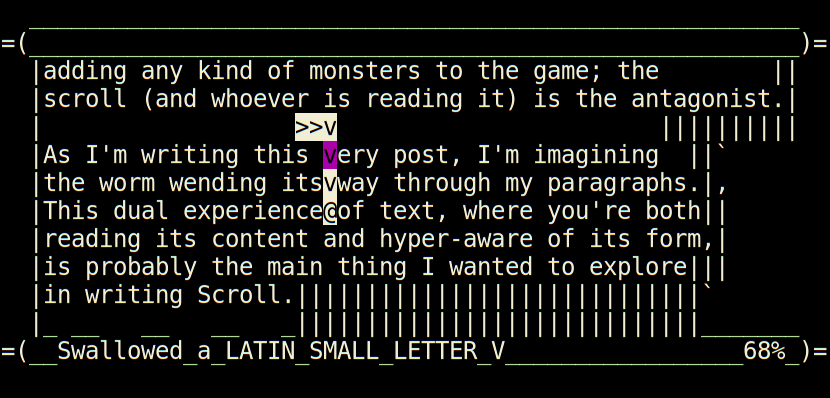
I haven't quite said what Scroll is about yet, let's fix that: In Scroll, you're a bookworm that's stuck on a scroll. You have to dodge between words and use spells to make your way down the page as the scroll is read. Go too slow and you'll get wound up in the scroll and crushed. The character is multiple chars in size (size is the worm's only stat), and the worm interacts with the scroll in lots of ways, like swallowing letters, or diving through a hole to the other side of the scroll. While it can swallow some letters, if it gets too full, it can't move forward anymore, so letters are mostly consumed to be used as spell components. I think that I will manage to get away without adding any kind of monsters to the game; the scroll (and whoever is reading it) is the antagonist. As I'm writing this very post, I'm imagining the worm wending its way through my paragraphs. This dual experience of text, where you're both reading its content and hyper-aware of its form, is probably the main thing I wanted to explore in writing Scroll. As to the text that fills the scroll, it's broadly procedurally generated, in what I hope are unusual and repeatedly surprising (and amusing) ways. I'm not showing any screenshots of the real text, because I don't want to give that surprise away. But, the other thing about Scroll is that it's scroll, a completely usable (if rather difficult..) Unix pager!

Next.

Previous.