about:config to spoof its user agent to Chrome for Windows:
general.useragent.override=Mozilla/5.0 (Windows NT 10.0; Win64; x64) AppleWebKit/537.36 (KHTML, like Gecko) Chrome/79.0.3945.117 Safari/537.36
general.useragent.updates.enabled=false
privacy.resistFingerprinting=false
The last two prefs are necessary in order for the hidden
general.useragent.override pref to not be
ignored.
:wq for today.
Get the Champagne ready, we have released the final images of TeX Live 2020.
Due to COVID-19, DVD production will be delayed, but we have decided to release the current image and update the net installer. The .iso image is available on CTAN, and the net installer will pull all the newest stuff. Currently we are working on getting those packages updated during the freeze to the newest level in TeX Live.
Before providing the full list of changes, here a few things I would like to pick out:
lualatex is now based on LuaHBTeX, meaning that one can use the HarfBuzz renderer which in particular for complicated scripts (Tibetan, Bengali, ) works better than the Lua-based renderer. Note that luatex itself remains normal LuaTeX, only the luaLAtex one uses LuaHBTeX.foobar.tar.xz while the name never changed. We have now changed all the infrastructure and TeX Live Manager to work with versioned containers foobar.rNNNNN.tar.xz. This should help quite some distributors!\input primitive in all TeX engines, including tex, now also accepts a group-delimited lename argument, as a system-dependent extension. The usage with a standard space/token-delimited lename is completely unchanged. The group-delimited argument was previously implemented in LuaTeX; now it is available in all engines. ASCII double quote characters ( ) are removed from the lename, but it is otherwise left unchanged after tokenization. This does not currently a ect LaTeX s \input command, as that is a macro rede nition of the standard \input primitive. cnf-line for kpsewhich, tex, mf, and all other engines, to support arbitrary con guration settings on the command line.\Uchar, \Ucharcat, \current(x)spacingmode, \ifincsname; revise \fontchar?? and \iffontchar. For eupTeX only: \currentcjktoken.
LuaTeX: Integration with HarfBuzz library, available as new engines luahbtex (used for lualatex) and luajithbtex. New primitives: \eTeXgluestretchorder, \eTeXglueshrinkorder.
pdfTeX: New primitive \pdfmajorversion; this merely changes the version number in the PDF output; it has no e ect on any PDF content. \pdfximage and similar now search for image les in the same way as \openin.
pTeX: New primitives \ifjfont, \iftfont. Also in epTeX, upTeX, eupTeX.
XeTeX: Fixes for \Umathchardef, \XeTeXinterchartoks, \pdfsavepos.
Dvips: Output encodings for bitmap fonts, for better copy/paste capabilities (https://tug.org/TUGboat/tb40-2/tb125rokicki-type3search.pdf).
MacTeX: MacTeX and x86_64-darwin now require 10.13 or higher (High Sierra, Mojave, and Catalina); x86_64-darwinlegacy supports 10.6 and newer. MacTeX is notarized and command line programs have hardened runtimes, as now required by Apple for install packages. BibDesk and TeX Live Utility are not in MacTeX because they are not notarized, but a README le lists urls where they can be obtained.
tlmgr and infrastructure:
tlmgr check texmfdbs, to to check consistency of ls-R les and !! speci cations for each tree.tlnet/archive/pkgname.rNNN.tar.xz; should be invisible to users, but a notable change in distribution.catalogue-date information no longer propagated from the TeX Catalogue, since it was often unrelated to package updates.samba, mumsi works, but
sometimes freezes and needs to be restarted. Each SIP account shows up
as a bot that comes up when someone calls the number. It supports
multiple callers, although apparently mumsi crashes after a while
with 4 callers. A comment here also mentioned there's a fork that
mentions using a "pin" as well for dialing in.
#mumble Freenode IRC channel, it became obvious that having a more
usable interface is not a priority. To put it in the words of a
participant in the channel:
If someone is too stupid to use a piece of software than they should probably use something else or have someone capable of critical thinking set it up for them. -- meepSo I guess "I'm with stupid": I do not believe we should make software only for "smart" people because that leads to overly complicated and over-engineered user interfaces that are needlessly hard to use and configure. Mumble is actually an excellent example of such programs: powerful software, but too hard to use to actually reach critical mass. Thankfully,
meep is not a Mumble developer and does not actually
represent the official position of the Mumble project. A core
developer (not representing the project either) was
more nuanced:
The UI being not up to date is a matter of taste. The kind of UI you are describing is the kind of UI I certainly don't want. More gernally though I agree that the UI needs some rework and especially: Flexibility so that each user can (ideally) make it appear as (s)he wants. Before this can happen though, we'll have to rewrite a fair bit of code as we'll have to separate backend and frontend from one another. -- krzmbrzlSo this will take time. The fact that Qt seems to be moving back to closed-source does not help the situation with Mumble's GUI development, unfortunately. But the other hand, maybe it will provide the necessary "kick" to write a new, simpler GUI.
Here's a blog post I wrote for the puppet.com blog. Many thanks
to Ben Ford and all their team!.
With everything that is currently happening around the world, many of us IT
folks have had to solve complex problems in a very short amount of time. Pretty
quickly at work, I was tasked with finding a way to make virtual meetings easy,
private and secure.
Whereas many would have turned to a SaaS offering, we decided to use Jitsi
Meet, a modern and fully on-premise FOSS videoconferencing solution.
Jitsi works on all platforms by running in a browser and comes with nifty
Android and iOS applications.
We've been using our instance quite a bit, and so far everyone from technical
to non-technical users have been pretty happy with it.
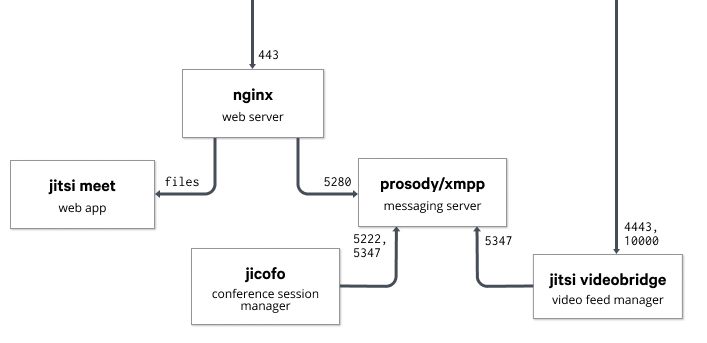
Jitsi Meet is powered by WebRTC and can be broken into multiple parts across
multiple machines if needed. In addition to the webserver running the Jitsi
Meet JavaScript code, the base configuration uses the Videobridge to manage
users' video feeds, Jicofo as a conference focus to manage media sessions and
the Prosody XMPP server to tie it all together.
Here's a network diagram I took from their documentation to show
how those applications interact:
Getting started with the Jitsi Puppet module
First of all, you'll need a valid domain name and a server with decent
bandwidth. Jitsi has published a performance evaluation of the
Videobridge to help you spec your instance appropriately. You will also need to
open TCP ports 443, 4443 and UDP port 10000 in your firewall. The
puppetlabs/firewall module could come in handy here.
Once that is done, you can use the smash/jitsimeet Puppet module on
a Debian 10 (Buster) server to spin up an instance. A basic configuration would
look like this:
class 'jitsimeet':
fqdn => 'jitsi.example.com',
repo_key => puppet:///files/apt/jitsimeet.gpg,
manage_certs => true,
jitsi_vhost_ssl_key => '/etc/letsencrypt/live/jitsi.example.com/privkey.pem'
jitsi_vhost_ssl_cert => '/etc/letsencrypt/live/jitsi.example.com/cert.pem'
auth_vhost_ssl_key => '/etc/letsencrypt/live/auth.jitsi.example.com/privkey.pem'
auth_vhost_ssl_cert => '/etc/letsencrypt/live/auth.jitsi.example.com/cert.pem'
jvb_secret => 'mysupersecretstring',
focus_secret => 'anothersupersecretstring',
focus_user_password => 'yetanothersecret',
meet_custom_options =>
'enableWelcomePage' => true,
'disableThirdPartyRequests' => true,
;
jitsimeet module is still pretty young: it clearly isn't perfect and some
external help would be very appreciated. If you have some time, here are a few
things that would be nice to work on:
First of all, congratulations to all those who got us 2022 Debconf, so we will finally have a debconf in India. There is of course, lot of work to be done between now and then. For those who would be looking forward to visit India and especially Kochi I would suggest you to hear this enriching tale
I am sorry I used youtube link but it is too good a podcast not to be shared. Those who don t want youtube can use the invidio.us link for the same as shared below.
https://www.invidio.us/watch?v=BvjgKuKmnQ4
I am sure there are lot more details, questions, answers etc. but would direct them gently to Praveen, Shruti, Balasankar and the rest who are from Kochi to answer if you have any questions about that history.
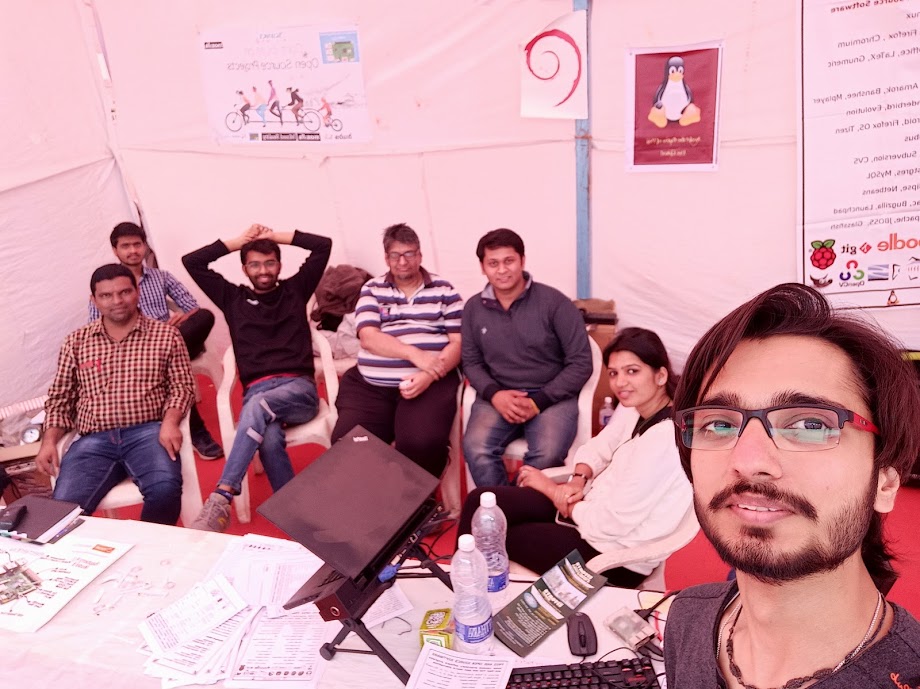
National Science Day, GMRT 2020
. Of course in another stall few students had used RPI s as part of their projects so at times we did tell some of the newbies to go to those stalls and see and ask about those projects so they would have a much wider experience of things. The Mozilla people were pushing VR as well as Mozilla lite the browser for the mobile.
We also gossiped quite a bit. I shared about indicatelts , a third-party certificate extension although I dunno if I should file a wnpp about it or not. We didn t have a good experience of when I had put an RFP (Request for Package) which was accepted for an extension which had similar functionality which we later come to know was sharing the sites people were using the extension to call home and share both the URL and the IP Address they were using it from. Sadly, didn t leave a good taste in mouth
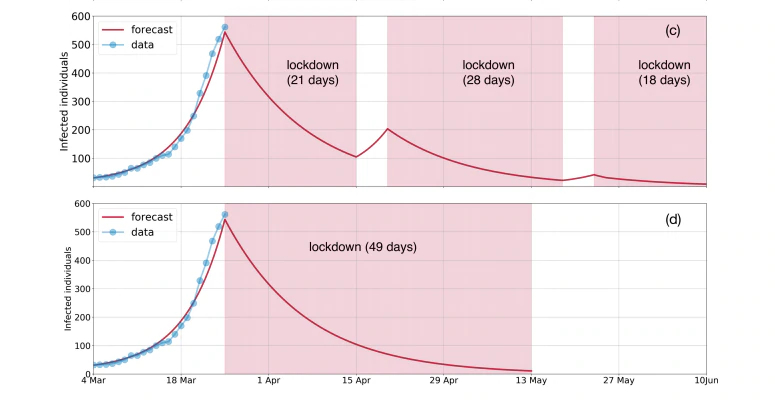
Predictions of the outcome of the current 21-day lockdown (Source: Rajesh Singh, R. Adhikari, Cambridge University)
Alternative lockdown strategies suggested by the Cambridge model (Source: Rajesh Singh, R. Adhikari, Cambridge University)
One of the original promises of open source software is that distributed peer review and transparency of process results in enhanced end-user security.
However, whilst anyone may inspect the source code of free and open source software for malicious flaws, almost all software today is distributed as pre-compiled binaries. This allows nefarious third-parties to compromise systems by injecting malicious code into ostensibly secure software during the various compilation and distribution processes.
The report from our recent summit in Marrakesh was published and is now available in both PDF and HTML formats. A sincere thank you to all of the Reproducible Builds community for the input to the event a sincere thank you to Aspiration for preparing and collating this report.
Harmut Schorrig published a detailed document on how to compile Java applications in such as way that the .jar build artefact is reproducible across builds. A practical and hands-on guide, it details how to avoid unnecessary differences between builds by explicitly declaring an encoding as the default value differs across Linux and MS Windows systems and ensuring that the generated .jar a variant of a .zip archive does not embed any nondeterministic filesystem metadata, and so on.
Janneke gave a quick presentation on GNU Mes and reproducible builds during the lighting talk session at LibrePlanet 2020. [ ]
Vagrant Cascadian presented There and Back Again, Reproducibly! video at SCaLE 18x in Pasadena in California which generated some attention on Twitter.
Herv Boutemy mentioned on our mailing list in a thread titled Rebuilding and checking Reproducible Builds from Maven Central repository that since the update of a central build script (the parent POM ) every Apache project using the Maven build system should build reproducibly. A follow-up discussion regarding how to perform such rebuilds was also started on the Apache mailing list.
The Telegram instant-messaging platform announced that they had updated their iOS and Android OS applications and claim that they are reproducible according to their full instructions, verifying that its original source code is exactly the same code that is used to build the versions available on the Apple App Store and Google Play distribution platforms respectfully.
Herv Boutemy also reported about a new project called reproducible-central which aims to allow anyone to rebuild a component from the Maven Central Repository that is expected to be reproducible and check that the result is as expected.
In last month s report we detailed Omar Navarro Leija s work in and around an academic paper titled Reproducible Containers which describes in detail the workings of a user-space container tool called dettrace (PDF). Since then, the PhD student from the University Of Pennsylvania presented on this tool at the ASPLOS 2020 conference in Lausanne, Switzerland. Furthermore, there were contributions to dettrace from the Reproducible Builds community itself. [ ][ ]
In openSUSE, Bernhard M. Wiedemann published his monthly Reproducible Builds status update as well as made the following changes within the distribution itself:
avfs (report build problem in %post script)arj (fix incorrect use of strcpy, submitted upstream)brickv (update get upstream fix)fvwm-themes (delta between architectures in noarch package)libpeas (report build failure in single-CPU mode)pmix (update to incoporate upstream fix)pw3270 (date variation, forwarded upstream)python-mailmanclient (report build failure in single-CPU mode)ripgrep (CPU, forwarded upstream)tensorflow2 (avoid random temporary directory path)tesseract-ocr (drop native architecture optimisations)vlc (fixed ghost file size and sort archive, already upstream)
Chris Lamb further refined his merge request for the debian-installer component to allow all arguments from sources.list files (such as [check-valid-until=no] ) in order that we can test the reproducibility of the installer images on the Reproducible Builds own testing infrastructure. (#13)
Holger Levsen filed a number of bug reports against the debrebuild tool that attempts to rebuild a Debian package given a .buildinfo file as input, including:
.buildinfo files. (#955050)nondeterministic_gtk_icon_cache [ ]nondeterministic_ordering_in_documentation_generated_by_doxygen [ ]nondeterministic_vo_files_generated_by_coq [ ]
utputrandomness_in_browserify_lite_output [ ]buildinfos.debian.net (#955434) and Chris Lamb kept isdebianreproducibleyet.com up to date. [ ]
Chris Lamb made the following changes to diffoscope, the Reproducible Builds project s in-depth and content-aware diff utility that can locate and diagnose reproducibility issues, including preparing and uploading version 138 to Debian:
readelf. (#93)dumppdf from the python3-pdfminer if we do not see any other differences from pdftext, etc. (#92).rdx files directly as the get_member method will return a file even if the file is missing. [ ]--help output or in the package long description. [ ]--list-debian-substvars when we want them for debian/tests/control generation. [ ]upstream-metadata-in-native-source as we are upstream. [ ]RequiredToolNotFound.get_package method s functionality as it is only used once. [ ]py36 = [..] argument in the pyproject.toml file. [ ]pmemkv (forwarded upstream)ndisc6.infernal.beep.node-nodedbi.node-browserify-lite.font-manager.pdb2pqr.gucharmap.cloudkitty.
There was further work performed on our documentation and website this month including Alex Wilson adding a section regarding using Gradle for reproducible builds in JVM projects [ ] and Holger Levsen added the report from our recent summit in Marrakesh [ ][ ].
In addition, Chris Lamb made a number of changes, including correcting the syntax of some CSS class formatting [ ], improved some filed against copy a little better [ ] and corrected a reference to calendar.monthrange Python method in a utility function. [ ]
We operate a large and many-featured Jenkins-based testing framework that powers tests.reproducible-builds.org that, amongst many other tasks, tracks the status of our reproducibility efforts as well as identifies any regressions that have been introduced.
This month, Chris Lamb reworked the web-based package rescheduling tool to:
POST method in the web-based scheduler as not only should HTTP GET requests be idempotent but this will allow many future improvements in the user interface. [ ][ ][ ]ath97 subtarget for the OpenWrt distribution.i386 architecture. [ ][ ]
#reproducible-builds on irc.oftc.net.
rb-general@lists.reproducible-builds.org
This month s report was written by Bernhard M. Wiedemann, Chris Lamb, Holger Levsen and Vagrant Cascadian. It was subsequently reviewed by a bunch of Reproducible Builds folks on IRC and the mailing list.
Over the past few weeks things have been pretty hectic. Since I'm not working at the moment I'm mostly doing childcare instead. I need a break, now and again, so I've been sending our child to p iv koti two days a week with him home the rest of the time.
I love taking care of the child, because he's seriously awesome, but it's a hell of a lot of work when most of our usual escapes are unavailable. For example we can't go to the (awesome) Helsinki Central Library as that is closed.
Instead of doing things outdoors we've been baking bread together, painting, listening to music and similar. He's a big fan of any music with drums and shouting, so we've been listening to Rammstein, The Prodigy, and as much Queen as I can slip in without him complaining ("more bang bang!").
I've also signed up for some courses at the Helsinki open university, including Devops with Docker so perhaps I have a future career working with computers? I'm hazy.
Finally I saw a fun post the other day on reddit asking about the creation of a DSL for server-setup. I wrote a reply which basically said two things:
file name => "This is my rule",
target => "/tmp/blah",
ensure => "absent"
The next thing to do is to allow that to notify another rule, when it results in a change. So you add in:
notify => "Name of rule"
# or
notify => [ "Name of rule", "Name of another rule" ]
You could also express dependencies the other way round:
shell name => "Do stuff",
command => "wc -l /etc/passwd > /tmp/foo",
requires => [ "Rule 1", "Rule 2"]
Anyway the end result is a simple syntax which allows you to do things; I wrote a file to allow me to take a clean system and configure it to run a simple golang application in an hour or so.
The downside? Well the obvious one is that there's no support for setting up cron jobs, setting up docker images, MySQL usernames/passwords, etc. Just a core set of primitives.
Adding new things is easy, but also an endless job. So I added the ability to run external/binary plugins stored outside the project. To support that is simple with the syntax we have:
Our good friend, Octavio M ndez Octagesimal , passed away due to
complications derived from COVID-2019.
Long-time free software supporter, very well known for his craft and
for his teaching with Blender. Great systems administrator. 45 year
old, father of two small girls, husband of our dear friend Claudia.
We are all broken. We will miss you.
For real, those that can still do it: Stay safe. Stay home.
I just had a weekend full of very successful serious geekery. On a whim I thought: Wouldn't it be nice if people could interact with my game Kaleidogen also via a telegram bot? This led me to learn about how I write a Telegram bot in Haskell and how I can deploy such a Haskell program to Amazon Lambda. In particular the latter bit might be interesting to some of my readers, so here is how went about it.
KaleidogenBot in action
bootstrap that queries the Lambda Runtime Interface for the next request to handle. The Lambda documentation is phrased as if this runtime has to be a dispatcher that calls the separate function s handler. But it could just do all the things directly.
I found the Haskell package aws-lambda-haskell-runtime which provides precisely that: A function
runLambda :: (LambdaOptions -> IO (Either String LambdaResult)) -> IO ()
that talks to the Lambda Runtime API and invokes its argument on each message. The package also provides Template Haskell magic to collect handlers of any JSON-able type and generates a dispatcher, like you might expect from other, more dynamic languages. But that was too much magic for me, so I ignored that and just wrote the handler manually:
main :: IO ()
main = runLambda run
where
run :: LambdaOptions -> IO (Either String LambdaResult)
run opts = do
result <- handler (decodeObj (eventObject opts)) (decodeObj (contextObject opts))
either (pure . Left . encodeObj) (pure . Right . LambdaResult . encodeObj) result
data Event = Event
path :: T.Text
, body :: Maybe T.Text
deriving (Generic, FromJSON)
data Response = Response
statusCode :: Int
, headers :: Value
, body :: T.Text
, isBase64Encoded :: Bool
deriving (Generic, ToJSON)
handler :: Event -> Context -> IO (Either String Response)
handler Event body, path context =
Event, listing only the fields I care about), and it will respond with a Response, again as JSON.
The handler can then simply pattern-match on the path to decide what to do. For example this code handles URLs like /img/CAFFEEFACE.png, and responds with an image.
handler :: TC -> Event -> Context -> IO (Either String Response)
handler Event body, path context
Just bytes <- isImgPath path >>= T.decodeHex = do
let pngData = genPurePNG bytes
pure $ Right Response
statusCode = 200
, headers = object [ "Content-Type" .= ("image/png" :: String) ]
, isBase64Encoded = True
, body = T.decodeUtf8 $ LBS.toStrict $ Base64.encode pngData
isImgPath :: T.Text -> Maybe T.Text
isImgPath = T.stripPrefix "/img/" >=> T.stripSuffix ".png"servant, or bridging towards wai apps (amost like wai-lamda, but that still assumes an existing runtime, instead of simply being the runtime). But for my purposes, no extra layers of indirection or abstraction are needed!
aws-lambda-haskell-runtime package, and similar projects like serverless-haskell, solve this using stack and Docker two technologies that are probably great, but I never warmed up to them.
So instead adding layers and complexities, can I solve this instead my making things simpler? If I compiler my bootstrap into a static Linux binary, it should run on any Linux, including Amazon Linux.
Unfortunately, building Haskell programs statically is also notoriously tricky. But it is made much simpler by the work of Niklas Hamb chen and others in the context of the Nix package manager, coordinated in the static-haskell-nix project. The promise here is that once you have set up building your project with Nix, then getting a static version is just one flag away. The support is not completely upstreamed into nixpkgs proper yet, but their repository has a nix file that contains a nixpkgs set with their patches:
let pkgs = (import (sources.nixpkgs-static + "/survey/default.nix") ).pkgs; in
This, plus a fairly standard nix setup to build the package, yields what I was hoping for:
$ nix-build -A kaleidogen
/nix/store/ppwyq4d964ahd6k56wsklh93vzw07ln0-kaleidogen-0.1.0.0
$ file result/bin/kaleidogen-amazon-lambda
result/bin/kaleidogen-amazon-lambda: ELF 64-bit LSB executable, x86-64, version 1 (SYSV), statically linked, stripped
$ ls -sh result/bin/kaleidogen-amazon-lambda
6,7M result/bin/kaleidogen-amazon-lambda
If we put this file, named bootstrap, into a zip file and upload it to Amazon Lambda, then it just works! Creating the zip file is easily scripted using nix:
function-zip = pkgs.runCommandNoCC "kaleidogen-lambda"
buildInputs = [ pkgs.zip ];
''
mkdir -p $out
cp $ kaleidogen /bin/kaleidogen-amazon-lambda bootstrap
zip $out/function.zip bootstrap
'';
So to upload this, I use this one-liner (line-wrapped for your convenience):
nix-build -A function-zip &&
aws lambda update-function-code --function-name kaleidogen \
--zip-file fileb://result/function.zip
Thanks to how Nix pins all dependencies, I am fairly confident that I can return to this project in 4 months and still be able to build it.
Of course, I want continuous integration and deployment. So I build the project with GitHub Actions, using a cachix nix cache to significantly speed up the build, and auto-deploy to Lambda using aws-lambda-deploy; see my workflow file for details.
telegram-api package provides bindigs for the Telegram Bot API (although I had to use the repository version, as the version on Hackage has some bitrot). Slightly simplified I can write a handler for an Update:
handleUpdate :: Update -> TelegramClient ()
handleUpdate Update message = Just m = do
let c = ChatId (chat_id (chat m))
liftIO $ printf "message from %s: %s\n" (maybe "?" user_first_name (from m)) (maybe "" T.unpack (text m))
if "/start" T.isPrefixOf fromMaybe "" (text m)
then do
rm <- sendMessageM $ sendMessageRequest c "Hi! I am @KaleidogenBot. "
return ()
else do
m1 <- sendMessageM $ sendMessageRequest c "One moment "
withPNGFile $ \pngFN -> do
m2 <- uploadPhotoM $ uploadPhotoRequest c
(FileUpload (Just "image/png") (FileUploadFile pngFN))
return ()
handleUpdate _ u =
liftIO $ putStrLn $ "Unhandled message: " ++ show u
and call this from the handler that I wrote above:
path == "/telegram" =
case eitherDecode (LBS.fromStrict (T.encodeUtf8 (fromMaybe "" body))) of
Left err ->
Right update -> do
runTelegramClient token manager $ handleUpdate Nothing update
pure $ Right Response
statusCode = 200
, headers = object [ "Content-Type" .= ("text/plain" :: String) ]
, isBase64Encoded = False
, body = "Done"
Note that the Lambda code receives the request as JSON data structure with a body that contains the original HTTP request body. Which, in this case, is itself JSON, so we have to decode that.
All that is left to do is to tell Telegram where this code lives:
curl --request POST \
--url https://api.telegram.org/bot<token>/setWebhook
--header 'content-type: application/json'
--data ' "url": "https://api.kaleidogen.nomeata.de/telegram" '
As a little add on, I also created a Telegram game for Kaleidogen. A Telegram game is nothing but a webpage that runs inside Telegram, so it wasn t much work to wrap the Web version of Kaleidogen that way, but the resulting Telegram game (which you can access via https://core.telegram.org/bots/games) still looks pretty neat.
/dev/dri/renderD128. Amazon does not provide that to Lambda code, and neither do the other big Function-as-a-service providers. So I had to swallow my pride and reimplement the rendering in pure Haskell.
So if you think the bot is kinda slow, then that s why. Despite properly optimizing the pure implementation (the inner loop does not do allocations and deals only with unboxed Double# values), the GL shader version is still three times as fast. Maybe in a few years GPU access will be so ubiquitous that it s even on Amazon Lambda; then I can easily use that.
DPL Campaign 2020 On the 12th of March, I posted my self-nomination for the Debian Project Leader election. This is the second time I m running for DPL, and you can read my platform here. The campaign period covered the second half of the month, where I answered a bunch of questions on the debian-vote list. The voting period is currently open and ends on 18 April.
Debian Social


Debian packaging I had the sense that there were fewer upstream releases this month. I suspect that everyone was busy figuring out how to cope during Covid-19 lockdowns taking place all over the world. 2020-03-02: Upload package calamares (3.2.10-1) to Debian unstable. 2020-03-10: Upload package gnome-shell-extension-dash-to-panel (29-1) to Debian unstable. 2020-03-10: Upload package gnome-shell-extension-draw-on-your-screen (5.1-1) to Debian unstable. 2020-03-28: Upload package gnome-shell-extension-dash-to-panel (31-1) to Debian unstable. 2020-03-28: Upload package gnome-shell-extension-draw-on-your-screen (6-1) to Debian unstable. 2020-03-28: Update package python3-flask-autoindexing packaging, not releasing due to licensing change that needs further clarification. (GitHub issue #55). 2020-03-28: Upload package gamemode (1.5.1-1) to Debian unstable. 2020-03-28: Upload package calamares (3.2.21-1) to Debian unstable.
Debian mentoring 2020-03-03: Sponsor package python-jaraco.functools (3.0.0-1) (Python team request). 2020-03-03: Review python-ftputil (3.4-1) (Needs some more work) (Python team request). 2020-03-04: Sponsor package pythonmagick (0.9.19-6) for Debian unstable (Python team request). 2020-03-23: Sponsor package bitwise (0.41-1) for Debian unstable (Email request). 2020-03-23: Sponsor package gpxpy (1.4.0-1) for Debian unstable (Python team request). 2020-03-28: Sponsor package gpxpy (1.4.0-2) for Debian unstable (Python team request). 2020-03-28: Sponsor package celery (4.4.2-1) for Debian unstable (Python team request). 2020-03-28: Sponsor package buildbot (2.7.0-1) for Debian unstable (Python team request).
| Publisher: | The New Press |
| Copyright: | 2019 |
| ISBN: | 1-62097-437-1 |
| Format: | Kindle |
| Pages: | 247 |
What many black women were angry about was how I located myself in what I'd written. I said, blithely as a matter of observable fact, that I am unattractive. Because I am unattractive, the argument went, I have a particular kind of experience of beauty, race, racism, and interacting with what we might call the white gaze. I thought nothing of it at the time I was writing it, which is unusual. I can usually pinpoint what I have said, written, or done that will piss people off and which people will be pissed off. I missed this one entirely.What follows is one of the best essays on the social construction of beauty I've ever read. It barely pauses at the typical discussion of unrealistic beauty standards as a feminist issue, instead diving directly into beauty as whiteness, distinguishing between beauty standards that change with generations and the more lasting rules that instead police the bounds between white and not white. McMillan Cottom then goes on to explain how beauty is a form of capital, a poor and problematic one but nonetheless one of the few forms of capital women have access to, and therefore why black women have fought to be included in beauty despite all of the problems with judging people by beauty standards. And the essay deepens from there into a trenchant critique of both capitalism and white feminism that is both precise and illuminating.
When I say that I am unattractive or ugly, I am not internalizing the dominant culture's assessment of me. I am naming what has been done to me. And signaling who did it. I am glad that doing so unsettles folks, including the many white women who wrote to me with impassioned cases for how beautiful I am. They offered me neoliberal self-help nonsense that borders on the religious. They need me to believe beauty is both achievable and individual, because the alternative makes them vulnerable.I could go on. Every essay in this book deserves similar attention. I want to quote from all of them. These essays are about racism, feminism, capitalism, and economics, all at the same time. They're about power, and how it functions in society, and what it does to people. There is an essay about Obama that contains the most concise explanation for his appeal to white voters that I've read. There is a fascinating essay about the difference between ethnic black and black-black in U.S. culture. There is so much more.
We do not share much in the U.S. culture of individualism except our delusions about meritocracy. God help my people, but I can talk to hundreds of black folks who have been systematically separated from their money, citizenship, and personhood and hear at least eighty stories about how no one is to blame but themselves. That is not about black people being black but about people being American. That is what we do. If my work is about anything it is about making plain precisely how prestige, money, and power structure our so-called democratic institutions so that most of us will always fail.I, like many other people in my profession, was always more comfortable with the technical and scientific classes in college. I liked math and equations and rules, dreaded essay courses, and struggled to engage with the mandatory humanities courses. Something that I'm still learning, two decades later, is the extent to which this was because the humanities are harder work than the sciences and I wasn't yet up to the challenge of learning them properly. The problems are messier and more fluid. The context required is broader. It's harder to be clear and precise. And disciplines like sociology deal with our everyday lived experience, which means that we all think we're entitled to an opinion. Books like this, which can offer me a hand up and a grounding in the intellectual rigor while simultaneously being engaging and easy to read, are a treasure. They help me fill in the gaps in my education and help me recognize and appreciate the depth of thought in disciplines that don't come as naturally to me. This book was homework, but the good kind, the kind that exposes gaps in my understanding, introduces topics I hadn't considered, and makes the time fly until I come up for air, awed and thinking hard. Highly recommended. Rating: 9 out of 10
How to save your soul from getting too callused
Mental health is becoming an increasingly important topic. For this talk Andrew will focus on one particular aspect of mental health, burnout. Including his own personal experiences of when it can get really bad and steps that could be taken to help catch it early.
Let s unpack society s general misunderstanding of the latest buzzword- burnout, shall we?
How to save your soul from getting too callused
Christina Maslach defines and explains burnout, in particular relating it to activism. She gives tips and lessons for avoiding it. Recorded at the Hero Round...
DOES19 London Burnout is a hot topic in today's workplace, given its high costs for both employees and organizations. What causes this problem? And what ca...
ssh-agent is a program to hold in memory the private keys used by
SSH for public-key authentication. When the agent is running, ssh
forwards to it the signature requests from the server. The agent
performs the private key operations and returns the results to ssh.
It is useful if you keep your private keys encrypted on disk and you
don t want to type the password at each connection. Keeping the agent
secure is critical: someone able to communicate with the agent can
authenticate on your behalf on remote servers.
ssh also provides the ability to forward the agent to a remote
server. From this remote server, you can authenticate to another
server using your local agent, without copying your private key on the
intermediate server. As stated in the manual page, this is
dangerous!
Agent forwarding should be enabled with caution. Users with the
ability to bypass file permissions on the remote host (for the
agent s UNIX-domain socket) can access the local agent through the
forwarded connection. An attacker cannot obtain key material from
the agent, however they can perform operations on the keys that
enable them to authenticate using the identities loaded into the
agent. A safer alternative may be to use a jump host (see -J).
As mentioned, a better alternative is to use the jump host feature:
the SSH connection to the target host is tunneled through the SSH
connection to the jump host. See the manual page and this
blog post for more details.
ssh command will spawn such an
ephemeral agent:
alias assh="ssh-agent ssh -o AddKeysToAgent=confirm -o ForwardAgent=yes"
-o AddKeysToAgent=confirm directive, ssh adds the
unencrypted private key to the agent but each use must be
confirmed.1 Once connected, you get a password prompt for
each signature request:2

Update (2020-04)
In a previous version of this article, the
wrapper around the ssh command was a more complex function.
Alexandre Oliva was kind enough to point me to the simpler
solution above.
Update (2020-04) Guardian Agent is an even safer alternative: it shows and ensures the usage (target and command) of the requested signature. There is also a wide range of alternative solutions to this problem. See for example SSH-Ident, Wikimedia solution and solo-agent.
The following packages will be REMOVED:Wait. "current home is /root"? What did you do? Then I've extracted its package (ar -x zoom_amd64.deb; tar xvf contro.tar.xz; view post*)
zoom*
0 upgraded, 0 newly installed, 1 to remove and 45 not upgraded.
After this operation, 269 MB disk space will be freed.
Do you want to continue? [Y/n] y
(Reading database ... 362466 files and directories currently installed.)
Removing zoom (3.5.374815.0324) ...
run post uninstall script, action is remove ...
current home is /root
Processing triggers for mime-support (3.64) ...
Processing triggers for gnome-menus (3.36.0-1) ...
Processing triggers for shared-mime-info (1.15-1) ...
Processing triggers for desktop-file-utils (0.24-1) ...
(Reading database ... 361169 files and directories currently installed.)
Purging configuration files for zoom (3.5.374815.0324) ...
run post uninstall script, action is purge ...
current home is /root
#!/bin/bashOuch. When I run apt with sudo, $HOME is /root. So, their maintscript tried to remove files under /root! Did they do any tests? Even if it would work well, touch user's files under $Home is NOT a good idea...
# Program:
# script to be run after package installation
echo "run post install script, action is $1..."
#ln -s -f /opt/zoom/ZoomLauncher /usr/bin/zoom
#$1 folder path
function remove_folder
if [ -d $1 ]; then
rm -rf $1
fi
echo current home is $HOME
remove_folder "$HOME/.cache/zoom"
(snip)
Their linux installer scripts are clueless and icky too:Will Stephenson (@wstephenson) March 31, 2020
_ "/ / "
_ "$ /. / "
_ "$ /. / "
rpm -q --scripts zoom output: https://t.co/HwnvljYyp4
Before uploading stuff to Debian, I build in a clean chroot, and then
run piuparts, autopkgtest and lintian. For some of my packages this
can take around an hour on my laptop, which is fairly old. Normally I
don t mind waiting, but sometimes I want to put my laptop away, and
then it would be good for things to be faster. It occurred to me that
I could make use of my builds.sr.ht account
to run these tests on more powerful hardware.
This build manifest seems to work:
# BEGIN CONFIGURABLE
sources:
- https://salsa.debian.org/perl-team/modules/packages/libgit-annex-perl.git
environment:
source: libgit-annex-perl
quilt: auto
# END CONFIGURABLE
image: debian/unstable
packages:
- autopkgtest
- devscripts
- dgit
- lintian
- piuparts
- sbuild
tasks:
- setup:
cd $source
source_version=$(dpkg-parsechangelog -SVersion)
echo "source_version=$source_version" >>~/.buildenv
git deborig origtargz
sudo sbuild-createchroot --command-prefix=eatmydata --include=eatmydata unstable /srv/chroot/unstable-amd64-sbuild
sudo sbuild-adduser $USER
- build:
cd $source
dgit --quilt=$quilt sbuild -d unstable --no-run-lintian
- lintian:
lintian $ source _$ source_version _multi.changes
- piuparts:
sudo piuparts --no-eatmydata --schroot unstable-amd64-sbuild $ source _$ source_version _multi.changes
- autopkgtest:
autopkgtest $ source _$ source_version _multi.changes -- schroot unstable-amd64-sbuild
And here s my script.
Sonic Mania is a really lovely homage to the classic 90s Sonic the Hedgehog
platform games. Featuring more or less the classic gameplay, and expanded
versions of the original levels, with lots of secrets, surprises and easter
eggs for fans of the original. On my recommendation a friend of mine bought it
for her daughter's birthday recently but her daughter will now have to prise
her mum off it! Currently on sale at 30% off ( 11.19).
The one complaint I have about it is the lack of females in the roster
of 5 playable characters.
Butcher is a Doom-esque aesthetic, very violent side-scrolling
shooter/platformer, currently on sale at 70%
off (just 2.69, the price of a coffee).
I've played it for about 10
minutes during coffee breaks and it's fun, hard, and pretty intense. The sound
track is great, and available to buy
separately but only if you own or buy
the original game from the same store, which is a strange restriction.
It's also on Spotify.
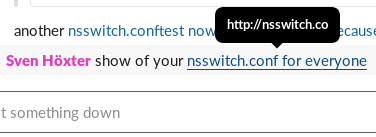
.co domains.
Leading to this auto linking:
Now I'm not sure if someone enocountered the same issue, or people just registered
random domains just because they could. I found registrations for
.conf files in /etc which could be interesting in an IT environment, but for the sake of playing with
it I registered nsswitch.co at godaddy. I do not want to endorse them in
anyway, but for the first year it's only 13.08EUR right now, which is okay to
pay for a stupid demo. So if you feel like it, you can probably register something stupid for yourself to play around with. I do not intent to renew this domain next year, so
be aware of what happens then with the next owner.
Sometimes, in our day-to-day-interactions, communication becomes disruptive,
resembling a chain of reactions to reactions to reactions. Sometimes we lose the
capacity to express our ideas and feelings. Sometimes communication just gets stuck,
maybe conflict breaks out. When we see these same patterns over and over again, this
might be due to the ever same roles that we adopt and play. Learnt in
childhood, these roles are deeply ingrained in our adult selves, and acted out
as unconscious scripts. Until we notice and work on them.
This is a post inspired by contents from my mediation training.
In the 1960s, Stephen Karpman has thought of a model of human communication
that maps the destructive interactions which occur between people. This map is known as the drama triangle.
Karpman defined three roles that interact with each other. We can play one
role at work, and a different one at home, and another one with our children.
Or we can switch from one role to the other in just one conversation. The three
roles are:
Persecutor Rescuer Assertive Caring
I'm right. I'm good. I have needs. I'm listening.
---------------------- ----------------------
\ / \ /
\ / \ /
\ / \ /
\ / \ /
\ / \ /
\ / \ /
\ / \ /
\ / \ /
\ / \ /
\ / \ /
\/ \/
Victim Vulnerable
I'm blameless. I'm struggling.
Karpman Dreaded Drama Triangle Choy's Winner Triangle
The Assertive "I have needs." has a calling, aims at change, initiates,
and gives feedback. Skills to learn: The Assertive needs to
learn to identify their needs, communicate them, and negotiate with
others on eye level without shaming, punishing, or belittling them. The Assertive needs to learn to give constructive feedback, without dismissing others. (In the workplace, it could be helpful to have a space for this.) The Assertive could benefit from learning to use I-Statements.
The Caring "I'm listening." shows good will and sensitivity, cares, is empathic and
supportive. Skills to learn: The Caring needs to learn to respect the
boundaries of others: trusting their abilities to think, problem solve and
talk for themselves. Therefore, the Caring could benefit from improving their active listening skills. Furthermore the Caring
needs to learn to identify and respect their own boundaries and not to do things only because it makes them feel better about themselves.
The Vulnerable "I'm struggling." has the skill of seeing and naming problems. Skills to learn: The Vulnerable
needs to learn to acknowledge their feelings and needs, practice self-awareness, and self-compassion. They need to untie their self-esteem from the validation of other people. They need to learn to take care of themselves, and to strengthen their problem solving and decision making skills.
What has this got to do with autonomy and power structures?
Each of these interactions is embedded in larger society, and, as said above,
we learn these roles from childhood. Therefore, we perpetually reproduce power
structures, and learnt behavior. I doubt that fixing this on an individual
level is sufficient to transform our interactions outside of small groups,
families or work places. Although that would be a good start.
We can see that the triangle holds together because the Victim, seemingly
devoid of a way to handle their own needs, transfers care of their needs to the
Rescuer, thereby giving up on their autonomy. The Rescuer is provided by the
Victim with a sense of autonomy, knowledge, and power, that only works while
denying the Victim their autonomy. At the same time, the Persecutor denies
everyone else's needs and autonomy, and feels powerful by dismissing others.
I've recently mentioned the importance of autonomy in order to avoid burnout, and as a means to control one's own life.
If the Rescuer can acknowledge being in the triangle, and give the Victim autonomy, by supporting them with
compassion, empathy, and guidance, and at the same time respecting their own
boundaries, we could find even more ways to escape the drama triangle.
Notes
My description of the roles was heavily inspired by the article Escaping Conflict and the Karpman Drama Triangle that has a lot more detail on how to escape the triangle, and how to recognize when we're moving into one of the roles. While the article is informing families living with a person suffering from a spectrum of Borderline Personality Disorder, the content applies to any dysfunctional interaction.
Next.